High efficiency mer-iridium complexes for organic light-emitting diodes{
Cheng-Hsien Yang, Kai-Hung Fang, Chun-Hung Chen and I-Wen Sun*
National Cheng Kung University, Department of Chemistry, No. 1, Ta-Hsueh Road, Tainan, Taiwan 701, Republic of China. E-mail: [email protected]; Fax: 1886 6274 0552; Tel: 1886 6275 7575 -65355
Received (in Cambridge, UK) 11th May 2004, Accepted 16th July 2004 First published as an Advance Article on the web 23rd August 2004
We have developed a new process at high vacuum (5 6 10
25Torr) and high temperature (300 uC) to produce meridional iridium complexes from the dimer; interestingly, mer-Ir(m-ppy)
3overthrows the concept of poor efficiency and shows excellent efficiency which is almost equal to that of fac- Ir(ppy)
3, fac-Ir(m-ppy)
3and (ppy)
2Ir(acac).
In the past decade, great progress has been made in organic light-emitting diodes (OLEDs).
1–3Electroluminescence from small molecules based on light-emitting diodes figures in the history of flat panel display. Recently, highly efficient OLEDs using phosphorescent dyes such as 2,3,7,8,12,13,17,18- octaethyl-21H,23H-porphine platinum (PtOEP), iridium(
III) fac-tris(2-phenylpyridinato-N,C
2’) (Ir(ppy)
3), iridium(
III) bis(2- phenylpyridinato-N,C
2’)acetylacetonate ((ppy)
2Ir(acac)), and their derivatives have been reported.
4–10Both fac-Ir(ppy)
3and (ppy)
2- Ir(acac) exhibit green emission with high external quantum efficiency. By employing triplet-based phosphorescent dye in OLEDs, where both singlet and triplet excited states participate, the external quantum efficiency can reach as high as 8 y 15%.
11,12Most of the previous investigations have been focused on the facial type of iridium complexes because of their structure symmetry and photophysics properties. The photophysics of mer-Ir(ppy)
3is different from that of fac-Ir(ppy)
3;it shows a marked red shift and band broadening in the photoluminescence (PL) and electroluminescence (EL) spectra.
13Similar to mer- Ir(ppy)
3, it was expected that iridium(
III) mer-tris(2-phenyl-4- methylpyridinato-N,C
2’) (mer-Ir(m-ppy)
3) would show a similar red shift in its PL and EL spectra. Interestingly, we have found that mer-Ir(m-ppy)
3in fact results in a blue shift with respect to fac- Ir(ppy)
3and produces a fairly pure green emission. In this com- munication, we report our results on the preparation of meridional iridium complexes for phosphorescent OLEDs.
Chemical structures of the iridium complexes, fac-Ir(ppy)
3, fac- Ir(m-ppy)
3, mer-Ir(ppy)
3and mer-Ir(m-ppy)
3are shown in Fig. 1.
(ppy)
2Ir(acac) was prepared from the 2-phenylpyridine ligand by treatment with iridium trichloride to form a dimer, [C^N
2Ir(m- Cl)
2IrC^N
2], followed by reaction with acetylacetone in the presence of sodium carbonate.
14fac-Ir(ppy)
3was prepared from the complex, (ppy)
2Ir(acac), followed by reaction with 2-phenyl- pyridine in glycerol. fac-Ir(m-ppy)
3was prepared by the same process. All procedures involving Ir(
III) species were carried out under nitrogen gas atmosphere. mer-Ir(ppy)
3and mer-Ir(m-ppy)
3were prepared from train sublimation of the dimer, [C^N
2Ir(m- Cl)
2IrC^N
2]. All these materials were characterized by
1H and
13C NMR as well as mass spectrometry.
Fig. 2 shows the PL spectra of the iridium complexes. The PL spectrum of fac-Ir(ppy)
3in CH
2Cl
2shows an emission band at 525 nm. In comparison to fac-Ir(ppy)
3, (ppy)
2Ir(acac) and mer- Ir(ppy)
3exhibit a bathochromic shift at 530.6 and 535.2 nm, respectively, whereas fac-Ir(m-ppy)
3and mer-Ir(m-ppy)
3exhibit a hypsochromic shift at 515 and 513.4 nm, respectively. These data indicate that when we introduce a methyl group to the para position of 2-phenylpyridine, these iridium complexes will show the
blue shift effect. The emission band of mer-Ir(ppy)
3is broad, indicating that the color purity is not excellent. Interestingly mer- Ir(m-ppy)
3shows a better color purity. According to the data of
1H and
13C NMR, the chemical equivalence of mer-Ir(m-ppy)
3is better than mer-Ir(ppy)
3, notedly. This result may improve the photophysics properties of mer-Ir(m-ppy)
3and thus it could show better efficiency for OLEDs. The blue shift of mer-Ir(m-ppy)
3and red shift of mer-Ir(ppy)
3indicate that the emission color is tunable according to the position of the substitution in the meridional type iridium complexes.
Devices were fabricated by high vacuum (10
26Torr) thermal evaporation on pre-cleaned indium-tin-oxide (ITO) glass substrate
{Electronic supplementary information (ESI) available: experimental section. See http://www.rsc.org/suppdata/cc/b4/b406958g/
Fig. 1 Chemical structure of iridium complexes.
Fig. 2 PL spectra of iridium complexes in CH2Cl2.
DOI:10.1039/b406958g
2 2 3 2 C h e m . C o m m u n . , 2 0 0 4 , 2 2 3 2 – 2 2 3 3 T h i s j o u r n a l i s ß T h e R o y a l S o c i e t y o f C h e m i s t r y 2 0 0 4
with the following structures: ITO/NPB (50 nm)/CBP : 6% dopant (30 nm)/BCP (10 nm)/AlQ
3(30 nm)/Al. With a base pressure of y1 6 10
26Torr, the organic and metal cathode layers were grown successively. In this device, 4,4’-bis[N-(1-naphthyl)-N-phenyl- amino]biphenyl (NPB) acted as a hole transport layer, 2,9- dimethyl-4,7-diphenyl-1,10-phenanthroline (BCP) as a hole blocking layer, tris-(8-hydroxyquinoline)aluminium(
III) (AlQ
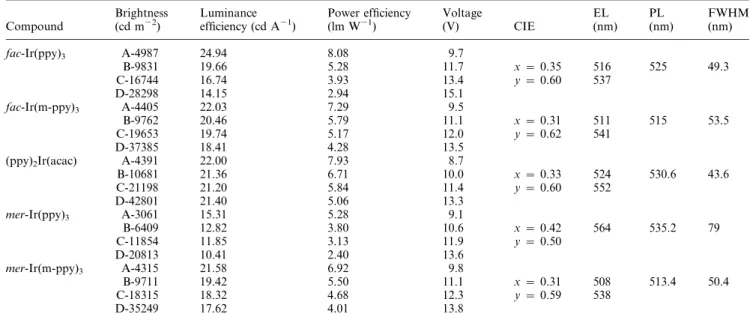
3) as an electron transport layer, 4,4’-bis(N-carbazolyl)biphenyl (CBP) as the host material, and iridium complexes as the dopant. The corresponding CIE (Commission International de L’Eclairage) chromaticity coordinates are x ~ 0.35, y ~ 0.60 for fac-Ir(ppy)
3, x ~ 0.35, y ~ 0.60 for fac-Ir(ppy)
3, x ~ 0.31, y ~ 0.62 for fac- Ir(m-ppy)
3, x ~ 0.33, y ~ 0.60 for (ppy)
2Ir(acac), x ~ 0.42, y ~ 0.50 for mer-Ir(ppy)
3and x ~ 0.31, y ~ 0.59 for mer-Ir(m-ppy)
3. All five devices show green to yellow-green emissions, and mer- Ir(ppy)
3shows the same tendency in PL spectrum data.
Electrophosphorescence data for the iridium complexes are summarized in Table 1.
The peak wavelength of the EL spectrum for the devices using fac-Ir(ppy)
3, fac-Ir(m-ppy)
3, (ppy)
2Ir(acac), mer-Ir(ppy)
3and mer- Ir(m-ppy)
3, was 516, 511, 524, 564 and 508 nm, respectively. The EL spectrum for each device was almost coincident with the corresponding PL spectrum. Although fac-Ir(ppy)
3shows the best luminance efficiency and power efficiency at low current density, (ppy)
2Ir(acac) exhibits the best brightness, luminance efficiency and power efficiency at a high current density. Similar to the demonstration of last year,
13,15mer-Ir(ppy)
3shows the yellow- green emission and poor performance among these complexes.
Although mer-Ir(m-ppy)
3is meridional type, its photophysics properties are different from mer-Ir(ppy)
3. mer-Ir(m-ppy)
3shows the best brightness of 35249 cd m
22, luminance efficiency of 17.62 cd A
21and power efficiency 4.01 lm W
21at a high current density of J ~ 200 mA cm
22, which are almost the same as for fac-Ir(ppy)
3, fac-Ir(m-ppy)
3and (ppy)
2Ir(acac). We speculate that when we introduced a methyl group to the para position of 2-phenylpyridine, the MLCT energy level of the iridium complex decreased. Then, energy transfer from the host to the mer- Ir(m-ppy)
3occurs more efficiently than to the mer-Ir(ppy)
3.
In conclusion, we have developed a simple procedure to prepare novel iridium complexes with 2-phenyl-4-methylpyridine ligands.
Marvellously, mer-Ir(m-ppy)
3shows excellent performance com- parable to fac-Ir(ppy)
3, fac-Ir(m-ppy)
3and (ppy)
2Ir(acac). This result opens up a new direction in developing novel emitters for OLEDs.
This work was supported by the National Science Council of the Republic of China, Taiwan.
Notes and references
1 M. Thelakkat and H.-W. Schmidt, Adv. Mater., 1998, 10, 219.
2 L. S. Hung and C. H. Chen, Mater. Sci. Eng., R., 2002, 39, 143.
3 S. Tokito, T. Lijima, T. Tsuzuki and F. Sato, Appl. Phys. Lett., 2003, 83, 2459.
4 M. A. Baldo, D. F. O’Brien, Y. You, A. Shoustikov, S. Sibley, M. E. Thompson and S. R. Forrest, Nature (London), 1998, 151, 395.
5 D. F. O’Brien, M. A. Baldo, M. E. Thompson and S. R. Forrest, Appl.
Phys. Lett., 1999, 74, 442.
6 M. A. Baldo, S. Lamansky, P. E. Burrows, M. E. Thompson and S. R. Forrest, Appl. Phys. Lett., 1999, 75, 4.
7 C. Adachi, M. A. Baldo, S. R. Forrest and M. E. Thompson, Appl. Phys.
Lett., 2000, 77, 904.
8 M. A. Baldo, C. Adachi and S. R. Forrest, Phys. Rev. B, 2000, 62, 10967.
9 S. Lamansky, P. Djurovich, D. Murphy, F. Abdel-Razzaq, H. Lee, C. Adachi, P. E. Burrows, S. R. Forrest and M. E. Thompson, J. Am.
Chem. Soc., 2001, 123, 4304.
10 C. Adachi, M. A. Baldo, M. E. Thompson and S. R. Forrest, J. Appl.
Phys., 2001, 90, 5048.
11 T. Tsutsui, M. J. Yang, M. Yahiro, K. Nakamura, T. Watanabe, T. Tsuji, Y. Fukuda, T. Wakimoto and S. Miyaguchi, Jpn. J. Appl.
Phys., Part 2, 1999, 38, L1502.
12 T. Tsuzuki, N. Shirasawa, T. Suzuki and S. Tokito, Adv. Mater., 2003, 15, 1455.
13 A. B. Tamayo, B. D. Alleyne, P. I. Djurovich, S. Lamansky, I. Tsyba, N. N. Ho, R. Bau and M. E. Thompson, J. Am. Chem. Soc., 2003, 125, 7737.
14 S. Lamansky, P. Djurovich, D. Murphy, F. Abdel-Razzaq, R. Kwong, I. Tsyba, M. Bortz, B. Mui, R. Bau and M. E. Thompson, Inorg. Chem., 2001, 40, 1704.
15 M. E. Thompson, P. Djurovich, S. Lamansky, D. Murphy, R. Kwong, F. Abdel-Razzaq, S. R. Forrest, M. A. Baldo and P. E. Burrows, US2002/0034656 A1.
Table 1 Electrophosphorescence and photophosphorescence data for iridium complexesa
Compound
Brightness (cd m22)
Luminance efficiency (cd A21)
Power efficiency (lm W21)
Voltage
(V) CIE
EL (nm)
PL (nm)
FWHM (nm)
fac-Ir(ppy)3 A-4987 24.94 8.08 9.7
B-9831 19.66 5.28 11.7 x ~ 0.35 516 525 49.3
C-16744 16.74 3.93 13.4 y ~ 0.60 537
D-28298 14.15 2.94 15.1
fac-Ir(m-ppy)3 A-4405 22.03 7.29 9.5
B-9762 20.46 5.79 11.1 x ~ 0.31 511 515 53.5
C-19653 19.74 5.17 12.0 y ~ 0.62 541
D-37385 18.41 4.28 13.5
(ppy)2Ir(acac) A-4391 22.00 7.93 8.7
B-10681 21.36 6.71 10.0 x ~ 0.33 524 530.6 43.6
C-21198 21.20 5.84 11.4 y ~ 0.60 552
D-42801 21.40 5.06 13.3
mer-Ir(ppy)3 A-3061 15.31 5.28 9.1
B-6409 12.82 3.80 10.6 x ~ 0.42 564 535.2 79
C-11854 11.85 3.13 11.9 y ~ 0.50
D-20813 10.41 2.40 13.6
mer-Ir(m-ppy)3 A-4315 21.58 6.92 9.8
B-9711 19.42 5.50 11.1 x ~ 0.31 508 513.4 50.4
C-18315 18.32 4.68 12.3 y ~ 0.59 538
D-35249 17.62 4.01 13.8
aFor each parameter, the data in different rows correspond to those measured at different current density: [A]: 20 mA cm22, [B]: 50 mA cm22, [C]: 100 mA cm22, [D]: 200 mA cm22.
C h e m . C o m m u n . , 2 0 0 4 , 2 2 3 2 – 2 2 3 3 2 2 3 3