୯ҥᆵεᏢЎᏢଣᙌᅺγᏢՏᏢำ ᅺγፕЎ
Graduate Program in Translation and Interpretation College of Liberal Arts
National Taiwan University Master’s Thesis
αӧ௲ύޑفՅ:
аऍ୯Γ౽҇௲αࣁٯ
The Role of Interpreting in a Church Setting:
Case Study of Ethnic Chinese Immigrant Churches in the USA
࢛٫ᇬ Eric Lieu
ࡰᏤ௲Ǻणৎሎറγ Advisor: Damien Fan, Ph.D.
ӅӕࡰᏤ௲Ǻഋη◖റγ Co-Advisor: Tze-wei Chen, Ph.D.
ύ҇୯ 107 ԃ 7 Д July 2018
Acknowledgements
First and foremost, I thank God, my Father in heaven, for His guiding hand throughout the entire process. At every critical juncture whenever doubt and anxiety became overwhelming, God made a way for me when there seemed to be none. My experiences growing up in an immigrant church and personal pursuit of faith in God were what led me to research interpreting in the church. And it is by God’s grace that I was able bring this thesis to completion.
But not without the invaluable guidance of my thesis advisors Professor Tze-wei Chen and Professor Damien Fan who helped me refine my initially nebulous and obscure ideas to give them coherent and refined form on these pages. Professor Chen and Professor Fan’s genuine interest and curiosity in my research topic spurred me onward. They were generous in their constructive feedback and effective in their encouragement. I learned a great deal from them and found renewed appreciation for the pursuit of knowledge and the research process. Professor Chen and Professor Fan have my utmost gratitude, appreciation, and admiration.
I also want to thank the committee members Professor Chia-chien Chang and Professor Brenda Yaling Chen who provided me with numerous helpful comments, suggestions, and encouragement. Their contributions were undoubtedly invaluable and deeply appreciated.
A special thankyou to the NTU GPTI department office staff, namely Vicky Yu-ting Li, for answering my barrage of questions and ensuring that I met every deadline and handed in every form. I also owe debts of gratitude to the brothers and sisters, pastors, preachers, and interpreters from churches in the USA and Taiwan for taking part in this study. Without their participation, I would have not been able to finish this thesis.
Last but not least, a most heartfelt thanks to my parents for their unflagging support of my academic pursuits here in Taiwan. I hope I have made you both proud.
Table of Contents
List of Figures ... vii
List of Tables ... viii
Abstract ... ix
ᷕᷕ㔯㐀天... x
Chapter 1: Introduction ... 1
1.1 Research Background and Statement of the Problem ... 1
1.1.1 NJCA’s Church Background ... 2
1.1.2 Interpreting at NJCA ... 3
1.1.3 Statement of the Problem ... 3
1.2 Research Questions ... 5
1.3 Conceptual Framework ... 6
1.4 Research Scope ... 7
1.5 Contributions... 9
1.6 Definition of Key Terms ... 9
Chapter 2: Literature Review ... 12
2.1 Interpreting by Setting & the Interpreter’s Roles ... 13
2.1.1 Inter-social and Intra-social Interpreting... 15
2.1.2 Role of the Interpreter by Code of Ethics ... 17
2.1.3 Role of the Interpreter by Setting... 18
2.1.4 Role of the Interpreter by Quality ... 20
2.2 Research on Interpreting in the Church Setting ... 21
2.2.1 General Overview of the Church Setting ... 21
2.2.2 Interpreting in the Church Institution ... 23
2.2.3 The Church Institution’s Ideology ... 24
2.2.4 Interpreter eligibility in a church setting ... 27
2.2.5 Church Institution’s Code of Conduct ... 29
2.3 Roles of the Church Interpreter... 33
2.3.1 The interpreter as a co-preacher/co-communicator ... 34
2.3.2 The interpreter as a performer/actor... 34
2.3.3 The interpreter as a servant/volunteer ... 35
2.3.4 The interpreter as a spiritual edifier ... 36
2.4.1 Interpreting in the Immigrant Church ... 39
2.4.2 The Role of Interpreting in the Immigrant Church ... 40
Chapter 3: Research Methods ... 42
3.1 Mixed Methods Approach... 42
3.2 Participants ... 42
3.3 Instruments & Procedures ... 44
3.3.1 Pilot Study ... 44
3.4 Online Questionnaire Design ... 45
3.4.1 Primary Section: Interpreter’s Eligibility and Obligations ... 46
3.4.2 Primary Section: Interpreter’s Active Roles ... 49
3.4.3 Primary Section: Passive Roles ... 52
3.4.4 Secondary & Background Sections ... 54
3.5 Interview Participant Profiles ... 55
3.5.1 Preachers and/or Pastors ... 56
3.5.2 Church Interpreters ... 58
3.5.3 Church Members ... 58
3.6 Data Collection ... 59
3.7 Data Analysis ... 60
Chapter 4: Results & Discussion ... 63
4.1 Online Questionnaire Results ... 63
4.1.1 Results for Interpreter’s Eligibility ... 64
4.1.2 Results for Interpreter’s Active Roles ... 72
4.1.3 Results for Interpreter’s Passive Roles ... 80
4.2 Interviews ... 87
4.2.1 Discussion on the Roles of the Church Interpreter at Immigrant Churches ... 87
4.2.2 Discussion on the Roles of the Church Interpreter at Bilingual Churches ... 106
4.2.3 Origins of Church Interpreting & Future Development ...119
4.3 Development of Church Interpreter Training ... 129
Chapter 5: Conclusion ... 132
5.1 Summary of Findings ... 132
5.1.1 Answering the First Research Question: What is the role of the church interpreter? 132 5.1.2 Answering the Second Research Question: What is the role of interpreting in the church? ... 135
5.2 Research Limitations ... 137
5.2.2 Denominational Constraints... 138
5.2.3 Limited Perspectives ... 139
5.2.4 Limited Number of Factors Considered ... 140
5.3 Suggestions for Future Research ... 141
5.3.1 Immigrant Churches in USA versus Bilingual Churches in Taiwan ... 141
5.3.2 Comparative Research: Church Interpreting versus Other Forms of Community Interpreting ... 142
5.3.3 In-person observations and Analysis of Video/Audio Recordings ... 143
5.3.4 Church Interpreting Training ... 143
References ... 145
Appendix A: Bar Charts Questionnaire Results ... 148
Section 1 Questionnaire Items: ... 148
Section 2 Questionnaire Items: ... 150
Section 3 Questionnaire Items: ... 153
Appendix B: Mean, Median, and Mode of Questionnaire Results ... 156
Section 1: Eligibility ... 156
Section 2: Active Roles ... 157
Section 3: Passive Roles ... 158
Appendix C: List of Semi-structured Interview Questions ... 159
Appendix D: Survey Monkey Questionnaire ... 161
List of Figures
Figure 1. Interpreting in different spheres of interaction ... 15
Figure 2. Conceptual Spectrum of Interpreting ... 16
Figure 3. Visible Interpreter Model ... 19
Figure 4. Juxtaposed questionnaire items ... 46
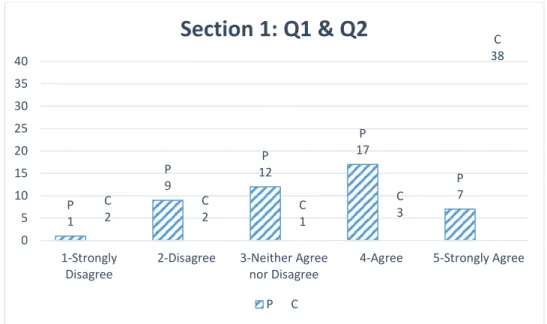
Figure 5. Number of Responses for Q1 and Q2 in Section 1 ... 65
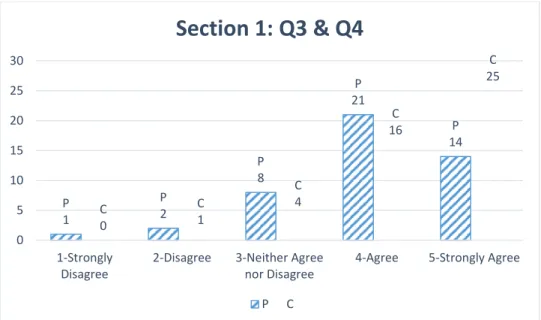
Figure 6. Number of Responses for Q3 and Q4 in Section 1 ... 66
Figure 7. Number of Responses for Q5 and Q6 in Section 1 ... 68
Figure 8. Number of Responses for Q7 and Q8 in Section 1 ... 69
Figure 9. Number of Responses for Q9 and Q10 in Section 1 ... 71
Figure 10. Number of Responses for Q1 and Q2 in Section 2 ... 73
Figure 11. Number of Responses for Q3 and Q4 in Section 2 ... 74
Figure 12. Number of Responses for Q5 and Q6 in Section 2 ... 76
Figure 13. Number of Responses for Q7 and Q8 in Section 2 ... 78
Figure 14. Number of Responses for Q9 and Q10 in Section 2 ... 79
Figure 15. Number of Responses for Q1 and Q2 in Section 3 ... 82
Figure 16. Number of Responses for Q3 and Q4 in Section 3 ... 83
Figure 17. Relationships in a Church Interpreter-mediated Event ... 93
List of Tables
Table 1. The essential characteristics of community interpreting and conference interpreting ... 14
Table 2. Interview Participants ... 56
Table 3. Online Questionnaire Participants by location and church code ... 60
Table 4. Professional versus Church Interpreters on Eligibility ... 64
Table 5. Professional versus Church Interpreters on Active Roles ... 72
Table 6. Professional versus Church Interpreters on Passive Roles ... 80
Abstract
This research aims to investigate the role of the interpreter within the setting of ethnic Chinese immigrant churches in the USA. In this study, “ethnic Chinese immigrant church” refers to Christian church communities situated outside of China, Taiwan, Hong Kong and Macau and founded by immigrants from Chinese-speaking countries and areas.
Interpreting most likely appeared in the immigrant church setting as a way to address the widening “acculturation gap” (Birman & Poff, 2011) between the Chinese-speaking first generation (i.e. immigrant members) and the English-speaking second generation (i.e. teenage and adult children of first generation members). Though there is currently scant research on the role interpreters and interpreting itself plays in this distinct interpreting setting. Thus, this study aims to answer the following questions: (1) what is the role of the interpreter in ethnic Chinese immigrant churches in the USA; and (2) what is the role of interpreting itself in this setting?
To address the first question, the researcher administered online questionnaires to church interpreters, users of interpreting (e.g. audience members), and commissioners of church interpreting (e.g. church leaders, pastors, speakers). Survey items juxtapose role perceptions and expectations of professional interpreters that work in non-church settings (e.g. hospitals, conferences, courtrooms) with that of interpreters in the church setting in an attempt to isolate distinct expectations and perceptions ascribed to the role of the church interpreter. Semi-structured interviews were conducted with interpreters and pastors from ethnic Chinese immigrant churches in the USA to get a better understanding of the role of interpreting itself in this setting.
Questionnaire results validate previous research on church interpreting and show that immigrant church interpreters are expected to be believing Christians who perform their role out of altruistic love for God and their fellow Christians; they are also believed to be spiritually empowered and enabled by God to reach their goal of edifying the congregation. Roles such as co- performer, co-communicator, servant, volunteer and advocate for Christianity were found to be the most prominent role descriptors for immigrant church interpreters. Data collected from semi- structured interviews with pastors, interpreters and users of church interpreting added an additional dimension to the role of the immigrant church interpreter. They are a bridge between not only differing speech communities within the church but also with potential members from outside the immigrant ethnic community.
Keywords: church interpreting, immigrant church, interpreter roles, ethnic Chinese immigrants
ᷕ
ᷕ㔯㐀天
㛔䞼䨞䘬ᷣ柴㗗⎋嬗⒉⛐伶⚳ˬ厗Ṣ䦣㮹㔁㚫˭ᷕ㈖㺼䘬奺刚ˤ㔯ᷕ䘬ˬ厗Ṣ䦣 㮹˭㊯䘬㗗⽆ᷕ⚳ˣ⎘䀋ˣ楁㷗⍲㽛攨䫱⛘怟䦣军伶⚳䘬厗Ṣ㕷佌烊ˬ厗Ṣ䦣㮹㔁㚫˭
㗗⛐ᶲ徘䫱⛘ᷳ⢾䓙厗Ṣ䦣㮹➢䜋⼺⺢䩳䘬㔁㚫䳬䷼ˤ
㛔㔯ἄ侭䋄゛炻⎋嬗⛐厗Ṣ䦣㮹㔁㚫䘬≇傥⎗傥㗗䷖㷃䦣㮹㔁㚫ᷕ䘬䫔ᶨẋ厗Ṣ䦣 㮹冯䫔Ḵẋ⛐伶⚳↢䓇䘬厗塼ᷳ攻ˬ㔯⊾ⶖ嶅˭“acculturation gap”炷 Birman & Poff, 2011炸 䘬㧳㦹ˤ昌㬌ᷳ⢾炻厗Ṣ䦣㮹㔁㚫⎋嬗⒉䘬℞Ṿ奺刚⯂㛒塓㶙ℍ㍊䨞ˤ㛔䞼䨞㍊妶䘬⓷柴
㗗烉炷ᶨ炸⎋嬗⒉⛐伶⚳厗Ṣ䦣㮹㔁㚫ᷕ㈖㺼䘬奺刚ˣ炷Ḵ炸⎋嬗㛔幓⛐伶⚳厗Ṣ䦣㮹㔁
㚫ᷕ㈖㺼䘬奺刚ˤ
䁢Ḯ䎮妋伶⚳厗Ṣ䦣㮹㔁㚫䘬ㆸ⒉⤪ỽ妋嬨⎋嬗⒉⛐㔁㚫ᷕ䘬奺刚炻㛔䞼䨞德忶䵚 嶗⓷⌟䘬㕡⺷炻吸普Ἦ冒㔁㚫ᷕᶱ栆Ṣ佌䘬シ夳炻℞⊭㊔㔁㚫⎋嬗䘬倥䛦ˣ㔁㚫⎋嬗䘬⥼
妿侭炷⤪烉㔁㚫柀⮶Ṣˣ䈏ⷓˣ⭋⮶ⷓˣ嫃忻Ṣ炸ẍ⍲㔁㚫⎋嬗⒉ˤ䵚嶗⓷⌟姕妰䘬ᷣ天 㕡⺷䁢⮵㭼姽₡ˤ⍿娎侭㟡㒂冒幓⮵⮰㤕⎋嬗⒉炷⛐朆㔁㚫䑘⠫ᷕ䘬⮰㤕⎋嬗⒉炸冯㔁㚫
⎋嬗⒉䘬奺刚娵䞍炻堐忼ṾᾹ⮵⓷⌟ᷕ⎬ᾳ婧㞍枭䚖䘬岲⎴⹎ˤ㛔㔯ἄ侭娎⚾德忶娚㕡⺷
㬠䲵↢厗Ṣ䦣㮹㔁㚫⎋嬗⒉冯⮰㤕⎋嬗⒉䘬奺刚ⶖ䔘ˤ㛔㔯ἄ侭Ṏ德忶冯㔁㚫䘬䈏ⷓˣ⎋
嬗⒉ẍ⍲⎋嬗倥䛦䘬姒婯炻娎⚾䎮妋厗Ṣ䦣㮹㔁㚫⎋嬗⒉㈖㺼䘬奺刚ẍ⍲⎋嬗㛔幓⛐厗 Ṣ䦣㮹㔁㚫ᷕ䘬≇傥ˤ
⓷⌟婧㞍䘬䳸㝄栗䣢炻⍿娎侭⮵㕤㔁㚫⎋嬗䘬奨溆冯姽₡炻冯ẍ⼨䘬䚠斄䞼䨞䘬䳸 㝄ᶨ农烉炷ᶨ炸㚱䘬⮎槿⮵尉㘖念娵䁢伶⚳厗Ṣ䦣㮹㔁㚫䘬⎋嬗⒉⽭⭂㗗➢䜋⼺炻᷎ᶼ 娵䁢⎋嬗⒉㗗ẍ⃭㺧ˬ⇑Ṿ䱦䤆˭䘬ン⹎㚵⊁㔁㚫ˤ炷Ḵ炸⮎槿⮵尉䚠ᾉ㔁㚫ᷕ㚱䘬㚵
⊁㍸ὃ侭炷⊭㊔⎋嬗⒉炸㗗啱䓙䤆䘬ˬ】岄˭炷ḇ⯙㗗䤆䴎俾⼺䘬傥≃炸ㇵ⼿ẍ⬴ㆸṾ Ᾱ䘬ᷣ天ả⊁炻ẍˬ忈⯙˭炷edify炸᷎≈⻟㔁㚫ㆸ⒉䘬ᾉẘˤ炷ᶱ炸昌Ḯἄ䁢㹅忂䘬㧳㦹
ᷳ⢾炻⮎槿⮵尉娵䁢⎋嬗⒉⛐厗Ṣ䦣㮹㔁㚫ᷕ䘬ᷣ天奺刚䁢ˬℙ⎴堐㺼侭˭ˣˬℙ⎴㹅忂 侭˭ˣˬ佑ⶍ˭ẍ⍲ˬ➢䜋㔁䘬㍸Έ侭˭ˤ昌㬌ᷳ⢾炻㛔㔯ἄ侭⽆姒婯ᷕ↮㜸᷎䷥䳸⼿↢烉
⍿姒侭娵䁢㔁㚫⎋嬗㚱≑㕤嬻㚜⣂朆厗Ṣ㕷佌圵ℍ厗Ṣ䦣㮹㔁㚫ˤ⚈㬌炻厗Ṣ䦣㮹㔁㚫⎋
嬗⒉ᶵ㗗ㇻ䟜婆妨昼敉䘬㧳㦹炻㚜㗗Ὣ忚厗Ṣ䦣㮹㔁㚫冯⢾䓴Ḻ≽䘬⨺ṳˤ
斄挝⫿烉㔁㚫⎋嬗ˣ䦣㮹㔁㚫ˣ⎋嬗⒉䘬奺刚ˣ厗Ṣ䦣㮹
Chapter 1: Introduction
1.1 Research Background and Statement of the Problem
The researcher was born in the state of New Jersey in the United States to ethnic Chinese immigrant parents who emigrated from Taiwan in 1984. Growing up in a community of Chinese- speaking immigrants in New Jersey, the researcher had frequent interactions with both ethnic Chinese immigrants and the English-speaking second-generation. Throughout the researcher’s childhood and early adulthood, the researcher attended an assembly of Christian believers (hereinafter referred to as NJCA)—an immigrant church founded and attended predominantly by immigrants from Chinese-speaking countries and their children who were mostly born and raised in the United States. Over time, interpreter-facilitated church services became the norm at NJCA where bilingual members who were born overseas or in the United States began serving as interpreters for the church. This study gauges the attitudes and perspectives of members of NJCA and other ethnic Chinese immigrant churches like it in the USA on the roles of their interpreters and interpreting itself in the ethnic Chinese immigrant church setting.
The motivation behind this study comes from the researcher’s personal experiences as both a user and provider of interpreting for NJCA. The researcher desires to investigate the nature of church interpreting in ethnic Chinese immigrant churches and uncover the roles and functions of both the practice of interpreting and the practitioner in the immigrant church setting. The researcher hopes that the results of the study will contribute to the still scarce but growing literature on interpreting in the church and serve as a helpful reference for those interested in the subject of interpreting in the church setting.
1.1.1 NJCA’s Church Background
The scope of this study includes multiple ethnic Chinese immigrant churches across the United States. Like many ethnic Chinese immigrant churches in their nascent years, all services at the aforementioned church of NJCA were initially conducted monolingually in Mandarin Chinese or another Chinese dialect, including children’s programs (e.g. Bible lessons, singing class, arts and crafts). In the first decade of NJCA’s founding, children’s programs were geared towards those who either immigrated to USA with their parents at a young age or those born in the USA to immigrant parents. With Mandarin Chinese being the common language for these children at the time, children’s programs were all conducted in Mandarin Chinese as well. But as more and more children entered the American school system, English slowly replaced the language of choice in their daily lives and in their interactions with other children at NJCA.
After entering middle school and high school, the American-born members eventually moved onto church meetings with their parents, which entailed listening to sermons and prayers given in Mandarin Chinese via NJCA’s first manifestation of an interpreting in the church. In NJCA’s early years, interpreting took on less visible formats (e.g. whispering) but gradually shifted as NJCA leaders experimented with other formats (e.g. simultaneous interpreting using handheld transmitters and receivers, consecutive interpreting, whispering). Eventually, the group of English-speaking members of NJCA were sizable enough to warrant their own sub-group within the church, informally referred to as the “youth group” which operated semi-independently from the Chinese-speaking membership. But even with the clear language divide between the two groups, the majority of church functions were still conducted jointly, which further substantiated the need for formalized interpreting services. By the time the researcher joined the youth group, consecutive interpreting for sermons, prayers and announcements at NJCA was a normalized
church service.
1.1.2 Interpreting at NJCA
Interpreters at NJCA have been predominantly members of the first generation, comprising Overseas-born Chinese (OBC)—ethnic Chinese who were born in a Chinese-speaking country or region (e.g. China, Taiwan, Hong Kong, Macau) but who currently reside in a non-Chinese- speaking country (Carlson, 2008). The majority of NJCA interpreters interpret from English into Mandarin Chinese with only a minority deemed capable by church leadership to render Chinese sermons into English. Within the last 15 years, however, more and more English-speaking young adults have been taking up the mantle in many areas in NJCA, one of which is the role of interpreter.
NJCA has also been interacting more with other ethnic Chinese immigrant churches in the USA as well as other churches from outside the ethnic group, resulting in an increased frequency of preachers visiting from other churches, some of which come from outside the ethnic group and preach in English. More recently, some of the native Chinese-speaking preachers at NJCA have started to shift towards preaching in English. All of these recent shifts together have increased the need for interpreters in both language directions at NJCA, making research on the role of the church interpreter in the immigrant church setting more integral than ever to future development of the immigrant church.
1.1.3 Statement of the Problem
For many immigrant churches, the role of the interpreter is not a permanent one. The church interpreter in many immigrant churches may only be temporary placeholders that act as a kind of social adhesive to bridge disjointed groups within the church until a more viable and sustainable option can be found. In many cases like the Chinese Christian Church (CCC) of Greater Washington (Yang, 1999) or the ethnic Chinese churches in Carlson’s (2008) research, interpreting
did little to stem the tide of frustrated ABC’s leaving the church. Contrary to these findings, immigrant churches like NJCA have been conducting services using interpreters for more than two decades. Although membership (both Chinese-speaking and English-speaking members) has waxed and waned over the years, there remains a relatively steady rate of attendance of Overseas- born members and ABC members as well as non-ethnic Chinese members (e.g. Caucasians, Indians, Koreans). Rather than seeing a need to discontinue interpreting in the church, there is arguably a growing need for it.
Currently, there have not been any extensive studies conducted on interpreting in immigrant churches in the United States. Thus, questions on the frequency of use and how long interpreting has been a part of immigrant churches are difficult to answer in definite terms. Studies on interpreting in the church (e.g. Tison, 2016; Tseng, 2009; Hokkanen, 2012; Downie, 2014) have been done, though none have explored church interpreting specifically in the immigrant church context in the United States. The studies that have focused on the immigrant church experience (Carlson, 2008; Yang, 1999, 2002; Ley, 2008; Woods, 2006) allot scarce attention to interpreting’s impact on the church community’s dynamic and future development. From all the literature gleaned in this study, church interpreting is usually treated as a fleeting phenomenon that will inevitably decline and fall out of disuse as part of the natural progression of immigrant churches.
The aspires in this study to challenge this perception and expectation that interpreting in the church will not last, and hopes to find evidence for effective continued use of interpreting in the later stages of immigrant church development, especially the ethnic Chinese immigrant church in the USA.
There are many ethnic churches in New Jersey that began as monolingual immigrant churches but have since gone through many changes as a result of the notable rifts between its
immigrant and ABC members. Taking into account the research done by Carlson (2008) and Yang (1999) as well as the researcher’s own personal experiences, ethnic Chinese immigrant churches have each taken varying approaches to deal with the disharmony between the immigrant, ABC and even non-ethnic Chinese members of immigrant churches. Some have completely created separate and independent Chinese and English ministries whose members have little to no exposure to church interpreting, save for special events (e.g. Christmas, Easter) or once-a-month joint meetings.
Other immigrant churches such as NJCA have opted to make interpreter-mediated church services the norm, making every effort to minimize causes for separation to the best of their ability and unite members across languages, cultures and generations through the medium of interpreting. In light of these divergent attitudes and policies on the usage of interpreting between immigrant churches, the researcher endeavors to find the answer to what exactly drives the need for interpreting via investigations of the roles of the interpreter and interpreting in ethnic Chinese immigrant churches in the USA like NJCA.
1.2 Research Questions
In an attempt to better understand the circumstances that create the need for interpreting and the factors that perpetuate or eliminate the need for interpreting in the immigrant church, this study explores the role of interpreting in the ethnic Chinese immigrant church setting and the expectations and perceptions ascribed to church interpreters by church members, which include the commissioners of interpreting (i.e. preachers, pastors), the users of interpreting, and the interpreters themselves. In short, this study aims to answer the following two research questions:
(1) What is the role of the interpreter in the immigrant church in terms of the perceptions and expectations ascribed to the church interpreter?
(2) What is the role of interpreting itself in the immigrant church?
1.3 Conceptual Framework
The most basic perception and expectation of the interpreter’s role in any setting is to serve as a bridge of communication between speakers of mutually unintelligible languages, or at the very least, languages different enough that require a bilingual or multilingual intermediary to facilitate successful communication. The stereotypical perception of the interpreter may be that the interpreter simply needs to render a unit of communication in one language into its equivalent in another language. This mechanical perception of the interpreter’s role is predicated on the assumption that all units of communication in one language have their equivalents in another language, which overlooks the complexity of language as a human invention and ignores the impact of the setting on the interpreter’s mentality and performance of their role(s).
Previous studies on the role of the interpreter in Translation and Interpreting Studies (hereinafter referred to as T&I Studies) have further fleshed out the role of the interpreter as encompassing more than just linguistic facilitation. T&I Studies scholars like Claudia Angelelli (2004) and Sandra Hale (2007) have refuted, or at the very least questioned, the one-dimensional perception of the interpreter as a mechanical language converter who is expected to be immune or otherwise responsible to remain unaffected by external factors. Their studies have provided ample evidence that bolster the notion that the role of an interpreter is multidimensional and varies depending on the setting.
The church is a unique setting that presents a distinct set of pressures that affect how the interpreter performs and how their role is perceived by the church members. Alev Balci Tison (2016) posits that the church is a social institution, replete with its own normative, regulatory and cultural norms, and isolated to certain degree from the society in which it is embedded. This type of paradigm depicts church interpreting as a special form of interpreting that is exclusive to
members of the church or even confined within the Christian faith. In contrast to church interpreters, a professional interpreter’s ability to interpret is not immediately called into question if they do not subscribe to a certain ideology or set of beliefs. In fact, Sandra Hale’s (2007) compilation of interpreter’s codes of ethics shows an expectation that any ideological differences or disagreements held by the interpreter must be kept in check, or even suppressed, during the interpreting process.
As evidenced in literature on church interpreting, church interpreters are held to religious or faith-based standards and are required to have a genuine spiritual connection with what is being interpreted. On an institutional level, the church interpreter is not only translating linguistic communication but also the church institution itself (Tison, 2016). While each verbal communication event can be considered an isolated and temporal production (Pöchhacker, 2016), the interpreter is not solely rendering what is being said in that time frame but is also channeling the church’s institutional norms and reflecting the church’s beliefs and ideology (Tison, 2016).
When it comes to the immigrant church, however, the church is more than just a religious institution. The immigrant church can also be a cultural hub (Ley, 2008) where immigrants can receive not only spiritual support but also social, financial and mental support from the church community. The conceptual framework of this study incorporates the facets of immigrant churches brought to light by Ley (2008), Tison (2016), Carlson (2008) and Yang (1999) to investigate the roles of the interpreter and the interpreting in the church, which is considered as a cultural service hub, a social institution, and a distinct community embedded in a larger society.
1.4 Research Scope
The subject of church interpreting has a myriad of factors and aspects that can be examined (see Figure 3 in Section 2.1.3). One potentially impactful factor is a church’s denomination, which
refers to an ideological affiliation with “groupings of congregations with at least a modicum of centralized authority that share some combination of a common tradition, viewpoint, organizational style, practice, and culture with regards to religion” (Fuist et. Al, 2011). However, today there are a large number of Christian denominations, each set apart from each other by distinct set of viewpoints, organization styles, practice, and culture in regards to how Christianity should be practiced in the church.
Thus, due to certain research limitations, this study focuses exclusively on ethnic Chinese immigrant churches in the USA, which generally belong to the Protestant denomination of Christianity. This means, the scope of this study does not include input from members of churches in other denominations (e.g. Roman Catholic, Eastern Orthodox). As a result, this also means that many factors that arise from a church’s denominational affiliation are not taken into account in this study. Therefore, the research results of this study only reflect the viewpoints of those selected to participate in the study and are thus not necessarily applicable to all church communities. The third chapter in this paper provides further details on the selection process of participants in this study..
For comparison purposes, a small group of members attending bilingual Protestant churches in Taiwan was also included in the study, though the primary focus remains on ethnic Chinese immigrant churches in the United States. In order to better reflect the ethnic Chinese immigrant church community while attempting to minimize the number of variables arising from denominational and ideological differences, other ethnic Chinese immigrant churches that are loosely affiliated with NJCA are also included in this study.
This study also does not take into account the impact of the mode of church interpreting (e.g. consecutive interpreting, simultaneous interpreting, chuchotage) might have on how the role
of the interpreter is perceived nor is the researcher denying that there is an impact. However, this study does not incorporate analyses on the differences between the roles of church interpreting by different modes of interpreting, and focuses primarily on the general perceptions and expectations of the interpreter’s role in relation to the church institution.
1.5 Contributions
Some immigrant churches may outright disqualify interpreting’s value in the church while others may staunchly swear by its high utility and effectiveness. Many churches are most likely caught somewhere in between and are unsure of how much time and effort to invest in developing their interpreting talent. Therefore, it is the researcher’s hope that the results of this study will help immigrant church communities to better gauge the level of significance of and need for interpreting their churches. The results of this study could also potentially be a source of reference for those interested in expanding on church interpreting studies which is currently still relatively sparse.
Despite what appears to be a lack of interest in church interpreting research, the amount of literature on church interpreting reviewed in this study suggests that interest in this niche aspect of interpreting studies may be growing. The data results from this project will hopefully add to existing research efforts and spur others to investigate interpreting in church settings. The researcher also hopes that this study will give current church interpreters a reflexive glimpse of their own role in the church, and possibly even raise awareness of the significance of their interpreting in the church community.
1.6 Definition of Key Terms
x American-born Chinese (ABC): ethnic Chinese who were born, raised and educated in the United States; may also include individuals who immigrated to the United States with their parents at a young age (i.e. before middle school or the age of 12)
x Bilingual church: refers to a church that regularly conducts its services and functions in
two more languages
x Brothers and sisters: referring to both male and female members of the church; broadly refers to male and female Christians
x Christian: a person who confesses belief in Jesus Christ as the Son of God and as their Lord and Savior, and that God raised Him from the dead
x Church: refers to a body or organization of Christians; in this study, “church” refers only to those of the Protestant denomination
x Church interpreter: an interpreter who interprets regularly for a Christian church
x Denomination: a sub-group of the general Christian community whose congregations are united in their adherence to a set of beliefs and practices that are distinct from those of other sub-groups yet generally sharing a common foundation in the basic tenets of Christianity
x Ethnic group: a community or population made up of people who share a common cultural and historical background and share the same language
x Ethnic church: refers to a church with a majority of members belonging to a single, specific ethnic group
x First-generation immigrant: see Overseas-born Chinese
x Immigrant: a person who takes up permanent residence in a country different from their place of birth
x Immigrant church: refers to a church founded and led by immigrants; in this study
“immigrant church” may or may not be actively catering to other immigrants x Non-ethnic: a person that does not belong to the ethnic group in question
x Overseas Chinese: those of ethnic Chinese descent who live in countries or regions other than China, Taiwan, Hong Kong or Macau
x Overseas-born Chinese (OBC): ethnic Chinese who were born in a Chinese-speaking country or region (e.g. China, Taiwan, Hong Kong, Macau) but who currently reside in a non-Chinese-speaking country (Carlson, 2008)
x Professional interpreter: an interpreter who interprets as a profession in various settings (e.g. conferences, courtrooms, hospitals, business meetings) and receives financial compensation for interpreting services rendered
In this study, “Chinese-speaking” denotes those who emigrated from a Chinese-speaking country or region (e.g. Taiwan, China, Hong Kong, Macau) and does not disclaim their ability to speak English. “Chinese-speaking” solely refers to those who identify Chinese as their dominant language. “English-speaking” in this study refers to those who are born and/or raised in the United States and identify English as their dominant language. This term is not intended to insinuate a lack of the ability to speak Chinese.
Chapter 2: Literature Review
This study is based on the assumption that the role of the church interpreter is a function of its setting—the church. The research literature reviewed in this chapter lays out the concepts that led to this assumption. Key findings and discussions from previous studies on the specific roles of the church interpreter are also presented in this chapter. Chapter 2 is organized by the following themes: (2.1) interpreting by setting and the role of the interpreter, (2.2) the general church setting, (2.3) specific roles of the interpreter in the church setting, and (2.4) interpreting in an ethnic Chinese immigrant church setting.
Section 2.1 aims to highlight how the role of the interpreter is linked to the setting in which interpreting occurs. Sub-section 2.1.1 gives an overview of how other researchers have classified the various types of interpreting by their setting. A simple classification would be the dichotomy between community and conference interpreting. On a more granular level,
community and conference interpreting can be further broken down into spheres of interaction and mapped along a spectrum ranging from inter- to intra-social settings. Sub-sections 2.1.2 and 2.1.3 present findings and discussions from research literature that establish linkage between the role of the interpreter seen in some interpreting codes of ethics with the role of the interpreter in relation to setting. Sub-section 2.1.4 presents literature on how the quality of interpreting is partially defined by the setting in which it occurs.
Section 2.2 fleshes out the argument that the setting, specifically the church setting, necessarily impacts the role of the church interpreter. The first sub-section 2.2.1 presents how one researcher attempts to classify church interpreting according to how the role of the church interpreter is perceived by commissioners and users of church interpreting. Subsequent sub-
expectations and norms, of the role of the church interpreter are a functions of the “church institution”.
Section 2.3 hones in specifically on the roles of the church interpreter as derivatives of the church setting as identified and explored in previous studies. Some of the interview questions and items on the questionnaire used in this study were derived from these roles. Section 2.4 presents research literature on interpreting in the setting of ethnic Chinese immigrant churches in the USA. This section serves to bridge research presented in sections 2.1 to 2.3 with the
objectives of this study, which is the investigation of the role of the interpreter and the role of interpreting in ethnic Chinese immigrant church settings in the USA.
2.1 Interpreting by Setting & the Interpreter’s Roles
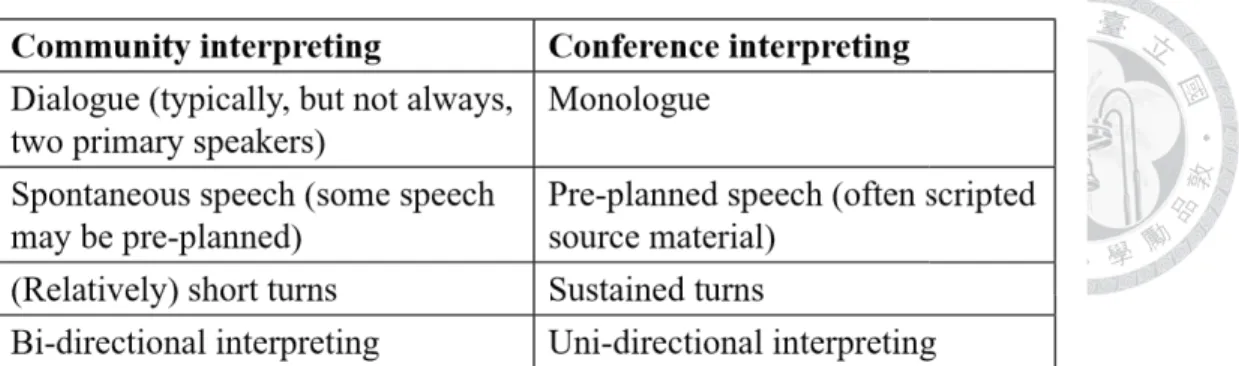
Bente Jacobsen (2009) points out that interpreting research for the most part has centered on either conference or community interpreting whereby both areas focused on the “visible interpreter” rather than the more abstract role of interpreting. According to Jacobsen, the research on conference interpreting focuses more on cognitive, neurophysiological, neurolinguistics and performance-related issues with the interpreter while research on community interpreting is more concerned with the “role perceptions and expectations among users of interpreting services and interpreting practitioners” (ibid., p.156). The reason for this categorical preference for certain issues is due to the differing characteristics of conference and community interpreting as summarized in Jacobsen’s table of essential characteristics for each type of communication (Table 1):
Table 1. The essential characteristics of community interpreting and conference interpreting Source: Jacobsen, 2009
Maurizio Viezzi (2013) states that if the “interaction format” of a communication event is adopted as the criterion for classification, then interpreting can be classified as either monologic or dialogic interpreting. Viezzi defines monologic communication as utterances being expressed from one person to many, occurring when “the interaction is not mutual between the audience and the speaker”, and dialogic communication as “face-to-face encounters where the form of communication is conversation” (ibid., p. 377). When applying Jacobsen’s dichotomy and Viezzi’s definitions to the types of communication events that take place within a church setting, one might come to the conclusion that church interpreting is a form of “conference interpreting”, given that sermons are predominantly monologic, pre-planned, and interpreted uni-directionally. Hwa-chin Tseng (2009), however, argues that church interpreting is in fact more akin to “community interpreting”, though it is difficult to see the validity of this claim based on just the aforementioned definitions and criteria.
Viezzi (2013) and Jacobsen (2009) also understand the insufficiency of solely using these criteria in classifying interpreting, as both bring up the significance of setting in the classification of interpreting activities. Viezzi points out that distinguishing interpreting events along the lines of setting gives way to setting-related categorizations, such as court interpreting, media
interpreting, business interpreting, parliamentary interpreting and so on (ibid., p. 377), while Jacobsen brings up Pöchhacker (2016) and his mapping of a conceptual spectrum of interpreting to flesh out interpreting classifications.
2.1.1 Inter-social and Intra-social Interpreting
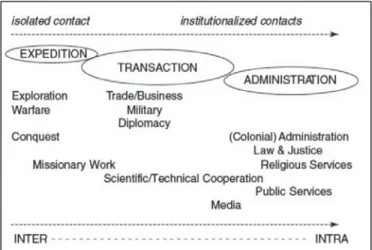
Pöchhacker (2016) mapped out a variety of interpreting activities along a spectrum from inter- to intra-social spheres of interaction, or what could otherwise be generally referred to as interpreting settings. Pöchhacker explained that the evolution of interpreting activity occurred with the increase in the number of settings requiring interpreting, ranging from inter-social dealings between communities to intra-social relations within a heterolingual and multicultural community.
In Figure 1, settings are grouped under catchwords that encapsulate the general type of interaction and contact through which interpreting is performed (ibid., 2004). Unlike the more fixed settings such as “military”, “public services” and “law and justice”, religious settings such as “missionary work” and “religious services” are placed on both sides of the spectrum, suggesting the varied nature of interpreting in the broader category of “religious settings”.
Figure 1. Interpreting in different spheres of interaction Source: Pöchhacker, 2016
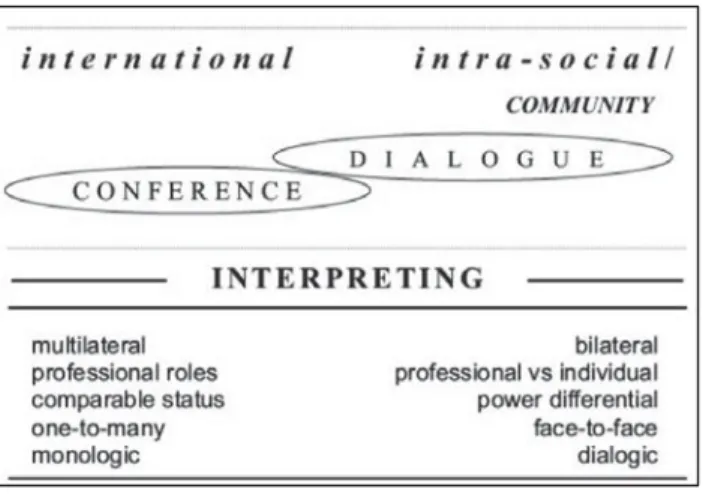
Pöchhacker (2016) points out that this spectrum featuring spheres of social interaction could be further refined by installing the constellations, or formats, of interaction, which can arguably better account for social interactions that extend across spheres of interaction, such as religious services and missionary work. The result is a spectrum that spans from the “international conference interpreting” sphere of interaction to the” intra-social community” interpreting sphere, which incorporates not only the interaction formats (i.e. conference and dialogue) but also features usually found in each type of interpreting (see Figure 2).
Figure 2. Conceptual Spectrum of Interpreting Source: Pöchhacker, 2016
In Pöchhacker’s initial mapping of interpreting in different spheres of interaction,
“religious services” and “missionary work” were placed at opposite ends of the spectrum due to the nature of each activity conforming to a certain type of setting. However, Pöchhacker (2016) also acknowledges the fact that categorizing interpreting settings is not always clear cut, and cautions against using a fixed dichotomy when categorizing interpreting interactions (Pöchhacker, 2016). Thus, Pöchhacker’s conceptual spectrum of interpreting in Figure 2 is designed to classify interpreting activities such as church interpreting, which falls somewhere between international and intra-social communication, intersects monologic conference and dialogic community interaction formats, and straddles the line between conference and community interpreting.
2.1.2 Role of the Interpreter by Code of Ethics
Based on Table 1 and Figures 1 and 2 above, it is clear that interpreting can occur and does occur in wide variety of settings. The question now is whether these settings play any part in forming the interpreter’s role, assuming that the interpreter is more than just a “translation machine”. In an attempt to connect the interpreting setting with the interpreter’s role, the researcher first turned to Sandra Hale (2007) and her tabulated compilation of role descriptions taken from professional associations and other programs (e.g. health services). These descriptions highlight the general consensus on what role or roles the community interpreter ought to take on. For the most part, the role descriptions spoke less on the actual role of the interpreter and more on the code of ethics for interpreting, prescribing interpreters to refrain from advocacy, counseling, interjection of personal opinions and actions of the like. However, these do’s and don’ts in these codes of ethics may not always be feasible depending on the various kinds of demands (e.g. social, cultural, physical) imposed on interpreters from the different settings in which they interpret.
Hale (2007) made another compilation of role descriptions provided by various practicing interpreters, and found that despite none openly contradicting the general interpreter’s code of ethics to remain impartial and neutral, “most agreed that the practical application of the role differed due to the limitations or demands of the setting,” with some even suggesting that different settings require different codes of ethics (ibid., p. 129). Rather than focusing on whether the interpreter is able to adhere to a specific code of ethics when interpreting, the focus of this study is placed on the notion that the setting itself plays a part in how interpreters are expected to carry out their duties.
2.1.3 Role of the Interpreter by Setting
Claudia V. Angelelli (2004) further develops this idea of setting-based interpreter roles.
She posits that interpreting does not happen in a social vacuum, and that interpreters are not immune to ever-present social factors, which make maintain neutrality as outlined in interpreter’s codes of ethics virtually impossible. Impartiality and neutrality are valued because such qualities absolve the interpreter from certain responsibilities related to the content of the communication;
however, interpreters do play a role in co-constructing the conversation, especially in dialogic interpreting (Hale, 2007). Thus, if the interpreter has a level of participation in the interaction, then social factors (e.g. race, ethnicity, gender, age, status) may have some bearing on how the interpreter presents information (Hale, 2007).
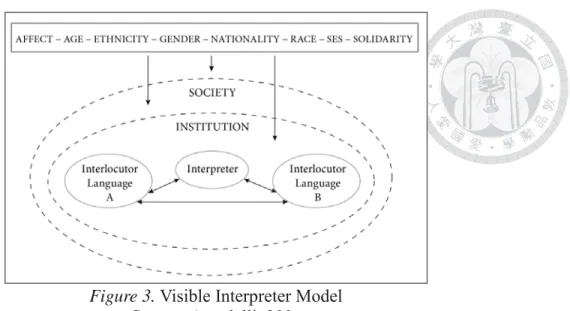
As seen in Table 1 and Figures 1 and 2, different domains of interpreting tend to be accompanied by certain interaction formats (i.e. monologic or dialogic) and modes of interpreting (i.e. consecutive interpreting, simultaneous interpreting) depending on the context or setting in which interpreting takes place. Angelelli’s Visible Interpreter Model (see Figure 3) pinpoint specific factors that act upon the interpreter. As seen in Figure 3, the entire communication event, interpreting, and the interlocutors are situated in nested spheres, each with its own set of social constraints acting upon the interlocutors and interpreter. In the church context, there may be additional factors not listed by Angelelli that may be acting upon the interpreter, including pressures from the church institution, religious ideology, and faith.
Figure 3. Visible Interpreter Model Source: Angelelli, 2004
Angelelli (2004) designed a tool—the Interpreter’s Interpersonal Role Inventory (IPRI)—
to study the interpersonal role of the interpreter by looking at interpreters’ perceptions of their roles in various settings (e.g. medical, court, conference) in hopes that differences in the competencies involved in each kind of interpreting event could be further clarified. The results of her study presented evidence showing that interpreters perceive themselves as visible to varying degrees that differ from setting to setting. Moreover, their roles are not restricted to bridging communication but may extend to advocacy, cultural mediation, trust-building and other roles not in line with the traditional notion of an invisible and neutral interpreter (Angelelli, 2004). The reason for the variability is due to the variance in setting and interaction formats.
Angelelli’s (2004) study brings to light the reality that interpreters as social creatures cannot possibly operate within a social vacuum, and will rather behave based on their perceptions of themselves, the interlocutors and the situation. Given that interpreters can never fully live up to the expectation of being impartial and invisible, interpreters can only focus on playing their respective roles in accordance to the code of conduct specific to each setting while relying on their
2.1.4 Role of the Interpreter by Quality
How well an interpreter is playing their role is measured by the interpreting “quality”. But what elements constitute “quality” was also found to vary from setting to setting in the following study by Franz Pöchhacker and Cornelia Zwischenberger (2010). In their study, AIIC members were asked to participate in a survey regarding role perceptions. The study, in part, extends the scope of Hildegund Bühler who conducted a study in 1986 on the quality criteria used to assess candidates for AIIC membership, and draws parallels with Claudia Angelelli’s (2004) study on role perceptions among interpreters in various settings. Based on their findings, Pöchhacker and Zwischenberger’s concluded that the interpreter’s function and role is “inherently linked with the issue of quality, since conference interpreters’ perceptions of the nature of their task will ultimately shape their performance” (Pöchhacker and Zwischenberg, 2010). The objective of the survey is stated as follows:
The survey focused exclusively on simultaneous conference interpreting. It sought to find out how AIIC members judge the importance of 11 output-related quality criteria (including fluency of delivery, correct grammar, lively intonation, logical cohesion, completeness, native accent, pleasant voice, and sense consistency with the original) and whether the relative importance of these criteria varied depending on the type of meeting or assignment.
(Pöchhacker and Zwischenberg, 2010)
The results of the study show that interpreters generally focus on language and delivery- related criteria to evaluate the quality of interpreting. However, when particular meeting types or domains are considered, the quality criteria that are generally considered less important are then rated as more important. The level of significance “attributed to various quality criteria thus varies in relation to the meeting (e.g. type of event, degree of formality, duration and size) and the domain (e.g. political, diplomatic, business, legal, medical) in which the event takes place” (Pöchhacker and Zwischenberg, 2010).
2.2 Research on Interpreting in the Church Setting
The previous section presented literature supporting the notion that setting is at the very least one of the major factors that impacts how the role of the interpreter is defined, perceived and carried out. With this concept in mind, this section focuses on delving into the intricacies of the church setting and presents literature on the various elements within the church setting that may act upon the role of the church interpreter, starting with an overview of the general church setting followed by more specific literature on the church as an institutional setting, which means it has its own language policy and faith-based code of conduct, all of which may be factors in how the role of the church interpreter is formed.
2.2.1 General Overview of the Church Setting
Tseng’s (2009) pilot study on church interpreting in Taiwan reaffirmed the reality of the church’s multifaceted environment. The results from her research showed that interpreting in the church does not fit exclusively into a binary classification (e.g. community or conference, intra- social or inter-social) but falls somewhere between two poles, as church interpreting can happen in many forms and settings (Tseng, 2009). The church setting is a hodge-podge of inter-social and intra-social elements and is where communication events can occur both monologically and
dialogically. For instance, sermons are generally given monologically in a one-to-many communication event, making sermon interpreters more like conference interpreters. Then again, there are times where the one-to-many communication in church settings takes on a more dialogic dynamic, whereby the preacher poses a question or comment and waits for the audience to respond before moving on in their preaching. However, within the church institution, “everyone in the church is on the same side, so the interpreter in this type of dialogic one-to-many situation need not take on advocacy, defendant or mediation roles as community interpreters often do in one-on- one settings” (Tison, 2016, p. 14).
There are also individual-level interactions in the church between a church “professional”
(i.e. pastors) and laymen members where a power differential may be perceived. The differential between these two types of interlocutors in the church may become apparent when one of the interlocutors is a new convert or an immigrant who is struggling to start a new life in a strange land. The interpreter and pastor may be on the same side, though the new convert or non-believing immigrant who is looking to join the church could be seen as being in a less informed or
“disadvantaged” position. In this type of intra-cultural dialogic situation, the interpreter may need to decide how to position themselves between the two interlocutors. In this regard, the church interpreting may take on more features from intra-social community interpreting.
Whether dialogic or monologic, inter-social or intra-social, conference or community, the church is a dynamic setting where many situations can occur, making the role of the church interpreter ever more complex. While it is worth noting that church interpreters perform their duties in a variety of settings and interaction formats, given the time and resource constraints, this study focuses primarily on monologic church interpreting and does not explore the role of the church interpreter in dialogic one-to-one, one-to-few settings. In other words, the role of the
immigrant church interpreter in this study primarily focuses on their role when interpreting sermons in the church.
2.2.2 Interpreting in the Church Institution
To reiterate, this study is predicated on the assumption that the role of the church interpreter is, at least in part, a function of the church setting. However, this is only possible if the church interpreter is seen as a formalized role in the church rather than just an individual interpreting in physical church setting. In other words, for the role of church interpreter to incorporate the church itself, it must become a formalized part of the church institution.
Koskinen (2008), as cited by Tison (2016), states that the institutionalization of a church first forms at the abstract, metaphysical level. The church then forms on the more formal level, gaining recognition and becoming legitimized by society and even the government; lastly this formal recognition allows for the church to further split into localized institutions like parishes, which are supervised by a central body, but not all churches reach this final stage. Some churches do not function under the jurisdiction of a centralized church authority but rather coexist as a group of independent churches that interact within a decentralized and loosely affiliated network of
“sister churches” linked by similar ideologies and engaging in inter-institutional interactions (e.g.
pastors and preachers visit other churches in the network and give sermons or hold special conferences). This is the case of the ethnic Chinese immigrant churches in this study. Throughout the institutionalization process, a church’s norms and expectations eventually become concretized and regularly enforced, which ultimately become part of the church’s identity. A formalized church interpreter role in this type of institutionalized setting would necessarily be impacted by these norms and expectations.
Tison (2016) frames the issues of settings, norms, expectations and roles for church interpreters as part of the “church institution” which she argues is what church interpreters are concurrently being influenced by and perpetuating. Tison posits that the church interpreter is involved in translating not just the textual and hyper-textual content of communication in the church but is also translating the institution of the church (i.e. the church setting), perpetuating and even shaping its ideology, norms and culture. The church interpreter primarily deals with sermons which is “constrained by the institution's ideology and norms for interpreting and, at the same time, […] is a factor in the translation of the institution itself” (Tison, 2016). But at the same time, the church institution is imposing its ideology, norms and culture onto the church interpreter, thereby forming a reciprocal relationship between church institution and church interpreter.
Thus, it goes to reason that the immigrant church institution also exerts pressures on its members from not only religious sources but also cultural, social, linguistic ones. These factors can be generalized as part of the church institution’s ideology. As a member of the immigrant church, the church interpreter is subject to the church’s ideological pressures. This study draws from this notion when investigating the role of interpreting itself in ethnic Chinese immigrant churches.
2.2.3 The Church Institution’s Ideology
Given the distinct speech communities (i.e. Chinese-speaking and English-speaking) within the ethnic Chinese immigrant church, the language policy of the immigrant church institution is thus an important piece in the investigation of the role of the immigrant church interpreter. Tison (2016) notes that an institution’s language policy is a particularly impactful medium through which an institution’s ideology, cultural beliefs and norms are transmitted and enforced. Given the church interpreter’s direct connection to church’s language policy, the church
interpreter naturally plays a role in the translation and enforcement of the church institution’s ideology. Linguistically, as part of the church institution, the church interpreter is “tacitly obliged to use the accepted lexicon of the church, the vocabulary found in the Bible as the authoritative text and most importantly to render sermons in line with the church’s ideology” (Tison, 2016).
Failure to do so may detract from the maintenance of the church institution’s ideology:
Common linguistic devices give group members a sense of security and solidarity. In the church context, it also creates a sense that all are part of a special interaction with each other and most importantly with their God. When language has such a crucial function for a group or institution and for the maintenance of the institutional ideology, [….] the impact of interpreters is worth re-thinking. (Inghilleri, 2004 as cited by Tison, 2016).
Church interpreters must also take denominational ideologies into account when interpreting in a given church. Although all denominations are loosely situated under the umbrella term “Christian” and generally claim to hold and defend the core tenets of Christianity, different denominations assert certain doctrines and practices more than others. In other words, not all churches see eye to eye despite belonging to the same faith. Thus, aside from language, other factors that shape a church’s ideology include each church’s interpretation of God’s word, God’s will, and how things ought to be conducted in the church to please God. The plethora of Christian denominations around the world is a testament to the ideological diversity within the Christian faith.
Tying denominational differences back to the church institution’s language policy, “church history shows that as a way of promoting the desired behavior, denominations have always had
language-related policies in keeping with their ideology (or belief system), ranging from the selection of Bible version to the choice of sacred language for rituals and liturgies” (Tison, 2016, p. 46). However, this study does not look at factors arising from denominational affiliations and their impact on the roles of the interpreter and interpreting in the church setting. Rather, the denominational ideological beliefs among research participants are assumed to be consistent or at least very similar. Nevertheless, it is still important to remember that the church’s ideology may be heavily shaped by their denominational affiliation, which by extension shapes the roles of the interpreter and interpreting in the church setting. However, due to research limitations and complexities of dissecting Christian denominations, the impact of a participant’s denominational affiliation is not considered in the analysis.
For the church interpreter who is both part of the institution and partly a dispenser of the institution’s ideology through language, the church institution’s ideological factors (e.g. language, denomination, doctrine, culture) may all have an impact on the role of the church interpreter, especially in the eligibility department. For instance, interpreters who interpret for churches that believe outward expressions of emotion, spontaneity, and an energetic atmosphere are conducive to worshipping God must themselves reflect that same ideology in the way they interpret. In contrast, interpreters who interpret for churches that believe that strict order, passive contemplation and more reserved styles of worship are the ways to commune with God may be pressured to reflect that culture in how they interpret.
Some items on the online questionnaire in this study address the church interpreter’s obligations during the interpreting process. These items are derived from the notion that church interpreters must use a certain lexicon as per the church’s language policy, be it religion-based or culture-based. Other questionnaire items addressing interpreter obligations are derived from the
notion that church interpreter’s must observe a certain decorum in accordance with the church’s its denominational ideology, which governs how interpreter’s should act or react when interpreting on stage, how interpreters should think and perceive their roles, and how to discern what is or is not appropriate when interpreting. Overall, these questionnaire items are based on the assumption that the role of the church interpreter is a function of the church institution, with all of its norms, expectations and ideology.
2.2.4 Interpreter eligibility in a church setting
Interpreters that fail to reflect the church institution’s ideology may come off as awkward and disconnected from the source text, but this would not necessarily deem them unfit to interpret in that particular church. In terms of eligibility, there may be more basic requirements in place.
This study dedicates a section of the questionnaire to address the issue of eligibility of the church interpreter in ethnic Chinese immigrant churches. Questions are based on the study done by Tison (2016) who also tackled the question of eligibility for interpreting in the church via a series of interviews, specifically focusing on whether non-Christians were allowed to interpret sermons.
The results from these interviews clearly showed that the general consensus was that “interpreters who are not from within the ideology of the church cannot function as expected in terms of both terminology and communicating the spirit of the message” (Tison, 2016), specifically referring to non-Christian interpreters. The underlying concern is that even if a non-Christian possesses all the mental and linguistic faculties to interpret well, they would still lack the spiritual faculties to convey the spiritual dimensions of what is being preached from the pulpit. Tison identifies this as a “trust” issue.
Qualms about whether the interpreter can be trusted to advocate the Christian ideology come up when the interpreter is functioning “in-between” instead of from “within” the church’s
ideology (Tison, 2016). Tison delineates two caveats that would mitigate issues with trust when considering whether to let non-Christians interpret in the church: (1) if the speaker personally knows the interpreter and trusts that they will not distort the sermon’s message; (2) some kind of control mechanism, such as going over the sermon in detail with the interpreter beforehand, must be in place (Tison, 2016).
The issue of loyalty is another major point of concern when it comes to the eligibility of a church interpreter. Interviews conducted by Tison (2016) revealed that preachers or pastors worry that non-Christian interpreters, which include those of other faiths, may interpret in line with their own theological views and may distort or change what is being said if they find the message to be incongruent with their own beliefs. Thus, there are certain reservations among commissioners of church interpreting that “would cause them to avoid using an interpreter who does not share the ideology ingrained in their context” (ibid., 2016). This could also happen between Christians from different denominations, though if given a choice between a non-Christian and a Christian from a different denomination, the latter would most likely be preferred.
Andrew Owen (2014) also cautioned against using non-Christian interpreters and warned of the adverse impact incongruous beliefs between the speaker and the interpreter would have on the audience, specifically the spirituality of listeners. Owen discusses the role of the church interpreter from a more spiritual aspect and emphasizes the interpreter’s spiritual responsibility to their listeners to nourish their spiritual growth. Church interpreters who hold opposing beliefs or hold ideology that is incompatible with the speaker may ultimately interpret in a way that will
“undermine the target language group and lead to potential spiritual downfall” to which God will hold them accountable; thus church interpreters cannot be detached from the speaker’s message and must have a “heart-belief and a spiritual desire to search out the truth of what the Scriptures
teach” (Owen, 2014). On Owen’s terms, eligibility to interpret in the church has less to do with skills and qualifications and more to do with “orientation of mind and heart” (ibid., 2014).
2.2.5 Church Institution’s Code of Conduct
This section has thus far presented the church as a unique institutionalized setting with its own ideology, norms and expectations, which all arguably impact the role of the church interpreter.
These norms and expectations set unwritten boundaries and guidelines for what the church interpreter ought to aim for and avoid, much like a code of ethics. As mentioned in the first section of this chapter, turning to existing interpreting code of ethics from professional associations and governmental programs to look for the role of the interpreter yielded limited findings. But in light of the church institution’s much more specific demands on its church interpreters, perhaps looking into the church interpreter’s code of ethics, or in this case code of conduct, would provide further insight into the role of the church interpreter. Andrew Owen (2014) refers to the Holy Bible as the holistic source for a code of ethics for anyone in the service of the church and God:
Indeed, in God’s Word we have a wealth of information to equip us at every stage of the process: we have a command to perform the act of interpreting in church, a model to inform us what a church interpreter looks like, an interpreter’s code of ethics, a methodological framework for interpreting in church, a case-study on the attitudes and moral fortitude required of a church interpreter, and a code of practice for church interpreting. (Owen, 2014)
In the above excerpt, Owen (2014) is referring to Moses’ Ten Commandments, all the instances of interpreting that were recorded in the Biblical texts, and something he refers to as the
“Corinthian Code of Conduct”: (1) No confusion, but rather, peace; (2) spiritual edification; (3) interpreting all the worship; (4) interpreters from within the local church; (5) the interpreter’s motive; (6) prayer (Owen, 2014).
“No confusion, but rather, peace” (Owen, 2014). This speaks the church interpreter’s obligation to facilitate orderly communication for the sake of peace amongst the church’s members.
Owen (2014) most likely derives this code from a passage in the First Epistle to the Corinthians (i.e. First Corinthians) in the Bible: “If anyone speaks in a tongue, it should be by two or at the most three, and each in turn, and one must interpret; but if there is no interpreter, he must keep silent in the church” (1 Corinthians 14:27-28, NASB). The author of First Corinthians, the Apostle Paul, urges members of the church to speak in turn so that what is being said can be properly heard and interpreted. Much like consecutive interpreting, if both speaker and interpreter talk at the same time, the resulting output is garbled noise, benefitting no one. However, in addition to being able to interpret coherently, there is an underlying purpose to having order and clarity—spiritual edification.
“Spiritual edification” is a running theme in the discussion of how members of the church should use their “gifts” (e.g. talents, abilities) in the church. “Edify” is defined by Merriam- Webster as “to instruct and improve especially in moral and religious knowledge”, and includes synonyms such as “uplift”, “enlighten” and “inform”. Based on this Corinthian Code, the goal of the church interpreter is not just to convey information but to also aim for the edification of those listening. There are a number of places where Owen (2014) could have derived this Corinthian Code, but the below passage in First Corinthians explicates the ultimate purpose of interpreting,