中英文摘要及關鍵字
摘要
本研究目的在於探討國內成棒投手的肩、肘、與腕關節之等速肌力特徵以及投 擲過程中之動力學特徵以期瞭解投手在肌力水準、運用投球技巧特徵。實驗以 10 名成棒投手為受試對象(2 名日本職棒(NPB)現役投手、2 名台灣職棒(CPBL)現役投 手、1 名旅美(MLB 1A)投手、其餘現役國體成棒投手)。實驗過程先以等速測力儀(Biodex Medical System 2001 Dynamometer, Shirly, NY) 進行肩、肘關節在 60°/s、
180°/s、300°/s、450°/s 四種角速度及前臂、腕關節在 30°/s、90°/s、150°/s、 210°/s
四種角速度下的等速肌力測試,再以動作分析系統 (Vicon 3D Motion Analysis,
Oxford Metrics, UK) 在靜態校正後進行動態投球拍攝。第二年本研究則增加以虛擬
Abstract
The purpose of this research is to investigate the adult pitchers ' shoulder, elbow and wrist isokinetic strength characteristic and throwing kinetics characteristic. In order to
understand the isokinetic strength level and pitching skill difference between east and west pitcher. Recruited participants are 10 adult pitchers (2 professional pitchers of Nippon Professional Baseball (NPB), 2 professional pitchers of Chinese Professional Baseball League (CPBL), 1 professional pitcher of Major League Baseball (MLB) 1A, and 5 pitchers are from baseball team of the National College of Physical Education and Sport in Taiwan). Biodex dynamometer (Biodex Medical System 2001 Dynamometer, Shirly, NY) was used for the isokinetic strength of shoulder and elbow at 60°/s、180°/s、 300°/s、450°/s, forearm and wrist at 30°/s、90°/s、150°/s、 210°/s. The pitching motion was captured by Vicon Motion Analysis System (Vicon 3D Motion Analysis, Oxford Metrics, UK) after static calibration. The Person correlation coefficients were derived to investigate the relationship of the baseball speed and the peak torque of isokinetic strength for upper extremity. The peak torques and forces of the joints in each phase of pitching were analyzed to understand the kinetics characteristics of pitching. The results showed that:
1. The shoulder external/internal rotation, flexion/extension, abduction/adduction, the elbow flexion/extension, the forearm supinaion/pronation and the wrist
2. Shoulder internal rotator strength is greater than external rotator strength, extensor strength greater than flexor strength, adductor strength greater than abductor strength, elbow extensor strength greater than flexor strength, forearm pronator strength greater than supinator strength, wrist extensor strength greater than flexor strength. The results accord with the researches of Bartlett et al., (1989); Clements et al., (2001) and Pedegana et al., (1982).
3. The Person correlation analyses of the ball speed and each joint’s peak torque showed that there were high relationships of the ball speed and shoulder isokinetic strength at 300°/s and 360°/s. It suggests that the pitchers with higher shoulder muscular strength at high speed may have better performance in pitching.
4. The order of peak values for applied resultant force and torque from large are shoulder > elbow > wrist; The appearing time of the peak resultant force for each joint are the same and in acceleration phase, but the appearing time of the peak applied resultant torque are not in an order. The results of the peak applied resultant force show that acceleration phase is the key stage for the maximum force production in pitching.
5. The peak values o f the shoulder, elbow, and wrist compressive force all appears in deceleration phase. It shows that the three joints in order to prevent deceleration movement so produce peak compressive force in deceleration phase.
extremity decelerate, it produce an eccentric shoulder external rotation torque. Movements let the radius, ulna cross in order to produce the result of deceleration before utilizing the palm to fasten again in addition.
7. The ball speed in this research and west foreign researches (Flesig et al., 1995; Feltner et al., 1986; Werner et al., 1993) have no significant difference, however, the peak applied force and torque are significantly lower than those west foreign
researches at shoulder anterior shear force, shoulder compressive force, shoulder horizontal adduction torque, shoulder internal rotation torque, elbow valgus force, elbow anterior force, elbow varus torque, elbow flexion torque. The results show that participants in this research can utilize smaller strength to produce the same level of baseball speed relatively compared to the west foreign pitchers. It implies that the eastern pitching method has different skills and may apply certain unique skills to obtain higher ball speed without higher muscular strength. The comparison of western and eastern pitching styles should be further studied through the kinematic and kinetic analyses of each joint including upper body and lower body both.
為國爭光。但是我們不禁要想想:台灣的選手到底是出了什麼問題?擁有過人的球 速,但卻常常進入傷兵名單呢?此一問題在國內棒球界中時常被提及,但深入探討 有關國內外優秀投手之「等速肌力」特徵與其實際投球過程中「上肢關節內受力情 況」之問題的相關研究卻甚少。 Jacobs (1987) 指出,優秀投手的重要指標包括球速、控球、策略這三項基本能 力。然而影響這三項者,除技巧、智能、及心理因素外,表現的優劣與其本身的肌 力、耐力和速度等基本能力有著絕對的關係(陳九州等人,1993)。棒球訓練中,增 加選手投擲出球的速度是最重要的目標之一。投球需要特殊的肌肉動作,為了要達 到最佳化表現,改變肌力被認為是必須的。這給了我們一個啟發,就是增加上肢肌
力將會增加投擲速度(Bartlettet al.,1989;Pedeganaet al.,1982;Toyoshimaet al.,
1974)。
Toyoshimaet al.(1974)的研究中顯現,影響球速之因素中,53.1%歸因於上肢的
涉及。在前人的研究中顯現出,肩關節外展、內收、伸展,內旋肌、肘關節伸肌與
腕關節伸肌的肌力與球速有顯著正相關(Clementset al.,2001;Wilket al.,1995;陳
九州等人,1993;莊林貴等人,2002),所以對增進投手運動表現來說,增加肌力是,
除了例行技術訓練外,最需要去加強的部分。在增加球速及不要讓投手增加傷害的
al.,2001)。上述許多文獻都顯示出球速與特定關節肌力有顯著正相關;所以,計算 投擲過程中各關節力矩,並將其實際運用效率呈現出來,將對肌力訓練及調整投球 姿勢有極大的幫助。其中使用的各關節力矩效率,要達到最佳值又要在不易受傷的 許可範圍之內,才是最佳的訓練策略。 診察加速期、跟進動作期,和評估投球表現以及動作模式,將可以幫助我們更 瞭解投球的機轉。我們將利用三維動作分析系統,分析出實際投球過程中的球速、 各關節運動學與動力學參數。再將其分析結果,與經由等速肌力測試後的各參數比 對;若能提出一套評估投手肌力特徵與預測運動傷害的機制,相信對此一問題將能 提出更進一步科學量化的數據,作為從事教練科學之相關人員參考的依據。 本研究是以國內甲組成棒投手為主要受測對象。使用等速測力儀,取得他們在 不同角速度下之上肢等速肌力特徵;使用三維動作分析系統,分析投擲過程中投手 上肢之運動學與動力學參數。利用這兩種量測分析結果,比較投手之上肢等速肌力 特徵與投擲中上肢各關節受力情況,以瞭解肌力與關節內受力比值,與其隱含意義。 在電腦模擬部分,本研究利用 ADAMS/View 12.0.0 版(圖 1-1)( ADAMS/View, 2002) 及其子模組 LifeMOD 2004 年 5 月試用版(圖 1-2)( BRG.LifeMOD, 2004) 來 進形模擬。模擬投手為虛擬人,其無肌肉群,各關節由提供力矩的旋轉式彈簧
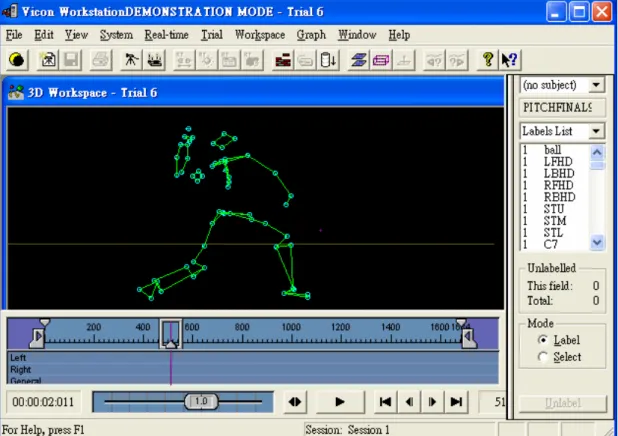
所拍攝的資料;拍攝和動作分析的工具為 VICON 624 系統 (圖 1-3)。真實動作的
分析結果將與虛擬動作的分析結果比較,以證明虛擬動作為較佳表現。
另一方面以虛擬人模擬真人的動作,找出棒球投手之投擲臂(pitching arm)的肩、肘、
腕關節的提供力矩(driving torques)與末端(手的質心)速度的關係,進而找出此投手目
圖3-2 運動時各肢段交互作用力矩圖(摘自Kreighbaum et al., 1996 )
根據動量傳遞的原理(Alexander et al., 1982; Atwater,1979),當近端肢段減速,
作分析方可一窺究竟。
(一)投球動作分期
Pappas et al.(1985)以15名職棒選手為受試者,使用高速攝影機200Hz進行投球動
作分析,以下是各過程中的特殊動作與時間點:
1.準備或舉臂期(Preparation or wind-up phase):由準備動作開始,將手臂舉起,到
球離開手套過程。
2.扳機期(Cocking phase):指投球臂由舉臂動作( wind - up)開始,肩關節水平外
地,投球臂開始向前作用,到棒球離手之過程稱為加速期。Feltne r等人(198 6) 與
Pappas等人(1985)指出加速期變化約從42至58毫秒,肩關節最大外轉約160°,球
離手時外轉約45°,加速期的範圍為35 - 58毫秒。Atwater(1979),Elliot等人
(1986,1988) ,Feltner(198 9)和Selin(1959)研究分析的球速範圍為31.7 - 45.1公尺
/秒。
4.跟進動作期( Follow through phase):自球離手開始,到完成投球動作為止之過
(肆) 研究方法
一、研究對象:本研究共有12 位國立體育學院棒球隊投手(8 名左投、4 名右投) 自願參與,這些受試者在過去3 個月內上肢各關節均無重大且影響實驗數值之 運動傷害,其年齡介於 18-23 歲。在實驗之前向受試者解說實驗流程與目的, 並簽署相關同意文件。期間包括兩次的測試: Biodex 等速肌力測試及 Vicon 動作分析系統拍攝。 二、實驗儀器: (一) 等速肌力測試:1. 硬 體 : 美 製 Biodex 等 速 測 力 儀 (Biodex Medical System 2001 Dynamometer, Shirley, NY)。
2. 軟體: Biodex Medical System Ⅲ分析軟體。
3. 使用情況:商借國立體育學院運動傷害防護研究所之等速測力儀。
(二) 三維動作分析:
1. 硬體:英製 Vicon 624(Vicon 3D Motion Analysis System, Oxford Metrics, UK)動作分析系統
(1) 主機與顯示器。 (2) 7 架紅外線攝影機。
2. 軟體:Vicon 之 Workstation 與 BodyBuilder 動作分析軟體。
3. 使用情況:商借國立體育學院運動科學研究所之三維動作分析系統。
(三) 電腦模擬分析軟體:
1. 硬體:筆記型電腦 (P4 2.4GHz 以上)
(二) 前臂:前臂之局部座標系統定義係依據橈骨莖突(Radius styloid process; rsp)與尺骨莖突(Ulna styloid process; usp)之中心點(RUM) 以及肱骨內、外髁所共同決定。其原點位於橈骨莖突與尺骨莖突 之中心點。Y 軸沿著前臂之長軸,內、外髁以及 Y 軸所定義之平 面決定Z 軸,X 軸由右手定則決定。詳細定義如下: MLM URM MLM URM forearm
P
P
P
P
Y
v
v
v
v
v
−
−
=
(
)
(
LEP MEP)
forearm(一) 資料收集:
1. 經由 Biodex 等速測力機取得峰值轉矩、相對體重峰值轉矩、作用肌與 拮抗肌力比值、動力、功等數值。
2. 經由 Vicon 攝影機拍攝所得之實驗資料經由 Vicon 之 Workstation 軟體完 成影片剪輯、修點、套用模型。 3. 處理過之實驗資料由 Vicon 之 BodyBuilder 軟體進行濾波、修勻及取得 各項運動學與動力學參數值。 4. 靜態測試影片之資料抓取範圍為 2 秒之完整不缺點影片。 5. 動態測試影片之資料抓取範圍為腳觸地(FC)前 20 張影片至肩最大內轉 後20 張影片。 6. 擷取參數為肩、肘與腕關節 X,Y,Z 等 3 軸之位移、速度、加速度、角度、 角速度、角加速度、作用力、力矩等數值。 (二) 資料分析:
1. 以 Office 2002 for Windows 之 Excel 進行統計分析。
(1) 將分析所得球速、肩、肘與腕關節之速度、角速度、作用力、力 矩做平均數、標準差分析,並畫出變化趨勢圖。
(2) 將測得之峰值轉矩、相對體重峰值轉矩、作用肌與拮抗肌力比值 做平均數與標準差分析。
2. 以 SPSS 10.0 中文版統計套裝軟體進行統計分析。
(1) 依據動力鏈原理,利用不同的動作形態組合,找出某個等速肌力 下可投出最大球速的最佳動作形態,即最佳化模擬。 (2) 最佳化模擬所得結果,將可對促進投球表現的方法上提出建議, 即如何用最小的肌力投出最快的球速。這結果也將幫助我們了解 關節力矩的限制,特別可解釋在加速期與跟進動作期之動作動力 學與等速肌力,以及涉及潛在運動傷害之細節。 三、使用LifeMOD 建立虛擬人
步驟一、建立全身肢段(Segments – Create BASE Set)
將真人資料(男性、240 個月大、173cm 高、72kg 重)套用到 GeBod 人體測量資
料庫(Anthropometric Database) 建立虛擬人的各肢段(圖 4-5)。模擬和分析過程所使
步驟二、建立關節(Joints – Create BASE Set) 依據Lifemod 軟體,關節的三軸向(圖 4-6)定義為: 1. 矢狀(sagittal)軸—肢段依此軸轉動在矢狀面活動,為左右方向、向左為正; 2. 衡(transverse)軸—肢段依此軸轉動在衡面活動,為上下方向、向上為正; 3. 額(frontal)軸—肢段依此軸轉動在額面活動,為前後方向、向前為正。 圖4-6 關節的三軸向定義
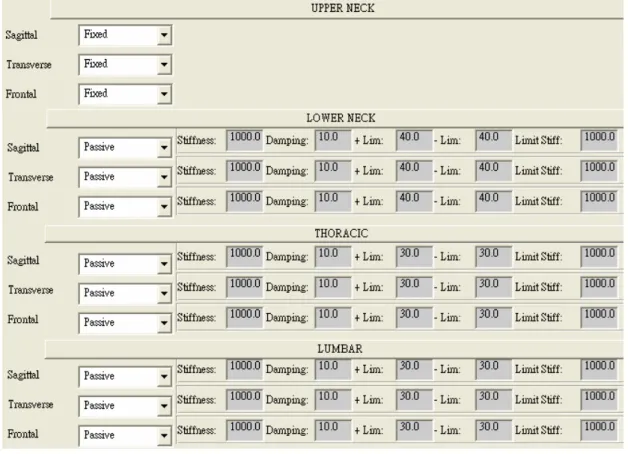
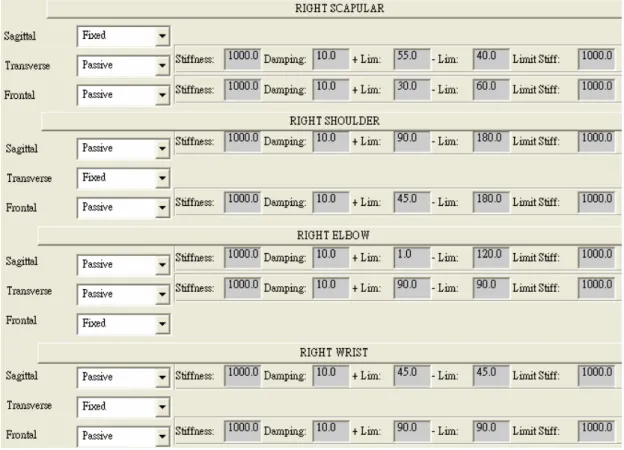
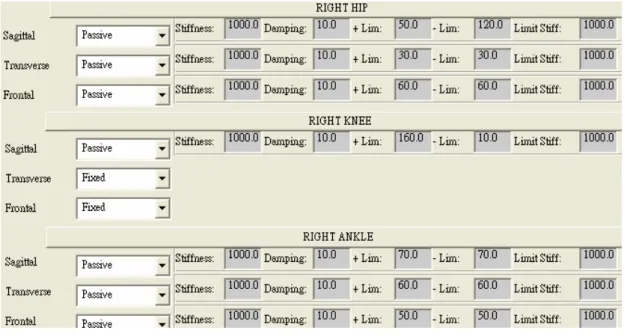
全身關節三軸參數選取有阻尼之彈簧(Spring Damper Joints with Stops) 內建資
料來設定(圖 4-7),其硬度(Nominal Joint Stiffness)為 1000、阻尼(Nominal Joint
Damping)為 10(Esteves, et al., 2004),結果如圖 4-8 a~e;其中,不動或少動的方向設
為固定(fixed),可動的方向設為被動(passive);各關節三軸向的驅動力矩(Driving
圖4-8d、左下肢關節(髖、膝、踝)設定
圖4-8e、右下肢關節(髖、膝、踝)設定
關節驅動力矩
步驟三、輸入動作點資料(Motion – MOCAP Data Import)
將VICON 拍攝之真實動作資料(從投手準備動作開始至球離手(圖 4-9)共 1.508
秒)依 LifeMOD 格式存成.slf 檔(圖 4-10):每列資料依序為 time(時間 sec)、part(拍攝
點編號)、x、y、z、yaw、pitch、roll,其中只選取拍攝點(LifeMOD 中稱為動作原動
力Motion Agents,MA)與 LifeMOD 身體點(Body Markers, BM)相同之資料套入(共
36 點,設為‘ON’,如圖 4-11 所示)。如圖 4-12 所示套入(Apply)後,MA 之時間序列
a. 準備 b. 肩關節最大外轉 c. 球離手 圖4-9、拍攝動作三個時間點之 VICON 處理圖
圖4-11、對應 LifeMOD 之拍攝點
圖4-12、動作輸入
步驟四、執行平衡分析(Equilibrium Analysis)
故1.508 秒內有 378 個時間點、377 步(Time Steps)將動作資料。依序點選 “Analyze”、
“Update Model Posture with equilibrium results”、 “Synchronize Body Marker Locations
with Data Locations”,可得 BM 與 MA 配當並同步後的結果(圖 4-14)。
步驟五、建立地面與足部接觸資料
在ADAMS/View 內建立地面基準
點(Contact Surface Marker):
.World.ground.flr,並配合虛擬人調整其
位置與方向。如圖十四所示,建立地面
與足部接觸資料;圖十三中的藍色面即
為地面。
圖4-15 地面與足部接觸資料之建立
步驟六、逆動力學分析(Inverse Dynamic Analysis, IDA)
在 _Analyze 之 Dynamics 模式下(圖 4-13)進行 IDA:勾選“−y”為重力方向、 不勾選 “Freeze Motion Agents for Equilibrium Analysis”;“Analyze” 後可得各關節驅
動力矩(Driving Torques)。圖 4-16 為虛擬投手(右手投擲)右邊腕、肘、肩關節驅動力
矩時間序列圖。要注意的是,分析後在關節處並無 “力” 項,是因為虛擬人的關節
圖4-16 LifeMOD IDA 之右臂腕、肘、肩驅動力矩
驅動虛擬人
步驟七、建立驅動源(Servo Spline) 在逆動力學分析(IDA)後,已產生各關節的驅動力矩和角度隨時間變化的資 料。要讓被動的虛擬人成為自動,需將關節型態由被動(Passive)改為驅動(Servo), 並提供所需的驅動源(Servo Spline, SS):SS 建立由圖 4-17 所示。在刪去所有的動作原動力(Motion Agents)、並製造新的軌跡原動力(Tracker Agent,圖 4-18)後,進行正
圖4-17 建立動作源之設定
(伍) 結果
第一節 上肢等速肌力結果
本節呈現肩關節屈曲/伸展、外展/內收、外旋/內旋動作、肘關節屈曲/伸展、前臂旋 後/旋前動作與腕關節屈曲/伸展動作的等速肌力結果。一、肩關節等速肌力
肩關節的測試動作為外旋/內旋、屈曲/伸展、外展/內收動作,其中屈曲/伸展及 外展/內收軸向測試角速度為 60、180、300、360°/s,外旋/內旋軸向為 60、180、300、 500°/s。肩關節外旋/內旋、屈曲/伸展、外展/內收的峰值轉矩與產生時之關節角度分 別示於表 5-1.1、5-1.2、5-1.3。結果顯示產生峰值轉矩時的關節角度在測試速度越 高時,峰值產生點會越接近動作末端位置,肩關節外旋峰值轉矩產生點為角度遞 減、內旋為角度遞增、屈曲為角度遞增、伸展從180°/s 增加後其角度為遞減、外展 為角度遞增、內收為角度遞減,此外峰值轉矩皆會隨著角速度增加而降低,這種情 形符合力量-速度關係所說明的現象(Mayer et al., 1994)。肩關節內旋軸向峰值轉矩 的平均值皆大於外旋軸向、伸展軸向皆大於屈曲軸向、內收軸向皆大於外展軸向, 此 結 果 和 許 多 相 關 研 究 結 果 相 同 (Clements et al.,2001; Williams et al., 1998; Ellenbecker et al., 1997; Wilk et al., 1995) 。SD 8.80 5.22 4.68 8.48 M 39.70 35.00 32.40° 25.20 展
關節角度(°)
圖5-4.3 FDS 後右邊腕、肘、肩關節驅動力
檢討
在第三章IDA 後,本以為能將 Driving Torques 當作 Servo Spline 來進行 Forward
Dynamics Simulation,不料 Servo Spline 必須為關節角度時間序列;這造成預定要分
3. 改變合力峰值的時間、
4. 改變合力矩峰值的時間、
5. 改變用力型態。
圖6-1.1 肩關節內旋等速肌力相關文獻比較圖
圖6-1.4 肩關節屈曲等速肌力相關文獻比較圖
圖6-1.5 肩關節內收等速肌力相關文獻比較圖
二、肘關節與前臂
表6-1.2 彙整國內外有關肘關節等速肌力相關研究結果,數據比較結果繪製成 折線圖如圖6-1.7 與圖 6-1.8。肘關節峰值轉矩皆會隨著角速度增加而降低,這種情 形符合力量-速度關係所說明的現象(Mayer et al., 1994),推測峰值產生點因測試速 度越高越接近動作末端位置的原因同於肩關節結果的現象。國內外文獻比較結果示 於圖6-1.7 與圖 6-1.8,本研究肘關節屈曲與伸展肌力皆劣於國外研究結果,肘關節 在解剖學分類上屬於屈戍關節,執行關節動作為單軸向動作,因此在等速肌力測試 上只能進行屈曲與伸展動作測試,而屈曲動作主要動作肌群為肱二頭肌、伸展動作 主要動作肌群為肱三頭肌。Clements 等人(2001)指出肘關節伸展等速肌力與球速達 顯著正相關,顯示肱三頭肌肌力對於增加球速來說扮演正向角色,然而本研究肘關 節肌力結果劣於國外研究結果,因此在球速表現上呈現較低的結果。 表6-1.2 相關文獻肘關節峰值轉矩表 測試角速度(°/s) 60 120 180 240 300 360 450 關節動作 肘關節屈曲/伸展 (Elbow flexion / extension)Pawlowski & Perrin 56.4/ 57.9 37.9/ 39.6 Clements 等人 50.4/ 56.3
Chen & Tang 49.4/ 51.1 33.9/ 38.5 25.7/ 33.3 15.9/ 23.1
本研究 45.6/ 49.1 33.8/ 37.5 25.9/ 30.0 21.0/ 26.2
圖6-1.7 肘關節屈曲等速肌力相關文獻比較圖
表6-1.3 彙整國外與本研究前臂等速肌力研究結果,數據比較結果示於圖 6-1.9 與圖6-1.10。前臂峰值轉矩皆會隨著角速度增加而降低,越接近末端關節其誤差越 高,在前臂與腕關節部分作討論的相關研究比較少且重要性較低,此處提供數值作 為參考,期望後續研究加入討論以作比較。 表6-1.3 相關文獻前臂峰值轉矩表 測試角速度(°/s) 0 30 60 90 120 150 210 關節動作 前臂旋前/旋後 (Forearm pronation / supination)
圖6-1.10 前臂旋後等速肌力相關文獻比較圖
第二節 球速與上肢各關節峰值轉矩相關性分析
點,接著在加速期中下降至第2 峰值,肩、肘與腕關節合峰值力矩產生時間順序不 同於合峰值作用力方式,然而在合峰值作用力同時出現情形之下,合峰值力矩出現 之順序卻顯現差異。
二、各關節峰值作用力在各投球分期中的出現百分比與運動傷害探討
棒球投擲之動力鏈是相當複雜且不具規則的動力傳遞,峰值作用力 與峰值力矩所產生的時機也都不盡相同,因此統合出動力鏈傳遞的規則 性,有助於瞭解投球動力模式。投球過程之中,作用力對於關節產生牽 張力(tension force)、壓迫力(compression force)與剪力(shearing force),將 對關節產生累積性傷害,長期下來容易產生關節磨損退化、韌帶鈣化與 撕裂、肌腱炎(tendinitis)等症狀,深入探討其量化數據與時間特徵,對於 掌控投手之運動傷害產生時機與預測實際負荷情況有具體的參考價值。 表 4-3.2 顯示各關節峰值作用力出現比率最高的期別:扳機期中包 括:肩關節的後向(達 88.8%)、向上峰值作用力(達 90%)、肘關節的後向 峰值作用力(達 80%)、腕關節的外側峰值作用力。在扳機期末段,肩關節 極度外旋、肘關節屈曲90°、前臂外翻,此時肘關節為抵抗外翻壓力,將 產生一巨大內翻力矩,此外,前臂的旋前與屈曲肌群也提供部分內翻力 矩,當此肌群衰退或疲勞時,將增加內側副韌帶的負荷,更進一步增加 韌帶傷害的危險性,重覆性的壓力在內側副韌帶與關節囊將導致生成骨 刺(spur),進而產生神經壓迫的症狀(Wojtys et al., 1986)。Morrey 等人(1983)內就以優異的球速聞名,出國前也未曾出現嚴重的運動傷害,然而在美 國職棒隊訓練下,還是出現了肘關節內側副韌帶斷裂等運動傷害,或許 東西方投球模式有很大差異,以致於東方投手可以在產生較小肘關節內 翻力矩情形下達到相等的球速表現,可能同時造成東方投手接受西方投 球訓練下,對肘關節內側副韌帶負荷增加,助長潛在的運動傷害危機, 其中原因可能必須建立大量常模資料庫來佐證東西方投手在韌帶負荷承 受模式的異同,以玆證明上述觀點。 加速期中包括:肩關節的合峰值作用力(達 90%)、前向、向下峰值作 用力、肘關節的合峰值作用力(達 90%)、前向、外翻峰值作用力等、腕關 節的合峰值作用力(達 90%)、前向(達 80%)、後向(達 83%)。在加速期間, 肩關節囊的鬆弛與肌力衰退將造成極度不穩定,也增高摩擦的危險性; 此期肘關節以鷹嘴突(olecranon)嵌進鷹嘴窩(olecranon fossa)的方式來提 供一部分的肘關節內翻力矩,這種快速的夾擠(impingement)極易產生肘 關節內後側(posteromedial)疼痛或是產生碎骨。 減速期中包括:各關節峰值壓迫力(皆達 100%),本期肩關節為幫助 手臂減速受到極大的肢段牽拉力,易產生肩關節旋轉帶發炎進而產生肩 關節夾擠症候群(shoulder impingement syndrome)、肩盂唇撕裂等症狀。 Andrews 等人(1985)指出在減速期間,手臂水平內收和內轉之下,肱骨頭 向前轉移可能會導致肱骨大結節在肩峰下表面或喙峰韌帶下夾擠肩關節 旋轉肌或肱二頭肌造成肌腱炎或破損。McLeod 等人(1986)研究指出在壓 迫力產生期間,任何在關節盂窩邊緣移動肱骨頭的力量將導致肩盂唇產 生受傷的風險,特別在肱骨頭向前或向後轉移和次鬆弛的現象將可能導 致介於肱骨頭與盂緣之間的肩盂唇嚴重陷入,而造成肩盂唇破裂。 Andrews 等人(1985)研究指出在減速期時,肩關節水平內收與內轉時,肩 關節旋轉肌試圖抵抗手臂分離的力量,逐漸產生撕裂而造成肌力衰退。
遞,也利用轉動慣量的改變以交互運用以達到最大關節角速度再配合所 有關節作用力臂在離手瞬間伸展至最大力臂範圍,最後將所有力量灌輸 在球體之上以達到最大球速。不少的棒球界專家認為東方投手在這一方 面所使用的技巧可能更甚於西方投手,東方投手利用其優異的全身協調 能力來發揮他們的天份,以填補其身材上的劣勢,不過近年來有許多身 材優異的東方投手(包括:落磯隊終結者曹錦輝、洋基隊王建民、道奇隊 郭泓志等台灣投手)頻頻將球速發揮至 95 甚至 100 英哩/小時以上,他們 擁有傲人身材也擁有優異的投球協調技巧,所以球速上的表現並不遜於 西方投手,掌握住應該有的優勢再加上有效率運用, 配合動作分析量化 研究予以建議與改進,相信假以時日也能迎頭趕上世界頂尖的技術水準。
第四節 投球分期時間與肩關節最大外旋角度
一、投球分期時間
(一)扳機期之觸地點(FC)至肩最大外旋(MER)的平均時間 本研究全體受試者由FC 至 MER 之平均時間為 155.6±53.2 毫秒,而 Feltner 等人(1986)以 8 名大學投手測試,平均時間則為 151±7 毫秒,另 Werner 等人(2001) 以40 位職棒投手測試,平均時間為 124±22 毫秒,兩個研究結果相當接近本研 究,本測試中10 名投手有 2 名超過 200 毫秒,1 名低於 70 毫秒為較特殊案例, 在球速上的表現此3 名皆低於總平均值 5 公里/小時。此期的主要目的在於增加 投球的工作距離,時間過長過短皆不適宜:時間過短可能造成肩關節外旋工作 距離不足,時間過長則容易錯過最佳肌肉施力關節角度,顯現出適當的肌肉微 控技巧以及關節活動度應用是本期最重要的關鍵所在。 (二)加速期之肩最大外旋(MER)至球離手(REL) 的平均時間參考文獻
一、中文部分
王苓華(2001):軟式網球選手肩部旋轉肌群的功率與總功量之研究。大專體育學刊, 第三卷第二期,頁153-160。 陳九州、蘇雄飛、林敏政、高英傑(1993):棒球投手上肢等速肌力與投球速度之相 關性探討。北體學報,第二期,頁197-226。 陳全壽(1993):速度、肌力、耐力的生理特性及訓練法。1993 年國際運動訓練科學 研討會論文集。 陳雅琳、王百川(1997):棒球投手之肘關節傷害。體育與運動,第 102 期,頁 50-55。 莊林貴、蔡一鳴、曾慶裕、王秀銀(2002):青棒投手不同投球法之投球速度與肩關 節等速肌力的相關性之研究。北體學報,第十期,頁83-92。 黃啟煌(1996):肩關節旋轉帶傷害之復健。國民體育季刊,第二十五卷第四期,頁 58-66。 黃紹禮、蔚順華、黃紹仁(1999):不同等級女性網球選手肩內外轉肌之等速肌力分 析。大專體育學刊,第一卷第一期,頁59-69。 黃紹禮 (2000):優秀及休閒女性網球選手肩內外轉肌反覆收縮後肌力衰退之比較。 大專體育學刊,第二卷第一期,頁61-81。二、
外文部分
Alderink, G.J., & Kuck, D.J. (1986): Isokinetic shoulder strength of high school and college-aged pitchers. Journal of Orthopedic and Sports Physical Therapy, 4:163-172.
Anita S.C., Karen A.G. & Elizabeth H. (2001): Correlation between strength and throwing speed in adolescent baseball players. Physical Therapy in Sports, 2:123-131.
compartment sprains of the knee. Journal of Orthopedic and Sports Physical Therapy, 16:288-292.
Bartlett L.R., Storey M.D., Simons B.D. (1989): Measurement of upper extremity torque production and its relationship to throwing speed in competitive athlete.
American Journal of Sports Medicine, 17:89-91.
Brown, D.P., Niehues, S.L. & Harrach, A. (1988): Upper extremity range of motion and isokinetic strength of the internal and external shoulder rotators in major league baseball players. American Journal of Sports Medicine, 16:577-585.
Chandler, T.J., Kibler, W.B., Stracener, E.C., Ziegler, A.K., & Pace, B. (1992): Shoulder strength, power, and endurance in college tennis players. American Journal of Sports Medicine, 20:455-458.
Clements, A. S., Ginn, K.A., & Henley, E. (2001): Correlation between muscle strength and throwing speed in adolescent baseball players. Physical Therapy in Sport Journal, 2:123-131.
Codine, P., Bernard, P.L., Pocholle, M., Benaim, C., & Brun, V. (1997): Influence of sports discipline on shoulder rotator cuff balance. Medicine and Science in Sports and Exercise, 29:1400-1405
Cohen, D.B., & Mont, M.A. (1994): Upper extremity physical factors affecting tennis serve velocity. American Journal of Sports Medicine, 22:746-751.
Cook, E.E., Gray, V.L., & Savinar-Nogue, E. (1987): Shoulder antagonistic strength ratio a comparison between college-level baseball pitchers and nonpitchers. Journal of Orthopedic and Sports Physical Therapy, 8:451-461.
baseball pitch. International Journal of Sports Biomechanics , 2:235-259. Figoni, S., Christ, C.B., & Mossey, B.H. (1988): Effect of speed, hip and knee angle
and gravity on hamstring to quadriceps torque ratio. Journal of Orthopedic and Sports Physical Therapy, 9:287-291.
Fleisig, G.S., Andrews, J.R., Dillman, C.J., & Escamilla, R.F. (1995): Kinetics of baseball pitching with implications about injury mechanisms. American Journal of Sports Medicine, 23:233-239.
Fleisig, G.S., Barrentine, S.W., Escamilla, R.F., & Andrews, J.R.(1996):Biomechanics of overhand throwing with implications for injuries. Sports Medicine,
21:421-437.
Forthomme, B., Croisier, J.I., Foidart-Dessalle, M., & Crielaard, J. M. (2002): Isokinetic assessment of the forearm and wrist muscles. Isokinetics and Exercise Science, 10:121-128.
Gowan, I.D., Jobe, F.W., Tibone, J.E., Perry, J., & Moynes, D.R. (1987): A comparative electromyographic analysis of the shoulder during pitching. American Journal of Sports Medicine, 15:586-590.
Hinton, R.Y. (1988): Isokinetic evaluation of shoulder rotational strength in high school baseball pitchers. American Journal of Sports Medicine, 16:274-279.
Ivey, F.M., Calhoun, J.H., Rusche, K., & Bierschenk, J. (1985): Isokinetic testing of shoulder strength, normal value. Arch. Physical Medicine Rehabilitation, 66:384-386.
Jacobs, P. (1987): The overhand baseball pitch. A kinesiological analysis and related strength-conditioning programming. NSCA Journal, 9:5-13, 78-79.
Kennedy, K., Altchek, D.W., & Glick, V. (1993): Concentric and eccentric isokinetic rotator cuff ratios in skilled tennis player. Isokinetics and Exericise Science. 3:155-159.
Moore J., & Wade, G. (1989): Prevention of anterior cruciate ligament injuries. NCSA Journal, 11:35-44.
Morrissey, M.C. (1987): The relationship between peak torque and work of the quadriceps and hamstrings after meniscenctomy. Journal of Orthopedic and sports Physical Therapy, 8:405-408.
Murray, T.A., Cook, T.D., Werner, S.L., Schlegel, T.F., & Hawkins, R.J. (2001): The effects of extended play on professional baseball pitchers. American Journal of Sports Medicine, 29:137-142.
Osternug, L.R., Sawhill, J.A., Bate, B.J., & Hamill, J. (1982): Relative influence of torque and limb speed on power production in isokinetic exercise. Medicine and Science in Sports and Exercise, 14:178.
Pappas, A.M., Zawacki, R.M., & Sullivan, T.J. (1985): Biomechanics of baseball pitching: a preliminary report. American Journal of Sports Medicine, 13: 216-222.
Pawlowski, D., & Perrin, D.H. (1989): Relationship between shoulder and elbow isokinetic peak torque, torque acceleration energy, average power, and total work and throwing velocity in intercollegiate pitchers. Athletic Training, 24:129-130.
Pedegana, L.R., Elsner, R.C., & Robert, D. (1982): The relationship of upper extremity strength to throwing speed. American Journal of Sports Medicine, 10:352-354. Pradhan, R.L., Itoi, E., Hatakeyama, Y; Urayama, M., & Sato, K. (2001): Superior
Singh, H., Osbahr, D.C., Wickham, M.Q., Kirkendall, D.T., & Speer, K.P. (2001): Valgus laxity of the ulnar collateral ligament of the elbow in collegiate athletes. American Journal of Sports Medicine, 29:558-561.
Sale, D.G. (1991): Testing strength and power, Physiological testing of the
high-performance athlete, second edition. Human Kinetics Books, Canadaian association of sports science, 21-106.
Sisto D.J., Jobe F.W., Mynes D.R., & Antonelli D.J. (1987): An electromygraphic analysis of the elbow in pitching. American Journal of Sports Medicine, 15:260-263.
Soderberg, G.J. & Blaschak, M.J. (1987): Shoulder internal and external rotation peak torque production through a velocity spectrum in differing position. Journal of Orthopedic and Sports Physical Therapy, 8:518-524.
Toyoshima, S., Hoshikawa, T., Miyashita, M., & Oguri, T. (1974): Contribution of the body parts to throwing performance. Biomechanics Ⅳ University Park Press, Baltimore, 169-174.
Vanswearingen J.M. (1983): Measuring wrist muscle strength. Journal of Orthopedic and Sports Physical Therapy, 4:217-228.
Walmsley, R.P., & Szybbo, C. (1987): A comparative study of the torque generated by the shoulder internal and external rotator muscles in different position and at varying speeds. Journal of Orthopedic and Sports Physical Therapy, 9:217-222. Werner, S.L., Fleisig,G.S., Dillman, C.J., & Andrews, J.R. (1993): Biomechanics of the
elbow during baseball pitching. Journal of Orthopaedic and Sports Physical Therapy, 17:274-278
29:354-358.
Wilk K.E., Arrigo C.A., & Andrews J.R. (1993): Isokinetic testing of the shoulder abductors adductors, Windowed v.s. nonwindowed data collection. Journal of Orthopedic and Sports Physical Therapy, 15:107-112.
計畫成果自評
可供推廣之研發成果資料表、附錄
1. Yi-Ling Chiang and Wen-Tzu Tang* (2005) Rotation Characteristics Of The Shoulder,
Torso, And Pelvis During Pitching For Taiwan Elite And Subelite Collegiate Baseball Pitchers. Presented in XXth Congress of the International Society of Biomechanics, Cleveland, OH, USA, August 1-5, 2005.
2. 陳建銘、湯文慈 (2004)上肢等速肌力相關參數在棒球投手訓練之應用,大專體 育,75。 , ISSN 00156-0382-2
3. Chen, C. -M. and Tang, W.-T*.: Comparison between Isokintic Strength and Applied Torque in the Upper Extremity During Pitching by Collegiate Baseball Pitchers. 4. 陳建銘,湯文慈*,龔容堂(2003)。大專優秀投手上肢等速肌力特性與離手球速
之相關性探討。2003 台灣運動生物力學年會暨國際學術研討會,69-70 頁。 ( ISBN 986-80689-0-8)
95 年 8 月 15 日
出席國際學術會議心得報告
計畫編號 94-2413-H-179-001-計畫名稱 優秀棒球投手等速肌力探討與投擲動力學最佳化模擬(2/2) 出國人員姓名 服務機關及職稱 湯文慈 國立體育學院 教練研究所 助理教授 會議時間地點 德國 慕尼黑 Germany, Munich 會議名稱 (中文) 第 五 屆 國 際 生 物 力 學 學 術 研 討 會 (英文) The 5th World Congress of Biomechanics發表論文題目
”The characteristics of postural tremors for the elite shooting players under different standing postures”及”The comparison of grab and track start in force, time, stretch-shorten-cycle, and performance efficiency " 及” The comparison of kinematics characteristics between single and successive kicking techniques for the taekwondo player with an Olympic medal:a case study