
評價系統在歐亨利的敘事篇章中的運用
141
0
0
全文
(2) 國立屏東商業技術學院 應用英語系(所) ( 碩) 士 論 文 101. 評價系統在歐亨利的敘事篇章中的運用. 蘇美芬撰.
(3) The Application of Appraisal System in the Three Narrative texts of O. Henry. Advisor: Dr. Chun-Mei Shieh By: Mei-Fen Su. A Thesis Submitted to the Graduate Program of Applied English In Partial Fulfillment of the Requirements For the Degree of Master of Arts National Pingtung Institute of Commerce. Pingtung, Taiwan, R.O.C. January, 2013.
(4) 摘要 本研究主旨在以系統功能語言學之人際功能的評價系統分析歐亨利的三篇敘 述故事篇章。Halliday 在 1960 年代發展系統功能語言學之後,Martin 根據系統 功能語言學的人際功能,於 1990 年代發展評價理論(系統),使人際功能更加完 善豐富。評價理論(系統) 是從語篇語義層面來探討有關於社會互動的協商。評 價系統有三個子系統包括態度、介入、級差。在台灣,因為這三個子系統的相關 研究尚不普遍,因此本研究的目的是根據這三個子系統探索敘述故事篇章的評價 資源與語言的關係,以期具體的闡述作者對當時社會裡赤貧者的觀察與關心,進 而揭露資本主義社會的消極和腐敗的一面和人性光輝的另一面。 本研究方法是用篇章分析的質化研究,篇章資料是來自歐亨利的三篇敘述故 事,發表在 20 世紀初美國的一個揭發醜聞的時代,三篇敘述故事包括最後一片 葉子,聖誕節的禮物、天窗室。本研究的語料分析結果是用描敘性的統計量性呈 現的。 研究結果顯示如下:(1) 在整個評價系統裡,三個子系統的評價資源平均的 分佈在三個語篇中,其中的級差子系統出現頻率最高,說明作者運用大量的強弱 語言資源形容痛苦的生活感覺;(2) 在態度子系統方面,判斷和鑑賞出現頻率比 情感高,而且消極詞彙比積極詞彙多,說明作者運用較多客觀的和消極的態度語 言資源去評估窮人的行為表現與事件的發生,進而呈現窮人的真實生活;(3) 在 介入子系統方面,對話的收縮與擴展分布相當平均,說明作者客觀地運用中庸的 立場與讀者們建立關係;(4) 在級差子系統方面,語勢的數量語言資源大量出現 在三個語篇中,而聚焦的確切性的語言資源出現極少,說明作者很技巧的、很具 體的引發讀者對窮人困境的共鳴。 作者根據此研究結果提出評價系統在英語教學及對未來相關研究之建 議,以供參考,希望此研究能提供英語教學和文學欣賞的新視野。 關鍵字: 系統功能語言學,人際功能,評價理論/系統,敘述故事. i.
(5) Abstract The purpose of this study is to analyze three narrative texts from the perspective of the appraisal theory (system), which is based on the interpersonal metafunction of Systemic Functional Linguistics, first developed in the 1960s by M. A. K. Halliday. Also, J. R. Martin has been developing the appraisal system since the 1990s, enriching the resources of interpersonal dimension analysis. The appraisal system concerns the negotiation of social interactions at the level of discourse semantics, including three sub-systems: 1. attitude, 2. engagement, and 3. graduation. The aim of this study is to explore the relationship between appraisal resources in narrative texts and in language, Also, present writer’s perceptions about the bankruptcy of life under capitalist society and glow the brilliance of humanitarian thought. The research methodology of this study involves descriptive statistic and discourse analysis. Corpus data is from three narrative texts of O. Henry (1862~1910) written during the muckraker era. The stories are: “The Last Leaf,” “The Gift of The Magi,” and “The Skylight Room.” The four significant findings of this study are as follows: first, in general, the three texts make average use of the three sub-systems of the appraisal framework. The highest distribution is the graduation resource, which either amplifies or reduces the miserable feeling of disappointment the stories present. Second, in terms of attitude, judgment and appreciation occur more frequently than affect. Hence, the writer uses a ii.
(6) more attitudinal lexis to evaluate the poor people’s behavior, performances and things present in their daily lives. Also, the negative lexis of attitude occurs more often than the positive lexis of attitude; so the writer’s conception of moral bankruptcy is negative and pitiful, expressing a terrible situation. Third, engagement frequently occurs in both dialogic contractions and expansions, indicating that the writer objectively uses both contraction and expansion dialogue to build and align his ideas with those of his readers. Finally, the overwhelming majority of graduation resources are force resources. Obvious focus resources occur rarely, which indicates that the writer uses plenty of quantification resources to concretely express the despair of poverty and, thereby, trigger sympathetic responses. Hopefully this study will offer new perspectives on English teaching and literature in Taiwan. Therefore, pedagogical implications and suggestions for future research conclude this study. Keywords: Systemic Functional Linguistics, interpersonal metafunction, Appraisal Theory/System, narrative. iii.
(7) Acknowledgements Completing this master’s degree would have been impossible without the great support and assistance from many important people. I would like express my respect and appreciation to them all. First, my deepest appreciation goes to my advisor, Dr. Chun-Mei Shieh, for her professional instruction and inspiration, which guided my research and helped me achieve this thesis. I am grateful for Dr. Shieh’s expert and enlightening guidance, which enabled me to understand SFL’s complex perspectives on language. In addition, I would like to extend a very special thanks to my committee members, Dr. Tzung-Hung Tsai and Dr. Feng-Hung Tsai, for their careful reviewing of my work and invaluable comments on the development of my thesis. I would also like to extend my gratitude to my students’ parents in financial support, all teachers, and classmates; without their help and confidence I wouldn’t have been able to finish the master’s degree and learn everything necessary to complete this thesis in the Department of Applied English at the National Pingtung Institute of Commerce. Finally, my heartfelt appreciation goes to my mom, siblings and family for their spiritual support and encouragement. Without their expectations and inspiration, it would have been impossible for me to accomplish this thesis. I am ever grateful and thankful to all of them. iv.
(8) Table of Contents Abstract (Chinese) ......................................................................................................... i Abstract ......................................................................................................................... ii Acknowledgements...................................................................................................... iv Table of Contents ...........................................................................................................v Tables .......................................................................................................................... vii Figures ..................................................................................................................... viii CHAPTER 1 ..................................................................................................................1 Introduction............................................................................................................1 Background and Motivation ..........................................................................1 Problem Statement……. ...............................................................................6 Purpose of the Study ......................................................................................7 Research Questions. ......................................................................................7 Significance of the Study ...............................................................................7 Definitions of Key Terms...............................................................................8 Organization of the Thesis ...........................................................................10 CHAPTER 2 ................................................................................................................12 Literature Review… ....................................................................................................12 An Introduction to SFL........................................................................................12 The Historical Development of SFL............................................................12 The Concept of SFL.....................................................................................13 Genre theory.........................................................................................15 Register theory…. ...............................................................................17 Five elementary conceptions for studying language............................18 Discourse semantic .............................................................................24 Appraisal Theory (AT)/Systems…… ..................................................................26 Attitude ........................................................................................................30 Engagement .................................................................................................36 Graduation....................................................................................................39 The Relevant Previous Studies of AT ..................................................................42 The Application of AT to English Teaching.........................................................47 Summary.. ….……...............................................................................................49 CHAPTER 3 ................................................................................................................51 Methodology......................................................................................................51 The Research Design .................................................................................51 Data Collection Procedures ......................................................................52 Data Analysis……………………………………………………………… ….54 v.
(9) The Contents of the Three Short Stories……………………………..54 The Language Features of the Three Short Stories..............................56 Ways to Analyze the Three Short Stories…….....................................58 CHAPTER 4 ..............................................................................................................63 Results and Discussion ........................................................................................63 Research Questions 1: How are the AT resources distributed in the three texts of O. Henry? ....................................................63 Research Questions 2: How does AT reveal the attitude resources in the three texts of O. Henry? .....................................65 Research Questions3: How does AT reveal the encoding of engagement resources in the three texts of O. Henry; and what is the relationship of the texts to the reader? ...............72 Research Questions 4: How does AT reveal the graduation resources in the three texts of O. Henry? .................................77 CHAPTER 5 ................................................................................................................80 Conclusions..........................................................................................................80 Summary of the Major Findings ..................................................................80 Pedagogical Implication in This Study ........................................................82 Limitations of the Study...............................................................................84 Suggestions for Further Research ................................................................85 References....................................................................................................................87 Appendix A: Analysis of Appraisal System from Text1: The Last Leaf .....................95 Appendix B: Analysis of Appraisal System from Text 2: The Gift of The Magi ......108 Appendix C: Analysis of Appraisal System from Text 3: The Skylight Room .........118. vi.
(10) Tables Table 1 Family of Story Genres and their Schematic Structure...................................16 Table 2 The Definition of three Register Variables and their Relationship to the Matefunctions in the Studied Texts..................................................................17 Table 3 The Dimensions (forms of order) of Language and their Ordering Principles..........................................................................................................18 Table 4 Discourse System and Metafunctions .............................................................25 Table 5 Key Resources for Text Analysis (by Strata and Metafunction).....................26 Table 6 Options for Affect ...........................................................................................31 Table 7 Irrealis Affect and Realis Affect......................................................................32 Table 8 Examples of Character Judgment....................................................................34 Table 9 Types of Judgment ..........................................................................................34 Table 10 Types of Appreciation ...................................................................................35 Table 11 Options for Graduation.. ...............................................................................40 Table 12 An Outline of the Most Relevant Narrative Studies that use AT...................46 Table 13 Themes and Main Points of the Three Texts.................................................56 Table 14 Rank Scale at the Lexico-grammar Stratum in a System Approach .............57 Table 15 The Overall items of AT and Abbreviation of Each Subtype ......................60 Table 16 The Items Definitions in AT and Example Sentences from the Three Texts.61 Table 17 The Distribution of Appraisal Resources and Percentages ...........................65 Table 18 The Distribution of Positive and Negative of Attitude..................................66 Table 19 The Distribution of Affect Resource items in the Three Texts......................70 Table 20 The Distribution of Each Item of Judgment Resources in the Three Texts ..71 Table 21 The Distribution of Each Item of Appreciation Resources in the Three Texts……………………………………………………………………………...72 Table 22 The Distribution of the Engagement Resources of Contraction and Expansion in the Three Texts.......................................................................74 Table 23. The Distribution of Engagement Resources in the Three Texts...................74 Table 24. The Distribution of Graduation Resources in the Three Texts.....................79. vii.
(11) Figures Figure 1. A strata interpretation depicting the relation of language to social context..15 Figure 2. Stratification….. ...........................................................................................20 Figure 3. Cline of instantiation…... .............................................................................21 Figure 4. Appraisal systems: an overview... ................................................................29 Figure 5. Judgment and appreciation as institutionalized affect..................................31 Figure 6. The engagement subsystem ..........................................................................38 Figure 7. The graduation subsystem………………………………………………….41. viii.
(12) CHAPTER 1 Introduction Background and Motivation Generally speaking, linguistics and literature are not the same, linguistics being a kind of scientific study of language. The goal of linguistics is to describe language and speech in all its relevant theoretical and practical aspects. On the other hand, literary studies relate to the critical analyses of stories, drama, and poetry. A story tells about events according to the real order of their happening. In other words, narrative description is the contents of a story (as cited in Dai, 2005). Kenney (1988) points out that a story exists for reading, according to its literary merits and availability. The readers of stories might desire to access different viewpoints, so readers need to have some worldly knowledge and critical competence to understand the stories. Huisman (2007) indicates that all research about narrative supposes research narrative is the study of story; so it is important to use techniques from various studies of narrative in order to create models for the purpose of analysis. It is vital to regard the narrative model as systemic. Eggins (2004) illustrates that: “The function of literary texts is to defamiliarize experience, and they generally do this by defamiliarizing the use of language. This defamiliarization then forces us to slow down. One of the dimensions of language that literary works often defamiliarize is genre” (p. 80). When people read. 1.
(13) a new story, they usually draw on different ways of approaching the text. For instance, people may read literary texts slowly or many times over to understand their implications. On the other hand, people rarely re-read romance novels. In other words, people learn to read different genres in different ways. People enjoy reading literary texts more slowly or many times over, because it allows them to capture new meanings while also getting used to a new genre. Eggins (2004) explains that the important function of literary texts, that is, literature is to expose our basic desire for genre. Research about story telling has a long history, widely exploring classical narrative literature, philosophy, and religion. Stories intimately influence our daily lives, because they describe the diversity of our world, enabling us to evaluate one another’s reactions, and to educate and entertain people. Martin & Rose (2008) point out that a story tells about the social life of people according to their words and deeds. Stories interact with readers by functioning as education and recreation; they inspire the imagination of adults and children everywhere. Thus, stories play the most important role in every genre. According to the classifications of genre (Martin & Rose, 2008), narrative is one member of the story genre family. Narratives are kinds of “stories which are concerned with protagonists who face and resolve problematic experiences” (Eggins, 2004, p. 70). The purposes for using the language of narrative. 2.
(14) are to form a series of events with a problematic and unexpected result that excites and educates the reader or listener (Butt, Fahey, Feez, Spinks & Yallop, 2001). In Europe and North America, narrative studies (or narratology) also research other uses of narrative, such as the sociolinguistic study of oral story-telling. Narrative structures also comprise semantic structure, language, culture, and forms of discourse. The implications of narrative analysis have also expanded into psychology, sociology, and other related fields (Martin & Rose, 2008). In terms of the length of story, Kenney (1988) mentions that a short story may be from five hundred to fifteen thousand words; whereas, a novel is relatively long, at least forty-five thousand words or much longer. Therefore, the contents of this study—three texts by O. Henry—belong to the category of short story, because the length of each text is about two thousand words. The present study uses the Appraisal Theory (AT, also known as the Appraisal System) of the interpersonal metafunction of Systemic Functional Linguistics (SFL) to analyze the three O. Henry short stories in order to deeply appraise their content and decode how appraisal resources may help readers more precisely understand the stories’ themes and language. The last several decades has seen a tremendous wave of interest in SFL, which includes three metafunctions: the ideational, the interpersonal, and the textual. SFL is a new mold for grammar first set out by M.A.K. Halliday in the 1960s. Eggins (2004). 3.
(15) mentions the common applications of SFL analyses, which emphasize social interaction in texts. In other words, the interplay of people represents an interaction based on social relationships that include cultural and other social contexts. Such analyses are possible because, as Eggins points out, “language is a semiotic system, a conventionalized coding system, organized as sets of choices” to interpret how human beings interact and make meaning (p. 3). Martin and White (2008) clarify that SFL regards language resources as the notion of choice. Wang (2001) indicates that SFL analyzes lexical grammar and regards clauses as exchanges, realizations, and information messages. Tian and Wang (2008) also indicate that SFL characteristically explores linguistic functions according to the three metafunctions, as well as contextually coherent relationships, coherence and cohesiveness in texts, theme-rheme structure and thematic progression, lexical metaphor and grammatical metaphor, and so forth. However, SFL has paid little attention to evaluating the semantics of speakers. Wang (2001) points out that it is not enough to research the structure and functions of only written language, noting that researchers have generally ignored the study of the expression of attitudes, conceptions, and judgments from writer/speakers’ viewpoints. Furthermore, it is valuable for researchers to explore and appraise the semantics of texts between writers/speakers and readers. Consequently, in the 1990s, James Martin. 4.
(16) began to develop AT based on the interpersonal metafunction of SFL. AT concerns the use of interpersonal meanings in language to negotiate ideas between writers and readers through texts. The past ten years has seen AT expand research into a diversity of fields. Chen and Xiao (2010) show how researchers have applied AT to media news, historical texts, academic writing, language teaching, literature, and so forth. Both SFL and AT are language theories based upon the interactions of people in social and cultural contexts. Coffin, Lillis, & O. Halloran, (2010) point out that SFL “is a theory of language which sets out to explain how humans make meaning (p. 2). Accordingly, SFL and AT are concerned with language in the context of social life. Researchers have been discussing the social problem of poverty for many years. In recent years, people have problem of bankruptcy has prompted a series of revolutions protesting autocracy in North Africa and West Asia, where most people live in penury. Of course, the problem of poverty exists everywhere around the world in the capitalistic societies that have sustained it for a long time. Also, the gap between rich and poor has grown more serious in modern times, particularly in recent decades. Although the problems of social poverty afflict the lives millions of people, fortunately, some of them have got help throughout the world. For instance, many charitable organizations, such as the Red Cross and Tzu Chi, have donated countless financial aid and goods and materials to support people who are in tough situations.. 5.
(17) Relative to the above social context, this study uses appraisal resources to explore and analyze the three O. Henry texts to try and comprehend how the works express the situations of poor people and the glorious charity displayed between them in a capitalistic society, in other words, how O. Henry’s stories portray through the use of language one of humanity’s great characteristics: charity. Problem Statement AT is an extension of the interpersonal metafunction, one of the three SFL metafunctions. Linguists have widely developed and increasingly researched AT over that past two decades, for example, media discourse (Zhou & Guan, 2010), school narrative (Xi, 2010), academic writing (Xu, 2010), movie discourse (Xiao & Wang, 2010), novel (Shang, 2008), argumentative writing (Liu & Thompson, 2009; Nakamura, 2009), and so forth. However, linguists in Taiwan have rarely used AT to explore the texts of short stories to aid in the understanding of language resources, the distributive situation, and realization in literature. Furthermore, the majority of similar previous research has only focused on one of the subsystems of AT; only a few studies have focused on all three sub-systems of AT: attitude, engagement, and graduation. Therefore, this study will investigate the narrative texts of O. Henry’s short stories by focusing on all three sub-systems of AT in order to explore completely the interpersonal metafunction in the language of the stories.. 6.
(18) Purpose of the Study Throughout the 1990s, AT research has extended into different fields focusing on the model of interpersonal meaning. Given the lack of narrative text studies using AT in Taiwan, this research has four purposes: (1) to examine the distribution situations in the three texts; (2) to explore the realization of attitude resources in the three texts; (3) to address the realization of engagement resources in the three texts, and (4) to investigate the realization of graduation resources in the three texts. Research Questions The research questions of the present study include: 1. How are the AT resources distributed in the three texts of O. Henry? 2. How does AT reveal the attitude resources in the three texts of O. Henry? 3. How does AT reveal the encoding of engagement resources in the three texts of O. Henry; and what is the relationship of the texts to the reader? 4. How does AT reveal the graduation resources in the three texts of O. Henry? Significance of the Study The following four points illustrate the value of the present study. First, the researcher hopes to encourage other scholars to further investigate the application of AT in the context of the written discourse. Second, this study aims to increase interest in both the theoretical understanding and practical use of AT relative to the. 7.
(19) interpersonal meaning and social context values of SFL. Third, the results of this study should offer an alternative perspective for appreciating narrative according to a keen understanding of its language features and textual thinking. Fourth, AT also precisely demonstrates the core theme(s) of a text, so teachers can utilize the system in English reading in order to improve one’s ability to catch the main meanings of texts (Ceng & Liao, 2010). Therefore, a teacher could apply AT in English reading classes or, to an even greater degree, in language teaching. Definitions of Key Terms The following definitions will help clarify the special technical terminology associated with SFL and AT: 1. Systemic Functional Linguistics Systemic Functional Linguistics (SFL) is a model of language that regards it as a network of systems. It offers “a functional-semantic approach to language which explores both how people use language in different contexts, and how language is structured for use as a semiotic system” (Eggins, 2004, p. 20-21). SFL includes five concepts of language: structure, system, stratification, instantiation and three metafunctions (Halliday & Matthiessen, 2004). Language encodes the three metafunctions in a lexico-grammar core through the transitivity complex of clauses (ideational), mood (interpersonal), and theme (textual). According to Martin & Rose. 8.
(20) (2003, p. 4), two general perspectives for understanding the character of SFL in discourse analysis are: . three levels of language: as grammar, as discourse, and as social context (known as the strata of language).. . three general functions of language in social contexts: to enact our relationships, to represent our experience, and to organize discourse as meaningful text (known as metafunctions).. 2. Interpersonal metafunction Interpersonal metafunction refers to the interactive communication between people that establishes and maintains their social relationship. Mood releases the interpersonal meanings of roles and relationships according to the tenor of register in a text (the context of situation), which also refers to the various types of clause structures (such as, declarative, imperative, and interrogative) and the expression of gradable certainty or obligation (modality). SFL includes four basic speech roles: giving and demanding information, and giving and demanding goods. It also includes four speech functions, which are statement, question, offer and command. All dialogue must attain speech functions and speech roles in order to exchange information (proposition) and exchange goods and services (proposal) (Dai, 2005; Eggins, 2004; Halliday, 1994).. 9.
(21) 3. Narrative Martin and Rose (2008) propose that narratives mean to resolve and evaluate an implied disruption of incidents. AT uses affect, judgment, and appreciation to evaluate the complications of people, things, and incidents. In other words, narrative also denotes a method of solving the complications of people’s daily lives. 4. Appraisal Theory (AT)/Systems Martin & Rose (2003) mention that “appraisal is concerned with evaluation: the kinds of attitudes that are negotiated in a text, the strength of the feelings involved and the ways in which values are sourced and readers aligned. Appraisals are interpersonal kinds of meanings, which realize variations in the tenor of social interactions enacted in a text” (p.17). In other word, AT is a kind of system of interpersonal meaning for socializing and negotiating our relationship. AT contains three main subsystems, which are attitude, graduation, and engagement. Each subsystem is divided into different subtypes, which in turn divide into items. Attitude is central to AT and to estimate things, people’s feeling and personality. Engagement is concerned with the resources of dialogistic positioning. And Graduation is gradable to explain the appraisal resources of attitude and engagement subsystems. Organization of the Thesis This thesis comprises five major chapters. Chapter one is an introduction and includes six sections: 1. background and motivation, 2. problem statements, 3. the purpose of the study, 4. research questions, 5. the significance of the study, and 6. definitions of key terms. The background and motivation section classifies three. 10.
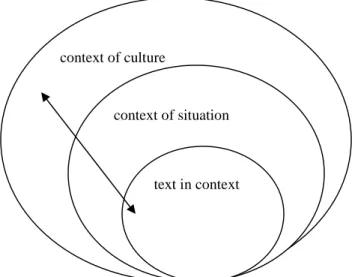
(22) points: 1. a brief descriptive history of SFL, 2. AT, and 3. narrative texts and the social issue of poverty. Chapter two reviews the theoretical framework of the study, including SFL, AT, and previous research related to AT and its application to English teaching. Chapter three describes the research methodology, including the research plan, data collection procedures, and data analysis and the overall framework of the methodology. The results and further discussion relative to the four research questions previously explained in this chapter make up Chapter four. Finally, Chapter five offers a concluding statement and an account of the pedagogical implications of the research.. 11.
(23) CHAPTER 2 Literature Review This research analyzes narrative texts from the perspective of appraisal theory (AT), which derives from SFL. The purpose of this chapter is to provide a whole picture of the research in AT from the recent past to the present and to establish its connection both to SFL and the present study of narrative texts. The chapter begins with an introduction to SFL before proceeding to an in depth discussion of AT, and finally to a summary of the relevant studies done on AT and its application to English teaching. An Introduction to SFL The Historical Development of SFL The social linguist, Michael Alexander Kirkwood Halliday, began developing SFL during the 1960s. Halliday was born in 1925 and raised in England. He graduated with a degree in modern Chinese language and Literature (Mandarin) at the University of London. In 1959, after the publication of his doctoral dissertation, The Language of the ‘Chinese Secret History of the Mongols,’ he began developing Systemic Functional Grammar (SFG). Halliday moved to Australia in 1976 as Foundation Professor of Linguistics at the University of Sydney, where he is an emeritus professor.. 12.
(24) SFL focuses on interaction within social contexts and the language in which texts happen. Malinowski and Firth, both of whom both belonged to the London School, inspired Halliday’s SFL. Malinowski explains that there are two strata of context in social interaction, the “context of situation” and the “context of culture” (Martin & Rose, 2008). Halliday was also motivated by the Prague School, the Copenhagen School, Saussure’s structuralism, and so forth. The influences on his work extend further to the study of visual and multimodal communication from the point of view of social semiotics (Hu & Ye, 2010). The Concept of SFL According to SFL, language has three compact features: language embodied in the process of society, language as a system, and language as function. Eggins (2004) mentions two main characteristics of SFL: genre (the context of culture) and register (the context of situation). Martin and Rose (2003) describe five elementary conceptions for studying language: structure, system, stratification, instantiation, and metafunction. They also include discourse semantics, which is the interpretation of social discourse through the analysis of texts. Discourse semantics emphasizes the meaning provided by clauses as a text unfolds (Martin & Rose, 2003). Halliday (1994) asserts that language simultaneously frames three main kinds of meaning: “ideational, interpersonal, and textual.” He considers the use of language. 13.
(25) as a kind of social interaction that embodies the contexts of culture and situation. Therefore, the function of language is as a social semiotic system. Eggins (2004) interprets Halliday’s functional grammar as having “four main theoretical claims about language: 1. that language use is functional 2. that its function is to make meanings 3. that these meaning are influenced by the social and cultural context in which they are exchanged 4. that the process of using language is a semiotic process, a process of making meanings by choosing” (p. 3). Halliday built his model of language as texts in contexts. Each situation and context unfolds as an interactive text that displays a people’s culture. Consequently, three contextual strata set-up the social interplay within a culture: the context of culture, the context of situation, and the context of text (Martin & Rose, 2008). The relations between the strata of language and social context in SFL move back and forth (see Figure 1). Moreover, each text encodes the patterns of social situations, and every situation expresses the patterns of a culture.. 14.
(26) context of culture. context of situation. text in context. Figure 1. A strata interpretation depicting the relation of language to social context (Adapted from Martin and Rose, 2008, p. 10) Genre theory. Genre reveals the cultural purpose of a text. Genres develop according to the way they use language recurrently with register variables; the reused patterns become habitual and institutional as genre. Martin and Rose (2003) define genre as “a staged, goal-oriented, social process....social because we participate in genres with other people; goal-oriented because we use genres to get things done; staged because it usually take us a few steps to reach our goals” (p. 8). The stages comprise the schematic structures of genre. When people interact with one another, they habituate that communication step-by-step in a series of constituent structures. Different genres have dissimilar schematic structures with two aspects: the social world and the natural world (Martin & Rose, 2008; Butt, Fahey, Feez, Spinks &Yallop, 2001). For example, historical narratives belong to the social world. Narratives include the story sub-genres of recounts, anecdotes, exempla, observations, and so forth. Narrative also relates to resolutions and evaluations, which imply the 15.
(27) disruption of incidents. Recounting-type narratives tell about things according to sequences of events or personal experiences. An anecdote tells of some notable event that may have been funny, cruel, tragic, and so forth. Exempla concern judgments about people’s behavior, which may be admirable or condemnable. Observations are descriptions of events (see Table 1). The constituent stages of genre are Orientation, Complication, Evaluation, Resolution and Code; however, apart from Complication and Resolution, these stages are optional (Martin & Rose, 2008). The social purposes of story genres are to display the problems of events and then explain and comment on that behavior for the audience. Butt et al. (2001) explains that the intention of narrative is “to construct a pattern of events with a problematic and/or unexpected outcome that entertains and instructs the reader or listener” (p. 9). Lobav (2006) points out that narrative describes the details of personal experiences, and the construction of a narrative follows a series of events in time. Table 1 Family of Story Genres and their Schematic Structure (Martin & Rose, 2008, p. 52) staging. experience. response. recount. record. prosodic. ----. variable. anecdote. remarkable event. reaction. ----. affect. exemplum. incident. interpretation. ----. judgment. observation. event description. comment. ----. appreciation. narrative. complication. evaluation. 16. experience. resolution. attitude. variable.
(28) Register theory. Halliday (1978) specifies three dimensions or parameters, in the context of situation, which he calls the register variables: field, mode, and tenor. Language realizes these parameters as social contexts according to three metafunctions for “enacting relationships as the interpersonal metafunction, construing experiences as the ideational metafunction, and organizing discourse as the textual metafunction” (Martin & Rose, 2008, p. 11). Table 2 illustrates the definitions of the three register variables, the relationships between the three metafunctions and the categories of register for the three texts. Actually, Butt et al. (2001) mentions that a text always has two contexts, one called genre (the context of culture), the outer stratification of context, and the other called register (the context of situation) within the genre context. In other words, “texts with meaning in common are said to belong to the same register and texts with obligatory structural elements in common are said to belong to the same genre” (Butt et al., 2001, p. 8). Table 2 The Definitions of Three Register Variables and their Relationship to the Metafunctions in the Studied Texts. (Adapted from Martin & Rose, 2008, p.11) Register tenor. Definition “kind of role relationship”. Metafunction. Leaf. Magi. Skylight. interpersonal. friends. couple. a thin girl. devotion. cold society. written text. written text. “enacting” field. mode. “the social action. ideational. the life’s. that is taking place”. “construing”. meaning. “what part language. textual. written. is playing”. “organizing”. text. 17.
(29) Five elementary conceptions for studying language. According to Table 3, structure, system, stratification, instantiation, and metafunction are the five primary terms for the study of language (Halliday & Matthiessen, 2004; Huisman, 2007; Wu, 2010). Table 3 The Dimensions (Forms of Order) of Language and their Ordering Principles (Halliday & Matthiessen, 2004, p. 20) Dimension 1. structure. Principle rank. (syntagmatic order) 2. system. Orders clause~group or phrase~word~morpheme ( lexicogrammar). delicacy. grammar~ lexis ( lexicogrammar). (paradigmatic order) 3. stratification. realization. semantic~lexicogrammar~phonology~phonetics. 4. instantiation. instantiation. potential~sub-potential or instance type~instance. 5. metafunction. metafunction. ideational (logical~experiential)~interpersonal~textual. Structure is “the set of functional constituents in syntagmatic ordering relation” in the sequence of a chain (Eggins, 2004, p. 192). In addition, a succession of ordered components forms a structure. In composition, the linguistic term constituency means the rank of structure, which is the ordering rule for systemic theory. The organization of the compositional ranks divides into four hierarchies: sounds, words, sentences, and clauses, which are organic configurations. System in a system model captures paradigmatic relationships, which are sequences of choice that represent logical priority and delicate choices, the latter at the right-hand side of a system network (Eggins, 2004). In the polarity of system, all the selections of clauses are either positive or negative and manifest a concept of the 18.
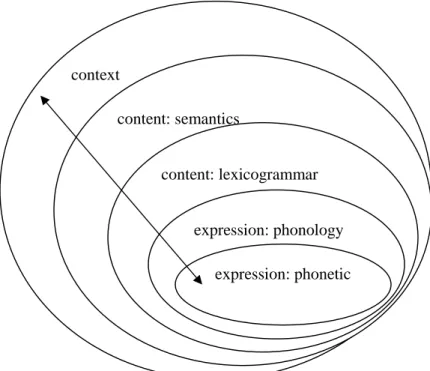
(30) meaning potential of language. (Halliday & Matthiesen, 2004; Wu, 2010) However, structure expresses every selection within a system. Eggins (2004) points out that “a complete system network involves organizing the choices into systems, and specifying how those choices are realized as a structures” (p. 200). Martin & White (2008) concludes that system and structure have the potential for correlative meaning: “The system perspective foregrounds the notion of choice—language as a resource. The structure perspective foregrounds the inherent temporality of semiotic processes—they unfold through time....” (p. 17). Language is a complex semiotic system that has several strata (Halliday & Matthiessen, 2004; Lin, 2010; Wu, 2010). Hu & Ye (2010) interpreted this multistratal concept according to three levels: the semantic, the lexico-grammar, and the phonological level. The relation of each level is a kind of realization. Halliday’s idea is to realize the strata from top to bottom, that is, the semantic level realizes the culture context (genre), while social context is a code on the lexicogrammar level, and lexicogrammar is the realization of phonology (see Figure 2). In regard to the perspective of system, the semantic level connects the outer social context (content) with the inner lexicogrammar level (expression).. 19.
(31) context content: semantics content: lexicogrammar expression: phonology expression: phonetic. Figure 2. Stratification (Adapted from Halliday and Matthiessen, 2004, p. 25) Instantiation relates to both system and text, that is, “the system of language is instantiated in the form of text” (Halliday & Matthiessen, 2004, p. 26), which indicates that language is a system and a set of texts with each representing one side of a cline. Register accounts for the system side of the cline of instantiation. Texts account for the levels of language, which are definite with their organization on the basis of contextual values. In addition, different methods of reading reveal more meaning potentials for texts (Halliday & Matthiessen, 2004). Figure 3 demonstrates the relationships in the cline of instantiation. In SFL, system is a stable and abstract conception that register and genre realize. Text, in turn, realizes both of these aspects with concrete instances; hence the term instantiation, which defines this series of realized processes (Martin &White, 2008).. 20.
(32) System. (generalized meaning potential) Register. (semantic sub-potential) Text type. (generalized actual) Text Reading. (affording instance) (subjectified meaning). Figure 3. Cline of instantiation (Adapted from Martin and White, 2008, p. 25) Metafunctions define the central components of the entire SFL theory. In traditional grammar, the term function includes words, phrases, and clauses; for example, the parts of speech: nouns, verbs, adjectives, adverbs, pronouns, prepositions conjunctions, and interjections (Hu & Ye, 2010; Stageberg & Oaks, 2000). However, unlike traditional grammar, Halliday’s view of function focuses on the semantic analysis of the purpose or method of language use. The essential functions of language are to make experiences meaningful and to build social relationships, which determine grammatical form (Halliday & Matthiessen, 2004). In SFL, the three principal components of language are the ideational, the interpersonal, and the textual metafunctions. These metafunctions simultaneously create three different types of meaning in both written and spoken texts. The ideational metafunction makes sense out of reality, so it has two sub-metafunctions, which are experiential and logical. The experiential metafunction concerns the flow of 21.
(33) experiences people have in the world, which the grammar of clauses encodes through a choice of process types—such as material, mental, behavioral, relational, verbal, or existential—and the potential participants and circumstances. The logical metafunction relates to the creation of grammatical clauses. Hu and Ye’s (2010) interpretation of the ideational metafunction is that “it organizes our reasoning on the basis of our experience for it is the potential of the language to construe logical links between figures and it appears in the form of coordination, subordination and recursion” (p. 134). The interpersonal metafunction relates to social activities, for example, how people negotiate or interact with each other, or how they share their feelings. The interpersonal metafunction computes people’s appraisals and decisions, and presents their social positions and solidarity with conversation partners (Hu &Ye, 2010). The mood structure of clauses explores interpersonal meaning. Halliday and Matthiessen (2004) argue that speakers take turns when conversing with one another. They take different speech roles when presenting statements, questions, offers and commands in order to move along the dialogue. The four move types are speech functions that realize declarative, interrogative and imperative Mood structures. The interpersonal metafunction not only displays personality, status and standpoint but also expresses Mood, modality, and the appraisal system (Wu, 2010). Martin and White (2008). 22.
(34) explain that interpersonal meaning focuses on interaction with a lexically-based perspective, while Martin and Rose (2008) expand discourse semantic analysis beyond the lexico-grammar of clauses. Therefore, basing it upon lexicogrammar analysis, AT realizes interpersonal meaning in the stratification of discourse semantics. Wu (2010) based a study of the interpersonal metafunction on an analysis of data from public service advertising (PSA). The purpose of Wu’s study was to use a method of discourse analysis to probe the distribution of the Mood structure, modality, the person system, and the attitude sub-systems of AT. The results show that readers not only extensively use declarative Mood to translate information in PSA but also probably widely use the modalization of modality. In addition, the third person pronoun appears in the data much more often than do the first and second person pronouns. The final result shows the highest distribution to be the affect of attitude within AT, with negative words appearing more frequently than positive words. The textual metafunction organizes the flow of information into clauses, in particular the messages going with the flow of Theme and Rheme in clauses. Generally, Theme displays new information, while Rheme comes afterwards to expand upon the new information. The relationship of the textual metafunction to experience and the interpersonal metafunction constructs a text by cohesively building. 23.
(35) up sequences of information (Halliday & Mattiessen, 2004). In short, language realizes three types of meaning according to the three register variables of field, tenor, and mode. Eggins (2004) claims that from Halliday’s perspective the three metafunctions up-link to the register variables and down-link to lexico-grammar. Thus, interpretively, ideational meanings realize the field; ideational meanings encode the patterns of six processes (transitivity) and the grammatical patterns of clause complexes. The interpersonal meanings express tenor, which the Mood types (declarative, imperative, and interrogative) and modality (modalization and modulation) symbolize in interaction. The textual meanings realize mode and encode the thematic structure of Theme and Rheme in the grammar. Discourse semantics. Martin and Rose (2003) explain that discourse analysis connects with the analysis of social activity and grammar. In addition, the stratum of discourse semantic is bigger than a clause and smaller than a culture. They further define discourse according to two general perspectives: “[1] relevant levels of language: as grammar, as discourse, and as social context (known as the strata of language); [2] three general functions of language in social contexts: to enact our relationships, to represent our experience, and to organize discourse as meaningful text (known as metafunctions)” (p. 4). SFL categorizes the model of language according to three general social functions. Martin and Rose (2003) explain that the. 24.
(36) discourse system comprises six dimensions that derive from the interpersonal metafunction: appraisal, ideation, conjunction, identification, periodicity, and negotiation (see Table 4). The level of discourse semantics involves diverse aspects, including some questions about how texts introduce and maintain the course of people, places and things, which refers to identification. Conjunction refers to how cause or time link events to one another; while appraisal refers to the building and expansion of evaluation (Martin & White, 2008). The present study focuses on the appraisal dimension of the discourse system. Table 5 shows the relationships between discourse semantics and relevant work (genre, register, lexicogrammar and graphology) in functional linguistics, as well as related models of language in social life; its purpose is to illustrate the stratification of SFL frameworks (Martin & Matthiessen, 2010) Table 4 Discourse Systems and Metafunctions (Adapted from Martin & Rose, 2003, p. 8) discourse dimension discourse system. metafunctions. appraisal. “negotiating attitudes”. interpersonal. ideation. “representing experience”. ideational. conjunction. “connecting events”. ideational. identification. “tracking people and things”. textual. periodicity. “information flow”. textual. negotiation. “enacting exchanges”. interpersonal. 25.
(37) Table 5 Key Resources for Text Analysis (by Strata and Metafunction) (Martin & Matthiessen, 2010, p. 295) metafunction. ideational. interpersonal. textual. stratum genre. orbital/serial structure. prosodic structure. periodic structure. register. field-. tenor-. mode-. Martin 1992, Martin &. activity sequences,. power, solidarity. action/reflection,. Rose 2003/2007. participant taxonomies. discourse semantic. ideation, external. Martin & Rose. conjunction. Martin & Rose 2008. monologue/dialogue appraisal, negotiation. identification, internal conjunction,. 2003/2007. information flow. lexicogrammar. transitivity; nominal. mood, modality,. theme and information;. [verbiage] Halliday &. group classification,. polarity, comment,. tense & deixis; ellipsis &. Mathiessen 2004. description,. vocation,. substitution. [image] Kress & van. digital enumeration. nominal group attitude,. Leeuwen 1996/2006 graphology/phonology. person tone sequence. formatting, emotions,. punctuation, layout;. Halliday & Greaves. color; tone, voice. tonality, tonicity. 2008. quality, phonaesthesia. Appraisal Theory(AT)/Systems In 1992, Martin pointed out that discourse analysis focuses on semantics, the meaning beyond the clause, rather than on grammar or social context, to connect with the strata of social context and lexicogrammar in SFL. That is, discourse analysis combines grammarians with social theorists in an inter-play of the analysis of grammar and social manners. With these two tools, grammar, discourse and social activity evolve into the model of language in a social context. In addition, movement from abstract concepts to clear instances realizes these three different levels of. 26.
(38) phenomena; thus, “social contexts are realized as texts which are realized as sequences of clauses” (Martin & Rose, 2003, p. 4). Consequently, AT is one of six aspects of the discourse system for the evaluation of texts. Appraisal is one of three main discourse semantic resources that build interpersonal meaning. Another is negotiation, which supplements appraisal to demonstrate speech function and exchange structure, and casual communication (Eggins & Slade, 2006). Likewise, involvement supplements appraisal by specifying the solidarity of the tenor relation. Therefore, three systems relate to the interpersonal resources at the level of discourse semantics (Chen & Xiao, 2010; Eggins & Slade, 2007; Martin & White, 2008). The present study focuses on appraisal to interpret the interpersonal meanings and realize the variations of tenor in interrelation in written texts. James Martin put forward the notion of AT in the beginning of the 1990s. AT concerns interpersonal meaning in language and its use to evaluate and negotiate between writers and readers through texts. In the early 1990s, Martin and his associates (Iedema, Feez &White, 1994; Fuller, 1995; Martin, 2010) started to research details from the lexically-based perspective in order to enhance interpersonal meaning in the texts of monologues. Later on, linguists constructed the appraisal framework and developed it in response to the need for writing in the workplace, secondary schools, and the creative arts. It expanded further to include media analysis,. 27.
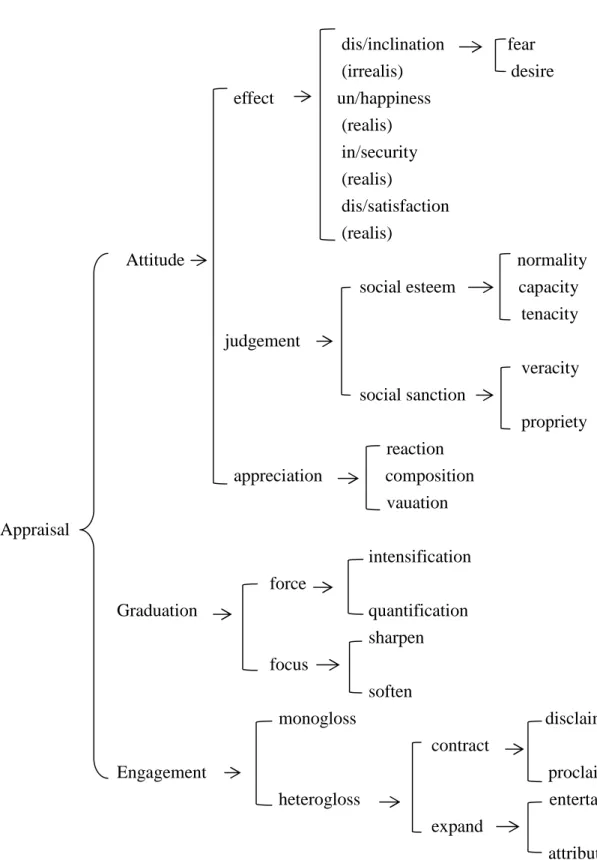
(39) discourse, secondary school historical narrative, popular science, causal conversation, legal and medical discourse, academic discourse, and so on. Martin and White (2008) define “appraisal as an interpersonal system at the level of discourse semantics” (p. 33) that focuses on the power status of tenor. AT offers a theoretical and analytical instrument for the exploration of the evaluative resources and the negotiation of intersubjective positions. AT includes three main subsystems—attitude, graduation and engagement (Martin & White, 2008)—each subsystem divided into subtypes, which in turn divide into items, some of which further divide into various markers. In figure 4, the enclosing bracket on the left side represents all the options selectable at the same time in a system network. For example, when one chooses an attitude resource, one can also use gradable resources to amplify and negotiate it with others. The square bracket means an either/or selection of subtypes. For instance, one can choose either affect or judgment or appreciation to express emotion or evaluate characters or things (see Figure 4).. 28.
(40) dis/inclination (irrealis) un/happiness (realis) in/security (realis) dis/satisfaction (realis). effect. Attitude social esteem. fear desire. normality capacity tenacity. judgement veracity social sanction propriety appreciation. reaction composition vauation. Appraisal intensification force Graduation. quantification sharpen focus soften monogloss. disclaim contract. Engagement. proclaim entertain. heterogloss expand. attribute. Figure 4. Appraisal systems: an overview. 29.
(41) Attitude. Attitude is central to AT; it estimates the language of attitudinal positioning in texts according to three dimensions: Affect—the appraisal of human feelings— Judgment—the appraisal of human character—and Appreciation—the appraisal of the value of things—(see Figure 4). Figure 5 shows the relationship between affect, judgment, and appreciation as an evaluative system of interconnections and interactions between institutionalized feelings or attitudes (Liu & Thompson, 2009). As Figure 5 shows, affect lies at the heart of the attitudinal system, where judgment recontextualizes it as estimations of people’s character, behavior; appreciation recontextualizes it as the evaluation of institutionalized values (Chen & Xu, 2010; Liu & Thompson, 2009; Martin, 2010). In other words, Martin (2010) points out that: “As judgment, affect is recontexttualized as an evaluation matrix for behavior, with a view to controlling what people do. As appreciation, affect is recontextualized as an evaluation matrix for the products of behavior” (p. 207). Affect concerns people’s emotions, which is how people express their inner feelings. It can be positive (good feelings) or negative (bad feelings) and can express feelings directly or indirectly (see Table 6).. 30.
(42) Ethics/ morality (rules and regulations) Feeling institutionalized as proposals. JUDGMENT. AFFECT APPRECIATION feeling institutionalised as propositions aesthetics/value (criteria and assessment) Figure 5. Judgment and appreciation as institutionalized affect (Adapted from Martin & White, 2008, p. 45) Table 6 Options for Affect (adapted from Martin and Rose, 2003, p. 32) Positive. We were ecstatic. We even celebrated.. Negative. I was torn to pieces. I can’t explain the plain and bitterness in me…. direct. emotion state. ecstatic wild consuming fear. implicit. physical. Withdrawn. expression. shake uncontrollably. extraordinary. wander from window to window. behaviour. rolls this way, that side of the bed. metaphor. ice cold in a sweltering night eyes… dull like the dead. According to research about attitude (Martin & Rose, 2003, Martin & White, 2008; Liu & Thompson, 2009), affect has four sets of variables or subtypes: un/happiness, in/security, dis/satisfaction, and dis/inclination. Un/happiness concerns the so-called feelings of heart, such as, sadness, hate, happiness and love; in/security 31.
(43) concerns feeling of social welfare, such as, anxiety, fear, confidence, and trust; dis/satisfaction concerns feelings about goals and achievements, such as, ennui, displeasure, curiosity, and respect; dis/inclination of irrealis affect concerns fear and desire. In terms of feelings, the four variables of affect display “emotional dispositions and surges of behavior” (Martin & Rose, 2003. p. 66; see Table 7). With regard to traditional grammar, affect is the realization of various lexical parts of speech, such as, verbs of emotion, and adverbs and adjectives of emotion and nominalization (Liu & Thompson, 2009; Chen & Xiao, 2010,) but most of this lexis is adjectives (Martin & White, 2008). Table 7 Irrealis Affect and Realis Affect (Adapted from Martin and Rose, 2003, p. 65-67) dis/inclination fear (irrealis). surge ( of behaviour) tremble shudder cower desire (irrealis) suggest request implore un/happiness (realis) surge (of behaviour) unhappiness: misery whimper [mood:‘in me’] cry wail unhappiness: antipathy rubbish [directed feeling: ‘at you’] abuse revile happiness: cheer chuckle laugh rejoice happiness: affection shake hands hug cuddle in/security (realis) surge ( of behaviour insecurity: disquiet restless twitching shaking insecurity: surprise start 32. disposition wary fear terrorized incomplete ( miss) lonely ( long for) bereft ( yearn for) disposition down (low) sad (median) miserable high) dislike hate abhor cheerful buoyant jubilant fond loving adoring disposition uneasy anxious freaked out taken aback.
(44) cry out faint security: confidence declare assert proclaim security: trust delegate commit entrust dis/satisfaction (realis) surge ( of behaviour) dissatisfaction: ennui fidget yawn tune out dissatisfaction: caution displeasure cold castigate satisfaction attentive busy flat out satisfaction pat on the back compliment reward. surprised astonished confident assured boastful comfortable with confident in/about trusting disposition bored fed up exasperated cross angry furious curious absorbed engrossed satisfied impressed proud. Alongside affect, judgment concerns people’s temperaments, which judgment separates into personal (social esteem) and moral (social sanction), according to how they relate to law and ethics. Social esteem includes normality (is s/he unusual), capacity (is someone talented), and tenacity (is someone insistent), which are classifiable as admiration (positive) and criticism (negative). In addition, social sanctions involve veracity (is a person truthful) and propriety (is someone polite), which are classifiable as praise (positive) and condemnation (negative). The result is a character judgment that can be direct or indirect (see Tables 8 & 9). With regard to traditional grammar, various verbs and adjectives, along with lexical metaphor can realize judgment (Chen & Xiao, 2010).. 33.
(45) Table 8 Examples of Character Judgment (Martin and Rose, 2003, p. 34) direct (explicit). Personal admire. indirect (implicit). bubbly, vivacious. He was working in a top security. (positive) Energetic, intelligent,. structure. popular criticize. What’s wrong with him?. I can’t explain the pain and. (negative). I can’t handle the man bitterness in me when I saw… anymore! moral praise their leaders have the guts I envy and respect the people the struggle (positive) to stand by their vultures.. condemn Our leaders are too holy (negative) and innocent. And faceless.. ‘Those at the top’ were again Targeting the next permanent removed from society. Table 9 Types of Judgment (Martin and Rose, 2003, p. 68) social esteem ‘venial’ normality [fate] ‘is s/he special?’. positive [admire]. negative [criticize]. lucky, fortunate, charmed… normal, average, everyday… in, fashionable, avant grade…. capacity ‘is s/he capable?’. unfortunate, pitiful, tragic… odd, peculiar, eccentric… dated, daddy, retrograde….. powerful, vigorous, robust…. mild, weak, wimpy…. insightful, clever, gifted…. slow, stupid, thick…. balanced, together, sane…. flaky, neurotic, insane…. tenacity [resolve]. plucky, brave, heroic…. rash, cowardly, despondent…. ‘is s/he dependable?’. reliable, dependable…. unreliable, undependable…. tireless, persevering, resolute… weak, distracted, dissolute… social sanction ‘moral’. positive [praise]. negative [criticize]. veracity [truth]. truthful, honest, credible…. ‘is s/he honest?’. sincere, genuine…. insincere, fake…. frank, direct…. deceptive, manipulative…. propriety [ethics]. good, moral, ethical…. ‘is s/he beyond. law-abiding, fair, just…. reproach?’. sensitive, kind, caring… 34. dishonest, deceitful…. bad, immoral, evil… corrupt, unfair, unjust… insensitive, mean, cruel….
(46) Table 10 Types of Appreciation (Martin and Rose, 2003, p. 69) positive reaction: impact. negative. arresting, captivating, involving. ‘Does it grab me?’. dull, boring, tedious, staid….. engaging, absorbing, imposing, stunning, striking, compelling, interesting… fascinating, exciting, moving…. dry, ascetic, uninviting…. remarkable, notable,. unremarkable, pedestrian…. sensational…. reaction: quality ‘Do I like it?’. lively, dramatic, intense…. flat, predictable, monotonous…. lovely, beautiful, splendid…. plain, ugly…. appealing, enchanting, pleasing,. repulsive, off-putting,. delightful, attractive, welcome… revolting, irritating, weird… composition: balance. composition:. balanced, harmonious, unified, symmetrical, proportional…. unfinished, incomplete…. simple, elegant…. ornamental, over-complicated,. complexity ‘Is it hard. unbalanced, discordant,. extravagant, puzzling… intricate, rich, detailed, precise…. monolithic, simplistic…. challenging, significant deep,. shallow, insignificant,. to follow?’. valuation ‘Is it. profound, provocative, daring…. worthwhile?’. unsatisfying, sentimental…. experimental, innovative, original,. conservative, reactionary,. unique, fruitful, illuminating…. generic…. enduring, lasting…. unmemorable, forgettable…. The variable of appreciation concerns values, that is, how people feel about things and their behaviour regarding things. Thus, appreciation can also be positive or negative. Table 10 represents appreciation as it involves reaction (Dose someone like something?), composition (In something hard to understand?) and valuation (Is. 35.
(47) something worth having?). Lexical metaphor accounts for the realization of appreciation with respect to traditional grammar (Chen & Xiao, 2010).. Engagement. The subsystem of engagement combines Bakhtin’s heteroglossia viewpoint with inter-subjective positioning in order to explore the diversity of alignment between writers and readers. It concerns the external voices speakers/ writers adopt as an interactive stance opposite listeners/readers, relative to the resources of dialogistic positioning in a discourse (Martin & White, 2008). In terms of AT, with attitude being central and graduation amplifying attitude resources, Engagement analyzes such features as attribution, modality, hearsay, concession, polarity, evidentiality, hedges, boosters and metadiscursives (Martin & White, 2008; White, 2001). White (2001) indicates that “these Engagement resources provide the means by which speakers/writers adjust and negotiate the arguability of their propositions and proposals” (p. 1); that is to say, an analysis can apply engagement resources in any discourse interaction, including writing, conversation, and so forth. Furthermore, engagement resources concern attitude, standpoint, and stance of language use toward speakers/writers. For instance, speakers maintain different stances, clearly or otherwise, such as, subjective, objective or neutral, which could influence or control the voice positioning of the dialogists (Wang & Li, 2010). Bakhtin (1981) indicates that the core of linguistic voices involves monoglossia. 36.
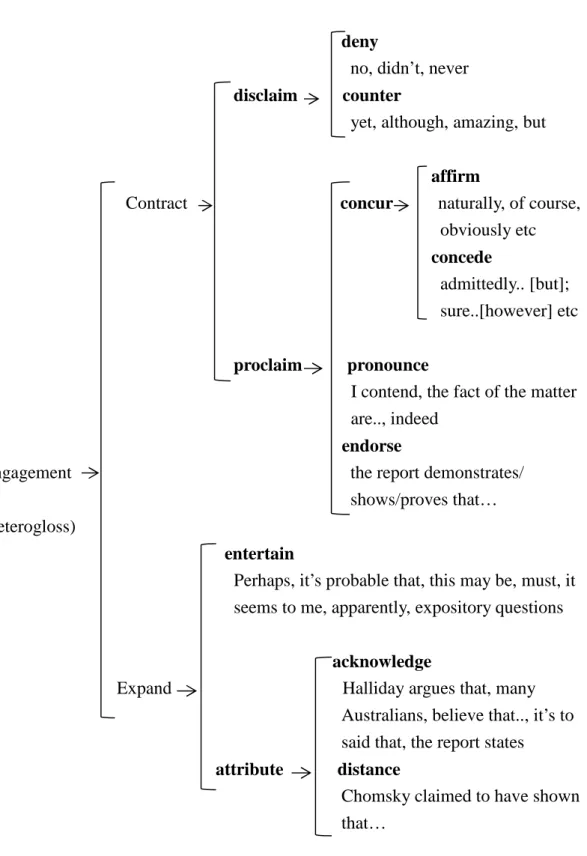
(48) (single voice) and heteroglossia (different voices). White borrows Bakhtin’s notions of dialogism and glossia to expand the engagement subsystem of AT to include monoglossic engagement (single voice) and heteroglossic engagement (different voice) (as cited by Chen & Xu, 2010). Figure 6 presents a detailed diagram of the engagement subsystem.. Heteroglossia refers to the interactions between writers/speakers and readers (voices) for the exchange of viewpoint positions. Heteroglossia includes dialogic contraction and expansion in terms of the intersubjective functionality of the interlocutors.. Dialogic contraction closes the space for dialogic alternatives into verbs of report, that is, to demonstrate, show, manifest, reveal, and so forth. Dialogic expansion opens the space for choosing stances and into the lexis of media verbs, which are claims, arguments, and so forth (Martin & White, 2008; Chatterjee, 2007). In addition, dialogic contraction comprises two items: disclaiming, which includes denial (negation) and countering (replacing), and proclaiming, which includes concurring (agreement with or sharing the same knowledge with readers) as well as pronouncing (powerful insistence) and endorsing (alignment with outer sources).. Dialogic expansion involves entertaining (making space for dialogic choice) and attributing, which includes acknowledging (unbiased positions towards outer 37.
(49) sources) and distancing (dis-alignment with outer sources) (Martin & White, 2008; Nakamura, 2009).. deny no, didn’t, never disclaim. Contract. counter yet, although, amazing, but. concur. affirm naturally, of course, obviously etc concede admittedly.. [but]; sure..[however] etc. proclaim. pronounce I contend, the fact of the matter are.., indeed endorse the report demonstrates/ shows/proves that…. Engagement (heterogloss). entertain Perhaps, it’s probable that, this may be, must, it seems to me, apparently, expository questions acknowledge Halliday argues that, many Australians, believe that.., it’s to said that, the report states. Expand. attribute. distance Chomsky claimed to have shown that…. Figure 6. The engagement subsystem (adapted from Martin and White, 2008, p.134). 38.
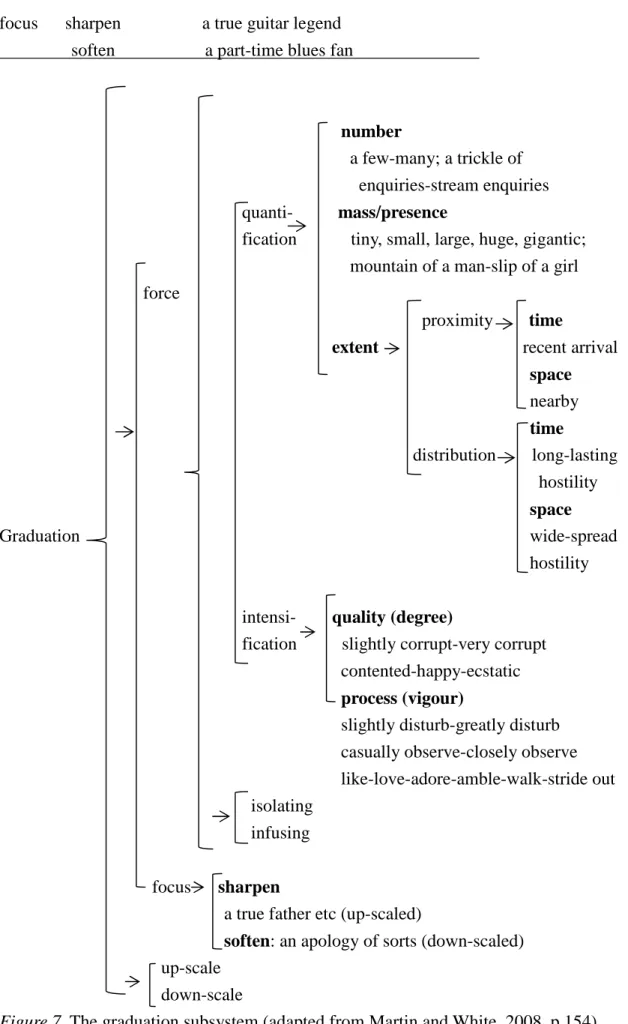
(50) Graduation. The degree of graduation is a property of all attitudinal meanings (affect, judgment, and appreciation) and engagement components. Graduation as a subsystem represents degrees of evaluation relative to things and people, as well as scaling the degrees of the interlocutors’ investment in a conversation. That is, graduation concerns the “up-scaling and down scaling” that amplifies degrees of emotion and dialogistic positioning, for example, how strongly a person feels about something or someone, whether a high degree (extremely, sharply) or a low degree (fairly, somewhat) of volume. Thus, “attitude and engagement are domains of graduation which differ according to the nature of the meaning being scaled” (Martin & White, 2008, p. 136). Graduation comprises two subtypes: force and focus. Force relates to the scalability of intensification and quantification, which engage different perspectives of analysis. Intensification comes from the standpoint of semantic meaning in the discourse; quantification comes from the standpoint of lexicogrammar. The grade of intensification is on a scale of qualities (slightly sad or very sad) or processes (slightly disturbed me or greatly disturbed me). Plenty of modifier resources from the English grammatical lexis can amplify emotion, people, character, position, and so on, for example: comparison (happier-happiest), modality (just or very possible), verbal (very-greatly), and qualitative adjective (miserable-fairly miserable). Graduation. 39.
(51) engages repetition (It’s hot, hot, hot) as well as metaphor (The water dribbled from the tap). Quantification includes numbers (many), mass (small), and extent, which also involves proximity in time (a recent arrival) and space (a nearby mountain), and distribution in time (long-lasting hostility) and space (wide-spread hostility). In addition, the amount of quantification refers to mass (size, weight, strength, and number) or time and space (recent and distant). Force resources include intensifiers, attitudinal lexis, metaphor, and swearing. Focus concerns categories of prototypicality from the experiential perspective; these categories are not gradable because they have clear boundaries, for example, the word “woman” in not gradable, but in the focus resource “woman” could describe a “true woman.” Focus also comprises sharpness with respect to the up-scaling of a phenomenon (a real father, a true friend) and softness with respect to the down-scaling of meaning (they are kind of crazy). Therefore, sharpness falls under the heading of intensifiers and amplifiers, while softness concerns the vaguer language of literature. (Martin & White, 2008; Nakamura, 2009; see Table 11 & Figure 7). Table 11 Options for Graduation (Martin and Rose, 2003, p. 48) Force. intensifiers he still plays great attitudinal lexis the second part is fantastic.. metaphors ice cold in a sweltering night swearing damn it there must be a clique. 40.
(52) focus. sharpen soften. a true guitar legend a part-time blues fan. number a few-many; a trickle of enquiries-stream enquiries quantification. mass/presence tiny, small, large, huge, gigantic; mountain of a man-slip of a girl. force proximity extent. time recent arrival space nearby. distribution. time long-lasting hostility space wide-spread hostility. Graduation. intensification. quality (degree) slightly corrupt-very corrupt contented-happy-ecstatic process (vigour) slightly disturb-greatly disturb casually observe-closely observe like-love-adore-amble-walk-stride out. isolating infusing focus. sharpen a true father etc (up-scaled) soften: an apology of sorts (down-scaled). up-scale down-scale Figure 7. The graduation subsystem (adapted from Martin and White, 2008, p.154) 41.
(53) The Relevant Previous Studies of AT Eggins (2004) explains that many kinds of genres categorize types of social interaction in culture. Roughly speaking, these genres include: “literary studies, film studies, art theory and cultural studies” (p. 55). For decades, the various studies of AT have fallen into different genres, including stories, which Shang analyzed using the sub-system of attitude (Shang, 2008; Xi, 2010); speech and thought presentation, based upon narratology and stylistics theory (Dai, 2005); academic writing (Xu, 2010); teaching English in media (Zhong, 2007); the TV interview, using the engagement subsystem ( Pang & Chen, 2006); English public speaking (Yu & Wang, 2009); reported speech (Zhou & Guan, 2010); oral narrative (Xiang & Su, 2006; Xiang & Cao, 2006); movie texts (Xiao, 2010); gender identities, analyzed in reference to judgment and appreciation (Liao, 2008); attitude in students’ argumentative writing (Liu & Thompson, 2009); argumentative essay writing (Nakamnura, 2009); tourism texts (Chen & Xu, 2010); the interpersonal meaning of modality (Chen & Sun, 2010), and so forth. Most of these studies only focus on one sub-system, either attitude or engagement. The following more specifically explains some examples from these related studies: Liu & Thompson (2009) used the attitude subsystem of AT to explore Chinese EFL students’ argumentative writing in both English and Chinese; their purpose was. 42.
數據

+4

相關文件
How would this task help students see how to adjust their learning practices in order to improve?..
develop students’ career-related competencies, foundation skills (notably communication skills), thinking skills and people skills as well as to nurture their positive values
• Develop students’ career-related competencies, foundation skills (notably communication skills), thinking skills and people skills as well as to nurture their positive values
Register, tone and style are entirely appropriate to the genre and text- type. Text
To this end, we introduce a new discrepancy measure for assessing the dimensionality assumptions applicable to multidimensional (as well as unidimensional) models in the context of
to introduce how teachers may enhance learning and teaching effectiveness by adopting virtual reality (VR) technology and relevant strategies in the classroom as well as
Due to rising prices in winter clothing and footwear, as well as increasing housing rent and expenses of house maintenance, indices of Clothing and footwear; and Rent and
Attributable to increasing rent of housing and expenses of house maintenance, rising prices in summer clothing and footwear, as well as fresh vegetables, the indices of Clothing
