
屏東縣原住民國小弱勢學生英語學習困境之研究
132
0
0
全文
(2)
(3)
(4) ACKNOWLEDGEMENTS I am truly grateful for all the support, assistance, and encouragement I’ve received from various individuals over the course of this project. Had it not been for these people, I would not have completed my thesis. First of all, I would like to express my sincere gratitude to my advisor, Dr. Li-Hung Chang, for his time and effort. It was due to his patience and professional guidance that I managed to persevere and ultimately complete this thesis. Also, I would like to express my profound appreciation to the committee members of my oral examination, Dr. Tzung-Hung Tzai and Dr. Wei-Yau Li, for their valuable suggestions. I would like to express my gratitude to my classmates, schoolmates, friends, and colleagues for their encouragement and assistance throughout the process of conducting this research. Also, I would like to thank all the students in Sandimen Township, whose participation was instrumental to the completion of this study. Last but not the least, I owe a debt of gratitude to my beloved family for the support and encouragement they showed me when I was struggling with my thesis. It was only with their constant love and support that I was able to complete my thesis writing and achieve my goal.. i.
(5) ABSTRACT This study intends to explore English learning predicaments of disadvantaged elementary school students in terms of gender, disadvantaged backgrounds, and English academic achievement. One hundred and thirty-eight participants were recruited from five aboriginal elementary schools in Sandimen Township. In addition, the differences among gender, disadvantaged background, and English academic achievement are examined to explore how English learning predicaments are affected in terms of family, school, communal learning environment, and cultural differences. Two data analyses were applied. First, the researcher adopted the quantitative analysis based on the questionnaires. Afterwards, the qualitative analysis was conducted according to the results of open-ended questions in the questionnaires. Based on the data analyses, the major findings are presented as follows: 1.. There were no significant differences owing to gender among the students in all four factors of English learning predicaments.. 2.. There were significant differences among different disadvantaged backgrounds in part of the four factors of English learning predicaments.. 3.. Most disadvantaged students had more predicaments in parental expectation and participation. In addition, those in low-income families had more predicaments in content and course as well as communal factor. Grandparenting students had more predicaments in parents ‘participation while aboriginal students in teaching.. 4.. Students with low English academic achievement had significantly more predicaments in parental expectation, parental involvement, and cultural differences compared to students with high and medium levels. Based on the results, suggestions are provided to teachers, schools, parents for practical. use, followed by suggestions for future research. Keywords: Elementary School, Aborigine, Disadvantaged Student, English Learning Predicament ii.
(6) 摘要 本研究旨在探討偏鄉弱勢國小學生學習英語之困境,分別依性別、弱勢背景及英語 學業成就三方面進行分析。此外,為了解不同性別、弱勢背景及英語學業成就在英語學 習困境之家庭、學校、社區學習環境及文化差異等因素間是否存有差異,也進一步探討 各個變項間的關係。本研究受試者取樣自屏東縣三地門五所原住民地區國小之學生,共 138人進行問卷調查。問卷回收及資料處理後,經獨立樣本t檢定及單因子變異量分析 後,依調查結果得出以下結論: 1.. 男、女學生在英語學習困境的四個因素間無任何顯著差異。. 2.. 不同弱勢背景在英語學習困境的四個因素間有顯著差異。. 3.. 大部份弱勢學生表示在父母期望及父母參與兩部份中擁有較多的英語學習困境。此 外,家庭經濟弱勢學生在課程內容及文化差異上也有較多的學習困境。隔代教養的 學生在父母參與部分有較多的困境,而原住民學生的英語學習困境則較多出現在教 學上。. 4.. 與中高學習成就學生比較,發現低成就的學生在父母期望、父母參與以及文化差異 因素有較多的英語學習困境。. 根據本研究之結論,提出相關建議供教師、學校及家長作為實務應用之參考,以及 供其他研究者作為未來相關研究之參考。. 關鍵字:國小、原住民、弱勢學生、英語學習困境. iii.
(7) TABLE OF CONTENTS ACKNOWLEDGEMENT………………………………………………….…………...……i ENGLISH ABSTRACT…………………………………………………….………….….…ii CHINESE ABSTRACT………….……………………………………………………….…iii TABLE OF CONTENTS………………………………………………….………………...iv LIST OF TABLES………………………………………………………….…...…………...ix LIST OF FIGURES………………………………………………………….………………xi CHAPTER ONE INTRODUCTION……………………………………….…………….…1 Background and Motivation……………………………………………………….….….1 Purpose of the Study……………………………………………………………….…….4 Research Questions…………………………………………………………………....…5 Significance of the Study………………………………………………………………...5 CHAPTER TWO LITERATURE REVIEW………………………………………….……6 Educational Predicaments in Remote Areas……………………………………….…….6 Disadvantaged Students…………………………………………………………….…....8 Learning Predicaments in Aboriginal Areas………………………………………….....10 Learning Difficulties in Family, School, Culture and Community………………….….12 CHAPTER THREE MTHODOLOGY……………………………………………….…...19 Participants….…………………………………………………………………..............19 Instruments………………………………………………………………………...........20 An Interview Form………………………………………………………………...……23 Procedure………………………………………………………………….…………….24 Data Analysis……………………………………………………………...……………25 A Quantitative Analysis……………………………………...……………………25 A Qualitative Analysis….………………………………………………....………26. iv.
(8) CHAPTER FOUR DISCUSSION………………………………………………………….27 Results of Descriptive Statistical Analysis………………………………………......….27 Sample Analysis…………………………………………………….……….…….27 Gender. ………………………………………………………………………27 Grade. ………………………………………………………………….…….27 Grade. ………………………………………………………………….…….28 Identity. ………………………………………………………………………28 Last semester grade. ………………………………………………………....28 Family structure. ……………………………………………………….…….28 Family financial condition…………………………………………………...28 Descriptive Statistics on Learning Predicaments. ………………………………...30 Results of Independent Sample t-Test………………………………………….……….31 Gender Differences…………………………………………………………...……31 Identity Differences……………………………………………………….……….32 Results of One-way ANOVA Analysis…………………………………………...….….33 Differences among the English Academic Achievement Levels….…………….…33 Differences among the Disadvantaged Backgrounds…………………………...…36 Family financial condition. ………………….……………………………....36 Family structure. …………………………………………………………….39 The HEA and the LEA’s Predicament and Suggestion for Learning English…......42 The HEA’s Learning Predicament……………………………………………42 The HEA’s suggestion for Providing Assistance in English Learning…….…45 The LEA’s Learning Predicaments………………………………………...…46 The LEA’s suggestion for Providing Assistance in English Learning…….….49 v.
(9) The Disadvantaged Student Learning Predicaments……………………...…………….50 Aboriginal Students……………….……………………………….……...……….51 Economically disadvantage Students…….……………….……………….………53 Structurally Unsound Family……………….…………………….……….………56 The Disadvantaged Student suggestion for Providing Assistance in English Learning……………….………………………….………………………….…………59 Aboriginal Students……………….……………………………….………………60 Economically disadvantage Students…….……………….……………….………62 Structurally Unsound Family……………….…………………….………….……65 CHAPTER FIVE CONCLUSION…………………………………………………………68 Conclusion…………………….…………………………………………………...……68 Disadvantaged Student Learning Predicaments………………………………...…69 Aboriginal Student Learning Predicaments……………………………….........…69 Economically Disadvantaged Student Learning Predicaments…………………....70 The learning predicaments of students in structurally unsound family.…...………71 Significant Differences among Disadvantaged Backgrounds……………...……...72 Significant differences between aboriginal and non-aboriginal students….…72 Significant differences among family financial conditions. …………………72 Significant differences among family types. ………………………...………73 vi.
(10) Significant differences among achievement levels………………….….……73. Predicaments among Aboriginal Schools of Sandimen Township…….…………….….74 Aboriginal Areas and Urban Areas………………………………………….……….….76 Suggestions………………………………………………………………………...……78 Suggestions for Teachers…………………………………………………….….…78 Suggestions for Schools……………………………………………………...……79 Suggestions for Parents……………………………………………………………81 Suggestions for Further Research ……………………………………………...…82. The Reflection on the English Education in Aboriginal Schools…………..……….….84 REFERENCES………………………………………………………………………...……86 APPENDICES………………………………………………………………………………91 Appendix A. English Version of Questionnaire on Understanding English Learning Predicaments for Disadvantaged Elementary School Students………………91. Appendix B. Chinese Version of Questionnaire on Understanding English Learning Predicaments for Disadvantaged Elementary School Students for Examination of Experts………………………………………………………………….…97. Appendix C. Revision for the Questionnaire of Understanding English Learning Predicaments for Disadvantaged Elementary School Students (in Chinese) ……………………………………………………………….……106. vii.
(11) Appendix D. Chinese Version of Questionnaire on Understanding English Learning Predicaments for Disadvantaged Elementary School Students for Pilot Study…………………………………………………………………...……111. Appendix E. Chinese Version of Questionnaire on Understanding English Learning Predicaments for Disadvantaged Elementary School Students for Formal Distribution…………………………………………………………………115. viii.
(12) LIST OF TABLES Table1 Percentage and Distribution of Participants’ Background Information………...…...29 Table2 Descriptive Statistics on Learning Predicaments……………………………………30 Table3 Descriptive Statistics on Family Factor……………………………………………...30 Table4 Descriptive Statistics on School Factor………………………………………….......31 Table5 Independent Sample t-Test Results of Males and Females for Learning Predicaments……………………………………………………………………………32 Table6 Independent-Sample t-Test Results of Aboriginal and Non- Aboriginal participants for Learning Predicaments……………………………………………………………….…33 Table7 One-way ANOVA Results of English Academic Achievement Levels for Family Factor…………………………………………………………………………………...34 Table8 One-way ANOVA Results of English Academic Achievement Levels for School Factor………………………………………………………………………………..….35 Table9 One-way ANOVA Results of English Academic Achievement Levels for Cultural Factor and Communal Factor…………………………………………………….…….36 Table10 One-way ANOVA Results of Family Financial Condition for Family Factor………37 Table11 One-way ANOVA Results of Family Financial Condition for School Factor………38. ix.
(13) Table12 One-way ANOVA Results of Family Financial Condition for Cultural Factor and Communal Factor……………………………………………………………………….39 Table13 One-way ANOVA Results of Family Structure for Family Factor…………………..40 Table14 One-way ANOVA Results of Family Structure for School Factor…………………..41 Table15 One-way ANOVA Results of Family Structure for Cultural Factor and Communal Factor…………………………………………………………………………………...42 Table16 The HEA’s English Learning Predicaments………………………………………...45 Table17 The LEA’s English Learning Predicaments…………………………………………49. x.
(14) LIST OF FIGURES Figure 1. A Flow Chart of the Study Procedures……………………………………...24. xi.
(15) CHAPTER ONE INTRODUCTION Background and Motivation With the trend of globalization, international interactions are happening more frequently in terms of diplomacy, economy, trade, culture, technology, and education. English, as an international language, has for some time held a place of importance and is only becoming more so (Lee, 2014). Due to the vital role it has played globally, English is now ubiquitous in our lives, seen everywhere from the internet and media to the academic fields. Hence, people have become enthusiastic about promoting English; parents invest money so that their children can learn it, and schools focus on teaching it. English education has become the common educational trend in non-English speaking countries. According to Kachru’s (1989) categorization of countries in which English is used, Taiwan is a part of this trend, since English serves as a highly-promoted foreign language here. In remote areas, there are few capable teachers and parents can’t afford to send their children to cram school. Therefore, the English levels of students in Taiwan are generally of two sorts, with students in wealthier urban areas having higher levels of proficiency than those in more remote, rural areas. The result is a worsening of the problem- since income correlates with English proficiency, the rich become richer while the poor become poorer. In recent years, the government has taken action and implemented programs to deal with the educational gap between these extremes, but the problem persists and seems to be getting worse. Sieh (2001) pointed out three main factors that affect the teaching of English: personal factors, school factors, and environmental factors (including life experience). This indicates that where students study matters. Students in city areas study in a completely different 1.
(16) environment from those in remote areas. Their learning and competitive attitudes are different from students in remote areas as well. In addition, they are in favorable surroundings with abundant resources and current information. In contrast, students in remote areas are limited by the quality and currency of their learning resources, along with cultural input, so their learning achievement is comparatively low (Wang, 2014). The researcher has been teaching in aboriginal schools for over six years and has seen this gap as well as its various causes, i.e. the availability of resources in schools across communities, differences in cultural and informational input, the student traits, learning attitudes, etc. As for the English learning, the aboriginal students are in a more disadvantaged state and unable to compete with the children in cities. The local government offers limited funding and the Council of Indigenous Peoples, the central office responsible for the affairs of aboriginal people countrywide, has put a lot of effort and resources into assisting indigenous cultural education instead of improving the English learning situation in aboriginal schools. This fails to help with the educational deficiency in aboriginal areas. In previous related research, learning difficulties have been generally divided into five aspects. The first one is the personal aspect, which includes the learning motivations, learning strategies, and experiences students have in cram schools (Lee, 2011; Tsai, 2010). The second one is the family aspect, containing the social and economic statuses of parents, their expectations and participation in the learning process, and the learning environment they create at home(Liu, 2015).The third one is the teacher aspect, which refers to the professional levels and sources of teachers along with the various differences between student educational levels (Lee, 2012; Chang, 2009; Yang, 2007; Yanh, 2008; Dai, 2009). The fourth is the school aspect, which includes teaching hours, facilities, tools, and learning activities (Fong, 2015). The fifth one is the gap between city and remote areas, which contains the distribution. 2.
(17) of resources, cultural input, transferal of teachers, and the digital and informational gaps (Lin, 2013; Hou, 2012; Huang, 2008). Theses learning difficulties are commonly seen in the aboriginal schools where the researcher has worked. A number of studies focus solely on English education but seldom explore the situation in aboriginal schools as relates to geographical and cultural differences, especially the situation in southern areas. This research intends to understand the learning predicaments of the students in Sandimen Township. There are many aspects that need to be accounted for, for example the different personality traits in students, differences in cultural backgrounds, the involvement, or lack thereof, of parents in the academic process, the limited resources of schools and communities, and so on. Other than the parents, teachers, and school policies, the researcher thinks students in themselves play a key role in the research on the English predicament. Although students might not understand what kind of difficulty it is that affects their learning, exploring from the student perspectives is likely to lend some insight into the problems aboriginal students face while learning English. Therefore, the present research is based on previous research on English learning difficulties and intends to explore more about what results from the English learning predicament of the students at aboriginal schools in Sandimen Township. Hopefully, this research can serve schools and teachers in aboriginal areas in designing and implementing courses, planning activities, and making policy.. 3.
(18) Purpose of the Study As an aboriginal person teaching in the aboriginal areas for over six years, I have seen aboriginal students struggling with their learning at school and the frustrations they suffer in the process of learning. Therefore, I feel concerned about the education of aboriginal students. Although people have already discussed the educational problems within aboriginal areas, there are still unexplored learning predicaments that require attention and need to be solved. The purpose of the present study is to investigate disadvantaged elementary student English learning predicaments in aboriginal schools. First of all, this research examines the difference among the different types of disadvantaged students, which are categorized based on their economic status, cultural backgrounds, and family structures, to explore what the possible learning difficulties for these disadvantaged students are. Secondly, this study intends to examine the learning predicaments in view of four aspects, which I term family factor, school factor, cultural difference, and communal environment, to try to find out what other problems go unnoticed when it comes to the English learning. Lastly, the gender and academic achievements of the students are investigated to see whether there are big differences between male and female disadvantaged students, and what factors cause differences in their learning performance.. 4.
(19) Research Questions Based on the purpose of the present study, the research questions are as follows: 1. What are the predicaments that disadvantaged elementary school students encounter while learning English? 2. Are there any differences in English learning predicaments among students with different disadvantaged backgrounds? 3. Are there any differences in English learning predicaments among English academic achievements of disadvantaged elementary school students?. Significance of the Study There are three aspects of this study. First, this study will offer the instructors in aboriginal schools some practical advice for teaching disadvantaged students, so that teachers, regardless of cultural background, can become aware of the complicated problems that exists in disadvantaged student English learning. Second, the findings of the present study will provide the schools with helpful suggestions to get to know about the core problems that result in the English learning predicaments those aboriginal students encounter, so that schools can build better environments for students to learn and make policies more conducive to English learning in aboriginal areas. Third, the results of the study will help enrich future empirical studies on the English learning predicaments of disadvantaged elementary students in aboriginal areas. It is also hoped that this study will provide aboriginal parents with some information about how they can better help their children learn.. 5.
(20) CHAPTER TWO LITERATURE REVIEW This chapter is an overview of disadvantaged students and the learning predicaments they may encounter. It intend to establish a theoretical basis for the investigation of disadvantaged student English learning predicaments. This chapter is divided into four sections. The first section begins with a discussion of educational predicaments, while the second provides a sketch of different types of disadvantaged students. The third section offers a description of the learning predicaments that aboriginal students face. Last, the fourth section concerns learning difficulties in terms of family, school, culture, and community.. Educational Predicaments in Remote Areas The areas where students are living and learning makes a difference in their academic performance. Nelson (1991) generalized that location is one of the factors that affects academic achievement. Liao (2007), in the Planning and Practice of English Teaching, mentioned that the big challenge in English teaching among elementary schools is the gap between urban and rural areas. In remote areas, many problems still remain. Previous research in Taiwan has demonstrated the difference between the learning outcomes of students in urban areas and those of students in remote areas, and indicates that students from schools in remote areas are less motivated and achieve at a lower level. In the countryside, due to unfavorable factors in their families and schools, students achieve lower than those in city areas or even give up on learning (Vincent J. Roscigno & Martha L. Crowle, 2001). Yu (2003) conducted a study on learning motivation which recruited fifth graders from Taitung county and Kaohsiung city. He found that students from Kaohsiung city were more proactive in learning than those from Taitung county.. 6.
(21) All of these consequences might have resulted from the differences in the resources that the students are given. “2013 Learning and Poverty Report on Taiwanese Students in Remote Areas” by The Child Welfare League Foundation indicated that about 71.5% of the disadvantaged students in remote districts are deficient in educational resources, which is 16 times more than those in urban areas. This demonstrates the huge gap between the urban and the rural areas in terms of learning environment and resources. Since the population of the remote areas is on the decline, the quality of resources distributed to students there is on the decline as well. Chen (2012) points out that the structural change in population is the key factor which results in the predicament in remote areas; this will cause the economically disadvantaged groups, the gap between the city and the rural areas, less funds in education, less maintenance for facilities, less interaction with peers, and insufficient cultural input. Other researchers have already done exemplary works in describing why the gap and the many educational problems it causes exist. According to the observation of Lin and Xu (2014), Taiwanese social and educational problems can be categorized into four types. First, by virtue of being located in remote areas, communication is more difficult and people often leave in favor of better opportunities. Second, because of the local cultural background, the content and the design of some courses aren’t suited to the local students. Third, insufficient population leads to less educational funding from the government. Last, the economically disadvantaged families fail to offer enough learning resources or, even worse, may require their children to work to help make a living. Being situated in places that are difficult to reach, it is difficult to get human resources in and to communicate with people on the outside; parents are often busy working, either unwilling or unable to participate in school activities all of which result in predicaments with which the students must contend (Qiu, Huang &Wu, 2009). According to the report by The Taiwan Education Panel Survey (2009), the frequent transferal of teachers, poor learning facilities, and the social and economic disadvantages of 7.
(22) students have a great impact on their learning attitudes and motivation. Fu (2016) combined domestic research and concluded that the educational problems generally exist in four basic aspects: resources, faculty, family background, and less cultural input. In remote areas students receive insufficient information and cultural input, exhibit poor performance in reading, and lack peers with whom to compete, which leads to low learning motivation and low academic achievement.. Disadvantaged Students ‘Disadvantages’ generally refer to unfavorable circumstances in terms of culture, socioeconomic status, and the availability and quality of resources (facilities, hardware, software, etc). Students who hold the backgrounds mentioned above are called disadvantaged students (Zhong, Chen, Yeh, Lee & Lu, 2006). With respect to social justice and equality, compared to those with favorable backgrounds, students with unfavorable or otherwise deficient backgrounds can be referred to as disadvantaged students (Graduate Institute of Curriculum and Instruction, Tamkang University, 2010). That is to say, disadvantaged students experience more deficiencies in their family structure, socioeconomic status, and culture. They don’t have access to the same educational resources or opportunities as other students. As a consequence, they only become further disadvantaged. According to Tan and Wu (2009), disadvantaged students can be defined and classified according to the externality or internality of the environmental factors affecting them. External environmental factors include having a single-parent family, grandparenting family, low-income family, being aboriginal persons or the children of parents who immigrated in recent years; internal personal factors include physical and mental disability, as well as special experiences (other special circumstances). In other words, there are a variety of factors that contribute to student disadvantaged statuses and sometimes those factors may overlap. Hence, one disadvantaged student may be subject to both internal and external factors. 8.
(23) Over time, the issue of disadvantaged students has gained notice, with the government making a greater effort to assist them. According to “the review meeting on educational reform” held by MOE (2001), “improving the disadvantaged in education” was on the agenda to be discussed, dividing disadvantaged students into the categories of physically and mentally disabled students, aboriginal students, and socially disadvantaged students. With regard to the socially disadvantaged, their disadvantages stem from the unfavorable conditions of family, society and economic status. The “2005-2008 MOE administrative principles of four-year policy” scheme placed emphasis on the social care of aboriginal people, low-income families, the physically and mentally disabled, the children of immigrant parents, and disadvantaged students who live in unfavorable social, economic, cultural, or educational circumstances, in the hope that, through active assistance, the effectiveness of education among disadvantaged students could be improved. Disadvantaged students, whether disadvantaged by the internal or external factors, face hardships in education, so the government has assumed responsibility for assisting them. Otherwise, those students who are already disadvantaged in life will also be disadvantaged in school. When it comes to disadvantaged students, aboriginal students are commonly mentioned. Aboriginal groups account for less than 2% of the Taiwanese population and constitute a minority in Taiwan. Because of their cultural backgrounds, low social and economic statuses, deficiencies in living and environmental resources, and geographical isolation, aboriginal students are growing up in conditions that aren’t favorable, which leads to maladjustment and learning difficulties. In addition, single-parent and grandparenting families make up a large proportion of the aboriginal population and children from these families are likely to be needed to help care for their families. As a result, educational problems and learning predicaments appear (Wu, 1993; Huang, 2005; Yan, 1997; Tang, 2002). 9.
(24) In general, aboriginal students face difficulties, such as unfavorable economic status, family separation, and unfriendly social environment. These factors appear to have a great impact on many aspects of aboriginal student normal life, especially in education. The present study focuses on the learning predicaments caused by the external environmental factors. Accordingly, aboriginal students, economically disadvantaged students, and students from structurally unsound families are the main focus.. Learning Predicaments in Aboriginal Areas Many educational and learning predicaments that exists in the aboriginal areas result from unfavorable external factors. Su (2006), in a study she conducted on teaching and learning predicaments in the aboriginal elementary schools in Kaohsiung, made the following important points: 1. Aboriginal schools have small populations and small classes with insufficient funds and facilities. 2. Parents have to leave their homes for work and remain busy with work, which leads to a lack of family involvement in education, which children need growing up. 3. Being isolated by their location, students in remote areas have less access to new information and cultural input from the outside. 4. Living in communities with few job opportunities and deficient resources results in economically disadvantaged and low-income families. 5. Many schools present content that doesn’t correspond to the cultural backgrounds of the aboriginal students. In other words, from family, resources, economy, and culture, aboriginal students don’t enjoy favorable circumstances. Since they don’t receive the same support as normal students outside the aboriginal areas, it is difficult for them to achieve at the same level. 10.
(25) Family cultural capital also plays an important role in causing educational difficulties among aboriginal students. Bourdieu and Passeron(1977)pointed out that the differences in educational achievement result from family cultural capital. Aboriginal students hold less family cultural capital than the students outside their villages, so that aboriginal students tend to have lower academic performance. Chen (2003) indicated that low economic status, conceptual biases, and lack of teaching ability render the family unable to offer enough support. Additionally, inharmonious family relationships and short-sighted parenting also affect the student ability to adapt to learning in schools. Aboriginal families have a relatively low economic status and parents hold low expectations for the academic achievements of their children, which isn’t beneficial to the learning motivation and ambition of the students. In addition, alcoholism is prevalent in aboriginal communities (Chen, 1988), and has a negative impact on the children in the villages since it can cause damage to family, career, and health (Yu, 2000). Other than the family factors, aboriginal student learning is also subject to cultural factors. With regard to aboriginal education, Tang (2002) showed that, when students are learning in a different cultural context, they naturally use the patterns from their mother culture to respond to challenges. Where the mother culture is not in accord with mainstream educational culture, learning difficulties result. In other words, the majority of course materials available at present might not be suitable for aboriginal students because it doesn’t connect to their life experience. Traditionally, without written language, aboriginal people learn by oral instruction, completion of practical tasks, and traditional ceremonies (Tan, 2002). Different from the core values in the education of Han people, rather than emphasizing the accomplishment of success or fame, Aborigine education focuses on responsibility, transmission of life skills, and building moral character (Tan, 2002). Furthermore, if the. 11.
(26) aboriginal students suffer from cultural conflicts in education, they are inclined to give up on their learning at school (Wu, 2000). According to existing research on educational predicaments in aboriginal areas, the educational problems of aboriginal students can be classified generally as follows (Mou, 1996; Tsai, 2004; Tang, 1997): 1. Cultural difference leads to learning predicaments. 2. Mental traits have a great effect on the learning outcome. 3. Family backgrounds result in low academic achievement and educational levels. 4. Courses and instruction cause learning problems. 5. The geographical environment makes it difficult to keep quality teachers. In sum, due to differences in family, school, cultural background, and community, aboriginal students lack the resources others outside the villages enjoy. This brings about a variety of learning predicaments, making it even harder for them to focus on learning and achieve academic success.. Learning Difficulties in Family, School, Culture and Community Learning difficulties are caused by many factors, which can be generally categorized as internal factors and external factors. Internal factors come from within the person, including delayed development, physical and mental disability, learning disorders, affective disorder, and deficiency in learning motivation and effective learning strategies. External factors stem from the environment, and encompass deficiency in learning opportunities and cultural input, socioeconomic status, and quality of instruction (Chan, 2016; Yeh, 1995). Lin (2004) conducted research on effective theories and strategies, dividing learning difficulties into learner factors and instructor factors. Learner factors include mental, physical,. 12.
(27) environmental, and internal factors. The environmental factors here contain the attitudes of parents toward discipline, the learning environment of the family, the classroom atmosphere, interpersonal relationships, whether between students and their peers or teachers and their students, and the difficulty of course content. The instructor factors refer to the strategic, behavioral, environmental, and instructional factors. The environmental factors here include being unable to follow the schedule, disharmony between students and teachers, distracting learning environments, and any lack in learning assistance or facilities. In the research on consultation on the learning of students with low achievement, Huang (2002) described four factors which lead to low learning achievement. The first one is the personal factor, which includes the self-control and learning motivation of the students. The second one is the family factor, which contains the social and economic status of the parents, the family atmosphere, and the way the parents discipline children. The third one is the school factor, which refers to the instruction being affected by large class size, deficiency in facilities, and unpleasant relationships among teachers and students. The last one is the social factor, referring to negative effects which pervade the communities and any bias in social values. The present study focuses on learning difficulties resulting from external factors in school, family, culture, and community. The external environment greatly influences instruction (Chen, 1977). However, in aboriginal schools, the learning resources are particularly problematic for students. Sun (2012) examined English teaching in aboriginal elementary schools in Taitung through questionnaires and found that, due to the small size of the schools, inadequacies in educational hardware and software, instructional media, teaching resources, and in human resources are troubling the schools. Without sufficient resources, the effectiveness of teaching and learning will be affected. Finocchiaro (1989) asserted that English teachers play such an important role in learning that they are sometimes even more important than the teaching materials and methods. 13.
(28) Brookes (1981) pointed out that teachers who use a variety of teaching methods to encourage and guide students to reach higher levels of language learning achievement are most effective. Teachers clearly play an important role in student learning. However, in aboriginal schools qualified teachers are rare. Owing to the inconvenience of the living situation and the transportation system, many teachers choose not to work in aboriginal schools. In addition, the weak support for teachers compared with urban areas, which leads to the deficiencies in the quality of teaching and learning resources, also makes it difficult to engage qualified teachers in aboriginal schools for long periods of time (Chen, 2011). Teachers with different cultural backgrounds and styles of teaching make a difference in learning. There are a variety of teaching methods, and the newest ones may not be the best or most effective ones. The best teaching method is the one best suited to help the students learn (Shih, 1993). In aboriginal schools, the present teaching materials aren’t suitable for students, and teachers therefore need to tailor them to better suit their students. However, few teachers are able to accomplish this goal. Chen (2011), exploring the educational predicaments of aboriginal elementary schools in Hsinchu County, found that, in terms of human resources, situations where there is a lack of qualified English teachers with English teaching ability had the highest proportion. In terms of options in teaching materials, situations where the life experience and cultural input of the students are deficient and the present teaching materials aren’t suitable for students had the highest proportion. In terms of learning context, not having the English classrooms and learning centers had the highest proportion. Last, in terms of the English school activities, that most of the families are economically disadvantaged and can’t afford the fees to let children participate the activities had the highest proportion. The learning predicaments aren’t just in school, but also in the family. Liu (2006) conducted research on 23 classes of sixth graders and explored the 14.
(29) relationship between English learning achievement and socioeconomic status, parental participation, and the expectations of parents. It was found that these correlate positively with English learning achievement. This shows that the family plays a vital role in children’s learning. Baker and Stevenson (1986) and Lareau (1987) pointed out that the educational level of parents has a great effect on their ability to assist children with homework and communicate with teachers effectively. Bandura et al. (1996) showed that educational levels of parents affect the parent expectations of their children. Burchinal (1996), examining students ranging from fourth graders to tenth graders, found that the vocational and educational levels of parents are positively related to the academic achievement of their children. Family resources, including income, along with parental participation have a direct effect on the learning achievement of children (Vacha & McLaughlin, 1992). The expectations of the students themselves are related to the parent expectations and can impact their learning achievement (Mau, 1995; Kaplan, 2001). Yin (2005) pointed out that the higher the social and economic status of the parents, the higher the level of English achievement students demonstrate, mentioning also the relationship between parental participation and the English ability of their children. The previous research all emphasizes the influence of family, and the relationship between learning achievement and family background. Education costs money. As for students from economically disadvantaged families, they aren’t just limited by their living conditions but also by their learning resources. Therefore, their learning achievement is limited as well. Poor families suffer not only from the deficiency in material conditions, but also from the low educational levels, less cultural input, and low socioeconomic status (Huang, 2000).. 15.
(30) Huang (2000) also observed that children from poor families have difficulties in building up confidence. Especially in this highly materialized society, poor children feel more strongly about the disadvantaged conditions facing them. In other words, being economically disadvantaged, students are deficient in learning resources and less motivated in learning, which results in their low learning achievement. According to the research on the poverty in children, one common characteristic mentioned in the research is the low learning achievement. Students in poor families tend to have low academic performance and even drop out of school. It is possibly because parents with low educational levels are busy working and lack the time, money, and energy to provide assistance and guidance to children (Korenmam & Miller, 1997; Sun, 2005; Sun, Fu & Wu, 2007). Grandparenting is another issue commonly seen in aboriginal areas and this is likely to cause difficulties for students in adapting to school life. Wu and Chen (2003) compared 169 fifth and sixth graders of grandparenting and non- grandparenting families to explore the difference in adapting the school life and found that students from non-grandparenting students are better at adapting to school life than the students from grandparenting families. Huang (2003) investigated 262 students from grandparenting in elementary schools and indicated that grandparenting students fail to perform well in adaptation to life circumstances. In grandparenting families, grandparents must already take care of themselves so when they have to take care of their grandchildren, it is hard for them to put in the effort needed for the children to grow and learn. Lin (2004) mentioned in his study on grandparenting problems that since grandparents are aged, in a poor state of health and economically disadvantaged, it is hard for them to take good care of grandchildren, which leads to educational and behavioral problems.. 16.
(31) Su (2004) investigated the unfavorable cultural factors affecting the English teaching in remote areas and found that it is the expectations of the parents and being active to offer children learning resources that leads to the difference in English levels between the urban and rural areas. He also listed some other reasons which cause the gap, which are as follows: 1. In remote areas, parents tend to have low economic status and fail to provide more. learning opportunities in English to their children. 2. Parents are unable to help children with English learning due to having low. educational levels. 3. There is a greater number of single-parent and grandparenting families there, which. don’t value the children’s academic as highly. 4. Most of the parents work long hours, spend less time with children, and expect less of. them, which result in the low English achievement of students 5. Lack of cultural input in English learning environment brings about low English. achievement. 6. Schools in remote areas have difficulties building a bilingual learning environment. 7. Rural areas are deficient in English learning facilities and government subsidies aren’t. yet in full effect. Aboriginal students face the same unfavorable and complicated factors detailed above, which lead to the English learning predicaments that prevent them from attaining acceptable achievement levels. For aboriginal groups, since people live together so closely, there’s a bond between the members of a village. Therefore, the culture of the community plays an important role in every member’s life as well as affecting children’s learning. Yeh (2012) conducted qualitative research on the learning participation of aboriginal students and found that in the aboriginal areas, the function of parents in educating and parenting is reduced. Instead, parents rely 17.
(32) overly on the schools. In addition, the culture of the community is in a slow development. The culture of the community has great influence on the communication between parents and children and further affect the language learning (Mou & Chen, 2000). In general, the learning predicaments for aboriginal students appear in family, school, cultural, and community contexts, and result from a number of external factors common among disadvantaged children growing and studying in remote areas. In the present study, the researcher will examine those learning predicaments and explore the particular factors affecting English education for the aboriginal students in Sandimen Township.. 18.
(33) CHAPTER THREE METHODOLOGY This chapter presents the methodology adopted for the study. First, the background information of the participants is introduced. Second, the instruments employed in the study are introduced. Third, the research design and procedure utilized throughout the study are depicted. Finally, the methods to analyze the data are described in detail.. Participants The participants in the study are 80 students from five aboriginal elementary schools in Sandimen Township. These 80 students range from 4th graders to 6th graders, who have studied English for at least one year and have no experience of going to cram schools. These aboriginal schools are located in places classified as remote mountain areas by the government, so classified due to the small population, limited resources, and the inconvenience of travel and living(http://stats.moe.gov.tw/remotegis/). Having less access to the abundant cultural and educational resources than those in city areas, the students from the aboriginal elementary schools usually need plenty of support and assistance from the outside to help with their learning at school or even with their basic needs outside of school. Two in seven families are structurally unsound, unlike the average family that is able to provide safe and stable living and learning conditions for children. The structurally unsound families here in the aboriginal areas mostly come in the form of single-parent families, grandparenting families, which usually exhaust already aged and sick grandparents to take total care of the young children left behind by their parents. Even worse, at least one student in each class lives in a dysfunctional family, suffering from seriously inadequate parenting instead of obtaining the support that he or she requires to grow and develop. In addition, almost half of the students in each class have to live on subsidies provided by the government to meet basic needs. 19.
(34) Instruments. A Questionnaire on Student Learning Predicaments while Learning English In order to explore the learning predicaments of the subjects, A Questionnaire on Student Learning Predicaments while Learning English was employed to collect data. The questionnaire was adapted from Wang’s (2011) and Wang’s (2014) questionnaires. The former was adopted to research the Relationship Among Family Social Capital, English Learning Motivation and Achievement, and the latter is used to study English Learning Predicaments of Disadvantaged Junior High School Students. According to the purpose of the study, the items concerning motivations for learning English were removed. In accordance with the context in elementary schools, some of the items were revised to be more comprehensible and relevant to the experiences of 4th to 6th graders. The questionnaire is categorized into three sections to determine the (a) background information, (b) learning predicaments, and (c) difficulties from the actual responses of participants. The first section includes six items to understand the participants’ background and learning achievements. In the second section, 46 items are implemented to isolate the possible learning predicaments the participants encounter while learning English, with a view to four different aspects: family factor, school factor, cultural difference, and communal environment. In terms of family factor, parent expectations, parent involvement, and economic conditions are examined (items 1~18). In terms of school factor, the next section (items 19~36) is designed to investigate the content of the courses, the instruction of the teachers, and the learning environment that the schools provide, along with the interpersonal relationships at school. As for the third section, there are two open-ended questions allowing the participants to relate the practical difficulties and hardships that come with their English learning, and tell what kind of assistance they need while learning English. The responses. 20.
(35) from the open-ended questions are both the qualitative data for the researcher as well as the possible suggestions for the teachers on the future. As for the scoring, the questionnaire employs a four-point scale, ranging from strongly agree, agree, disagree to strongly disagree, for evaluating the English learning predicaments and demonstrating participants’ responses to each one of the items. Each item scores from four points to one point, corresponding with the scale from strongly agree to strongly disagree. As a result, the higher score the questionnaire acquires, the more English learning predicaments the participant is faced with. In order to establish the validity of the questionnaire of the study, two stages are brought into practice. During the first stage, an expert validity is built up and secondly, the researcher reassesses the validity through a pilot study. Each stage is described in detail as follows. With regard to an expert validity conducted for the questionnaire, six in-service Taiwanese teachers would be invited to evaluate the questionnaire. All of them are aboriginal persons, who have taught in aboriginal schools for over ten years and are familiar with the situation and problems of students in aboriginal schools. Six of them examine the questionnaire from three different angles due to their professional backgrounds. Two out of the six aboriginal teachers come from administrative personnel, another two of them are selected from among homeroom teachers, and the other two chosen from among English teachers. Hence, the questionnaire would be more adequate at evaluating the learning predicaments of the participants from the perspectives of administration and instruction, as well as a deeply close observation from the homeroom teachers. All the suggestions from the experts would be utilized to revise the questions in terms of the wording and content of each item. Based on their opinions, the researcher will make some amendments to the items to male them suitable for and comprehensible to the participants.. 21.
(36) During the pilot study, four students with low academic achievements are recruited to fill in the questionnaires which the researcher has made revisions on the basis of the previous advice from the experts. These four students selected had average scores below 60 in the monthly exams of the previous semester. These four students came from the three various disadvantaged backgrounds this study focuses on, which are aboriginal identity, economically disadvantaged family, and structurally unsound family. Therefore, regarding the four students, two of them are aboriginal, another one comes from an economically disadvantaged family, and the other lives in a structurally unsound family. Each of the four students help the researcher recheck the items one by one to make sure each item is at the point where any student with any level or background can comprehend and answer the questions with no difficulties. The questionnaire will be reviewed once again by the four students to check if every single item can be fully understood and whether the expression of each question will cause confusion or misunderstanding. Any advice and suggestions from the students are very welcome so they are allowed to write down questions, feedback, and responses to the questionnaire, which will provide a foundation for the researcher to revise the questionnaire once again.. 22.
(37) An Interview Form In order to go deep into the problems that the participants are probably faced with and explore more about the process that leads to the predicaments for them, An Interview Form is carried out. There are five questions on the interview form with Questions 1~4 inquiring about what is bothering them while learning English and what most likely brings about the learning difficulties they encounter in terms of family, school and community. As for the last question, Question 5 is designed to investigate how the participants feel about English in itself and the culture that comes with the language. Based on the responses on the interview forms, the researcher will get to explore more deeply about what predicaments actually exist among students and how their difficulties came to be.. 23.
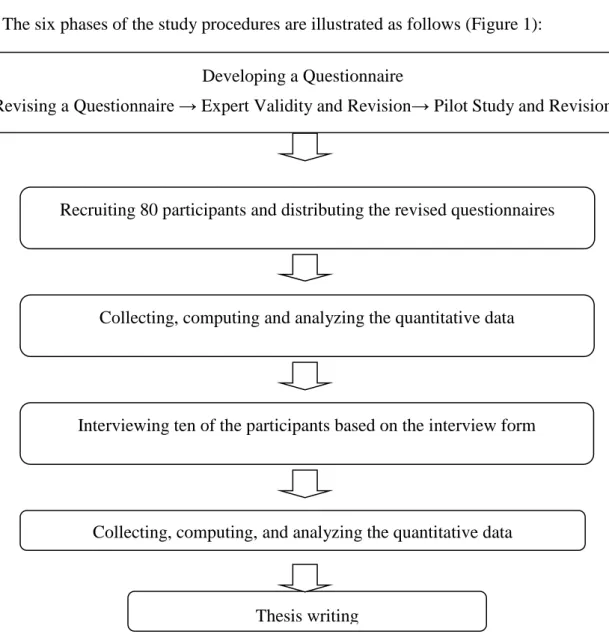
(38) Procedure The research is implemented in six phases. First, the researcher develops a revised questionnaire through expert validity and a pilot study. Afterwards, the revised questionnaires are distributed to the selected 80 participants. And then, data collected through the questionnaires is analyzed in a quantitative way. After that, to conduct the interviews and analyze the data qualitatively, the researcher chooses ten participants from the five aboriginal schools, two from each school, a male and a female, whose average scores are below 60 in the monthly exams of the last semester. At last, thesis writing begins. The six phases of the study procedures are illustrated as follows (Figure 1): Developing a Questionnaire (Revising a Questionnaire → Expert Validity and Revision→ Pilot Study and Revision). Recruiting 80 participants and distributing the revised questionnaires. Collecting, computing and analyzing the quantitative data. Interviewing ten of the participants based on the interview form. Collecting, computing, and analyzing the quantitative data. Thesis writing Figure 1. A flow chart of the study procedures. 24.
(39) Data Analysis The data of the present study are analyzed in two ways; one is quantitative analysis, and the other is the qualitative analysis. For the purpose of making research on the learning predicaments while learning English, the data from the questionnaire is computed statistically and analyzed quantitatively in terms of the participants’ genders, disadvantaged backgrounds, and English academic achievements. Moreover, the answers to the open-ended questions at the end of the questionnaire and the responses on the interview forms are analyzed qualitatively.. A Quantitative Analysis In the quantitative analysis, the statistical data from the questionnaires is computed by the Statistical Package for the Social Science (SPSS). At first, descriptive statistics was adopted to demonstrate the percentage distribution and frequency of the English learning predicaments with regard to genders, disadvantaged backgrounds, and English academic achievements. Secondly, in order to see whether there is a significant difference between genders in English learning predicaments, an independent sample t-test is employed. Finally, one-way analysis of variance (one-way ANOVA) is used for investigating the significant difference among the three disadvantaged backgrounds and three levels of English academic achievements respectively.. 25.
(40) A Qualitative Analysis In the qualitative analysis, the data collected from the responses to the open-ended questions on the questionnaire is sampled and analyzed in a qualitative way. In the interview, ten participants are recruited to answer five questions about their overall learning difficulties, learning problems from schools, families, and communities, and feelings about the English. According to their responses, the researcher will further study the predicaments in a way that is more closely related to the participants’ actual and personal experiences. Besides, the difficulties participants encounter and the assistances participants need while learning English in Items 42 and 43 on the questionnaire are further explored.. 26.
(41) CHAPTER FOUR RESULTS AND DISCUSSION This chapter intends to explore the relationship among learning predicaments, gender, academic achievement levels (high, medium, and low levels) and disadvantaged backgrounds (aboriginal, structurally unsound and low-income families). Three sections are included in this chapter. First, descriptive statistics was adopted to analyze the samples. Secondly, the researcher conducted the independent sample t-test to examine the gender difference and the identity difference (aboriginal and non-aboriginal). In the last section, one-way ANOVA was employed to investigate the difference among academic achievement levels and disadvantaged backgrounds.. Results of Descriptive Statistical Analysis Sample Analysis A total of one hundred and fifty questionnaires were distributed to five aboriginal schools in Sandimen Township, and one hundred and thirty-eight were effectively retrieved at the response rate of 92 %. The participants were fourth graders through sixth graders. The background information was analyzed according to six items which included grade, gender, identity, last semester grade, family structure and family financial condition. The statistical results were presented and interpreted as showed in Table 1.. Gender Among the valid samples (N=138), a total of 70 females accounted for 57.2% while a total of 68 males accounted for 47.8%. It was demonstrated that there were more female than male ones.. Grade Among 138 valid samples, fourth graders accounted for 36.96% with 51 participants, fifth graders accounted for 20.29% with 28 participants, and sixth graders accounted for 42.75% with 59 participants, which shows that sixth graders were the majority of the participants.. 27.
(42) Identity Among the valid samples (N=138), there were 132 aboriginal students which accounted for 95.65% of the participants. In the contrast, only six were not aboriginal students, accounting for 4.35% of the participants. Last Semester Grade Based on the last semester grades, the participants were divided into high, medium, and low achievers. 46.38% of the whole group were low achievers, who were 64 participants and scored from 0 to 79. As for medium achievers who scored from 80 to 89, there were 30 participants, accounting for 21.74% of the whole group. Last, about thirty percent of the whole group with 44 participants were high achievers who scored above 90. It suggested that most of the participants were inclined to be low achievers.. Family Structure As to the family structure, 89 participants living with parents (nuclear family) constituted the majority, making up over three fifths of the whole group. Students from single-parent families took the second place with 25 participants, accounting for 18.12%. Lastly, about fifteen percent of the participants were from grandparenting families, which have twenty participants.. Family Financial Condition According to the statistical results, students of low-income families were the majority, which had 69 participants, half of the whole group. The second largest group were from middle-class families, which had 64 participants, over forty-six percent of the whole. Wealthy families took the third place, constituting only five students and less than four percent of the whole group. This result demonstrated that most participants came from low-income families. To sum up, according to the results in Table1, among all the valid samples, most were sixth graders (42.75%). As for gender, most were females (50.72%). In terms of identity, scarcely any students were non-aboriginal (4.35%). Generally, the majority of the participants were low achievers (46.38%). With regard to the family structure and family financial 28.
(43) condition, participants in nuclear families (64.49%) and those in low-income families (54.4%) constituted the majority (50%).. Table 1 Percentage and Distribution of Participants’ Background Information (N=138) Items. Sub Items. N. P(%). CP(%). Male. 68. 49.28. 49.28. Female. 70. 50.72. 100.00. Fourth Graders. 51. 36.96. 36.96. Fifth Graders. 28. 20.29. 57.25. Sixth Graders. 29. 42.75. 100.00. Aboriginal. 132. 95.65. 95.65. Non-Aboriginal. 6. 4.35. 100.00. Low Level (0-69 points). 64. 46.38. 46.38. Medium Level (70-89 points). 30. 21.74. 68.12. High Level (90-100 points). 44. 31.88. 100.00. Nuclear Family. 89. 64.49. 64.49. Single-Parent Family. 25. 18.12. 82.61. Grandparenting Family. 20. 14.49. 97.10. Others. 4. 2.90. 100.00. Wealthy Family. 5. 3.62. 3.62. Middle-Class Family. 64. 46.38. 50.00. Low-Income Family. 69. 50.00. 100.00. Gender. Grade. Identity. Last Semester Grade. Family Structure. Family Financial Condition. Note. N = the number of participants; P = percentage; CP = cumulative percentage. 29.
(44) Descriptive Statistics on Learning Predicaments According to the descriptive statistical results in Table 2, school factor acquired the highest mean score, higher than any other factor of the learning predicaments. In contrast, cultural factor gained the lowest mean score. This indicated that school factor is likely a key cause of English learning predicaments, while cultural factor has less of an effect on causing learning difficulties overall. Table 2 Descriptive Statistics on Learning Predicaments Category. N. Mean. SD. Rank. Family Factor. 138. 2.020. .450. 3. School Factor. 138. 2.030. .472. 1. Cultural Factor. 138. 1.908. .724. 4. Communal Factor. 138. 2.022. .472. 2. To further explore the family factor, parent expectation, parent participation, and family financial condition were analyzed separately in Table 3. Among the three sub-categories, parent participation obtained the highest mean, which suggested that, in terms of family factor, most participants’ learning predicaments resulted from the low participation of the parents. Table 3 Descriptive Statistics on Family Factor Category. N. Mean. SD. Rank. Parent Expectation. 138. 1.967. .623. 2. Parent Participation. 138. 2.387. .590. 1. Family Financial Condition. 138. 1.704. .565. 3. As shown in the Table 4, school factor was further investigated with respect to content and course, teaching, school learning Environment, and interpersonal relationships. Based on the statistical results, the teaching of the school gained the highest mean and interpersonal relationship scored the lowest mean. It can be inferred that, concerning school. 30.
數據
相關文件
The English terms, simple or compound, included in the glossary are listed in alphabetical order, e.g3. ther terms ‘active transport’ is considered beginning with the
printing, engraved roller 刻花輥筒印花 printing, flatbed screen 平板絲網印花 printing, heat transfer 熱轉移印花. printing, ink-jet
• helps teachers collect learning evidence to provide timely feedback & refine teaching strategies.. AaL • engages students in reflecting on & monitoring their progress
Tying in with the modules and topics in the school-based English Language curriculum, schools are encouraged to make use of the lesson plans in the resource
Strategy 3: Offer descriptive feedback during the learning process (enabling strategy). Where the
• Tying in with the modules and topics in the school-based English language curriculum, schools are encouraged to make use of the lesson plans in the resource
The Seed project, REEL to REAL (R2R): Learning English and Developing 21st Century Skills through Film-making in Key Stage 2, aims to explore ways to use film-making as a means
(1) Western musical terms and names of composers commonly used in the teaching of Music are included in this glossary.. (2) The Western musical terms and names of composers
