行政院國家科學委員會專題研究計畫 成果報告
腸內菌之多功能轉錄調節因子 FlhDC 與其同源 DNA 形成的
複合物的結構與功能關係之研究
研究成果報告(精簡版)
計 畫 類 別 : 個別型 計 畫 編 號 : NSC 97-2311-B-006-006- 執 行 期 間 : 97 年 10 月 01 日至 98 年 10 月 31 日 執 行 單 位 : 國立成功大學微生物學科暨微生物及免疫學研究所 計 畫 主 持 人 : 王淑鶯 報 告 附 件 : 出席國際會議研究心得報告及發表論文 處 理 方 式 : 本計畫可公開查詢中 華 民 國 99 年 01 月 11 日
行政院國家科學委員會補助專題研究計畫
■ 成 果 報 告
□期中進度報告
腸內菌之多功能轉錄調節因子 FlhDC 與其同源 DNA 形成的複
合物的結構與功能關係之研究
計畫類別:■ 個別型計畫 □ 整合型計畫
計畫編號:NSC 97-2311-B-006-006-
執行期間: 97 年 10 月 01 日至 98 年 10 月 31 日
計畫主持人:王淑鶯
共同主持人:
計畫參與人員: 趙世宇
成果報告類型(依經費核定清單規定繳交):
■
精簡報告 □完整報告
本成果報告包括以下應繳交之附件:
□赴國外出差或研習心得報告一份
□赴大陸地區出差或研習心得報告一份
■
出席國際學術會議心得報告及發表之論文各一份
□國際合作研究計畫國外研究報告書一份
處理方式:除產學合作研究計畫、提升產業技術及人才培育研究計畫、
列管計畫及下列情形者外,得立即公開查詢
□涉及專利或其他智慧財產權,□一年□二年後可公開查詢
執行單位:國立成功大學微生物暨免疫學研究所
中 華 民 國 99 年 1 月 11 日
Abstract in English
The heterohexameric (D4C2) FlhDC complex is a multifunctional regulator of transcription in
enterobacteria and has pleiotropic effects upon gene regulation in most species of
enterobacteriaceae. The long-term goal of this project is to understand, at the molecular level,
how the FlhDC complex acts as a multifunctional transcriptional regulator, how it binds to its cognate promoters, and how its structure defines its DNA-binding specificity. We intended to solve the crystal structures of the FlhDC complexes from other species, to allow us to compare and contrast them with the Escherichia coli FlhDC structure to draw conclusions regarding the general features of the complex. Therefore, we have established protocols for the overexpression and purification of the FlhDC complexes from Yersinia enterocolitica and
Salmonella newport. In order to crystallize the FlhDC-DNA complex, we have collaborated and
communicated with Prof. Philip Matsumura at the University of Illinois of Chicago, for his advice on the sequences and lengths of DNA for protein-DNA complexes preparation based on the results characterized from his lab. To resolve the disordered C-terminal DNA-binding domains in E. coli FlhDC structure, we constructed and purified His-tagged FlhD and MBP-FlhC fusion proteins. In summary, we have fulfilled with parts of the specific aims proposed for this project during this funding cycle.
Abstract in Chinese
FlhDC 複合物存在於腸內菌中,是目前唯一以異構形 Heterohexameric (D4C2) 複合物形式存在 於原核生物中的多功能轉錄調節因子,而且具有許多腸內菌科物種中多效性基因調節的功 能。這個計畫的長期目標是要在分子結構的層次去深入瞭解 FlhDC 複合物是如何執行它多 功能轉錄調節因子的角色、如何與它的同源 DNA 結合以及它的結構與 DNA 相互作用的特 異性。目標之一是要將 FlhDC 在其他腸內菌晶體結構解出來,與已知的 Escherichia coli 的 FlhDC 結構比較,以瞭解此複合物在腸內菌中的共通性質。我們已建立了從 Yersiniaenterocolitica 和 Salmonella newport 表現及純化 FlhDC 蛋白質之步驟。在進行 FlhDC-DNA 複 合物結晶試驗時,我們與伊利諾大學芝加哥分校的 Philip Matsumura 教授合作,根據他實驗 室的結果以及他的建議,我們設計了不同的 DNA 長度與序列來進行這方面的研究。為了要 瞭解在 FlhD 和 FlhC 在 C 端與 DNA 結合後結構的變化,我們已製備出 His-tagged 及 FlhD 及 MBP-FlhC 蛋白。總括來說,在計畫執行期間,我們已完成了部分當初計畫擬定的執行目標。
Introduction
The objective of this project is to resolve the structures of the DNA-binding domains of the FlhDC complex in which these C-terminal DNA-binding regions are disordered in the
Escherichia coli FlhDC complex structure. It was proposed that these regions are very flexible,
the binding of DNA can stabilize the C-terminal structures (1-8). To test these hypotheses, we proposed to solve the structures of the FlhDC complex from other species of enterobacteria as well as the E. coli FlhDC-DNA complex structure to understand how FlhDC acts as a global regulator and how the structures defines DNA-binding specificity.
The preparation of soluble protein samples is a potential bottleneck of successful growth of crystals. We have made progress to improve the quality and quantity of the FlhDC complexes purified from Yersinia enterocolitica. In order to see whether and to what degree that the FlhC structure changes upon binding to FlhD, we have constructed the plasmid that carries flhC fused to maltose-binding protein (MBP) at its N-terminal end and this fusion does not interrupt the interaction between FlhC and FlhD. We have obtained the MBP-FlhC purified protein.
The collaboration we have established with Prof. Philip Matsumura at the University of Illinois at Chicago has accelerated the process for the preparation of the FlhDC-DNA complex. It is often challenging to crystallize the protein-DNA complex (9). The design of sequences and lengths of DNA usually plays a key factor determining whether the protein-DNA complexes crystallize. The high- and low-binding affinity regions characterized in Prof. Matsumura’s lab has been very helpful for us to design the DNA sequences for crystallization trial.
In continuous interest in structure/function studies of transcription factors that regulate gene expression of virulence factors in bacteria, we have collaborated with Prof. Jiunn-Jong Wu at the National Cheng Kung University to work on the structural studies of the stress response regulator PerR protein from Streptococcus pyogenes (10-12). We have successfully obtained PerR crystals.
References
1. Givaudan, A., and Lanois, A. (2000) Journal of bacteriology 182, 107-115 2. Pruss, B. M. (2000) Rec. Res. Developm. Microbiol. 4, 31-42
3. Campos, A., and Matsumura, P. (2001) Molecular microbiology 39, 581-594
4. Campos, A., Zhang, R. G., Alkire, R. W., Matsumura, P., and Westbrook, E. M. (2001)
Molecular microbiology 39, 567-580
5. Pruss, B. M., Liu, X., Hendrickson, W., and Matsumura, P. (2001) FEMS microbiology
letters 197, 91-97
6. Claret, L., and Hughes, C. (2000) Journal of molecular biology 303, 467-478
7. Wang, S., Matsumura, P., and Westbrook, E. M. (2001) Acta crystallographica 57, 734-736
8. Wang, S., Fleming, R. T., Westbrook, E. M., Matsumura, P., and McKay, D. B. (2006)
Journal of molecular biology 355, 798-808
9. Hollis, T. (2007) Methods in molecular biology (Clifton, N.J 363, 225-237
10. Jacquamet, L., Traore, D. A., Ferrer, J. L., Proux, O., Testemale, D., Hazemann, J. L., Nazarenko, E., El Ghazouani, A., Caux-Thang, C., Duarte, V., and Latour, J. M. (2009)
Mol Microbiol 73, 20-31
11. Tsou, C. C., Chiang-Ni, C., Lin, Y. S., Chuang, W. J., Lin, M. T., Liu, C. C., and Wu, J. J. (2009) Int J Med Microbiol
12. Traore, D. A., El Ghazouani, A., Jacquamet, L., Borel, F., Ferrer, J. L., Lascoux, D., Ravanat, J. L., Jaquinod, M., Blondin, G., Caux-Thang, C., Duarte, V., and Latour, J. M. (2009) Nat Chem Biol 5, 53-59
Research Design and Methods
We cloned the genes of interest into the vector pET21b and transformed the plasmid harboring the gene to E. coli strain BL21 (DE3). The overexpression of the protein was induced by adding 0.5 mM IPTG when the cell density reached to an optical density 0.4 ~ 0.6. If the protein forms inclusion body when overexpressed, we varied the induction temperature and IPTG concentration to improve the solubility of the protein. Purification of proteins was carried out by Ni-NTA affinity column. Briefly, the cell pellet was disrupted by sonication and clarified by centrifugation. Then the supernatant was loaded into the Ni-NTA column. The unbound contaminates were washed out and the protein was eluted. The purified protein was used for crystallization trial. We have setup an automatic crystallization platform Honeybee 961 for efficient crystallization screenings.
Results
1. Purification of the MBP-FlhC fusion protein. The solubility of FlhC has been greatly
improved by fusing it to dual His-MBP tag at the N-terminal end of FlhC.
Figure 1. Purification of MBP-FlhC fusion protein. Lane 1, uninduced cells; lane 2, induced cells; lane 3,
2. Purification of FlhDC complex from Salmonella enterica serovar Newport, and Yersinia
enterocolitica. We have purified the homologous FlhDC complexes from other species of
enterobacteria.
Figure 2. Purified Salmonella newport FlhDC complex.
3. In vitro competition binding data of the 48 base-pair fliA promoter footprint region (Y. Lee and P. Matsumura, personal communication). Dr. Matsumura and his colleagues have
characterized high- and low-binding affinity regions within the 48 base-pair fliA promoter sequence, which binds FlhDC. The 48 base-pair fragment was divided into 5 sections (A, B, C, D, and E), each of 9-10 base-pairs. The DNA sequence has been mutated in each section for in
vitro competition binding assays. Labeled fliA fragments were competed against a 500-fold
excess of un-labeled fliA fragments and also against sections A-E. Sections B, D, and E were found to have higher binding affinity for the FlhDC complex.
Figure 3. In vitro competition binding assay of 48 bp fliA promoter sequence. (a) 48-bp fragments for in vitro
binding competition assays. DNA sequences are mutated in highlighted regions. (b) A binding competition assay was conducted by 32P - labeled fliA fragment competing against 500-fold excess of un-labeled fragments of fliA and sections A, B, C, D and E. Fragment A and C can compete the binding as well as the wild-type fliA fragment, meaning mutations on sections A and C do not affect the binding. Mutations on fragment B, D and E weaken the shifted band, indicating these sections have higher binding affinity. Last lane is the control of the 32P - labeled fliA fragment.
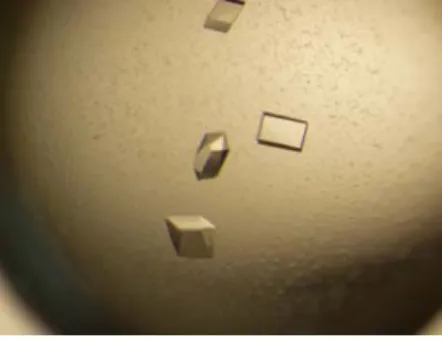
4. Crystals of the Streptococcus pyogenes PerR protein. In continuous interest of structural
studies of transcription factors, we have worked on a stress response regulator PerR protein in S.
pyogenes and have successfully crystallized it.
出國心得報告(出國類別:出席國際會議)
參與 2009 年於英國牛津舉辦的第十四屆
小角度散射會議
姓名: 王淑鶯
職稱: 助理教授
單位: 國立成功大學微生物暨免疫學所
出國日期 :
98.9.12– 98.9.19
目的地 : 英國牛津
國科會計畫編號 :
NSC
97-2311-B-006-006-報告日期:
99.1.11
The fourteenth International Conference of Small-angle Scattering (SAS) meeting was held in Oxford, UK, 13-18 Sep. 2009. The SAS meeting has been held every three years since 1965 and it was the first time to be in UK. Over five hundred participants from 35 countries were attending this meeting. We were gathering in the conference room at Examination School of Oxford and discussed the work based on SAS studies. Speakers in this meeting reported high quality research in this area as well as the poster presentations whose topics include biological science, physical science, material science, and synchrotron radiation facility development.
I have presented a poster titled “Solution Small-angle X-ray Scattering studies of a Multidomain RNA Helicase, the Bacillus subtilis YxiN protein”. During my presentation, I had the opportunity to discuss my work with Dr. Pau Bernado from European Molecular Biology Laboratory (EMBL) who is an expert in analyzing the conformations of the flexible protein system and contributes to the creating of software EOM that I used in this work. Speakers from Dr. Dimitri Svergun’s group from EMBL had an update of the new development of Atsas program suite used for SAS data analysis from biological molecules. What impresses me is that the SAS beamline station X33 at EMBL has been upgraded with automatic sample exchanger and fully accessible for remote data collection. Dr. Daniel Franke demonstrated this remote data collection during his talk by logging in the server from the conference room and the audience could monitor the data collection going on at EMBL. This state-of-art technology can allow us to perform high throughput SAS data collection without travelling. I also met with Dr. Michal Hammel and Dr. Gregory Hura from SIBYLS beamline at Lawrence Berkeley National Laboratory, USA. Both of them are experts in SAXS analysis for biological molecules and the beamline they work at has also been fully developed for remote data collection. I also interacted with friends who were my colleagues and collaborators when I was a postdoctoral fellow in Stanford University. Those are Dr. Hiro Tsuruta from the Stanford Synchrotron Radiation Laboratory and Jacob Kirkensgaard who gave a talk about polymer simulation. Jacob Kirkensgaard is a Ph.D. candidate at the University of Copenhagen and he introduced me to his adviser Prof. Kell Mortensen who is an expert in SAS based polymer research. By interacting with the scientists from Prof. Mortensen’s lab, I have more understanding of the SAS application in physical and material science.
The organizers of this meeting arranged a valuable tour for us to visit Diamond light source, a new synchrotron facility located at South Oxfordshire. Right next to the Diamond is the ISIS proton synchrotron that pulses neutrons and muons that allow scientist to perform neutron scattering experiments. I have visited several X-ray synchrotron facilities in the world, but that was the first time for me to visit the proton synchrotron. I am grateful to the scientists who guide us through the tour and explain to us how the facilities work and how we can conduct the experiments at the beamline station. After this tour, I start to understand the application of neutron scattering on material and life science.
Overall, this is a high quality meeting and not only have I broadened my knowledge in SAS, but also get valuable advice and suggestions from the scientists whom I interacted with. SAS has become an important tool during the past decade and the SAS field is gaining greater significance in science and technology. With the fast development of the synchrotron facility for SAS and automation of the software for data analysis, we can conduct experiments efficiently and get results in days. After this meeting, I am motivated to put more efforts in SAS studies besides crystallography and to expand my expertise.