明新科技大學 97 校內專題研究計畫成果報告
應外系學生跨國文化敏感性之研究
應外系學生跨國文化敏感性之研究 中文摘要 隨著臺灣快速國際化,以及當今經濟、社會和科技等蓬勃發展,英語已發展成跨 國間和跨文化間溝通的重要橋樑。如何幫助英語學習和使用者有效發展跨文化/ 國籍間溝通能力的知識及策略來滿足實際需要,實為當務之急。英語學習者需要 被合適教導和引導,才能在地球村的時代中真正扮演好國際公民的角色。 對於本校新成立的大學部應外系同學而言,如何在未來有效地使用英語與來自世 界上不同國籍與文化的人溝通,亦成為這四年學習過程中一項重要且值得探討得 議題。研究者深感本系課程除了強調學生語言能力的訓練(基礎聽說讀寫的知識 和技巧),對於非語言部分,例如跨文化溝通能力,也需多加瞭解、重視和加強。 本研究則是初步調查、瞭解第一屆本校應外系同學(日夜間部)的跨文化敏感性 發展現況(intercultural sensitivity)--特別是跨文化間溝通能力中的情意部分 (affective aspects),亦即參與者對於瞭解和欣賞不同文化間豐富性及差異性的情 感渴望。根據Chen and Starosta的模式(1996, 1997 & 2000),跨文化敏感性包 含了五個主題:互動時的參與感(interaction engagement)、對文化差異的尊重度 (respect for cultural differences)、互動時的自信心(interaction confidence)、互動時 的喜悅(interaction enjoyment) 及互動時的專注情形(interaction attentiveness)。
A Study of Applied Foreign Languages Students’ Intercultural Sensitivity
ABSTRACT
Nowadays, the importance of developing intercultural communication competence (ICC) has become as important as the learning of English in the era of a global village. According to the ICC model proposed by Chen and Starosta (1996), there are three dimensions in intercultural communication competence: intercultural sensitivity,
intercultural awareness and intercultural adroitness. Among the three dimensions, the
ability of intercultural sensitivity has been a critical buffer and enhancer of achieving intercultural communication competence. The five major factors of intercultural sensitivity include interaction confidence, interaction attentiveness, interaction
enjoyment, interaction engagement, and respect for cultural differences.
In this study, the participants were 80 English-major students in Applied Foreign Languages (AFL) Department (Day and Night school of Ming Hsin University). Intercultural Sensitivity Questionnaire, designed and validated by Chen and Starosta (1996, 1997 & 2000), was used to help the researcher better understand these participants’ emotional desire towards understanding and appreciating the varieties and richness among cultures. Moreover, students’ perspectives about the target issue were collected through interview questions for further reflection and interpretation.
The study results indicate that (1) the development of interaction confidence of many participants was obviously affected by the deficiency of personal abilities, (2) cultural factors often determined the orientation of interaction attentiveness, (3) interaction
enjoyment could be reduced by participants’ negative feelings about personal abilities,
(4) positive interaction engagement usually went to western people, and (5) the questionnaire results showed that many participants expressed respect for cultural
differences, but interview data indicated that stereotypes still existed in their mind. All
of the data can provide English teachers with valuable information for their future design of effective and practical curriculum in promoting English-major students’ intercultural sensitivity.
TABLE OF CONTENTS (目錄)
中文摘要
英文摘要 (abstract)
1. Introduction P.1
2. Intercultural Communication Competence:Chen and Starosta’s Model P.1
3. The Importance of Intercultural Sensitivity P.1
4. Purpose of the Study P.2
5. Method P.2
5.1 Subjects P.2
5.2 Instruments P.3
5.3 Procedure P.3
5.4 Data collection and analysis P.3
6. Results P.4
6.1 A shortage of interaction confidence P.4 6.2 Cultural factors and interaction attentiveness P.5 6.3 Personal abilities and interaction enjoyment P.6 6.4 Positive findings about interaction engagement with western people P.7 6.5 Stereotype or respect for cultural differences P.9
7. Discussion P.12
8. Conclusion P.13
Reference P.14
Appendix A: Intercultural Sensitivity Questionnaire (ISQ 中文版) P.15
Appendix B: A Brief Summary of the 5 themes/factors of 24 items in ISQ P.17
Appendix C: Interview Questions P.18
Appendix D: The Results of Intercultural Sensitivity Questionnaire P.19
1. Introduction
Nowadays, English, the international language, has no longer linked to a single culture or nation for economic, social and technological purposes. Due to the increasingly global and local needs of communication, the development of intercultural communication competence (ICC) plays an important role in English education. English learners need to be taught or guided appropriately to become effective international citizens in the era of a global village.
2. Intercultural Communication Competence:Chen and Starosta’s Model
The development of intercultural communication competence has been considered as important as English itself in the world of globalization. Except for the training of target language skills, the non-linguistic aspects in intercultural communication should be emphasized for English learners of all levels.
In general, intercultural communication competence (ICC) is assumed to include three dimensions: affective, cognitive and behavioral. The three dimensions have been suggested to develop together in order to communicate effectively and properly in intercultural settings (Byram 1997, Chen and Starosta 1996, Fantini 2000, Lustig and Koester 2006, Spitzberg 2000, Ting-Toomey 1999). Chen and Starosta (1996) have proposed a comprehensive model of intercultural communication competence (ICC) that elaborates elements for the three dimensions: intercultural sensitivity (affective dimension : self-concept, open-mindedness, non-judgmental, and social relaxation), intercultural awareness (cognitive dimension:self-awareness and cultural awareness) and intercultural adroitness (behavioral dimension : linguistic skills, interaction management, behavioral flexibility, identity management, and relationship cultivation). In this study, Chen and Starosta’s model is used as the basis to explore the issue under research.
3. The Importance of Intercultural Sensitivity
textbooks. However, without the enhancement of intercultural sensitivity, the accumulation of cultural facts or information may easily form stereotypes (Guest 2002) and result in tragedy. The recent shocking news in Taiwan that 8 university students beat foreign workers during holidays for fun (Liberty Times 2007) should be a negative example showing the shortage of intercultural sensitivity. Therefore, the development of intercultural communication competence is unreachable, unless a person firstly shows positive feelings towards learning, understanding, and respecting the varieties and richness among cultures. Teachers and researchers should consider the ability of intercultural sensitivity seriously because it is the critical buffer and enhancer of achieving intercultural communication competence.
4. Purpose of the Study
The study was designed to understand the intercultural sensitivity of Applied Foreign Languages Students in Ming Hsin University, HsinFon Taiwan. Chen and Starosta’s model was chosen as the basis to understand the affective dimension of intercultural communication competence. Intercultural sensitivity refers to a person’s motivation and attitude before, during and after intercultural interaction. It can be conceptualized as the emotional desire of a person towards understanding and appreciating the varieties and richness among cultures that can promote an appropriate and effective behavior in intercultural communication (Chen and Starosta 1996 and 1997,Fritz, Möllenberg and Chen 2002). It contains four components: self-concept, open-mindedness, non-judgmental, and social relaxation (Chen and Starosta 1996 and 1997). This ability of developing positive emotional responses is believed to help EFL learners appreciate, acknowledge and respect cultural differences (Chen and Starosta 1996 and 1997), which is beneficial to their future intercultural communication.
5. Method 5.1 Subjects
of time abroad studying or traveling.
5.2 Instruments
The Intercultural Sensitivity Questionnaire (ISQ, see Appendix A), designed and validated by Chen and Starosta (1996, 1997 & 2000), was used in this study to help the researcher better understand these participants’ emotional desire towards understanding and appreciating the varieties and richness among cultures. There are 24 items under five themes in this questionnaire. The five themes (factors) are (1) interaction engagement: participants’ feelings of participation in intercultural communication, (2) respect for cultural differences: how participants orient to or tolerate their counterpart’s culture and opinion, (3)
interaction confidence: how confident participants are in the intercultural
setting, (4) interaction enjoyment: participants’ positive or negative reaction towards communicating with people from different cultures, and (5) interaction
attentiveness: participants’ efforts to understand what’s going on in intercultural
interaction (see Appendix B).
Each theme stands for one factor to affect the development of intercultural sensitivity. A choice of five Likert-scale responses (1,2,3,4,or 5) under each item in the Chinese translation version of ISQ was employed in the study for participants to decide the degree to which they agreed or disagreed with each item. Moreover, students’ perspectives concerning this issue were collected through interview questions (see Appendix C) for further reflection and interpretation. All of the data can provide AFL teachers with valuable information for their future design of effective and practical curriculum in promoting English-major students’ intercultural sensitivity.
5.3 Procedure
Implementation of the project started in early March of the year 2008 and was completed in September of the same year. The students were asked to fill in the Intercultural Sensitivity Questionnaire in the beginning of spring semester 2008. Then, 28 volunteers accepted further interviews about the target issue during the following months.
5.4 Data collection and analysis
from the Intercultural Sensitivity Questionnaire (ISQ) of 80 students. The second was the interviews results conducted among 28 volunteers. The quantitative analysis of the questionnaire was computed by using descriptive statistics, such as frequencies and percentages, to summarize the participants’ responses to ISQ. The data from interviews was subjected to content analysis, and thematic categories were created from the data for further interpretation. These descriptive analyses can help researcher understand and explain the current development of English-major students’ intercultural sensitivity in this study.
6. Results
As stated earlier, the main purpose of this study was to understand the
intercultural sensitivity of Applied Foreign Languages Students in Ming Hsin
University, Taiwan. Firstly, 80 participants completed the Intercultural Sensitivity Questionnaire (ISQ), and of them, 28 accepted further interviews about the same topic. The main findings after analyses are discussed as follows.
6.1 A shortage of interaction confidence
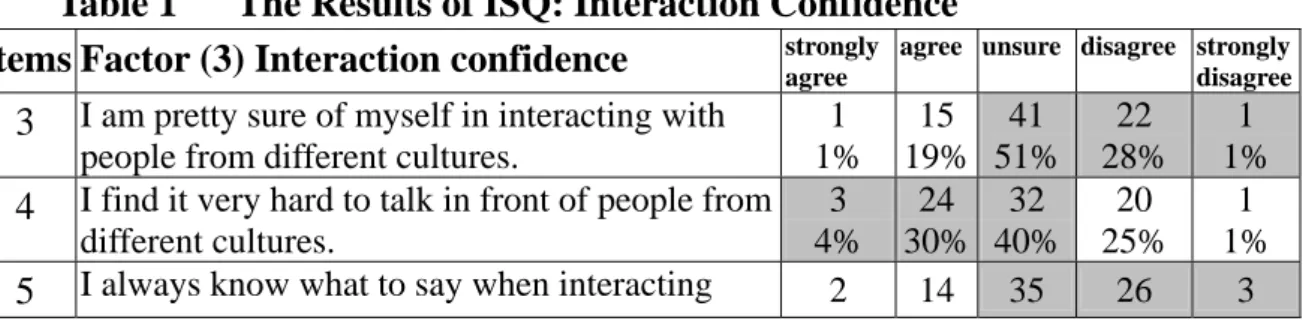
In table 1, the questionnaire results show that interaction confidence was the main factor that hindered these participants’ development of intercultural sensitivity. More than half of the participants in this study expressed their negative or uncertain attitude to the five items grouped under the factor
interaction confidence. Many participants were doubtful if they had the ability
to interact with people from different cultures by themselves (Item 3: 80%). They found it could be hard to talk in front of people from different cultures (Item 4: 74%) because they did not know what to say (Item 5: 80%). Most participants did not feel confident (Item 10: 85%) and thought that they could not be as sociable as they wanted to be, when interacting with people from different cultures (Item 6: 90%).
Table 1 The Results of ISQ: Interaction Confidence
Items Factor (3) Interaction confidence strongly agree agree unsure disagree strongly disagree
3 I am pretty sure of myself in interacting with
people from different cultures.
1 1% 15 19% 41 51% 22 28% 1 1%
4 I find it very hard to talk in front of people from
different cultures. 3 4% 24 30% 32 40% 20 25% 1 1%
with people from different cultures. 3% 17% 43% 33% 4%
6 I can be as sociable as I want to be when
interacting with people from different cultures.
1 1% 7 9% 40 50% 25 31% 7 9%
10 I feel confident when interacting with people
from different cultures.
5 6% 8 10% 46 58% 19 24% 2 3%
The findings from interviews also demonstrate that many students didn’t feel confident in intercultural settings because of their poor abilities in several aspects, such as fluent spoken English, communication strategies, culture knowledge, and English listening comprehension:
Extract 1:
I hope I can use English to express my opinions freely in front of foreign people, but I don’t know how to say things fluently…using my own ideas to share with others in English is quite difficult…I think I will feel nervous during intercultural interaction, especially in formal settings…I need more trainings in English and interaction strategies. (Q6/S6)
Extract 2:
I am not sure if I can talk in English with foreign people naturally… To
me, they are like a mystery…I am afraid of offending them because of my poor knowledge of their cultures. (Q2/S13)
Extract 3:
I can’t be myself in front of foreign people…I feel uncomfortable when talking with people from different countries in English… They have different English accent and their own cultures…I don’t know what they are thinking about when talking…and how they think of me. (Q1/S2)
6.2 Cultural factors and interaction attentiveness
Chinese sayings, such as “Listen what people say and observe what people behave carefully”( 察 言 觀 色 ), and “Think three times before action/ talking”(三思而後行).
Table 2 The Results of ISQ:Interaction attentiveness
Items Factor (5) Interaction attentiveness strongly agree agree unsure disagree strongly disagree
15 I am very observant when interacting with people from different cultures.
18 23% 47 59% 13 16% 2 3% 0
17 I try to obtain as much information as I can when interacting with people from different cultures. 0 12 15% 51 64% 12 15% 5 6% 19 I am sensitive to my culturally-distinct counterpart’s subtle meanings during our interaction. 5 6% 57 71% 13 16% 5 6% 0
Similar results can be found from interviews, which suggest that the influence of Chinese culture on Taiwanese students during intercultural communication cannot be ignored. Two examples are chosen as follows to present the strategies many participants preferred to use during intercultural communication:
Extract 4:
It is not necessary to understand everything during intercultural communication…like a spy to explore everything? … It is rude to be aggressive in front of foreign people…I will smile and nod my head to show my respect…. Being a quiet listener will make a good impression on foreign people. (Q3/S7)
Extract 5:
Of course, I will try to express my opinions if I can … I don’t mean to be talkative. I will not try my best to understand everything they say…conversation like that makes people sick…I think observing, listening and smiling are polite strategies to win people’s attention…Foreign people will know I respect them. (Q3/S22)
6.3 Personal abilities and interaction enjoyment
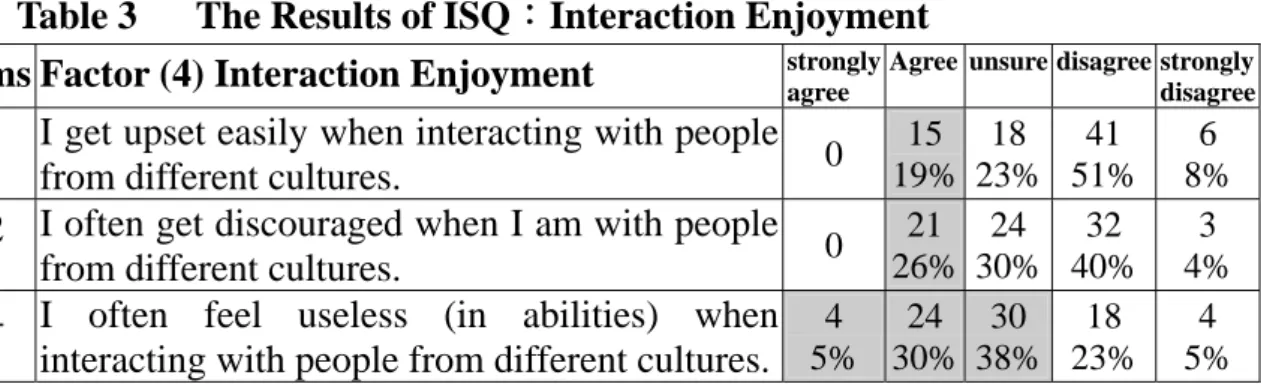
(about 38%) participants were not sure (Item 14). When being asked if they felt upset easily during cross-cultural interaction (Item 9) or got discouraged when being with these people from different cultures (Item 12), they seemed to be more optimistic. Only 19% and 26% agreed to these statements. The results indicate that these participants’ negative reaction towards communicating with people from different cultures in this study should be mainly related to personal abilities (Item 14) rather than personal feelings (Item 9 & 12). In other words, many participants psychologically enjoyed interacting with people from different cultures, but they felt useless in their abilities, which might reduce their enjoyment.
Table 3 The Results of ISQ:Interaction Enjoyment
Items Factor (4) Interaction Enjoyment strongly agree Agree unsure disagree strongly disagree
9 I get upset easily when interacting with people
from different cultures. 0
15 19% 18 23% 41 51% 6 8%
12 I often get discouraged when I am with people
from different cultures. 0
21 26% 24 30% 32 40% 3 4%
14 I often feel useless (in abilities) when interacting with people from different cultures.
4 5% 24 30% 30 38% 18 23% 4 5%
The information drawn from interviews also supports this finding mentioned above. In particular, many participants expressed their strong desire to make foreign friends from western or English-speaking countries, and to become international citizens. What they worried about most was if they had the abilities to achieve successful intercultural communication.
Extract 6:
I like to make western friends and that is why I choose English as my major… I hope my foreign friends will enjoy my company and we can be good friends…I know foreigners are different from me. I need to learn many things to empower myself, such as fluent English abilities and understanding the customs of their cultures, to communicate with them effectively, like an international person. (Q5/ S27)
Extract 7:
an international citizen in the future. (Q5/S20)
6.4 Positive findings about interaction engagement with western people
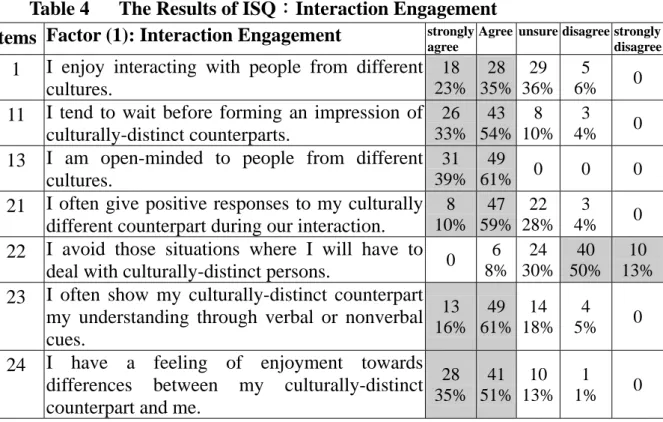
Based on the questionnaire results shown in Table 4, it is obvious that many participants had very positive feelings of participation in intercultural communication (interaction engagement). 87% participants tended to wait before forming an impression of culturally-distinct counterparts (Item 11). They enjoyed interacting with people from different cultures (Item 1: 58%), as well as enjoyed the differences between them (Item 24: 86%). Rather than avoiding those intercultural situations, 63% participants chose to face them (Item 22: 63%). All participants agreed that they were open-minded to people from different cultures (Item 13: 100%) and showed these people their understanding through verbal or nonverbal cues (Item 23: 77%). Also, more than half of participants were willing to give positive responses to people from different cultures (Item 21: 69%).
Table 4 The Results of ISQ:Interaction Engagement
Items Factor (1): Interaction Engagement strongly agree Agree unsure disagree strongly disagree
1 I enjoy interacting with people from different cultures. 18 23% 28 35% 29 36% 5 6% 0
11 I tend to wait before forming an impression of culturally-distinct counterparts. 26 33% 43 54% 8 10% 3 4% 0
13 I am open-minded to people from different cultures.
31 39%
49
61% 0 0 0
21 I often give positive responses to my culturally different counterpart during our interaction.
8 10% 47 59% 22 28% 3 4% 0
22 I avoid those situations where I will have to deal with culturally-distinct persons. 0
6 8% 24 30% 40 50% 10 13%
23 I often show my culturally-distinct counterpart my understanding through verbal or nonverbal cues. 13 16% 49 61% 14 18% 4 5% 0
24 I have a feeling of enjoyment towards differences between my culturally-distinct counterpart and me.
28 35% 41 51% 10 13% 1 1% 0
of different cultures (they meant people of western cultures) and were willing to be friends with them. They expected some amazing experiences with foreign friends, especially with those English-speaking or European people.
Extract 8:
I like to make friends from European countries…I have been fascinated
with their music, art and architectures … They speak English, good English, I think. I have heard that they start to learn English from elementary schools…maybe earlier. (Q5/ S10)
Extract 9:
I think I try to create opportunities to know foreign people…In HsinChu, you can see many Americans walking on the streets during holidays…they are working in the companies of Science Park…They are very nice and need friends. I will not actively talk to them, but I will walk close to them to see if they need help…Most of the time, they can feel my sincerity and then have a chat with me…. Now, I have no fear of facing foreigners and quite enjoy this kind of experience (Q5/ S8)
Extract 10:
I like to make western friends but I think I need to improve my English
abilities firstly…. If possible, I don’t like to learn English from Africans or Philippines…I know for many of them English is their native tongue… They have got a strange accent that makes no sense to me…If I learn English from them, the English I speak will make people think I’ve come from a low-ranking class. (Q6/ S4)
6.5 Stereotype or respect for cultural differences
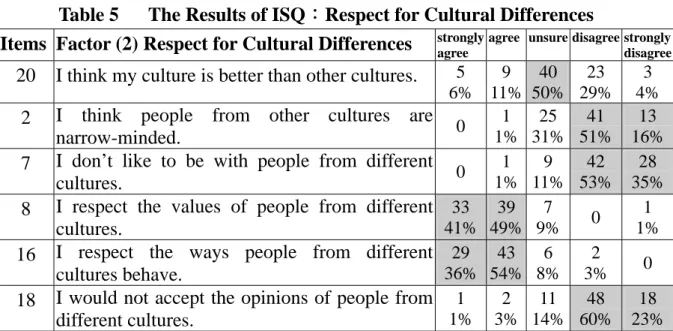
As Table 5 shows, most participants in this study expressed their willingness to show respect for cultural differences. Many liked to be with people from different cultures (Item 7: 88%) and were willing to accept their different opinions (Item 18: 83%). 67% disagreed that these people were narrow-minded (Item 2: 67%). Instead, most respected the values of these people (Item 8: 90%) and the ways they behaved (Item 16: 90%).
Table 5 The Results of ISQ:Respect for Cultural Differences
Items Factor (2) Respect for Cultural Differences strongly agree agree unsure disagree strongly disagree
20 I think my culture is better than other cultures. 5
6% 9 11% 40 50% 23 29% 3 4%
2 I think people from other cultures are
narrow-minded. 0 1 1% 25 31% 41 51% 13 16%
7 I don’t like to be with people from different
cultures. 0 1 1% 9 11% 42 53% 28 35%
8 I respect the values of people from different cultures. 33 41% 39 49% 7 9% 0 1 1%
16 I respect the ways people from different cultures behave. 29 36% 43 54% 6 8% 2 3% 0
18 I would not accept the opinions of people from different cultures. 1 1% 2 3% 11 14% 48 60% 18 23%
The questionnaire results in the topic respect for cultural differences seem to be positive; however, the interview information from these participants indicates that “knowing is one thing and doing is another.” Many unconscious stereotypes, like common knowledge, had narrowed their mind. Their feedbacks (28 interviewees) to the 18 statements in Table 6 asked during interviews demonstrate that many of them did not have real respect for cultural differences. Table 6 is a brief summary of their first impression of these statements. Many of them agreed with these statements during interviews without hesitation.
Table 6 The Responses of 18 Statements
No Statement Agree Unsure Disagree
1 Most foreign brides from Mainland China, Vietnam, or Indonesia come to Taiwan for money. They can cause many social problems.
28 100%
0 0
2 People from Philippines or Thailand are very open in sex. 24 86% 4 14% 0
3 Most People from USA are rich. 20 71%
5 18%
3 11% 4 I prefer products from France, Japan and USA,
because it means high quality.
17 61% 10 36% 1 3% 5 I think people from Egypt are low in hygiene,
because they eat with fingers.
24 86%
4 14%
0
6 Men from Italy are too open to be a husband. 22 79%
4 14%
7 People from Indonesia are very lazy. 26 93%
2 7%
0
8 Korean men are very romantic. 21 72%
6 21%
2 7% 9 Japanese people are very diligent, but they like
to talk behind people’s back.
24 86% 3 11% 1 3% 10 Studying in western countries (USA, UK,
Canada, Australia…) is better than studying in local universities.
28 100%
0 0
11 People from Mainland China are very greedy. 25 89%
3 11%
0
12 Most beautiful Korean girls have done cosmetic surgery. 20 71% 8 29% 0
13 People from India are good at mathematics. 25 89%
3 11%
0
14 People from Middle East are very crucial. 26 93%
2 7%
0
15 People from Russia are very cold. 19 68%
6 21%
3 11% 16 Germans are very serious and difficult to deal
with. 23 82% 3 11% 2 7% 17 People from Africa are very poor. 28
100%
0 0
18 People from Africa are not well educated. 28 100%
0 0
According to the interview data, it is found that these stereotypes had been gradually shaped through the information from movies (soap operas), newspapers, magazines and Internet. Many participants explained their impressions on different cultures or countries, completely based on their experience with the information from mass communication. Four examples are listed below.
Extract 11:
I have no idea about the people from Middle East, but I know they are religionists of Islam. Most of them are Muslim, the followers of Mohammed. …. I will not go to these countries….war, kidnapping and murder have happened every day …Newspapers and magazines have reported many terrible things happening in this area that really scare people. (S9)
Extract 12:
working-level young men marry Vietnamese or Indonesian women…These women do not really love their Taiwanese husbands. What they want is money and residence card…One day, I watched the TV news…a poor veteran man explained in despair how his wife from China abused him and consumed his money. (S11)
Extract 13:
My mother and my older sister are crazy about Jang Dong Gun, a gorgeous Korean actor…. I am one of his fans, too…We enjoy watching Korean soap operas every night…Romantic story plot and handsome actors have attracted our attention… We are planning to visit Korea in this summer…(S17)
Extract 14:
I prefer Cosmetics from France…They mean high quality… When reading fashion magazines, I find French Women look very elegant… better than women in other countries… As Internet advertisements and related magazine reports say, the skin care products from France are very natural and good…I believe good Cosmetics can help women become charming, even though these products are expensive. (S 23)
7. Discussion
The present study yields several findings. Discussions of these findings are based on the five major factors of intercultural sensitivity: interaction confidence, interaction attentiveness, interaction enjoyment, interaction engagement, and respect for cultural differences.
Firstly, the development of interaction confidence in this study was obviously affected by the deficiency of personal abilities, such as the use of practical English, the comparison and reflection of intercultural knowledge, and the application of effective communication strategies. In other words, if language teachers want to help students feel confident during intercultural settings, the training and practice of these personal abilities mentioned here cannot be ignored.
Secondly, cultural factors often determined the orientation of interaction
attentiveness. In this study, many participants used their preferred ways to
Thirdly, this study shows that interaction enjoyment could be reduced by participants’ negative feelings about personal abilities. When interacting with people from different cultures, poor communication abilities made many of these participants feel unconfident, useless, and unhappy. Thus, how to design and provide effective courses that can help these students improve their communication abilities, and enhance their confidence and enjoyment in intercultural settings, becomes an urgent issue for language teachers.
Fourthly, the questionnaire data about interaction engagement in this study is encouraging, but interview results indicate that most of the time these positive feelings went to western people. The result has implied that these participants were not really open-minded to people from different cultures. Their horizon should be broadened to become interested in communicating with people of different countries. Watching travel films of different countries in the world for reflection and discussion is one of the examples that may help. Finally, many participants in this study expressed their willingness to show
respect for cultural differences, but interview results tell us a different story.
Stereotypes still existed in their minds. They need more opportunities on understanding different countries, and more training on appreciating the benefits of cultural diversity. Students should be reminded that all people (cultures) should be valued and respected. Open-minded attitude to face them in intercultural communication is necessary.
8. Conclusion
Reference
Byram, M. (1997). Teaching and assessing Intercultural Communicative
Competence.Sydney: Multilingual Matters.
Chao, T.C. (2007). Enhancing EFL Learners' Intercultural Sensitivity Through Travel Films: A Diary Study. This paper presented in the TEFL International
Conference at National Taichung University, November 24, 2007.
Chen, G.M. and Starosta, W.J. (1996). Intercultural communication competence: A synthesis. In B. Burleson (Ed.), Communication Yearbook 19 (pp.353-383). Thousand Oaks: Sage.
Chen, G.M. and Starosta, W.J. (1997). A review of concept of intercultural sensitivity. Human Communication, 1, 1-16.
Chen, G.M. and Starosta, W.J. (2000). The development and validation of the intercultural communication sensitivity scale. Human Communication, 3,
1-15.
Fantini, A. E. (2000). Assessing Intercultural Competence: A YOGA Form. Brattleboro, VT: School for International Training.
Fritz, W., Möllenberg, A. and Chen, G.M. (2002). Measuring intercultural sensitivity in different cultural contexts. Intercultural Communication
Studies,11,165-176.
Guest, M. (2002). A critical "checkbook" for culture teaching and learning. ELT
Journal, 56(2), 154-161.
Liaw, M. L. (2006). E-learning and the development of intercultural competence. Language Learning and Technology, Vo l10(3), 49~64.
Liberty Times (12/10, 2007). University Students beat Foreign Workers (In Chinese).
Lustig M.W. and Koester J. (2006). Intercultural Competence: Interpersonal
communication across cultures. Boston, MA: Pearson Education, INC.
Spitzberg,B.H. (2000). A model of intercultural communication competence. In L.A. Samour and R.E. Porter (Eds.), Intercultural Communication: A reader
(pp.375-387). Belmont, CA: Wadsworth.
Appendix A (中文版)
跨文化1敏感性問卷
<Intercultural Sensitivity Questionnaire>
Appendix B
A Brief Summary of the 5 themes/factors of 24 items in ISQ
ISQ Items Factor (1): Interaction Engagement
1 I enjoy interacting with people from different cultures.
11 I tend to wait before forming an impression of culturally-distinct counterparts.
13 I am open-minded to people from different cultures.
21 I often give positive responses to my culturally different counterpart during our interaction.
22 I avoid those situations where I will have to deal with culturally-distinct persons.
23 I often show my culturally-distinct counterpart my understanding through verbal or nonverbal cues.
24 I have a feeling of enjoyment towards differences between my culturally-distinct counterpart and me.
Factor (2) Respect for Cultural Differences
2 I think people from other cultures are narrow-minded. 7 I don’t like to be with people from different cultures. 8 I respect the values of people from different cultures. 16 I respect the ways people from different cultures behave.
18 I would not accept the opinions of people from different cultures. 20 I think my culture is better than other cultures.
Factor (3) Interaction confidence
3 I am pretty sure of myself in interacting with people from different cultures. 4 I find it very hard to talk in front of people from different cultures.
5 I always know what to say when interacting with people from different cultures.
6 I can be as sociable as I want to be when interacting with people from different cultures.
10 I feel confident when interacting with people from different cultures.
Factor (4) Interaction Enjoyment
9 I get upset easily when interacting with people from different cultures. 12 I often get discouraged when I am with people from different cultures. 14 I often feel useless when interacting with people from different cultures.
Factor (5) Interaction attentiveness
15 I am very observant when interacting with people from different cultures. 17 I try to obtain as much information as I can when interacting with people
from different cultures.
Appendix C
Interview Questions
1. How do you feel when interacting with people from different cultures (different countries)?
2. Will you try to express your opinions and thoughts when interacting with culturally distinct counterpart? If Yes, How? If not, why?
3. Will you try to understand what’s going on during intercultural communication? If Yes, How? If not, Why?
4. How do you think of the ways and values of people from different cultures. Express your first impression to the following examples.
◎Most foreign brides from Mainland China, Vietnam, or Indonesia come to Taiwan for money. They can cause many social problems.
◎People from Philippines or Thailand are very open in sex. ◎Most People from USA are rich.
◎I prefer products from France, Japan and USA, because it means high quality.
◎I think people from Egypt are low in hygiene, because they eat with fingers. ◎Men from Italy are too open to be a husband.
◎People from Indonesia are very lazy. ◎Korean men are very romantic.
◎Japanese people are very diligent, but they like to talk behind people’s back. ◎Studying in western countries (USA, UK, Canada, Australia…) is better than studying in local universities.
◎People from Mainland China are very greedy.
◎Most beautiful Korean girls have done cosmetic surgery. ◎People from India are good at mathematics.
◎People from Middle East are very crucial. ◎People from Russia are very cold.
◎Germans are very serious and difficult to deal with. ◎People from Africa are very poor.
◎People from Africa are not well educated.
6. How do you think of your abilities in interacting with people from different cultures? Explain.
Appendix D
The Results of Intercultural Sensitivity Questionnaire
跨文化敏感性題目
(The 24 items of Intercultural Sensitivity Questionnaire)
非常 同意 同意 不確 定 不同 意 非常不 同意 1. 我非常喜歡與不同文化背景的人互動。
(I enjoy interacting with people from different cultures.)
18 23% 28 35% 29 36% 5 6% 0 2. 我覺得許多來自於其他文化背景的人度量較小、心 胸也狹窄。
( I think people from other cultures are narrow-minded.)
0 1 1% 25 31% 41 51% 13 16% 3. 我相信自己目前有能力與不同文化背景的人溝通。
(I am pretty sure of myself in interacting with people from different cultures.) 1 1% 15 19% 41 51% 22 28% 1 1% 4. 我覺得在不同文化背景得人面前表達自己是一件蠻 困難的事。
(I find it very hard to talk in front of people from different cultures.) 3 4% 24 30% 32 40% 20 25% 1 1% 5. 與不同文化背景的人互動時,我覺得自己總是知道 要說些什麼。
(I always know what to say when interacting with people from different cultures.)
2 3% 14 17% 35 43% 26 33% 3 4% 6. 在跨文化溝通時,我能如願地靈活穿梭其間與別人 互動。
(I can be as sociable as I want to be when interacting with people from different cultures.)
1 1% 7 9% 40 50% 25 31% 7 9% 7.我不太喜歡和不同文化背景的人在一起。
(I don’t like to be with people from different cultures.) 0
1 1% 9 11% 42 53% 28 35% 8.我非常尊重不同文化背景的人所持的價值觀。
(I respect the values of people from different cultures.)
33 41% 39 49% 7 9% 0 1 1% 9.與不同文化背景互動時,我很容易覺得沮喪。
(I get upset easily when interacting with people from different cultures.) 0 15 19% 18 23% 41 51% 6 8% 10.在跨文化溝通時,我總是很有信心。
(I feel confident when interacting with people from different cultures.) 5 6% 8 10% 46 58% 19 24% 2 3% 11.我不會只憑第一印象,就對與我文化背景不同的人下 定論,我會觀察再產生觀感。
12.與不同文化背景的人在一起溝通互動時,我常有挫折 感。
(I often get discouraged when I am with people from different cultures.) 0 21 26% 24 30% 32 40% 3 4% 13.我敞開心胸接受不同文化背景的人。
(I am open-minded to people from different cultures.)
31 39%
49
61% 0 0 0 14.常與不同文化背景的人互動時,常覺得自己能力差。
(I often feel useless when interacting with people from different cultures.) 4 5% 24 30% 30 38% 18 23% 4 5% 15.與不同文化背景的人溝通時,對於我們之間的互動情 形,我會非常專注及敏銳。
(I am very observant when interacting with people from different cultures.) 18 23% 47 59% 13 16% 2 3% 0 16.我覺得自己尊重不同文化背景的人的行為方式。 (I respect the ways people from different cultures behave.)
29 36% 43 54% 6 8% 2 3% 0 17.與不同文化背景的人互動時,我總是設法獲得我要的 資訊,不因語言或文化因素退縮。
(I try to obtain as much information as I can when interacting with people from different cultures.)
0 12 15% 51 64% 12 15% 5 6% 18.我不太能接受不同文化背景的人所提供的意見。 ( I would not accept the opinions of people from different cultures) 1 1% 2 3% 11 14% 48 60% 18 23% 19.在跨文化溝通過程中,我很在意不同文化背景的對方 急欲表達的意思。
(I am sensitive to my culturally-distinct counterpart’s subtle meanings during our interaction.)
5 6% 57 71% 13 16% 5 6% 0 20.我覺得自己國家的文化比任何其他國家的文化好。 (I think my culture is better than other cultures.)
5 6% 9 11% 40 50% 23 29% 3 4% 21.在跨文化溝通時,我通常會給不同文化背景的對方正 面的回應。
(I often give positive responses to my culturally different counterpart during our interaction.)
8 10% 47 59% 22 28% 3 4% 0 22.我盡量避免到一些跨文化溝通的場合,與不同文化背 景的人互動。
(I avoid those situations where I will have to deal with culturally-distinct persons.) 0 6 8% 24 30% 40 50% 10 13% 23.在跨文化溝通過程中,我會透過語言或非語言的暗 示,向不同文化背景的對方表達我的想法。
(I often show my culturally-distinct counterpart my understanding through verbal or nonverbal cues.
13 16% 49 61% 14 18% 4 5% 0 24.在跨文化溝通的場合,我總是抱著喜悅的心情面對我 和互動者之間的文化差異。
(I have a feeling of enjoyment towards differences between my culturally-distinct counterpart and me.)
明新科技大學 97年度 研究計畫執行成果自評表
計 畫 類 別 : ◎任務導向計畫 所 屬 院 ( 部 ) : 人文社會與科學學院 執 行 系 別 : 應外系 計 畫 主 持 人 : 趙子嘉 職 稱:副教授 計 畫 名 稱 : 應外系學生跨國文化敏感性之研究 計 畫 編 號 : MUST-97-任務導向型計畫-8 計 畫 執 行 時 間 : 2007 年 2 月 1 日至 2007 年 9 月 30 日 教 學 方 面 1. 對於改進教學成果方面之具體成效:The research has helped me understand the development of applied foreign students’ intercultural sensitivity. I find if I want to help my students (learners) develop intercultural sensitivity, it is necessary to take a holistic view and design effective courses that can help them improve practical language skills, develop useful communication strategies and cultivate intercultural awareness. They should be guided to experience cultures of diversity through activities such as reflective practice through watching intercultural films and E-learning with intercultural Pen Pals. As learners get opportunities to expand their minds, the possibility of becoming successful intercultural communicators will be increased.
計 畫 執 行 成 效 學 術 研 究 方 面 1.該計畫是否有衍生出其他計畫案 ◎是 計畫名稱:97 年度教育部提升技職院校學生外語能力計劃: 多元文化英語學習活動與講座主持人 2.該計畫是否有產生論文並發表 ◎預定投稿/審查中 發表期刊(研討會)名稱:2008 技職教育國際學術研討會 發表期刊(研討會)日期:2008年11月15、16、17日 3.該計畫是否有衍生產學合作案、專利、技術移轉等,請說明:◎是 大專英語教材多元文化議題分析既使用效果評估之研究:以臺灣出版社自編 Global Eyes 為例主持人(和傳英國際行銷有限公司產學合作)
計畫預期目標:Collect data from both questionnaire and interviews.
計畫執行結果:In general, all students have provided me valuable data. Because of time limitation, I could not get more students involved for interview data collection in the study.
預期目標達成率:90%
成
果 自