• 沒有找到結果。

Effects of Carbonization Temperatures in an Earthen Kiln on the Properties of Bamboo Charcoal

N/A
N/A
Protected

Academic year: 2021

Share "Effects of Carbonization Temperatures in an Earthen Kiln on the Properties of Bamboo Charcoal"

Copied!
8
0
0

加載中.... (立即查看全文)

全文

(1)

Effects of Carbonization Temperatures in an Earthen Kiln on the Properties of Bamboo Charcoal

Gwo-Shyong Hwang 1,2)

【 Summary】

Moso bamboo (Phyllostachys pubescens), Makino bamboo (Phyllostachys makinoi), and Ma bamboo (Dendrocalamus latiflorus) were used for charcoal making in an earthen kiln. Bamboo specimens were cut to 4~6 cm in width and 20 cm in length and then put in a with stainless steel cylinder. Five cylinders were piled up to 1 m in height. The carbonization temperature in each cylinder was respectively measured using a K-type thermocouple. In order to investigate the prop- erties of bamboo charcoal affected by differences in the carbonization temperature in the earthen kiln, the pH value, true density, electrical resistivity, and specific surface area were determined for specimens sampled from different cylinders. From the results of the processes of carbonization temperatures of each cylinder in the earthen kiln, curves of different temperatures were obtained.

The highest carbonization temperatures in different cylinders at the end of carbonizing were 774, 745, 695, 609, and 537℃, respectively, from top to bottom. pH values of bamboo charcoal were at the range of 8.96~10.26 and were not obviously affected by the species or carbonization tempera- ture. The true density of bamboo charcoal increased with an increase in the carbonization tempera- ture. The electrical resistivity of the 3 kinds of bamboo charcoal significantly decreased with an increase in the carbonization temperature. For all 3 kinds of bamboo charcoal, the specific surface area increased with an increase in the carbonization temperature.

Key words: earthen kiln, carbonization temperature, bamboo charcoal.

Hwang GS. 2016. Effects of carbonization temperatures in an earthen kiln on the properties of bam- boo charcoal. Taiwan J For Sci 31(4):285-91.

1)

Division of Technical Service, Taiwan Forestry Research Institute. 53 Nanhai Rd., Taipei 10066, Taiwan. 林業試驗所技術服務組,10066台北市南海路53號。

2)

Corresponding author, e-mail:[email protected] 通訊作者。

Received March 2016, Accepted June 2016. 2016年3月送審 2016年6月通過。

(2)

研究報告

土窯炭化溫度對竹炭性質之影響

黃國雄 1,2)

摘 要

本研究以國產之桂竹、孟宗竹與麻竹為材料,利用土窯研製竹炭。將上述三種材料鋸製成寬度 4~6 cm、長度20 cm之試片後,放入五個直徑與高度均為20 cm之不銹鋼衝孔圓筒並堆疊成高度1 m,

每一圓筒內中央分別插入直徑3.2 mm之K type測溫棒。為了瞭解土窯炭化溫度對竹炭性質之影響,取 出土窯內各圓筒內不同炭化溫度之竹炭試材進行 pH、真密度、電阻與比表面積等試驗,各圓筒內最 終之炭化溫度由上而下分別為774、745、695、609與537℃。竹炭pH介於8.96~10.26受竹種與炭化溫 度之影響不明顯,竹炭之真密度隨炭化溫度增高而增大,三種竹炭之電阻隨炭化溫度之增高而明顯降 低,三種竹炭之比表面積隨炭化溫度之增高而增大。

關鍵詞:土窯、炭化溫度,竹炭。

黃國雄。2016。土窯炭化溫度對竹炭性質之影響。台灣林業科學31(4):285-91。

INTRODUCTION

Bamboo charcoal has a wide variety of applications, such as humidity control (Fuji- hara et al. 2003), deoderization (Hung et al.

2004), maintaining freshness (Hosokawa et al. 1991), water purification (Zhou and Lu 2010, Hiroya and Emi 2012), soil improve- ment (Lin et al. 2011, Ho et al. 2013), etc.

Bamboo charcoal offers a good environment for life, such as environmental improvement materials, also raw materials to industries for developing new products.

In order to solve downcast problems of bamboo processing industries, investigating the products of bamboo charcoal by local industries and the manufacture of high-quality charcoal using local bamboo species are very essential.

The Taiwan Forestry Research Institute (TFRI) began developing bamboo charcoal making in 2002 to use domestic bamboo effectively. The earthen kiln-building technol- ogy and charcoal-making technology reached maturity after half a year. The TFRI built 16

seat charcoal kilns in Taiwan to 2008 and taught charcoal-making technology to farmer groups to promote the domestic bamboo char- coal industry. Recently, we published some research papers in Taiwan (Lin et al. 2004, Hwang et al. 2004, Hwang et al. 2006).

MATERIALS AND METHODS Materials

In this study, Moso bamboo, Makino

bamboo, and Ma bamboo were from Nantou,

Miaoli, and Chiayi, respectively. These bam-

boo were cut to 4~6 cm in width and 20 cm

in length after being heat-treated with smoke

and air-drying for about 2 mouths. They were

then used to make charcoal with different

temperatures in an earthen kiln. In order to

reduce the effect of the bamboo height on

the properties of bamboo charcoal, 3 kinds

of bamboo with heights of 1~3 m were used

for charcoal sample making. The moisture

content, specific gravity, and thickness of the

(3)

culm wall were measured in 10 specimens for each kind of bamboo.

Bamboo charcoal making

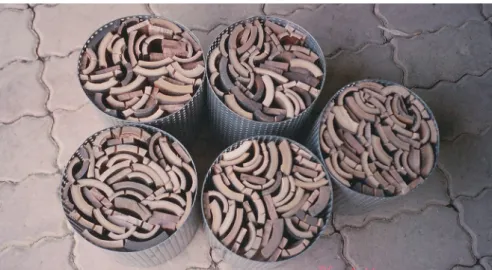
The kiln was 2.8 m wide, 2.8 m long, and 1.4 m high with an arch-type ceiling is shown in Fig. 1. Three kinds of bamboo specimens were put into a stainless steel cylinder that was 20 cm in diameter and 20 cm in height with numerous 5 mm holes (Fig. 2). Five cyl- inders piled up to 1 m in height were installed 30 cm away from the side of the chimney flue in the rear part of the kiln. The carbonization temperature in each cylinder was respectively measured using a K-type thermocouple.

Bamboo charcoal test

In order to investigate the properties of bamboo charcoal affected by the carbonization

temperature distribution in the earthen kiln, the pH value, true density, electrical resistiv- ity, and specific surface area were determi- nated for specimens sampled from different cylinders. The pH value was measured after boiling for 5 min by adding 100 mL water to a bamboo charcoal sample. The true den- sity of the bamboo charcoal was measured by Quantachrome ultrapycnometer 1000 (QUANTACHROME INSTRUMENTS) after drying at 105℃ using a powder mesh size of 36~60. The specific surface area of the bamboo charcoal was measured by PMI Automated BET Sorptometer BET-202A (Po- rous Material Inc.) using the same samples as for true density. The electrical resistance of the bamboo charcoal was measured by AVO DLRO-10 and AVO BMM-2580 (AVO INTERNATIONAL LTD.) from both ends of

Fig. 1. Dimensions of the earthen kiln and measurement points (nos.1~6) of the carbonization

temperature.

(4)

a specimen. The electrical resistivity, ρ, was calculated as:

ρ = (R×A) / L;

where R is the electrical resistance of the specimen (Ω), A is the cross-section area of the specimen (cm

2

), and L is the length of the specimen (cm).

RESULTS AND DISCUSSION Properties of bamboo

The properties of the test material are shown in Table 1. The specific gravities of Makino bamboo, Moso bamboo, and Ma bamboo were 0.91, 0.87, and 0.78, respec- tively. However, the thicknesses of the culm wall were respectively 6.86, 10.01, and 11.38 mm in the reverse order of specific gravity.

Carbonization temperature

Figure 3 shows the carbonization tem- perature curves for each cylinder in the earthen

kiln. In order to increase the bamboo charcoal yield, the kiln and bamboo must be preheated to shorten the ignition time of the bamboo as much as possible. The initial temperature in Fig. 3 was after preheating for 4d. The earthen kiln used in this study can achieve the com- plete spontaneous carbonization of woody materials. In order to enhance the quality of bamboo charcoal, a large amount of air was injected into the kiln when the secondary car- bonization was carried out after the end of the primary carbonization. Because external heat cannot be applied to an earthen kiln during bamboo charcoal making, the temperature in the kiln tends to become uneven. The high- est temperatures in the cylinders at the end of carbonization were 774, 745, 695, 609, and 537℃, respectively, from top to bottom.

Properties of bamboo charcoal

pH values of bamboo charcoals shown in Table 2 were in the range of 8.96~10.26 and Fig. 2. Three kinds of bamboo specimens in stainless steel cylinders for charcoal making.

Table 1. Properties of bamboo specimens

Species Moisture content (%) Specific gravity Thickness of the culm wall (mm)

Moso bamboo 9.43±0.18 0.87±0.03 10.01±0.72

Makino bamboo 10.77±0.35 0.91±0.04 6.86±0.86

Ma bamboo 10.93±0.38 0.78±0.04 11.38±1.71

(5)

Fig. 3. Temperature curves of the carbonization processes (measurement points 1~6 are shown in Fig. 1).

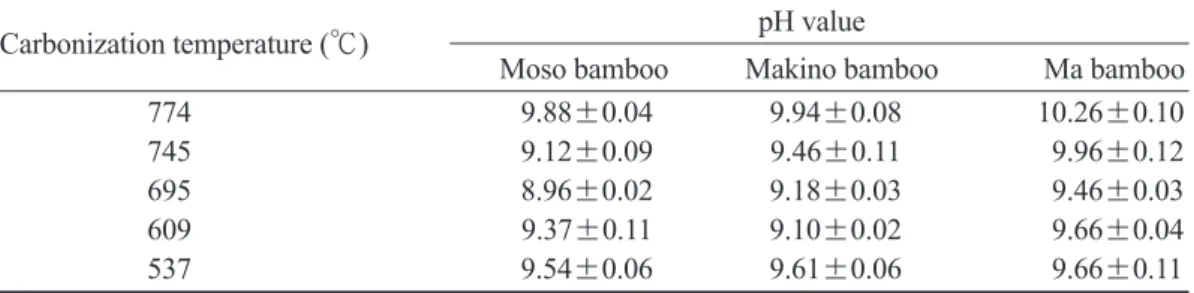
Table 2. pH values of bamboo charcoal at different carbonization temperatures

Carbonization temperature (℃) pH value

Moso bamboo Makino bamboo Ma bamboo

774 9.88±0.04 9.94±0.08 10.26±0.10

745 9.12±0.09 9.46±0.11 9.96±0.12

695 8.96±0.02 9.18±0.03 9.46±0.03

609 9.37±0.11 9.10±0.02 9.66±0.04

537 9.54±0.06 9.61±0.06 9.66±0.11

were not obviously affected by the bamboo species or carbonization temperatures. The pH value of wood charcoal from acidic to alkaline with a rising carbonization temperature, but the bamboo charcoal maintains its alkalinity regardless of the carbonization temperature (Fujihara et al. 2003). The true density of bam- boo charcoal shown in Table 3 increased with an increase in the carbonization temperature.

At the same carbonization temperature, the true density of Ma bamboo charcoal was the highest, followed by Makino bamboo char- coal , and Moso bamboo charcoal. Lan et al.

(2008) studied the properties of Moso bamboo

charcoal and indicated that the true density of

bamboo charcoal increased with an increasing

charcoalization temperature. The increases in

density of charcoal are attributed to coalesc-

ing of cell walls or shrinkage of intercellular

interstices (Elder et al. 1979). The electrical

resistivity of the 3 kinds of bamboo charcoal

shown in Table 4 significantly decreased with

an increase in the carbonization temperature,

but the electrical resistivity of Makino bam-

boo charcoal was lower than those of Moso

bamboo charcoal and Ma bamboo charcoal at

the same carbonization temperature. This is

considered to be due to the thin culm walls of

(6)

Makino bamboo. Fukuda et al. (2001) studied the utilization of bamboo charcoal and indicat- ed that the higher carbonization temperature, the lower was the electrical resistance of the charcoal. Lan et al. (2008) also reported that the resistivity decreased with an increasing charcoalization temperature. Results for the specific surface area of the 3 kinds of bamboo charcoal with different carbonization tempera- tures are shown in Table 5. It indicates that the specific surface area increased with an increase in the carbonization temperature for all 3 kinds of bamboo charcoal. Abe (2004) reported that the physical adsorption ability of the adsorbent increases with an increase in the specific sur- face area.

CONCLUSIONS

From the results of temperature changes in each cylinder in the earthen kiln, the tem- perature rise in the upper part was earlier and more rapid than those in the lower part. The highest temperature exceeded 770℃, where- as, the lowest temperature was about 530℃.

The test results of bamboo charcoal indicates that the pH of the different bamboo charcoal was not obviously affected by the carboniza- tion temperature, the electrical resistivity of bamboo charcoal significantly decreased with an increasing carbonization temperature, and the true density and specific surface area of bamboo charcoal increased with an increasing Table 3. The true density of bamboo charcoal at different carbonization temperatures Carbonization temperature (℃) True density (g cm

-3

)

Moso bamboo Makino bamboo Ma bamboo

774 1.95 1.96 2.04

745 1.87 1.90 1.91

695 1.76 1.77 1.79

609 1.58 1.61 1.62

537 1.51 1.52 1.52

Table 4. Electrical resistivity of bamboo charcoal at different carbonization temperatures Carbonization temperature (℃) Electrical resistivity (Ω·cm)

Moso bamboo Makino bamboo Ma bamboo

774 1.20±0.39 0.84±0.25 1.64±0.46

745 1.26±0.04 1.06±0.15 2.15±0.37

695 31.76±0.67 19.71±10.59 37.09±11.06

609 8.96±2.81×10

4

0.83±0.37×10

4

1.11±0.87×10

4

537 1.37±0.55×10

6

0.89±0.35×10

6

1.03±0.51×10

6

Table 5. The true density of bamboo charcoal at different carbonization temperatures Carbonization temperature (℃) Specific surface area (m

2

g

-1

)

Moso bamboo Makino bamboo Ma bamboo

774 369.71 358.01 408.83

745 294.45 273.42 304.66

695 215.27 226.91 197.42

609 183.36 92.91 144.37

537 67.13 23.85 42.94

(7)

carbonization temperature.

LITERATURE CITED

Abe I. 2004. Carbonization and acitivation techniques for prodution of carbonaceous ad- sorbent. TANSO 211:21-9. [in Japanese with English summary].

Elder TJ, Murphey WK, Blankenhom PR.

1979. A note on the thermally induced changes of intervessel pits in black cherry (Prunus se- rotina EHRH). Wood and Fiber 11(3):179-83.

Fujihara S, Shima K, Chiba K. 2003. Fun- damental characteristics and humidity control capacity of bamboo charcoal. Mokuzai Gak- kaishi 49(5):333-41.[in Japanese with English summary].

Fukuda Y, Kainuma Y, Mizuguchi T. 2001.

Utilization of bamboo charcoal to processing and cookery (Part I Effects of bamboo charcoal on oxidative stability of frying oil). Nippon Shokuhinn Kagaku Kaishi 48(2):105-11. [in Japanese with English summary].

Hiroya H, Emi Y. 2012. Water treatment by charcoal. Kobe Coll Stud 59(2):35-46. [in Japanese with English summary].

Ho HM, Kuo WR, Peng CW, Hwang GS, Lin HC. 2013. Investigation of yield and seedling growth of cabbage from cultural me- dia with Moso bamboo charcoal. J Agric For (NCYU) 10(1):43-60. [in Chinese with English summary].

Hosokawa K, Minamide T, Kanai H, 1991.

The application of bamboo shoots freshness.

Bamboo J 9:27-32. [in Japanese with English

summary].

Hung CP, Ko CH, Hsu DJ, Wang SY, Shiau IL, 2004. Effect of carbonization conditions on purification of bamboo charcoal. For Prod Ind 29(3):183-98. [in Chinese with English summary].

Hwang GS, Ho CL, Yu HY, Su YC. 2006.

Bamboo vinegar collected during charcoal making with an earthen kiln and its basic properties. Taiwan J For Sci 21(4):547-57. [in Chinese with English summary].

Hwang GS, Yu HY, Toba A. 2004. Effects of carbonization temperatures in an earthen kiln on the true density and electric resistivity of Makino bamboo charcoal. Taiwan J For Sci 19(3):237-45. [in Chinese with English summary].

Lan FL, Lay HL, Teng WF. 2008. Study on Moso bamboo charcoal property. Crop Environ Bioinform 5:180-6. [in Chinese with English summary].

Lin HC, Wu YD, Peng CH, Hwang GS, Kuo WR. 2011. Application of Moso bamboo charcoal cultural media to vegetable plug seed- lings. For Prod Ind 29(3):159-71. [in Chinese with English summary].

Lin YJ, Hwang GS, Yu HY. 2004. Cost anal- ysis for the building of bamboo charcoal kiln.

Qua J Chinese For 37(2):195-204. [in Chinese with English summary].

Zhou KC, Lu KT. 2010. Improvement of

drinking water qualities by using Moso bamboo

activated carbon made from different activation

temperatures. Q J For Res 32(4):35-44. [in

Chinese with English summary].

(8)

數據

Fig. 1. Dimensions of the earthen kiln and measurement points (nos.1~6) of the carbonization  temperature.
Figure 3 shows the carbonization tem- tem-perature curves for each cylinder in the earthen
Table 2. pH values of bamboo charcoal at different carbonization temperatures
Table 4. Electrical resistivity of bamboo charcoal at different carbonization temperatures Carbonization temperature (℃) Electrical resistivity (Ω·cm)

參考文獻

相關文件

• to assist in the executive functions of financial resource management (such as procurement of goods and services, handling school trading operations, acceptance of donations,

IQHE is an intriguing phenomenon due to the occurrence of bulk topological insulating phases with dissipationless conducting edge states in the Hall bars at low temperatures

This study will base on the perspective of the philological education to discuss 788 characters that were commonly used in the daily life of the early Tang era, for highlighting

The growth of the Chinese bamboo: Coaching, teaching and learning in promoting reading literacy in Hong Kong primary schools – Hong Kong students in PIRLS 2011.

Analysis Based on Xia Jing Shan’s Seven Sages of Bamboo Grove: Comparing the sacred and the profane, by using symbols as a connector, profane occurrences and things could then

constant angular acceleration* 恆角加速度 constant angular velocity 恆角速度. constant force

The English terms, simple or compound, included in the glossary are listed in alphabetical order, e.g3. ther terms ‘active transport’ is considered beginning with the

using & integrating a small range of reading strategies as appropriate in a range of texts with some degree of complexity,. Understanding, inferring and