IUCN Centre for Mediterranean Cooperation
Planning and delivering Nature-based Solutions in Mediterranean cities
First assessment of the IUCN NbS Global Standard
in Mediterranean urban areas
The designation of geographical entities in this report, and the presentation of the material, do not imply the expression of any opinion whatsoever on the part of IUCN concerning the legal status of any country, territory, or area, or of its authorities, or concerning the delimitation of its frontiers or boundaries. The views expressed in this document do not necessarily reflect those of IUCN.
IUCN is pleased to acknowledge the support of its Framework Partners who provide core funding: Ministry of Foreign Affairs of Denmark; Ministry for Foreign Affairs of Finland; Government of France and the French Development Agency (AFD); the Ministry of Environment, Republic of Korea; the Norwegian Agency for Development Cooperation (Norad); the Swedish International Development Cooperation Agency (Sida);
the Swiss Agency for Development and Cooperation (SDC) and the United States Department of State.
This publication has been made possible by funding from Mava Foundation.
Published by: IUCN, Gland, Switzerland.
Produced by: IUCN Centre for Mediterranean Cooperation.
Copyright: © 2021 IUCN, International Union for Conservation of Nature and Natural Resources.
Reproduction of this report for educational or other non‐commercial purposes is authorised without prior written permission from the copyright holder provided the source is fully acknowledged. Reproduction of this report for resale or other commercial purposes is prohibited without prior written permission of the copyright holder.
Citation: IUCN (2021). Planning and delivering Nature-based Solutions in Mediterranean cities. First assessment of the IUCN NbS Global Standard in Mediterranean urban areas. Málaga, Spain: IUCN.173 pp.
English reviewer: Christopher Tribe
Cover photo: © Pere Sanz | Dreamstime.com Layout by: Carmen Moreno
Available for
download from: https://www.iucn.org/regions/mediterranean/resources/thematic‐documents
About IUCN Centre for Mediterranean Cooperation:
IUCN, International Union for Conservation of Nature, is a membership Union composed of both government and civil society organisations. It harnesses the experience, resources and reach of its more than 1,300 Member organisations and the input4of more than 18,000 experts. IUCN is the global authority on the status of the natural world and the measures needed to safeguard it. The IUCN Centre for Mediterranean Cooperation opened in Malaga (Spain) in October 2001 with the core support of the Spanish Ministry of Environment and the regional Government of Junta de Andalucía. The Centre’s mission is to influence, encourage and assist Mediterranean societies to conserve and use sustainably the natural resources of the region and work with IUCN Members and cooperate with all other agencies that share the objectives of IUCN.
Planning and delivering Nature-based Solutions in Mediterranean cities
First assessment of the IUCN NbS Global Standard
in Mediterranean urban areas
Table of contents
Acknowledgements III
Foreword IV
Introduction 1
1. A Global Standard for Nature-based Solutions 3
2. What is the purpose of the present assessment report? 4
3. Scope and structure of the Standard: criteria and indicators for undertaking the assessment 5 4. Methodological approach followed by this first assessment in Mediterranean cities 9
5. General remarks 13
5.1 On the evaluation method 13
5.2 On the applicability and usability of the Standard as perceived by stakeholders 14
5.3 On the review of the projects analysed 18
5.4 On the review of the challenges considered in the Standard 28
Individual project forms. Type 1. URBAN REGENERATION IN A GLOBAL CHANGE CONTEXT 34
— AMMAN (Jordan). Urban agriculture. City Strategic Agenda 35
— MALAGA (Spain). Green Infrastructure Plan. Perchel Lagunillas 43
— PAVLOS MELAS (Greece). Integrated regeneration and Metropolitan Park 50
— THESSALONIKI (Greece). BlueHealth and resilience strategy 56
— OUED TINE VALLEY AREA (Tunisia). Environmental corridors. An example of a micro-project 63
— ZAGREB (Croatia). The Living Lab at Sesvete. NbS for post-industrial urban regeneration 72
— NICE (France). Nature in the heart of Nice – La nature au coeur de Nice 81
Individual project forms. Type 2. NbS FOR CLIMATE CHANGE AND WATER RESILIENCE 88
— FRENCH ALPS (France). Land use and ecosystem services in the Grenoble urban area 89
— JERUSALEM (Israel). Gazelle Valley. Urban Nature Park 97
— MALTA (Malta). The Alter Aqua. Non-Conventional Water Resources Programme 103
— TIRANA (Albania). Adaptation Action Plan: Northern Boulevard and River project & Magnet project area 111
Individual project forms. Type 3. NbS FOR COASTAL RESILIENCE IN A CONTEXT OF RISING SEA LEVELS 118
— MARSEILLE (France). New Stormwater Retention Basins 119
— ALICANTE (Spain). Park of the Sea – Parque del Mar 125
— MÁLAGA (Spain). Coastal Trail – Senda Litoral 132
— NAPLES (Italy). Regeneration of Bagnoli coastal area 137
Individual project forms. Type 4. MATURE PROJECTS 144
— BARCELONA (Spain). Green Infrastructure and Biodiversity Plan 145
— SLOVENIA. Establishing connectivity in the Ljubljanica River and Green Parks Strategy 154
— VITORIA-GASTEIZ (Spain). Urban Green Infrastructure System 160
This report has been prepared in a highly collaborative manner, drawing on the expertise of a variety of people from within and outside IUCN. We would like to thank everyone who has contributed to this report, especially those who reviewed and provided extensive technical information on the case studies from local governments and other institutions:
– Alberto Ruiz Carmena,
Urban Environment Observatory, Málaga City Council.
– Amanda Lind and Yael Hammerman, The Society for the Protection of Nature, Israel.
– Amira Sansa and Edouard Jean,
Association Les Amis de Capte Tunisie, Tunisia.
– Anne Itziar Velasco and Blanca Marañón,
Environmental Studies Centre, Vitoria-Gasteiz City Council, Spain.
– Iva Bedenko,
Zagreb Council, Croatia.
– Jérôme Sieurin,
Métropole Nice-Côte d’Azur, France.
– Juan Jerez and Juan Antonio Ochando, Port of Alicante, Spain.
– Konstantina Toli,
Global Water Partnership Mediterranean.
– Manuel Sapiano,
Energy & Water Agency, Malta.
– Margarita Pares and Coloma Rull Sabaté,
Directorate of Green Spaces and Biodiversity–Urban Ecology, Barcelona City Council, Spain.
– Maria Mavroudi,
Pavlos Melas Council, Greece.
– Mariló Recio,
Málaga Provincial Council, Spain.
The document was elaborated by the team of the Energy and Environment Department. Climate Change Adaptation Group from TECNALIA Research & Innovation: Gemma García-Blanco, Igone García, Karmele Herranz, Bart Goes, and Pilar Fernández.
The project was coordinated by Lourdes Lázaro and Andrés Alcántara from the IUCN Centre for Mediterranean Cooperation.
Acknowledgements
The IUCN Centre for Mediterranean Cooperation along with the IUCN Members in the region and key strategic partners are committed to promoting Nature-based Solutions (NbS), as approved in Resolution 34 “The implementation of Nature-based Solutions in the Mediterranean Basin” by the IUCN constituency in the framework of the World Conservation Congress 2020.
This Resolution also urges local authorities in the Mediterranean Basin to prioritise NbS in the strategies they adopt for the management of natural areas and urban zones, as well as in their green infrastructure strategies, and to give them priority in their land-use and urban policies.
The NbS concept was also identified by the European Commission as a strategic solution for the development of more sustainable cities, with specific funding programmes on research and innovation (Horizon 2020 Programme).
A milestone in the support for NbS roll-out was the launch of the IUCN Global Standard for Nature-based Solutions in July 2020, which aims to create a common framework for the public, private, academic and civil society sectors to design, implement and scale up solutions through the timely and transparent provision of sound policies, actions and investment.
Foreword
In pursuit of this goal, in 2020, TECNALIA1 was commissioned by IUCN-Med to help in the assessment of the good projects identified in the publication “Nature-Based Solutions in Mediterranean cities” (2019) against the criteria of the IUCN Global Standard on NbS. This would be the first practical assessment of real projects and strategies (either implemented or in the design stage) from Mediterranean cities.
The following pages present 18 projects from existing NbS interventions in Mediterranean cities that were assessed against the IUCN Standard.
The result of this exercise identified both the Standard’s potential in Mediterranean cities, and challenges in its use that must be resolved. The overall lessons learned from the assessment point to the need for continuing improvements in projects, especially the systematic evaluation of options, more inclusive public involvement, incorporation of adaptive management and establishment of monitoring systems for better reporting on the potential benefits of NbS in urban contexts.
To complement this assessment, a summary for policy-makers was also produced with key messages to enable them to understand this supportive framework and recognise windows of opportunity for advancing and promoting NbS in urban areas.
1 Research and technological organization (RTO) based in Spain.
The Mediterranean region has one of the fastest urbanisation rates in the world. Sixty per cent of the current population lives in urban settings, and it is expected that this trend will continue until 2030.
In this scenario of demographic growth, often with limited land available and also limited municipal resources and budgets, cities face increasingly complex challenges of competition and conflict over land use distribution, waste and energy management, guaranteed water availability and quality, reductions in CO2 emissions and air and noise pollution, mobility, creation of economic opportunities and jobs, regeneration of degraded and unoccupied areas, biodiversity conservation, urban agriculture and food security, and so forth. All the solutions proposed are aimed at ensuring the health and well-being of a more inclusive, fair and equitable society as well as addressing the pressing need for adaptation and resilience to climate change.
Introduction
Mediterranean cities share quite unique territorial and bioclimatic specificities that make them especially vulnerable to the effects of climate change, in that water shortages, extreme rainfall and flooding, droughts, forest fires and heat waves are becoming increasingly more frequent and intense.
The concept of Nature-based Solutions (NbS) is taking hold internationally, providing a genuine opportunity for cities to adapt to climate change and improve sustainability.
The IUCN defines NbS as actions to protect, sustainably manage and restore natural or modified ecosystems that address societal challenges effectively and adaptively,
simultaneously providing human well-being and biodiversity benefits.
NbS, as the European Commission proposes,
“helps society face environmental, economic and social challenges in a sustainable way” and is economically profitable.
NbS does not reject new technologies but, on the contrary, innovates by favouring the active participation of citizens in both the design and the management of their cities. A number of Mediterranean cities have already implemented urban renaturing programmes as a way to more responsibly and efficiently manage their current challenges, including their adaptation to climate change.
Mediterranean cities share quite unique territorial and bioclimatic specificities that make them especially vulnerable to the effects of climate change.
Nature-derived solutions Nature-inspired solutions Nature-based solutions
© JOSEFKUBES | DREAMSTIME.COM
© FGCANADA | DREAMSTIME.COM
© AIRUBON | DREAMSTIME.COM
The societal challenges Nature-based Solutions can address
In recent years, the European Union has played a prominent role in boosting the deployment of NbS in cities, including in the Euro‐Mediterranean region. Beyond the general framework provided by the European Urban Agenda 2050, NbS in the EU are promoted in the cross-cutting European Cohesion Policy (2014–2020) and now the new EU Framework Programme for Research and Innovation for 2021–2027, connecting urban, regional and environmental policies and bringing together established ecosystem-based approaches such as ecosystem-based adaptation and ecological engineering with the social and economic dimensions.
Notwithstanding the developing global evidence base on the benefits of NbS in cities, it is still at a relatively early stage of development and consists of evidence that is currently not sufficiently detailed for the development of city- specific NbS strategies. Nor is there a sufficiently broad portfolio of case studies that are relevant and replicable outside their original location;
those profiled to date typically rely on bespoke investment and delivery mechanisms. As this is an emerging policy area, cities are therefore currently having to deliver custom-designed local research and pilot projects to generate the knowledge and the evidence base on NbS benefits, and effectiveness they require for local policy development and investment attraction.
Climate change mitigation and
adaptation
securityFood Water
security Human
health
Economic and social development Disaster risk
reduction
Environmental degradation and biodiversity loss
IUCN is a membership Union composed of both government and civil society organisations. It provides public, private and non-governmental organisations with the knowledge and tools that enable human progress, economic development and nature conservation to take place together.
Recognising the lack of a common understanding and international consensus on NbS, IUCN has developed a Global Standard to mainstream the concept and to facilitate the verification, design and scaling-up of NbS, in a highly collaborative process.
As NbS are increasingly being adopted in everyday business, a standard will ensure the quality and credibility of these solutions, thus guaranteeing their effectiveness in providing benefits to both human well-being and biodiversity.
A standard to
facilitate the verification, design and
scaling-up of NbS
to achieve IUCN’s ambitious transition towards agreen growth recovery.
Based on
knowledge co-creation,
involving conservation science, social science and traditional knowledge.
Crowd-sourced drafts developed through two rounds of
open consultation,
500+ people across 100 countries, 1000s of comments, each comment and response tracked.
Developed to be
compatible
with the ISEAL Alliance Code of Good Project revised every four years.The Standard also aims to increase demand for NbS, thus bringing about positive sustainable change. To mainstream NbS, a common language and framework are required to bring partners together to address common challenges. This is where the Standard comes in.
The Standard with its guidance document and self-assessment tool was officially launched in July 2020.
The Global Standard can be found online at https://www.iucn.org/theme/nature-based- solutions/resources/iucn-global-standard-nbs
A Global Standard for Nature-based Solutions
1
© ASSOCIATION LES AMIS DE CAPTE TUNISIE-BIZERTE
This report presents the results of an initial assess- ment of a number of projects in Mediterranean cities against the IUCN Global Standard.
The projects were selected to be evenly distributed around the Mediterranean, to be representative of the Mediterranean climate region and its idiosyncrasies, and to deal with a range of climate risks, urban development, planning culture and systems, governance, etc., at different scales from regional to city and district levels.
The analysis sought to:
Assess examples of good practice
in different Mediterranean cities in terms of the benefits of NbS and their contribution to societal challenges, using the criteria and set of indicators suggested by the Standard.
Identify gaps
in the projects and explore niches for improvement and opportunities for enhancing the NbS interventions and the implementation process.
Identify lessons learned
for practical application and usability of the standard, and extract messages and elements that can be shared with other practices.
Evaluate the adaptability of the Standard
and how it could be reviewed and customised.What is the purpose of this assessment report?
2
It is worth mentioning that the practices analysed have been assessed as potential Nature- based Solutions despite the fact
that they may not have been designed as such in the first place.
© RADIOKAFKA | DREAMSTIME.COM
Target audience. Governments and authorities at all levels, non-governmental organisations, private companies, urban planners and practitioners, the financial sector and local communities – basically all parties that might be involved in creating or implementing NbS.
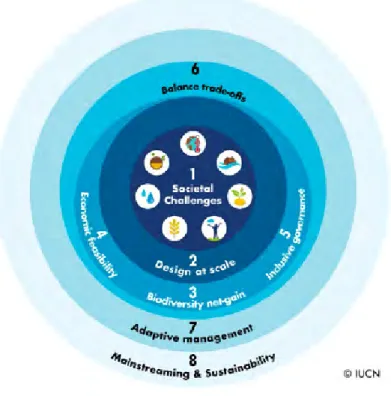
The Standard is structured around eight challenges as shown in Figure 1 bellow, namely:
1.
Societal challenges2.
Design at scale3.
Biodiversity net-gain4.
Economic feasibility5.
Inclusive governance6.
Balance trade-offs7.
Adaptive management8.
MainstreamingScope and structure of the IUCN Standard: criteria and indicators for undertaking the assessment
3
Figure 1: The eight Criteria that make up the IUCN Global Standard for NbS are all interconnected.
Criteria and indicators of the IUCN Global Nature- based Solutions Standard, adapted from IUCN (2020).
Global Standard for Nature-based Solutions. A user-friendly framework for the verification, design and scaling up of NbS. First edition.
Gland, Switzerland: IUCN.
ISSUE BEING ADDRESSED CRITERIA INDICATORS Societal challenges
The purpose of this Criterion is to ensure that the NbS is designed as a response to one or more societal challenges that have been identified as a priority by those who are or will be directly affected by them. All stakeholders, especially rights holders and beneficiaries of the NbS, must be involved in the decision-making process used for identifying the priority challenge or challenges (Criterion 5).
NbS
1
effectively address societal challenges
1.1 The most pressing societal challenges for rights holders and beneficiaries are prioritised.
1.2 The societal challenges addressed are clearly understood and documented.
1.3 Human wellbeing outcomes arising from the NbS are identified, benchmarked and periodically assessed.
Design at scale
The purpose of this Criterion is to encourage NbS designs that recognise the complexity and uncertainty that occur in living dynamic land/seascapes. Scale applies not only to the biophysical or geographic perspective but also to the influence of economic systems, policy frameworks and the importance of cultural perspectives. NbS design will be informed by what stakeholders know about the interactions between different aspects of a land/seascape using a three-scale framework that considers the parts within the land/seascape, the land/seascape itself and the wider environment around the land/seascape. One example would be households within villages within a local authority area. Understanding the interactions which affect attributes like cultural values, laws, soils, forests and water are important in this regard, as they are relevant to the assessment of the risk of undesirable change, or the probability of creating desirable change.
NbS design seeks to maintain the productive capacity of ecosystems as well as the production of benefits necessary for human well-being.
Design
2
of NbS is informed by
scale
2.1 Design of NbS recognises and responds to the interactions between the economy, society and ecosystems.
2.2 Design of NbS integrated with other complementary interventions and seeks synergies across sectors.
2.3 Design of NbS incorporates risk identification and risk management beyond the intervention site.
Biodiversity net-gain
NbS are derived as goods and services from ecosystems, and therefore strongly depend on the health of an ecosystem. Biodiversity loss and ecosystem change can have significant impacts on the functioning and integrity of the system.
Therefore, NbS design and implementation must avoid undermining the integrity of the system and, instead, proactively seek to enhance the functionality and connectivity of the ecosystem.
Doing so can also ensure the long-term resilience and durability of the NbS.
NbS result in
3
net gain to biodiversity
ecosystem and integrity
3.1 NbS actions directly respond to evidence- based assessment of the current state of the ecosystem and prevailing drivers of degradation and loss.
3.2 Clear and measurable biodiversity conservation outcomes are identified, benchmarked and periodically assessed.
3.3 Monitoring includes periodic assessments of unintended adverse consequences for nature arising from the NbS .
3.4 Opportunities to enhance ecosystem integrity and connectivity identified and incorporated into the NbS strategy.
Economic feasibility
The return on investment, the efficiency and effectiveness of the intervention, and equity in the distribution of benefits and costs are key determinants of success for an NbS. This Criterion requires that sufficient consideration is given to the economic viability of the intervention, both at the design stage and through monitoring the implementation. For NbS to be sustainable, there must be strong consideration of the economic aspects as, most likely, long-term gains must be balanced against short-term costs, with short-term actions developed within the context of long-term (over generations) goals and plans. If the economic feasibility is not adequately addressed, NbS run the risk of being short-term projects, where, after closing, the solution and benefits provided cease to exist, potentially leaving the landscape and communities worse off than before. Innovative and evidence-based tools for the valuation of nature, along with ideas for NbS contributions to markets and jobs, encourage creative (blended) financing of NbS, thereby increasing the likelihood of their long-term success.
NbS are
4
economically viable
4.1 The direct and indirect benefits and costs associated with the NbS, who pays and who benefits, are identified and documented.
4.2 A cost-effectiveness study is provided to support the choice of NbS including the likely impact of any relevant regulations and subsidies.
4.3 The effectiveness of an NbS design is justified against available alternative solutions, taking into account any associated externalities.
4.4 NbS design considers a portfolio of resourcing options such as market-based, public sector, voluntary commitments and actions to support regulatory compliance.
ISSUE BEING ADDRESSED CRITERIA INDICATORS
Inclusive governance
This criterion requires that NbS acknowledge, involve and respond to the concerns of a variety of stakeholders, especially rights holders. Good governance arrangements are proven to not only reduce an intervention’s sustainability risks, but also to enhance its social ‘licence to operate’. Conversely, inadequate governance provision for otherwise well- intended actions can adversely affect the legitimacy of benefit- and cost-sharing arrangements. As a minimum, NbS must adhere to and align with the prevailing legal and regulatory provisions, being clear on where legal responsibilities and liabilities lie.
However, as often is the case with natural resources, basic compliance will need to be complemented with ancillary mechanisms that actively engage and empower local communities and other stakeholders.
NbS are
5
based on inclusive, transparent empowering and
governance processes
5.1 A defined and fully agreed upon feedback and grievance resolution mechanism is available to all stakeholders before an NbS intervention can be initiated.
5.2 Participation is based on mutual respect and equality, regardless of gender, age or social status, and upholds the right of Indigenous Peoples to Free Prior and Informed Consent (FPIC).
5.3 Stakeholders who are directly and indirectly affected by the NbS have been identified and involved in all processes of the NbS intervention.
5.4 Decision-making processes document and respond to rights and interests of all participating and affected stakeholders.
5.5 Where the scale of the NbS extends beyond jurisdictional boundaries, mechanisms are established to enable joint decision making of the stakeholders in the affected jurisdictions.
Balance trade-offs
Trade-offs in land and natural resource management are inevitable. Ecosystems provide a wealth of different benefits and not everyone values each of them in the same way. While trade-offs cannot be avoided, they can be effectively and equitably managed. This Criterion requires that NbS proponents acknowledge these trade-offs and follow a fair, transparent and inclusive process to balance and manage them over both time and geographic space. This involves a credible assessment, full disclosure and agreement among the most affected stakeholders on how the trade-offs should be addressed. Fair and transparent negotiation of trade-offs and compensation among potentially affected parties for any damages or trade-offs to local opportunities and livelihoods provides the basis for successful long-term NbS outcomes. Critically, it is important to recognise that trade-offs have social and ecological limits beyond which point certain values or benefits can be lost in perpetuity. This means that safeguards will be necessary to ensure, inter alia, that the integrity of ecosystems and the long-term stabilising properties of ecosystem services are not exceeded.
NbS
6
equitably balances trade-offs between achievement
of their primary goal(s) and the continued
provision of multiple
benefits
6.1 The potential costs and benefits of associated trade-offs of the NbS intervention are explicitly acknowledged and inform safeguards and any appropriate corrective actions.
6.2 The rights, usage of and access to land and resources, along with the responsibilities of different stakeholders are acknowledged and respected.
6.3 Established safeguards are periodically reviewed to ensure that mutually agreed trade-offs limits are respected and do not destabilise the entire NbS.
Adaptive management
This Criterion requires that NbS implementation plans include provisions to enable adaptive management as a response to uncertainty and as an option to effectively harness ecosystem resilience. A degree of uncertainty is inherent when managing most ecosystems due to their complex, dynamic and self-organising nature. This also means that ecosystems have greater resilience, which confers a wider range of options to respond to unanticipated social, economic or climate events. The foundation of adaptive management is the evidence-base provided by regular monitoring and evaluation, drawing on scientific understanding as well as indigenous, traditional and local knowledge. By proactively adopting an adaptive management approach, the NbS can continue to be relevant through the lifecycle of the intervention and the risk of redundancy and stranded investments minimised.
NbS are
7
managed adaptively,
based on evidence
7.1 A NbS strategy is established and used as a basis for regular monitoring and evaluation of the intervention.
7.2 A monitoring and evaluation plan is developed and implemented throughout the intervention lifecycle .
7.3 A framework for iterative learning that enables adaptive management is applied throughout the intervention lifecycle.
ISSUE BEING ADDRESSED CRITERIA INDICATORS Mainstreaming
This Criterion requires that NbS interventions are designed and managed with a view to long-term sustainability and that they take account of, work with and align with sectoral, national and other policy frameworks. There are various approaches to mainstreaming NbS; however, all rely on strategic communications and outreach. Audiences to consider include individuals (e.g. the public, academics), institutions (e.g. national government, start-ups, businesses, and organisations) and global networks (e.g. Sustainable Development Goals, Paris Agreement).
NbS are
8
sustainable mainstreamed and
within an appropriate jurisdictional
context
8.1 NbS design, implementation and lessons learnt are shared for triggering transformative change.
8.2 NbS inform and enhance facilitating policy and regulation frameworks to support its uptake and mainstreaming.
8.3 Where relevant, NbS contribute to national and global targets for human wellbeing, climate change, biodiversity and human rights, including the United Nations Declaration on the Rights of Indigenous Peoples (UNDRIP).
© JOYFULL | DREAMSTIME.COM
a ) Case identification and information gathering
18 projects were selected for this assessment report. Cases to be analysed as examples of good practice were identified through desk-based research. The criteria for selecting the most relevant NbS were:
An even distribution of projects throughout the Mediterranean bioclimatic zone;
The challenges for which they were designed (adaptation to climate change, urban
regeneration, health, social inclusion, etc.);
The scale of the interventions (e.g. urban acupuncture scale, district scale, city scale);
Implementation models (governance, concretion, management, financing, etc.).
Professional online searching of available and accessible information followed, with the involvement of TECNALIA’s Business Intelligence Department.
Finally, a search of research papers and grey literature provided additional information on the projects.
b ) Analysis of the projects against the Standard indicators
In a second step, each selected project was then assessed against the 28 indicators grouped under the 8 Criteria of the Standard, in order to:
Highlight the most relevant aspects of each solution;
Identify potential gaps and explore opportunities for improvement;
Extract key messages and lessons learned that could be transferred to other urban contexts;
Improve the applicability of the Standard itself.
Individual project briefing forms are provided for each project.
c ) Obtaining preliminary findings and messages
Semi-quantitative analysis of the available information was used to draw conclusions on both the review of NbS projects in Mediterranean cities and the evaluation method advised by the Standard.
Methodological approach used for this first assessment in Mediterranean cities
4
© ILYAS TUKHTAREV | DREAMSTIME.COM
Two different speeds were detected in the way the selected cities implement NbS in the Mediterranean region: Advanced and mature cases, which have a long tradition and experience in using ecosystem- based approaches, green infrastructure and NbS in urban planning and management; and other good practice cases which reveal interesting examples for boosting NbS in their urban planning and management. We decided to classify these two different speeds into four types of case studies:
Type 1:
Urban regeneration in a global change context:
Focusing specifically on urban interventions for social inclusion and socio-economic improvement of degraded areas, with a strong bottom-up, citizen engagement and multi-agent participatory approach.Type 2:
NbS for climate change and water resilience:
Driven by climate change adaptation needs, mainlyinterventions designed to cope with water management (either flood risk or water scarcity) and thermal stress.
Type 3:
NbS for coastal resilience in a context of rising sea levels:
The Mediterranean Sea is always an important presence in all the cities assessed. However, this group includes projects where the NbS have a strong blue component to deal with specific coastal challenges faced by coastal cities (i.e. sea level rise, seaport infrastructure, maintenance of ecosystem services and biodiversity conservation).Type 4:
Mature projects:
More advance practices in terms of NbS a longer experience applying this approach into local planning.The extent to which the project complied with each of the 28 indicators defined in the Standard was evaluated at one of two levels:
Indicator is not considered at all;
Indicator is fully covered, or some work has been done around some of the elements of the indicator.
In the context of this first screening assessment we have not considered intermediate scoring scales, since, to be able to approach it in this way, a much more accurate knowledge of the practices and all their content would have been required.
Furthermore, the case-studies assessment was undertaken between February-September 2020, thus when the Global Standard’s self- assessment was not yet available in its current version. Therefore, we used a 2-levels (0 or 1) evaluation system, as opposed to using the currently available 4 levels self-assessment (insufficient, partial, adequate, strong).
Each of these levels was standardised in order to obtain a percentage for the extent to which the projects complied with each of the indicators of the Standard. This provided information at two levels, both for the analysis of the projects as a whole and for the types defined above. That allowed us to draw conclusions on:
Revision of the Standard as a self-assessment tool, identifying the criteria and the indicators which are the most challenging to address and to comply with. Conclusions can then be drawn on the applicability and usability of the Standard and tools to support its use can be identified.
Analysis of how the projects meet the criteria and indicators, identifying strengths, gaps and opportunities for improvement NbS deployment.
The preliminary findings and messages obtained for each project were then validated with a number of stakeholders2. An online working session was organised on 16 July 2020 with representatives of the Spanish projects analysed (in Málaga, Alicante, Vitoria-Gasteiz and Barcelona) in order to:
Reflect on the applicability and usability of the Standard to assess NbS projects in Mediterranean cities;
2 Disclaimer: Most of the individual project briefing forms have been validated with government stakeholders in bilateral meetings. However, for 6 case studies (Amman, Marseille, Grenoble, Tirana, Naples, Ljubljana) no feedback was received in time for final consolidation.
Share lessons learned;
Identify gaps and value elements in these projects;
Detect opportunities for improvement.
d ) Preparation of the final report
The procedure, final findings and individual project briefings make up the present report, produced with the support of the IUCN Centre for Mediterranean Cooperation, and will be disseminated at the IUCN World Conservation Congress to be held in Marseille in 2021.
CASE IDENTIFICATION a) AND INFORMATION
GATHERING Selecting criteria:
Mediterranean, region coverage, urban chalenges, scale of interventions, availability an
accesibility of information
Drafting of case briefings for each case analysed
First assessment of the IUCN Global Standard for Nature-based Solutions
in Mediterranean Cities
Double-checking results with stakeholders
Working sessions Semi quantitative
analysis of the results Classification of projects:
Professional
online searching Grey literature, research papers
ANALYSIS OF THE PROJECTS b) AGAINST THE STANDARD
INDICATORS
PRELIMINARY c) FINDINGS AND
MESSAGES
FINAL REPORTd)
Type 1:
URBAN REGENERATION IN A GLOBAL CHANGE
CONTEXT
Type 2:
CLIMATE CHANGE AND WATER RESILIENCE
Type 3:
COASTAL RESILIENCE UNDER
RISING SEAS Type 4:
MATURE PROJECTS
STANDARD
• Reflecting on its applicability for assessing solutions.
• Shaing lessons learned
SOLUTIONS
• Gaps and value elements
• Opportunities for improvement Figure 2: Summarizes the methodology followed for the elaboration of the first screening of the IUCN Standard in Mediterranean cities.
BARCELONA
Green Infrastructure
& Biodiversity Plan
VITORIA-GASTEIZ
Urban Green Infrastructure
TIRANA
Boulevard and river
JERUSALEM
Gazelle Valley Park
GRENOBLE
Land use and ecosystem services
PAVLOS MELAS
Metropolitan Park
MALTA
Non-conventional water
management
TUNISIA
Environmental corridors
18 practices were selected in the first screening report
MALAGA
Perchel Lagunillas
MALAGA
Coastal Trail
ALICANTE
Park of the Sea
NAPLES
Coastal regeneration in Bagnoli
LJUBLJANA
River and parks connectivity
NIZE
Greening the city
ZAGREB
Sesvete
Living Lab AMMAN
Urban agriculture
THESSALONIKI
Blue spaces and resilience
MARSEILLE
Stormwater retention basins
© VVOEVALE | DREAMSTIME.COM
Type 1:
URBAN REGENERATION IN A GLOBAL CHANGE CONTEXT
Type 2:
CLIMATE CHANGE AND WATER RESILIENCE
Type 3:
COASTAL RESILIENCE UNDER RISING SEAS
Type 4:
MATURE PROJECTS
5.1 On the evaluation method
For the evaluation method a total of 28 indicators were used, grouped under 8 categories or criteria.
The answers obtained varied strongly with the city and the indicator.
In the case of Zagreb evidence was found for a highly satisfactory number of indicators, namely 24 out of 28. Concerning the criterion 1 and indicator 1.1 “The most pressing societal challenges for rights holders and beneficiaries are prioritised” is the one for which most useful information was found for all cities. However, for indicator 6.3 “Established safeguards are periodically reviewed to ensure that mutually agreed trade-off limits are respected and do not destabilise the entire NbS” no evidence was
General remarks
5
found at all. Other indicators with very low values (5 answers or less out of 18) are the ones on Economic feasibility (4.1, 4.2, 4.3), the remaining ones on Balance trade-offs (6.1, 6.2) and 7.3.
on Adaptive management. On the other hand, Indicators with very high values (15 answers or more out of 18) are the ones dealing with Societal challenges, as already stated, Design at scale (particularly 2.1 and 2.2) and Biodiversity net-gain (3.1). The graphic below summarises the availability of information for each criterion.
As can be clearly seen from the figure, a reasonable amount of information was available for most criteria, especially criteria 1 and 2.
Conversely, less information was found for criteria 4 and 7, while serious problems were encountered in obtaining evidence for criterion 6.
Project contributions to each criterion of the Standard
Each percentage shows how each criterion was relatively met by the case-studies, all together.
14%
NbS are SUSTAINABLE and MAINSTREAMED within an appropriate JURISDICTIONAL CONTEXT
10%
NbS are managed ADAPTIVELY, based on EVIDENCE
6% NbS equitably balances trade-offs between achievement of their primary goal(s) and the continued provision of MULTIPLE BENEFITS 12% NbS are based on INCLUSIVE, TRANSPARENT
and EMPOWERING GOVERNANCE processes 9% NbS are ECONOMICALLY VIABLE
18% NbS effectively address SOCIETAL CHALLENGES 17% Design of NbS is INFORMED BY SCALE
14%
NbS result in net gain to BIODIVERSITY and ECOSYSTEM INTEGRITY
INDICATOR CLASS RELEVANCE
1. NbS effectively address SOCIETAL CHALLENGES 93%
2. Design of NbS is INFORMED BY SCALE 91%
3. NbS result in net gain to BIODIVERSITY and ECOSYSTEM INTEGRITY 71%
4. NbS are ECONOMICALLY VIABLE 50%
5. NbS are based on INCLUSIVE, TRANSPARENT and EMPOWERING GOVERNANCE processes 63%
6. NbS equitably balances trade-offs between achievement of their primary goal(s) and the
continued provision of MULTIPLE BENEFITS 30%
7. NbS are managed ADAPTIVELY, based on EVIDENCE 52%
8. NbS are SUSTAINABLE and MAINSTREAMED within an appropriate JURISDICTIONAL CONTEXT 74%
RELATIVE DEGREE AT WHICH THE CRITERIA WERE MET
5.2 On the applicability and usability of the Standard as perceived by stakeholders
How is the Standard generally perceived?
© ASSOCIATION LES AMIS DE CAPTE TUNISIE-BIZERTE
“The assessment with the NbS criteria will allow us to implement the new Standard when designing, writing, implementing and monitoring
our future projects. We will enrich our database of monitoring and evaluation measures of ecosystem services generated by our agroforestry projects with this methodology. We hope to get to know and have more opportunities to collaborate with other projects and members of the civil society involved in the assessment of Standard and
also to strengthen our chances of accessing more funding.”
Association Les Amis de Capte Tunisie-Bizerte (Tunisia)
“It could be very useful, especially if used in the planning phase, which is over for us at the moment. I personally
would like to revisit it from time to time, as it can provide new insight in every phase, but its main strength would be in the initial phases“.
City of Zagreb
“It proposes a very valuable approach for the valuation of biodiversity in urban contexts“. “It can contribute to improving the way of reporting to
citizens and different agents with focus on the relevant involvement of the private sector in the NbS implementation“.
Barcelona City Council
“While the balance between economic variables and biodiversity and sustainability is difficult to achieve it is also seen as an opportunity to verify the need to consider all dimensions beyond the economic viability towards successful implementation“.
Vitoria-Gasteiz City Council
“It offers the opportunity for strategic view and thinking, although lack of time and resources are always a constraint for those responsible for the practices“.
Barcelona City Council
“It provides a consistent way in which practices can be analysed and reported easing the identification of opportunities and niches for improvement“.
Málaga provincial authority
© XABIER TOVAR | DREAM STIME.COM
© VMEDIA84 | DREAM STIME.COM
© GVICTORIA | DREAMSTIME.CO M © TOMAS1111 | DREAMSTIME.COM
What is the general feedback on the structure and content of the Standard?
A certain bias towards biodiversity was perceived by most stakeholders, to the detriment of other societal challenges. However, it provides interesting and detailed keys to bringing about changes in green management, given the specificity of the urban environment in compact Mediterranean cities3: evaluating green infrastructure projects for their overall Biodiversity net-gain is of great value.
Three criteria of the Standard were highlighted as the most difficult ones to evaluate and also to comply with, as explained below:
Economic feasibility:
Its evaluation raises two problems:
How to monetise NbS benefits versus traditional interventions is difficult to analyse; there is still a lack of available tools and expertise and the studies (i.e. natural capital accounting) are time consuming and resource intensive, difficult to be assumed by most municipalities consulted. These kinds of analysis are in any case normally subcontracted on demand for the assessment of specific interventions, but there is not yet a standard procedure, not even for the most advanced and mature projects analysed.
Evaluation in economic terms is not always feasible or even desirable. Some green interventions are not sustainable in economic terms sine the investment will not have an economic return, but the intervention is still strategic and will have a huge impact in social and environmental terms, which justifies its implementation. However, there is a lack of good evaluation methods for assessing return on investment. Natural Capital Assessment and Social Return on Investment are tools worth exploring, but they have not yet produced reliable results in terms of public health, for instance.
Consideration of benefits and trade-offs:
Although this criterion is considered very relevant, the studies and analysis required to evaluate benefits and trade-offs are time consuming and resource intensive and they are not delivered on a regular basis. These studies may be subcontracted ad hoc for a certain intervention, particularly strategic projects, but this is usually not yet done in the projects evaluated, and it remains a challenge even for the most mature ones.
Adaptive management:
This is a relatively new concept that has not yet been incorporated or internalised in territorial and urban planning and therefore it is too ambitious to try to evaluate it in the context of NbS implementation.
3 Barcelona City Council.
© GRAFIKERLINE | DREAMSTIME.COM
What are the main barriers to its use?
“Standard with interesting and innovative criteria but also with very ambitious indicators”
While the Standard offers an interesting and innovative criteria, it is also contained very ambitious indicators to really assess the current state of projects4. Lack of monitoring data could be an issue and there is still a need for a more comprehensive approach to knowhow and who should evaluate each indicator (including economic ones).
Lack of data is seen as a constraint but also as an opportunity to challenge the local authorities and responsible bodies of the practices in the search for new elements or development criteria.
In general terms, it was understood that a qualitative assessment of the indicators is possible, but a quantitative assessment, although useful, would be so complex that it would be very difficult to carry out5.
It is necessary to know in detail the scope of the object of evaluation: is it the plan or strategy or a specific project? The Standard seems valid for both, but perhaps it seems more appropriate for use at a strategic level6.
It seems that the Standard works better on the conceptual, abstract and strategic approach (top-down) rather than the more operational approach (bottom up) that cities actually adopt in their day-to-day urban management7.
“Availability and accessibility of information”
Availability and accessibility of the information in order to apply the Standard versus the day-to-day work in reality – there is a need for an extra effort to give more visibility to the studies and analyses that are carried out in each city and region.
In some cases, there were enough studies and information to respond to some of the NbS criterion but the day-to-day work of civil servants does not allow to have enough time to find the data available from various sources of documentation. There is a need for an extra effort to give more visibility to the studies and analyses that are carried out in each city and region and systematise the information to make it more accessibility for easy consultation and further follow-up.
4 Málaga provincial authority – shared by all.
5, 6 Vitoria Gasteiz Centre for Environmental Studies, Vitoria-Gasteiz City Council.
7 Barcelona City Council.
© MARTIAPUNTS | DREAMSTIME
What challenges and opportunities does the Standard present?
“Inspiration for improvement”
The strategic and abstract vision provided by the Standard, in the shape of criteria and indicators, is considered an opportunity to undertake a qualitative, strategic reflection that could lead to improvements in the implementation and deployment of NbS and their incorporation into the local political agenda. However, it is also perceived as a difficult tool to apply to urban projects, particularly in the context of compact cities in the Mediterranean region and the increasingly limited resources available.
“Governance”
There is a need for a systemic, multiscale approach to NbS implementation with a view to fostering the transition between the consolidated urban fabric and other natural or semi-natural green and blue spaces in peri-urban and rural areas. Some examples of this approach are Málaga’s green corridors, the Green Infrastructure Strategy in Vitoria Gasteiz and the Metropolitan Park in Pavlos Melas, amongst others, which seek to establish such a link between these areas.
The lack of multilevel (vertical) and interdepartmental (horizontal) coordination remains a challenge, and the need for a specifically metropolitan approach8 was highlighted by several stakeholders.
The complexity in governance and the distribution of powers and responsibilities between different governmental levels and even between departments within the same authority was perceived as a key challenge, alongside unbending planning instruments. There is a need for innovative governance models and more agile and flexible planning instruments that can facilitate the implementation process.
“Systematic approach to biodiversity and green management”
Green management has been on the political agenda for many years for most of the projects analysed. Environmental quality is seen as a driver for dialogue with citizens. In Barcelona, green management is particularly driven by the biodiversity challenge, which is reflected in profiles and organisational charts, as well as spatial information systems and formal planning documents. The Standard can help to systematise the way green management and biodiversity are addressed in the political agenda, to further advance NbS deployment.
“Public procurement”
Public procurement9 was also highlighted as a valuable tool that could aid sustainable NbS implementation. Clear guidelines, criteria and design standards could facilitate the process (e.g. by selecting species adapted to climate change while increasing autochthonous biodiversity).
“Social acceptability”
The importance of social acceptability10 and responding to social demands and population needs remain a challenge for most projects.
Working towards liveable and healthy public spaces through NbS could be a way to respond to social demands.
A proactive approach to citizens’ concerns, motivations and demands through public consultations guarantees acceptance without having to mobilise huge resources. A lack of social involvement in decision making could result in social non-acceptance or even generate a backlash against green interventions (misperception of insecurity and environmental risks, dirtiness, etc.). Co-creation and co-design processes, effective evaluation and good communication channels are vital for increasing awareness, sensitivity, equity and acceptance and there is room for innovative approaches here.
“It helps to put NbS on the political agenda and on the list of concerns of society”.
8 Barcelona City Council, Málaga provincial authority.
9 Barcelona City Council.
10 All stakeholders.
5.3 On the review of the projects analysed
Even though the 18 projects examined are very diverse in their contents, statu quo, scope, resources and budget, they all show good examples of the use of NbS approach to cope with relevant city challenges. They also provide evidences of significant improvement on the performance of one or more of the following dimensions: health, human well-being, resilience to climate change, biodiversity, solidarity among inhabitants, gender equality, healthy food production, more efficient water use, labour conditions, etc. We congratulate all the promoters on this, and we are impressed by the advances made. Some of the projects were carried out by associations, as in the case of Les Amis de Capte in Tunisia, while most were created and led institutionally, usually by the city council.
The tables on the following pages summarise the practices contribution to the Standard criteria and indicators, by challenge and by typology of practice analised.
The projects were given one of two ratings:
0 when there was no evidence of the project responding to the indicator;
1 when there was evidence of the project analysed responding to the indicator completely or to a certain extent.
Intermediate ratings were not used for this rapid assessment, since that would have required much more detailed knowledge of the projects and all their content.
© LJUBOV | DREAMSTIME.COM
Issue + Criterion Indicator Zagreb Tunisie Málaga Perchel Tesalonica Amman Pavos Melas Niza Nº of answered indicators Issue relevance SOCIETAL
CHALLENGES 1. NbS effectively address societal challenges
1.1 The most pressing societal challenges for rights
holders and beneficiaries are prioritised 0,5 1 1 1 1 1 1 7
1.2 The societal challenges addressed are clearly 100%
understood and documented 1 1 1 1 1 1 1 7
1.3 Human wellbeing outcomes arising from the NbS are
identified, benchmarked and periodically assessed 1 1 1 1 1 1 1 7
DESIGN AT SCALE 2. Design of NbS is informed by scale
2.1 Design of NbS recognises and responds to the interactions between the economy, society and
ecosystems 1 1 1 1 1 1 1 7
90%
2.2 Design of NbS integrated with other complementary
interventions and seeks synergies across sectors 1 1 1 1 1 1 1 7
2.3 Design of NbS incorporates risk identification and risk
management beyond the intervention site 1 0 1 1 0 1 1 5
BIODIVERSITY NET-GAIN 3. NbS result in net gain to biodiversity and ecosystem integrity
3.1 NbS actions directly respond to evidence-based assessment of the current state of the ecosystem and
prevailing drivers of degradation and loss 1 1 1 1 1 1 1 7
79%
3.1 NbS actions directly respond to evidence-based assessment of the current state of the ecosystem and
prevailing drivers of degradation and loss 1 1 1 1 0 1 1 6
3.1 NbS actions directly respond to evidence-based assessment of the current state of the ecosystem and
prevailing drivers of degradation and loss 1 1 0 0 0 1 1 4
3.1 NbS actions directly respond to evidence-based assessment of the current state of the ecosystem and
prevailing drivers of degradation and loss 1 1 1 0 0 1 1 5
ECONOMIC FEASIBILITY 4. NbS are economically viable
4.1 The direct and indirect benefits and costs associated with the NbS, who pays and who benefits, are identified
and documented 1 1 0 0 1 1 0 4
46%
4.2 A cost-effectiveness study is provided to support the choice of NbS including the likely impact of any relevant
regulations and subsidies 1 0 0 0 0 1 0 2
4.3 The effectiveness of an NbS design is justified against available alternative solutions, taking into
account any associated externalities 1 1 0 0 0 1 0 3
4.4 NbS design considers a portfolio of resourcing options such as market-based, public sector, voluntary commitments and actions to support regulatory compliance
1 1 1 0 0 1 0 4
INCLUSIVE GOVERNANCE 5. NbS are based on inclusive, transparent and empowering governance processes
5.1 A defined and fully agreed upon feedback and grievance resolution mechanism is available to all
stakeholders before an NbS intervention can be initiated 1 1 1 1 1 0 1 6
71%
5.2 Participation is based on mutual respect and equality, regardless of gender, age or social status, and upholds the right of Indigenous Peoples to Free Prior and Informed Consent (FPIC)
1 1 1 1 1 0 1 6
5.3 Stakeholders who are directly and indirectly affected by the NbS have been identified and involved in all
processes of the NbS intervention 1 1 1 1 1 1 1 7
5.4 Decision-making processes document and respond to rights and interests of all participating and affected
stakeholders 1 1 1 0 1 0 1 5
5.5. Where the scale of the NbS extends beyond jurisdictional boundaries, mechanisms are established to enable joint decision-making among the stakeholders in those jurisdictions affected by the NbS
0 1 0 0 0 0 0 1
Type 1: