界面活性劑動態吸附行為及其對萃取塔中質傳效應之研究
計劃編號:NSC89-2214-E041-003 執行期限:89/8/1~900/7/31
主持人:李玉郎 嘉南藥理科技大學醫化系 教授
中文摘要:(關鍵字:動態界面張力、質傳係數、液 滴形成、液滴下落)
本研究利用單一液滴萃取裝置來探討不同型式 界面活性劑的吸附特性對其在質傳抑制上的效應。
所 使 用 的 界 劑 包 含 陰 離 子 型 (SDS) 、 陽 離 子 型 (DTMAC)及非離子型(Triton X-100),實驗中利用不 同萃取管的長度來求得液滴在形成階段及下落階段 的質傳量,並探討界劑的吸附行為對此二階段的質 傳效應。實驗結果發現 SDS 有最高的界面張力下降 能力,對質傳亦有最大的抑制效果,而 DTMAC 則 是最弱的。在高濃度的 SDS 及 DTMAC 溶液中,質 傳係數不隨濃度的增加而有明顯的變化,但在 Triton X-100 溶液中,質傳速率在高濃度時會有再增加的現 象。這主要是因 Triton X-100 在界面上的吸附行為是 屬於擴散速率控制所導致。實驗分析發現,界劑對 液滴形成階段質傳的抑制主要來自於其對界面流動 的抑制,而對液滴下落階段則主要因界劑吸附,形 成一質傳阻礙層的效應。
英文摘要: (Keywords: dynamic surface tension, mass transfer coefficient, drop formation, drop falling)
Three types of surfactants including anionic (SDS), cationic (DTMAC), and nonionic (Triton X-100) were used to study their effects on the inhibition of mass transfer in liquid-liquid extraction. A single drop extraction apparatus was used to obtain the extraction percentage of acetic acid from dispersed CCl4 droplets to the aqueous phase. By using various lengths of extraction column, the extraction amounts during drop formation and drop falling stages were estimated. The effects of these surfactants on the mass transfer during drop formation, drop falling, and the overall mass transfer coefficient were studied and were related to the activity and adsorption behavior of these surfactants.
The results show that the SDS has the most effectiveness in reducing the mass transfer rate due to its highest activity in reduce the interfacial tension. On the contrary, the DTMAC is the least one. The effects of surfactant in the drop formation stage are much significant than in the drop falling stage. For SDS and DTMAC, the extraction percentages vary little with concentration at elevated concentrations. But for Triton X-100, the mass transfer rate may increase further at high concentration. This phenomenon is attributed to the surface re-mobilization caused from the fast adsorption-desorption rate of Triton X-100 at elevated concentrations. The results also show that the mass transfer inhibition effects of surfactant is mainly due to
the hydrodynamic effect in the drop formation stage, but to the barrier layer effect in the drop falling stage
Intr oduction
The presence of surfactant in a extraction equipment will affect the extraction efficiency both by increasing the mass transfer area and by reducing the mass transfer coefficient across the interface (Ruskan, 1974; Chen and Lee, 1999). Many researchers had studied the effects of surfactants on the reducing of mass transfer rate. All of these results show that the mass-transfer coefficient, K, will decrease rapidly with increasing of surfactant concentration.
Two models are widely accepted to explain the excess mass-transfer resistance exerted by the surfactants. The first is that the surfactant adsorbed on the interface may form an interfacial barrier layer due to the interaction between the solute and the adsorbed surfactant, which is also called as the physicochemical effect (Boye-Christensen and Terjesen, 1958; Mudge and Heideger, 1970). The second is based on the hydrodynamic point of view (Beitel and Heideger, 1971;
Lee et al., 1998).
In the literature, the effects of surfactants on the mass-transfer resistance are always studied in terms of the equilibrium interfacial tension of the surfactant solution, or the tension-related parameters. However, the time required to approach an equilibrium interfacial tension by a commercial tensiometer is much longer than the resident time of droplets in the extraction column. So, in addition to the equilibrium interfacial tension, the dynamic interfacial tension, which shows the variation of nonequilibrium interfacial tension with time, should be considered to take care the effects of surfactants.
It had been known that the mass transfer during drop formation stage is very important in the extraction process. So, it is indispensable to look into the drop formation stage when one tries to identify the surfactant effects on the mass transfer rate. Because the drop formation time is always shorter than 1-2 sec, it is more reasonable to study the surfactant effects by the property of dynamic interfacial tension, rather than by the equilibrium data.
In our previous work (Chen and Lee, 2000), three types of surfactants were used to study the relationship between their adsorption behavior and the mass transfer inhibition in a single-drop extraction process. In the present study, the mass transfer during drop formation and drop falling stages are estimated by using extraction columns of various lengths. The effects of
the three surfactants on the mass transfer during the two stages are studied separately and related to the adsorption behavior of these surfactants.
Exper imental Section
The extraction system consists of the solute, acetic acid (>99%, Osaca Chemical Co. Japan), diffusing from drops of carbon tetrachloride (99%, Acros Organics, USA) into the continuous phase (water). The initial concentration of acetic acid in the carbon tetrachloride was controlled at 0.2 M for all of the experiments. Three types of surfactants used in this study are sodium dodecyl sulfate (SDS, 95 %, anionic), dodecyl trimethyl ammonium chloride (DTMAC, cationic), and polyoxyethylated t-octylphenol (Triton X-100, nonionic).
The single-drop extraction apparatus, shown in Figure 1, is used to estimate the extraction percentage and related mass transfer coefficient in the main extraction column (A). The CCl4 drops fell down after leaving the drop former, passed through the stagnant continuous phase (water) and were collected at the bottom of column (B). By analyzing the amount of acetic acid in the column (B), including the water and carbon tetrachloride, the extraction percentage and the overall mass transfer coefficient in column A can be evaluated. The drop volume is controlled at 0.02±0.001 ml/drop by changing inside diameter of the drop former for various concentrations of surfactant solutions. The dispersed drops were formed within water and the formation times were controlled between 0.8-1.2 seconds per drop. The extraction column has an inside diameter of 3 cm. Five different lengths (10, 20, 30, 45, and 70 cm) of the main extraction column (A) were used to study the mass transfer during drop falling and drop formation. The time of extraction, tf, was estimated by measuring the average traveling time of drops through column (A) with a stop watch. All experiments were carried out at 25 oC
The overall mass transfer coefficient, KR, can be evaluated from the equation (Lee et al., 1998)
KR=(Vd/tfad)ln(XR1/XR2) (1)
where ad and Vd are surface area and volume of a drop respectively; tf is the extraction time, XR1 and XR2 are the measured mole fractions of solute in feed and raffinate solutions, respectively. All drops were considered to be spherical in shape for calculating the surface area, ad.
The dynamic interfacial tensions between the aqueous solution of surfactant and the carbon tetrachloride were measured at 298 K by a drop volume tensiometer (TVT1, Lauda Co.).
Results and Discussion Adsorption properties of surfactants
The equilibrium adsorption parameters of the three surfactants on the water/CCl4 interface were list in Table 1. The critical micelle concentration (CMC)
occurs at 0.3 mM for Triton X-100, 0.7 mM for SDS, and 1.9 mM for DTMAC. As shown in Table 1, the ability of the three surfactants in reducing the interfacial tension increases in the following order:
DTMAC<Triton X-100<SDS. However, at small concentrations (small than 0.1 mM), the ability of Triton X-100 is higher than SDS. The Szyszkowski equation (Eq. 2) of Langmuir isotherm is used to correlate the dependence of interfacial tension on the bulk concentration:
σ=σo-nRTΓmln(1+KLC) (2) where Γm is the maximum surface concentration, KL is the Langmuir equilibrium adsorption constant. The two parameters are also list in Table 1. The KL value for Triton X-100 was two order larger than those for SDS and DTMAC, which reflects the more efficiency (surface activity) of Triton X-100 than the others.
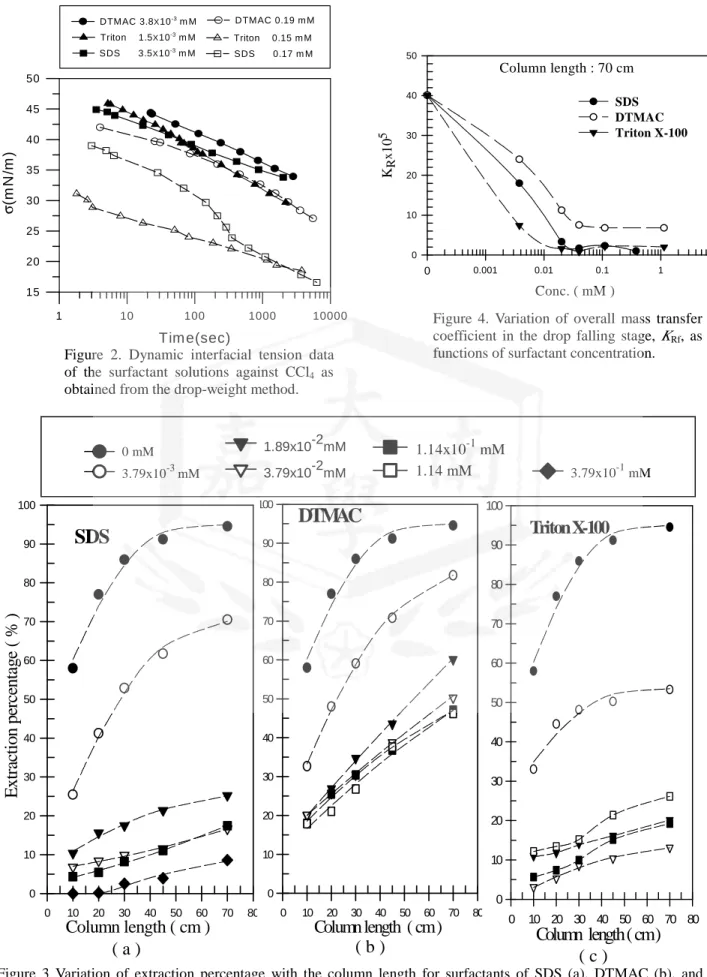
Figure 3 shows the typical data of dynamic interfacial tensions for the three surfactant solutions. At high concentrations (0.15-0.19 mM), the lower curve for Triton X-100 indicates that Triton X-100 can decrease the interfacial tension more rapidly than the others, although its equilibrium tension is higher than SDS which can also be inspected in this figure.
However, the situation is different at small concentrations (1.5x10⁻³ – 3.8x10⁻³ mM). The interfacial tension for Triton X-100 is higher than that for SDS at short adsorption time (< ca. 50 sec), that is, the adsorption kinetic of Triton X-100 is slower than SDS at the initial stage. The two results indicate that when the bulk concentration is increased, the transport rate of Triton X-100 can be enhanced more prominently than of SDS, which shows the characteristic of diffusion-controlled mechanism for Triton X-100. As for the DTMAC, the dynamic interfacial tension shows that the adsorption kinetic of DTMAC is similar to that of SDS, that is, the adsorption-rate limited mechanism.
Surfactant effects on overall extraction percentage The variations of extraction percentages of acetic acid with the column length were shown in Figure 3 for various surfactant concentrations. In general, the extraction percentage decreases notably when only a tiny amount of surfactant is present. When the surfactant concentration is increased, the extraction percentage decreases steadily and then level off for SDS and DTMAC, but for Triton X-100, decreases to a minimum value first and then increases when the concentration is further elevated. The effectiveness of the surfactants in decreasing the extraction amount varies with the surfactant concentration. For small concentrations, Triton X-100 is the most effective one, and DTMAC is the least. However, at high concentrations, the effectiveness of SDS will surpass that of Triton X-100. The effectivenesses of these surafcatnts in decreasing the overall extraction percentage are found to have similar tendency as their effects in decreasing the interfacial tension as shown in Table 1 and discussed in the previous paper (Chen and Lee, 2000).
Mass transfer during drop formation
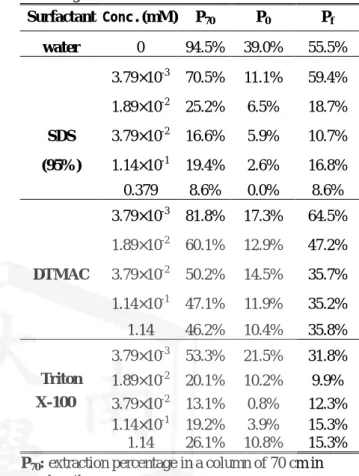
The curves in Figure 3 were extrapolated to zero position of column length to estimate the extraction percentage during drop formation. These results are shown in Table 2 as well as other related parameters.
For the surfactant free system, the extraction percentage during drop formation is 39.0 %, which is 41 % of the total extraction amount for the column length of 70 cm.
So, the drop formation stage takes an important part in the extraction process.
At surfactant concentration of 3.79x10⁻³ mM (about 1 ppm for DTMAC and SDS), the extraction percentage at drop formation stage decreases to 11.1%, 17.3%, and 21.5%, respectively, for SDS, DTMAC, and Triton X-100. That is, at such concentration, SDS is the most effective one in inhibition the mass transfer at the drop forming stage, and Triton X-100 is the least one.
However, at the falling period, the extraction percentage for the column of 70 cm in length, Pf, increases for SDS and DTMAC, but decreases to 31.8%
for Triton X-100. That is, at such concentration, SDS and DTMAC have no obvious effect in inhibition the mass transfer of the drop falling period, but Triton X-100 has significant effects. These results indicate that SDS and Triton X-100 have contrary effect on mass transfer during the drop formation and drop falling stges.
For SDS contained system, the value of P0
decreases with increasing of SDS concentration and approaches to zero at 0.379 mM. For the DTMAC system, the P0 also decreases with increasing of DTMAC concentration, but the mass transfer can not be inhibited completely and a minimum value of about 10 % will be approached. Besides, it was also found that the Pf values do not vary apparently for concentration larger than 3.79x10⁻² mM. For Triton X-100 system, a minimum value of P0 (about 1 %), as well as the overall extraction percentage (P70), approaches at about 3.79x10⁻² mM. When the concentration of Triton X-100 is increased further, both P0 and P70 will be increased instead, although only to a certain extent. The increase of the mass transfer rate at high concentration of Triton X-100 had been attributed to the interfacial re-mobilization caused from the fast adsorption kinetic of Triton X-100 (Chen and Lee, 2000). The present result demonstrates that this increase of mass transfer rate is mainly due to the enhance effect in the drop formation stage.
Effects of adsorption kinetic of surfactants on the mass transfer
From the dynamic interfacial tension shown in Figure 3, when the adsorption time is shorter than 5 sec, the interfacial tension is close to that of a surfactant free system (ca. 46 mN/m) at small concentrations. That is, few of surfactant molecules are adsorbed on the interface and the surface concentration of surfactant, Ã, is very small at short adsorption time. So, the barrier-obstruction model can not be used to explain the excess mass transfer resistance exerted by the
surfactants during the drop formation stage. And thus, the significant decrease of P0 can only be attributed to the hydrodynamic effect because this effect is dominated by the concentration gradient of surfactant on the interface, but not by the magnitude of concentration. Although the surface concentration of surfactant is small for an adsorption time as short as the drop formation interval, the surfactant molecules on the drop surface may be compressed (or expanded) locally by the movement of the interface. Thus, a meaningful concentration gradient is supposed to be constructed, which is responsible for the inhibition of the interfacial mobility during the drop formation stage.
For surfactant concentration as small as 3.79 x10⁻³ mM, the initial adsorption rate of Triton X-100 is smaller (as verified from the data of dynamic interfacial data in Figure 3) due to its slower diffusion rate, than that of SDS. As a consequence, Triton X-100 is less effective than SDS in drop formation stage. However, at the drop falling stage, the transport rate of Triton X-100 may be accelerated by forced convection at the leading edge of a falling drop. Although the same accelerating mechanism may also be occurred in SDS solution, the overall transport rate is limited by the later adsorption-desorption mechanism. As shown in Figure 3, for long adsorption time, the interfacial tension can be decreased rapidly and lower by Triton X-100 at such concentration range. The higher surface activity and fast transport rate of Triton X-100 are taken as responsibility for its higher effectiveness in reduce the mass transfer rate in the drop falling stage.
Mass transfer at high surfactant concentration and mechanism of mass transfer inhibition
At high surfactant concentrations, the mass transfer during drop formation stage can be inhibited completely when SDS concentration is elevated to 0.38 mM. However, similar inhibition condition can’t be achieved by DTMAC due to its less activity in decreasing the interfacial tension.
For the Triton X-100 containing system, both values of P0 and Pf are increased slightly with increasing of surfactant concentration at elevated concentrations. A model proposed to explain this unusual result can also be resorted to its diffusion-controlled mechanism of transportation.
Based on the previous discussion, the mass transfer inhibition of surfactant during the drop formation stage can be attributed to the hydrodynamic effect. For surfactants with adsorption-desorption controlled mechanism, such as SDS and DTMAC, the adsorption becomes the rate-determining step at elevated concentrations and thus, the transport rate of surfactant molecules from the subsurface cannot be increased fast enough to replenished what are swept away by the surface convection. A concentration gradient is built as a consequence. For Triton X-100, which has a diffusion-controlled mechanism, the surfactant transport rate can be increased steadily by elevating the bulk concentration and thus, it is possible to replenished the molecules swept by the surface
convection, especially when the convection is small as that in the drop formation stage. The mass transfer enhanced by the surface remobilization during the drop falling stage is not as significant as for the drop formation stage. This is because that the mass transfer inhibition of surfactant in the drop falling stage is mainly caused from the resistance of the barrier-layer formed for the reasons described in the previous work (Chen and Lee, 2000).
Mass transfer coefficient in drop falling stage
The overall mass transfer coefficients in drop falling stage, KRf, along the column of 70 cm, can be calculated from Eq. (1). Where XR1 should be the more fraction of acetic acid in CCl4 phase after the drop formation stage. The dependence of KRf value on the surfactant concentration is shown in Figure 4. The variation of KRf with surfactant concentration has similar tendency as that shown in the previous work which considered simultaneously both stages of drop formation and drop falling (Chen and Lee, 2000). For surfactant concentrations higher than 0.04 mM, the KRf
value doesn’t vary appreciable for DTMAC and SDS, but increases slightly for Triton X-100.
Liter atur e Cited
Beitel, A and W. J. Heideger, “Surfactants Effects on Mass Transfer from Drops Subject to Interfacial Instability,” Chem. Eng. Sci., 26, 711 (1971) Boye-Christensen, G. and S. G. Terjesen, “On the
Mechanism of Interfacial Resistance to Mass Transfer in Liquid-Liquid Extraction,” Chem.
Eng. Sci., 7, 222 (1958)
Chen, L. H., and Y. L. Lee, “Surfactant Effects on the Equipment Performance of Extraction Column,”
J. Chem. Eng. Jpn., 32, 138 (1999)
Chen, L. H., and Y. L. Lee, “Adsorption Behavior of Surfactants and Mass Transfer in Single-Drop Extraction,” AIChE J., 46, 160 (2000)
Lee, Y. L., J. R. Maa, and Y. M. Yang, “The Effects of Surfactant on the Mass Transfer in Extraction Column,” J. Chem. Eng. Japan, 31, 340 (1998).
Mudge, L. K. and W. J. Heideger, “The Effect of Surface Active Agents on Liquid-Liquid Mass Transfer Rates,” AIChE J., 16, 602 (1970) Ruskan, R. P., “The Effect of a Surfactant on a
Mechanically Agitated Extraction Column,” Ind.
Eng. Chem. Process Des. Dev., 13, 203 (1974)
Table 1 Equilibrium adsorption parameters and properties of surfactants.
surfactant Γm
(mole/m2)
KL
(m3/mole)
CMC (mM)
σCMC
(mN/m) Triton X-100 9.6 x 10⁻⁷ 8.5 x 10⁵ 0.3 15.7
SDS 9.7 x 10⁻⁷ 3.6 x 10³ 0.7 6.9 DTMAC 5.2 x 10⁻⁷ 4.7 x 10³ 1.9 21.1
Table 2. The extraction percentage during periods of drop formation and drop falling for a column of 70 cmin length.
Sur factant Conc.(mM) P70 P0 Pf
water 0 94.5% 39.0% 55.5%
3.79×10⁻³ 70.5% 11.1% 59.4%
1.89×10⁻² 25.2% 6.5% 18.7%
SDS 3.79×10⁻² 16.6% 5.9% 10.7%
(95% ) 1.14×10⁻¹ 19.4% 2.6% 16.8%
0.379 8.6% 0.0% 8.6%
3.79×10⁻³ 81.8% 17.3% 64.5%
1.89×10⁻² 60.1% 12.9% 47.2%
DTMAC 3.79×10⁻² 50.2% 14.5% 35.7%
1.14×10⁻¹ 47.1% 11.9% 35.2%
1.14 46.2% 10.4% 35.8%
3.79×10⁻³ 53.3% 21.5% 31.8%
Tr iton 1.89×10⁻² 20.1% 10.2% 9.9%
X-100 3.79×10⁻² 13.1% 0.8% 12.3%
1.14×10⁻¹ 19.2% 3.9% 15.3%
1.14 26.1% 10.8% 15.3%
P70: extraction percentage in a column of 70 cm in length
P0: extraction percentage in the drop formation stage Pf: extraction percentage in the drop falling stage
Figure 1 Experimental apparatus for single-drop extraction process. (A: main extraction column; B: collection column; C and D:
controlling valves; E: drop former).
E
C
D A
B
DTMAC 3.8X10⁻³ m M Triton 1.5X10⁻³ m M SDS 3.5X10⁻³ m M
DTMAC 0.19 m M Triton 0.15 m M SDS 0.17 m M
Tim e(sec)
1 10 100 1000 10000
σ(mN/m)
15 20 25 30 35 40 45 50
Figure 2. Dynamic interfacial tension data of the surfactant solutions against CCl4 as obtained from the drop-weight method.
Conc. ( mM )
0.0001 0.001 0.01 0.1 1 10
KRx105
0 10 20 30 40 50
SDS DTMAC Tr iton X-100 Column length : 70 cm
0
Figure 4. Variation of overall mass transfer coefficient in the drop falling stage, KRf, as functions of surfactant concentration.
0 mM 3.79x10⁻³ mM
1.89x10⁻² mM 3.79x10⁻²
mM
1.14x10⁻¹ mM
1.14 mM 3.79x10⁻¹ mM
Column length ( cm )
0 10 20 30 40 50 60 70 80
E xtr act io n pe rc enta g e ( % )
0 10 20 30 40 50 60 70 80 90 100
SDS
( a )
Column length ( cm )
0 10 20 30 40 50 60 70 80 0
10 20 30 40 50 60 70 80 90
100
DTMAC
( b )
0 10 20 30 40 50 60 70 80 0
10 20 30 40 50 60 70 80 90 100
Column length ( cm ) Triton X-100
( c )
Figure 3 Variation of extraction percentage with the column length for surfactants of SDS (a), DTMAC (b), and Triton X-100 (c).