Prep a ra tion and Re ac tiv ity of Mo(NCMe)( -C
2Ph
2)
2( -C
4Ph
4)
Su-Chin Changa ( ), Wen-Yann Yeha* ( ),Gene-Hsiang Leeb ( ) and Shie-Ming Pengb ( )
aDe part ment of Chem is try, Na tional Sun Yat-Sen Uni ver sity, Kaohsiung 804, Tai wan, R.O.C. bDe part ment of Chem is try, Na tional Tai wan Uni ver sity, Tai pei 106, Tai wan, R.O.C.
Re ac tion of Mo(CO)( -C2Ph2)2( -C4Ph4) and Me3NO in acetonitrile sol vent af fords Mo(NCMe)( C2Ph2)2( -C4Ph4) 1. Com pound 1 re acts with trimethylphosphine to pro duce Mo(PMe3)( - C2Ph2)2( C4Ph4) 2, or re acts with diphenylacetylene to pro duce ( 5-C5Ph5)2Mo 3 and Mo( -O2CPh)( - C4Ph4H)( C4Ph4) 4. The mo lec u lar struc tures of 1, 2 and 4 have been de ter mined by an X-ray dif frac tion study.
IN TRO DUC TION
Re ac tions of metal car bon yls with al kynes are known to af ford a wide va ri ety of organometallic and or ganic prod -ucts,1-6 such as form ing the coordinative spe cies Mx(alkyne)y or through di-, tri- or tetramerization of the alkyne lig ands to yield metallacyclic sys tems or carbocycles. Tate7 has pre vi -ously pre pared the polyalkyne com plex W(CO)( -C2Ph2)3 by treat ing W(CO)3(NCMe)3 with diphenylacetylene. In con -trast, the anal o gous re ac tion with Mo(CO)3(NCMe)3 yields mainly the mo lyb de num tetraphenylcyclobutadiene com -plexes Mo(CO)( -C2Ph2)2( -C4Ph4).8 We have shown that W(CO)( -C2Ph2)3 is able to un dergo mul ti ple alkyne-alkyne cou pling re ac tions un der harsh con di tions to form W(CO) ( -C2Ph2)2( -C4Ph4)
9
and sev eral cyclopentadiene com pounds,10,11 in clud ing a novel tungstenocene com plex ( 5-C5Ph5)2W.12 In the pres ent re search, we ex plore the re ac tiv ity of the mo lyb -de num an a logue Mo(CO)( -C2Ph2)2( -C4Ph4).
RE SULTS AND DIS CUS SION
Mo(CO)( -C2Ph2)2( -C4Ph4) is ther mally ro bust and shows no re ac tions with diphenylacetylene or ter tiary phos -phines. It has been il lus trated that re place ment of the CO ligand in W(CO)( -C2Ph2)3 and W(CO)( - C2Ph2)2( C4Ph4) with a la bile acetonitrile moi ety tre men dously in -creases their re ac tiv ity to wards phos phine sub sti tu tion as well as alkyne cou pling re ac tions.13 Thus, Mo(CO)( C2Ph2)2 ( -C4Ph4) is treated with Me3NO in acetonitrile to af -ford Mo(NCMe)( -C2Ph2)2( -C4Ph4) 1, which re acts with PMe3 smoothly at room tem per a ture to pro duce Mo(PMe3) ( C2Ph2)2( -C4Ph4) 2. More over, the re ac tion of 1 and di -phenyl acetylene af fords the molybdenocene com plex ( 5 C5Ph5)2Mo 3 in 36% to gether with Mo( -O2CPh)(
C4Ph4H)( - C4Ph4) 4, which con tains a ben zo ate ligand and a Mo=C dou ble bond (Scheme I). Com pound 3 was pre vi ously ob tained in low yield (ca. 4%) by heat ing PhC CPh with ei -ther Mo(CO)6, Mo(CO)3(NCMe)3 or Mo(CO)3(diglyme).14 Thus, the pres ent re ac tion pro vides an al ter na tive method to pre pare 3 in better yield.
The for ma tion of 4 is in ter est ing. Since the re ac tion in non-aromatic sol vents also af fords 4, the ben zo ate moi ety must arise from diphenylacetylene. It has been pos tu lated that an alkylidyne moi ety, M C-R, from alkyne C C bond scission is in volved in cer tain cat a lytic re ac tions like alkyne me tath e sis and alkyne oligomerization.15,16 To ac count for the ob ser va tion herein, the re ac tion of 1 and diphenyl ace tylene is likely to gen er ate the benzylidyne spe cies Mo -( CPh)-( -C4Ph4)( -C4Ph4), which could lead to 3 via fur -ther C-C bond cou plings or un dergo hydroxidation to give 4. The new com pounds 1, 2 and 4 have been char ac ter ized by mass and NMR spec tros copy. In or der to eval u ate the elec tronic and steric ef fects of lig ands on the co or di na tion con fig -u ra tion aro-und the Mo atom, their str-uc t-ures were de ter mined
by an X-ray dif frac tion study. The mo lec u lar struc tures of 1 and 2, shown in Fig. 1 and Fig. 2, are closely re lated and re -semble those ob served for the tung sten an a logues W(CO) ( C2Ph2)2( -C4Ph4)9 and W(PMe3)( -C2Tol2)2( -C4Tol4).17 If tak ing the cen ters of the al kynes and the cen ter of cyclo -butadiene, the co or di na tion about the mo lyb de num atom in 1 and 2 can be de scribed as a dis torted tet ra he dron.
In 1 the NCMe ligand is ter mi nally bonded to the mo -lyb de num atom with the an gle Mo-N(1)-C(9) = 175.4(4)°. The two alkyne lig ands are bonded to the mo lyb de num atom
sym met ri cally, and the phenyl groups are bent back from the C C vec tor by an gles av er ag ing 139°. The cyclobutadiene ring is about pla nar, which is bonded to the mo lyb de num atom asym met ri cally with the lengths Mo-C(2) = 2.235(4) Å and Mo-C(3) = 2.268(4) Å be ing slightly shorter than those of Mo-C(1) = 2.337(4) Å and Mo-C(4) = 2.349(4) Å. The phenyl ipso-car bons C(21), C(31), C(11) and C(41) are bent away from the cyclobutadiene ring by 24, 12, 19 and 15°, re -spec tively.
In 2 the PMe3 group is sterically forc ing the alkyne lig -ands and the cyclobutadiene ring from be ing par al lel, such
Fig. 1. Mo lec u lar struc ture of 1. Se lected bond dis -tances/Å: Mo-N(1) = 2.152(3), N(1)-C(9) = 1.127(6), C(9)-C(10) = 1.465(8), Mo-C(1) = 2.337(4), Mo-C(2) = 2.235(4), Mo-C(3) = 2.268(4), Mo-C(4) = 2.349(4), Mo-C(5) = 2.082(4), Mo-C(6) = 2.088(4), Mo-C(7) = 2.099(4), Mo-C(8) = 2.092(4), C(1)-C(2) = 1.455(5), C(1)-C(4) = 1.474(6), C(2)-C(3) = 1.484(6), C(3)-C(4) = 1.454(5), C(5)-C(6) = 1.309(6), C(7)-C(8) = 1.307(6). Se lected bond an gles/deg: N(1)-C(9) = 175.4(4), C(1)- C(2) = 67.7(2), Mo-C(2)-C(1) = 75.3(2), Mo-C(3)-C(4) = 74.7(2), Mo-C(4)-C(3) = 68.6(2), Mo-C(5)-C(6) = 72.0(3), Mo- C(5) = 71.5(2), MoC(7)C(8) = 71.5(3), Mo -C(8)- C(7) = 72.1(3), N(1)-Mo-C(1) = 118.0(1), N(1)-Mo-C(2) = 81.3(1), N(1)-Mo-C(3) = 84.7(1), N(1)-C(4) = 121.3(1), N(1)- C(5) = 83.4(2), N(1)-Mo-C(6) = 120.0(2), N(1)-Mo-C(7) = 119.9(2), N(1)-Mo-C(8) = 83.6(2), C(2)-C(5) = 105.6(2), C(5)- C(8) = 112.1(2), C(8)-Mo-C(3) = 100.5(2), C(1)- Mo-C(6) = 86.3(2), C(6)-Mo-C(7) = 91.8(2), C(7)-Mo-C(4) = 84.6(2).
Fig. 2. Mo lec u lar struc ture of 2. Se lected bond dis -tances/Å: Mo-P(1) = 2.5106(6), Mo-C(1) = 2.262(2), Mo-C(2) = 2.348(2), Mo-C(3) = 2.355(2), Mo-C(4) = 2.306(2), Mo-C(5) = 2.090(2), Mo-C(6) = 2.113(2), Mo-C(7) = 2.119(2), Mo-C(8) = 2.080(2), C(1)-C(2) = 1.459(3), C(1)-C(4) = 1.490(3), C(2)-C(3) = 1.457(3), C(3)-C(4) = 1.453(3), C(5)-C(6) = 1.301(3), C(7)-C(8) = 1.308(3). Se lected bond an gles/deg: C(1)-C(2) = 74.8(1), C(2)- C(1) = 68.4(1), Mo-C(3)-C(4) = 70.0(1), Mo-C(4)-C(3) = 73.7(1), Mo-C(5)-C(6) = 72.9(1), Mo-C(6)-C(5) = 71.0(1), C(8) = 70.3(1), Mo-C(8)-C(7) = 73.5(1), Mo-C(1) = 94.8(5), P(1)-Mo-C(2) = 131.52(5), P(1)-Mo-C(3) = 123.14(5), P(1)-Mo-C(4) = 88.40(5), Mo-C(5) = 117.92(6), Mo- C(6) = 82.14(6), P(1)-Mo-C(7) = 78.76(6), P(1)-Mo-C(8) = 114.77(6), C(2)-Mo-C(5) = 84.31(7), C(5)-C(8) = 91.64(8). C(8)- C(3) = 84.75(7), C(1)-Mo-C(6) = 100.56(8), C(6)-Mo-C(7) = 112.93(8), C(7)-Mo-C(4) = 106.40(8).
that C(5)C(6) is tilted from the Mo-P(1) vec tor by 11.0°, C(7)C(8) by 8.4°, C(1)C(2) by 20.0° and C(3)C(4) by 14°. This gives rise to a slight dif fer ence be tween the up per and lower C-Mo dis tances, such that Mo-C(6) = 2.113(2) Å, Mo-C(5) = 2.090(2) Å, Mo-C(7) = 2.119(2) Å and Mo-C(8) = 2.080(2) Å. The cyclobutadiene group (C(1) to C(4)) is about pla nar and bonded to the mo lyb de num atom asym met ri cally, with Mo-C dis tances rang ing from 2.262(2) Å through 2.355(2) Å. The phenyl ipso-car bons C(12), C(18), C(24) and C(30) are bent away from the cyclobutadiene ring by 19, 25,
13 and 24°, re spec tively. The alkyne phenyl groups are bent back from the C C vec tor by an gles av er ag ing 134°.
The mo lec u lar struc ture of 4, il lus trated in Fig. 3, con -sists of dis crete mol e cules with each mo lyb de num unit bonded to one ben zo ate, one tetraphenylcyclobutadiene and one tetraphenylbutadienyl ligand. The carboxylate group, cyclobutadiene ring and butadienyl group are es sen tially pla -nar with the max i mum atomic dis place ment from plane be ing 0.01, 0.01 and 0.03 Å, re spec tively. The cyclobutadiene ring is bonded to the mo lyb de num atom with Mo-C(3) = 2.232(3) Å and Mo-C(4) = 2.234(3) Å be ing slightly shorter than MoC(1) = 2.256(3) Å and Mo(2) = 2.292(3) Å, and the at -tached phenyl ipso-car bons are bent away from the ring plane by an gles av er ag ing 14.0°. The ben zo ate group is 2co or di -nated to Mo with Mo-O(1) = 2.252(2) Å and Mo-O(2) = 2.160(2) Å. How ever, the weak in ter ac tion be tween the Mo and C(9) at oms (dis tance = 2.575(3) Å) could also sug gest an
3
-bond ing mode for the ben zo ate ligand. The butadienyl group (C(5)~C(8)) ap pears to have a mo lyb de num-carbon dou ble bond to C(5) (1.946(3) Å), a sin gle bond to C(8) (2.304(3) Å), and a -do na tion from C(6) and C(7) to Mo (2.352(3) and 2.437(3) Å). More over, the at oms Mo, C(5), C(6) and C(40) are about on the same plane with the di hed ral an gle Mo-C(5)-C(40) = 173.7(3)° and the an gle C(5)- C(40) = 121.0(2)°, im ply ing a carbene car bon for the C(5) atom.
The re sults pre sented here de scribe ac ti va tion of Mo(CO)( -C2Ph2)2( -C4Ph4) by re plac ing the CO ligand with NCMe, which sub stan tially in creases the re ac tiv ity of the com plex. The re ac tion pat terns of 1 with PMe3 and di -phenylacetylene show great re sem blance to those oc cur ring at a tung sten cen ter. How ever, more com pli cated re sults are ob tained when treat ing 1 with bulky phosphines, such as triphenylphosphine and bis(diphenylphosphino)ferrocene, in com par i son with the tung sten sys tem.17 The dif fer ence may be at trib uted to the in trin si cally lower sta bil ity of the sec ondraw tran si tion metal com plexes than the thirdraw met -als.18
EX PER I MEN TAL SEC TION Gen eral Methods
All the ex per i men tal ma nip u la tions were car ried out un der a dinitrogen at mo sphere us ing stan dard Schlenk tech -niques.19 Sol vents were dried over ap pro pri ate re agents un -der dinitrogen.20 An hy drous Me3NO was ob tained from Me3NO·2H2O (Aldrich) by sub li ma tion un der vac uum twice. Mo(CO)6, PMe3 (1.0 M in to lu ene) and PhC CPh were pur -Fig. 3. Mo lec u lar struc ture of 4. Se lected bond dis
-tances/Å: Mo-O(2) = 2.160(2), Mo-O(1) = 2.252(2), Mo-C(9) = 2.575(3), C(9)-C(10) = 1.484(4), C(9)-O(1) = 1.264(3), C(9)-O(2) = 1.282(3), Mo-C(1) = 2.256(3), Mo-C(2) = 2.292(3), Mo-C(3) = 2.232(3), Mo-C(4) = 2.234(3), Mo-C(5) = 1.946(3), Mo-C(6) = 2.352(3), Mo-C(7) = 2.437(3), Mo-C(8) = 2.304(3), C(1)-C(2) = 1.458(4), C(1)-C(4) = 1.469(4), C(2)-C(3) = 1.460(4), C(3)-C(4) = 1.466(4), C(5)-C(6) = 1.457(4), C(6)-C(7) = 1.406(4), C(7)-C(8) = 1.447(4). Se lected bond an gles/deg: Mo-O(2) = 59.18(7), C(9)-O(2) = 117.8(2), O(1)-C(9)-C(10) = 121.1(3), O(2)C(9)C(10) = 121.1(3), Mo -C(5)- C(6) = 86.2(2), Mo--C(5)-C(40) = 152.2(2), C(40)-C(5)-C(6) = 121.0(2), C(5)- C(6)-C(7) = 117.2(2), C(6)-C(7)-C(8) = 118.0(2), C(8)-C(58) = 129.0(2), C(58)- C(8)-C(7) = 123.4(2). Se lected tor sion an gles/deg: C(6)C(5)C(40) = 173.7(3), C(5) C(6) C(7) -C(8) = 9.5(3), C(40)- C(5)- C(6)-C(46) = 55.7(3), C(46)C(6)C(7)C(52) = 12.1(4), C(58) C(8) -C(7)-C(52) = 2.6(4).
chased from Aldrich and used as re ceived. Pre para tive layer chro mato graphic (TLC) plates were pre pared from sil -ica gel (Kieselgel DGF254). Mo(CO)( -C2Ph2)2( -C4Ph4) was pre pared as de scribed in the lit er a ture.21 IR spec tra were taken on a Hitachi I2001 spec trom e ter. MS spec tra were ob tained on a VG Blotch5023 mass spec trom e ter. NMR spec tra were re corded on a Varian VXR300 spec trom e ter. El e -men tal anal y sis was per formed at the Na tional Chen-Kung Uni ver sity, Tainan.
Prep a ra tion of Mo(NCMe)( -C2Ph2)2( -C4Ph4)
Mo(CO)( -C2Ph2)2( -C4Ph4) (670 mg, 0.80 mmol) and di chloro methane (10 mL) were in tro duced into an oven-dried 100 mL Schlenk flask, equipped with a mag netic stir bar and a rub ber se rum stop per, un der dinitrogen at mo -sphere. A so lu tion of Me3NO (185 mg) in acetonitrile (5 mL) was in tro duced into the flask via a sy ringe through the se rum stop per. The mix ture was stirred at room tem per a ture for 2 h and then in an oil bath (50 C) for an other 2 h, at which point the IR spec trum showed no CO ab sorp tion due to the start ing com pound. The mix ture was passed through a short sil ica gel col umn to re move the re main ing Me3NO, and the sol vents were re moved on a ro tary evap o ra tor. The res i due was crys -tal lized twice from di chloro methane/n-hex ane to af ford dark pur ple crys tals of Mo(NCMe)( -C2Ph2)2( -C4Ph4) 1 (420 mg, 0.50 mmole, 62%). MS FAB m/z: 849 (M+
, 96Mo), 808
(M -NCMe). H NMR (CD2Cl2, 20 C): 7.37-6.84 (m, Ph), 1.97 (s, NCMe) ppm. Anal. For C58H43NMo: Found C, 81.94; H, 5.03; N, 1.63; Calc. C, 81.96; H, 5.10; N, 1.65.
Prep a ra tion of Mo(PMe3)( -C2Ph2)2( -C4Ph4)
Com pound 1 (150 mg, 0.18 mmol) and di chloro -methane (10 mL) were placed in a 50 mL Schlenk flask un der dinitrogen. PMe3 (0.3 mmol) was added into the flask and the re sult ing mix ture was stirred at room tem per a ture for 12 h. The vol a tile ma te ri als were re moved un der vac uum, and the res i due was sub jected to TLC with di chloro methane/n hex ane (3:1, v/v) as eluant. Crys tal li za tion of the ma te rial form ing the ma jor pur plered band from di chloro methane/nhex -ane pro duced dark red crys tals of Mo(PMe3)( - C2Ph2)2( C4Ph4) (2, 34 mg, 22%). MS FAB m/z: 884 (M+, 96Mo), 808 (M+-PMe3). 1H NMR (CD2Cl2, 20 C): 7.24-6.78 (m, Ph), 0.93 (d, 2JP-H = 5 Hz, Me) ppm. 31P {1H} NMR (CD2Cl2, 20
C): -17.02 (s) ppm.
Re ac tion of 1 with Diphenylacetylene
A so lu tion of com pound 1 (100 mg, 0.12 mmol) and diphenylacetylene (107 mg, 0.6 mmol) in to lu ene (5 mL) was heated to re flux un der dinitrogen for 10 min. The mix ture was cooled to am bi ent tem per a ture and fil tered. The red solid pre cip i tate was washed with di chloro methane, dried un der vac -uum, and char ac ter ized as the known ( 5-C5Ph5)2Mo (3, 40
Table 1. Crystal Data and Refinement Details for Compounds1, 2 and 4
1 2 4
Formula C58H43MoN C59H49MoP C63H46MoO2
T (K) 295(2) 295(2) 150(2)
Crystal system triclinic orthorhombic triclinic
Crystal solvent CH2Cl2 CH2Cl2
Space group P Pbca P
Unit cell dimensions
a/Å 12.3453(2) 18.3613(6) 12.4535(4) b/Å 12.8798(2) 18.6957(6) 13.4417(4) c/Å 16.4718(2) 26.2646(9) 16.4928(5) /deg 76.666(1) 90 84.650(1) /deg 84.320(1) 90 69.791(1) /deg 75.175(1) 90 73.091(1) V/Å3 2461.43(6) 9016.0(5) 2478.78(13) Z 2 8 2 Dcalcd/g cm-3 1.261 1.304 1.361 F(000) 964 3680 1048 Radiation ( /Å) 0.71073 0.71073 0.71073 /mm-1 0.413 0.365 0.419 range/deg 2.31-27.45 1.55-27.50 1.32-27.50 R1 0.0653 0.0312 0.0402 wR2 0.1868 0.0684 0.0798 Goodness-of-fit on F2 1.086 1.033 1.027
mg, 36%). The fil trate was evap o rated to dry ness on a ro tary evap o ra tor. The res i due was sub jected to TLC with di chloro methane/nhex ane (3:7, v/v) as eluant. The first band re cov -ered the unreacted diphenylacetylene. The sec ond band was the unreacted 1. Crys tal li za tion of the ma te rial form ing the third red band from di chloro methane/n-hex ane af forded dark
red crys tals of Mo( -O2CPh)( -C4Ph4H)( -C4Ph4) (4, 3 mg, 3%). MS FAB m/z: 930 (M+, 96Mo). 1H NMR (CD
2Cl2, 20 C): 7.80-7.05 (m, Ph, CHPh) ppm.
Struc ture De ter mi na tion for 1, 2 and 4
A crys tal of 1 (ca. 0.20 0.13 0.05 mm3), a crys tal of
2 (ca. 0.27 0.25 0.12 mm3
) and a crys tal of 4 (ca. 0.18 0.16 0.05 mm3) were each mounted in a thin-walled glass cap il lary and aligned on the Nonius Kappa-CCD (for 1), Brucker SMART-CCD (for 2) and Simens SMART-CCD (for
4) diffractometers, re spec tively, with graph ite mono chro
-mated Mo-K ra di a tion. The data were col lected at 295(2) K for 1 and 2 and 150(2) K for 4. All data were cor rected for the ef fects of ab sorp tion. The struc tures were solved by the di rect method and re fined by full-matrix least square on F2
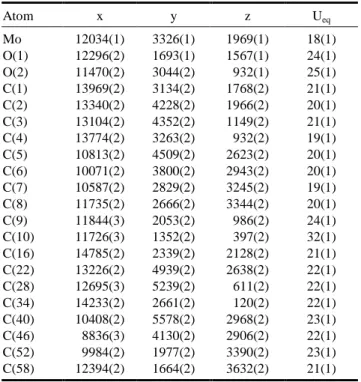
. The pro gram used was the SHELXTLE pack age.22 All hydrogen at oms were re fined with anisotropic dis place ment pa ram e ter. Hy dro gen at oms were in cluded but not re fined. The data col lec tion and re fine ment pa ram e ters are pre sented in Ta ble 1. Se lected atomic po si tional pa ram e ters for 1, 2 and
4 are given in Ta ble 2, 3 and 4, re spec tively.
AC KNOWL EDG MENT
We are grate ful for sup port of this work by the Na tional Sci ence Coun cil of Tai wan.
Table 2. Selected Atomic Coordinates (× 104) of Compound1
Atom x y z Ueq Mo 6916(1) 5148(1) 7368(1) 44(1) N(1) 5826(3) 5681(3) 6333(2) 57(1) C(1) 8512(3) 5841(3) 7253(2) 49(1) C(2) 7931(3) 6153(4) 6474(2) 50(1) C(3) 8318(3) 4999(3) 6371(2) 49(1) C(4) 8875(3) 4691(3) 7159(2) 48(1) C(5) 5683(4) 6270(4) 7890(3) 53(1) C(6) 6466(3) 5811(3) 8431(2) 48(1) C(7) 7149(3) 3537(3) 8081(2) 49(1) C(8) 6479(4) 3654(4) 7483(3) 55(1) C(9) 5224(4) 6021(5) 5811(3) 69(1) C(10) 4385(7) 6481(9) 5171(4) 129(3) C(11) 8873(4) 6496(4) 7736(3) 53(1) C(21) 7608(4) 7242(4) 5898(3) 55(1) C(31) 8329(3) 4444(4) 5681(2) 53(1) C(41) 9730(3) 3740(3) 7565(2) 48(1) C(51) 4660(4) 7164(4) 7758(3) 56(1) C(61) 6639(4) 5849(4) 9288(2) 51(1) C(71) 7598(4) 2708(4) 8811(3) 54(1) C(81) 5798(4) 3047(4) 7189(3) 59(1)
Table 3. Selected Atomic Coordinates (× 104) of Compound2
Atom x y z Ueq Mo 6819(1) 2536(1) 6169(1) 29(1) P(1) 7581(1) 2428(1) 5380(1) 38(1) C(1) 7152(1) 3676(1) 6336(1) 34(1) C(2) 6599(1) 3506(1) 6716(1) 33(1) C(3) 6036(1) 3509(1) 6326(1) 34(1) C(4) 6570(1) 3702(1) 5942(1) 35(1) C(5) 7186(1) 2025(1) 6829(1) 35(1) C(6) 7703(1) 1973(1) 6492(1) 36(1) C(7) 6147(1) 1881(1) 5708(1) 36(1) C(8) 5868(1) 1931(1) 6164(1) 34(1) C(9) 8439(1) 2926(1) 5343(1) 56(1) C(10) 7883(1) 1513(1) 5266(1) 51(1) C(11) 7179(1) 2634(1) 4761(1) 51(1) C(12) 7887(1) 3980(1) 6421(1) 35(1) C(18) 6590(1) 3607(1) 7274(1) 35(1) C(24) 5229(1) 3504(1) 6353(1) 37(1) C(30) 6520(1) 4063(1) 5445(1) 40(1) C(36) 7097(1) 1808(1) 7365(1) 37(1) C(42) 8400(1) 1589(1) 6488(1) 39(1) C(48) 5918(1) 1509(1) 5241(1) 40(1) C(52) 5248(1) 1462(2) 4455(1) 75(1)
Table 4. Selected Atomic Coordinates ( 104) of Compound4
Atom x y z Ueq Mo 12034(1) 3326(1) 1969(1) 18(1) O(1) 12296(2) 1693(1) 1567(1) 24(1) O(2) 11470(2) 3044(2) 932(1) 25(1) C(1) 13969(2) 3134(2) 1768(2) 21(1) C(2) 13340(2) 4228(2) 1966(2) 20(1) C(3) 13104(2) 4352(2) 1149(2) 21(1) C(4) 13774(2) 3263(2) 932(2) 19(1) C(5) 10813(2) 4509(2) 2623(2) 20(1) C(6) 10071(2) 3800(2) 2943(2) 20(1) C(7) 10587(2) 2829(2) 3245(2) 19(1) C(8) 11735(2) 2666(2) 3344(2) 20(1) C(9) 11844(3) 2053(2) 986(2) 24(1) C(10) 11726(3) 1352(2) 397(2) 32(1) C(16) 14785(2) 2339(2) 2128(2) 21(1) C(22) 13226(2) 4939(2) 2638(2) 22(1) C(28) 12695(3) 5239(2) 611(2) 22(1) C(34) 14233(2) 2661(2) 120(2) 22(1) C(40) 10408(2) 5578(2) 2968(2) 23(1) C(46) 8836(3) 4130(2) 2906(2) 22(1) C(52) 9984(2) 1977(2) 3390(2) 23(1) C(58) 12394(2) 1664(2) 3632(2) 21(1)
Re ceived De cem ber 18, 2001.
Key Words
Mo lyb de num; Molybdenocene; Alkyne cou pling; Cyclobutadiene com plexes.
REF ER ENCES
1. Bowden, F. L.; Le ver, A. B. P. Organomet. Chem. Rev. 1968, 3, 227.
2. Sappa, E.; Tiripicchio, A.; Braunstein, P. Chem. Rev. 1983, 83, 203.
3. Templeton, J. L. Adv. Organomet. Chem. 1989, 29, 1. 4. Schore, N. E. Chem. Rev. 1988, 88, 1081.
5. Wink, D. J.; Greagan, T. Organometallics 1990, 9, 328. 6. Grotjahn, D. B. In Com pre hen sive Organometallic Chem is
-try II; Pergamon Press: Ox ford, U.K., 1995; Vol. 12, p 741. 7. Tate, D. P.; Augl, J. M. J. Am. Chem. Soc. 1963, 85, 2174. 8. Potenza, J. A.; John son, R. J.; Chirico, R.; Efraty, A. Inorg.
Chem. 1977, 16, 2354.
9. Yeh, W.-Y.; Liu, L.-K. J. Am. Chem. Soc. 1992, 114, 2267. 10. Yeh, W.-Y.; Peng, S.-M.; Lee, G.-H. J. Chem. Soc., Chem.
Commun. 1993, 1056.
11. Yeh, W.-Y.; Ho, C.-L.; Chiang, M. Y.; Chen, I.-T. Organometallics 1997, 16, 2698.
12. Yeh, W.-Y.; Peng, S.-M.; Lee, G.-H. J. Organomet. Chem.
1999, 572, 125.
13. Yeh, W.-Y.; Ting, C.-S.; Chih, C.-F. J. Organomet. Chem.
1991, 427, 257.
14. Hübel, W.; Merényi, R. J. Organomet. Chem. 1964, 2, 213. 15. Schrock, R. R.; Pedersen, S. F.; Chur chill, M. R.; Ziller, J. W.
Organometallics 1984, 3, 1574.
16. Nu gent, W. A.; Mayer, J. M. Metal-Ligand Mul ti ple Bonds; Wiley: New York, 1988.
17. Yeh, W.-Y.; Ting, C.-S.; Chien, S.-M.; Peng, S.-M.; Lee, G.-H. Inorg. Chim. Acta 1997, 255, 335.
18. Cot ton, F. A.; Wilkinson, G.; Murillo, C. A.; Bochmann, M. Ad vanced In or ganic Chem is try, 6 th ed.; Wiley: New York, 1999.
19. Shriver, D. F.; Drezdzon, M. A. The Ma nip u la tion of Air-Sensitive Com pounds, 2nd ed.; Wiley: New York, 1986. 20. Perrin, D. D.; Armarego, W. L. F. Pu ri fi ca tion of Lab o ra tory
Chem i cals, 3rd ed.; Pergamon Press: Ox ford, U.K., 1988. 21. Li, C.-I.; Yeh, W.-Y.; Peng, S.-M.; Lee, G.-H. J. Organomet.
Chem. 2001, 620, 106.
22. Sheldrick, G. M. SHELXTL, Uni ver sity of Göttingen, Ger -many, 1985.