Long-term Effect of Antihypertensive drugs on the Risk of New-onset Atrial Fibrillation: A Longitudinal Cohort Study
Gwo-Ping Jong1, Hung-Yi Chen2, Shu-Yi Li3, Yi-sheng Liou4
1Gwo-Ping Jong, MD, PhD: Department of Internal Medicine, Armed Forces
Taichung General Hospital, and Central Taiwan University of Science and Technology, Taichung, Taiwan, ROC.
2Hung-Yi Chen: Institute of Pharmacy, China Medical University, Taichung,
Taiwan, ROC. E-mail: [email protected]
3Shu-Yi Li, MHA: Department of Nursing, Lin Shin Hospital, Taichung, Taiwan,
ROC. E mail: [email protected]
4Department of Family Medicine, Taichung Veterans General Hospital, and
Department of Public Health, National Defense Medical Center, Taipei, Taiwan, ROC. E mail: [email protected]
Running titer: Antihypertensive drugs and new-onset atrial fibrillation
Correspondence to Professor Yi-sheng Liou, MD, Department of Family Medicine, Taichung Veterans General Hospital, and Department of Public Health, National Defense Medical Center, 40705, Taipei, Taiwan, ROC. Tel: +886-4-23938143, fax: +886-4-23918421, E-mail address:
Abstract
(NAF); however, data on the effect of these drugs on the development of NAF in hypertensive patients has not been well determined. The aim was to investigate the association between antihypertensive drugs and NAF in a population. We examined the association between all antihypertensive drug therapy and the risk of NAF in a population-based study. The sample consisted of 47,682 hypertensive patients. Our data were taken from claim forms provided to the central region branch of the Bureau of National Health Insurance in Taiwan from January 2005 to December 2010. Prescriptions for antihypertensive drugs before the index date were retrieved from a prescription database. We estimated the hazard ratio (HR) of NAF associated with antihypertensive drug use; non- NAF subjects served as the reference group. The risk of NAF after adjusted age and sex was higher among users of diuretics (HR, 1.39; 95% confidence interval (CI), 1.06-1.82) than among non-users. Patients who take angiotensin- converting enzyme (ACE) inhibitors (HR, 0.73; 95% CI, 0.60-0.90) are at a lower risk of developing NAF than non-users. Angiotensin receptor blockers, alpha-blockers, beta-blockers, and calcium channel blockers were not associated with risk of NAF. The results of this study suggest that hypertensive patients who take ACE
inhibitors are at lower risk of NAF. Diuretics were associated with a significant increase in the risk of NAF.
Keywords: Antihypertensive drugs, New-onset atrial fibrillation,
Hypertension
INTRODUCTION
Atrial Fibrillation (AF) is the most common type of cardiac arrhythmia1
Antihypertensive drugs have been linked to new-onset atrial fibrillation (NAF). Numerous studies have demonstrated that certain classes of antihypertensive medication can affect NAF development.4-10 However,
reports on the effect of various antihypertensive drugs on the risk of NAF are inconsistent. There is a paucity of data from studies comparing large groups of patients taking more than two classes of antihypertensive medication.4-8,10 Therefore, we conducted a retrospective cohort study to
explore the relationships between all antihypertensive drugs and NAF in a general population.
To determine whether diuretics, alpha-blockers, beta-blockers, calcium channel blockers, angiotensin-converting enzyme (ACE) inhibitors, and angiotensin receptor blockers (ARBs) were independently associated with NAF, we conducted a retrospective study in a population in central
Taiwan. The current study was designed to explore the relationship between antihypertensive drugs and NAF using a Cox survival analysis model.
METHODS
Our data were taken from claim forms provided to the central region branch of the Bureau of National Health Insurance (BNHI) in Taiwan from January 2005 to December 2010. The BHNI stores information from the claim forms in two tables: a visit table and a prescription table. Visit tables contain information regarding patient identification numbers, sex, age, three diagnostic codes, medical expenditures, hospital’s and physician’s information. The prescription table contains the quantity and expenditure for all drugs, operations and treatments. Patients were
included in the study if they had hypertension with monotherapy without atrial fibrillation at baseline (January 1, 2005). We summarized the claim records of each patient into one record.
We used the International Classification of Diseases, Ninth Revision (ICD-9) Clinical Modification code to define hypertension (ICD-9 codes 401-405) and atrial fibrillation (ICD-9 codes 427.31). The primary
endpoint was NAF, which was the first time that an atrial fibrillation code appeared in the diagnostic codes of outpatient claim records. We
identified all prescriptions aged 20 to 80 years for antihypertensive drugs administered to patients within a 6-year period before the date NAF was diagnosed. In Taiwan, these drugs are available only by prescription.
Patients who had used only one type of antihypertensive drug in the 90 days before the date NAF was diagnosed were categorized according to the antihypertensive drug class that they took: diuretics, alpha-blockers, beta-blockers, calcium channel blockers, ACE inhibitors, and angiotensin receptor blockers. Patients using more than one type of antihypertensive drug in the 90 days before the date NAF was diagnosed were categorized as combined users. Data were excluded if (1) missing data could not be obtained from the claim forms, (2) patients with a diagnosis of
paroxysmal atrial fibrillation between January 1, 2003 and January 1, 2005, (3) if patients who were lost to follow-up or died during the study period, or (4) patients with a diagnosis of heart failure, coronary heart disease, valvular heart disease, thyrotoxicosis, alcoholism, or chronic obstructive pulmonary disease at any time during the study period. Finally, a total of 47,682 outpatients were selected for this study (Figure 1).
Drug classes
The antihypertensive drugs were categorized into 6 drug classes (Alpha-blockers, ACE inhibitors, angiotensin receptor (Alpha-blockers, beta-(Alpha-blockers, calcium channel blockers, and diuretics). There are 43 drugs in the
alpha-blocker class, 132 drugs in the ACE inhibitor class, 9 drugs in the
angiotensin receptor blockers class, 279 drugs in the beta-blockers class, 228 drugs in the calcium channel blockers class, and 205 drugs in the diuretics class.
Statistical methods
Continuous variables are presented as mean + SD. They were compared by the unpaired Student t-test. Categorical and discrete variables are presented as frequencies and percentages. When appropriate, they were compared by either the Fisher’s exact test or the chi-square test. All analyses were performed using SAS version 9.0. This study aimed to find out what drug classes might increase or decrease the incidence probability of developing NAF. The 6 drug classes are the main effects adjusted by total drug days (tdays). The Kaplan-Meier and Cox survival analysis were applied. The hazard ratio (HR) was used to judge if there were significant difference between NAF and Non-NAF groups. A p value of < 0.05 was considered statistically significant.
Incidence, baseline characteristics
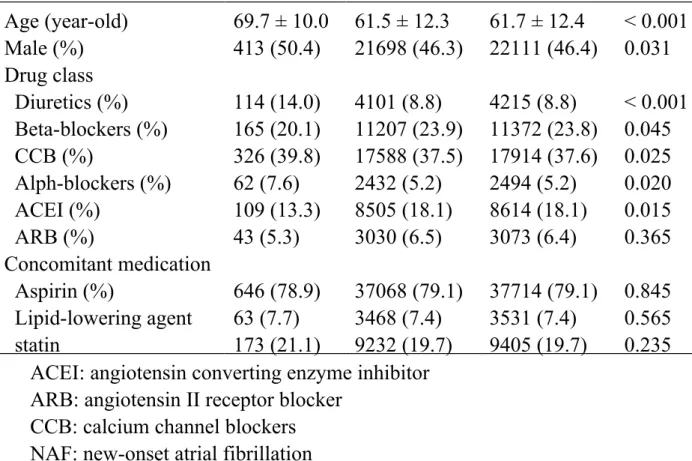
Of the 47,682 eligible samples, 819 (1.72%) patients developed new-onset atrial fibrillation. The average age for all patients was 61.7 ±12.4. There were 22,111 (46.4%) patients were male. There were 17,914 patients (37.6%) took calcium blockers. Only 2,494 (5.2%) patients took alpha blockers.
For NAF and Non-NAF group, the average age for these two groups was significantly different(69.7 ± 10.0, 61.5 ± 12.3; p< 0.001). Women comprised more than half (25,571, 53.6%) of the sample population. There was significant difference in sex between these two groups of patients (p= 0.031).
There were significant differences for NAF and Non-NAF patients taking alpha blockers (p=0.020), ACE inhibitors (p= 0.015), beta-blockers (p=0.045), calcium channel beta-blockers (p=0.025) and diuretics (p<0.001). Only angiotensin receptor blocker had no significant difference (p=0.365). Baseline concomitant medication, it showed no significant difference of patients taking aspirin, lipid-lowering agent, and statin between the groups (Table 1).
The risk estimate of NAF for users of ACE inhibitors (HR, 0.73; 95% confidence interval [CI], 0.60-0.90), and beta-blockers (HR, 0.84; 95% CI, 0.70-1.00) was lower (p < 0.05) than for non-user. Angiotensin receptor blockers (HR, 0.83; 95% CI, 0.54-1.29), and calcium channel blockers (HR, 1.15; 95% CI, 0.99-1.33) were not associated with increased risk of NAF (p > 0.05). However, alpha blockers (HR, 1.70; 95% CI, 1.19-2.49), and diuretics (HR, 1.76; 95% CI, 1.34-2.30) had the highest risk estimates of NAF (p < 0.05) [Table 2].
Cox Survival Analysis adjusted with Age and Sex
After adjustment for age, and sex, the patients who took Diuretics (HR, 1.39; 95% CI, 1.06-1.82) had higher conditional hazard ratio than patients who did not take this drug class. Alpha blockers (HR, 1.20; 95% CI, 0.83-1.73), beta-blockers (HR, 1.08; 95% CI, 0.91-1.29), angiotensin receptor blockers (HR, 0.90; 95% CI, 0.58-1.38), and calcium channel blockers (HR, 0.98; 95% CI, 0.85-1.14) were not associated with increased risk of NAF (p > 0.05). However, ACE inhibitors (HR, 0.79; 95% CI, 0.65-0.97) had the lowest risk estimates of NAF (p < 0.05) (Table 2).
The present study demonstrates that diuretics were independently associated with an increased risk of NAF in patients with hypertension without heart failure. The use of ACE inhibitors was independently associated with a decreased risk of NAF. The use of alpha-blockers, beta-blockers, calcium channel beta-blockers, and ARBs were not associated with NAF.
In this study, diuretics were found to be associated with a high risk of NAF in outpatients with hypertension. No previous studies have reported that diuretics are associated with an increased risk of NAF. Only
Heckbert et al. reported that the use of ACE inhibitors or ARBs is
associated with a decreased risk of NAF development compared with the use of diuretics [adjusted odds ratio (OR) 0.63; 95% CI 0.44–0.91].10 To
the best of our knowledge, this is the first study indicating that diuretics are associated with an increased risk of NAF.
Beta-blockers may decrease the risk of NAF via several mechanisms. They may have a positive effect on premature atrial contractions because of the decrease in sympathetically mediated effects on automaticity and conduction, thereby inhibiting renin secretion and decreasing atrial remodeling.11-13 Many studies have reported that the use of beta-blockers
is independently associated with a decreased risk of NAF.14 Differences
between our findings and those of Schaer et al.14 may be attributed to the
older age of patients in their study sample and their decision to exclude individuals with clinical risk factors from their study. However, our results are similar to those reported in a case-control study by the Group Health Cooperative in Washington, USA..10 In that study, 2,320 patients
(810 AF cases and 1,512 controls) without heart failure were treated for hypertension between 1 October 2001 and 31 December 2004. The authors found that single-drug use of beta-blockers was not significantly associated with NAF (OR 1.05; 95% CI 0.73–1.52).
The rennin–angiotensin–aldosterone system (RAAS) plays an important role in AF. Evidence shows that blocking RAAS with ACE inhibitors and ARBs plays a definite role in preventing NAF and in maintaining sinus rhythm in recurrent AF.15-18 In our study, we found that
ARBs were not associated with NAF and ACEIs were found to be associated with a low risk of NAF in outpatients with hypertension; however, this result could have been because of the relatively small sample size of patients taking ARBs (6.4%) and without underlying heart failure. Our results concerning ARBs are the same as those reported in a
case-control study by the General Practice Research Database in the UK.10 In that study which included adults aged ≥18 years with
hypertension, who were single-drug users of ACE inhibitors or ARBs, and were not at an increased risk of NAF (RR: 1.04; 95% CI: 0.93–1.17). However, our results regarding ACE inhibitors are similar to those
reported by Schaer et al., who found that the use of ACE inhibitors was associated with a decrease in the incidence of NAF (OR: 0.75; 95% CI: 0.65–0.87) compared with calcium channel blocker groups for patients with hypertension in a usual care setting.14
Some studies have reported that the use of calcium channel blockers is independently associated with an increased risk of NAF.14,19 In contrast,
Heckbert et al. reported that single-drug use of calcium channel blockers was not significantly associated with an increased risk of NAF (adjusted OR: 0.76; 95% CI: 0.45–1.29).10 Similarly, our finding that use of calcium
channel blockers was also not significantly associated with an increased risk of NAF.A potential explanation for the association between calcium channel blocker therapy and NAF is differences in the baseline
comorbidities of patients.20
in outpatients with hypertension. No studies have reported that alpha-blockers are not associated with a risk of NAF. To the best of our
knowledge, this is the first to show that alpha-blockers are not associated with a risk of NAF.
In conclusion, our findings provide some support for the hypothesis that there are differences in risk of developing NAF between different
antihypertensive drugs. Our results show that outpatients with
hypertension who take ACE inhibitors are at lower risk of developing NAF than hypertensive patients who take other classes of
antihypertensive drugs.
Study limitations
Two limitations in this study need to be emphasized. First, this was a retrospective and descriptive study in central Taiwan over a period of six years. Also, we performed analyses excluding untreated regularly
hypertensive participants, so caution must be exercised in interpreting our data.
Secondary, all cases in this study are collected from secondary dataof the claim dataset of primary care clinics under the central Bureau of
National Health Insurance in Taiwan. We performed analyses restricted to participants who reported regular follow up during the study; therefore, it is not clear how our findings can be generalized to patients among different areas.
CONFLICTS OF INTEREST
All authors report receiving lecture fees from various pharmaceutical companies in Taiwan.
ACKNOWLEDGEMENTS
This study was supported by the Taichung Armed Forces General
Hospital, and by a grant from the central region branch of the Bureau of National Health Insurance in Taiwan.
REFERENCES
1. Hennersdorf MG, Schueller PO, Strauer BE. Prevalence of paroxysmal atrial fibrillation depending on the regression of left ventricular
hypertrophy in arterial hypertension. Hypertens Res 2007; 30: 535-540. 2. Wolf PA, Abbott RD, Kannel WB. Atrial fibrillation as an independent
risk for stroke: the Framingham Study. Stroke 1991; 22: 983-988.
3. Miyasaka Y, Barnes ME, Elailey KR, et al. Mortality trends in patients diagnosed with first atrial fibrillation: a 21-year community-base study.
J Am Coll Cardiol 2007; 49: 986-992.
4. Hansson L, Lindholm LH, Niskanen L, Lanke J, Hedner T, Niklason A, et al. Effect of angiotensin-converting- enzyme inhibition compared with conventional therapy on cardiovascular morbidity and mortality in hypertension: the Captopril Prevention Project (CAPPP) randomized trial. Lancet 1999; 353: 611-616.
5. Wachtell K, Lehto M, Gerdts E, Olsen MH, Hornestam B, Dahlo¨f B, et al. Angiotensin II receptor blockade
reduces new-onset atrial fibrillation and subsequent stroke compared to atenolol: the Losartan Intervention For End Point Reduction in Hypertension (LIFE) study. J
Am Coll Cardiol 2005; 45: 712-719.
6. Healey JS, Baranchuk A, Crystal E, Morillo CA, Garfinkle M, Yusuf S, et al. Prevention of atrial fibrillation with angiotensin- converting
enzyme inhibitors and angiotensin receptor blockers: a meta-analysis.
J Am Coll Cardiol 2005; 45: 1832-1839.
7. Anand K, Mooss AN, Hee TT, Mohiuddin SM. Meta-analysis: inhibition of renin-angiotensin system prevents new-onset atrial fibrillation. Am Heart J 2006; 152: 217-222.
8. Nasr IA, Bouzamondo A, Hulot JS, Dubourg O, Le Heuzey JY, Lechat P. Prevention of atrial fibrillation onset by beta-blocker treatment in heart failure: a meta-analysis. Eur Heart J 2007; 28: 457-462.
9. Dorian P, Singh BN. Upstream therapies to prevent atrial fibrillation.
Eur Heart J 2008; 10(suppl H): H11-H31.
10. Heckbert SR, Wiggins KL, Glazer NL, Dublin S, Psaty BM, Smith NL, Longstreth Jr WT, Lumley T. Antihypertensive treatment with ACE inhibitors or beta-blockers and risk of incident atrial fibrillation in a general hypertensive population. Am J Hypertens 2009; 22: 538-544. 11. Schauerte P, Scherlag BJ, Patterson E, Scherlag MA, Matsudaria K,
Nakagawa H, et al. Focal atrial fibrillation: experimental evidence for a pathophysiologic role of the autonomic nervous system. J
Cardiovasc Electrophysiol 2001; 12: 592-599.
beta-blockers on the risk of atrial fibrillation in patients with acute myocardial infarction. Clinics (Sao Paulo) 2010; 65: 265-270.
13. Hodgkinson JA, Taylor CJ, Hobbs FDR. Predictors of incident atrial fibrillation and influence of medications: a retrospective case-control study. Br J Gen Pract 2011; e353-e361. DOI:
10.3399/bjgp11X578034.
14. Schaer BA, Schneider C, Jick SS, Conen D, Osswald S, Meier CR. Risk for incident atrial fibrillation in patients who receive
antihypertensive drugs. Ann Intern Med 2010; 152: 78-84.
15. Vermes E, Tardif JC, Bourassa MG, Racine N, Levesque S, White M,
et al. Enalapril decreases the incidence of atrial fibrillation in patients
with left ventricular dysfunction: insight from the Studies Of Left Ventricular Dysfunction (SOLVD) trials. Circulation 2003; 107: 2926-2931.
16. Maggioni AP, Latini R, Carson PE, Singh SN, Barlera S, Glazer R, et
al. Val-HeFT Investigators. Valsartan reduces the incidence of atrial
fibrillation in patients with heart failure: results from the Valsartan Heart Failure Trial (Val-HeFT). Am Heart J 2005; 149: 548-557. 17. Ducharme A, Swedberg K, Pfeffer MA, Cohen-Solal A, Granger CB,
Maggioni AP, et al. CHARM Investigators. Prevention of atrial fibrillation in patients with symptomatic chronic heart failure by candesartan in the Candesartan in Heart failure: Assessment of
Reduction in Mortality and morbidity (CHARM) program. Am Heart
J 2006; 152: 86-92.
18. Cuspidi C, Negri F, Zanchetti A. Angiotensin II receptor blockers and cardiovascular protection: Focus on left ventricular hypertrophy regression and atrial fibrillation prevention. Vasc Health Risk Manag 2008; 4: 67-73.
19. L’Allier PL, Ducharme A, Keller PF, Yu H, Guertin MC, Tardif JC. Angiotensin-converting enzyme inhibition in hypertensive patients is associated with a reduction in the occurrence of atrial fibrillation. J
Am Coll Cardiol 2004; 44: 159-164.
20. Webb AJS, Rothwell PM. Blood pressure variability and risk of new-onset atrial fibrillation: A systematic review of randomized trial of antihypertensive drugs. Stroke 2010; 41: 2091-2093.
Table 1 Baseline characteristics of all patients NAF (n= 819) Non-NAF (n= 46863) Total (n= 47682) P value
Age (year-old) 69.7 ± 10.0 61.5 ± 12.3 61.7 ± 12.4 < 0.001 Male (%) 413 (50.4) 21698 (46.3) 22111 (46.4) 0.031 Drug class Diuretics (%) 114 (14.0) 4101 (8.8) 4215 (8.8) < 0.001 Beta-blockers (%) 165 (20.1) 11207 (23.9) 11372 (23.8) 0.045 CCB (%) 326 (39.8) 17588 (37.5) 17914 (37.6) 0.025 Alph-blockers (%) 62 (7.6) 2432 (5.2) 2494 (5.2) 0.020 ACEI (%) 109 (13.3) 8505 (18.1) 8614 (18.1) 0.015 ARB (%) 43 (5.3) 3030 (6.5) 3073 (6.4) 0.365 Concomitant medication Aspirin (%) 646 (78.9) 37068 (79.1) 37714 (79.1) 0.845 Lipid-lowering agent 63 (7.7) 3468 (7.4) 3531 (7.4) 0.565 statin 173 (21.1) 9232 (19.7) 9405 (19.7) 0.235
ACEI: angiotensin converting enzyme inhibitor ARB: angiotensin II receptor blocker
CCB: calcium channel blockers NAF: new-onset atrial fibrillation
Table 2 Incidence of hazard ratios (HRs) with 95% confidence intervals (CIs) for NAF according to prescriptions for antihypertensive drugs compared with non-NAF subjects.
Value Value Diuretics 1.76 1.34-2.30 <0.001 1.39 1.06-1.82 0.018 Beta-blockers 0.84 0.70-1.00 0.045 1.08 0.91-1.29 0.392 CCBs 1.15 0.99-1.33 0.072 0.98 0.85-1.14 0.794 Alph-blockers 1.70 1.19-2.44 0.004 1.20 0.83-1.73 0.335 ACEIs 0.73 0.60-0.90 0.003 0.79 0.65-0.97 0.025 ARBs 0.83 0.54-1.29 0.407 0.90 0.58-1.38 0.621
*: adjusted for age and sex
ACEIs: angiotensin converting enzyme inhibitors ARBs: angiotensin II receptor blockers
CCBs: calcium channel blockers
Figure Legends
48,768 patients identified on January 1, 2005
908 patients excluded based on paroxysmal atrial fibrillation diagnosis between January 1, 2003 and January 1, 2005.
47,860 patients identified for detailed evaluation
178 patients excluded who were lost to follow-up or died