行政院國家科學委員會專題研究計畫 成果報告
6061 鋁合金滾軋板材在不同晶向方位及應變速率下之塑變
行為與差排次結構分析
研究成果報告(精簡版)
計 畫 類 別 : 個別型 計 畫 編 號 : NSC 100-2221-E-006-062- 執 行 期 間 : 100 年 08 月 01 日至 101 年 07 月 31 日 執 行 單 位 : 國立成功大學機械工程學系(所) 計 畫 主 持 人 : 李偉賢 計畫參與人員: 碩士班研究生-兼任助理人員:許銘家 碩士班研究生-兼任助理人員:吳宗翰 報 告 附 件 : 出席國際會議研究心得報告及發表論文 公 開 資 訊 : 本計畫可公開查詢中 華 民 國 101 年 07 月 27 日
中 文 摘 要 : 本文主要是探討 6061 鋁合金滾軋板材在不同晶向方位及應變 速率下之塑性變形行為與差排顯微結構的特性。利用壓縮式 霍普金森桿高速撞擊試驗機(Hopkinson bar)於室溫,應變速 率分別為 103s-1,3×10³s-1,5×10³s-1 之條件進行塑性變形 測試,以分析晶向方位(Crystallographic orientation)及 應變速率對 6061-T6 鋁合金之塑性特性及差排結構特徵所產 生的影響。實驗結果顯示,6061-T6 鋁合金在三個晶向方位 之塑流應力隨應變速率與應變量之增加而增加,其加工硬化 率則隨應變速率的增加而降低,而應變速率敏感性係數則隨 應變速率區間的增加而增加,但隨應變量的提升而降低;熱 活化體積則隨著應變速率區間的增加而降低,但隨著應變量 的增加而提升。此外在相同的應變速率下,垂直於板材之滾 軋方向(Transverse)有最高的塑流應力值,其次為通過板厚 方向(Through-Thickness),但是當應變速率超過 3000s-1 時,沿滾軋方向(Longitudinal)之應力值則優於通過板厚方 向(Through-Thickness)。若在相同應變速率下及應變量下, 沿滾軋方向之材料具有最高的加工硬化率。而應變速率敏感 性係數之大小,在應變速率低於 3000s-1 時,則以垂直於板 材滾軋方向居冠,但是在應變速率高於 3000s-1 時,則反由 沿著板材滾軋方向超前,相反的趨勢皆可見於熱活化體積之 上。穿透式電子顯微鏡觀測結果顯示,在三個晶向方位上, 差排的密度隨應變速率的上升而上升。而塑流應力值隨均方 根差排密度作線性的增加趨勢,證實了 Bailey-Hirsch 關係 式的存在。其 α 值在垂直於板材之滾軋方向(Transverse), 沿滾軋方向(Longitudinal),通過板厚方向(Through-Thickness),分別為 0.4,0.37 及 0.35。 中文關鍵詞: 6061 鋁合金、晶向方位、塑性變形、應變速率、差排 英 文 摘 要 : In this study, a spit-Hopkinson bar is utilized to
study the effect of crystallographic orientation and strain rate on impact deformation behavior and
dislocation substructure of a rolled 6061-T6 aluminum alloy plate at room temperature under strain rates of 103s-1, 3×10³s-1 and 5×10³s-1. Cylindrical
compression specimens are prepared from rolled plate with three different crystallographic orientations, i.e. longitudinal, transverse and through-thickness. All specimens are then solution heat treated at 565℃ for 1.5h and aged at 171℃ for 16h. It is found that for all the crystallographic orientations, the flow stress increases with increasing strain and strain
rate. However the work-hardening rate decreases with increasing strain and strain rate. Furthermore the strain rate sensitivity increases with increasing strain rate, but decreased with increasing strain. An inverse trendy exists for the activation volume. In addition, for a given strain rate, the transverse specimen has the highest flow stress, followed by the through-thickness specimen. However, as the strain rate is higher than 3000s-1, the flow stress of longitudinal specimen is superior to that of through-thickness specimen. Furthermore, at the same strain and strain rate level, the work hardening rate of the longitudinal specimen is higher than that of through-thickness specimen or transverse specimen. It is also found that the transverse specimen is more sensitive to strain rate than longitudinal when strain rate is under 3000s-1, but the longitudinal specimen will be more sensitive than transverse when strain rate is over 3000 s-1, An inverse tendency is also found for the activation volume will have contrary to the strain rate sensitivity rate trend. Transmission electron microscope(TEM) observations show that the dislocation density increases with an increasing strain rate for all three crystallographic
orientations. As the strain rate greater than 3x10³s-1, the dislocation multiplication rate for
longitudinal specimen is higher than that for through-thickness specimen. The linear correlation between the square root of the dislocation density and the true stress confirms the existence of a Bailey-Hirsch type relationship.
英文關鍵詞: 6061 aluminum alloy, crystallographic orientation, plastic deformation, strain rate, dislocation.
行政院國家科學委員會補助專題研究計畫
■成果報告
□期中進度報告
6061 鋁合金滾軋板材在不同晶向方位及
應變速率下之塑變行為與差排次結構分析
計畫類別:■個別型計畫 □整合型計畫
計畫編號:NSC 100 - 2221 - E - 006 - 062
-
執行期間:100 年 8 月 1 日 至 101 年 7 月 31 日
執行機構及系所:國立成功大學機械工程學系
計畫主持人:李偉賢 教授
共同主持人:
計畫參與人員:許銘家(碩士生)、吳宗翰(碩士生)
成果報告類型(依經費核定清單規定繳交):■精簡報告 □完整報告
本計畫除繳交成果報告外,另須繳交以下出國心得報告:
□赴國外出差或研習心得報告
□赴大陸地區出差或研習心得報告
■出席國際學術會議心得報告
□國際合作研究計畫國外研究報告
處理方式:
除列管計畫及下列情形者外,得立即公開查詢
□涉及專利或其他智慧財產權,■一年□二年後可公開查詢
中 華 民 國 101 年 7 月 26 日
6061 鋁合金滾軋板材在不同晶向方位及
應變速率下之塑變行為與差排次結構分析
The Influence of crystallographic orientation and strain
rate on the plastic deformation and dislocation substructure
of a rolled 6061 aluminum alloy plate
計畫編號: NSC 100-2221-E-006-062
執行期限: 99年8月1日至100年7月31日
主 持 人:李偉賢 成功大學機械系 教授
一、 中文摘要 本文主要是探討 6061 鋁合金滾軋板 材在不同晶向方位及應變速率下之塑性變 形行為與差排顯微結構的特性。利用壓縮 式霍普金森桿高速撞擊試驗機(Hopkinson bar)於室溫,應變速率分別為 103s-1,3× 10³s-1,5×10³ s-1之條件進行塑性變形測試, 以 分 析 晶 向 方 位 (Crystallographic orientation)及應變速率對 6061-T6 鋁合金 之塑性特性及差排結構特徵所產生的影響。 實驗結果顯示,6061-T6 鋁合金在三個晶 向方位之塑流應力隨應變速率與應變量之 增加而增加,其加工硬化率則隨應變速率 的增加而降低,而應變速率敏感性係數則 隨應變速率區間的增加而增加,但隨應變 量的提升而降低;熱活化體積則隨著應變 速率區間的增加而降低,但隨著應變量的 增加而提升。 此外在相同的應變速率下,垂直於板 材之滾軋方向(Transverse)有最高的塑流 應 力 值 , 其 次 為 通 過 板 厚 方 向 (Through-Thickness),但是當應變速率超過 3000s-1時,沿滾軋方向(Longitudinal)之應 力 值 則 優 於 通 過 板 厚 方 向 (Through-Thickness)。若在相同應變速率下 及應變量下,沿滾軋方向之材料具有最高 的加工硬化率。而應變速率敏感性係數之 大小,在應變速率低於 3000s-1時,則以垂 直於板材滾軋方向居冠,但是在應變速率 高於 3000s-1時,則反由沿著板材滾軋方向 超前,相反的趨勢皆可見於熱活化體積之 上。 穿透式電子顯微鏡觀測結果顯示,在 三個晶向方位上,差排的密度隨應變速率 的上升而上升。而塑流應力值隨均方根差 排 密 度 作 線 性 的 增 加 趨 勢 , 證 實 了 Bailey-Hirsch 關係式的存在。其α值在垂 直於板材之滾軋方向(Transverse),沿滾軋 方 向 (Longitudinal) , 通 過 板 厚 方 向 (Through-Thickness),分別為 0.4,0.37 及 0.35。 關鍵字 6061鋁合金、晶向方位、塑性變形、 應變速率、差排 英文摘要In this study, a spit-Hopkinson bar is
utilized to study the effect of
crystallographic orientation and strain rate on impact deformation behavior and dislocation substructure of a rolled 6061-T6 aluminum alloy plate at room temperature under strain rates of 103s-1, 3×10³s-1 and 5×10³s-1. Cylindrical compression specimens are prepared from rolled plate
with three different crystallographic orientations, i.e. longitudinal, transverse and through-thickness. All specimens are then solution heat treated at 565℃ for 1.5h and aged at 171℃ for 16h.
It is found that for all the
crystallographic orientations, the flow stress increases with increasing strain and strain rate. However the work-hardening rate decreases with increasing strain and strain rate. Furthermore the strain rate sensitivity increases with increasing strain rate, but decreased with increasing strain. An inverse trendy exists for the activation volume.
In addition, for a given strain rate, the transverse specimen has the highest flow stress, followed by the through-thickness specimen. However, as the strain rate is higher than 3000s-1, the flow stress of longitudinal specimen is superior to that of through-thickness specimen. Furthermore, at the same strain and strain rate level, the work hardening rate of the longitudinal
specimen is higher than that of
through-thickness specimen or transverse specimen. It is also found that the transverse specimen is more sensitive to strain rate than longitudinal when strain rate is under 3000s-1, but the longitudinal specimen will be more sensitive than transverse when strain rate is over 3000 s-1, An inverse tendency is also found for the activation volume will have contrary to the strain rate sensitivity rate trend.
Transmission electron microscope(TEM) observations show that the dislocation density increases with an increasing strain rate for all three crystallographic orientations. As the strain rate greater than
3x10³s-1, the dislocation multiplication rate for longitudinal specimen is higher than that for through-thickness specimen. The linear correlation between the square root of the dislocation density and the true stress confirms the existence of a Bailey-Hirsch type relationship. 二、 前言 6061 鋁合金是屬鋁鎂矽(Al-Mg-Si)合 金主流,具有高的比強度,良好的成形性 與可銲性,優異的抗腐蝕性能,且相較於 2xxx(Al-Cu)和 7xxx(Al-Zn)系列鋁合金, 其成本低廉,加工容易,因此已被大量應 用於汽車、航太、紡織、食品加工業工業 之結構元件[1-4],商品化的範圍可以說是 相當的廣泛。由於此合金之成型性高和機 械加工性佳,因此,可使用傳統之成型製 程(如鍛造、抽拉、滾軋、擠製等)或車銑 等加工技術來製成成品。在這些加工及成 型製程中,或結構元件於實際應用過程中, 材料與及元件常處於高的應變速率荷載, 其引發的塑變行為及共破壞的特性,常與 低應變速率下或準靜態條件下不同。而不 同的晶向方位(Crystallographic orientation) 亦會反映出不同的機械性能與差排結構。 為提高 6061 鋁合金之加工效率及使用性 能,並增加其高速荷載之應用性,有關應 變速率及晶向方向對 6061 鋁合金之機械 性能、塑變特性及差排組織的影響,須作 有系統的研究;進而結合巨觀之機械性能 與微觀結構之特性,建立足量的組構關係 式,以作為結構元件設計之依據。 從塑性變形的觀點,材料的強度常受 應變速率的影響,隨著應變速率的增加, 材料的強度亦隨之增加。先前學者發表的 文獻中顯示,無論在 BCC 結構,FCC 結 構或 HCP 結構的材料中[5],皆可發現各
種應變速率的效應[6],特別是當應變速率
大於 103
s-1以上時,強度與應變速率的相
依特性特別顯著,因此針對高速荷載的結 構設計應變速率的效應及應變速率的敏感 性(Strain rate sensitivity),須作有效的考量。 由於不同的應變速率會反映出不同的機械 性質,其對應的變形機制也會有所改變。
一般而言,當應變速率介於 102
s-1 ~ 5×
103s-1時,材料的塑性變形主要是由熱活化
機制(thermal activation mechanism)作主宰。
當應變速率高於 104 s-1時,材料的強度隨 應變速率的增加急遽上升,此時之變型則 由 差 排 黏 滯 機 制 (dislocation drag mechanism)所掌控[7]。而變形時材料的機 械性質除受應變速率的影響外,亦會隨著 晶相方位的不同有所差異。先前學者的研 究中發現,在靜態壓縮荷載下,α鈦及鈦 合金晶相方位不同時,其應變硬化的速率 亦不同[8]。而初始晶相方位之效應亦可見 於多晶 Ti-Ni 形狀記憶合金板材之麻田散 鐵再排列特性上。 事實上,材料之應力-應變特性反映出 變形時之差排顯微結構。當塑性變形開始 時,差排的增殖與密度的增加,導致加工 硬化率的上升。而塑性變形的塑性功會促 使變型溫度的增加,熱軟化速率的增加, 進而降低差排密度,特別是在高應變速率 變形下。因此,在高速變形荷載下,應力-應變的特性取決於加工硬化速率與熱軟化 速率間的競爭。而差排在晶粒及晶界中排 列與堆積,將阻礙其他差排之移動,進而 形成加工硬化的效應,因此,差排密度與 硬化行為間的相關性可藉由 Bailey-Hirsch 關係式來表示。 由於 6061 鋁合金為析出硬化型的合 金,具有非常優異的機械及物理性能,為 應用性極高的結構材料,故有關其析出硬 化行為、腐蝕特性、焊接機械性能、破壞 韌性及靜態拉伸與疲勞性質已被廣泛研究 [9-10]。然而,正如前述,6061 鋁合金再 製程加工,及元件之使用過程中常承受高 應變速率之荷載,其強度及差排亦受晶向 方位之影響,而有關應變速率及晶向方位 之效應則未被詳細探討。因此,本研究利 用哈普金森高速撞擊試驗機測試三種不同 晶向方位之 6061 鋁合金分別於應變速率 103s-1,3×10³ s-1,5×10³ s-1下之塑性變形特 性,再藉由穿透式電子顯微鏡分析其差排 密度及差排環結構,以解析應變速率及晶 向方位之效應,並結合機械性質與差排環 結構之特性,供結構元件設計用。 三、 實驗方法及步驟 本實驗將 6061-T6 鋁合金棒材以 CNC 線切割機和平面研磨的方式,分別取三個 晶 向 方 位 的 試 件 加 工 成 直 徑 與 高 度 為 8±0.01mm 之圓柱形試片以進行試驗。本 實驗所採用之 6061-T6 鋁合金之化學成分 如表一所示。 表一 6061-T6 鋁合金之化學成分表 Element Si Fe Cu Mn wt. % 0.4-0.8 ≦0.7 0.15-0.40 ≦0.15 Mg Cr Zn Ti Al 0.8-1.2 0.04-0.35 ≦0.25 ≦0.15 Balance 3.1 動態撞擊實驗 本研究利用哈普金森高速撞擊試驗機 測試三種不同晶向方位之 6061-T6 鋁合金 分別於應變速率 103 s-1,3×10³s-1,5×10³s-1 下,施以高速撞擊之變形,經由一維波傳 理論,可計算出該材料之應力應變曲線, 進行各種機械性質分析。
3.2 OM 金相觀察 將母材和各實驗條件下之高速撞擊變 形後試件,經過冷鑲埋後,進行研磨拋光, 使用 Keller’s 腐蝕液在室溫下腐蝕,最後 利用 Axiovert200 MAT 倒立式光學顯微鏡 觀察其金相組織與剪切帶形貌並拍照記錄 之。 3.3 TEM 試片製備 將試件切片並研磨至厚度約 100μm, 再以小型衝頭衝出直徑約 3mm 之圓形薄 試片,之後利用雙噴射式電解拋光機,以 C2H5OH 和 HNO3以 2:1 的比例在-15℃下 進行電解拋光,拋光後試片加以清洗烘乾 便能進行 TEM 之觀察。 四、 實驗結果與討論 4.1 應力-應變曲線 圖一為 6061-T6 鋁合金在各實驗條件 下所得之應力應變曲線,我們可發現全部 之應力應變曲線初步皆有明顯上升趨勢, 故可推斷 6061-T6 鋁合金具有加工硬化之 特性。另外,隨著應變量之增加,全部之 應力應變曲線其上升幅度逐步趨緩,故可 研判 6061-T6 鋁合金在動態撞擊變形時, 除了有前述之加工硬化現象外,尚有熱軟 化現象出現與之抗衡。 此外,若固定應變速率條件時,無論 在任何應變速率下,垂直於板材滾軋方向 (Transverse)的試件都擁有最高的應力值, 通過板厚(Through-Thickness)的試件在應 變速率在 3000s-1 之前都比沿板材滾軋方 向(Longitudinal)的試件要來得高。然而在 應變速率達到 3000s-1後,Longitudinal 晶 向 方 位 試 件 的 應 力 值 會 超 越 Through-Thickness 晶向方位的試件 圖一(a) 在不同晶向方位之應力應變曲線圖
圖一(b) 在不同應變速率下, 三晶位方向之應力應變 曲線比較 4.2 應變速率敏感性係數 欲了解應變速率與應力值之關係,我 們引入描述應變速率效應之橋樑-應變速 率敏感性係數β[11]: 2 1 2 1 ln( ) (1) 2 和1即是在相同應變量下,2和1 條件下所得之應力值。故材料之 值愈大 時,其應力值對於應變速率效應更加敏感, 即在相同應變速率區間範圍時,其應力值 有較大之增減。本實驗之 值之趨勢則如 圖二所示。可以發現在任一晶向方向上之 曲線,應變速率區間為 3000s-1到 5000s-1 之應變速率敏感性係數,較 1000s-1 到 3000s-1區間者要大,尤以 Longitudinal 晶 向方位的試件之值差距最多,其原因是差 排 密 度 快 速 增 加 的 關 係 , Through-Thickness 晶向方位的試件在兩個 應變速率區間差距最少。 4.3 熱活化體積 我們現在分析差排滑移難易程度對於 應力之影響,故引入熱活化體積: * 2 1 2 1 ln( ) kT v kT (2) 上式之v*即為熱活化體積,k 為波茲 曼常數(Boltzmann Constant),T 則是取絕 對溫度,β 則是應變速率敏感性係數。熱 活化體積愈大時,表示差排滑移較容易, 所表現出來的巨觀機械性質即為應力值較 低、加工硬化效果較小[12]。由圖三可知 大部分的實驗條件下,無因次化的熱活化 體積都在 10 以下,但是 Through-Thickness 晶向方位的試件,在低應變速率區間時, 其無因次化後的熱活化體積隨著應變量的 增加而顯著提升,這即表示此時材料呈現 以刃差排與螺旋差排滑移帶混和主導材料 變形的 情形 。從 應力 -應 變曲 線來看,
Through-Thickness 晶向方位的試件在低應 變速率時,應力值成長幅度較低,此結果 與熱活化體積觀點一致。 圖二 應變速率敏感性係數與應變量及應變速率區 間之關係 圖三 熱活化體積與應變量及應變速率區間之關係 4.4 構成方程式 由於 6061-T6 鋁合金應用範圍非常廣 泛,一定會有本實驗設定條件以外的情況 發生,在此便需要可描述材料高速變形行 為之模式,故我們會引用一材料構成方程 式,來完整地描述其塑流應力值之變化情 形,以提供在工程或模擬分析上之應用。 圖四 各晶向方位條件下之實驗值與理論值比較
我們使用 Zerilli-Armstrong 結構方程 式來探討,其方程式如下所示[13]: 2 exp[ 3 4ln( )] n a C C T C (3) 上述之a、C2、C3、C4皆為材料參數, T 以絕對溫度表示。Zerilli-Armstrong 模式 包含有應力、應變、溫度以及應變速率, 很符合我們所設之參數,故相當適用於本 實驗之模擬。 將各實驗條件所得之結果套入此方程 式進行模擬,並藉由 Sigma-Plot 軟體之最 小平方法之計算結果,計算出材料參數後, 再將理論值與實驗值進行比較,C2分別為 309MPa(Transverse)、240MPa (Longitudin al)、207MPa(Through-Thickness),C3分別 為 0.0297K-1 (Transverse)、0.0318 K-1(Lon gitudinal)、0.085K-1(Through-Thickness), C4分別為 0.028K-1(Transverse)、0.074 K-1 (Longitudinal)、0.046K-1(Through-Thicknes s),n 分別為 0.14(Transverse)、0.11(Longi tudinal)、0.0817(Through-Thickness),實驗 值與理論值之應力應變曲線則如圖四所示, 可以發現誤差皆在 2%以內,因此可知 Zer illi-Armstrong 方程式有良好之準確性。對 於 6061-T6 鋁合金之高速撞擊變形模擬有 相當好之成效,可有效助於工程或模擬分 析上之應用。 4.5 OM 金相組織觀察 Transverse 與 Longitudinal 晶向方位材 料的晶體以層狀排列為主,黑色部分為析 出物,成分為 Mg2Si,其中 Longitudinal 晶向方位的析出物又比 Transverse 晶向方 位的析出物密度高,Through-Thickness 晶 向方位的晶體都是以完整晶粒為主,析出 物均勻散佈在基材之中,這些析出物說明 材料經過 T6 處理後擁有析出強化的效果。 把三個晶向方位的金相圖組成圖五,可以 清楚展現各晶向方位的晶體排列特色。 由圖六可以觀察到,當應變速率逐漸 提高時,Transverse 晶向方位(圖六(a))與 Longitudinal 晶向方位(圖六(b))的試件晶 粒會沿著材料製造時的滾軋方向進行延展, 析出物密度亦會提高,Through-Thickness 晶向方位(圖六(c))的試件晶粒表面積則會 變大。另一方面,在巨觀機械性質的觀察 時,我們發現 Longitudinal 晶向方位的試 件在應變速率 3000s-1與 5000s-1時其應力 值會超越 Through-Thickness 晶向方位的 試件,比較這兩個晶向方位的金相圖可以 發 現 Longitudinal 晶 向 方 位 的 試 件 在 3000s-1與 5000s-1時,其晶粒扭曲的情況要 比 Through-Thickness 晶向方位的試件明 顯得多,意即材料在高速變形時會進行晶 體扭曲,而非單純的抵抗析出強化,這說 明了 Longitudinal 晶向方位的試件在高應 變 速 率 時 應 力 快 速 提 升 的 原 因 。 而 Transverse 晶向方位的材料試件晶體細緻, 排列整齊,當材料受到高速撞擊進行變形 行為時,單位面積的變形量所需要移動的 晶界(Grain boundary)比起其他兩個晶向方 位材料要多,又在相同應變速率下析出物 密度亦為三個晶向方位裡面最高。故其應 力值在任何應變速率條件下皆為最高。 圖五 6061-T6鋁合金母材金相立體圖
Transverse, 母材 Transverse, 1000s-1 Transverse, 5000 s-1 圖六(a) 在 Transverse 晶向方向上各條件之 OM 金相圖 Longitudinal, 母材 Longitudinal, 1000s-1 Longitudinal, 5000 s-1 圖六(b) 在 Longitudinal 晶向方向上各條件之 OM 金相圖
Through-Thickness, 母材 Through-Thickness, 1000s-1 Through-Thickness, 5000 s-1 圖六(a) 在 Through-Thickness 方向上各條件之 OM 金相圖 4.6 TEM 分析 材料在變形過程中,主要是藉由差排 移動來達到塑性變形,而差排滑移之難易 程度會強烈影響到材料之塑流應力值。為 了解材料內部微觀組織和機械性質的關聯 性,可利用穿透式電子顯微鏡(TEM)進行 觀察,分析其微觀結構特徵。圖七為各個 不同條件下之差排結構特徵,可以觀察到 三個晶向方位的試件析出物與微量差排都 沿著材料特定方向排列,在基底可以觀察 到微量的差排與析出物平均散佈之中,其 中 Through-Thickness 晶向方位的試件其 析出物呈現圓棒狀,而 Transverse 晶向方 位與 Longitudinal 晶向方位的試件則偏向 條狀排列。差排遇到晶界或者析出物,排 列皆會產生變化,。Longitudinal 晶向方位 與 Through-Thickness 晶向方位的試件生 成許多差排環結構,甚至可以發現析出物 被差排環包圍之情形,顯示析出物會影響 差排移動的特性,可以說明本材料有析出 強化機制,觀察 Transverse 晶向方位的試 件則可以發現其微觀結構仍表現出層狀分 布特質,隨著應變速率的提升差排密度提 高,基底上的析出物遇到差排時即停滯, 成為阻擋差排移動的障礙物,藉以提升強 度。 對照巨觀機械性質之曲線探討差排密 度變化趨勢,我們可以發現應變速率越高 時,其應力值相對較大,差排密度也隨之 增加,此與 TEM 觀察特徵相符。另外 Longitudinal 晶向方位的試件在應變速率 1000s-1 以前僅呈現出不規則差排環特徵, 但是當應變速率達到 5000s-1時,差排密度 迅速提升,差排環與析出物互動情形遠比 Through-Thickness 晶向方位的試件嚴重, 差排環增生在析出物附近,甚至包住析出
物,此現象也再一次說明 Longitudinal 晶 向方位的試件在較高的應變速率時其應力 值會超越 Through-Thickness 晶向方位的 試件之性質。另外可以發現析出物與差排 大量堆積在晶界,說明晶界可以有效阻擋 差排移動。經過撞擊變形後之試件,其差 排密度比起母材增加許多,6061-T6 鋁合 金經過劇烈塑性變形後,內部會增生大量 差排。 為了瞭解差排密度與塑流應力間之相 關性,可以藉由 Bailey-Hirsch Type 關係式 來描述,即: 0 1
Gb
(4) 此處ρ為差排密度,G 是 6061-T6 鋁 合金之剪切模數(Shear modulus),b 為布格 向量(Burger’s vector), 0 為靜態降伏應 力(Yield Stress),其α1為常數。一般而言 Bailey-Hirsch Type 關係式常被用來表示材 料在變形時之強化行為,將各實驗條件代 入式(4)後,可以得到α1,其值分別為 0.4(Transverse) 、 0.37(Longitudinal) 、 0.35(Through-Thickness)。若比較先前學者 計算出潛變下的 值約 0.31[14],這是由於 在高的應變速率下,差排密度快速提升, 三晶位方向的α1值皆高於潛變下之值。由 圖七可以看出差排密度隨著塑流應力增加 而上升。 從圖八中可知道差排密度隨著應變速 率增加而上升,這是因為在撞擊的同時, 自由滑動之差排與鄰近之差排環互相作用 箝制,導致差排滑移愈來愈困難,但是材 料之差排隨著撞擊的推展而不斷的生成, 因此其差排密度便隨著塑流應力值的增加 而上升。 Transverse, 母材 Transverse, 1000s-1 Transverse, 5000 s-1Longitudinal, 母材 Longitudinal, 1000s-1 Longitudinal, 5000 s-1 圖七(b) 在 Longitudinal 晶向方向上各條件之 TEM 金相圖 Longitudinal, 母材 Longitudinal, 1000s-1 Longitudinal, 5000 s-1 圖七(c) 在 Through-Thickness 晶向方向上各條件之 TEM 金相圖
圖八 塑流應力與差排密度關係圖 五、 結論 (1) 6061-T6 鋁 合 金 三個晶 向 方 位的 試 件,其塑流應力值會隨著應變速率及應變 速率的提升而增加。當應變速率提高時, 其塑流應力值亦相對較高;若比較三個晶 向方位的實驗結果,可以發現在相同的應 變速率下,Transverse 晶向方位的試件都 具有最高的塑流應力值。而 Longitudinal 晶向方位的試件在應變速率超過 3000s-1 之後,會超越 Through-Thickness 晶向方位 的試件的塑流應力值。 (2) 6061-T6 鋁合金三個晶向方位的試件 加工硬化率會隨著應變速率增加而減少, 這是因為材料內部溫度提高會產生熱軟化 之現象逐漸與加工硬化效益取得平衡的結 果。固定應變速率條件下,則可以發現 Longitudinal 晶向方位的試件具有最高的 加工硬化率, Transverse 晶向方位試件其 加工硬化率則最低。增加應變速率無法明 顯增加 Transverse 晶向方位試件的塑流應 力,但是 Longitudinal 晶向方位的試件則 會快速增加其塑流應力。 (3) 6061-T6 鋁合金之應變速率敏感性係 數會隨著應變速率的增加而些微下降,應 變 速 率 區 間 較 大 者 其 值 較 高 , 且 Longitudinal 晶向方位的試件擁有最高的 應變速率敏感性係數,顯見顯示材料在高 應變速率環境下與 Longitudinal 晶向方位 的試件強化效果較佳。因此工業界若需要 擁有容易加工成型,且成形後需擁有高強 度的應用元件,可以優先採用 Longitudinal 晶向方位的材料。 (4) 熱活化體積用來表示材料內部差排滑 移之難易程度,在高應變速率區間時,三 個晶向方位的試件其熱活化體積差別不大, 但 是 在 低 應 變 速 率 區 間 時 , Through-Thickness 晶向方位的試件具有極 高的熱活化體積,說明在低應變速率區間 條件下,Through-Thickness 晶向方位的試 件差排滑移容易發生,材料應力值偏低。 (5) 6061-T6 鋁合金在三種晶向方位,在 相同的應變速率下,理論溫升量皆隨著應 變速率與應變量的增加而變大。在相同應 變速率條件下,Transverse 晶向方位的試 件 具 有 最 高 的 理 論 溫 升 量 。 但 比 較 Longitudinal 晶 向 方 位 與 Through-Thickness 的試件可以發現在應變 速率 3000s-1之後,Longitudinal 晶向方位 試 件 的 理 論 溫 升 量 會 超 越 Through-Thickness 晶向方位的試件,這是 因 為 高 應 變 速 率 及 高 應 變 量 情 況 下 , Longitudinal 晶向方位的試件擁有相對較 高之應力值,因此塑性功轉換為熱能的量 也較多。 (6) 可藉由 Zerilli-Armstrong 構成方程式 來描述 6061-T6 鋁合金在不同應變速率及 晶向方位條件之動態塑變行為,其誤差值 皆在 2%以內。
(7) 利用光學顯微鏡觀察,三個晶向方位 的母材晶體排列各有不同特色:Transverse 與 Longitudinal 晶向方位材料的晶體以層 狀排列為主, Through-Thickness 晶向方 位的晶體都是以完整晶粒為主,析出物為 Mg2Si 且均勻散佈在基材之中,且析出物 密度會逐步提高,與材料塑流應力值成正 相關。另外,Transvers 晶向方位的試件晶 體細緻,單位面積的變形量所需要移動的 晶界比起其他兩個晶向方位的材料為多, 故其應力值表現在任何荷載條件下皆為最 高。 (8) 利用 TEM 進行顯微組織的觀察,可 以發現隨著應變速率的提升,差排密度與 差排環增生迅速。應變速率從 3000s-1 到 5000s-1 之間時,Longitudinal 晶向方位的 試件差排密度迅速提升,差排環增生在析 出物附近,甚至糾結於析出物周圍,其與 析出物互動情形遠比 Through-Thickness 晶向方位的試件劇烈,此現象也再一次說 明 Longitudinal 晶向方位的試件在較高的 應 變 速 率 時 其 應 力 值 會 超 越 Through-Thickness 晶向方位的試件之巨觀 機械性質,差排快速的增生導致塑流應力 的增加。 六、 參考文獻
1. E. Starke and A. Csontos, "Aluminum
Alloys–Their Physical and Mechanical Properties (ICAA-6)". 1998, The Japan
Institute of Light Metals, Tokyo.
2. J. T. Staley and D. J. Lege, "Advances in
aluminium alloy products for structural applications in transportation". Le
Journal de Physique IV, 1993. 3(C7): p. 7-7.
3. A. Morita, "Aluminum Alloys–Their
Physical and Mechanical Properties (ICAA-6)". 1998, The Japan Institute of
Light Metals, Tokyo.
4. N. P. Wasekar, N. Ravi, P. Suresh Babu, L. Rama Krishna and G. Sundararajan, "High-Cycle Fatigue Behavior of Microarc Oxidation Coatings Deposited on a 6061-T6 Al Alloy". Metallurgical
and Materials Transactions A, 2010. 41(1): p. 255-265.
5. W. S. Lee and T. H. Chen,
"Rate-dependent deformation and dislocation substructure of Al–Sc alloy".
Scripta materialia, 2006. 54(8): p. 1463-1468.
6. Q. Li, Y. B. Xu and M. N. Bassim, "Dynamic mechanical behavior of pure
titanium". Journal of Materials Processing Technology, 2004. 155– 156(0): p. 1889-1892.
7. G. Regazzoni, U. F. Kocks and P. S. Follansbee, "Dislocation kinetics at
high strain rates". Acta metallurgica,
1987. 35(12): p. 2865-2875.
8. A. Salem, "The Influence of Initial
Texture and Deformation Temperature on the Strain Hardening Response of Alpha-Titanium". 2004.
9. S. C. Bergsma, M. E. Kassner, X. Li and M. A. Wall, "Strengthening in the
new aluminum alloy AA 6069".
Materials Science and Engineering: A, 1998. 254(1): p. 112-118.
10. 23. R. Braun, "Effect of thermal
exposure on the microstructure, tensile properties and the corrosion behaviour of 6061 aluminium alloy sheet".
Materials and Corrosion, 2005. 56(3): p. 159-165.
11. J. D. Campbell and W. G. Ferguson, "The temperature and strain-rate
dependence of the shear strength of mild steel". Philosophical Magazine, 1970.
21(169): p. 63-82.
12. H. Conrad, "Thermally activated deformation of metals". JOM, 1964.
16(7): p. 582-588.
13. L. W. Meyer, N. Herzig, T. Halle, F.
Hahn, L. Krueger and K. P.
Staudhammer, "A basic approach for strain rate dependent energy conversion including heat transfer effects: An experimental and numerical study".
Journal of Materials Processing
Technology, 2007. 182(1): p. 319-326.
14. J. E. Bailey and P. B. Hirsch, "The dislocation distribution, flow stress, and
stored energy in cold-worked
polycrystalline silver". Philosophical Magazine, 1960. 5(53): p. 485-497.
七、 誌謝
感謝國科會(NSC 100-2221-E-006-062) 與實驗室的支援,使本文得以順利完成, 特此致上感謝之意。
1
國科會補助專題研究計畫項下出席國際學術會議心得報告
日期:101 年 6 月 25 日一、參加會議經過
二、與會心得
三、考察參觀活動(無是項活動者略)
四、建議
五、攜回資料名稱及內容
六、其他
計畫編號
NSC 100 - 2221 - E - 006 - 062 -
計畫名稱
6061 鋁合金滾軋板材在不同晶向方位及應變速率下之塑變行為與差排次結構分析出國人員
姓名
李偉賢
服務機構
及職稱
國立成功大學機械系 特聘教授會議時間
2012 年 6 月 20 日至2011 年 6 月 22 日會議地點
西班牙, Torremolinos
會議名稱
(中文) 2012 年能源及材料研究國際學術會議 (EMR 2012)
(英文) The Energy and Materials Research Conference (EMR 2012)
發表論文
題目
(中文) Ti-6Al-4V 合金在低溫下的撞擊性能與差排結構分析
(英文) Impact properties and dislocation evolution of Ti-6Al-4V alloy at
cryogenic temperatures
2
出席 2012 年能源及材料研究國際學術會議報告
國立成功大學機械工程學系 李偉賢教授
一、參加會議經過 2012 年能源及材料研究國際學術會議係由西班牙 FORMATEX 研究中心所主辦之 大型國際研討會。本次國際會議於 101 年 6 月 20 日~22 日在西班牙 Torremolinos 市之 國際會議中心舉行,主要是針對能源及材料在各項能源製造系統、分佈與轉換、及儲 存技術提出發表,並藉以提升國際能源相關領域之科技及學術水準,為目前世界上有 關新能源技術及永續能源新材料領域中最重要之國際會議之一。 此次會議之論文發表分成口頭報告及壁報方式,會議論文之主題共計十四項,涵 括不同之實驗與理論數值模擬之結果,即(1) Energy production; (2) Nuclear energy and materials; (3) Energy production from fossil fuels; (4) solar energy; (5) Hydrogen; (6) Energy harvesting materials; (7) Wave, tidal and hydropower; (8) Fuel cells; (9) Energy transmission, distribution and storage; (10) Energy saving and sustainability; (11) Energy-efficient buildings; (12) Advances in lighting materials; (13) Wind power; (14) Other topics; 這十四個主題在三天的議程中依序分別進行,而壁報發表則安插在口頭 報告時段之間,整個會議安排相當緊湊充實。大會於 6 月 20 日 11 點舉行開幕典禮,首先由大會主席 Prof. Antonio Mendez-Vilas 致歡迎辭後,隨即進行各議題之論文發表與討論,並由各領域之國際知名學者作引言 及評述。會中筆者所提之論文「Ti-6Al-4V 合金在低溫下的撞擊性能與差排結構分析」 (Impact properties and dislocation evolution of Ti-6Al-4V alloy at cryogenic temperatures) 被安排在 6 月 22 日下午 5 點 15 分至 6 點 30 分之時段發表,主要是探討 Ti-6Al-4V 合 金之撞擊特性與差排結構受低溫溫度影響之效應。其結果對核能潛艇及核能導彈設計 有重要參考價值,因此頗受注意,並有多位學者於會後繼續討論並交換相關資訊。筆 者亦被邀請在 6 月 22 日擔任Energy-efficient Buildings/Advances in Lighting Materials/Other
topics (2nd part)場次議程的主持人。 二、與會心得 本次會議中,每篇文章皆有 15 分鐘的發表時間及交流,與會者面對面溝通,氣氛 相當熱絡。在筆者發表期間,相繼有各國之學者與筆者討論 Ti-6Al-4V 合金之最新發 展與應用,及目前台灣在高速撞擊力學方面之研究現況。從交流中發現,筆者之研究 成果在國際上已有相當之知名度,並從交流中亦獲得不少新的能源研究與材料開發概 念,收穫頗多。
3 本次會議中,有許多論文提到省能源之綠色建築設計,並列舉許多節能數據作為 設計評估之參考。其分析分別經由數值模擬及實際驗證,可信度相當高。這些綠色建 材料皆屬高價值具輕能特性之結構設計材料,對於新型綠建築設計之改良及提升提供 相當好之應用概念。同時對於高性能新能源材料之開發與製造亦有參考價值。 在最佳能源策略與方案之應用議題上,有許多學者專家提出不同的分析方法,包 括不同的混沌理論及 VIKOR 方法論,並提出其預測及估算的準確度,這些分析方法 在實際能源系統之設計上提供了非常大的幫助。然而從發表的內容來看,其分析及計 算的步驟相當繁復,所需驗算時間亦長,因此如何從現有的基礎理論,發展出更具適 用性及精確性之分析方法,以快速決定出最佳的能源策略與方案,則是未來應積極努 力的目標。 在新型能源製造與傳輸之分析與模擬中,目前仍有部分不易執行實驗之驗證,在 議題發表之論文中,雖有部分研究提供了實驗數據的佐證,但大多數的佐證還相當的 薄弱且說服力明顯不足。因此,如何建立與數值分析模擬契合之實驗設置與方法,應 是值得思考的議題,及進一步研究開發的新領域。 在所發表之論文中,有許多屬非常重要且是創新構想之應用性論文,如於寒帶地 區,應用奈米科技及材料,以防止建築物內熱量自然耗損之研究及設計,及如何在不 同的都會區中,比較耗能之原因並提供不同的節能措施與方案等。這些主題所探討之 方向令人印象深刻,亦深感新能源的開發與研究已大量應用在新型綠能民生建築之研 發設計上。這些論文對個人未來在新能源材料之開發及設計研究上,提供許多新的概 念及實驗方面之構思。 由參與此一國際會議,筆者亦意識到節能及新型替代能源的開發,對未來民生生 活效能及建築設計上日益重要且應用日廣。隨著能源使用目的的多樣性,其製程與系 統相關參數之效應,及對應之分析方式也越趨複雜,這些都是新能源領域之研究者可 大展身手之處。國內學術單位應提升這方面的能量,並進一步應用到替代能源的開發 與設計上。 三、建議 在大會發表之論文中,有相當比例是由政府機構或企業與各大學合作的成果;而 國內在能源開發與新型能源技術領域中,雖然政府已提出大型整合研究計劃,然能源 種類繁多,宜集中力量建立適合台灣環境所需之能源策略,及尋求新的替代能源方案, 讓新型能源之研究領域在國內更加發展茁壯,並與實際之民生需求相結合。 學者參與國際學術會議對提升台灣國際學術能見度,及推展台灣之國際形象,有 非常大的助益。然由於機票及相關註冊費已大幅提高,政府在相關經費的補助上應適 度的增加,否則會降低學者參與國際學術活動的意願,妨害國內的學術發展。
4 四、攜回資料名稱及內容 1. 大會論文摘要集一本 2. 會議議程一份 3. 太陽能雜誌一本 4. 國際會議簡介資料 5. Torremolinos 市簡介資料
6
Impact properties and dislocation evolution of Ti-6Al-4V alloy at
cryogenic temperatures
W. S. Lee*1 and T. H. Chen2
1 Department of Mechanical Engineering, National Cheng Kung University, 1 University Road, Tainan 701, Taiwan 2 Department of Mechanical Engineering, National Kaohsiung University of Applied Sciences, 415 Chien Kung Road,
Kaohsiung 807, Taiwan
*Corresponding author: e-mail: [email protected], Phone: +886 6 2757575 ext. 62174
The aim of this study is to investigate impact response and dislocation substructure of Ti-6Al-4V alloy using a compressive split-Hopkinson pressure bar and transmission electron microscopy technique. Cylindrical specimens are deformed at strain rates ranging from 8×10² s-1 to 4.0×10³ s-1 and temperatures of 0℃ and -200℃, respectively. It is shown that the impact properties of Ti-6Al-4V alloy depend strongly on strain rate and temperature. For a constant temperature, the flow stress and strain rate sensitivity increase with increasing strain rate, while the activation volume decreases. Meanwhile, for a constant strain rate, the activation volume increases with increasing temperature, while the flow stress and strain rate sensitivity decrease. Transmission electron microscopy (TEM) observations show that the dislocation density increases with an increasing strain rate, but decreases with an increasing temperature. By contrast, the dislocation cell size decreases with increasing strain rate, but increases with increasing temperature. The mechanical properties of the impacted specimens are related to the microstructural evolution. The strengthening effect in deformed Ti–6Al–4V alloy is a result primarily of dislocation multiplication.
Keywords Ti-6Al-4V alloy; strain rate; cryogenic temperature; dislocation
1. Introduction
Ti-6Al-4V alloy has attracted considerable interest recently because of its high specific strength, extensive ductility and good corrosion resistance [1,2]. These properties render Ti-6Al-4V an ideal candidate for a wide variety of components in the aerospace, defense and bio-medical industries. For the structural applications, the Ti-6Al-4V components are subject not only to dynamic impact loading, but also to cryogenic temperatures. To ensure the mechanical integrity of such components, it is essential to develop a thorough understanding of the effects of high strain rate and cryogenic temperature on the deformation response and dislocation substructure evolution.
It is recognized that the deformation behavior of materials vary with the strain rate and temperature [3,4]. For example, the impact flow stress of 304L stainless steel increases with an increasing strain rate. Furthermore, a notable increase in the strain rate sensitivity occurs at strain rates greater than a critical value of approximately 103 s-1. When predicting the deformation response of engineering materials, this marked increase in the strain rate sensitivity must be taken into account. In addition, most metals and alloys experience a significant increase in flow stress and a dramatic reduction in ductility as the temperature is reduced to the cryogenic range. This effect is even more pronounced when the component is loaded under high strain rate conditions.
Although the high-temperature deformation behaviour of Ti-6Al-4V alloy has been extensively examined over a wide range of strain rates [5,6], the effects of strain rate on the impact response and dislocation substructure evolution of Ti-6Al-4V alloy in the cryogenic temperature range are less clear. Therefore, this study utilises a compressive
7
split-Hopkinson pressure bar (SHPB) and transmission electron microscopy technique to examine the impact deformation behaviour and microstructural evolution of Ti-6Al-4V alloy under strain rates ranging from 8 ×10² s-1 to 4.0 ×10³ s-1 and temperatures of 0℃ and -200℃, respectively.
2. Material and Experimental Procedure
The material used in this study was Ti-6Al-4V alloy. This alloy was purchased from B&S Aircraft Alloys, USA in the form of a hot-rolled bar with a length of 200 mm and a diameter of 27 mm. The chemical composition of the Ti-6Al-4V alloy was as follows: 6.1%Al, 4.0%V, 0.21%Fe, 0.1%C, 0.03%N, 0.012%H, 0.15%O, and a balance of Ti. The bar was annealed at 750 for 2h and then air-cooled in order to reduce the residual stress and ensure a uniform microstructure. Specimens with a length of 5.1 mm and a diameter of 5.1 mm were then machined from the bar and finished to a final diameter of 5±0.1 mm using a centre-grinding process. Dynamic impact tests were then carried out using a compressive SHPB at strain rates of 8 ×10² s-1, 2.0×10³ s-1 and 4.0×10³ s-1 and temperatures of 0℃ and -200℃. The low testing temperatures of 0℃ and –200℃ were obtained by fitting a refrigeration system around the specimen. Liquid nitrogen and alcohol were added to the refrigeration system at the beginning of the experimental tests and were periodically replenished in order to maintain a constant fluid level. The full details of the experimental procedure and analytical technique used to evaluate the dynamic mechanical response of the impacted specimens are presented in [7], and are therefore omitted here. Following the impact tests, TEM samples were then prepared by cutting foils with a thickness of 350 from the Ti-6Al-4V specimens using a low speed cutting machine. Discs with a diameter of 3 mm were then punched from each foil and polished using a twin-jet electro-polishing machine in a solution of 95% ethyl alcohol and 5% perchloric acid at a temperature of 25℃ using an agitation voltage of 20 V. The microstructural characteristics of the various specimens were examined using a JEOL TEM-3010 transmission electron microscope with an accelerating voltage of 200 kV.
3. Results and Discussion
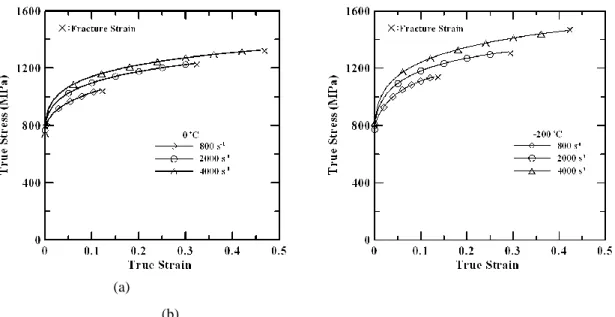
3.1 True stress-strain response
The true stress-strain curves of Ti-6Al-4V alloy deformed at 0℃ and -200℃ under three different strain rates are presented in Figures 1(a) and 1(b), respectively. It can be seen that the flow stress depends on both the temperature and the strain rate. For a given temperature, the flow stress increases gradually with increasing strain rate, while for a constant strain rate, the flow stress increases rapidly with decreasing temperature. This result suggests that a lower deformation temperature increases the density and multiplication rate of the dislocations within the Ti-6Al-4V microstructure, and prompts a corresponding improvement in the resistance of the alloy to plastic flow. The results presented in Figs. 1(a) and 1(b) also show that the strain rate governs not only the flow stress, but also the facture strain. Specifically, for a given temperature, the fracture strain increases with an increasing strain rate. However, for a constant strain rate, the fracture strain reduces with a reducing temperature.
8
(a) (b)
Fig. 1 True stress-strain curves of Ti-6Al-4V alloy deformed at strain rates of 1.0×10³ s-1, 3.0×10³ s-1 and 4.3×10³ s-1 and
temperatures of (a) 0℃ and (b) -200℃, respectively.
The stress-strain relations presented in Fig. 1 clearly show that the flow stress of Ti-6Al-4V alloy is significantly dependent on the strain rate. The strain rate sensitivity (β) of the Ti-6Al-4V alloy can be derived from the experimental results presented in Figs. 1(a) and 1(b) in accordance with the formulation
2 1 2 1 ( / ln ) ln( / ) (1)
where the flow stresses2 and 1 relate to impact tests conducted at average strain rates of 2 and 1, respectively, and are calculated at the same value of plastic strain. The corresponding results are summarized in Table 1. It can be seen that the strain rate sensitivity increases with an increasing strain and strain rate, but decreases with an increasing temperature. It is observed that the strain rate sensitivity increases particularly rapidly at low temperatures (i.e. -200℃) and higher strain rates (i.e. 2×10³~ 4.0×10³).
Table 1 Values of strain rate sensitivity of Ti-6Al-4V alloy deformed at different strain rates and temperatures.
T (℃) Strain rate (s-1)
Strain rate sensitivity β (MPa)
=0.05 =0.1 =0.2 =0.3 0 800~2000 44.6 48.5 107.3 115.4 2000~4000 92.0 99.6 --- --- -200 800~2000 49.5 57.6 148.0 --- 2000~4000 108.5 119.6 --- ---
9 3.2 Dislocation substructure observations
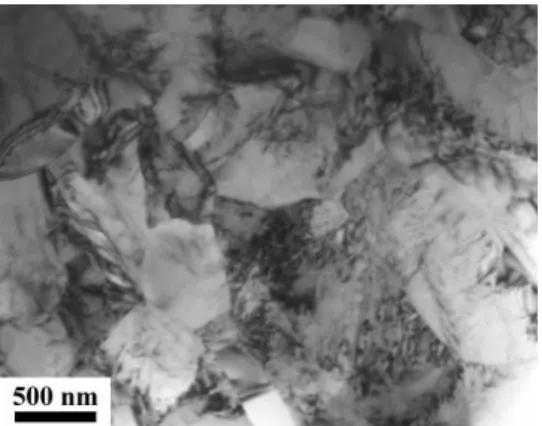
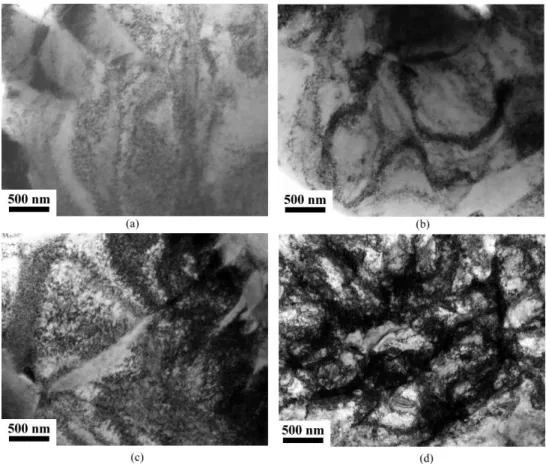
It is well known that the deformation response of a material is related to its microstructure state. In order to investigate the effects of strain rate and temperature on the dislocation substructure of the Ti-6Al-4V alloy, the microstructure of deformed and undeformed specimens were examined by TEM. Figure 2 presents the microstructure of an undeformed Ti-6AL-4V specimen at a temperature of 25℃. It is observed that the microstructure contains a small number of dislocations and has a stacking fault arrangement. Figures 3(a) ~ 3(d) show the dislocation structures of Ti-6Al-4V specimens deformed at temperatures of 0℃ and -200℃ under strain rates of 8×10²s-1 and 4.0×10³s-1, respectively. It can be seen that the deformed microstructure contains different dislocation densities. Comparing Figs. 3(a) and 3(b), it is observed that at a low temperature of 0℃, the number of dislocations increases and the average size of the dislocation cells decreases as the strain rate is increased. The increased dislocation density prompts the formation of a tangled dislocation structure, which reduces the mobility of the dislocations and therefore enhances the resistance of the Ti-6Al-4V alloy to plastic deformation. Thus, as shown in the stress-strain curves in Fig. 1(a), for a constant true strain and a temperature of 0℃, the flow stress increases with an increasing strain rate. A similar strain-rate dependency is also observed in the specimens deformed at temperature of -200℃, respectively. By comparing the microstructures of the specimens deformed at a constant strain rate (e.g. 4.0×10³ s-1) but at a decreasing temperature (Figs. 3(b) and 3(d), it is seen that a rapid multiplication of the dislocations takes place as the deformation temperature is decreased. Hence, an augmentation in the work hardening rate and material strength occurs (see Figs 1(a) and 1(b)).
Fig. 2 Transmission electron micrograph of undeformed Ti-6Al-4V specimen at temperature of 25℃.
The correlation between the microstructural evolution of Ti-6Al-4V alloy and its macroscopic behaviour was evaluated quantitatively under various strain rate and temperature conditions by computing the dislocation density within the various fracture specimens using the method proposed by Ham [11], i.e. , where n is the number of intersections between a particular dislocation and a random set of lines of length L and t is the foil thickness. The values of n, L and t were determined by drawing five lines with a total length of L in random directions on TEM images with a magnification of 100000x, and then counting the total number of dislocations intersecting these lines in order to obtain the value of n. Finally, the foil thickness, t, was measured using a convergent beam diffraction technique. Figure 4 shows that the dislocation density increases linearly with an increasing strain rate, but decreases with an increasing temperature. Furthermore, it is shown that for a constant deformation temperature, the flow stress increases with an increasing strain rate and dislocation density.
10
Fig. 3TEM micrographs of dislocation microstructures of Ti-6Al-4V specimens deformed at: (a) 0℃, 8×10² s-1; (b) 0℃, 4.0×10³ s-1;
(c) -200℃, 8×10² s-1; (d) -200℃, 4.0×10³ s-1.
Fig. 4 Variation of dislocation density with strain rate and flow stress at constant true strain of 0.1 and temperatures of 0℃and -200 ℃.
11
4. Conclusions
The effects of the strain rate on the impact response and dislocation substructure evolution of Ti-6Al-4V alloy at cryogenic temperatures are studied. The experimental results have shown that the flow stress, yield strength and work hardening coefficient all increase with increasing strain rate, but decrease with increasing temperature. Moreover, as the strain rate is increased, the strain rate sensitivity increases, but the activation volume decreases. The TEM observations have shown that the dislocation density increases linearly with an increasing strain rate, but decreases with an increasing temperature. In addition, the TEM images suggest that for a given deformation temperature, the flow stress increases with an increasing strain rate and dislocation density.
Acknowledgements The authors gratefully acknowledge the financial support provided to this study by the National Science Council (NSC) of Taiwan under contract no. NSC 96-2221-E-006-048.
References
[1] Gurrappa I. Characterization of titanium alloy Ti-6Al-4V for chemical, marine and industrial applications. Materials Characterization. 2003;51:131-139.
[2] Yamada M. An overview on the development of titanium alloys for non-aerospace application in Japan. Materials Science and Engineering A. 1996; A213:8-15.
[3] Lee WS, Liu TJ. strain rate dependence of impact properties of sintered 316L stainless steels. Journal of Nuclear Materials. 2006; 359:247-257.
[4] Odeshi AG, Owolabi GM, Singh MNK, Bassim MN. Deformation and fracture behaviour of aluminum particle-reinforced Al 6061-T6 composite during dynamic mechanical loading. Metallurgical and Materials Transactions A. 2007;38A:2674-2680. [5] Kailas SV, Prasad YVRK, Biswas SK. Flow instabilities and fracture in Ti-6Al-4V deformed in compression at 298 K to 673 K.
Metallurgical and Materials Transactions A. 1994; 25A:2173-2179.
[6] Mier M, Mukherjee AK. The strain hardening behavior of superplastic Ti-6Al-4V. Scripta Metallurgical Materials. 1990;24:331-336.
[7] Lee WS, Chen T.H. Dynamic mechanical response and microstructural evolution of high strength aluminum-scandium (Al-Sc) alloy. Materials Transactions. 2006;47: 355-363.
國科會補助計畫衍生研發成果推廣資料表
日期:2012/07/26國科會補助計畫
計畫名稱: 6061鋁合金滾軋板材在不同晶向方位及應變速率下之塑變行為與差排次結構 分析 計畫主持人: 李偉賢 計畫編號: 100-2221-E-006-062- 學門領域: 應力應變與成型無研發成果推廣資料
100 年度專題研究計畫研究成果彙整表
計畫主持人:李偉賢 計畫編號: 100-2221-E-006-062-計畫名稱:6061 鋁合金滾軋板材在不同晶向方位及應變速率下之塑變行為與差排次結構分析 量化 成果項目 實際已達成 數(被接受 或已發表) 預期總達成 數(含實際已 達成數) 本計畫實 際貢獻百 分比 單位 備 註 ( 質 化 說 明:如 數 個 計 畫 共 同 成 果、成 果 列 為 該 期 刊 之 封 面 故 事 ... 等) 期刊論文 0 0 100% 研究報告/技術報告 1 1 100% 研討會論文 1 1 100% 篇 論文著作 專書 0 0 100% 申請中件數 0 0 100% 專利 已獲得件數 0 0 100% 件 件數 0 0 100% 件 技術移轉 權利金 0 0 100% 千元 碩士生 2 2 100% 博士生 0 0 100% 博士後研究員 0 0 100% 國內 參與計畫人力 (本國籍) 專任助理 0 0 100% 人次 期刊論文 2 2 100% 研究報告/技術報告 0 0 100% 研討會論文 0 0 100% 篇 論文著作 專書 0 0 100% 章/本 申請中件數 0 0 100% 專利 已獲得件數 0 0 100% 件 件數 0 0 100% 件 技術移轉 權利金 0 0 100% 千元 碩士生 0 0 100% 博士生 0 0 100% 博士後研究員 0 0 100% 國外 參與計畫人力 (外國籍) 專任助理 0 0 100% 人次其他成果