The Associations between Arsenic in
Drinking Water and the Decline of
Chronic Kidney Disease (CKD): A
Nationwide Cohort Study in Taiwan
YA-YUN CHENG
Department of Environmental and Occupational Health
College of Medicine, National Cheng Kung University
27 Aug. 2014
Arsenic Important?
Nevertheless, epidemiology studies
on the association between arsenic
exposure and the progression of
CKD are still limited.
2http://research.stevens.edu/index.php/sers-on-site-analysis
This graphic illustrates global occurrences of arsenic in groundwater
In TAIWAN 1/25
0.9 million / 23 million
were exposed to arsenic concentration
in drinking water above 0.05 mg/L
which was the regulatory standard at the time of survey.
(Lo et al. 1977, Guo et al. 1997; Guo et al. 1998)
3As in well water: 350 to 1140 µg/L
[Kuo, 1964]1910s ~ the early 1970s
[Chen et al., 1962]Arsenic-exposed areas in Taiwan
Fig. Map of southwestern and northeastern arsenic-exposed areas in Taiwan. There
are four townships in the southwestern exposed area: Putai (1), Ichu (2), Peimen
(3), and Hsuehchia (4); and four townships in the northeastern exposed area:
Chiaohsi (1), Chuangwei (2), Wuchieh (3), and Tungshan (4).
(Guo et al.,1998, 2008) 4
As in well water: 0.15μg/L ~3590μg/L
The late 1940s to the early 1990s
[Chiou et al., 1997]NCKU 5
Background- Arsenic
Arsenic were the compounds that IARC
considered to have sufficient evidence for human
carcinogenicity, also for animal carcinogenicity.
(IARC, 2012a)
Maximum permissible level (MPL) of arsenic
concentration 0.01 mg/L (ppm) in drinking water.
(WHO 2008)
Several epidemiological studies have demonstrated
that there is increased risk for several types of
cancers and chronic diseases.
DM, HTN, peripheral vascular disease, and
ischemic heart disease
(Wang et al. 2003;Walton et al. 2004; Meliker et al. 2007; Wu et al. 2011)
Cancer: Bladder, lung, skin, liver, kidney
(Tseng et al. 1968, Chen et al., 1985; Guo et al., 1998, Guo 2004, Yuan et al. 2010) (IARC),International Agency for Research on Cancer
60-75%
10-15%
10-20%
Blood
Liver
Liver
(Vahter M, 2000; Kitchin, 2001; Stýblo M et al., 2002; Hayakawa et al., 2005)
Monomethylarsonic Acid (MMA)
Dimethyarsinic Acid (DMA)
MMA3+>As3+>As5+>MMA5+=DMA5+
6
Arsenic concentrates in the kidney
during its urinary elimination that
affects the function of proximal tubules and glomerulus
Mechanisms pertaining to arsenic toxicity. Toxicol Int. 2011 Jul;18(2):87-93.
(Singh et al. 2011)
(Liao et al. 2009) 7
NCKU 8
Mechanisms pertaining to arsenic toxicity. Toxicol Int. 2011 Jul;18(2):87-93.
Arsenic-Induced Nephro-toxicity
By ROS (Reactive Oxygen Species)
Enhances lipid peroxidation and
cellular damage in renal tissue.
Acute renal dysfunction due
to arsenic exposure
is characterized by acute
tubular necrosis and cast
formation with increasing in
blood urea nitrogen (BUN)
and creatinine (Cr) levels.
(Giberson et al. 1976, Sasaki et al. 2007)
8
Epidemiology: As – kidney disease
Reference Design Arsenic exposure Main findings
(Chen et al. 2011) Chemosphere
Community-based cross-sectional study from central Taiwan
Urine As U-As might relate to renal
dysfunction even other important risk factors were taken into
account.
(B2MG > 0.154 mg/L) U-As > 35 lg/g
(eGFR < 90 mL/min/1.73 m2/year) U-As > 75 lg/g (Hsueh et al. 2009)
American Journal of Kidney Diseases
Hospital based Case- control study
125 CKD patients and 229 controls
Urine As Total arsenic level was
associated significantly with CKD in a dose-response relationship.
(Chiu and Yang 2005) Journal of Toxicology and Environmental Health - Part A
Standardized mortality ratios
(SMRs) for the years 1971–2000.
Residents BFD endemic area in the southwestern coast of Taiwan more than 50 yr.
(SMRs) for renal diseases were positively correlated.
(Chiou et al. 2005a) International Journal of Epidemiology
National Health Insurance (NHI) database.
1999-2000 prevalence
Residents BFD endemic area in the southwestern coast of Taiwan
An increased prevalence of microvascular diseases,
including neurological and renal disorders, is associated with arsenic ingestion.
NCKU 9
Arsenic level was associated significantly
with CKD in a dose-response relationship
9
NCKU 10
American Journal of Kidney Diseases, 2007 Vol 49, No 1 : pp 46-55
Epidemiology of
Chronic Kidney Disease
In NHIRD
(Kuo et al. 2007) (Wen et al. 2008)
They were significantly higher in
southwestern Taiwan with an
increasing trend.
NCKU 11
(United States Renal Data System, USRDS 2012)
12% CKD 2.7 million in 2011
0.26% ESRD cost NHI: 7 % $
11
NCKU 12
Objective
1. To evaluate the associations between
arsenic exposure and the risks of CKD
and its rapid progression in Taiwan.
We conducted a nationwide cohort
study including both the BFD endemic
area and other areas in Taiwan.
NCKU 13
Materials and methods
NCKU 14
Arsenic exposure index
Data on well water arsenic were obtained
from a nationwide survey conducted by the
Taiwan Provincial Institute of Environmental
Sanitation using the standard mercuric
bromide stain method.
(Lo et al.,1977; APHA, 1985)
There were more than 80,000 wells, mostly between
1974 and 1976, and were available for 311 townships.
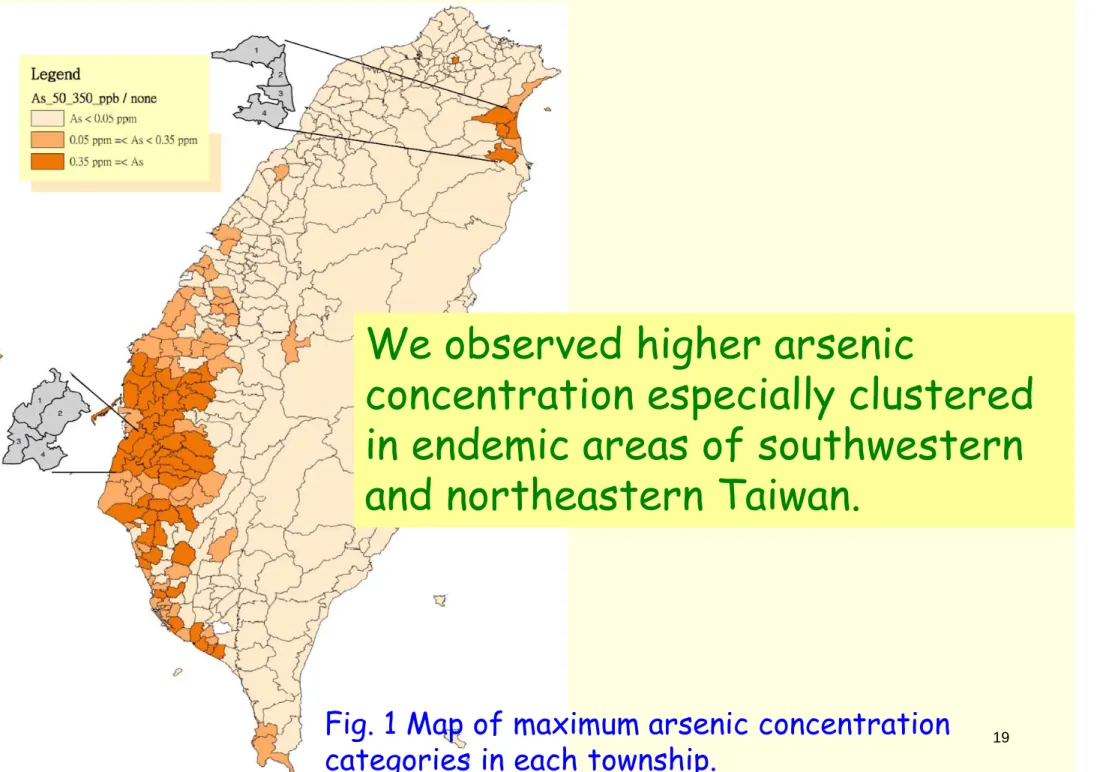
Arsenic levels were three categories: below 0.05 ppm
(similar to mg/L), 0.05-0.35 ppm, and above 0.35 ppm.
NCKU 15
Drinking history
Addresse
Evaluate the associations between possible arsenic
exposure and the risk of progression in CKD.
2000 2009
Addresses
MJ Health Management Institution 2000-2009:
A Nationwide Cohort Study in Taiwan (N=10,018)
(CP Wen, 2008)
End point:
Diagnosis of CKD3b-5
> 5 ml/min/1.73 m2/year
Follow up period
≥12 months ≤24 months
15
NCKU 16
Risk factors of CKD
Epidemiological and clinical evidence have shown a
link between hypertension, diabetes, obesity, and
metabolic syndrome (Comorbidity) and the onset and
progression of CKD.
SEX, Age, Edu
(Yang WC, 2008; Wen CP, 2008)
High prevalence low awareness for CKD
(Hsu CC, 2006; Wen et al. 2008)
Western medicines
NSAID (non-steroidal anti-inflammatory drugs)
Acetaminophen
(Chiu et al. 2008; Wen et al. 2008; Lai et al. 2009; Lai et al. 2010)
Chinese herbal medicine ( Aristolochic acid)
(Vanherweghem JL, 1993; Yang CS, 2000; Chang CH, 2001; Yang HY, 2006)
Index of renal function and progression
Subjects who had an eGFR of less than 60
mL/min/1.73 m
2that continued for 3 months were
defined as having stages 3-5 CKD (Chronic Renal
Failure, CRF).
It was further divided into 3a with eGFR 45-59
mL/min/1.73 m
2and 3b with eGFR 30-44 mL/min/1.73
m
2 [National Kidney Foundation guidelines (NKF)].
Rapid progression: is defined as a sustained decline
in eGFR of more than 5 ml/min/1.73 m
2/ within 1
year according to KDIGO guideline and NICE
guideline.
(Kasiske and Wheeler 2013; NICE 2008)NCKU 17
(K/DOQI)
NCKU 18
Statistic
• Chi-square test, T-test, ANOVA
• Logistic regression: CKD3b-5 / progression
• Odds Ratio 95% C.I
• Single, multiple, stepwise (include p<0.05;
exclude p>0.15)
• SAS 9.3 + SPSS1 17.0
• Two-side p<0.05
NCKU 19
We observed higher arsenic
concentration especially clustered
in endemic areas of southwestern
and northeastern Taiwan.
Fig. 1 Map of maximum arsenic concentration
categories in each township.
NCKU 20
Flow chart of the
nationwide cohort study
NCKU 21 21
NCKU 22
2-1
2-2
23
NCKU 24
2-3
24
25
b: CKD_3b~5: 19 factors15 factors
Male, ≥40 years, lower Educational, Residence (Middle+ South Taiwan),
smoker<10 year, Alcohol, NSAID, Herbal, As≥0.05, BMI≥27, SBP≥140,
FPS≥126, TG≥200, Anemia, HTN, DM, CVD, Gout, Nephritis
c: eGFR decline >5 ml/min/1.73 m
2/year: 16 factors12 factors
Female, lower Educational, Residence (Middle+ South Taiwan), smoker≥10
year, Alcohol, Betel, Herbal, As_0.05_0.35, BMI≥27, SBP≥140, FPS≥126,
TG≥200, Anemia, HTN, DM, Nephritis
2-4
Conclusion
Using either 0.05 or 0.35 mg/L as the cut-
off, we found most of the hot spots
clustered in the southwestern coast and
northeastern endemic areas in Taiwan.
Furthermore, we found exposure to arsenic
in drinking water > 0.05 mg/L was
associated with both the prevalence of
CKD and the rapid progression of CKD
(eGFR decline>5 ml/min/1.73 m2/year),
independent of most documented risk
factors.
NCKU 26
Acknowledgements
This work was supported by Grants
NSC102-2314-B-006 -026 -MY2 from the
Ministry of Science and Technology of
Taiwan, R.O.C.
Co-author:
Neng-Chyan Huang M.D
How-Ran Guo M.D
NCKU 27
NCKU 28