Chapter 3 Evaluation of Grammar Instructions for Learners in Taiwan
Literature Review in Chapter 2 suggests that recent studies have taken dynamic context as the primary concern of countability judgment. However, an evaluation of grammar instructions of countability for learners in Taiwan shows that a large number of students are still instructed with rules of class-specification, which stipulates that count nouns include common and collective nouns, and non-count nouns include proper, material, and abstract nouns. When uses countering such a strict classification are encountered, some learners may memorize the cases as exceptions to the rules by heart, but such a static concept of countability often constitutes a heavy burden on them.
This seems to be the main reason why noun countability is often a confusing notion to learners of English in Taiwan.
This chapter tries to examine traditional grammar instructions of countability in Taiwan and discusses inadequacy found in the instructions.
New Standard English Grammar (Lin and Chen, 1996)
1is chosen as a representative book to discuss with because this book has been widely used in senior high school. Many other grammar books for learners in Taiwan have similar framework to this book. For junior high school students, a specific
1 Lin, Chun-shan (林春山) and Chen Yong-zhu (陳永祝), eds. 1996. New Standard English
Grammar. I. Nan Yi Bookstore.
grammar book may not be used, but the rules being supplemented by teachers in teaching textbooks or outside readings are often in the same framework as those stated in Lin and Chen (1996).
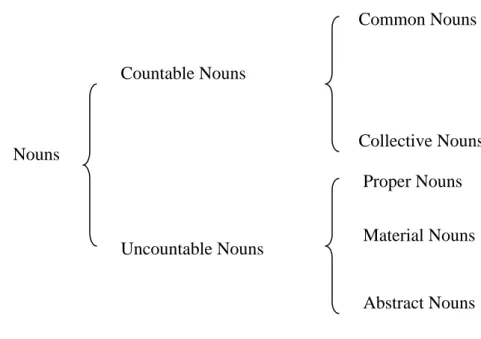
2First, nouns are categorized in the following way. As shown in Figure 1, the classification here provides a clear-cut distinction between the so-called countable and uncountable nouns.
Nouns
Countable Nouns
Uncountable Nouns
Common Nouns
Collective Nouns Proper Nouns Material Nouns
Abstract Nouns
Figure 1: Traditional Noun Categorization for Taiwanese Learners
Based on the teaching material, a typical explanation of noun countability in the classroom is often like this
3: “Nouns can be classified as countable nouns and
2 The information of grammar instructional material is provided by several teachers and also book salesmen in high school.
3 In my teaching experience, four years in junior high school and five years in senior high school, the concept of countability is typically presented in this way. Besides, an informal discussion with several teachers also confirms that the rigid classification is the commonest way
uncountable nouns
4. Countable nouns include common nouns and collective nouns. Uncountable nouns include proper nouns, material nouns, and abstract nouns.” It is then supplemented that “common nouns like boy, teacher, city, country, book, dog, and collective nouns like family, class, committee, audience, are countable nouns. On the other hand, proper nouns like Tom, Taiwan, Mt. Ali, material nouns like glass, paper, stone, tea, coffee, water, and abstract nouns like ability, freedom, illness, difference, difficulty, love, are uncountable nouns.”
A major problem of the traditional account lies in the fact that it treats tendencies as rigid rules. It strictly classifies nouns according to their semantic features. To some extent, the traditional classification of noun classes reflects the phenomena in typical examples of the noun classes; however, the typical examples are presented as if they had absolute membership in the categories. Such strict classification may be misleading when students are making their countability judgment.
Meanwhile, some nouns are noted in traditional grammar as being able to be ‘countable’ or ‘uncountable’ because it expresses different meanings, as shown in (12)
5:
(12) a. Please wrap the present in paper.
b. What do the papers say about it?
that countability is taught in the classroom.
4 Countable nouns and uncountable nouns are not suitable terms for count and non-count nouns.
The terminology will be discussed later in this section.
5 The example is taken from Lin and Chen (1996: 70)
According to the categorization, paper is a material noun, and it is
‘uncountable’. Then three problems arise. First, the count and non-count uses of the same noun are presented as the exceptional cases in the traditional account, not treated as a common phenomenon. Secondly, a material noun is uncountable according to the figure. Then how can it be countable? Thirdly,
‘countable’ means ‘can be counted’, while ‘uncountable’ means cannot be counted.’ Then how can an uncountable noun be ‘countable’ depending on the meanings it conveys? Since it is not able to be counted, how can it be able to be counted? A more reasonable way is to say that the same noun is used in a sense in which the speaker intends to count or not to count. A noun being count instead of countable means that it is counted due to the need to individuate in context, but not that it is able to be counted. ‘Count’ and
‘non-count’ are more suitable terms for categorization.
Moreover, many counterexamples of the rules are cited as exceptions in the traditional account. Collective nouns like furniture, clothing, merchandise, baggage are treated as an exceptional class of uncountable collective nouns. Likewise, count uses of proper nouns like an Edison, four Johns, of material nouns
6like a glass, a sweet wine, stones, of abstract nouns like an unspeakable happiness, a kindness, a composition, a beauty, are treated as special uses of the three noun classes. Some rules of the special
6 Material nouns here refer to substance only. Material nouns in Jespersen’s (1933) terminology referred not only to substance, but also to objects. In other words, Jesperson’s material nouns are concrete nouns, but not material nouns in recent terminology.
uses are generalized by Lin and Chen (1996) as follows
7:
(13) Proper nouns can sometimes be used as common nouns to express (a) people, places, or objects like X, (b) people called X, and (c) products of X.
(14) Material nouns can sometimes be used as common nouns to express (a) products of the material, (b) varieties of the material, and (c) pieces or special instances of the material.
(15) Abstract nouns can sometimes be used as common nouns to express (a) varieties of a quality or an action, (b) instances or results of a quality or an action, and (c) possessors of a quality or an action.
In brief, the semantic noun classes of common, collective, proper, material, and abstract nouns are strictly categorized as count and non-count nouns, with only some exceptional special uses briefly mentioned.
However, the so-called “exceptional special uses” of the above-mentioned categorization are in fact commonly observed and are far from sporadic exceptions. In other words, the count and non-count distinction is often not clear-cut, but a fuzzy line depending on context (Li, 2004). To be more specific, whether a noun is count or non-count is often not inherently
7 The original rules are stated in Chinese in Lin and Chen (1996) as: 專有名詞,有時可以被用 做普通名詞以表示(1)「類似原有名稱的人、地、物」(2)「名叫~的人」或「某人的作品」
等各種意思(p.77)。物質名詞,有時可以被用做普通名詞以表示(1)「製品」(2)「種類」(3)
「個體或特殊的事物」等各種意思(p.81)。抽象名詞,有時可以被用做普通名詞,以表示 性質或動作的(1)「種類」(2)「實例或結果」(3)「所有者」等各種意思(p.84)。
determined by the noun itself, but rather depends on the speaker’s intent in a certain context (Givon, 1993).
In the following sections, the semantic noun classes as proposed in the traditional account will be reexamined with their general functions, and then examples will be provided to show that countability is determined not by the semantic noun classes themselves, but rather in the context.
3.1 Common Nouns
Common nouns code people, places, or things like boy, prison, or pencil, and refer primarily to prototypical nouns
8. Generally speaking, these nouns have important features of being count: concreteness and definite outline, and are typically individuated. However, unindividuated common nouns like school or basketball also play an important part in everyday language.
Consider the following examples:
(16) In the fashion world, styles come and go—and come back again!
I’ll never forget the day I wore my new lace-up boots to school.
They were brown leather with a platform heel, and they laced up almost to my knee. I thought they were so cool. That is, until my
8 Givon (1993) touched on the most general features of nouns: concreteness, animacy, artifactness, humanity, countability (individuation), generality and reference (p.55-57).
Prototypical nouns are nouns that resemble the prototype in many of such features.
math teacher walked up to me. She said, “Nice boots! I had those exact same ones when I was in college!” I was horrified. My math teacher was at least 50 years old! Was I that out of style?
9(17) Are you interested in country music? In basketball? Whatever your interest is, you can find a discussion group to join.
10In the above examples, the non-count use of common nouns involves a powerful cognitive tool, metonymy. Metonymy, according to Ungerer and Schmid (1997: 115), involves “a relation of ‘contiguity’ (i.e. nearness or neighbourhood) between what is denoted by the literal meaning of a word and its figurative counterpart”. In example (16), the speaker described an event in class: She wore her new boots to school. It can be inferred from the context that the event happened on one day when she was in the process of being educated in a school. Thus, school in example (16) involves the type PLACE FOR EVENT. In other words, school is used in (16) to mean participating in the process of being educated in a school. In example (17), it is understood from the context that basketball here means taking part in a sport or game instead of just a ball. Therefore, basketball in example (17) involves the type OBJECT FOR EVENT. That is, basketball for playing basketball. Both types are typical examples of contiguity-relations.
Similar non-count uses of common nouns include go to school, go to church, be sent to prison, go to bed, play football, watch television, on hand,
9 The example is taken from Vogel (2005:38).
10 The example is taken from Shih, Y., L, M. & Brooks, S. (Eds.) (2002: 183).
and on line, etc., as shown in the following examples
11:
(18) a. Is your child old enough to go to school?
b. They go to church every Sunday.
c. The thief was sent to prison for a year.
d. It was late in the evening. Wei-hua was writing a composition about the wild animals of Taiwan. He did not have enough information on hand. No one in his family could help him, and the library near his home was closed. He had to finish his homework before he went to bed. What could he do?
e. He plays football for England.
f. Do you watch a lot of television?
g. The Internet is also excellent for communication. There are tens of thousands of BBS (bulletin board system) sites and discussion groups on line.
School, church, and prison in (18a, b, c) are not simply a place someone goes to, but they involve more abstract concepts of education, religion and penalty. Go to bed in (18d) involves not only the bed, but also resting on the bed. Play football in (18e) involves not only playing with a certain ball, but also taking part in a sport or game. Likewise, watch television in (18f) does not mean
11 Examples (18a, b, c, e, f) are adapted from Longman Dictionary of Contemporary English (1999), on page 1352, 248, 1192, 1144, 1736 respectively. Example (18e) is modified slightly.
The original sentence is: He plays cricket for England. Examples (18d, g) are adapted from Shih, Y., L, M. & Brooks, S., Eds. (2002: 182-183).
looking simply at the television set, but has the interpretation of watching the shows received by a television. In (18d) and (18g), on hand, on line are used here only to express availability of information, and connection with information. All the common nouns here are not individuated because they do not code prototypical functions of nouns, but are related to some other concepts.
Therefore, the need for individuation decreases. In traditional grammar, these commonly used phrases are often instructed as fixed phrases for students to memorize. It would be more understandable if learners can understand the reasons for non-count uses of the nouns.
Unindividuated common nouns in expressions like husband and wife, and brother and sister are used to mean a kind of relationship. Consider:
(19) They are claimed to be husband and wife.
Parallel examples of the above non-count uses of common nouns can also be found easily in our daily language, as shown in (20).
(20) a. There is a school across from my house.
b. I bought a basketball for my son.
c. This is a beautiful church.
d. It is said that the treasure was hidden in a prison.
e. Draw a hand here.
f. My brother and I slept in a room with twin beds.
g. We bought a television yesterday.
h. Draw some lines here.
i. I believe that my cousin could make an ideal husband.
In these cases, concrete referents are intended in the contexts. Therefore, it is necessary to catch the intended meaning in a certain context to decide whether to count or not.
For some common nouns like chicken, and salmon, both count and non-count uses are very common, as shown in (21):
(21) a. I was lucky enough to catch a salmon today.
b. We’re having salmon for dinner.
Count salmon in (21a) means a fish of a particular species, while non-count salmon in (21b) means the meat of a salmon as stated in Huddleston and Pullun (2003: 337), “The primary sense here is the count one, with salmon denoting a fish of a particular species; in the secondary non-count sense it denotes a food substance. This extension of meaning applies very generally with fish. It is also found with poultry….”. Huddleston and Pullun also stated that the food sense of fish and poultry can be further reinterpreted as count with the restaurant order sense. Consider:
(22) One roast beef and two lambs, please.
12The common noun lamb is unindividuated through the metonymy WHOLE FOR PART to mean the meat of a lamb. And through another metonymy MATERIAL FOR OBJECT, the noun lamb is individuated to mean servings of food.
Some family member address terms like Mother, Father, are common
12 The example is adapted from Huddleston & Pullun (2003: 337).
nouns used as proper nouns. The nouns have the uses due to the unique position a mother or a father has in one’s family. Usually, there is only one mother and one father in a family. If there is more than one mother in a family, the speakers will have to say my mother or your mother instead of Mother.
For some common nouns like book, pencil, cat, boy, girl, normally people would only have count interpretations for them. But even nouns of this type, if we can imagine a very peculiar context, atypical uses may also emerge as shown in the following examples
13:
(23) a. The termite was living on a diet of book.
b. The vet found bits of chewed-up pencil in the dog’s stomach.
c. There was cat all over the driveway.
d. I like boy better than girl.
For the termite in (23a), book is food instead of books for reading. In other words, book has the substance interpretation from a termite’s perspective. In (23b), pencil is non-count because it represents a formless mass rather than a discrete object. In (23c), the cat has already been squashed all over the driveway, and lost the concrete form of a cat. In (23d), boy and girl have become the food of cannibals in fiction.
For nonce
14occasions of primarily count nouns, speakers may have different degrees of countability judgment. Some speakers tend to use the
13 Examples (23a) and (23c) are adapted from Huddleston & Pullun (2003: 337). Example (23b) is adapted from Master (2002: 334). Example (23d) is adapted from Conrad &
Schousboe (1989, cited in Li, 2004: 6).
non-count forms to strongly express their peculiar intent, while some speakers still think it more natural to use the count form as long as the context allows.
For two of the examples, the native speaker participating in the study had a different opinion from that of the researchers providing the examples. Unless the context strongly coerces an innovative use of nouns, she seldom has non-count interpretation of very prototypical nouns like boy. The contrast is shown below:
(24) a. The termite was living on a diet of books.
b. The cannibal said, “I like eating boys better than girls.”
c. “There is chicken on the menu today,” recommended a waitress.
A strange-looking young man said, “I like boy better than chicken.”
For the examples, she had food interpretation for them. She still thought it more natural to use books, boys and girls as shown in (24a) and (24b), just like apples and oranges. However, under the influence of the parallel noun chicken, she thought it better to say boy in (24c). Since chicken has a substance interpretation in food interpretation, it is strongly suggested that boy can also have a substance interpretation in (24c).
Different speakers may have different countability judgment for a new word. For example, it is natural to use non-count forms of computer in the following way for some speakers:
14 Nonce means invented for special occasions only.
(25) Computer is an important part in modern life. We can get a lot of information through computer.
For the native speaker participating in the study, however, she thought it is more natural to individuate computer as a computer or computers. In her English
15, computer is still treated as a concrete object instead of an abstract concept.
For a more modern device like computers, she still could not accept it as an abstract concept. Contrastively, she thought it is quite natural to use an older word television as non-count as the following example shows:
(26) Television is an important part in modern life. We can get a lot of information through television.
To conclude, common nouns not only have count uses, they also have non-count uses in our everyday language. For very prototypical common nouns, it is also possible to have non-count interpretation for them in suitable contexts. Therefore, it is inadequate for learners to be instructed that common nouns are count nouns. Common nouns in context may show that common nouns may have both count and non-count uses depending on the functions they have in the context.
3.2 Collective Nouns
Collective nouns like team, crowd, audience, group, etc., can be viewed
15 The speaker, Kimberley Cooper, is a native speaker of Scottish English, aged 25.
from two distinct perspectives: First, as a collection of individuals. Second, as a single unified group This distinction is coded as a variation in their number agreement (Givon, 1993: 286)
16. Since nouns in this pattern are named collective nouns, generally speaking, they are viewed as a single unified group with a singular verb and co-referent pronoun. However, in suitable context, individuals in the collection may be emphasized. Typical examples are shown as follows (Givon, 1993: 286):
(27) a. The team is winning, it’s in good shape.
b. The team are bickering; they hate each other.
In (27a), the team is viewed as a single unified group because there is no need to look at the individual members of it when talking about the winning opportunity of the group. In (27b), only individuals can be bickering (quarrelling about unimportant matters) with each other. So there is a need to individuate the collective noun.
Collective nouns can also be created via NP conjunction, and then display the very same distinction, as shown in Givon (1993: 286):
(28) a. Peter, Paul and Mary are trying to get back together, they’ve been split since 1963.
b. ‘Peter, Paul and Mary’ is a folk group that was really big in the ’60s.
In (28a), since the three people have been split since 1963, it is reasonable not to think of them as a group for the moment. So the individuality of the three
16 Givon (1993) used the term ‘group nouns’ instead of ‘collective nouns’.
people is manifested in the plural verb. (28b) serves as a contrast to show how the three people are not individuated, but are viewed as a single group.
Biber et al. (1999) stated that collective nouns refer to groups of single entities. They behave like ordinary count nouns, i.e. they vary in number and definiteness, but they are marked by special patterns with respect to subject-verb concord and co-referent pronouns. Basically, Biber et al. had similar observation to Givon. But their definition ‘groups of single entities’
can rule out words like furniture and clothing, which are more like a name to call aggregates of different entities with a common function.
In traditional noun categorization, collective nouns are classified as count nouns. But it is still not clear whether learners have to count individuals in the collection, or the group as a unit. Special forms of collective nouns also complicate the situation. Therefore, context is especially needed in teaching or learning when to individuate a collective noun or not.
In traditional grammar, nouns like furniture, clothing, merchandise, baggage are treated as an exceptional class of non-count collective nouns.
Since the formal behavior of these nouns is quite different from the collective nouns discussed in this section, it is better to treat these nouns as a separate class instead of an exceptional class of non-count collective nouns.
3.3 Proper Nouns
The general function of proper nouns is referring to unique entities.
Therefore, proper nouns are typically not individuated. Givon (1993:
240-241) stated that most commonly proper nouns
17are given to unique important persons, locations, or temporal entities. Typical examples given by Givon are:
(29) (Givon, 1993: 241)
proper noun referent type current text
a. Dorian Grey person a novel
b. George Washington
person US history
c. John person one’s life
d. Lima, Peru location world geography
e. The Civil War time US history
Givon (1993: 241) also stated that “Some proper nouns require a complex referential access. For their referent to be defined uniquely, it must be relationally anchored. Such anchoring depends heavily on generic, culturally-shared, conventional knowledge.” Typical examples are:
(30) (Givon, 1993:241)
proper noun text convention
a. Mom, Dad one’s life a person has only one Mom and Dad
b. home one’s life a person has only
one home at a time c. Tuesday each week each week has only
one Tuesday
17 Givon (1993) used the term ‘name’ instead of ‘proper noun’.
d. January each year each year has only one January
e. Christmas each year each year has only one Christmas
All the above examples demonstrate that the general function of proper nouns is coding unique entities. Since proper nouns refer to unique entities, they require no further specification. They typically come by themselves, with neither determiners nor any other modifiers, because modifiers function to restrict the domain of possible reference of a noun. (Givon, 1993: 247) In short, proper nouns, standing for unique entities, are sufficiently restricted in their reference, so that they require no further restrictive modification. (Givon, 1993: 269)
According to Givon, proper nouns need no further modification because of uniqueness. In other words, once the degree of uniqueness decreases, further modification is needed. The range of functions performed by the various types of modifiers include plurals, some quantifiers, determiners, etc.
(Givon, 1993: p.269). Therefore, it is possible that proper nouns can be individuated in the example World Englishes, or in the context of (31)
18:
(31) The last bridegroom to be married in Crathie church was also a Tim.
World Englishes means varieties of English in the world. There may be British English, American English, African English, Taiwanese English, and a lot more different Englishes in the world. A Tim means another person also
18 This example is adapted from Biber et al. (1999: 247).
called Tim. There are two Tims. Therefore, there is a need to individuate.
According to the rules listed by Lin & Chen (1996) in (13), restated as (32), proper nouns have some special uses as common nouns. Examples are given as (33).
(32) Proper nouns can sometimes be used as common nouns to express (a) people, places, or objects like X, (b) people called X, and (c) products of X.
(33) a. I wish to become an Edison.
19b. There are two Edisons in China.
c. There are four Johns in our class.
d. There are two Turners in the museum.
Lin & Chen (1996) treated these examples as special instances of proper nouns.
However, it can be found that all the count uses of the above examples stem from decrease of uniqueness. Edison in (33a) and (33b) refers to a great inventor like Edison, but not the great inventor Edison himself. There may be another Edison in the future. Not standing for the unique person in history, but a person with the feature, Edison in (33a) and (33b) should be individuated like I wish to become a great inventor. Four Johns in (33c) means four students named John. Two Turners in (33d) means two pictures painted by Turner.
Similar examples include I want to be a Picasso (meaning a great painter), I am also a Rebecca (meaning a person named Rebecca), and I need to buy a Hoover (meaning a vacuum cleaner), or a Ford (meaning a car).
19 Examples (33a) to (33d) are adapted from Lin & Chen (1996: 78).
According to Biber et al. (1999), when the reference of a proper noun is an action associated with the person carrying the name, a proper noun is also individuated, as shown in (34).
(34) You could do an Arnold Schwarzenegger, just go – <unclear>
break the door.
Arnold Schwarzenegger in (34) does not stand for the unique movie star, but an action that the unique person often does in movies—go break the door. There may be another person doing another Arnold Schwarzenegger. Therefore, the count use of example (34) also stems from lack of uniqueness.
To conclude, prototypical proper nouns are non-count because they are used for unique reference. Once the major function of a proper noun is not referring to a unique entity in a certain context, there is need to individuate it.
Instructions in traditional grammar give abundant examples and described them as special rules and instances. If the general function of proper nouns
—referring to unique entities—can be pointed out, and functions of count uses of proper nouns can be discussed in context, there will be no need for treating the less prototypical cases as separate exceptions that have to be learned through rote memory.
3.4 Material Nouns
Material nouns, such as sand, water, blood and air, have the feature
concreteness, but are often with no fixed shape or in small particles. In the
natural world, it is difficult to perceive the outline or single out the individual entities of material. Therefore, material nouns are typically viewed as non-count. However, similar to other noun classes, in suitable context, material nouns also have count uses.
Almost all material nouns have count uses as long as they refer to servings of the substance in a certain context. Therefore, besides a water and a pizza, an orange juice, a coffee, a tea, a fruit, a fabric are all common uses of the material nouns (Li, 2004). A very common and typical context is the restaurant context, as shown in (35):
(35) My friend finally came. I waved to a waitress, and said, “Two coffees, please.” I drank some coffee and started to talk about my
situation in class.
Two coffees can be easily understood as a shortened form of two cups of coffee in a restaurant. In the second occurrence of coffee, there is no need to individuate coffee because the speaker does not drink some cups of coffee. In the context, it can be quite redundant to say we want two servings of beef, and two cups of coffee. Simply two beefs and two coffees would be easier and meanwhile understandable in the context. If we treat the count uses of material nouns in a restaurant as special uses, then how can we define what is special, and what is not? After all, a restaurant is such a common context that almost every speaker has a chance to experience.
Other count uses of material nouns include products, varieties, and pieces
of the material, etc., as shown in (36)-(38):
(36) Mother bought several beautiful glasses yesterday.
(37) That was only one forty-nine a bottle. Which is cheap cos a lot of non-alcoholic wines are expensive.
20(38) There is no way to tell how old a rock is merely by looking at its minerals.
21These examples are actually what are perceived in our eyes in the real world.
In other words, there is no reason to treat such uses as special cases of the material nouns. In fact, drinks or food servings, products, varieties, and pieces of materials are quite ordinary uses in our life experience.
Whether a material noun would be individuated depends on the need in communication. The native speaker participating in the study described how she asks for some water in a restaurant:
(39) When I need just a cup of water, I would say, “Give me water,” or
“Give me some water, please.” But if we need two cups of water, I would say “Two waters, please” as a shortened form of two cups of water.
The description of her choice of language forms suggests that forms reflect the need for communication. For her, in general situation, some water means a cup of water, so there is no need to individuate water. However, when more than one cup is meant, there is a need to individuate water. At that time, two waters would be a shortened and convenient form to express her need. For her, she would not say, “Give me a water,” because there is no need to individuate
20 The example is taken from Biber et al. (1999: 244). It was transcribed from a conversation.
21 The example is taken from Biber et al. (1999: 243).
water there, and water is non-count unless there is a need to count it in context.
Under the principle of language economy, it is quite natural to use language in this way. But if someone says, “Give me a water”, she would think it is okay to say so to mean a cup of water. In other words, choices of countability may have individual differences, but basically, the choices reflect the speaker’s intent in the context.
Therefore, it can be said that the old school grammar account of material nouns as uncountable is rather improper. Countability of material nouns is better demonstrated in context.
3.5 Abstract Nouns
Generally speaking, abstract nouns code entities whose existence cannot be defined in terms of either time
22or space. Typical examples include freedom, love, independence, size, policy, refusal, etc. (Givon, 1993: 55).
Therefore, speakers may feel it more difficult to individuate abstract nouns because they are not perceivable, let alone being count. Therefore, abstract nouns are typically viewed as non-count.
In our experience with real language use, however, abstract nouns are found to code entities that exist in time. For example:
22 Temporal nouns code entities that exist only in time, such as morning, minute, etc. (Givon, 1993: 55-56)
(40) In the fashion world, styles come and go—and come back again!
I’ll never forget the day I wore my new lace-up boots to school.
They were brown leather with a platform heel, and they laced up almost to my knee. I thought they were so cool. That is, until my math teacher walked up to me. She said, “Nice boots! I had those exact same ones when I was in college!” I was horrified. My math teacher was at least 50 years old! Was I that out of style?
23Styles in the first line refers to styles existing in different periods of time.
Therefore, it is quite reasonable to individuate it. At the end of the passage, style does not refer to a particular style in a particular period, but a fashionable or elegant quality, so it is in non-count use.
Other instances show that abstract nouns can even code entities existing in space, as shown in (41)
24:
(41) She studies composition at school. Recently, she has been writing a composition about wild animals.
In the first sentence of example (41), studies composition means taking part in an activity of writing. In the second sentence, a composition means an end product of writing. So it is natural to individuate composition to mean the end product.
Other abstract nouns like freedom, language, and failure, are often
23 This example is adapted from Vogel (2005:38).
24 The first sentence in this example is adapted from Lin & Chen (1996: 84) with changing of the verb. The original sentence is: She learns composition at school.
categorized as non-count nouns, but such abstract nouns also have count uses, as in (42)-(44):
(42) Hong Kong has suddenly become a highly contentious place.
Twice in the past two years, 500,000 residents poured into the streets to demand greater political freedoms, such as the right to directly elect its next leader and all its legislators, an issue Tung didn’t broach in his address
25.
(43) He speaks several languages.
(44) He was a failure.
Freedoms in this context (such as the right to….) are instances of the abstract concept freedom
26. Several languages means varieties of language. A failure means a person who possesses the abstract quality failure. Therefore, speakers may feel the need to individuate them.
Some abstract nouns denoting linguistic communication are often individuated and used in a plural form like ideas, thoughts, and feelings.
Consider
27:
(45) a. Try to pack more thoughts into fewer words.
25 This example is adapted from Estulin (2005: 30).
26 A discussion with the native speaker in the present study also suggests different degrees of countability judgment among individuals. For her, she would simply use freedom in the context. But she could understand what is meant by the speaker with the plural form of
freedom. Advisor of the present study suggested that the writer of (42) has a much wider
context which motivates his use of freedoms.27 The examples are taken from Reddy (1979), cited in Ungerer and Schmid (1997: 119).