THE PERSONALITY AND
EMOTIONAL INTELLIGENCE OF MEDICAL PROFESSIONALS FOR IDENTITY ON ADAPTIVE SELLING
BEHAVIOR OF CARE SERVICES
Sheng-Feng Shih
1Hsiu-Li Huang
21Department of Business Management, Xiamen University Tan Kah Kee College
2 Extension Education Center, Minghsin University of Science and Technology
ABSTRACT
In the highly competitive health care industry, services provided by the me- dical professionals can be regarded as the sale of an appropriate care service to patients. In particular, there are many different types of patients that the first line medical professionals face each day. Adaptive Selling Behavior (ASB) of the care service offered is to achieve a successful nurse-patient relationship. That is, the care service provided by the medical professionals is composed of different members from different backgrounds. Hence, the team’s cross-sector integration and multi- integration are the most important directions for improving the quality of care and work performance, and also the aspects explored with industrial and organizational psychology. The purpose is for the “most suitable person” to provide the “most suitable service” at the “optimal time”. This study used a questionnaire survey to investigate 519 medical professionals and explored the relationship between the personalities and Emotional Intelligence (EI) of medical professionals and ASB of care services.
The more the medical professionals are inclined to type A personality, the higher the ASB of the care service they provide will be; when the potential shortcomings of type A personality are too impatient, EI will adjust its relationship. The higher (lower) the EI, the stronger (weaker) positive impact of type A personality on the ASB of the care service will be. This indicates that when the medical professionals have a higher EI, the ASB of care service will enhance. EI can effectively adjust the type A per- sonality of the medical professionals and the ASB of care services that they demon- strate. This research suggests that hospitals select candidates with high EI in the future, or they can increase the curriculum of the emotional aspects, which will not only promote the ASB of care service, but also maintain a better interaction with
the patients. It is further proposed to achieve balance through emotional intelli- gence AIMP to assess, identify, modulate and perform, to improve the overall care service as a reference basis for the education and training of medical professionals.
Keywords: medical professionals, medical service, industrial and organizational
psychology (I/O psychology), personality, emotional intelligenceIntroduction
In the era of convenient and rapid medical services, medical institutions are important departments that provide active treatment to maintain vital functions. The focus on patients’ vital signs (body temperature, pulse, blood pressure and etc.) and the service provided by medical professionals can be regarded as the ASB to patients, and the success of the sale of medical services relies on the medical professionals who maintain long-term contact with patients (customers). So the increase in the average number people served per hospital and the amount of medical services (Figure 1) shows the role of medical professionals, and how they can provide high-quality medical services through education and training of the contents of the working background.
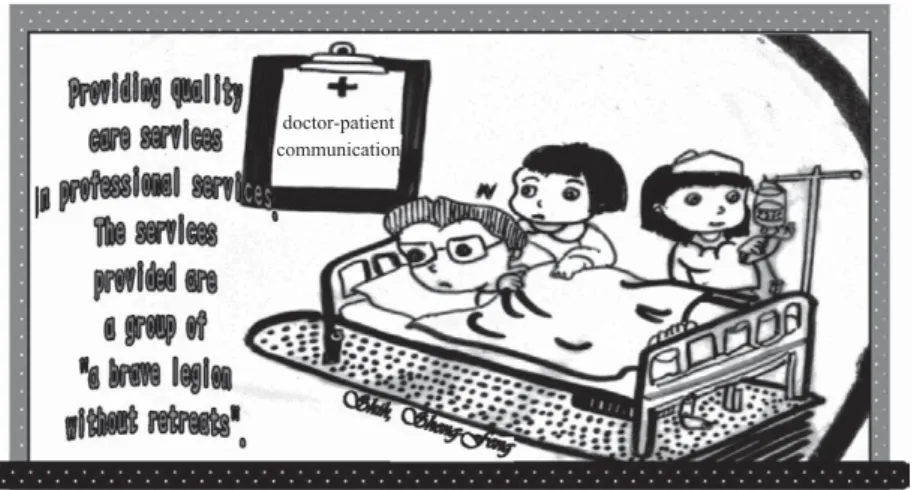
The medical judgments made by medical devices for patients are quite accurate. Therefore, the criteria for determining the patient’s needs can be made based on the type and service of the care work provided by the medical professionals. In particular, the behavior of care services has paid considerable attention to doctors-patient communication, truth-telling, autonomy and deter- mination in recent years. According to the Ministry of Health and Welfare, Executive Yuan’s sta- tistics on the number of care services for the past 10 years, in 2006, the average length of hospital stay for patients in general beds was 9.6 days. With the improvement of the quality of medical care services, the average length of hospital stay was 9.1 days in 2011, and reduced to 8.7 days in 2016. Therefore, how can medical professionals provide optimal care services within a limited medical time (professional mutual assistance and cooperation), including ill treatment of patients, negative events, etc., to further enhance service quality and patient (consumer) satisfaction (Figure 2); therefore, there is no escape route for medical professionals in face of the patient’s life and death, and they can only take the care work by overcoming their own limitations and continue to advance without giving up. No matter how hard the road is, they will never look back even if disappointed. The behavior of the care services they provide can be said to be provided by a
“brave legion without retreat”.
3,424 6,738
2,954
1,904 991 941 808 975
1,374
1,215 1,204 1,1531,2901,379 1,167
1,4491,397 1,374 1,182
1,338 1,122
2,504
1,563 1,059
818681 648 504 433 386343 333 280 165 92 59
404,930 Country
6,872 123,272 8,003 1,139 33,262 12,275 7,222 51,574 8,012 23,554 8,154 18,090 30,014 51,154 11,789 1,292 2,720 6,532
21,239 444 5,268 597 101 1,921 992 456 2,447 452 1,079 556 873 1,734 2,640 870 119 270 421
15,657 318 3,635 343 30 1,821 531 410 2,061 402 753 481 824 1,046 1,770 732 74 137 288
6,181 92 1,907 118 8 544 227 95 839 81 334 128 271 505 733 144 12 36 108
33.1 37.3 32.1 30.1 38.9 32.0 26.5 32.1 33.4 27.2 31.2 32.1 31.0 35.7 39.0 38.6 34.0 44.1 26.2 KLC
TPC ILH KMC & LCC
TYC HCT & HCH
MLH TCC NTC CHH YLH CIH & CIC
TNH KHC PTH PHC TTH HLH
LCC
KMC
PHC
KLC TPC
NTPC TYC HCH HCT
MLH TCC CHH NTC YLH HLH CIH CIC
TNH KHC PTH
TTH ILH
Medical care
region Outpatient Emergency Hemodialy Surgery Cesarean
section rate
Number of medical institutions
Average number of people served at each hospital Average number of people served by each hospital in the county
Average in the county
Unit: N, %
TPC TCC KHC TNH TYC CHH HCT & HCH CIH & CIC PTH YLH NTC MLH KLC ILH HLH TTH PHC KMC & LCC Average number of people served at each hospital
Number of medical institutions
7000 6000 5000 4000 3000 2000 1000 0
3000 2500 2000 1500 1000 500 0
Figure 1 Statistical analysis of service personnel and service volume at Taiwan medical centers
doctor-patient communication
Figure 2 Diagram of providing the optimal medical service in limited time
Lin (2015) pointed out that medical professionals can emphasize supportive activities from being different to create better qualities and traits for consumers (patients) than their competitors.
Wang and Lo (2010) believes that the socio-economic structure change and self-realization concept are important factors that enable workers to integrate self-development and service values of the community. Lu and Hsieh (2012) pointed out that the medical behaviors of medical con- sumers (patients) are affected by three main factors. First, the “currency cost” of the relationship between what the patient gets and the price of medical services; second, the “time cost” of the time spent in the treatment process or traffic; and third, a patient with a high level of education feeling it easy to obtain health or medical information will naturally increase awareness of health care and increase “acquiring information” for the number of active consultations or hospital visits. Tsai and Hu (2005) used the value chain interaction of medical institutions as the analysis unit to point out that medical services need not only the suppliers’ physical goods, but also such intangible products such as technology, information and knowledge attached to commodity trading identified from the medical service process. Tsai (2015) pointed out that medical services are intangible goods as are the behavior of the patient asking for providing or receiving medical services, which is a consumer behavior. That is, patients are consumers as under the consumer protection law.
Personalized health maintenance does not create consumer demand from the perspective of the provider; instead, it emphasizes the needs, values and expectations of consumers to reshape the service (Lin, 2015). The structure of medical consumption refers to various types of products consumed (the use of medical devices) and services (medical care services) received by the general public in their process of medical behavior (Lu, & Hsieh, 2012). In traditional nursing training, knowledge learning and clinical skills training are usually conducted separately, but the application of mobile technology in nursing education is maturing. Through the use of mobile devices and activities in the learning activities, it is possible to clearly detect whether the virtual patient is in the correct position to perform operations to assess the physical condition of a specific disease and thus to achieve the improvement of the quality of care service (Chang, Lai, & Hwang, 2018; Wu, Hwang, Su, & Huang, 2012). As a result, today’s care services are gradually shifting from the focus on active medical treatment only in the past to a focus on relieving patients’ pain due to their symp- toms. What kind of mechanism should the medical professionals have to influence the patient’s medical behavior and physical and mental status? It is imperative that the medical professionals should hold what kind of EI and personality traits in their emotional work to mitigate these situations? Type A personality is often positive and active, good-minded, and competitive. ASB needs to understand consumer needs and preferences and provide appropriate service and sales model to respond to consumer demand. However, in the dynamic sales situation with the influence
of different reactions from consumers, the emotions of medical professionals are quite easily disturbed, especially in the high unit-price product market (advanced health examinations, examinations at their own expense etc.) When patients purchase care services, they usually need more time to think, and when they are hesitant to make decisions, it makes it easier for medical professionals to become intolerant, and thus it is not easy to demonstrate ASB. In view of this, this study will attempt to explore the relationship between the personality of the medical professionals and the sales behavior of the care services provided.
In recent years, both academia and industry have started to advocate the concept of EI, which is the ability of individuals to perceive, understand and manage their own and others’ emotions (Mayer & Salovey, 1997; Salovey & Mayer, 1990). If one can has the capacity to effectively use or manage emotions, he or she will have better social adaptability (Wang & Lo, 2008, 2009). It points out that the provision of medical services does not need to have a profit, but emphasizes that medical professional services take it as their obligations to provide treatment. The ultimate goal is not to profit but to transform human life (Tsai, 2015). What role EI of the medical pro- fessionals plays in personality and the sales behavior of the care services provided was rarely dis- cussed in the past.
Literature Review
Give, and it shall be given unto you; good measure, pressed down, and shaken together, and running over, shall men give into your bosom. For with the same measure that ye mete withal it shall be measured to you again.
──Bible: Luke 6:38
1. Emotional Intelligence (EI)
EI is one of the important terms of interest in society and business. The term was first pro- posed by Payne in 1986. Salovey and Mayer collated and combined previous research to propose a more complete EI framework. They defined EI as to be able to monitor the emotions and feelings of oneself and others, distinguish them, and understand and use these information to guide one’s ability to think and act. They also suggested that EI is the ability to rationally judge and solve problems, and to identify the meaning and relationship between emotions (Salovey & Mayer, 1990). EI and personality types can predict interpersonal interaction and self-cognition, and satisfaction of communication skills (Shirzad, 2016).
A medical consumer experience scale can be developed based on five experience strategy modules of the medical consumer experience (sensory, emotional, reflective, action, and connected experience). The results show that, for the measurement of patient experience, the relationship be- tween experience results and consumer satisfaction and loyalty can be further analyzed when me- dical institutions perform experience marketing (Su & Ho, 2006). Mobile learning is mainly applied to the training of basic nursing concepts and skills, and context-aware mobile learning systems is used to train nursing strategies for acquiring thinking skills (such as problem solving or critical thinking) to significantly improve learning outcomes to improve the quality of care (Chang, Lai, &
Hwang, 2018; Wu, Hwang, Su, & Huang, 2012). In particular, EI is an ability to identify, assess and control emotions of individuals, other people, and other groups. Emotional intelligence can be divided into ability EI and trait EI. At present, the scholars’ cognition of EI is divided into two major schools, namely, ability theory and mixed model. The former regards EI as a psychological ability. This ability can help individuals in the perception, understanding, reasoning and solving of problems; the latter considers EI as a trait (Bar-On, 2006), and develops 15 emotional personality traits and classifies them into five major categories, including: (1) Individual internal components:
self -perception, self-respect, self-affirmation, self-realization and independence; (2) empathy, social responsibility and interpersonal relationships; (3) adaptive components: reality testing, problem solving and flexibility; (4) pressure management components: pressure receiving, and impulse control;
(5) general mood ingredients: well-being, optimism and the like.
Regarding the EI aspect, most scholars refer to Salovey, Mayer, and Gross’s architecture, which are divided into 4 aspects: (1) Self-emotion appraisal, SEA: this refers to people who can deeply understand their emotions and can naturally express their emotions. People with higher SEA ability will feel and recognize their emotions faster than others; (2) Others emotion appraisal, OEA:
the ability of individuals to perceive and understand the emotional state of other people around them. People with better OEA ability can feel and interpret others’ emotions more sensitively;
(3) Regulation of emotion, ROE: this refers to one’s ability to adjust emotions. People with good ROE ability can better control their extreme emotions and be able to recover from sadness or low tide faster; (4) Use of emotion, UOE: it means one can use emotions to direct oneself to more constructive activity performance or better performance (Gross, 1998; Salovey & Mayer, 1990).
A study of the impact of service orientation and support climate on sales performance has taken service orientation and support climate as independent variables to explore the impact of such factors on emotional services, ASB and sales performance. It was found that, service personnel with service-oriented personality will perform higher-level emotional services, and then show more ASB, and ultimately achieve higher sales performance (Lin, Tang, Liu, & Shen, 2011).
In addition, the OEA component of EI significantly modifies the relevance of authorita- rianism leadership and job satisfaction, and this relevance is strongly negatively correlated with high OEA (Wu, 2008). Worker’s EI perceptions may be affected by socio-cultural changes, or may be influenced by their direct work field and socialization process (Wang, & Lo, 2008).
Patients with anxiety disorders present lower EI, especially due to difficulties in emotional cognition and management skills, and the lack of these skills is associated with higher anxiety and personality disorders (Lizeretti, Vázquez Costa, & Gimeno-Bayón, 2014). Hung (2010) pointed out the impact of the service provided by the medical care system on the patient’s satisfaction with the medical consumption experience, and pointed out that the patient’s satisfactory medical consumption experience and good feelings cultivated with the medical professionals can indirectly affect the patient’s willingness to stay in hospital.
2. Type A Personality
Personality is inherent in everyone. It affects people’s attitudes and behaviors. For example, previous studies have pointed out that personality and background characteristics are important factors affecting performance (Lamont, & Lundstrom, 1977). The origin of research on type A personality is as follows. After the American cardiologists Friedman and Rosenman used the behavioral characteristics of cardiology patients as an analysis sample, the characteristics were classified as “hurry sickness” and based on the long-term observation of cardiology patients, the behavioral characteristics of cardiology patients are formally declared as “type A behavioral group”, and this behavioral characteristic is related to coronary heart disease, CHD’s disease (Friedman & Rosenman, 1959). Through “type A behavioral group”, it was noted that patients under the age of 60 suffering from coronary iliac arteries have common traits and similar behaviors, and
“type A behavioral group” was defined as “type A personality”. Its characteristics include being aggressive and strongly ambitious, always striving hard, and expecting to achieve the greatest achievement in the least time, and their ambition to compete with others can be found in both behavior and emotion.
Personality and motivation both affect performance. It also proves that motivation has a dis- turbing effect on the relationship between personality and performance, and personality is divided into target-oriented, adaptive-adjustment, problem-solving, and professional regulatory (Tsen, &
Wu, 2011). After further research, personality is divided into two types, type A and type B. The behavioral trait of type A tends to be “positive personality, eager to excel, earnest, and competitive”, but it also includes aggressiveness, lack of patience, excessive competition, hostility, urgent action and urgency for time. “A” in type A personality means aggressive; conversely, Type B behavioral
characteristics tend to be more patient, non-aggressive, with good personality and less hostility to compete with people, easy-going, less demanding on oneself, and cares less of success or failure (Friedman & Rosenman, 1974). The people of type A personality are highly motivated and expect to achieve goals in the shortest possible time, complete tasks, and are willing to eliminate dif-ficulties when they need to achieve goals. Due to the positive nature of their activities, they usually like to accomplish many things at the same time, making them easy to feel impatient when the pace of things is slow. They will find things to keep themselves busy in the idle time and like to use numbers to measure success and failure (Robbins, 2003).
In addition, the mediation of service relevance is related to the relationship between opti- mistic personality and in-depth behavior rather than superficial behavior (Liu & Wu, 2012). Recent studies also indicate that personality influences performance, job-related behaviors such as task performance, work commitments etc., (Tsen & Wu, 2011), but may also result in negative work outcomes such as emotional exhaustion and work stress (Ng, Sorensen, & Eby, 2006). There are studies showing people with type A personality are oppressive about time, short-tempered and im- patient and they will set a working period for themselves because of their high achievement orien- tation, which forces them to complete their work within a set period (Carver, & Glass, 1978). They are also less patient and want to complete many things in a short period of time. They tend to demon- strate their ability in many aspects. They are aggressive, have high desire for achievement, and are highly competitive (Hansson, Hogan, Johnson, & Schroeder, 1983). Type A personality is indeed work related, and they think that people with type A personality have two distinct characteristics when they work. First, they tend to finish quickly, and they have little patience. So they often ig- nore all difficulties during work, easily underestimate the time required for a project, and will find that these problems exist almost until the completion of the work. Second, they tend to compete, challenge and control, that is, the more challenging work will arouse their ambitions, and they will show hostility and work harder to beat the others. Everything needs to be under their control (Rosenman, & Chesney, 1980).
3. Adaptive Selling Behavior (ASB)
In the development and appeal of medical consumerism and medical democracy, in the traditional interaction between doctors and patients, the majority of patients are passive receivers (Chang, 2017). In a review of ASB over the past decade, we found the concept, both in research and practice, has always been a major focus, and the quality of the salesperson’s work relationship was proposed as a link between regulation of ASB and performance, a new result and job satisfac- tion has been confirmed (Park, & Deitz, 2006). If there is a gap in medical marketing content,
most complainants (patients) of medical use will treat it in a manner similar to consumer disputes, while service providers will take actions for medical model or consumption model based on which is favorable to themselves (Tsai, 2011). The purpose of labor provision for medical services is related to the scope of their professional activities, regardless of whether they obtain a certain con- sideration relationship, or whether the amount of the consideration is determined freely according to the market price function, so the provision of medical services does not hinder the business prac- tices in the consumer protection law (Tsai, 2015). The main purpose of the consumption model of medical commodification is to allow consumers to receive more accurate and comprehensive care.
Postnatal care was used to explore consumer expectations and perceptions, and it was found that mater- nity women’s pre-departure expectation of “kinship relations” and “medical services” is consistent with post-exercise perception (Tsung, 2011). The ASB perspective mainly contains two impor- tant elements. First, there must be an insight into the consumer (which is the patient in the case of this study) and the response of the consumer (which is the patient in this study) must be observed at any time. Second, there must be a responsive ability as the salesperson (which is the medical professionals in the case of this study) can respond to the customer’s internal needs and have ap- propriate behavior (Weitz, Sujan, & Sujan, 1986). Medical services require the use of diagnostic instruments or supplies, accompanied by the processing or use of “a certain item of labor service”, that is, medical service is a kind of labor service to be provided to the patient (Tsai, 2015). To apply this view to this study is the interaction of the medical professionals with the patient, or when talk- ing with different patients, the medical professionals may change their care behavior according to the care service behavior (sales situation) and type of patient or other information, or adjust their entire service method according to the characteristics of their contact with different patients.
Sales skills and emotional commitments directly affect ASB. However, empowerment and behavior under control can only indirectly affect the ASB. According to the findings of the study, the management of retail sales personnel and its limitations and recommendations for future research has been proposed (Simintiras, Ifie, Watkins, & Georgakas, 2013). There are six trends in ASB, in- cluding: (1) Understand that in different sales situations, it is necessary to change the sales model according to the situation; (2) sales personnel need to have confidence that they can use all kinds of suitable sales models according to the needs of consumers in the face of customers; (3) be con- fident in responding to consumers, be able to adapt to them, and timely adjust their own sales model;
(4) the knowledge of business personnel can help them understand different sales situations, and they can find out the most appropriate sales strategy in different situations at the right time; (5) be able to collect relevant information on sales situations to enable them to use adaptive selling with con- fidence; (6) in the face of different sales situations, they can quickly adopt the most suitable and
corresponding sales model. (Spiro & Weitz, 1990). Tsai (2015) pointed out that from the legal point of view of medical services, the purpose of the Consumer Protection Act is to provide “safety ob- ligations (personal or property security)” protection for consumers when they receive services. There- fore, consumption is not merely a consumer behavior in economics. It should be judged from the origin of the goods or services provided to see the value they are pursuing. There is obviously a dependency relationship between the patient and the hospital, that is, the patient receiving medical service behavior is considered as a consumer behavior.
Summing up the above-mentioned six trends in ASB, ASB is the professional knowledge possessed by sales personnel, which can meet the needs of different consumers or show the most suitable sales strategy for the people and things under various sales conditions, instead of only the sales strategy of the company’s standard sales process. So past studies have considered there are positive results of ASB and sales performance (Lin, Tang, Liu, & Shen, 2011; Román, & Iacobucci, 2010; Porter, Wiener, & Frankwick, 2003; Holmes & Srivastava, 2002; Keillor, Parker, &
Pettijohn, 2000; Spiro & Weitz, 1990). In addition, Cockerham (2012) states that, in order for an individual to achieve his or her health, the activities taken to prevent the disease are regarded as healthy behaviors, and the specific lifestyle is based on the fact that in order to produce good health, he or she ultimately gets in contact with the medical care provider and makes consumer choices.
With the promotion of transparency in information, the increasingly fierce market competition, more and more selectivity that the consumers (which mean the patients in this study) have, traditional sales behavior is no longer applicable to consumers at this stage. Sales personnel (meaning the medical professionals in this study) need to adjust their sales behaviors according to different consumers in order to win the goodwill of consumers. Such sales behaviors are named as ASB, meaning that the salesperson will further adjust their sales behavior based on the sales situa- tion (which refers to the context of care in this study) and the nature of the consumers when inter- acting with consumers, or with various consumers (Spiro & Weitz, 1990; Weitz, H. Sujan, & M.
Sujan, 1986). The focus of previous studies was mainly to explore the relationship between ASB and sales performance (Román & Iacobucci, 2010; Porter, Wiener, & Frankwick, 2003; Sharma &
Levy, 2003; Keillor, Parker, & Pettijohn, 2000; Holmes & Srivastava, 2002; Tseng, Wu, & Lien, 2016), and the prepositional factors of ASB were more on the ambiguous roles, intrinsic motiva- tion and professional skills of salespersons (Román & Iacobucci, 2010), as well as service orien- tation and climate support (Tseng, Wu, & Lien, 2016). The researches in the past rarely explored the relationship between the personality of the medical professionals and the ASB of care services.
4. Relationship between Type A Personality and ASB
In academic research, a personality that is serious, motivated, often diligent and hard-working and expecting to achieve maximum success and high-performance as soon as possible is typical type A personality (Friedman & Rosenman, 1959). Also, people with type A personality will continue to work hard for a long time and expect to complete many cases in a short time and get the most satisfactory results (Friedman & Rosenman, 1974). A significant relationship between person- ality type and EI is obtained from the correlation between personality and EI, and effective inter- personal function regards EI as an important measure. This relationship can obviously be used to understand the positive performance of working environment (Sindhuja, Shrivastava, Gambhir, &
Chaturvedula, 2013). People with type A personality can get satisfaction, a sense of accomplishment and competence from their work (Frost, & Wilson, 1983). Salespeople with high self-discipline tend to be more aware of social contextual clues and generate incentives to demonstrate appropriate sales behaviors, and they can show different behaviors in different contexts, which is the manifestation of ASB (Snyder, 1974). Type A personality people are undoubtedly one of the talents that many companies expect to acquire. In the sales environment of variegated care services, employees with type A personality have positive sales behavior, but they still have many potential problems and weaknesses, such as: being too aggressive and anxious to express themselves in the interaction with consumers, resulting in susceptibility to impatience, lack of patience and aggressiveness (Friedman, & Rosenman, 1974), or inability to provide different sales behaviors based on dif- ferent types of consumers and etc., which may make consumers feel oppressive and result in the reduction in the service quality and affect their sales performance. It was pointed out in the inves- tigation of the relationship between nursing characteristics and nursing care by Yang, Liao, and Tsai (2012) that the tangibility, reliability, responsiveness and empathy of the relationship between the patient and the care provider have a positive effect on job satisfaction.
According to the above literature research, it is found that salespersons with high self- discipline tend to change their sales behaviors when interacting with consumers, and that they can adjust their sales strategies in response to the special needs of different consumers, while those with type A personality, relative to Type B personality, have higher self-discipline with a strong desire for work achievement, and can bring better performance to the organization. Therefore, this study hypothesizes that the medical professionals with type A personality are willing to show the patient the ASB of care services due to their high self-discipline and their intention of achieving better care performance.
5. Relationship between EI, Type A Personality and ASB
The mediating effects of emotional services and ASB, and emotional services and ASB all play an important role in the promotion of service sales performance (Lin, Tang, Liu, & Shen, 2011).
Self-emotional assessment and self-emotional regulation can adjust and balance people with type A personality for their negative and irritable traits. For example, in the past, scholars have pro- posed relevant research to prove that self-emotional abilities in EI can regulate the relationship be- tween authoritarian leadership and job satisfaction (Wu & Cheng, 2006). By using consumer-oriented customer relationship management to explore the characteristics of medical consumer demand in order to meet future needs from customer acquisition, customer retention, customer relationship, strategic customer service management strategy, we have found that the degree of implementation of cus- tomer relationship management strategies in Taiwanese medical industry is higher than other general industries, and that different strategic services have significant differences in the characteristics of medical consumer demand (Wu & Hsieh, 2007). Many studies in the past have also shown that people can effectively regulate work-family conflict through EI (Akintayo, 2010), which affects job satisfaction and happiness (Singh & Woods, 2008), as well as job performance and attitudes (Wong, & Law, 2002), so EI becomes an important variable that can predict work-related outcomes (Singh, &Woods, 2008; Sy, Tram, & O’Hara, 2006; Lam, & Kirby, 2002). EI can effectively regulate the relationship between stress and mental health (Ciarrochi, Deane, & Anderson, 2002).
According to the literature mentioned above, it is found that EI has self-emotion appraisal, others emotion appraisal, regulation of emotion, use of emotion, having others emotion appraisal and self- emotional application, and can make different behaviors through empathy and perception of consumers’
emotions so as to increase ASB. It is proposed by this study to explore whether EI can regulate the relationship between the nurses of type A personality and the ASB of their care services.
Based on the above research questions, the purpose of this study to list EI as an analytical vari- able is: First, it is mainly to discuss the ASB for care services to the patients exhibited by the medical professionals with type A personality due to their high self-discipline and willingness to achieve better care performance, that is, the hypothesis that this study considers the relationship between type A personality and the ASB of care services for medical professionals. Second, it is proposed to investigate whether EI can regulate the relationship between the nurses with type A personality and the ASB of their care services, that is, how EI will regulate the ASB of the medical pro- fessionals of type A personality in the care service process. Therefore, the main axis lies in that the medical professionals of type A personality have a positive and active personality and they can take the initiative to actively receive patients, which should have a positive impact on sales of
care services. However, they may sometimes be overly eager and impatient, which may further affect the performance of care service sales.
Research Design and Method
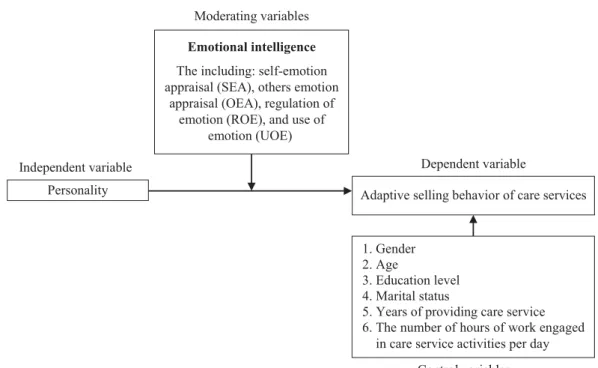
This study focused on exploring the relationship between the independent variable, type A personality, and the dependent variable, ASB of adaptive care services, and discussed the impact of the moderating variable EI on the relationship between type A personality and ASB of care services. Based on the results of the above literature analysis and the purpose of the study, a re- search architecture diagram was drawn, as shown in Figure 3.
Control variables
Personality Adaptive selling behavior of care services
Independent variable Dependent variable
Moderating variables
Emotional intelligence The including: self-emotion appraisal (SEA), others emotion
appraisal (OEA), regulation of emotion (ROE), and use of
emotion (UOE)
6. The number of hours of work engaged in care service activities per day 1. Gender
2. Age
3. Education level 4. Marital status
5. Years of providing care service
Figure 3 Research architecture
As indicated in Figure 3, this study first used gender, age, educational level, marital status, the years of providing care services, and the number of hours of work engaged in care service per day and etc. as control variables. Second, various levels of personality was independent variable, and the ASB of care services was dependent variable. First, whether there is a significant relationship between
the two was verified. Finally, after verifying the relationship between the two, the EI was used as the moderating variable to analyze whether the relationship between the two was regulated by different levels of EI.
1. Sampling Methods and Research Objects
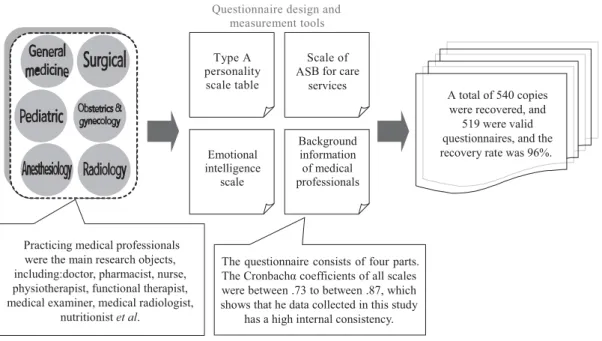
In this study, a questionnaire survey method was used. The scope of research was deter- mined to be the general hospitals as per Paragraph 1, Article 2 of “Standards for Setting Medical Institutions” of Taiwan, which include the six diagnosis and treatment departments of medical, surgical, pediatric, obstetrics and gynecology, anesthesiology and radiology. Practicing medical professionals were the main research objects. In order for the medical professionals (subjects) to fill out the questionnaire clearly and correctly and have a high questionnaire recovery rate, the research team personally went to each hospital to conduct the questionnaire survey. After the medical professionals completed the questionnaire, the questionnaire was recovered on the spot, as shown in Figure 4.
Practicing medical professionals were the main research objects, including:doctor, pharmacist, nurse, physiotherapist, functional therapist, medical examiner, medical radiologist,
nutritionist et al.
Type A personality scale table
Scale of ASB for care
services
Emotional intelligence
scale
Background information of medical professionals Questionnaire design and
measurement tools
A total of 540 copies were recovered, and
519 were valid questionnaires, and the recovery rate was 96%.
The questionnaire consists of four parts.
The Cronbachα coefficients of all scales were between .73 to between .87, which shows that he data collected in this study
has a high internal consistency.
Figure 4 Study design flowchart
Because the questionnaire content involved care related issues, to increase the questionnaire’s recovery rate and reduce the invalid questionnaire, mainly stratified sampling was adopted. It also took into account the representativeness of the sample. There was also an appropriate allocation
for the number of the medical professionals. Questionnaires were distributed according to the pro- portion of the six types of medical professionals, which were 24%, 15%, 13%, 17%, 12% and 19%
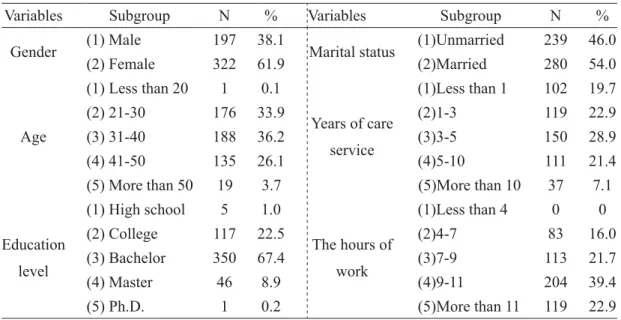
respectively. 540 copies were recovered, and 519 were valid questionnaires, and the recovery rate was 96%. Due to missing values, the total number of background variables varied, and the number distribution was sorted according to background variables as in Table 1.
Table 1 Number distribution of background variables
Variables Subgroup N % Variables Subgroup N %
Gender (1) Male 197 38.1
Marital status (1)Unmarried 239 46.0
(2) Female 322 61.9 (2)Married 280 54.0
Age
(1) Less than 20 1 0.1
Years of care service
(1)Less than 1 102 19.7
(2) 21-30 176 33.9 (2)1-3 119 22.9
(3) 31-40 188 36.2 (3)3-5 150 28.9
(4) 41-50 135 26.1 (4)5-10 111 21.4
(5) More than 50 19 3.7 (5)More than 10 37 7.1
Education level
(1) High school 5 1.0
The hours of work
(1)Less than 4 0 0
(2) College 117 22.5 (2)4-7 83 16.0
(3) Bachelor 350 67.4 (3)7-9 113 21.7
(4) Master 46 8.9 (4)9-11 204 39.4
(5) Ph.D. 1 0.2 (5)More than 11 119 22.9
2. Questionnaire Design and Measurement Tools
The questionnaire consists of four parts, which are the personality scale, the scale of ASB of care services, the EI scale, and the background information of the medical professionals. The Cronbach’s
α
coefficients of all scales were between .73 to between .87, which shows that the data collected in this study has a high internal consistency. The questionnaires for each part are described as follows:2.1 Type A Personality Scale Table
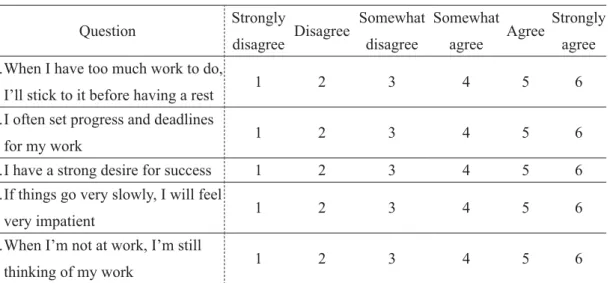
By using the work of Professor Sheng-ying Lii, National Chengchi University and referring to the scale of related research and concepts developed by Friedman, Rosenman, Rosenman, and Chesney, we prepared 20 questions (Lii, 1985; Rosenman, & Chesney, 1980; Friedman, & Rosenman, 1974). The measurement was based on a Likert Six-point Scale, ranging from 1 (strongly disagree) to 6 (strongly agree) (Table 2). In the discussion of type A and type B personality, the median was
used mostly for distinction, because regardless of positive skewness (mean number > median >
mode) or negative skewness (mode > median > mean number), the median is more precise and not subject to extreme values. The main point of this study is to investigate the care behavior of type A personality. Therefore, this research also used this method to first determine the concentration trend of values as a clear demarcation of the personality traits of type A and type B. The higher the score, the more the medical professional tends to be type A personality, which is positive and highly competitive with relatively high achievement desire, but easily gets impatient and anxious.
The lower the score, the more the medical professional tends to be type B personality, which is more patient with less emphasis on competition and a sense of accomplishment.
Table 2 Personality scale
Question Strongly
disagree Disagree Somewhat disagree
Somewhat
agree Agree Strongly agree 1. When I have too much work to do,
Iʼll stick to it before having a rest 1 2 3 4 5 6
2. I often set progress and deadlines
for my work 1 2 3 4 5 6
3. I have a strong desire for success 1 2 3 4 5 6
4. If things go very slowly, I will feel
very impatient 1 2 3 4 5 6
5. When I’m not at work, I’m still
thinking of my work 1 2 3 4 5 6
2.2 Scale of ASB for Care Services
ASB of care services referred to in this study is to further adapt to the perceptions of dif- ferent patients within the ability of the medical staff to meet their the needs of their own care work and service targets. In other words, it is a condition to change the care service sales method de- pending on the situation to meet patients’ needs during the care process. They can try to change themselves to change the patient’s values to create a sales service environment and work environ- ment that helps them, and achieve a good adaptability between themselves and the environment.
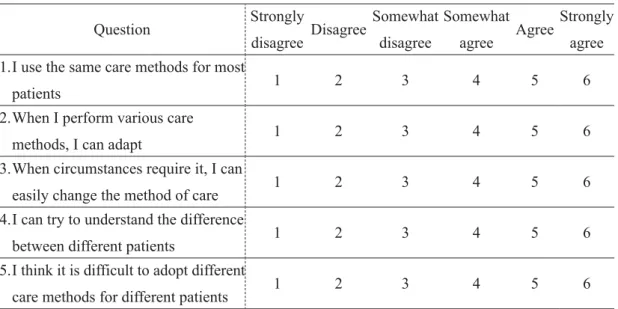
Using the ADAPTS scale developed by Spiro and Weitz, we developed 16 questions (Spiro, & Weitz, 1990). The measurement was based on a Likert six-point scale, ranging from 1 (strongly dis-agree) to 6 (strongly agree). In addition, the 1st, 3rd, 6th, 11th and 14th questions are reversed questions,
* means a reversed question, and the inverse scoring is 1 for strongly agree and 6 for strongly disagree. (Table 3). The higher the score, the more ASB of the care services for the medical pro- fessionals. The lower the score, the less ASB of the care services for the medical professionals.
Table 3 Scale of ASB for care services
Question Strongly
disagree Disagree Somewhat disagree
Somewhat
agree Agree Strongly agree 1. I use the same care methods for most
patients 1 2 3 4 5 6
2. When I perform various care
methods, I can adapt 1 2 3 4 5 6
3. When circumstances require it, I can
easily change the method of care 1 2 3 4 5 6
4. I can try to understand the difference
between different patients 1 2 3 4 5 6
5. I think it is difficult to adopt different
care methods for different patients 1 2 3 4 5 6
Remark: Providing only part of the items to understand its measurement meaning.
2.3 Emotional Intelligence Scale
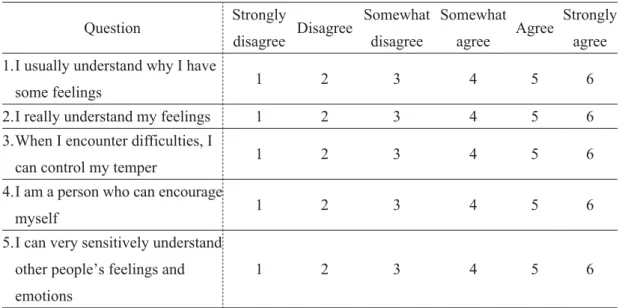
This study developed an EI scale suitable for Chinese people by quoting Wong and Law on the basis of Mayer and Salovey’s architectural study, which includes four factors: self-emotion appraisal (the ability to understands oneself), others emotion appraisal (the ability to understand other people’s emotions, or the ability to predict other people’s emotional responses), regulation of emotion (the ability to quickly return from low mood to normal mood), and use of emotion (be able to control one’s emotions, and keep oneself positive). There are 4 questions for each factor and a total of 16 questions for emotional intelligence scales (WLEIS), which are positive questions (Wong, & Law, 2002; Mayer, & Salovey, 1997). The measurement was based on a Likert six-point scale, ranging from 1 (strongly disagree) to 6 (strongly agree) (Table 4). A higher score indicates higher EI of the medical professionals, and vice versa.
Table 4 Emotional intelligence scale
Question Strongly
disagree Disagree Somewhat disagree
Somewhat
agree Agree Strongly agree 1. I usually understand why I have
some feelings 1 2 3 4 5 6
2. I really understand my feelings 1 2 3 4 5 6
3. When I encounter difficulties, I
can control my temper 1 2 3 4 5 6
4. I am a person who can encourage
myself 1 2 3 4 5 6
5. I can very sensitively understand other peopleʼs feelings and emotions
1 2 3 4 5 6
Remark: Providing only part of the items to understand its measurement meaning.
2.4 Background Information of Medical Professionals
The background information included gender, age, education level, marital status, years of pro- viding care service, and the number of hours of work engaged in care service activities per day, totaling 6 questions.
3. Reliability and Validity
This study used SPSS17.0 Chinese version of statistical software for data analysis. The internal consistency was used for the analysis of the individual scales. If Cronbach’s alpha coefficient value is greater than .7, it indicates high confidence, and if less than .5, it indicates no reliability and must be rejected. Internal consistency analysis was conducted for the medical professionals’ opinions of the “Type A Personality Scale”, “Scale of ASB for Care Services”,
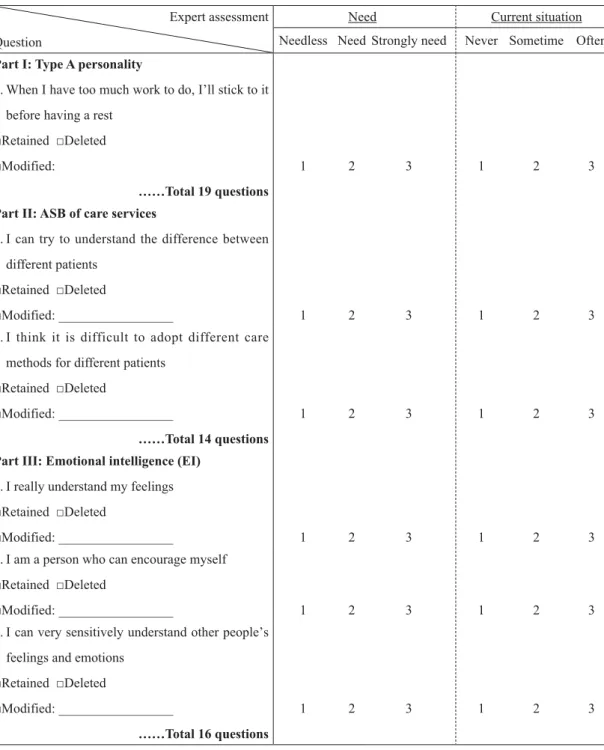
“Emotional Intelligence Scale” and etc., and their Cronbach’s alpha coefficients of the scales were respectively of .873, .736, .822 , all greater than .7, indicating high reliability. This research tool is a structured questionnaire. Regarding the validity of the questionnaire, the relevant do- mestic and foreign research and literature were collected into a first draft, and 5 senior experts and scholars in relevant fields were invited. After the preliminary draft of the questionnaire was com- pleted, experts and scholars were asked to examine the validity of the questionnaire based on the content and suitability of the questionnaire. Based on this, the missing, ambiguous or inappropriate questions
in the questionnaire were updated (Table 5), and 11 questions were revised from the first draft of the questionnaire, to the revised questionnaire to the formal questionnaire. Those questions were unanimously agreed by the experts to ensure the questionnaire content is conducive to research purposes and facilitate the response by the respondents.
Table 5 Questionnaire validity assessment form
Expert assessmentQuestion
Need Current situation
Needless Need Strongly need Never Sometime Often Part I: Type A personality
1. When I have too much work to do, I’ll stick to it before having a rest
□Retained □Deleted
□Modified:
……Total 19 questions
1 2 3 1 2 3
Part II: ASB of care services
1. I can try to understand the difference between different patients
□Retained □Deleted
□Modified: _________________ 1 2 3 1 2 3
2. I think it is difficult to adopt different care methods for different patients
□Retained □Deleted
□Modified: _________________
……Total 14 questions
1 2 3 1 2 3
Part III: Emotional intelligence (EI)
1. I really understand my feelings
□Retained □Deleted
□Modified: _________________ 1 2 3 1 2 3
2. I am a person who can encourage myself
□Retained □Deleted
□Modified: _________________ 1 2 3 1 2 3
3. I can very sensitively understand other peopleʼs feelings and emotions
□Retained □Deleted
□Modified: _________________
……Total 16 questions
1 2 3 1 2 3
Analysis and Results
1. Sample Narrative Statistics
For the samples collected in this study, women accounted for 61.9% of the medical pro- fessionals and men accounted for 38.1%. For the age distribution range, most were from 31-40 years (36.2%), followed by 21-30 years (33.9%). In terms of educational level, college graduates (67.4%) were the most, followed by graduates (22.5%); in terms of marital status, marital status was more evenly distributed (46.0% unmarried and 54.0% married). For the number of years spent on care services, most was 3 to 5 years (28.9%), followed by 1-3 years (22.9%), and for the num- ber of hours of working hours engaged in care services per day, most was 9-11 hours (accounting for 39.4%), followed by more than 11 hours (22.9%).
2. Correlation Analysis between Personal Background Data of Medical Pro- fessionals and Research Variables
The related analysis results showed that, in the research on the pair relationships between the observed indicators of all the variables, it is worth noting that there were positive correlations between the “ type A personality” indicator in the research variable and its corresponding other indicators like “ASB of care services” and “EI”, that is, there was a positive correlation between type A personality and the ASB of care services (r = .24, p < .01), showing that the more the medical professionals tended to be type A personality, the higher the ASB of the care service; type A personality and EI were also positively correlated (r = .22, p < .05), indicating that the more the medical professionals tended to be type A personality, the higher the EI. There was a positive correlation between EI and the ASB of care services (r = .38, p <.05), indicating that the higher the EI of the medical professionals, the higher the ASB of care services.
3. Total Hierarchical Regression of Personality, EI and ASB of Care Services
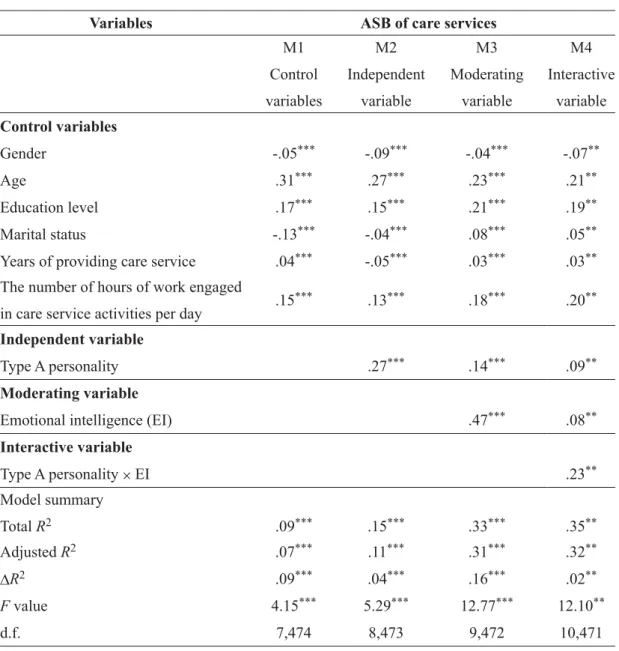
This study was validated by hierarchical regression analysis with SPSS version 17.0 and divided into Mode 1 (control variables), Mode 2 (independent variable), Mode 3 (moderating variable), and Mode 4 (interactive variable). Forced entry variable method was adopted, and each variable was entered into the equation to understand its explanatory power. This study used gender, age, education level, marital status of the medical professionals, their years of providing care services and daily working hours engaged in care service as the control variables, type A personality as the independent variable, and ASB of care services as dependent variable, and they
were sequentially added to the regression model for analysis. The analysis results are shown in Table 6.
Table 6 Related hierarchical regression summary of EI adjustment type A personality and ASB of care services
Variables ASB of care services
M1 Control variables
M2 Independent
variable
M3 Moderating
variable
M4 Interactive
variable
Control variables
Gender -.05*** -.09*** -.04*** -.07**
Age .31*** .27*** .23*** .21**
Education level .17*** .15*** .21*** .19**
Marital status -.13*** -.04*** .08*** .05**
Years of providing care service .04*** -.05*** .03*** .03**
The number of hours of work engaged
in care service activities per day .15*** .13*** .18*** .20**
Independent variable
Type A personality .27*** .14*** .09**
Moderating variable
Emotional intelligence (EI) .47*** .08**
Interactive variable
Type A personality × EI .23**
Model summary
Total R2 .09*** .15*** .33*** .35**
Adjusted R2 .07*** .11*** .31*** .32**
ΔR2 .09*** .04*** .16*** .02**
F value
4.15*** 5.29*** 12.77*** 12.10**d.f. 7,474 8,473 9,472 10,471
*p < .05; **p < .01; ***p < .001
3.1 Explanatory Power of Control Variable to ASB of Care Services
As far as Mode 1 (M1) is concerned, this model was mainly composed of background vari- ables such as gender, age, education level, marital status, years of service engaged in care services, number of working hours engaged in daily care services etc. Those variables first occurred on the samples and were not affected by other explanatory variables. Therefore, in hierarchical regression, they are usually handled by control variables to control the influence of external factors (Chiou, 2010). Table 6 shows that after Mode 1 adjustment, R2 was .07, and F was 4.15, indicating that these background variables had significant explanatory power for the ASB of care services. However, none of the standardized regression coefficients of these background variables (
β
) had significant differences, indicating that a single background variable had no explanatory power for the ASB of care services.3.2 Explanatory Power of Independent Variable to ASB of Care Services
As for Mode 2 (M2), after the personality of the independent variable was put into the model, R2 of the adjusted explanatory power of the model was .11 and F was 5.29. The regression analysis results showed that the “type A personality” had a significant positive effect for “ASB”
of “caring services” (
β
= .27, p < .01). The adjusted R2 was .11, meaning that the adjusted overall model explanatory power was 11%, which means that when the medical professionals had more type A personality, they are more able to make good ASB of care services, so type A personality of medical professionals will positively affect the ASB of care services, the medical professionals of type A personality has a positive influence the ASB of care services. ΔR2, the explanatory power of Mode 2 was .04, indicating the input of type A personality can effectively increase the explanatory power of the model. That is, the increase of Mode 2 had statistical significance, i.e., type A personality can contribute an additional 4% of explanatory power under the influence of the controlled background variables.3.3 Explanatory Power of Moderating Variable (EI) to ASB of Care Services
As for Mode 3 (M3), this model increased the EI of the moderating variable. After the input of this variable into the model, the adjusted R2 of the model explanatory power was .31, and