CHAPTER TWO LITERATURE REVIEW
This chapter gives a general review of the literature on the rationale of reading, the study of reading comprehension tests, the revision of Bloom’s Taxonomy, and the application of Bloom’s Taxonomy on assessment and testing. Four sections are included in this chapter. Section one discusses models of reading, reading skills, and the correlation between the classification of skills and Bloom’s Taxonomy. Section two reviews studies on reading comprehension tests in EFL/ESL contexts and studies of the Scholastic Achievement English Test (SAET) and the Department Required English Test (DRET) reading comprehension item analysis in Taiwan. Section three describes the Revised Bloom’s Taxonomy; while the last section discusses studies related to the operationalization of Bloom’s Taxonomy.
The Rationale of Reading
Of the literature on the nature of reading, comprehension is often assumed as the goal of the reading process or as the product of reading. Despite the fact that reaching the ideal comprehension, i.e., recapturing author’s original meaning, can never be fully achieved, a reader accesses a certain degree of understanding in different reading situations, depending on readers’ background knowledge, interest, goals, language abilities etc. (Urquhart &Weir, 1998). To comprehend a text, that is, to understand textual information and interpret it appropriately, a reader engaged actively in a mental process. Taking a cognitive perspective, the reading process, as Bernhardt (1991) specified, is “an intrapersonal problem-solving task that takes place within the brain’s knowledge structure” (p. 6). Metaphorically, three models: bottom-up model, top-down model, and interactive model, describe the reading processes.
Models of Reading
Bottom-up (or data-driven) model is a sequential model, in which the reader
begins with the printed letters, decodes them to sounds, recognizes them as words and
decodes their meanings, and further proceeds reading in the same manner to the sentence level (Gough, 1972). It emphasizes the recognition and decoding of the text as input and is typically known as a lower-level processing, which represents
automatic linguistic process. Criticisms against this model in both L1 and L2 research and pedagogy in the seventies were influenced primarily by models proposed by Goodman (1967) and Smith (1971), which emphasize the contribution of readers (or the knowledge they bring to the text) to their reading comprehension.
Goodman’s (1967) model is a top-down (or reader-driven) model within which the reader samples the text, makes prediction, confirms his or her guesses, forms new hypothesis, and then samples further (i.e., a cyclical hypothesis verification process).
Reading in this model has been called “a psycholinguistic guessing game.” This approach has a great impact on ESL reading theory and practice. Coady (1979), elaborating on this psycholinguistic model, suggested that reading comprehension involved EFL/ESL readers’ background knowledge, conceptual ability (i.e.,
intellectual capacity), and process strategies (i.e., various subcomponents of reading ability). He claimed that background knowledge might be able to compensate for certain syntactic deficiencies. Related to this view, a quantity of studies have been conducted on the effects of schema—an abstract structure representing concepts stored in the reader’s memory according to schema theory—on both first language comprehension (e.g., Anderson, Reynolds, Schallert & Goetz, 1977; Bransfor &
Johnson, 1972; Freebody & Anderson, 1983; Mandler & Johnson, 1977) and
second/foreign language comprehension (e.g., Carrell, 1983; Hudson, 1982; Johnson, 1981 & 1982). Carrell (1983) proposed two essential kinds of schemata for L2 reading—formal schema, knowledge of language and linguistic conventions, and content schema which refers to knowledge of the world or subject matter of the text.
Currently, the preferred model in both L1 and L2 is the interactive model, which
provides a synthesized view of both bottom-up and top-down reading processes.
Rumelhart (1977) pointed out that several sources such as orthographic, lexical, syntactic, semantic etc provided input simultaneously and interactively in the reading process and ultimately influenced our interpretation of the text. Stanovich (1980) in his proposal of the interactive-compensatory model stated that the reader may try to compensate for deficiencies at one level (e.g., word recognition) by depending more on another, either higher or lower level (e.g., contextual knowledge). This interactive view recognizes both readers’ role, the knowledge they bring to the text, and the role of the written text in reading comprehension.
Grabe (1991) stated that reading was a complex cognitive process and that “a description of reading has to account for the notions that fluent reading is rapid, purposeful, interactive, comprehending, flexible, and gradually developing” (p.378).
By interactive process, he explained that reading involved: (1) the interaction between the reader and the text, suggesting that readers use their background knowledge as well as the information from the text to aid comprehension; and (2) the simultaneous interaction of various skills (e.g., decoding skills and comprehending skills work at the same time). Carrell and Eisterhold (1983) suggested that bottom-up processing ensured that the readers noticed information that was new or that did not
accommodate their prediction or anticipation of the text content or structure, whereas top-down processing helped readers to resolve ambiguities or to select possible interpretation of the incoming information.
Carrell (1988) noted two existing types of skill deficiencies that might influence the efficiency of the interaction between the text-based and knowledge-based
processing in ESL reading: (1) linguistic deficiencies and (2) reading skill deficiencies.
Linguistic competence, on the one hand, has been extensively discussed and viewed
as the fundamental aspect, including skills in decoding the vocabulary and syntactic
structure in text-based processing, in successful English reading (Eskey, 1988). On the other hand, Carrell (1988) in reviewing Spiro’s (1978) research explained that reading skill deficiencies, i.e., lacking either text-based skills (e.g., decoding) or knowledge- based skills (e.g., pragmatic inference), may affect reading comprehension. For example, readers who prefer one particular reading skill such as decoding might only use this skill to solve all problems encountered in reading or escape the problem by shifting to another skill such as making inferences. Problems occur when the decoder receives too much discrete information without higher-level understanding, or when the decoder overtly relies on his or her assumption of the text that causes
misinterpretation. Thus, different from less skilled readers who were likely to
over-rely on one model of processing most of the time, efficient readers shift from one process to another frequently in order to accommodate a certain text or reading
situation.
In simple terms, reading emphasizes an interactive process in which the reader dynamically construct meaning of the text and where various kinds of knowledge and skills are being used such as word decoding skills (through bottom-up processing) and higher-level mental operating skills (through top-down processing). Efficient reading requires the interaction of these two processes.
Reading Skills
Much of what has been described as the components of models could be translated into terms of reading skills, for example, decoding, accessing the lexicon, making inference and so on. “A reading skill can be described roughly as a cognitive ability which a person is able to use when interacting with written text” (Urquhart &
Weir, 1998, p.88). Researchers, teachers, and test writers who believe in the
multi-dimensional nature of reading comprehension assume that reading skills can be
identified, researched, taught and tested (e.g., Chapelle et al., 1997; Dubin et al., 1986;
Grabe, 1991; Weir, 1997; William & Moran, 1989). Many different lists, taxonomies and hierarchies of skills have been developed, yet little consensus of the content or terminologies in those taxonomies can be found (Williams and Moran, 1989). Skills can be identified as the linguistic elements of the text (Munby, 1978), different
knowledge areas (Grabe, 1991), different levels of textual understanding (Gray, 1960), or even a hierarchy of skills and sub-skills, specifically related to Benjamin Bloom’s
“Taxonomy of Educational Objectives: Cognitive Domain” (Adams-Smith, 1981).
This view has been criticized by Alderson (2000), who views reading as a unitary entity, claiming that firstly, there is a lack of empirical evidence to illustrate
identifiable skills in reading; secondly, skills are more or less ill defined, overlapping, and the concept of the reading skills will mislead audiences that reading can be divided into discrete components; thirdly, judges are unable to agree on which item tests which skill; and finally, analysis of the test result does not show separately on each skill. Nonetheless, the claim of the unitary view of reading comprehension is far from conclusive to prove reading skills do not exist.
Since reading can be considered as a cognitive activity that takes place in the reader’s mind, it can also represent a problem-solving process in which the reader applies skills or strategies to resolve difficulties in reading. The present study, taking a cognitive-processing-oriented viewpoint (i.e., reading involves different levels of cognitive abilities), attempts to employ the Revised Bloom’s Taxonomy of Educational Objectives (Anderson & Krathwohl, 2001) as the coding scheme to explore what cognitive skills were measured in the reading comprehension test items on the Scholastic Achievement English Test (SAET) and the Department Required English Test (DRET) in Taiwan.
Reading Skills and Bloom’s Taxonomy
Studies related to the use of Bloom’s Taxonomy in categorizing reading skills
reveal that the taxonomy is adequate for evaluating reading comprehension objectives, students’ reading abilities, and designing classroom questions, material, and test items (Adams-Smith, 1981; Beatty, 1975; Costin, 1986). Beatty (1975) believed that the Bloom’s Taxonomy (Bloom, 1956) solved the problems of selecting the reading comprehension objectives, the sequence of those objectives, and the confusion of different definitions for a reading skill. He argued that skill such as finding the main idea defined by different authors could involve either a lower-level processing (when the main idea is in the topic sentence, which can be easily identified) or higher-level processing (when the main idea has to be implied), and Bloom’s Taxonomy could describe these differences while classifying skills. Beatty adapted the categories in the Bloom’s Taxonomy published in 1956 (comprises six categories: Knowledge,
Comprehension, Application, Analysis, Synthesis, and Evaluation) by firstly renaming the Knowledge category into Recall with subcategories—recall of specifics, recall of conventions, and recall of trends, which he thought was more representative to the process of comprehending rather than what was comprehended. Beatty excluded some categories that he considered irrelevant to reading and added three categories,
Translation, Apprehension, and Extrapolation, in place of the Comprehension category. Beatty further demonstrated how specific comprehension skills fit into Bloom’s classification. Skills such as finding facts (recall of specific), finding the main idea stated explicitly in the topic sentence (recall of conventions), and retaining concepts (recall of trends) could be categorized into Recall. Translation category included skills like interpreting figurative language; Apprehension category involved identifying theme, finding main idea not stated in topic sentence, or writing a
summary; and skills such as inferring, drawing conclusions, predicting outcomes went
to Extrapolation category. Application level comprised skills that required learners to
apply an idea from a selection to a different situation. Analysis category included
skills like recognizing assumptions, distinguishing relevant and irrelevant information (analysis of elements), showing how details relate to the main idea (analysis of
relationships), and identifying author’s purpose or point of view (analysis of
organizational principles). Reading skills such as making comparison and contrasts, making analogies, or writing a synthesis of a passage belonged to Synthesis category, whereas skills of judging relevancy/significance, forming own opinion, or using evidence to support opinion were at Evaluation level. Beatty suggested that reading teachers refer to the scheme and use it to teach comprehension skills.
In more recent research, Surjosuseno and Watts (1999) discussed how EFL reading teachers could use the cognitive process domain of Bloom’s Taxonomy to promote learners’ critical reading abilities. By comparing the categories in the taxonomy with various critical reading skills (proposed by Paul, 1993; Flynn, 1989;
Cheek, Flippo and Lindsey,1989; Hickey, 1988; and Rubin, 1982) and instructional strategies of critical reading (proposed by Singh, Chirgwin and Elliott, 1997; and Karlin, 1980), they found that even though there were a variety of names and definitions to describe critical reading abilities, abilities like analysis, synthesis, and evaluation, which required higher order thinking, could be found among studies and fit into Bloom’s classification. Surjosuseno and Watts maintained that all six levels of Bloom’s Taxonomy with a slight modification could be useful as a planning tool for teaching critical reading in EFL classes.
Lately, interest in the development of critical reading skills or abilities draws our
attention to the study of reading and thinking. Advocates of critical reading suggest
that reading critically involves readers actively interact with the written text. Abdulah
(1994, cited in Alderson, 2000), for example, indicated that critical reading sub-skills
included skills such as evaluate deductive and inductive references, recognize hidden
assumptions or author’s motives, or evaluate the strength of arguments. These critical
reading abilities are major goals of the SAET and the DRET test design and are essential abilities for a college student (objectives extracted from CEEC website).
Adams-Smith (1981), who adapted Bloom’s Taxonomy in designing questions at each level for ESP (English for Specific Purposes) classes, stated that college students needed skills like problem solving, deductive thinking, and evaluation, and that Bloom’s Taxonomy can be a useful scheme for English language teachers to develop materials to help students learn to think. Therefore, Bloom’s Taxonomy is selected as the framework for test item analysis in the present study.
Testing Reading in the EFL/ESL Context
Testing reading in EFL/ESL contexts focused on the test methods in the early 1980s, and then the concern of testing reading had shifted from how to what to test in late 80s (Weir, 1997). Among various test formats, multiple-choice questions
(henceforth MCQs) were widely used in testing reading comprehension, whereas some researchers have made unfavorable comments on the use of multiple-choice questions. Using multiple-choice questions as a test technique allows more items to be tested in a given period of time; it is a rapid and reliable scoring, and it tests receptive skills without asking examinees to produce written language. A major problem is that questions providing possible answers might affect the test results. It is hard to know whether the failure of certain questions is due to the lack of comprehension of the text or of the question (Weir, 1990). The strongest criticism of multiple-choice reading comprehension tests is the problem of passage-independent (Bernhardt, 1991; Teale &
Rowley, 1984). Teale and Rowley (1984) questioned the validity of the test items when examinees could answer the question without referring to the reading text.
Additionally, the training of test taking techniques can improve students’ scores rather
than their language ability. Test taking strategies would mislead students to the surface
feature of the text rather than to its embedded deeper meaning (Nevo, 1989; Weir,
1990). Irrespective of these comments, issues of what MCQs actually measure and of whether they are valid measurements have become the major focus for debate of the MCQs reading tests (Cummings, 1982; Farr, Pritchard & Smitten, 1990; Hughes, 2003; Weir, 1997; Weir & Urquhart, 1998). Farr et al. (1990) stated that “the types of questions that follow a reading selection will determine if the reading selection focuses on only the surface meaning of the text or on other—perhaps
deeper—comprehension,” and that developing questions tapping important elements of the text “enhance the validity of the test” (p.224).
Validity is one of the major considerations in language test design. It is “the appropriateness of a given test or any of its component parts as a measure of what it is purported to measure” (Henning, 1987, p. 89). McNamara (2000) explained that “the purpose of validation in language testing is to ensure the defensibility and fairness of interpretations based on test performance” (p.48). A test is valid when it measures what it is supposed to measure. Among several kinds of validity, construct validity and content validity play crucial roles on the decision of test validity (Alderson et al., 1995; Bachman, 1990; Bachman & Palmer, 1996; Davies, 1990; Henning, 1987;
Hughes, 1989; McNamara, 2000; Weir, 1990).
Construct validity refers to the degree to which an instrument measures an
intended hypothetical construct. It is how well you translated your ideas or theories
into actual measurement. The word construct, as defined by Ebel and Frisbie (1991),
is “a psychological construct, a theoretical conceptualization about an aspect of
human behavior that cannot be measured or observed directly.” Hughes (1989)
defined construct in language testing as “any underlying ability (or trait) that is
hypothesized in a theory of language ability” (p. 31). Hence, the construct of reading
is based on models of reading, which may translate into various skills and factors that
affect reading.
In Weir’s (1997) four-level version of reading comprehension for testing
purposes (i.e., reading expeditiously for global comprehension, reading expeditiously for local comprehension, reading carefully for global comprehension, and reading carefully for local comprehension), skills such as locating or identifying a specific phrase are micro-skills operated while reading at local levels, whilst finding the main theme and making inference are seen as macro-skills while reading at global levels.
Both micro-skills like word recognition and macro-skills like inferring or evaluating need to be tested.
As mentioned in the previous section, researchers holding the view of multi-dimensional nature of reading attempted to design questions to test the underlying skills and sub-skills required in different levels of understanding of the text. Nonetheless, researchers disapproving the multi-dividable nature of reading challenged the accountability of test items intended to assess different reading abilities, claiming that it was not possible to differentiate which reading ability component was tested in which language test item, either through empirical demonstration or through the judgment of experts (Alderson, 1990; Alderson &
Lukmani, 1989; Carver, 1992; Lunzer et al., 1979; Rosenshine, 1980; Rost,1993).
Despite claims that it is hard to demonstrate various reading skills do exist in the previous studies, it is also hard to demonstrate that they do not. And if there are no distinguishable components in reading, it should not really matter how we test it or what we try to test.
Reading Comprehension Test Item Analysis
Content validity is one of the forms that provide evidence for construct validity— “whether or not the content of the test if sufficiently representative and comprehensive for the test to be a valid measure of what it is supposed to measure”
(Henning, 1987, p. 94). If we are going to assess a student’s reading ability, a test with
content validity will contain items that measure, for example, a variety of reading (sub) skills, which are parts of the construct of reading ability. Thus, whether a test of
reading comprehension does have the content validity has been a main concern for researchers or teachers who want to ensure what is actually tested in each item.
Research on English reading comprehension tests, specifically on standardized tests, has received great interest in EFL setting in Taiwan. Testing plays a vital role in English learning and teaching especially on secondary education because test results usually bring consequences to students’ future, they determine whether students can continue studying in higher education or which school to enter. Research reports on test content analysis and statistical analysis (e.g., the number of items and distribution, length of text, vocabulary, topics, discriminatory power, and examinees’ test
performances) of both SAET and DRET subject tests have been conducted annually by the College Entrance Examination Center (CEEC Web site; Huang, 1994; Jeng 1992; Jiang & Lin, 1999; Xu & Lu, 1998). Huang (1994) presented a qualitative analysis of the Joint College Entrance Examination (henceforth JCEE, renamed as DRT in 1992) English test items from 1985 to year 1994. The results of the reading comprehension item analysis showed that over 90% of the items were well written, yet a few were not. Some items were found to test examinees’ vocabulary and grammatical knowledge rather than their reading abilities. He indicated that items on vocabulary and grammar that could be answered without referring back to the text should be excluded and items that involved arithmetic should be designed with caution. Xu and Lu (1998) researched the topics, text length, syntactic complexity, vocabulary, distractors, and question types on the JCEE English test content in 1998.
They reported that reading comprehension test items could usually be classified into
four types: vocabulary, main idea, detail, and inference questions. Yet, they did not
further identify those elements item by item or examine the frequency and distribution
of different items. These studies give an overview of the overall test construction or the statistical results rather than a thorough report on the reading skills tested on each comprehension item in particular.
Recently, two studies (Lu, 2002; Hsu, 2005) used Mo’s (1987) classification to analyze the reading comprehension test items on the SAET and the DRET in Taiwan.
Mo (1987) proposed that a reading test should include questions requiring test takers to clarify the organization of the text and questions of textual comprehension. He excluded skills such as reading speed, habit, and pleasure that were unrelated to the text structure and then classified reading skills into six main categories: (1)
identifying the main idea, (2) finding specific details mentioned in the passage, (3) finding implications and drawing inferences and conclusions from the text, (4) recognizing style and tone, (5) determining the special techniques used by the author to achieve his effect
1, and (6) determining the meaning of strange words or phrases as used in the test.
Lu (2002) conducted both qualitative and quantitative analyses of the reading comprehension test items on SAETs from 1995 to 2002. Qualitatively, she classified items into Mo’s six question types, and examined textual materials, examinees’
passing rates on each question type, test variables that affected those passing rates, and discrimination index, etc; whereas quantitatively, she computed the frequency distribution of question types and the correlation between question types and passing rates. Results indicated that the most common question type was items on details, followed by items on inference, main idea, style/tone, organization, and word
meaning. Generally, the examinees performed best on word meaning items, followed
1This question type refers to items that test examinee’s ability to recognize the organization of the passage or writing techniques used by the author. Techniques are those that used to develop paragraphs, such as the use of details, examples, cause and effect, comparison, definition and so on. Example questions are: in what way does the writer present the passage, the author supports his argument by…, etc.
by main idea, detail and inference items, whilst they performed worst on the
style/tone and the organization items. High achievers performed better on detail items followed by inference items, while low achievers failed on these two types of
questions probably owing to their lack of linguistic knowledge (for they even failed to answer detail items even when the information was clearly stated) and summarizing and synthesizing abilities. Comprehending difficulties occurred when questions required readers to use higher-order reading processes, such as synthesizing numerous details needed to reach the correct answer. Also, lengthy articles dealing with
unfamiliar topics inhibited understanding.
Hsu (2005), applying the same coding scheme, analyzed reading comprehension test items taken from 2001 JCEE (renamed as DRT in 2002) English test and 2002 to 2004 DRET. The themes of the texts and text variables that accounted for item difficulty were also investigated. Different from Lu’s study, she examined the use of words in the chosen texts by comparing to the Word List published by the DRT, and examined the performances of 76 Grade II students (divided into the high-proficiency group, the middle-proficiency group, and the low-proficiency group) from two
different classes in a high school in Kahohsiung city on question types, instead of directly computing the passing rates of examinees taking those tests. Eighteen passages on the 2000-2004 DRET tests were given to those students during a
ten-week time frame. Similar to Lu’s (2002) study, it was found that items on details were the most frequent. Likewise, examinees performed well on items tested
micro-skills like determining the meaning of words and finding specific details, whereas they performed worst on questions of drawing inferences, which required higher level processing.
The present study, different from pervious studies on test items analysis using
Mo’s classification of reading skills or other methods, attempts to employ the Revised
Bloom’s Taxonomy, which presents a hierarchy of cognitive processes (skills) (i.e., skills are arranged from simple to complex, and from lower-levels to higher-levels), to analyze the reading comprehension multiple-choice questions qualitatively and
quantitatively on both SAETs and DRETs in Taiwan from 2002 to 2006.
Revision of Bloom’s Taxonomy
The Taxonomy for Educational Objectives: Cognitive Domain (Bloom, et al., 1956), typically referred to Bloom’s Taxonomy, was published by Bloom and his associates in 1956 and has been used in various ways in education. In year 2001, Anderson and Krathwohl proposed a revision for the original Taxonomy. The revised Taxonomy attempts to help teachers and educators in at least four ways: (a) to analyze the objectives of a unit/syllabus/curriculum, (b) to improve instruction (Anderson, 2002; Hoff, 200l; James, 2002), (c) to construct or validate assessment tool, and (d) to align curriculum (Anderson, 2002).The following sections discussed the original framework, the revised Taxonomy, the differences between those two, and studies related to the application of the Taxonomy.
The Original Bloom’s Taxonomy
The original classification includes six major categories in the Cognitive Domain:
Knowledge, Comprehension, Application, Analysis, Synthesis, and Evaluation (see Table 1 for the structure of the original Taxonomy). Except for the Application category, each of these categories contains subcategories.
The categories above Knowledge level were labeled as abilities and skills. The
structure of the original taxonomy was assumed to present a cumulative hierarchy,
that is to say, the categories were arranged from simple to complex and from concrete
to abstract, while mastery of each simpler category was prerequisite to mastery of the
next more complex one (Krathwohl 2002; Krietzer et al., 1994). One of the most
frequent use of the taxonomy has been to examine the adequacy of curricular
objectives and test items
Table 1. Structure of the Original Taxonomy 1.0 Knowledge
1.10 Knowledge of specifics
1.11 Knowledge of terminology 1.12 Knowledge of specific facts
1.20 Knowledge of ways and means of dealing with specifics 1.21 Knowledge of conventions
1.22 Knowledge of trends and sequences
1.23 Knowledge of classifications and categories 1.24 Knowledge of criteria
1.25 Knowledge of methodology
1.30 Knowledge of universals and abstractions in a field 1.31 Knowledge of principles and generalization 1.32 Knowledge of theories and structures 2.0 Comprehension
2.1 Translation 2.2 Interpretation 2.3 Extrapolation 3.0 Application 4.0 Analysis
4.1 Analysis of elements 4.2 Analysis of relationships
4.3 Analysis of organizational principles 5.0 Synthesis
5.1 Production of a unique communication
5.2 Production of a plan, or proposed set of operations 5.3 Derivation of a set of abstract relations
6.0 Evaluation
6.1 Evaluation in terms of internal evidence 6.2 Judgments in terms of external criteria
Note. Adopted from A revision of Bloom’s taxonomy: An overview, by D.R.
Krathwohl, 2002, Theory Into Practice, 41(4), 213.
Krathwohl (2002) indicates that Bloom saw the original Taxonomy as more than
a measurement tool, as it could serve as a
‧ common language about learning goals to facilitate communication across persons, subject matter, and grade levels;
‧ basis for determining for a particular course or curriculum the specific meaning of broad educational goals, such as those found in the currently prevalent national, state, and local standards;
‧ means for determining the congruence of educational objectives, activities, and assessments in a unit, course, or curriculum; and
‧ panorama of the range of educational possibilities against which the limited breadth and depth of any particular educational course or curriculum could be contrasted.
(Krathwohl, 2002, p.212) However, several weaknesses and practical limitations could be found in the original Taxonomy. One of the major problems is the cumulative hierarchy structure (Furst, 1994). For example, some demands for the Knowledge categories are more complex than certain demands for Analysis or Evaluation levels, and Evaluation is not more complex than Synthesis (which involves evaluation) (Krietzer et al., 1994).
The Revised Bloom’s Taxonomy
A focus on meaningful learning, a constructivist view point, is recognized as a crucial educational goal these days. In constructivist learning, students engage in active cognitive processing, being actively and mentally constructing the meaning of their selective information by integrating the information with their existing
knowledge (Mayer, 2002). Educators thus need to emphasize what learners know (knowledge) and how they think (cognitive process). The former (i.e., the knowledge they acquired) helps the teachers know what to teach, while the latter (i.e., their cognitive process) tells the teacher how to help learners retain and then transfer the knowledge they have learned. Additionally, instructional objectives are usually formulated in a verb-noun form, which typically consist of a noun or noun phrase—the subject matter content, and a verb or verb phrase—the cognitive
processes (cf. In the original Taxonomy, the Knowledge category embodies both noun
and verb aspects. This differentiates the Knowledge category, which is
dual-dimensional, from the other five that are unidimensional, and thus brought confusion to its structure). Consequently, based upon the beliefs above, in the revised version of Bloom’s Taxonomy, Anderson and Krathwohl (2001) divided the
framework into two dimensions—the knowledge dimension and the cognitive process dimension.
The Knowledge Dimension
The knowledge categories of the revised Taxonomy, similar to the original Taxonomy, cut across subject matter lines. The knowledge dimension contains four major types of knowledge with subtypes under each category—factual knowledge, conceptual knowledge, procedural knowledge, and metacognitive knowledge (a new category to the original).
Factual Knowledge is the knowledge of discrete, isolated content elements, the basic elements of certain discipline. It contains (1) knowledge of terminology, including knowledge of specific verbal and nonverbal labels and symbols (e.g., knowledge of alphabet, vocabulary, terms), and (2) knowledge of specific details and elements (e.g., knowledge of events, locations, people or the source of information etc). In contrast, Conceptual Knowledge refers to knowing how basic elements are interrelated or interconnected in a larger structure and how these parts function together (e.g., schemas, mental models, and theories). It includes (1) knowledge of classifications and categories (e.g. knowledge of the parts of sentences, the variety of types of literature), (2) knowledge of principles and generalizations (e.g., knowledge of major generalizations about particular cultures, the principles involved in learning).
The third category is Procedure Knowledge, which refers to the knowledge of
how to do something. That something could be completing a routine task or a new
task. Procedure knowledge includes knowledge of skills, algorithms, techniques and
methods (which are more subject specific), known as procedures of a series of steps to
follow. Procedure knowledge also includes knowledge of the criteria used to decide when to use certain procedure. Subtypes in this category are: (1) knowledge of subject-specific skills and algorithms (e.g., knowledge of skills for spelling words in English); (2) knowledge of subject-specific techniques and methods (e.g., knowledge of research methods relevant to the social science), and (3) knowledge of criteria for determining when to use appropriate procedures (e.g., knowledge of the criteria for determining which method to use in solving algebraic equations).
The fourth new category, Metacognitive Knowledge, involves knowledge about cognition in general as well as awareness of and knowledge of one’s own cognition.
Metacognitive Knowledge contains three subcategories: (1) strategic knowledge that
shows both what strategies to use and how to use them (i.e., knowledge for general
strategies for learning, thinking, and problem solving, such as knowledge for rehearsal
of information as a learning strategy to retain the information); (2) knowledge about
cognitive tasks, including contextual and conditional knowledge (i.e., knowing when
and why to use these strategies under different circumstance, for example, knowing
that strategies like summarizing and paraphrasing can result in deeper levels of
comprehension); and (3) self-knowledge (Flavell, 1979), which includes knowledge
of one’s strengths and weaknesses relating to cognition and learning, awareness of
different types of strategies to use in different situations, and motivational beliefs
(Pintrich & Schunk, 1996). This knowledge is unique and varies from person to
person; hence it is difficult to measure metacognitive knowledge through paper-pencil
measurement. It may be best assessed in the context of classroom activity or strategy
instruction. Table 2 is the structure of the knowledge dimension.
Table 2. Structure of the Knowledge Dimension of the Revised Taxonomy A. Factual Knowledge—The basic elements that students must know to be
acquainted with a discipline or solve problems in it.
Aa. Knowledge of terminology
Ab. Knowledge of specific details and elements
B. Conceptual Knowledge—The interrelationships among the basic elements within a larger structure that enable them to function together.
Ba. Knowledge of classifications and categories Bb. Knowledge of principles and generalizations Bc. Knowledge of theories, models, and structures
C. Procedural Knowledge—How to do something; methods of inquiry, and criteria for using skills, algorithms, techniques, and methods.
Ca. Knowledge of subject-specific skills and algorithms Cb. Knowledge of subject-specific techniques and methods
Cc. Knowledge of criteria for determining when to use appropriate procedures
D. Metacognitive Knowledge—Knowledge of cognition in general as well as awareness and knowledge of one’s own cognition.
Da. Strategic knowledge
Db. Knowledge about cognitive tasks, including appropriate contextual and conditional knowledge
Dc. Self-knowledge
Note. Adopted from A revision of Bloom’s taxonomy: An overview, by D.R.
Krathwohl, 2002, Theory Into Practice, 41(4), 214.
The Cognitive Process Dimension
Two of the most important educational goals are to promote retention and transfer. The revised Taxonomy encompasses also six cognitive process
categories—one relates closely to retention (i.e., Remember) and the other five relate
increasingly to transfer (i.e., Understand, Apply, Analyze, Evaluate, and Create). Each
of these main cognitive skills includes subcategories. The structure of the cognitive
process dimension is presented in Table 3.
Table 3. Structure of the Cognitive Process Dimension of the Revised Taxonomy 1.0 Remember—Retrieving relevant knowledge from long-term memory 1.1 Recognizing
1.2 Recalling
2.0 Understand—Determining the meaning of instructional messages, including oral, written and graphic communication.
2.1 Interpreting 2.2 Exemplifying 2.3 Classifying 2.4 Summarizing 2.5 Inferring 2.6 Comparing 2.7 Explaining
3.0 Apply—Carrying out or using a procedure in a given situation.
3.1 Executing 3.2 Implementing
4.0 Analyze—Breaking material into its constituent parts and detecting how the parts relate to one another and to an overall structure or purpose.
4.1 Differentiating 4.2 Organizing 4.3 Attributing
5.0 Evaluate—Making judgments based on criteria and standards.
5.1 Checking 5.2 Critiquing
6.0 Create—Putting elements together to form a novel, coherent whole or make an original product.
6.1 Generating 6.2 Planning 6.3 Producing
Note. Adopted from A revision of Bloom’s taxonomy: An overview, by D.R.
Krathwohl, 2002, Theory Into Practice, 41(4), 215.
Remember. Remember involves retrieving relevant knowledge from long-term
memory. Remembering knowledge is essential for meaningful learning and problem solving in a larger and more complex task, including recognizing and recalling.
Recognizing (also called identifying), the first subcategory of Remember, involves
locating knowledge in long-term memory to compare it with the present information.
Learners would be asked to identify or recall the knowledge they have learned in the assessment. A corresponding test format would be true or false questions or
multiple-choice questions. The second subcategory, Recalling (also called retrieving), involves retrieving relevant knowledge from long-term memory.
Understand. Understand refers to constructing meaning from the oral, written or
graphic messages by integrating the new information with their prior knowledge.
Cognitive processes in the category of Understand include interpreting, exemplifying, classifying, summarizing, inferring, comparing, and explaining. (1) Interpreting (also called clarifying, paraphrasing, representing, or translating) takes place when a student is able to convert information from one form of representation to another.
Interpreting may involve words to words converting (e.g., paraphrasing), pictures to words, number to words or vice versa. (2) Exemplifying (also called illustrating or instantiating) occurs when a student can find or give a specific example or instance of a general concept or principle. (3) Classifying (also called categorizing or subsuming) occurs when a student determines that something belongs to a certain category. (4) Summarizing (also called abstracting or generalizing) occurs when a student expresses the general idea of a presented information in a short form. (5) Inferring (also called concluding, extrapolating, interpolating, or predicting) involves drawing a logical conclusion from presented information. (6) Comparing (also called contrasting, mapping, or matching) involves examining similarities or differences between two or more objects, events, ideas, problems, or situations. (7) Explaining (also called constructing models) occurs when a student mentally constructs and uses a cause-and-effect model of a system.
Apply. Apply (closely related to procedural knowledge) involves carrying out or
using a procedure to do an exercise or solve problems through executing or
implementing. Executing (also called carrying out) occurs when a student uses a procedure to a familiar task (i.e., doing an exercise). Implementing (also called using) occurs when a student applies one or more procedures to an unfamiliar task (i.e., solving a problem). Unlike Executing, when implementing a task, students not only apply a procedure but also rely on conceptual understanding of the problem and procedure.
Analyze. Analyze involves breaking material into its constituent parts and
determining how the parts are related to each other and to an overall structure. This category includes the cognitive processes of differentiating, organizing, and
attributing. Differentiating (also called discriminating, selecting, distinguishing, or focusing) occurs when a student determines the relevant or important parts of a message. Organizing (also called finding coherence, integrating, outlining, parsing, or structuring) involves determining how elements fit or function within a structure.
Attributing (also called deconstructing) occurs when a student is able to determine the underlying purpose like author’s point of view, biases, values, or intent in the
presented material.
Evaluate. Evaluate refers to making judgments according to criteria and
standards through checking (i.e., judgments about internal consistency) and critiquing (judgments based on external criteria). The criteria frequently used are quality,
effectiveness, efficiency, and consistency. Checking (also called coordinating,
detecting, monitoring, or testing) involves detecting inconsistencies or fallacies within
a process or product, examining the internal consistency of the process or product or
the effectiveness of a procedure. Critiquing (also called judging), the core for critical
thinking, involves detecting inconsistencies between a product or operation and some
external criteria, by examining the external consistency of a product, or by judging the
adequacy of a procedure for a given problem.
Create. Create is the process of putting elements together to form a coherent or
functional whole, or to form a new pattern or structure (which involves originality and creativity). Objectives classified as Create involve having students produce an
original product. Subcategories in Create are generating, planning, and producing.
Generating (also called hypothesizing) refers to inventing alternative hypotheses based on criteria. A student is required to produce an alternative solution for a problem. Planning (also called designing) involves inventing a method or a plan for accomplishing some tasks, for example, a student can break a task into smaller tasks to be performed when solving the problem. Producing (also called constructing) involves carrying out a plan for solving a given problem that meets the description of a goal, or creating or inventing a product.
The Taxonomy Table
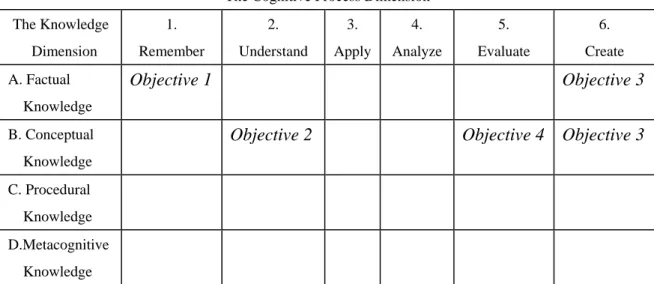
In the revised Taxonomy, a two-dimensional table (termed as the Taxonomy Table) is constructed. The knowledge dimension forms the vertical axis of the table, while the cognitive process dimension forms the horizontal axis. The intersections of the knowledge and the cognitive process categories form the cells. Objectives,
activities, or assessments can thus be analyzed and accordingly placed in either one of these cells. Anderson & Krathwohl (2001) demonstrated the use of the Taxonomy Table by teachers in different subjects. One of the examples was provided by Ms.
Airasian, a fifth grade teacher who described a classroom unit in which she integrated history of pre-revolutionary war with a persuasive writing assignment. Table 4
presents the placement of those four objectives in her history lesson.
The Taxonomy Table reinforces the idea of the original Taxonomy that different
types of objectives require different types of assessments (regardless of the subject
area), whereas similar types of objectives need similar types of assessments. The
dual-dimension in the taxonomy draws our attention to assess the higher-level
Table 4. An Example of Objectives Classification into the Taxonomy Table
The Cognitive Process Dimension The Knowledge
Dimension
1.
Remember
2.
Understand 3.
Apply
4.
Analyze
5.
Evaluate
6.
Create A. Factual
Knowledge
Objective 1 Objective 3
B. Conceptual Knowledge
Objective 2 Objective 4 Objective 3
C. Procedural Knowledge D.Metacognitive
Knowledge
Note. From A taxonomy for learning, teaching, and assessing: A revision of Bloom’s educational objectives (p.174), by L.W. Anderson,& D.R. Krathwohl (Eds.), 2001,
New York: Longman.
Objective 1= Remember the specific parts of the Parliamentary Acts
Objective 2=Explain the consequences of the Parliamentary Acts for different colonial groups Objective 3=Choose a colonial character or group and write a persuasive editorial stating his/her/its position on the Acts
Objective4=Self and peer edit the editorial
processing, the importance of assessing metacognitive knowledge, and the need of new assessing techniques to tap those two. Airasian & Miranda (2002, p. 253) concluded that “using the Taxonomy Table to increase the alignment of school-wide or district-wide curriculum and instruction with state standards and state-mandated assessments will enable teachers to focus on the standards without ‘teaching to the test.’”
Differences Between the Original and the Revised Taxonomy
The revision of the Taxonomy contains twelve changes in total: four changes in emphasis, four in terminology, and four in structure (Anderson & Krathwohl, 2001).
(1) Changes in emphasis include focusing on the Taxonomy in use (i.e., the
application of the taxonomy in planning curriculum, instruction, assessment and the
alignment of the three): aiming at broader audience, particularly teachers at all grade levels; including more sample assessment tasks (rather than including model test items only) to clarify meaning in categories; and emphasizing the subcategories. (2) Changes in terminology consist of changing the major category titles into verbs to be consistent with how objects are formed (i.e., a verb-noun relationship): renaming and reorganizing the Knowledge subcategories into a new dimension—the knowledge dimension that includes factual, conceptual, procedural, and metacognitive knowledge;
replacing the nouns in the subcategories in the cognitive process by verbs; and re-titling the Comprehension (to Understand) and Synthesis (to Create) (i.e., from noun to verb). (3) Changes in structure involve separating the noun and verb components in objective into two dimensions: constructing the Taxonomy Table of these two dimensions as the analytical tool; restructuring the cognitive process categories from simple to complex, yet eliminating the idea of cumulative hierarchy;
and changing the order of Create (originally Synthesis) and Evaluate (originally Evaluation).
Application of Bloom’s Taxonomy
2Bloom’s Taxonomy has been widely used in objectives setting/evaluation, instruction and assessment design/evaluation, or the curriculum alignment cutting across subject areas, e.g., computer science, economics, mathematics, and language learning (Adam-Smith, 1981; Aviles, 1999, 2000, 2001; Bissell & Lemons, 2006;
Chen, 2004; Costin ,1986; Granello, 2001; Hoeppel, 1980; Karns, Burton, & Martin, 2001; Lee, 2004). Within the extensive literature on various disciplines, however, comparatively little research has focused on the application of the Taxonomy in EFL
2 Studies that applied the original Taxonomy are: Adam-Smith, 1981; Aviles, 1999; Bissell & Lemons, 2006; Buckles & Siegfried, 2006; Costin ,1986; Granello, 2001; Karns, Burton, & Martin, 2001; David, 2002a; David, 2002b; Frisbie, Miranda, & Baker, 1993; Hoeppel, 1980; Squire, 2001; while those that used the revised Taxonomy are: Chen, 2004; Lee, 2004; Liu, 2004.