Hole-doping effect on the thermoelectric properties and electronic structure of CoSi
C. S. Lue,1,*Y.-K. Kuo,2,†C. L. Huang,1and W. J. Lai1
1Department of Physics, National Cheng Kung University, Tainan 70101, Taiwan
2Department of Physics, National Dong Hwa University, Hualien 97401, Taiwan 共Received 3 December 2003; published 23 March 2004兲
We report the effect of Al substitution on the temperature-dependent electrical resistivity, Seebeck coeffi- cient, as well as thermal conductivity in the binary compound cobalt monosilicide. It is found that the substi- tution of Al onto the Si sites causes a dramatic decrease in the electrical resistivity and lattice thermal conductivity. A theoretical analysis indicated that the reduction of lattice thermal conductivity arises mainly from point-defect scattering of the phonons. For x⭓0.05 in the CoSi1⫺xAlx system, the Seebeck coefficient changes sign from negative to positive, accompanied by the appearance of a broad maximum. These features are associated with the change in the electronic band structure, where the Fermi level shifts downwards from the center of the pseudogap due to hole-doping effect. While the thermoelectric performance improves with increasing Al substitution, the largest figure-of-merit ZT value among these alloys is still an order of magnitude lower than the conventional thermoelectric materials.
DOI: 10.1103/PhysRevB.69.125111 PACS number共s兲: 72.15.Eb, 72.15.Jf, 71.20.Be
I. INTRODUCTION
Transition-metal silicides with semiconducting or semi- metallic properties have attracted considerable attention due to their practical applications in electronics and thermoelectrics.1,2 Cobalt monosilicide CoSi has been re- ported to be one of the promising candidates for advanced thermoelectric applications.3,4 Previous transport studies on this compound indicated that CoSi is a semimetal with the room-temperature electrical resistivity () on the order of 1 m⍀ cm.5,6 The Seebeck coefficient S is negative, with a moderate absolute value of ⬇80 V/K at 300 K.3 On the other hand, the thermal conductivity , a combination of lattice contribution (L) and electronic contribution (e), is as high as 20 W/m K at room temperature. The electronic term estimated from the Wiedemann-Franz lawe⫽TLo/ 共where the Lorentz number Lo⫽2.45⫻10⫺8 W⍀/K2) is only 0.7 W/m K at 300 K, suggesting that the lattice phonons are responsible for the observed large thermal conductivity.
In general, the efficiency of a thermoelectric material is given by the dimensionless figure-of-merit ZT⫽S2T/. The energy conversion efficiency of a thermoelectric mate- rial increases with increasing ZT value. However, the diffi- culty in achieving good thermoelectric performance is char- acterized by the need to minimize the thermal conductivity of materials, while enhancing their electrical conductivity.
The strategy to optimize these two conflicting parameters usually involves the increase of charge carrier by doping and the enhancement of phonon scattering by introducing crystallographic disorder.7
In this study, we investigated the effects of chemical sub- stitution on the thermoelectric properties including electrical resistivity, Seebeck coefficient, as well as thermal conductiv- ity for CoSi1⫺xAlx (0⭐x⭐0.15). A significant decrease of lattice thermal conductivity accompanied by a large enhance- ment of electrical conductivity was observed as partially sub- stituting Al onto the Si sites in CoSi. An analysis of lattice thermal conductivity further indicated that the point-defect scattering of the phonons plays an important role for the
reduction of L. In addition, the evolution of the Seebeck coefficient in this class of materials was used to characterize the electronic structure in the region of the semimetallic pseudogap, in accordance with the band-structure calcula- tions.
II. EXPERIMENTAL DETAILS AND RESULTS A. Sample preparation and structural analysis Polycrystalline CoSi1⫺xAlx samples were prepared by mixing appropriate amounts of elemental metals. Mixture of high-purity elements was placed in a water-cooled copper crucible and then melted several times in an argon arc- melting furnace. An x-ray analysis taken with Cu K␣ radia- tion on powder specimens was consistent with the expected B20-type structure,8with no other phases present in the dif- fraction spectrum, as demonstrated in Fig. 1共a兲. The variation of lattice parameter as a function of Al concentration is shown in Fig. 1共b兲. It is clearly seen that the lattice parameter increases with x, indicating that the Si sites are successfully replaced by Al atoms, according to the Vegard’s law. It should be addressed that two samples with x⫽0.20 and 0.30 were also fabricated. Although their x-ray spectra show single phase, the relative intensity of the diffraction peaks indicates strong disorder occurring in both materials. In this regard, the solubility limit for Al in the CoSi lattice is about x⫽0.15 using our growth method.
B. Electrical resistivity
Electrical resistivity for the CoSi1⫺xAlx alloys was ob- tained by a standard dc four-terminal method during warm- ing process. The evolution of electrical resistivity with Al substitution is presented in Fig. 2. For all studied samples, the electrical transport exhibits metallic behavior 共positive temperature coefficient兲. Upon Al substitution for Si, the electrical resistivity of the CoSi1⫺xAlx alloys shows a sig- nificant reduction with increasing x. Such a result is attrib- uted to an increase of hole carriers via substitution, as Al has
one more hole in its valence shell than Si. It is worthwhile mentioning that a 20-fold decrease inis obtained with 15%
Al substitution (x⫽0.15) than the CoSi sample.
C. Seebeck coefficient
Seebeck coefficients for the CoSi1⫺xAlxseries were mea- sured with a dc pulse technique. Seebeck voltages were de- tected using a pair of thin Cu wires electrically connected to the sample with silver paint at the same positions as the junction of differential thermocouple. The stray thermal emfs are eliminated by applying long current pulses (⬃100 s) to a chip resistor which serves as a heater, where the pulses ap- pear in an off-on-off sequence.
The T-dependent Seebeck coefficient of CoSi1⫺xAlx is shown in Fig. 3. The negative S values for the stoichiometric compound of CoSi indicate that electron-type carriers domi- nate the heat transport in the entire temperature range we investigated, consistent with the previous results.3–5For the
slightly substituted sample (x⫽0.02), the S values remain negative regardless of a positive peak at low temperatures.
Note that the absolute value of S for CoSi0.98Al0.02is consid- erably smaller than that of CoSi. Such a result can be as- cribed to the compensation of p- and n-type carriers involved in the heat transport processes by substitution. Upon further Al substitution for Si (x⭓0.05), the hole concentration in- creases and consequently reverses the sign of S from nega- tive to positive. In these alloys, the Seebeck coefficient de- velops broad maximums and the corresponding peak positions shift to higher temperatures with increasing x. The downturn in S at high temperatures is presumably due to the contribution of thermally excited quasiparticles across their pseudogaps. The observed Seebeck coefficients can be un-
FIG. 1.共a兲 X-ray-diffraction patterns in CoSi1⫺xAlx.共b兲 Lattice parameter vs Al concentration as obtained from x-ray diffraction.
FIG. 2. Electrical resistivity as a function of temperature for CoSi1⫺xAlx.
FIG. 3. Seebeck coefficient vs temperature in CoSi1⫺xAlx.
derstood within the framework of two-carrier electrical con- duction. Accordingly, the total S can be expressed as9
S⫽
冉
pSpp⫹⫹nnSn冊
, 共1兲where Sp,n andp,n represent the Seebeck coefficients and electrical conductivities for the p- and n-type carriers, re- spectively. Since the signs of Sp and Sn are opposite, tuning these quantities could result in a sign change in S, as we did observe in the present study.
D. Thermal conductivity
To further evaluate the possibility for potential thermo- electric applications in these materials, we performed T-dependent thermal-conductivity measurements. Thermal- conductivity measurements were carried out in a closed- cycle refrigerator, using a direct heat-pulse technique.
Samples were cut to a rectangular parallelepiped shape of typical size of 1.5⫻1.5⫻5.0 mm3 with one end glued共with thermal epoxy兲 to a copper block that served as a heat sink, while a calibrated chip resistor as a heat source glued to the other end. The temperature difference was measured by us- ing an E-type differential thermocouple with junctions thermally attached to two well-separated positions along the sample. The temperature difference was controlled to be less than 1 K to minimize the heat loss through radiation, and the sample space is maintained in a good vacuum (⬇10⫺4 torr) during measurements. All experiments were performed on warming with a rate slower than 20 K/h. The uncertainty of our thermal conductivity is about 20%, mainly arising from the error on the determination of the geometri- cal factor of these samples.
In Fig. 4, we display the observed thermal conductivity for all studied samples. At low temperatures, increases with temperature and a maximum appears between 40 K and
70 K. This is a typical feature for the reduction of thermal scattering in metals at low temperatures. A remarkable trend found in is that the height of the low-temperature peak decreases dramatically with increasing substitution level, in- dicative of a strong enhancement in the phonon scattering by Al substitution. Generally, the total thermal conductivity for ordinary metals and semimetals is a sum of electronic and lattice terms. The electronic thermal conductivity ecan be evaluated using the Wiedemann-Franz law e/T⫽Lo with the measured resistivity data. The lattice thermal conductiv- ityL, plotted in Fig. 5, is obtained by subtractinge from the observed. As seen from Fig. 5, the values ofLreduce drastically with increasing x in CoSi1⫺xAlx. It is found that the peak value of L decreases from 49 W/m K for CoSi to 13 W/m K for CoSi0.85Al0.15. This observation is quite sur- prising, with which 15 at. % of Al substitution of the Si site could lead to such a huge reduction in L. An analysis re- garding this issue will be described in the following section.
III. DISCUSSION
It is known that the Seebeck coefficient measurement is a sensitive tool of probing the energy relative to the Fermi surface and the results could reveal information about the Fermi-level band structure. From the band calculations, CoSi, characterized as a semimetal, has a slightly indirect overlap between electron and hole pockets, which yields a small density of states 共DOS兲 at the Fermi surface.10 Al- though the hole pockets are heavier (mh⬇6mo and me
⬇2mo),5the electron pockets are larger than the hole ones, still leading to the n-type carriers dominate its transport properties. The observed negative Seebeck coefficient in CoSi is thus consistent with this two-carrier electrical con- duction picture.
With replacing Si by Al, the values decrease accompa- FIG. 4. Temperature dependence of the total thermal conductiv-
ity in CoSi1⫺xAlx.
FIG. 5. Lattice thermal conductivity for CoSi1⫺xAlxvs tempera- ture. The solid lines represent the calculation based on Eqs.共2兲 and 共3兲.
nied by the sign change in S. These observations are associ- ated with an increase of the number of hole carriers via Al substitution, as expected from the nominal valences of Si and Al. Since the DOS in the pseudogap is very small, a change in the carrier concentration would lead to an appreciable downward shift of the Fermi energy EF within a simple rigid-band scenario. This shift reduces the electron pockets but enlarges the hole pockets, making the p-type carriers dominate the transport behavior. As the temperature in- creases further, intrinsic electrons and holes are excited across the pseudogap. If the electrons have a slightly higher mobility than the holes in these materials, the thermal trans- port is increasingly governed by n-type carriers and the posi- tive Seebeck coefficient would decrease after passing through a broad peak, as we observed in these materials. In addition, with increasing x value EF shifts from near the valley to slightly below the center of pseudogap, resulting in a higher activated energy for quasiparticles to be thermally excited across the pseudogap. Therefore, the S maximum shifting toward higher temperature with larger x can be qualitatively understood in terms of this picture.
Now we discuss the influence of Al substitution on the phonon scattering processes in these alloys. In order to clarify the origin of the significant reduction ofL, we mod- eled the T-dependent L using the Debye approximation.
Such an analysis has been successfully applied to the p-type skutterudites and other materials,11,12and the obtained fitting parameters would provide information about the phonon scattering mechanisms in the studied samples. In the model of Debye approximation,L is written as13,14
L⫽ kB
22v
冉
kBបT冊
3冕0D/TP⫺1共ex4xe⫺1兲x 2dx, 共2兲 where x⫽ប/kBT is dimensionless, is the phonon fre- quency, ប is the reduced Planck constant, kB is the Boltz- mann constant,Dis the Debye temperature,v is the average phonon velocity, andP⫺1is the phonon scattering relaxation rate. HereP⫺1is the combination of three scattering mecha- nisms and can be expressed asP⫺1⫽v
L⫹A4⫹B2Te⫺D/3T, 共3兲 where the grain size L and the coefficients A and B are the fitting parameters. The terms in Eq. 共3兲 are the scattering rates for the grain-boundary, point-defect, and phonon- phonon Umklapp scatterings, respectively. In general, the grain-boundary scattering is a dominant mechanism for the low-temperatureL, while the Umklapp procedure is impor- tant at high temperatures. The point-defect scattering, on the other hand, has a strong influence on the appearance of the shape and position of the phonon peak occurring in the in- termediate temperature regime. Taking v⫽5400 m/s and
D⫽410 K given from the specific heat measurement for CoSi,15 the experimental data of all studied samples can be fitted very well for T⬍120 K. The fitting curves are drawn as solid lines in Fig. 5, and the resulting parameters are listed in Table I. Notice that the fitting curves deviate from
the data points for T⬎120 K. We attempted to include electron-phonon interaction in the calculations, but such an effort yielded no significant improvement to the overall fit.
We thus conclude that electron-phonon scattering has a mi- nor influence on the lattice thermal conductivity in CoSi1⫺xAlx. The discrepancy between the measured data and the fit at high temperatures may arise from radiation losses during the experiments, temperature dependence of the Lorentz number, and the undetermined Debye tempera- tures for the substituted compounds. This discrepancy, how- ever, has little effect on the following discussion.
As seen from Table I, the grain size L for the studied materials varies from 5 to 9 m with no obvious tendency among these samples. Also the Umklapp coefficient B scat- ters around in these samples, presumably due to the un- known Debye temperature for these materials共except CoSi兲.
It should be noted that even though the Debye temperature is a significant factor for the Umklapp scattering rate, it only affects the fitting result at high temperatures. On the other hand, a systematic change of the parameter A is obtained from the fit, where A increases with increasing Al content.
According to the model proposed by Klemens,16the prefac- tor A is proportional to c(1⫺c), where c is the relative con- centration of point defects. As shown in Fig. 6, the parameter A scales linearly with x(1⫺x), suggesting that the effect of Al substitution for Si in the CoSi1⫺xAlx system is strongly related to the appearance of point defect. We argue that these TABLE I. Lattice thermal-conductivity fitting parameters deter- mined from Eqs.共2兲 and 共3兲.
x L (m) A (10⫺42s3) B (10⫺18s/K)
0.00 9.44 0.60 4.54
0.02 5.81 1.67 2.94
0.05 5.14 1.84 3.62
0.10 7.68 3.34 2.37
0.12 5.82 3.66 3.21
0.15 4.74 4.01 2.45
FIG. 6. Prefactor A as a function of x(1⫺x) for CoSi1⫺xAlx.
point defects are not originated from the mass fluctuations between Si and Al, since their atomic size and mass differ- ences are less than 4%. Rather, other lattice imperfections, such as vacancies, are introduced with Al substitution, which in turn give rise to a considerable amount of point defect to the substituted samples.
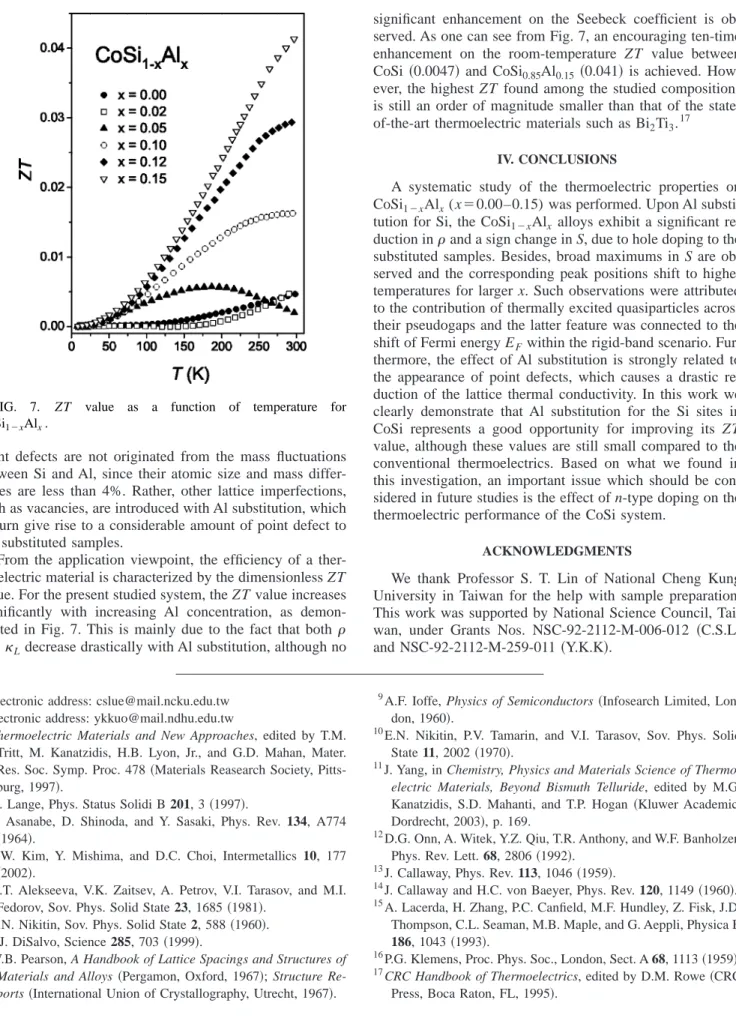
From the application viewpoint, the efficiency of a ther- moelectric material is characterized by the dimensionless ZT value. For the present studied system, the ZT value increases significantly with increasing Al concentration, as demon- strated in Fig. 7. This is mainly due to the fact that both andLdecrease drastically with Al substitution, although no
significant enhancement on the Seebeck coefficient is ob- served. As one can see from Fig. 7, an encouraging ten-time enhancement on the room-temperature ZT value between CoSi 共0.0047兲 and CoSi0.85Al0.15 共0.041兲 is achieved. How- ever, the highest ZT found among the studied compositions is still an order of magnitude smaller than that of the state- of-the-art thermoelectric materials such as Bi2Ti3.17
IV. CONCLUSIONS
A systematic study of the thermoelectric properties on CoSi1⫺xAlx(x⫽0.00–0.15) was performed. Upon Al substi- tution for Si, the CoSi1⫺xAlx alloys exhibit a significant re- duction inand a sign change in S, due to hole doping to the substituted samples. Besides, broad maximums in S are ob- served and the corresponding peak positions shift to higher temperatures for larger x. Such observations were attributed to the contribution of thermally excited quasiparticles across their pseudogaps and the latter feature was connected to the shift of Fermi energy EFwithin the rigid-band scenario. Fur- thermore, the effect of Al substitution is strongly related to the appearance of point defects, which causes a drastic re- duction of the lattice thermal conductivity. In this work we clearly demonstrate that Al substitution for the Si sites in CoSi represents a good opportunity for improving its ZT value, although these values are still small compared to the conventional thermoelectrics. Based on what we found in this investigation, an important issue which should be con- sidered in future studies is the effect of n-type doping on the thermoelectric performance of the CoSi system.
ACKNOWLEDGMENTS
We thank Professor S. T. Lin of National Cheng Kung University in Taiwan for the help with sample preparation.
This work was supported by National Science Council, Tai- wan, under Grants Nos. NSC-92-2112-M-006-012 共C.S.L兲 and NSC-92-2112-M-259-011共Y.K.K兲.
*Electronic address: [email protected]
†Electronic address: [email protected]
1Thermoelectric Materials and New Approaches, edited by T.M.
Tritt, M. Kanatzidis, H.B. Lyon, Jr., and G.D. Mahan, Mater.
Res. Soc. Symp. Proc. 478共Materials Reasearch Society, Pitts- burg, 1997兲.
2H. Lange, Phys. Status Solidi B 201, 3共1997兲.
3S. Asanabe, D. Shinoda, and Y. Sasaki, Phys. Rev. 134, A774 共1964兲.
4S.W. Kim, Y. Mishima, and D.C. Choi, Intermetallics 10, 177 共2002兲.
5G.T. Alekseeva, V.K. Zaitsev, A. Petrov, V.I. Tarasov, and M.I.
Fedorov, Sov. Phys. Solid State 23, 1685共1981兲.
6E.N. Nikitin, Sov. Phys. Solid State 2, 588共1960兲.
7F.J. DiSalvo, Science 285, 703共1999兲.
8W.B. Pearson, A Handbook of Lattice Spacings and Structures of Materials and Alloys 共Pergamon, Oxford, 1967兲; Structure Re- ports共International Union of Crystallography, Utrecht, 1967兲.
9A.F. Ioffe, Physics of Semiconductors共Infosearch Limited, Lon- don, 1960兲.
10E.N. Nikitin, P.V. Tamarin, and V.I. Tarasov, Sov. Phys. Solid State 11, 2002共1970兲.
11J. Yang, in Chemistry, Physics and Materials Science of Thermo- electric Materials, Beyond Bismuth Telluride, edited by M.G.
Kanatzidis, S.D. Mahanti, and T.P. Hogan 共Kluwer Academic, Dordrecht, 2003兲, p. 169.
12D.G. Onn, A. Witek, Y.Z. Qiu, T.R. Anthony, and W.F. Banholzer, Phys. Rev. Lett. 68, 2806共1992兲.
13J. Callaway, Phys. Rev. 113, 1046共1959兲.
14J. Callaway and H.C. von Baeyer, Phys. Rev. 120, 1149共1960兲.
15A. Lacerda, H. Zhang, P.C. Canfield, M.F. Hundley, Z. Fisk, J.D.
Thompson, C.L. Seaman, M.B. Maple, and G. Aeppli, Physica B 186, 1043共1993兲.
16P.G. Klemens, Proc. Phys. Soc., London, Sect. A 68, 1113共1959兲.
17CRC Handbook of Thermoelectrics, edited by D.M. Rowe共CRC Press, Boca Raton, FL, 1995兲.
FIG. 7. ZT value as a function of temperature for CoSi1⫺xAlx.