行政院國家科學委員會專題研究計畫 成果報告
直接甲醇燃料電池奈米結構材料之研究(3/3) 研究成果報告(完整版)
計 畫 類 別 : 整合型
計 畫 編 號 : NSC 96-2120-M-011-001-
執 行 期 間 : 96 年 08 月 01 日至 97 年 07 月 31 日 執 行 單 位 : 國立臺灣科技大學化學工程系
計 畫 主 持 人 : 黃炳照
共 同 主 持 人 : 林智汶、杜景順、高憲明、李志甫 計畫參與人員: 五專級-專任助理人員:李偉翔
碩士班研究生-兼任助理人員:蔡孟哲 碩士班研究生-兼任助理人員:謝在軒 碩士班研究生-兼任助理人員:謝家穎 碩士班研究生-兼任助理人員:余昌憲 碩士班研究生-兼任助理人員:林相亮 碩士班研究生-兼任助理人員:溫鎧聰 博士班研究生-兼任助理人員:賴鋒儒 博士班研究生-兼任助理人員:張士浤 博士班研究生-兼任助理人員:曾吉永 博士班研究生-兼任助理人員:李美嬅 博士班研究生-兼任助理人員:黃育楓 博士後研究:L.S. Sarma
博士後研究:S.Vetrivel 博士後研究:A. Palani
中 華 民 國 97 年 12 月 03 日
行政院國家科學委員會補助專題研究計畫 ■ 成 果 報 告
□期中進度報告 直接甲醇燃料電池奈米結構材料之研究(3/3)
計畫類別: □個別型計畫 ■整合型計畫 計畫編號:NSC 96-2120-M-011-001-
執行期間: 96 年 8 月 1 日至 97 年 7 月 31 日
計畫主持人:台灣科大化工系 黃炳照 教授 共同主持人:雲林科大化工系 林智汶 教授 東海大學化工系 杜景順 教授 中央大學化學系 高憲明 教授 同步輻射中心 李志甫 博士
計畫參與人員:Loka Subramanyam Sarma; Shanmugam Vetrivel; Arudra Palani; 李偉翔; 賴鋒儒;張士浤;曾吉永;蔡孟哲;謝在軒; 謝家穎;
李美嬅; 余昌憲; 林相亮; 溫鎧聰; 黃育楓
成果報告類型(依經費核定清單規定繳交):□精簡報告 ■完整報告 本成果報告包括以下應繳交之附件:
□赴國外出差或研習心得報告一份
□赴大陸地區出差或研習心得報告一份
▉出席國際學術會議心得報告及發表之論文各三份
□國際合作研究計畫國外研究報告書一份
處理方式:除產學合作研究計畫、提升產業技術及人才培育研究計畫、
列管計畫及下列情形者外,得立即公開查詢
▉涉及專利或其他智慧財產權,□一年▉二年後可公開查詢
2
摘要
此三年期研究計畫之主要目標在研 發甲醇燃料電池用之奈米結構材料。嘗試建 立材料奈米結構與其性能之關係,結合研發 之奈米結構材料及膜電極組製作技術,製備 奈米結構之膜電極組,並探討電池之性能及 其衰退機構。
本計畫將經由控制電極觸媒之奈米結構,研 發符合電化學及觸媒特性要求之電極觸媒。
藉由控制材料之合成及奈米結構,建立奈米 結構與其電化學活性及電子結構之關係,以 掌握奈米結構電極觸媒之活性、選擇性及穩 定性。本計畫中亦將研發奈米結構碳擔體,
以提昇奈米觸媒粒子之分散性及增加其在電 極上之活性位置。藉由電解質膜奈米結構之 控制,研發低甲醇滲透率、高質子傳導性及 高機械強度之電解質膜。再依據研發之奈米 結構電極觸媒及電解質膜,研製高性能奈米 結構膜電極組。為了達到上述之目標,本計 畫將以創新之實驗及計算方法深入研究上述 相關之主題。
關鍵詞:計算化學,奈米結構材料,奈米結 構-性能關係,膜電極組,電池性能,衰退機 構
Abstract
The main objectives of this three-year research programme are aimed to develop nanostructured materials for direct methanol fuel cells and to establish the nanostructure-property relationships. With the integration of the developed materials, novel nanostructured membrane-electrode-assemblies (MEAs) will be fabricated and cell performance and fading mechanisms will also be investigated.
Nanostructured carbon supports that are capable of having high dispersion of catalyst nanoparticles and increasing the active sites of electrocatalysts will be developed via a silica-template synthetic route which is well-established in this research team.
Electrocatalysts with a well control over their nanostructure to meet the electrochemical and catalytic characteristics for DMFC will be developed by studying their step-wise formation mechansim. Manipulating the nanostructure of the materials and establishing the nanostructure-properties (electroactivity &
electronic structures) relationships will allow us to achieve significant improvement of the electroactivity of the nanostructured electrocatalysts. Membranes with low methanol permeability, high proton conductivity and mechanical strength will be developed via a well manipulation over their nanostructure. With the integration of the developed nanostructured electrocatalysts and membranes, the nanostructured MEAs with high-performance will be fabricated. In order to achieve these goals, novel approaches in both experiment and computation will be carried out.
Keywords: Computational chemistry,
Nanostructured materials, Nanostructure-performance relationships,
Membrane-electrode-assembly, Cell performance, Fading mechanisms
Introduction and Objectives
Direct methanol fuel cells (DMFCs) using polymer electrolyte membranes and high energy density methanol (6000 Wh/kg) are promising candidates for portable power sources and remarkable achievements have been made. Despite the significant progress, DMFCs still suffer from many obstacles such as, low power density, which has been attributed to poor kinetics of both anode, and cathode, high flux of water/methanol across membranes, and mixed potential at cathode.
These phenomena lead to high overpotentials involving methanol crossover overpotential, activation overpotential, and concentration overpotential on both the anode and the cathode sides and, hence, reduction in cell voltage.
Bimetallic Pt–Ru alloys have been received renewed attention as the most active anode catalysts for DMFCs, however, the efficiency of DMFCs operating with Pt–Ru catalysts still needs to be improved for practical applications.
In this direction many other binary, ternary and even quaternary catalysts have been developed and tested. Much of the work has been aimed to produce high CO tolerant anode materials. In order to achieve commercial success specific electroactivity should be improved and agglomeration and coalescence of the catalyst nanoparticles must be minimized. However, relatively few studies are aimed in this direction.
One way to solve this problem is to improve the multi-scale dispersion by dispersing the catalyst nanoparticles effectively on carbon supports (intraparticle) as well as by improving the atomic distribution within a nanoparticle (interparticle). However, methods are currently lacking to improve the multi-scale dispersion in the electrocatalysts systems, to identify the nature of extent of alloying, atomic level distribution of atoms in the catalysts, and nanostructure of the catalysts. Recently, we developed XAS methods to estimate the multi-scale dispersion and to characterize the nano-scale structure in fuel cell anode catalysts.
We observed that introducing TiO2 in the Pt-Ru matrix not only increases the dispersion of catalysts particles onto carbon supports as well
electrocatalyst showed enhanced performance towards methanol oxidation reaction when compared to the commercial and in-house prepared Pt-Ru/C catalysts. We also developed general methodologies to determine the extent of alloying in the commercial grade bimetallic nanocataysts and its impact on electroactivity and structure based on the coordination parameters derived from XAS.
Due to the complex kinetics of ORR, there is a need to search for better cathode electrocatalysts. Though the Pt catalyst is served as a cathode catalyst for low-temperature PEMFCs, the cell voltage losses are at 0.3 ~ 0.4 V versus theoretical potential under typical operating conditions. It was shown that the formation of Pt-OH during ORR poisons the active sites for molecular oxygen adsorption. In this direction many researchers are trying to study the effect of other metals on Pt catalysts to enhance the molecular oxygen adsorption. In our team we have studied the effect of several metals underpotentially deposited (UPD) on Pt/C/Nafion electrodes under O2 flow and found the highest O2 reduction current and the highest onset potential with Cr modified Pt/C/Nafion electrodes, and with these results we can understand that the UPD Cr/Pt/C can be utilized as ORR electrocatalysts and also these results indicate that metals such as Ag, Cd, Pb if present in the reaction environment probably poisons the Pt active sites for the molecular oxygen adsorption.
Mukerjee et al. showed that among the various catalysts for ORR Pt-Cr alloys are stable in
4
The improvement of ORR activity has been explained by several factors such as electronic and structure effects. With the use of XAS Mukerjee et al. suggested that the activity enhancement in Pt-M alloy catalysts is due to the increased Pt d-band vacancy upon alloying with the metals and favorable Pt-Pt mean interatomic distance. The importance of the state of Pt was emphasized. It was also found that in situ XAS methods were helpful in this regard. We have developed the in-situ XAS methods in our team to study the nature of foreign metal monolayers on the carbon-supported Pt clusters. In this direction we studied the copper monolayer,on metallic clusters at various applied potentials. We also studied the cobalt monolayer transformation on carbon-supported Pt clusters by in-situ XAS. At lower potentials cobalt monolayer was found to be in the form of Co(OH)2. It will be oxidized at higher potentials and incorporated in to oxide/hydroxide layer of Pt clusters. This system may be utilized as ORR catalysts because the sacrificial oxidation of Co may inhibit the formation of Pt─OH formation to maintain the active sites. In search for better ORR electrocatalysts further advances should be made to understand the nano-scopic nature of the structure and local arrangements of the atoms in the metallic core. We need to achieve complete control of nanostructure and to understand the relations between structure, properties, and performance.
Thus nanostructured electrocatalysts with a well control over particle size, dispersion and interparticle atomic distribution to meet the electrochemical and catalytic requirements must be developed. Recent advances in computational studies will allow predicting the potential energy surfaces for MOR and ORR at
the surface of electrocatalysts. The theory guided materials will be beneficial in this regard. Understanding the formation mechanism of catalyst particles to control nanostructure is highly needed to further optimize the electrocatalysts and in-situ XAS and in-situ XRD which are well developed in our team will be applied to study these tasks and to establish a structure controllable synthetic route for the nanostructured electrocatalysts. We have developed in-situ X-ray absorption spectroscopic (XAS) methods to study the formation mechanism of Pt, and Pt-Cu bimetallic nanoparticles,in AOT reverse micellesand based on the variation of white line intensity areas, and EXAFS coordination numbers we probed the formation mechanism. The successful understanding of formation mechanism is necessary to tune the synthetic strategies to achieve structure-controlled nanoparticles.
In order to develop electrocatalysts for MOR and ORR, the reaction mechanism and nature of the intermediate species need to be understood. The promising way to study these mechanisms are by computational studies, by applying spectroscopic techniques such as in-situ Raman, in-situ IR, and by electrochemical techniques. The in-situ Raman techniques are well developed in our team. With the in-situ IR it is possible to analyze change in wave number with the applied potential so that information about the intermediate species can be obtained and catalyst behavior in an electrochemical environment can be probed. In-situ Raman will allow us to study the temperature-dependent and potential dependent metal-oxygen vibrational modes and provides information regarding the state
of the adsorbed species. By integrating the computational and spectroscopic results it is possible to synthesize the electrocatalysts with enhanced activities. The synthesized electrocatalysts need to be characterized delicately to gain insights in to the nanostructure of the electrocatalysts. Methods based on XAS and NMR are beneficial in this regard. Wieckowski group has developed NMR methods to study the electronic structure of the electrocatalysts, and our team has also studied the solid-state NMR spectroscopy on series of electrocatalysts to study the nanostructure,and also started the application of this technique to study the nanostructure of fuel cell catalysts.
Electronic effects in electrocatalysts need to be studied to realize the role of second (or) third metal in Pt based bi- or tri-metallic catalysts in enhancing the performance and spectroscopic techniques such as XANES and XPS are most beneficial. XANES can provide the information on change of Pt d-vacancies upon alloying with other metals and help us to understand the electrocatalytic activity enhancements and our team has proven ability in developing XAS based methods for the structural related aspects on wide variety of materials.
In addition to the development of electrocatalysts, much attention has recently been paid to the development of new carbon materials as supports in order to help achieve optimum catalytic performance. Several different carbon materials such as mesostructured carbon materials, graphitic carbon nanofibers, and mesocarbon microbeads have been reported as supports of Pt or Pt alloy
opened up new approaches for developing electrocatalysts for DMFCs. Because of their interesting structures mesoporous carbons with ordered or uniform pore structures have been intensively studied in the past several years, primarily using templating synthetic route through the use of mesostructured silica as a host to template the carbon structure.
However, the silica templated approach involves long and complicated multi-step template synthetic procedures and therefore, an effective and simple synthetic procedure is required to control the nanostructure of mesoporous carbons for applications. We have established template synthetic routes for the synthesis of cubic mesoporous molecular sieves such as MCM-48 and SBA-1, and both can be used as templates for the synthesis of mesoporous carbon materials.
The membranes commonly used in current DMFCs were originally developed for PEMFC applications and typically have a phase-separated structure comprising a hydrophobic matrix and interconnected hydrophilic clusters, called ionic channels.
Proton conduction occurs through the ionic channels of the membranes, like per- fluorosulfonic acid (Nafion, DuPont).
Nafion exhibiting a phase-separated morphology has high proton conductivity.
The drawback of the currently used membranes in DMFCs is that they are not optimal with regard to methanol and cause blocking and causes methanol crossover and causes fuel loss and mixed potential at cathode. Therefore, methanol crossover
6
made on nanostructure control of the membranes.
In the past few years, intensive research efforts have been made to develop new membranes such as SPEEK, SPES, and acid-doped poly (benzimidazole) (PBI) for DMFC. Besides synthesis of these new membranes, modification of existing membranes, especially with Nafion also explored to minimize the methanol cross-over. However, the latter approach shows that it may be possible to reduce the methanol cross-over only at the expense of proton conductivity. Therefore, it is essential to address this problem by adopting new synthetic approaches, and materials other than conventional one with a special emphasis on nanostructure. Organic-inorganic hybrid materials, where organic and inorganic components are chemically bonded each other, have extensively been studied because a combination of organic and inorganic components allows the development of materials with novel properties, as an alternative to the perfluorinated polymers. The presence of organic phase makes hybrid materials more flexible while their thermal stability and mechanical strength have been substantially enhanced by inorganic part. Incorporation of acidic moieties provides the hybrid material with proton conducting property. A convenient approach to prepare hybrid membrane is the sol-gel method. The flexibility of this synthetic approach offers the potential for designing the material properties at molecular level. We have already prepared and characterized a series of organic-inorganic hybrid membranes such as PEO/SiO2, PWA-doped SiO2/PEO hybrid membranes with a nanosized composite structure of organic PEO, inorganic silica and functionally doped with phosphotungstic acid
molecules for the protonic conductivity.
PWA-doped SiO2/PEO hybrid membranes are designed to have a nanosized composite structure of organic PEO, inorganic silica and functionally doped with phosphotungstic acid molecules for the protonic conductivity. The novel properties of the hybrid membrane originated from a controlled mixture of polymer-silica molecules at nanolevels. The most striking feature is that the methanol permeability of our hybrid membrane is at least one order lower than that of Nafion 117.
Also, the selectivity of hybrid membranes is substantially higher than that of Nafion117.
This is a clear indication that hybrid membranes are promising candidate for DMFC. Hence, we would like to extend the present work with the control of the nanostructure such as 3D morphology of the membranes, nano-scaled distribution of proton carriers, nano-phase separation of organic and inorganic domains etc. SAXS and WAXS can be utilized to study the 3D morphology. We derived morphological model for PEO/SiO2
hybrid membrane by measuring the interdomain spacing of regions in which the organic and inorganic components are mixed and its proton conduction pathway is determined.
For the physico-chemical characterization of new membranes, several standard methods are available, which includes swelling measurements, ion-exchange capacity (IEC–titration method), proton conductivity (by AC impedance technique), methanol permeability (using diffusion cell). From these measurements it is possible to estimate the PM selectivity (defined as ratio of proton conductivity to methanol permeability). The
thermal stability of the membranes can be assessed from TGA analysis and mechanical property can be studied by dynamic mechanical analysis (DMA). Chemical bonds and/or molecular interactions will be delicately identified by utilizing FTIR, Raman spectroscopy, and solid-state NMR which are well applied in our team and structure of the membranes need to be understood. We have implemented solid-state NMR methods to explore the microstructure of DBSA doped PEO/SiO2 membranes.
Effective diffusion constants (global diffusion constants) of water and methanol associated with the self-diffusion constants and the nanostructure of the membrane can be determined from permeability measurements.
However, it is difficult to extract the self-diffusion constant from permeability measurements in the complex membranes.
Self-diffusion constants of water and methanol need to be determined in order to deduce the transport mechanisms. Self-diffusion constants can be directly determined by pulse field gradient NMR (PEG-NMR) measurements.
With this technique it is possible to measure the diffusion of water, and methanol in membranes as a function of temperature. With integration of the nanostructure of membranes, global diffusion constants and self-diffusion constants of water and methanol are useful to establish the so called structure-property (proton conductivity & methanol permeability) relationships.
The central element of a fuel cell is the
electrode layers is considered for the MEA improvement. The electrode layer with feature of appropriate nanostructure and hydrophobicity for good access of the reactants to and easy removal of products from the catalytic sites needs to be developed.
The hydrophobicity control of both the anode and cathode electrode layers is considered to be important. The hydrophobicity of anode layers should be high enough to avoid the blocking of CO2 on the active sites.
Similarly, if the cathode hydrophobicity is maintained at certain threshold value then the cathode is flooded with water and oxygen access to the active sites is hindered. In this direction work should be done in studying the effect of binder in controlling the hydrophobicity, and in providing ionic conductive path in order to maximize the three-phase boundaries. The nanostructure and the cell performance (cell voltage & power density) of the MEA need to be studied during long-term stability testing and fading mechanisms need to be evaluated.
The mapping techniques such as Raman and EDS are capable of estimating the dispersion of binder and catalyst in the electrode layer of MEA. The hydrogen desorption or CO-stripping methods can provide the electrochemically active area which quantifies the catalyst utilization. SEM studies the morphology of membrane-electrode interface.
The MEA interfacial resistance can be possible to be determined by EIS and also by current-interrupt methods and provide information on interfacial phenomena. The cell performance of the nanostructured MEA
8
Fading mechanisms need to be studied in order to identify the factors that limit the stability of the MEA. The items most appropriate in this regard are the dissolution, poison and coarsening of electrocatalyst, degradation of binders and ionomers, corrosion of the carbon support, and deterioration of membrane-electrode interface. In order to identify the fading mechanisms spectroscopic techniques like FT-IR, XAS, SEM/EDS and electrochemical CV techniques will be helpful.
The team also experienced with MEA fabrication and their performance evaluation.
Hot pressing and mechanical pressing methods are developed to fabricate MEA in the team and performance is evaluated by polarization curves.
We compared the performance of MEAs prepared from DBSA doped PEG/SiO2, PVA/PWA hybrid and Nafion115 membranes at room temperatures and the electrodes are home-made with the catalyst loading of 3 mg cm-2. The MEA prepared with PVA/PWA hybrid membrane shows enhanced increase in OCP due to the reduced methanol cross-over over the DBSA-doped PEG/SiO2 and the commercial Nafion 115.
Results and Discussion
Our research philosophy in achieving the specific targets of this project involves placing continuous efforts to develop structure-controllable synthesis strategies for carbon supports, anode and cathode electrocatalysts, and membranes. In addition, nano-scale characterization technologies to realize the key properties which can influence materials activity towards the targeted reactions are strongly emphasized. Several X-ray absorption spectroscopy (XAS) based methodologies are developed to determine the atomic distribution and surface composition in
bimetallic nanoparticles (bi-MNPs). Most of these works are listed as research highlights in high impact journals and in the annual reports of synchrotron laboratories like NSRRC and Spring-8.
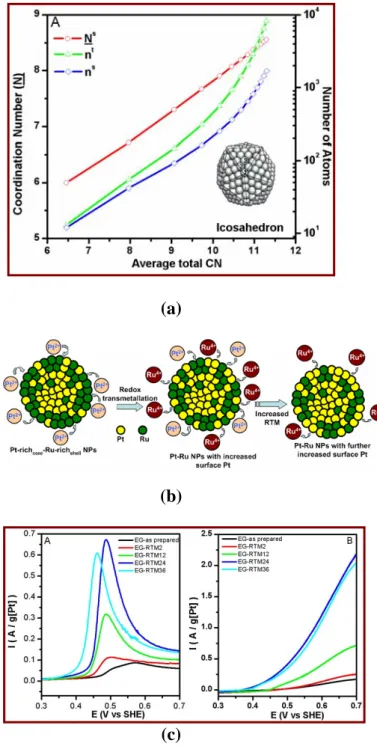
Knowledge of the surface composition of bi-MNPs is crucial for the development of DMFC catalysts. A combined modeling and experimental XAS based approach allowed us to determine the surface composition of fcc bimetallic NPs (Figure 1) and demonstrated a surface-tunable fabrication of PtxRu1–x
bi-MNPs. We understood that by manipulation of proper surface Pt/Ru composition one can achieve high performance towards methanol oxidation reaction. These works are under review in Phys. Rev. Lett., 2008 and J. Am.
Chem. Soc., 2008.
Understanding the d-vacancies in Pt metal is crucial to develop improved electrocatalysts.
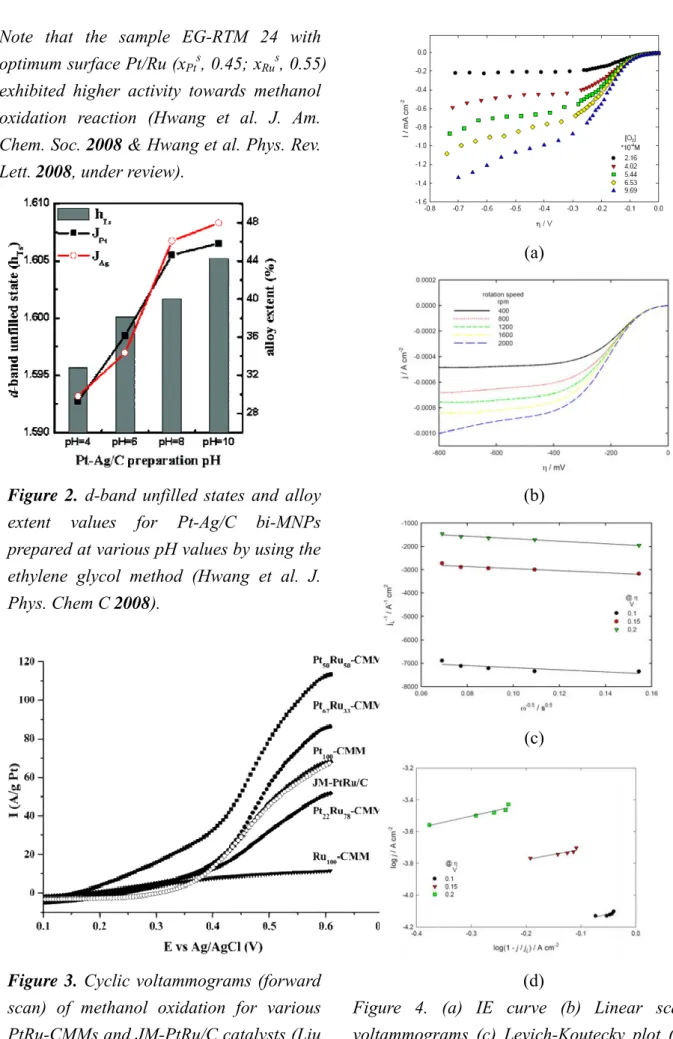
In a recent work, we utilized XAS technique to evaluate the d-band unfilled states in Pt–Ag/C bi-MNPs synthesized at various solution pHs (Figure 2) and attempted to correlate the relation between the d-band unfilled states and the CO-oxidation activity [1].
We put efforts to develop promising supports for electrocatalysts. Recently, we demonstrated highly stable and well-dispersed PtRu bi-MNPs of ca. 2 – 3 nm on carbon mesoporous materials (PtRu-CMMs) [2].
Among the PtRu-CMMs with various Pt/Ru loadings examined, the Pt50Ru50-CMM exhibited the lowest onset potential (0.16 V), when compared to that of the commercial JM-PtRu/C catalyst (0.21 V) (Figure 3).
Promising mesoporous templates were synthesized and characterization techniques based on solid-state NMR were established [3,
4]. Recently, well-ordered mesoporous silicas SBA-1 functionalized with pheyl groups have been synthesized via co-condensation of tetraethoxy silane (TEOS) and phenyl triethoxy silane (PhTES) under acidic conditions [3]. In another work, we demonstrated control of ordered structure and morphology of cubic mesoporous silica SBA-1 via direct synthesis of thiol functionalization [4].
The kinetics of oxygen reduction reaction (ORR) Corich core-Ptrich shell/C electrocatalysts prepared by the thermal decomposition and alcoholic reduction method, and modified by acid were studied in the project of this year.
Accordingly, the mechanisms for promoting the electroactivity of ORR due to the acidic treatment were investigated [5]. Quantitative kinetic measurements of ORR on Pt/C and Corich core-Ptrich shell/C with acidic treatment were made by using the stationary electrode and the thin film rotating disk electrode (RDE) methods.
The polarization (IE) curve on the stationary electrode, the linear scan voltammograms with various rotational rate on RDE, and the Levich-Koutecky plot and dependence log j vs.
log (1-j/jL) of ORR on Pt/C in 0.5M HClO4
shown in Fig. 4. Using the polarization method on the stationary electrode and the thin film rotating disk electrode (RDE) method, the optimal conditions for treating Corich core-Ptrich shell/C electrocatalysts were investigated, and the elecroactivity of ORR on Corich core-Ptrich shell/C electrocatalysts modified with acid was greater than Pt/C elecrocatalyst.
(a)
(b)
(c)
Figure 1. (a) Model calculations on the dependence of coordination number (N), total average surface CN (Ns), total number of atoms (nt), total number of surface atoms (ns) considering cubooctahedron shape, and (b) Schematic of ethylene glycol based polyol-assisted redox transmetalation strategy for the
10
Note that the sample EG-RTM 24 with optimum surface Pt/Ru (xPts, 0.45; xRus, 0.55) exhibited higher activity towards methanol oxidation reaction (Hwang et al. J. Am.
Chem. Soc. 2008 & Hwang et al. Phys. Rev.
Lett. 2008, under review).
Figure 2. d-band unfilled states and alloy extent values for Pt-Ag/C bi-MNPs prepared at various pH values by using the ethylene glycol method (Hwang et al. J.
Phys. Chem C 2008).
Figure 3. Cyclic voltammograms (forward scan) of methanol oxidation for various PtRu-CMMs and JM-PtRu/C catalysts (Liu
& Hwang et al. Chem. Mater. 2008).
(a)
(b)
(c)
(d)
Figure 4. (a) IE curve (b) Linear scan voltammograms (c) Levich-Koutecky plot (d) Dependence log j vs. log (1-j/jL) of ORR on Corich core-Ptrich shell in 0.5M HClO4.
Summary
The strong drive to commercialize direct methanol fuel cells (DMFCs) for wide range of applications in diverse energy-seeking fields has intensified research thrust in fundamental research aimed at overcoming the kinetic limitations on the methanol oxidation reaction (MOR) and oxygen reduction reaction (ORR). Another major research thrust is to explore the ways to reduce/control methanol crossover through the membrane, which not only depress the cathode performance but also reduces the fuel efficiency. Most of the research activities are focused on finding anode catalysts for better methanol oxidation, cathode catalysts for improved oxygen reduction activity, and developing highly stable membranes with high proton conductivity and low methanol permeability.
Our approaches emphasized in this project are significantly new and not addressed by the other working groups. Even though mechanistic understanding of the local distribution of alloying elements in catalysts is a key to understand their catalytic behavior, no such attempts were made in the literature so far. For the first time, we succeeded in accessing such information experimentally by developing an XAS methodology to determine the atomic distribution in bimetallic catalysts and understood the influence of atomic distribution on the MOR and ORR activity. Establishment of structure-controllable synthesis strategies by studying the nanoparticle formation mechanism via in-situ XAS provides solutions to synthesize nanoparticles with desired structures. Attempts were not made in the literature so far focusing in this direction and we emerged as the first contributors in this field. Besides this study we also succeeded in applying XAS to realize the depth-profile of alloying extent in bimetallic NPs under reaction conditions, and estimation of metal d-band vacancies in NPs to realize the electronic effect in influencing the catalytic activity.
surface composition of bimetallic NPs by XAS technique based on a combined modeling and experimental approach. To our knowledge this is the first example of bringing modeling and XAS results together in determining the surface composition of bimetallic NPs.
Long-term operation of fuel cells normally leads to dissolution and/or agglomeration of noble metal particles and thus degradation of the electrocatalysts. Therefore, higher performing and more stable electrocatalysts are sought. We recently made significant efforts to find new ternary catalysts which are promising against Ru dissolution. In another approach, we achieved highly stable PtRu bi-MNPs by confining them in ordered carbon mesoporous material.
A major research thrust for DMFC development is the identification of polymeric membranes with high proton conductivity and low methanol permeability. Our group has been actively conducting nanostructured membrane materials research. A low-cost, PVA based SIPN polymeric systems and sulfonated PVA membranes with interesting properties were synthesized [6]. The developed membranes are applied for R. O. C patents [No: 095120471 and No: 095120472), 2006].
Self-evaluation
(1)The results of this work are consistent with the expected outcome of the proposal.
(2)More than 20 SCI papers have been published within this year.
(3) More than 6 PhD and 20 MS students have been trained in this project.
Reference
12
2. Liu SH, Yu WY, Chen CH, Lo AY, Hwang BJ, Chien SH, and Liu SB*, Fabrication and Characterization of Well-dispersed and Highly Stable PtRu Nanoparticles on Carbon Mesoporous Material for Applications in Direct Methanol Fuel Cell.
Chem. Mater. 20, 1622–1628 (2008) (SCI:
5.104).
3. Kao HM*, Liao CH, Hung TT, Pan YC, and Chiang AST, Direct Synthesis and Solid-state NMR Characterization of Cubic Mesoporous Silica SBA-1 Functionalized with Phenyl Groups. Chem. Mater. 20, 2412–2422 (2008) (SCI: 5.104).
4. Kao HM*, Shen TY, Wu JD, and Lee LP,
Control of ordered structure and morphology of cubic mesoporous silica SBA-1 via direct synthesis of thiol functionalization. Microporous and Mesoporous Materials 110, 461–471 (2008) (SCI: 2.796).
5. Lee MH, Wang PS, and Do JS, Effect of Acid Treatment of Corich core-Ptrich shell/C Electrocatalyst on Oxygen Reduction Reaction, J. Solid State Electrochem. In press (SCI: 1.542).
6. Lin CW, Huang YF, and Kannan AM. J.
Power Sources 171, 340-347 (2007).
出席「第 17 屆國際精密化學與功能性高分子研討 會與第 3 屆先進材料與合成研討會聯合會議」
報告書
台灣科技大學化工系 黃炳照
一、參加會議經過
本次會議為第 17 屆國際精密化學與功能性高分子研討會與第 3 屆 先進材料與合成研討會聯合會議(IUPAC 3rd International Symposium on Novel Materials and their Synthesis (NMS-III) & 17th International Symposium on Fine Chemistry and Functional Polymers
(FCFP-XVII))。本屆會議在大陸上海舉行,會期為 10 月 17 日至 10 月
21 日,共五天。涵蓋的領域廣泛,分在多個會場(Session)同時舉行,
其中電化學能源材料及功能性材料是主要研究領域之一,也是目前許 多學者專家的研究重點。
二、與會心得
此次會議除了一般會議之議程外,邀請諾貝爾獎得主,進行演講,
除了本人外,參加此次會議之國內學者及專家相當多,如中央大會費 定國教授,清大胡啟章教授,中正大學蔣見超教授等。本人受邀在大 會進行邀請演講,演講題目為「Characterization and Preparation of Bimetallic Nanoparticles」,演講後多位學者對我們的研究十分有興 趣,希望與我們進行合作。另外,由於會場相當多,本人並未能參加 每一場之演講,因此乃依自己之專長及興趣,事先選擇主題及規劃時 間,因此會議期間常在不同會場之間穿梭),由於不同會場時間之掌握 不一,因此部分演講未能參加,有點遺憾,所幸大部分重要演講均能 參加。期間並參觀復旦大學,對其學生在諾貝爾獎得主演講後之提問,
印象深刻,台灣學生之積極性有待加強。
Invited Talk
Synthesis and Characterization of Bimetallic Nanocatalysts B. J. Hwang,1, 2
1Department of Chemical Engineering, National Taiwan University of Science and Technology, Taipei, 106, Taiwan.
2National Synchrotron Radiation Research Center, Hsinchu , 300, Taiwan.
The activity of bimetallic nanoparticles towards their targeted reactions depends on several tunable structural factors like alloying extent and surface composition. Techniques for synthesis and characterization of bimetallic nanoparticles are developed in our group and reported in this presentation. An X-ray absorption spectroscopy (XAS) based methodology has been developed to determine the extent of alloying and surface composition of bimetallic nanoparticles. A structure-controllable synthesis approach has also been developed to manipulate the surface composition of bimetallic nanoparticles. The effects of size, alloying extent and surface composition of bimetallic nanoparticles on their electrochemical activity will be investigated and discussed in this presentation.
出席「國際材料學會會議」報告書
台灣科技大學化工系 黃炳照
一、參加會議經過
本 次 會 議 為 國 際 材 料 學 會 會 議 (MRS International Materials Research Conference)。本屆會議在大陸重慶舉行,會期為 6 月 9 日至 6 月 12 日,共四天。涵蓋的領域廣泛,分在多個會場(Session)同時舉行,
其中能源材料及功能性材料是主要研究領域之一,也是目前許多學者 專家的研究重點。
二、與會心得
此次會議除了一般會議之議程外,邀請諾貝爾獎得主,進行演講,
除了本人外,參加此次會議之國內學者及專家相當多,如成大蔡文達 教授,台大林麗瓊教授,台科大王孟菊教授等。本人受邀在大會進行 邀請演講,演講題目為「Structural Analysis of Electrocatalysts for Fuel Cell Applications」,演講後多位學者對我們的研究十分有興趣,希望 與我們進行合作,另外,亦受大會特別報導本人演講之內容。由於在 大陸四川大地震之後在重慶舉行此會議,多位在災區之演講者未能出 席,十分可惜。本人亦因台灣有另外會議必須參加,亦在第二天主持 會議後即返台,未能參加每一場之演講,有點遺憾。
三、攜回資料名稱與內容
出席本屆會議除了攜回註冊時分發的會議手冊(Meeting Program) 一本及論文的會議摘要(Meeting Abstracts)一本外。
Invited Talk
Structural Analysis of Electrocatalysts for Fuel Cell Applications B. J. Hwang,1, 2 L. S. Sarma,1 C. H. Chen,1 D. G. Liu,2 and J. F. Lee2
1Department of Chemical Engineering, National Taiwan University of Science and Technology, Taipei, 106, Taiwan.
2National Synchrotron Radiation Research Center, Hsinchu , 300, Taiwan.
Direct methanol fuel cells (DMFCs) based on the oxidation of methanol in the anode and the reduction of oxygen in the cathode are believed to be a
highly desirable alternative energy source for portable and automotive applications. Carbon supported nano-particles of Pt-group metals constitute intriguing electrocatalysts for both anode and cathode in DMFCs. However,
the activity of nano-sized catalysts towards the target reaction depends on several tunable structural factors like homogeneity, dispersion, alloying
extent and nanostructure. Therefore the developments of experimental techniques which can explore more insights into these structural aspects are
expected as crucial at this moment. We explored an X-ray absorption spectroscopy (XAS) based methodology to determine the extent of alloying
or atomic distribution quantitatively in bimetallic nano-sized catalysts. In this presentation I would like to emphasize the structure-activity relationship of Pt-Co/C catalysts towards oxygen reduction reaction (ORR)
with the knowledge of coordination parameters, extent of alloying, and nature of homo- and heterometallic interactions derived from XAS. The
reasons for the enhancement of activity of such nano-sized Pt-Co/C catalysts towards ORR will be discussed by the derived structural models.
Moreover we employed an electrochemical-infra red (EC-IR) spectroscopy to uncover the potential dependent adsorption behavior of carbon monoxide (CO) on Pt and Pt-Ru nano-particles. These studies are more relevant to the
fuel cell operational conditions where the CO poisoning become unavoidable on Pt based electrocatalysts during methanol oxidation at anode. The experimental results will be presented and discussed in this talk.
出席國際會議研究心得報告
杜景順
東海大學 化工系
計畫編號 NSC 96-2120-M-011-001
計畫名稱 直接甲醇燃料電池奈米結構材料之研究(3/3)
出國人員姓名 服務機關及職
稱
杜景順 東海大學 化工系 教授 會議時間地點 中國大陸 天津 2008/06/22~2008/06/28
會議名稱 The 14th International Meeting on Lithium Batteries 發表論文題目 COBALT OXIDE THIN FILM PREPARED BY AN
ELECTROCHEMICAL ROUT FOR Li-ION BATTERY
出席2008年第14屆國際鋰電池研討會
(The 14
thInternational Meeting on Lithium Batteries) 報告書
杜景順 東海大學化工系 民國九十七年七月五日
(一)參加會議經過
本人此次參加的是在中國大陸舉行之 2008 年第 14 屆國際鋰 電池研討會,地點在天津市的泰達萬麗酒店國際會議廳 (Renaissance Tianjin TEDA Hotel & Convention Centre)。舉辦日期是 2008 年 6 月 22 至 6 月 28 日, 共 7 天。參與此次會議,除了本人之外,台灣尚有多 位學者及鋰電池相關產業的業界人士與會。本人於 6 月 22 日下午抵達 中國大陸北京市,再搭乘北京至天津塘沽的巴士,大約於晚上 09:50 到達會場進行註冊相關事宜。休息一個晚上之後於 5 月 23 日抵達會 場,參與其開幕式,接著是大會演講,主講人為 Sony 公司的 Y. Nishi,
其 講 題 為 「 Past, Present and Future of Li-ion Battery Technology Development」,在其演講中以鋰電池產業的角度,對鋰離子電池的過 去、現在與未來的技術發展發表該公司的看法。本次會議的主辦單位 為中國之「天津電源研究所」與「中國化學與物理電源行業協會」,
此學術研討會在鋰電池方面極為著名。
本次投稿論文數量上相當多,此次發表之論文數共有 619 篇,
大會中除了邀請之口頭發表論文(invited papers)共 81 篇之外,其餘之 538 篇均為壁報式論文(poster papers)。大會將所有論文在議程上將其 分成分為 9 個主題:
1. General 1: Overview of Lithium Ion Battery Development in Today & Future
2. General 2: Overview of Lithium Ion Battery Materials in Today
& Future
3. Nano Materials for Lithium Batteries 4. Anode Materials
5. Cathode Matetrials
6. New Electrolytes & New Battery Systems 7. Fundamental Studies
8. Lithium-ion Batteries for HEV, PHEV and EV 9. Safety Related Issues
由以上發表的主題可得知本次研討會的規模相當的大, 其討論的主 題與子題極為廣泛,包括鋰電池的各種領域與主題,每一主題均有相 當多的論文發表,涵蓋面極為廣泛,包括了新陽極與陰極材料、奈米 材料在鋰電池上的應用、電解質的發展、新系統的開發、各種應用層 面上應考量的因素,以及安全相關主題等。故參與本次研討會除了可 以看到全世界有關鋰電池相關研究的最新研究成果之外,由於其廣泛 的主題,可以增廣研究者在鋰電池方面的視野,可啟發新的研究動能 與方向。對於本人目前主持進行有關能源轉換的研究主題;包括鋰電 池,甚至於燃料電池等研究,在研究方向與細節上有許多值得借鏡之 處。大會安排在天津的大型國際飯店中的國際會議廳中舉辦,由於場 地設施完善,且提供中餐服務,可免除與會者奔波勞頓,可專心於學 術探討。美中不足的是演講廳太大,若坐在較後面,投影資訊將不易 看清楚。下圖為該會場的外觀
本人在此次會議中以壁論文方式發表一篇有關鋰電池中的陽 極薄膜材料,論文題目為「COBALT OXIDE THIN FILM PREPARED BY AN ELECTROCHEMICAL ROUT FOR Li-ION BATTERY」,被 安排在 6 月 23 日(週一)的下午發表,被分類在 Anode Materials 主題中 發表。下圖為本人在會場中發表之壁論文
本次研討會參與的研究學者來自全世界,其專長均在於能源 轉換與儲存方面;尤其是鋰電池方面的專家學者,因其發表主題廣泛,
規模龐大, 尤其是以是在陽極與陰極材料部份更是占了多數,其他如基 礎性的探討,以及應用層面的考量均使本人得到相當多的啟發與靈 感。故參與本次研討會除了可以看到全世界有關鋰電池相關研究的最 新的研究成果之外,由於其廣泛的主題,增廣了研究者的視野,啟發 新的研究動能與方向。例如由此次的研討會中看到一些新的研究領域 與方向:
1. 利用無機與有機的混成材料作為鋰電池的電極材料,
2. 利用不具活性的材料可促進具電活性材料的性能,
3. 中孔性材料在電極材料方面的應用,
4. 奈米材料可促進電池電容量及性能的學理探討,
可明顯的感受到目前有關鋰電池方面的研究重點,除了著重在基本學 理的研究之外,更重視實際應用層面的問題,另外, 因近年來鋰電池發 生了一些意外,因此其安全主題亦在此次研討會中成為討論的重點之 一。在本次研討會中可說是增廣了學術的視野,看到不同領域的研究 學者, 在相同的領域中,發現了不同研究方向的切入點與不同的看法與 解釋,對於本人及研究室的研究方向上, 有極大的助益。
此次會議發表領域中,與本人興趣最接近與感興趣者主要為 2. General 2: Overview of Lithium Ion Battery Materials in Today
& Future
3. Nano Materials for Lithium Batteries 4. Anode Materials
5. Cathode Matetrials 7. Fundamental Studies
等五大領域。因此除了自已發表的時間之外,儘量的參與各有興 趣主題的演講場次。
(三)建議
本次研討會舉辦的層面來看,其會場相當的集中且設備與服 務完善,用餐與會場地點也相當的接近,增加與會人員的方便性,有 相當多值得國內借鏡之處。本次研討會由於規模龐大,研究與討論主 題極為廣泛,國內若能爭取到此類研討會在台灣舉辦,可使國內的學 者、研究者與研究生廣泛的參與,使國內相關人員大開視野,相信對 國內相關研究水準的提升幫助極大。
(四)攜回資料名稱及內容
大會議程、論文摘要集一冊及光碟一張,在往後之研究上具 有很大之幫助。
出席國際會議發表論文
東海大學 化工系 杜景順
Cobalt oxide thin film prepared by an electrochemical rout for Li-ion battery
Jing-Shan Do* and Rui-Feng Dai
Department of Chemical Engineering, Tunghai University, Taichung, Taiwan 40704, ROC
Abstract
Cobalt oxide (CoO) thin film was prepared by the calcination of its precursor (Co(OH)2) electrodeposited in the Co(NO3)2 and NaNO3 aqueous solution. The characteristics of Co(OH)2 and CoO were analyzed by SEM, FTIR and XRD, respectively. The cobalt hydroxide analyzed by the FTIR was found to be α-Co(OH)2, which could be converted to be β-type by immersing in the KOH solution. The pure CoO could be obtained by calcining α-Co(OH)2 at the temperature greater than 500 oC in high purity N2 atmosphere. Increasing the run number for electrodepositing α-Co(OH)2 from 2 to 6 the weight of α-Co(OH)2 and CoO decreased from 0.913 and 0.700 mg to 0.750 and 0.525 mg due to the decrease in the pH of the electrolyte with the run number. The grain size of CoO decreased from 12.88 to 6.98 nm by decreasing the pH for preparing α-type precursor from
calcining α-Co(OH)2 electrodeposited at pH 3.30~3.14 as the cathode, the maximum discharge capacity of Li/CoO coin cell was obtained to be 1589.4 mAh g-1. The irreversible discharge capacity of the Li/CoO coin cells at the first cycle could be recovered in the following activation cycles.
Keywords: cobalt hydroxide, cobalt oxide, thin film, anodic material, lithium battery
* Author to whom should be corresponded.
1. Introduction
Lithium-ion battery has been considered as a promising power source for the modern electronics due to its highest energy density among commercial rechargeable batteries. The commonly used as the anodic material in the lithium ion battery is a carbonaceous compound due to its low cost and high operational voltage. Though the capacity has been much improved by the development of the highly disordered structure carbonaceous compounds [1-2], the capacity is still unsatisfied, especially for the thin-film Li-batteries. The high specific capacity is found for using the metal alloys [3-8] and the metal oxides [9-12] as the anodic materials of lithium ion battery. Using metal alloys as anodic materials, the decrease in the specific capacity with cycle number due to the pulverization problems associated with the large change of volume during the charge/discharge cycle is still a problem to be overcome [3, 13]. Metal oxide, such as SnO2, is developed to overcome the large volume change between the lithiated and lithium-free host. The reversible specific capacity of SnO2 with good cycle stability is found to be 600 mAh g-1 [9]. However, a large irreversible capacity in the first cycle due to the formation of Li2O prevents the commercialization of tin oxides [13]. In recent year, Co3O4 [14-18] and various vanadates [19-22] are also used as the anodic materials in lithium-ion batteries. The relative higher reversible specific capacities are found in these materials, however, the large irreversible capacity in the first cycle and fading rate are need to be improved for further applications.
CoO was mentioned to be the decomposition of CoO to Li2O and Co by insertion of Li+ [23, 28]. The reversible capacity of CoO is obtained to be 600 ~ 800 mAh g-1 in the room temperature [14, 23, 25]. However, CoO studied in the most of the investigations is the commercial products. Using the home-made CoO powder as anodic material of lithium ion battery, the electrochemical and charge/discharge properties of CoO, and the effect of calcination temperature were discussed in our previous papers [29-30].
Thin film batteries could be potentially applied to the microelectronic mechanical systems (MEMSs), implantable medical devices, integrated circuits with self-power sources, smart cards, and portable electronic devices [31-33]. The charge/discharge properties of miniaturize Ni-MH batteries prepared by the microfabrication technologies based on the ceramic and polypropylene film substrates have been investigated in our previously works [34-35]. Recently, the lithium and lithium-ion micro-batteries fabricated with the thin-film technologies are also widely reported in the literatures [31-33, 36-47]. However, thin-film lithium ion batteries based on cobalt oxides as anode are seldom reported [47]. A large irreversible capacity in the first cycle and a higher fading of capacity are found by using thin-film Co3O4 as anode of lithium ion battery [47]. In our previous investigations [29-30], a relative lower irreversible discharge capacity is found based on the home-made CoO powder as the anodic material of Li-ion battery in the first cycle, and the irreversible
discharge capacity can be recovered in the following charge/discharge cycles. Hence it is of interesting to prepare thin CoO film as the anode of thin-film Li-ion battery.
CoO thin-film is prepared by the calcination of Co(OH)2
precursor synthesized by the electrolytic deposition. The factors affected the properties of the Co(OH)2, and the characteristics and the charge/discharge properties of the CoO thin-film are investigated in this work.
2. Experimental
2-1. Electrodeposition of Co(OH)2 and preparation of CoO A Cu foil of 4×8 cm2 folded to be 4×4 cm2 was placed in 0.175 M Co(NO3)2 and 0.075 M NaNO3 aqueous-ethyl alcohol (v/v ratio of 1) solution as the working electrode for electrodeposition of Co(OH)2. The edges of the Cu foil were pasted up by some adhesives to obtain the Co(OH)2 deposit on one side of the 4×8 cm2 Cu foil. Two Au plates with dimension of 5 × 6 cm2 placed on the both sides of the working electrode (Cu foil), and the Ag/AgCl/3 M NaCl aqueous solution were used as the counter and reference electrodes, respectively. The Co(OH)2
electrodeposited on Cu foil with the constant current method controlled by an electrochemical analyzer (CHI 604) was washed with ethyl alcohol and deionized (DI) water for several times, and then dried in a 70 oC vacuum oven for 24 h. The obtaining Co(OH)2/Cu was cut into 8 circular pieces with area of 1.3 cm2 and calcined in a tubular oven environed with 99.995% N2 for 1 h to prepare CoO/Cu.
2.2 Characterization of Co(OH)2 and CoO
The bonding properties of Co(OH)2 were analyzed with a Fourier Transform Infrared Rays Spectrometer (FTIR) (Shimadzu IR Prestige-21).
The crystallographic information, grain size and surface morphologies of
Co(OH)2/Cu and CoO/Cu were analyzed by X-ray powder diffraction (XRD, Shimadzu XRD-6000) and SEM (Joel JSM-5400), respectively.
2-3 Electrochemical and Charge/discharge Characteristics of CoO
Li/CoO coin cells were fabricated in a glove-box (VAC MO-5) filled with argon environment described previously [29-30]. The coin cells were galvanostatically charged and discharged at a suitable C-rate, and the voltage behavior against the time was recorded over the potential range of 0.02 ~ 3.0 V (vs. Li/Li+). The coin cell was first discharged from the open circuit voltage (OCV) to 0.02 V, and then charged and discharge between 0.02 and 3.0 V in the following cycles.
3. Results and Discussion 3-1 Preparation of Co(OH)2/Cu
Using Cu foil as the working electrode for the electrodeposition of Co(OH)2 at the current density (cd) of 0.5 mA cm-2, the cathodic potential sharply increased from -1.1 V to -1.3 V in the initial stage of the first run, and then the cathodic potential was decreased slowly to -1.1 V as sown in Fig. 1. The electrochemical reactions on the Cu foil were proposed to be the reduction of NO3
- [48] and H2O
NO3
- + H2O + 2e- → 2OH- + NO2 - (1)
2H2O + 2e- → H2 + 2OH-
(2)
Hence the significant increase in the cathodic potential from -1.1 to -1.3 V was mainly caused by establishing the diffusion boundary layer on the cathodic surface. The hydroxide ion (OH-) produced in equations (1) and (2) was deposited with Co2+ in the solution onto the Cu foil. At the same time the increase in the concentration of H+ in the solution was due to the anodic
oxidation of H2O on the anode, and resulted in the decrease in the pH of solution from 5.40 to 3.30 in the first run of electrodeposition (Table 1).
The increase in the concentration of H+ induced the cathodic reduction of H+ on the cathode, and resulted in the decrease in the cathodic potential from -1.3 to -1.1 V (Fig. 1).
2H+ + 2e- → H2
(3)
In the first run of electrodeposition of Co(OH)2 a non-uniform film was obtained due to the higher Co(OH)2 deposition rate caused by the fast OH- generation rate based on equations (1) and (2).
The cathodic reaction of H2O to produce OH- (equation (2)) was generally replaced by the evolution of H2 (equation (3)) for the run number greater than 2 due to the decrease in pH of the solution (Table 1). For the run number greater than 2, the uniform Co(OH)2 deposits on Cu foil were obtained due to the slower electrodeposition rate caused by the less OH- generation rate for compared with the first run. Furthermore the pH and the
value for the sixth run. Increasing the run number from 2 to 6 the weight of Co(OH)2 deposit decreased from 0.913 to 0.750 mg due to the slower deposition rate (Table 1).
3.1.1 Characterization of Co(OH)2
As indicated in Table 1, the pH of solution for depositing Co(OH)2 was less than 3.30 for the run number greater than 2. Hence a part of Co(OH)2 deposit would reaction with H+ in the solution to form crystal water
Co(OH)2 + xH+ → [Co(OH)2-x⋅(H2O)x]x+
(4)
At the same time NO3
- was inserted into the structure to compensate the positive charge of the deposit to form α-type Co(OH)2 [49-50],
[Co(OH)2-x⋅(H2O)x]x+ + xNO3
- →
Co(OH)2-x(NO3)x⋅y(H2O) (5)
When the as-deposited Co(OH)2 was dried in 70 oC vacuum oven and then
analyzed by FTIR, the wavenumbers of 630 and 1384 cm-1 were found due to the Co-O and N-O bonds (curve (a) of Fig. 2). The broad wavenumber of 3480 cm-1 was deduced to be the O-H stretching with the hydrogen bond.
The experimental results revealed that the electrolytic deposit was the α-Co(OH)2. The α-type Co(OH)2 was also synthesized and reported in the literatures [49-50].
The as-deposited α-Co(OH)2 immersed in 1.0 M KOH aqueous solution for various times were washed with DI water for several times, and then dries in an 70 oC vacuum oven for 24 h. The products were analyzed by FTIR as illustrated in curves (b) ~ (h) of Fig. 2. The strength of wavenumber of 1384 cm-1 caused by the N-O stretching was decreased with the time for immersing in 1.0 KOH solution, and disappeared finally for the immersing time greater than 10 min. On the other hand, the peak strength of 3630 cm-1 due to the O-H stretching without hydrogen bond increased with the immersing time as shown in curves (b) ~ (h) of Fig. 2.
The experimental results indicated that the generally replacing NO3 -
inserted in the α-Co(OH)2 by OH- resulted in the decrease in the peak strength of 1384 and 3480 cm-1, and the increase in the 3630 cm-1 peak