行政院國家科學委員會專題研究計畫 成果報告
以錯誤擴散法為核心之列印效率、品質改進並結合高效率 壓縮技術與數位浮水印技術混成應用之研究(第 2 年)
研究成果報告(完整版)
計 畫 類 別 : 個別型
計 畫 編 號 : NSC 96-2221-E-011-124-MY2
執 行 期 間 : 97 年 08 月 01 日至 98 年 07 月 31 日 執 行 單 位 : 國立臺灣科技大學電機工程系
計 畫 主 持 人 : 郭景明
計畫參與人員: 碩士班研究生-兼任助理人員:劉雲夫 碩士班研究生-兼任助理人員:蔡嘉晉 碩士班研究生-兼任助理人員:林陳琦 碩士班研究生-兼任助理人員:吳旻峰 博士班研究生-兼任助理人員:夏至賢
報 告 附 件 : 出席國際會議研究心得報告及發表論文
處 理 方 式 : 本計畫可公開查詢
中 華 民 國 98 年 09 月 17 日
行政院國家科學委員會補助專題研究計畫V 成 果 報 告
□期中進度報告
以錯誤擴散法為核心之列印效率、品質改進並結合高效率壓縮技術 與數位浮水印技術混成應用之研究
計畫類別:V 個別型計畫 □整合型計畫 計畫編號:NSC 96-2221-E-011-124-MY2 執行期間:2008 年 8 月 1 日至 2009 年 7 月 31 日
計畫主持人:郭景明 共同主持人:
計畫參與人員:夏至賢、蔡嘉晉、林陳琦、劉雲夫、吳旻峰
成果報告類型(依經費核定清單規定繳交):V 精簡報告 □完整報告
本成果報告包括以下應繳交之附件:
□赴國外出差或研習心得報告一份
□赴大陸地區出差或研習心得報告一份
□出席國際學術會議心得報告及發表之論文各一份
□國際合作研究計畫國外研究報告書一份
處理方式:除產學合作研究計畫、提升產業技術及人才培育研究計畫、列管計 畫及下列情形者外,得立即公開查詢
□涉及專利或其他智慧財產權,□一年□二年後可公開查詢
執行單位:國立台灣科技大學
中 華 民 國 98 年 9 月 15 日
附件一
可供推廣之研發成果資料表
V 可申請專利 V 可技術移轉
日期:98 年 9 月 15 日
國科會補助計畫
計畫名稱:以錯誤擴散法為核心之列印效率、品質改進並結合高 效率壓縮技術與數位浮水印技術混成應用之研究 計畫主持人:郭景明
計畫編號:NSC 96-2221-E-011-124-MY2 學門領域:影像處理
技術/創作名稱 以錯誤擴散法為核心之列印效率、品質改進並結合高效率壓縮技 術與數位浮水印技術混成應用之研究
發明人/創作人 郭景明
技術說明
中文:本研究提出一套以錯誤擴散法為核心之高效率壓縮與數位 浮水印混成技術,稱為Majority-Parity-Guided Error-Diffused Block Truncation Coding (MPG-EDBTC),本技術可提供非常高之影像品質 及浮水印嵌入容量。傳統的區塊截斷編碼在高壓縮率的情況下,
影像品質惡化得非常嚴重,因此本研究利用所提出之錯誤擴散區 塊截斷編碼大幅提昇高壓縮率下的影像品質。另一方面,由於監 控系統的拍攝畫面往往不允許事後的竄改,因此基於安全上的考 量,本研究提出 MPG-EDBTC 的浮水印技術,配合前面所提出的錯 誤擴散區塊截斷編碼,可作為竄改資料的驗證功能。最後,本研 究另外又提出一套延伸的技術可應用於多重浮水印的嵌入,並且 同時兼顧影像品質、高強健性及高嵌入容量,因此可完全含括各 種監控應用場合。由實驗結果證明,本研究所提出之技術具備極 高處理效率、高品質,高壓縮率及高隱藏容量的優勢。
關鍵詞: 區塊截斷編碼、錯誤擴散法、數位浮水印技術、數位半 色調技術
附件二
英文:In this report, a watermarking scheme, called Majority-Parity- Guided Error-Diffused Block Truncation Coding (MPG-EDBTC), is proposed to achieve with high image quality and embedded capacity.
The main problem of traditional BTC is its poor quality over configurations of high compression ratio. To overcome such problem, the extreme pixel values are employed to substitute both high and low means. The quantized error is also compensated by adjusting the neighboring pixels. With these strategies, the image quality and processing efficiency are improved. Moreover, the watermark is embedded by evaluating the parity value in a pre-defined Parity-Check Region (PCR). As seen in the experimental results, the proposed scheme can provide good robustness, image quality, and processing efficiency. Finally, the proposed MPG-EDBTC is extended to embed multiple watermarks and achieves excellent image quality, robustness, and capacity as well. Nowadays, most multimedia is stored in compressed format. It is more appropriate to embed information such as watermarks in compressed domain. The proposed method has been proved to solve effectively the inherent problems in traditional BTC, and provide excellent performance in watermark embedding.
Index terms: Block truncation coding, error diffusion, digital watermarking, digital halftoning
可利用之產業 及 可開發之產品
監控產業,多媒體保護系統,影視訊壓縮系統
技術特點
1. 固定位元率,可節省硬體緩衝之成本。
2. 大幅提昇高壓縮率下之影像品質。
3. 達到監控壓縮資料之保護功能。
4. 達到秘密通訊及資料防竄改功能。
5. 所提出之新式技術將比現有之影視訊壓縮技術更有效率,並且 更適於編輯儲存。
推廣及運用的價值
監視器普遍存在於辦公大樓、街道、銀行、超商等公眾場合,
其主要目的是為了記錄發生在該區域的所有行為,以便發生事 情的時候可以還原事件的真像,而我們的計畫是要以新穎的智 慧型監控系統來取代傳統的監視器。
傳統監控系統幾乎都採用 H.264 或 MPEG4 等高複雜度的 壓縮技術,這些技術有三大問題: 第一,計算複雜度過高,導 致硬體成本提高,第二,畫面與畫面之間具有相關性,因此 不易編輯儲存,第三,使用變動長度編碼,使硬體緩衝成本 提高。因此本研究所提出技術可完全改善以上三個問題。
另外,若能在視訊壓縮技術中加入數位浮水印的技術,在 不影響到視訊壓縮的品質的前提之下,不僅可以擁有良好的
壓縮率,還能讓多媒體資料更富有安全性,並能將其應用到 遠端監控系統數位資料傳輸的保護上以及家庭監控影、視訊 安全系統,對於人類生活可說又是一大福祉。
※ 1.每項研發成果請填寫一式二份,一份隨成果報告送繳本會,一份送 貴單位研發成果推廣 單位(如技術移轉中心)。
※ 2.本項研發成果若尚未申請專利,請勿揭露可申請專利之主要內容。
※ 3.本表若不敷使用,請自行影印使用。
中文摘要
本研究提出一套以錯誤擴散法為核心之高效率壓縮與數位 浮水印混成技術,稱為 MPG-EDBTC,本技術可提供非常高 之影像品質及浮水印嵌入容量。傳統的區塊截斷編碼在高 壓縮率的情況下,影像品質惡化得非常嚴重,因此本研究 利用所提出之錯誤擴散區塊截斷編碼大幅提昇高壓縮率下 的影像品質。另一方面,由於監控系統的拍攝畫面往往不 允許事後的竄改,因此基於安全上的考量,本研究提出 MPG-EDBTC 的浮水印技術,配合前面所提出的錯誤擴散區 塊截斷編碼,可作為竄改資料的驗證功能。最後,本研究 另外又提出一套延伸的技術可應用於多重浮水印的嵌入,
並且同時兼顧影像品質、高強健性及高嵌入容量,因此可 完全含括各種監控應用場合。由實驗結果證明,本研究所 提出之技術具備極高處理效率、高品質,高壓縮率及高隱 藏容量的優勢。
關鍵詞: 區塊截斷編碼、錯誤擴散法、數位浮水印技術、
數位半色調技術
Abstract—In this report, a watermarking scheme, called Majority- Parity-Guided Error-Diffused Block Truncation Coding (MPG- EDBTC), is proposed to achieve with high image quality and embedded capacity. The main problem of traditional BTC is its poor quality over configurations of high compression ratio. To overcome such problem, the extreme pixel values are employed to substitute both high and low means. The quantized error is also compensated by adjusting the neighboring pixels. With these strategies, the image quality and processing efficiency are improved. Moreover, the watermark is embedded by evaluating the parity value in a pre- defined Parity-Check Region (PCR). As seen in the experimental results, the proposed scheme can provide good robustness, image quality, and processing efficiency. Finally, the proposed MPG- EDBTC is extended to embed multiple watermarks and achieves excellent image quality, robustness, and capacity as well. Nowadays, most multimedia is stored in compressed format. It is more appropriate to embed information such as watermarks in compressed domain. The proposed method has been proved to solve effectively the inherent problems in traditional BTC, and provide excellent performance in watermark embedding.
Index terms: Block truncation coding, error diffusion, digital watermarking, digital halftoning
1. I NTRODUCTION
Block Truncation Coding (BTC), which was proposed by Delp and Mitchell in 1979 [1], is a technique for image compression. The basic concept of this technique is to divide the original image into many non-overlapped blocks, each of which is represented by two distinct values. In traditional BTC, the two values have to preserve the first- and second-moment characteristics of the original block.
When a BTC image is transmitted, each pair of values (2x8 bits/block) and the bitmap which records the arrangement of the two values in each block (1 bit/pixel) are required. Although BTC cannot provide comparable coding gain as other modern compression techniques, such as JPEG or JPEG2000, the complexity of BTC is much lower than that of these modern techniques, which makes it feasible for less powerful processing kernel, such as Arm-based applications.
In the literature, many approaches have been proposed to improve BTC. One category involves preserving the moment characteristic of the original image. Halverson et al. [2] generalized a
family of moment-preserving quantizers, by employing moments higher than three. Udpikar and Raina [3] proposed a modified BTC algorithm, which preserves only the first-order moment. The algorithm is optimum in the mean-square sense, and it is also convenient for hardware implementation. Another category involves improving the image quality and reducing the blocking effect.
Kanafani et al. [4] decomposed the image into homogeneous and non-homogeneous blocks and then compressed them using BTC or Vector Quantization (VQ). This block classification is achieved by image segmentation using the Expectation-Maximization (EM) algorithm. The new EM-BTC-VQ algorithm can significantly improve the quality and fidelity of compressed images when compared with BTC or VQ. A new video codec algorithm combined with Discrete Cosine Transform (DCT) is proposed by Horbelt and Crowcroft [5]. The basic concept of this algorithm is that the traditional BTC provides excellent performance in high-contrast and detailed regions, while the DCT works better for smooth regions. A problem of BTC is its poor image quality under low bit rate condition, and some studies have attempted to address this issue.
Kamel et al. [6] proposed two modifications on BTC. The first one allows the partitioning of the image into variable block sizes rather than a fixed size. The second modification involves the use of an optimal threshold to quantize the blocks by minimizing the mean square error. Chen and Liu [7] proposed a Visual Pattern Block Truncation Coding (VPBTC), in which the bitmap is employed to compute the block gradient orientation and match the block pattern.
Another refinement is the classification of blocks according to the properties of human visual perception. However, most of the improvements described above increase the complexity substantially.
Digital halftoning [8] is a technique which converts a grayscale image into a binary image. This halftone image can resemble the original grayscale image when viewed from a distance with the lowpass characteristic of Human Visual System (HVS).
Various attempts including ordered dithering [8], error diffusion (EDF) [9]-[15], dot diffusion [16]-[17], and Direct Binary Search (DBS) [18]-[20] has been devoted to quality improvement and complexity reduction. On the other hand, the replacement of the two distinct values in a block of a BTC image is similar to the binary fashion in halftone image. Thus, the halftoning technique can be used for arranging the distribution of the two distinct values in a BTC image to subsequently improve the image quality [21]. Among the above-mentioned halftoning techniques, the EDF provides excellent image quality at reasonable complexity cost. More specifically, the average grayscale of an image can be maintained after it is transformed into binary fashion. Consequently, the EDF is combined with BTC in this work to achieve excellent image quality.
Digital watermarking is a value-added technique for providing copyright protection or authentication feature. Nowadays, it is impossible to store of transmit an image or a video sequence without prior compression. As mentioned above, BTC is a good solution for image/video compression with an extremely low complexity.
Subsequently, the possibility of embedding watermarks in BTC-
compressed images has been investigated. For example, Tu and Hsu
[22] proposed an ownership share approach, which combines the
image and its watermark in generating a secret key, while leaving the
original image unmodified. The ownership share is then required in
the process of decoding. Lin and Chang [23] proposed a data hiding
scheme for images compressed by BTC. They embedded
information into both high and low means by alternating one bit
value, according to the value of the messages, as well as into the
bitmap using the Minimum Distortion Algorithm (MDA). In this
report, a watermarking, namely Majority-Parity-Guided Error-
Diffused Block Truncation Coding (MPG-EDBTC), is proposed, in
which the energy-preserving property of EDF is exploited to
improve image quality. Experimental results prove that the proposed MPG-EDBTC provides excellent image quality, robustness, and embedded capacity.
The rest of this report is organized as follows. Section 2 introduces the performance evaluation approaches used in this study.
Section 3 describes the traditional BTC. The proposed MPG-EDBTC is presented in Section 4. Section 5 summarizes the experimental results, and conclusions are drawn in Section 6.
2. P ERFORMANCE E VALUATIONS
In this section, the performance evaluation approaches, PSNR and Correct Decoding Rate (CDR), employed in this work are defined.
For an image of size P Q, the quality evaluation of an images is defined as
10 255
∑ ∑ ∑
,∑
, , ,, 1 where h , denotes the original grayscale host image; wh , denotes the watermarked host image; g , denotes a Gaussian filter for simulating the lowpass characteristic of human visual system (HVS), and R denotes the support region of this filter. In this work, the standard deviation of the Gaussian filter is 1.3, and R is fixed at 7x7.
In general, the greater the PSNR, the better image quality will be.
The other performance evaluation is the Correct Decode Rate (CDR), which determines the similarity between the original watermark and the corresponding decoded watermark. Suppose the watermark is of size M N,
1
, ,
100%, 2 where w , and w , denote the decoded watermark and the original watermark, respectively. The notation Θ denotes XNOR operation.
In general, the greater the CDR, the better the decoded result will be.
3. O VERVIEW OF THE T RADITIONAL B LOCK T RUNCATION C ODING Standard BTC is easy to implement. The original image is divided into many non-overlapped blocks, each of which is of size M N.
Each block can be processed independently. To begin with, the first- moment, second-moment, and the corresponding variance are obtained as
1
,
, 3 1
,
, 4 , 5 where h , denotes the grayscale value in a block. Since BTC is a one-bit quantizer, a threshold h is employed to binarize the block.
The block is then replaced by its high mean and low mean as below,
,
,
,,
,6 where a and b denote low mean and high mean, respectively. The concept of BTC is to preserve the first- and second- moments of a block when the original value is substituted by its high or low means.
Thus, the following two equations should be maintained:
, 7 , 8 where , and is the number of the pixels greater than . The high and low means can be evaluated as follows
, 9
, 10
4. M AJORITY -P ARITY -G UIDED E RROR -D IFFUSED B LOCK
T RUNCATION C ODING
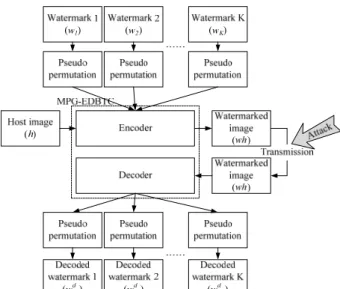
The proposed watermarking is introduced in this section. Figure 1 shows its system architecture. For simplicity, the selected watermarks are of identical size, each of which is permutated with a pseudo-random key to improve security and withstand some types of attacks. In the rest of this section, the two functional blocks, encoder and decoder of MPG-EDBTC, are fully discussed.
4.1 MPG-EDBTC Encoder
According to Fig. 1, two inputs, including host image and K watermarks, are directed to the MPG-EDBTC encoder. Figure 2 shows the fundamental embedding concept. Let the host image and watermark be of sizes P Q and M N, respectively. A watermark is generally in binary fashion. As indicated, the host image is divided into many non-overlapped blocks, and the number of blocks is equal to the number of watermark pixels, meaning that a watermark bit is embedded in a block. The processing order is in raster scan path, which means from left to right and top to bottom. Figure 3 illustrates the processing algorithm. In Fig. 3(a), h , denotes the grayscale value of the host image at the current processing position i, j , h , denotes the diffused error sum added up from the neighboring processed pixels, v , denotes the modified input value, and wh , denotes the binary results by thresholding from v , . The binary thresholded result is replaced by either maximum or minimum values in the current block, and the threshold exploits the mean of the current block. Error kernel is employed to diffuse the error caused by the difference e , . Three well-known error kernels, Floyd [9], Jarvis et al., [10], and Stucki [11], are shown in Fig. 4, where the notation x denotes the current processing position. The relationship between these variables are organized as,
, , ,
, where
,∑ ∑
, ,, 11
, , ,
, where
,, if
,, if
,, 12 where h, h , and h denote the mean, minimum, and maximum values, repectively of the current processed block. The variable ε is an additive value for controlling the result of wh , , which will be discussed later. Comparing with Eq. 6, the high mean and low mean are replaced by the local maximum and minimum values.
Consequently, the complexity can be significantly reduced by saving the effort in calculating the variance used in high and low means.
Moreover, the image quality can be improved by diffusing the quantized error into the neighboring pixels. Notably, the error in the boundary pixels of a block should also diffuse to its neighboring blocks to eliminate the blocking effect.
A watermark bit is embedded by controlling the parity value in a divided block of the EDBTC image. The parity value is evaluated from the number of pixels with minimum values in a Parity-Check Region (PCR) as defined below,
,
1, if
,0, Otherwise
,
2. 13
Notably, the calculating area excludes the current processing
position (i,j). The additive value ε as given in Eqs. 11-12 is
employed to control parity of the current position (i,j) in order to
comply with the expected value. An example is shown in Fig. 3(b),
where the size of PCR for each watermark embedding is different. If the PCR exceeds the boundary of the host image, as the bottom one with embedding watermark K (w K ) in Fig. 3(b), the exceeding area can be considered as an area with all minimum values. In this case, K watermarks are embedded in the same host image. In each time, each bit of the watermarks is considered simultaneously using a different PCR size.
Take a watermark embedded in a host image for example. Each bit in a watermark has two different values, 0 and 1. When the parity value is equal to the watermark value; for example, parity value=0 and watermark=0, there is no need to modify the parity value to hide the watermark information. In this case, we select +noise (noise itself is a positive value) to decrease the likelihood that the current processed value becomes a minimum value. Conversely, when the parity value does not comply with that of the watermark bit; for example, parity value=0 and watermark=1, it implies a need to add a parity of 1 to change the parity value. In this case, we select –noise to increase the likelihood that current processed value becomes a minimum value.
The previous case is for embedding a watermark in a host image. Nonetheless, it can be extended to embed multiple watermarks. As shown in Fig. 3(b), each watermark associated with a different PCR size can find a selection for noise operation. For a bit in each watermark, the voting condition can be obtained, which is called p_vote and n_vote. The p_vote denotes the number of watermarks that need +noise, and n_vote denotes the number of watermarks that need –noise. Conducting this voting for all watermarks can determine the final selection of noise operation.
Figure 3(a) shows the voting concept. Since the final selection is the result of majority voting. The variable ε of Eqs. 11 and 12 is defined as follows
ε , if _ _
0, if _ _
, if _ _ , 14 where the variable denotes noise increment.
4.2 MPG-EDBTC Decoder
In the encoder, the original host image is divided into many non- overlapped blocks, and a watermark bit is embedded in a block. In the decoder, the pixels inside a block are employed to conduct the majority voting to decode the watermark bit, and can thus achieve good robustness. First, the received watermarked image is divided into many non-overlapped blocks of size P/M Q/N , where P Q is the size of the watermarked image, and M N is the size of the embedded watermark. In practical application, all kinds of attacks may exist, which lead to alterations in maximum and minimum values. For this, instead of calculating the number of minimum values in a PCR directly, the mean in a block is calculated to threshold the pixels inside the block and then produces the temporary binary format image. The procedure described above is organized as below:
1
,
, 15
,
0, if
,255, if
,, 16 where wh , and tb , denote the watermarked image and the temporary binary image, respectively. Figure 5 shows the subsequent decoding procedure, where each watermark can be extracted independently using the corresponding PCR size. Watermark extraction involves parity values evaluation via the temporary binary image as given below:
,
1, if
,0
0, if
,255
,
2, 17 where v , and PCR denote the voting matrix and the PCR of the nth watermark, respectively. This voting matrix is used for recording each assessment result at each pixel position via the temporary binary image. Subsequently, the decoded watermarks can be extracted from the voting matrix as below
,
0, if
, //
/ /
2 255, Otherwise
, 18
where the w , denotes the nth decoded watermark, and where 0 and 255 indicate black and white pixels, respectively.
5. E XPERIMENTAL R ESULTS
In this section, the proposed watermarking is adopted for quantitative performance evaluation. To provide full knowledge regarding the PCR size, we conduct extensive experiments to determine an appropriate size from the aspects of image quality and decoded rate.
Here, 10 different tested host images of size 512x512 and 10 watermarks of size 32x32 are employed. Figure 6 shows the evaluation results. As seen in Figure 6(a) when PCR size=1, the parity value cannot be changed via the encoding algorithm (because the current processing position is excluded from the PCR). Hence, the whole block is directly affected by the embedded watermark bit (each pixel in a block has the same operation of additive noise), which will extremely affect the quality of the watermarked image.
Figure 6(b) shows that when N 0 is employed, the worst CDR is achieved since the watermark information cannot be embedded under this condition. According to the results in Figs. 6(a) and 6(b), the selection of PCR size can affect the performance of the proposed watermarking. Figure 6(c) shows the processing time versus PCR size. As can be seen, the processing time increases when the PCR size is increased. By summarizing the results in Figs. 6(a)-6(c), PCR size=4 is a good choice for the proposed watermarking. Figure 7 shows some watermarked images and the corresponding decoded watermarks.
Figures 8 and 9 show the variations in performance with different watermark sizes. In the following results, the PCR size is fixed at 4. Figure 8 indicates that the image quality is proportional to the watermark size; since the block size is P/M Q/N , the influence of blocking effect is increased with increasing block size.
For CDR, the bigger block means that the higher likelihood in obtaining the required parity value is available by a smallest noise, which is a positive benefit for system performance. Figure 9 shows the practical watermarked images and the corresponding decoded watermarks with different watermark sizes. As can be seen, though the PSNR is proportional to the size of a watermark, the CDR is inversely proportional to the size of a watermark.
Figure 10 shows the performances with different number of watermarks. This experiment is obtained with parameters PCR=4, N 14, and watermark of size 64x64. In terms of image quality, even number of watermarks embedding is superior to odd number of watermarks embedding. The reason behind this observation is that when even watermarks are embedded, there is no N added, which contributes to image quality. However, the benefit decreases as the number of watermarks is increased as shown in Fig. 10(a). In terms of decoded rate, the CDR decreases when the number of watermarks is increased as expected.
Figures 11 and 12 show the performances with different
number of watermarks and noise increments. The objective of this
experiment is to find a recommended N for a corresponding number
of watermarks to achieve acceptable image quality (around PSNR=40 dB) and high CDR. According to Fig. 11, the recommended N for each number of watermarks is organized in Table I. For the extremely high-capacity case of embedding 10 watermarks, it still obtains CDR=89.59%. Figure 12 shows the watermarked images and the corresponding decoded watermarks using the recommended N from Table I when even numbers of watermarks are embedded. Figure 12(a) shows the 10 employed watermarks. The results demonstrate that the proposed method can achieve good image quality and decoded rate under huge embedding capacity.
Figure 13 shows comparisons of image quality between traditional BTC and the proposed MPG-EDBTC. For a fair comparison, the parameter N is set at zero. As can be seen, the proposed MPG-EDBTC is superior to traditional BTC in dealing with configurations of different block sizes.
So far, there have been few former approaches addressing the issue of embedding watermarks in BTC images. In Tu-Hsu’s method [22], the watermark embedding is independent of BTC image generation. Hence, the image quality of the obtained watermarked image is identical to that of the original BTC image, while an overhead of the same size as the watermark should be transmitted as an overhead. For practical usage, Tu-Hsu’s method is different from the proposed MPG-EDBTC, and the comparison is thus made with Lin-Chang’s mehod only [23]. Figures 14-16 show the comparison of performance between Lin-Chang’s watermarking [23] and the proposed MPG-EDBTC. The sizes of a host image, watermark, and block are 512x512, 64x64, and 8x8, respectively.
Lin-Chang’s method employs different embedding targets to increase capacity, such as different bit-planes of low mean and high mean (the definition is the same as that of traditional BTC), and bitmap.
Figure 14 shows the comparison of image quality when different numbers of watermarks are embedded, where the parameters addressed in Table I are employed for the proposed method, and the PSNRs are thus always around 40 dB. Regarding the comparison of robustness, many types of attacks are tested, including lightening, darkening, pulse noising, Gaussian noising, Gaussian smoothing, down-sampling, jittering, cropping, JPEG, and JPEG2000. Figure 15 shows the corresponding experimental results. As can be seen, the robustness of the proposed method is superior to that of Lin-Chang’s method for six types of attacks, including darkening, pulse noising, Gaussian noising, Gaussian smoothing, jittering, and JPEG compression. Two types of attacks have similar performance, including down-sampling and cropping, and inferior to their method by two types of attacks, including lightening and JPEG2000 compression. In summary, for those attacks that affect significantly the distributions of local maximum and minimum value positions or reduce the relative difference between local values, the proposed watermarking cannot guarantee good decoded results.
6. C ONCLUSIONS
Nowadays, most images are compressed before they are transmitted or stored, and thus watermarking is highly suggested to be catered into compressed domain of an image. In this work, a high-capacity watermarking technique for Block Truncation Coding (BTC) images is proposed. This technique improves image quality of traditional BTC for configurations of high coding gain, where the energy- preserving property of EDF is exploited to effectively remove the blocking effect inherent in BTC images. Moreover, the efficiency can also be improved by replacing the high mean and low mean with the maximum and minimum values in a block. When watermarks are embedded, the proposed Majority-Parity-Guided Error-Diffused BTC (MPG-EDBTC) can achieve good image quality and decoded rates under a huge embedded capacity. The robustness of the
proposed method is superior to that of Lin-Chang’s method for many types of attacks, and thus proves that the proposed watermarking is effective in addressing the security issues in compressed images.
R EFERENCE
[1] E. J. Delp and O. R. Mitchell, “Image compression using block truncation coding,” IEEE Trans. Communications., 27(9), pp. 1335- 1342, Sept. 1979.
[2] D. R. Halverson, N. C. Griswold, and G. L. Wise, “A generalized block truncation coding algorithm for image compression,” IEEE Trans. Acoustics, Speech, and Signal Processing, 32(3), pp. 664-668, June 1984.
[3] V. Udpikar and J. P. Raina, “Modified algorithm for block truncation coding of monochrome images,” Electronics Letters, 21(20), pp. 900- 902, Sept. 1985.
[4] Q. Kanafani, A. Beghdadi, and C. Fookes, “Segmentation-based image compression using BTC-VQ technique,” IEEE Proc. of ISSPA 2003, vol.1, pp.113-116, Paris 1-4 Jul. 2003.
[5] S. Horbelt and J. Crowcroft, “A hybrid BTC/ADCT video codec simulation bench,” Seventh International Workshop on Packet Video, 18-19 March. 1996.
[6] M. Kamel, C.T. Sun, and G. Lian, “Image Compression by Variable Block Truncation Coding with Optimal Threshold,” IEEE Trans.
Signal Processing, 39(1), pp. 208-212, 1991.
[7] L.G. Chen and Y.C. Liu, “A High Quality MC-BTC Codec for Video Signal Processing,” IEEE Trans. Circuits and Systems for Video Technology, 4(1), pp. 92-98, 1994.
[8] R. Ulichney, Digital Halftoning. Cambridge, MA: MIT Press, 1987.
[9] R. W. Floyd and L. Steinberg, “An adaptive algorithm for spatial gray scale,” in Proc. SID 75 Dig.: Society for information Display, pp. 36–
37, 1975.
[10] J. F. Jarvis, C. N. Judice, and W. H. Ninke, “A survey of techniques for the display of continuous-tone pictures on bilevel displays,” in Comp. Graph. Image Proc., vol. 5, pp. 13–40, 1976.
[11] P. Stucki, “MECCA-A Multiple-Error Correcting Computation Algorithm for Bilevel Image Hardcopy Reproduction,” IBM Res. Lab., Zurich, Switzerland, Res. Rep. RZ1060, 1981.
[12] V. Ostromoukhov, “A simple and efficient error-diffusion algorithm,”
Computer Graphics (Proceedings of SIGGRAPH 2001), pp. 567-572, 2001.
[13] J. N. Shiau and Z. Fan, “A set of easily implementable coefficients in error diffusion with reduced worm artifacts,” SPIE, 2658: 222-225, 1996.
[14] P. Li and J. P. Allebach, “Tone-dependent error diffusion,” IEEE trans.
Image Processing, vol. 13, pp. 201-215, Feb. 2004.
[15] P. Li and J. P. Allebach, “Block interlaced pinwheel error diffusion,”
JEI, vol. 14, Apr-Jun. 2005.
[16] D. E. Knuth, “Digital halftones by dot diffusion,” ACM Trans. Graph., 6(4), Oct. 1987.
[17] M. Mese and P. P. Vaidyanathan, “Optimized halftoning using dot diffusion and methods for inverse halftoning,” IEEE Trans. Image Processing, vol. 9, pp. 691–709, Apr. 2000.
[18] M. Analoui and J. P. Allebach, “Model based halftoning using direct binary search,” in Proc. SPIE, Human Vision, Visual Proc., Digital Display III, (San Jose, CA), vol. 1666, pp. 96-108, Feb. 1992.
[19] Q. Lin and J. P. Allebach, “Color FM screen design using DBS algorithm,” Proc. SPIE, vol. 3300, pp. 353-361, 1998.
[20] A. U. Agar and J. P. Allebach, “Model-based color halftoning using direct binary search,” IEEE Trans. Image Processing, vol. 14, pp.
1945-1959, Dec. 2005.
[21] J. M. Guo, “Improved block truncation coding using modified error diffusion,” IET Electronics Letters, 44(7), pp. 462-464, March 2008.
[22] S. F. Tu and C. S. Hsu, “A BTC-based watermarking scheme for digital images,” International Journal on Information & Security,15(2), pp. 216-228, 2004.
[23] M. H. Lin and C. C. Chang, “A novel information hiding scheme
based on BTC,” International Conference on Computer and
Information Technology 14-16, pp. 66-71, 2004.
Fig. 1. System architecture of the proposed watermarking.
Fig. 2. Fundamental watermark embedding diagram.
(a)
(b)
Fig. 3. MPG-EDBTC encoder. (a) Encoder algorithm. (b) Voting mechanism.
x 7/15
3/15 5/15 1/15
(a)
x 7/48 5/48
3/48 5/48 7/48 5/48 3/48 1/48 3/48 5/48 3/48 1/48
(b)
x 8/42 4/42
2/42 4/42 8/42 4/42 2/42 1/42 2/42 4/42 2/42 1/42
(c)
Fig. 4. Three well-known error kernels. (a) Floyd [9]. (b) Jarvis et al.
[10]. (c) Stucki [11].
Fig. 5. MPG-EDBTC decoding procedure.
(a) 35
37 39 41 43
1 2 3 4 5 6 7 8 9 10
PS N R
PCR size
PSNR vs. PCR size
Noise=0 Noise=5 Noise=10
Noise=15 Noise=20 Noise=25
Fig PS wa
g. 6. Average p SNR of the wate atermarks. (c) A
(b) 45.
(d) 47.
40 60 80 100
1
CD R
0 0.2 0.4 0.6 0.8
1 P rocessing tim e (Sec.)
performance w ermarked imag Average process
71dB, 76.00%
01dB, 99.49%
2 3 4
CD
2 3 4
Processin
Encoding Decoding
(b)
(c)
with different P es. (b) Average sing time of enc
(a)
(c) 40.62d
(e) 42.81d
5 6 7
PCR size
DR vs. PCR siz
Noise=0 Noise=10 Noise=20
5 6 7
PCR size
ng time vs. PC
CR size. (a) A e CDR of the d coding and deco
dB, 87.18%
dB, 99.98%
8 9 10
ze
Noise=5 Noise=15 Noise=25
8 9 10
CR size
Average decoded oding.
F w P pr
F A 0
0
(f) 47 ig. 7. Waterm watermarks. (a)
CR=1, 7.
=21. (f) PCR=
rinted at 400 dp
ig. 8. Averag Average PSNR.
(a) 41.26dB
(c) 42.39 36 41 46 51 56
0 2
PSNR
40 60 80 100
0 2
CD R
1 2 3 4 5
8x8
Bit per pixel (pps)
7.01dB, 99.44%
marked image Original graysc (c) PCR=1,
=7, =7. (g) P pi, decode wate
ge performance (PCR=4) (b) A
B, 100.0%
9dB, 100.0%
2 4 6 8
N
PSNR v
4 6 8
CDR v
8 16x16 3
W
BPP v
% (g) 42.83 es and the co
cale image and
=21. (d) PCR PCR=7, =21.
ermarks printed
(a)
(b)
(c)
e with differe Average CDR. (P
(b) 50.98dB, 9
(d) 47.10dB, 10 12 14 16 Noise increment
vs. Noise incr
8x8 32x32 128x1
10 12 14 16 Noise increment
vs. Noise incre
8x8 32x32 128x12
2x32 64x64 Watermark size
vs. Watermark
3dB, 100.0%
orresponding d binary waterm R=4, =7. (e)
(Watermarked at 200 dpi)
ent data capac PCR=4) (c) Bit
98.26%
99.45%
18 20 22 2
ement
16x1
2 64x6
28 256x
18 20 22 2 t
ement
16x16 64x64
28 256x25
128x128 256x2
k size
decoded mark. (b) PCR=4, d images
city. (a) t rate.
24 16 64 x256
4 56
256
Fig wa (a) wa Wa at 4
Fig (PC
(e) 43.26 g. 9. Practical atermarks with ) Watermark o atermark of si
atermark of siz 400 dpi)
g. 10. Average CR=4 and
41.1 41.3 41.5 41.7 41.9 42.1
1
PSNR
85 87 89 91 93 95 97 99
1
CD R
38 39 40 41 42 43
1 4 7
PSNR
# of
# of
# of
# of
6dB, 99.90%
embedded ima different sizes of size 8x8. (b
ze 16x16. (d) ze 32x32. (f) W
performance w 14) (a) Avera
2 3 4
Num
PSNR vs. N
2 3 4
Num
CDR vs. Nu
7 10 13 16 19 2 No
PSNR vs
W=1 W=4 W=7 W=10
(f) 44.72dB, 9 ages and the co
of watermarks b) Watermark ) Watermark o Watermark of siz
(a)
(b)
with different nu age PSNR. (b) A
(a)
5 6 7
mber of waterma
Number of wa
5 6 7
mber of watermar
umber of wate
22 25 28 31 34 oise increment
. Noise increm
# of W=2
# of W=5
# of W=8
99.93%
orresponding d s (PCR=4 and N
of size256x25 of size 128x12 ze 64x64. (All
umber of water Average CDR.
8 9 10
ark
atermark
8 9 10
rk
ermark
37 40 43 46 49
ment
# of W=
# of W=
# of W=
decoded N =14).
56. (c) 28. (e) printed
rmarks.
F an C
0
0
9
=3 =6
=9
ig. 11. Average nd noise incre CDR.
PSNR=4
PSNR=4
PSNR=4 88 92 96 100
1 4
CDR
# o # o
# o # o
e performance ements. (PCR=
43.99 dB
43.69 dB
43.70 dB 7 10 13 16 19
N
CDR v
f W=1 f W=4 f W=7 f W=10
(b) with different
=4) (a) Averag
(a)
99
(b)
99
99 (c)
97.78%
97.56%
(d)
9 22 25 28 31 34 Noise increment
vs. Noise incre
# of W=2
# of W=5
# of W=8
number of wat e PSNR. (b) A
9.88% 99.88%
9.05% 99.29%
9.27% 99.19%
% 97.68% 97.6
% 98.12% 98.17 4 37 40 43 46 4
ement
# of W
# of W
# of W
termarks Average
8%
7%
49
W=3 W=6
W=9
Fig wa wa wa 27 em (W at 2
Fig pro
Fig wa
PSNR=43
PSNR=43 g. 12. Practical atermarks with atermarks. (b) atermarks ( 7), (d) Six water mbedding ( Watermarked im
200 dpi)
g. 13. Image qu oposed MPG-E
g. 14. Imag atermarking [23
25 28 31 34 37 40 43
8
PSNR
38 39 40 41
1
PS N R
3.55 dB
3.27 dB l embedded ima h different size
Watermarked 32), and (c) rmarks embedd 24), and (f) 1 mages printed at
uality compariso DBTC.
ge quality c 3] and the propo
8 16
PSNR
MPG-EDBTC BTC
Number o 2
PSNR vs. N w
MPG-EDBTC Lin-Chang meth
96.31%
96.2
95.75%
(e)
94.48%
94.70% 94.
94.82%
(f)
ages and the co es of watermar d image and
Four waterma ding ( 25), 0 watermarks e t 400 dpi, decod
ons between tra
omparison be osed MPG-EDB
32 Block size
R vs. Block siz
of embedded wa 3
Number of emb watermark
hod
% 95.83% 96.17
26% 96.63%
% 95.92% 96.12
% 93.99% 95.17
38% 94.95% 94
% 94.29% 94.73 orresponding d rks (PCR=4).
d the two d arks embedding , (e) Eight wate embedding ( de watermarks
aditional BTC a
etween Lin-C BTC.
64
ze
4 5
termark
bedded
%
%
%
4.02%
% decoded
(a) 10 decoded g ( ermarks
24).
printed
and the
Chang’s
96 97 98 99 100
CD R
75 80 85 90 95 100
-0
CD R
40 60 80 100
0
CD R
45 55 65 75 85 95
1%
CD R
40 60 80 100
0
CD R
CD
40 50 60 70 80 90
509
CD R
(a) L
(b) D
(c) P
(d) Ga
(e) Gaus
(f) Dow
+0 +10
Gray
CDR vs. Gr
MPG-EDBT Lin-Chang lo Lin-Chang h Lin-Chang M
0 -10
Grays
CDR vs. Gr
MPG-EDBTC Lin-Chang lowm Lin-Chang high Lin-Chang MD
0.02 0.04 0.
R
CDR vs
% 2%
Gauss
CDR vs. Ga
.1 0.2
Standard d
DR vs. Standa
MPG-EDBTC Lin-Chang lowm Lin-Chang high Lin-Chang MD
506 500
D
CDR vs.
MPG-EDBTC Lin-Chang lowm Lin-Chang high Lin-Chang MDA
Lightening
Darkening
Pulse Noise
aussian noise
ssian smoothing
wn-sampling
+20 +30
yscale additional
rayscale addit
TC
owmean (LSB) highmean (LSB) MDA
-20 -30
scale additional v
rayscale addit
mean (LSB) hmean (LSB) DA
06 0.08 0.1 Ratio of noisy are
. Ratio of nois
MPG-EDB Lin-Chang Lin-Chang Lin-Chang
sian noise magni 3%
aussian noise m
MPG-ED Lin-Cha Lin-Cha Lin-Cha
deviation of Gau 0.3
rd deviation o filter
mean (LSB) hmean (LSB)
A
488 464 4
own-sample size
. Down-sampl
mean (LSB) hmean (LSB)
A
g
+40 +50
l value
tional value
-40 -50
value
tional value
0.12 0.14 0.
ea
sy area
BTC g lowmean (LSB g highmean (LSB g MDA
4% 5%
itude
magnitude
DBTC
ang lowmean (LSB ang highmean (LS ang MDA
0.4 0.5
ussian filter
of Gaussian
416 384 25
e
le size
0
0
16 B) )
B) SB)
56
Fig wa dif no sam JPE
g. 15. Rob atermarking [2 fferent types of ising. (d) Gaus mpling. (g) Jit EG2000 compr
40 60 80 100
1/51
CDR
60 70 80 90 100
0%
CDR
40 60 80 100
95
CDR
50 60 70 80
CD R
(g)
(h) C
(i) JPEG
(j) JPEG20 bustness com 23] and the p f attacks. (a) L ssian noising.
ttering. (h) Cr ression.
(a) 43.0
2 1/256 1/
CDR
10% 2
Rati
CDR vs. R
MPG-EDBTC Lin-Chang lowm Lin-Chang highm Lin-Chang MDA
85 75 65
J
CDR v
3 5
Co
CDR vs.
Jittering
Cropping
G compression
00 compression mparisons be
proposed MPG Lightening. (b)
(e) Gaussian s ropping. (i) JP
09 dB, 100%
/128 1/64 Jitter scale
vs. Jitter scal
MPG-ED Lin-Chan Lin-Chan Lin-Chan
20% 30%
io of Cropped ar
Ratio of Cropp
mean (LSB) mean (LSB) A
5 55 45
JPEG quality
vs. JPEG qual
MPG-ED Lin-Chan Lin-Chan Lin-Chan
mpression ratio 7
. Compression
MPG-EDB Lin-Chang Lin-Chang Lin-Chang
n
tween Lin-C G-EDBTC und Darkening. (c) smoothing. (f) PEG compressi 1/32 1/16
le
DBTC ng lowmean (LSB ng highmean (LS ng MDA
40% 50%
rea
ped area
35 25 15
DBTC lity
ng lowmean (LSB ng highmean (LSB ng MDA
9
n ratio
BTC g lowmean (LSB g highmean (LSB g MDA
Chang’s der 10
) Pulse Down- ion. (j)
F W (- G ( (s (q ra w
C B)
SB)
5 B) B)
) B)
(b) 14.
(d) 35.
(f) 43.
(h) 33
(j) 43.
ig. 16. Practic Without attack.
-50 grayscale v Gaussian noisin
0.3). (g) D scale=1/128). ( quality factor=
atio=3). (Wate watermarks print T ABLE I. T C ORRESPONDING
# of
.16 dB, 100.0%
.24 dB, 91.94%
45 dB, 97.31%
.92 dB, 93.38%
06 dB, 74.93%
cal results with (b) Lightening value). (d) Pu ng (1% noise m Down-sampling
(i) Cropping (
=85). (k) JPE ermarked ima
ted at 200 dpi) T HE R ECOMMEN G P ERFORMANCE
(PC noise
% (c) 14.26
% (e) 42.66
% (g) 42.94
% (i) 16.68
(k) 40.12 h 10 different (+50 grayscale ulse noising (0
magnitude). (f (down-sample (10% area). (j EG2000 comp ages printed
NDED N OISE S TR E FOR E ACH N UM
CR SIZE =4) Correspondin
6 dB, 96.22%
6 dB, 77.03%
4 dB, 87.82%
8 dB, 92.19%
2 dB, 86.01%
types of atta e value). (c) Da 0.02% noisy ar f) Gaussian sm size=488). (h) (j) JPEG comp pression (comp at 400 dpi,
RENGTHS AND TH MBER OF W ATE
ng Corresp acks. (a)
arkening rea). (e) moothing
Jittering pression pression decode
HE RMARKS
ponding
Watermark strength PSNR CDR
1 20 39.99dB 99.48%
2 32 40.00dB 98.87%
3 20 40.04dB 96.31%
4 27 40.01dB 96.36%
5 20 40.02dB 93.52%
6 25 40.06dB 93.80%
7 20 40.03dB 90.93%
8 24 40.06dB 91.48%
9 20 40.05dB 88.67%
10 24 39.95dB 89.59%
計畫成果自評部份:
資料壓縮及數位浮水印技術長期停留在學術上的研究,而缺少實際企業需求上的互動,此一計劃 配合監控系統發展以上兩大研究領域,使研究較為貼近實際應用需求,參與本計劃的工作人員充 分獲得訓練,並且充分瞭解現行監控系統發展之相關之理論背景,瞭解將來的可能應用範圍,及 實際應用所會遭遇之困難,並學習如何克服這些問題。
傳統監控系統幾乎都採用H.264 或 MPEG4 等高複雜度的壓縮技術,這些技術有四大問題:
1. 計算複雜度過高,導致硬體成本提高;
2. 畫面與畫面之間具有相關性,因此不易編輯儲存;
3. 使用變動長度編碼,使硬體緩衝成本提高。
4. 由於計算複雜度過高,導致其他功能不容易植入,例如:資料保護技術
本研究所提出技術具備以下特色,可完全改善以上三個問題。
1. 固定位元率,可節省硬體緩衝之成本。
2. 大幅提昇高壓縮率下之影像品質。
3. 達到監控壓縮資料之保護功能。
4. 達到秘密通訊及資料防竄改功能功能。
5. 所提出之新式技術將比現有之影視訊壓縮技術更有效率,並且更適於編輯儲存。
另外,在視訊壓縮技術中加入數位浮水印的技術,在不影響到視訊壓縮的品質的前提之下,不 僅可以擁有良好的壓縮率,還能讓多媒體資料更富有安全性,並能將其應用到遠端監控系統數位 資料傳輸的保護上以及家庭監控影、視訊安全系統。在此,本研究提出 Majority-Parity-Guided Error-Diffused Block Truncation Coding (MPG-EDBTC)的浮水印技術,配合前面所提出的錯誤擴散區 塊截斷編碼,可作為竄改資料的驗證功能。最後,本研究另外又提出一套延伸的技術可應用於多 重浮水印的嵌入,並且同時兼顧影像品質、高強健性及高嵌入容量,因此可完全含括各種監控應 用場合。由實驗結果證明,本研究所提出之技術具備極高處理效率、高品質,高壓縮率及高隱藏 容量的優勢。
本技術已投稿國際 SCI 期刊 IEEE Transactions on Image Processing。
出席國際學術會議心得報告
計畫編號
NSC 96-2221-E-011-124-MY2
計畫名稱 以錯誤擴散法為核心之列印效率、品質改進並結合高效率壓縮技
術與數位浮水印技術混成應用之研究
出國人員姓名 服務機關及職稱
郭景明
國立台灣科技大學電機系副教授 會議時間地點 2009 年 1 月 13~16 日,地點:日本東京
會議名稱 The 3
rd
Pacific-Rim Symposium on Image and Video Technology發表論文題目
1. J. M. Guo*, “Error-diffused image security improving using overall minimal-error searching,” Pacific-Rim Symposium on Image and Video Technology, Tokyo, Japan, January 13-16, 2009. (NSC 96-2221-E-011-124-MY2)
2. Y. F. Liu, J. M. Guo*, and J. D. Lee, “Inverse halftoning based on bayesian theorem,” Pacific-Rim Symposium on Image and Video Technology, Tokyo, Japan, January 13-16, 2009. (NSC 96-2221-E-011-124-MY2)
一、參加會議經過
PSIVT 2009 為影像及視處理方面近年來主辦得相當不錯的研究會,本研討會提供了 非常多影像處理方面的交流技術平台,本次參加研究討除了參與本身發表論文的場次 外,也參加了許多其他個人有興趣的主題,除了吸收最新發展技術外,也結識許多國際 上知名的學者,對於未來的國際合作奠立了基礎,並且也藉由參與本研討會讓國際上的 學者瞭解台灣在這方面的技術發展,也間接提升少許的國際知名度。
二、與會心得
本次參與 PSIVT 2009 研討會裏面不乏有些人所帶領的團隊在這個領域已有多年的 經驗,而且也有相當不錯的成果,本人也與這些學者有技術上的交流,但關鍵的技術問 題,仍有待回國後慢慢消化。本次大會安排的 plenary 非常有水準,主要是介紹有關 video synopsis 相關的研究,將時間軸上的資訊壓縮至空間域上,在不損失資訊量的情況下大 幅地降低資料量,非常具有啟發性。大體而言,這次的研討會參與相當重要,不僅瞭解 國際上的學者在這個議題上的態度與發展,也得到了不少新的啟發。
本次個人所發表之論文摘要分別如下:
1. J. M. Guo*, “Error-diffused image security improving using overall minimal-error searching,”
Pacific-Rim Symposium on Image and Video Technology, Tokyo, Japan, January 13-16, 2009.
(NSC 96-2221-E-011-124-MY2)
Abstract:
In this work, a method which can generate high quality inverse halftone images from halftone
images is proposed. This method uses least-mean-square (LMS) trained filters to establish the relationship between the current processing position and its corresponding neighbor positions in each kind of halftone image. This includes direction binary search (DBS), error diffusion, dot diffusion, and ordered dithering. After which, the support region which is used for features extracting can be obtained by relabeling the LMS-trained filters by order of importance. Two features are used in this work: 1) the probability of black pixel occurrence at each position in the support region, and 2) the probability of mean occurrence which is obtained from all pixels in the support region. According to these data, the probabilities of all possible grayscale values appearance at current processing position can be obtained by Bayesian theorem. Consequently, the final output at this position is the grayscale value with highest probability. Experimental results show that the image quality and memory consumption of the proposed method are superior to Mese-Vaidyanathan’s method.
2. Y. F. Liu, J. M. Guo*, and J. D. Lee, “Inverse halftoning based on bayesian theorem,”
Pacific-Rim Symposium on Image and Video Technology, Tokyo, Japan, January 13-16, 2009.
(NSC 96-2221-E-011-124-MY2)
Abstract:
This study presents a high capacity data hiding method for generating high quality watermarked halftone images. The embedded watermarks can be distributed into single or multiple halftone images with the proposed Overall Minimal-Error Searching (OMES). The proposed method modifies the halftone values at same position of all host images with the trained Substitution Table (S-Table). The S-Table makes the original combination of these halftone values as another meaningful combination for embedded watermark, which is the key part in determining the image quality. Hence, an optimization procedure is proposed to achieve the optimized S-Table. As demonstrated in the experimental results, the proposed approach provides good image quality and is able to guard against some frequent happened attacks in printing applications.