Number 5/07, June 2007
China Economic Issues
Recent Reforms and Progress in Rural Development in Mainland China
Raymond Yip, Jun-yu Chan and Nathan Chow
Recognising the economic disparity between rural and urban areas, the Mainland authorities have been placing increasing emphasis on building a
‘new socialist countryside’ in recent years as a key element in sustaining the Mainland’s robust growth and enhancing social harmony. Wide ranging reforms have been undertaken in policy areas such as taxation, rural finance, healthcare and education, with a view to increasing disposable income, fostering efficient resource allocation, as well as improving social provisions in rural areas.
While it takes time for reform measures to address issues of a structural nature,
there are signs that the living standard of rural residents has improved more
noticeably over the past few years. Most notably, the growth rate of rural
income has accelerated to catch up with its urban counterpart, and the
urban-rural income gap has started to stabilise. Poverty reduction has also
progressed at a rapid pace. The ongoing policy efforts are expected to show
fuller impacts over the medium to long term in enhancing productivity in rural
areas and improving the well-being of rural residents.
I. Introduction
Rural China, like the rest of the country, has made giant strides in the past three decades in economic developments. However, it still trails behind its urban counterpart in many aspects, as highlighted by a widening urban-rural income gap with the ratio of urban to rural income rising from 1.9 in 1985 to 3.3 in 2006. Acknowledging the economic disparity between rural and urban areas, the Mainland authorities have been placing increasing emphasis on improving the living standard of the rural population, undertaking wide ranging reforms to address the “three rural issues” (三農問 題) – agriculture (農業), rural areas (農村) and peasants (農民). Significant progress has been made in improving the rural tax system, rural financing, and social provision for rural residents and migrant workers, while discussions in many other policy areas such as land ownership are underway.
Rural developments in Mainland China have been given relatively little attention in academic research as well as policy discussions in Hong Kong as the significance is not widely appreciated. Of vital importance to Hong Kong’s economic well-being and prosperity is sustainable economic growth and social stability in the Mainland. In both aspects, the authorities’
current efforts to promote rural welfare and developments are critical. As conceivably the rural population with lower income has a higher propensity to consume, faster income growth in rural areas, together with better social provision, can boost consumption, which will help the economy to rebalance towards more domestic demand driven growth. Also, policy initiatives to narrow the income and welfare disparities between the urban and rural areas will help promote social harmony and social stability.
This paper provides a review of the recent major policy initiatives for rural areas and assesses their impacts so far. The rest of the paper is organised as follows. Section
II summaries some key reforms in the policy areas of rural taxation, rural finance and social provisions. Section III assesses the effectiveness of these reforms by analysing selected economic and social indicators, and Section IV concludes.
II. Major policy efforts
To improve the general well-being in rural areas, the central government has taken initiatives in reforming the rural tax system, facilitating financial intermediation in rural areas, expanding income sources for the rural population, as well as improving rural residents’ access to social provisions such as healthcare services and education.
Tax reforms
Until recently, peasants were subject to numerous taxes and fees imposed by the central and local governments. Aubert and Li (2002) summarise the taxes faced by peasants into three types. At the highest administrative level, there were the various agricultural taxes collected by the local governments. Next came the Tongchou (統籌) and Tiliu (提留) levies which were the de facto taxes collected by the township- and village-level governments respectively.
While these two types of taxes were relatively limited, the third category included a long list of additional fees and charges collected at the local level, constituting some 40-50% of the total tax receipts collected by the local governments.
These taxes and charges, however, also represented a major burden on peasants, as they were even levied on the poorest because many of the taxes were determined according to farm output, family headcount, or the area of arable land leased to peasants rather than their net income or profits.
Aubert and Li (2002) report that as a result of the taxes and fees collected at the multiple levels, the average tax burden borne by peasants could be as much as 225-269 yuan per person in 2000,
equivalent to 10-12% of a peasant’s average net income. Their estimates are higher than the corresponding figure of 168 yuan reported by the government. 1 Moreover, a study (Sato et al., 2006) using survey data which cover 18 provinces, estimates that the average rate of taxation faced by the bottom 10% income group was 13.7%, whereas that by the top 10% group was only 2.8% in 1995. In overall terms, China’s regressive tax system placed a heavy tax burden on poor rural households.
The heavy tax burden on peasants was one factor contributing to the poor living standard in rural areas by lowering disposable income and encouraging precautionary savings. The regressive tax system also causes incentive distortions for income producing activities in rural areas.
To reduce peasants’ tax burden and create a more equitable tax system, the central government has undertaken a series of tax reforms since the early 90’s (Table 1). In 2000, the government simplified the tax code by replacing numerous local levies by higher agricultural taxes, which were then
shared between the central and local governments. More specifically, the Tongchou and Tiliu taxes, along with most other additional fees, were abolished. The increased agricultural taxes, with a possible augmentation of these tax bills by at most 20% of the amounts taxed by the central government, served to compensate the local governments for the revenue lost by the abolition of the miscellaneous fees. The reform was first rolled out in the Anhui province and later implemented in most provinces in 2002. According to the 2003 Work Report of the Government, the reform effected a 30% reduction in the average tax burden of participating counties. In 2004, the central government pledged to abolish all agricultural taxes within five years.
This goal was reached well ahead of schedule in 2006, with the tax repeals estimated to achieve an annual average tax saving of 160 yuan for each peasant, or 4.5% of their income. On the other hand, the central government has further boosted financial transfers to the local governments in rural areas in order to ensure an uninterrupted supply of various public provisions.
1
1 This estimate is based on figures of agricultural taxes and fees and rural population reported in the China Agricultural Yearbook and China Statistical Yearbook.
Table 1. Major reforms on the rural tax system
Year Reforms
1991 Capped township and village levies at 5% of farmers’ total net income.
1993 Enacted the agricultural law, which provides a legal framework for rural taxation and levy collection.
1994 Established the “tax sharing system”, re-defining the sharing of tax revenues between the central and local governments.
1996 Issued a directive containing 13 measures to ease the tax burdens on peasants.
2000 Initiated a reform to simplify the rural tax system in the Anhui province.
2002 Extended the tax reform to most provinces.
2004 Pledged to abolish all agricultural taxes within 5 years.
2006 Abolished all agricultural taxes by 1 January 2006.
Diversifying rural income sources
Historically, farming and other agricultural activities were the main income sources of the rural population. With the diminishing importance of agriculture in China’s economic growth and the relative scarcity of arable land restraining rural income growth, migrating rural labour out of agriculture to jobs in the secondary and tertiary industries has become a critical development for increasing rural productivity and reducing reliance of rural income on the agricultural sector.
The need to mobilise rural labour has led to the emergence of Township and Village
Enterprises (TVEs), which are rural entities engaging in non-agricultural production to provide employment opportunities for the rural population in higher value-added secondary and tertiary industries. With the government’s support for establishing TVEs, economic output from these enterprises has already surpassed that from agricultural activities (Chart 1a). Employment in TVEs has also been expanding rapidly, adding about 7 million jobs per year during the early 1990s and reaching 147 million in 2006, or about 31% of the rural workforce (Chart 1b). Therefore, TVEs have played a crucial role in generating rural income and absorbing excess farm labour.
Chart 1. Township and Village Enterprises (TVEs)
Chart 1a. Output Chart 1b. Employment
0 1000 2000 3000 4000 5000 6000
1998 1999 2000 2001 2002 2003 2004 2005 0 1000 2000 3000 4000 5000 6000 Value added of TVEs
Value added of primary industry
RMB bn RMB bn
Sources: CEIC, China Statistical Yearbook, and Ministry of Agriculture.
0 100 200 300 400 500
1998 1999 2000 2001 2002 2003 2004 2005 2006 0 100 200 300 400 500 Employment by TVEs
Employment by primary industry
Million Million
Sources: CEIC, and China Statistical Yearbook.
As an alternative way of income diversification, millions of rural residents – collectively termed “migrant workers” – have left rural areas to take up non-agricultural jobs in urban areas. There are currently about 200 million migrant workers who have generated substantial income for rural areas and contributed greatly to the prosperity in urban areas. By offering a more diverse array of job opportunities for migrant workers, such as construction and manufacturing, at better wages, the labour demand in urban areas relieves rural areas of the pressure to supply jobs. Rural migrants often send remittances to their dependents still residing in the countryside, such as their ageing parents and young children. Also, some migrant workers have chosen to move back to rural areas to establish new businesses after accumulating capital, skills and knowledge derived from their urban jobs over years, thereby boosting rural employment. According to the Ministry of
Agriculture, returning workers have set up one-fifth of the country’s rural enterprises.
The State Council has described this migration as a way of resolving the “three rural issues” and an impetus to building a
“new socialist countryside” 2.
However, these migrant workers have encountered difficulties when working in urban areas, including lack of rights protection and provision of social services.
Wage payment delays, defaults, or unreasonable deductions by urban employers have become a pervasive problem. Those in certain industries such as mining and construction often work under dangerous conditions, as they lack the legal means or knowledge to press employers to follow safety guidelines.
Moreover, most migrant workers could not receive the social benefits available to native urban residents provided by the city governments.
2
2 See the State Council, “Several Opinions of the State Council on Settling Issues on Rural Migrant Workers,”
State Council Gazette, Issue No.10, 10 April 2006.
In response, the central government has pledged to offer greater protection of the rights of migrant workers. The State Council promised to resolve the issue of defaulting or cutting wage payments to migrant workers by 2006. As of July 2006, 95.2% of the arrears reported by construction companies before end-2003 were paid to migrant labourers. The State Council has also considered establishing a wage payment supervision system, so as to monitor wage payments and force employers with a history of payment defaults to deposit a sufficient amount of money into a special account before their projects begin as a precaution against defaults. To protect migrants’ rights in labour disputes and physical injuries, the government has streamlined legal aid procedures for migrant workers. For instance, legal aid departments now no longer examine the financial status of migrant workers before giving aid.
As for the difficulties for migrant workers in obtaining social benefits in the cities, the Household Registration System is widely cited as the cause. An urban hukou (户口) is essential for receiving various social benefits provided by the city governments.
Stringent restrictions have been in place to prohibit migrants from obtaining urban resident status in the cities even after living and working in the cities for many years.
To address the inequality in receiving social provisions, various reforms of the registration system have already been implemented. Since 1997, many cities and municipalities have allowed migrant workers to obtain urban hukou under certain conditions, such as home ownership and stable employment.3 However, given the difficulties for migrants to meet these stringent conditions, the government believes that a better way to solve the problem is to decouple social benefits from
the registration status. Some regions have already undertaken reforms to this end.
For example, since 2006, migrant workers in Shanghai have been entitled to the rights currently enjoyed by registered residents, including the local minimum wage protection and nine-year free education for their children. Furthermore, the Ministry of Public Security has recently announced to push through a major reform to the registration system abolishing the urban-rural division in the registration system altogether, under the principle that household registration should be determined by the place of residency rather than the place of origin. These reforms are likely to create a more unified and standardised labour market which promotes economic growth by allowing better allocation of human resources.
Rural finance
The financial system in rural areas has long been characterised by a lack of access to capital by farmers and small rural enterprises. High information collection costs and small loan sizes have rendered the lending business to the agricultural sector unprofitable for rural financial institutions.
Also, loans to individual peasants, whose repayment ability is impaired by their limited pricing power in the increasingly competitive markets, represent a risky asset class from the perspective of lending institutions. As a result, rural financial institutions have strong incentives to use rural deposits for lending in urban areas to enhance their returns. The lack of credit from formal financial institutions then forces peasants to resort to relatives, friends or even usuries for funds. These informal funding sources are estimated to have satisfied more than 70% of borrowing needs in rural areas.
3
3 See Congressional-Executive Commission on China, “China’s Household Registration System: Sustained Reform Needed to Protect China’s Rural Migrants,” 7 October 2005.
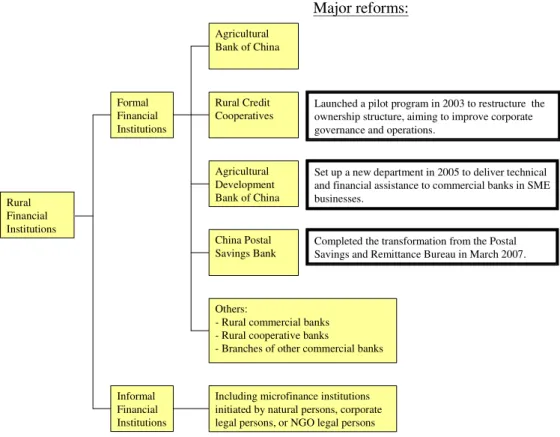
To address these problems, the central government has taken steps to restructure the rural financial institutions, including Rural Credit Cooperatives (RCCs), the China Postal Savings Bank (CPSB) and the Agricultural Development Bank of China (ADBC). The aim is to transform them
into competitive and commercially oriented institutions for offering a wide range of financial services to rural households and businesses, as well as improving the efficiency of financial intermediation in rural areas (Diagram 1).
Diagram 1. Structure of rural financing and major reforms
Rural Financial Institutions
Formal Financial Institutions
Informal Financial Institutions
Agricultural Bank of China
Rural Credit Cooperatives
Agricultural Development Bank of China
China Postal Savings Bank
Others:
- Rural commercial banks - Rural cooperative banks
- Branches of other commercial banks
Including microfinance institutions initiated by natural persons, corporate legal persons, or NGO legal persons
Launched a pilot program in 2003 to restructure the ownership structure, aiming to improve corporate governance and operations.
Completed the transformation from the Postal Savings and Remittance Bureau in March 2007.
Set up a new department in 2005 to deliver technical and financial assistance to commercial banks in SME businesses.
Major reforms:
RCCs are by far the most important financial institution providing credit to rural households in China, holding roughly 12%
of total deposits and accounting for 91% of all agricultural loans at end-2006. 4 However, lending processes of RCCs have long been characterised as bureaucratic and costly, since day-to-day operations are
4 See People’s Bank of China, “China Monetary Policy Report, Quarter 4, 2006”.
subject to significant influence from local leaders and the China Banking Regulatory Commission (CBRC). Recognising this, a pilot RCC reform program was launched in 2003 to shift more responsibility for RCC governance to provincial and county governments, aiming ultimately at transforming township level RCCs into more commercially oriented institutions such as rural commercial banks and rural cooperative banks. A key component of
the pilot program is the enhanced financial support for RCCs provided by the People’s Bank of China (PBoC), which directly boosts RCCs’ lending capacity by purchasing substantial portions of non-performing loans held by RCCs with special central bank bills. The bills will then be redeemed by the PBoC if capital adequacy and governance of RCCs are subsequently improved.
Another significant reform of improving the rural financial infrastructure is the transformation of the Postal Savings and Remittance Bureau (PSRB) into the CPSB in March 2007, which implies that the substantial postal savings funds are more readily available to rural areas. Previously the PSRB engaged in deposit taking and remittance services in postal offices without offering loans. Its huge branch network, as well as sizeable client and deposit base, make the newly established CPSB the fifth largest bank in China. The bank is required to focus on the retail and intermediary banking sectors, providing basic financial services particularly for rural households and companies. The establishment of the bank therefore marked a substantial step in China’s rural financial reform, greatly increasing supply of credit to the rural population. Likewise, the Agricultural Bank of China (ABC), the second largest bank in China in terms of assets, will potentially become an important player in rural finance in the future after undergoing the necessary financing restructuring already completed by the other three state-owned nationwide commercial banks.
Financing for small and medium-sized enterprises (SMEs) has been identified by the central government as a key financial sector development in Mainland China and this is particularly important in rural areas.
The ADBC, established in 1994, has been participating in financing infrastructure and contributes greatly to the urbanisation
process at the county level in rural China.
One key initiative of the ADBC in recent years is to improve SME finance. In particular, the ADBC set up a new department in 2005 to provide technical assistance and lines of credit to commercial banks that are interested in SME finance.
In collaboration with international organisations such as the World Bank, the ADBC aims to build upon best international practices in small-scale lending so as to develop similar expertise among commercial banks in Mainland China. The ADBC launched a pilot program in early 2006 with the city commercial banks in Baotou and Taizhou with the aim of rolling out the business throughout the branch networks of participating banks in all provinces by 2008.
Medical provisions
As anywhere in the world, healthcare cost is one of the biggest financial burdens. This is particularly the case in rural China where there are no affordable medical insurance schemes, making treatment of a major illness in a hospital inconceivable for rural residents because of both the medical expenses and the income losses. The medical care system currently in place in rural areas is largely market-based and commercially-oriented, with its nature of fee-for-service becoming increasingly unaffordable by a majority of the rural population. According to a joint study by the World Health Organisation (WHO) and the State Council Development Research Centre (2006), some 80% of China’s rural population were not covered by any health insurance by 2003, and as high as 90% of the total medical spending was self-financed by rural residents. The financial barrier is identified as the most acute obstacle to accessing health services by the poor, and the root causes of the problem are the weaknesses in health financing, inequitable government financing and low coverage by available health insurance schemes.
Given that health could be both a cause and a result of poverty, a persistent vicious cycle stemming from poor health care services available to rural residents will continue to drag rural productivity growth and hinder the progress of poverty reduction.
Therefore, the establishment of a medical system that provides universal and affordable healthcare in rural areas by effectively pooling the health risks of its participants has become a pressing need in China. To this end, the central government launched a new medical care scheme known as the New Rural Cooperative Medical System in selected counties in 2003. It is essentially a subsidised and voluntary medical insurance scheme, in which each rural resident can participate for a low annual fee, matched by contributions from the local and central governments accordingly. For each participant, the original financial requirement set by the central government was a minimum of 10 yuan per year from each party, including the local government, the central government, and the participant in the scheme.
Participants then receive 65% coverage of their medical expenses. The contributions from the two levels of government subsequently rose to 20 yuan in 2006, while that from the participant has remained unchanged.5 The coverage of the scheme has expanded quickly since its introduction (Chart 2). Since the government initiated the scheme as a pilot project in 2003, the scheme has already covered 410 million peasants in more than 50% of the counties by 2006. The government has also pledged to expand the scheme to cover 80%
of the counties by 2007 and the entire rural area by 2010.
5 See the State Council, “Decision of the Central Committee of CPC and the State Council on Further Strengthening the Public Health Work in Rural Areas,” State Council Gazette, Issue No.33, 19 October 2002.
Chart 2. Coverage of the New Rural Cooperative Medical System
0 100 200 300 400 500 600
2004 2005 2006
0 100 200 300 400 500 600 Number of people with access to the
system
Number of people joining the system
Million Million
Sources: Ministry of Health, and Ministry of Science and Technology
Education
Nine-year compulsory education for children has been a national policy for China since 1986. However, this goal has not yet been fully achieved especially in rural areas for a number of reasons.
Funding for rural education has been lacking in poor regions and is only available for covering teachers’ wages in general, with shortfalls often covered by students themselves. In a field study in Gansu province in 2000, Hannum and Park (2002) find that the average rural primary school fee stood at 270 yuan per year, roughly half of the secondary school fee. An earlier study by Brown and Park (2001) using survey data from six provinces puts the school fees at about 100 yuan for primary school and 318 yuan for secondary school in 1997, which were substantial amounts for rural households. Together with the expenditures on books and supplies, these burdens are heavy for poor families, especially those with more than one child, and therefore limit children’s access to schooling in rural areas.
Enhancing human capital through investing in education to improve the quality of rural labour is probably the most effective means to reduce poverty in rural areas over generations, even though it will take a long time to realise the benefits. Improving
basic education for rural residents will greatly facilitate the transfer of rural labour to non-agricultural activities, thereby leading to higher productivity for the whole economy and higher earnings for individuals.
Recognising the need, the government has considerably increased the overall spending in education (Chart 3). Specifically, the government directly increased financial aid for education in the poor regions, eliminated school fees, as well as offered free textbooks and subsidies for all rural students in the western region and part of the central region in 2006. The government has further pledged a nationwide coverage of free rural education for 150 million students in 2007. To achieve this goal, the central government budgeted 28 billion yuan for rural education, accounting for one-third of its total education spending in 2007. In March 2007, the Ministry of Education released the implementation details of the latest education reform for fifteen provinces, ensuring that the share of burden shouldered by each rural region would be commensurate with its financial strength.
The sharing of education costs among the province-, county-, and village-level governments allows poorer cities or counties to be liable for a smaller share of the overall costs, with the central government bearing at least 60% of these costs in many provinces. Certain counties only shoulder less than 10% of the tuition costs, and receive full funding for textbook purchases.
Chart 3. Government spending on education
0 100 200 300 400 500
2000 2001 2002 2003 2004 2005 2006
0 5 10 15 20 Share in total government spending (rhs)
Government spending on education (lhs)
% RMB bn
Sources: CEIC, and China Statistical Yearbook
III. Economic and social indicators While it is too early to assess the fuller impact of the newly implemented reforms whose benefits are more likely to be visible over the longer term, some economic and social indicators are already suggesting that the living standard in rural China has begun to close the gap with its urban counterpart in the recent years. This section will review some of these indicators including the real rural income per capita, the number of people living below the poverty line, as well as the components of rural income.
The importance of agricultural activities in the overall economy has been shrinking since the early 1990s, with agricultural output as a share of GDP declining from 26.9% in 1990 to 11.8% in 2006 amid a much faster growth in non-agricultural output (Chart 4). However, the growth of agricultural output has re-accelerated in the recent years, rising notably to over 5% since 2004. As a result, the growth differential between agricultural and non-agricultural output narrowed noticeably to an average of 5.6 percentage points in 2004-06, from that of 8.1 percentage points in the preceding 20 years.
Chart 4. Diminishing importance of agricultural activities in the economy
0 4 8 12 16 20 24
1986 1988 1990 1992 1994 1996 1998 2000 2002 2004 2006 0 4 8 12 16 20 24 28 32 36 40 Share of agricultural output in GDP (rhs) Agricultural output (lhs)
Non-agricultural output (lhs)
% yoy %
Sources: CEIC, China Statistical Yearbook, and staff calculations
The improvement in the living standard of rural China is more readily reflected by the
faster growth of rural income in the recent years, with rural income per capita rising by an average of 6.6% in real terms in 2001-06 and registering higher increases of over 8%
in 2005 and 2006. This represents a remarkable recovery from the deceleration of growth to a 2.1% rise in 2000.
Although remaining outpaced by urban income, rural income has increased at a more comparable growth rate since 2004, markedly closing the gap with the urban income growth to only 1.2 percentage points on average in 2004-06, from 5.4%
percentage points in the preceding 5 years.
As a result, the ratio of urban to rural income stabilised somewhat in the recent years, staying slightly over 3.0 since 2002, albeit still higher than the low of 2.3 in 1986 (Charts 5 and 6).
Chart 5. Rural income growth catching up with urban counterpart
Chart 6. Stabilising urban-rural income gap in recent years
-8 -6 -4 -2 0 2 4 6 8 10 12 14 16
1986 1988 1990 1992 1994 1996 1998 2000 2002 2004 2006 -8 -6 -4 -2 0 2 4 6 8 10 12 14 16
Real urban income per capita Real rural income per capita
% yoy % yoy
0 50 100 150 200 250 300 350 400
1986 1988 1990 1992 1994 1996 1998 2000 2002 2004 2006 0.0 0.5 1.0 1.5 2.0 2.5 3.0 3.5 4.0 Real rural income per capita (lhs)
Real urban income per capita (lhs) Urban-rural income ratio (rhs) 1986 = 100
Sources: CEIC, China Statistical Yearbook, and staff calculations.
Sources: CEIC, China Statistical Yearbook, and staff calculations.
The favourable developments in rural output and income, coupled with the rapid urbanisation, have led to a notable reduction in poverty since the onset of Mainland China’s economic reforms in 1978 (Charts 7 and 8). The number of rural residents
living below the poverty line as defined by the Mainland government declined substantially from 250 million in 1978, or 30.7% of the population, to 24 million in 2005, or 2.5% of the population.
Chart 7. Poverty reduction in rural China Chart 8. Rapid urbanisation
0 20 40 60 80 100 120 140
1986 1987 1988 1989 1990 1992 1994 1995 1997 1998 1999 2000 2001 2002 2003 2004 2005 0 2 4 6 8 10 12 14 16 Number of people in poverty (lhs) Poverty rate (rhs)
Million %
Renewed decline in the past three years
0 200 400 600 800 1000 1200 1400 1600
1986 1988 1990 1992 1994 1996 1998 2000 2002 2004 2006 0 200 400 600 800 1000 1200 1400 1600 Urban population
Rural population
million million
Source: China Statistical Abstract 2006. Sources: CEIC, and China Statistical Yearbook.
Together with the reduced economic prominence of agricultural activities, the number of people employed in the agricultural sector has also been dropping.
In 2005, agricultural employment only accounted for 45% of China’s total employment, down sharply from 62% in 1985 (Chart 9), as rural residents seek non-farming job opportunities both inside and outside rural areas. Correspondingly, the importance of agricultural businesses as a source of rural income has diminished notably, with its share in total rural income
dropping to 45% in 2005 from 66% in 1985.
On the other hand, the share of wages in total rural income doubled from 18% to 36% over the same period (Chart 10). The shift in the composition of rural income essentially reflects a fast increase in wage income, which surged by an annual average of 12.9% in 1995-2005, dwarfing a corresponding increase of 4.6% in income derived from agricultural activities. The resultant diversification of rural income sources has contributed greatly to rising income in rural areas.
Chart 9. Declining employment in primary industry
Chart 10. Less reliance of rural income on agricultural activities
1985 1990 1995 2000 2005
Primary industry Secondary industry Tertiary industry
% %100
80
60
40
20
0 100
80
60
40
20
0
Sources: CEIC, and China Statistical Yearbook.
1985 1990 1995 2000 2005
Wages Others
Non-agricultural businesses Agricultural businesses*
100
80
60
40
20
0
100
80
60
40
20
0
% %
* Agricultural businesses include farming, forestry, animal husbandry and fishery.
Sources: CEIC, China Statistical Yearbook, and staff calculations.
IV. Conclusions
The central government has clearly demonstrated its determination to improve the well-being of the rural population through reiterating on many occasions its commitments in addressing the “three rural issues” (三農問題), which are backed by concrete policy measures. The reforms are designed with a view to addressing the most critical issues and meeting the diverse needs of the rural population. The implementation of some major reforms is well timed and carefully planned, as reflected by the abolishment of the agricultural taxes and various fees amid the strong fiscal position of the government.
For the rural population as a whole, their underprivileged treatment in terms of insufficient social provisions such as basic healthcare and free education is expected to be rectified gradually by increasing spending in these areas over the longer term.
In addition, attention has been given to securing the rights of rural residents, as reflected by the increased protection of the rights of rural migrant workers. Also importantly, the reforms of rural finance are expected to enhance rural residents’ access to finance facilities and thus foster more efficient allocation of rural resources. All these reforms should help to alleviate the problem of rural poverty, improve the living standard in rural areas and build a more
equitable and harmonious society in general.
While it is too early to assess the full impact of the new rural policies, there appear to be positive results already. Growth of real rural per capita income has been on a rising trend since 2000. Rural income sources have become more diversified, reducing the reliance of the rural population on agricultural activities. The abolition of the agricultural taxes has saved around 5% of the income of a rural resident, with the elimination of school fees representing additional savings for rural households. In richer cities, rural migrant workers can now enjoy the same social benefits as the native urban residents, which is unprecedented.
With the Mainland economy envisaged to continue its robust growth registered in the past few years, the central government is in a good position to intensify the reforms discussed above and push through reforms in other areas. The major policy areas under discussion include better protection of land ownership, as well as improving the openness of local fiscal accounts and checks and balances between and within different levels of government. It is hoped that the ongoing reforms will achieve their goals in due course, enabling the rural population to share the fruits of Mainland China’s economic success.
References
Aubert, C. and Li, X. (2002), “’Peasant Burden’: Taxes and Levies Imposed on Chinese Farmers,” China in the Global Economy: Agricultural Policies in China after WTO Accession, OECD.
Brown, P. and Park, A. (2002), “Education and Poverty in Rural China,” Economics of Education Review, Volume 21, Number 6, December 2002, pp. 523-541(19).
Hannum, E. and Park, A. (2002), “Educating China’s Rural Children in the 21st Century,”
Harvard China Review, Vol 3 II, Summer 2002, pp 8–14.
Office of the World Health Organisation Representative in China and Social Development Department of China State Council Development Research Centre (2006), “China: Health, Poverty and Economic Development”.
People’s Bank of China (2006), China Monetary Policy Report, Quarter 4, 2006.
Sato, H., Li, S. and Yue, X. (2006), “The Redistributive Impact of Taxation in Rural China, 1995-2002: An Empirical Study Using the 1995-2002 CASS CHIP Surveys,” Discussion Paper No. 2006-10, Graduate School of Economics, Hitotsubashi University.
Scott, D. and Wang, J. (2006), “Developments and Prospects for Rural Finance in China,”
The World Bank.
About the Author
Raymond Yip is Manager, Nathan Chow and Jun-yu Chan are Analysts in the External Department.
The authors would like to give special thanks to Wensheng Peng and Chang Shu for their comments and suggestions. The authors are responsible for the views expressed in this article and any errors.
About the Series
China Economic Issues provide a concise analysis of current economic and financial issues in China.
The series is edited by the External Department.