Temperature- and field-dependent quantum efficiency in tris-
„
8-hydroxy
…
quinoline aluminum light-emitting diodes
S. K. Sahaa) and Y. K. Sub)
Department of Electrical Engineering, National Cheng Kung University, Tainan 70101, Taiwan, Republic of China
F. S. Juang
Department of Electro-Optics Engineering, National Huwei Institute of Technology, Huwei, Yunlin 63208, Taiwan, Republic of China
共Received 20 October 2000; accepted for publication 20 February 2001兲
Temperature- and field-dependent electroluminescence and quantum efficiency have been investigated in tris-共8-hydroxy兲 quinoline aluminum (Alq3) light-emitting diodes over the temperature range from 10 to 300 K. At lower applied voltage, two peaks have been observed in the quantum efficiency with temperature. The two peaks are attributed to the deep trap levels 共high-temperature regime兲 and shallow trap levels 共low-temperature regime兲 in Alq3. With increasing voltage, the high-temperature peak shifts toward lower temperature but no significant shift of the low-temperature peak is observed. At voltage around 10 V, superposition of two peaks causes the apparent saturation in the low-temperature regime of the quantum efficiency. © 2001 American Institute of Physics. 关DOI: 10.1063/1.1364651兴
INTRODUCTION
Organic electroluminescent共EL兲 devices are of great im-portance because of their potential application in large-area flat-panel displays.1–3 Organic light-emitting diodes共LEDs兲 consist of a thin layer共40–100 nm兲 of the organic electrolu-minescent material sandwiched between two metallic elec-trodes. Under application of proper bias, electrons will be injected from the cathode and holes will be injected from the anode into the organic layer. The injected holes and electrons recombine, emitting light into the organic layer. For many optoelectronic applications, an understanding of the pro-cesses limiting charge injection and conduction is critical for device optimization and, hence, high-efficiency operation. However, there remains little detailed understanding of the charge-transport mechanisms, and of the role played by or-ganic interfaces in controlling the operation of such devices. It has recently been shown4 that the current voltage (I – V) and EL characteristics of organic LEDs共OLEDs兲 are consis-tent with the injection of charge carriers into a thin film with a large density of traps distributed in energy beneath the lowest unoccupied molecular orbital 共LUMO兲. The physical nature of trap states in the materials is important to the car-rier transport in the organic layers. It is believed that EL in the OLED originates due to the recombination of these trap states. The study of temperature-dependent luminescence is a very useful tool to understand the device physics, especially the band states and charge-transport mechanisms. In this work, we report the temperature dependence of electrolumi-nescence and quantum efficiency to understand the effect of trap states on the efficiency of OLED devices containing
tris-共8-hydroxy兲 quinoline aluminum (Alq3) as the electron-transport layer as well as the emissive layer and N,N
⬘
-diphenyl – N,N⬘
bis共3-methylphenyl兲 – 关1 - 1⬘
- biphenyl兴 -4-4⬘
-diamine 共TPD兲 as the conventional hole-transport layer. EXPERIMENTFigure 1 shows a typical structure of the device fabri-cated for this study. ITO glass with 20⍀/cm2, was cut into 2⫻2 cm2 pieces and then cleaned in an ultrasonic bath of isopropyl alcohol, methanol, and acetone, respectively. A layer of about 200 nm thickness of TPD has been spin casted on the ITO substrate. The thickness of the layer has been controlled by controlling the rpm of the spin-coating unit. Alq3 obtained from the Aldrich Company has been purified by a sublimation technique. An Alq3layer of⬃30 nm thick-ness was deposited at a rate of 1 Å/s, under pressure of 10⫺5Torr. The cathode material共Al兲 was evaporated on top of the Alq3 layer by an evaporation technique. The active area of the LEDs determined by the overlap of the patterned ITO and Al electrodes was 0.25 cm2. The EL spectra共shown in Fig. 2兲 have been measured using Acton Research Corpo-ration Spectra pro 500 over the temperature range from 10 to 300 K. The power of the device has also been measured by a power meter over the same temperature range.
RESULTS AND DISCUSSION
It has previously been shown that the optical properties of low-mobility organic solids are dominated by a small ra-dius Frenkel exciton.5 Forrest, Burrows, and Thomson6 as-sumed that the electroluminescence originates from the gen-eration and subsequent radiative recombination of Frenkel excitons in the Alq3 layer. These excitons are formed by electrons, localized in the traps of density Ntwith an energy
distribution defined by the equation7 a兲Permanent address: Department of Physics, Bidhannagar College, Salt
Lake City, Calcutta, India.
b兲Electronic mail: [email protected]
JOURNAL OF APPLIED PHYSICS VOLUME 89, NUMBER 12 15 JUNE 2001
8175
0021-8979/2001/89(12)/8175/4/$18.00 © 2001 American Institute of Physics Downloaded 08 Feb 2009 to 140.116.208.55. Redistribution subject to AIP license or copyright; see http://jap.aip.org/jap/copyright.jsp
Nt共E兲⫽
冉
Nt KTt冊
exp冉
E⫺ELUMO KTt冊
, 共1兲and holes injected from the TPD layer. In Eq.共1兲, Nt(E) is
the density of traps per unit energy centered on energy E, ELUMOis the lowest unoccupied molecular orbital band en-ergy, Nt is the total trap density, K is Boltzmann constant,
and Tt is the characteristic temperature of the exponential
trap distribution共i.e., Tt⫽Et/K, where Et is the
characteris-tic trap energy兲. The EL flux, EL, is then proportional to the rate of radiative recombination from these localized states, and hence, to the rate of recombination of minority-carrier holes in Alq3.
Forrest, Burrows, and Thomson6 have calculated the hole density, p(), using the steady-state
p共兲 p共兲 ⫽Dp d2p共兲 d2 ⫺p d d关p共兲F共兲兴, 共2兲 continuity equation, where Dp is the hole diffusion constant, p is the hole mobility, and F() is the position-dependent
electric field at a distancefrom the electron-injecting elec-trode.
The expression for p() is given by p共兲⫽p共d兲d exp
冋
⫺d pF共d兲p共d兲册
, 共3兲 where ⫽d andp共d兲⫽NHOMOexpb共EHOMO⫺Ep兲/kTc, 共4兲
is the hole density at the heterointerface, Ep is the hole
quasi-Fermi level, and NHOMOis the density of states in the highest occupied molecular orbital 共HOMO兲. The total re-combination rate per unit area is then given by
R⫽
冕
0d
p共兲/p共兲d⫽p共d兲pF共d兲. 共5兲
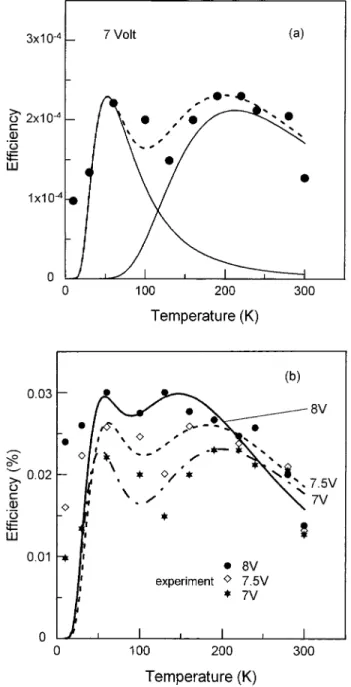
FIG. 3. 共a兲 Variation of quantum efficiency with temperature. The solid lines represent the theoretical curves as obtained by Eq.共5兲. The dashed line is the resultant curve of the two peaks. 共b兲 Shift of high-temperature quantum-efficiency peak with voltage.
FIG. 1. Schematic diagram of the device.
FIG. 2. Electroluminescence spectra for the device at different temperatures.
8176 J. Appl. Phys., Vol. 89, No. 12, 15 June 2001 Saha, Su, and Juang
The temperature-dependent EL flux EL(T) is then ob-tained by multiplying the temperature-dependent PL effi-ciency, which is the ratio of radiation to total recombination.
The expression forEL(T) is given by
EL共T兲⫽␣PL共T兲P共d兲pF共d兲, 共6兲
where␣is a constant.
In Fig. 3共a兲, we have fitted the experimental data by Eq. 共6兲. The solid lines represent the theoretical curves as ob-tained by Eq. 共6兲 and the points are the experimental data. We have used the hole mobility (p) as 1/T2共taken by other workers兲.8 From the fitting procedure it has been observed that the best-fit curve关dotted line shown in Fig. 3共a兲兴 is the resultant of two peaks, one in the high-temperature region and the other in the low-temperature region. From Fig. 3共b兲, it is seen that the high-temperature peak shifts to the lower temperature as voltage increases, but for the low-temperature peak 共peak position at ⬃65 K兲, no shift with voltage is ob-served. The origin of the two peaks might be explained by considering the trap states distributed in two different energy regions. From the thermally stimulated luminescence 共TSL兲 spectra of Alq3, it has been observed that apart from deep trap states 共⬃0.15 eV兲, there are also shallow trap states 共⬃0.07 eV兲. The high-temperature peak in Fig. 3共a兲 is attrib-uted to the deep trap states and the low-temperature peak is due to shallow trap states.
Figure 4 represents the energy-band diagram of the de-vice structure. From the energy-band diagram it is seen that the energy barrier 共⬃0.8 eV兲 between the LUMO levels of TPD and Alq3is very large compared to that of the HOMO levels共⬃0.3 eV兲. Therefore, the device current is dominated by holes and the light emission originates from the Alq3
layer. The hole mobility in TPD (⬃7.0⫻10⫺3cm2/V s) is also much higher than the electron mobility (5 ⫻10⫺5cm2/V s) in Alq
3. For this reason, under some bias the holes can more easily reach the Alq3layer than the elec-trons and the TPD/Alq3interface acts as a virtual anode.
Under application of proper bias, holes will be injected from ITO to the TPD layer and electrons will be injected from the Al electrode to the Alq3 layer. The injected elec-trons will be distributed among the trap states in the band-gap region of Alq3according to Eq.共1兲. In the Frenkel exci-ton model 关Eq. 共6兲兴, the temperature dependence of the quantum efficiency depends on three factors:共i兲 the hole mo-bility (p⬃1/T2),共ii兲 the photoluminescence efficiency, and 共iii兲 the hole density p(d). The first two factors increase with decreasing temperature but the hole density decreases with decreasing temperature. Therefore, a peak in the quantum efficiency with temperature is expected in the model. The high-temperature peak 关Fig. 3共a兲兴 originates due to radiative recombination of the deep trap levels共electrons兲 and mobile holes.
The most interesting phenomenon is the origin of the low-temperature peak. So far, most of the results9 in the literature regarding quantum efficiency in Alq3devices show saturation in the low-temperature regime. This is because of the fact that the quantum efficiency has been measured with higher voltage. We have analyzed the low-temperature peak also by the Frenkel exciton model and the energy gap (E-EF), EF being the quasi-Fermi level for electrons (En)
or holes (Ep) for different voltages, which are shown in
Table I for both high- and low-temperature peaks. From Table I, it is seen that the energy gap for the high-temperature peak is higher than that for the low-high-temperature peak, and for the high-temperature peak the energy gap de-creases with increasing voltage. No significant change in the energy gap with voltage is observed for the low-temperature peak. This is because of the fact that the high-temperature
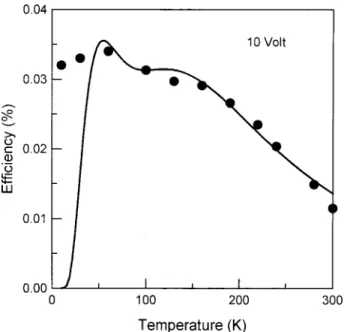
FIG. 5. High-temperature quantum-efficiency peak converges with the low-temperature peak at voltage 10 V.
TABLE I. Values of the energy gap between the quasi-Fermi level for holes and HOMO states (E⫺Ep) and the quasi-Fermi level for electrons and
LUMO states (E⫺En) at different voltages, obtained from the fitting
pro-cedure.
Voltage共V兲 E⫺Ep共eV兲 E⫺En共eV兲
6.5 0.08 0.02 7.0 0.07 0.02 7.5 0.07 0.02 8.0 0.06 0.02 9.0 0.06 0.02 10.0 0.05 0.02
FIG. 4. Energy-band diagram of the device.
8177
J. Appl. Phys., Vol. 89, No. 12, 15 June 2001 Saha, Su, and Juang
peak originates due to recombination of the deep trapped electrons and mobile holes. According to the Frenkel exciton model, the energy gap corresponds to the energy difference between the quasi-Fermi level (Ep) of the holes and HOMO
levels. As voltage increases the quasi-Fermi level (Ep) shifts
toward the HOMO level. Correspondingly, the energy gap decreases.
But, the origin of the low-temperature peak is different from that of the high-temperature peak. At low temperature 共around ⬃100 K兲 it is very likely that mobile electrons can recombine with holes trapped in shallow trap levels. Because of lesser thermal energy, some holes will be trapped in shal-low trap levels. We have analyzed the shal-low-temperature peak also by the Frenkel exciton model because of the same basic mechanism. The only difference will be the electron mobility
n 共n⬃1/T2 is the same as p except for it being two
orders of magnitude higher thanpin the Alq3layer兲 and the electron density n(d) instead of hole mobility p and hole
density p(d). Therefore, in this case the energy gap appear-ing in the model is the difference between the quasi-Fermi level of the electron (En) and LUMO levels. The Alq3 com-pound is basically an electron-transport material. Therefore, when electrons and holes are injected into Alq3, the energy gap between En and ELUMO will be lesser than the energy gap between Ep and EHOMO.
Another interesting point is that the high-temperature peaks shift toward lower temperature, but the low-temperature peaks remain in the same position with increas-ing voltage. This is because of the fact that as the voltage increases the quasi-Fermi level (Ep) of the holes shifts
to-ward the HOMO level, as is evident from Table I, conse-quently reducing the energy gap. From Eq.共4兲 it is seen that the hole density increases with decreasing energy gap. Therefore, the quantum-efficiency peak shifts toward lower
temperature to reduce the hole density. On the other hand, no shift of the low-temperature peak is observed with increasing voltage. Therefore, with increasing voltage the high-temperature peak shifts toward lower high-temperature and the low-temperature peak remains in the same position. From Fig. 5, it is seen that at voltage around 10 V the two peaks converge and the apparent saturation was observed as was the case for other workers.
CONCLUSION
The temperature-dependent quantum efficiency of the ITO/TPD/Alq3/Al device has been studied over the tempera-ture range from 10 to 300 K on the basis of the Frenkel exciton model. Two peaks have been observed, one in the high-temperature regime and the other in the low-temperature regime. The high-low-temperature peak originates due to recombination of trapped deep-level electrons and mobile holes and the low-temperature peak is due to trapped 共shallow兲 holes with mobile electrons.
1
C. W. Tang and S. A. Van Slyke, Appl. Phys. Lett. 51, 913共1987兲.
2J. H. Burroughes, D. D. C. Bradley, A. R. Brown, R. N. Marks, K. Macky,
R. H. Friend, P. L. Burns, and A. B. Holmes, Nature共London兲 347, 539
共1990兲.
3
D. Braun and A. J. Heeger, Appl. Phys. Lett. 58, 1982共1991兲.
4
P. E. Burrows and S. R. Forrest, Appl. Phys. Lett. 64, 2285共1993兲.
5Organic Molecular Crystals, edited by E. A. Silinsh 共Spinger, Berlin,
1980兲.
6S. R. Forrest, P. E. Burrows, and M. E. Thomson, in Organic
Electrolu-minescent Materials and Devices, edited by S. Miyata and H. Singh Nalwa共Gordon and Breach, New York, 1997兲, p. 425.
7Current Injection in Solids, edited by M. A. Lampert and P. Mark
共Aca-demic, New York, 1970兲.
8L. Friedman, Phys. Rev. 140, A1649共1945兲. 9
S. R. Forrest, P. E. Burrows, and M. E. Thomson, in Organic Electrolu-minescent Materials and Devices, edited by S. Miyata and H. Singh Nalwa共Gordon and Breach, New York, 1997兲, p. 435.
8178 J. Appl. Phys., Vol. 89, No. 12, 15 June 2001 Saha, Su, and Juang