
建構分析「區域性敵對關係」的研究架構:以東北亞之區域安全為例
20
0
0
全文
(2) 行政院國家科學委員會補助專題研究計畫. 成果 報告. 建構分析「區域性敵對關係」的研究架構:以東北亞之區域 安全為例. 計畫類別: ˇ個別型計畫 □ 整合型計畫 計畫編號:NSC 94-2414-H-006-001 執行期間: 94 年 1 月 1 日至 94 年. 7. 月. 31. 日. 計畫主持人:周志杰 共同主持人:n/a 計畫參與人員:周志杰、(助理)李顯虎、(助理)陳景堯 成果報告類型(依經費核定清單規定繳交):ˇ精簡報告. □完整報告. 本成果報告包括以下應繳交之附件: □赴國外出差或研習心得報告一份 □赴大陸地區出差或研習心得報告一份 □出席國際學術會議心得報告及發表之論文各一份 □國際合作研究計畫國外研究報告書一份 處理方式:除產學合作研究計畫、提升產業技術及人才培育研究計畫、 列管計畫及下列情形者外,得立即公開查詢 □涉及專利或其他智慧財產權,□一年□二年後可公開查詢 執行單位:國立成功大學政治學系 中. 華. 民. 國. 94. 年. 10. 月. 30. 日.
(3) 中英文摘要及關鍵詞 本計劃將以「區域性敵對」 (regional rivalry)的概念為基礎,藉由深入分析東北亞的區 域安全(南北韓關係、台海兩岸關係、以及中日間的互動關係) ,發展出一個探討區域安全 的分析架構。區域性敵對指涉在地緣上鄰近的兩國之間所存在的一種資源、實力(及影響力) 或理念上的競爭。雙方將彼此視為是國家安全上的重大威脅,並且在外交與國防上視對方 為敵手並相互採行防範措施或敵對政策。本計劃所建構之架構將有助於解釋各種導致區域 內雙邊或多邊敵對關係形成與持續的主要動因,並有助於回答下述問題:為何有些地緣上 相近的敵對關係得以和平地消弭,甚至成為區域整合的催化劑;有些則因敵對情勢不斷升 高而最終以戰爭收場?在研究過程中,本計劃希望(1)建立區域性敵對的概念化意涵; (2) 探究形成與升高敵對關係與情勢的原因;(3)解釋在區域性敵對關係內,足以影響當事國 之間政治、經濟、軍事與意識形態等各層面互動的變因;以及(4)分析導致此一關係得以 存續或終結的原因。在後冷戰時期,東北亞已被公認為是最足以引發全球性衝突的地區之 一。因此,本計劃的研究發現將有助於分析兩岸、南北韓與中日關係的未來走向,與三者 之間以及三者與美國之間的連動關係,並且為政府在研判國家安全戰略與兩岸局勢時提供 重要的決策參考。 關鍵詞:區域安全、區域性敵對、東北亞、兩岸關係、南北韓關係、中日關係 The security dynamics of Northeast Asia have been the object of several studies. The large majority of these studies, however, have failed to clearly identify the nature of Northeast Asia’s security dynamics due to their sole focus on military factors and because of the limitations of the application of international-level variables to the study of regional security. This research develops an analytical framework for the study of regional security, based on the concept of ‘regional rivalry’ and the analyses of regional security in Northeast Asia. After reviewing the literature pertaining to the notion of ‘rivalry’ in international relations, the concept of ‘regional rivalry’ is defined as a spatial, positional or ideational competition between two states of the same (regional) security complex, who both perceive each other as threats to their national security and largely determine their foreign and defence policies against one another. It argues that regional dynamics in Northeast Asia have revolved around two clear regional rivalries (China-Taiwan and North-South Korea) and an important interstate relationship that has often been labelled as a competition or rivalry (China-Japan). This paper believes that the application of the concept and framework of regional rivalry to the Northeast Asian security complex can generate valuable insights into the intensity of the existing regional rivalries and the nature of China-Japan relations. Key Terms: regional security, regional rivalry, Northeast Asia, cross-Taiwan Strait relations, North-South Korea relations, China-Japan relations. 1.
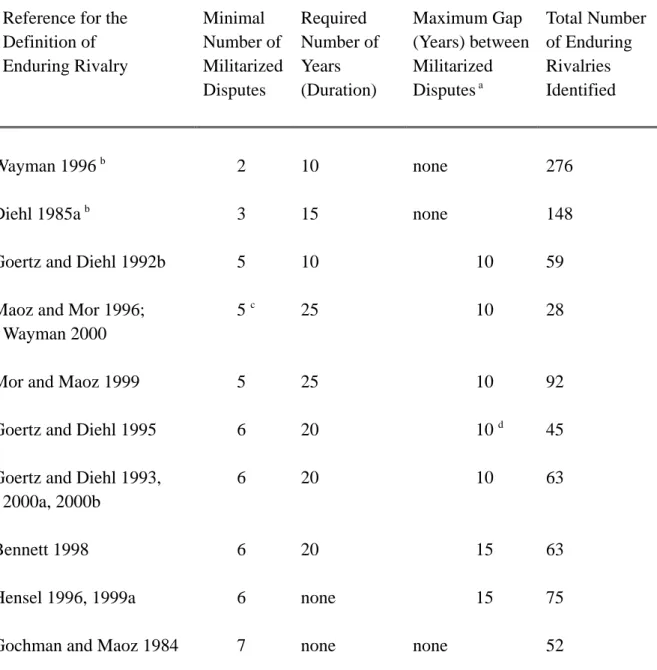
(4) PREFACE AND SIGNIFICANCE OF THE PROJECT This project develops an analytical framework for the study of regional security, based on the notion of ‘regional rivalry.’ Although international relations scholars have often used the concept of regional rivalry (e.g., Garver 2001; 1995; McGinnis 1990) and such rivalries are integral to most studies of regional security (e.g., Buzan 1991, Creighton 1992; Garret and Glaser 1997; Hickey 2001; Lieberman 1995; Nishijima and Smith 1996), scholars have paid surprisingly little attention to the nature of regional rivalries. The underlying argument of this paper is that regional rivalries constitute one of the most interesting conceptual and empirical puzzles for the study of international relations. Understanding the nature of regional rivalries—in other words, what is a regional rivalry, what triggers one, what are the different political, military, ideational and economic dynamics at play in the rivalry, and what amplifies, sustains or negates regional rivalries -- will provide a valuable theoretical tool to analyze questions of regional order and stability. Moreover, understanding the nature of regional rivalries will eventually help explain the patterns of change in regional security orders, notably why some rivalries evolve towards peace and regional integration while others flare up into war. This project conceptualizes the notion of ‘regional rivalry,’ develops an analytical framework to examine the different dynamics at play in such rivalries, and applies the framework to Northeast Asia. It is divided into three parts. The first section examines the security studies literature pertaining to interstate rivalry. It critically reviews the definitions of ‘international enemies’ (Finlay, Holsti and Fagen 1967), ‘interstate rivalry’ (Bennett 1993, 1996; Gochman and Maoz 1984; Goertz and Diehl 1992b, 1996; Hensel 1996, 1998, 1999a; Kuenne 1989; Vasquez 1993, 1996), ‘political-military rivalry’ (Huth, Bennett and Gelpi 1992), ‘enduring rivalry’ (Bennett 1997a, 1997b, 1998; Diehl 1998; Diehl and Goertz 2000; Goertz and Diehl 1992b, 1993, 1995, 1998, 2000a, 2000b; Huth 1996, 1999; Maoz and Mor 1996; Mor and Maoz 1999; Stinnett and Diehl 2001; Wayman 1996, 2000), ‘principal rivalry’ (Thompson 1995), and ‘strategic rivalry’ (Thompson 2001). The second section develops an analytical framework for understanding the dynamics of regional rivalries. It defines the notion of ‘regional rivalry’ and presents the important dimensions or dynamics at play within such rivalries. The third section is designed to show how the concept and framework of regional rivalry can be applied to the study of regional security. It examines three dyadic interstate relationships in Northeast Asia: China-Taiwan, North-South Korea, and China-Japan.. LITERATURE REVIEW The term ‘rivalry’ has often been used but has rarely been defined by international relations scholars. In most studies, the word ‘rivalry’ has been used, without any theoretical questioning, to label a situation in which two or more states compete over some stakes or contentious issues. The numerous analyses of the Cold War in terms of ‘superpower rivalry’ or ‘East-West rivalry,’ stand as prime examples of such usage (e.g., Clawson and Alavi 1986; Millar 1981; Weeks 1991). Hence, when employed as a synonym of competition, the term rivalry encompasses a wide variety of situations, including political parties competing in the same election, multinational corporations competing for the same market, and states competing for political influence in the 2.
(5) same area (Hensel 1996: 3). Some authors have noted that the concept of rivalry seems to imply something more than competition. For Kuenne (1989), a rivalry is distinguished from a competition by the non-anonymity of the actors involved, who know that each of their autonomous actions will affect the other. Rivals, then, know who they are dealing with. Still, the notion seems incomplete. Rivals do not simply know who they are competing against, they also perceive each other as enemies. In a pioneering study of international enmity, David J. Finlay, Ole R. Holsti and Richard R. Fagen (1967) explain that the idea of enmity entails two actors who both perceive each other as a threat to their welfare or interests. They distinguish three types of enemies: 1) social enemies are actors who have ill-feelings against each other, 2) political enemies are actors who oppose each other’s power aspirations, and 3) military enemies are states who experience overt or latent hostilities that can escalate to war. The notion of ‘international enemies’ sheds light on the concept of rivalry. Rivals not only compete against each other, they also, at a more vital level, perceive and define each other as social, political and military enemies. Despite its insightfulness, the notion of international enmity did not trigger much attention, at least at the theoretical level, and scholars continued to study international relations using rivalry and competition as synonymous terms. Interstate Rivalry The concept of rivalry only emerged in the field of international relations in the early 1980s, as an indirect consequence of the increased number of studies on militarized interstate disputes stemming from the Correlates of War project (COW). Identifying four levels of militarized interstate disputes (MIDs), 1 namely the threat of force, the display of force, limited use of force, and all-out war, Charles S. Gochman and Zeev Maoz (1984: 587) highlight the fact that some interstate dyads have experienced more MIDs than others. In their view, then, an ‘interstate rivalry’ is simply “states that most often have engaged in disputes with each other” (Gochman and Maoz 1984: 609). Despite its rather simplistic character, this definition has triggered a growing interest in the notion of rivalry in international relations. This growing interest, however, was largely applied to the study of other phenomena through the lens of rivalries, rather than a significant theoretical exploration of the concept of rivalry itself. Scholars have used incomplete notions of rivalry to study alliances (Diehl 1994), arms races (Diehl 1985a), democratic peace theory (Hensel, Goertz and Diehl 2000), deterrence (Huth and Russett 1993; Lieberman 1995), geographic contiguity (Diehl 1985b; Tir and Diehl 2002), global geopolitical orders (Rusi 1997), power transitions (Geller 1993; Kadera 1996, 2000), and territorial disputes (Goertz and Diehl 1992a; Hensel 1999b; Huth 1996a, 1996b, 1999).. 1. In fact, Gochman and Maoz (1984: 587) define five degrees of hostility: 1) the absence of military action, 2) the threat of force, 3) the display of force, 4) limited use of force, and 5) all-out war. They then use the last four criteria to identify MIDs, specifying that these acts must be “explicit, overt, non-accidental, and government sanctioned.” This has become the standard definition of MIDs used in the COW. In a more detailed refinement of these degrees: ‘threats’ include the threat to use force, to blockade, to occupy territory, and to declare war; ‘displays’ include an alert, a mobilization, the show of troops, ships and planes, the fortification of borders, and a nuclear alert; and ‘limited uses’ include blockade, the occupation of territory, the seizure of material or military personnel, a military clash, and a military raid (Jones, Bremer, and Singer 1996: 171-173). 3.
(6) Nevertheless, a more carefully defined notion of interstate rivalry has progressively emerged in the lexicon of international relations. Gary Goertz and Paul F. Diehl (1992b: 153), define a rivalry as a competition over tangible or intangible scarce goods, that is often perceived in terms of a zero-sum game. They later explain that “a rivalry relationship is a militarized competition between the same two states over a given period of time” (Goertz and Diehl 1996: 292). This emphasis on the militarized component of interstate rivalries is used as a criterion to dismiss other types of rivalries, notably economic rivalries among corporations or states and intra-state rivalries between political parties or identity groups. Militarized disputes often constitute a preponderant characteristic of interstate rivalries, but are certainly not the only important element to consider in this theoretical exercise. John A. Vasquez (1996: 532) defines an interstate rivalry as “a relationship characterized by extreme competition, and usually psychological hostility, in which the issue positions of contenders are governed primarily by their attitude toward each other rather than by the stakes at hand.” D. Scott Bennett (1993, 1996) and Paul R. Hensel (1996) also explain that rivals tend to consider each other as primary threats to their security and interests. Bennett’s (1996) definition of interstate rivalry, however, emphasized another important aspect of interstate rivalry: the presence of contested issues. For him (1996: 160), a rivalry involves two states who “disagree over the resolution of some issue(s) between them for an extended period of time, leading them to commit substantial resources (military, economic, or diplomatic) toward opposing each other, and in which relatively frequent diplomatic or military challenges to the disputed status quo are made by one or both of the states.” As a result of this intense competition and hostility, interstate rivals formulate their foreign policy in military terms (Diehl and Goertz 2000: 4). Finally, Vasquez (1993) adds that rivals are generally more concerned about relative gains or losses vis-à-vis each other, than they are with absolute gains. Hence, an interstate rivalry is a dyadic relationship between states which intensely disagree on some issues concerning them, are primarily concerned with relative gains or losses, perceive each other as security threats and, thus, militarize their relationship. This conception of interstate rivalry, then, has inspired other scholars to explore the question of rivalries in international relations. Enduring Rivalry Goertz and Diehl, who are by far the most prolific scholars on the notion of enduring rivalry, use the criterion of duration to differentiate between three types of rivalries: 1) ‘sporadic or isolated rivalries,’ which are very brief and involve only one or two militarized disputes, 2) ‘proto-rivalries,’ which last for about a decade but only involve a few militarized disputes, and 3) ‘enduring rivalries,’ which last for a considerable period of time and involve repeated militarized disputes (Goertz and Diehl 1992b: 152; Diehl and Goertz 2000: 22). Noting that most interstate wars have occurred within the context of enduring rivalries, Goertz and Diehl (1992b, 1993, 2000a, 2000b; Diehl and Goertz 2000) argue that analyses of conflict patterns in such rivalries may provide valuable additions to the study of international violence. Long-standing rivalries indeed constitute an important contextual factor to study empirically. In that regard, the use of the 4.
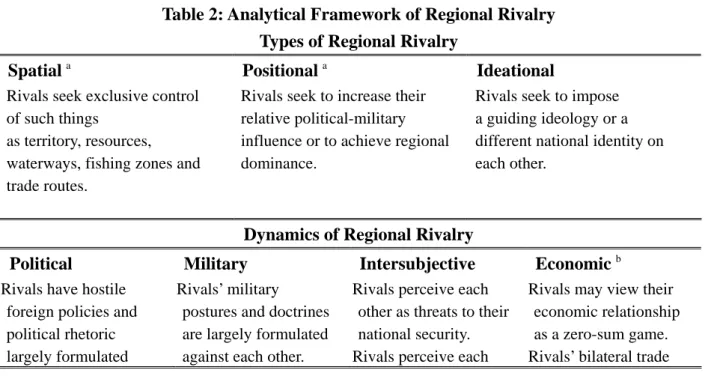
(7) notion of enduring rivalry to construct databases is a valuable first step. Its current theoretical underpinnings, however, show signs of definitional ambiguity and arbitrariness. The notion of enduring rivalry provides some insights into the empirical importance of rivalries. Scholars of enduring rivalries push international relations beyond the structural assumptions of neorealism and open up a new subfield of research and a new way of looking at the world. Nevertheless, in their effort to build extensive databases, they have yet to develop a solid conceptual basis for the notion of enduring rivalry. Table 1: Comparison of Different Definitions of Enduring Rivalry Reference for the Definition of Enduring Rivalry. Minimal Number of Militarized Disputes. Required Number of Years (Duration). Maximum Gap (Years) between Militarized Disputes a. Total Number of Enduring Rivalries Identified. Wayman 1996 b. 2. 10. none. 276. Diehl 1985a b. 3. 15. none. 148. Goertz and Diehl 1992b. 5. 10. 10. 59. Maoz and Mor 1996; Wayman 2000. 5c. 25. 10. 28. Mor and Maoz 1999. 5. 25. 10. 92. Goertz and Diehl 1995. 6. 20. 10 d. 45. Goertz and Diehl 1993, 2000a, 2000b. 6. 20. 10. 63. Bennett 1998. 6. 20. 15. 63. Hensel 1996, 1999a. 6. none. 15. 75. Gochman and Maoz 1984. 7. none. none. a. 52. This criterion has been used primarily to link together militarized disputes that are (arguably) part of the same rivalry, but it has also been used as an indicator for rivalry termination. b Definition focused solely on major powers. c Additional criterion: militarized disputes must be reciprocal and last a minimum of 30 days. d There is some confusion in this definition: Goertz and Diehl (1995) defined the maximum gap between militarized disputes as being 10 years, but they only consider a rivalry to be over after a gap of 15 years.. 5.
(8) Strategic Rivalry In a more recent publication, Thompson (2001) further develops the theorization of rivalries in international relations. Re-emphasizing his interpretive conceptualization of ‘strategic rivalries,’ he explains that rivals perceive each other as significant threats to their goal attainment. In his view, strategic rivalries are dyadic interstate relationships where both states define each other as: 1) competitors, 2) the source of actual or potential threats that can be militarized, and 3) enemies (Thompson 2001: 560). He acknowledges that longer-lasting rivalries undoubtedly carry more psychological baggage than shorter ones, but does not specify a minimal duration, nor does he focus on militarized disputes.. METHODOLOGY While the term ‘regional rivalry’ has been used several times in the international relations and security studies literature, only two scholars seek a definition of regional rivalry in their work. The first, Thompson (1995), uses the term ‘regional rivalry’ simply to refer to an area where positional ‘principal rivalries’ can occur, and not as a concept in its own rights. The other, Michael D. McGinnis (1990: 111), addresses the concept of regional rivalry as “two states engaged in a long-standing competition over regional issues that could easily go to war” and notes such examples as Ethiopia-Somalia, Greece-Turkey, India-Pakistan, Iran-Iraq, and North-South Korea. However, his analysis of regional rivalries is embedded in the Cold War mentality. In this view, regions are of secondary importance, and are simply considered as geographical playgrounds for superpower competition. Regional powers could be involved in their own rivalry, but, according to McGinnis (1990), the patterns of alignment concessions, military expenditures and arms imports are much more important to study. This kind of thinking is outdated in the post-Cold War era. Regions now clearly exhibit security dynamics of their own, and regional rivalries play a large part in these dynamics (Buzan 1991). 2 Regional Security The term ‘region’ can sometimes be difficult to define. Scholars have indeed used a wide range of indicators to differentiate between different regions. Such criteria have notably included the degree of socio-historical cohesiveness, economic trade patterns, and the existence of regional political institutions (e.g., Cantori and Spiegel 1970). Yet, such complex attempts to theorize about regions often forget that the fundamental constituent of any region is the geographical proximity and contiguity of a certain group of states. It is, in fact, on this geographical basis that decision-makers and societies at large have, over the years, perceived and interpreted the idea of region. Thus, it is important to keep in mind that regions are not set in stone, but are socially constructed (Hurrell 1995). Avoiding the potential ambiguity associated with the notion of region, Barry Buzan (1991). 2. Buzan (1991:219-220) defines the notion of ‘overlay’ as a context in which “one or more external powers move directly into the local complex with the effect of suppressing the indigenous security dynamic.” During the Cold War, both superpowers ‘overlaid’ most regional security dynamics, leading scholars to forget about the regional level. The end of the Cold War, however, has considerably reduced major power ‘overlay’ in regional security matters. 6.
(9) has developed the concept of ‘security complexes’ to analyze the patterns of amity and enmity that are geographically confined to regional subsystems. He defines a security complex “as a group of states whose primary security concerns link together sufficiently closely that their national securities cannot realistically be considered apart from one another” (Buzan 1991: 190). Security complexes, then, “emphasize the interdependence of rivalry as well as that of shared interests” (Buzan 1991: 190). They have structures, power distributions, and political-military dynamics of their own (Buzan 1995: 132-133). Hence, it is within these regional security complexes that regional rivalries can be conceptualized. Regional Rivalries A regional rivalry is, obviously, an interstate rivalry between two states of the same regional security complex. This is overly simplistic, but it is important to keep in mind. Regional rivalries emerge out of the process of ‘securitization’ 3 of two states that perceive each other as security threats and political opponents. Hence, the perception of security threats (Bennett 1993, 1996; Hensel 1996), and the development of psychological hostility (Vasquez 1996), are key components of regional rivalry dynamics. Moreover, the notion of ‘political-military rivalry’ (Huth, Bennett, and Gelpi 1992), and particularly the idea that one or both rivals may show dissatisfaction with the status quo, captures another important element of regional rivalries. Thus, rivalry duration cannot be understood by simply measuring the duration and frequency of militarized disputes (e.g., Goertz and Diehl 1992b; Diehl and Goertz 2000). Instead, periods of rivalry need to be conceptualized by examining the processes of political-military policy-making and threat perceptions. Rivals remain rivals as long as they define their relation as a rivalry. This paper does not define ‘regional rivalry’ solely in terms of disagreements over contentious issues (Bennett 1996) or competition for regional hegemony (Thompson 1995), nor does it rely on the calculable frequency of militarized disputes in arbitrarily given time periods (e.g., ‘enduring rivalry’ literature). Instead, this project defines a regional rivalry as a spatial, positional or ideational competition between two states of the same (regional) security complex, who both perceive each other as threats to their national security and largely determine their foreign and defence policies against one another. The terms ‘spatial’ and ‘positional’ are borrowed from Thompson’s (1995) analysis of ‘principal rivalries,’ which captures these two important types of rivalries. Predominantly spatial regional rivalries may feature intense competitions over such things as territory, resources, waterways, fishing zones, and trade routes. A good example of a predominantly spatial rivalry is the India-Pakistan rivalry over the control of Kashmir. Predominantly positional regional rivalries, on the other hand, are competitions for political-military influence and increased relative power in the regional security complex, as well as quests for regional hegemony. The regional rivalry between Spain and France in the 16th century and the Argentina-Brazil rivalry until the mid-1980s 3. The process of ‘securitization’ is twofold. It refers to the process by which decision-makers within states identify what is and what is not a national security threats and develop policy responses accordingly, but, “presenting something as an existential threat to a referent object does not by itself create securitization” (Buzan, Waever and Wilde 1998: 25). The process is also political: “In naming a certain development a security problem, the ‘state’ can claim a special right […] by definition, something is a security problem when the elites declare it to be so” (Waever 1995: 54). 7.
(10) are examples of this type of regional rivalry. There is also a third possible type of regional rivalry, which this paper labels as ‘ideational.’ Predominantly ideational regional rivalries are competitions over ideological supremacy between two states or competitions driven by conflicting perceptions of their national identities. The China-Taiwan rivalry is a clear example of this type of regional rivalry. It is important to note, however, that these categories are not mutually exclusive. Some regional rivalries may very well be rooted simultaneously in spatial, positional and ideational competitions. Dynamics of Regional Rivalries Understanding the nature of regional rivalries requires an examination of the dynamics at play within them. How exactly do regional rivals act towards each other? Rivalries can escalate and de-escalate (Goertz and Regan 1997). Thus, understanding their dynamics is not only important for theoretical purposes, but also for practical purposes, such as identifying the rivalries likely to escalate and the conditions that favour their de-escalation. This paper identifies three important dynamics of regional rivalry: political, military, and intersubjective; and a potential fourth dynamic: economic. First, regional rivalries are expressed politically. In a way, regional rivalries are intergovernmental rivalries. Decision-makers from both states will define their relationship as a rivalry. Consequently, rival states will develop hostile foreign policies against each other and will have tense diplomatic relations. Such policies may include containment, the identification of the rival as a political opponent, or the recall of an ambassador. The regional rivalry will also transpire in the political rhetoric of both states. Rivals use a wide range of slogans and demeaning characterizations. Identifying this political dynamic requires a careful examination of the official foreign policy documents and discourse of key decision-makers’ on both sides of the rivalry. Second, regional rivalries are expressed militarily. Rivals do not necessarily engage in repeated militarized disputes, but they certainly develop their military postures and doctrines against each other. The use of deterrence doctrines, for instance, is common in rivalry situations. Moreover, regional rivals will formulate conflict scenarios against each other. Consequently, they will deploy their armed forces and train their military personnel accordingly. Regional rivals will also engage in competitive arms dynamics. 4 As such, decision-makers will pay close attention to the military balance, particularly to the balance of offensive and defensive weapon systems. They will, then, keep track of each other’s military expenditures and arms procurements. Identifying this military dynamic requires an examination of the defence policies, arms dynamics, military expenditures, and military postures of both rivals. Third, regional rivalries are socially constructed, thus intrinsically intersubjective. 5 Regional 4. This paper defines a ‘competitive arms dynamic’ as either an ‘arms competition’ or an ‘arms race.’ The other (non-competitive) types of arms dynamics are ‘reduction’ and ‘maintenance’ (Buzan and Herring 1998). Furthermore, this paper defines an ‘arms race’ based on two criteria: 1) a given time period must show a rate of increase of military capabilities significantly above the maintenance level, and 2) the second half of this period must show a greater rate of increase than the first (Horn 1987). If the rate in both periods is above the maintenance level but does not increase in the second half, then the arms dynamic is an ‘arms competition.’ 7 This dimension originates in the constructivist approach to international relations theory (e.g., Wendt 1992, 1999). This paper, then, agrees with constructivism that the neorealist concept of international structural anarchy does not fully explain the patterns of amity and enmity that characterize interstate dynamics. 8.
(11) rivals perceive each other as threats to their national security. They also conceive of each other as enemies. These perceptions are often rooted in the social psyche of a state, rather than actual political or military factors. Moreover, states have ‘strategic cultures,’ long-lasting sets of beliefs, or ‘systems of symbols,’ concerning their geopolitical environment, history, and socio-political culture (e.g., Booth and Trood 1999; Johnston 1995; Katzenstein 1996). Rivals, then, construct or reconstruct their national identities and their strategic cultures in opposition to each other. Identifying this intersubjective dynamic requires a close examination of the strategic culture, social perceptions of threats and enmity, as well as norms and values of national security within each rival (e.g., Alagappa 1998). Fourth, regional rivalries can have an economic dimension. Of course, some states can have minimal bilateral economic contacts before the rivalry develops, making it difficult to observe any variation in economic relations, but because rivals are concerned about relative gains or losses, they are likely to view their bilateral economic relations as a zero-sum game. As such, they are likely to reduce their flow of bilateral trade (Mansfield and Bronson 1997). There is some debate regarding the impact of political-military factors on trade, as some scholars argue against such a correlation (Li and Sacko 2002; Morrow 1999). Mindful of this debate, this paper develops a framework that can account for an economic dimension within regional rivalries. It is important to note that, by definition, a regional rivalry does not need to have an economic dynamic; however, regional rivalries can have an economic impact: regional rivalries can intensify the bilateral economic competition between rivals. In sum, regional rivalries emerge out of political, military and intersubjective dynamics, and may also have an economic dimension. It is important to keep in mind that these dimensions are not necessarily isolated from each other, as events in one dynamic may very well have an effect in other dynamics. Yet, applying the analytical framework of regional rivalry, summarized in Table 2, to different dyadic interstate relations, past or present, can identify regional rivalries and their dynamics. Finally, this comprehensive understanding of the nature of regional rivalries will also contribute to the analysis of regional security dynamics. Table 2: Analytical Framework of Regional Rivalry Types of Regional Rivalry Spatial a. Positional a. Ideational. Rivals seek exclusive control of such things as territory, resources, waterways, fishing zones and trade routes.. Rivals seek to increase their relative political-military influence or to achieve regional dominance.. Rivals seek to impose a guiding ideology or a different national identity on each other.. Dynamics of Regional Rivalry Political Rivals have hostile foreign policies and political rhetoric largely formulated. Military Rivals’ military postures and doctrines are largely formulated against each other.. Intersubjective Rivals perceive each other as threats to their national security. Rivals perceive each 9. Economic b Rivals may view their economic relationship as a zero-sum game. Rivals’ bilateral trade.
(12) against each other. Rivals have tense diplomatic relations. Rivals’ decision-makers define the relationship as a rivalry.. Rivals are involved in competitive arms dynamics. Rivals’ decision-makers clearly focus on their relative military balance.. other as enemies. Rivals’ identities and strategic cultures are (re)constructed in opposition to each other.. a. Type of rivalry originally conceptualized by Thompson (1995).. b. It is important to note that not all regional rivalries develop an economic dynamic.. flow may be reduced. Rivals may increase their economic competition.. DISCUSSION: CASES IN NORTHEAST ASIA Regional dynamics in Northeast Asia have revolved around two clear regional rivalries (China-Taiwan and North-South Korea) and an important interstate relationship that has often been labelled as a competition or rivalry (China-Japan). The security dynamics of Northeast Asia have been the object of several studies. The large majority of these studies, however, have failed to clearly identify the nature of Northeast Asia’s security dynamics due to their sole focus on military factors (e.g., Hickey 2001) and because of the limitations of the application of international-level variables to the study of regional security. This project believes that the application of the concept and framework of regional rivalry to the Northeast Asian security complex can generate valuable insights into the intensity of the existing regional rivalries and the nature of China-Japan relations. Hence, this section will examine the regional rivalries of Northeast Asia to identify their predominant rivalry type, their dynamics and their potential for escalation or de-escalation. Cross-Taiwan Strait Rivalry The situation between China and Taiwan clearly possesses the political, military and intersubjective characteristics of a regional rivalry, but has not (yet) developed an economic dimension. In the near future, the rivalry is likely to remain politically complex, as both sides are conscious of the risks of diplomatic and military escalation if political rhetoric is not managed. The military dynamic of the rivalry may perhaps cause more problems. Arms acquisitions have an impact on the threat perception of the rivals; thus, the arms race may escalate if Taiwan successfully purchases more destabilizing weaponry from the Unites States, such as Aegis-capable destroyers and other kinds of ABM systems. Moreover, the sale of conventional weapon systems is a state-to-state activity, and as such, escalates the intersubjective dynamic of the regional rivalry by reinforcing Taiwan’s perception of itself as an independent actor and China’s ideational antagonism towards the island. The China-Taiwan regional rivalry, then, clearly has a potential for escalation if its political, military and intersubjective dynamics are not properly managed. North-South Korea Rivalry The situation between North and South Korea clearly constitutes a regional rivalry. It is, however, difficult to predict a trend in the rivalry. The 2000 Summit has somewhat improved the 10.
(13) situation, but the enthusiasm of 2000 has now been replaced by scepticism, as the pace of the exchanges has slowed down considerably. The future of the North Korean regime is also difficult to foresee, but it seems that the regional rivalry between the DPRK and the ROK will remain militarily competitive and politically stagnant. The key for transformation then, lies at the intersubjective level, as perceptions of threat and enmity may erode over time. Rise of China-Japan Rivalry The interstate relationship between China and Japan does not currently constitute a regional rivalry per se, but it does possess certain characteristics which suggest that it could potentially evolve into a regional rivalry in the future. Examining the China-Japan relations with the framework of regional rivalry will clarify its dynamics more precisely than the common neorealist perception that a rivalry is looming (e.g., Bernstein and Munro 1997; Hickey 2001). China and Japan are not involved in a regional rivalry at the moment. Instead, they hold good and stable diplomatic relations, their military policies are not formulated against each other, and they are becoming increasingly interdependent economically. Nevertheless, both countries perceive each other as potential long-term threats to their national security and intersubjectively define each other as such. Furthermore, China and Japan are both courting Southeast Asian states for political and economic reasons. Their recent competition for leadership in the institutionalism of East Asian regionalism (ASEAN+3) and the negotiation of FTA, may be signs of an emerging Sino-Japanese positional regional rivalry over East Asia. The analytical framework of regional rivalry, then, will be useful to identify possible changes in the China-Japan interstate relations, which may eventually emerge as a full-fledged regional rivalry.. CONCLUDING REMARKS AND SUGGESTIONS This paper has introduced an analytical framework for the study of regional rivalries. It has argued that understanding the nature of regional rivalries and their political, military, intersubjective and economic dynamics is fundamental for the study of regional security. The goal of this framework is not to identify one dynamic as responsible for creating or sustaining regional rivalries, but rather to provide a comprehensive analytical tool to study the important dynamics at play within regional rivalries. Only by understanding how two states perceive each other as rivals, and how that translates into political, military and economic practices, can questions of regional order and stability be truly explored. By applying the analytical framework of regional rivalry to Northeast Asia, the paper has demonstrated its utility. The concept of regional rivalry has been able to identify: 1) clear situations of regional rivalry, such as the China-Taiwan case; 2) dynamics of regional rivalry that appear to or have the potential for change, such as the intersubjective dynamic of the North-South Korea rivalry; and 3) situations that do not constitute regional rivalries despite some degree of political rhetoric and threat perceptions, such as the China-Japan situation. Overall, the case studies have shown that: 1) the regional rivalry between China and Taiwan is likely to remain politically, militarily and intersubjectively tense. Despite both governments’ interest in avoiding political crises and continuing their economic exchanges, 11.
(14) further sales of sophisticated weapons to Taiwan may destabilize the rivalry; 2) the regional rivalry between North and South Korea is likely to remain politically and militarily tense, with little economic interaction, but has the potential for de-escalation in its intersubjective dynamic; and 3) China-Japan relations do not constitute a regional rivalry at the moment, but the framework has provided some insight as to where to look for the development of a regional rivalry between these two states. Theoretically, while the concept of regional rivalry still warrants further theoretical and empirical research, notably in the operationalization of its variables, this paper has established its validity and its usefulness as a conceptual tool for the analysis of regional security dynamics. For future research on Northeast Asia, Japan’s and South Korea’s redirections on foreign policy might be cautiously observed. The potential regime change in Taiwan in 2008 will also possibly re-identity this Island’s geopolitical status when considering the balance between China, United States, and Japan. More importantly, a challenge is to find a path to sustain the regional order with impacts of these region al rivalries. Building a rival, but peaceful geopolitical order based on defining mutual-respected status quo between those dyadic rivals could be a possible way to respond to the current scenario in the region.. 12.
(15) REFERENCES Alagappa, Muthiah, ed. 1998. Asian Security Practice: Material and Ideational Influences. Stanford: Stanford University Press. Bennett, D. Scott. 1993. “Security, Economy, and the End of Interstate Rivalry.” Ph.D. dissertation, University of Michigan. ———. 1996. “Security, Bargaining, and the End of Interstate Rivalry.” International Studies Quarterly 40, no. 2: 157-184. ———. 1997a. “Democracy, Regime Change, and Rivalry Termination.” International Interactions 22, no. 4: 369-397. ———. 1997b. “Measuring Rivalry Termination, 1816-1992.” Journal of Conflict Resolution 41, no. 2: 227-254. ———. 1998. “Integrating and Testing Models of Rivalry Duration.” American Journal of Political Science 42, no. 4: 1200-1232. Bernstein, Richard, and Ross H. Munro. 1997. The Coming Conflict with China. New York: Alfred A. Knopf. Binder, Leonard. 1958. “The Middle East as a Subordinate International System.” World Politics 10: 408-429. Bleiker, Roland. 2001. “Identity and Security in Korea.” The Pacific Review 14, no. 1: 121-148. Booth, Ken, and Russell Trood, eds. 1999. Strategic Cultures in the Asia-Pacific Region. London: MacMillan Press. Brecher, Michael. 1963. “International Relations and Asian Studies: The Subordinate State System of Southern Asia.” World Politics 15: 213-235. Buzan, Barry. 1991. People, States, and Fear: An Agenda for International Security Studies in the Post-Cold War Era. Boulder: Lynne Rienner. ———. 1995. “The Post-Cold War Asia-Pacific Security Order: Conflict or Cooperation?” In Pacific Cooperation: Building Economic and Security Regimes in the Asia-Pacific Region, edited by Andrew Mack and John Ravenhill. Boulder: Westview Press. Buzan, Barry, and Eric Herring. 1998. The Arms Dynamic in World Politics. Boulder: Lynne Rienner. Buzan, Barry, Ole Waever, and Jaap de Wilde. 1998. Security: A New Framework for Analysis. Boulder: Lynne Rienner. Cantori, Louis, and Steven Spiegel, eds. 1970. The International Politics of Regions: A Comparative Approach. Englewood Cliffs, NJ: Prentice Hall. Chevalérias, Philippe. 2001. “Chine-Taiwan: le poids des échanges économiques.” Politique Étrangère 66, no. 1: 69-81. Clawson, Robert W., and Alireza Alavi, eds. 1986. East-West Rivalry in the Third World: Security Issues and Regional Perspectives. Wilmington, DE: Scholarly Resources. Cliff, Roger. 1998. “Taiwan: In the Dragon’s Shadow.” In Asian Security Practice: Material and Ideational Influences, edited by Muthiah Alagappa. Stanford: Stanford University Press. Clough, Ralph N. 1987. Embattled Korea: The Rivalry for International Support. Boulder: Westview Press. Cooper, John F. 1999. “The Origins of the Conflict Across the Taiwan Strait: The Problem of Differences in Perceptions.” In Across the Taiwan Strait: Mainland China, Taiwan, and the 1995-1996 Crisis, 13.
(16) edited by Zhao Suisheng New York: Routledge. Copper, John F. 1996. Taiwan: Nation-State or Province? 2nd edition. Nations of the Modern World. Boulder: Westview. Creighton, John. 1992. Oil on Troubled Waters: Gulf Wars, 1980-91. London: Echoes. Diehl, Paul F. 1985a. “Arms Races to War: Testing Some Empirical Linkages.” Sociological Quarterly 26, no. 3: 331-349. ———. 1985b. “Contiguity and Military Escalation in Major Power Rivalries, 1816-1980.” The Journal of Politics 47, no. 4: 1203-1211. ———. 1994. “Substitutes of Complements?: The Effects of Alliances on Military Spending in Major Power Rivalries.” International Interactions 19, no. 3: 159-176. ———, ed. 1998. The Dynamics of Enduring Rivalries. Urbana: University of Illinois Press. Diehl, Paul F., and Gary Goertz. 2000. War and Peace in International Rivalry. Ann Arbor: University of Michigan Press. Finlay, David J., Ole R. Holsti, and Richard R. Fagen. 1967. Enemies in Politics. Rand McNally Studies in Comparative Government and International Politics. Chicago: Rand McNally & Company. Garret, Banning, and Bonnie Glaser. 1997. “Chinese Apprehensions about the Revitalization of the US-Japan Alliance.” Asian Survey 37, no. 4: 383-402. Gartzke, Erik, and Michael W. Simon. 1999. “’Hot Hand’: A Critical Analysis of Enduring Rivalries.” The Journal of Politics 61, no. 3: 777-798. Garver, John W. 2001. Protracted Contest: Sino-Indian Rivalry in the Twentieth Century. Seattle: University of Washington Press. Geller, Daniel S. 1993. “Power Differentials and War in Rival Dyads.” International Studies Quarterly 37, no. 2: 173-193. Gochman, Charles S., and Zeev Maoz. 1984. “Militarized Disputes, 1816-1976: Procedures, Patterns, and Insights.” Journal of Conflict Resolution 28, no. 4: 285-303. Goertz, Gary, and Paul F. Diehl. 1992a. Territorial Changes and International Conflict. Studies in International Conflict, ed. Manus I. Midlarsky, vol. 5. London: Routledge. ———. 1992b. “The Empirical Importance of Enduring Rivalries.” International Interactions 18, no. 2: 151-163. ———. 1993. “Enduring Rivalries: Theoretical Constructs and Empirical Patterns.” International Studies Quarterly 37, no. 1: 147-171. ———. 1995. “The Initiation and Termination of Enduring Rivalries: The Impact of Political Shocks.” American Journal of Political Science 39, no. 1: 30-52. ———. 1996. “Taking ‘Enduring’ out of Enduring Rivalry: The Rivalry Approach to War and Peace.” International Interactions 21, no. 3: 291-308. ———. 1998. “The Volcano Model and Other Patterns in the Evolution of Enduring Rivalries.” In The Dynamics of Enduring Rivalries, edited by Paul F. Diehl. Urbana: University of Illinois Press. ———. 2000a. “(Enduring) Rivalries.” In Handbook of War Studies II, edited by Manus I. Midlarsky. Ann Arbor: University of Michigan Press. ———. 2000b. “Rivalries: The Conflict Process.” In What Do We Know about War? edited by John A. Vasquez. Lanham, MD: Rowman & Littlefield. Goertz, Gary, and Patrick M. Regan. 1997. “Conflict Management in Enduring Rivalries.” International 14.
(17) Interactions 22, no. 4: 321-340. Hamm, Taik-young. 2001. “North-South Korean Reconciliation and Security on the Korean Peninsula.” Asian Perspective 25, no. 2: 123-151. Hensel, Paul R. 1996. “The Evolution of Interstate Rivalry.” Ph.D. dissertation, University of Illinois at Urbana-Champaign. ———. 1998. “Interstate Rivalry and the Study of Militarized Conflict.” In Conflict in World Politics: Advances in the Study of Crisis, War and Peace, edited by Frank P. Harvey and Ben D. Mor. New York: St. Martin’s Press. ———. 1999a. “An Evolutionary Approach to the Study of Interstate Rivalry.” Conflict Management and Peace Science 17, no. 2: 175-206. ———. 1999b. “Charting a Course to Conflict: Territorial Issues and Interstate Conflict, 1816-1992.” In A Road Map to War: Territorial Dimensions of International Conflict, edited by Paul F. Diehl. Nashville: Vanderbilt University Press. Hensel, Paul R., Gary Goertz, and Paul F. Diehl. 2000. “The Democratic Peace and Rivalries.” The Journal of Politics 62, no. 4: 1173-1188. Hickey, Dennis Van Vranken. 2001. The Armies of East Asia: China, Taiwan, Japan, and the Koreas. Boulder: Lynne Rienner. Horn, Michael D.. 1987. “Arms Races and the International System.” Ph.D. dissertation, University of. Rochester. Hurrell, Andrew. 1995. “Regionalism in Theoretical Perspective.” In Regionalism in World Politics: Regional Organization and International Order, edited by Louise Fawcett and Andrew Hurrell. Oxford: Oxford University Press. Huth, Paul K. 1996a. “Enduring Rivalries and Territorial Disputes, 1950-1990.” Conflict Management and Peace Science 15, no. 1: 7-41. ———. 1996b. Standing Your Ground: Territorial Disputes and International Conflict. Ann Arbor: University of Michigan Press. ———. 1999. “Enduring Rivalries and Territorial Disputes, 1950-1990.” In A Road Map to War: Territorial Dimensions of International Conflict, edited by Paul F. Diehl. Nashville: Vanderbilt University Press. Huth, Paul, D. Scott Bennett, and Christopher Gelpi. 1992. “System Uncertainty, Risk Propensity, and International Conflict Among the Great Powers.” Journal of Conflict Resolution 36, no. 3: 478-517. Huth, Paul, and Bruce Russett. 1993. “General Deterrence Between Enduring Rivals: Testing Three Competing Models.” American Political Science Review 87, no. 1: 61-73. Information Office of the State Council. 2000. China’s National Defense in 2000. Beijing: Information Office of the State Council. International Institute for Strategic Studies (IISS). 2001a. The Military Balance 2001-2002. London: Oxford University Press for the International Institute for Strategic Studies. International Institute for Strategic Studies (IISS). 2001b. Strategic Survey 2000-2001. London: Oxford University Press for the International Institute for Strategic Studies. Japanese Defense Agency. 2001. White Paper on Defense. Tokyo: Japanese Defense Agency. Job, Brian L., André Laliberté, and Michael D. Wallace. 1999. “Assessing the Risks of Conflict in the 15.
(18) PRC-ROC Enduring Rivalry.” Pacific Affairs 72, no. 4: 513-535. Johnston, Alastair I. 1995. “Thinking about Strategic Culture.” International Security 19, no. 4: 12-64. Jones, Daniel M., Stuart A. Bremer, and J. David Singer. 1996. “Militarized Interstate Disputes, 1816-1992: Rationale, Coding Rules, and Empirical Patterns.” Conflict Management and Peace Science 15, no. 2: 163-213. Kadera, Kelly M. 1999. “The Power-Conflict Story: A Synopsis.” Conflict Management and Peace Science 17, no. 2: 149-174. ———. 2001. The Power-Conflict Story: A Dynamic Model of Interstate Rivalry. Ann Arbor: University of Michigan Press. Katzenstein, Peter, ed. 1996. The Culture of National Security: Norms and Identity in World Politics. New York: Columbia University Press. Kinsella, David. 1994. “Conflict in Context: Arms Transfers and Third World Rivalries during the Cold War.” American Journal of Political Science 38, no. 3: 557-581. ———. 1995. “Nested Rivalries: Superpower Competition, Arms Transfers, and Regional Conflict, 1950-1990.” International Interactions 21, no. 2: 109-125. Kuenne, Robert E. 1989. “Conflict Management in Mature Rivalry.” Journal of Conflict Resolution 33, no. 3: 554-566. Lake, David A., and Patrick M. Morgan, eds. 1997. Regional Orders: Building Security in a New World. University Park: Pennsylvania State University Press. Lebovic, James H. 1986. “The Middle East: The Region as a System.” International Interactions 12, no. 3: 267-289. Lee, Chung Min. 2001. “North Korean missiles: strategic implications and policy responses.” The Pacific Review 14, no. 1: 85-101. Li, Rex. 1999. “Partners of Rivals? Chinese Perceptions of Japan’s Security Strategy in the Asia-Pacific Region.” The Journal of Strategic Studies 22, no. 4: 1-25. Li, Quan, and David Sacko. 2002. “The (Ir)Relevance of Militarized Interstate Disputes for International Trade.” International Studies Quarterly 46, no. 1: 11-43. Lieberman, Elli. 1995. “What Makes Deterrence Work? Lessons from the Egyptian-Israeli Enduring Rivalry.” Security Studies 4, no. 4: 851-910. Mansfield, Edward D., and Rachel Bronson. 1997. “Alliances, Preferential Trading Arrangements, and International Trade.” American Political Science Review 91, no. 1: 94-107. Maoz, Zeev and Ben D. Mor. 1996. “Enduring Rivalries: The Early Years.” International Political Science Review 17, no. 2: 141-160. McGinnis, Michael D. 1990. “A Rational Model of Regional Rivalry.” International Studies Quarterly 34, no. 1: 111-135. Millar, Thomas B. 1981. The East-West Strategic Balance. London: Allen & Unwin. Mor, Ben D., and Zeev Maoz. 1999. “Learning and the Evolution of Enduring International Rivalries: A Strategic Approach.” Conflict Management and Peace Science 17, no. 1: 1-48. Morrow, James D. 1999. “How Could Trade Affect Conflict?” Journal of Peace Research 36, no. 4: 481-489. Nishijima, Shoji, and Peter H. Smith, eds. 1996. Cooperation of Rivalry? Regional Integration in the Americas and the Pacific Rim. Boulder: Westview Press. 16.
(19) Park, Han S. 2000. “North Korean Perceptions of Self and Others: Implications for Policy Choices.” Pacific Affairs 73, no. 4: 503-516. Rigger, Shelley. 1999. “Competing Conceptions of Taiwan’s Identity: The Irresolvable Conflict in Cross-Strait Relations.” In Across the Taiwan Strait: Mainland China, Taiwan, and the 1995-1996 Crisis, edited by Zhao Suisheng New York: Routledge. ROK Ministry of National Defense. 1999. ROK White Paper on Defense. Seoul: Ministry of National Defense. Roy, Denny. 1998. China’s Foreign Relations. Lanham, MD: Rowman & Littlefield. Rusi, Alpo M. 1997. Dangerous Peace: New Rivalry in World Politics. Boulder: Westview Press. Stinnett, Douglas M., and Paul F. Diehl. 2001. “Path(s) to Rivalry: Behavioral and Structural Explanations of Rivalry Development.” The Journal of Politics 63, no. 3: 717-740. Stockholm International Peace Research Institute. 2001. SIPRI Yearbook 2001. Oxford: Oxford University Press for the Stockholm International Peace Research Institute. Sutter, Robert G. 2000. Chinese Policy Priorities and Their Implications for the United States. Lanham, MD: Rowman & Littlefield. Taiwan Ministry of Foreign Affairs. 1993. ROC Foreign Affairs Report. Taipei: Government Information Office. Taiwan Ministry of National Defense. 1992. 1992 National Defense Report. Taipei: Li Ming Cultural Enterprise. The Taiwan Affairs Office and the Information Office of the State Council. 2000. The One-China Principle and the Taiwan Issue. Beijing: The Taiwan Affairs Office and the Information Office of the State Council. Thompson, William R. 1995. “Principal Rivalries.” Journal of Conflict Resolution 39,. no. 2: 195-223.. ———. 2001. “Identifying Rivals and Rivalries in World Politics.” International Studies Quarterly 45, no. 4: 557-586. Tir, Jaroslav, and Paul F. Diehl. 2002. “Geographic Dimensions of Enduring Rivalries.” Political Geography 21, no. 2: 263-286. Vasquez, John A. 1993. The War Puzzle. Cambridge Studies in International Relations 27. Cambridge: Cambridge University Press. ———. 1996. “Distinguishing Rivals That Go to War from Those That Do Not: A Quantitative Comparative Case Study of the Two Paths to War.” International Studies Quarterly 40, no. 4: 531-558. Wachman, Alan M. 1994. Taiwan: National Identity and Democratization. Taiwan in the Modern World. Armonk, NY: M.E. Sharpe. Waever, Ole. 1999. “Securitization and Desecuritization.” In On Security, edited by Ronnie Lipschutz. New York: Columbia University Press. Wallace, Michael D., Brian L. Job, Jean Clermont and André Laliberté. 2001. “Rethinking Arms Races: Asymmetry and Volatility in the Taiwan Strait Case.” Asian Perspective 25,. no. 1: 157-193.. Wang, T. Y. 2001. “Cross-Strait Relations after the 2000 Election in Taiwan: Changing Tactics in a New Reality.” Asian Survey 41, no. 5: 716-736. Wayman, Frank W. 1996. “ Power Shifts and the Onset of War.” In Parity and War: Evaluations and Extensions of The War Ledger, edited by Jacek Kugler and Douglas Lemke. Ann Arbor: University 17.
(20) of Michigan Press. ———. 2000. “Rivalries: Recurrent Disputes and Explaining War.” In What Do We Know about War? edited by John A. Vasquez. Lanham, MD: Rowman & Littlefield. Weeks, John F., ed. 1991. Beyond Superpower Rivalry: Latin America and the Third World. New York: New York University Press. Wendt, Alexander. 1992. “Anarchy is What States Make of It.” International Organization 46, no. 2: 391-426. ———. 1999. Social Theory of International Politics. Cambridge Studies in International Relations 67. Cambridge: Cambridge University Press. Wong, Timothy Ka-ying. 2000. “Changing Taiwan’s Foreign Policy: From One China to Two States.” Asian Perspective 24, no. 1: 5-46. Yu, Taifa. 1999. “Relations between Taiwan and China after the Missile Crisis: Toward Reconciliation?” Pacific Affairs 72, no. 1: 39-55. Zhao, Suisheng. 1999a. “Economic Interdependence and Political Divergence: A Background Analysis of the Taiwan Strait Crisis.” In Across the Taiwan Strait: Mainland China, Taiwan, and the 1995-1996 Crisis, edited by Zhao Suisheng New York: Routledge. ———. 1999b. “Military Coercion and Peaceful Offence: Beijing’s Strategy of National Reunification with Taiwan.” Pacific Affairs 72, no. 4: 495-512.. 18.
(21)
數據
相關文件
• Since the term structure has been upward sloping about 80% of the time, the theory would imply that investors have expected interest rates to rise 80% of the time.. • Riskless
Referring to the Student Worksheet (p.2) of Activity 2, ask students to identify which situations incur pure risk and speculative risk respectively... Invite students to present
that study in the past, sum up, interconnected system produce, influence the intersection of industrial area and future testing amount of ' economic and regional de
6 《中論·觀因緣品》,《佛藏要籍選刊》第 9 冊,上海古籍出版社 1994 年版,第 1
Therefore, the key to the increase of government efficiency lies on the implementation of cross-regional cooperation mechanism among local governments.. As a matter of fact,
Reading Task 6: Genre Structure and Language Features. • Now let’s look at how language features (e.g. sentence patterns) are connected to the structure
各區安全等級為 DB/Backup> Intranet > Campus >DMZ>Internet 。安全等
除了前述與嚴重特殊傳染性肺炎(COVID-19)疫情有關的時事素材之外,本年度試卷中並未出現 其他諸如區域全面經濟夥伴協定(Regional Comprehensive
