Research Express@NCKU - Articles Digest
1 of 3
Research Express@NCKU Volume 31 Issue 4 - March 3, 2017 [ http://research.ncku.edu.tw/re/articles/e/20170303/6.html ]
Breakdown of Bose-Einstein Distribution in Photonic Crystals
Ping-Yuan Lo, Heng-Na Xiong, Wei-Min Zhang*
Department of Physics and Center of Quantum Information Science, National Cheng Kung University, Tainan70101, Taiwan, Republic of China.
Scientific Reports, Vol. 5, 9423 (2015)
P
hotonic band gap (PBG) structures in photonic crystals (PCs) together with the characteristic dispersion properties have stimulated considerable interest in the study of fundamental photonic science and also in the development of new photonic technology1. The most significant new features induced by the PBG are the inhibition of atom spontaneous emission and the localization of light2. This provides the opportunity to control and manipulate light for photonic information technology. Practically, understanding photonic quantum dynamics at finite temperature is important for the development of all-optical circuits incorporating cavities and PBG waveguides embedded in PCs in the microwave regime.
We investigate micro/nano cavity photonics in PCs at finite temperature. Due to PBG-induced localized long-lived non-Markovian photon dynamics3, we find that cavity photons in PCs do not obey Bose-Einstein statistical distribution. Within the PBG region and also in the vicinity of the PBE, cavity photons combine the nontrivial non- Markovian dissipations with thermal fluctuations together to form photon states that can memorize the initial cavity state information. As a result, Bose-Einstein statistical distribution for photons is completely broken down in these regimes, even though the photonic thermal energy is larger or much larger than the cavity detuning energy. This conclusion is generally valid for various photonic band gap structures in PCs. For the 1D and 2D PCs, the breakdown of Bose-Einstein distribution leads to a crossover from equilibrium to nonequilibrium cavity steady states, while for 3D PCs with an anisotropic DOS, the breakdown of Bose-Einstein distribution corresponds to a critical transition rather than a crossover. No matter whether it is a crossover or a critical transition, the breakdown of Bose-Einstein distribution is a consequence of localization photons due to the presence of PBG structures in PCs. Therefore the conclusion is also valid for other nanomaterials with band gap structures. It could provide a hitherto unexplored challenge on photon statistics.
Research Express@NCKU - Articles Digest
2 of 3
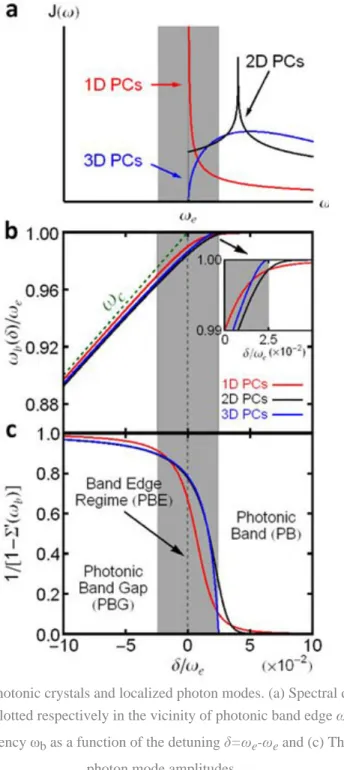
Figure 1. Band structures of photonic crystals and localized photon modes. (a) Spectral densities for different DOS of 1D, 2D and 3D PCs are plotted respectively in the vicinity of photonic band edge ωe; (b) The corresponding localized photon mode frequency ωb as a function of the detuning δ=ωe-ωe and (c) The corresponding localized
photon mode amplitudes.
Research Express@NCKU - Articles Digest
3 of 3
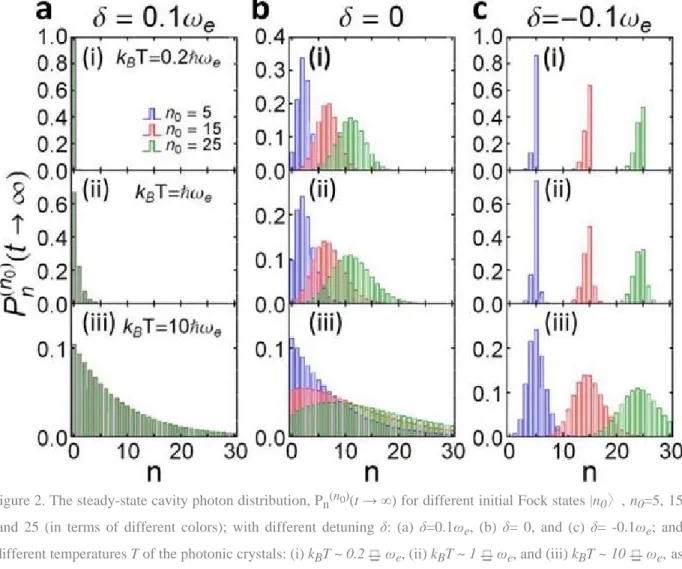
Figure 2. The steady-state cavity photon distribution, Pn(n0)(t → ∞) for different initial Fock states |n0〉, n0=5, 15 and 25 (in terms of different colors); with different detuning δ: (a) δ=0.1ωe, (b) δ= 0, and (c) δ= -0.1ωe; and different temperatures T of the photonic crystals: (i) kBT ~ 0.2 ωe, (ii) kBT ~ 1 ωe, and (iii) kBT ~ 10 ωe, as given in the figure.
References:
1. J. D. Joannopoulos, S. G. Johnson, J. N. Winn and R. D. Meade, Photonic Crystals: Modeling the Flow of Light (Princeton, New York, 2008).
2. E. Yablonovitch, Phys. Rev. Lett. 58, 2059 (1987); S. John, Phys. Rev. Lett. 58, 2486 (1987).
3. Wei-Min Zhang*, P. Y. Lo, H. N. Xiong, M. W. Y. Tu and F. Nori, Phys. Rev. Lett. 109, 170402 (2012).