
具八酚官能基多面體聚矽氧烷於高分子作用力 奈米複合材料的合成與研究
64
0
0
全文
(2) 誌謝 碩士生涯晃眼即過,能夠有這篇論文的產生,實在必須歸功於許許多多人們的 幫助,謹以這篇文章獻給曾經指導我、幫助我以及一起奮鬥的夥伴們。 特別感謝 張豐志老師引領我進入高分子這門學術殿堂,老師不但在我初到 新竹、人生地不熟之下給了我一個安棲之所,甚至對於原本完全不熟悉這門科學 的我也願意給我時間與機會努力,並提供了一個良好的環境讓我能夠安心研究,這 一年半以來我學習到的任何東西,首先都必須感激張老師的提攜與照顧。 感謝郭紹偉學長不厭其煩的回答我許許多多的問題,紹偉學長對學術的專業 以及對論文的寫作能力更是令我感到佩服,尤其紹偉學長在百忙之中仍舊耐心指 導我在生活以及學業上的一切問題,讓初窺門徑的我不至於無所依循,更是令我感 到感激不已。 感謝實驗室的學長姐們,我的實驗技巧以及初到新竹生活上的適應,都是來自 於大家的教導,學長姐們願意把自己的經驗毫不藏私的傾囊相授,令我能夠少走許 多錯誤以及憑空摸索的路。 感謝同屆的同學們,當時我們一起唸書討論準備考試,彼此勉勵實驗進度,互 相安慰生活上的不適意,那些情景仍歷歷在目,能夠有這些一起努力的夥伴對於我 的求學以及研究,更是有著莫大的助益。 也要特別感謝我的家人和大學、高中和國中的朋友們,在我遠赴新竹求學的 時候給我心靈上的支持,使我無論遇到什麼困境,只要想到大家就能立刻溫暖自己 的心,重新面對一切的困難。 在我即將邁入博士班領域的前夕,我以這篇論文為我的碩士生活畫下句點,希 望在未來更長的求學生涯裡,我能夠精益求精,在這個無止境的學術領域中更上好 幾層樓。 祝福曾經幫助我、教導我、關心我、鞭策我的人們,大家都能平平安安,快快 樂樂的度過每一天。. 2004 年 12 月 31 日於交大 2.
(3) Outline of Contents Pages Acknowledgments Outline of Contents. 3. List of tables. 5. List of figures. 6. Abstract (Chinese). 8. Abstract (English). 9. Chapter 1 Introduction 1.1 A quick history of Polyhedral Oligomeric Silsesquioxane(POSS). 12. 1.2 Silsesquioxanes and Polyhedral Oligomeric Silsesquioxane(POSS). 14. 1.3 Polymer miscibility and interactions. 18. References. 20. Chapter 2 The syntheses of octaphenol-POSS 2.1 Experimental section. 23. 2.2 FTIR and NMR spectrum of the products. 24. 2.2.1 Characterizations. 24. 2.2.2 Discussions. 25. 3.
(4) Chapter 3 Studies of hydrogen bonding in Blends of Phenolic resin with AS-POSS Abstract. 29. 3.1 Introduction. 30. 3.2 Experiment section. 34. 3.3 Results and Discussion. 42. 3.4 Conclusions. 43. Chapter 4. A Novolac type of phenolic nanocomposite from octaphenol-POSS Abstract. 45. 4.1 Introduction. 46. 4.1.1 Strategies for designing addition-cure phenolics. 47. 4.1.2 Hybrid inorganic/organic crosslinked resins containing polyhedral oligomeric silsesquioxanes. 48. 4.2 Experimental section. 51. 4.3 Characterizations. 53. 4.4 Results and Discussion. 55. 4.5 Conclusions. 63. Reference. 64. 4.
(5) List of tables. Pages Table 3-1: Curve fitting of the area fractions of the carbonyl stretching bands in the FTIR spectra of phenolic/AS-POSS blends recorded at room temperature.. 36. Table 3-2: Summary of the self-association and inter-association equilibrium constants and thermodynamic parameter of phenolic/AS-POSS blends at 25℃. 40. Table 4-1 Comparison of phenolic/octaphenol-POSS for reaction system and blend system(DSC). 56. Table 4-2 Comparison of phenolic/octaphenol-POSS for reaction system and blend system(TGA). 60. 5.
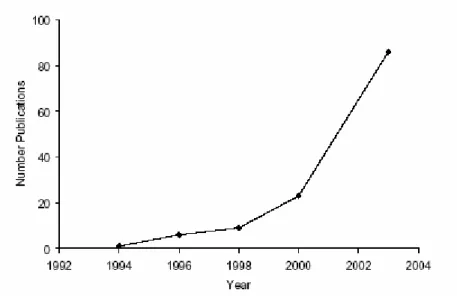
(6) List of figures. Pages Fig. 1-1. Plot of the number of POSS publications versus the year in which they were published.. 13. Fig. 1-2. Structures of silsesquioxanes.. 14. Fig. 1-3. Structure of POSS. 15. Fig. 2-1. FTIR spectrum of the synthesis process. 26. Fig. 2-2. NMR spectrum of AS-POSS. 27. Fig. 2-3. NMR spectrum of octaphenol-POSS. 27. Fig. 3-1 Infrared spectra of phenolic/AS-POSS blend at room temperature in the hydroxyl stretching region (a) and carbonyl stretching region (b). 37. Fig. 3-2 Deconstructed models of the carbonyl stretching bands (in Figure 3-1) of the weight percent of phenolic/AS-POSS blends at various compositions.. 37. Fig. 3-3 Fraction of the hydrogen-bonded carbonyl group versus composition. 38. Fig. 4-1 DSC scans of phenolic/octaphenol-POSS (blend system). 55. Fig. 4-2 DSC scans of phenolic/octaphenol-POSS (reaction system). 56. Fig. 4-3 MALDI-TOF of phenolic/octaphenol-POSS (reaction system). 57. 6.
(7) Fig. 4-4 TGA of phenolic/octaphenol-POSS (blend system). 58. Fig. 4-5 TGA of phenolic/octaphenol-POSS (reaction system). 59. Fig. 4-6 WAXD of phenolic/octaphenol-POSS (reaction system) and Q8M8H. 61. 7.
(8) 摘要. 有機-無機混成材料結合了有機材料及無機材料的性質,而奈米級 有機-無機複合材料由於可大幅補強原材料的性質,在近年引起相當廣 泛的研究。在眾多奈米級填充物中,多面體聚矽氧烷由於具備固定的 籠狀結構而有良好的尺寸安定性,在矽原子上連接之有機官能基可藉 由傳統有機合成方法加以改質,來達成與高分子間有良好的作用力而 在分子等級分散均勻。本論文以含八酚官能基的多面體聚矽氧烷為研 究主體,內容則分為以下三大主題: (1) 含八酚官能基的多面體聚矽氧烷之合成 合成產物均藉由紅外線光譜以及核磁共振光譜做出證實。. (2) octa(acetoxystyryl)- octasilsesquioxane (AS-POSS)與酚醛樹酯混摻 之高分子間作用力研究 高分子之相容性和特殊作用力的探討有助於解釋許多高分子的 行為。本研究乃利用 AS-POSS 其有機部份可產生氫鍵受體,可與其他 帶有氫鍵予體的高分子產生氫鍵作用力,藉此探討酚醛樹酯與多面體 聚矽氧烷間的氫鍵作用情形。. 8.
(9) (3) 利用含八酚官能基的多面體聚矽氧烷改質酚醛樹酯,以製備有機無機混成奈米複合材料 酚醛樹酯由於其良好的機械強度、耐熱性以及尺寸穩定性,從工 業上到太空科技上均具有廣泛的用途。本研究乃利用酚醛樹酯聚合過 程中摻入含八酚官能基的多面體聚矽氧烷,使得奈米粒子與高分子之 間產生反應藉以達成製備奈米複合材料,令改質後的酚醛樹酯性質能 夠進一步提升之目的。. 9.
(10) Abstract. Inorganic-organic hybrid materials combine both properties of inorganic and organic materials, and inorganic-organic hybrid nanocomposites have attracted enormous interests due to their large improvement of material properties. In numerous nanofillers, polyhedral oligomeric silsesquioxane(POSS) compounds have good dimension stability because they embody a truly hybrid (inorganic-organic) architecture, which contains an inner inorganic framework made up of silicone and oxygen (SiO1.5)x, that is externally covered by organic substituents. A selection of POSS nanostructured chemicals now exist that contain various combinations of nonreactive substituents and/or reactive functionalities. Thus, POSS nanostructured chemicals may be easily incorporated into common plastics via copolymerization, grafting, or blending to achieve well dispersion. In this thesis, we focus on three major subjects which based on octaphenol-polyhedral oligomeric silsesquioxane: (1) The syntheses of octaphenol-POSS The synthesis products are confirmed by FTIR and NMR.. (2) Studies. of. hydrogen. bonding. in. blends. octa(acetoxystyryl)- octasilsesquioxane AS-POSS. 10. of. phenolic. resin. with.
(11) We concentrate on the polymer miscibility and specific interaction, especially in the hydrogen bonding interaction. The AS-POSS contains carbonyl group that is known as a proton acceptor for several polymers with proton doner, we can study the hydrogen bonding between phenolic and AS-POSS.. (3) A novolac type of phenolic nanocomposite from octaphenol-POSS Phenolic resins are preferred in a wide range of applications, from commodity and construction materials to high technology aerospace industry. This recognition emerges from the fact that these resins have several desirable characteristics, such as superior mechanical strength, heat resistance and dimensional stability. In this studies, we incorporated octaphenol-POSS into phenolic matrix by copolymerization to attain further improvement of thermal properties.. 11.
(12) Chapter 1 Introduction. 1.1 A quick history of Polyhedral Oligomeric Silsesquioxane(POSS) In 1991, Lichtenhan and the Air Force Research Laboratory received funding from the Air Force Office of Scientific Research (AFOSR) for his proposed development of POSS macromers containing a polymerizable functional group and the subsequent synthesis of a POSS-copolymer[1,2]. The University-Government collaboration between Lichtenhan and Feher rapidly expanded to include more academic coaborators including Laine and Sellinger[3], Mather et al.[4] and others who were all intrigued by the physical and mechanical property improvements imparted by incorporation of these nanostructured materials into polymer systems. In the late nineties not only was government and academic interest growing, but also that of the industrial sector which desired lowers costs and larger quantities of the material. The fall of 1998 marked the start-up of Hybrid Plastics in Fountain Valley, CA, which transitioned the government scale-up facilities to the commercial sector through a cooperative research and development agreement. In addition, the award of a 3 year multimillion dollor NIST Advanced Technology Program grant in 1998 to Hybrid Plastics was critical in both reducing the prices of the POSS feedstocks and. 12.
(13) macromers ($5000-$10000 down to $50-$2000 per pound) and increasing production (<20 to >2000 lb/year) to satify the more than 100 companies now investigating how the incorporation of POSS improves material properties for their applications. In the summer of 2003, Hybrid Plastics launched critical agreements with Southern Mississippi State University and the City of Hattiesburg for their development of a 26000 sq ft production facility and a 1500 sq ft R&D center. The nearly exponential increase in the number of academic researchers, academic publications (Fig. 1-1), government programs, and industrial research efforts on POSS nanostructured chemicals has made it one of the top nanomaterials in the nanoscience/nanotechnology field. Indeed, the versatility of the POSS molecule, the more than one hundred demonstrated compatible polymer systems and the innumerable applications makes it difficult to understand and discern the current and future direction. However, it is clear that at least one concerted effort with a single-minded goal of predicting and controlling structure-property relationships is needed, and os beong pursued by a number of research groups working with POSS nanostructured chemicals.. 13.
(14) Fig. 1-1. Plot of the number of POSS publications versus the year in which they were published.. 1.2 Silsesquioxanes and Polyhedral Oligomeric Silsesquioxane(POSS) The term silsesquioxane refers to all structures with the empirical formula RsiO1.5, where the R is hydrogen or any alkyl, alkylene, aryl, arylene, or organofunctional derivative of alkyl, alkylene, aryl, or arylene groups. The silsesquioxanes include random structures, ladder structures, cage structures, and partial cage structures, as illustrated in Figure 1-2 [5]. In 1995, Baney et al. reviewed the structure, preparation, properties, and applications of silsesquioxanes, especially the ladder-like polysilsesquioxanes shown in Figure 1-2 (structure b). These include poly(phenylsilsesquioxane) (PPSQ) [6,7], poly(methyl silsesquioxane) (PMSQ) [8-10], and poly(hydridosilsesquioxane) (PHSQ). 14.
(15) [11,12]. These ladder-like polymers have an outstanding thermal stability and they exhibit oxidative resistance even at temperatures of more than 500℃. In addition, these ladder-like polymers have good insulating properties and gas permeabilities. Therefore, the ladder-like silsesquioxane polymers have a variety of applications in areas such as photoresist coatings [13,14] for electronics and optical devices, interlayer dielectrics and protective coating films [15,16] for semiconductor devices, liquid crystal display elements [17], magnetic recording media [18], optical fiber coatings [19], gas separation membranes [20], binders for ceramics [21]. However, in the past few years, much more attention has been paid to the silsesquioxanes with specific cage structures [Figure 1-2 structure c-f]. These Polyhedral Oligomeric Silsesquioxane have been designated by the abbreviation POSS.. Fig. 1-2. Structures of silsesquioxanes. 15.
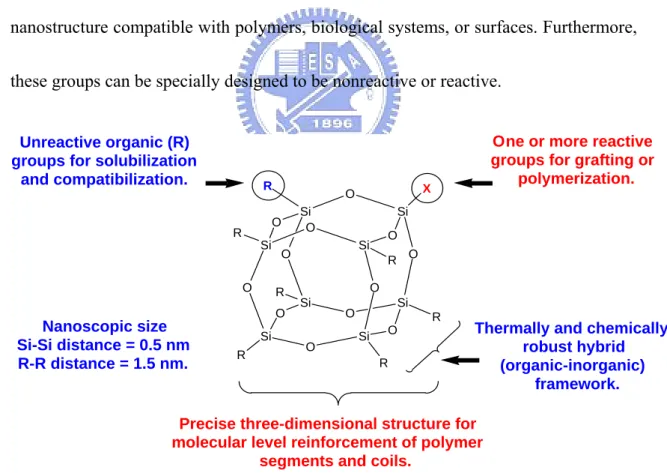
(16) POSS compounds embody a truly hybrid (inorganic-organic) architecture, which contains an inner inorganic framework made up of silicone and oxygen (SiO1.5)x, that is externally covered by organic substituents. These substituents can be totally hydrocarbon in nature or they can embody a range of polar structures and functional groups. POSS nanostructured chemicals, with sizes of from 1 to 3 nm in diameter, can be thought of as the smallest possible particles of silica, as shown in Figure 1-3. They may be viewed as molecular silicas. However, unlike silica, silicones, or fillers, each POSS molecule contains organic substituents on its outer surface that make the POSS nanostructure compatible with polymers, biological systems, or surfaces. Furthermore, these groups can be specially designed to be nonreactive or reactive.. Unreactive organic (R) groups for solubilization and compatibilization.. R. Si. O. R. Si R. Si O. Si O. Si. O. O. Nanoscopic size Si-Si distance = 0.5 nm R-R distance = 1.5 nm.. X. O. O. R. One or more reactive groups for grafting or polymerization.. O. R O Si. Si. O. O. R Si. O R. Thermally and chemically robust hybrid (organic-inorganic) framework.. Precise three-dimensional structure for molecular level reinforcement of polymer segments and coils.. Fig. 1-3. Structure of POSS. 16.
(17) A variety of POSS nanostructured chemicals have been prepared which contain one or more covalently bonded reactive functionalities that are suitable for polymerization, grafting, surface bonding, or other transformations [22]. Unlike traditional organic compounds, POSS chemicals release no volatile organic components, so they are odorless and environmentally friendly. The incorporation of POSS derivatives into polymeric materials can lead to dramatic improvements in polymer properties which include, but are not limited to, increases in use temperature, oxidation resistance, surface hardening, and improved mechanical properties, as well as reductions in flammability, heat evolution, and viscosity during processing. These enhancements have been shown to apply to a wide range of thermoplastics and a few thermoset systems [23]. It is especially convenient that the use of POSS monomers doesn’t require dramatic changes in processing. Monomers are simply mixed and copolymerized. As long as the POSS monomer is soluble in the monomer mixture, it is incorporated in a true molecular dispersion into the copolymer. No phase separation will occur although some aggregation of POSS units bound with polymer will occur. This is a significant advantage over current filler technologies. POSS nanostructures have also shown significant promise for use in catalyst supports and biomedical applications as scaffolds for drug delivery, imaging reagents, and combinatorial drug development.. 17.
(18) 1.3 Polymer miscibility and interactions Polymer blend phase behavior can be predicted or analyzed by inserting the binary interaction model into the thermodynamic framework of either the Flory-Huggins theory or an appropriate equation-of-state theory. It is useful for evaluation of isothermal phase boundaries, miscibility maps, or phase separation by using the simplicity of the Flory-Huggins theory and equation-of-state. Recently, several polymer theoretical equations of state are available [24], and some have been applied to polymer solutions and blends [25]. However, the role of polymer interaction in determining the phase behavior of polymer blends is fascinating from a number of concerns. Polymer interactions are usually meaning “strong” specific, and orientation dependent. In polymer blends, most of it have been widely concerned with the following intermolecular or inter-segment forces: (a) Strong dipoles (b) Hydrogen bonds (c) Charge transfer complexes (d) Ionic interactions in ionomers Polymer miscibility is based on the assertion that the free energy of mixing can be written in the following form:. (1-1) 18.
(19) The segmental interaction parameter χ is the “physical” interaction parameter and subscripts 1 and 2 refer to the blend components, while the ΔGH term reflects free energy changes corresponding to specific interactions, most commonly, but not necessarily, hydrogen bonds. Nevertheless, hydrogen bonds are not easily characterized. There are two common experimental ways being able to characterized hydrogen bonds within polymers: (a) Thermodynamic: Measurements depend upon thermodynamic changes in a system as a whole and can be related to molecular properties through the analyses of statistical mechanics, and these results are often model dependent and sensitive to various assumptions that have to made. (b) Spectroscopic: Spectroscopy techniques can aid in the evolution of miscibility, specifically when the interactions induce a change in the material physical properties (e.g. glass transition temperature); such as a change can be measured by radiate energy, including spectroscopy of solid-state or liquid nuclear magnetic resonance (NMR), Fourier transform infrared spectroscopy (FTIR), Raman, XPS and others.. 19.
(20) References [1] Lichtenhan JD, Feher FJ, Gilman JW. Macromolecules 1993;26:2141-2 [2] Lichtenhan JD, Otonari Y, Carr MJ. Macromolecules 1995;28:8435-7 [3] Laine RM, Sellinger A. Macromolecules 1996;29:2327-30 [4] Mather PT, Haddad TS, Oviatt HW, Schwab JJ, Chaffee KP, Lichtenhan JD. Polym Prepr 1998;39:611-2 [5] R. H. Baney, M. Itoh, A. Sakakibara, and T. Suzuki, Chem. Rev. 95, 1409 (1995) [6] X. Zhang and L. Shi, Chin. J. Polym. Sci. 5, 197 (1987) [7] J. F. Brown, Jr., J. Polym. Sci. C 1, 83 [8] Z. Xie, Z. He, D. Dai, and R. Zhang, Chin. J. Polym. Sci. 7(2), 183 (1989) [9] G. E. Maciel, M. J. Sullivan, and D. W. Sindorf, Macromolecules 14, 1607 (1981) [10] G. Engelhavdt, H. Jancke, E. Lippmaa, and A. Samoson, J. Organomet. Chem. 210, 295 (1981) [11] C. L. Frye and W. T. Collins, J. Am. Chem.Soc. 92, 5586 (1970) [12] V. Belot, R. Corriu, D. Leclerq, P. H. Mutin, and A. Vioux, Chem. Mater. 3,127 [13] H. Adachi, O. Hayashi, and K. Okahashi, Japanese Patent Kokoku-H-2-15863 [14] H. Adachi, O. Hayashi, and K. Okahashi, Japanese Patent Kokai-S-60-108841 [15] E. Adachi, Y. Aiba, and H. Adachi, Japanese Patent Kokai-H-2-277255 [16] Y. Aiba, E. Adachi, and H. Adachi, Japanese Patent Kokai-H-3-6845. 20.
(21) [17] F. Shoji, R. Sudo, and T. Watanabe, Japanese Patent Kokai-S-56-146120 [18] E. Imai, H. Takeno, Japanese Patent Kokai-S-59-129939 [19] T. Mishima, and H. Nishimoto, Japanese Patent Kokai-H-4-247406 [20] Y. Saito, M. Tsuchiya, and Y. Itoh, Japanese Patent Kokai-S-58-14928 [21] T. Mine and S. Komasaki, Japanese Patent Kokai-S-60-210570 [22] Lichtenhan JD, J. J. Schwab, and W. A. Reinerth, Sr., Chem. Innovat. 1, 3 [23] M. W. Ellsworth and D. L. Gin, Polym. News 24,331 [24] Dee, G. T. and Walsh, D. J. Macromolecules 1988,21, 811 [25] Flory, P. J. J. Am. Chem. Soc. 196, 87, 1833. 21.
(22) Chapter 2 The syntheses of octaphenol-POSS. Q8M8H M.W : 1017.99 HMe2Si HMe2Si. O. O Si O O. O Si. O. Si O. O HMe2Si HMe2Si. O. O O. Si. SiMe2H. (=R). SiMe2H. O Si. O. O. Si. O. o. Si. O. O. SiMe2H. O Si. O. o. O. SiMe2H. M.W : 2314 AS-poss R R. O Si Me2. Toluene / Pt(dvs). Si O. Si. Si Me2 Si O. Me2Si. O. Si. O. SiMe2. O Si. O. Si. O. O. O. O. O. R. SiMe2. O Si. R. SiMe2. R. O. Si. O O. R. O. O. R. N2. Si O Me2 O. R. SiMe2. OH. Hydrolysis. Octaphenol-POSS M.W:1978 R' R'. O Si Me2 R'. Si O Me2 O. Si O. Si. Me2Si. O. SiMe2. O Si. O O. Si. O O. SiMe2 R'. O. O. Si Me2 Si O. O. Si. Si. OO. R'. O. R' O. SiMe2. O Si. R' O. SiMe2. (R'=. Scheme 2-1. The syntheses of octaphenol-POSS. 22. OH. ).
(23) 2.1 Experimental section. Materials Q8M8H. was. purchased. from. Hybrid. Plastics. Co.. Platinum. divinyltetramethyldisiloxane complex, Pt(dvs) and acetoxystyrene were obtained from Aldrich Chemical Co. Inc. Octa(acetoxystyryl) octasilsesquioxane(AS-POSS) was synthesized as following method.. Synthesis of Octa(acetoxystyryl)octasilsesquioxane(AS-POSS) Q8M8H (2.00 g, 1.96 m-mole) was placed in a 100 mL Schlenk flask equipped with a reflux condenser and a magnetic stirrer. Toluene (20 mL) was added to dissolve the cube, followed by the addition of 4-acetoxystyrene(3.2 g, 19.6 m-mole). Pt(dvs) (2 mM solution, 0.2ml) was added via a syringe. The reaction mixture was then heated to 80℃ under nitrogen and was completed in 4 hours. The solution was removed from Toluene under reduced pressure, then was dried in a vacuum oven at 80 ℃ for 24 hours. The product(3.17 g, 93 %), octa(acetoxystyryl)octasilsesquioxane (AS-POSS) was obtained. The AS-POSS is a colorless, viscous liquid, soluble in THF, CHCl3, acetone, etc.. 23.
(24) Synthesis of Octa(phenol)octasilsesquioxane(octaphenol-POSS) AS-POSS(3.17g, 1.82mmole) was placed in a 100ml Schlenk flask with a magnetic stirrer. THF(20ml) was added to dissolve the liquid, followed by NaOH(aq)(20ml, 10wt%). The reaction was carried out in room temperature under nitrogen and was complete in 2 days. Ethyl ether(20ml) and deionized water(20ml) was added to the solution, and then slowly added aqueous hydrochloric acid(10wt%) with stirring until pH=8. Two layers were formed. The top layer containing the product, octaphenol-POSS, was recovered. Residual ethyl ether and water were removed under vacuum. Octaphenol-POSS(2.26g, 65%) is a light brown, viscous liquid, soluble in THF, benzene, CHCl3, etc.. 2.2 FTIR and NMR spectrum of the products. 2.2.1 Characterizations Nuclear magnetic resonance (1H NMR) 1. H NMR spectra were recorded on a Varian Unity Inova 500 FT NMR Spectrometer. operating at 500 MHz with chemical shift reported in parts per million(ppm). Deuterium chloroform was used as solvent.. 24.
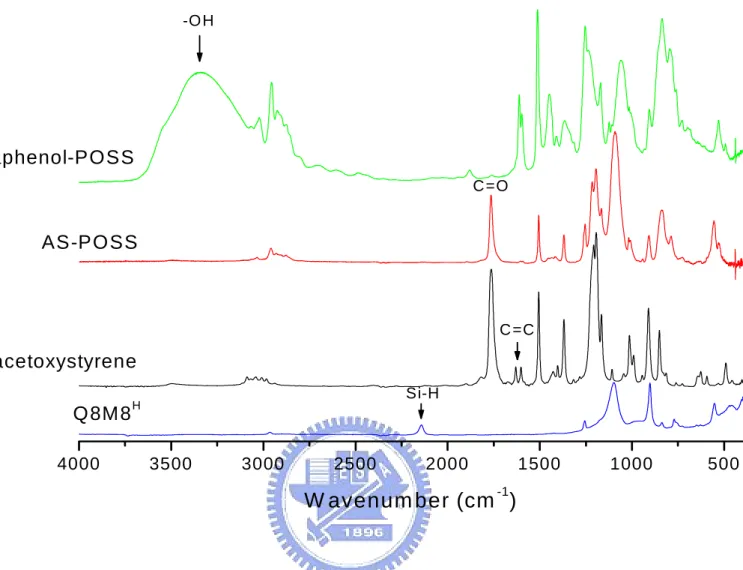
(25) Fourier Transform Infrared Spectroscopy (FTIR). Infrared spectroscopic measurements were recorded on a Nicolet Avatar 320 FTIR spectrophotometer, and 32 scans were collected with a spectral resolution of 1 cm-1. Infrared spectra of polymer blend films were determined with the conventional NaCl disk method. All sample preparations were under continuous nitrogen flow to ensure minimal sample oxidation or degradation. Samples were prepared by casting the THF solution directly onto a NaCl disk and dried under conditions similar to those used in the bulk preparation.. 2.2.2 Discussions The FTIR spectra of Q8M8H, acetoxystyrene, and the final hydrosilylation product, AS-POSS, are shown in Figure 2-1. The strong absorption peak at 1100 cm-1 of Q8M8H and AS-POSS is the vibration of the siloxane (Si-O-Si) group, the feature of the POSS. The characteristic stretching vibration peaks of vinyl (φ-CH=CH2) and Si-H groups are at 1650 and 2200 cm-1, respectively. In AS-POSS, the peaks for Si-H and the vinyl groups have disappeared completely, indicating that the complete reaction was obtained. Furthermore, the carbonyl group at 1765 cm-1 of acetoxystyrene remained in AS-POSS, is another evidence of the successful attachment of the acetoxystyrene on the POSS. In octaphenol-POSS, the broad band. 25.
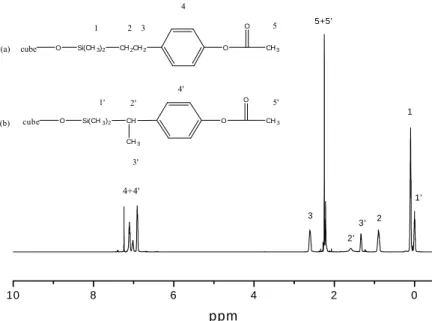
(26) of hydroxyl group appeared at 3400 cm-1 and the sharp peak of cabonyl group at 1765 cm-1 disappeared, indicated that the hydrolysis reaction is completed. Figure 2-2 and 2-3 shows the 1H NMR spectra of the AS-POSS and octaphenol-POSS, respectively. Clearly, the peaks for the chemical shifts of vinyl protons around 5.8 ppm and the Si-H protons at 4.7 ppm are both disappeared, also indicating the complete reaction. The vinyl groups of acetoxystyrene is able to attach the Si-H bond of Q8M8H on either α or βcarbon, therefore, the spectrum shown in Figure 2-2 and 2-3 are the mixture. of these two possible structures. From the integrated areas of these two methyl groups attach on Si, it is able to estimate that the ratio of the integrated areas of carbon 1:1’ is approximately 3:1. That means the α carbon attachment is three times of the β carbon attachment.. 26.
(27) -OH. Octaphenol-POSS C=O. AS-POSS. C =C. 4-acetoxystyrene Q8M8 4000. Si-H. H. 3500. 3000. 2500. 2000. 1500 -1. W avenum ber (cm ). Fig. 2-1. FTIR spectrum of the synthesis process. 27. 1000. 500.
(28) 4 1 (a). cube. O. 2. Si(CH 3)2. 3. CH 2CH 2. 5+5'. 5. O O. CH 3. 4' 1'. O. 2'. 5'. 1 cube. (b). O. Si(CH 3 )2. CH. O. CH 3. CH 3. 3'. 4+4'. 1' 3. 3'. 2. 2'. 10. 8. 6. 4. 2. 0. ppm. Fig. 2-2. NMR spectrum of AS-POSS. 4 1 (a). cube. O. 2. Si(C H3 ) 2. 3. 5. C H2 C H2. OH. 1+1'. 4' 1' (b). cube. O. Si(C H3 ) 2. 2'. 5'. CH. OH. C H3. 3'. 4+4'. 3. 5+5'. 10. 8. 6. 4. 2'. 3' 2. 2. ppm. Fig. 2-3. NMR spectrum of octaphenol-POSS. 28. 0.
(29) Chapter 3 Studies of hydrogen bonding in Blends of Phenolic resin with AS-POSS. Abstract We have successfully synthesized a polyhedral oligomeric silisesquioxane (POSS) containing eight acetoxystyryl functional groups [octa(acetoxystyryl)octasilsesquioxane (AS-POSS)] and then blends with the phenolic resin to form nanocomposites through the hydrogen bonding interaction between the phenolic hydroxyl group and the AS-POSS carbonyl group. Infrared spectroscopy analyses provide positive evidence for this type of hydrogen-bonding interaction. In addition, the inter-association equilibrium constant based on Painter-Coleman association model (PCAM) between phenolic resin and POSS can be indirectly calculated from the fraction of hydrogen-bonded carbonyl groups and quantitative analyses show that the hydroxyl-siloxane inter-association from PCAM is exactly consistent with the classical Coggeshall and Saier (C&S) methodology.. 29.
(30) 3.1 Introduction Incorporation of nanoparticles into polymer matrixes to enhance polymer properties has attracted enormous interests in recent years due to its potential as candidate materials for bridging the gap between polymer and nanoparticles. In particular, polyhedral oligomeric silsesquioxanes (POSS) offer one solution to this need since they embody an inorganic-organic hybrid architecture with a well-defined inorganic framework composed of silicone and oxygen (SiO1.5)x and organic substituents containing nonreactive or reactive functionalities. By designing the functionality of the organic substituents, it is possible to create octafunctional or monofunctional macromonomers at desired usage. Therefore, these nanostructured chemicals can be incorporated easily into polymer chains through copolymerization, such as polysiloxane [1], poly(methyl methylacrylate) [2-3], poly(styrene) [4], epoxy [5], polyurethane [6], polyimide [7], and polynorborbornene [8]. Physical properties of polymer/POSS nanocomposites are strongly influenced by the miscibility between the host polymer and the POSS moiety. Random copolymerization by the organic functional groups of the POSS is one approach to attain this end. Therefore, in our previous study [9], we have synthesized a series of poly(vinylphenol-co-vinylpyrrolidone-co-POSS). (PVPh-co-PVP-co-POSS). copolymers, resulting in significant glass transition temperature increase than the. 30.
(31) corresponding non-POSS PVPh-co-PVP copolymer due to the strong hydrogen bonding existing between the PVPh and the POSS. The synthesis of a random copolymer is more complicated and time-consuming than a blend. Therefore, polymer blending is a more convenient method to prepare the polymer/POSS nanocomposites. Since the combined entropy contribution to the free energy in mixing two polymers is negligibly small, specific intermolecular interactions are generally required for the miscibility of polymer blends. To improve the properties and miscibility of hybrid materials, it is necessary to ensure that favorable specific interactions exist between these components, such as hydrogen bonding [10], dipole–dipole interactions, and acid–base complexation. Our previous study [11], indicated that a simple blending of POSS containing nonreactive or inert diluent functional groups (here is octaisobutyl POSS) with phenolic resin did not give satisfactory results because of poor miscibility. The inter-association equilibrium constant between the phenolic hydroxyl group and the octaisobutyl POSS siloxane group (38.6) is lower than the self-association equilibrium constant of the pure phenolic (52.3) based on the Painter-Coleman association model (PCAM) [10]. This result indicates that the POSS tends to partial miscible with phenolic in the phenolic/POSS hybrid due to poor interaction between the phenolic resin and the octaisobutyl POSS. Functionalization of the POSS to. 31.
(32) possess hydrogen bonding acceptor pedant groups is expected to improve the miscibility with phenolic resin. Functionalization of Q8M8H [HsiMe2OsiO1.5]8 can be achieved by the hydrosilylation reaction of Si-H groups in the presence of a platinum catalyst with acetoxystyrene. The hydrogen bonding interaction between the carbonyl group of the poly(acetoxystyrene) (PAS) and the hydroxyl group of the phenolic resin has widely investigated via infrared and solid state NMR in our previous studies [12]. We found that the inter-association equilibrium constant for the phenolic/PAS blend (64.6) is higher than the self-association equilibrium constant of pure phenolic (52.3), implying that the tendency toward hydrogen bonding of the phenolic resin and PAS dominates the self-association (intra-hydrogen bonding) of the phenolic resin in the mixture. By infrared (FTIR) spectroscopy, the carbonyl, hydroxyl and siloxane vibration have been proved to be the excellent tool to detect these molecular interactions [13]. This tool can be used to study the mechanism of interpolymer miscibility through the formation of different type hydrogen bonds both qualitatively and quantitatively. However, the inter-association equilibrium constant between the phenolic hydroxyl group and the POSS siloxane group can not be quantified directly because no carbonyl group is available to measure the fraction of the hydrogen bonded group from IR analysis in this binary blend. The siloxane-stretching mode near 1100-1200. 32.
(33) cm-1 is a highly coupled mode that is conformationally sensitive and can not be readily decomposed into two peaks, corresponding to the free and the hydrogen-bonded siloxane absorptions. Therefore, according to our previous study [11], the inter-association equilibrium constant (KA) between hydroxyl group of phenolic resin and siloxane group of octaisobutyl POSS was calculated by using classical. Coggeshall. and. Saier. (C&S). [14]. methodology.. However,. the. inter-association equilibrium constant obtained from low molecular weight compound is not exactly the same as that from the true polymer blend due to the intramolecular screening and functional group accessibility effects in the miscible polymer blend [15]. Fortunately, in our previous study [11], the octaisobutyl POSS is the low molecular weight compound, thus this calculation can be considered as the true inter-association equilibrium constant between the phenolic hydroxyl group and the POSS siloxane group. To recheck the inter-association equilibrium constant between the phenolic hydroxyl group and the POSS siloxane group in the present study, the KA value is determined indirectly from a least square fitting procedure of the experimental fraction of hydrogen bonded carbonyl group of the AS-POSS in this binary blend. We found that the inter-association equilibrium constant of hydroxyl-siloxane have good correlation between these two methods. The hydrogen bonding formation is shown as scheme 3-1.. 33.
(34) 3.2 Experiment section. CH2. OH. O. CH3. O R R. Si O Me2 O. O Si Me2 R. Si O. Si. Me2Si. O. Si. O O. O O. SiMe2. O Si. SiMe2 R. O. O. Si Me2 Si O. O. Si. Si. OO. R. O. O R. O. SiMe2. O Si. O. R O. SiMe2. R. *. Scheme 3-1. Hydrogen bonding formation of blends of phenolic and AS-POSS. Materials The phenolic used in this study was synthesized with sulfuric acid via a condensation reaction and gave average weights of Mn=500 and Mw=1200. Octa(acetoxystyryl) octasilsesquioxane(AS-POSS) was synthesized as mentioned before... 34. CH3.
(35) Blend Preparation Blends of phenolic/AS-POSS of various compositions were prepared by solution blending. Tetrahydrofuran solution containing 5 wt% of the mixture was stirred for 6-8 h, and then the solvent was evaporated slowly at room temperature for 1 day. To ensure total elimination of solvent, the powder of the blend was then dried in a vacuum oven at 60 ℃ for 2 days.. 3.3 Results and Discussion In our previous study [11], we have discussed in details the hydrogen bonding interaction between the phenolic hydroxyl groups and the POSS siloxane groups using 1D and 2D FTIR spectra. Figure 3-1(a) shows the infrared spectra in the range from 2700 cm-1 to 4000 cm-1 of the pure phenolic and various phenolic/AS-POSS nanocomposites measured at room temperature. The pure phenolic polymer exhibits two bands in the hydroxyl stretching region of the infrared spectrum. A very broad band centered at 3350 cm-1 is attributed to the wide distribution of the hydrogen bonded hydroxyl group while a narrower shoulder band at 3525cm-1 is caused by the free hydroxyl group. Figure 3-1(a) clearly shows that the intensity of the free hydroxyl absorption (3525cm-1) decreases gradually as the AS-POSS content of the blend is increased from 5 to 90 wt%. The hydrogen-bonded hydroxyl band in the. 35.
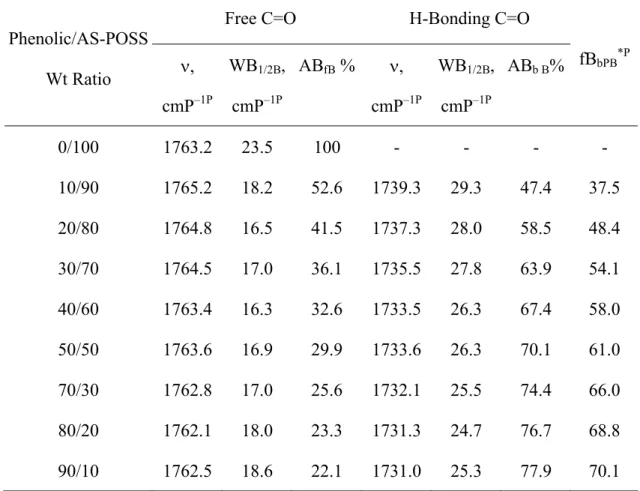
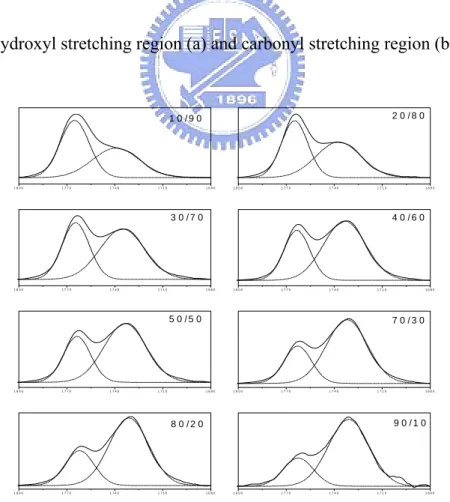
(36) phenolic tends to shift into a higher frequency with increasing AS-POSS content at the vicinity of 3465 cm-1. This change is due to the switch from the hydroxyl-hydroxyl bond to the hydroxyl-carbonyl or hydroxyl-siloxane bond. Figure 3-1(b) displays the infrared spectra in the region from 1680 cm-1 to 1820 cm-1 for various phenolic/AS-POSS blend compositions measured at room temperature. The carbonyl stretching frequency is split into two bands at 1760 cm-1 and 1735 cm-1, corresponding to the free and the hydrogen-bonded carbonyl groups, respectively. The band can be easily decomposed into two Gaussian peaks, with areas corresponding to the hydrogen-bonded carbonyl (1735cm-1) and free carbonyl (1760cm-1) as shown in Figure 3-2. In order to obtain the fraction of the hydrogen-bonded carbonyl, the known absorptivity ratio for hydrogen bonded and free carbonyl contributions is required. We have employed a value of αHB/αF=1.5, which was previously calculated by Moskala et al. [10]. Fractions of hydrogen bonded carbonyl through curve fitting are summarized in Table 3-1, indicating that the hydrogen bonded fraction of the carbonyl group increases with the increase of the phenolic content.. 36.
(37) Table 3-1: Curve fitting of the area fractions of the carbonyl stretching bands in the FTIR spectra of phenolic/AS-POSS blends recorded at room temperature.. Free C=O. H-Bonding C=O. Phenolic/AS-POSS Wt Ratio. ν,. WB1/2B, ABfB %. cmP–1P. cmP–1P. 0/100. 1763.2. 23.5. 10/90. 1765.2. 20/80. ν,. *P WB1/2B, ABb B% fBbPB. cmP–1P. cmP–1P. 100. -. -. -. -. 18.2. 52.6. 1739.3. 29.3. 47.4. 37.5. 1764.8. 16.5. 41.5. 1737.3. 28.0. 58.5. 48.4. 30/70. 1764.5. 17.0. 36.1. 1735.5. 27.8. 63.9. 54.1. 40/60. 1763.4. 16.3. 32.6. 1733.5. 26.3. 67.4. 58.0. 50/50. 1763.6. 16.9. 29.9. 1733.6. 26.3. 70.1. 61.0. 70/30. 1762.8. 17.0. 25.6. 1732.1. 25.5. 74.4. 66.0. 80/20. 1762.1. 18.0. 23.3. 1731.3. 24.7. 76.7. 68.8. 90/10. 1762.5. 18.6. 22.1. 1731.0. 25.3. 77.9. 70.1. ν: wavenumber, W1/2: half width, *fb: fraction of hydrogen bonding interaction. 37.
(38) (b ). (a ). p u r e p h e n o lic 9 5 /5 9 0 /1 0 8 0 /2 0 7 0 /3 0. 9 0 /1 0 6 0 /4 0. 8 0 /2 0. 5 0 /5 0. 7 0 /3 0. 4 0 /6 0. 5 0 /5 0 3 0 /7 0. 4 0 /6 0. 2 0 /8 0. 3 0 /7 0 2 0 /8 0. 1 0 /9 0. 1 0 /9 0 p u re A S -P O S S. p u re A S -P O S S. 1800. 4000 3800 3600 3400 3200 3000 2800. 1780. 1760. 1740. 1720. W a v e n u m b e r (c m. -1. 1700. ). Fig. 3-1 Infrared spectra of phenolic/AS-POSS blend at room temperature in the hydroxyl stretching region (a) and carbonyl stretching region (b).. 2 0 /8 0. 1 0 /9 0. 1800. 1770. 1740. 1710. 1680. 1800. 1770. 1740. 1710. 3 0 /7 0. 1800. 1770. 1740. 1710. 4 0 /6 0. 1680. 1800. 1770. 1740. 1710. 5 0 /5 0. 1800. 1770. 1740. 1710. 1770. 1740. 1710. 1680. 7 0 /3 0. 1680. 1800. 1770. 1740. 1710. 1680. 9 0 /1 0. 8 0 /2 0. 1800. 1680. 1680. 1800. 1770. 1740. 1710. 1680. Fig. 3-2 Deconstructed models of the carbonyl stretching bands (in Figure 2) of the weight percent of phenolic/AS-POSS blends at various compositions. 38. 1680.
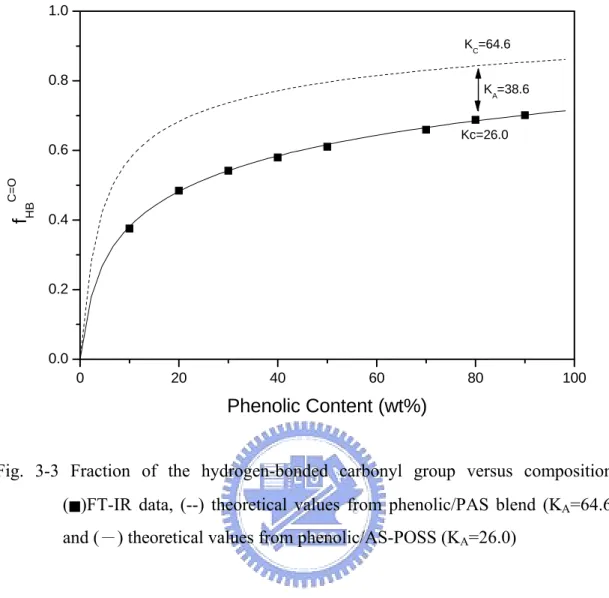
(39) 1.0 KC=64.6. 0.8. KA=38.6 Kc=26.0. fHB. C=O. 0.6. 0.4. 0.2. 0.0 0. 20. 40. 60. 80. 100. Phenolic Content (wt%) Fig. 3-3 Fraction of the hydrogen-bonded carbonyl group versus composition: (■)FT-IR data, (--) theoretical values from phenolic/PAS blend (KA=64.6) and (-) theoretical values from phenolic/AS-POSS (KA=26.0). Figure 3-3 shows plots of the experimental data and theoretical predicted curve as a function of composition at room temperature that demonstrates the ability of PCAM to predict the degree of hydrogen bonding on the carbonyl group. Figure 3-3 indicates that the experimental values are generally lower than the predicted values based on using KA = 64.6 from phenolic/PAS blends. This result also indicates that the hydroxyl groups of phenolic not only interact with the carbonyl group of the acetoxystyrene but also with the siloxane group of the POSS, which is consistent with results from our previous study [11]. In other words, the AS carbonyl competes with 39.
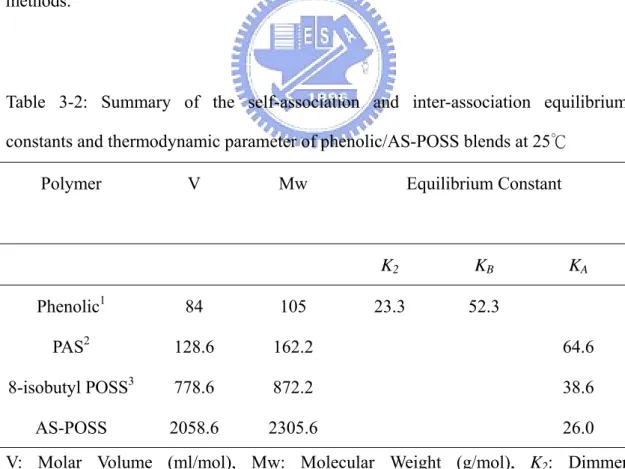
(40) the siloxane of POSS to form a hydrogen bond with hydroxyl groups of the phenolic resin. The numerical method is employed to determine KA of the phenolic/AS-POSS blend according to the PCAM based on the fraction of the hydrogen bonded carbonyl group. The approximate equations are [11]: ⎡ K Φ ⎤ Φ B = Φ B1Γ2 ⎢1 + A A1 ⎥ rA ⎦ ⎣. (1). Φ A = Φ A1 [1 + K AΦB1Γ1 ]. (2). where ⎛ ⎞ K ⎞ K ⎛ 1 ⎟ Γ1 = ⎜⎜1 − 2 ⎟⎟ + 2 ⎜⎜ K B ⎠ K B ⎝ (1 − K BΦB1 ) ⎟⎠ ⎝. (3). ⎞ ⎞ K2 ⎛ 1 ⎜⎜ ⎟ ⎟⎟ + 2 ⎟ ⎠ K B ⎝ (1 − K BΦB1 ) ⎠. (4). ⎛ K Γ2 = ⎜⎜1 − 2 ⎝ KB. Where ΦA and ΦB denote volume fractions of non-self associated species A (AS-POSS) and self associating species B (phenolic), respectively. ΦA1 andΦB1 are the corresponding volume fractions of the isolated AS-POSS and phenolic segments, respectively. r is the ratio of molar volume, VA/VB. Self-association equilibrium constants, KB and K2, describe the formation of multimers and dimers, respectively. Finally, the KA is the equilibrium constant describing the association of A with B. In addition, KB and K2 are 23.3 and 52.3 at 25℃ of the pure phenolic [11]. In order to calculate the inter-association constants (KA), the methodology of a least square method has been described in our previous study [12]. Table 3-2 lists all the 40.
(41) parameters required by the Painter-Coleman association model to estimate thermodynamic properties for this phenolic/AS-POSS blend. The inter-association equilibrium constant of 26.0 is obtained for the phenolic/AS-POSS blend. However, the KA=64.6 for the phenolic/PAS blend, implying that the KA between the hydroxyl group of phenolic and the siloxane group of POSS is equal to 38.6 (64.6-26.0 = 38.6), which is exactly consistent with the previously reported value based on the classical Coggeshall and Saier (C&S) methodology. Therefore, the inter-association equilibrium constant of hydroxyl-siloxane has good correlation between these two methods.. Table 3-2: Summary of the self-association and inter-association equilibrium constants and thermodynamic parameter of phenolic/AS-POSS blends at 25℃ Polymer. V. Mw. Equilibrium Constant. K2. KB. 23.3. 52.3. KA. Phenolic1. 84. 105. PAS2. 128.6. 162.2. 64.6. 8-isobutyl POSS3. 778.6. 872.2. 38.6. AS-POSS. 2058.6. 2305.6. 26.0. V: Molar Volume (ml/mol), Mw: Molecular Weight (g/mol), K2: Dimmer self-association equilibrium constant, KB: Multimer self-association equilibrium constant, KA: Inter-association equilibrium constant, 1: reference 11, 2: reference 12, 3: reference 11.. 41.
(42) 3.4 Conclusion A new nanomaterial based on AS-POSS has been synthesized and the hydrogen bonding interaction of phenolic/AS has been investigated by using FTIR analyses. The inter-association equilibrium constant between the hydroxyl group of the phenolic and the siloxane group of the POSS is determined indirectly from a least square fitting procedure based on the experimental fraction of hydrogen bonded carbonyl group in this blend system. The observed KA (38.6) of hydroxyl-siloxane is found equal to the value from classical classical Coggeshall and Saier (C&S) methodology.. 42.
(43) References [1] Schwab JJ, Lichtenhan JD. Appl Organomet Chem 1998;12:707. [2] Lichtenhan JD, Otonari Y, Carri MG. Macromolecules 1995;28:8435. [3] Shochey EG, Bolf AG, Jones PF, Schwab JJ, Chaffee KP, Haddad TS, Lichtenhan JD. Appl Organomet Chem 1999;13:311. [4] Haddad TS, Lichtenhan JD. Macromolecules 1996;29:7302. [5] Abad MJ, Barral L, Fasce DP, Williams RJJ. Macromolecules 2003;36:3128. [6] Fu BX, Zhang W, Hsiao BS, Johansson G, Sauer BB, Phillips S, Balnski R, Rafailovich M, Sokolov J. Polym Prepr 2000;41:587. [7] Leu CM, Chang YT, Wei KH. Macromolecules 2003;36:9122. [8] Mather PT, Jeon HG., Romo-Uribe A, Haddad TS, Lichtenhan JD.. Macromolecules. 1999;32:1194.. [9] Xu H, Kuo SW, Lee JS. Chang FC. Polymer 2002;43:5117. [10] Coleman MM, Graf JF, Painter PC. Specific Interactions and the Miscibility of Polymer Blends; Technomic: Lancaster, PA, 1991. [11] Lee YJ, Kuo SW, Huang WJ, Lee HY, Chang FC. J Polym Sci., Polym Sci Ed 2004;42:1127. [12] Kuo SW, Chang FC. Macromol Chem Phys 2002;203:868. [13] Kuo SW, Chang FC. Macromolecules 2001;34:4089.. 43.
(44) [14] Coggesthall ND, Saier EL. J Am Chem Soc 1951;71:5414. [15] Coleman MM, Painter PC. Prog Polym Sci 1995;20:1. 44.
(45) Chapter 4. A Novolac type of phenolic nanocomposite from octaphenol-POSS Abstract By adding the octaphenol-POSS before the polymerization process (which we called the reaction system) of phenolic resin to join the reaction with phenol and formaldehyde, we can synthesized a series novel novolac type of phenolic/POSS nanocomposite. Each octaphenol-POSS has eight phenol groups, and they can be viewed as eight polymerizable groups in the condensation polymerization process of phenolic resin. In order to demonstrate the occurrence of the reaction, we synthesized another series novolac type of phenolic/POSS nanocomposite by adding the octaphenol-POSS after the polymerization process (which we called the blend system) of phenolic resin for comparison. The thermal properties of these two materials are investigated by DSC, TGA, and the molecular weight distribution of the nanocomposite and dispersion condition of POSS are investigated by MOLDI-TOF and WAXD, respectively.. 45.
(46) 4.1 Introduction Despite the emergence of several new classes of thermosets, high performance polymers and several other new generation materials that are superior in some respects, phenolic resins retain industrial and commercial interest, a century after its introduction. Phenolic resins are preferred in a wide range of applications, from commodity and construction materials to high technology aerospace industry. This recognition emerges from the fact that these resins have several desirable characteristics, such as superior mechanical strength, heat resistance and dimensional stability, as well as, high resistance against various solvents, acids and water. They are inherently flame resistant, and evolve low smoke upon incineration. Although phenolics cannot be substituents for epoxies and polyimides in many engineering areas, their composites still find a major market in thermo-structural application in the aerospace industry due to good heat and flame resistance, excellent ablative properties and low cost. These key properties add to their market growth, and as a result of innovative research, new products and applications continue to emerge, demonstrating the versatility and the potential of phenol resins to cope with the ever-changing requirements and challenges of advanced technology. [1-2] Undisputedly, classical phenolic resins based on resole and novolac dominate the resin market. However, their acceptance as a universal material in many engineering areas is hampered by some of the inherent qualities derived from their special 46.
(47) chemical structures. These resins cure at moderately high temperature by a condensation mechanism with the evolution of volatiles, which necessitates application of pressure during molding to form void-free components. The need for the use of catalyst for curing and the limited shelf life of resin at ambient conditions are also major shortcomings of these systems. When compared to many known thermally stable polymers, their thermo-oxidative stability is low. The rigid aromatic units tightly held by the short methylene linkages make the matric brittle. In view of this, a new chemistry is needed to modify the cure of phenolic resins, in particular, a new method is needed to chain extend and/or to cross-link phenolic resins without production of volatiles and allow for extended shelf stability at ambient conditions for the formulated thermosets. In doing so, it is imperative that the modifications do not impair the thermo-mechanical characteristics of the resultant system.. 4.1.1 Strategies for designing addition-cure phenolics Several approaches have been reported for modification of phenolic resins and their cure chemistry. Structural modification to confer addition-cure character has been one thrust area of research [3,4]. Additional-curable phenolic resins with improved thermal and pyrolysis characteristics will be the desirable resins in composites for thermo-structural applications. [5] Higher char-yield leads also to a. 47.
(48) better heat shielding. Such high char phenolics could be potential candidates as matrices in carbon/carbon composites with obvious advantages [6]. The major strategies in designing addition-cure phenolics are: (1) Incorporation of thermally stable addition-curable groups on to novolac backbone (2) Structural modification (transform) involving phenolic hydroxyl groups (3) Curing of novolac by suitable curatives through addition reactions of OH groups (4) Reactive blending of structurally modified phenolic resin with a functional reactant. 4.1.2. Hybrid. inorganic/organic. crosslinked. resins. containing. polyhedral oligomeric silsesquioxanes As POSS macromers are incorporated, a kinetic race occurs. The solubility of the POSS in the organic monomer mixture of the resin (phenolics, epoxies, vinyl esters, methacrylics, styrene-divinylbenzene, cyanate esters or dicyclopentadiene) decreases during the cure as the number of monomer molecules (hence the entropy of mixing) decreases. Therefore, phase separation of the POSS macromer may occur sometime during the cure. This would occur in competition with the POSS macromer’s chemical incorporation into the resin. After such phase separation, the POSS macromer may homopolymerize (or copolymerize with smaller amounts of. 48.
(49) resin monomers) to form POSS-rich phases within the composite as the resin curing continues. This process can compete against random POSS incorporation into the developing resin network. Random incorporation leads to molecularly dispersed POSS monomer units within a homogeneous resin phase. Phase separation will be increasingly favored if the POSS monomer has a low relative reactivity. This will cause monomer drift during the cure which raises POSS concentration relative to the other monomers, favoring phase separation. Anything that increasing the early incorporation of POSS will lower this phase separation. Another type of phase separation process can also operate, even if all the POSS is polymerized randomly into the resin network. POSS macromers bonded into chain segments of the resin may preferentially self-associate with each other, forming POSS aggregates whose structures and sizes are limited by the freedom of motion permitted by the developing resin’s chain segmental mobility and the POSS stoichiometry. This process is favored at low crosslink densities where segmental mobility is larger. POSS aggregation has been previously observed in uncrosslinked thermoplastics. Coughlin et al have demonstrated that linear copolymers of ethylene with a mono-alpha-olefin-substituted POSS can form POSS nanocrystalline domains due to self-aggregation of pendant POSS moieties [7]. The extent of such aggregation depends on the mole fraction of POSS present and the method of solidifying the polymer (cooling a melt, precipitation. 49.
(50) from solution etc.). Such aggregation in crosslinked resin matrices will certainly be dependent on (1) the buildup of crosslinked density as a function of the degree of cure, (2) the relative reactivity ratios of the monomers, (3) the solvent used (if any) and (4) other factors (processing condition etc.).. In this thesis, we used octaphenol-POSS to enhance the thermal properties of phenolic resin, the suitable time of adding POSS and the changes in thermal properties will be discussed.. 50.
(51) 4.2 Experimental section. OH. HO. SiMe2. Me2Si. HO Si O Me2 Si. Si O. O. O Si. Me2 O O Si. Si. O. O Si. O. O. phenol,formaldehyde. O. O. HO. OH. O. O Si. O Si Me2 O. Si. O. O. H+. Me2 Si. OH. O Si. O. SiMe2. SiMe2. OH. HO. OH. H2 C m. Scheme 4-1. Preparation of phenolic/octaphenol-POSS nanocomposite. Synthesis process of phenolic/octaphenol-POSS nanocomposite: reaction system formaldehyde(aq) (137 g, 37wt%) was placed in a 1000 mL Schlenk flask equipped with a reflux condenser and a mechanical stirrer. Octaphenol-POSS at desired composition was added to phenol solution (188 g), stirred 5 minute, and then added the solution to the flask. Sulfuric acid (10%, 10ml) was added via a syringe. The reaction mixture was then heated to 100℃ under nitrogen and was completed in 22 hours. The solution was washed by hot water (90℃) three times to remove. 51.
(52) unreacted monomer and extract to remove water layer. The product was dried in a vacuum oven at 180 ℃ for 24 hours. Phenolic/octaphenol-POSS nanocomposite: reaction system can be obtained.. Synthesis process of phenolic/octaphenol-POSS nanocomposite: blend system formaldehyde(aq) (137 g, 37wt%) and phenol solution (188 g) were placed in a 1000 mL Schlenk flask equipped with a reflux condenser and a mechanical stirrer. Sulfuric acid (10%, 10ml) was added via a syringe. The reaction mixture was then heated to 100℃ under nitrogen and was completed in 22 hours. The solution was washed by hot water (90℃) three times to remove unreacted monomer and extract to remove water layer. The product (pure phenolic resin) was dried in a vacuum oven at 180 ℃ for 24 hours. Dissolve the pure phenolic resin and octaphenol-POSS at desired composition in tetrahydrofuran (THF) and dried in a vacuum oven at 80 ℃ for 24 hours. Phenolic/octaphenol-POSS nanocomposite: blend system can be obtained.. 52.
(53) 4.3 Characterizations. Differential scanning calorimeter (DSC). Thermal analysis was performed with a differential scanning calorimeter from DuPont (DSC-9000) with a scan rate of 20 ℃/min and a temperature range of -50~150 ℃. Temperature and energy calibrations were carried out with indium. Approximately 5-10 mg of each blend was weighted and sealed in an aluminium pan. This sample was quickly cooled to -50℃ from the melt for the first scan and then scanned between -50 to 150℃ at 20℃/min. The glass transition temperature is at the midpoint of the specific heat increment. Wide Angle X-ray Diffraction (WAXD). XRD spectra was collected on a M18XHF-SPA X-ray diffraction instrument (MacScience Co, Japan), used Co Kα radiation; Bragg’s law(λ=2d sinθ) was used to compute the spacing. Thermogravimetric Analysis (TGA). Thermal stability of the cured sample was investigated by a Du Pont 2050 TGA. The cured sample of 5-10mg was placed in a Pt cell and heated at a heating rate of 10 ℃/min from 30 to 800℃ at a nitrogen flow of 90 mL/min.. 53.
(54) MALDI-TOF. All the mass spectra were obtained using a Biflex 3 (Bruker) time-of-flight mass spectrometer. The mass spectrometer was equipped with a 337-nm nitrogen laser, a 1.25-m flight tube, and a sample target having the capacity to load 384 samples simultaneously. The accelerating voltage was set to 19 Kv.. 54.
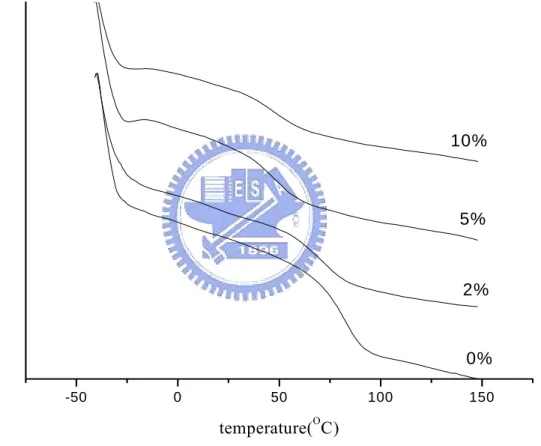
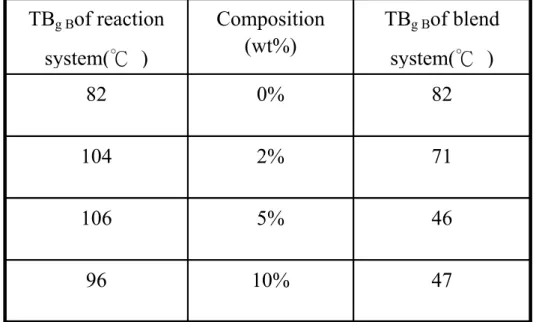
(55) 4.4 Results and Discussion. Figure 4-1 displays the DSC thermograms of octaphenol-POSS blended with phenolic (the blend system) as a function of composition, and Figure 4-2 displays the DSC thermograms of the reaction system. For comparison, Table 4-1 shows the summary of Tg of these two figures. The Tg of the blend system decreases with increasing POSS content, while the Tg of the reaction system increases with increasing POSS content (except the 10wt%), which verifies that in reaction system, the octaphenol-POSS joins the polymerization reaction and acts as a crosslinking point to make the thermal properties of the material improve. A Tg depression in the blend system is characteristic of a poor dispersion of POSS, as we mentioned before at Chapter 3, the phenol groups of phenolic resin will form hydrogen bonds with the siloxane groups of the octaphenol-POSS. Apparently, the force of the hydrogen bonds are not strong enough to make the octaphenol-POSS disperse well. For the reaction type, Tg increases with increasing POSS content and then decreases again (10wt%), indicates that octaphenol-POSS joins the polymerization of phenolic and acts as a crosslinking points to make the nanocomposite crosslinke, reduces the free volume and raises the Tg. Figure 4-3 displays the MALDI-TOF of the reaction system phenolic/POSS nanocomposites. The low molecular weight portions (<1500) increase. 55.
(56) significantly with increasing POSS content, indicates that as the POSS content increases, the steric hindrance of the POSS will lower the reactivity of the phenol groups. In other words, the effect of POSS acts as a crosslinking point competes with the effect of steic hindrance POSS, once the POSS content exceeds a certain degree,. heat flow(mW). the low reactivity will make the thermal property of the material decreases.. 10%. 5%. 2%. 0% -50. 0. 50. 100. 150. O. temperature( C). Fig. 4-1 DSC scans of phenolic/octaphenol-POSS (blend system). 56.
(57) Heat flow(mW). 10% 5%. 2% 0% -50. 0. 50. 100. 150. o. Tem perature( C). Fig. 4-2 DSC scans of phenolic/octaphenol-POSS (reaction system). Table 4-1 Comparison of phenolic/octaphenol-POSS for reaction system and blend system(DSC). TBg Bof reaction. Composition (wt%). TBg Bof blend. 82. 0%. 82. 104. 2%. 71. 106. 5%. 46. 96. 10%. 47. system(℃ ). 57. system(℃ ).
(58) absolute intensity. 10%. 5%. 2% 0% 1000. 1500. 2000. 2500. 3000. 3500. 4000. m/z. Fig. 4-3 MALDI-TOF of phenolic/octaphenol-POSS (reaction system). Figure 4-4 and figure 4-5 display the TGA thermograms of the blend system and the reaction system phenolic/POSS nanocomposites, respectively. The decomposition parameters obtained from TGA thermograms are compiled in Table 4-2, including the 5 wt% loss temperatures and char yields. The thermal stability and anaerobic char residue of the blend type decrease with increasing POSS content, while for the reaction type, they increase. The totally different trends between the two types are. 58.
(59) resulted from the role of octaphenol-POSS play in phenolic: In the reaction system, the POSS joins the polymerization and acts as a crosslinking point, it will definitely increase the thermal stability of the nanocomposite due to the better dispersion of POSS induced by the chemical bond formation. However, in the blend system, the POSS just acts as a nano-filler. Moreover, even at very low POSS loading aggregation appears easily, the poor dispersion will lower the thermal stability.. 100. 10%. Pure phenolic. weight percent(wt%). 90. 80. 70. 60. 50. 40. 30 0. 100. 200. 300. 400. 500. 600. O. temperature( C). Fig. 4-4 TGA of phenolic/octaphenol-POSS (blend system) (For clarity, data of 2% and 5% are not shown.). 59. 700. 800.
(60) 10% 5% 2% pure phenolic. 100 90. weight percentage (%). 80 70 60 50 40 30 20 10 0 0. 100. 200. 300. 400. 500. 600. o. temperature ( C). Fig. 4-5 TGA of phenolic/octaphenol-POSS (reaction system). 60. 700. 800.
(61) Table 4-2 Comparison of phenolic/octaphenol-POSS for reaction system and blend system(TGA). TB5%B(℃). char yield(%). 251.7. 39.8. 2%. 311.3. 53.3. 5%. 330.9. 53.6. 10%. 375.1. 48.2. 2%. 240.7. 41.3. 5%. 189.8. 37.0. 10%. 180.7. 36.8. Pure phenolic Reaction system:. Blend system:. 61.
(62) Figure 4-6 is the WAXD of phenolic/octaphenol-POSS nanocomposite (reaction system). From 0% to 10%, traces of WAXD show only amorphous halo, leading to the conclusion that at reaction system, POSS aggregation is small.. 10%. 4000. Lin (Counts). 5% 3000. 2% 0%. 2000. 1000. QB8BM 0. 2. 10. 20. 30. 2-Theta - Scale phenolic0% - File: phenolic0%.raw - Type: 2Th/Th locked - Start: 1.000 ? - End: 40.000 ? - Step: 0.100 Operations: Y Scale Add 500 | Y Scale Add 500 | Y Scale Add 500 | Y Scale Add 500 | Import phenolic1% - File: phenolic1%.raw - Type: 2Th/Th locked - Start: 1.000 ? - End: 40.000 ? - Step: 0.100 Operations: Y Scale Add 2500 | Import phenolic5% - File: phenolic5%.raw - Type: 2Th/Th locked - Start: 1.000 ? - End: 40.000 ? - Step: 0.100 Operations: Y Scale Add 3000 | Import Phenolic10% - File: Phenolic10%.raw - Type: 2Th/Th locked - Start: 1.000 ? - End: 40.000 ? - Step: 0.1 Operations: Y Scale Add 3500 | Import. Q8M8H - File: Q8M8H.raw - Type: 2Th/Th locked - Start: 1.000 ? - End: 40.000 ? - Step: 0.100 ? - Step Operations: Import. Fig. 4-6 WAXD of phenolic/octaphenol-POSS (reaction system) and Q8M8H. 62. 40.
(63) 4.5 Conclusions. We have successfully synthesized a new novolac type phenolic resin based on the octaphenol-POSS, through carefully choosing the time of adding octaphenol-POSS, the thermal properties will improve dramatically. Compared to the blend system of phenolic and octaphenol-POSS, the thermal properties have totally different trend between the two systems. It can be explained by the poorer dispersion of nano-particles in blend system than reaction system.. 63.
(64) Reference [1]. Knop. A,. Pilato. LA.. Phenolic. Resins:. Chemistry. Applications. and. Performance-Future directions. Heidelberg: Springer;1985 [2] Phenli UA. IN: Salamone JC, editor. Phenolic Resin: Polymeric Materials Encyclopaedia, vol. 7. Florida: CRC Press; 1996. p.5305 [3] Reghunadhan Nair CP, Bindu RL, Ninan KN. Recent advances in phenolic resins. Metals Materials and Processes, vol. 9(2). Mumbai: Meshap Science Publishers; 1997. pp. 179-200 [4] Reghunadhan Nair CP. Non-convential phenolic resins. J Sci Ind Res 2002;61:17-33 [5] Katzman HA, Mallon JJ, Barry WT. Polyarylacetylene-matrix composites for solid rocket motor components. J Adv Mater 1995;4:21-7 [6] Golfarb IJ, Lee CY-C, Arnold FE, Helminiak TE. In: Serafini TM, editor. High Temperature. Polymer. Matrix. Composites.. Park. Ridge,. NJ:. Noyes. Corporation;1987 [7] L. Zheng, R. J. Farris, E. B. Coughlin, Macromolecules 2001,34,8034. 64. Data.
(65)
數據
+7
相關文件
包括具有藥理活性的高分子和低分子藥物高分子化或
其次醋酸乙烯酯可與其他單體共聚合 ( copolymerization),可改善各單 體形成聚合物之缺點,如與氯乙烯單體 ( vinyl chloride monomer,簡稱 VCM ) 共聚合,可改善聚氯乙烯 (
接枝共聚合反應是材料改質的主要技術之ㄧ,已廣泛應用於高分子材料及生
1975 年 Feullade 和 Perche 發現 PEO, PAN, PVdF 等聚合物的鹼金屬鹽錯合物具有離子導 電性, 並製成 PAN 和 PMMA 基的離子導電膜.. 1979 年,
經過多次實驗後,團隊發現研發出的寡聚 物附著在一遇到高溫就會釋放出氧氣的正極材
實驗操作與多元學習,使學習者能具備科學核心 知識、探究實作與科學論證溝通能力,並強調跨
下列哪兩位學者最先模擬地球早期的大氣組成與狀態,利用甲烷、氨氣、氫 氣與水蒸氣等無機物成功的合成出小分子有機物? (A)許旺(Theodor Schwann)、許來登(Matthias Schleiden)
X-ray diffractograms of liquid crystalline polymers.... TGA results of polymers
