
現代零售通路CRM計畫之診斷性架構: 策略4C模型與分析成熟模型之應用 - 政大學術集成
143
0
0
全文
(2) ACKNOWLEDGEMENT I would like to express my sincere appreciation to Prof. Chiou, Jyh-sheng (邱志 聖), my Research Supervisor, for his continuous guidance and suggestion in accomplishment of this thesis. He has contributed great in inspiring me to develop research interest and I hope this work meets his expectation. Special thanks to Prof. Chen, Chien-Wei (陳建維) for coaching and leading WenShan-PaoChong team (文山包種隊), representing NCCU, into the winner of International Case Competition of 2011 among top-ranked Taiwan universities. 政 治 大 I am grateful to my classmates and team members, Joyce Lee (李宜真), Nancy 立 Chen (陳怡靜), Aimee Sun (孫鈺娟), Sander Su (蘇渝宏), Johnson Lu (呂佳穎),. ‧ 國. 學. Charlie Chen (陳鴻霖) as well as Chuan-Shing Teng (鄧傳馨) and Barry Lin (林 文正) for their supports, encouragement and companionship, making my. ‧. graduate study a fun-filled journey.. sit. y. Nat. No words can satisfactorily express my gratefulness to my ever loving best half Vita Yu (游承芳) and two sons Sean Liu (劉尚沅) and Ethan Liu (劉尚宜) for. n. al. er. io. their patience shown during my two year study at NCCU.. Ch. i n U. v. Finally, to my parents, Shue Tsai (蔡雪) and Chun-nan Liu (劉春南), I owe both. engchi. of them sincere thanks, for providing me the environment and opportunity to experiment, learn and grow at my own pace. Claude Chien-hung Liu (劉建宏) Executive MBA program, 2012 College of Commerce, National Cheng-chi University 國立政治大學 商學院經營管理碩士學程 中華民國 101 年 6 月. 2.
(3) ABSTRACT The purpose of this thesis has three objectives: (1) clarify some common misunderstandings about definitions of loyalty scheme, explore the relationship between CRM and loyalty scheme, and develop a typology of loyalty scheme for practical use; (2) study on current tactics used within retail CRM programs and provide strategic advices on how to fine-tune the tactics focus and align resource accordingly; and (3) develop a practical framework. 政 治 大 terms of analytical maturity 立and strategic marketing focus.. that allows modern trade retailers for self-diagnosing their CRM programs in. ‧ 國. 學. To achieve the research goals, this research has firstly reviewed previous. ‧. research on retail, CRM, loyalty schemes and its typology, and thus. sit. y. Nat. misunderstandings about definition of loyalty scheme, CRM, the relationship. al. n. typology of loyalty scheme has been developed.. Ch. engchi. er. io. between CRM and loyalty scheme have explained and consequently a new. i n U. v. Second, strategic 4C model (Chiou 2010) is used in this research to analyze current tactics used within retail CRM programs and the strategic advices are generated on how to fine-tune the tactics focus and align resource accordingly.. Third, this research adopted literature of strategic 4C model (Chiou 2010) and analytical maturity model (Davenport and Harris 2007) to form a two-stage diagnostic framework for retail CRM program. The further analysis is conducted based on this framework while strategic advices are provided to 3.
(4) retailers of different analytical stage.. The benefits for business executives in retail include a diagnostic framework allowing for strategically reviewing their CRM program focus and priority as retailers grows their business.. The benefits for CRM and loyalty practitioners include building correct understandings about retail CRM program, loyalty scheme and related conceptual definitions.. 立. 政 治 大. The findings in this study may serve as strategic advices to CRM or loyalty. ‧ 國. 學. marketers to better align resources, when they design tactics, to companies’. ‧. CRM strategy at different analytical stage.. sit. y. Nat. io. er. Key words: Strategic Marketing, Strategic 4C Model, Analytical Maturity Model, CRM, Customer Relationship Management, Loyalty Scheme,. n. al. Ch. Loyalty Program, Retail CRM Program. engchi. 4. i n U. v.
(5) TABLE OF CONTENTS ACKNOWLEDGEMENT .................................................................................. 2 ABSTRACT ...................................................................................................... 3 TABLE OF CONTENTS ................................................................................... 5 LIST OF FIGURES .......................................................................................... 7 LIST OF TABLES............................................................................................. 8 APPENDICES .................................................................................................. 9 Chapter 1 Introduction ................................................................................... 10 1.1. Background ......................................................................................... 10. 治 政 大 1.3. Research Scope and Flow .................................................................. 11 立 1.4. Research Outline................................................................................. 14. 1.2. Research motivation and objective...................................................... 11. ‧ 國. 學. Chapter 2 Literature Review .......................................................................... 16 2.1 Retail Industry ..................................................................................... 16. ‧. 2.2 Customer Relationship Management .................................................. 20. sit. y. Nat. 2.3 Loyalty Scheme ................................................................................... 26 Definition of loyalty scheme ..................................................................... 27. io. n. al. er. Type of loyalty scheme ............................................................................ 29. Ch. i n U. v. A new typology of loyalty schemes proposal ........................................... 34. engchi. The relationship between loyalty scheme and CRM................................ 42 2.4 Analytical Maturity Model..................................................................... 43 Four pillars of analytical competition ....................................................... 44 Support of a strategic, distinctive capability ............................................. 45 Senior Management Commitment ........................................................... 46 Largest-Scale Ambition ........................................................................... 46 Five stages of analytical competition ....................................................... 47 2.5 Strategic 4C Model .............................................................................. 49 Unit-Utility Cost........................................................................................ 50 Information Search Cost .......................................................................... 53 5.
(6) Moral Hazard Cost .................................................................................. 56 Asset Specificity Cost .............................................................................. 59 2.6 Strategic 4C Analysis of CRM Tactics Used by Retailers in Taiwan ... 60 2.7 Proposed Diagnostic Framework ........................................................ 71 Analytically Impaired Organization .......................................................... 72 Localized Analytics Companies ............................................................... 74 Analytical Aspiration Organization ........................................................... 75 Analytical Companies .............................................................................. 76 Analytical Competitors............................................................................. 77 Chapter 3 Current state of CRM program in retail industry ............................ 80. 政 治 大 3.2. Retail CRM programs in Taiwan.......................................................... 86 立. 3.1. Global Trends in Retail CRM programs ............................................... 81. ‧ 國. 學. Chapter 4 Diagnostic Framework Analysis .................................................... 93. 4.1. Strategic 4C Analysis on CRM Program of Stage 1 Retailers ............. 94. ‧. 4.2. Strategic 4C Analysis on CRM Program of Stage 2 Retailers ............. 97 4.3. Strategic 4C Analysis on CRM Program of Stage 3 Retailers ........... 100. Nat. sit. y. 4.4. Strategic 4C Analysis on CRM Program of Stage 4 Retailers ........... 103. er. io. 4.5. Strategic 4C Analysis on CRM Program of Stage 5 Retailers ........... 107. al. 4.6. The rolling of Strategic 4C Analysis on Analytical Maturity Model ..... 110. n. v i n C h ......................................................... Chapter 5 Conclusion and Suggestion 111 engchi U 5.1. Conclusion......................................................................................... 111 5.2. Strategic marketing advice ................................................................ 116 REFERENCES ............................................................................................ 120. ENGLISH .................................................................................................. 120 CHINESE.................................................................................................. 121 INTERNET................................................................................................ 122 APPENDICES .............................................................................................. 124. 6.
(7) LIST OF FIGURES Figure 1-1 Research Flow.............................................................................. 13 Figure 1-2 Research Outline .......................................................................... 15 Figure 2-1 Retail positioning map .................................................................. 18 Figure 2-2 Increasing the Value of Customer Base........................................ 24 Figure 2-3 Five-stage Customer Relationship ................................................ 25 Figure 2-4 Time-Resource Matrices of loyalty programs................................ 42 Figure 2-5 Four pillars of analytical competition ............................................. 45 Figure 2-6 Five stages of analytical maturity model ....................................... 47 Figure 2-7 Marketing exchange functions of 4C ............................................ 50 Figure 2-8 Equation of Explicit Unit-utility Cost .............................................. 51 Figure 2-9 Consumer Decision Journey......................................................... 54 Figure 2-10 Occurrence of Asset Specificity .................................................. 60 Figure 2-11 A diagnostic Framework for CRM Program in Retail ................... 72 Figure 4- 1 Rolling of Strategic 4C Model on Analytical Maturity model ....... 110. 立. 政 治 大. ‧. ‧ 國. 學. n. er. io. sit. y. Nat. al. Ch. engchi. 7. i n U. v.
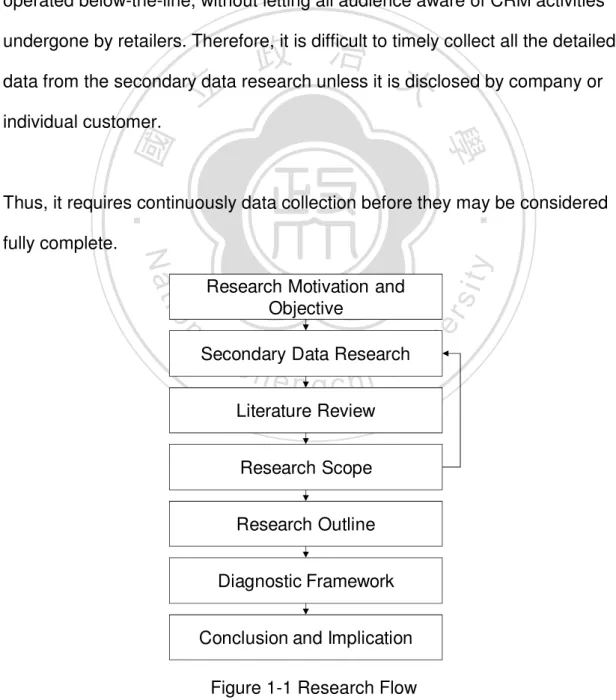
(8) LIST OF TABLES Table 2-1 Examples by Types of Retailers ..................................................... 19 Table 2-2 Modern trade retailers in Taiwan .................................................... 20 Table 2-3 Type of CRM (Buttle 2009) ............................................................. 21 Table 2-4 Definition of CRM in the literature .................................................. 22 Table 2-5 Definition of loyalty scheme in the literature ................................... 28 Table 2-6 Classification of loyalty scheme in the literature ............................. 33 Table 2-7 A new typology of loyalty scheme proposal .................................... 37 Table 2-8 4C analysis on common CRM Tactics of leading modern trade retailer in Taiwan ..................................................................................... 64 Table 2-9 Strategic 4C analysis of CRM tactics used by retailers in Taiwan .. 70 Table 2-10 Loyalty Scheme Options at different analytical stage ................... 79 Table 3-1 Adoption among Global Top 10 Retailers ....................................... 81 Table 3-2 Comparison of Retail CRM Programs in Taiwan ............................ 89 Table 3-3 Comparison of CRM tactics used by Retailers in Taiwan ............... 92 Table 4-1 Example of Tesco life-style segments (Woolf 2002) ..................... 103 Table 4-2 Example of Tesco life-stage segments (Woolf 2002).................... 103. 立. 政 治 大. ‧. ‧ 國. 學. n. er. io. sit. y. Nat. al. Ch. engchi. 8. i n U. v.
(9) APPENDICES Appendices 1 Modern-trade retailer of Nielsen Company............................ 124 Appendices 2 Green Shield Stamps ............................................................ 125 Appendices 3 Example S&H Green Stamps ................................................ 125 Appendices 4 A screenshot of the Tesco mobile site................................... 126 Appendices 5: Korger’s discount in exchange for shopper database……… 127 Appendices 6 A screenshot of benefits offered by Kroger’s My Plus Card .. 127 Appendices 7 A screenshot of the CVS mobile site ..................................... 128 Appendices 8 Carrefour HaoKang Card ...................................................... 129 Appendices 9 Carrefour Co-branded Credit Card with E.Sun Bank ............. 130 Appendices 10 Carrefour Taiwan launched its first MobileApp .................... 131 Appendices 11 Example of Online Coupon Carefour Taiwan ...................... 132 Appendices 12 Costco Loyalty Scheme....................................................... 133 Appendices 13 Costco FAQ ......................................................................... 134 Appendices 14 Costco Member’s Exclusive Coupon Passport .................... 135 Appendices 15 Costco Background ............................................................. 136 Appendices 16 Watsons Taiwan’s loyalty scheme mechanism ................... 137 Appendices 17 PX-mart’s FreeCard Program .............................................. 139 Appendices 18 PX-mart’s Beauty & Healthy eClub...................................... 140 Appendices 19 iCash Card Scheme ............................................................ 141 Appendices 20 iCash Co-branded Card Scheme ........................................ 141 Appendices 21 iCash Card Personalization Service .................................... 142 Appendices 22 Sample of 7-Eleven EC ....................................................... 142 Appendices 23 Point redemption for items .................................................. 143 Appendices 24 Extra point item ................................................................... 143. 立. 政 治 大. ‧. ‧ 國. 學. n. er. io. sit. y. Nat. al. Ch. engchi. 9. i n U. v.
(10) Chapter 1 Introduction. 1.1. Background CRM (Customer Relationship Management) has been widely adopted across different industries as a business strategy to effectively understand, manage and sustain customer relationship with technologies (Frow and Payne 2009; Buttle 2009; Baran, Galka, and Strunk 2008; Minami and Dawson 2008; Malthouse and Calder 2005; Kivertz and Itamar 2003; Rigby, Reichheld and Schefter 2002).. 政 治 大. 立. ‧ 國. 學. More and more retailers, international or local, are seeking to adopt this strategy through creating CRM programs and many of them choose loyalty. ‧. schemes as tools to realize this initiative.. sit. y. Nat. n. al. er. io. After more than twenty years innovative development in practices, loyalty. i n U. v. scheme has been widely adopted as an important component of firms’. Ch. engchi. customer relationship management (CRM) strategy to increase customer loyalty and long-term profitability because both practitioners and researchers find that retaining customers is less expensive than attracting new ones. (Cao, Nsakanda, and Mann 2010). The objectives of CRM programs may be various. Some develop CRM programs to avoid customer attritions from rivals, some hope to drive sales and profits, increase visit frequency and basket size spending, and others aim for building customer loyalty. 10.
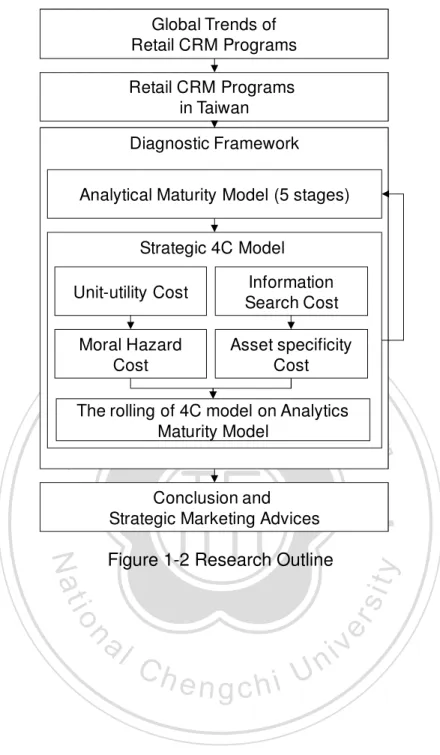
(11) 1.2. Research motivation and objective The main motivation of this thesis comes from the lacking of practical guidance, for senior executives in retail, on deciding or reviewing a CRM program corresponding with their business scale.. In addition, it is surprising that many CRM and loyalty professionals in the retail sector still have many misunderstandings about the nature of loyalty scheme,. 政 治 大. its relationship with CRM, and even its definition and typology.. 立. Hence, this research attempts to achieve the following objectives:. ‧ 國. 學. Objective 1: Clarify the misunderstandings about definition of loyalty scheme,. er. io. sit. y. Nat. typology of loyalty scheme for practical use.. ‧. explore the relationship between CRM and loyalty scheme, and develop a. Objective 2: Study on current tactics used within retail CRM programs and. al. n. v i n provide strategic advices on C how to fine-tune the U h e n g c h i tactic focus and align resource accordingly.. Objective 3: Develop a practical framework that allows modern trade retailers for self-diagnosing their CRM programs in terms of analytical maturity and strategic marketing focus.. 1.3. Research Scope and Flow This thesis focuses specifically on the CRM programs adopted by the leading 11.
(12) modern trade retailers in Taiwan. The definition of modern trade retailer used in this study is based on that of Nielsen Company, which includes hypermarket, supermarket, convenience store, drug stores, and warehouse clubs (Table 2-2).. The research starts with firstly confirming the research objectives based on research background and motivation, proceeding secondary data research and literature review to define the research scope, then further conducting the. 政 治 大. secondary data research and literature review again to develop a research outline.. 立. ‧ 國. 學. In order to achieve objective 1, the research will review the CRM and loyalty. ‧. scheme literature to understand their definitions, roles of CRM programs in. io. er. consequently develop a typology of loyalty scheme.. sit. y. Nat. retail environment, explore relationship between loyalty scheme and CRM and. al. n. v i n C h focuses on secondary To achieve objective 2, the research data research engchi U. including periodicals, industry magazines, internet news site, annual reports, company publishing and cooperate web sites of retailers along with personal experience to summarize commonly used CRM tactics and CRM program benefits among leading modern trade retailers in Taiwan. And the research will further apply strategic 4C model (Chiou 2010) to analyze the CRM program tactics of these selected retailers in Taiwan to propose strategic advices.. In order to achieve objective 3, the research reviews intensively on literature, 12.
(13) especially strategic 4C model (Chiou 2010) and analytical maturity model (Davenport and Harris 2007) in order to form a diagnostic framework.. Finally, analysis based on research outline is undertaken in order to draw a final conclusion and implication.. However, this research is not without its limitations. Many CRM tactics are operated below-the-line, without letting all audience aware of CRM activities. 政 治 大 data from the secondary data research unless it is disclosed by company or 立. undergone by retailers. Therefore, it is difficult to timely collect all the detailed. individual customer.. ‧ 國. 學 y. n. al. Ch. i n U. Secondary Data Research. engchi. Literature Review Research Scope Research Outline Diagnostic Framework Conclusion and Implication Figure 1-1 Research Flow 13. sit. io. Research Motivation and Objective. er. Nat. fully complete.. ‧. Thus, it requires continuously data collection before they may be considered. v.
(14) 1.4. Research Outline Based on the research flow described earlier, the research outline is developed after intensive secondary data research and literature review.. Outline begins with introducing the current trend of global CRM in retail industry, then reviews, and analyzes the CRM programs of leading modern trade retailers in Taiwan at both program level and tactic level.. 政 治 大 analytical maturity model introduced by Davenport and Harris (2007) is used to 立 Secondarily, a two-step diagnostic framework will be formed: (1) a five-stage. evaluate the level of analytical maturity for retailers and define their analytical. ‧ 國. 學. stage; (2) simultaneously, strategic 4C model is used to analyze the CRM. ‧. programs of retailers based on the stage definition from first step.. sit. y. Nat. io. al. n. retailers.. er. Finally, strategic marketing analysis concludes with a strategic advice to. Ch. engchi. 14. i n U. v.
(15) Global Trends of Retail CRM Programs Retail CRM Programs in Taiwan Diagnostic Framework Analytical Maturity Model (5 stages) Strategic 4C Model Information Search Cost. Unit-utility Cost. Asset specificity 政 治 Cost大. Moral Hazard Cost. 學. Conclusion and Strategic Marketing Advices. ‧. io. y. sit. Nat. Figure 1-2 Research Outline. n. al. er. ‧ 國. 立. The rolling of 4C model on Analytics Maturity Model. Ch. engchi. 15. i n U. v.
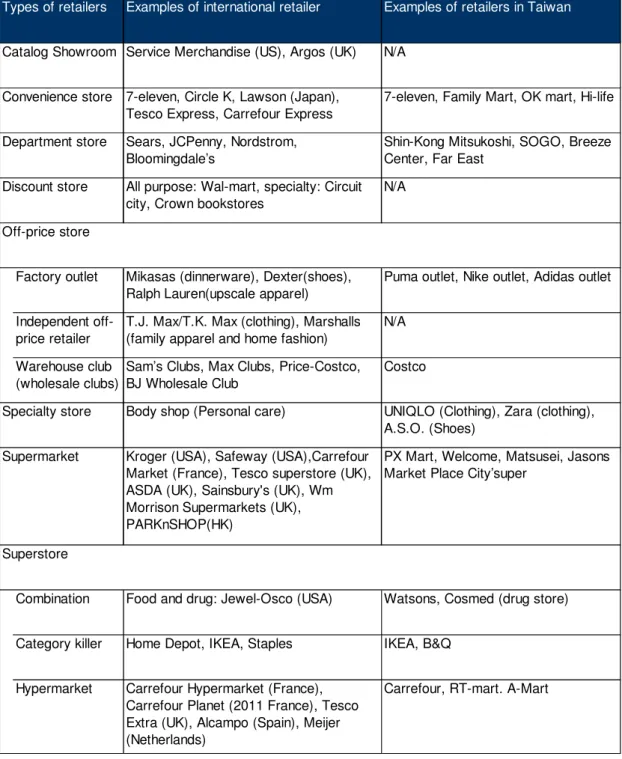
(16) Chapter 2 Literature Review. 2.1. Retail Industry. Retailing includes all the activities involved in selling goods or services directly to final consumers for personal, non-business use. A retailer or retail store is any business enterprise whose sales volume comes primarily from retailing (Kotler 2000). Kotler (2000) has summarized seven types of major retail as below:. 立. 政 治 大. Catalog showroom: Broad selection of high markup, fast-moving, brand-name. ‧ 國. 學. goods at discount prices. Customers order goods from a catalog in the showroom, the pick these goods up at a merchandise pickup area in the store.. ‧ y. Nat. sit. Convenience store: Relatively small store located near residential area open. n. al. er. io. long hours seven days a week and carry a limited line of high-turnover. i n U. v. convenience products at slightly higher prices. Many have added takeout. Ch. engchi. sandwiches, coffee and pastries. Today, many convenience stores in Taiwan and major cities in Asia already turn into 24 hours operations.. Department store: Several product lines- typically clothing, home furnishings and household goods- with each line operated as a separate department managed by specialist buyers or merchandisers.. Discount store: Standard merchandise sold at lower prices with lower margins and higher volumes. True discount stores regularly sell merchandise at lower 16.
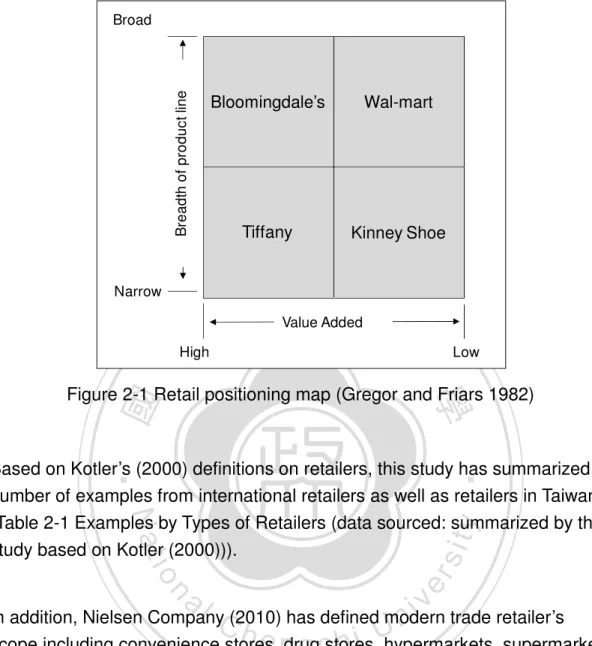
(17) prices and offer mostly national brands. Discount retailing has moved into specialty merchandise stores, such as discount sporting-goods stores, electronics stores and bookstores.. Specialty store: Narrow product line with a deep assortment, such as apparel stores, sporting-goods stores, furniture stores, florists, and bookstores.. Superstore: Averages 35,000 square feet of selling space traditionally aimed at. 政 治 大 items. A new group called “Category killer” carries a deep assortment in a 立. meeting consumers’ total needs for routinely purchased food and nonfood. particular category and a knowledgeable staff. Combination stores of the. ‧ 國. 學. supermarket store into the growing drug-and-prescription field. Combination. er. io. sit. y. Nat. diversification of the supermarket stores.. ‧. food and drug stores, average 55,000 square feet of selling space, are a. Off-price retailer: Merchandise bought at less than regular wholesale prices,. al. n. v i n C hleftover goods, overruns, and sold at less than retail: often and irregulars engchi U obtained at reduced prices from manufactures or other retailers.. Based on the breadth of product line and value added by retailers, Gregor and Friars (1982) created a retail positioning map that classified retailers into four major quadrants (Figure 2-1 Retail positioning map (Gregor and Friars 1982)).. 17.
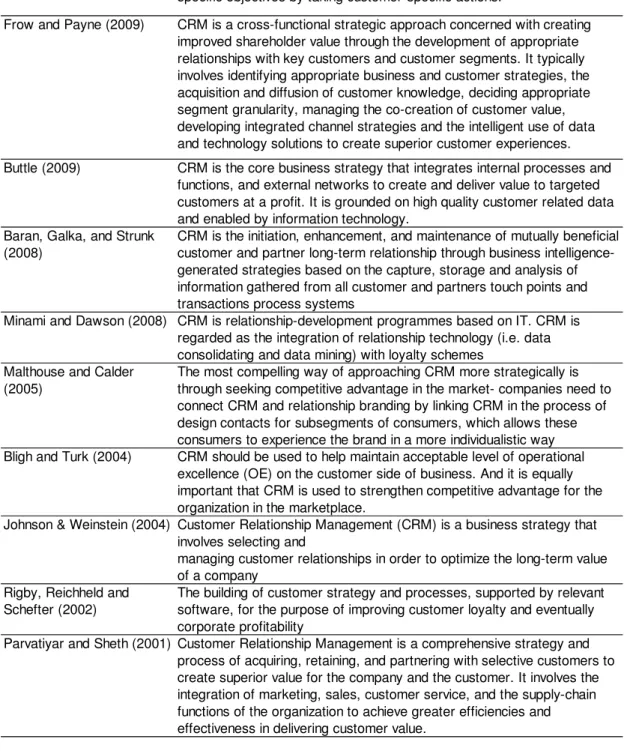
(18) Breadth of product line. Broad. Bloomingdale’s. Wal-mart. Tiffany. Kinney Shoe. Narrow. 政 治 大 Value Added. 立. High. Low. ‧ 國. 學. Figure 2-1 Retail positioning map (Gregor and Friars 1982). ‧. Based on Kotler’s (2000) definitions on retailers, this study has summarized a number of examples from international retailers as well as retailers in Taiwan (Table 2-1 Examples by Types of Retailers (data sourced: summarized by this study based on Kotler (2000))).. n. er. io. sit. y. Nat. al. Ch. i n U. v. In addition, Nielsen Company (2010) has defined modern trade retailer’s scope including convenience stores, drug stores, hypermarkets, supermarkets, and warehouse clubs. Modern trader retailers in Taiwan are summarized by Nielsen Company as below (Table 2-2 Modern trade retailers in Taiwan (data source: Appendices 1 Modern-trade retailer of Nielsen Company).. engchi. 18.
(19) Table 2-1 Examples by Types of Retailers (data sourced: summarized by this study based on Kotler (2000)) Types of retailers. Examples of international retailer. Examples of retailers in Taiwan. Catalog Showroom Service Merchandise (US), Argos (UK). N/A. Convenience store. 7-eleven, Circle K, Lawson (Japan), Tesco Express, Carrefour Express. 7-eleven, Family Mart, OK mart, Hi-life. Department store. Sears, JCPenny, Nordstrom, Bloomingdale’s. Shin-Kong Mitsukoshi, SOGO, Breeze Center, Far East. Discount store. All purpose: Wal-mart, specialty: Circuit city, Crown bookstores. N/A. Off-price store Factory outlet. 政 治 大. Mikasas (dinnerware), Dexter(shoes), Ralph Lauren(upscale apparel). 立. Puma outlet, Nike outlet, Adidas outlet. Warehouse club Sam’s Clubs, Max Clubs, Price-Costco, (wholesale clubs) BJ Wholesale Club. Costco. Specialty store. Body shop (Personal care). UNIQLO (Clothing), Zara (clothing), A.S.O. (Shoes). ‧. Supermarket. ‧ 國. N/A. Kroger (USA), Safeway (USA),Carrefour PX Mart, Welcome, Matsusei, Jasons Market (France), Tesco superstore (UK), Market Place City’super ASDA (UK), Sainsbury's (UK), Wm Morrison Supermarkets (UK), PARKnSHOP(HK). n. al. er. io. sit. y. Nat. Superstore. 學. Independent off- T.J. Max/T.K. Max (clothing), Marshalls price retailer (family apparel and home fashion). Ch. v i n Watsons, Cosmed (drug store) U. Combination. Food and drug: Jewel-Osco (USA). Category killer. Home Depot, IKEA, Staples. IKEA, B&Q. Hypermarket. Carrefour Hypermarket (France), Carrefour Planet (2011 France), Tesco Extra (UK), Alcampo (Spain), Meijer (Netherlands). Carrefour, RT-mart. A-Mart. engchi. Note: N/A stands for not available. 19.
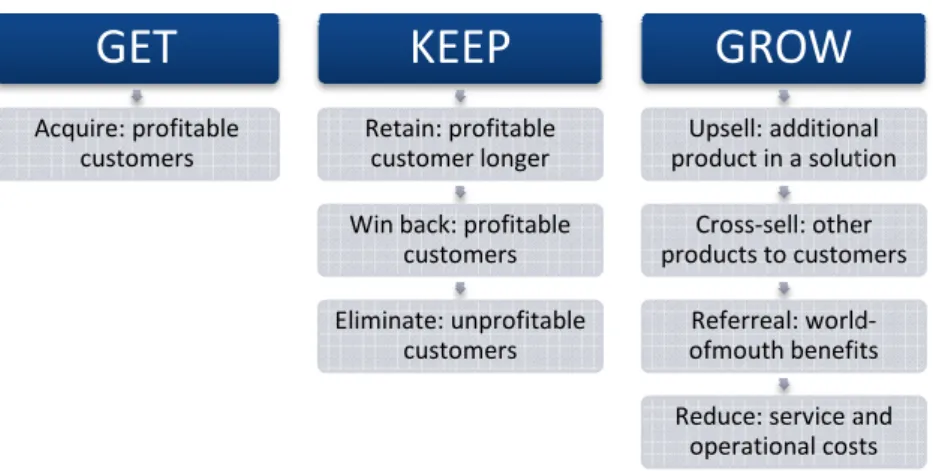
(20) Table 2-2 Modern trade retailers in Taiwan (data source: Appendices 1 Modern-trade retailer of Nielsen Company). 立. 政 治 大. ‧. ‧ 國. 學. n. er. io. sit. y. Nat. al. 2.2. Ch. engchi. i n U. v. Customer Relationship Management. Back to early 2000s, when Winer (2001) discussed CRM in his research paper, he observed a phenomenon or a problem that CRM means different things to different people. CRM could mean direct e-mails, mass customization or product development fitting individual’s needs, OLAP (on-line analytical processing) or customer interaction centers.. Today, in 2012, this confusion remains, partly due to advanced technology and 20.
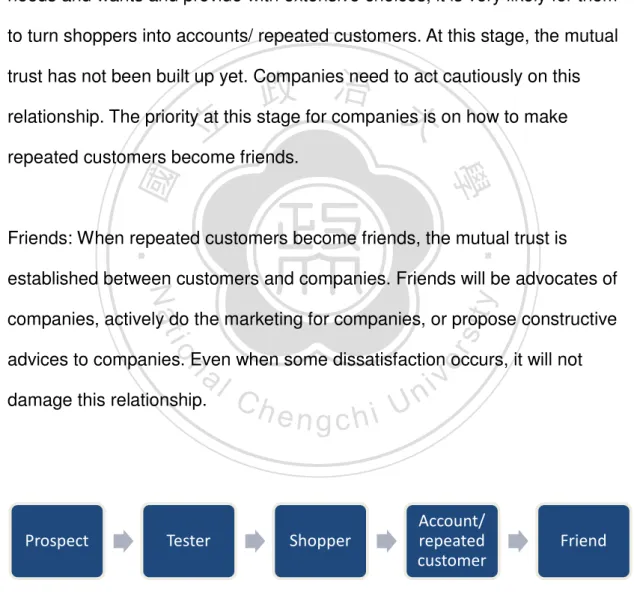
(21) analytical power that has given to CRM.. Buttle (2009) has summarized four types of CRM that may explain these discrepancies of views: strategic, operational, analytical and collaborative (Table 2-3 Type of CRM (Buttle 2009)).. Table 2-3 Type of CRM (Buttle 2009) Type of CRM. Dominant Characteristic. Strategic. Strategic CRM is a core customer-centric business strategy that aims at winning and keeping profitable customers. Operational. Operational CRM focuses on the automation of customer-facing process such as selling, marketing and customer service. ‧ 國. Analytical CRM focuses on the intelligent mining of customer-related data for strategic or tactical purposes. ‧. Collaborative. 學. Analytical. 立. 政 治 大. Collaborative CRM applies technology across organizational boundaries with a view to optimizing company, partner and customer value. sit. y. Nat. n. al. er. io. Given many discussions are from either marketing or technological. i n U. v. perspectives, more and more scholars start to agree on the view that CRM is a. Ch. engchi. business strategy (Peppers and Rogers 2011; Buttle 2009; Baran, Galka and Strunk 2008; Johnson and Weinstein 2004; Rigby and Reichheld and Schefter 2002; Parvatiyar and Sheth 2001). This study has summarized definitions from different literatures (Table 2-4 Definition of CRM in the literature).. 21.
(22) Table 2-4 Definition of CRM in the literature Literature. Definition of CRM. Peppers and Rogers (2011) CRM is an enterprise-wide business strategy for achieving customerspecific objectives by taking customer-specific actions. Frow and Payne (2009). CRM is a cross-functional strategic approach concerned with creating improved shareholder value through the development of appropriate relationships with key customers and customer segments. It typically involves identifying appropriate business and customer strategies, the acquisition and diffusion of customer knowledge, deciding appropriate segment granularity, managing the co-creation of customer value, developing integrated channel strategies and the intelligent use of data and technology solutions to create superior customer experiences.. Buttle (2009). CRM is the core business strategy that integrates internal processes and functions, and external networks to create and deliver value to targeted customers at a profit. It is grounded on high quality customer related data and enabled by information technology. Baran, Galka, and Strunk CRM is the initiation, enhancement, and maintenance of mutually beneficial (2008) customer and partner long-term relationship through business intelligencegenerated strategies based on the capture, storage and analysis of information gathered from all customer and partners touch points and transactions process systems Minami and Dawson (2008) CRM is relationship-development programmes based on IT. CRM is regarded as the integration of relationship technology (i.e. data consolidating and data mining) with loyalty schemes Malthouse and Calder The most compelling way of approaching CRM more strategically is (2005) through seeking competitive advantage in the market- companies need to connect CRM and relationship branding by linking CRM in the process of design contacts for subsegments of consumers, which allows these consumers to experience the brand in a more individualistic way Bligh and Turk (2004) CRM should be used to help maintain acceptable level of operational excellence (OE) on the customer side of business. And it is equally important that CRM is used to strengthen competitive advantage for the organization in the marketplace. Johnson & Weinstein (2004) Customer Relationship Management (CRM) is a business strategy that involves selecting and managing customer relationships in order to optimize the long-term value of a company Rigby, Reichheld and The building of customer strategy and processes, supported by relevant Schefter (2002) software, for the purpose of improving customer loyalty and eventually corporate profitability Parvatiyar and Sheth (2001) Customer Relationship Management is a comprehensive strategy and process of acquiring, retaining, and partnering with selective customers to create superior value for the company and the customer. It involves the integration of marketing, sales, customer service, and the supply-chain functions of the organization to achieve greater efficiencies and effectiveness in delivering customer value.. 立. 政 治 大. ‧. ‧ 國. 學. n. er. io. sit. y. Nat. al. Ch. engchi. i n U. v. Kotler (2010) elaborates CRM concepts in a highly digestible way:. Once you have customers, keep up good relations with them. Get to know your 22.
(23) customers personally, one by one, so you have a complete picture of their needs and wants and preference and behaviors. Then grow their business. It is about attracting right customers who will keep buying from you because of deep rational and emotional satisfaction. They are also capable of becoming your strong advocates through word-of-mouth marketing (p.176).. From strategic perspective, CRM helps companies accumulate customer knowledge from multiple interactions, which improves communication. 政 治 大 customers. In addition, this knowledge helps companies provide better 立 efficiency with customers and thus reduces information search cost of. services to satisfy their customers, which consequently reduces perceived. ‧ 國. 學. risks of customers. Eventually, this deepening customer understanding and. ‧. satisfaction pave the way for companies to build trust and relationship with. y. sit. io. er. customers.. Nat. customers, in other words, increasing switching costs that holding up. al. n. v i n C h that companies Peppers and Rogers (2011) believe determined to build engchi U. successful and profitable customer relationship should go through a three-step approaches: get, keep and grow (Figure 2-2 Increasing the Value of Customer Base (Peppers and Rogers 2011)).. 23.
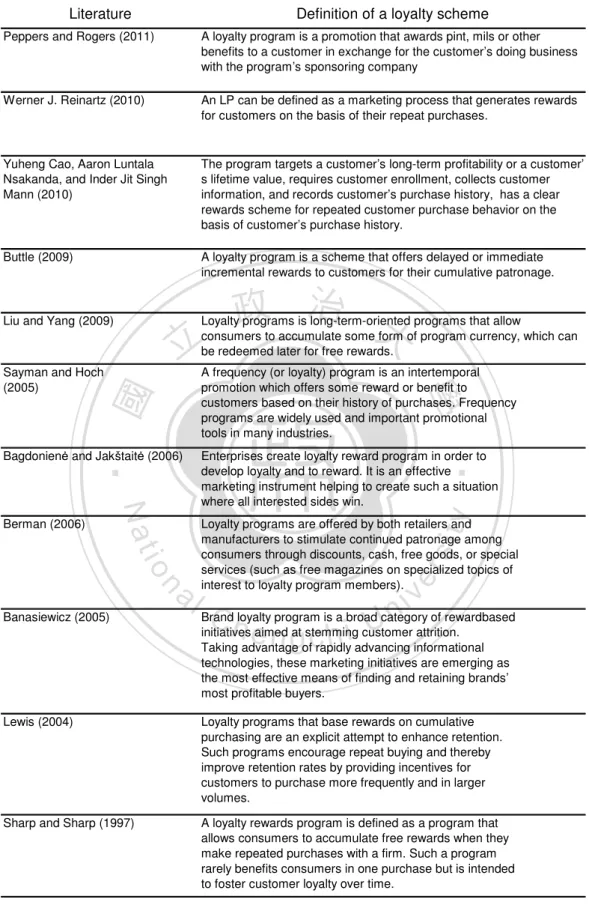
(24) GET. KEEP. GROW. Acquire: profitable customers. Retain: profitable customer longer. Upsell: additional product in a solution. Win back: profitable customers. Cross-sell: other products to customers. Eliminate: unprofitable customers. Referreal: worldofmouth benefits Reduce: service and operational costs. Figure 2-2 Increasing the Value of Customer Base (Peppers and Rogers 2011). 政 治 大 propose a five-stage of customer relationship (Figure 2-3 Five-stage Customer 立. Lu (2011) revised on Ian Gordon’s classification of customer relationship to. Relationship (Lu 2011)):. ‧ 國. 學 ‧. Prospect: Identifying the “potential” customers is the first step of relationship. sit. y. Nat. management. Many companies use mass marketing techniques, including. io. er. internet marketing, for customer acquisition. The focus of this stage is to win customers’ limited attentions.. n. al. Ch. engchi. i n U. v. Tester: When prospects are attracted, their first interactions with companies will take place. Prospects’ first time experience of interaction will impact on the their willingness to establish deeper relationships with the company. The challenges for companies at this stage are to win prospects’ perceptions, help them understand the product uniqueness, and convert their perceptions into actions.. Shopper: When testers place orders, they become shoppers, meaning that 24.
(25) prospects are convinced, or feel satisfactory about interaction experiences with companies. It is essential for companies to understand shoppers’ needs and wants before they can convert their shoppers into accounts/ repeat customers.. Accounts/ repeated customers: If companies continue to fulfill their customers’ needs and wants and provide with extensive choices, it is very likely for them to turn shoppers into accounts/ repeated customers. At this stage, the mutual. 政 治 大 relationship. The priority at this stage for companies is on how to make 立. trust has not been built up yet. Companies need to act cautiously on this. repeated customers become friends.. ‧ 國. 學 ‧. Friends: When repeated customers become friends, the mutual trust is. sit. y. Nat. established between customers and companies. Friends will be advocates of. io. er. companies, actively do the marketing for companies, or propose constructive advices to companies. Even when some dissatisfaction occurs, it will not. n. al. damage this relationship.. Prospect. Tester. Ch. engchi. Shopper. i n U. v. Account/ repeated customer. Figure 2-3 Five-stage Customer Relationship (Lu 2011). 25. Friend.
(26) 2.3. Loyalty Scheme. Loyalty scheme has a long history. In 1896, the Sperry and Hutchinson (S& H) Company of the U.S., which began issuing S&H Green Stamps that year, was the first trading stamp company that operated as an independent business, providing stamps to different types of merchants in a community, along with booklets to paste them in, and opening their own stores where merchandise was purchased only in exchange for the company's stamps (Lonto 2004).. 政 治 大 checkout counters of supermarkets, department stores, and gasoline stations, 立 In this stamps program model, customers would receive stamps at the. which could be redeemed for products in the catalog (Appendices 3 Example. ‧ 國. 學. S&H Green Stamps).. ‧. sit. y. Nat. In the mid-1960's most gas stations and supermarkets were offering stamps to. io. er. shoppers. At the peak of trading stamp popularity in the mid 1960's, S&H operated 800 free-standing redemption centers nationwide, and printed more. n. al. i n C hdid (Slatalla 2000). stamps than the Postal Service engchi U. v. In UK, Green Shield stamps were developed by Green Shield Trading Stamp Company founded by Richard Tompkins in 1958. A "Stamp War" broke out in 1963. Fine Fare, a British retailer, started giving away the American S&H Pink Stamps. Green Shield Stamps were being given away by Tesco and Priceright and other stamp companies competed aggressively for outlets (Appendices 2 Green Shield Stamps).. 26.
(27) In the 1970, Southwest Airlines ran a “Sweetheart Stamps” program that enabled travelers to collect proofs of purchase and surrender them for free flights for their partners. In 1981, loyalty scheme evolved into forms of Frequent Flyer Program (FFP) from Stamps program. American Airline’s Advantage Program is an example that airline made a strategic decision to use its spare capacity as resource to generate customer loyalty. Since then this basic model has migrated from airlines into many other B2C sectors such as hotels, restaurants, retail, car hire, gas stations and bookstores (Buttle 2009).. 政 治 大 The use of loyalty cards was an extremely important development in the 1990s 立 in most developed world markets. Loyalty cards are now used in a number of. ‧ 國. 學. sectors: retail, leisure, business airlines, car rental and more recently. Nat. er. io. sit. y. Definition of loyalty scheme. ‧. business-to-business markets (Tapp 2008).. This study reviews several different loyalty scheme literature (Rogers and. al. n. v i n CButtle Peppers 2011; Reinartz 2010; Liu and Yang 2009) and collective U h e n2009; i h gc. summary of loyalty definitions from Cao, Nsakanda, and Mann (2010). There is not one single definition of a loyalty scheme because of its considerable overlap with promotional tools (Reinartz 2010); however, most scholars tend to view loyalty scheme as a reward program for repeated customers (Table 2-5 Definition of loyalty scheme in the literature).. 27.
(28) Table 2-5 Definition of loyalty scheme in the literature Literature. Definition of a loyalty scheme. Peppers and Rogers (2011). A loyalty program is a promotion that awards pint, mils or other benefits to a customer in exchange for the customer’s doing business with the program’s sponsoring company. Werner J. Reinartz (2010). An LP can be defined as a marketing process that generates rewards for customers on the basis of their repeat purchases.. Yuheng Cao, Aaron Luntala Nsakanda, and Inder Jit Singh Mann (2010). The program targets a customer’s long-term profitability or a customer’ s lifetime value, requires customer enrollment, collects customer information, and records customer’s purchase history, has a clear rewards scheme for repeated customer purchase behavior on the basis of customer’s purchase history.. Buttle (2009). A loyalty program is a scheme that offers delayed or immediate incremental rewards to customers for their cumulative patronage.. Liu and Yang (2009). Loyalty programs is long-term-oriented programs that allow consumers to accumulate some form of program currency, which can be redeemed later for free rewards.. 立. A frequency (or loyalty) program is an intertemporal promotion which offers some reward or benefit to customers based on their history of purchases. Frequency programs are widely used and important promotional tools in many industries.. Bagdonienė and Jakštaitė (2006). y. Nat. sit. io. al. n Banasiewicz (2005). Loyalty programs are offered by both retailers and manufacturers to stimulate continued patronage among consumers through discounts, cash, free goods, or special services (such as free magazines on specialized topics of interest to loyalty program members).. er. Berman (2006). Enterprises create loyalty reward program in order to develop loyalty and to reward. It is an effective marketing instrument helping to create such a situation where all interested sides win.. ‧. ‧ 國. 學. Sayman and Hoch (2005). 政 治 大. v i n Brand program is a broad category of rewardbased C hloyalty U attrition. initiatives aimed at stemming customer i e h n c g Taking advantage of rapidly advancing informational technologies, these marketing initiatives are emerging as the most effective means of finding and retaining brands’ most profitable buyers.. Lewis (2004). Loyalty programs that base rewards on cumulative purchasing are an explicit attempt to enhance retention. Such programs encourage repeat buying and thereby improve retention rates by providing incentives for customers to purchase more frequently and in larger volumes.. Sharp and Sharp (1997). A loyalty rewards program is defined as a program that allows consumers to accumulate free rewards when they make repeated purchases with a firm. Such a program rarely benefits consumers in one purchase but is intended to foster customer loyalty over time.. 28.
(29) Type of loyalty scheme There are many types of loyalty scheme existent in different forms on the markets. Based on earlier research from Cao, Nsakanda, and Mann (2010) who have reviewed three key literature on the classification of loyalty scheme, including Kadar and Kotanko (2009), Bagdonienė and Jakštaitė (2006) and Berman (2006), this study further reviews other related literature about this. 政 治 大 short list of classification of loyalty program (Table 2-6 Classification of loyalty 立. topic and includes Robinson (2011), Tapp (2009), Chang and Wu (2007) and in. scheme in the literature).. ‧ 國. 學 ‧. Some scholars such as Berman (2006), Bagdonienė and Jakštaitė (2006),. sit. y. Nat. Chang and Wu’s (2007), Tapps (2008), Kadar and Kotanko (2009) and. io. er. Robinson (2011) have proposed different classifications of loyalty schemes respectively. Among them, Chang and Wu (2007) introduced a classification. al. n. v i n C h in Taiwan (Table which is more specific for retailers 2-6 Classification of loyalty engchi U scheme in the literature).. Tapp (2008) has classified loyalty schemes into three key categories based on the historical evolution of loyalty schemes: (1) Proof-of purchase based loyalty scheme: This is the traditional mechanism that is still used by some package goods manufacturers who have no way of easily using cards. In markets where margins are very tight, in particular packaged good sectors, the rewards are 29.
(30) often self-liquidating; that is, customers are asked to pay a small fee in addition to the vouchers to receive their rewards. This fee covers the company cost of the gift.. (2) Card based schemes: Cards are ideal for tracking transaction data and building the customer records. There are two types of card which runs loyalty schemes: Smart cards and magnetic stripe.. 政 治 大 Smart cards carry computer chips within and have greater off-line functionality 立 and data capability than magnetic strip cars. Customer data is held within the. ‧ 國. 學. card not on a database while magnetic stripe cards have been much cheaper. ‧. than smart cards and are more likely to be compatible with existing store. er. io. sit. y. Nat. electronic point of sale (EPOS) technology.. (3) Cross-category promotion scheme (co-branded):. al. n. v i n Most loyalty schemes are runCby solo supplier which h e n g c h i U bears the cost of point reward and redemption. Cross-category promotion schemes have become popular. This type of schemes often involves a number of suppliers from different sectors. Consumers can earn points on purchases from all these suppliers, which are then redeemed for rewards in the normal way. It is hoped this would be an umbrella loyalty scheme involving non-competing companies from as many sectors as possible, in particular frequent-purchase markets.. Chang and Wu (2007) indicate that retailers use two types of loyally scheme in 30.
(31) their CRM initiatives, loyalty shopper card and co-branded credit card, depending on whether retailers co-operate with banks: (1) Loyalty shopper card Loyalty shopper card is a type of member program operated by retailers that allows customers to migrate their status upward to member to enjoy better treatment, mainly on member price items. This type of program can be free of charge to join the membership such as membership of Best Denki appliance store or of TK 3C appliance in Taiwan.. (2) Co-branded credit card. 立. 政 治 大. Co-branded credit card is another type of loyalty scheme that supports. ‧ 國. 學. member cross-sell marketing. For retailers, launching co-branded credit card. ‧. with banks can leverage banks’ resource for marketing or receive additional. sit. y. Nat. sales promotion fee from bank. For banks, working with retailers allows them. io. al. n. rate.. er. to expedite site expansion for card acquisition and remain card holders’ usage. Ch. engchi. i n U. v. For example, co-branded credit card program was the most fast growing card type in the year of 2001 in Taiwan since retailers greatly adopted this type of loyalty scheme. In 2004, more than 50% of credit card growth came from co-branded credit cards (Chang and Wu 2007).. Some scholars looked at loyalty scheme typology from tactics points of view (Berman 2006; Robinson 2011). . 31.
(32) Robinson (2011) proposed a categorization of loyalty reward programs that include four types: (1) Simple percent off on all purchases; (2) Buy n get one free; (3) Tiered rewards (airline miles); and (4) Customer relationship with frequent special offers.. Berman (2006) classified loyalty schemes into four types: (1) Members receive additional discount at registers; (2) Members receive one free unit when they purchase n units; (3) Members receive rebates or points based on cumulative. 政 治 大. purchases; and (4) Member receive targeted offers and mailings.. 立. Other scholars classified loyalty schemes by numbers of partners engaged or. ‧ 國. 學. the target of program designed for (Bagdonienė and Jakštaitė 2006; Kadar and. sit. y. Nat. .. ‧. Koanko 2009).. io. er. Bagdonienė and Jakštaitė (2006) proposed three types of loyal schemes: (1) Open or closed loyalty programs; (2) Direct or indirect reward loyalty. al. n. v i n C h for end customers programs ; and (3) Loyalty program or for intermediate engchi U customers. Kadar and Koanko (2009) brought up the other classification of loyalty scheme: (1) Exclusive one-company program; (2) Inclusive company-specific programs; and (3) Cross company programs. Although there are many loyalty scheme classifications discussed in the literature, there is not any type of classifications mentioning the dimension of 32.
(33) time and resource needed to implement a loyalty scheme so that retailers cannot have a full picture of available choices when they consider the use loyalty scheme as part of their business strategy (Table 2-6 Classification of loyalty scheme in the literature).. Consequently, this study proposes a new approach of classifying loyalty scheme in the next section that fits in retail context in Taiwan and that could be applicable to retailers in other regions.. 政 治 大 Table 2-6 Classification of loyalty scheme in the literature 立 1. 2. 3. 4.. Simple percent off on all purchases Buy n get one free Tiered rewards (airline miles) Customer relationship with frequent special offers. ‧. ‧ 國. Robinson (2011). Classification of Loyalty Scheme. 學. Literature. Tapp (2008). 1. Proof-of purchase based loyalty scheme 2. Card based schemes 3. Cross-category promotion scheme (co-branded):. n. sit. er. io. al. y. 1. Exclusive one-company program 2. Inclusive company-specific programs 3. Cross company programs. Nat. Kadar and Kotanko (2009). Ch. i n U. v. Chang and Wu (2007). 1. Loyalty shopper card 2. Co-branded credit card. Bagdonienė and Jakštaitė (2006). 1. Open or closed Loyalty programs 2. Direct or indirect reward Loyalty programs 3. Loyalty program for end customers or for intermediate customers. Berman (2006). 1. 2. 3. 4.. engchi. Members receive additional discount at register Members receive 1 free when they purchase n units Members receive rebates or points based on cumulative purchases Member receive targeted offers and mailings. 33.
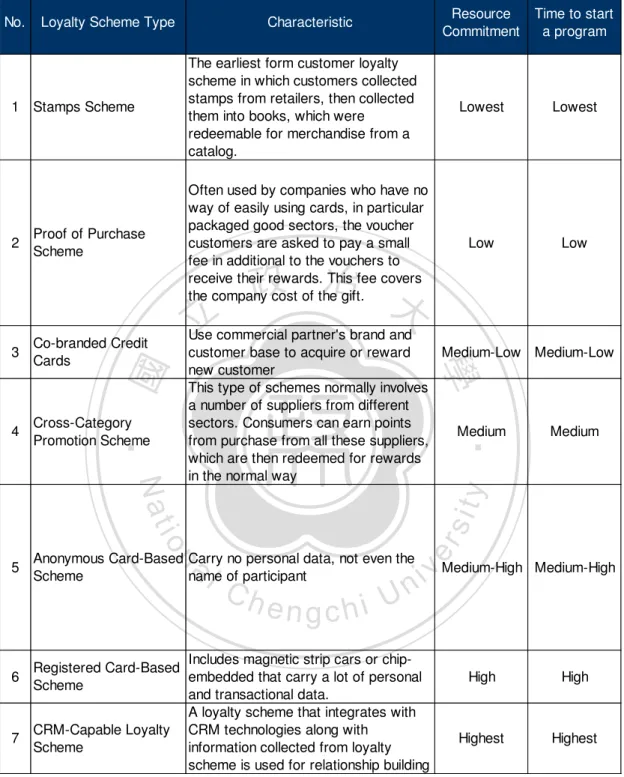
(34) A new typology of loyalty schemes proposal Tapp (2008) has classified loyalty programs into three types: (1) Proof of purchase based scheme; (2) Card-based scheme; and (3) Cross-category promotion scheme (co-branded). However, Tapp (2008) missed including stamps program in his classification, the most original type of loyalty scheme that can be tracing back to nineteen centuries.. 政 治 大 imply to include stamp program but did not explicitly classify it in his typology. 立. Conceptually, proof-of-purchase based type introduced by Tapp (2008), might. Tapp’s (2008) definition on proof-of-purchase based program mainly refers to. ‧ 國. 學. the practice used by brand suppliers or consumer product companies.. ‧. sit. y. Nat. Stamps program is the much earlier version of loyalty scheme which is still. io. er. used by retailers today. In terms of time and resourced needed, stamps program can be started quickly and may require less resource comparing to. al. n. v i n CFor other types of loyalty scheme. rationales, this study includes stamps h ethese ngchi U program as part of the new typology of loyalty scheme.. Buttle (2009) further separates card-based programs into anonymous and non-anonymous programs based on whether loyalty card is anonymous or not. An anonymous program normally involves less on the technological resource, compared with non-anonymous program. The latter often includes more advanced system functions to manage customer data, consolidate all information under one account, one promotion or even individual promotion 34.
(35) offer. In short, for anonymous and non-anonymous programs, their time and resources needed are much more than stamps program and proof-of-purchase based programs. Thus, this study takes Buttle’s (2009) views and includes two separated programs in the new typology of loyalty scheme.. In addition, Buttle (2009) also indicates another type ”linked scheme” in his classification, which is defined as allowing different of retailers to join as participants and customers are able to convert their existing credits to the currency of linked scheme.. 立. 政 治 大. This study believes that linked scheme concept is similar to cross-category. ‧ 國. 學. promotion scheme (Tapp 2008) or cross company program (Kadar and. ‧. Kotanko 2009) and therefore they should be treated as same type.. sit. y. Nat. io. er. However, based on Chang and Wu’s (2007) classifications, co-branded credit card program is reasonable to be treated independently from Tapp’s (2008). al. n. v i n C h as co-brandedUcredit card program is cross-category promotion scheme engchi. relatively less complex than cross-category promotion scheme and often engages one partner only, which often is the bank. In terms of time and resource commitment, co-branded credit card program is relatively simple than cross-category promotion scheme as well. Thus, this study believes they should be treated as two different types and thus this study includes both in the new typology.. It is worth noting that Robinson’s (2011) scheme type four: customer 35.
(36) relationship with frequent special offers, as it is the only program type that addresses on integrating reward card into customer relationship management system. Robinson (2011) notes that the only downside of this type is that the expense of running a full customer relationship management (CRM) system (identifying customers by name and address, tracking all purchases, analyzing behavior and responding) requires a substantial initial investment and an on-going commitment to fund the operation. However, Robinson’s (2011) scheme type four only focuses on building customer relationship with frequent. 政 治 大. special offers, which may underestimates the potential of this scheme type.. 立. Although Robinson’s (2011) categorization method is readily understandable,. ‧ 國. 學. yet it tends to be categorizing loyalty schemes only based on tactics level. ‧. except scheme type four, and therefore this method could not offer retailers the. y. sit. io. er. scheme.. Nat. capabilities to identify the resource and time needed to launch a loyalty. al. n. v i n C hpractically usefulUin the future, this study To make the categorization more engchi proposes a new typology of loyalty program (Table 2-7 A new typology of. loyalty scheme proposal (data source: summarized by this study)), based on research from Chang and Wu (2007), Tapp (2008), Braran, Galka, and Strunk (2008), Davenport and Harris (2007), Minami and Dawson (2008) ,Buttle (2009), and Robinson (2011) and earlier discussions on using dimension of time, resource commitment and program evolution in developing new typology of loyalty scheme.. 36.
(37) Table 2-7 A new typology of loyalty scheme proposal (data source: summarized by this study) Loyalty Scheme Type. The earliest form customer loyalty scheme in which customers collected stamps from retailers, then collected them into books, which were redeemable for merchandise from a catalog.. 1 Stamps Scheme. 2. Characteristic. Resource Commitment. Time to start a program. Lowest. Lowest. Low. Low. Often used by companies who have no way of easily using cards, in particular packaged good sectors, the voucher customers are asked to pay a small fee in additional to the vouchers to receive their rewards. This fee covers the company cost of the gift.. Proof of Purchase Scheme. 立. Use commercial partner's brand and customer base to acquire or reward Medium-Low Medium-Low new customer This type of schemes normally involves a number of suppliers from different sectors. Consumers can earn points Medium Medium from purchase from all these suppliers, which are then redeemed for rewards in the normal way. ‧ 國. 學. Co-branded Credit 3 Cards. 政 治 大. Cross-Category Promotion Scheme. 5. Anonymous Card-Based Carry no personal data, not even the Scheme name of participant. io. sit. Nat. y. ‧. 4. n. al. Ch. engchi. er. No.. i n U. Includes magnetic strip cars or chipRegistered Card-Based embedded that carry a lot of personal Scheme and transactional data. A loyalty scheme that integrates with CRM-Capable Loyalty CRM technologies along with 7 Scheme information collected from loyalty scheme is used for relationship building 6. v Medium-High. Medium-High. High. High. Highest. Highest. New typology proposed in this study classifies loyalty schemes into seven types:. 37.
(38) Stamps scheme (type one) and proof-of-purchase scheme (type two) are still seen among many small and medium retailers today, in particular those are still in their earlier stage of development. These two types consume much less resources from retailers and require relatively shorter time to operate (Table 2-7 A new typology of loyalty scheme proposal (data source: summarized by this study)).. Proof-of-purchase scheme (type two) is often used by fast-moving consumer. 政 治 大 explanation for this phenomenon: 立. goods company (Tapp 2008). In addition, Winner (2001) provides a reasonable. ‧ 國. 學. Companies such as Procter & Gamble and Unilever selling. ‧. frequently-purchased consumer products have greater problems constructing. sit. y. Nat. a customer databases due to lack of systematic information about their millions. io. er. of customers and the fact that they use intermediaries (i.e., supermarkets, drug stores) that prohibit direct contact. The challenge is to create opportunities for. al. n. v i n C htherefore, data collection customer interaction and, (pp.89-105). engchi U. Some retailers that do not operate any card-based loyalty scheme but would like to quickly launch a loyalty scheme may consider a co-branded credit card scheme with bank (type three) or a cross-category promotion scheme (type four). It is quicker and easier for a retailer to set up the co-branded credit card scheme and starts to offer benefits to members if compared with operating it sorely on one’s own (Table 2-7 A new typology of loyalty scheme proposal (data source: summarized by this study)). 38.
(39) Alternatively, cross-category promotion scheme (type four) is also an attractive option because it provides retailers with a cost-effective way to offer customers a variety of attractive benefits that they would not be able to provide without the support of other businesses.. Anonymous card-based scheme (type five) is mostly a stored-value card or pre-paid card scheme and often is operated by one retailer. It is often the first. 政 治 大 own efforts. Its investment is relatively low compared with registered 立. type of program when retailers would like to operate loyalty programs on their. card-based scheme (type six) or CRM-capable loyalty scheme (type seven).. ‧ 國. 學. However, the main drawback is that the scheme is anonymous and thus there. ‧. is no customer data being collect, which would further limits the potential for. er. io. sit. y. Nat. target communication, promotion or understand customer behavior.. Registered card-based scheme (type six) is defined as a solo loyally program. al. n. v i n C hcostly to set up one operated by a retailer. It is more as a loyalty card system engchi U. will need to be set up and tied up with Point of Sales (POS) system in order to manage point reward and redemption functionalities, such as double points reward on certain items, or real-time redemption at check-out counter. This system often consists of Bonus Point System and Customer Management System or other system supporting card member promotion. Obviously this type of scheme requires more resource commitment from one retailer and it takes longer time to design a scheme and set up loyalty card system at POS in all different retail stores (Table 2-7 A new typology of loyalty scheme proposal 39.
(40) (data source: summarized by this study)).. The last category proposed in this new typology is the CRM-capable loyalty scheme (type seven), which is the advanced version of registration card-based scheme. Over the past few years, loyalty programs have become a key component of customer relationship management (CRM), serving a critical role in developing relationships, stimulating product and service usage, and retaining customers (Kivertz and Itamar 2003). However, only when. 政 治 大 and communication vehicles for participants, the loyalty program become a 立. information collected from loyalty programs data used to customize offerings. CRM program (Braran, Galka, and Strunk (2008). This study believes that. ‧ 國. 學. these definitions should also include the goal of relationship building into. ‧. consideration (Table 2-7 A new typology of loyalty scheme proposal (data. er. io. sit. y. Nat. source: summarized by this study)). For a loyalty scheme to reach the goal that CRM program is expected, it. al. n. v i n seems inevitable for a loyaltyC scheme to be powered h e n g c h i U by CRM technology. This concept is similar to the scheme type four, customer relationship with frequent. special offers, introduced by Robinson (2011), which is integrating reward card into its customer relationship management system.. Earlier discussions were made from loyalty scheme perspective. Some scholars, such as Minami and Dawson (2008), provides an alternative view of linking CRM to loyalty scheme. Minami and Dawson (2008) define CRM as the integration of relationship technology (i.e. data consolidating and data mining) 40.
(41) with loyalty schemes. Both researchers imply that loyalty scheme becomes a CRM program only when loyalty is CRM capable.. Therefore, this study defines CRM capable loyalty scheme (type seven) as that a loyalty scheme becomes a truly CRM scheme only when it is intergraded with CRM technology along with information collected from loyalty scheme is used for relationship building (Table 2-7 A new typology of loyalty scheme proposal (data source: summarized by this study)).. 政 治 大 This study believes that a CRM-capable loyalty scheme requires more 立. resource from retailer as well as longer time to realize its full potential than. ‧ 國. 學. other types. On top of already existent loyalty card systems, it requires a. ‧. retailer to invest on acquiring skilled talents of analytics and direct marketing,. sit. y. Nat. analytical CRM systems, and operational CRM systems, such campaign. io. er. management system.. al. n. v i n C h evolved into this Today some retailers have already stage, for example, Tesco, engchi U the third largest retailer in the world, has transformed its Clubcard loyalty. program into different stages since 1995. Thanks to Dunnhumby, its data mining partner, Tesco now is capable of mining its data of over 15 million members in UK, and develop a deeper relationship with each customer by using insight generated by data and tailoring offers to the needs and wants of their customers (Tesco Annual Report 2012).. 41.
(42) Resource Commitment. CRMcapable Loyalty Scheme Registered Card-based Crosscategory scheme promotion scheme. Co-branded Credit Cards Anonymous Card-based scheme. Stamps Scheme. 立. Proof of Purchase Scheme. 政 治 大 Time to start porgram. ‧. ‧ 國. 學. Figure 2-4 Time-Resource Matrices of loyalty programs (data source: summarized by this study). The relationship between loyalty scheme and CRM. sit. y. Nat. n. al. er. io. Since early 2000, some scholars have already discussed the relationship. v. between loyalty scheme and CRM. For example, Kivertz and Itamar (2003). Ch. engchi. i n U. believe that loyalty programs have become a key component of customer relationship management (CRM), serving a critical role in developing relationships, stimulating product and service usage, and retailing customers. Other scholars such as Braran, Galka, and Strunk (2008) agree that loyalty programs are examples of CRM but only if the data obtained from participants are used to establish a dialogue instrumental in attracting, retaining, and developing them as customs, which is not always the case.. In the context of customer relationship management (CRM), loyalty programs 42.
(43) have become a popular marketing tool to encourage loyal customer behavior (Tuzovic and Mangold, 2008).. Loyalty scheme may play two roles in CRM, first, to generate data that can be used to guide customer acquisition, retention and development and secondly, loyalty scheme may serve as an exit barrier (Buttle 2009).Alternatively, Minami and Dawson (2008) define CRM as the integration of relationship technology (i.e. data consolidating and data mining) with loyalty schemes.. 政 治 大 In many cases, loyalty scheme is considered as a marketing tool and has 立 become a critical component of firms’ overall CRM efforts. Studying the. ‧ 國. 學. literature in the fields of CRM and loyalty scheme, it becomes clear that loyalty. ‧. scheme is always involved with CRM. Until loyalty scheme evolves into a state. sit. y. Nat. capable of using data and relational technologies for getting, growing and. io. er. keeping customers, loyalty scheme becomes a key component of CRM, a company-wide business strategy that assumes the role for customer. n. al. Ch. acquisition, development and retention.. engchi. i n U. v. Therefore, this study believes the proper definition of loyalty scheme is a scheme that is capable of using data and relational technologies for getting, growing and keeping customers.. 2.4. Analytical Maturity Model. Davenport (2006) was the first to point out the phenomenon of competing on analytics and also identified the characteristics shared by analytical 43.
(44) competitors in his study of 32 organizations that have made a commitment to quantitative, fact-based analysis.. His study shows that analytical competitors are the leaders in their varied fields—consumer products, finance, retail, and travel and entertainment among them. Analytics has been instrumental to Capital One, which has exceeded 20% growth in earnings per share every year since it became a public company. It has allowed Amazon to dominate online retailing and turn a. 政 治 大 real secret weapon is not steroids, but statistics, as dramatic victories by the 立. profit despite enormous investments in growth and infrastructure. In sports, the. Boston Red Sox, the New England Patriots, and the Oakland A’s attest. ‧ 國. 學. (Davenport 2006).. ‧. sit. y. Nat. Organizations are competing on analytics not just because they. io. er. can—business today is awash in data and data crunchers—but also because they should. At a time when firms in many industries offer similar products and. al. n. v i n Cbusiness use comparable technologies, are among the last U h e n gprocesses i h c. remaining points of differentiation. And analytical competitors wring every last drop of value from those processes (Davenport 2006).. Four pillars of analytical competition Researching 371 medium to largest firms in 2005 and detailed analysis of data allows Davenport and Harris (2007) to define the four key attributes of an most analytically sophisticated and successful analytical competitor: (1) Analytics supported a strategic, distinctive capability; (2) The approach to and 44.
(45) management of analytics was enterprise-wide; (3) Senior management was committed to the use of analytics; and (4) The company made a significant strategic bet on analytics-based competition. These four pillars are not independent of each other but supporting one another to make an analytical platform. However, Davenport and Harris (2007) believers that true analytical competitors have all four; less advanced organizations may have only one or two at best.. 立. 政 治 大. ‧. ‧ 國. 學. n. er. io. sit. y. Nat. al. Ch. engchi. i n U. v. Figure 2-5 Four pillars of analytical competition (Davenport and Harris 2007). Support of a strategic, distinctive capability To support company’s competitive strategy, analytics must be in the support of an important and distinctive capability first. Distinctive capability is considered to be the decisive factor for a company in getting beyond its competitors and making it successful in the marketplace. Without a distinctive capability, it is impossible to be an analytical competitor as there is no clear process or 45.
(46) activity for analytics to support.. An enterprise-level approach to and management to management of analytics Davenport and Harris (2007) found that companies and organization that compete analytically do not delegate analytical activities just to one group within the company or to a collection of disparate employees across organization. They manage analytics as an organization or ensure that no. 政 治 大 they make the management of analytics an organization-wide activity ensuring 立 process or business unit is optimized at the expense of another. In addition,. that that the data and analysis are made available broadly through the. ‧. ‧ 國. 學. organization.. sit. y. Nat. Senior Management Commitment. io. er. To adopt an analytics approach to business, a company requires the changes in culture, process, behavior, and skills for multiple employees. To achieve that,. al. n. v i n C h to lead the changes senior management must commit as well as have passion engchi U. for analytics and fact-based decisions. Davenport and Harris (2007) found that it is rare to find a firm making the cultural changes necessary to become an analytical competitor without the push from the top.. Largest-Scale Ambition The final way to define analytical competitors is by the results they aspire to achieve. There are many ways to measure the results of analytical activity but the most obvious is with money, i.e. savings or revenue increases. The results 46.
(47) of analytical competition can also be measured in overall revenues and profits, market share, and customer loyalty. It is considered not really competing on analytics if a company cannot see any impact on such critical measures of its nonfinancial or financial performance (Davenport and Harris 2007).. Five stages of analytical competition. Davenport and Harris (2007) 2007) has exemplified the four factors that define the analytical competition and thus proposed an analytical maturity model, as seen. 政 治 大 follow from non-analytical competitors to true analytical competitor while true 立 in figure 2-6. These stages can describe the path that an organization can. 學. ‧ 國. analytical competitors exhibit all four factors and less advanced organization may have only one or two at best:. n. engchi. Stage 3 Analytical aspiration. sit er. io. Ch. y. ‧. Nat. al. Stage 5 Analytical Competitors Stage 4 Analytical companies. i n U. v. Stage 2 Localized anallytics Stage 1 Analytically impaired. Figure 2-6 Five stages of analytical maturity model (Davenport and Harris, 2007). Stage 5 organizations, “the analytical competitors”, with four factors described above. They, supported by analytics, have distinctive capabilities that set them 47.
(48) apart from competitors, they are taking an enterprise-wide approach, their executive are committed to analytics and their analytical initiatives are ambitious enough to produce financial o nonfinancial results. Davenport and Harris (2007) estimated that no more than five percent of large firms would be in this category and it is difficult to generalize about industries for analytical competition.. Stage 4 organizations, “the analytical companies”, are in transition to analytical. 政 治 大 but lack the will to compete on this basis, do not consider analytics as firm’s 立. competition but still face some challenges to get to stage 5. They have skills. strategic competencies yet, or senior management are not passionate about. ‧ 國. 學. competing on this basis.. ‧. sit. y. Nat. Stage 3 organizations, “the analytical aspirations”, realize the importance of. io. er. analytics, have visions and ambitions to compete on this basis, yet have not started the implementation. Often, organizations at this stage still have. al. n. v i n C happroach to analytics difficulties mounting a cohesive across the enterprise. engchi U Stage 2 organizations, “the localized analytics”, emphasize on reports but they do not measure up to the standard of analytical competition. Their analytical activities produce economic benefits but not enough to affect the company’s competitive strategy. Lacking of vision of analytical competition from senior execution vision is a primary characteristic for organizations at stage. Some company may have some of same technology as firms at higher stages of analytical activity, but they have not put it to strategic use. 48.
(49) Stage 1 organization, “the analytically impaired”, have some desire to become more analytical, but lack both the intention and the skill to do so and thus far the goal of analytical competition. They lack either human talents, technical skills to analytical competition or even interest in analytical competition from senior executives. Therefore, they are still focused on putting basic, integrated transaction functionality and high quality data in place, i.e. they do not have a single definition of the customers and hence cannot se customer data across. 政 治 大 not even on the path to becoming analytical competitors. 立. the organization to segment and select the best customers. In shorts, they are. ‧ 國. 學. Davenport and Harris (2007) believe that most organizations need to go. ‧. through each one of the stages but an organization, with sufficiently motivated. sit. y. Nat. sensor executive, may be possible to skip a stage or at least move rapidly. io. al. n. to overcome.. er. through them. However, organization change will still be the most difficult part. Ch. 2.5 Strategic 4C Model. engchi. i n U. v. Based on Williamson’s transaction cost theory, classification made by Barny and Ouchi, agency theory and other studies, Chiou (2001, 2006, 2010) has developed a strategic 4C analysis structure that is highly applicable in analyzing marketing exchange relationship from strategic perceptive.. The efficiency of marketing exchange is depending on four costs (1) Explicit unit-utility cost ;(2) Information search cost; (3) Moral hazard cost; and (4) 49.
(50) Asset specificity cost. The lower these four costs are, the more willing customers are to exchange with sellers, resulting to better efficiency of marketing exchange (Chiou 2010).. Figure 2-7 Marketing exchange functions of 4C (Chiou 2010). 立. 政 治 大. ‧ 國. 學. Unit-Utility Cost (C1). Chiou (2010) defined explicit unit-utility cost as the cost customers paid for. ‧. acquiring a product and service divided by the total utility gained from the. y. Nat. sit. product or service. The total cost of acquiring a product includes price of. n. al. er. io. transaction, transportation fee, service fee, handling fee, and etc. The total. i n U. v. utility includes tangible and intangible benefits excluding the utility gained from. Ch. engchi. three implicit costs. However, the utility that Chiou (2010) mentioned here is not excluding the utility created by brand awareness, trust or asset specificity for two reasons: (1) Excluding utility generated from implicit cost allows marketer to understand that three implicit costs are as important as explicit cost when dealing with exchange. More importantly, the approaches to deal with four different costs are not only distinct but also need priority; (2) In practice, excluding utility generated from implicit cost allows deeper analysis. Chiou (2010) suggests to analyze the explicit cost first, then three implicit costs and finally focus on solving three implicit cost when conducting competitor 50.
(51) analysis or product competitiveness analysis.. Figure 2-8 Equation of Explicit Unit-utility Cost (Chiou 2010). 政 治 大. Based on the Chiou’s (2010) definitions above, there are two characteristics of. 立. explicit unit-utility cost of a company:. ‧ 國. 學. 1. Company can decide whether to launch a product based on its level of. ‧. unit-utility cost: Explicit unit-utility cost of a product should be evaluated before. y. Nat. sit. its launch. A company may use market research to understand. n. al. er. io. competitiveness of a product on unit-utility cost compared with those of competitors’ products.. Ch. engchi. i n U. v. 2. Explicit unit-utility cost is one of key sources of competiveness. Explicit unit-utility cost is essential for a new-established, or less known company. In general, market newcomers or less-known companies are less capable of handling implicit exchange costs than existing competitors or well known companies are. For this type of companies, Chiou (2010) suggests reviewing the definition of explicit unit-utility cost and finding many ways to improve explicit costs. For example, a new company may choose a niche market segment, understand and fulfill customers needs better than 51.
數據
+7

相關文件
蔣松原,1998,應用 應用 應用 應用模糊理論 模糊理論 模糊理論
and Kasper, H.D.P., “The impact of Satisfaction on Brand Loyalty: Urging on Classifying Satisfaction and Brand Loyalty,” Journal of Consumer Satisfaction, Dissatisfaction
住宅選擇模型一般較長應用 Probit 和多項 Logit 兩種模型來估計,其中以 後者最常被使用,因其理論完善且模型參數之估計較為簡便。不過,多項
則巢式 Logit 模型可簡化為多項 Logit 模型。在分析時,巢式 Logit 模型及 多項 Logit 模型皆可以分析多方案指標之聯合選擇,唯巢式 Logit
A decision scheme based on OWA operator for an evaluation programme: an approximate reasoning approach. A decision scheme based on OWA operator for an evaluation programme:
The GCA scheduling algorithm employs task prioritizing technique based on CA algorithm and introduces a new processor selection scheme by considering heterogeneous communication
The GCA scheduling algorithm employs task prioritizing technique based on CA algorithm and introduces a new processor selection scheme by considering heterogeneous communication
Service quality, customer satisfaction and customer loyalty are also different while people used Taipei Smart Card in different situation.. We suggest that the Taipei Smart
