Hsiou-Huai Wang & Chen-Wei Chang You Don’t Know What Really Matters to Me! 243
Journal of Research in Education Sciences 2016, 61(4), 243-270
doi:10.6209/JORIES.2016.61(4).09
“You Don’t Know What Really Matters to Me!”
Examining the Gaps Between Governmental
Policies and Student Perspectives in
International Student Recruitment Practices
in Taiwan
Hsiou-Huai Wang
Chen-Wei Chang
Center for Teacher Education, National Taiwan University
Research Center for Educational System and Policy, National Academy for Educational Research
Abstract
In the present era of competitive globalization, rethinking the ideals and rationales involved in recruiting global talent is crucial. This study used Taiwan as a case study to explore the approaches adopted by a non-English speaking country for recruiting international students. The Taiwan government believes that it should foster an English language teaching environment in universities and provide sufficient financial support to international students in order to establish and strengthen political and diplomatic relationships with the students’ home countries. However, international students emphasize cultural, linguistic, social, and vocational elements in their motives for studying abroad. Gaps apparently exist between governmental policies and students’ perceptions. Suggestions for bridging these gaps were provided with regard to policy clarification, system building, and niche strengthening in the age of global competition.
Keywords: higher education, international student perspectives, international student recruitment policy, Taiwan
Corresponding Author: Chen-Wei Chang, E-mail: [email protected]
244 You Don’t Know What Really Matters to Me! Hsiou-Huai Wang & Chen-Wei Chang
Introduction
Over the past 10 to 15 years, international student mobility has become an increasingly important part of the global higher education landscape. The total number of mobile tertiary education students was estimated to have reached more than 3.6 million in 2010, a nearly 50% increase since 2004 (United Nations Educational, Scientific and Cultural Organization [UNESCO], 2012). Traditionally, international student mobility has focused on the major English-speaking destination countries (MESDCs), such as the US, the UK, and Australia. Although MESDCs are still the dominant providers of education for international students, they experienced some declines or moderations in international enrollments in the latter half of the last decade. In addition, increased student mobility within East Asia indicates a shift toward a stronger Asian influence in the student flows of global international education (JWT Education, 2008).
This research briefly reviewed the development of international education and found four factors affecting international education: culture, politics, the economy, and human resources. These four factors can reflect fundamental drivers for different countries/regions at different times (Knight & de Wit, 1997, 1999). Culturally, the main motivations for nonprofit universities entered the international market is for enhance cultural understanding (Altbach & Knight, 2007; Knight, 2006). European countries support internationalization of higher education at the very early stage, especially after the European Union was initiated, for they believe it is enhancing the sharing of knowledge and culture, also it is helpful to strengthen their networks among political and economic elites from different countries, and to improve mutual understandings in order to maintain a stable and multicultural society (Ma, 2008). Politically, Industrialized nations viewed higher education as another battleground for winning “hearts and minds” in the world, particularly from the North to the South, during Cold War period by providing assistant programs, scholarships, the translation and reprinting of books, the provision of foreign aid (Altbach, 2005). “Winning hearts and minds” still composes part of the international higher education equation even today. Such government- sponsored scholarship programs as Australia’s Colombo Plan scholarship, Japan Foundation for the Promotion of Science international programs, and America’s Fulbright Programs provide opportunities for international study often combine elements of altruism and national interest (Altbach, 2005). The varied international components of higher education are becoming increasingly commercialized as HEIs and systems confront the challenges of massification, decreasing state support, and the effects of privatization (Garnier, 2004). Economically, many countries recruit
Hsiou-Huai Wang & Chen-Wei Chang You Don’t Know What Really Matters to Me! 245
international students to earn profits by charging high fees—including Australia, Canada, the U.K. and the U.S. International students produce significant income for local HEIs and the host country’s economy, for example, international students bring more than $12 billion to the U.S. economy annually (Altbach, 2005; Altbach & Knight, 2007). Host countries view international students as a source of highly trained personnel for the labor market, and some nations, such as the U.S., have established immigration regulations that permit international graduates to remain once they have finished their studies (Altbach, 2005). For other countries, such as Singapore, the immigrant law is generally opened opportunities for foreign students to stay, strategies are as granting them working permit and even citizenship to keep talented workers in the country (Ducanes & Abella, 2008).
Nation-states often promote international education for cultural, political, economic, and human resource purposes. It would be interesting to determine if there are gaps between national imperatives and individual motives as well as how the gaps could be bridged by taking a closer look at individual students’ needs and perceptions. Taiwan, a non-English-speaking country, tries hard to internationalize itself by realizing various policies and programs to attract students from abroad in order to promote a multicultural campus and society as well as establish a global reputation and additional revenue. This study, therefore, uses Taiwan, as a case study to examine this important issue.
Taiwan’s Context
Taiwan’s Policies for International Education
Historically, Taiwan has emphasized its international student recruitment through political and cultural considerations as Taiwan needs diplomatic alliances in its longstanding struggle for political legitimacy and cultural legacy against the Mainland China regime during the Cold War era. Since the end of the 1990s, the Taiwanese government has pushed for internationalization at a higher education level due to pressure to achieve global competitiveness. However, unlike MESDCs, Taiwan spends more funding to encourage global intellects to come study rather than make money from those foreign friends.
Moreover, in order to respond to the effects of globalization and the knowledge economy on higher education, the Ministry of Education (MOE) has proposed several policies and projects in the past 15 years, including Report for Promoting Higher Education’s International Competitiveness (RPHEIC), Project for Expanding Foreign Student Recruitment (PEFSR), Blueprint for Recruiting Foreign Students Policy at Higher Education Level (BRFSP), and Study-in-Taiwan Enhancement
246 You Don’t Know What Really Matters to Me! Hsiou-Huai Wang & Chen-Wei Chang
Program (STEP). These policies and projects concentrate on internationalizing higher education and promoting global competency at a higher education level in Taiwan.
Foreign Students in Taiwan
Due to the effective strategies of the previously identified policies, there has been a drastic growth in the number of foreign students in recent years. In the academic year 2008/2009, 17,684 foreign students were studying in Taiwan to achieve an academic diploma; this number more than doubled to 40,078 in the academic year 2014/2015 (Table 1) (Ministry of Education, 2015). The majority of foreign students in Taiwan come from Asia, followed by America, Africa, Europe, and Oceania countries (Ministry of Education, 2014). Students from Southeast Asian countries, primarily Vietnam, Malaysia, and Indonesia, comprise 60.85% of the international student population (Ministry of Education, 2014).
Table 1
Overseas Students in Taiwan (R.O.C.)
Academic Year 2008/2009 2011/2012 2014/2015
Diploma
Studying for a Degree 6,258 10,059 14,063
Overseas Compatriot Students 11,426 14,045 20,134
Mainland China Students - 928 5,881
Non-Diploma
International Exchange 1,732 3,301 3,626
Short-term Study 1,258 2,265 4,758
Studying Mandarin Chinese 10,651 14,480 15,526
Mainland China Students 1,321 11,227 27,030
Total 32,646 56,305 91,135
Note. Summary of Statistics, Ministry of Education, 2015, Retrieved from https://stats.moe.gov.tw/ files/main_statistics/beyond.xls
Research Purposes
Despite the increasing number of foreign students studying in Taiwan, little research has been conducted to understand why students come to study and how they perceive their studying experiences. More importantly, it is not clear if the Taiwan government’s policy and practices meet the needs of these foreign students. Therefore, the main purpose of this research is to examine if a
Hsiou-Huai Wang & Chen-Wei Chang You Don’t Know What Really Matters to Me! 247
gap exists between government’s practices and international students’ perspectives on foreign student recruitment. Based on the results of this research, suggestions can be made for Taiwan to improve its current international student recruitment strategies and initiate a more international student-oriented system in the future.
Research Methods
In order to achieve the identified research purposes, the researchers conducted a policy analysis, interviews, and a survey.
Policy Analysis
This research used Knight and de Wit’s (1997, 1999) four rationales and applied them to selected main governmental policies, including RPHEIC, PEFSR, BRFSP, and STEP. The research examined these policies’ strategies and practices to promote and guide international education at the national and institutional level in order to determine the rationales behind these policies and strategies for international student recruitment.
Individual Interviews
In addition to understanding governmental policies on internationalization at the higher education level, this research aims to reveal international students’ interpretations of those policies at local higher education institutions (HEIs). In particular, it is important to investigate the motivations that bring international students to Taiwan for further study as well as their living and educational experiences at local HEIs and in Taiwanese society as a whole.
Ten international students from various backgrounds were individually contacted based on the snowball sampling method. In the process, the balance in students’ country of origin, gender, and fields of study was carefully considered to reach a maximized variation of these interviewees. The interview was semi-structured, and the whole process was conducted in English. Participants were presented with questions concerning the following six main aspects: 1. basic background information, such as nationality, gender, focused academic field in Taiwan and in the home country, degree, and scholarship status (Table 2); 2. reasons why they chose to study in Taiwan rather than in their home countries; 3. reasons for choosing the current academic field in terms of language of instruction, cultural uniqueness, international competitiveness, and opportunities to work in Taiwan after graduation; 4. reasons of not choosing other Chinese cultural societies, such as Hong Kong, Singapore, and China, to pursue higher education; 5. academic, social, and language obstacles
248 You Don’t Know What Really Matters to Me! Hsiou-Huai Wang & Chen-Wei Chang
Table 2
Background Information of the Interviewees in the Research
No. Pseudonyma Gender Country Origin Field of Study
1 Paul Male U.S. MBA
2 Joy Female Canada Anthropology
3 Denise Female France Chinese
4 Yuki Female Japan Chinese Literature
5 Kim Female South Korea International Business
6 Mary Female Russia International Business
7 Leung Male Vietnam Economic
8 Lee Male Cambodia Computer Science
9 Lin Male Mongolia Industrial Management
10 David Male Republic of Nicaragua Computer Science
a Pseudonym were used to ensure anonymity.
encountered during their stay; and 6. general suggestions on improving policies and strategies of international student recruitment. During the interview process, the researchers asked the respondents for detailed and concrete examples and, in cases of inconsistency, for further clarification and reinterpretation. Interviews were audiotaped and later transcribed for data analysis.
Data were analyzed using the traditional qualitative inquiry approach (Corbin & Strauss, 1990). After transcribing the interviews, the researchers first coded the interviews using external codes developed from the theoretical and conceptual perspectives that were brought to this study. These codes were developed based on three factors: reasons for coming, general experiences during their stay, and further suggestions. For example, one interviewee indicated that “Taiwan is the only place that systematically teaches the traditional form of Chinese language,” which was coded as “language attraction.” After coding the data using external codes, the researchers developed a set of internal codes based on the issues that arose from reading the data (Corbin & Strauss, 1990). For instance, the internal code of “the gap” emerged as some of the interviewees discussed “the discrepancy between their expectation for Chinese-medium instructions and the government’s promotion of English-taught courses.” After the internal codes were added to the data, the data were read through several more times. Divergence in the classification of several cases was then re-examined and consensus reached on the appropriate categorization.
Hsiou-Huai Wang & Chen-Wei Chang You Don’t Know What Really Matters to Me! 249
Survey
Based on the results of the interviews, the researchers further designed a questionnaire to inquire about the relevant factors that might attract or hinder international students seeking to study in Taiwan. Four main parts were included in the questionnaire: 8 questions are about basic background information; 10 questions are about reasons for studying in Taiwan; 12 questions are about learning, social, and general impressions or experiences in Taiwan; and 14 questions are about suggestions on how Taiwan can improve its academic, political, and cultural aspects to attract more foreign students. The questionnaire, consisting of 44 items total, used a 6-point Likert scale, where 1 was “strongly disagree” and 6 was “strongly agree.” The questionnaire was written in English so participants from various countries could all have access to it.
The questionnaire was provided as 2 pages of printed hard copies with 20 questions in the first page and 24 questions in the second page. The hard copies were distributed to the international students in the language centers of various universities. In order to receive more international students’ opinions, the questionnaire was also provided an online version for further distribution. The online version was distributed to international students with the help of the department of foreign student affairs at each HEI. A total of 107 questionnaires were returned for data analysis (Table 3). The mean and ranking of each aspect in the individual sections were calculated and summarized in tables for further discussion.
Research Outcomes
Taiwan’s Rationales and Policies for Promoting Internationalization
at Higher Education Level
Based on the main statements of governmental policies regarding international student recruitment, this research analyzed the factors reflecting the government’s perceptions of internationalization and its practices in promoting international student recruitment. Different recruitment strategies with various rationales might bring different levels of influence to students with various needs and diverse cultural backgrounds.
Political Factors: We Are Not Voiceless and We Need Friends
From “overseas Chinese education” to current international education, there is a fundamental idea of the governmental thinking of Republic of China (R.O.C.): We are not voiceless and we need friends. R.O.C. government considers international student recruitment to be a way not only to equip
250 You Don’t Know What Really Matters to Me! Hsiou-Huai Wang & Chen-Wei Chang
Table 3
Overview of All Survey Participants’ Background (N = 107)
Valid Number and Percent (%) Missing Data Total Number Male Female Number 53.0 53.0 1 106 Gender Percent 50.0 50.0
Non-degree Bachelor Master Doctoral
Number 38.0 41.0 20.0 6.0 2 105 Degree Percent 36.2 39.0 19.0 5.7 Scholarship Non-scholarship Number 40.0 62.0 5 102 Scholarship Percent 39.2 60.8
Developed North East Asia Developing
Number 51.0 17.0 39.0 0 107
Country
Percent 47.7 15.9 36.4 0
Chinese Humanities Business Science Others Number 45.0 11.0 24.0 10.0 15.0 2 105 Background
Information
Field of study
Percent 42.9 10.5 22.9 9.5 14.3
the next generation with global competency, but also to pave the way for building up the diplomatic network with future leaders all over the world. The government documents and strategies show that the long-term plan for the R.O.C. government is to build up the relationship for further diplomatic and economic cooperation, as statements in BRFSP clearly showed:
It is important to build up “relational capital” with foreign students when they are studying in Taiwan and hope to keep long-term cooperation with themselves and even with their countries, when they return to their home countries. (Ministry of Education, 2009)
A similar rationale was presented in the following statement:
Taiwan expanded the scale of recruiting international students to respond to the trend of globalization at a higher education level. International students help to enhance Taiwan’s ability to interact and to build up friendship with their original societies. Recruiting foreign students to HEIs not only proves the quality of our higher education, but also improves other countries’ understanding and support for Taiwan. Furthermore, it is also
Hsiou-Huai Wang & Chen-Wei Chang You Don’t Know What Really Matters to Me! 251
helpful for Taiwan to approach other nations for building up further diplomatic relationship. (Ministry of Education, 2009)
While internationalization in some countries is economically driven, the R.O.C. government currently provides generous scholarships, such as the Taiwan Scholarship, to foreign students for political reasons. By attracting students from alliance countries to come study in Taiwan, as Ma (2008) pointed out, the “invisible revenue” that the country can earn from educating intellectuals and future leaders from other countries is a treasure that could further strengthen and stabilize Taiwan’s political status in the international arena.
Cultural Factors: We Are Inheritors of the Chinese Legacy
Chinese, a powerful language with a deep cultural heritage and a tool for establishing business with societies using Chinese as first or second official language, such as China, Taiwan, Hong Kong, Macao, and even Singapore, is becoming increasingly popular in the world (Jang, 2005). In Western countries, such as Canada, Chinese has become the third most common language spoken in the society. The United States initiated “the year of language” project to teach Chinese from kindergarten to college, and Japan also predicted that Chinese will be the second foreign language in Japan by 2040 (Wu, 2006).
Taiwan maintains the traditional written form of Chinese and has a different phonetic transcription system than Mainland China in Mandarin instruction. As the teaching and learning systems are different in the two “legitimate” Chinese cultural inheritances, Taiwan has tried hard to promote its cultural legacy in international student recruitment. The Taiwan Scholarship is one of the incentives that the R.O.C. government uses to attract foreigners to come learn traditional Chinese (Chen, 2009). BRFSP clearly mentioned that part of the reason that the R.O.C. government funds foreign students to come learn traditional Chinese is to “make them understand and identify with the Chinese language/culture in Taiwan as the legitimate one in the world.”
Human Resource Factors: We Need Students to Fill Current Insufficient Student
Sources, But Not Future Workers
In recent years, the low birth rate has shrunk the pool of student sources, which has become a serious problem in Taiwan (Peng, 2009). Therefore, recruiting more students from foreign countries is considered a possible solution to fill the gap (Ministry of Education, 2009). The R.O.C. government provides a large number of scholarships to attract students to fill its HEIs’ campuses seeking student sources due to decreased local student populations. In order to internationalize HEIs,
252 You Don’t Know What Really Matters to Me! Hsiou-Huai Wang & Chen-Wei Chang
the MOE encourages each HEI to develop internationally competitive programs with English-friendly learning environments to attract as many students as possible from abroad (Ma, 2008). The major documents of government policy, such as RPHEIC, PEFSR, and BRFSP, have all pointed in the same direction.
More specifically, host HEIs could be awarded governmental funding as written in PEFSR. As Chou (2011) and Song and Tai (2007) pointed out, R.O.C. MOE devised a progressive mechanism to reward institutions able to successfully recruit a large number of international students. The amount of reward is based on a head-counting progressive scale. As mentioned in PEFSR, HEI recruits more than 50 international students, MOE allocates 3 million NTD; more than 100 international students, MOE allocates 5 million NTD; more than 200 international students, MOE allocates 7 million NTD; more than 400 international students, MOE allocates 10 million NTD. The program actually subsidies went to 10 universities in 2005 and 13 universities in 2006, totaling NT$49.4 million and NT$54.3 million, respectively (Song & Tai, 2007). The MOE also incorporated international student recruitment in the key indicators for the Public University Evaluation as well as a criterion for the Review of Private University Development, as the mechanisms for the state to assess the development plans for public and private colleges and universities and to determine the level of subsidies for these institutions accordingly (Song & Tai, 2007). In this way, international student recruitment becomes a business-like activity in which the R.O.C. government “pays” HEIs based on their performance in recruiting “customers” from abroad.
However, the current immigration law does not favor international students’ long stay in Taiwan for contributing their learned knowledge and skills from local HEIs to the Taiwanese society (Song & Tai, 2007). In addition, due to strict immigration policy, foreign students face difficulties finding jobs after graduation, and most of them returned to their home countries as they do not meet R.O.C.’s immigration requirements (Council for Economic Planning and Development, 2012).
Academic Factors: We Have to Be Competitive in the World-Class University
Rankings
Among the governmental policies, the importance of improving the quality of educational environments at the higher education level has been particularly emphasized. RPHEIC focuses on promoting HEIs to become competitive. The government has also invested a huge amount of funding through the “The Aim for the Top University Project” to support local HEIs in transforming into “top-ranking world-class universities” (Ministry of Education, 2011a). Part of the indicators is to internationalize learning environments, including adopting internationally relevant curriculum, hiring internationally renowned scholars and researchers, and renewing the facilities, so that local
Hsiou-Huai Wang & Chen-Wei Chang You Don’t Know What Really Matters to Me! 253
HEIs are able to compete with other top-ranking universities in the world as well as attract more outstanding foreign students to pursue their higher education degrees in Taiwan.
RPHEIC encourages HEIs to participate in international assessment as well as professional accreditation in order to elevate their teaching and research standards to international levels. In addition, as both PEFSR and STEP emphasize, it is important to open international competitive fields at local HEIs, such as electronic engineering, Taiwanese research, Chinese research, and biological medicine, to attract students from foreign countries—not only to learn from universities, but also to stay and contribute their talents to Taiwanese society. Furthermore, the advantages of recruiting students from foreign countries to local HEIs include that the international students internationalize the local HEIs and enrich local students, faculty, and the university as a whole with their cultures and languages (Li, 2010).
In summary, by examining the ideas and realization of policies regarding international student recruitment, the researchers found that Taiwan has proposed policies and strategic plans that appear to fulfill the four factors affecting internationalization. However, a closer look into the motive of these policies found that the government has emphasized the political and cultural factors more than the human resources and academic factors. The main statements from policy documents showed that the R.O.C. government has considered international student recruitment mainly as approaches to improving its diplomatic isolation in the world and promoting its cultural legacy as legitimate. Therefore, the current economic/human resource-driven idea seems to dominate the direction of international education policies, and the eventual purpose of realizing such policies is to attract international students in order to establish a stronger and broader political and cultural network in the world.
International Students’ Perceptions Regarding Recruitment Practices
This research not only examines the factors and ideas that underlie the current international education policies promoted by the government, but also intends to unveil international students’ interpretations of such policies and actual experiences at local HEIs and in Taiwanese society as a whole.
By discussing the results from interviews and the questionnaire survey, this section examines the reasons why international students chose to study abroad in Taiwan, their studying and living experiences at the host HEIs and in Taiwanese society, their overall satisfaction with their studying and living experiences during their stays, and recommendations for improving practices of internationalization. In order to present participants’ real voices, this section will show their responses both through data from questionnaire and from their own words in interviews.
254 You Don’t Know What Really Matters to Me! Hsiou-Huai Wang & Chen-Wei Chang
Overview of All Participants’ Responses
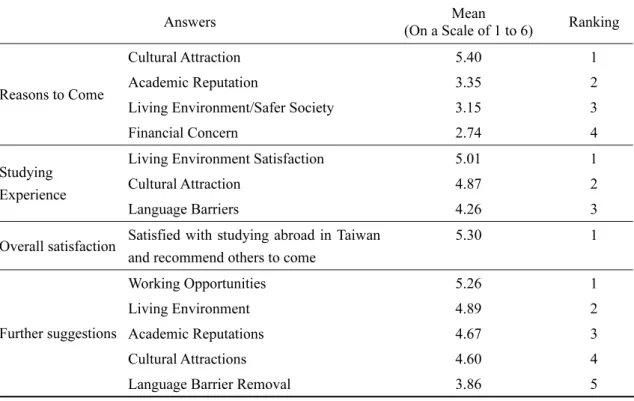
Table 4 shows that, compared to other factors, most of the participating international students came to Taiwan because of an attraction to the Chinese culture (M = 5.40). In addition, participants show high satisfaction with the living environment in Taiwan (M = 5.01). Overall, they are satisfied with their studying experiences and would recommend that their friends come for further study (M = 5.30). When participants were asked to provide suggestions to their host HEIs and Taiwanese society for attracting more international students, they stressed the importance of work opportunities (M = 5.26) over other factors.
Table 4
Overview of All Participants’ Responses to the Questionnaire
Answers Mean
(On a Scale of 1 to 6) Ranking
Cultural Attraction 5.40 1
Academic Reputation 3.35 2
Living Environment/Safer Society 3.15 3
Reasons to Come
Financial Concern 2.74 4
Living Environment Satisfaction 5.01 1
Cultural Attraction 4.87 2
Studying Experience
Language Barriers 4.26 3
Overall satisfaction Satisfied with studying abroad in Taiwan and recommend others to come
5.30 1 Working Opportunities 5.26 1 Living Environment 4.89 2 Academic Reputations 4.67 3 Cultural Attractions 4.60 4 Further suggestions
Language Barrier Removal 3.86 5
The following section presents the responses gathered from participants through both interviews and surveys pertaining to their reasons for coming to Taiwan, experiences of studying and living, as well as suggestions to further improve current policies.
Why We Came to Taiwan to Study
Students answered the question “Why did you choose to study in Taiwan?” on the questionnaire. As Table 5 shows, students’ answers were diverse, mentioning cultural, living, academic, and
Hsiou-Huai Wang & Chen-Wei Chang You Don’t Know What Really Matters to Me! 255
Table 5
Reasons for Coming to Taiwan for Study Reasons to come
Category Item Description
Mean (On a scale of 1 to 6) To learn the Chinese language/culture 5.53
Cultural Factor
To experience different cultures 5.22
Because of the democratic and liberal atmosphere 3.47 Living Factor
Because the living quality is similar to my home country 2.98 To study in the top field of research 3.63
To obtain a degree 3.48
Academic Factor
Because Taiwanese degrees are better than those offered in my home country
3.06
Financial Factor Because I received a scholarship 2.97
financial factors.
Generally, participants showed very high interest in learning Chinese language/culture (M = 5.53) and wanted to experience different cultures (M = 5.22), which contributed to their decision to study in Taiwan. Kim, an interviewee from South Korea majoring in international business, mentioned:
I have been interested in learning Chinese since I was 7 years old […] I decided to come to Taiwan partly because of my sister’s advice after she had a disappointing learning experience in China, also because I prefer to learn the traditional form of Chinese, which is offered in Taiwan.
In addition to the language and cultural factors, the living factor also played a role in their decision to study in Taiwan. Lin mentioned that one of his reasons for studying in Taiwan was its democratic and liberal atmosphere:
Compared to Mainland China, I prefer the Taiwanese social environment, where it is more democratic and safer for foreigners to stay and study in society.
Some students came to Taiwan mainly to pursue advanced degrees in top fields that Taiwanese universities are renowned for and also because Taiwanese degrees are more respected than those in
256 You Don’t Know What Really Matters to Me! Hsiou-Huai Wang & Chen-Wei Chang
their home countries. David from the Republic of Nicaragua chose to study computer science in Taiwan because of its international reputation:
When I considered coming to Taiwan, I cared more about the reputation of the field of study than the language barrier […]. Taiwanese universities have a better reputation in computer science than other countries.
In terms of financial factors, the participants indicated that they came to Taiwan not just because of the availability of scholarships. During the interviews, four types of comments on the scholarship issue were recorded: (1) no need to provide more scholarships to attract students (“scholarships may not influence my decision to come or not”); (2) needs for more scholarships (“increase the number of scholarship recipients without limitations”); (3) recipients should come to Taiwan for degree studies, not just for cultural/leisure purposes (“increase scholarship recipients with certain conditions”); and (4) quality of education prior to scholarship offering (“it is more important for the government to strengthen the quality of higher education than offer scholarships”).
What We Have Experienced During Our Stay in Taiwan
When international students were asked about their experiences in Taiwan, their responses could be divided into three categories: cultural encounters, living environments, and language barriers (Table 6).
Table 6
International Students’ Experiences in Taiwan Experiences in Taiwan
Category Item Description
Mean (On a scale of 1 to 6) I am satisfied with my experience in Taiwan 5.30 Overall Experiences
I would recommend my friends to study in Taiwan 5.08
Taiwan is a safe place 5.10
Taiwanese people are friendly 5.17
I have many Taiwanese friends 5.10
Living Environment
Life in Taiwan is interesting 4.58
Cultural Factors I have been exposed to many cultural activities 4.57 It is hard for me to understand instructions in Chinese 3.79 Language Barriers
It is hard for me to read Chinese textbooks 4.15
Hsiou-Huai Wang & Chen-Wei Chang You Don’t Know What Really Matters to Me! 257
Table 6
International Students’ Experiences in Taiwan (continued) Experiences in Taiwan
Category Item Description
Mean (On a scale of 1 to 6) It is hard for me to write reports in Chinese 4.75 It makes courses learning more challenging if instructed
in Chinese with Chinese teaching materials
3.58
Generally, participating international students showed high satisfaction with their overall experiences (M = 5.30) and would recommend studying in Taiwan to their friends (M = 5.08). More specifically, they were highly satisfied with their living and social experiences, such as “Taiwan is a safe place” (M = 5.10), “Taiwanese people are friendly” (M = 5.17), “local life here is interesting” (M = 5.10), and they “have many local friends” (M = 4.58).
Yuki, a Japanese student who studied Chinese literature, mentioned such experiences:
I feel the best part of Taiwan is that people here are so friendly. On campus, there are many clubs for us to participate in. In addition, the food here is cheap and it is easy to find a place to live near campus.
In addition, international students generally agreed that they were “exposed to many cultural activities in Taiwan” (M = 4.57).
As for students’ studying experiences, the data in Table 6 indicate that it is not easy for international students to understand Chinese instructions in classes. The language barriers appeared when students tried to “understand instructions” (M = 3.79), “read textbooks” (M = 4.15), and “write reports” (M = 4.75).
What We Suggest for Further Improvement on International Education in
Taiwan
At the end of the questionnaire, international students were asked about their overall impression of their experiences in Taiwan and were encouraged to provide suggestions for the R.O.C. government and HEIs to improve international student services in the future. Based on their educational experiences, the international students proposed several approaches to improving the current practices of internationalization at HEIs in Taiwan in order to attract more international students in the future (see Table 7).
258 You Don’t Know What Really Matters to Me! Hsiou-Huai Wang & Chen-Wei Chang
Table 7
Students’ Suggestions for International Education in Taiwan
Category Item Description Mean
(On a scale of 1 to 6) Offer higher quality Chinese language courses 4.63 Offer higher quality Chinese literature/culture courses 4.55 Cultural Factor
Offer exquisite cultural events and activities 4.72 Develop internationally renowned fields 4.65 Academic Factor
Set up more dual degrees with foreign universities 4.62 Provide better accommodations for foreign students 4.67 Living Factor Offer more social activities for further interaction with
Taiwanese people
5.25
Provide work permit to during foreign student’s stay of study
5.24 Work/Financial Factor
Issue work visa so that foreign students can stay and work after graduation
5.29
Cultural Factors: We Want to Learn Chinese
Regarding the need to improve cultural courses and language programs, students suggested that local HEIs offer more Chinese language courses (M = 4.63), quality Chinese literature/culture courses (M = 4.55), and more exquisite cultural events and activities (M = 4.72).
In terms of the language taught in class, they did consider that Chinese-taught courses paired with Chinese readings made their learning highly challenging. However, some students were strongly motivated to learn Chinese, especially for those who came for cultural experiences and enjoyment. As Kim emphasized during the interview:
I hope these will be more high quality Chinese language and cultural courses for us to be more immersed in the Chinese learning environment. In this way, I believe that many foreign students will come to Taiwan.
Some interviewees indicated that they did not prefer the all-English teaching environment provided by their institutions. One participant, Lee, who came from Cambodia to study computer science, stated:
Hsiou-Huai Wang & Chen-Wei Chang You Don’t Know What Really Matters to Me! 259
For me, I do not want to take many English-taught courses and I do not think my foreign friends want to have such an arrangement either. It is because not all of us are from English-speaking countries; we are not so comfortable speaking English with local Taiwanese. It might be more practical to offer us more Chinese courses so we can improve our Chinese proficiency and communication with local people.
Academic Factors: We Want to Learn From the Best Fields in Taiwan
International students addressed the importance of establishing internationally renowned fields to attract foreign students (M = 4.65) and suggested offering more dual degrees with foreign universities (M = 4.62). Leung from Vietnam mentioned that:
I think it is important to attract foreign students coming to learn from internationally renowned scholars… it is more critical for Taiwanese universities to strengthen the academic field’s reputation than provide more scholarships to foreign students.
Living Environment: We Want to Be Closer to the Society
Considering the main reasons bringing international students to Taiwan, they planned to explore more cultural activities and learn more about Chinese cultures. Therefore, they strongly suggested that more social activities for interactions with Taiwanese people should be offered (M = 5.25). Kim pointed out that:
It is very important to offer more social activities to encourage foreign students and local students to interact with each other in and out of the classes. We can also exchange languages lessons—like I teach you Korean, and you teach me Mandarin. But I found, while many foreign students want to do so, local students and the school are not so enthusiastic about this.
At the same time, participants also indicated that some of the current arrangements did not fit their needs (M = 4.67). Joy, an anthropology major from Canada, said:
It is important to really understand what foreign students’ needs—not to assume their needs, which might not meet their requests.
260 You Don’t Know What Really Matters to Me! Hsiou-Huai Wang & Chen-Wei Chang
In sum, when students arrive at a new place that has a different cultural background than their own, it is very important to guide them through the new environment with appropriate consultation and guidance.
Work Opportunities/Permits: We Hope to Have Further Opportunities in Taiwan
All participants suggested that the government should “provide work permits” (M = 5.24) during their school years and opportunities for “issuing work visas” after they graduate from college (M = 5.29). Lee mentioned that:
I have heard a lot of complaints from my foreign friends here that they could not get a work permit while studying […] I think it will be an attractor for foreign students to come if they could work part time while studying.
Lin was more straightforward:
It is important to provide international students with opportunities to work and stay in Taiwan after they graduate from school. For many of us, part of the reasons to come study here is to seek opportunities to work and stay here in the future.
Discussion
Mismatches Between Government Factors and International
Students’ Motivations to Study in Taiwan
Based on the interviews and survey, the researchers determined that the factors that attract international students to study in Taiwan are mainly cultural and academic factors as well as future employment. However, the factors behind the government’s strategic plans and policies for international education are primarily based on the political factors to build up and consolidate relational networks with current diplomatic allies and future leaders from these countries. Three mismatches were identified between the government’s strategies and students’ motives.
We Come to Learn Mandarin/Chinese Culture, But You Teach Me English?!
Cultural factors were the primary reasons that international students came to study in Taiwan. However, their experiences showed that there were not enough opportunities for them to learn and practice Chinese in daily life. Some of the international students felt frustrated when they entered aHsiou-Huai Wang & Chen-Wei Chang You Don’t Know What Really Matters to Me! 261
class taught in English and did not have the chance to practice Chinese orally. Furthermore, students from non-English-speaking countries faced dual language barriers in which they needed to overcome both the frustration from learning Chinese and English. Even for students who are native English speakers, they could not understand Taiwanese professors’ accents in English-taught classes.
Improving Academic Reputation Is More Important Than Giving Me a
Scholarship!
Scholarships are the most direct and widely used strategy to attract international students at local HEIs in Taiwan (Liu & Sheu, 2008). However, when the participants were asked about scholarships, their comments were surprising. Some of the students mentioned, instead of offering more scholarships, it is more important to enhance the quality of higher education.
Therefore, if R.O.C. governmental policies continue to emphasize English-taught programs and the provision of scholarships, they might ignore students who are interested in learning Chinese languages and earning valuable diplomas from reputable fields at HEIs. Considering such circumstances, it might be more crucial to recruit highly reputable faculty to offer high quality courses rather than offering English classes so the overall quality of instruction can be elevated.
Pull the Potential Workforce Into the Society or Push Them Away?
Participants also proposed the possibility of working in Taiwan after graduation. However, the current R.O.C.’s immigration policy and regulations are extremely strict and unfavorable to international students (Jiang, 2012). According to Foreigners in the Employment Service Act, if a foreigner plans to stay in Taiwan to apply for a job, he/she needs to meet the requirements of having at least two years of related work experiences and the employer is willing to pay 47,971 NTD per month for his/her work. It appears that the government and HEIs exerted much effort to “pull” international students into local HEIs and then “push” them away without considering their own choices and preferences. If international students are motivated and ambitious to make contributions to Taiwan through work, the government should consider the possible approaches to attract and keep talented people in the country.
A Missing Part Between the System and Students: Lacking a Consulting
Mechanism for International Students
Some participants in this study went through a complicated application process to study in HEIs in Taiwan. Without sufficient and helpful information and consultations, some felt lost and disoriented. They did not know where to ask for advice and might miss the chance for making a better decision.
262 You Don’t Know What Really Matters to Me! Hsiou-Huai Wang & Chen-Wei Chang
Several interviewees mentioned that they came to Taiwan because of their interest in learning Chinese culture and they planned to advance their Chinese proficiency. However, after two year of studying in Chinese, the only way they could stay in Taiwan was to apply for degree-granted programs. For example, participants like Kim and Yuki were attracted by the Chinese culture and would like to learn Mandarin. However, due to immigration regulations, they had to apply for a specific major if they wanted to obtain a student visa after their first two-year period of studies. Therefore, Yuki applied to major in Chinese language and Kim applied for international business. However, their learning experiences in their majors were hindered by their limited Chinese capacities. Such frustrations have pushed them to reconsider if they should return to their home countries to continue their college education. Therefore, a more elaborate and well-coordinated student consultation system for international students should be established and improved to help them adapt more smoothly in a new environment.
Suggestions: Bridging the Gaps in International
Student Recruitment
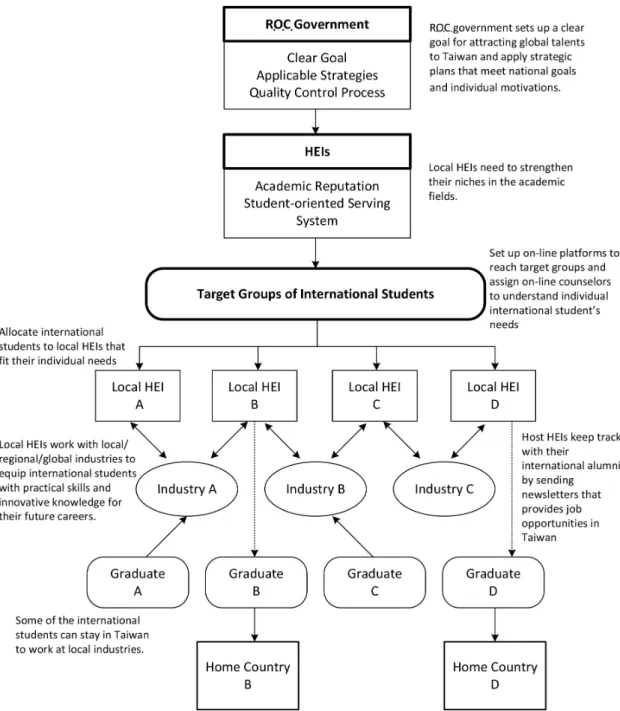
According to the research finding mentioned earlier in this article, the research further proposes the following suggestions showed as Figure 1. The way to bridge the gaps between R.O.C. policies to attract international students and their own interpretation in personal experiences starts from clarifying the goals and the factors for implementing internationalization at higher education level. By working with local HEIs, the government can strengthen the niches to further promote R.O.C. higher education and attract students from foreign countries to come study. In addition, the research suggests that the government and HEIs can build up an on-line platform to reach international students and assign individual counselor to help each of them to be allocated at local HEIs that fit their expectations. Furthermore, local HEIs can collaborate with local/regional/global industries to design curriculum for equipping international students with innovative knowledge and skills that lead them to the bright future. If international students choose to go back to home countries after their study, the host HEIs should keep tracking with foreign alumni and recruit them back to contribute to Taiwanese society.
Hsiou-Huai Wang & Chen-Wei Chang You Don’t Know What Really Matters to Me! 263
Figure 1. The Flow of Attracting, Recruiting, Educating, Retaining, and Tracking International Students
264 You Don’t Know What Really Matters to Me! Hsiou-Huai Wang & Chen-Wei Chang
Clarifying Factors Related to Internationalizing Higher Education
As Knight (2006, p. 215) pointed out:
[W]ithout a clear set of rationales, followed by a set of objectives or policy statements, a plan of strategies, and a monitoring/evaluation system, the process of internationalization is often an ad hoc, reactive and fragmented response to the overwhelming number of new international opportunities available.
Our study found that the cultural factor was the primary attraction for overseas students coming to Taiwan to learn about Chinese cultures and traditional Mandarin. However, the government policy emphasizes the provision of English-taught courses and scholarships. It is clear that Taiwan needs to consider foreign students’ needs and concerns to strengthen its niches. Therefore, it is advised that the government encourage host HEIs to provide free Chinese courses and cultural activities for foreign students to learn the Chinese language and culture in order to fulfill their primary motives for studying in Taiwan.
Reexamining Policies of Performance Evaluation by Counting
Numbers
R.O.C.’s MOE set a goal to recruit 150,000 international students to study in Taiwan by 2020 (Ministry of Education, 2011b). However, increasing the number of international students should not be the only considered indicator of internationalization as it takes time to see the long-term effects in this field. Some HEIs use scholarships/funds to attract international students to fit the number formula calculated by the government and misallocate these resources aimed at for upgrading the quality of HEIs. This recruitment approach not only intensifies the competitive market among local HEIs, but also distorts schools’ operation philosophy from how much the students want to learn to how much money the institution can get. In this situation, international students who want to pursue further studies might leave for other countries with higher quality education programs. The R.O.C. government needs to work with HEIs to figure out how to attract outstanding international students and improve the quality of education at the higher education level.
Establishing a Student-Oriented Serving System
It is more important to prepare a learning environment with qualified faculty, resources, curriculum design, support system, and good accommodations than simply providing international
Hsiou-Huai Wang & Chen-Wei Chang You Don’t Know What Really Matters to Me! 265
students with money. The further development of international education should focus on identifying the diverse needs of students from different regions. Students need effective consultation and full support on their application process and daily life in local HEIs. This would not only help their learning experiences, but also strengthen their choices to study, work, and further cooperate with Taiwan in the future.
Situating and Strengthening Taiwan’s Niches
As Ma (2008) mentioned in her research, students choose to go to Western countries not because these countries provide scholarships, but because the HEIs have better reputations in specific fields. Taiwan needs to figure out a way to strengthen its niches in order to attract more overseas students to learn and work in Taiwan. Based on the research findings, the researchers propose establishing the following niches to attract international students, including Chinese legacy, renowned academic fields, financial support, and friendly living environment.
Taiwan is generally viewed as a good Chinese learning environment with an abundant reservoir of Chinese history and cultural treasures as well as an open and democratic society with good living quality. Furthermore, Taiwan’s government generously gives various scholarship opportunities to attract international students interested in such chances to study in Taiwan. Moreover, Taiwan is known for its highly developed economy and friendly society. These fields are promising for R.O.C.’s HEIs to further introduce to international students pursuing higher education or advanced degrees in Taiwan.
Reconsidering Immigration and Employment Policies to Retain
Global Talents
Immigration and employment policies, such as PEFSR and STEP, suggest that the government wants to recruit talents all over the world to contribute to Taiwan. In addition, international students’ responses to the survey showed that they highly recommend that the government issues work permits for international students and work visas after they graduate from school. However, immigration and employment policies are still restricted in Taiwan, and they need to be revised in order to attract and draw talents from all over the world to work in Taiwan, especially for those who study here and are willing to continue contributing to Taiwanese society. As Figure 1 shows, the local HEIs could collaborate with local/regional/global industries to design programs to educate and train international students with innovative skills and knowledge for their further career plans. With the possible deregulation of immigration and employment policy, R.O.C. and local HEIs will attract more international talents to come study and contribute to the society.
266 You Don’t Know What Really Matters to Me! Hsiou-Huai Wang & Chen-Wei Chang
Conclusion
In this globally competitive age, it is crucial to rethink the ideals and rationales for recruiting global talents and internationalization. This research used Taiwan as a case study to understand the approaches the non-English-speaking country adopted to recruit international students as well as how international students perceived and interpreted such practices. The research identified gaps between the ultimate goals of the government and the expectations and concerns of the students. Such results might provide some insights for other non-English-speaking countries when they try to identify and strengthen their own niches to recruit talented students from abroad in this age of global competition.
Hsiou-Huai Wang & Chen-Wei Chang You Don’t Know What Really Matters to Me! 267
References
Altbach, P. G. (2005, May). The political economy of international higher education cooperation: Structural realities and global inequalities. Paper presented at the “A Changing Landscape” conference, The Hague, The Netherlands.
Altbach, P. G., & Knight, J. (2007). The internationalization of higher education: Motivations and realities. Journal of Studies in International Education, 11(3-4), 290-305. doi:10.1177/1028315 307303542
Chen, C.-C. (2009). Recruitment policies and strategies of foreign students in higher education of Taiwan via the analysis of educational marketing theories (Unpublished doctoral dissertation). National Taiwan Normal University, Taipei, Taiwan. (in Chinese)
Chou, C. I. (2011). The survey on international system in Taiwan. (in Chinese) Retrieved from http://www3.nccu.edu.tw/~iaezcpc/publications/C_publications/Journals/%E5%91%A8%E7% A5%9D%E7%91%9B(2011)_%E5%8F%B0%E7%81%A3%E5%9C%B0%E5%8D%80%E5% 9C%8B%E9%9A%9B%E5%AD%B8%E7%94%9F%E8%AA%BF%E6%9F%A5%E7%A0% 94%E7%A9%B6.pdf
Corbin, J. M., & Strauss, A. (1990). Grounded theory research: Procedures, canons, and evaluative criteria. Qualitative Sociology, 13(1), 3-21. doi:10.1007/BF00988593
Council for Economic Planning and Development. (2012). Easier for foreign and overseas Chinese grads to work in Taiwan. Retrieved from http://www.cepd.gov.tw/encontent/m1.aspx?sNo= 0017374
Ducanes, G., & Abella, M. (2008). Labour shortage responses in Japan, Korea, Singapore, Hong Kong, and Malaysia: A review and evaluation. Retrieved from http://digitalcommons.ilr.cornell. edu/intl/50
Garnier, L. (2004). Knowledge and higher education in Latin America: Incommodious commodities? In J. K. Odin & P. T. Macicas (Eds.), Globalization and higher education (pp. 181-201). Honolulu, HI: University of Hawaii Press.
Jang, F.-M. (2005). Government should build up business with learning Chinese. (in Chinese) Retrieved from http://www.epochtimes.com/b5/5/6/3/n942971.htm
Jiang, Y. C. (2012). Help the oversea students study in Taiwan. Retrieved from http://www. epochtimes.com.tw/12/5/23/193268.htm%E5%8A%A9%E8%8F%AF%E8%A3%94%E7%94 %9F%E4%BE%86%E5%8F%B0%E7%95%99%E5%AD%B8-%E6%94%BF%E5%BA%9C %E6%94%BE%E5%AF%AC%E7%95%99%E5%AD%B8%E9%99%90%E5%88%B6
268 You Don’t Know What Really Matters to Me! Hsiou-Huai Wang & Chen-Wei Chang
JWT Education. (2008). International student mobility in East Asia: Executive summary. In JWT Education (Ed.), British council East Asian student mobility project report (pp. 6-8). London, UK: British Council.
Knight, J. (2006). Internationalization: Concepts, complexities and challenges. In J. Forest & P. Altbach (Eds.), International handbook of higher education (pp. 207-228). Dordrecht, The Netherlands: Springer Academic. doi:10.1007/978-1-4020-4012-2_11
Knight, J., & de Wit, H. (Eds.). (1997). Internationalization of higher education in Asia Pacific countries. Amsterdam, The Netherland: European Association for International Education and IDP Education Australia.
Knight, J., & de Wit, H. (1999). An introduction to the IQPR project and process. In J. Knight & H. de Wit (Eds.), Quality and internationalization in higher education. Paris, France: Organization for Economic Co-operation and Development.
Li, S. (2010). Studying in Taiwan. Taiwan Panorama, Monthly(3), 70. (in Chinese)
Liu, L.-F. & Sheu, T.-M. (2008). Attracting international students to study in Taiwan. The Educator Monthly, 493, 8-13. (in Chinese)
Ma, A. H. (2008). Marketing investigation on international student recruitment at higher education level in Taiwan. Taipei, Taiwan: MOE. (in Chinese)
Ministry of Education. (2009). Blueprint of international student recruitment at higher education level. Taipei, Taiwan: Author. (in Chinese)
Ministry of Education. (2011a). Aim for the top university project. Retrieved from http://www. ora.nsysu.edu.tw/top-U/2007in/pdf/top100.pdf
Ministry of Education. (2011b). Study-in-Taiwan enhancement program. Retrieved from http://www. ey. gov.tw/Upload/RelFile/27/80182/1671614971.doc
Ministry of Education. (2014). Summary of statistics. Retrieved from https://stats.moe.gov.tw/ files/main_statistics/beyond.xls
Ministry of Education. (2015). Summary of statistics. Retrieved from https://stats.moe.gov.tw/ files/main_statistics/beyond.xls
Peng, S. J. (2009). Low birth rate, but less is not just for kids. Global Views Monthly, 282(12). (in Chinese) Retrieved from http://www.gvm.com.tw/Boardcontent_15635.html
Song, M.-M., & Tai, H.-H. (2007). Taiwan’s responses to globalization: Internationalisation and questing for world class universities. Asia Pacific Journal of Education, 27(3), 323-340. doi:10. 1080/02188790701594067
Hsiou-Huai Wang & Chen-Wei Chang You Don’t Know What Really Matters to Me! 269
2012. Montreal, Canada: UNESCO Institute for Statistcs.
Wu, R. L. (2006). If Taiwan becomes the center of global Chinese education. (in Chinese) Retrieved from http://city.udn.com/50426/1557305
270 You Don’t Know What Really Matters to Me! Hsiou-Huai Wang & Chen-Wei Chang 教育科學研究期刊 第六十一卷第四期 2016年,61(4),243-270 doi:10.6209/JORIES.2016.61(4).09