
網際網路企業對敏捷軟體開發程序採用的成功案例 -以AUTOTRADECENTER為例 - 政大學術集成
132
0
0
全文
(2) TABLE OF CONTENTS CHAPTER 1 INTRODUCTION ..................................................... 1 1.1 1.2. INTRODUCTION ................................................................... 1 RESEARCH OBJECTIVES .......................................................... 5. CHAPTER 2 LITERATURE REVIEW ............................................. 7 2.1 AGILE SOFTWARE DEVELOPMENT PROCESS....................................... 7 2.1.1 Software Development Processes History ........................ 10 2.1.2 Agile process .............................................................. 14 2.1.3 Summary ................................................................... 27 2.2 INNOVATION AND TECHNOLOGY MANAGEMENT ................................. 29 2.2.1 Managing Innovation and knowledge .............................. 29 2.2.2 Open source platform .................................................. 37 2.2.3 Summary ................................................................... 39 2.3 ORGANIZATIONAL SUPPORT ...................................................... 40 2.3.1 Organizational system and culture ................................. 40 2.3.2 Organizational changes ................................................ 44 2.4 ORGANIZATIONAL CORE CAPABILITY ............................................. 48 2.5 SUMMARY........................................................................... 53. 立. ‧ 國. 學. CHAPTER 3. 政 治 大. RESEARCH METHODOLOGY ................................. 55. ‧. er. io. sit. y. Nat. 3.1 RESEARCH FRAMEWORK .......................................................... 55 3.2 RESEARCH VARIABLES ............................................................ 57 3.3 RESEARCH DESIGN ................................................................ 63 3.3.1 Research Target .......................................................... 63 3.3.2 Research Limitation ..................................................... 64 CHAPTER 4 RESEARCHED CASE – AUTODAQ ........................... 66. n. al. Ch. i n U. v. 4.1 ADOPTING AGILE PROCESS....................................................... 66 4.2 MANAGING INNOVATION AND KNOWLEDGE ..................................... 78 4.3 ORGANIZATIONAL SUPPORT ...................................................... 89 4.4 AGILITY AS CORE CAPABILITY .................................................... 93 4.5 SUMMARY........................................................................... 97. engchi. CHAPTER 5 RESEARCH FINDINGS AND DISCUSSIONS ............ 99 5.1 FINDINGS IN ADOPTING THE AGILE PROCESS ................................... 99 5.2 MANAGING THE INNOVATION AND KNOWLEDGE .............................. 102 5.3 MAINTAINING THE SUPPORTIVE ORGANIZATION .............................. 104 5.4 CREATING AGILITY............................................................... 106 CHAPTER 6 CONCLUSIONS AND SUGGESTIONS .................... 107 6.1 CONCLUSION ..................................................................... 107 6.2 SUGGESTIONS ................................................................... 112 6.2.1 Practical Suggestions ................................................. 112. Page i.
(3) 6.2.2 Future research suggestions ....................................... 113 REFERENCE........................................................................... 115 APPENDIX A ........................................................................ 117 INTERVIEW WITH JORGE BORBOLLA, FOUNDER AND CTO ... 117 APPENDIX B ......................................................................... 120 INTERVIEW WITH SHEKHAR KRISHNAN, SENIOR STAFF AS PROJECT MANAGER, 2000 TO 2005; CURRENTLY AS ARCHITECT IN ATC-ONLANE.................................................................... 120 APPENDIX C ......................................................................... 123 INTERVIEW WITH TAWEN KAN, SENIOR STAFF AS PROJECT LEAD, 2002 TO 2005 ............................................................. 123. 立. 政 治 大. ‧. ‧ 國. 學. n. er. io. sit. y. Nat. al. Ch. engchi. Page ii. i n U. v.
(4) TABLE OF FIGURES FIGURE 2-1 WATERFALL MODEL ........................................................ 11 FIGURE 2-2 SPIRAL MODEL BARRY BOHEM ............................................. 13 SOURCE: BOEHM (1998) ................................................................ 13 FIGURE 2-3 DIMENSIONS OF THE TYPES OF INNOVATION ............................ 30 SOURCE: HENDERSON AND CLARK (1990) ............................................ 30 FIGURE 2-4 INNOVATION PATTERNS IN TECHNOLOGY CYCLES ....................... 34 SOURCE: TUSHMAN & O’REILLY (1997) ............................................... 34 FIGURE 2-5 NONAKA SPIRAL DIAGRAM FOR KNOWLEDGE CONVERSION ............. 35 FIGURE 2-6 MATRICES OF THE MEASUREMENTS FOR CONTROL SYSTEM ............. 41 SOURCE: TUSHMAN & O’REILLY (1997) ............................................... 41 FIGURE 2-7 THE VIRTUOUS CYCLE...................................................... 43 SOURCE: LEONARD-BARTON (1995) .................................................. 43 FIGURE 3-1 RESEARCH FRAMEWORK ................................................... 56 FIGURE 4-1 PARALLEL RELEASE PROCESS.............................................. 71. 立. 政 治 大. ‧. ‧ 國. 學. n. er. io. sit. y. Nat. al. Ch. engchi. Page iii. i n U. v.
(5) TABLE OF TABLES TABLE 2-1 SUMMARIES OF THE SOFTWARE DEVELOPMENT PROCESSES .............. 11 TABLE 2-2 EXAMPLES OF AGILE DEVELOPMENT METHODOLOGIES .................... 27 TABLE 2-3 THE RATES OF MAJOR INNOVATION FOR PRODUCTS AND PROCESSES .. 32. 立. 政 治 大. ‧. ‧ 國. 學. n. er. io. sit. y. Nat. al. Ch. engchi. Page iv. i n U. v.
(6) Acknowledgements I am heartily thankful to professor, Dr. Vincent (Feng-Shang) Wu, whose encouragement, guidance and support from the start to the end enabled me to complete this thesis.. The major research materials for this study were collected from my work at AutoTradeCenter. My special appreciations go to Jorge Borbolla, Shekhar Krishnan and Tawen Kan for providing me their feedback of the agile methodology exercises in AutoTradeCenter.. 立. 政 治 大. ‧. ‧ 國. 學. I would like to thank my family members, especially my mother, Mrs. Chen-Jye Hwang, and my father, Mr. Fang-Ren Hwang, who helped me to care my two young daughters while I was on the overnight trips to the school. Thanks to my lovely daughters, Neha and Kareena, who tolerated lives without mommy for a few days weekly and patiently gave me the quiet time to work on this thesis.. n. er. io. sit. y. Nat. al. Ch. engchi. Page v. i n U. v.
(7) Abstract The fast change technology and business environment from the emerging Internet economy have resulted in the evolution of the software development process into an adaptive process. This evolution of the agile software development process has helped numerous new Internet businesses to enter the field and to stay competitive over the past decades. Internet businesses, which adopted the agile software development methodology, are able to remain flexible and address changes in any stage of software development process. A lightweight team with close and good communications is the key ingredient to speedily deliver software products. Quick cycles and prototypes make feasibility studies easier and allow business people to test and provide feedback thereby allowing creation of the innovative products that truly address the market requirements.. 立. 政 治 大. ‧. ‧ 國. 學. Open source technology has helped agile organizations to innovate and materialize the innovation. Knowledge transfer and technology management play important roles in an agile software development environment without a need for excess documentations.. er. io. sit. y. Nat. Organizations stay adaptive with agility as their core competence. The organizational values and culture need to be shaped accordingly to support the agile spirit across organizations. Incumbents should motivate the members using social control system rather than the formal control system.. al. n. v i n AutoTradeCenter, a case study successfully C h used in this research, U i formed an agile organization byeadopting the agile methodology, h ngc. utilizing and managing the open source technology, and creating an adaptive culture and value. The agility helped the company staying competitive during the economic downturn in early 2000. This research suggested that any Internet startup can adopt the same path that AutoTradeCenter chose to create its competitive advantages. Keywords: Agile Software Development, Open Source Technology, Knowledge Management, Organizational Culture, Core Competence, Competitive Advantage, Internet Business Model, AutoTradeCenter. Page vi.
(8) 摘要 逐漸崛起的網際網路經濟在科技及商業環境的快速變化中促使軟體開發程序漸漸進 化成因應需求而調整式的程序,敏捷開發程序的演化在過去十幾年已幫助許多網際 網路商業設立而且使其可以保持競爭力。 採用敏捷開發程序的網際網路商業組織較具有彈性,可以在任何軟體開發的階段中 對於針對需求的改變而改變軟體的開發。主要加快軟體完成的因素是保持一個輕量 級並有密切及通暢溝通的團隊。快速的軟體開發週期以及原形的開發使得初步可行 性研究較簡單,也因此可以幫助需求單位提早測試軟體並提早提供回饋。 開放原始碼技術能幫助敏捷組織創新。知識轉移與技術管理在沒有很多文件紀錄的 敏捷軟體開發環境中也扮演非常重要的角色。. 政 治 大. 處於隨時因應需求而敏捷調整步調成為組織的核心競爭力。組織的文化與價值需要 根據組織要求的敏捷特性來調整。在事者應當用社會控制體系來管理其員工,而非 用傳統式的正式控制體系。. 立. ‧ 國. 學. ‧. AutoTradeCenter 成功的採用敏捷方法而成為一個敏捷的組織。它採用開放原始 碼技術並強調創新管理。也建立組織的文化與價值來支持其「敏捷開發系統」的建 立。該公司的高度敏捷度在 2000 年代初期的不景氣時候仍讓其保持競爭力。. n. al. er. io. sit. y. Nat. 本研究建議任何新成立的網際網路商業公司可以嚐試使用 AutoTradeCenter 所 採用的敏捷開發方式來建立組織的競爭力。. Ch. engchi. i n U. v. 關鍵字:敏捷軟體開發,開放原始碼技術,知識管理,組織文化,核心競爭力,競 爭優勢,網際網路商業模式,AutoTradeCenter,核心能力. Page vii.
(9) Chapter 1 Introduction This chapter describes how the emerging fast changing environment and advanced technologies created the needs for the agile development process for the internet companies. In order to stay competitive, organizations required to build agility to fulfill the business needs. The fast changing environment not only triggered the. 政 治 大 pushed the Internet organizations to effectively manage the innovation 立 Internet organizations to adopt agile development process, it also. ‧ 國. 學. and to provide supportive organizations. The objective of this research is outlined in this chapter.. ‧ y. Nat. al. er. io. sit. 1.1 Introduction. v. n. Numerous emerging, innovative Internet based business models have. Ch. engchi. i n U. been re-shaping the economic and business environment since the rise of the World Wide Web technology. The Internet businesses have altered the fundamental nature of doing the business such as the way they compete and operate. Chesbrough and Rosenbroom (2002) defined the business model as a coherent framework that takes technological characteristics and potentials as inputs and converts them through customers and markets into economic output. Although Chesbrough and Rosenbroom (2002) indicated the missing profit Page 1.
(10) potential addressed from the Internet business models, the Internet business models have subsequently proven to actually fit into the description of a coherent framework and have created the new Internet economy. Furthermore, the Internet business models evolve radically and have been influencing the business world greatly. Jack Welch, the former CEO of GE, commented “The Internet is the Viagra of big business.” Traditional businesses are adopting the Internet. 政 治 大. platform to introduce new commerce channels since 2000.. 立. Over the past decades, information technology has been helping. ‧ 國. 學. organizations to support business. Due to the fast changing. ‧. environment and the rapidly evolving requirements, software development departments or organizations are often burdened with. y. Nat. io. sit. extra development cycles and costs. Software development business is. er. notorious for delays in schedule and being over budget. Typically, the. al. n. v i n requirements of the software accurately during C hproducts are identified engchi U the planning session. The changes of the requirements usually make delivering final products on time difficult, so does keeping the good quality of the software products. The rapidly evolving Internet business environment had made these challenges in software development more prominent. The Internet has expedited the communications among societies; it shortened the distance between people. The advent of the new. Page 2.
(11) Internet technologies enables customers to receive information and products faster and so to provide feedbacks. The fast changing requirements has become the biggest challenge in the recent software business industry. A software development process to enable an organization to bring products to market in time and meeting the customer’s needs at the end is essential. The traditional waterfall software development process obviously cannot meet the needs in this. 政 治 大. era. Various software development processes are introduced over past. 立. decades. Most of them are focusing in agility of the software. ‧ 國. 學. development.. ‧. In-time marketing has been an important factor to acquire first market shares in competitions. The closed innovation style in 1970s is no. y. Nat. io. sit. longer the main stream of the software development. Adoption of the. er. open innovation prevails with the rise of the Internet technology. “Not. al. n. v i n re-inventing the wheel” is C the motto for most of the technology hengchi U. companies in Silicon Valley. The open source community helped builds up numerous of the startups. It was cost and time efficient. Hippel (2001) explained how the open source community gave users incentives and ability to innovate and share their innovation. Managing the innovation and organization knowledge effectively can help the organization to be agile in response to the shifting markets.. Page 3.
(12) The organizational changes are required to adopt the agile software development process. Over the past, organizations often make changes to adjust to the environment of market demand and technological changes. Tushman and O’reilly (1997) emphasized that the discontinuous organizational change is required to allow managers to manage and execute the innovation stream. Using AutoTradeCenter, a leading Internet B-to-B used vehicle auction. 政 治 大. business, as a research object, this thesis is to expose that an. 立. organization can build its competitive advantages and core. ‧ 國. 學. competence by using agile software development process and. ‧. adopting the open source framework in its organization in the fast change environment. The ready-to-accepting-change culture is. y. Nat. io. sit. instrumental to the success of the Internet business. The advent of the. er. new Internet business models brings the business world to the fast. al. n. v i n changing environment. The technology forces Cadoption U h e n g ofc hthei Internet. the organizations to change to factor in the new software development process and technology management; the software development process changes for fast iterations; and adoption of the open source platform is to speed up the final production.. Page 4.
(13) 1.2 Research Objectives Facing the competitions and lack of the profit margins, most of the 90s Internet business models failed to sustain themselves but inspired the traditional businesses to implement the new commerce platform. The Internet not only brings information to people in a faster manner, it also changes the way of consumption. Traditional business learned that the Internet can be an effective channel during the Internet boom.. 政 治 大. For example, Webvan, a grocery deliver service, one of the most. 立. innovative Internet business models, shut down without warning in. ‧ 國. 學. 2001. Now, Safeway, one of the biggest US supermarket chains, is. ‧. providing such service to their customers.. sit. y. Nat. Comparing to most of the failed innovative Internet based businesses. io. al. er. sprouting in the late 90’s, surviving ones definitely own their core. v. n. competence and capability to sustain over the dotcom bubbles.. Ch. engchi. i n U. Besides the profitable business model, the Internet startup needs agile software process and open source platform to quickly establish and grow in the fast change business environment. The agility is what to discover in this research that an Internet business should have as a competitive advantage. In this research, the objective is to use a successful Internet business as the case to explore that establishing agility of the organization as. Page 5.
(14) the core competence and competitive advantage is the major survival and growth factor for an Internet based business besides the profitable business model. The following are the issues being discussed in this research(1) How does an Internet startup business create the agility as the competitive advantage and the core competence by adopting the agile development process?. 政 治 大. (2) How does an Internet startup business manage the technical. 立. knowledge in adoption of the agile development process and the open. ‧ 國. 學. source platform?. ‧. (3) What organizational culture and organization changes are needed. n. al. er. io. sit. y. Nat. to adopt agile process?. Ch. engchi. Page 6. i n U. v.
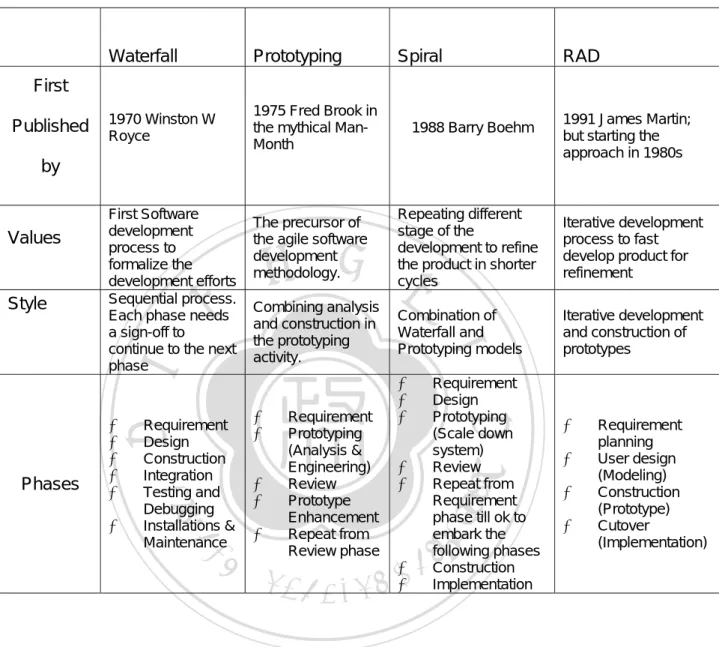
(15) Chapter 2 Literature Review This chapter reviews the literatures and theories of the software development process, the knowledge and innovation management and the organizational support. The agile methodology promotes incremental changes over the course of the development process. However, an organization stays. 政 治 大 discontinuous organizational 立 changes are required to manage the competitive when executing revolutionary innovation. The. ‧ 國. 學. process and technology changes. This study reveals how the radical innovation was triggered by the business requirements and managed. ‧. in the incremental development process.. er. io. sit. y. Nat. 2.1 Agile Software Development Process. n. al. Ch. engchi. i n U. v. The recent booming agile methodology is not a new concept in the software development industry. In the software development history, the development processes are often being reviewed and refined to effectively deliver the software products. Different characteristics of the agile methods often appear in different processes to solve the development issues. The latest agile development process brings in new style of communications among teams, adopts shorter cycles and. Page 7.
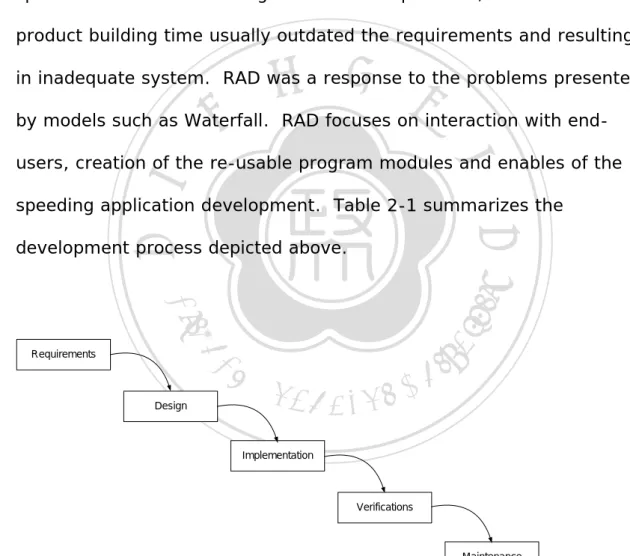
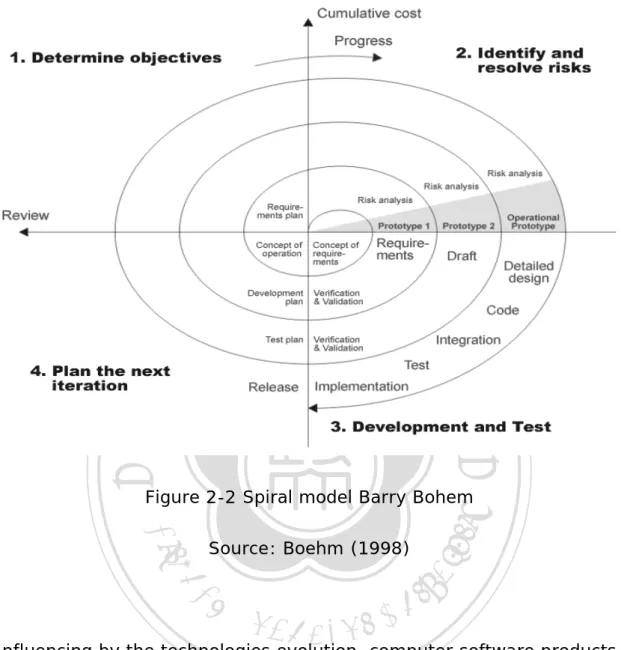
(16) incremental changes in completing the development, and presents working software at the end of each cycle to gain feedback more effectively and to replace the lengthy documentation. Larman and Basili (2003) recorded that the earliest time the iterative and incremental development method used was in 1957. The latest prevailed agile process inherits the iterative and incremental development method to be more effective. The agile process. 政 治 大. promotes lean production. Lean production is not a new concept either.. 立. Toyota developed the lean production system between 1948 and 1975.. ‧ 國. 學. It was quite a movement in the automobile industry. The efficiency. ‧. that the lean manufacturing brought to the table has helped Toyota defeated the biggest and most successful North American and Western. y. Nat. io. sit. Europe automobile makers in late 1970s and early 1980s. The TPS. er. (Toyota Production System) influenced not just the automobile. al. n. v i n industry but all other industries. C h In searchingUthe efficient development engchi methodology, the software agilsts are obviously inspired by Toyota lean manufacturing. The successful implementation and the benefits of any agile methodology are often contributed by environment, technologies and corporate culture. That, the principle, disciplines and process strictly followed by any organization adopting agile methodology is essential. Page 8.
(17) to the success of the new product development to conquer the markets. Agile process promotes building successful software product within changes. The methodology of design and building the products requires changes from the traditional methodologies. Managing the technology and the actual development is equally important. Advanced technology is suggested to be adopted to reach such goal. Simple. 政 治 大. system design guided by the object oriented methodology was a key. 立. principle in the agile practice. Not reinvent the wheel is the motto in. ‧ 國. 學. the 90s during the Internet boom. Section 2.2 illustrates more in the. ‧. technology and innovation management to facilitate the agile development process in helping the organization to build the core. y. Nat. er. io. sit. competence of agility.. The agile process is really about the process of changes. Committing. al. n. v i n to adopt agile process, an C organization to change the h e n g c ish committing i U. organization culture. There are changes an organization needs to make when adopting the agile software programming model. Section 2.3 illustrates the theories which can explain the organizational support in adopting the agile process. This section, 2.1, introduces the history of the software development process; elaborates the characteristics of the agile process and illustrate different flavors of the agile processes. Page 9.
(18) 2.1.1 Software Development Processes History. The software development process usually involves steps such as marketing research, requirement collection, problem analysis, system and product specifications, coding, testing, porting, implementation, deployment, maintenance and bug fixes. Over the past decades, the formalized methodologies formulated these steps into software. 政 治 大. development process models. The main concept is to create and. 立. utilize the efficient and structured process to help manage the. ‧ 國. 學. software project and to deliver better quality software product. Some of the represented models are Waterfall1, Prototyping2, Spiral3 and. ‧. Rapid Application Development (RAD)4. Except for Waterfall model, the. Nat. sit. y. rest of the models above are the precursory of the agile software. n. al. er. io. development process. The agility that agile methodology brought has. i n U. v. become the mainstream in the software development sector in the past decade.. Ch. engchi. While the Waterfall model emphasizes to enter each stage only after completion of previous stage, a RAD model involves prototyping and rapidly iterative development to proof concept and receive feedback. 1. Royce, Winston (1970), "Managing the Development of Large Software Systems", Proceedings of IEEE WESCON 26 (August): 1-9, <http://www.cs.umd.edu/class/spring2003/cmsc838p/Process/waterfall.pdf>. 2 Fred Brook (1975), “The Mythical Man-Month” 3 Boehm, Barry B, (1998) "A Spiral Model of Software Development and Enhancement",. "Computer", "IEEE", 21(5):61-72 4. Martin, James (1991), Rapid Application Development. Page 10.
(19) earlier in the software product development life cycle. Figure 2.1 illustrates the stages that the Waterfall model goes through in a process. Spiral model was proposed in 1988 to quickly and repeatedly iterate through different cycles. Figure 2.2 illustrate the spiral model. Although Waterfall model promotes well defined requirements and specifications to better design the software products, the extensive product building time usually outdated the requirements and resulting. 政 治 大. in inadequate system. RAD was a response to the problems presented. 立. by models such as Waterfall. RAD focuses on interaction with end-. ‧ 國. 學. users, creation of the re-usable program modules and enables of the speeding application development. Table 2-1 summarizes the. ‧. development process depicted above.. n. al. er. io. sit. y. Nat Requirements. Design. Ch. engchi. i n U. v. Implementation. Verifications. Maintenance. Figure 2-1 WaterFall Model. Page 11.
(20) Table 2-1 Summaries of the software development processes. Waterfall. Prototyping. 1970 Winston W Royce. 1975 Fred Brook in the mythical ManMonth. Spiral. RAD. First Published. 1988 Barry Boehm. by. n. al. Iterative development process to fast develop product for refinement. Combining analysis and construction in the prototyping activity.. Combination of Waterfall and Prototyping models. Iterative development and construction of prototypes. 政 治 大. . Ch. engchi. Page 12. . i n U. . . y. . Requirement Prototyping (Analysis & Engineering) Review Prototype Enhancement Repeat from Review phase. Requirement Design Prototyping (Scale down system) Review Repeat from Requirement phase till ok to embark the following phases Construction Implementation. sit. . . ‧. io. . Requirement Design Construction Integration Testing and Debugging Installations & Maintenance. Repeating different stage of the development to refine the product in shorter cycles. 學. . Nat. Phases. 立. The precursor of the agile software development methodology.. er. Style. ‧ 國. Values. First Software development process to formalize the development efforts Sequential process. Each phase needs a sign-off to continue to the next phase. 1991 James Martin; but starting the approach in 1980s. v. . Requirement planning User design (Modeling) Construction (Prototype) Cutover (Implementation).
(21) 立. 政 治 大. ‧. ‧ 國. 學 Source: Boehm (1998). n. al. er. io. sit. y. Nat. Figure 2-2 Spiral model Barry Bohem. Ch. engchi. i n U. v. Influencing by the technologies evolution, computer software products demand greater features and more complex system. The emerging Internet technology and the new business models create the faster changing demands in software products. These changes require software development organizations to adopt a model to speed up the development to bring the software product to the market in time and to be able to manage the often change requirements without. Page 13.
(22) sacrificing the cost and quality of the product. This is the key factor contributed to the agile process movement in the 1990s. The agile methodology inherited the spirits of prototyping, spiral and RAD methodologies and evolved into an incremental quick-cycle process allowing early delivery of the working product in order to collect feedback and enhance the final products as early as possible.. 2.1.2 Agile Process. 立. 政 治 大. “Agile implies being effective and maneuverable. An Agile process is. ‧ 國. 學. both light and sufficient. The lightness is a means of staying. ‧. maneuverable. The sufficiency is a matter of staying in the game”. sit. y. Nat. defined by Cockburn and Highsmith (2001). During the Internet boom. io. al. er. in the late 1990s and early 2000s, the agile software development. n. methodology prevailed gradually. In 2001, a group of software. Ch. engchi. i n U. v. development guru wrote the “Manifesto for Agile Software Development”5 to reflect the new movements of the rapid development process. The writings defined the values and principles of the agile processes. The Manifesto states higher values of individuals and Interactions than processes and tools; higher values of working software than comprehensive documentation; higher values of. 5. http://agilemanifesto.org/. Page 14.
(23) customer collaboration than contract negotiation; and higher values of responding to change than following a plan. According to this group of software development process guru, the principle of the agile development process is to build a cohesive selforganizing team among engineering and business people. This type of process encourages frequent and face-to-face communication; delivers the working software to replace burdened documentation and to. 政 治 大. measure the progress in shorter cycles; emphasizes simplicity in. 立. design; and promotes to reach the technology excellence. Satisfying. ‧ 國. 學. customers is the highest priority in this process; it welcomes changes. ‧. even at the later stage of the development cycles. It is important to provide environment and support to motivate each individual to. y. Nat. io. sit. perform and work effectively. “At regular intervals, the team reflects. er. on how to become effective, then tunes and adjusts.” The Manifesto. al. n. v i n summarizes how the process C hwill deliver andUevolve the deliveries. engchi. Fowler (2005) expressed that the agile methods possess the adaptive nature and people-first orientation. Fowler cited an important engineering metaphor that it requires design and construction parts to complete a project in engineering world. While the design is harder to achieve and planned, once it is done properly, the construction is simply building following the blue-print. In this sense, it required more Page 15.
(24) skillful people in design phase than in construction. The author argued that the software engineering is different from the traditional engineering profession such as civil engineering. From the cost perspective, in building a bridge, usually 10% of the cost and time is spent in design while the rest is in construction; the software engineering, on the other hand, requires at least 50% in design considering building software is fairly quick. Reeves (1992) stated. 政 治 大. “Designing software is an exercise of managing complexity”. Reeves. 立. believed that software is easy to build but hard to design. Unlike the. ‧ 國. 學. other engineering work, which always requires more cost and time in construction so that the design is required to set in stone at the design. ‧. and planning stage, the software is easy to build and it should evolves. Nat. sit. y. to reflect to the changes of requirements while it is being built. Reeves. n. al. er. io. concluded that considering coding, testing and debugging are part of. i n U. v. the design, the source code is the best design document.. Ch. engchi. Adaptive than Predictive The agile development process was perceived as lightweight and effective. The agile process focuses on building adaptive model than a predictive one. Fowler stated that an adaptive process is the one that can give control over unpredictability.. Page 16.
(25) Agile processes encourage embracing change in an efficient and flexible manner. Agile methods welcome changes in technology, requirements and even the methods and the processes. The process enables the customers to feedback the working software in each cycle. Unlike the other process, such as a predictive model, to fixate the requirements and the design for the end products in the beginning of the cycle, the agile process creates an adaptive model to evolve the. 政 治 大. products in small iterations of development cycles. The process creates. 立. adaptive environment forming a cohesive relationship among team. ‧ 國. 學. members and customers. The customers are communicated as though. ‧. they are part of the development team during the software development cycles. With the short cycles planned, customers are able. y. Nat. io. sit. to examine the products with the working software at the end of each. er. cycle. This helps the development team to adjust the software design. al. n. v i n and development based onCfeedbacks from the customers. hengchi U. Fowler stressed that one of the key adaptability of the agile process is the adaptive process itself. Most properly, the process used in the beginning of the cycle was changing over time. An agile team may evolve the process itself to fit the changes of requirements, technology, team members or any factors impeding the project progress.. Page 17.
(26) People First Drucker (1988) advocated businesses will become knowledge-based and rely on its knowledge workers to discipline their own performance through out the feedbacks from colleagues, customers and managers. Drucker indicated that the command and control management model will no longer suitable for the information-based organizations and a new management style should emerge.. 政 治 大. Booch (1995) expressed “People are more important than any process.. 立. Good people with a good process will outperform good people with no. ‧ 國. 學. process every time”. The agile development process values talents and. ‧. focuses on the talent management. It should provide support. sit. y. Nat. environment and management process to motivate the team members.. al. er. io. Cockburn and Highsmith (2001a) also expressed that people are the. v. n. primary drivers of project success in the agile process. Fowler in his. Ch. engchi. i n U. new methodology also explained that the role of agile method is to support the development team to determine the best way to handle work.. Process Characteristics Although different agile process encompasses different focuses, all agile processes outstand similar characteristics.. Page 18.
(27) Incremental changes The agile process embeds prototyping spirits in the iteration characteristic. Iterating through short and quick cycles and introducing incremental developments to complete software is the first key characteristic. The agile methodology promotes shorter cycles to be adaptive to the fast changing requirements and prefers incremental improvements in software deliverables to effectively reflecting to. 政 治 大. feedbacks. Under the agile development process, the software is built. 立. in several iterations. During iterations, the agile team develops and. ‧ 國. 學. tests the planned intermediate working software products. The system. iterations.. ‧. is growing incrementally with new functionality throughout the. y. Nat. er. io. al. sit. Close team communications. v. n. The second characteristic is the close team communication practice.. Ch. engchi. i n U. Rather than relying on the written document, the agile method emphasizes frequent and face-to-face communication among the team members and the customers who are closely involved with the development team on a regular basis. Review meetings are important in this new communication setting. They range from the daily quick meetings, resolving issues early in the development cycle, to the product review meetings, presenting the intermediate deliverable to customers, marketers and the business executives. Resolving the Page 19.
(28) issues as soon as they are presented is one of key practices to allow creating speedy and accurate software. Product review meetings with the management and customers provide a platform to demonstrate the results from the cycles in order to verify the requirements. The review meetings are important as it removes the risks of building software based on the outdated requirements and designs, which is usually an unknown situation in the traditional development process.. 政 治 大. Review meetings are run in particular fashion in any agile process. For. 立. example, in Scrum (2004) practice, the daily stand-up meeting is. ‧ 國. 學. supposed to be short so everyone stands. The Scrum master needs to understand the issues and overcome the impediment while each. Nat. y. ‧. member to inform their project progress.. io. sit. The different working environment setting is suggested to support and. er. to achieve the frequent communication practice. Within the. al. n. v i n communication practice, the employs different C hagile methodology engchi U. project team organization structure. Utilizing the cross-functional team engages the team members from all functional groups and brings in seamless communications and collaborations. Working Software as documents The third characteristic is treating the working software as the best documentation. The agile methodology discourages to create lengthy and soon to be outdated documents, usually creating during all cycles Page 20.
(29) in the waterfall software development process. According to Gladden (1982), the agile method satisfies three propositions: . System objectives are more important than system requirements. The agile method promotes the development team to understand the system to be built more than the written requirements or the design documents which can be easily changed over the course of building out the software.. . 政 治 大. A physical object conveys more information than a written. 立. specification. This proposition reflects to one of the Agile. ‧ 國. 學. Manifesto values - Working software over Comprehensive. System objectives plus physical demonstrations will result in a. sit. y. Nat. . ‧. documentation.. al. er. io. successful product. The successful product means that a product. v. n. that performs the function intended and satisfies the customer’s need.. Ch. engchi. i n U. This characteristic can be a good practice only if the discipline is enforced. Lack of documentation to describe what was built, it worsen the support in the later days without proper comments in the software codes. Discipline of the coders to leave correct and sufficient comments in the software codes is essential to compensate this characteristic in the agile development process.. Page 21.
(30) Test First The last characteristic is the test driven development. Ensuring the quality of the software with frequent integration and improvement during the development cycle is entirely different from the Total Quality Control methodology utilized in the traditional development process. The agile process promotes unit test, like the white box testing in the traditional methodology. Test first concept was. 政 治 大. emphasized in XP programming practice. Each coder is required to. 立. write codes to perform unit tests before they write the actual software. ‧ 國. 學. codes building the software products. The test first concept is used to. ‧. ensure the new added codes not to break the original working software. In this practice, during each software building phase, the test is being. y. Nat. io. sit. run. This concept also indicates that the software engineers can think. er. of all possible use cases before they started to code and create more. al. n. v i n well around software codes. C hAfter all, testingUall use cases, especially engchi the negative cases, is usually the difficult task.. Unit test can only make sure the logical coding is correct in programs. The business logic needs to be verified in the acceptance tests. The cross functional team need to work together to perform this test in each cycle to ensure the success of the deliverables. The tests are recommended to be automated as much as possible in order to fit into the speedy process and cycles.. Page 22.
(31) Better technology and design Utilizing the best technology and the sound framework design is another basic practice to provide better quality while adopting the agile methodology. To adapt to frequent change environment and be able to respond to the feedbacks, the easy-to-enhance framework is essential. In the software development industry, the loose-coupled design was well accepted for better maintenance and enhancement. 政 治 大. goal. The object oriented methodology makes this practice easier. The. 立. programming practice in the 90s.. 學. ‧ 國. agile method sprouted and blossomed by the prevailed object oriented. ‧. Besides creating a loosely coupled framework, the agile methodology. y. Nat. promotes frequent re-factoring codes practice. The Extreme. er. io. sit. programming practice viewed frequent re-factoring codes as the requisite. Some management may see this as a waste of resource if. al. n. v i n re-factoring the codes wasC not h emanaged i U n g c heffectively.. Internet advances the innovation and the technology adoption to a sharpen cycle. Internet itself is a phenomenon of the advanced technology adoption. In such phenomenon, the open source plays a key role. Internet makes the open source popular, and open source helps to build the Internet business. Open source platform has brought Internet business abundant source and help open source community to grow better. Page 23.
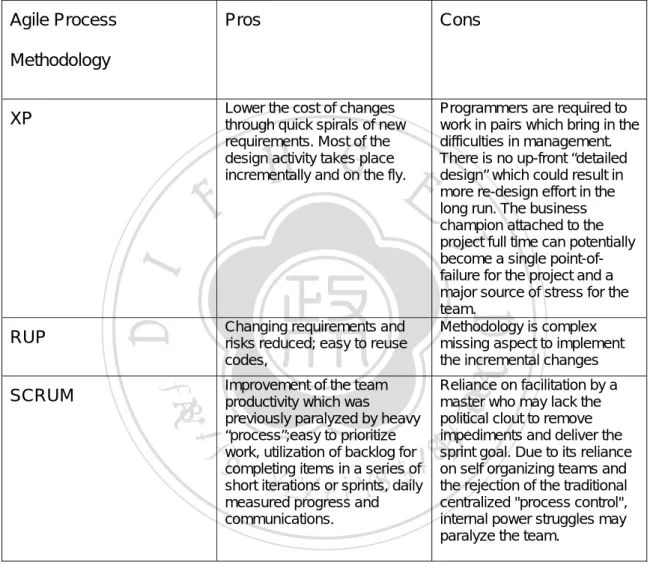
(32) Types of agile development processes Over the past decades, various types of the agile development methodologies were introduced to the software development industry. The agility has become the core competence each software development organization pursuits to gain. The following are the three most popular agile process methodologies over the past decades. Extreme Programming. 政 治 大 Extreme programming(2001) stresses the adaptive and people 立 6. ‧ 國. 學. oriented features. It was rooted in 1990s from the small talk. community and was created by Kent Beck in 2000 while his C3 project. ‧. being cancelled after four years planning in Chrysler. The Extreme. sit. y. Nat. programming methodology brings values of communication, feedback,. al. er. io. simplicity, courage, and respect to the software development team. It. v. n. advocates the whole team should follow simple design principle to. Ch. engchi. i n U. iterate through small cycles in providing working software as intermediate deliverable and receive early feedback. In reaching this goal, the development team exercises the planning game to define the development scope, uses the pair programming practice to gather feedback between software coders, performs unit test and acceptance tests utilizing test driven development practice, and insists that the. 6. “Extreme Programming", Computerworld (online), December 2001, webpage: Computerworldappdev-92. Page 24.
(33) whole team should include business people and customers for the better communications and fine scale feedback. In project management, Extreme programming methodology adopts small cycles and working software to measure the progress of the development. Continuous integration and design improvement require the refactoring practice. Coding standards and collective code ownership are required to manage the frequent added improvements. The Extreme. 政 治 大. programming practice values the programmers and insists in providing. 立. the sustainable working environment for them. Extreme embrace. ‧ 國. ‧. Scrum. 學. changes just like other agile development process.. y. Nat. Scrum(2004) is an adaptive project management process. It was. er. io. sit. rooted in 1980s in the object oriented development community and the term ‘SCRUM’ was initiated by Ken Schwaber in early 1990s.. al. n. v i n Scrum stresses the projectCmanagement U practice. Scrum Master h e n g c hini the is the main coordinator to control and direct project on daily basis. Communications and short cycles are stressed in this method, too. Meetings are one of the tools to perform project management. Daily standup meeting to communicate among team members; sprint planning meeting to define scope of the project and each cycles; the Sprint review meeting to examine the deliverable in each milestone, and retrospective meeting to get feedback among team members to. Page 25.
(34) adjust the process for the next cycle. Scrum explained the importance of getting a cross-functional team, include customers to work seamlessly together to iterate through two to four week cycles. Working software as the intermediate deliverable is used in the sprint review meeting to gather feedback. Based on the object oriented programming practice, Scrum emphasizes design patterns in building software. RUP. 立. 政 治 大. Rational Unified Process (RUP) is created by IBM in 2003. It is not a. ‧ 國. 學. single process but an iterative development process framework. RUP. ‧. defines the development process in four phases, Inception, Elaboration,. y. Nat. construction, and Transition. In these four phases, the software. er. io. sit. development will cycle through requirement analysis, architecture building, software system construction, and production implementation.. al. n. v i n C h correlate toUthe four phases described The principles in RUP framework engchi above. The following activities provide disciplines to the RUP users business modeling, requirements clarifications, analysis & design specification, Implementation tests, deployment implementation, configuration and change management, project management and environment supports. Any organization can tailor their development process by assembling numbers of different phases into the development cycle. For example, a development cycle can be. Page 26.
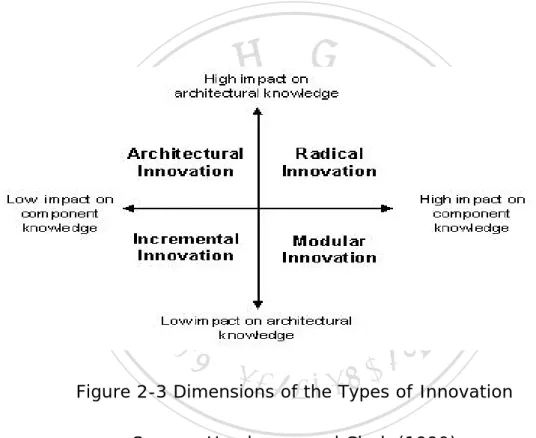
(35) comprised of iterations of one initial phase, two elaboration phases, three construction phases, and two transitional phases. Table 2-2 Examples of Agile Development Methodologies Agile Process. Pros. Cons. Lower the cost of changes through quick spirals of new requirements. Most of the design activity takes place incrementally and on the fly.. Programmers are required to work in pairs which bring in the difficulties in management. There is no up-front “detailed design” which could result in more re-design effort in the long run. The business champion attached to the project full time can potentially become a single point-offailure for the project and a major source of stress for the team. Methodology is complex missing aspect to implement the incremental changes. Methodology XP. 立. n. al. Ch. engchi. y. sit. Reliance on facilitation by a master who may lack the political clout to remove impediments and deliver the sprint goal. Due to its reliance on self organizing teams and the rejection of the traditional centralized "process control", internal power struggles may paralyze the team.. er. ‧ 國 io. Improvement of the team productivity which was previously paralyzed by heavy “process”;easy to prioritize work, utilization of backlog for completing items in a series of short iterations or sprints, daily measured progress and communications.. ‧. Changing requirements and risks reduced; easy to reuse codes,. Nat. SCRUM. 學. RUP. 政 治 大. i n U. v. 2.1.3 Summary. In summary, all the agile methodologies promote incremental development in combining prototyping technique and using shorter. Page 27.
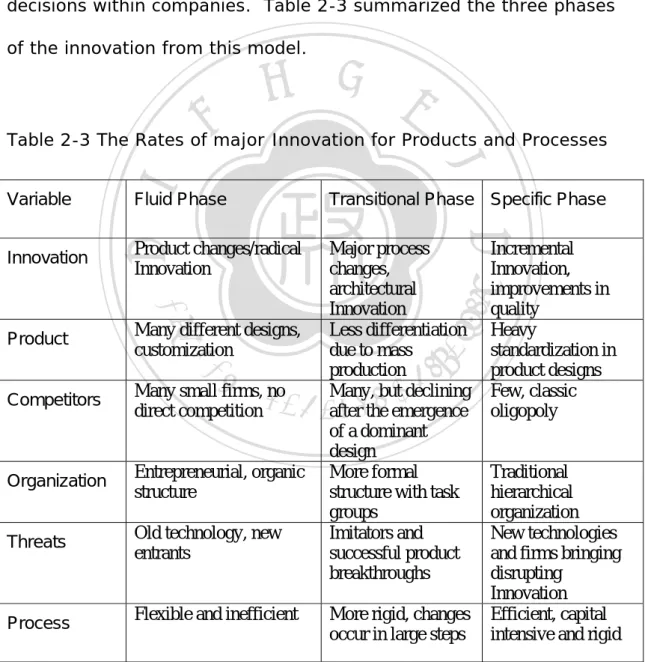
(36) cycles to allow checking up the system being built against the requirements. They emphasize the communication among team members and enlarge the team concept to include not just the engineering team but customers and executives. Different principles of written and face-to-face communications are enforced to help reducing the risks and costs of the projects. The process itself is adaptive. Constant review of methodology and make improvements to the. 政 治 大. process is the key characteristic that enables the team to adapt to. 立. changes of environment and requirements. Reusable models, coding. ‧ 國. 學. standard and test driven development are fundamental yet key characteristics to support the rapid changes from requirements.. ‧. n. er. io. sit. y. Nat. al. Ch. engchi. Page 28. i n U. v.
(37) 2.2 Innovation and Technology Management. Better and proper innovation and technology management empower the agile development process. The agile development process focuses on quick cycles and relies on talented programmers to deliver the software products. Adopting the best technology and simple designs are the principles followed by most of the agilsts. Boehm (2003). 政 治 大. defines, “In general, agile methods are very lightweight processes that. 立. employ short iteration cycles; actively involve users to establish,. ‧ 國. 學. prioritize, and verify requirements; and rely on tacit knowledge within a team as opposed to documentation”. It clearly stated the. ‧. importance of how the knowledge was managed and organized.. Nat. sit. y. Section 2.2.1 illustrates the theories of the knowledge and innovation. n. al. er. io. management from various scholars. Section 2.2.2 illustrates the theories about open source platform.. Ch. engchi. i n U. v. 2.2.1 Managing Innovation and Knowledge. Over the past few decades, organizations strive to innovate and to manage the innovation in order to build competitive advantages. There have been a lot of theories and researches on managing the innovation and explore how organizations should stay competitive by managing. Page 29.
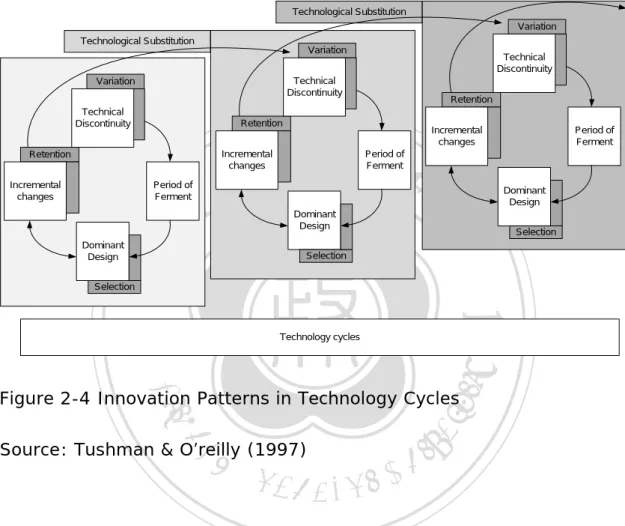
(38) the innovation stream successfully. In 1970s, theories about dichotomy of the incremental and radical innovation prevailed. Until 1990, Henderson and Clark proposed a new aspect of the innovation pattern in two knowledge dimensions, the component knowledge and the architectural knowledge. Figure 2-3 displays the dimensions described in this model.. 立. 政 治 大. ‧. ‧ 國. 學. n. er. io. sit. y. Nat. al. Ch. engchi. i n U. v. Figure 2-3 Dimensions of the Types of Innovation Source: Henderson and Clark (1990). Apart from distinguishing incremental innovation from radical innovation, the Henderson-Clark model stressed that the incumbents should watch out for the types of modular innovation and architectural innovation. Both types involve incremental innovation in one. Page 30.
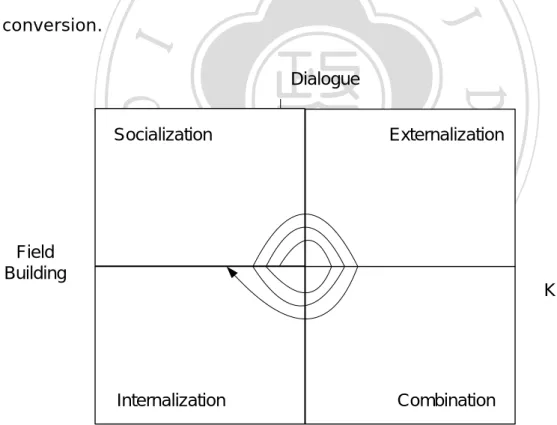
(39) dimension, either architectural knowledge or component knowledge, since each innovation type should exploit different competencies and strategies. Statically, both incremental-radical dichotomy and the HendersonClark theories define the innovation types based on the changes made to the products without time dimension. These theories fail to consider the technical limit over a period of time. The S curve model is used to. 政 治 大. analyze the technology cycles and to describe the pattern of the. 立. introduction, the growth and the maturation phases for the new. ‧ 國. 學. technology. The S curve theory indicated the technology cycles always. usually wins the market, the limits will set it back.. Nat. y. ‧. ends at the technical limits. Although the high potential technology. er. io. sit. Combining the above theories, Abernathy and Utterback (1978) proposed three innovation stages, Fluid stage, Transitional stage and. al. n. v i n Cthat Specific stage, as a pattern h eeach h i U would experience from n g ccompany startup to the matured stage. Any organization, in a startup position, always focused on the innovation of the products. In this stage, Fluid stage, the organization often introduced radical and major innovation. To managing the innovation well and help the company grow, the organization needed to transition well from the initial stage into finding its dominant product design and make its production system more efficient. When forming the dominant design, the organization required. Page 31.
(40) incremental and evolutionary changes to both products and processes for economic of scale. The analysis done by Abernathy and Utterback ranged from technological impact upon products and processes to market dynamics and competition, and to organizational structure and strategic decisions within companies. Table 2-3 summarized the three phases of the innovation from this model.. 立. 政 治 大. Table 2-3 The Rates of major Innovation for Products and Processes. ‧ 國. Transitional Phase Specific Phase. Product changes/radical Innovation. Major process changes, architectural Innovation Less differentiation due to mass production Many, but declining after the emergence of a dominant design More formal structure with task groups Imitators and successful product breakthroughs. n. al. Ch. Competitors. Many small firms, no direct competition. Organization. Entrepreneurial, organic structure. Threats. Old technology, new entrants. Process. Flexible and inefficient. sit. er. Many different designs, customization. io. Product. Incremental Innovation, improvements in quality Heavy standardization in product designs Few, classic oligopoly. y. Nat. Fluid Phase. ‧. Innovation. 學. Variable. engchi. i n U. v. More rigid, changes occur in large steps. Source: Abernathy and Utterback (1978). Page 32. Traditional hierarchical organization New technologies and firms bringing disrupting Innovation Efficient, capital intensive and rigid.
(41) Although this research focused on the tangible product development, the software development can be explained using this pattern very well. Moore (1991) expresses the software has less smooth product cycle in the market than the tangible products. The proposed diffusions of innovation model impact on the way of marketing in the high-tech industry. Nevertheless, the dominant design proposed by Abernathy and Utterback still exists in software development and it may be proprietary.. 立. 政 治 大. Managing revolutionary innovation and maintaining the short term. ‧ 國. 學. stability and efficiency is as important as encouraging the Innovation. ‧. by creating suitable organizational structure, culture and processes. Tushman and O’reilly (1997) emphasized that the ambidextrous. y. Nat. io. sit. organizations can lead both evolutionary and revolutionary changes.. er. While incremental innovation improves existing products, the. al. n. v i n discontinuous innovation can standards and C hcreate new industry engchi U. further to substitute the existing products. Applying the BCG model by the Boston Consultant group to this model, the incremental innovation makes improvements in the cash cow products while the discontinuous innovation brings in the breakthrough to create star products. Understanding the innovation patterns happening in different stage of the organizations should help the incumbents to manage the innovation and the knowledge. Figure 2-4 depicted the Tushman and. Page 33.
(42) O’Reilly’s (1997) concept of the innovation patterns in the technology cycles.. Technological Substitution Variation Technological Substitution Variation Technical Discontinuity. Variation Technical Discontinuity. Retention. Retention. 政 治 大. Incremental changes. Retention Incremental changes. Technical Discontinuity. Period of Ferment. 立. Incremental changes. Period of Ferment. Dominant Design. Dominant Design. ‧ 國. Selection. 學. Dominant Design. Period of Ferment. Selection. Selection. ‧. Technology cycles. sit. y. Nat. io. n. al. Source: Tushman & O’reilly (1997). Ch. engchi. er. Figure 2-4 Innovation Patterns in Technology Cycles. i n U. v. Nonaka & Takeuchi (1995) concluded the organizational knowledge creation is the root of the successful Japanese companies. The theory elaborated the dynamic of the knowledge creation throughout the organizational innovation. Nonaka & Takeuchi proclaimed that the knowledge conversion (the interaction between tacit and explicit knowledge) is performed by individuals, not by organizations. The. Page 34.
(43) authors indicated four modes of the knowledge conversions: socialization mode to convert knowledge from tacit to tacit; externalization mode to convert knowledge from tacit to explicit; combination mode to convert knowledge from explicit to explicit; and internalization mode to convert knowledge from explicit to tacit. Organizational knowledge creates competitive advantages. Since any organization does not create knowledge and relies on individual to. 政 治 大. create knowledge, it is important for an organization to support and. 立. stimulate individuals to create knowledge and perform knowledge. ‧ 國. 學. conversion.. Externalization. n. al. er. io. sit. y. Nat. Socialization. Field Building. ‧. Dialogue. Ch. engchi. Internalization. i n U. v. Combination Learning by doing. Figure 2-5 Nonaka spiral diagram for knowledge conversion. Page 35. Linking Explicit Knowledge.
(44) Software development management usually relies on requirement documents, system design documents, coding standards and coding comments to allow team members sharing the knowledge of the creations. As the requirement documents and system design documents are often outdated before the system was created, the coding standard and coding comments are strongly focused in agile methodology as the communication vehicles. All agile methods. 政 治 大. promote a cohesive team comprised of customers, marketers,. 立. developers and testers to exchange the tacit and explicit knowledge to. ‧ 國. 學. accomplish the project. Each agile methodology emphasizes the close and effective communications and encourages talented team members. ‧. to resolve issues innovatively; it carries out the four modes of the. Nat. io. sit. y. knowledge conversions described by Notaka and Takeuchi.. er. Execution is needed to carry on the innovation. Tushman and Orielly. al. n. v i n (1997), stated “Executing C change is a crucial source of competitive hengchi U advantage.” Use adequate process and resources to materialize. innovation speedy is the core competence an Internet organization can build to sustain its competitive advantage.. Page 36.
(45) 2.2.2 Open Source Platform. Cohen and Levinthal (1990) suggested that “Most innovations result from borrowing. Prior knowledge gives one the ability to acquire new information.” The increasing web applications and platforms result from the rise of the Internet. The open source community provided the shortcuts to the Internet platforms and application developers. The. 政 治 大. open source framework has rekindled the software developers to. 立. reconsider the agile methodology and evolve the methodology to more. ‧ 國. 學. practical software development process. The open source software and the Internet gave the development organizations access to numerous. ‧. free and self-modified-able components and more to leverage. Not re-. Nat. sit. y. invent the wheel has become a motto to most of the Internet startups. n. al. er. io. in the late 1990s. The open source platforms and technology allows. i n U. v. the startups to adopt and to build up the business application in short. Ch. engchi. time. The quick turn-around development process helped the Internet start up to deliver the features on sites for business in fast fashion. “Open-source software projects, among others, have led to innovation, development and consumption communities run completely by and for users. “ Hippel (2001) identified three conditions creating the phenomenon of the innovation done by the user community while the manufactures were viewed as the major innovation incubators. The. Page 37.
(46) first condition is when users have the incentives to innovate whether due that the manufactures do not satisfy the users and/or users find it cost-beneficial to innovate. Secondly, there should be a mechanism to reveal the innovation freely which was forbidden in manufacturers. The open source platform encourages the innovation to be share among the open source community so the innovation can be collaborated and built upon on each contribution. In the commercial world, any. 政 治 大. innovation is kept as business secrets. The user community finds the. 立. benefits of revealing the innovation to allow enhancement of the. ‧ 國. 學. innovation. The last condition is whether users are able to diffuse the innovation. Traditionally, manufactures has roles of not only innovate. ‧. but also distribute the innovated products. Internet obviously is the. Nat. sit. y. best channel for users to distribute the innovated products. Citing the. n. al. er. io. innovation process of the Apache web server and the high-. i n U. v. performance windsurfing gears, Hippel(2001) pointed out the user. Ch. engchi. community evolves by growing the volunteers. The collaborations and distribution supported by the Internet amplify the software development user community’s ability to innovate. Unlike the traditional economic view, the open source software development strengthened the Internet development and vice versa.. Page 38.
(47) 2.2.3 Summary. Repetition and experimentation enable tasks to be done better. Agile processes promote iterated and prototyping methods which relying on the software framework and design to be simple and loosely coupled. Advanced programming technology and the open source tools give Internet developers great room to innovate. Producing and managing. 政 治 大. streams of innovation is the route to sustain competitive advantage.. 立. ‧. ‧ 國. 學. n. er. io. sit. y. Nat. al. Ch. engchi. Page 39. i n U. v.
(48) 2.3 Organizational Support. Section 2.3 described the needs for the organization to manage the incremental and radical innovation to build their competitive advantages.. 2.3.1 Organizational System and Culture. 立. 政 治 大. Corporate culture refers to the values and beliefs the employees hold.. ‧ 國. 學. The founders of the company can definitely start shaping the company. ‧. culture and values by the vision and mission statements. However,. sit. y. Nat. the culture and values are not built in one day. It requires managerial. io. al. er. system and the organizational control system to form the desired. n. culture and values. Any organizational control system embedded the. Ch. engchi. i n U. v. organizational culture, values and norms. The system should provide the purpose of motivating the members using incentives such as promotional programs, rewards or even educational opportunity. Usually the system provides measurement and review process to monitor the members’ performance. In general, managerial system is widely used to guide the member’s attitude and behaviors and provide control in the organizations. Control is what makes the organizations. Page 40.
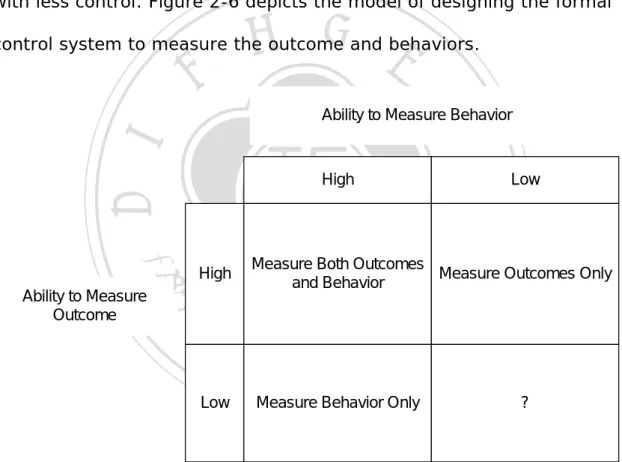
(49) advantageous over the individual efforts. There are various theories and researches about the organizational control systems. Tushman and O’Reilly (1997) believes formal control system is used in the scenarios where the outcome and behaviors are able to be measured while the organizational culture, served as the social control system, gives the members the sense of autonomy and responsibility with less control. Figure 2-6 depicts the model of designing the formal. 政 治 大. control system to measure the outcome and behaviors.. 立. ‧ 國. 學. Ability to Measure Behavior. High. io. Measure Both Outcomes Measure Outcomes Only and Behavior. n. al. sit. y. Low. er. Nat Ability to Measure Outcome. ‧. High. Ch. Low. engchi. i n U. v. Measure Behavior Only. ?. Figure 2-6 Matrices of the measurements for control system Source: Tushman & O’reilly (1997) There are three assumptions in this model. First, the formal control system is suitable for the tasks with clear definitions, in which. Page 41.
(50) managers can anticipate the results in advance. Secondly, it works well in the environment that top-down authority is well accepted. Last, the measurement is able to provide the extrinsic rewards, which are sufficient to motivate the task owners. Although these assumptions may not be true for any given jobs, the traditional assembly line work can be associated with this type of control system. However, the assembly line workers usually felt over-controlled and remained. 政 治 大. unmotivated under such control system. Any jobs with frequent. 立. changes and unpredictability such as R&D, consultants and service. ‧ 國. 學. jobs cannot fit into the static and formal control system. Social control system can provide non-monetary rewards creating more powerful. ‧. incentives.. y. Nat. io. sit. Tushman and O’Reilly(1997) defined organizational culture as the. er. values and norms shared by the members in an organization. Forming. al. n. v i n organization culture to incubate C h and executeUthe innovation can be far engchi best than forming a formal control system to manage the innovation stream. Schein (1984) defined the culture paradigm, “a set of interrelated assumptions that form a coherent pattern.”. Values and. norms are a set of the corporate values growing from the personal values of the founders. Leonard-Barton (1996) proposed four dimensions associated with the core capability, creating and maintaining the knowledge. The. Page 42.
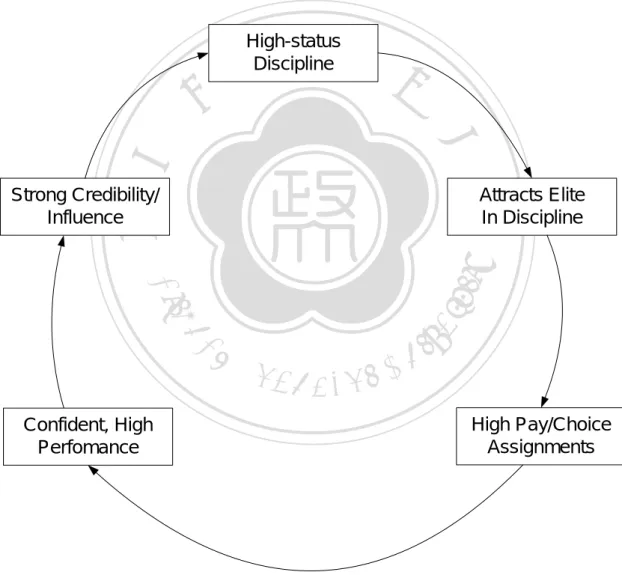
(51) managerial systems, values and norms are among the four dimensions. Figure 2-7 shows the positive reinforcing cycle, which is depicted by the author to explain values and norms interacting with other dimensions in a self-reinforced “virtuous cycle” and creating positive organization culture.. 政 治 大. High-status Discipline. 立. ‧ 國. 學 Attracts Elite In Discipline. ‧. Strong Credibility/ Influence. n. er. io. sit. y. Nat. al. Ch. engchi. i n U. v. High Pay/Choice Assignments. Confident, High Perfomance. Figure 2-7 The Virtuous Cycle Source: Leonard-Barton (1995). Page 43.
(52) The managerial system, the reward and incentive program, and the educational program, as the part of the fourth dimension proposed by Leonard-Barton is the important aspect of the core capability. The motivation program inspires employees to reach the superior performance. The corporate values are really exhibited through the knowledge and skills in employees, physical system and the managerial system. The values can interact with the other three. 政 治 大. dimensions in a self-reinforcing “virtuous cycle”.. 學. ‧ 國. 立. 2.3.2 Organizational Changes. ‧. sit. y. Nat. The tyranny of the success is that tomorrow’s failure always results. io. al. er. from today’s success. Under a successful system, the organization. n. usually develops a system-wide resistance to accepting the innovation.. Ch. engchi. i n U. v. Radical organizational re-engineering is needed to support and creating new products from the innovation. Innovation come from an organization which promotes changes; and harder from an organization with strict hierarchical authority. Teece et al. (1997) defined dynamic capability as a firm’s ability to integrate, build and reconfigure internal and external competences to address rapidly changing environment. Surveillance of market and. Page 44.
(53) technology and willingness to adopt the best practice requires firms to make changes to its organization to successfully build the core capability. The discontinuous organizational changes are required to drive the innovation streams comprised of dominant design, architectural innovation and product substitution. Like managing the invention stream, the managers need to manage the incremental organizational. 政 治 大. changes and discontinuous organizational changes to help creating an. 立. ambidextrous organization. However, discontinuous organizational. ‧ 國. 學. changes usually received resistance in the organizations. Andy Grove. ‧. said “there is at least one point in the history of any company when you have to change dramatically to rise to next performance level.. y. Nat. al. Crisis can help innovation to be. er. io. change when you’re hemorrhaging.”. sit. Miss the moment and you begin to decline... Emotionally, it’s easier to. n. v i n accepted in an organization. crisis, a successful C hWithout facing the engchi U organization remains stable but vulnerable. There is always. organizational resistance to the innovation and changes as they are perceived disruptive. Unless organization is under an urgent situation for a change, it is hard to introduce radical organizational changes. In a crisis, an organization will accept the changes easier and better than when it was in its smooth ride. Prior incremental innovation is the seed to the next breakthrough even though they seem to be. Page 45.
(54) composted. Organizations need to have the dual capabilities, managing both incremental and radical innovation streams, to grow into the ambidextrous organizations. Tushman and O’reilly (1997) described the patterns of organizational changes including growth through evolution and growth through revolution. Citing Apple as an example, Tushman and O’reilly (1997) mentioned that the S curve of the organization development over the. 政 治 大. past twenty-year period by punctuated by discontinuous, revolutionary. 立. change. Implementing the innovation stream (accepting incremental. ‧ 國. 學. and discontinuous innovation) can often be hindered by the stability of. ‧. successful productions. While the incremental innovation can be managed by the existing organization, the discontinuous innovation. y. Nat. io. sit. requires the organizations to make radical organizational changes. In. er. order to shape the innovation stream, the managers need to. al. n. v i n understand the technologyCcycles which allows managers to hengchi U. understand the timing and types of technology and capture the windows of opportunity. Managing by building internal congruence, strong culture and continuous improvement is not sufficient for sustaining competitive advantages. “Nothing is harder than casting aside the thinking, strategies and biases that propelled a business to its current success.. Page 46.
(55) Companies need to learn how to unlearn, to slough off yesterday’s wisdom.” Compaq CEO Erhard Pfeiffer said.. 立. 政 治 大. ‧. ‧ 國. 學. n. er. io. sit. y. Nat. al. Ch. engchi. Page 47. i n U. v.
(56) 2.4 Organizational Core Capability. Clark and Wheelwright(1993) cited three competitive imperatives, speed, efficiency and quality that firms must have to respond to the changes demanded by the customers, and to the moves of their competitors. Clark and Wheelwright concluded that firms need to “be fast” to be competitive.. 政 治 大. The implication of “speed” was to have shorter development cycles and. 立. better integrated products. “Efficiency” meant leverage from the. ‧ 國. 學. critical resources and increase numbers of successful development project per engineer. “Quality” meant customers integrated with truly. ‧. cross-functional development process. These imperatives are similar. y. Nat. er. io. sit. to the characteristics that the agile development process holds. “Effective fast-cycle competitors have emerged in a wide range of. al. n. v i n C h explained.UThey listed various firms industries.” Clark and Wheelwright engchi which gained the competitive ability by bringing new product to. market rapidly such as Honda in automobile, Applied Materials in semiconductor production equipment and Hill-Rom in hospital beds. Any change is usually costly so organizations should develop process to minimize the cost. The process to implement the innovation and changes is as important as the management of the innovation stream. Organizational changes are essential to meet with innovation and Page 48.
(57) changes. Depict the path to take the organizations from current state to future state by implementing the innovation is important. Teece et al. (1997) depicted a dynamic capability framework as an organization achieving and sustaining the competitive advantage which is resting on the distinctive processes, the organization’s asset positions, and the evolution paths it has adopted or inherited. This framework suggested that in the field of rapid technological change,. 政 治 大. the organization creates the competitive advantages by honing internal. 立. technological, organizational and managerial processes inside the. ‧ 國. 學. organization. Teece et al. believed identifying new opportunities and. ‧. organizing the team effectively and efficiently are generally more fundamental to private wealth creation than to its strategizing, which. y. Nat. al. er. io. raises rival's costs, and excludes new entrants.. sit. is engaging in business conduct that keeps competitors off balance,. n. v i n C h in Teece’s article Different models are examined e n g c h i U to proof that the process, position and path held by an organization could help the organization to build its core competence. Competitive force, proposed by Porter, emphasizes on creating entry barrier in the industry or sector. Strategic conflict model, shown on Game theory, is valuable when the competitors do not have deep-seated competitive advantages. Organizational competence needs to be distinct and uneasy to replicate. The Resource based model emphasizes owning. Page 49.
(58) distinct product market and idiosyncratic (unique) hard-to-imitate resource is the dynamic capability an organization can build upon. Buying the resource if not owned is not in line with the resource-based perspective. Teece and all believed that the tacit know-how and reputation are not trade-able. Leonard-Barton (1995), expressed that the development of the organization’s core capability is linked to the learning. The core. 政 治 大. technological capability was defined in his book, Wellsprings of. 立. knowledge, as a firm’s competitive advantage and is distinct from the. ‧ 國. 學. supplemental capability and enabling capability. Figure 9 depicted the. ‧. Leonard-Barton’s generic system framework comprising of knowledge creating activities interacting with four dimensions of the core. er. io. sit. y. Nat. capability.. Leonard-Barton did not believe that knowledge generation was enough. al. n. v i n C hAn organizationU required to have the to form the core competency. engchi dynamic system to interact with the knowledge created by the employees, the physical system through knowledge-channeling activities, and the enforcement of reward and incentive from the managerial system. The dynamic knowledge system was depicted as four learning activities constantly feeding into and deriving from company’s core capabilities to create and build knowledge: (1) shared, creative Page 50.
數據
+7
相關文件
In the third quarter of 2002, the Census and Statistics Department conducted an establishment survey (5) on business aspirations and training needs, upon Hong Kong’s
Resources for the TEKLA curriculum at Junior Secondary Topic: Business, Business Environment and Globalization Strategies and Management – Core Learning Elements1. Module
Microphone and 600 ohm line conduits shall be mechanically and electrically connected to receptacle boxes and electrically grounded to the audio system ground point.. Lines in
• When providing accommodation for business travellers to stay during the MICE event, the hotel needs to provide the following services for the delegates or attendees, the.
• Many home and small business users connect to the Internet via high-speed broadband Internet service. Discovering Computers 2012: Chapter
(資料來源:The INSEAD − Wharton Alliance on Globalizing: Strategies for Building Successful Global Business (歐洲商業管理學院 −
By clarifying the relationship between IA and the associated indexes as well as the association between IA and the business operating performance, the proposed CICEM
and Norton,D.P., “The Strategy-Focused Organi zation: How Balanced Scorecard Companies Thrive in the New Business Environment”, Harvard Business School Press
