
捷克民眾眼中的台灣國家形象與產品形象:國家與產品熟悉度之角色 - 政大學術集成
117
0
0
全文
(2) 論文題目 Country and Product Images of Taiwan among the Czech people: The Role of Country and Product Familiarity 捷克民眾眼中的台灣國家形象與產品形象: 國家與產品熟悉度之角色 Student: 楊伯瑞 Borek Janeček Advisor: 郭貞 Cheng Kuo. 國立政治大學. 學. ‧ 國. 立. 政 治 大. 國際傳播英語碩士學程. Nat. y. ‧. 碩士論文. er. io. sit. A Thesis. n. Submitted to the International Master‟s Program in International a. l. Ch Communication Studies Un engchi. iv. In Partial Fulfillment of the Requirements For the degree of Master of Arts In International Communication Studies. 中華民國 99 年 7 月 July 2010.
(3) Country and Product Images of Taiwan among the Czech people: The Role of Country and Product Familiarity. A Master Thesis. 政 治 大. 立 National Chengchi University. sit. y. ‧. ‧ 國. 學. Nat. In Partial Fulfillment. al. er. io. of the Requirements for the Degree of. n. iv n C In International h eCommunication n g c h i UStudies Master of Arts. By Borek Janeček July 2010.
(4) Acknowledgement First and foremost, I would like to express my deep gratitude to my thesis advisor, Dr. Cheng Kuo, for her guidance throughout the course of work on this thesis, invaluable advice, patience and continuous support. I also greatly appreciate her offering me the chance to actively participate in a Chinese opera performance, giving me a wonderful cultural experience as well as an opportunity to take my mind off the thesis for several days. Professors Yuhmiin Chang, Annie Chi and Vincent Huang on my thesis proposal and thesis defense exam panels provided excellent comments and helped point my work in the right direction.. 立. 政 治 大. Many thanks go to Huiting for her endless support throughout my studies at NCCU, and for. ‧ 國. 學. helping me find my way around the Chinese-only sections of NCCU website.. ‧. Last but not least, I must acknowledge all those who reviewed and revised the research questionnaire and provided valuable suggestions during the pilot test, as well as those. y. Nat. n. er. io. al. sit. proofreading and editing this thesis.. Ch. engchi. I. i Un. v.
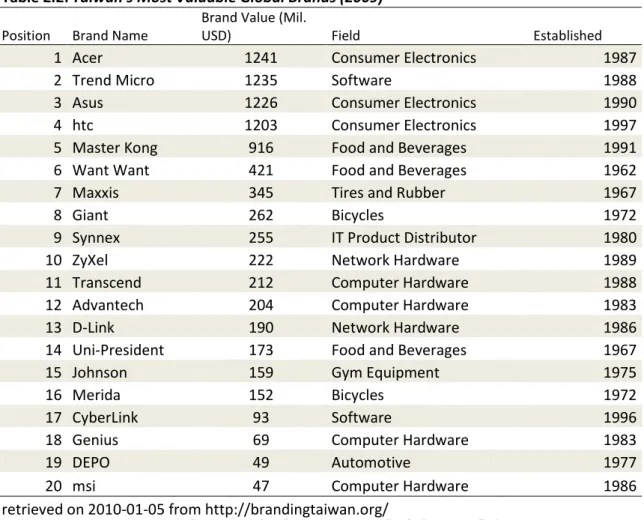
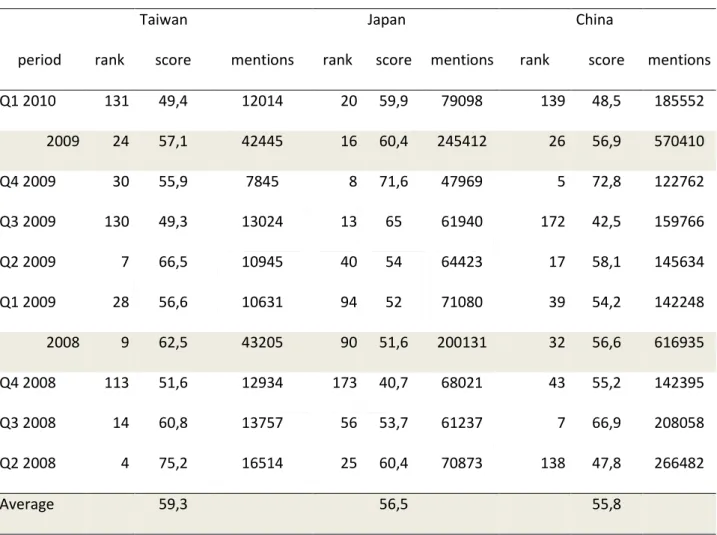
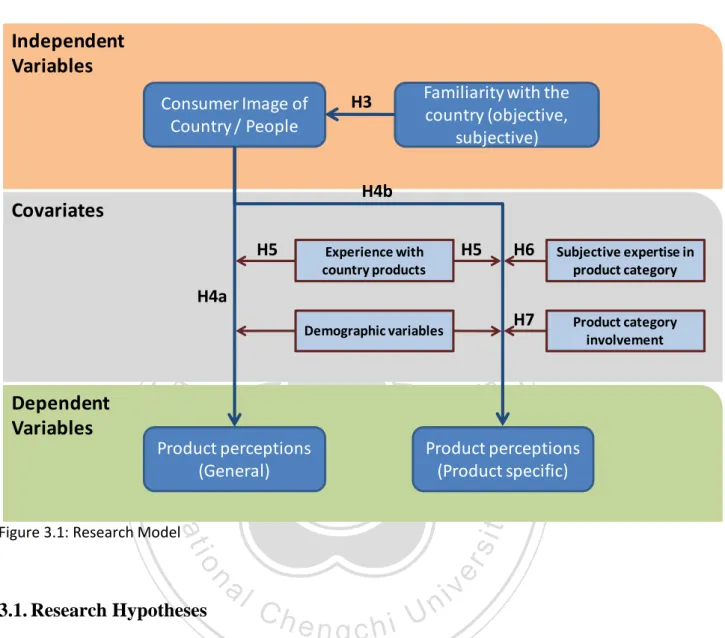
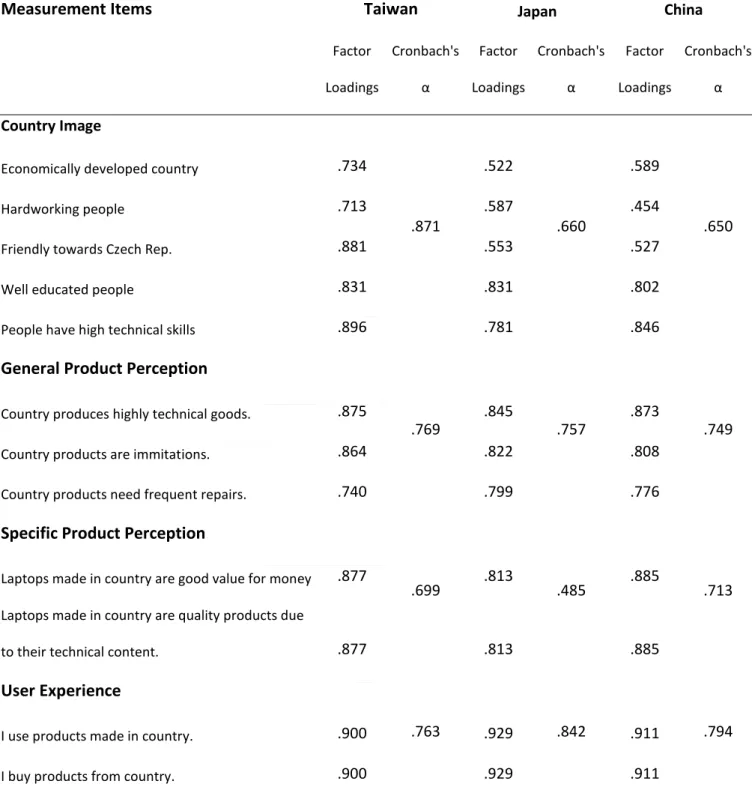
(5) Abstract Country and Product Images of Taiwan in the Czech Republic: The Role of Country and Product Familiarity by Borek Janeček. In the globalized economy of today, countries compete among each other for tourists, investors or shares in export markets. In order to achieve their goals, they must carefully build. 政 治 大. and maintain their reputations internationally, much like commercial brands do. This study. 立. evaluates the country image of Taiwan in the Czech Republic, and its effect on perception of. ‧ 國. 學. Made-in-Taiwan products by Czech consumers. For comparative purposes, images and. ‧. product perceptions of Japan and China are also included in the study. Extra focus is also placed on the impact of consumers‟ knowledge of the country on their perception of country. y. Nat. er. io. sit. image and country products. The data was gathered through an online survey (252 respondents) and the research reveals several important findings.. al. n. iv n C First, the country and product perceptions Taiwan iinU h e ofn g c h the Czech Republic are on average slightly positive to positive, dismissing the negative assessment of the Made-in-Taiwan product label. Second, the knowledge of the Czech people about Taiwan is extremely limited. Third, perception of Taiwan‟s country image shows a strong positive correlation with consumers‟ subjective and objective knowledge of Taiwan. Fourth, the stereotypical positive image of Japanese products and negative image of Chinese products is confirmed here.. Keywords: Country image, country of origin, country familiarity, product knowledge, consumer behavior II.
(6) Table of Contents 1.1.. Motivation ................................................................................................................... 2. 1.2.. Research Objectives .................................................................................................... 3. 1.3.. Research Questions...................................................................................................... 4. 1.4.. Originality, Contribution ............................................................................................. 5. Literature Review ............................................................................................................... 7 2.1.. Country of Origin Research ......................................................................................... 7. 2.2.. Country of Origin Definitions ..................................................................................... 8. 2.3.. Country Image Definitions .......................................................................................... 8. 2.4.. The Importance of Country Images ............................................................................. 9. 2.4.1.. 政 治 大. The Country Image – Country of Origin Relationship ...................................... 11. 2.5.. Country Familiarity ................................................................................................... 13. 2.6.. Variables Influencing the Product Perception ........................................................... 15. 立. Product Category, Product Characteristics, Product Involvement ..................... 15. 2.6.2.. Product-Category Expertise ............................................................................... 16. 2.6.3.. Experience with Country Products ..................................................................... 18. 2.6.4.. Consumer-Specific Variables ............................................................................. 19. 2.6.5.. Economic Development of COO ....................................................................... 20. 2.6.6.. Country of Evaluation – Nationality of the Consumer....................................... 20. 2.6.7.. Product Brands ................................................................................................... 23. 學. 2.6.1.. ‧. io. sit. y. Nat. al. er. 2.. Country and Product Images of Taiwan in the Czech Republic ........................................ 1. ‧ 國. 1.. v. Design of COO studies .............................................................................................. 24. 2.8.. Limitations of COO studies ....................................................................................... 26. n. 2.7.. 2.8.1. 2.9.. Ch. engchi. i Un. Country of Origin Identification, Hybrid Products ............................................ 27. Country Image Research in Asia ............................................................................... 28. 2.9.1.. Taiwan Image Studies - Review......................................................................... 29. 2.9.2.. The Perception of Taiwan as a Country of Product Origin ................................ 32. 2.9.4.. Taiwanese Government Image Building Campaigns ......................................... 34. 2.9.5.. The Image of Japan as a Country of Product Origin .......................................... 36. 2.9.6.. The Image of China as a Country of Product Origin ......................................... 37. 2.10. Consumer Attitudes and Cultural Considerations in the Czech Republic ................. 39 2.11. Sources of Country Information ................................................................................ 40. 3.. 2.11.1.. The Effects of Information from Different Sources on Opinion Formation .. 40. 2.11.2.. Media Coverage of Countries ......................................................................... 41. Research Model ................................................................................................................ 44 3.1.. Research Hypotheses ................................................................................................. 44 III.
(7) 3.2. 4.1.. Measurement of Research Variables ......................................................................... 52. 4.2.. Data Collection .......................................................................................................... 54. 4.3.. Measurement Reliability Test .................................................................................... 55. Data Analysis ................................................................................................................... 57 5.1.. Data Analysis Procedure ........................................................................................... 58. 5.2.. Hypothesis Testing .................................................................................................... 59. 5.2.1.. Hypothesis 1 ....................................................................................................... 59. 5.2.2.. Hypothesis 2 ....................................................................................................... 61. 5.2.4.. Hypothesis 4a & 5 .............................................................................................. 66. 5.2.5.. Hypothesis 4b, 6 and 7 ....................................................................................... 70. 5.3. 6.. 政 治 大 Taiwan Country Image立 .............................................................................................. 78 Sources of Country Information ................................................................................ 74. Discussion ........................................................................................................................ 78 6.1.. Made-in-Taiwan Product Label ................................................................................. 80. 6.3.. Country Knowledge ................................................................................................... 81. 6.4.. Country of Origin Research ....................................................................................... 83. 6.5.. Limitations ................................................................................................................. 85. 6.6.. Future Research ......................................................................................................... 87. 學. 6.2.. ‧. Nat. y. 5.. Research Design ............................................................................................................... 52. ‧ 國. 4.. Variables Not Included in the Research .................................................................... 50. sit. References: ............................................................................................................................... 89. al. er. io. Appendix I.: Questionnaire (English Version) ......................................................................... 97. n. Appendix II.: Questionnaire (Czech Version) ........................................................................ 103. Ch. engchi. IV. i Un. v.
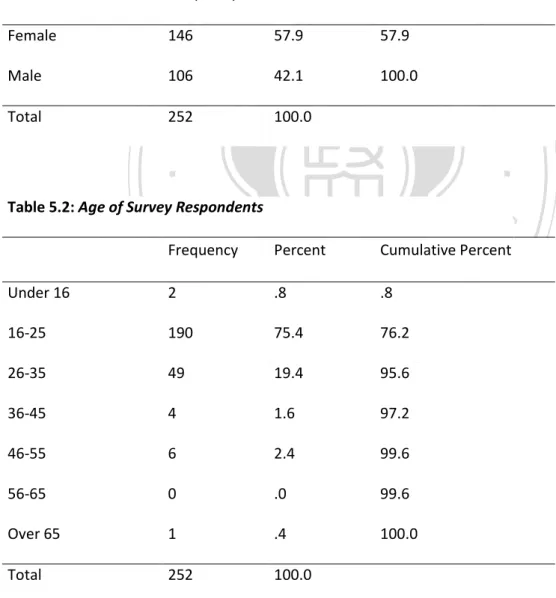
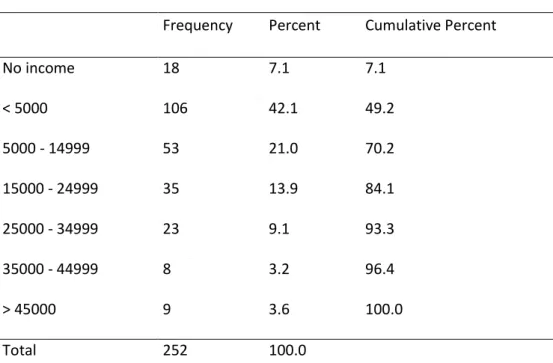
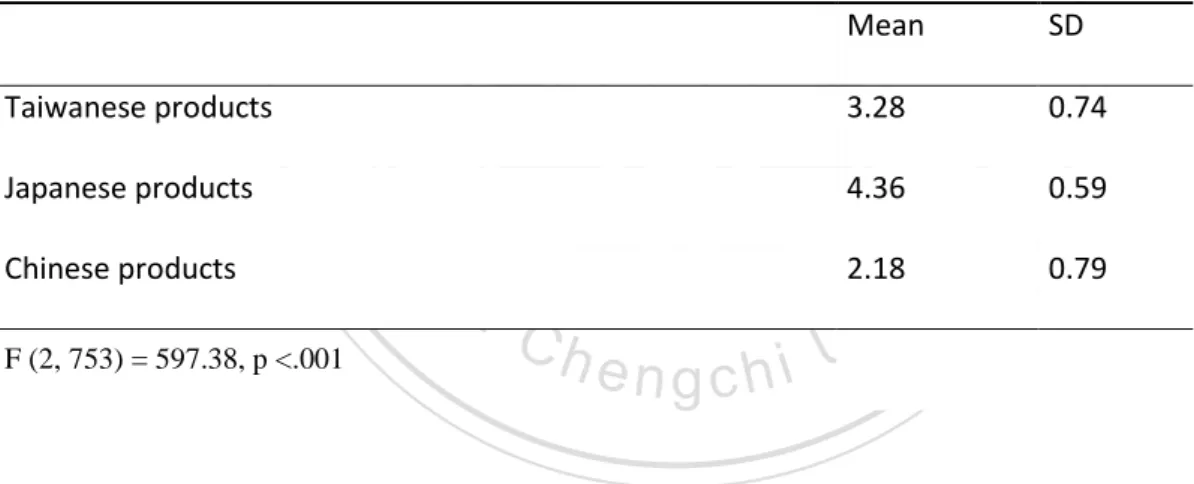
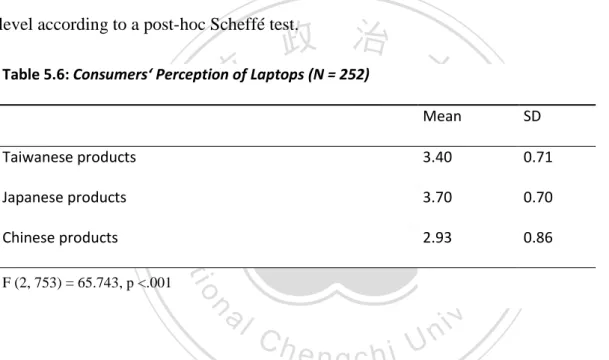
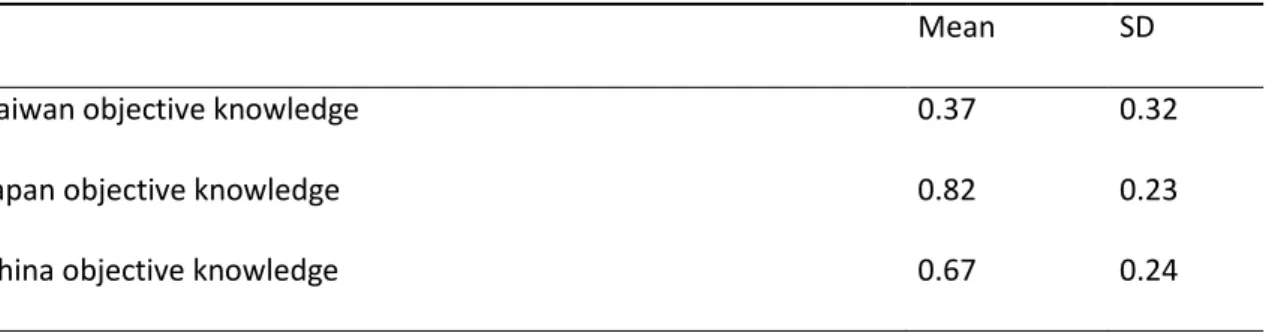
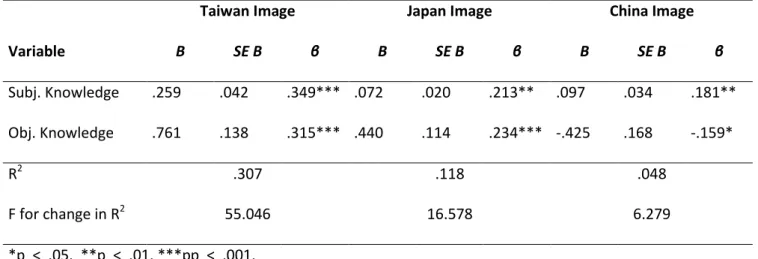
(8) List of Tables and Figures Table 2.1 Anholt Nation Brand Index 2008 .............................................................................32 Table 2.2 Taiwan's Most Valuable Global Brands (2009) .......................................................34 Table 2.3 EWBI Index of Media Coverage of Selected Countries ..........................................43 Table 4.1: Factor Loadings and Reliabilities of Measurement Scales .....................................56 Table 5.1: Gender of Survey Respondents ...............................................................................57 Table 5.2: Age of Survey Respondents ....................................................................................57 Table 5.3: Highest Completed Education ................................................................................58 Table 5.4: Average Monthly Income in Czech Crowns ...........................................................58 Table 5.5: Consumers‟ Product Perception of Three Countries ...............................................59. 政 治 大. Table 5.6: Consumers‟ Perception of Laptops .........................................................................60. 立. Table 5.7: Perceived Country Image (N = 252) .......................................................................62. ‧ 國. 學. Table 5.8: Country Subjective Knowledge (N = 252) .............................................................63 Table 5.9: Country Objective Knowledge (N = 252) ...............................................................63. ‧. Table 5.10: Regression Analysis for Country Knowledge Predicting Country Image ............64. sit. y. Nat. Table 5.11: Summary of Hierarchical Regression Analysis for Variables Predicting Perception of Taiwanese products (N = 252) .............................................................................................68. n. al. er. io. Table 5.12: Summary of Hierarchical Regression Analysis for Variables Predicting Perception of Japanese products (N = 252) ................................................................................................68. Ch. i Un. v. Table 5.13: Summary of Hierarchical Regression Analysis for Variables Predicting Perception of Chinese products (N = 252) ................................................................................................69. engchi. Table 5.14: Summary of Hierarchical Regression Analysis for Variables Predicting Perception of Taiwanese laptops (N = 252) ...............................................................................................73 Table 5.15: Summary of Hierarchical Regression Analysis for Variables Predicting Perception of Japanese laptops (N = 252) ..................................................................................................73 Table 5.16: Summary of Hierarchical Regression Analysis for Variables Predicting Perception of Chinese laptops (N = 252) ...................................................................................................74 Table 5.17: Sources of Country Information ...........................................................................77 Table 5.18: Favorability of Received Country Information .....................................................77 Table 6.1: Summary of Research Hypotheses and Outcomes .................................................78 Figure 3.1: Research Model .....................................................................................................44. V.
(9) 1. Country and Product Images of Taiwan in the Czech Republic Over the second half of the 20th Century, Taiwan achieved tremendous economic growth and by most indicators became a developed, high-income economy. However, the initial development strategy of the past, which focused on contract manufacturing of unbranded export products, mainly in the consumer electronics sector, also created a negative image for the Made in Taiwan (MIT) brand. Consumers in developed markets interpreted the low price of MIT products as an indicator of low quality. Taiwanese producers generally assumed anonymity and paid little attention to marketing and branding of their products. The lack of. 政 治 大. brand names only reinforced the poor image of MIT goods (Amine, Chao, Arnold, 2005).. 立. ‧ 國. 學. Despite its role in the world economy (the world‟s 19th largest economy per country GDP, 18th largest exporter and importer in 2009 [CIA World Factbook, n.d.]), Taiwan remains quite. ‧. unknown to most people around the world. It is a functional, de-facto state, though it is not. sit. y. Nat. recognized as an independent country by most governments. These do not maintain official. n. al. er. io. diplomatic relations with the territory due to the One China Policy enforced by the People‟s. i Un. v. Republic of China. Owing to its small size, lack of international recognition, constraining. Ch. engchi. efforts from the side of the PRC and consequently lack of participation in international structures and organizations, Taiwan has a considerably more difficult position than most countries in promoting itself and having its voice heard internationally. In the globalized world today, being visible and having a good reputation is as important for countries as it is for commercial organizations. “Countries, cities and regions that are lucky or virtuous enough to have acquired a positive reputation find that everything they or their citizens wish to do on the global stage is easier: their nation brand goes before them like a calling card, opening doors, creating trust, generating respect and raising the expectation of quality, competence and integrity. Places with a reputation for being poor, uncultured, backward, dangerous or corrupt will find that everything they or their citizens try to achieve outside their own neighbourhood is harder, and the burden of proof is always on them to prove. 1.
(10) that, as individuals or as organisations, they do not conform to the national stereotype.” (Anholt, 2009, p. 207). 1.1. Motivation With the development of the Taiwanese economy and moving of the manufacturing to technologically higher product segments, the Taiwanese government recognized the need to promote the island internationally and change the unfavorable perception of its products. Achieving international success in the more advanced industries required a change in the marketing and promotion strategies, and manufacturer anonymity was no longer desirable. The first Taiwan product quality and Taiwan image enhancement plans were launched around. 政 治 大. 1988-1990 (Dinnie, 2007), and various campaigns have been in place ever since, with the goal. 立. of transforming Taiwan from a regional manufacturing center into a global R&D and. ‧ 國. 學. innovation center (Branding Taiwan, n.d.). Despite these long-running efforts, the image of MIT products among consumers internationally still appears to be based on the low-quality. ‧. manufacturing stereotype. One reason for the pertaining image may be Taiwan‟s low. y. Nat. io. sit. international visibility, and subsequently insufficient consumers‟ knowledge (familiarity) of. n. al. er. Taiwan and Taiwanese products, especially in regions geographically and culturally distant. Ch. i Un. v. from Taiwan. My personal experience and observation also suggests that my Czech and. engchi. European peers‟ level of knowledge about Taiwan is very low. Support for the argument of the importance of consumers‟ familiarity with a country can be found in Anholt‟s nation branding study (2009), which shows that Taiwan‟s image is considerably more favorable in Japan, Korea and China, i.e. countries that are geographically closer and likely more exposed to Taiwan‟s communication channels. Anholt suggests that the international perception of more visible countries tends to be closer to reality than the perception of less visible nations, mostly unknown to people abroad, whose opinion of these countries is likely to be based on dated images and stereotypes.. 2.
(11) 1.2. Research Objectives This paper sets out to examine the relations between the consumers‟ (subjective and objective) knowledge of a foreign country and perception of the country (national image) on the one hand, and their perception of products made in that particular country on the other hand. The aim of the thesis is to elucidate the perception of East-Asian countries and their products in the eyes of Czech consumers, and how this perception is influenced by the consumers‟ familiarity with these countries. This thesis strives in particular to examine the image of Taiwan and Taiwanese products in the Czech Republic, as well as the factors that may possibly hinder Taiwan‟s effort to become recognized as a producer of innovative and. 治 政 high-technology goods. Based on the literature review, 大 variables which may influence the 立 relationship, and which are therefore included in the study as covariates, include: specific ‧ 國. 學. product category (laptop computers as technologically advanced products), consumers‟. ‧. knowledge of product category, consumer involvement with product category and consumers‟. sit. y. Nat. previous experience with country products. The research will be conducted within the. io. n. al. er. framework of country of product origin and country image theories.. i Un. v. This study will evaluate country images and product perceptions of three East Asian. Ch. engchi. nations. Along with Taiwan, which is the main focus of the research, Japan and China are also included in the study. Japan‟s position as one of the world‟s economic powerhouses is well established. Previous studies have confirmed a favorable perception of the Japanese national image, as well as the fact that Japanese products are consistently ranked among the best by consumers worldwide (Anholt, 2009; Ahmed & d‟Astous, 2008; Gurhan-Canli & Maheswaran, 2000). It is notable that Japan has undergone the same type of industrialization and economic transformation as Taiwan, only several decades earlier, after the end of World War 2. In the early stages of the transformation, foreign consumers showed a negative bias against Japanese products (Schooler & Wildt, 1968). The image of Japanese products changed 3.
(12) from very poor at the beginning of the transformation, to the current reputation of a pinnacle of product quality worldwide. From this viewpoint, Japan undoubtedly serves as a role model for Taiwan, which has not yet been able to achieve a similar change of national image and product perception in the eyes of international consumers. While Japan‟s positive country and product quality images have been undisputed in recent decades, the Toyota scandals in 2009 and 2010 may have had a negative influence on the perception of Japanese products. This is a very recent concern, certainly worth a closer look. Therefore, this study also hopes to find out whether the Toyota issue has had an effect on the perception of Japanese products in the Czech Republic.. 政 治 大 China trails behind the other two countries in terms of economic development, but as one 立. ‧ 國. 學. of the world‟s biggest exporters, Chinese products are well known and available to consumers. worldwide. However, the general perception of China is that of a manufacturer of low-price. ‧. consumer goods, and the image of Chinese products tends to be negative, with frequent. sit. y. Nat. consumer concerns regarding the quality and safety considerations of the products (Interbrand,. n. al. er. io. 2009). In the eyes of many consumers, the Made-in-China product label nowadays evokes. i Un. v. low price and low product quality associations. Such stereotypical image was inherent to. Ch. engchi. Made-in-Taiwan products several decades ago, and Made-in-Japan products still earlier. Today, Taiwan likely stands between Japan and China in terms of national image and product perception. While Taiwan is an industrialized and developed economy aiming to become a high-tech hub like Japan, the lingering negative stereotype of Taiwanese products and presumably also low consumer familiarity with the country might constrain its efforts, in that consumers may perceive Taiwan as “just the other China.”. 1.3. Research Questions The research interests of this study are formalized into the following research questions:. 4.
(13) 1. How positive or negative is the perception of Taiwanese products in the Czech Republic, and how is this perception similar to or different from the perception of Japanese and Chinese products? 2. How positive or negative is the image of Taiwan and Taiwanese people in the Czech Republic, and how is this image similar to or different from the images of Japan and China? 3. How does Czech consumers‟ subjective and objective knowledge of Taiwan, Japan and China influence their perception of each country? 4. How is the perception of products made in a Taiwan, China and Japan influenced by the image of the country in the eyes of Czech consumers? 5. How is the perception of products from Taiwan, Japan and China influenced by Czech. 政 治 大. consumers‟ previous use experience of products made in these countries? 6. How does the Czech respondents‟ subjective expertise in a product category (laptop. 立. computers) influence the respondents‟ evaluation of laptops made in Taiwan, China. ‧ 國. 學. and Japan?. 7. How does the level of Czech consumers‟ involvement with a product category (laptop. ‧. computers) influence their perception of laptops made in Taiwan, China and Japan? 8. From what information sources do the Czech people gain information about Taiwan,. y. Nat. n. a. er. io. sit. China and Japan?. 1.4. Originality, Contributionl. Ch. engchi. i Un. v. This study aims to contribute to the body of research on country images and productcountry evaluations in several ways. While Taiwan has previously appeared in studies regarding country-product perceptions, it generally has not been the focal point of the studies and there has not been a concentrated effort to evaluate the position of the Made in Taiwan label. Similarly, the amount of information on Taiwan country image is extremely limited. The assessment of Taiwan‟s country image and product perceptions in relation with its neighbors (China and Japan) should provide an opportunity for comparison with countries more scrutinized in research, as opposed to producing isolated data.. 5.
(14) Furthermore, although several papers have acknowledged the potential effect of country‟s visibility on the international scene, and subsequently the influence of consumers‟ familiarity with a country on their country and product evaluations, the actual research into this variable in relevant studies has been marginal at best. Country knowledge and product familiarity are among the key focuses of this study. Lastly, very few related studies have been carried out in the region of Central and Eastern Europe, and to my knowledge no country image study has been conducted with Czech respondents. There is a sound reason to believe that consumer evaluations vary depending on the nationality and cultural, political and historical specifics of the respondents‟ country, thus creating a gap in our knowledge which this study hopes to fill.. 立. 政 治 大. ‧. ‧ 國. 學. n. er. io. sit. y. Nat. al. Ch. engchi. 6. i Un. v.
(15) 2. Literature Review 2.1. Country of Origin Research The first study which suggested that consumers may use the country of origin of a product (COO) for their product evaluation was published by Robert D. Schooler in 1965. He found significant differences in consumers‟ evaluations of products, which were identical in every aspect except for the name of the country appearing on the product label. The initial studies further pointed out that products made in less-developed countries were not evaluated as. 政 治 大 products, classes of products or specific products) made in foreign, especially less developed, 立 quality products, with a conclusion of an existing bias against products (whether it be general. ‧ 國. 學. countries (Phau & Prendegast, 2000). Since then, COO has become one of the most widely researched topics in international business and marketing (Leonidou et al., 2007).. ‧. Country of origin effects have been defined as the effect of the country of product origin. Nat. sit. y. on consumers‟ evaluation and purchase intention of the product. Most studies on the topic. n. al. er. io. have defined a product‟s country of origin as “the country of manufacture or assembly” of a. i Un. v. product (Bilkey and Nes, 1982, Han and Terpstra, 1988, Papadopoulos, 1993). In other words,. Ch. engchi. country of origin is operationalized as the final point of manufacture of the product, which can, but does not have to be the same as the headquarters of a company (Al-Sulaiti & Baker, 1998). This was the prominent approach especially in the early research. However, some studies are not concerned with the place of product manufacture (Johansson et al., 1985). Instead, they define country of origin as the country where corporate headquarters of the company marketing the product or brand is located. Typically, this is the home country for a company (Al-Sulaiti & Baker, 1998). More recently, researchers have also been focusing on concepts such as country of product assembly, country of product design and others.. 7.
(16) 2.2. Country of Origin Definitions Country of origin (COO) product perception looks at a country as an origin of a product (Roth Diamantopoulos, 2009). This country-product perception has been defined as: “Consumers' perceptions about the attributes of products made in a certain country; emotions toward the country and resulted perceptions about the social desirability of owning products made in the country” (Nebenzahl et al., 2003, p. 388). A narrower approach to the concept focuses exclusively on the consumers‟ beliefs about products from a particular country. It reflects product dimensions such as workmanship, innovation, design, and prestige (Pappu et al., 2007). Other frequently cited definitions of country of origin product perception include. 治 政 “the total of beliefs one has about the products of a given 大 country” (Nagashima, 1977), 立 “consumers' general perceptions of quality for products made in a given country” (Han, 1989, ‧ 國. 學. p. 222) as well as “the overall perception consumers form of products from a particular. ‧. country, based on their prior perceptions of the country's production and marketing strengths. sit. y. Nat. and weaknesses” (Roth and Romeo (1992, p. 480). The country of origin is an extrinsic cue in. io. al. n. (Lee & Lee, 2009).. er. product evaluations, serving as a cognitive shortcut when other product information is limited. 2.3. Country Image Definitions. Ch. engchi. i Un. v. Country of origin research originated with studies of evaluation of products from particular countries and comparisons across countries. A new research interest evolved from this topic later, to study a more complex construct of images of countries not only on the product level, but also from the perspective of the perception of the country, its people, its involvement in world affairs and other related areas (Roth & Diamantopoulos, 2009). This is the concept of country image, or country brand. While there is a long history and extensive body of research on the country of product origin effects, the country image construct which emerged from it is much younger and has so far been receiving considerably less attention 8.
(17) (Zeugner-Roth & Diamantopoulos, 2010). As such, there is yet no universally accepted consensus on conceptualization and operationalization of the country image construct (Roth & Diamantopoulos, 2009). Nevertheless, existing literature does propose a number of definitions which appear to describe the concept well. Country image has been defined as “the total of all descriptive, inferential and informational beliefs one has about a particular country” (Martin and Eroglu (1993; p. 193), or as “mental representations of a country's people, products, culture and national symbols” (Verlegh and Steenkamp, 1999, p. 525). Alternatively, some definitions also conceive the mental process of country image formation. “Country image is the sum of beliefs and. 政 治 大 impressions people hold about places. Images represent a simplification of a large number of 立. ‧ 國. 學. associations and pieces of information connected with a place. They are a product of the mind trying to process and pick out essential information from huge amounts of data about a place”. ‧. (Kotler & Gertner, 2002, p.251). Other, broader definitions treat country image is a generic. sit. y. Nat. construct, which consists of images created from the perception of the country products,. n. al. er. io. economic and political status, people, historical events, relationships, traditions,. i Un. v. industrialization, the degree of technological advancement, and others (Lee & Ganesh, 1999).. Ch. engchi. These factors usually refer to cognitive beliefs about a country, but some studies also mention the affective component of country image (Peterson & Jolibert, 1995; Roth & Diamantopoulos, 2009).. 2.4. The Importance of Country Images In today‟s environment, countries, like commercial organizations, have to actively create and manage their reputations in order to gain and / or retain competitive advantage in relation to other countries. Countries attempt to take advantage of this reputation to show tourist potential, attract foreign investment, develop consumer products for domestic consumption and export, in international politics and other areas. It essentially means a competition of 9.
(18) nations in a commercial environment, trying to make self attractive and beat out the others (Passow, Fehlmann, Grahlow, 2005; Olins, 2002). Country image (in some literature also called country brand or country reputation) is a concept which attempts to describe how a particular country is perceived abroad by others. The „others‟ in this case can include anyone from government officials, businessmen, media representatives to the general population as consumers or tourists. Scholars, governments and managers of commercial organizations have agreed that country image is a vital information cue, which is of high interest for businesses striving to improve their competitiveness internationally, as well as for public policy makers concerned with the position of entire nations and industries on the macro-level (Roth & Diamantopoulos, 2009).. 立. 政 治 大. ‧. . ‧ 國. following variables:. 學. According to Heslop et al. (2008), most country image constructs and models include the. Political and social character of the country – e.g. political stability, democracy. Nat. sit. y. level, human rights, environmental control, nation‟s role in world politics, quality of. al. n. . er. io. life, education standards.. i Un. v. Capacities / competencies of the country – e.g. technological development,. Ch. engchi. industrialization, economic stability, well managed economy, wealth. . Character of the people – e.g. trustworthiness, friendliness, attitude to work.. . Competency of the people – e.g. education, technical capability.. . Country and people evaluations – e.g. likeability, attractiveness.. . Desired country associations – e.g. interest in travel, relocation or relocation to the country, investment in the country, building closer ties with the country.. When looking at the image of a country from the evaluator‟s perspective, it would be more accurate to add a subjective dimension to the variables, i.e. perceived capabilities of the. 10.
(19) country, perceived economic strength etc., as consumers are unlikely to hold objective, up-todate information about realities of all countries. In fact, most images (country, brand) are stereotypes, extreme simplifications of reality which can be dated, based on exceptions rather than patterns, impressions rather that facts, and ignorance and prejudice rather than reality. Because of human‟s cognitive processing, stereotypical images can be long lasting and difficult to change (Kotler & Gertner, 2002). However, that does not mean that they can be ignored or excluded from political and economic debate, because perception can determine people‟s behavior as much as reality, if not more (Anholt, 2009). Also, “national images exist at different intellectual and cultural levels, and they have different meanings for different. 政 治 大. audiences” (O‟Shaughnessy & O‟Shaughnessy, 2000, p.58).. 立. The Country Image – Country of Origin Relationship. ‧ 國. 學. 2.4.1.. The importance of country images is also widely recognized from the perspective of. ‧. countries as producers of goods, and as players in the global trade (Ozretic-Dosen et al., 2007).. Nat. sit. y. This is where the concepts of country image and country of origin come together. Previous. n. al. er. io. experimental studies have proven that a simple manipulation of the „product origin‟ or „made. i Un. v. in‟ label associated with a product significantly influenced people‟s attitudes and purchase. Ch. engchi. intentions towards the product (Kotler & Gertner, 2002). Wang and Lamb (1983) believed that country of origin effects are inherently negative, describing them as intangible barriers to enter new markets in the form of negative consumer bias toward imported products. However, the perspectives have changed dramatically since their article was published. Marketers nowadays see the country of origin information as a tool to influence the consumers‟ valuation of a product or a brand, positioning and distinguishing products in markets, and for formulation of a multinational marketing strategy (Agrawal & Kamakura, 1999; OzreticDosen et al., 2007). From this point of view, country of origin and country images function in ways very similar to a product‟s brand name and brand image. Country equity can serve as 11.
(20) one of the vital purchase-decision cues for the consumer in a situation of high supply-side competition and product standardization. Consumers have a tendency to treat the product origin or product brand name as indicators of quality and acceptability of the product, as a means of simplification of information processing. Product-country images are accentuated even more strongly in the era of global brands and global products (Papadopoulos, 1993). The desired country association can be conveyed through the brand name, company name, in advertisements, in product or package design, sales and service staff etc. Naturally, the marketer can freely choose which of the country image associations to emphasize and which. 政 治 大 effective. It has been suggested that highly positive country association may be able to 立 ones to downplay, though they should always be believable in order for the advertising to be. ‧ 國. 學. warrant premium product pricing, while products associated with countries with a negative image may require discount pricing strategy in order to find a market (Agrawal & Kamakura,. ‧. 1999).. Nat. sit. y. It is generally accepted that country image and country-product perception are two distinct,. n. al. er. io. but in most instances correlated variables. Past research provides evidence that favorable. i Un. v. country image generally leads to a favorable perception of products made in the country. Ch. engchi. (country-product perception) (Pappu et al., 2007; Roth & Diamantopoulos, 2009). Heslop and Papadopoulos (1993) provide an empirical confirmation of the presence of explicit correlation between country image and product perceptions. They also present a breakdown of the country image construct and suggest that favorable product evaluations are most strongly linked to images of well managed, technologically advanced nations, with citizens who are described as hard-working, likeable, trustworthy, admirable for their role in world politics and possessing a refined taste. In relation to product evaluation, the impact of the country of product origin and its image is largest in relation to the perception of product quality (Pappu et al., 2006). Perceived product quality has been defined in many ways, for example as 12.
(21) “consumer‟s judgment about a product‟s overall excellence or superiority” (Insch & McBride, 2004, p.257).. 2.5. Country Familiarity Consumers‟ familiarity with the country (or knowledge of the country) is a variable that has been linked to the research of country images and perception of country products only recently and its impact has not yet received sufficient attention (Lee & Ganesh, 1999; Josiassen & Karpen, 2007). However, its role should not be overlooked, as it is contended that country familiarity strongly affects country evaluation (Ahmed & d'Astous, 2008).. 政 治 大. As for country familiarity in COO research, the majority of studies to date have used. 立. large, developed countries (United States, Germany, Japan, France) for their country-product. ‧ 國. 學. evaluations. These countries are big, global exporters with rich cultural and historical traditions, and they are also very involved in world affairs. Consumers are likely to have a. ‧. fairly high level of self-perceived knowledge of such countries, as they often come across. y. Nat. io. sit. information, products or people connected to the countries. However, the same may not. er. necessarily be the case for smaller, developing or newly industrialized countries.. al. n. iv n C Most people probably “have nohdistinct image ofUany foreign country that is not the engchi. image of the region” (O‟Shaughnessy & O‟Shaughnessy, 2000, p.57). It is wrong to assume that people have strong, clear beliefs and sharp images of other nations in the world. The lack of general familiarity with a country may create a substantial problem for the country image and perception of the country products. “By default, relatively unfamiliar countries are expected to receive neutral to lower attributions” (Chattalas, et al., 2008, p.61). Indeed, in his comparative study of national images, Anholt (2009) shows that smaller, less-visible, highincome countries (Singapore, South Korea, United Arab Emirates) received significantly worse evaluation from international respondents on all dimensions of the research, in. 13.
(22) comparison with large, high-income countries. Small countries with very limited brand exposure and marginal role in world affairs (Ecuador, Estonia) were rated towards the bottom of the list. Ahmed et al. (2002) show on the example of Asian Newly industrialized countries (Korea, Singapore, Taiwan), that consumers abroad tend to have a very stereotypical, and often somewhat negative, view of these countries. In an unrelated research, Hayo (1999) shows that knowledge of the European Union and European Monetary Union among citizens of European countries was positively related to respondents‟ support for the institutions. Theoretical foundation for this proposition can be found in the psychological theory of „mere exposure,‟ which maintains that repeated exposure to a stimulus leads to greater positive. 政 治 大. affect for the object portrayed and id a sufficient condition for attitude enhancement (Zajonc. 立. 1968). This effect has been found for a wide variety of stimuli and is quite robust (Han, 1994).. ‧ 國. 學. 2.5.1.. Objective and Subjective Knowledge. ‧. There are two major approaches available for operationalizing and measuring. Nat. sit. y. familiarity with any given category (country, product, brand). One is to measure familiarity in. n. al. er. io. terms of how much a person actually knows about the category (objective knowledge,. i Un. v. objective familiarity). The other approach is to measure familiarity in terms of how much a. Ch. engchi. person thinks he or she knows about the category (subjective knowledge, subjective familiarity) (Park and Lessig, 1981). Subjective knowledge includes the individual‟s degree of confidence in his/her knowledge, whereas objective knowledge only refers to what the individual really knows (Brucks, 1985). Therefore, subjective knowledge is likely to provide a better understanding of the biases and beliefs of decision makers than objective knowledge does. It is also believed to increase the reliance on previously stored information (Brucks, 1985). Corresponding to intuition and real-life situations, there is a strong positive correlation between objective knowledge and subjective knowledge (Raju, Lonial, Mangold; 1994).. 14.
(23) 2.6. Variables Influencing the Product Perception Most of the recent COO research has treated product-country perceptions in a multi-cue variable context, and recognized a wide range of variables that affect it. The following section will review the variables which may play a role in consumer evaluations of country products, or influence the link between country of origin information and product evaluation. These variables will then either be directly included in this study, or they will be controlled for. 2.6.1.. Product Category, Product Characteristics, Product Involvement. Consumers are more sensitive to the COO cues when evaluating some product. 政 治 大 brands are almost always visibly 立affiliated with the country of origin of the brand, and the. categories and less sensitive with others. For example, in the automobile category, individual. ‧ 國. 學. country cue is also frequently used in advertising (e.g. „Volkswagen: Das Auto‟ is an obvious reference to Germany). The COO serves here as highly diagnostic information, as it conveys. ‧. additional information about product quality and other relevant ascriptions (Balabanis &. Nat. sit. y. Diamantopoulos, 2008). In other instances, it is quite unlikely that country superiority is. n. al. er. io. attached to a product category. Research indicates that COO information is assigned high. i Un. v. importance for products that are durable, expensive, high-involvement (products where the. Ch. engchi. buyer is prepared to spend considerable time and effort in searching prior to purchase; Day, 1970). On the other hand, country of origin is often non-diagnostic and unsubstantial with frequently purchased, inexpensive, non-durable, low-involvement products, where consumers assign little importance to the purchase (Hsieh, 2004; Samiee, Shimp, Sharma, 2005). Consequently, most COO research is conducted with high-involvement products, which present high monetary risk and also higher hedonistic value. Nevertheless, a weak to moderate, though still significant COO effect has been confirmed even in low-involvement products, such as food (Ahmed et al., 2004). The product categories which appear most often in COO research are consumer electronics, cars and textiles / apparel / shoes (Usunier, 2006). 15.
(24) Some particular product categories bear strong links to a particular country, usually the actual country of invention or strong tradition (i.e. vodka with Russia), or a group of several countries (Usunier & Cestre, 2007). In the minds of most consumers, wine is associated with France, fashion with Italy, watches with Switzerland and cars with Germany, Japan or the United States. When given the choice, consumers are likely to prefer products with such association, despite potential differences in price (Chattalas, Kramer, et al., 2008). These associations are known as „Product-country matches‟, or „Product ethnicity‟ (Usunier & Cestre, 2007). Similarly, „product-country associations‟ refer to the consumers‟ ability to evoke a country when the product category is mentioned (Pappu et al., 2006). Other than a. 政 治 大. stereotypical product-country association, a product-country match should occur when the. 立. perceived strengths of a country are important for the product features, or beneficial in that. ‧ 國. 學. particular product category (Roth & Romeo, 1992). However, consumers from different. ‧. countries don‟t necessarily make the same product-country or country-product associations.. y. sit. n. al. er. Product-Category Expertise. io. 2.6.2.. Nat. Moreover, most product categories do not carry such associations with a particular country.. i Un. v. One of the context-specific factors believed to play a role in the relationship between. Ch. engchi. country image and product evaluation is product knowledge and expertise (Usunier, 2006). Previous studies mention several different types of knowledge, namely knowledge (expertise) of the product category, experience with country products, and knowledge of product brand (Lee & Ganesh, 1999). Product-category expertise refers to how knowledgeable a consumer is about a given product category (Josiassen et al., 2008), or to the consumer information about functional attributes of products and about brand differences on attributes (Lee & Lee, 2009). This concept has been conceptualized either through subjective assessment of self-perceived expertise in a particular product or product category, or in a more objective fashion through 16.
(25) behavioral considerations such as product information search experience, product usage experience, and product ownership status (Park & Lessig, 1981). Some studies, such as Brucks (1985) tested objective product category knowledge through asking the respondents product-related questions. It appears that the experience-based measures of knowledge are less directly linked to behavior than are the other types of knowledge measures. Subjective product class knowledge is likely to affect consumers‟ confidence in using information stored in memory. In the case of country of origin, consumers with high subjective expertise in the product category are likely to be more confident in using the COO cue, and therefore more likely to rely on COO than consumers with low subjective product expertise (Schaefer, 1997).. 政 治 大 Existing literature suggests several ways in which product expertise may influence 立. ‧ 國. 學. product evaluation in connection with the country of product origin information. Some of the early studies on the subject suggested that COO is a proxy variable for missing product. ‧. characteristics, only having value when more specific product information is unavailable.. sit. y. Nat. People with limited knowledge of a product category have to rely more heavily on their. n. al. er. io. existing stereotypic biases (Heimbach et al., 1989). This line of thinking developed into a. i Un. v. halo-construct approach to product knowledge, which contends that consumers use the COO. Ch. engchi. image as indirect evidence of a product‟s performance, in situations where they are not familiar with the product itself. In other words, the importance of COO as an extrinsic cue in product evaluation grows when consumers are not familiar with the product category, because they do not possess the expertise necessary to evaluate the product and its quality based on intrinsic cues (Maheswaran, 1994; Zhang, 1996; Phau and Suntornnond, 2006; Lee & Lee, 2009). If consumers had knowledge of similar products, they would have less need to rely on the product‟s COO information to evaluate the product (Han, 1989). Consumers who are unfamiliar or less familiar with a product are more likely to use extrinsic cues for product quality assessment, due to the lack of intrinsic product information and lack of ability to 17.
(26) process intrinsic cues (Lee & Lee, 2009). In contrast, more familiar consumers also have better ability to process intrinsic cues, which are informative about the product quality, thus decreasing the reliance on extrinsic cues (Lee & Ganesh, 1999). Josiassen and Karpen (2007) show that familiarity with products of a particular origin is positively correlated to product quality evaluations. 2.6.3.. Experience with Country Products. Another type of product knowledge is the consumers‟ amount of knowledge or experience with products originating from a given country. Consumers develop some basic. 政 治 大 product experience, word of mouth, and other sources of information (Johansson, 1994; 立 expectations about products originating from a particular country through direct or indirect. ‧ 國. 學. Leonidou et al., 1999). In regards to this variable, literature suggests that the consumers have a tendency to generalize a particular previous experience with a country product on products. ‧. from that country as a whole. This construct (sometimes called the summary construct). Nat. sit. y. assumes that the more familiar the consumer is with products from a country, the more the. n. al. er. io. COO information will be relied on during product evaluation. This is because the consumer is. i Un. v. only able to rely on COO image as a useful performance indicator if he/she is already familiar. Ch. engchi. with similar products from the same country (Josiassen et al., 2008). Such individuals are more willing to include COO cues in their product evaluations (Heimbach et al., 1989). Under this construct, consumers familiar with country‟s products infer a country‟s image from its product information, which then indirectly influences attitudes to country products encountered in the future (Han, 1989). Country image then serves as an indirect channel in affecting product attributes and brand attitudes (Ahmed et al., 2004). However, while familiarity with particular products of different national origins affects evaluations, it does not necessarily create more favorable perceptions of these products (Johansson, Douglas and Nonaka, 1985). At the same time, product familiarity appears to play a significant role in 18.
(27) acceptability of a product and its potential purchase intention. Johansson et al. (1994) shows that consumers interviewed in their study were reluctant to purchase, or even consider a product that they are unfamiliar with. Moreover, consumers were not likely to change this attitude until they experienced the comfort of familiarity. Overall, consumers tend to hold stereotypes about products that originate in other countries, regardless whether they have any substantial experience with products from the foreign country or not. Country of origin of a product as a stereotype construct is used by consumers to predict that a product manufactured in a certain country will have certain. 政 治 大 context dependent and with variance across situations. While consumers knowledgeable with 立 features. These inferences, based entirely on stereotyped belief tend to be less accurate,. ‧ 國. 學. a particular product category tend to use attribute information for their product evaluation, consumers with little knowledge are more likely to rely on stereotypical information. ‧. (Maheswaran, 1994).. y. Nat. Consumer-Specific Variables. io. sit. 2.6.4.. n. al. er. As documented in a number of existing studies, the perception of foreign products is. Ch. i Un. v. influenced by the personal attitudes and demographic variables of the consumer. High-. engchi. ethnocentric consumers are probably more sensitive to the COO cues than less ethnocentric ones, who pay less attention to the country information (Samiee, Shimp, Sharma, 2005). Consumers described as world-minded consumers (defined as younger, better educated and more affluent have displayed lower level of prejudice towards foreign products, in comparison with older, less educated and less wealthy consumers (Ahmed & d'Astous, 2008). It appears that foreign products are generally better accepted by consumers with higher income and higher education (Al-Sulaiti & Baker, 1998). Further, it has been suggested that women have higher COO bias against foreign products and in favor of domestic ones that. 19.
(28) men do. Also, older customers in general evaluate foreign products less favorably than young ones (Balabanis et al., 2002). 2.6.5.. Economic Development of COO. Without a doubt, the image and the status of the COO is a significant factor in consumer product evaluations. It has been shown that there is a positive relation between product evaluations and the level of economic development of the COO. Products made in less-developed countries tend to be evaluated as inferior to those made in more developed countries (Leonidou et al., 2007). Higher levels of industrialization positively influence the. 政 治 大 contrast, consumers tend to show a bias against products from developing countries, because 立. perception of quality of products originating from a country (Ahmed & d'Astous, 2008). In. ‧ 國. 學. of stereotypical judgments. Therefore, products from developing countries face high psychological barriers in the international market (Lee & Lee, 2009). Moreover, even source. ‧. credibility of a COO is higher for countries associated with more favorable product-country. Nat. sit. y. images. Advertising claims for products originating from countries with unfavorable country. n. al. er. io. image are seen as less credible (Verlegh et al., 2005). In research, most operationalizations of. i Un. v. country image in some way include the economic development of the country.. Ch. engchi. There are exceptions to the general pattern of the effect of country development, as a less favorable general image of a country can be offset by a strong, positive product-country match. “For example, Afghanistan is considered as a third world underdeveloped country. When asked about its products, most would evaluate it on a lower scale. Yet, Afghan rugs are highly valued in the world markets” (Phau & Suntornnond, 2006, p.35).. 2.6.6.. Country of Evaluation – Nationality of the Consumer. There is little doubt that consumer orientations and consumer preferences vary across countries, and by the nationality of consumers (Roth & Romeo, 1992). Consequently, 20.
(29) consumer evaluations of other countries as well as of products from other countries can by no means be identical in every country. Indeed, past research has proposed that the country where the study is conducted as one of the most significant variables in the COO research. The evaluation of a countries and country products can be strongly influenced by direct contact between the two countries, cultural and historical links, as well as consumer‟s fluency in the language of the country of origin, which can create more objective evaluations of the country (Balabanis et al., 2002). As a result, it has been suggested that consumers tend to have preference for products that originate from culturally similar and geographically close countries.. 政 治 大 In economically developed countries, there appears to be a general home-country 立. ‧ 國. 學. selection bias, with subjects showing preference for products and services from their own country, and a bias against products from other countries, especially less-developed countries. ‧. (Al-Sulaiti & Baker, 1998). In general, consumers from developed countries tend to prefer. sit. y. Nat. products from their own country first, followed by products from other developed countries. n. al. er. io. and finally products from less developed countries (Ahmed et al., 2004). In a study comparing. i Un. v. Japanese and U.S. consumers, Gürhan-Canli and Maheswaran (2000) suggested that home-. Ch. engchi. country bias is particularly prominent in collectivist cultures (as outlined by G. Hofstede) in an effect they called „collectivism-based preference‟. This means that consumers from a collectivist culture (in this case, Japan) show a greater preference for products from their own country, even if the products are of lower quality. The same trend has been observed in Korea, also a collectivist country (Nebenzahl and Jaffe, 1996). In contrast, American consumers in a similar study showed clear preference for same-country products only when those products were superior to foreign products, suggesting that the COO may be of less importance in individualist cultures (Gürhan-Canli and Maheswaran, 2000; Fong & Burton, 2008). However, other studies confirm product ethnocentrism in most of the (generally individualist) developed 21.
(30) Western nations (Essoussi & Merunka, 2007). Second in order of preference (after domestic products) are goods from other developed countries, which are culturally and geographically close to home country (Hsieh, 2004; Amine, Chao, Arnold, 2005). Consumer preferences in less developed and developing countries or regions often follow a different pattern, in that consumers tend to prefer imported, branded products from more developed countries to domestic ones, because they imply high quality and fashionable styles. This trend can be called reverse ethnocentrism (Essoussi & Merunka, 2007). In China, for example, brands from developed countries imply high status, cosmopolitanism, and. 政 治 大 consumer purchase decision. Even domestic Chinese brands often use foreign elements in an 立 modernity, and the status of a foreign brand serves as an essential determinant in the. ‧ 國. 學. effort to improve the desirability of the product (Zhuang et al., 2008). Moreover, consumers in developing countries actually often have an unfavorable perception of products made in. ‧. their own countries (Al-Sulaiti & Baker, 1998). Overall the volume of research on the COO. sit. y. Nat. effect in developing, transitional and newly industrialized countries is small in comparison. al. er. io. with developed countries. However, this group of countries warrants considerably more. v. n. attention from researchers as well as marketers, as it holds 80% of the world‟s population and. Ch. engchi. i Un. provides much better market growth opportunity, compared to the strong over-supply and competition in markets in the developed world (Essoussi & Merunka, 2007). A special case of product-country choices based on the relationship between the country of study and country of product origin stems from country animosity. Animosity is a multi-dimensional construct, which is country-specific and involves different levels of intensity. It is defined as the “remnants of antipathy related to previous or ongoing military, political, or economic events” (Amine, 2008, p.408). Country animosity can be reflected in consumer attitudes towards products from a particular country. Klein et al. (1998) found that Chinese consumers demonstrated animosity towards Japanese products because of cruelties 22.
(31) committed by the Japanese during their occupation of China in World War 2, and a considerable number of Chinese consumers have been boycotting Japanese products (Ahmed & d'Astous, 2008). Following the publishing of the satirical cartoons of Prophet Mohammed in Danish newspapers in 2005 and 2006, a furious wave of anti-Denmark sentiments swept through Muslim nations, especially in the Middle East, where numerous protests took place, death threats were issued, Danish embassies were set on fire and massive boycotts of Danish products were carried out. In some countries, Danish products were taken down from the shelves altogether (Anholt, 2009).. 政 治 大 a prerequisite for all respondents in the study. 立. In this research, the nationality of consumers will be controlled, as Czech nationality is. ‧ 國. 學. 2.6.7.. Product Brands. Brand name of a product is an important extrinsic cue, which bears many. ‧. resemblances to the country of origin of the product in the way it acts and influences product. y. Nat. io. sit. evaluations (Han & Terpstra, 1988). Like the country of product origin, product brand gives. n. al. er. consumers a cue based on which they make their stereotypical evaluations, without examining. Ch. i Un. v. the actual intrinsic product cues. If country and brand cues are available to the consumer at. engchi. the same time, they are both likely to influence the product evaluation. The magnitude of the effect of each cue varies from situation to situation, and there is evidence that the two variables also influence one another (Balabanis & Diamantopoulos, 2008). Brands can benefit from a positive image of their home country and conversely, the image of a country in a foreign market can be affected by the image of major brands originating from that country. In addition, brands can actually improve the image of their home country as a whole (Pappu et al., 2007). At the same time, there is evidence that a positive brand image may not be able to outweigh the effects of a negative image of the country of product origin. “Many Israeli consumers refused to buy Volkswagen cars made in Brazil, when it was known that identical 23.
(32) models were available from Germany, albeit at a higher price” (Nebenzahl and Jaffe, 1996, p.5). The overall perceived value of a product is therefore a combination of brand value and country value. However, controlling for relevant factors (such as brand names) to determine the exact effect of individual extrinsic cues like brand and COO in research settings is problematic (Han & Terpstra, 1988). Some brands choose to imply the country of origin cues intentionally to elicit desirable perceived COO associations in consumers, either directly through the brand name, or in their promotional appeals. Country image does not hold equal importance in all fields, but there. 政 治 大 tremendous importance. The perceived origin associations are also a major source of brand 立. undoubtedly are product categories where perceived origin and national identity are of. ‧ 國. 學. appeal. Leclerc et al. (1994) found that hedonic products are perceived better when France is the assumed COO, as opposed to the United States. Some companies purposely choose brand. ‧. names that create associations with a particular country (different from the country of brand. y. sit. Nat. origin) to raise brand value through positive brand associations.. n. al. er. io. In order to isolate the effects of country image in this research, the product brand. i Un. v. information will not be provided. Respondents will be asked to evaluate products based on country image only.. Ch. engchi. 2.7. Design of COO studies Country image and country of origin research started with relatively simple single-cue studies. The early experimental studies involved a single cue, where COO was the only information provided to respondents for their product evaluation. This approach was later heavily criticized for biasing results in favor of stronger COO effects, and for the failure to account for a number of other variables which undoubtedly play a role in consumer product evaluation, causing an issue of internal validity of the COO studies (Han & Terpstra, 1988;. 24.
(33) Johansson, 1993). The study of Johansson, Douglas and Nonaka (1985) confirms that singlecue experiments create a bias in favor of COO effect, and urges the use of multi-cue tests. The COO image measures may vary in reliability due to differing levels of variables such as awareness, knowledge, familiarity, affect with the people, product types and categories, product brands and others (Parameswaran & Yaprak, 1987). Therefore, the focus saw a shift from the initial single-cue studies into a number of multi-cue tests that followed. Multi-cue tests evaluate the effect of COO when it is presented along with other information cues in the study, such as brand, price etc. Later studies then inquired into the effects of product type, cultural orientation, consumer expertise, involvement, ethnocentrism and other factors as. 政 治 大. outlined in the literature review (Chattalas et al., 2008). “Nowadays, research on the COO. 立. effect typically concentrates on the impact that distinctive subcategories (country of. ‧ 國. 學. manufacture, country of brand origin, country of design) or extrinsic cues (such as price or. ‧. COO) in relation to intrinsic cues have on product evaluations and purchase intentions”. sit. y. Nat. (Zeugner-Roth & Diamantopoulos, 2010, p. 446).. n. al. er. io. Today, COO research methods are based mostly on psychometric instruments and survey. i Un. v. data (Usunier, 2006). Most research treats country of origin as an independent variable.. Ch. engchi. Numerous studies have confirmed that the country of origin plays a significant role in product evaluation. Country of origin is regarded as an extrinsic cue (others include price, brand name, retailer reputation), as opposed to intrinsic information, i.e. product attributes derived from the actual physical product such as product size or function such as taste, design or performance. Product evaluations based on extrinsic cues are more common when intrinsic cues are not readily available (Samiee, 1994). In most cases, product evaluation based on intrinsic cues is problematic, as the quality of a product is usually not detectable prior to purchase (or repeated purchase) (Han & Terpstra, 1988). For that reason, most consumers who do not possess expert 25.
(34) knowledge on the particular product have a tendency to evaluate product based mostly on extrinsic cues. The COO cue may therefore be used as a heuristic in product evaluation (Leonidou et al., 1999). It is mainly studied as a cognitive cue (Verlegh & Steenkamp, 1999). The COO effect as a cognitive cue suggests that consumers make rational use of the COO information, and try to infer product‟s quality attributes from the COO. The study of affective effects of the COO (i.e. emotional reaction of the consumer to the COO information) and of conative/normative effects (moral reflections generated by the COO cue) is marginal (Bloemer et al., 2009).. 政 治 大 Despite the massive body of 立literature in country of origin research, there are limitations. 2.8. Limitations of COO studies. ‧ 國. 學. that persist in the research. Most of the studies are conducted using developed North American, Western European and a handful of other countries as the researched country of. ‧. origin. The United States is the most represented country of survey (36%), followed by. Nat. sit. y. France (10%), United Kingdom, Canada and Japan (Usunier, 2006). Of 30 country of origin. n. al. er. io. and country image studies reviewed by Roth & Diamantopoulos (2009), 21 (70%) selected at. i Un. v. least one of USA, Germany or Japan as the focal COO. Similarly, there is a heavy reliance on. Ch. engchi. the United States samples in the COO studies (Roth & Diamantopoulos, 2009). There is only marginal interest in countries outside this cluster. The amount of COO studies conducted in former socialist countries of Central and Eastern Europe is especially limited. Leonidou et al. (1999) conducted a study with a Bulgarian sample, Rojsek (2001) presented a study of purchasing and consumption behavior in Slovenia, Ozretic-Dosen et al. (2007) measured attitudes of Croatian consumers to domestic and imported products and Dmitrovic et al. (2009) studied the effect of ethnocentrism and domestic product appraisal in four former Yugoslavian countries. Overall, the shift in research towards newly industrialized, transforming and developing economies (both as sources of products and as product markets) 26.
(35) is justified due to the rising importance of these countries in the world economy and their high share of product manufacturing (Amine, Chao, Arnold, 2005). Also, with the exception of Japan and South Korea, Asia Pacific countries have received little attention from the countryproduct image researchers (Leonidou et al., 1999). Finally, while country of origin remains a popular and widely researched topic in international marketing and consumer research, some papers in the recent decade have questioned the relevance of COO on actual consumer decision making (Usunier, 2006). 2.8.1.. Country of Origin Identification, Hybrid Products. 政 治 大 correctly identify the origin of the product. In laboratory settings, many experimental studies 立. Some critical voices in the area of COO research question the consumers‟ ability to. ‧ 國. 學. present the respondents directly with the COO information as the only cue or one of several cues, thus artificially inflating the influence of the presented information. In reality, it is quite. ‧. likely that many consumers do not know the true country of origin of a particular product, and. sit. y. Nat. neither do they consciously search for this information. “Associating a brand with the. n. al. er. io. incorrect COO could affect consumers‟ perceptions of value directly and, thus, their. i Un. v. willingness to purchase the brand at the stated price” (Balabanis & Diamantopoulos, 2008, p.40).. Ch. engchi. This concern is particularly relevant due to the rising prominence of global companies and brands, where the product cannot be assigned to one single country, but rather has a dual or multinational origin (Chattalas, Kramer, et al., 2008). A single global product may indeed have a number of countries of origin at the same time, in a situation where the country of brand origin, country of product design, country of manufacture of components and country of assembly are all different from one another (Balabanis & Diamantopoulos, 2008). Such products with multi-country affiliations are known as hybrid products. COO research in recent years has reflected the increasing number of hybrid products, by focusing on the effects of the 27.
(36) various origins of the product. The prominence of hybrid products has also distorted the COO definitions, which can now be viewed through one of several different concepts (Al-Sulaiti & Baker, 1998). While the country of origin of a product was in the past operationalized mostly by „Made in‟, „Manufactured in‟ or „Assembled in‟ concepts, it has since moved on to include definitions such as „Designed in‟, „Engineered in‟, or „Parts supplied by‟. However, the findings of COO effects on brands of hybrid products to date have been largely inconclusive (Phau & Prendegast, 2000).. 2.9. Country Image Research in Asia. 政 治 大 countries more favorably than products 立 from newly industrialized or developing countries. In Research shows that consumers evaluate products from industrialized and developed. ‧ 國. 學. the Asian context, this means that Japan (developed country) has a better country image than Malaysia (newly industrialized country). Both Japan and Malaysia have been shown to have a. ‧. more favorable country image than China (less developed country) (Pappu et al., 2007).. Nat. sit. y. Similarly, Japanese products are invariably ranked as the best of products from Asian. n. al. er. io. countries, as well as among the best in the world (Han & Terpstra, 1988). The majority of. i Un. v. consumers reported favorable perceptions of Japanese products due to their superior quality.. Ch. engchi. In a study conducted by Leonidou et al. (1999) among Bulgarian consumers, Japanese products were rated as the best, with Hong Kong, India, Indonesia and Singapore following (in this order). The overall attitude of Bulgarian consumers to Asia Pacific products (with the exception of Japan) was moderately satisfactory to unsatisfactory. Japanese products were evaluated favorably (Leonidou et al., 1999). The study also provides a number of useful insights into the evaluation of products from the Asia Pacific region by customers in an Eastern-European country (Bulgaria), which once belonged to the socialist bloc, along with former Czechoslovakia. The source used most frequently for evaluating products made in region was knowledge gained through personal experience (regular or experimental) with 28.
數據
+7
相關文件
The main interest in the interpretation and discussion of passages from the sutra is to get a clear picture of how women are portrayed in the sutra and to find out
• Teaching grammar through texts enables students to see how the choice of language items is?. affected by the context and how it shapes the tone, style and register of
This thesis mainly focuses on how Master Shandao’s ideology develops in Japan from the perspective of the Three Minds (the utterly sincere mind, the profound mind, and the
(It is also acceptable to have either just an image region or just a text region.) The layout and ordering of the slides is specified in a language called SMIL.. SMIL is covered in
Microphone and 600 ohm line conduits shall be mechanically and electrically connected to receptacle boxes and electrically grounded to the audio system ground point.. Lines in
◦ Value function: how good is each state and/or action1. ◦ Model: agent’s representation of
(Shift the binary point the number of places equal to the value of the exponent. Shift right if the exponent is positive, or left if the exponent is negative.).. From left to
This research does a survey on their children’s academic performance and the life adjustment at school, and studies how the backgrounds of the mothers of
