行政院國家科學委員會專題研究計畫 期中進度報告
結構資本、人力資本及關係資本之研究─多種研究方法之應
用(2/3)
計畫類別: 個別型計畫 計畫編號: NSC94-2416-H-004-009- 執行期間: 94 年 08 月 01 日至 95 年 07 月 31 日 執行單位: 國立政治大學會計學系 計畫主持人: 吳安妮 報告類型: 精簡報告 處理方式: 本計畫可公開查詢中 華 民 國 95 年 5 月 26 日
A RE-EXAMINATION OF THE DOMINANT STRATEGIC HUMAN RESOURCE MANAGEMENT PERSPECTIVE
A RE-EXAMINATION OF THE DOMINANT STRATEGIC HUMAN RESOURCE MANAGEMENT PERSPECTIVE
Assumptions and limited evidence have propelled the field of human resource management into the strategic realm. But there is emerging logic and evidence to question this transformation. Using a multi-sourced dataset of 106 Taiwanese high technology firms, we examined the relationship between strategy, human resource management, and organizational performance. Conventional analyses of the data provided little support for the strategic human resource management perspective. A re-examination of the assumptions of strategic human resource management revealed a significantly different set of findings. Organizations simultaneously followed a prospector, analyzer, and defender strategy (multi-dimensional), the human resource management profile of the organizations varied by intensity (high, moderate, and low), and the strategic and human resource management profiles of the organizations were not directly associated. A more comprehensive analysis of the human resource management profile showed the instrumental role of age, environmental uncertainty and strategy. Organizations which followed a multi-dimensional strategy and a moderate commitment human resource management approach were likely to perform better than those which did not follow such a strategy-human resource management path. The results, as such, highlight the need for more in-depth analysis of the dominant strategic human resource management perspective.
The field of Human Resource Management (HRM) is transformed. HRM is no longer seen as a support function. Instead, it is seen as a “strategic partner” in the drive to improve organizational performance (Ulrich, 1997). The key logic of this
transformation is that the HRM functions combine in a system, in which they are
horizontally integrated with each other (Osterman, 1994, MacDuffie, 1995) and vertically integrated with the overall strategy of the organization (Delery and Doty, 1996; Youndt, Snell, Dean, and Lepak, 1996). It is the integration (or compatibility) of the system, referred to as strategic human resource management (SHRM), which its proponents have proposed as the source of superior organizational performance (Barney, 1995; Miles and Snow, 1984). “[T]he theoretical and practitioner literatures suggest that simply
instituting best-in-class HR programs and practices from a functional perspective will not have the type of strategic impact that a properly configured HR system will” (Becker and Gerhart, 1996: 797). An expert on the subject matter, however, concluded that “[…] empirically, the jury might still be out on research demonstrating conclusively the need to fit HR practices to the strategy of the business […]” (Wright, 1998: 56). The
transformation of HRM, therefore, has occurred with very little empirical evidence (see Horgan and Muhlau, 2003; Huselid, 1995).
Our first objective is to investigate an explanation for the lack of such empirical support of the SHRM perspective. We do so by re-examining its assumptions and logic. The first assumption underlying SHRM is that an organization adopts a pure and specific strategic posture (e.g., prospector, differentiation, or innovation) (e.g., Delery and Doty, 1996). The reality is that strategy formation is not necessarily a neat process in which intended strategies are realized (Mintzberg, 1978). Also an organization can follow a
multi-dimensional strategic orientation (Luo and Park, 2001; Tan and Litschert, 1994; Wang, Tsui, Zhang, and Ma, 2003). The second assumption motivating SHRM is that an organization selects a specific set of HRM practices to “fit” the desired strategic
orientation (Devanna, Fombrun, and Tichy, 1984; Miles and Snow, 1984). The evidence is that some organizations follow a “high” commitment HRM strategy, in which they adopt many HRM practices to gain in an additive sense (MacDuffie, 1995). Others mimic the HRM practices of similar organizations to gain legitimacy (Paauwe and
Boselie, 2003; DiMaggio and Powell, 1983). The lack of pure or specific strategy as well as targeted HRM practices can pose a significant challenge to alignment or fit in the dominant SHRM perspective (Brewster and Larsen, 1992; Beaumont, 1992).
The reality of a multi-dimensional strategic orientation, a commitment-based HRM approach, and mimicry opens alternative theoretical outcomes. Our second
objective is to discuss these outcomes and draw on the employment relationship literature (Tsui, Pearce, Porter, and Tripoli, 1997; Shore and Barkdale, 1998; Wang, et al., 2003) to show that a multi-dimensional strategic orientation can combine with a
moderate-commitment HRM approach to positively affect organizational performance. This contingency or fit is radically different from the premise of a pure strategic posture and targeted HRM practices (Devanna, et al., 1984; Miles and Snow, 1984) as well as a high-commitment HRM approach (MacDuffie, 1995; Huselid, 1995). It is a classic “stuck-in-the middle” approach (see Miles and Snow, 1984).
To put this re-examination in perspective, we begin in the next section with a description of the HRM system (Osterman, 1994; MacDuffie, 1995; Becker and Gerhart, 1996). The contingency view that underlies the SHRM view is then presented. Each of
the two assumptions of SHRM is then discussed and the alternative contingency of a multi-dimensional strategic orientation/moderate commitment HRM approach is
proposed. This is followed by a description of the data and statistical techniques. After a presentation of the results, we provide a discussion which highlights our contributions and the limitations of our approach.
THEORETICAL BACKGROUND Definition of the HRM System
For HRM practices to have positive effects, they should improve skills (human-capital) or provide a source of motivation (Ichniowski, Kochan, Levine, Olson, and Strauss, 1996). Pfeffer (1994) identified sixteen “best practices” for managing people (e.g., employment security, selectivity in recruiting, high wages, incentive pay, and employee ownership) and argued that they individually add value to the organization. The individual practice can have universal positive (main effect) effects (Delery and Doty, 1996), as shown with respect to staffing (Terpstra and Rozell, 1993), performance
appraisal (McDonald and Smith, 1995), compensation (Leonard, 1990; Gerhart and Milkovich, 1990), and employee participation (Kaufman). Others have argued that the effects of HRM practices are interactive rather than additive (i.e., they are best viewed as an integrated bundle). For example, MacDuffie (1995) proposed that HRM practices should be combined based on an “organizational logic.” The underlying rationale is that logically organized best practices will yield higher returns than individual best practices. MacDuffie (1995) proposed openness to learning (as a staffing practice), training, and pay for performance in a dichotomous HRM system (high commitment versus low
commitment). Huselid (1995) emphasized a very different set of practices (e.g., access to
incentive plans, access to formal grievance systems, and employment tests as a hiring criterion). Youndt et al (1996) proposed distinguishing between an administrative system and human-capital enhancing system based on staffing, training, performance appraisal, and compensation. These divergent approaches illustrate that there is no generally accepted set of HRM practices to be included individually or in an HRM system (Becker and Gerhart, 1996).
We included nine HRM practices under the general areas of acquisition, development, and maintenance (Miles and Snow, 1984). Three criteria are used for inclusion: they either improve skills or provide a source of motivation (Ichniowski, et al., 1996; MacDuffie, 1995; Huselid, 1995; Youndt, et al., 1996); they were included in Pfeffer’s (1994) list; and they received at least some empirical support (see discussion below). An important feature of our approach is that we do not a priori classify the HRM practices into a bundle (MacDuffie, 1995). Instead, we follow the emerging convention to empirically define the bundle or we allow the data to define the appropriate bundle (Huselid, 1995; Youndt et al., 1996).
Acquiring capable employees begins with a job analysis that results in a job description. Current trends include broadening the duties of jobs, defining the responsibilities of the employees, and allowing employees to shape their own jobs (Delery and Doty, 1996; Huselid, 1995). The job description then facilitates the staffing function. Current recruitment and selection initiatives include preference for internal candidates (Delery and Doty, 1996; Delaney and Huselid, 1996) and use of employment tests (Delaney and Huselid, 1996; Huselid, 1995; Stone and Meltz, 1993). Job clarity,
internal recruitment, and employment tests increase the likelihood of acquiring individuals with the appropriate skills (Ichniowski, et al., 1996).
Both externally and internally acquired employees undergo a developmental phase that can include training, career planning and performance appraisal (Stone and Meltz, 1993). Training facilitates lifelong learning that is increasingly regarded as crucial for employees. So both initial training as well as on-going training can be beneficial (Huselid, 1995). Career planning is crucial in the developmental phase since it reconciles the needs of the employee with those of the organization (Stone and Meltz, 1993).
Career paths that are in ample quantity, clear, and known by an employee’s immediate supervisors can be a source of motivation. Career planning, in essence, allows the
organization to efficiently use its human resources (Delery and Doty, 1996). Information to manage training, career planning, and subsequently pay for performance, is acquired through a performance appraisal. Formal, objective and frequent performance appraisals serve an important role in procedural fairness and assist with the motivation of employees (Stone and Meltz, 1993).
The HRM responsibility turns to maintenance once an organization invests in acquiring and developing employees (Stone and Meltz, 1993). Some organizations may use job security as a source of motivation (Delery and Doty, 1996). Other organizations may engage pay for performance, dispute resolution, and employee participation to achieve their maintenance role. Pay for performance means that a portion of an employee’s overall compensation is contingent, or based upon, some measure of
performance. A dispute resolution system provides a mechanism to resolve conflict in a formal and expeditious manner (Cutcher-Gershenfeld, 1992). Employees who are
enticed to stay with the organization (as a result of compensation, job satisfaction, and fairness) often demand a voice in the administration of the workplace (Hirshman, 1970). Employee empowerment is one of the most powerful practices in that it attempts to directly motivate employees (Huselid, 1995; Osterman, 1994; MacDuffie, 1995).
The Dominant SHRM Perspective
As we have discussed in the previous section, one school of thought puts forth the argument that the HRM practices can act independently of each other to positively affect firm performance, while another school of thought presents the argument that the HRM practices can be combined in an internally logical order to positively affect firm
performance. The school of thought, however, that has become the dominant paradigm states that HRM practices should be aligned with the overall strategy of the organization to positively affect firm performance (Snell, 1992; Wright and Snell, 1998). The main theoretical arguments in favor of SHRM can be found in the resource-based view (RBV) of the firm (Barney, 1991). Proponents of the RBV of the firm have argued that
competitive advantage can be derived from the link between the strategy of the firm and how it deploys its internal resources (Barney, 1991; Ricardo, 1817; Schumpeter, 1934).1 No two firms have the exact same set of resources (resource heterogeneity), and the resources of one firm cannot be easily transferred to another firm (resource immobility) (Barney, 1991). Internal resources can be a source of competitive advantage when: they add positive value; they are unique and rare; they are imperfectly inimitable; and they
1 Much of the strategy literature, prior to the RBV of the firm, centered on “forces” outside of the organization as the basis of competitive advantage (see Porter, 1980; 1985).
cannot be substituted (Barney, 1991; Wright & McMahan, 1992).2 Human resources, according to Wright, McMahan and McWilliams (1992), satisfy these criteria. Hence, HRM practices that help the firm harness the potential of its human resources can be a source of competitive advantage. These positive effects can be further enhanced if the HRM practices are aligned with the strategy of the firm (Chandler, 1962; Galbraith and Nathanson, 1978; Devanna, et al., 1984; Miles and Snow, 1984).
Early scholarship of SHRM began with Chandler’s (1962) argument that the strategy of an organization determines its structure.3 Miles and Snow (1984: 36), in a seminal article on SHRM, presented “[…] guidelines for developing proactive [HRM]
2 Firms have jobs that require unique skills and individuals differ in terms of their skills portfolio. Value (or utility) results from the matching of the demand and supply of labor (Boudreau and Berger, 1985). Given the normal distribution of ability levels, individuals with high levels are a rare commodity. Inimitability of human resources stems from the unique path through which HRM policies and practices are crafted, the difficulty of mapping the casual path, and the social complexity of human interactions in the workplace. Conceivably capital resources can be substituted for human resources. But there is an optimal level, beyond which they are not perfect substitutes. In some firms, as varied as labor-intensive manufacturing and research and development, labor is the primary source of production (Stone and Meltz, 1993).
3 A growth strategy, for instance, is followed by a structural change in the form of expansion of volume, geographic dispersion, vertical integration or product
diversification. Firms that fail to adapt their structures are destined to become inefficient or obsolete. Galbraith and Nathanson (1978) extended this logic to include HRM. Devanna et al (1984: 37) captured the argument: “[…] just as firms will be faced with inefficiencies when they try to implement new strategies with outmoded structures, so they will also face problems of implementation when they attempt to effect new
strategies with inappropriate human resource systems.” Galbraith and Nathanson (1978) designed, based on logic, HRM systems that are aligned with different structures to achieve different strategies. For example, they proposed that a strategy that is based on related diversification of product lines through internal growth and acquisition should be backed up by a multidivisional structure and a HRM system that includes selection based on systematic criteria, an appraisal system that is impersonal and based on return on investment, productivity, and subjective assessment of contribution to the company, large bonuses based on profitability and subjective assessment of contribution to the company, and a development system that is cross functional, cross divisional and formal
(summarized in Devanna, et al., 1984). 9
systems that tap the organization’s full complement of human capabilities while
supporting […] business strategies.” Miles and Snow (1978) identified four pure types of organization (or strategic orientation). Three of them – prospectors, analyzers, and defenders – were classified as successful types and the fourth – reactors – was viewed as an unsuccessful type (Segev, 1987; Miles and Snow, 1978). Prospectors are the most dynamic in form and operate in a changing environment to which they respond with constant monitoring for new opportunities (Doty, Glick, and Huber, 1993). They use flexible, prototypical, and multiple technology with a low degree of standardization (Segev, 1987). They are also very organic, with little formalization, specialization, and hierarchical structure (Doty, et al., 1993).4 Prospectors are compatible with HRM functions that are designed to start new groups (divisions), by identifying and quickly deploying critical human resources. Key human resources are brought in from outside and developed internally (i.e., the focus is on employee acquisition), development initiatives are geared at preparing them for allocation into a “new” unit, elaborate appraisal systems give way to judgment, and the principal reward is promotion (Miles and Snow, 1984: 45-46). Based on this discussion, we propose that:
4 Defenders are less dynamic and operate in a more stable environment than prospectors (Doty, et al., 1993). Defenders do not scan as much as prospectors and hence they create a single core technology that is cost efficient with the objective of dominating a narrow segment of the total market (Segev, 1987). Defenders have much more
mechanistic structures based on intensive planning that leads to formalization,
centralization, and specialization (Doty, et al., 1993; Segev, 1987). Analyzers contain characteristics of both prospectors and defenders (Miles and Snow, 1978). Reactors, according to Segev (1987), respond inappropriately to the environment and as such experience instability and poor performance. An unclear definition of a strategy, a strategy that is inappropriate to the environment or an inability to create structure and processes to back up a strategy may be the source of poor performance (Segev, 1987).
H1a: A prospector strategic orientation will be positively correlated with staffing, training, as well as career mobility, and negatively correlated with formal,
objective, and quantifiable performance appraisal.
H1b: Organizations which follow a greater degree of a prospector strategic orientation and emphasize either staffing, training, career mobility or minimize formal, objective, and quantifiable performance appraisal will have higher performance.
Re-Examining the Assumptions of the SHRM Perspective
Strategic orientation. Miles and Snow’s (1984) logic is often used as the point
of departure for the examination of the SHRM perspective. But Miles and Snow’s (1984) logic, of a pure strategic profile supported with targeted HRM practices, has evolved into a predictable trend. Pure strategic orientation is now being replaced by a specific strategy (e.g., manufacturing, innovation, or flexible production). Delery and Doty (1996), for example, used Miles and Snow’s (1978) theory of strategy, structure, and process, to argue for the SHRM perspective. They, however, did not directly focus on any of the strategic typology. Instead, Delery and Doty (1996: 807-808) selected an innovation strategy since, they assumed, “[f]irms that are highly innovative are considered
prospectors, firms that are moderately innovative are considered analyzers, and firms that rarely innovate are considered defenders.” Others have chosen a differentiation (Huselid, 1995) or a manufacturing strategy (flexible production) (MacDuffie, 1995; Youndt, et al., 1996). The formation of a pure or specific strategy, however, is an elusive task
(Mintzberg, 1978; Storey and Sisson, 1993). If the target (a pure or specific strategy) is
elusive, then the challenge to find the appropriate HRM practices to go with it is amplified (Brewster and Larsen, 1992; Beaumont, 1992).
Pure or specific strategy formation is an elusive task for two reasons. First, strategies are formed through different modes: planning, entrepreneurial, and adaptive (Mintzberg, 1973). The SHRM perspective falls squarely under the planning mode, which “[…] depicts the process as a highly ordered, neatly integrated one, with strategies, explicated on schedule by a purposeful organization” (Mintzberg, 1978: 934).5 But under the entrepreneurial mode a powerful leader can take bold and risky decisions (Mintzberg, 1978; Drucker, 1970), and under an adaptive mode decision makers who have conflicting goals bargain to produce a stream of incremental and disjointed decisions (Mintzberg, 1978; Cyert and March, 1963). Second, the outcome of the strategy formation process is not guaranteed. Mintzberg (1978) made the distinction between intended strategy and realized strategy. A realized strategy is a pattern in a stream of decisions, in which resources are committed to act upon the decisions (Mintzberg, Raisinghani, and Theoret, 1976). Changes moderate the relationship between intended strategy and realized strategy.6 Often, what results from the process are strategies that are intended and
5 This should not be surprising given the roots of the SHRM perspective in Chandler’s research, who defined strategy as “[…] the determination of the basic long-term goals and objectives of an enterprise, and the adoption of courses of action and the allocation of resources necessary for carrying out these goals” (Chandler, 1962: 13).
6 Intended or realized strategy is contingent on the interaction of the environment, bureaucracy, and leadership (Mintzberg, 1978). The environment changes, the
bureaucracy helps to maintain stability in the organization, and leadership bridges the two by allowing the changes to happen within the operating system (Mintzberg, 1978). A strategy, Mintzberg (1978) argued, has a life cycle which engenders conception,
elaboration, decay, and death. Change, Mintzberg (1978) continued, occurs in periodic waves throughout the life cycle. “[C]hange – even incremental change – takes place in spurts, each followed by a period of continuity” (Mintzberg, 1978: 943).
realized (deliberate), intended but not realized (unrealized), and not intended but realized (emergent) (Mintzberg, 1978).
Recent empirical evidence supports the outcome of strategies that are not pure and specific. Wang et al (2003), for example, concluded that “[r]ecent studies [have]
suggested that it is proper to treat business strategy as a multidimensional construct; i.e., a firm can pursue simultaneously two or more different strategies.” This is especially true under conditions of environmental uncertainty (Tan and Litschert, 1994; Luo and Park, 2001), when organization find it necessary to experiment with different modes of management (Wang, et. al., 2003). Wang et al (2003) specifically showed that in the emerging economy of China subsidiaries of multinational firms simultaneously adopted analyzer, prospector, and defender orientations (multi-dimensional) as a result of an uncertain local market. The mean rate at which the firms adopted the analyzer strategy was higher than the mean rate for the prospector or defender orientation. The analyzers, in turn, outperformed the prospectors and defenders (Wang, et. al., 2003). The point is not whether the analyzers were better performing companies than the prospectors or defenders, but the fact that organizations can pursue a multi-dimensional strategic orientation.
Based on the different modes of strategy formation, the impact of changes on intended and realized strategies, and evidence of non-pure, non-specific strategies, we propose that:
H2: Organizations will more likely exhibit a multi-dimensional rather than a single-dimensional strategic orientation.
HRM approach. According to the SHRM perspective, the formation of a pure or
a specific strategy would then be complemented with a specific set of HRM practices that logically fit that strategy (Miles and Snow, 1984). Despite the fundamental nature of this relationship (or fit) to the SHRM view, it has received very little empirical scrutiny (see Horgan and Muhlau, 2003 for a review). Instead, the concept of a “high commitment” or a “high involvement” approach has received attention. Given a choice of workplace or HRM best practices, an organization will adopt a “high road” or a “low road.” A
substantial portion of this research is focused on workplace practices.7 Others have freely moved between workplace and HRM practices (Horgan and Muhlau, 2003; Huselid 1995; Ichniowski, et. al., 1994). The logic underlying this body of research is that
organizations which implement a “bundle” of workplace or HRM practices benefit from the added effect of each practice within the bundle (Bae and Lawler, 2000; MacDuffie, 1995; Ichniowski and Kochan, 1995; Ichniowski, Shaw, and Prennushi, 1994; Huselid, 1995; Arthur, 1992). “Implicit in the notion of a ‘bundle’ is the idea that practices within bundles are interrelated and internally consistent, and that ‘more is better’ with respect to the impact on performance, because of the overlapping and mutually reinforcing effect of
7 Osterman (1994), for example, assembled a constellation of workplace practices (e.g., teams, total quality management, job rotation, and quality circles) and termed them a “high performance work system.” Pil and MacDuffie (1996) shied away from the high performance work system label in favor of “high involvement work practices” (teams, employee involvement, suggestions received, suggestions implemented, job rotation, and quality circles) since high performance implies empirical support and as such the label is misleading. Pil and MacDuffie (1996) linked the adoption of a high commitment system to complementary HRM practices and technology, performance achieved with previous practices, and factors that alter the cost of introducing new practices. MacDuffie (1995) has also shown that a flexible production strategy (i.e., reduce inventory, increase interdependence of production process, and highlight production problems) is
complemented by a high commitment HRM approach to positively affect organizational performance.
multiple practices” (MacDuffie, 1995: 201). Horgan and Muhlau (2003) provided a recent example of the adoption of HRM practices (selection, training, guidance, incentives, and gifts). In a sample of 80 Irish organizations, 14% adopted a high
commitment HRM approach. Of particular importance to us, a high commitment HRM approach was not significantly related to strategy (either a low cost or a differentiation). The important point, for both workplace and HRM practices, is that there is empirical support for a commitment choice (high or low). Based on these logic and evidence, we propose that:
H3a: Organizations will adopt all of the HRM practices with a degree of intensity (i.e., low or high) rather than a selected set of HRM practices.
Proponents of a high commitment approach have highlighted its benefits
(Osterman, 1994; Ichniowski, et al., 1996; MacDuffie, 1995). Yet the adoption rate of a high commitment HRM approach remains very low (Ichniowski, et al., 1996; Horgan and Muhlau, 2003). This paradox has resulted in a theoretical discussion of HRM adoption (Horgan and Muhlau, 2003; Paauwe and Boselie, 2003). The most logical contender, that HRM is driven by strategy, has not received convincing support (see Horgan and Muhlau, 2003; Wright, 1998; Huselid, 1985). Other theoretical explanations, such as
institutionalism or more precisely new institutionalism (DiMaggio and Powell, 1983), have begun to receive attention. The logic is that organizations are imbedded in a wider institutional environment, which has a direct impact on the practices that they adopt (Powell, 1998).8 Greenwood and Hinings (1996), using institutional theory, argued that
8 At the national level, HRM practices may vary based on labor laws. For example, Anglo-Saxon countries (e.g., United States) have fewer institutionalized HRM practices than Rhineland countries (e.g., Germany) (Paauwe and Boselie, 2003).
organizational behavior is often a response to regulation (e.g., from the state or the
profession) and social expectations of other leading organizations. Specifically, coercive, mimetic, and normative institutional mechanisms can influence HRM practices (Paauwe and Boselie, 2003). Coercive mechanisms are embedded in regulations. In the
Netherlands, for example, the Accord of Wassenaar forms the basis for industry-level collective bargaining, which profoundly affects the development and implementation of HRM (Visser and Hemerijck, 1997). Mimetic mechanisms imply “blueprints” that are developed by consulting firms and sold to all. Normative mechanisms include the formalization of education and subsequent membership in a professional organization as the basis for an isomorphic trend.9 The central idea of new institutionalism, in terms of the adoption of HRM practices, is that people and organizations conform “without thinking” about how the social norm would affect them (Zucker, 1977). The popular analogy is to “do as the Jones do” or lose legitimacy. Or it is “hip” to do so, similar to the adoption of other popular management ideas such as learning organization models (Senge, 1990) and the HR scorecard (Becker, Huselid, and Ulrich, 2001). Proponents of new institutionalism propose that organizations become similar as they try to change (isomorphism). The drive to become similar can be influenced by competition and environmental uncertainty (competitive isomorphism) or the need to be like others (based on age, size, and sales) in the industry (institutional isomorphism) (DiMaggio and Powell, 1983).
9 A fascinating research idea is emerging in terms of how the values of management influence the development and implementation of HRM (see Bae and Lawler, 2000; Othman and Poon, 2000).
H3b: HRM practices will be positively related to competition, environmental uncertainty, sales, age and size of the organization.
Exploring a Alternative Contingency
Our re-examination has highlighted three possibilities: organizations can adopt a multi-dimensional strategic orientation (e.g., Tan and Litschert, 1994; Luo and Park (2001); organizations can adopt a commitment based HRM approach (e.g., MacDuffie, 1995; Osterman, 1994); and organizations can adopt HRM practices because it is the norm to do so (e.g., Paauwe and Boselie, 2003; DiMaggio and Powell, 1983). Organizations can, of course, adopt a pure or specific strategy and a targeted HRM approach (the predominant SHRM perspective). If we take all of these options into consideration, then we will have six choices: a pure/specific strategy and a targeted HRM approach; a pure/specific strategy and a commitment based HRM approach; a
pure/specific strategy and a mimicry HRM approach; a multi-dimensional strategy and a targeted HRM approach; a multi-dimensional strategy and a commitment based HRM approach; and a multi-dimensional strategy and a mimicry HRM approach. As can be seen in Figure 3, we argue that four of these choices can fit into the SHRM perspective10
10 Proponents of the dominant SHRM perspective argue for a pure or specific strategy and a targeted HRM approach (e.g., Miles and Snow, 1984; Delery and Doty, 1996). Others added the utility of a high commitment based HRM approach (Osterman, 1994; MacDuffie, 1995; Pil and MacDuffie, 1996; Ichniowski, et al., 1994). MacDuffie (1995) even provided evidence that a flexible production strategy will combine with a high commitment system to positively affect organizational performance. Evidence of these contingency perspectives, however, is sparse (see Wright, 1998). Horgan and Muhlau (2003) provided the logical basis for the integration of a legitimacy/mimicry HRM approach into the SHRM realm. “HRM diffusion [is] an unfolding process that takes place in two stages. The early stage depicts the decision by certain companies to adopt [a high commitment system] as being guided primarily by efficiency goals. During this early stage, the reputation of these practices is established. The later stage depicts another group of companies who, as rational imitators of the early adopters, are willing
and one choice is illogical.11 The remaining option – a multi-dimensional strategy and a commitment based HRM approach – offers an interesting challenge. Can a
multi-dimensional strategy be combined with a commitment based HRM approach to positively affect organizational performance?
To answer this question, we turn to the employment relationship literature for guidance (see Tsui and Wang, 2002 for a review). The employment relationship
literature makes a distinction between an employer’s inducements (e.g., training and pay) and an employee’s contributions (e.g., productivity). Tsui, Pearce, Porter, and Tripoli (1997) defined four types of employment relationships: mutual investment (high inducement-high contribution), overinvestment (high investment-low contribution), underinvestment (low investment-high contribution), and quasi-spot contract (low inducement-low contribution).12 Wang et al (2003) argues the case for the universal positive effects of a mutual investment approach.13 Strategy, however, moderates the relationship between the employment relationship and organizational performance (Wang, et al., 203). For example, a prospector strategy combines with an underinvestment
‘to jump on the bandwagon’ in order to signal their status as high performance” (Horgan and Muhlau, 2003: 29). It is certainly possible for organizations to adopt “legitimate” HRM practices that are consistent with a pure/specific strategy or a multi-dimensional strategy. Hence, these two options can be folded into the strategic realm (Horgan and Muhlau, 2003).
11 A pure or specific strategy can be logically linked to targeted HRM practices (see Miles and Snow, 1984; Schuler and Jackson, 1987). Prospectors, defenders, analyzers, innovators, and reactors are each supported by a different set of HRM practices (see Miles and Snow, 1984). A multi-dimensional strategy, as such, cannot be logically linked to any targeted HRM practice.
12 Shore and Barkdale (1998) defined a similar set of employment relationships (mutual high obligation, mutual low obligation, over-obligation and under-obligation).
13 Mutual investment is a characteristic of reciprocity (Gouldner, 1960), RBV (Barney, 1991), self-fulfilling prophecy (Eden, 1990), and goal setting (Locke and Latham, 1990). These could very well be the underlying explanation for the positive effects of a high commitment HRM approach.
approach to positively affect organizational performance, while a defender strategy combines with an overinvestment approach to positively affect organizational
performance.14 Analyzers, presumably, straddle characteristics of both prospectors and defenders (Miles and Snow, 1984). A multi-dimensional strategic orientation, therefore, can present a challenge with regards to the required employment relationship.
Turing back to the SHRM literature for a while, a pure or specific strategy can be supported by targeted HRM practices (all or nothing) or a pure or specific strategy can be supported by a high commitment (as opposed to a low commitment) HRM approach. The employment relationship literature offers us two approaches (overinvestment and underinvestment) in between mutual investment (high) and quasi-spot contract (low). It is these two “in between” options that are the most appropriate for prospectors and defenders. As such, we propose that for a multi-dimensional strategic orientation, a “moderate commitment HRM approach” is appropriate. Prospectors would not be spoiled, defenders would not be over-indulged, and analyzers would strive. Our specific hypotheses are:
H4a: A multi-dimensional strategic orientation will be associated with a moderate commitment HRM approach.
H4b: Organizations that follow a multi-dimensional strategic orientation as opposed to a reactor orientation and emphasize a moderate commitment HRM
14 Prospectors constantly scan for opportunities so that they can spin off business units. The HR strategy is to buy talent (or recruit from outside). Indeed, employee commitment can be counterproductive under a prospector regime. Defenders, on the other hand, rely on internal efficiencies to protect their products and services. This requires deep knowledge of the organization, as well as firm specific skills. Long term employment will support this strategic posture. Therefore, prospectors are compatible with an underinvestment approach, while defenders are compatible with an
overinvestment approach.
approach as opposed to a high or low commitment HRM approach will earn higher returns in terms of firm performance.
METHODS Sample and Survey Administration
To limit common method bias, we assembled data from published financial reports and surveys of top level and human resource managers of manufacturing
companies in Taiwan. The sample was identified from a database of published financial statements by companies that are traded on the Taiwan Stock Exchange or over-the-counter (the Taiwan Economic Journal Taiwan Data Bank). A total of 711 companies were identified as belonging to the electronics, telecommunications, and information technology sectors. An initial target sample of 100 companies was randomly selected. Personal contact and referrals from major chartered public accounting and consulting firms were used to seek cooperation from the chief executive officer, president, or a top-level manager of each organization. As we encountered (initial) refusals to participate, additional firms were randomly selected as replacements. In total, we contacted 115 firms, out of which 106 (92% response rate) ultimately participated.
Each company provided a contact person to whom we delivered two surveys in January 2003. One version of the survey (“Top Management Survey”) sought
information on the company’s strategy, a subjective assessment of the company’s performance, the level of competition the company is facing, the uncertainty of the environment in which it operates, age and size. It was targeted at a top-level manager because he or she is usually the most knowledgeable source for this kind of information (Hambrick 1981; Shortell and Zajac 1990; Snow and Hrebiniak 1980). The second
survey (“Human Resource Manager Survey”) was targeted at a high-level human
resource or personnel manager. Consistent with current practice (Delery and Doty 1996), it sought from this manager information on the company’s HRM practices. To ensure an informed answer, each manager had to have been with the company for a minimum of three years. To encourage a truthful response, in light of some questions’ sensitive nature (e.g., the organization’s strategy, specific HRM practices and performance), complete confidentiality and anonymity were guaranteed for both respondents and their companies, and a postage-paid, self-addressed envelope was provided for direct return of completed surveys to us. Since responses were obtained from two different managers in each company, all surveys provided to a company had a common identification code to match the two surveys and this was explained in the cover letters.
Because the survey was administered in Chinese, we followed Brislin’s (1986) recommendation of translation and back-translation to ensure conceptual equivalence. Both surveys were first translated into Chinese by a bilingual individual who was not told the objective of the study. The surveys were then back-translated into English by another bilingual individual who was also not told the objective of the study. Several minor changes were made to the Chinese surveys based on comparing the back-translated and original English versions.
The respondents to the Top Management Survey were distributed among
positions as follows: chief executive officer (6.6%), chairman of the board (2.8%), chief financial officer (25.5%), vice chairman of the board (2.8%), vice president (19.8%), and others such as general managers, business directors, and special assistants to the chief executive officer (42.5%). On average, the respondents had been in their current jobs for
over 9 years. The majority of respondents to the Human Resource Manager Survey were managers of human resources (53.8%). The remainders were directors of human
resources (12.3%), vice presidents of HRM (0.9%), and others such as general managers and special assistants to the manager of human resources (33%). Their average tenure in the current position was over 5 years. Thus, both groups of respondents were sufficiently knowledgeable to provide an informed response.
Measures
Firm performance. To overcome the potential limitations of relying on
subjective performance, we supplemented it with two measures derived from publicly disclosed financial statements for 2002. Return on Assets (ROA) is defined as net
income before taxes divided by the book value of assets. Tobin’s Q is widely accepted as a proxy of how investors assess (presumably based on a broad set of information) a company’s potential for value creation (Khanna and Palepu 2000; Lee and Tompkins 1999). It is calculated as the market value of equity, plus the book value of preferred stocks, plus the book value of debt, with the sum being divided by the total book value of assets. Subjective performance of the company was based on a top manager’s assessment for the past three years, as compared to the industry. There were 23 dimensions of
performance that spanned four categories: financial (e.g., “long run level of
organizational profitability,” “financial strength and liquidity,” and “growth rate of sales and revenues”) internal operations (e.g., “quality of products and services,” “operational and cost efficiency,” and “productivity”), learning and continuous improvements (e.g., “employee quality and employee development”), and customer (e.g., “customer
satisfaction and loyalty,” “strength of brand name(s),” and “stability of market position”).
The 7-point response scale for each item was anchored by 1=one of the worst, 4=about average, and 7=one of the best.15 The internal reliability consistency for the 23 items is 0.96.
Strategy. To measure strategy as defined by Miles and Snow (1978), we used the
instrument developed by Segev (1989). Eight items were used to define prospectors. Typical items on the prospector scale include “the firm responds rapidly to early signals of opportunities in the environment,” “the firm leads in innovations in its industry,” and “the firm’s actions often lead to a new round of competitive activity in the industry.” Internal reliability consistency for the prospector scale is 0.69. Nine items are used to capture the defender strategy, with typical items being “the company tries to locate a safe niche in a relatively stable products or services domain,” “the company tries to protect the products or services domain in which it operates by stressing lower prices than its competitors,” and “the company tries to maintain a limited line of products or services.” The internal reliability consistency for the defender items is 0.48. Seven items on the analyzer construct include “the company quickly adopts promising innovations in the industry,” “the innovations which are chosen by the company are carefully examined,” and “the company seldom leads in developing new products or services in the industry.” Internal reliability consistency of the seven items is 0.26. Alpha scores for the defender
15 The entire list of performance indicators is: long run level of firm profitability, financial strength and liquidity, growth rate of sales and revenues, employee retention and morale, employee quality and employee development, level of return on assets, trend of return on assets, quality of products and services, market share, operational and cost efficiency, productivity, level of return of sales, use of technology, trend of return on sales, time-to-market of new products and services, proportion of revenues from new products and services, innovativeness of products and services, responsiveness to customers’ evolving or anticipated needs, customer satisfaction and loyalty, strength of brand name(s), overall company public image and goodwill, stability of market position and overall performance (based on the Balance Scorecard, Kaplan and Norton, 1992).
and analyzer items are well below accepted standards. Dropping selected items did not improve the internal consistency reliability. Therefore, we used an index instead of a scale.16 The reactor scale contained four items, such as “the company takes many risks” (reverse coded) and “the company responds to areas in which pressure is made on it by its environment.” The following item, “compared to its competitors in the industry, the firm is aggressive in maintaining its product/service-market domain,” significantly lowered the internal reliability consistency of the scale and was dropped. The remaining three items resulted in an internal reliability consistency of 0.66.
HRM. As previously discussed, nine HRM practices are included under
acquisition (job analysis and staffing), development (training, career planning, and performance appraisal), and maintenance (pay for performance, job security, dispute resolution, and voice). Measures for career planning, performance appraisal and job security are taken from Delery and Doty (1996). Career planning includes four items such as “individuals have clear paths within the company,” and “individuals have very little future within this company (reverse coded).” Typical items on the four-item performance appraisal scale include “performance appraisals are based on objective, quantifiable results” and “employees are given feedback on their performance based on formal, quantifiable results.” Job security contained four items such as “job security is almost guaranteed to employees in this company” and “if the company was facing economic problems, employees would be the last to get cut.” High level human resource and personnel managers were asked to agree or disagree, on a scale from 1=strongly
16 A scale is the sum of each item, divided by the number of items. An index is the sum of each item. In a scale, each item is given an equal weight, while in an index each item adds to the overall measure.
disagree to 7=strongly agree, if the set of HRM practices is an appropriate current description for the firm. The internal reliability consistencies for career planning, performance appraisal, and job security, respectively, are 0.65, 0.77, and 0.55.
To measures job analysis, we supplemented the four items from Delery and Doty (1996) (e.g., “duties of jobs are clearly defined” and “job descriptions contain all the duties performed by the employees”) with one from Huselid (1995) (“duties of jobs are determined by job analysis”) and another from Kalleberg, Marsden, Knoke, and Spaeth (1996) (“jobs are broadly defined”).17 Together the six items yielded an internal
reliability consistency of 0.75. Voice is captured with a five-item scale. Four of the five items are taken from Delery and Doty (1996) and include “employees are provided with the opportunity to suggest improvements in the way things are done” and “employees are allowed to make many decisions.” The other item (“formal mechanisms [e.g., worker-management committee] are set in place to promote employee participation”) is common to many sources (e.g., Osterman, 1994). The internal reliability consistency for the voice scale is 0.66.
Staffing, training and dispute resolution are measured with items taken from multiple sources. Staffing involves both recruitment and selection and is captured by four items. Two items are taken from Huselid (1995) (“employment tests are used in the hiring process” and “non-entry level jobs are filled by internal candidates”) and the other two are taken from Marsden (1996) (“hiring decisions are based on candidates’ prospects to learn the job rather than whether they can currently do the job” and “ratios of people
17 One of the problems with the SHRM literature is the lack of a consistent set of measures (see Becker and Gerhart, 1996). We, therefore, reviewed this literature and collected the items which were on the face consistent with each other. We used this strategy since there is not consensus measure of HRM.
hired to the number of applicants are used to evaluate the hiring process”). The internal reliability consistency for the staffing scale is 0.56. Training is also captured with a four-item scale taken from two sources. The first two four-items are taken from MacDuffie (1995) (“on average, new hires receive extensive training” and “training continues to be
extensive after the initial period”). The other two items are dawn from Betcherman, Leckie, McMullen, and Caron (1994) (“training costs too mush so it is not done [reverse coded] and “training takes away the employee from production so it is not done [reverse coded]). This resulted in an internal reliability consistency of 0.76. Dispute resolution is measured by a two-item scale one taken from Cutcher-Gershenfeld (1992) (“workplace disputes are quickly resolved’) and the other from Huselid (1995) (“workplace disputes are settled by a formal procedure”). The internal reliability consistency for the dispute resolution scale is 0.74.
Pay for performance is captured with three items that are common to many sources (e.g., Delery and Doty, 1996). They are “compensation is directly tied to individual performance,” “people’s compensation contracts clearly specify how their compensation is based on their performance,” and “people’s compensation increases as their performance increases.” The internal reliability consistency is 0.70.
Control variables. Five control variables are included since they can affect
strategy, HRM, and organizational performance. Top managers provided information on the level of competition, environmental uncertainty, age and size of the company. Respondents reported on a scale of 1=of negligible intensity and 7=extremely intense, their intensity of competition for inputs, price competition, and competition on
product/service quality and features in the industry. The internal reliability consistency
of the scale is 0.70. Environmental uncertainty was measured with the following
question: “How stable/dynamic is the external environment (economic, technological and political/regulatory) facing your company?” The response categories ranged from 1=very stable (changing slowly) and 7=very dynamic (changing rapidly). The internal reliability consistency for the three items is 0.72. Age was the number of years the company has been in existence and size was captured by the number of full-time equivalent employees as well as net sales for 2001 obtained from publicly disclosed financial records of the company.
Analysis of the Data
The data are analyzed in three steps. First, we present the means, standard deviations, and correlations of all the variables (except those that are derived from existing variables). We then follow the convention of the SHRM perspective by
estimating a series of hierarchical regression equations. Three dependent variables, ROA, Tobin’s Q, and subjective performance, are used. Step 1 of the hierarchical regression includes the five control variables. In Step 2, the prospector variable is added and in Step 3 the nine HRM practices are included. In the final step, the interaction terms (prospector by HRM) are entered into the equation. We observed the effect of the control variables, strategy, HRM practices, and the contingency terms (strategy by HRM) on firm
performance. To identify the incremental contribution of each set of variables, we examined the change in R2. A significant change in R2 for the entry of the interaction terms would indicate support for the contingency perspective or SHRM (Youndt, et al., 1996; Delery and Doty, 1996; Huselid, 1995).
Second, we do not assume that the companies follow a pure strategy (e.g., prospector) and back up that strategy with selected HRM practices (e.g., staffing). Instead, we allowed the facts to define the strategic and HRM profiles of the companies. To do so, we converted the scores for the four strategies and nine HRM practices into their standardized values (see Kalleberg and Moody, 1996). The four strategy variables and the nine HRM variables were then separately cluster analyzed. The number of clusters, for each set of variables, was decided based on two criteria. First, it is interpretable (Arthur, 1992). Second, each cluster has to contain enough observations (above 10%) for subsequent statistical analysis (Kervin, 1993). We then examined the association between the strategic and HRM profiles. Since both variables, based on the cluster analysis, are now defined as nominal category variables, we used the χ2 test of association (Kervin, 1993). In addition, we tested whether the HRM profiles were related to the strategic profile, controlling for competition, environmental uncertainty, net sales, age and size of the company. Given that the dependent variable (HRM profile) is defined as a nominal category variable, we used a multinomial logistic regression (Greene, 1993).
Third, we returned to an analysis of firm performance with the empirically derived definitions of strategy and HRM as well as the contingency relationship between the two. To reiterate, three dependent variables (ROA, Tobin’s Q, and subjective
performance) are used, Step 1 includes the five control variables, Step 2 adds the new multi-dimensional strategy, Step 3 adds the new commitment based HRM profile, and the final step adds the interaction terms (strategy profile by HRM profile). Exactly like the first step in our analysis, we observed the effect of the control variables, strategic and HRM profiles, and the contingency terms (strategic profile by HRM profile) on firm
performance. To identify the incremental contribution of each set of variables, we examined the change in R2. A significant change in R2 for the entry of the interaction terms would indicate support for the contingency perspective or SHRM (Youndt, et al., 1996; Delery and Doty, 1996; Huselid, 1995).
RESULTS
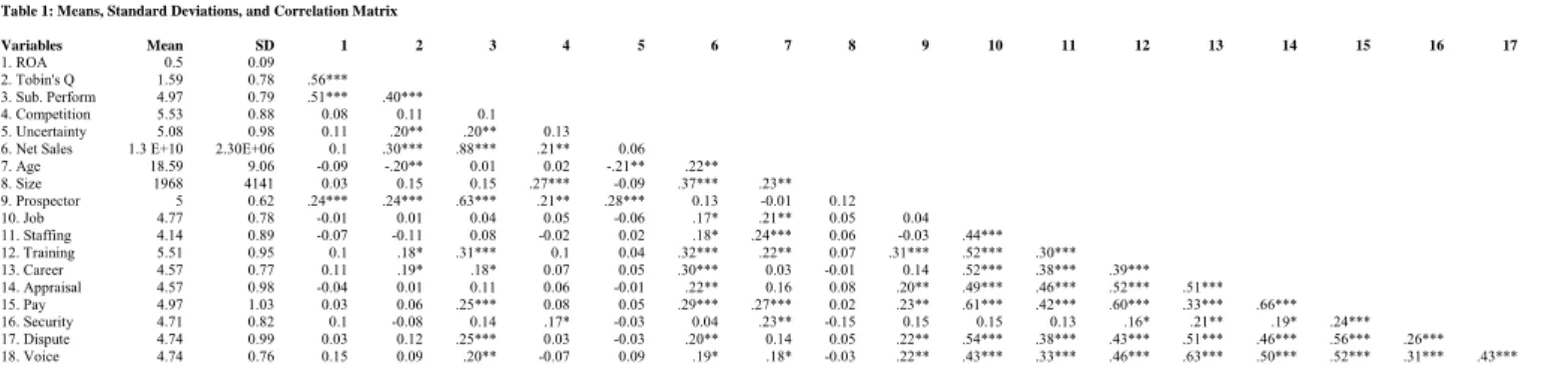
In Table 1, the summary statistics (means, standard deviations and correlations) for the variables are presented. Hypothesis 1 concerns the SHRM perspective.
Specifically, H1a proposes that a prospector strategy will be positively correlated with staffing, training, and career mobility, and negatively correlated with performance appraisal. The results in Table 1 indicate that a prospector strategy is positively correlated with training (r = .31, p < .01), performance appraisal (r = .20, p < .05), pay-for-performance (r = .23, p < .05), dispute resolution (r = .22, p < .05), and voice (r = .22, p < .05). Therefore, with the exception of training, H1a is not supported.
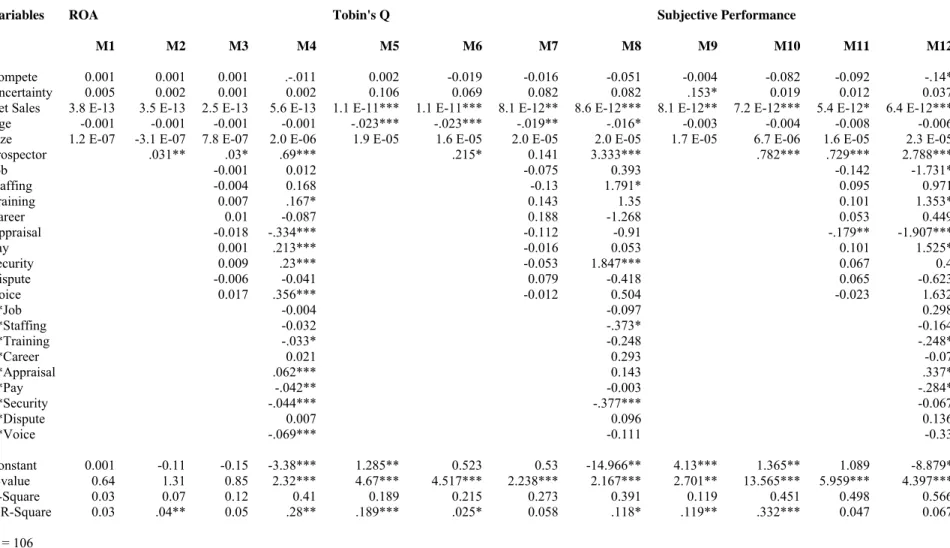
H1b is basically the SHRM proposition. A prospector strategy will interact with staffing, training, and career mobility to positively affect organizational performance, and interact with performance appraisal to negatively affect organizational performance. In Table 2, twelve models are presented: M1-M4 uses ROA, M5-M8 uses Tobin’s Q, and M9-M12 uses subjective performance as the dependent variable. M1, M5, and M9 contain the controls variables only. M2, M6 and M10 add the strategy variable
(prospector) to the equation. M3, M7 and M11 add the HRM practices, and M4, M8, and M12 add the interaction teams of strategy by HRM practices. To support the SHRM perspective (H1b), there must be a significant change in R2 for the entry of the interaction terms. So M4, M8 and M12 provide the results to assess H1b. Moving from M3 to M4,
the change in R2 is .28 (p < .05). The change in R2 from M7 to M8 is also statistically significant (∆R2 = .118, p < .10). The change in R2 from M11 to M12, however, is not statistically significant at p < .10. So with respect to ROA and Tobin’s Q, the addition of the interaction terms provided a significant degree of explanation of the variance.
Interpreted in this strict sense, using the change in R2 test, the data provide support for H1b.
A more careful interpretation of the results would, however, provide a different view. Focusing on M4 and M8, it can be seen that roughly 40% of the variance of both ROA and Tobin’s Q is explained. The models also show adequate fits (F-values = 2.32 and 2.167, respectively, p < .01). H1b states that the interactions between prospector and staffing, training, and career mobility, respectively, would positively affect organizational performance, while the prospector and performance appraisal interaction would
negatively affect organizational performance. No other interaction should be statistically significant. The results, though, show that ROA is negatively related to
prospector*training (β = -.033, p < .10), prospector*pay-for-performance (β = -.042, p < .05), prospector*job security (β = -.044, p < .01), prospector* voice (β = -.069, p < .01), and positively related to prospector*performance appraisal (β = .062, p < .01). Tobin’s Q is negatively related to prospector*staffing (β = -.373, p < .10) and prospector*job
security (β = -.377, p < .01). Thus, while the addition of the interaction terms resulted in a significant change in R2 of ROA and Tobin’s Q, the specific predictions of the SHRM perspective (H1b) were not supported.
Hypothesis 2 proposes that organizations are more likely to exhibit a multi-dimensional rather that a single-multi-dimensional strategic orientation. To test H2, the raw
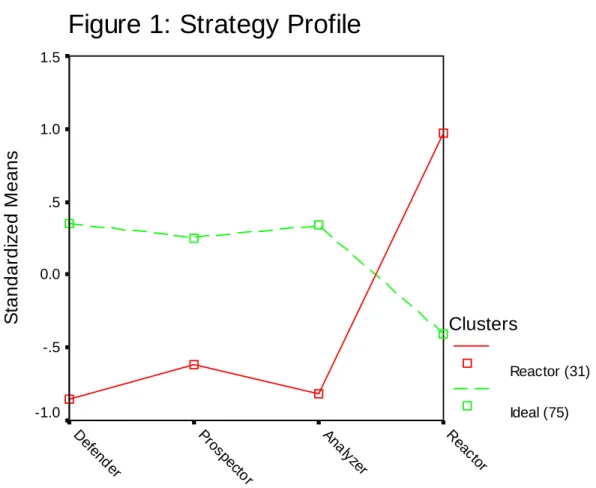
scores for prospector, defender, analyzer, and reactor measures were standardized and cluster analyzed. Figure 1 contains a diagram of the strategic profiles. As can be seen, the organizations predominantly followed a multi-dimensional strategic orientation comprising of defender, prospector, and analyzer characteristics. Thirty-one of the 106 organizations, however, did follow a reactor strategy. The results, therefore, show strong support for H2.
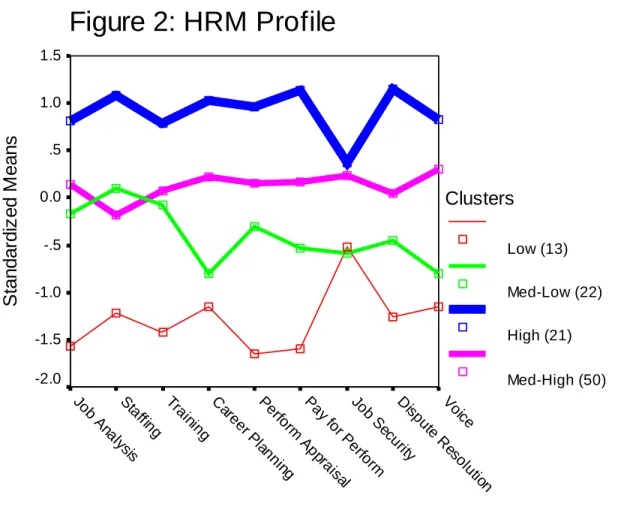
Hypothesis 3a deals with the idea that organizations will implement all of the HRM practices – though with varying degrees of intensity – rather than a selected set of HRM practices (or an all or nothing approach). The correlations provided in Table 1 suggest support for H3a. With few exceptions, the HRM practices were significantly correlated. To provide a test, the values for the HRM scales were standardized (easier to show on a diagram) and cluster analyzed. The results are displayed in Figure 2. Only 21 out of 106 organizations adopted a high commitment approach. Just below a majority (50/106) of the organizations followed a medium-high commitment approach. The remaining organizations implemented a medium-low (22/106) or a low (13/106) commitment HRM approach.18 The results, as such, provide strong support for H3a.
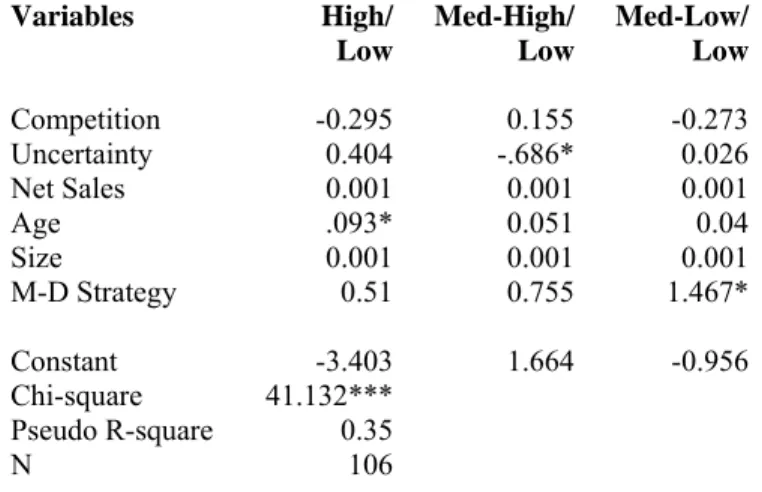
H3b concerns the isomorphic view, in that HRM will be positively related to competition, environmental uncertainty, sales, age and size. Table 3 contains the results of a multinomial logistic regression of the commitment based HRM approach (with the low group as the reference choice). The model shows adequate fit (Chi-square = 41.132, p < .01). Age is positively related to a high commitment HRM approach (β = 0.093, p
18 Now that we have empirically defined the HRM approach, we will consider either the medium-high or the medium-low approaches to be the moderate commitment HRM approach.
< .10) and environmental uncertainty is negatively related to a medium-high commitment HRM approach (β = -0.686, p < .10). Hence, the results presented in Table 3 provide very weak support for H3.
H4a proposes that a multi-dimensional strategy will be positively associated with a moderate commitment HRM approach. The results in Table 4 show that the association between the strategic profile and the HRM profile is not statistically significant.
However, return to the results presented in Table 3. As can be seen, a multi-dimensional strategy is positively related to a medium-low (or moderate) commitment HRM approach (β = 1.467, p < .10).19 So while the chi-square test did not support H4a, the multinomial logistic regression controlling for competition, environmental uncertainty, sales, age and size does provide support for H4a.
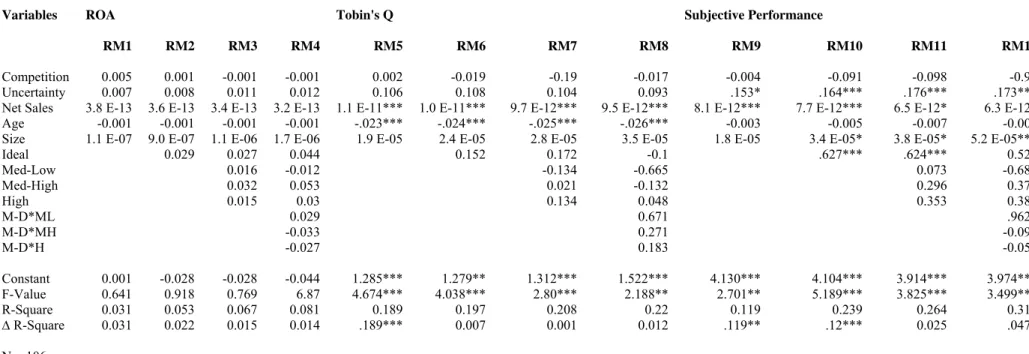
Hypothesis 4b concerns an alternative contingency perspective. It examines whether a multi-dimensional strategic orientation can combine with a moderate commitment HRM approach to positively affect organizational performance. Table 5 provides the results to assess H4b, by focusing on the change in R2 from RM3 to RM4, RM7 to RM8, and RM11 to RM12. As can be seen, only the change in R2 from RM11 to RM 12 is statistically significant (p < .10). RM12 shows adequate fit (F-value = 3.499, p < .01) and the independent variables explained 31.1% of the variation of subjective performance. The multi-dimensional strategic orientation*medium low commitment
19 This finding warrants further investigation. Research has shown that a multi-dimensional strategic orientation is highly likely under conditions of environmental uncertainty (see Wang, et. al., 2003). So the inclusion of the environmental uncertainty variable in the multinomial logistic regression could “draw” out the predictive validity of the multi-dimensional strategy in terms of the adoption of an HRM profile. This is an issue of environment-strategy fit (Tan and Litschert, 1994).
HRM approach is positively related to subjective performance (β = .962, p < .10). The results, as such, provide marginally significant support for H4b.
DISCUSSION
Logic and assumptions have elevated the field of HRM into the strategic realm. In fact, without logic and assumptions, it is difficult to test the merits of the SHRM perspective. We provide three examples of how the connection is made between strategy and HRM. “I assumed that a predominantly differentiation or focus strategy would require more intensive investments in High Performance Work Practices than would a cost leadership strategy” (Huselid, 1995: 650). “[T]he prospector strategy requires the market system, which entails (1) fewer career opportunities, (2) lack of formal training systems, (3) output-based appraisals, (4) profit-sharing systems, (5) little employment security, (6) little employee voice, and (7) broadly defined jobs” (Delery and Doty, 1996: 811).20 “[F]irms high in prospector orientation are likely to acquire needed skills and knowledge instead of developing employees within the internal labor market. Therefore, these firms are least incline in [sic] invest in their employees in terms of training and development” (Wang, et al., 2003: 516-517).21 It can be argued that the SHRM
perspective typifies the notion of how theories can become self-fulfilling (Ferraro, Pfeffer, and Sutton, 2005). Even the assumptions of the theory are construed as reality (Miller, 1999). We put the logic and assumptions of the SHRM perspective to an empirical test.
20 Delery and Doty (1996) used seven employment practices (internal career opportunities, training, result-oriented appraisals, profit sharing, employment security, participation, and job descriptions) to define a market-type system and an internal system.
21 Miles and Snow (1984: 45) actually said that “[t]alent is quickly sought, both inside and outside the organization [….]”
Our results provide several insights with regard to the theory and practice of SHRM. For convenience, we have summarized the findings in Table 6.
The hypotheses concerning the SHRM perspective received very little support. A prospector strategic orientation is positively correlated with training. A strict
interpretation of the test of a contingency perspective (the incremental validity of the interaction term) would suggest support for the SHRM perspective (Youndt, et. al., 1996; Delery and Doty, 1996; Huselid, 1995). But the results do not support the predictions proposed by Miles and Snow (1984). The results were almost the opposite.22 In this regard, our results are consistent with the conclusion that there is little empirical support for the SHRM perspective (Huselid, 1995; Wright, 1998; Horgan and Muhlau, 2003). The results also provide a baseline to continue with a re-examination of the logic and assumptions of SHRM.
Contrary to the genesis of the SHRM perspective (a pure or specific strategy), the results support the hypothesis that organizations are more likely to exhibit a
multi-dimensional strategic orientation (Tan and Litschert, 1994; Luo and Park, 2001; Wang, et. al., 2003). This finding could be influenced by the context (high technology
manufacturing Taiwanese industry) in which the study was conducted. Most Asian countries have been drawn into the international economy, in which there is intense
22 Higher levels of a prospector orientation combined with higher levels of a staffing focus to negatively affect Tobin’s Q, higher levels of a prospector orientation combined with higher levels of training to negatively affect ROA and subjective
performance, and higher levels of a prospector orientation combined with higher levels of a performance appraisal focus to positively affect ROA and subjective performance. When a prospector orientation was combined with career planning, the impact on
organizational performance was not statistically significant. In addition, higher levels of a prospector orientation combined with higher levels of job security and voice to
negatively affect ROA, and higher levels of a prospector orientation combined with higher levels of job security to negatively affect Tobin’s Q.
competition and organizations are in search of modes of management (see Wang, et. al., 2003 for an update). Whether a multi-dimensional strategy is common and instrumental in an economy with a stable market is an empirical question that warrants further research.
The results are encouraging for the argument that HRM practices are
implemented in a bundle and that the individual practices within the bundle work in collaboration to affect organizational performance (MacDuffie, 1995; Huselid, 1995; Delery and Doty, 1996; Youndt, et. al., 1996). The results, however, do not support the high commitment HRM approach. A middle-of-the-road approach has begun to receive scholarly attention. Doty et al (1993) argued that the mid-point between a prospector and a defender is an analyzer strategic orientation. Delery and Doty (1996) then proposed an employment system between the market-type employment system and the internal employment system as appropriate for the analyzer strategic orientation. They called it a “middle-of-the-road” employment system. Wang et al (2003) reported that a prospector strategic orientation when combined with an underinvestment employment relationship positively affected organizational performance. Our data clearly delineate the four levels at which the nine HRM practices are implemented. The most popular HRM route was the medium high approach. And it was the medium low commitment HRM approach which combined with the multi-dimensional strategic orientation to positively affect subjective performance. These findings, it should be highlighted, are based on empirically derived definitions of strategy and HRM.
The isomorphic hypothesis only received weak support, in that a high
commitment HRM approach was positively affected by age and a medium-high HRM approach was negatively affected by environmental uncertainty. This is clearly an area
that warrants further research. The weak support we detected could be related to the measures which we used to capture institutional isomorphism (sales, age, and size). Coercive mechanism should be based on similarity in collective bargaining outcomes (Visser and Hemerijck, 1997), mimetic mechanism on blueprints from consulting firms, and normative mechanism from formal education, membership in professional
organizations, and management values (Bae and Lawler, 2000; Othman and Boon, 2000). Recent research has begun to move in this direction (Horgan and Muhlau, 2003).
A few general issues warrant discussion. First, we believe that it is appropriate to examine both objective and subjective measures of organizational performance (see Kaplan and Norton, 1992). The results showed that the different performance outcomes, although strongly correlated, were affected by a different set of factors. The percentage of variance, of the three organizational performance outcomes, that is explained by the independent variables differed. Subjective performance, it seems, is better explained by the set of independent variables than ROA or Tobin’s Q. Second, the measure used for the four strategic typologies (Segev, 1989) did not show high internal consistency reliabilities (prospector = 0.69, defender = 0.48, analyzer = 0.26, and reactor = 0.66). The defender and analyzer constructs were regarded as indices. The decision to proceed in this manner is supported by both theory and evidence which point to the reality of a multi-dimensional strategic orientation (Tan and Litschert, 1994; Luo and Park, 2001; Wang, et. al., 2003). It is not reasonable to expect a neat differentiation between the four strategic orientations. The prospector strategic orientation scale showed an acceptable alpha, and was used to examine the SHRM perspective. Third, measuring HRM has come a far way, in which the momentum is toward multiple items constructs (Bartel,
2004; Delery and Doty, 1996). The list of HRM practices, though, has still not converged. Perhaps the idea to codify HRM into acquisition, development, and
maintenance would move the literature in the direction to be inclusive. This is especially important since the evidence seems to support not the choice of selective HRM practices, but the adoption of all HRM practices at different levels. The call to horizontally
integrate the HRM function is loud (MacDuffie, 1995; Huselid, 1995; Youndt, et. al., 1996; Delery and Doty, 1996; Wang, et. al., 2003). Measuring organizational
performance, strategy, and HRM will continue to present a challenge, but the advances provided here can assist with a solution.
Our final comment is that the SHRM perspective was essentially developed in the United States (Becker and Gerhart, 1996). Whether the ideas would unfold in emerging economies and cultures is an empirical question. Recent research has suggested that this is so (Bae and Lawler, 2000; Wang, et. al., 2003; Takeuchi, Wakabayashi, and Chen, 2003). It is important for the Asian region, especially, to grasp the extent and impact of American-style commitment based HRM approach, since the first wave of globalization in the region was guided by low-cost, mass production business strategies or export-oriented development (Bae and Lawler, 2000). It seems as though the high commitment strategy is giving way to the middle-of-the-road alternative, and when combined with a multi-dimensional strategic orientation can produce positive organizational performance (H4). Our study and Wang et al (3003) support that a “middle” road approach is also a route toward equifinality (Doty, et. al., 1993).