Hsiou-Huai Wang & Cheng-Yu Lin Learning for Duty or Enjoyment 271
Journal of Research in Education Sciences 2020, 65(1), 271-296
doi:10.6209/JORIES.202003_65(1).0011
Learning for Duty or Enjoyment:
Two Paths to Fulfillment in Learning for
Taiwanese High School Students in the
Confucian Cultural Context
Hsiou-Huai Wang
Cheng-Yu Lin
Center for Teacher Education, National Taiwan University
Teachers College, Columbia University
Abstract
In the context of Self-Determination Theory (SDT), numerous published studies have argued that intrinsic motivation is the key to engaging students with their academic work, improving school performance, and acquiring psychological well-being. By contrast, an increasing body of research focusing on Eastern Asian Confucian societies, including Taiwan, has shed light on the salience of extrinsic motivation centered around role obligation and duty fulfillment. Scholars have argued that extrinsic motivation has a high value of encouraging students’ effort making, enhancing their academic performance and providing them with psychological fulfillment. To help settle this theoretical dissonance, this research constructed and validated the two learning paths of Taiwanese students, the first, learning for duty, and the second, learning for enjoyment. A self-developed questionnaire on students’ learning motivation, effort-making, academic performance, and acquired satisfaction was administered to 511 students in northern Taiwan. Structural equation modeling generated path analysis and model fit results that demonstrated that Taiwanese students possess two learning motivations followed by two types of psychological fulfillment. Specifically, intrinsic motivation based on personal interest predicted effort-making, with mediation of “learning satisfaction.” Extrinsic motivation based on duty fulfillment directly predicted effort-making. Furthermore, “obligation satisfaction” emerged as a result of effort-making, regardless of students’
Corresponding Author: Hsiou-Huai Wang, E-mail: [email protected]
272 Learning for Duty or Enjoyment Hsiou-Huai Wang & Cheng-Yu Lin
different motivations. These findings regarding different learning motivations and satisfaction are valuable in reshaping the theoretical conception of learning motivation in a Confucian cultural setting. Relevant implications and suggestions for parenting and teaching are discussed.
Keywords: Confucian culture, effort-making, learning for duty, learning for enjoyment, self-determination theory
Hsiou-Huai Wang & Cheng-Yu Lin Learning for Duty or Enjoyment 273
Introduction
Understanding students’ learning motivation and associated emotional welfare is vital to improving their academic performance. For a long time, intrinsic motivation has been seen as key to fostering students’ interest and desire to explore, absorb, and apply new knowledge and attain psychological well-being, while extrinsic motivations, such as rewards, punishment, social norms and others’ expectations, are deemed less likely to benefit students’ learning experience (Ryan & Deci, 2011). This view reflects the fundamental belief in Self-Determination Theory (SDT) in western-centric education that encourages students’ autonomy, self-efficacy, and inner well-being in learning.
Yet, as the world is a collage of various cultures and societal customs, an important question to educational researchers lies in the uncertainty about applying SDT-based pedagogies, as promoted by mainstream western educators, without heeding the conflicts between the nature of those pedagogies and indigenous sociocultural norms. This concern is especially strong among educators in cultural contexts unlike that in the West, such as the Confucian culture in East Asia.
With regard to learning, despite that most of the western societies have emphasized the importance of intrinsic motivation, East Asian societies, situated in a different cultural background compared to their western counterparts, tend to apply a different philosophy about learning. In fact, Stevenson and Stigler (1992) explained that when it comes to learning, American students, teachers, and parents tend to accept “ability model”. In this model, people attribute success mostly to talent. Furthermore, since talent is a fixed quality, for whose who are considered highly talented, their talent is the key to success in learning rather than the effort they invest in learning. On the other hand, for those who are less talented, they are less likely to make substantial effort for their learning since they may think their efforts can not make up for their lack of talent anyway. In contrast, East Asian students, teachers, and parents tend to apply “effort model” regarding learning. In this model, people tend to consider individual ability as malleable. That is, people can increase their abilities through making effort. Therefore, it is assumed that when individuals invest time and effort, that will positively contribute to the likelihood of success. In the similar vein, since success is not limited to one’s talent but more based on effort, the values of making effort as an action to fulfill one’s duties are also underscored in East Asian societies.
The importance of acknowledging the effort model in learning has been echoed by various studies. For instance, despite applying a different learning philosophy compared to that in western
274 Learning for Duty or Enjoyment Hsiou-Huai Wang & Cheng-Yu Lin
societies, students in the Confucian circle of influence including those in Taiwan, stand out in international comparisons of academic achievement (Martin, Mullis, Foy, & Stanco, 2012; Organisation for Economic Co-operation and Development [OECD], 2014) and tie academic performance to personal duties to not only oneself but also one’s significant others. This duty-bound concept, featuring extrinsic motivation, has proven its effectiveness in enhancing students’ learning performance and helping students to perpetuate their diligence in studying when encountering discouraging learning experiences (Huang, Hsu, & Chen, 2015; Iyengar, Lepper, & Ross, 1999). In addition, recent studies on this duty-fulfilling learning motivation in the Confucian circle have also discovered that students’ emotional well-being is associated with both personal achievement and meeting others’ expectations after a successful academic endeavor (Huang et al., 2015). However, in regard to intrinsic and extrinsic motivations ascribed by SDT, it is important to highlight that this duty-bound extrinsic motivation exists not only in the Confucian cultural sphere but elsewhere as well. Yet for countries in this context, such as Taiwan, the value of this sort of motivation is noteworthy and has not yet been fully discussed. As this duty-bound motivation can be deemed as a culturally-specific extrinsic motivation on the motivation spectrum of SDT (Chen & Wei, 2013), it is important to investigate the strength of this extrinsic motivation and the well-being it will potentially bring about in learning in a specific sociocultural context such as Taiwan.
Therefore, this study investigated the existence of different learning motivations and the satisfaction of students in Taiwan. The authors of this current research argue that, because of the long-term cultural cultivation that is so different from that in the West (Stevenson & Stigler, 1992), Taiwanese students will possess two different learning motivations and two types of satisfaction. We examined, first, how the two motivations influence students’ academic engagement and performance, and second, how and when the two types of satisfaction are likely to emerge. By constructing the two learning paths, the authors developed a new perspective on students’ learning motivation and sources of satisfaction, especially those differing from the conventional learning path as presumed by self-determination theory.
Theoretical Framework & Hypotheses
SDT and Intrinsic Learning Motivation
SDT was initially established by Deci and Ryan (2008) and then applied in various research realms, including education. Within its theoretical construct are three major factors: autonomy, competence, and relatedness.
Hsiou-Huai Wang & Cheng-Yu Lin Learning for Duty or Enjoyment 275
According to SDT, autonomy refers to the perception that one’s activities are endorsed by or congruent with the self. Competence is defined as the experience that one can effectively bring about desired effects and outcomes. Relatedness pertains to the perception that one is close and connected to significant others. Furthermore, it has been widely accepted that personal well-being is a direct function of the satisfaction of these three basic psychological needs (Deci & Ryan, 2008; Ryan, 1995). Meanwhile, Deci and Ryan (2008) also argued that these three needs are deemed essential and universal to encouraging people to achieve internalization of motivation (intrinsic motivation). According to SDT, when facing important tasks, individuals could possess amotivation, external motivation, and intrinsic motivation before taking on their tasks (Deci, Ryan, & Williams, 1996). According to Deci and Ryan (2008), conditions supporting individuals’ experience of autonomy, competence, and relatedness are effective to intrinsic motivation and engagement for activities, including enhanced performance, persistence, and creativity. Also, these three key psychological factors are argued to be necessities for people to attain psychological well-being/satisfaction, which is the catalyst for their continuous participation and effort made for their tasks.
According to SDT, when high degrees of autonomy, competence, and relatedness are perceived by students in learning, students tend to develop intrinsic motivation and achieve well-being. For instance, researchers have found that greater personal interest, less pressure and tension, more creativity, more cognitive flexibility, better conceptual learning, and a more positive emotional tone are associated with intrinsic motivation, whereas negative effects such as stress, anxiety, fear, and task aversion are likely to emerge when people exercise extrinsic motivation for self-regulation (Nix, Ryan, Manly, & Deci, 1999; Ryan & Deci, 2000).
In summary, SDT prescribes that when high degrees of autonomy, competence, and relatedness are perceived, people tend to foster intrinsic motivation towards their tasks. Meanwhile, it is argued that these three vital components are nourished by people’s preliminary curiosity and desire to learn, explore, and assimilate knowledge as a means of attaining psychological well-being/satisfaction, which should be free of any exertion of external pressure or allurement (Deci & Ryan, 2010, 2012).
Values of Extrinsic Learning Motivation in Collectivist Culture
As described above, much research has applied SDT’s theoretical framework in both academic and vocational settings and developed empirical evidence to validate the benefits of fostering students’ perception of autonomy, competence, and relatedness because these factors can nourish one’s intrinsic motivation, which in turn becomes the key to one’s psychological well-being (satisfaction) (Nix et al., 1999). Nevertheless, aside from the research that yields results conforming
276 Learning for Duty or Enjoyment Hsiou-Huai Wang & Cheng-Yu Lin
with SDT’s prediction about intrinsic motivation, other research focusing on cultural influences on students’ learning motivation, such as Iyengar and Lepper (1999), draw a different pictures of how students incorporate different motivations to engage in learning tasks.
Iyengar and Lepper (1999) conducted a study to investigate the learning motivations of Anglo-American and Asian-American students. Their research revealed that Asian-American children displayed less intrinsic motivation in the personal context, and they actually performed best and enjoyed the task most if their tasks were selected by their mothers. In contrast, the Anglo-American students showed higher performance and higher psychological fulfillment when they were given personal choice in selecting tasks. Also, similar research conducted by D’Ailly (2003) on Taiwanese elementary students demonstrated that there was no relation between students’ perceived autonomy and effort-making; in fact, a negative relation was observed between autonomy and school performance, while extrinsic forces such as social values exerted a positive effect on effort-making, which then led to better school performance.
Not only do these compelling findings delineate how individualist and collectivist cultural factors may impact students’ learning motivation and performance, but they also challenge the conventional assumption based on SDT that the lack of autonomy will necessarily relate to negative consequences (Iyengar & Lepper, 1999). In this light, it seems that extrinsic learning motivation may not always exert detrimental effects on students’ willingness to learn, nor will it banish psychological well-being in specific cultural contexts.
With regard to this variant result and increasing evidence of research on extrinsic motivation in the Asian cultural context, Deci and Ryan (2000) maintain that, even though learning fulfillment in an autonomous setting is a global need that should be satisfied to activate intrinsic motivation for better performance and well-being, it is true that people view the idea of autonomy differently, especially those from a collectivist culture. As Menon, Morris, Chiu, and Hong (1999) explained, Anglo-American students place a greater value on personal autonomy, while their Asian-American counterparts prioritize group autonomy. In fact, the idea of having autonomy can be interpreted by Anglo-Americans as having/not having personal choice, whereas for Asian-Americans, the distinction lies in whether they acquire their motivation from themselves or from their in-group members (Iyengar & Lepper, 1999). It is plausible that in certain Asian societies, people utilize extrinsic motivation as much as intrinsic motivation to direct their learning engagement. In fact, the extrinsic motivation based on the will of family members, which may be viewed as a lack of personal autonomy in Westerners’ eyes, may just be another form of autonomy in some Asian cultural traditions (Iyengar & Lepper, 1999).
Hsiou-Huai Wang & Cheng-Yu Lin Learning for Duty or Enjoyment 277
In summary, the provision of individual choice and intrinsic learning motivation seems to be more crucial to American independent selves than to their Asian counterparts. For the former group, making personal choices is a way to establish one’s identity and self-worth so that they see learning tasks as intriguing; for the latter, having choices made by others can be taken as more intrinsically motivating in the process of fulfilling their collectivist obligations for family and friends (Iyengar & Lepper, 1999). In order to understand the influence collectivist culture exerts on learning motivation, it is necessary to examine the characteristics of East Asian culture. For this need, we have to focus on the Confucian culture, since it is the most prevalent and influential cultural philosophy that constructs people’s concept of learning and education in most of the East Asian areas.
Extrinsic Motivation, Effort-making, and Obligation Satisfaction in
Confucian Culture
Collectivism and individualism are a cultural dimension that could characterize national cultures of different countries. Although there could be various sub-cultures within the same country, culture should be considered as collective mental programming that conditions people in the same country often through formal education and common life experiences people share within that country (Hofstede, 1983). Compared to individualists, people coming from collectivism countries are described to be more concerned about the effect of their actions on others and obliged to make contribution for lives of others (Hui & Triandis, 1986). Different nations can develop their own type of collectivism culture based on their own history, traditions, customs, and norms, though they could still share some general collectivism cultural characteristics at the same time (Hofstede, 1983).
East Asian nations such as China, Taiwan, Hong Kong, South Korea, and Japan, are often recognized as collectivist societies that are heavily influenced by the Confucian culture (Chen, Wang, Wei, Fwu, & Hwang, 2009; Huang et al., 2015). To most of the students in the countries of the so-called Confucian circle, including Taiwan, academic learning is an important and challenging task. On international assessments such as the TIMSS and PISA, students from the aforementioned Confucian societies tend to perform well. Among these countries, Taiwanese students ranked at the top in math performance in a series of TIMSS and PISA assessments from 1999 to 2015 (Mullis, Martin, Foy, & Arora, 2008, 2012; OECD, 2018). When asked to reflect on their academic success as such, Taiwanese students tend to attribute their achievement to their effort rather than ability, and they prioritize effort-making as the key to outstanding academic performance (Chiu, 1988; Stevenson & Stigler, 1992; Uttal, 1997). However, despite the high academic achievement and tremendous effort-making, Taiwanese students, unlike western students, often express that they are
278 Learning for Duty or Enjoyment Hsiou-Huai Wang & Cheng-Yu Lin
motivated to study hard by extrinsic factors such as stress from peer competition and the needs to enter top-tier universities, maintain their hardworking public image, and fulfill family expectations (Fwu, Wei, Chen, & Wang, 2014).
Contradicting the assumption of SDT’s argument that intrinsic motivation is the determinant of continuous engagement in academic endeavors, it is clear that Taiwanese students are also driven by their quest to fulfill their duties as students as well as filial children in engaging in academic work. To understand the association between one’s duty, obligation, and effort, one has to be culturally-sensitive to Confucian tradition and examine prospective cultural factors that contribute to a motivation philosophy unlike that in the West (Fwu et al., 2014).
In the Confucian cultural tradition, academic achievement has long been perceived as a major vertical goal for students to pursue. For individuals who desire to thrive in society, they are expected to study hard and climb the “pyramid ladder” of achievement to attain status and wealth. By doing so, they are able to fulfill their moral obligations as filial children and glorify their parents and family. In ancient China, the pyramid ladder was built around the national civil service examination (ke-ju科 舉), through which only the top scholars were selected for placement into the hierarchical ladder of government offices (Chan, 1996). In order to climb to the top of this social ladder, one had to study state-mandated books of classics in order to pass the examination (Zeng, 1999). Thus, hard work and perseverance in such a pursuit were highly regarded and ascribed great moral significance.
In a Confucian society such as Taiwan, effort plays a pivotal role, for it is an obligation in the learning process. To an individual, working hard to learn is a life-long process of self-perfection that emphasizes deep concentration, steadfast perseverance, hardship, and diligence. These characteristics can be seen as “learning virtues,” and endeavoring to learn is a moral behavior (Li, 2006, 2012). In fact, in Confucian culture, making effort is considered as an “unconditional positive duty,” a process in which people should take actions to fulfill their duties for significant others, and those who endeavor to fulfill such duties tend to be viewed as possessing a moral character.
The emphasis on duty fulfillment and obligation satisfaction in Confucian society derives from the socialization process in two locations that are most essential to students’ development: school and family. At school, teachers tend to nominate those who study hard and succeed as role models. Through the small-scale, gradual socialization process of the classroom, children learn to internalize the concept that they must study to be academically successful. In the family, parents also tend to give credit to children who not only can achieve high grades but also work hard enough to deserve their academic harvest. On the other hand, those who do not make effort but still succeed will be negatively evaluated because they fail to fulfill their individual duties. That is, no matter the
Hsiou-Huai Wang & Cheng-Yu Lin Learning for Duty or Enjoyment 279
academic outcomes, for students in the Confucian context, effort-making is seen as a requisite for a moral character and high academic performance (Fwu et al., 2014; Huang et al., 2015).
Having acknowledged the need to make tremendous effort in learning as a means to fulfill students’ duty, Chen and Wei (2013) hypothesized a “Two-factor learning model” and conducted research on Taiwanese college students’ learning motivation, effort-making, and academic performance. Based on, and in contrast to, SDT’s argument, the authors found that Taiwanese college students were driven to engage in their academic work by both intrinsic and extrinsic motivations/identification. Specifically, they discovered that learning satisfaction could mediate the relation between interest-based intrinsic motivation/identification and engagement in academic work. On the other hand, they also found that Taiwanese students would also engage in learning without learning satisfaction if they applied extrinsic motivation/identification based on role identity and the need to fulfill their duties as a student. The authors conclude that the two-factor motivation/ identification can both effectively engage students in their learning and lead to satisfactory performance.
Although Chen and Wei’s (2013) work has highlighted the fact that Taiwanese students indeed possess two distinct learning motivations, two questions deserve further investigation. First, in their research, only learning satisfaction was found as a catalyst “before” effort-making, concurring with Deci & Ryan’s SDT’s argument focusing on intrinsic motivation. Yet according to past theoretical literature about Confucian effort-making and the importance of one’s dutiful responsibility, it is possible that students tend to feel a sense of obligation satisfaction “after” making effort. This obligation satisfaction hinges on a student’s investment of effort in order to fulfill their duties (Fwu et al., 2014). Second, the relations between effort-making, academic performance, and different sorts of psychological satisfaction have not been fully explored. According to past research on students in Confucian societies, it is equally imperative for them to make effort and to achieve good outcomes for their learning tasks. Given that effort-making is the minimum expectation on the one hand and that effort-making and attaining outstanding results are the high expectation on the other, reaching either or both objectives is a means of fulfilling the responsibility as a student and as a filial member of a family (Fwu et al., 2014; Huang et al., 2015)
In summary, from the above understanding of Confucian tradition and cultural norms about the moral significance of effort-making, it is evident that in a Confucian cultural context such as Taiwan, students’ learning path may differ from the pattern described by SDT. Based on past research in the same realm, we can also assume that both personal interests and the perceived need to fulfill duties as a student will drive Taiwanese students’ engagement in academic work. However, to understand
280 Learning for Duty or Enjoyment Hsiou-Huai Wang & Cheng-Yu Lin
the in-depth relations between different motivations, as well as how motivation, effort-making, satisfaction, and academic performance interact with each other, we propose a more sophisticated research model as follows.
Theoretical Model and Hypotheses
This study investigated different learning motivations, effort-making, academic performance, and students’ learning and obligation satisfaction. Before the research hypotheses are presented, it is essential to clarify the meanings of two essential terminologies in this research: “learning satisfaction” and “obligation satisfaction.” First, “learning satisfaction” refers to the psychological well-being that students achieve in the process of learning. They attain this sort of well-being because they enjoy studying a subject and consider that process interesting (Chen & Wei, 2013; Deci & Ryan, 2000). In contrast, “obligation satisfaction” refers to the psychological well-being condition that arises when students think they have fulfilled their obligations as students in the learning process (Fwu et al., 2014).
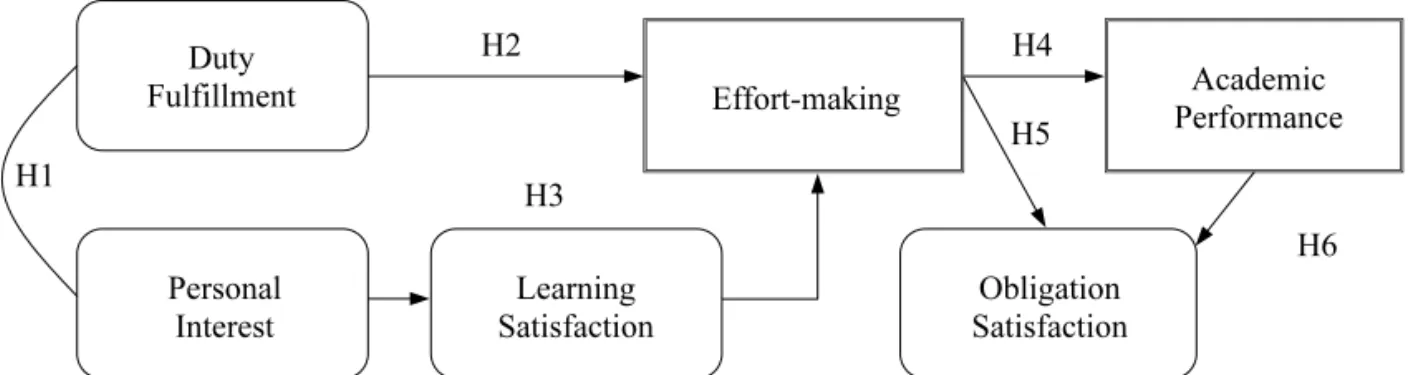
As discussed in the literature review, we hypothesize that Taiwanese students will possess both intrinsic and extrinsic motivations, with the former motivation stressing “personal interest” and the latter one emphasizing “duty fulfillment” regarding their school learning tasks (H1).
In addition, based on the SDT’s insight and past research on Taiwanese students’ learning patterns in the Confucian circle, we hypothesize that the two distinct learning motivations will invoke two different paths towards effort-making and then academic performance. Specifically, the extrinsic motivation based on duty fulfillment will directly predict learning effort (H2). On the other hand, based on SDT’s theoretical argument and also the empirical evidence by Chen and Wei (2013), though intrinsic motivation can also predict effort-making, this predictive relation has to go through students’ psychological well-being before they engage in their learning tasks. Therefore, we propose that students’ perceived learning satisfaction will mediate the relation between personal interest (intrinsic) motivation and effort-making (H3).
Naturally, we also hypothesize that the students’ effort-making will predict high academic performance (H4); however, differing from the past research done by Chen & Wei, which argues that Taiwanese students do not acquire satisfaction if they base their effort-making on dutiful reasoning, we argue that Taiwanese will receive a Confucian culturally-specific obligation satisfaction based on their investment of effort-making. That is, for Taiwanese students, obligation satisfaction will occur as a result of their diligent work applied to fulfill their role as a student (H5). In the end, as discussed previously, in the Confucian culture, the assessment of a “role model” student depends not only on a
Hsiou-Huai Wang & Cheng-Yu Lin Learning for Duty or Enjoyment 281
student’s effort on their academic work but also on their academic performance, as they might be equally essential in order to fulfill a student’s duties. Therefore, in our research model, we also hypothesize that academic performance will positively impact students’ perceived obligation satisfaction (H6). Yet it would be intriguing to see its impact compared to effort-making and to investigate if students’ obligation satisfaction results more from actions of “doing” or from the final results of their academic endeavors. The above hypotheses and research question are presented in Figure 1 below.
Figure 1. Theoretical Model of Two Learning Paths for Taiwanese Students
Research Method
Participants
A total of 511 high school students were recruited as participants for the current study. The students were selected from three segments of high school in the northern region of Taiwan. Based on the average minimum scores for school entrance exams in the recent five years, the top segment consisted of three schools, from which 183 (36%) students were drawn. The intermediate segment consisted of three schools, from which 178 (35%) students were drawn, and the bottom segment had two schools, from which 150 (29%) students were chosen. As for gender distribution, the total number of male students was 296 (58%), and that of female students was 215 (42%). The ages of the participants ranged from 14 to 18, with the majority (96.5%) of participants aged 15 or 16 years. All participants were in the first year of high school (the 10th grade).
Procedure
To test the hypotheses and the Taiwanese students’ learning paths, the authors acquired the cooperation of collaborative high school teachers in various schools in Taiwan to assist in the
H2 H3 H4 H6 H1 H5 Duty Fulfillment Personal Interest Learning Satisfaction Obligation Satisfaction Academic Performance Effort-making
282 Learning for Duty or Enjoyment Hsiou-Huai Wang & Cheng-Yu Lin
research procedure by sending out emails or phone calls. The selected high school teachers consented to help with this research out of personal willingness and courtesy. A questionnaire was developed and given to the student participants through collaborative high school teachers.
For ethical considerations, consent from the student participants was obtained, and their anonymity and confidentiality were ensured. Participants were guaranteed that this questionnaire would only be used for research purposes and would not be viewed by their teachers, school administrators, or family members. After the participants completed the questionnaires, the questionnaires were sealed and returned to the authors of this research. This process was implemented in order to retrieve genuine feedback from the participants.
The questionnaire contained items about students’ basic information such as school name, age, gender, and other items about students’ self-evaluation of two learning motivations, extent of effort-making, satisfaction, average score, and class rankings in the designated academic subject, followed by an open question asking students to reflect on their overall learning experience of that subject (detailed explanation in the section below). All the aforementioned items referred to their experience of studying English in school. The authors chose the academic subject of English to cater to the need of “high social expectation goals” (Chen et al., 2009), for students’ performance in this topic is commonly seen as extremely important by teachers, parents, and the students themselves because their performance in that subject can affect largely their overall academic career and opportunities to enter good universities.
Measures
Personal Interest & Duty Fulfillment Motivation
Seven questionnaire items were developed by the authors to assess participants’ personal interest (intrinsic) and duty fulfillment (extrinsic) motivation towards studying English. Four items measured “Personal Interest Motivation” (PIM), (e.g., I study English in order to satisfy my curiosity about that subject; I study English because I enjoy the process of studying it). The other three items were used to assess students’ “Duty Fulfillment Motivation” (DFM) (e.g., I study English in order to fulfill my parents’ or teachers’ expectation, and I study English so that I can fulfill my duties for my parents or teachers). Responses were made on a 6-point Likert-type scale ranging from 1 (strongly disagree) to 6 (strongly agree). The reliability of each subscale was as follows: personal interest (intrinsic) learning motivation (α = .91), and duty fulfillment (extrinsic) learning motivation (α = .88).
Effort-making
Hsiou-Huai Wang & Cheng-Yu Lin Learning for Duty or Enjoyment 283
for the English subject. The three items were as follows: (1) “When I am in English class, I concentrate on the teacher’s lecture,” (2) “I answer the teacher’s questions and ask questions in English class,” and (3) “In addition to assignments assigned by my English teacher, I complete more practice assignments by myself.” Responses in this section were made on a 6-point Likert-type scale ranging from 1 (never) to 6 (always). The reliability for this measure was good (α = .73).
Learning & Obligation Satisfaction
As for participants’ learning satisfaction about studying English, the two questions on Learning Satisfaction (LS) were as follows: (1) “I feel happy when I study English,” and (2) “I have fun when learning English.” The two questions concerning their Obligation Satisfaction (OS) were: (1) “I feel good that I have fulfilled my responsibility as a student in studying English,” and (2) “I am content that I have made enough effort in my English studies to fulfill my duties for my parents or teachers.” Responses were made on a 6-point Likert-type scale ranging from 1 (strongly disagree) to 6 (strongly agree). The reliability of each subscale was as follows: learning satisfaction (α = .91), and obligation satisfaction (α = .86). These results indicated that these measures have achieved high reliability.
Academic Performance
In order to assess students’ Academic Performance (AP) in English, two self-assessment items were given. First, the participants were asked to provide their average test scores of the three major exams in English from the previous semester. The responses were made on a 10-point Likert-type scale, with “1” signifying 0-10 points and “10” signifying 91-100 points. Second, the participants were asked to provide their average class rankings in their English class. The responses were made on a 4-point Likert-type scale ranging from 1 (top 10 places in class) to 4 (below the 30th place in class). These two questions were applied to assess students’ academic performance in English. It is worth mentioning that the authors used the data of class rankings to help verify the accuracy of students’ self-reported exam scores. Although there might still be uncertainty in the exam scores students reported, the authors compared both the scores and rankings to reduce this uncertainty. Also, in order to minimize the variance between classes and schools, all the scores data were standardized before conducting further analyses.
284 Learning for Duty or Enjoyment Hsiou-Huai Wang & Cheng-Yu Lin
Results
Measurement Questions and Latent Variables
To ensure the appropriateness of all measures and their factor loadings, the authors first conducted a Confirmatory Factor Analysis (CFA) by using Structural Equation Modeling (SEM). This study was expected to reveal how different measures can load onto their associated latent constructs. Ideally, a total of six latent variables should emerge when all questions are properly loaded with a satisfactory model fit. The results of CFA revealed six latent variables and a nice fit of the measurement model. The result showed χ2 (76) = 272; GFI = .94; RMSEA = .07; AGFI = .9; NFI = .94; CFI = .96; NNFI = .94; PNFI = .68, meaning that all six hypothesized latent variables were verified with satisfactory factor loadings.
Specifically, all of these factor loadings were significant (p < .001), with β values range from .69 to .93 for all six latent variables.
It is worth mentioning that the chi-square value (χ2) was rather inflated due to the large sample size (N = 511), and this was likely to cause the p value to be statistically significant. In this case, Tanaka (1993) suggested that regarding a sample size larger than 200, the chi-square is likely to be significant. Therefore, other indications of model fit should be examined and supplemented. As reported, other measurements such as GFI, RMSEA, AGFI, NFI, CFI, NNFI, and PNFI were performed, and all demonstrated ideal results of total model fit.
Means, Standard Deviations, Correlations between Latent Variables
Table 1 lists the means, standard deviations, and correlations between key measures. The results of correlation analysis showed that personal interest (intrinsic) motivation was positively correlated with learning satisfaction (r = .8, p < .001) and effort-making (r = .53, p < .001), but not significantly correlated with duty fulfillment (extrinsic) motivation (r = -.04, p = .4). On the other hand, duty fulfillment motivation had a negative correlation with learning satisfaction (r = -.1, p < .05) and academic performance (r = -.11, p < .05), but a positive correlation with effort-making (r = .11, p < .05 ) and obligation satisfaction (r =.1, p < .05). Moreover, learning satisfaction was significantly correlated with effort-making (r = .51, p < .001), while effort-making was positively correlated with obligation satisfaction (r = .49, p < .001) and academic performance (r = .29, p < .001). These preliminary findings provide valuable references and are consistent with our hypotheses in the theoretical model. To further examine the causal and mediation effects of the aforementioned variables, the authors conducted subsequent analyses as follows.
Hsiou-Huai Wang & Cheng-Yu Lin Learning for Duty or Enjoyment 285
Table 1
Descriptive Statistics And Correlations of Key Measures in Current Study
Measures 1 2 3 4 5 6
1. Personal interest motivation -
2. Duty fulfillment motivation -.04*** -
3. Effort-making -.53*** .11* - 4. Learning satisfaction -.8*** -.1*- .51*** - 5. Obligation satisfaction -.35*** .1* .49*** .38*** - 6. Academic performance -.31*** -.11* .29*** .36*** .38*** - M 3.71*** 3.47* 3.53*** 3.65*** 3.74*** 6.81 SD 1.16*** 1.2*- 1.09*** 1.32*** 1.18*** 2.05 Note.Correlation analysis of all the above constructs was performed after all measures were standardized. ***p < .001. ** p < .01. *p < .05.
Model fit of Taiwanese Students’ Two Learning Paths
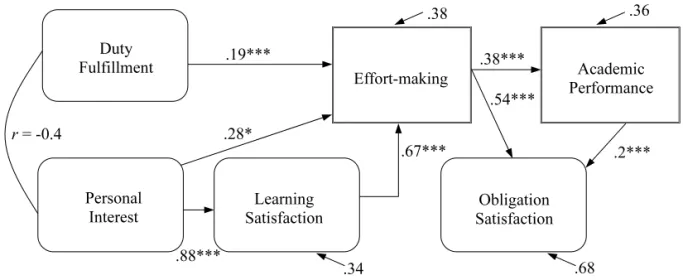
In order to better understand the relationships between different latent variables, the authors conducted a SEM path analysis to test the model’s fit and relevant coefficients. The theoretical model of the two learning paths demonstrated good model fit, χ2 (84) = 321.33; GFI = .92; RMSEA = .07; AGFI = .89; NFI = .93; CFI = .95; NNFI = .94, PNFI = .75. The good model fit matched the current study’s assumption about learning motivations and related psychological satisfaction (see Figure 2 below).
Figure 2. SEM Analysis of Taiwanese Students’ Two Learning Paths. Latent variables were applied to represent all constructs; path coefficients and residuals are standardized estimates.
***p< .001. * p < .05. .19*** Duty Fulfillment Personal Interest Learning Satisfaction Obligation Satisfaction Academic Performance Effort-making .38 .36 .68 .34 .28* r = -0.4 .2*** .88*** .67*** .38*** .54***
286 Learning for Duty or Enjoyment Hsiou-Huai Wang & Cheng-Yu Lin
First, PIM and DFM were found to be distinct from each other (r = -.04, p = .4) (H1). In addition, both types of motivation could effectively predict Effort-Making (EM) despite the processes being different. Based on our theoretical assumption and after testing several mediation relation between two different motivation and satisfaction variables, we’ve found that DFM directly predicted EM without any satisfaction variable as mediator (β = .19, p < .001) (H2). In order to test the assumption of SDT that intrinsically-motivated student must perceive learning satisfaction before they engage in making effort for study, we also tested the mediation between personal interest, learning satisfaction, and effort making. The results showed that Learning Satisfaction (LS) was found to mediate the relation between PIM and EM. That is, PIM significantly predicted LS (β= .88, p < .001) and then contributed to EM positively (β = .67, p < .001). Meanwhile, it is worth noting that this mediation effect is partial regarding the fact that PIM could also directly predicted EM in our model (β = .28, p < .05) (H3). However, comparatively, the mediated effect (β = .59), which derived from multiplying coefficients from PIM to LS (β = .88) and that from LS to EM (β = .67), is larger than the direct effect going from PIM to EM (β = .28). This result partially matched SDT’s assumption that students’ inner well-being (satisfaction) must be attained prior to engagement in learning tasks.
Furthermore, EM significantly contributed to AP (β = .38, p < .001) (H4) and OS (β = .54, p < .001) (H5). It is also worth mentioning that AP also positively contributed to OS (β= .20, p< .001) but represented a weaker contribution as compared to EM (H6).
Additional Validation of Relationships between Latent Variables
To further our data analysis and the integrity of our theoretical assumptions, the authors also tested mediation between DFM, OS, and EM. Our results matched our theoretical assumption that DFM did not predict OS (β= .08, p= .07). This means OS did not derive from DFM. According our previous results, OS resulted from students’ EM and AP. That is, OS is more of a “fruit” of both one’s diligence and performances than a “trigger”. Moreover, effort exerted a larger impact on OS than on one’s AP.
All in all, the SEM analyses verified the authors’ two learning paths for Taiwanese high school students. A few valuable discoveries were achieved in this model. First, two distinct motivations were found based on the same group of subjects. Second, two different types of psychological satisfaction, occurring at different phases of the students’ learning process, were found. Third, OS, which is characteristic of the ethic and obligation-based Confucian tradition was found in the current study, and it was based more on effort than on actual AP (β = .54 vs. β = .20). Our analyses have
Hsiou-Huai Wang & Cheng-Yu Lin Learning for Duty or Enjoyment 287
supported all six hypotheses in this study.
Conclusion & Discussion
Significance of Obligation Satisfaction
Based on the results of our current research, we have discovered the psychological well-being of “obligation satisfaction” perceived by students in the Confucian context (i.e., Taiwan). Relevant motivation theories in the past such as SDT focused on students’ perceived satisfaction from their aptitude, talent, ability, and personal achievement, but rarely covered satisfaction based on one’s fulfillment of duties and role in different social contexts. SDT views the major components of autonomy, competence, and relatedness as the requisites of psychological well-being, but our research has discovered not only the emotion of obligation satisfaction but also found that it is not a catalyst for Taiwanese students to make effort in learning. Instead, it is a result after those students have engaged and make efforts in their learning, as well as, achieve good academic performance. The emotion of obligation satisfaction and its reason of occurrence have indicated that this kind of psychological well-being is less about having fun in learning at the individual level, rather, it is a positive psychological feedback for a Taiwanese students situated in values prescribed by Confucian morale about learning. In other words, though many past studies have claimed that learning without personal interest is prone to lack of positive psychological feedback and personal fulfillment, our results indicated that learning motivated by an urge to fulfill one’s duty will actually result in a different type of psychological well-being, that is, obligation satisfaction.
Sources for Obligation Satisfaction
This current research has not only discovered obligation satisfaction that is prevalent in a Confucian context such as Taiwan, we have also identified the sources for this kind of satisfaction. In our study, we’ve found that both making effort and achieving good academic performance could increase students’ obligation satisfaction. This result demonstrated that obligation satisfaction is not based merely on the outcome of learning but also based on the process of investing efforts in learning for Taiwanese students. Compared to another similar study done by Chen and Wei (2013), which only identified two kinds of learning motivations and a single kind of learning satisfaction, our research has furthered this line of investigation by not only discovering obligation satisfaction but also providing explanations about what contributed to it. Furthermore, in Chen and Wei’s study, the role-oriented motivation was not associated with any satisfaction in the process of learning. Our
288 Learning for Duty or Enjoyment Hsiou-Huai Wang & Cheng-Yu Lin
findings in the current research have identified that motivation based on one’s duty fulfillment, similar to motivation based on personal interest, is effective in prompting Taiwanese students to make efforts, achieve good academic outcomes, and attain obligation satisfaction. In other words, for Taiwanese students, learning motivated by the urge to fulfill the duty as a student did eventually bring about psychological well-being though this motivation is often considered as extrinsic by a lot of literature in the past, especially those based on SDT.
In short, the discovery of obligation satisfaction has opened another dimension of well-being in the process of learning. This dimension should be further investigated in future research and in different cultural contexts, especially in places where people’s societal roles are highly contextual and role fulfillment is considered inevitably as a moral pursuit. Our research results have provided the evidence and opportunities for theoretical breakthrough for future research. However, it is important to highlight that the concept of obligation satisfaction is not unique to Confucian culture. This means obligation satisfaction may appear in different forms in different cultural contexts and more relevant studies are needed to verify the influence of this kind of learning motivation and satisfaction.
The Moral Aspect of Attaining Positive Emotions in Learning
The current research has revealed that Taiwanese students demonstrated two distinct learning motivations and two kinds of psychological satisfaction associated with their learning processes. First, from motivation to effort-making, we have found that intrinsic motivation based on personal interest in studying important school subjects significantly predicted students’ hard work in studying that subject; however, this relation was mediated by students’ perceived learning satisfaction. This result confirmed Deci and Ryan’s SDT theoretical framework that personal interest played a vital role in cultivating intrinsic motivation and psychological well-being (in our case, learning satisfaction). On the other hand, for Taiwanese students, the other learning path was initiated by their extrinsic duty-fulfillment motivation. As our results indicated, students were urged to make effort in their important academic subject of English, based on their perceived obligation to meet the expectations of their teachers and parents. Unlike intrinsic motivation based on personal interest, the duty fulfillment motivation would propel students to engage in their learning activities without any mediation of psychological satisfaction. In other words, students exercising this sort of extrinsic motivation did not think about if they “liked” the school subject; instead, they simply thought that they “had to” study important subjects.
Hsiou-Huai Wang & Cheng-Yu Lin Learning for Duty or Enjoyment 289
to fulfill one’s duty in the learning process has been rooted in the moral aspect in the Confucian culture for a long time. In the Confucian culture, fulfilling duty associated with different social roles is not only imperative but also well-regarded (Fwu et al., 2014). In fact, it is commonly accepted that societal harmony hinges on the interconnected relationships between people and the notion that everyone needs to play his/her role in this all-embracing social network plays a key role in guiding one’s action. In this context, fulfilling duty as a student in one’s learning has naturally become an action motivated more by moral motives and less by personal preference.
What’s worth noting about this moral aspect of fulfilling duties in learning is the positive emotions it contributes to. In fact, many studies have attributed extrinsic motivation to negative emotions (Deci & Ryan, 2008). However, our research revealed that in order to attain positive emotions in learning, students did not necessarily prioritize their personal interest to engage in learning but they also considered the moral aspect of making efforts in learning. This can be explained by the fact that people, particularly in the Confucian context, consider learning as a process of moral endeavors as fulfilling duties to significant others through effort. In this sense, when people think they have fulfilled their duties, either by making efforts or achieving high academic performance, they are likely to gain positive morale-associated emotions as a feedback.
On the other hand, as emotions has recently become an important research topic in the field of academic learning (Pekrun, Goetz, Titz, & Perry, 2002), it is also important to point out that many studies on academic emotions have been based on learning outcomes instead of learning process. For instance, Pekrun et al. (2002) suggested that negative emotions are bound with failure. However, in our study, students tended to experience a certain type of positive emotions called “obligation satisfaction” by investing effort in the process of learning regardless of their learning outcomes.
Meanwhile, we have also found that Taiwanese students’ initiative to make effort was a more salient factor for predicting students’ acquisition of obligation satisfaction compared to actually achieving academic performance. This inspiring result accords with Fwu et al.’s (2014) argument that students’ willingness to make effort is the key to be considered a good student who is diligent and possesses moral character. All in all, these findings have provided evidence that making effort for learning is not only based on personal interest or in pursuit of satisfaction; for Taiwanese students, their engagement in learning could also be driven by their motivation to fulfill their duty and that will give them a different kind of satisfaction to reward their moral deeds.
290 Learning for Duty or Enjoyment Hsiou-Huai Wang & Cheng-Yu Lin
Implications
This present research has several important implications for education practitioners, parents, and educational researchers.
First, for school teachers or curriculum designers, it is important to ensure that the course content and teaching provided to students can stimulate their personal interest. As described in SDT and also shown in this current research, making students enjoy their learning process could help them acquire psychological satisfaction, which in turn encourages them to perpetuate their engagement and effort for studying an academic subject (Ryan & Deci, 2011). On the other hand, though this idea contradicts the conventional assumption about extrinsic motivation, it is worth noting that reminding students of their need to fulfill their duties as a student is another effective approach to propel them to take on learning tasks. That is, when students lack intrinsic motivation to learn, it is possible for teachers or parents to encourage students to study based on the premise that studying is more than a pursuit of high academic performance; it is also a moral deed to build their character (Fwu et al., 2014). To summarize, the two motivations should be stimulated by teachers or parents, depending on students’ needs, in order to maximize student’s willingness to engage in learning activities.
Second, the consequences of applying either motivation should also be noted. As our research showed, students applying intrinsic motivation could achieve both learning and obligation satisfaction, though at different learning stages. In contrast, applying solely extrinsic motivation based on students’ need for duty fulfillment may yield only one type of satisfaction. Moreover, since obligation satisfaction hinges on effort-making as well as academic performance, it is advised that students focus on suitable learning strategies to attain good performance, rather than focusing solely on their effort. Although it is evident that good learning outcomes must be based on effort, it is dangerous for students to be trapped in the fallacy of being a “good student” by only working hard but not working smart. In the case of students focusing exclusively on duty fulfillment motivation but engaged in futile effort-making, the inevitable low academic performance may harm their sense of self-worth and self-efficacy concerning school work, and perhaps also in other realms.
Third, regarding the benefit of intrinsic motivation of achieving two sorts of satisfaction in this study, for students that are majorly driven by duty fulfillment motivation to study, it may be helpful for teachers to lead those students to discover efficient and effective learning strategies so that they might gradually establish their intrinsic motivation when their personal interest of studying that
Hsiou-Huai Wang & Cheng-Yu Lin Learning for Duty or Enjoyment 291
subject is developed. Also, when students base their studying exclusively on duty fulfillment motivation and still achieve good outcomes, it may also be beneficial for teachers to encourage the students to reflect on their learning experiences to elicit students’ interest and self-efficacy in an academic subject. Though that subject did not interest those students at first, they may gradually establish their intrinsic motivation based on personal interest after “doing well”.
Research Limitations
There were a few limitations to the present study. First, although the sample of Taiwanese high school students was drawn from different schools at different levels (based on their minimum score requirements for student admission), the sampled schools were all located in northern Taiwan. To increase the validity of the two learning paths in the current research, more students from different areas of Taiwan or from other countries in the Confucian circle could be sampled in the future.
Second, the measures of academic performances in this study were based on students’ self-recollections, the accuracy of which might be undermined due to distortion or memory loss. To minimize the impact of such limitation, the researchers have normalized the scores to mitigate the effects due to diverse ranking and scoring systems among different schools and classes. Furthermore, previous research have pointed out that there is a positive association between self-reported and actual scores (Cassady, 2001), indicating that self-reported scores collected in the current study may have reflected students’ actual performances to a certain extent. However, we suggested that future studies may consider to collect actual scores, whenever possible, to increase the authenticity of performance measurement.
Furthermore, regarding the exploratory nature of this current research and the lack of relevant measures appropriate for the current study design, the authors established self-developed questionnaire based on past relevant literature. Although the results from examining the reliability and validity of the measure in our research yielded satisfactory outcomes, we also acknowledged that there may be limitation in our measure tools in a different context or when they are applied to different population of participants. In that regard, we suggested that similar studies can increase or modify questions in each dimension of the measures to examine the robustness of our current measure tools. On the other hand, future research can also apply multiple methods, such as both quantitative and qualitative approaches, for methodological triangulation to further verify the relations between students’ motivation, satisfaction, and learning outcomes when investigating similar research questions.
292 Learning for Duty or Enjoyment Hsiou-Huai Wang & Cheng-Yu Lin
In the end, because of the design of the present research, the longitudinal data on the measured parameters were not accessible. In the future, it would be valuable to conduct a longitudinal study to see how different learning motivations, effort-making, obligation satisfaction, and academic performance influence each other. Meanwhile, it would also be intriguing to see if different learning motivations and learning satisfaction can be obtained by students in a different sequence when they have advanced through their high school studies.
Acknowledgement
The authors thanks the funding support from the R.O.C. Ministry of Science & Technology (MOST103-2410-H-002-126-MY2).
Hsiou-Huai Wang & Cheng-Yu Lin Learning for Duty or Enjoyment 293
References
Chan, J. (1996). Chinese intelligence. In M. H. Bond (Ed.), The handbook of Chinese psychology (pp. 93-108). New York, NY: Oxford University Press.
Cassady, J. C. (2001). Self-reported GPA and SAT: A methodological note. Practical Assessment, Research & Evaluation, 7(12). Retrieved from https://scholarworks.umass.edu/pare/vol7/iss1/ 12
Chen, S.-W., & Wei, C.-Y. (2013). A two-factor model of learning motivation for Chinese undergraduates: On the function of academic identity and role identity. Chinese Journal of Psychology, 55(1), 41-55. doi:10.6129/CJP.20120717
Chen, S.-W., Wang, H.-H., Wei, C.-F., Fwu, B.-J., & Hwang, K.-K. (2009). Taiwanese students’ self-attributions for two types of achievement goals. The Journal of Social Psychology, 149(2), 179-194. doi:10.3200/SOCP.149.2.179-194
Chiu, L.-H. (1988). Locus of control differences between American and Chinese adolescents. The Journal of Social Psychology, 128(3), 411-413. doi:10.1080/00224545.1988.9713759
D’Ailly, H. (2003). Children’s autonomy and perceived control in learning: A model of motivation and achievement in Taiwan. Journal of Educational Psychology, 95(1), 84-96. doi:10.1037/ 0022-0663.95.1.84
Deci, E. L., & Ryan, R. M. (2000). The “what” and “why” of goal pursuits: Human needs and the self-determination of behavior. Psychological Inquiry, 11(4), 227-268. doi:10.1207/S15327965 PLI1104_01
Deci, E. L., & Ryan, R. M. (2008). Self-determination theory: A macrotheory of human motivation, development, and health. Canadian Psychology/Psychologie Canadienne, 49(3), 182-185. doi:10.1037/a0012801
Deci, E. L., & Ryan, R. M. (2010). Self-determination. In I. B. Weiner & W. E. Craighead (Eds.), The corsini encyclopedia of psychology (pp. 1-2). New York, NY: John Wiley & Sons. doi:10. 1002/9780470479216.corpsy083
Deci, E. L., & Ryan, R. M. (2012). Self-determination theory. In P. A. M. Van Lange, A. W. Kruglanski, & E. T. Higgins (Eds.), Handbook of theories of social psychology (Vol. 1, pp. 416-433). doi:10.4135/9781446249215.n21
Deci, E. L., Ryan, R. M., & Williams, G. C. (1996). Need satisfaction and the self-regulation of learning. Learning and Individual Differences, 8(3), 165-183. doi:10.1016/S1041-6080(96)
294 Learning for Duty or Enjoyment Hsiou-Huai Wang & Cheng-Yu Lin
90013-8
Fwu, B.-J., Wei, C.-F., Chen, S.-W., & Wang, H.-H. (2014). Effort counts: The moral significance of effort in the patterns of credit assignment on math learning in the Confucian cultural context. International Journal of Educational Development, 39, 157-162. doi:10.1016/j.ijedudev.2014. 07.010
Hui, C. H., & Triandis, H. C. (1986). Individualism-collectivism: A study of cross-cultural researchers. Journal of Cross-Cultural Psychology, 17(2), 225-248. doi:10.1177/00220021860 17002006
Hofstede, G. (1983). The cultural relativity of organizational practices and theories. Journal of International Business Studies, 14(2), 75-89. doi:10.1057/palgrave.jibs.8490867
Huang, H.-T., Hsu, C.-C., & Chen, S.-W. (2015). Identification with social role obligations, possible selves, and L2 motivation in foreign language learning. System, 51, 28-38. doi:10.1016/ j.sqstem.2015.03.003
Iyengar, S. S., Lepper, M. R., & Ross, L. (1999). Independence from whom? Interdependence with whom? Cultural perspectives on ingroups versus outgroups. In D. A. Prentice & D. T. Miller (Eds.), Cultural divides: Understanding and overcoming group conflict (pp. 273-301). New York, NY: Russell Sage Foundation.
Iyengar, S. S., & Lepper, M. R. (1999). Rethinking the value of choice: A cultural perspective on intrinsic motivation. Journal of Personality and Social Psychology, 76(3), 349-366. doi:10. 1037/0022-3514.76.3.349
Li, J. (2006). Self in learning: Chinese adolescents’ goals and sense of agency. Child Development, 77(2), 482-501. doi:10.1111/j.1467-8624.2006.00883.x
Li, J. (2012). Cultural foundations of learning: East and west. New York, NY: Cambridge University Press. doi:10.1017/CBO9781139028400
Martin, M. O., Mullis, I. V. S., Foy, P., & Stanco, G. M. (2012). TIMSS 2011 international results in science. Amsterdam, NL: International Association for the Evaluation of Educational Achievement.
Menon, T., Morris, M. W., Chiu, C.-Y., & Hong, Y.-Y. (1999). Culture and the construal of agency: Attribution to individual versus group dispositions. Journal of Personality and Social Psychology, 76(5), 701-717. doi:10.1037/0022-3514.76.5.701
Mullis, I. V. S., Martin, M. O., & Foy, P. (2008). TIMSS 2007 international mathematics report: Findings from IEA’s trends in international mathematics and science study at the fourth and Eighth grades. Chestnut Hill, MA: TIMSS & PIRLS International Study Center, Boston
Hsiou-Huai Wang & Cheng-Yu Lin Learning for Duty or Enjoyment 295
College.
Mullis, I. V. S., Martin, M. O., Foy, P., & Arora, A. (2012). TIMSS 2011 international results in mathematics. Chestnut Hill, MA: TIMSS & PIRLS International Study Center, Boston College. Nix, G. A., Ryan, R. M., Manly, J. B., & Deci, E. L. (1999). Revitalization through self-regulation: The effects of autonomous and controlled motivation on happiness and vitality. Journal of Experimental Social Psychology, 35(3), 266-284. doi:10.1006/jesp.1999.1382
Organisation for Economic Co-operation and Development. (2014). PISA 2012 results in focus: What 15-year-olds know and what they can do with what they know. Paris, France: Author. Organisation for Economic Co-operation and Development. (2018). PISA 2015 results in focus. Paris,
France: Author.
Pekrun, R., Goetz, T., Titz, W., & Perry, R. P. (2002). Academic emotions in students’ self-regulated learning and achievement: A program of qualitative and quantitative research. Educational Psychologist, 37(2), 91-105. doi:10.1207/S15326985EP3702_4
Ryan, R. M., & Deci, E. L. (2011). A self-determination theory perspective on social, institutional, cultural, and economic supports for autonomy and their importance for well-being. In V. I. Chirkov, R. M. Ryan, & K. M. Sheldon (Eds.), Human autonomy in cross-cultural context: Perspectives on the psychology of agency, freedom, and well-being (pp. 45-64). Dordrecht, Netherlands: Springer.
Ryan, R. M. (1995). Psychological needs and the facilitation of integrative processes. Journal of Personality, 63(3), 397-427. doi:10.1111/j.1467-6494.1995.tb00501.x
Ryan, R. M., & Deci, E. L. (2000). Self-determination theory and the facilitation of intrinsic motivation, social development, and well-being. American Psychologist, 55(1), 68-78. doi:10. 1037/0003-066X.55.1.68
Stevenson, H. W., & Stigler, J. W. (1992). The learning gap: Why our schools are failing and what we can learn from Japanese and Chinese education. New York, NY: Touchstone Books.
Tanaka, J. S. (1993). Multifaceted conceptions of fit in structural equation models. In K. A. Bollen & J. S. Long (Eds.), Testing structural equation models (pp. 10-39). Newbury Park, CA: Sage. Uttal, D. H. (1997). Beliefs about genetic influences on mathematics achievement: A cross-cultural
comparison. Genetica, 99(2-3), 165-272. doi:10.1007/BF02259520
Zeng, K. (1999). Dragon gate: Competitive examination and their consequences. London, UK: Cassell.
296 Learning for Duty or Enjoyment Hsiou-Huai Wang & Cheng-Yu Lin 教育科學研究期刊 第六十五卷第一期 2020年,65(1),271-296 doi:10.6209/JORIES.202003_65(1).0011