10082 Chem. Commun., 2011,47, 10082–10084 This journal is c The Royal Society of Chemistry 2011
Cite this:
Chem. Commun
., 2011, 47, 10082–10084
Facile synthesis of a 56p-electron 1,2-dihydromethano-[60]PCBM and its
application for thermally stable polymer solar cellsw
Chang-Zhi Li,
aShang-Chieh Chien,
abHin-Lap Yip,
acChu-Chen Chueh,
aFang-Chung Chen,
bYutaka Matsuo,
dEiichi Nakamura
dand Alex K.-Y. Jen*
aceReceived 21st July 2011, Accepted 25th July 2011 DOI: 10.1039/c1cc14446d
A facile synthesis was employed to make a 56p-electron methano-PC61BM with a very small 1,2-dihydromethano (CH2) group.
This new fullerene derivative possesses high electron mobility (0.014 cm2 V 1s 1) and higher LUMO energy level (0.15 eV) than PC61BM. Bulk hetero-junction devices based on using
poly-(3-hexylthiophene) and methano-PC61BM as active layer exhibited
better performance and thermal stability than those using the PC61BM analogue.
Fullerene and its derivatives have been widely utilized in organic electronics.1,2 Among them, [6,6]-phenyl-C61-butyric
acid methyl ester (PC61BM) and its C70 analogue PC71BM
represent the benchmark materials used in bulk heterojunction (BHJ) polymer solar cells (PSCs).3Although these fullerene derivatives are widely used,4 they still need to be further
optimized to have a suitable energy level,5electron mobility,6
and thermal stability,7 to be compatible with the rapidly developed polymer donors. For instance, the open circuit voltage (Voc) of PSCs with good organic/electrode interfacial
contact is known to proportionally reflect the energy offset between the lowest unoccupied molecular orbital (LUMO) of the acceptor and the highest occupied molecular orbital (HOMO) of the donor.8Bis-functionalized 56p-electron fullerenes with up-shifted LUMO, such as bis-PCBM and bis-indene–C60
adducts, have been demonstrated to improve the performance of poly(3-hexyl thiophene) (P3HT) based PSCs. While, signifi-cant structural perturbation from two steric-hindered addends may hamper the close contact between fullerene/fullerene and fullerene/polymer, to deteriorate charge separation and transport.6 On the other hand, it is well-known that crystalline PCBM
tends to form large aggregates in the blends with P3HT under continuous thermal annealing, which is a severe problem for achieving long lifetime for PSCs.9
Here we report the facile synthesis of a 1,2-dihydromethano group (CH2) functionalized phenyl-C61-butyric acid methyl
ester, namely methano-PC61BM 1 (Scheme 1). This 56p-electron
fullerene not only possesses a higher LUMO energy (0.15 eV) than PC61BM but also has the smallest structural alternation10
to ensure that this new acceptor has similar electron mobility (Fig. 1). BHJ photovoltaic devices derived from the blend of methano-PC61BM 1/P3HT exhibit superior performance and
thermal stability compared to PC61BM-based PSCs (Fig. 2 and 3).
Methano-PC61BM 1 was prepared through a three-step
synthesis starting from pristine C60 (Scheme 1 and ESIw).
Following the procedure for synthesizing 1,2-dihydromethano fullerene,10 the silylmethyl-fullerene 2 was first prepared in 85% yield by adding i-PrO-Me2SiCH2MgCl to C60 in the
presence of DMF.11It was then converted into
1,2-dihydro-methano[60]fullerene 3 in 77% yield, via the Cu(II)-promoted cyclization of g-silylfullerene anion species. Treating p-tosyl-hydrazide with sodium methoxide in dry pyridine affords the diazo compounds, which were directly reacted with compound 3 at 75 1C in dry ODCB for 40 h. Methano-PC61BM 1
was isolated in 23% yield after refluxing in ODCB for 5 h,
Scheme 1 Synthesis of methano-PC61BM 1 from fullerene. aDepartment of Materials Science and Engineering,
University of Washington, Seattle, Washington 98195, USA. E-mail: [email protected]
b
Department of Photonics and Display Institute, National Chiao Tung University, Hsinchu 30010, Taiwan
c
Advanced Materials for Energy Institute, University of Washington, Seattle, Washington 98195, USA
dDepartment of Chemistry, The University of Tokyo, 7-3-1 Hongo,
Bunkyo-ku, Tokyo 113-0033, Japan
eDepartment of Chemistry, University of Washington, Seattle,
Washington 98195, USA
w Electronic supplementary information (ESI) available: Synthetic procedures for fullerene derivatives, and device fabrication and characterization. See DOI: 10.1039/c1cc14446d
ChemComm
Dynamic Article Links
www.rsc.org/chemcomm
COMMUNICATION
Published on 10 August 2011. Downloaded by National Chiao Tung University on 25/04/2014 02:37:16.
This journal is c The Royal Society of Chemistry 2011 Chem. Commun., 2011,47, 10082–10084 10083
to convert the [5,6]-open isomer into the [6,6]-closed isomer. The resulting compound 1 has similar solubility compared to PC61BM, which can be dissolved easily in common organic
solvents, such as chloroform, toluene, chlorobenzene, and o-dichlorobenzene. The new fullerene derivative was charac-terized by MALDI-TOF MS, 1H, and 13C NMR spectro-scopy. It consists of a mixture of regioisomers, which are inseparable over a silica gel column.
The addition of a small CH2group efficiently lifts the LUMO
level by 0.15 eV, from 3.73 eV (PC61BM) to 3.58 eV
(methano-PC61BM 1), because of the extraction of two more
p-electrons from the fullerene core. As illustrated by cyclic voltammograms, PC61BM shows the first reduction potential,
E1/2red1, at 1.07 V. While, the E1/2red1 of 1 is at 1.22 V
(Fig. 1 and Table 1). Therefore, the increased energy difference between the LUMO of 1 and the HOMO of P3HT should improve the Voc of PSCs. It is also worthy to note that the
high electron mobility (0.014 cm2V 1s 1) can be preserved by
using this 1,2-disubstitution with a very small group to ensure minimal structural perturbation. The slightly decreased mobi-lity may be due to the intrinsic electronic properties of bisfullerene and the nature of mixed isomers. For comparison, bis-PC61BM with two identical addends exhibits much lower
electron mobility (0.002 cm2V 1s 1), which is almost two-orders lower than that of parent PC61BM. Therefore, better
perfor-mance is expected from using this new fullerene 1 in PSCs. For practical devices, thermal properties of the fullerene acceptors strongly affect their performance and lifetime. Fullerene 1 is amorphous in nature as inferred from the thermal analysis
using Differential Scanning Calorimetry (DSC), with no endothermic peak detected during the second heating. In contrast, PCBM exhibits an obvious melting peak at 295 1C, which indicates its crystalline nature. It is well known that the morphology of PCBM/P3HT BHJ is not thermodynamically stable. Small and crystalline molecules like PCBM tend to diffuse and aggregate into larger clusters or crystals during the thermal annealing. This will significantly affect the optimal morphology and deteriorate device performance.
Previously, we have demonstrated that amorphous fullerenes can be used to overcome this crystallization-driven phase separation between a polymer donor and fullerene to achieve thermally stable PSCs.7aIn this study, we have also observed
very good thermal stability for methano-PCBM based PSC upon thermal annealing at 150 1C, which is sharply different from the fast decay performance of PCBM-based devices (Fig. 3 and 4).
The fullerene derivatives were further studied in PSC devices with the configuration of ITO/PEDOT:PSS(45 nm)/P3HT: fullerene (w/w = 1 : 1)/Ca(30 nm):Al (100 nm). The devices based on using 1 as acceptor showed improved PCEs compared to those using PC61BM and bisPC61BM as acceptors (Fig. 2
and ESIw). The reference P3HT/PC61BM device fabricated
from chlorobenzene (with a thickness of 110 nm) showed a PCE of 3.02% (Voc= 0.58 V, Jsc= 7.42 mA cm 2, and
FF = 70%). Under the same fabrication conditions, higher PCE of 3.81% was achieved from the P3HT/methano-PC61BM 1 BHJ (Jsc = 8.03 mA cm
2
; Voc = 0.69 V and
FF = 0.69), which accounts for 26% improvement compared to the reference device.
Similar FF and Jscwere observed compared to the devices
using PC61BM. This suggests that compound 1 with a very
compact structure inherited similar electron-transporting properties in BHJ as PCBM. Importantly, the enhanced Voc
Fig. 1 Material properties of methano-PC61BM 1. (a) Cyclic
voltammo-grams of 1 (black), and PC61BM (red) in ODCB/MeCN (5/1) containing
tetrabutylammonium perchlorate as a supporting electrolyte (vs. Fc/Fc+).
(b) Second heating trace of DSC analysis (10 1C min 1) for 1 (black), and
PC61BM (red). (c) Output current–voltage characteristics of 1. (d) Transfer
characteristics of 1.
Table 1 LUMO, thermal properties and OTFT mobility of compound 1 and PCBM
Compound E1/2red1/V LUMOa/eV Tm/1C FETme/cm2V 1s 1
1 1.22 3.58 ND 0.014
PCBM 1.07 3.73 295 0.104
a
The LUMO level: LUMO = (4.8 + E1/2red1). Fig. 3
Optical microscope images of (a) the P3HT:PCBM, and (b) P3HT:methano-PCBM 1 blends after annealing at 150 1C for1 h. Fig. 2 (a) The current density–voltage (J–V) characteristics of devices under illumination of AM 1.5G at 100 mW cm 2 and (b) their
corresponding external quantum efficiency spectra.
Published on 10 August 2011. Downloaded by National Chiao Tung University on 25/04/2014 02:37:16.
10084 Chem. Commun., 2011,47, 10082–10084 This journal is c The Royal Society of Chemistry 2011
resulting from the higher LUMO of compound 1 was the key for devices to achieve better performance. To further evaluate the effect of the methano group on bisfunctional PCBM, we also fabricated a device with the P3HT/bisPC61BM as the
active layer. The resulting device only exhibited a moderate PCE of 2.26%, with a Voc of 0.71 V, and the dramatically
decreased Jsc(5.86 mA cm 2
) and FF (0.54), which correlated to the lower electron mobility of the bis-adduct (see ESIw). Therefore, the 1,2-dihydromethano functionalized PCBM gives an ideal example for simultaneous tuning of the LUMO energy level while preserving high electron-transporting properties.
The external quantum efficiency (EQE) spectra of PSCs based on P3HT/PC61BM and P3HT/methano-PC61BM 1
are shown in Fig. 2b. The higher EQE in the region from 400 to 650 nm correlates well with the results of higher photocurrents. It is probably because an optimal D–A domain size in BHJ was achieved from this amorphous fullerene to facilitate excitons dissociation.
To understand how PCBM and methano-PCBM affect device stability, we compared the BHJs annealed at 150 1C for various heating times using optical microscopy. P3HT/PCBM (Fig. 3a) after heating at 150 1C for 1 h exhibited several micrometre-sized aggregates. In contrast, the active layer of P3HT/methano-PC61BM remains homogenous with no obvious
phase segregation observed (Fig. 3b). The mm-scale PCBM aggregates dramatically reduce the D–A interfacial contact, resulting in decreased efficiency for exciton dissociation.
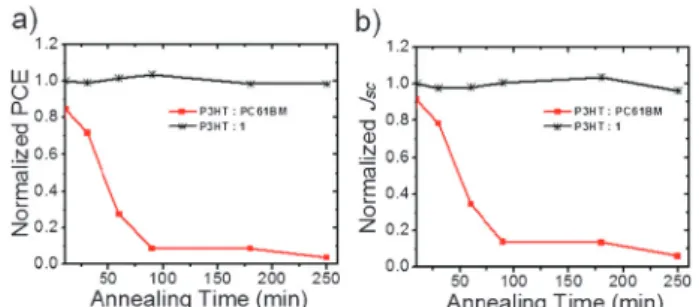
The size of the PCBM domain became even larger with longer annealing time. As a result, the PCE and Jscof PCBM-based
devices showed continuous decay as a function of annealing time (Fig. 4). In contrast, the methano-PC61BM-based PSCs
show very good thermal stability with no obvious decay of PCE and Jscthat could be observed under annealing. This may
be ascribed to the amorphous nature of the new fullerene derivative that remarkably suppresses the continuous growth of phase segregation in BHJ to enhance device thermal stability. In conclusion, we have designed and synthesized a new 56p-electron methano-PC61BM using a very small and stable
1,2-dihydromethano (CH2) group. This new bis-functionalized
fullerene derivative possesses higher LUMO energy level (0.15 eV) and good electron-transporting properties (0.014 cm2V 1s 1)
compared to parent PCBM. The BHJ devices that incorporate methano-PC61BM exhibited much improved performance and
thermal stability than those using the PC61BM/P3HT active
layer. This study provides a simple and generally applicable method to improve the performance and long-term stability of PSCs.
The authors thank the support from the National Science Foundation (DMR-0120967), the Department of Energy (DE-FC3608GO18024/A000), the AFOSR (FA9550-09-1-0426), the Office of Naval Research (N00014-11-1-0300), and the World Class University (WCU) program through the National Research Foundation of Korea under the Ministry of Education, Science and Technology (R31-21410035). S. C. Chien thanks the National Science Council of Taiwan (NSC98-2917-I-009-112) for support in the Graduate Students Study Abroad Program. This work was partially supported by the Strategic Promotion of Innovative Research and Development from Japan Science and Technology Agency, JST (to E.N.): and by the funding for Next-Generation World-Leading Researchers (to Y.M).
Notes and references
1 (a) C. Waldauf, P. Schilinsky, M. Perisutti, J. Hauch and C. J. Brabec, Adv. Mater., 2003, 15, 2084; (b) T. D. Anthopoulos, C. Tanase, S. Setayesh, E. J. Meijer, J. C. Hummelen, P. W. M. Blom and D. M. de Leeuw, Adv. Mater., 2004, 16, 2174.
2 (a) S. Sariciftci, D. Braun, C. Zhang, V. I. Srdanov, A. J. Heeger, G. Stucky and F. Wudl, Appl. Phys. Lett., 1993, 62, 585; (b) G. Yu, J. Gao, J. C. Hummelen, F. Wudl and A. J. Heeger, Science, 1995, 270, 1789; (c) Y. Matsuo, Y. Sato, T. Niinomi, I. Soga, H. Tanaka and E. Nakamura, J. Am. Chem. Soc., 2009, 131, 16048. 3 (a) J. C. Hummelen, B. W. Knight, F. LePeq, F. Wudl, J. Yao and
C. L. Wilkins, J. Org. Chem., 1995, 60, 532; (b) J. M. Kroon, W. J. H. Verhees, J. Knol, J. C. Hummelen, P. A. van Hal and R. A. J. Janssen, Angew. Chem., Int. Ed., 2003, 42, 3371. 4 Y. J. He and Y. F. Li, Phys. Chem. Chem. Phys., 2011, 13, 1970. 5 (a) M. Lenes, G.-J. A. H. Wetzelaer, F. Kooistra, S.-C. Veenstra,
J. C. Hummelen and P. W. M. Blom, Adv. Mater., 2008, 20, 2116; (b) Y.-J. He, H.-Y. Chen, J.-H. Hou and Y.-F. Li, J. Am. Chem. Soc., 2010, 132, 1377; (c) R. B. Ross, C. M. Cardona, D. M. Guldi, S. G. Sankaranarayanan, M. O. Reese, N. Kopidakis, J. Peet, B. Walker, G. C. Bazan, E. V. Keuren, B. C. Holloway and M. Drees, Nat. Mater., 2009, 8, 208.
6 (a) M. Lenes, S. W. Shelton, A. B. Sieval, D. F. Kronholm, J. C. K. Hummelen and P. W. M. Blom, Adv. Funct. Mater., 2009, 19, 3002; (b) G. J. Zhao, Y. J. He, Z. Xu, J. H. Hou, M. J. Zhang, J. Min, H.-Y. Chen, M. F. Ye, Z. R. Hong, Y. Yang and Y. F. Li, Adv. Funct. Mater., 2010, 20, 1480.
7 (a) Y. Zhang, H. L. Yip, O. Acton, S. K. Hau, F. Huang and A. K. Y. Jen, Chem. Mater., 2009, 21, 2598; (b) Y.-J. Cheng, C.-H. Hsieh, P.-J. Li and C.-S. Hsu, Adv. Funct. Mater., 2011, 21, 1723; (c) C.-Z. Li, Y. Matsuo, T. Niinomi, Y. Sato and E. Nakamura, Chem. Commun., 2010, 46, 8582.
8 Organic Photovoltaics: Mechanism, Materials and Devices, ed. S.-S. Sun and N. S. Sariciftci, Taylor & Francis, London, 2005. 9 M. Jørgensen, K. Norrman and F. C. Krebs, Sol. Energy Mater.
Sol. Cells, 2008, 92, 686.
10 Y. Zhang, Y. Matsuo, C.-Z. Li, H. Tanaka and E. Nakamura, J. Am. Chem. Soc., 2011, 133, 8086.
11 Y. Matsuo, A. Iwashita, Y. Abe, C.-Z. Li, K. Matsuo, M. Hashiguchi and E. Nakamura, J. Am. Chem. Soc., 2008, 130, 15429.
Fig. 4 The normalized PCE (a) and Jsc(b) of PSCs based on the
P3HT:PCBM (red), and P3HT:methano-PCBM 1 (black) BHJs as functions of annealing time at 150 1C (normalized according to the optimal PCE and Jscof P3HT:methano-PCBM 1 annealed at 150 1C
for 10 min).
Published on 10 August 2011. Downloaded by National Chiao Tung University on 25/04/2014 02:37:16.