High efficiency microwave digestion purification of multi-walled carbon
nanotubes synthesized by thermal chemical vapor deposition
Chieng-Ming Chen
a, Mi Chen
b,*, Yong-Wang Peng
b, Hung-Wei Yu, Chia-Fu Chen
aa
Department of Materials Science and Engineering, National Chiao-Tung University, Hsinchu, 300 Taiwan
b
Department of Chemical Engineering, Minghsin University of Science and Technology, Hsinfong, Hsinchu, 304 Taiwan Available online 10 August 2005
Abstract
Multi-walled carbon nanotubes (MWCNTs) synthesized by thermal chemical vapor deposition (Thermal CVD) have been successfully purified by high efficient microwave digestion purification method. In this paper, microwave digestion method was introduced to purify carbon nanotubes, because that acid can absorb microwave energy rapidly and dissolve metal efficiently in this method. MWCNTs were placed in 100 ml TFM (thermally resistant form of Teflon) vessels with 50 ml 5 M nitric acid. First, the temperature ramped up to 210-C in 30 min and then kept for 10, 20, 30 to 120 min to digest the catalyst. The efficiency of this method was analyzed by thermogravimetric analysis (TGA) and the results showed that the catalyst content dropped from 10.39% to 1.75% only in 10-min digestion and 1.03% for 120-min treatment. Raman spectroscopy and high-resolution transmission electron microscopy (HRTEM) were applied to analyze the property and structure of raw and purified MWCNTs. This study presents a highly efficient and non-destructive purification method for high purity MWCNTs which can be provided in many applications or intrinsic property studies.
D 2005 Elsevier B.V. All rights reserved.
Keywords: Multi-walled carbon nanotubes; Microwave digestion; Purification; High purity
1. Introduction
In the past few years, carbon nanotubes (CNTs)[1]have attracted a lot of attention on their unique properties; strength and stiffness along with high thermal and electrical conducti-vity. Many studies in the field of nano-structure, fullerence science, physics, chemistry, and materials have been repor-ted. Various beneficial applications, such as field emission displays, nano-scale electronic devices, diodes, sensors, com-posite polymers, mechanical reinforcements, capacitors, and hydrogen storage, have been reported by researchers[2 – 16]. However, most of the synthesis methods were based on the use of metal catalyst. The as-prepared soot contains several kinds of carbonaceous and metal particles which could significantly affect the properties of CNTs and the
performance of any device built of them. Therefore, it is necessary to purify the raw soot to enable detailed characterization and application.
Gas phase oxidation [17]or thermal annealing in air or oxygen atmosphere [18] has been reported to eliminate carbonaceous particles. However, metal catalysts encapsu-lated in tip and wall structure could not be eliminated by oxidation and affect the function of practical applications. Because of this, various chemical or physical methods have been made to remove metal particles[19 – 23].
However, these methods were either time-consuming or defect-inducing process. CNTs were even cut into small pieces by ultrasonication or acid treatment for long time. In our previous studies, we have successfully purified the MWCNTs which were synthesized by electron cyclotron resonance chemical vapor deposition (ECRCVD) using microwave digestion system. The microwave digestion system (Milestone Microwave Labstation ETHOSD) has dual magnetrons (1600 W) can create a homogeneous
0040-6090/$ - see front matterD 2005 Elsevier B.V. All rights reserved. doi:10.1016/j.tsf.2005.07.088
* Corresponding author. Tel.: +886 3 5593142x3339; fax: +886 3 5724727.
E-mail address: [email protected] (M. Chen).
Thin Solid Films 498 (2006) 202 – 205
microwave field with no cold or hot spots that might cause incomplete digestions. The advantages of this method are high temperature, closed vessel, acid digestion prepared samples in shorter time than other methods, less acid consumed and volatile elements available.
Although microwave digestion can dissolve metal efficiently, the amount of residual catalyst in our previous study was still high[24]. This might be that the ECRCVD-synthesized nanotubes were short and the weight percentage of catalyst relatively reached 30%. In this study, as-prepared commercial MWCNTs synthesized by thermal CVD were used to study the efficiency of microwave digestion method and the effects of digestion treatment on nanotubes.
Purification efficiency of microwave digestion at various treatment times was evaluated by thermo-gravimetric analysis. Morphology and structure of nanotubes were observed by scanning electron microscope (SEM) and high-resolution transmission electron microscope (HRTEM). The effect of acid digestion on carbon nanotubes bonding structure was evaluated by Raman spectroscopy (Renishaw system 200, Ar+-laser; 514.5 nm).
2. Experimental details
Sample was weighted and placed in 100 ml TFM vessels filled with nitric acid and put on sample rotor made of Teflon. The power of microwave was set at 100 W and purification was taken at two steps. First, temperature ramped up to 210 -C in 30 min. The second step was carried out isothermally at 210-C for 10, 20, 30 to 120 min. After digestion, the suspension was filtered with 0.1 Am PTFE (poly-(tetrafluoroethylene)) membrane in deionized water. After rinsing with alcohol and vacuum drying for 8 h, there appeared a black thin mat.
The morphology of MWCNTs and the wall structure of nanotubes, before and after purification, were observed by high-resolution transmission electron microscopy (HRTEM, Philips TECNAI 20). The amount of catalyst in the raw and purified sample was estimated by thermo-gravimetric analysis (TGA, PERKIN ELMER 1020 Series TGA 7) with the heating rate of 20-C/min from 30 -C to 900 -C at the air flow rate of 10 sccm. The bonding structure of carbon nanotubes in raw and purified samples was analyzed by Raman spectroscopy (Renishaw system 200, 514.5 nm; Ar+-laser).
3. Results and discussion
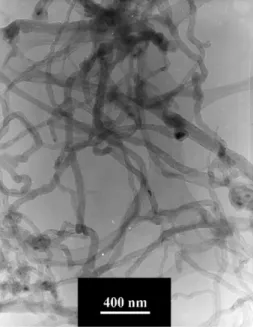
Fig. 1 is a TEM image, which shows that raw sample contains multi-walled carbon nanotubes and catalyst. In this image, metal catalysts of various sizes can be found in the tip or tube wall. The diameters ranging from 40 to 60 nm can also be displayed by TEM.
As shown in Fig. 2, the catalysts embedded in the tip were removed. Obviously, the closed tip was opened by acid treatment in microwave digestion. It seems that closed tip was opened first and the catalyst was eliminated by acid. Another point is that the wall structure was not damaged by acid treatment.
Fig. 3 shows the TGA analysis of raw and 120-min purified sample. Curve (a) shows that the original catalyst content is 10.39 wt.%. The weight starts to reduce near 478 -C and completely evaporate above 773 -C. The decom-position temperature at 622 -C is defined as the inflection point during oxidation process. Besides, there are two region appeared at 601-C and 642 -C. The former might be carbonaceous particles or amorphous carbon, and the latter could be MWCNTs. In curve (b), the weight loss of purified MWCNTs starts from 550 -C and completely burn-out at 728 -C. The amount of residual catalyst dropped to 1.03% in 120-min purified sample. The decomposition temperature
Fig. 1. Low magnification TEM image of raw sample.
Fig. 2. HRTEM image of acid-treated MWCNTs.
in this is 701 -C, which is slightly higher than that of the raw one. The reason might be that the embedded metal catalyst in nanotubes acts as oxidation site and initiated oxidation reaction[25]. It was also reported that the metal impurity would lower the decomposition temperature and increase the decomposition rate[25]. So, the purified sample is thermally more stable towards oxidative destruction than the raw one. Another reason is the containing of carbona-ceous materials in the raw sample. The carboxyl, aldehyde, and other oxygen-containing function groups on the surface of carbonaceous fractions, by report, are extremely hygro-scopic and reactive towards oxidation. However, in curve (b), there is no any separate region except the main combustion region. This result might point out that micro-wave digestion not only removes catalyst but also have potential to eliminate some carbonaceous materials.
As shown in Fig. 4, the residual catalyst content of different digestion time ranges from 10 to 120 min. It is obviously that the content suddenly falls to 1.75% only in 10-min digestion. With increasing purification time, the catalyst content slowly decreases to 1.03% of 120-min treatment. We can find that the effect of time on purification efficiency may not be significant. The reason might be that
most of metal particles were eliminated within the first few minutes; however, the other catalyst covered by tens of graphene layer is difficult to remove (Fig. 5). So, it is not a genius way to increase the digestion time, but to reduce the diameter of carbon nanotubes. The efficiency of microwave digestion could be increased if the diameter of nanotubes is small and uniform.
Fig. 6is Raman analysis of raw and purified sample for 30, 60, 90, and 120 min of treatment. The result of Raman analysis shows that the ratios of IG/ID increase after purification. Some studies[18,25]also have suggested that the IG/IDratio would increase after purification because of the improvement in nanotubes percentage by eliminating amorphous carbon. We can find some amorphous carbon content in the raw sample by TGA analysis, and note this feature in curve b, Fig. 3. So the Raman spectra and TGA analysis could prove each other that microwave digestion method cannot only eliminate metal catalyst but also the carbonaceous materials without structure damages.
Since the discovery of carbon nanotubes, many efforts have been made to obtain the highest purified carbon
Fig. 4. The residual catalyst amount of different acid treatment time.
Fig. 5. HRTEM images of metal catalyst covered by fifty or sixty layers graphene.
Fig. 6. Raman analysis of raw and purified sample for 30, 60, 90, and 120 min of treatment.
Fig. 3. The TGA analysis of raw and purified MWCNTs.
C.-M. Chen et al. / Thin Solid Films 498 (2006) 202 – 205 204
nanotubes[22,23,26]. It is obviously that the past work of chemical purification usually removed catalyst by long time acid treatment, about 24 h or even more. However, it was also reported that long acid treatment time would result in the break of tubes [25]. This might be that oxygen-containing mineral is very efficient to dissolve metal and polyaromatic solids, such as graphite or amorphous carbon. Although the acid could dissolve polyaromatic materials, the acid in microwave digestion system can rapidly absorb microwave energy and quickly dissolve metal particles in very short time preventing the damages of tubes.
Different from the chemical treatment, many kinds of physical methods were provided, such as ultrasonically assisted filtration or oxidation combing with acid treatment
[20,21]. However, metal catalysts embedded in the tip could not be eliminated by ultrasonication. Besides high effi-ciency, the other advantage of digestion method is to eliminate the catalyst embedded in the tubes.
4. Conclusion
In our previously work, we have successfully developed a high efficient and damage-free microwave digestion method. The advantages of this method are high efficient, easy to operate, short in time, free of damage on CNTs and little consumed in reagents. However, the residual catalyst in that time was still high. In this work, we studied the purification efficiency on MWCNTs synthesized by thermal chemical vapor deposition with different parameters by using TGA, SEM, HRTEM and Raman spectroscopy and indented to get high purity MWCNTs in very short time. The results show that the purification efficiency increases with increasing acid treatment time but the most important parameter might be the diameter of carbon nanotubes. Microwave digestion method has great potential to get high purity carbon nanotubes if we can get small and uniform diameter carbon nanotubes. The amount of residual catalyst in purified sample was reduced to 1.75% only for 10-min digestion at 210 -C and 1.03% for 120-min digestion. In conclusion, microwave digestion method may have great potential in mass purification. High quality and large amount of purified CNTs would be applied to more intrinsic studies and industrial applications.
References
[1] S. Iijima, Nature 354 (1991) 56.
[2] W.A. Heer, A. Chaˆtelain, D. Ugarte, Science 270 (1995) 1179. [3] Q.H. Wang, A.A. Setlur, J.M. Lauerhaas, J.Y. Dai, E.W. Seelig, R.P.H.
Chang, Appl. Phys. Lett. 72 (1998) 2912.
[4] A.G. Rinzler, J.H. Hafner, P. Nikolaev, L. Lou, S.G. Kim, D. Toma´nek, P. Nordlander, D.T. Colbert, R.E. Smalley, Science 269 (1995) 1550.
[5] P.G. Collins, A. Zettl, H. Bando, A. Thess, R.E. Smalley, Science 278 (1997) 100.
[6] S. Frank, P. Poncharal, Z.L. Wang, W.A. de Heer, Science 280 (1998) 1744.
[7] C. Liu, Y.Y. Fan, M. Liu, H.T. Cong, H.M. Cheng, M.S. Dresselhaus, Science 286 (1999) 1127.
[8] M.M.J. Treacy, T.W. Ebbesen, J.M. Gibson, Nature 381 (1996) 678. [9] C. Niu, E.K. Sichel, R. Hoch, D. Moy, H. Tennent, Appl. Phys. Lett.
70 (1997) 1480.
[10] E. Frackowiak, K. Metenier, V. Bertagna, F. Be´guin, Appl. Phys. Lett. 77 (2000) 2421.
[11] E. Frackowiak, F. Be´guin, Carbon 39 (2001) 937.
[12] E. Frackowiak, K. Jurewicz, S. Delpeux, F. Be´guin, J. Power Sources 97 – 98 (2001) 822.
[13] K. Jurewicz, S. Delpeux, V. Bertagna, F. Be´guin, E. Frackowiak, Chem. Phys. Lett. 347 (2001) 36.
[14] G. Arabale, D. Wagh, M. Kulkarni, I.S. Mulla, S.P. Vernekar, K. Vijayamohanan, A.M. Rao, Chem. Phys. Lett. 376 (2003) 207. [15] P.G. Collins, P. Avouris, Sci. Am. 12 (2000) 62.
[16] P.M. Ajayan, Chem. Rev. 99 (1999) 1787.
[17] T.W. Ebbesen, P.M. Ajayan, H. Hiura, K. Tanigaki, Nature 367 (1994) 519.
[18] Y.S. Park, Y.C. Choi, K.S. Kim, D.C. Chung, D.J. Bae, K.H. An, S.C. Lim, X.Y. Zhu, Y.H. Lee, Carbon 39 (2001) 655.
[19] S. Bandow, A.M. Rao, K.A. Williams, A. Thess, R.E. Smalley, P.C. Eklund, J. Phys. Chem., B 101 (1997) 8839.
[20] K.B. Shelimov, R.O. Esenaliev, A.G. Rinzler, C.B. Huffman, R.E. Smalley, Chem. Phys. Lett. 282 (1998) 429.
[21] I.W. Chiang, B.E. Brinson, A.Y. Huang, P.A. Willis, M.J. Bronikow-ski, J.L. Margrave, R.E. Smalley, R.H. Hauge, J. Phys. Chem., B 105 (2001) 8297.
[22] Y. Ando, X. Zhao, S. Inoue, S. Iijima, J. Cryst. Growth 237 – 239 (2002) 1926.
[23] X.H. Chen, C.S. Chen, Q. Chen, F.Q. Cheng, G. Zhang, Z.Z. Chen, Mater. Lett. 57 (2002) 734.
[24] C.M. Chen, M. Chen, F.C. Leu, S.Y. Hsu, S.C. Wang, S.C. Shi, C.F. Chen, Diamond Relat. Mater. 13 (2004) 1182.
[25] A.C. Dillon, T. Gennett, K.M. Jones, J.L. Alleman, P.A. Parilla, M.J. Heben, Adv. Mater. 11 (1999) 1354.
[26] J.M. Moon, K.H. An, Y.H. Lee, Y.S. Park, D.J. Bae, G.S. Park, J. Phys. B 105 (2001) 5677.