
銷售人員幫助行為分類之研究–以台灣網通設備產業為例
81
0
0
全文
(2) 銷售人員幫助行為分類之研究–以台灣網通設備產業為例 A Typology of Salespeople Helping Behavior – A Case of Networking Equipment Industry in Taiwan. 研 究 生:郭哲銘. Student:Che-Ming Kuo. 指導教授:張家齊. Advisor:Dr. Chia-Chi Chang. 國 立 交 通 大 學 管理學院碩士在職專班管理科學組 碩 士 論 文. A Thesis Submitted to Master Program of Management Science College of Management National Chiao Tung University in Partial Fulfillment of the Requirements for the Degree of Master of Business Administration June 2007 Hsinchu, Taiwan, Republic of China. 中華民國九十六年六月.
(3) 銷售人員幫助行為分類之研究–以台灣網通設備產業為例 學生:郭哲銘. 指導教授:張家齊 博士. 國立交通大學管理學院碩士在職專班管理科學組. 摘要 本研究目的在運用深度訪談的技巧,來收集和分類台灣網通設備產業的 銷售人員幫助行為。研究結果將銷售人員幫助行為分為與工作無關的私人 幫助和與工作有關的額外服務。與工作無關的幫助可再細分為訊息分享、 休閒活動、滿足未表明的需要、送禮和其他。與工作有關的幫助則分為出 差行程協助、定單相關協助、提供市場情報、形象強化和客戶工作的協助。. 除了幫助行為的分類外,研究結果也發現銷售人員幫助行為的主要動機 在於生意上的利益,也證實了銷售人員幫助行為與銷售人員的工作有正向 的關係。最後,本研究也顯示出工作有關的幫助比工作無關的幫助對銷售 人員的工作有比較大的影響。. 關鍵字:銷售人員幫助行為、分類. i.
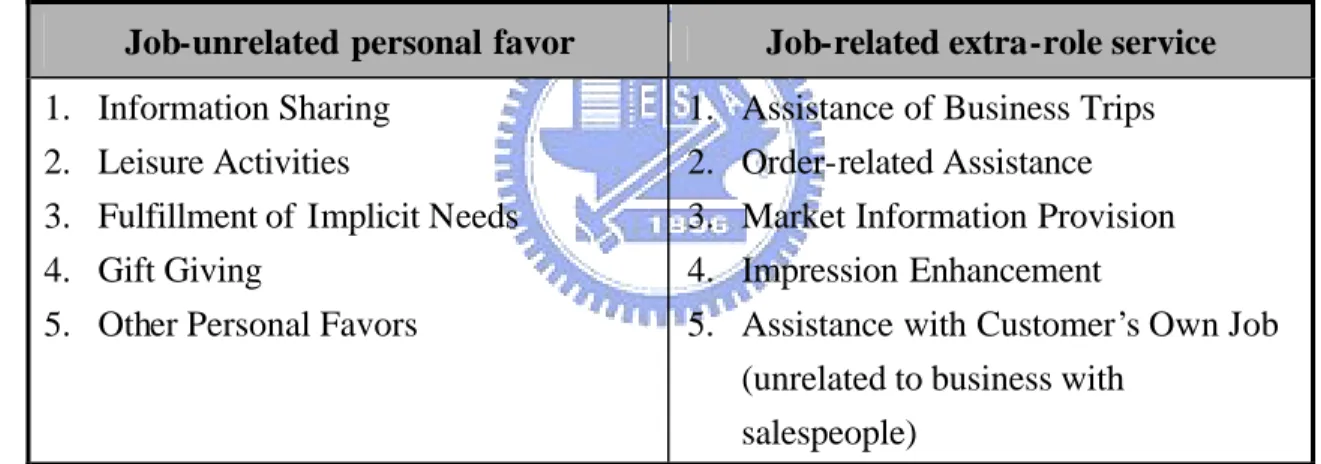
(4) A Typology of Salespeople Helping Behavior – A Case of Networking Equipment Industry in Taiwan. Student:Che-Ming Kuo. Advisor:Dr. Chia-Chi Chang. Master Program of Management Science National Chiao Tung University Abstract In this study, in-depth interviews are conducted to collect and categorize the salespeople helping behavior (SHB) in the networking equipment industry in Taiwan. In the results of the study, the SHB is divided into Job- unrelated personal favor and Job-related extra-role service. Job-unrelated personal favor is sub-categorized into Information Sharing, Leisure Activities, Fulfillment of Implicit Needs, Gift Giving, and Others. Job- related extra-role service includes Assistance of Business Trips, Order-related Assistance, Market Information Provision, Impression Enhancement, and Assistance with Customer’s own Job.. Besides, the business benefits are found to be the major motivation of SHB. The relationship between SHB and business is positively associated. Finally, the study also shows that the job-related SHB gives more influence on business than the job-unrelated SHB.. Key Words: SHB, Salespeople Helping Behavior, Typology. ii.
(5) 誌謝. 回顧這段求學的歷程,忙碌於家庭、工作和學業之間,讓人格外珍惜學習的時光。 課堂上的討論、同學間的友誼、閱讀時的領悟,都是難得的收穫。. 指導教授張家齊老師對學術研究有一貫的堅持與認真,她的耐心指導,是本論文能 夠完成最重要的原因。郭瑞卿和鄭佩瑜同學進行與本論文相關領域的研究,提供了許多 寶貴的心得,讓本研究能夠順利的進行;江秋君、高奐宇、陳慧芸、陳淑懿、黃以江、 廖為新、廖裕傑等其他同學,在論文研討的會議中,展現的研究精神,給予我持續進行 論文的動力;此外,接受訪談的網通產業先進,也為本論文的研究提供許多寶貴的經驗。. 在交大研讀的這段期間,梁義偉、汪顯欽、陳緯、高輔成先生等各級主管的支持與 鼓勵,還有邱文廷、賴宏亮、沈政霆先生和王俐君小姐等其他同事的幫助,讓我能夠兼 顧工作和課業。. 一路走來,感謝家人的支持,他們是我精神上的支柱。特別是內子彭維敏女士在這 段時間的體諒和包容,以及協助逐字稿的打字工作,讓本論文能如期完成。因為這些人 的幫忙,本論文才能順利完成,在此表達對他們的感謝。. 最後,謹以拙作,獻給所有關心我的人。. 郭哲銘謹誌於交大管科所 中華民國九十六年七月. iii.
(6) Table of Contents. 摘要 ............................................................................................................................................ i Abstract ......................................................................................................................................ii 誌謝 ..........................................................................................................................................iii Table of Contents...................................................................................................................... iv List of Tables ............................................................................................................................ vi List of Figures ..........................................................................................................................vii Chapter 1 Introduction...............................................................................................................1 1.1 Research Background and Motivation.........................................................................1 1.2 Research Objectives.....................................................................................................2 1.3 Research Framework ...................................................................................................3 Chapter 2 Literature Review......................................................................................................5 2.1 Definition of Salespeople Helping Behavior ...............................................................5 2.2 Prosocial Organizational Behavior ..............................................................................7 2.3 Altruistic Helping Behavior ....................................................................................... 11 2.4 Commercial Relationships between Salespeople and Customers .............................14 2.5 Selling and Buying in the Industrial Market..............................................................17 Chapter 3 Research Methodology ...........................................................................................19 3.1 Overview of Research Method ..................................................................................19 3.2 Design of Interview Questions ..................................................................................21 3.3 Sampling and Background of Interviewees ...............................................................24 3.4 Interview Process and Contents Analysis ..................................................................27 3.5 Reliability and Validity..............................................................................................27 Chapter 4 Data Analysis ..........................................................................................................29 4.1 Analysis of Interviewee Background .........................................................................29 4.1.1 Statistics of Basic Interviewee Information....................................................29 4.1.2 Classification of Interviewees.........................................................................32 4.2 Typology of Salespeople Helping Behavior ..............................................................34 4.2.1 Job-unrelated personal favor...........................................................................35 4.2.2 Job-related extra-role service..........................................................................41 4.3 Analysis of Salespeople Helping Behavior................................................................46 4.3.1 Motivation of Salespeople Helping Behavior.................................................46 4.3.2 Relationship between SHB and Business .......................................................48 Chapter 5 Conclusions .............................................................................................................51 5.1 Conclusions ................................................................................................................51 5.2 Managerial Implications ............................................................................................51 5.3 Research Limitations .................................................................................................52 iv.
(7) 5.4 Suggestions for Future Research...............................................................................52 Reference .................................................................................................................................54 Appendix A: Questions of In-depth Interviews .......................................................................57 Appendix B: Questions of Interviewee Basic Information......................................................58 Appendix C: Quotations of Interview Contents ......................................................................59 Appendix D: Table of Job-unrelated Personal Favor...............................................................61 Appendix E: Table of Job-related Extra-role Service ..............................................................67. v.
(8) List of Tables. Table 3.1 Basic Information of Interviewees… … … … … … … … … .… … … .… … ....… … .… .26 Table 4.1 Statistics of Basic Interviewee Information… … … … … … … … … … … ..… ..… … ..30 Table 4.2 Criteria of Interviewee Classification… … … … … … … … … … .… … … … … … ......33 Table 4.3 Classification of Interviewees Status… … … … … … … … … … .… … … … … ...… … 33 Table 4.4 Simplified Business Models of Companies of Interviewees… … … .… … … … ...… 34 Table 4.5 Interviewee Classification by Status and Business Model… … … … .… … … ...… ...34 Table 4.6 Typology of Salespeople Helping Behavior… … … … … … … … … .… … … ...… … .35 Table 4.7 Subcategory of Job-unrelated Personal Favor… … … … … … .… … … … ...… … … ..36 Table 4.8 Subcategory of Job-related Extra-role Service… … … … … .… … … … … ...… … .… 42 Table 4.9 Motivation of Salespeople Helping Behavior… … … … … .… … … ..… … … … … ....47 Table 4.10 Effect of SHB on Business… … … … … … … … … … … … .… … … ..… … … … … ..49 Table 4.11 Most Effective SHB to Business… … … … … … … … … … … .… ..… … … ....… … .50. vi.
(9) List of Figures. Figure 1.1 Research Flow… … … … … … … … … … … … … … … … … … ...… … … … … … … … 4 Figure 2.1 Salesperson-Customer Relationships and Classification of Customers… … ...… ...15 Figure 2.2 Model of Relationship Quality… … … … … … … … … … … … … ...… … … … … … .16 Figure 3.1 Selling Model of Networking Equipment Industry… … … ...… … … … … … … … ..25. vii.
(10) Chapter 1 Introduction 1.1 Research Background and Motivation. Selling is one of the most important activities for businesses, because it brings in cash flow to maintain the operation of businesses. Salespeople not only offer acceptable products or service to their customers, they also need to have good relationship with key customers to facilitate the sales of products and service and to prevent from customer loss due to intense competition. Especially in the industrial market, salespeople have to monitor key accounts, understand their problems, and be ready to serve them in a number of ways. They must do more than the call of duty: call or visit customers frequently, take customers to dinner, and make useful business suggestions (Philip Kotler, 2003, P.660).. In the study of George (1991), it pointed out that role-prescribed helping behavior is positively associated with sales performance. It could be inferred that better service quality, faster delivery, and lower price might strengthen the business relationship between salespeople and customers and then contribute to the sales performance. However, salespeople also conduct a lot of extra-role helping behavior beyond the call of duty. The extra-role behavior defined as Salespeople Helping Behavior (SHB) in this study actually plays an important role in the selling process.. It is often read in newspapers that salespeople actively take care a lot of things for customers in addition to their duties, then become good friends with customers, and finally win customers’ trust and business (夏淑賢, 2006). Price and Arnould (1995) also reported that extra attention is a significant factor in positive emotional responses to service encounters. If salespeople conduct more effective SHB than competitors, they get close to customers and 1.
(11) have the advantage of selling their service or products and thus get better job performance (Dyne & Lepine, 1998).. Although some studies report that organizations should encourage employees to go beyond the boundaries of their jobs in order to bring about positive change at work (Morrison & Phelps, 1999; Dubinsky & Skinner, 2002), there is barely any literature discussing how SHB affects the private relationship between salespeople and their customers (林崇孝, 2006). Therefore, it is important to explore the effects of SHB on the salespeople-customer relationship and the contributio n of SHB on sales management.. 1.2 Research Objectives. One of the major aims of this study is to collect and categorize business-to-business (B2B) SHB of the networking equipment industry in Taiwan. Because the current literature is limited (林崇孝, 2006), it is not enough to support related quantitative researches such as the effect of SHB on sales performance. There are also some other literatures in which extra service and prosocial organizational behavior are discussed, but the authors do not focus on SHB. After the types of SHB are identified and presented, the whole picture of extra-role helping behavior could be described, thus further quantitative studies could proceed.. In the B2B networking equipment industry, there exists long-term business partnership between buyers and sellers, so salespeople in the field have much incentive to maintain or promote the relationship. Therefore, SHB might be implemented to contribute to the progress or growth of closeness (Dyne & Lepine, 1998; George, 1991). In order to identify the types of SHB, experienced salespeople are ideal participants to be interviewed with.. 2.
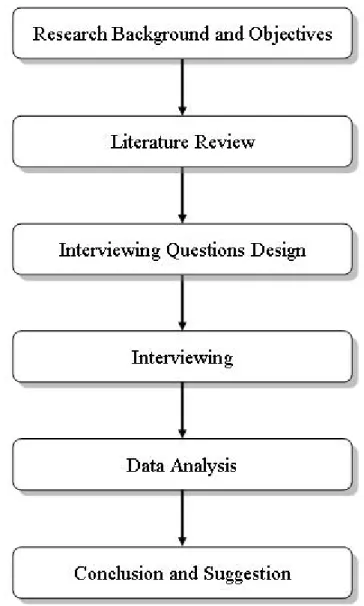
(12) Although it is obvious that extra-role helping has positive effect on the emotional responses of customers (Price & Arnould, 1995), salespeople in the networking equipment industry do not help customers on any occasion. Besides, some salespeople tend to help others but some do not. Knowing the motivation behind SHB would be helpful to understand the meaning of SHB to salespeople even though there might be individual differences.. Based on the study of Swan et al. (2001), SHB is expected to be positively association with salespeople-customer relationship. George (1991) also suggested that role-prescribed prosocial behavior contributes to sales performance, so SHB is hypothesized to be positively associated with sales revenue in this study. Through interviews, the responses from salespeople are expected to verify the arguments.. Finally, the ultimate purpose of the research is to offer constructive reference for further studies to probe the effect of SHB on sales performance and the relationship between salespeople and their customers.. 1.3 Research Framework. This study is conducted by following the research flow illustrated in Fig. 1.1. It is divided into five chapters. Chapter 1 introduces the research background, motivation, and objectives. Literature review is specified in Chapter 2 focus ing on Salespeople Helping Behavior and Prosocial Behavior. The research method, in-depth interviewing, as well as interview questions design are discussed in Chapter 3. The interview records are analyzed and presented in Chapter 4. Finally, conclusions and suggestions are in Chapter 5 for further research.. 3.
(13) Figure 1.1 Research Flow. 4.
(14) Chapter 2 Literature Review. Literature review is divided into five parts in this chapter. Firstly, the definition of Salespeople Helping Behavior (SHB) is stated to be the core of the thesis. The next is Prosocial Organizational Behavior. SHB is a kind of prosocial organizational behavior, so the related papers are discussed to help probe the essence of SHB. And then is Altruistic Helping Behavior. SHB is inspected from the standpoint of altruism. The fourth section is Commercial Relationships between Salespeople and Customers. The articles show the relationship between SHB and commercial friendship. The final part is about Selling and Buying Behavior in the Industrial Market. The behaviors of salespeople and customers are described to be the background of Business-to-Business SHB.. 2.1 Definition of Salespeople Helping Behavior. The helping behavior that salespeople conduct on customers could be role-prescribed or extra-role. The role-prescribed is that salespeople follow the corporate regulations or managers' indications to execute their tasks and serve customers. The extra-role is that salespeople help their customer on something beyond the request of their companies. Salespeople Helping Behavior (SHB), proposed by Chang (2005), is the later and is defined as the extra-role assistance provided by salespeople directly at customers. The implementation of SHB is out of the discretion and willingness of salespeople.. Because there are limited empirical researches on SHB, the related discussion could only found in the literature of prosocial behavior (Brief & Motowidlo, 1986 and Bettencourt & Brown, 1997). SHB could be divided into two forms. One is job-unrelated personal favor; the other is job-related extra-role service. Based on the definition of Brief & Motowidlo, 5.
(15) job-unrelated personal favor of SHB is that salespeople help consumers with personal matters unrelated to organizational services or products, while job-related extra-role service of SHB, based on the study of Brief & Motowidlo and Bettencourt & Brown, means salespeople provide extra-role services or products to consumers both in organizationally consistent and inconsistent ways. For example, “Voluntarily assists customers even if it means going beyond job requirements.”, “Helps customers with problems beyond what is expected or required.”, “Often goes above and beyond the call of duty when serving customers.”, “Willingly goes out of his/her way to make a customer satisfied.”, “Frequently goes out the way to help a customer.” (Bettencourt & Brown, p.48), and “provide a service by igno ring important organizational rules and procedures and thereby help the client” (Brief & Motowidlo, p. 713). From the above statement, it is quite clear that companies would benefits from SHB when salespeople voluntarily offer extra assistance and promote the business image. But SHB is not always good for business. Out of some private reasons, salespeople may offer help against the benefits of companies (Brief & Motowidlo, 1986).. It is well known that salespeople try very hard within their capability to advance the relationship with customers for better sales performance. It is quite reasonable to infer that salespeople would catch opportunities to show the courtesy actively. But it is also possible that customers would ask salespeople a favor in explicit or implicit ways. It is not clear that whether salespeople expect to receive material or social rewards in return while they are planning and helping customers. They may conduct SHB due to altruism.. SHB could be found both in business-to-business (B2B) and business-to-consumers (B2C) environment. B2C is a simple environment. A consumer is usually the right person to make a decision, purchase and utilize a product. Therefore, only few persons would be involved in a single event of SHB. On the other hand, the situations are more complicated in 6.
(16) B2B setting. The trade between two companies usually proceeds as a team-to-team activity and involve a lot of persons. The role of salespeople could be played by CEO, sales managers, product managers, or other employees. It depends on the organization structures and the job definitions in companies. Besides, salespeople need to face customers with different positions in a company because the buying decision is made by a group of persons called buying center (Anderson & Dubinsky, 2004; Solomon, 2004). Most of time, salespeople also face a challenge from competitors who may have common interest with members inside the buying center. Consequently, B2B SHB is conducted with a complex combination of people, interest, motivatio n, and other factors.. From the above statements, SHB is actually a form of prosocial behavior (Brief & Motowidlo, 1986) and a form of positive social acts carried out by salespeople to produce and maintain the well-being of customers.. 2.2 Prosocial Organizational Behavior. In the study of Brief and Motowidlo (1986), it defines “Prosocial organizational behavior is behavior which is (a) performed by a member of an organization, (b) directed toward an individual, group, or organization with whom he or she interacts while carrying out his or her organizational role, and (c) performed with the intention of promoting the welfare of the individual, group, or organization toward which it is directed.” (p.711) Moreover, among the 13 kinds of prosocial organizatio nal behaviors mentioned in the article, two of them are extra-role helping on customers. One is “Provide services or products to consumers in organizationally inconsistent ways”. It means “Customers or clients might be helped by providing goods or services in a manner that is detrimental for the organization”. The other is “Helping consumers with personal matters unrelated to organizational services or products”. 7.
(17) Based on the above statement, SHB is actually a particular form of prosocial organizational behavior carried out by salespeople to benefit customers. Therefore, it would help understand the facets of SHB through reviewing the literature of prosocial organizational behavior.. As we know, the job of salespeople is to assist or aid customers in determining and satisfying their differing needs, informing products features and characteristics, and being responsive to their concerns (George, 1998). Their sales performance is positively associated with the role-prescribed prosocial behavior (George, 1991). Puffer (1987) also pointed out that salespeople engage in more prosocial behavior, they perform better on job. It seems that managers should encourage salespeople to conduct prosocial behavior in working settings to get better work performance.. Meglino and McNeely (1994) suggested that the factors responsible for prosocial behavior could be divided into dispositional or antecedent variables by the beneficiaries. They claimed that the two dispositional variables, the value of concern for others and empathy, explain the influence in prosocial behavior directed only at specific individuals and the two situational variables, perceptions of reward equity and recognition, explain the influence in prosocial behavior directed only at the organization. The statement seems consistent with the studies of Puffer (1987) on nontask behavior, Bettencourt and Brown (1997) on fairness perception, Chebat and Kollias (1998) on empowerment, George (1991 & 1998) on mood, and the results of the studies of altruistic helping behavior discussed in the next section.. Puffer (1987) found that “need for achievement”, “satisfaction with material rewards”, and “low perceived peer competition” are positively related to prosocial behavior. He explained that achievement-oriented individuals tend to actualize their need to excel by performing nontask behavior that benefit the organization; satisfying financial security 8.
(18) improves one’s situation and foster prosocial behavior; perceived peer competition could lead to focusing on oneself and ignore the opportunities for performing prosocial behavior. Although the research of Puffer is quite persuasive, Baruch et al. (2004) conducted an experiment and have more detailed explanation about the relationship between “need for achievement” and prosocial behavior. People with a strong “need for achievement” are not always willing to conduct prosocial behavior. They perform prosocial behavior only when doing so is not at the expense of their own success.. Bettencourt and Brown (1997) proposed that fairness perception of contact employee is positively related with service quality. Fairness of job supervision, pay and promotion rules, and supervisor administration of these rules are used to be key predictors of contact employee prosocial service behavior, extra-role customer service, role-prescribed customer service and employee cooperation. Fairness of job supervision is significantly positive to the three types of prosocial behavior. It reveals that customer service managers should avoid bias in daily activities and allow contact employees appropriate authority in serving customers. Fairness in pay and promotion rules have employee believe that exceptional service will be recognized and rewarded in the long run. Fairness of supervisor administration is the basic consideration of contact employees engaging in performance above and beyond the call of duty.. Chebat and Kollias (2000) indicated empowerment is a way to promote prosocial behavior because it could increase the ability of employees to adjust their behavior to accommodate customer needs and requests. If contact employees are more adaptive, they are more effective when performing role-prescribed tasks and more willing to provide extra-role support to their client s. The discovery of empowerment on prosocial behavior is consistent with the effect of fairness of job supervision in the study of Bettencourt and Brown (1997).. 9.
(19) George (1991) proposed positive moods at work foster both role-prescribed and extra-role prosocial behavior. People in positive moods are more likely to conduct helping behavior directed at customers no matter it is part of their job or beyond the call of duty. In addition, the customer-service behavior is positively related with sales performance. The study also supports the hypothesis that positive mood has more significant effects on prosocial behavior over and about the effects of fairness cognition. George (1998) explicitly pointed out “One important determinant of helping behavior is a help giver’s current mood state which, in the case of salespeople, refers to a salesperson’s mood at work or how a salesperson feels on the job”.. In the study of George (1998), George took a further step to explore the effect of mood on helping behavior. Moods could be separated into two independent and major dimensions, positive mood and negative mood. In daily activities, both positive and negative moods foster helping behavior (Cialdini et al., 1973). But in a sales context, positive mood facilitates salesperson helping behavior while negative mood may hinder help towards customers or provision of high quality service. George offered several explanations for the effects of positive mood. First, it results in a salesperson perceiving sales opportunities more positively. Second, it results in a salesperson having more helping and positive approach towards customer service. Third, it leads to salespeople finding others more pleasant or appealing and makes salespeople more likely to provide help. Lastly, it may lead to a more positive perspective on human nature and result in salespeople more genuinely desiring to be helpful to customers. George finally suggested that positive moods at work may be fostered by promoting a sense of competence, achievement, and meaning in the workplace, providing rewards and recognition, keeping work group or team size relatively small, and the leader's having a positive mood.. 10.
(20) From the above description, prosocial organization behavior plays an important role in the work environment. Some factors could be controlled to facilitate it for creating better work performance such as fairness perception and empowerment. The others, such as empathy and concern for others, seem to come from the nature of human being and are hard to be influenced. Since SHB is a kind of prosocial organizational behavior, its characteristics should be similar with those of prosocial organizational behavior although it is left to be verified further.. 2.3 Altruistic Helping Behavior. From 1978, more than 100 helping behaviors have been studied with few systematical attempts to define the types of helping (Pearce & Amato, 1980). Until 1980, Pearce and Amato use multidimensional scaling procedures to distinguish helping behaviors and to define a three-dimensional framework: planned, formal vs. spontaneous, informal help; serious vs. nonserious help; and giving, indirect vs. doing, direct help. The framework contributes to stimulate new directions in helping research, create new helping forms, and plan helping studies.. Compared with the various and complicated helping behavior, altruistic helping behavior is the helping behavior due to altruism. It is a kind of prosocial behavior like SHB. When people are conducting SHB, do they expect tangible or intangible return? If salespeople engage in a kind of extra service on the job, they might expect rewards from supervisors or customers. But if the behavior is a kind of job- unrelated helping, it would be hard to know the truth. Some salespeople might expect something in return but hide the idea in their mind. Some salespeople might engage in helping behavior due to altruism. Because of the ambiguity between SHB and altruistic helping behavior, the related literature would be reviewed in this 11.
(21) section.. Baumann et al. (1981) has a general introduction on helping behaviors and contributes to probe the altruistic helping behavior. Baumann et al. followed the studies of Cialdini et al. (1973) and indicated two propositions of helping. One is “The U-Shaped Curve ”. Both positive and negative mood increases helping for adults. But for young children, only positive mood has the effect because they have not completed socialization process like adults. The other is “An Instrumental Model for Negative Mood”. Helping is instrumental to the removal of the mood state while adults are in a negative mood. He stated further that “… when the costs of helping were low and the benefits high did individuals attempt to remove a negative mood state via prosocial action”. Baumann et al. also conducted an experiment to support the prediction that helping is the functional equivalent of self- gratification. The effects of mood state on self- gratification are parallel to the effects of mood on helping.. The study of Guéguen and Gail (2003) also supported the effect of mood on altruistic helping behavior. They conducted an experiment that subjects receiving smile from a stranger would enhance subsequent helping behavior towards another person. Because the subjects had no reason to help the third person, Guéguen and Gail explained that the effect of smiling on helping is mediated by a positive mood.. Intuitionally, empathy-based helping is essentially a pure altruistic behavior, but Cialdini et al. (1987) had a different opinion. In order to explore that empathy-based helping is selflessly or selfishly motivated, Cialdini et al. conducted two experiments to investigate the effects of empathy and sadness. Empathy means selfless altruism and sadness means selfish altruism. The results of the first experiment show that helping is predicted by the levels of sadness that subjects are experiencing, not by their empathy scores. The results of the second 12.
(22) experiment show that subjects in the high-empathy set, labile-mood condition help at a higher level than subjects in other three combinations of empathy sets and mood conditions. With the results, Cialdini et al. indicated that empathy-based helping is a selfish behavior rather than a selfless one. While observing others are suffering, people with high empathy are more likely to help them but it is not due to selfless desire. In other words, when sadness is increased with higher empathy, people try to reduce the sadness by helping others. The helping behavior is out of egoistic desire to relieve the sadness under conditions of high empathy.. After reviewing the related studies, Resenhan et al. (1981) suggested that the relatively global terms, positive and negative, might make readers confused that all negative or positive moods have much in common. Resenhan et al. gave examples that “Fear and anger are more different than they are the same; sadness and shame, both negative affects, have less in common than that simple rubric might imply”. To tell from the effects of “joy experienced for the self” and “empathic joy” (joy for other people), they conducted an experiment of helping to distinguish the difference. The results show that joy experienced to the self facilitates altruistic behavior and empathic joy depresses the level of altruistic behavior. They further compared the data with those from Thompson et al. (1980) and got reverse results that empathic sadness promoted altruism and egocentric sadness retards it. They further explained “If one perceives that another’s sadness is much greater than one’s own, one ’s subsequent thoughts are more likely to be directed to the plight of the other and to the fact that the other requires help.” and “The combined impact of cognitions about one’s own emotional wealth and another’s relatively impoverishment increments the likelihood that altruistic behavior will arise.”. It demonstrates that whether joy or sadness results in altruism depends critically on whether attention is directed to self or to others.. The above articles suggest that altruistic helping behavior may arise from subtle reasons 13.
(23) such as self- gratification or desire to relieve sadness. It seems that the motivation of altruistic helping behavior only exists in positive mood.. 2.4 Commercial Relationships between Salespeople and Customers. Commercial friendship is an important type of marketing relationship. It develops in the encounters between service providers and clients. In addition to the key marketing objects: satisfaction, loyalty, and positive word of mouth, commercial friendship is also associated with affection, intimacy, social support, loyalty, and reciprocal gift giving as friendship (Arnould & Price, 1999). Arnould and Price also indicated characteristics and recurrent nature of service encounters could contribute to friendly commercial exchange for more intense friendships. Although the characteristics of the commercial friendship are quite similar with those of friendship, there exists differences between them. The business environment and interest conflicts lead to a significant minority of participants to consider it inappropriate to form a friendship with their commercial partners, even in an environment likely to foster relationships.. SHB involves positive individual characteristics, such as friendliness and social support, to provide structural opportunities the formation of commercial friendship, so there should be some kinds of connections between SHB and commercial friendship. When the relationship between salespeople and customers are closer, it is more likely that SHB is conducted. On the other hands, when SHB is conducted, the relationship between salespeople and customers is more likely to get closer.. In the study of Swan (2001), it reported that the salespeople-customer relationships perceived by salespeople may guide their interactions with that customer. It conducted 14.
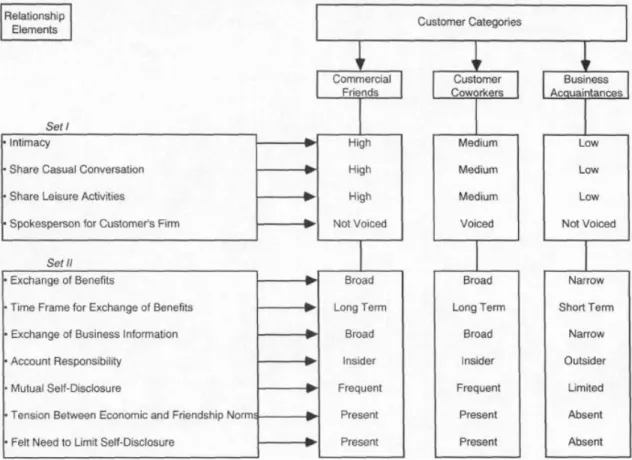
(24) in-depth interviews with salespeople to establish a classification schema of customer types for better understanding the relationships and identified three customer identities: commercial friends, customer coworkers and business acquaintances. Commercial friends have the closest relationships and business acquaintances have the least relationships. In the results of interviews, the relationship elements were divided into two sets (Figure 2.1). Intimacy, share casual conversation, share leisure activities, and spokesperson for customer ’s firm are in the first set; exchange of benefits, time frame for exchange of benefits, exchange of business information, account responsibility, mutual self-disclosure, tension between economic and friendship norms, and felt need to self- disclosure are in the second.. Figure 2.1 Salesperson-Customer Relationships and Classification of Customers Source: Swan et al., 2005. The first set defines the extent to which customers and salesperson relate personally and 15.
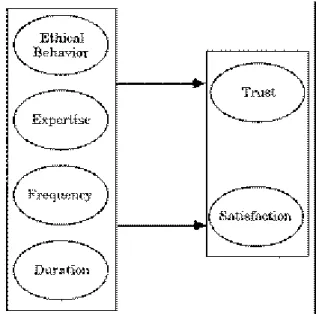
(25) the second set relates the expectations and trust that salespeople hold for the relationships. According to the definition of SHB, some relationship elements in Figure 2.1 could be referred to salespeople helping behavior. “Share Casual Conversation”, “Share Leisure Activity”, and “Mutual Self- Disclosure” are types of job-unrelated personal favor while “Exchange of Business Information” is a type of job-related extra-role service. When the relationship between salespeople and customers are stronger, there are more frequent SHB. This gives strong support for the connection between commercial friends and SHB.. Although the commercial relationship is decided both by salespeople and customers, customers might have more power to affect it because salespeople have incentives to maintain it. In the study of Lagace et al. (1991), a model of relationship quality developed by Crosby et al. (1990) was extended by adding ethical behavior of salespeople as an independent variable (Figure 2.2). The model is developed from the point of view that customers observe the behavior of salespeople. Ethical selling behavior, salesperson expertise, and extent of relational contact would impact trust toward salespersons and satisfaction with exchanges.. Figure 2.2 Model of Relationship Quality Source: Lagacy et al., 1991 16.
(26) 2.5 Selling and Buying in the Industrial Market. Selling in the industrial market is much more challengeable than in the consumer market. Many industrial products are made and based on specifications and tend to be homogeneous. It is easy for competitors to slightly improve a product and sell it as their own or to cause competition on price. If all factors are equal, industrial customers accepting industry standards may sign the contract with the seller submitting the lowest price. The pricing is also complex. There are a lot of factors for salespeople to estimate the final price: period of agreement, current and future labor and material costs, availability of materials, expected salvage value of equipments, product service agreements, cost-effectiveness of manufacturing facilities, and return on investment. Because of the many factors affecting the price, salespeople may be given a range of prices to negotiate with customers (Futrell, 1993).. Because industrial products often involve a lot of knowledge about the product category, salespeople face knowledgeable buyers and need more product training and considerable expertise. Usually industrial customers are professional and their decisions are based on past experience and weighting of alternatives. The purchase decisions are actually made by a group of organization members. When a collective decision is made, the members play a number of specific roles (Anderson & Dubinsky, 2004; Solomon, 2004). These roles include: 1. Initiator: The person who brings up the idea or needs. 2. Gatekeeper: The person who conducts the information search and controls the flow of information available to the group. In organizational contexts, the gatekeeper identifies possible vendors and products for the rest of the group to consider. 3. Influencer: The person who tries to sway the outcome of the decision. 4. Decider: In many cases these are higher- level managers who have power to select or approve suppliers and final purchase decisions. For routine purchases, the purchasing 17.
(27) agents are the deciders. 5. Buyer: People with formal authority to order supplies and negotiate purchase terms within organizational constraints. 6. User: People who will actually use the product or service purchased. Depending on the decision, some or all of the organizational members may participate in and one person may play one or more roles.. The relationships between buyers and sellers are critical in industrial market. Both sides need to create and maintain long-term relationship. Buyers want to do business with trusted, reliable salespeople who can truly look out for their organization’s best interests while sellers want long-term business to bring in steady income. Both parties need to have mutual trust in one another and cooperate with one another to pursue win-win solutions for more profits (Anderson & Dubinsky, 2004).. 18.
(28) Chapter 3 Research Methodology. 3.1 Overview of Research Method. As little work has been reported in the literature on SHB, this study employs in-depth interviewing , a qualitative inductive research approach, to collect SHB from salespeople. Maintaining good relationship is essential to business, so salespeople usually take it for granted to do favors to customers and the helping behaviors eventually become tacit knowledge. To transfer SHB into explicit knowledge, in-depth interviews are employed to interactively communicate with salespeople and to elicit stories in their sales career.. Personal interviewing is one of methods which collect primary data. Through moderately design and professional skills, an experienced interviewer could guide the interviewee to share inner opinions and thinking in the face-to-face process. The advantage of personal interviewing is to acquire detailed and deep data. Interviewers could explain questions further or ask extra questions to collect more information. On the other hand, the disadvantage of personal interviewing is the high cost of time and money, especially in broad sampling area. Another drawback of personal interviewing is that the quality of collected data depends on the ability and the willingness of interviewee cooperation. Interviewees may reply with unreliable answers while privacy is involved in the questions. Therefore, a qualified interviewee must be able to offer useful information, understand his own role, and be willing to cooperate in the interview (Cooper & Emory, 1996; Cavana et al., 2005).. Generally speaking, there are three structure types for interviews, structured, unstructured, and semi-structured (Cavana et al., 2005). The structured interview is based on a strict order of presentation of questions which are carefully designed in limited response format. The 19.
(29) interviewer follows a prepared agenda to control and guide the whole process. It is quite useful to collect quantitative data. For the unstructured interview, there is no clear agenda and list of questions but it just aims to enable the interviewee to talk generally about issues. It relays on interaction or conversation between an interviewer and an intervie wee to find out the answers for studies. The position of the semi-structured interview is between the structured and the unstructured. It predefines some topics to be addressed in the interview but allow the respondent to initiate new topics or relevant issues (Memon & Bull, 1999). From the above statement, in-depth interviewing is actually a semi- structured interview (杜幼章, 2006) and a highly skilled activity which needs carefully preparation.. In-depth interviewing is much different from simple interviews. It is conducted to get real feeling and important data which is unable to be obtained by ordinary interviews. Researchers must understand the research problems and the purpose of interviews very well. With open, direct, and oral questions, real messages and thinking hidden inside the deep mind of interviewees are revealed through the description for stories and cases (Crabtree & Miller, 2002). By means of analyzing the messages and thinking, researchers could understand the meaning, the impact, and the solutions to a study. In-depth interviews take much more time than ordinary interviews, but they could probe the essence of study more thoroughly for further analysis (萬文隆, 2004).. In the in-depth interviews for SHB, open-ended questions are designed to have salespeople freely talk about their experience of helping customers. If replies are not reasonable enough or some other doubt arises, further questions would be proposed to make them clear. It allows the interviewees to have wide choices to answer questions, so the contents of interviews would finally depend on the interaction between the interviewer and the interviewee. 20.
(30) 3.2 Design of Interview Questions. The purpose of the interview questions design is to collect and categorize salespeople helping behavior from the points of view of salespersons. According to the interview objective, the agenda of the in-depth interviews is developed and divided into stages: (1). Explain the purpose and procedures of the in-depth interview.. (2). Inquire the markets of the interviewees.. (3). Follow the designed questions to conduct the interview.. (4). Collect the basic information of the interviewees.. (5). Express appreciation to the interviewees.. Based on the literature, SHB could be job-unrelated personal favor or job-related extra-role service, so the questions are designed to collect various SHB from different scenarios. Before the formal questions are decided, three salespersons are interviewed for question adjustment. According to the results of pre-interviews and literature review, eight questions are finally designed to collect SHB.. Question 1: What topics do you usually talk with customers in addition to business?. Salespeople and customers do not always talk about business. They need other topics to alleviate the business tension and create personal relationship. To take a further step, they may develop a kind of commercial friendship which might accompany with mutual help. The focus of this question is to collect job-unrelated helping behavior. In the beginning, interviewees would be asked about the chat topics and then guided to reveal the interaction between salespeople and customers. Gift giving, information sharing, and motional disclosure would be typical job-unrelated helping.. 21.
(31) Question 2: What have you ever done to impress important customers? Trust is a key factor for the long-term salespeople-customer relationship. To win customer's trust, salespeople need to pay attention to a lot of things including impressing customers. The question is designed to start with this topic. While interviewees are answering the question, it is expected that both in-role and extra-role helping behaviors would be fo und. In addition to gift giving, business trip assistance, and entertainment, there should be other significant events which largely improved the image.. Question 3: How do you have customers satisfy your products or services? To satisfy customers, it needs to provide better products or services than competitors. In the fiercely competitive market nowadays, salespeople may do much more beyond the call of duty to get business. They should have their own methods to find customers' needs and satisfy them. During the process, it is expected that both job-related and unrelated extra-role service would be found. The question is designed to have interviewees show their selling skills first and then directly ask what extra-role assistance they have ever given to customers.. Question 4: What things on business have you ever done to copy with urgent requests from your customers?. Urgent requests from customers usually involve product manufacturing, product delivery, and a large sum of money. To deal with those requests, salespeople may need to interrupt current going tasks, communicate with or persuade coworkers in other departments. It takes a lot of effort, so salespeople are not always pleased to do such things unless it brings more profits. To some extent, there is ambiguous room for salespeople to decide how to respond to the requests. Especially, in the business-to-business environment, a contract is usually signed before products are shipped to the customer. If there are conflicts between the contract and the 22.
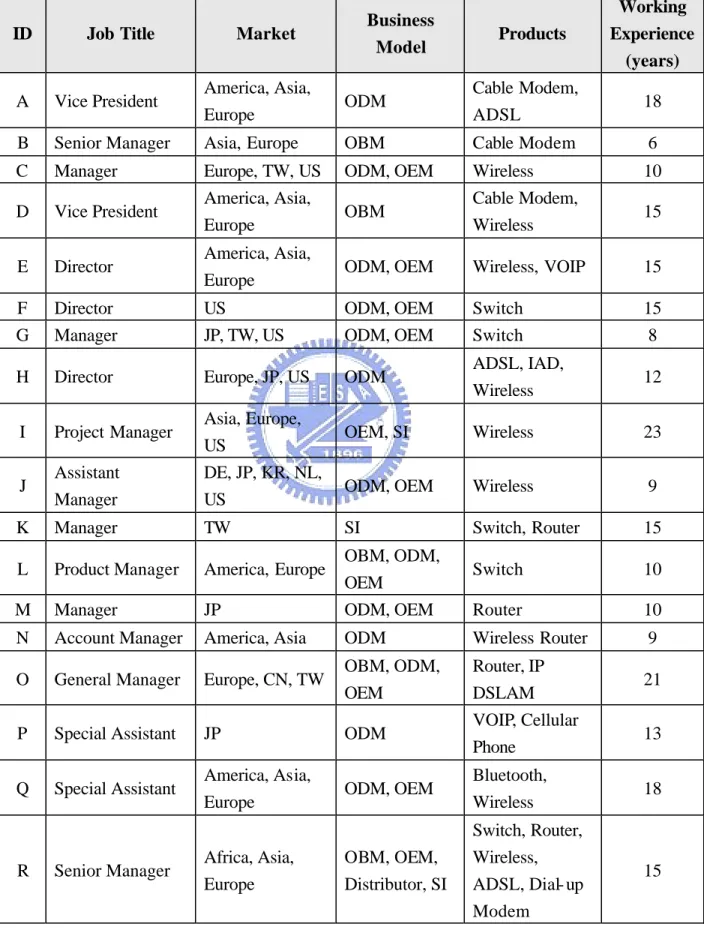
(32) request, salespeople would have some alternatives to choose. Therefore, this question is designed to collect such kind of job-related helping behavior.. Question 5: What resources have you ever utilized to serve customers in addition to those from your company?. Helping customers with resources other than companies offer is actually a kind of extra-role service because employees are under no obligation to do so and it is out of their own discretion. Working overtime, use one's own money to pay bills, and asking friends to do favors to customers are all included in the definition of SHB. The question is intended to have interviewees recall for more examples and to observe if salespeople often use personal resources to facilitate their business.. Question 6: What kinds of helping behaviors have you ever conducted to benefit customers which are not related to your business directly?. The various products or parts in a company may be provided by different suppliers. When the problems occur, customers would first find related persons to take care them. However, the problems are not always easy to be solved due to complexity or other reasons. To solve these problems as soon as possible, customers might turn to other people who have no responsibility to the issues but are capable of offering solutions. There are similar SHB found in the pre-test interviews, so the question is designed to collect such kinds of helping behaviors.. Question 7: What kinds of gifts have you ever given to customers? Gift giving is a kind of typical SHB. Because the types of gifts may vary from person to. 23.
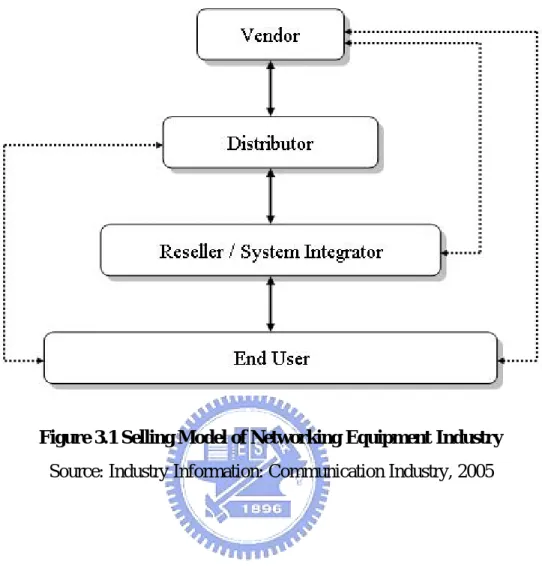
(33) person, this question is specifically designed to deal with and classify complicated situations. Gifts are usually manipulated to please customers, so it is worthy to pay more attention on the motivations and considerations while listening to interviewees. Customized gifts and gifts for other family members are also collected in this question.. Question 8: Do you think that the help you mentioned towards customers could also facilitate your sales revenue? What is the most effective help?. After replying the above seven questions, the influence of SHB on business may or may not be revealed in the answers of interviewees. To confirm the effect of SHB, the question is designed to have interviewees make conclusions. Another purpose of this question is to collect the most effective SHB which would contribute to sales management. The behavior of whether interviewees encourage their subordinates to conduct SHB is also inquired to understand the organizational culture.. 3.3 Sampling and Background of Interviewees. This study is to conduct in-depth interviews with salespersons of the networking equipment industry in Taiwan to collect and categorize SHB because the industry with long-term salespeople-customer relationship could provide an ideal environment for SHB. Salespersons in the industry sell products for data, voice, and video traffic transmission through Internet such as WLAN, xDSL CPE, SOHO routers, Ethernet LAN switches, Cable CPE, IP Phone, etc. There exists a selling model consists of vendors, distributors, resellers, system integrators, and end users (Figure 3.1).. 24.
(34) Figure 3.1 Selling Model of Networking Equipment Industry Source: Industry Information: Communication Industry, 2005. Due to different business models, the vendors can be divided further into Own Brand Manufacturer (OBM), Original Design Manufacturer (ODM), and Original Equipment Manufacturer (OEM). According to the selling model, convenience sampling is used to select 20 experienced salespersons as interviewees. In Table 3.1, the IDs of participants are assigned by the interview sequence from A to T. The information of job title, market, business model, products, and working experience is also displayed in the table. According to the study of Lin (林玉如, 2007), the output value of the networking equipment industry is NT$226.2 billion in 2006. The total sales revenue of the companies that the interviewees work for is NT$182.7 billion (80.77%) in 2006. To a certain extent, it explains the representativeness of the samples.. 25.
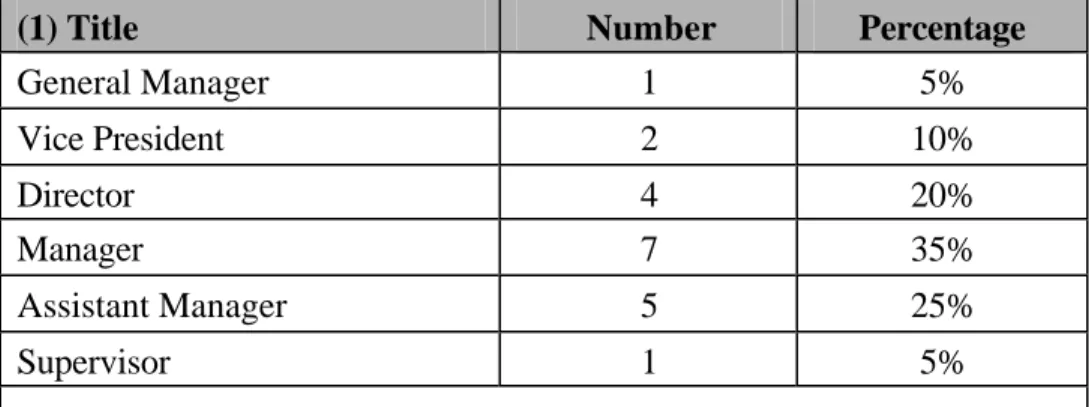
(35) Table 3.1 Basic Information of Interviewees. Business Model. ID. Job Title. A. Vice President. America, Asia, Europe. ODM. Cable Modem, ADSL. 18. B. Senior Manager. Asia, Europe. OBM. Cable Modem. 6. C. Manager. ODM, OEM. Vice President. Wireless Cable Modem, Wireless. 10. D. Europe, TW, US America, Asia, Europe. E. Director. America, Asia, Europe. ODM, OEM. Wireless, VOIP. 15. F G. Director Manager. US JP, TW, US. ODM, OEM ODM, OEM. Switch Switch. 15 8. H. Director. Europe, JP, US. ODM. ADSL, IAD, Wireless. 12. I. Project Manager. OEM, SI. Wireless. 23. J. Assistant Manager. Asia, Europe, US DE, JP, KR, NL, US. ODM, OEM. Wireless. 9. K. Manager. TW. SI. Switch, Router. 15. L. Product Manager. America, Europe. Switch. 10. M. Manager. JP. OBM, ODM, OEM ODM, OEM. Router. 10. N. Account Manager. America, Asia. ODM. Wireless Router. 9. O. General Manager. Europe, CN, TW. OBM, ODM, OEM. P. Special Assistant. JP. ODM. Router, IP DSLAM VOIP, Cellular Phone. Q. Special Assistant. America, Asia, Europe. ODM, OEM. Bluetooth, Wireless. 18. OBM, OEM, Distributor, SI. Switch, Router, Wireless, ADSL, Dial- up Modem. 15. R. Senior Manager. Market. Africa, Asia, Europe. OBM. 26. Products. Working Experience (years). 15. 21 13.
(36) S. Assistant Manager. Europe. OBM, Distributor, SI. T. Supervisor. JP. ODM, OEM. ADSL Router, Security, VPN Wireless, Bluetooth. 5 7. Note: AU: Australia; CN: China ; DE: Germany; IN: India; JP: Japan; KR: Korea; NL: Netherlands; TW: Taiwan; US: United States; SI: System Integrator. 3.4 Interview Process and Contents Analysis. Before the interviews are conducted, interviewees would be informed the research objective, the interview questions and procedures, and the recording of the conversation. The interviews would proceed as the sequence of the questions, but if participants mention SHB beyond the design, it would be adjusted to have participants reveal more information. During the interviews, if participant s do not understand the questions well, more explanation would be provided to make sure that they can offer useful information to the study. It takes about one hour for each interview. The conversation would be recorded for later analysis.. After an interview is finished, the recorded conversation files are transferred into the verbatim transcriptions. Based on the grounded theory, the verbatim transcriptions are coded sentence by sentence to collect SHB for further content analysis... 3.5 Reliability and Validity. After all the in-depth interviews are finished, the reliability test is conducted by another researcher who is quite familiar with this study. After the author finished extracting and counting SHB from the verbatim transcriptions, the researcher do it again to get the amount of. 27.
(37) SHB. The reliability of the research is expressed by the ratio of the number of the overlapped SHB over the total number of SHB in the two times of inspections. With the compromise of two results, the reliability reaches 87%. Besides, experts in the SHB field are invited to do the validity test. The experts are informed the types of SHB and check the validity of the typology. After that, the experts express that the typology is reasonable and the validity is acceptable.. 28.
(38) Chapter 4 Data Analysis 4.1 Analysis of Interviewee Background 4.1.1 Statistics of Basic Interviewee Information. The statistics of the basic interviewee information in Table 3.1 is calculated and listed in Table 4.1 for further analysis. Companies usually have their own systems define job titles. A job title in different organizational structures may denote different experience, ability, and power. The job titles in Table 4.1 (1) are divided in to 6 classes. Based on the interview contents, the senior managers are classified to the manager class; the project manager is classified to the assistant manager class; one of special assistants is classified to the class of director and the other is classified to the class of manager. In Table 4.1 (1), 14 interviewees (70%) have the titles same with or higher than the manager class. In Table 4.1 (4), 14 interviewees (70%) have 10 years or more working experience. The data in the two table show that the salespersons are experienced and qualified participants for the study as a whole.. In Table 4.1 (2), salespersons with experience in multiple markets are counted to respective markets. Salespersons who mentioned Taiwan, Japan, or US markets instead of just mentioning Asia or America are also counted and listed in Table 4.1 (2) because Japan and US are big markets and Taiwan is a domestic market. Fourteen salespersons have experience in multiple markets. It is reasonable because they may be assigned to different markets or be promoted to higher positions to take over multiple markets during the past years. In Table 4.1 (3), the number of subordinate is listed. Five salespersons (25%) have 15 or more subordinates. It means the job contents of these salespersons may involve a lot of sales strategies and management, not only selling products. Fifteen salespersons (75%) who lead 14 or less subordinates respectively should really execute the selling tasks.. 29.
(39) The business models that the salespersons have experienced are listed in Table 4.1 (5). The data fit the selling model of the networking equipment industry in Taiwan. Most companies are manufacturers which consist of OBM, ODM, and OEM. Distributors and system integrators are the minor. In Table 4.1 (6), 4.1 (7), and 4.1 (8), the job performance of these persons are displayed. It is consistent that 13 salespersons (65%) think their performance just meet the self-request while the sales revenues of 12 salespersons (60%) are close to the quotas set by their companies. Ten salespersons (50%) shows that their annual sales revenues are in the range of NT$ 1 and 10 billion. Combined this with data in Table 4.1 (1), it seems that a manager-class or director-class salesperson should bring in NT$ 1 to 10 billion sales revenue annually.. In Table 4.1 (9), 14 salespeople (70%) do not disclose their annual income because it is too sensitive. In Table 4.1 (10), seventeen salespersons (85%) are male and three (15%) are female. There are two reasons for the result. One is most salespersons in this field are male. The other is that female salespersons have much lower willingness to interviews than male salespersons because of some personal considerations.. Table 4.1 Statistics of Basic Intervie wee Information (1) Title General Manager. Number 1. Percentage 5%. Vice President. 2. 10%. Director Manager. 4 7. 20% 35%. Assistant Manager. 5. 25%. Supervisor. 1. 5%. 30.
(40) (2) Market America. Number 12. Percentage 60%. Asia. 15. 75%. Europe Africa. 13 1. 65% 5%. Taiwan Japan. 6 9. 30% 45%. US. 10. 50%. Multiple Markets. 14. 70%. Single Market. 6. 30%. Number. Percentage. Over 100. 2. 10%. 15 ~ 100 6 ~ 14. 3 4. 15% 20%. 1~5. 8. 40%. 0. 3. 15%. Number. Percentage. Over 20 years 16 ~ 20. 2 2. 10% 10%. 10 ~ 15. 10. 50%. 5~9. 6. 30%. Number. Percentage. OBM ODM. 6 14. 30% 70%. OEM. 11. 55%. Distributor System Integrator. 2 4. 10% 20%. Number 1. Percentage 5%. Meet Self- Request. 13. 65%. Beyond Self- Request. 5. 15%. (3) Number of Subordinates. (4) Working Experience. (5) Business Model. (6) Self-Rating Performance Close to Self- Request. 31.
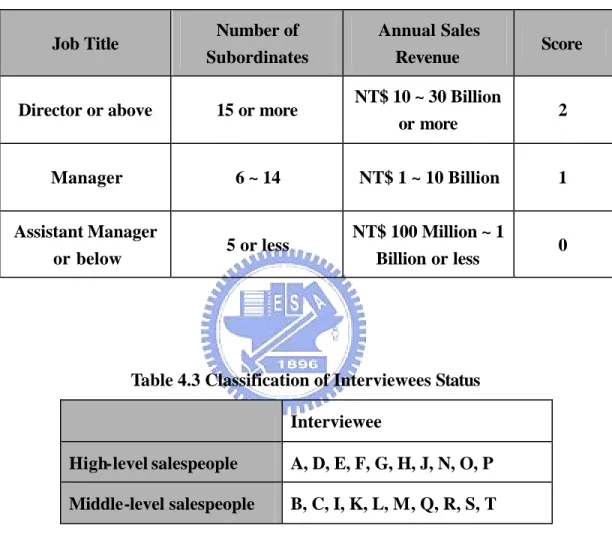
(41) Excellent. 1. 5%. Number. Percentage. Over NT$ 30 Billion NT$ 10 ~ 30 Billion. 1 2. 5% 10%. NT$ 1 ~ 10 Billion. 10. 50%. NT$ 100 Million ~ 1 Billion Below NT$ 100 Million. 5 2. 25% 10%. Number 1. Percentage 5%. Below Quota 5 ~ 20%. 2. 10%. Meet Quota (-5% ~ 5%) Beyond Quota 5 ~ 20%. 12 5. 60% 25%. (9) Annual Income NT$ 3 ~ 5 Million. Number 1. Percentage 5%. NT$ 1 ~ 3 Million. 4. 20%. Below NT$ 1 Million Not Disclosure. 1 14. 5% 70%. Number 17. Percentage 85%. 3. 15%. (7) Annual Sales Revenue. (8) Performance Rating Below Quota More Than 20%. (10) Gender Male Female. 4.1.2 Classification of Interviewees. In order to explore the difference among the behaviors of the interviewees, these persons are classified by their job titles, numbers of subordinates, sales revenues, and business model to distinguish their status and simplified business models. Based on the criteria in Table 4.2, salespersons that score 3 or more are classified to the high- level while the other salespersons are classified to the middle- level. The results are shown in Table 4.3. The status of. 32.
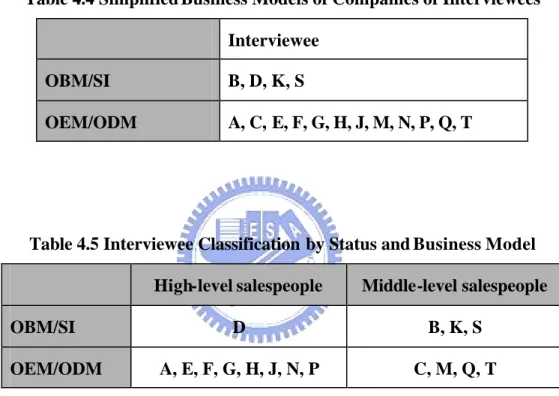
(42) Interviewee A, D, E, F, G, H, J, N, O, and P is high- level and that of Interviewee B, C, I, K, L, M, Q, R, S, and T is middle- level.. Table 4.2 Criteria of Intervie wee Classification Job Title. Number of Subordinates. Annual Sales Revenue. Score. Director or above. 15 or more. NT$ 10 ~ 30 Billion or more. 2. Manager. 6 ~ 14. NT$ 1 ~ 10 Billion. 1. Assistant Manager or below. 5 or less. NT$ 100 Million ~ 1 Billion or less. 0. Table 4.3 Classification of Interviewees Status Interviewee High-level salespeople. A, D, E, F, G, H, J, N, O, P. Middle-level salespeople. B, C, I, K, L, M, Q, R, S, T. The companies that the salespersons work for are divided into OBM, ODM, OEM, distributors, and system integrators. In the interview process, the SHB of OBM, distributors, and system integrators is found to be similar and that of OEM and ODM are similar, too. Salespersons in OBM, distributors, or system integrators sell their products through their own sales channels in different markets. They usually have only one customer in a region and maintain long-term cooperation with it. Salespersons in OEM or ODM sell their products to companies which own brands and sales channels. They need to compete with other. 33.
(43) manufacturers to get business order by order. They have stronger incentives to maintain good relationships with their customers. Interviewee I, L, O, and R have experienced the two simplified business models, so they are discarded in the classification (Table 4.4). From Table 4.3 and 4.4, the matrix of Status and Business Model is shown in Table 4.5.. Table 4.4 Simplified Business Models of Companies of Interviewees Interviewee OBM/SI. B, D, K, S. OEM/ODM. A, C, E, F, G, H, J, M, N, P, Q, T. Table 4.5 Interviewee Classification by Status and Business Model. OBM/SI OEM/ODM. High-level salespeople. Middle-level salespeople. D. B, K, S. A, E, F, G, H, J, N, P. C, M, Q, T. 4.2 Typology of Salespeople Helping Behavior. From the coding of the verbatim transcriptions of interviews, the salespeople helping behavior is categorized by the functions into job-unrelated personal favor and job-related extra-role service in Table 4.6. There are two kinds of helping behavior which is mentioned by the interviewees but is discarded. One is in-role helping behavior. For example, a salesperson quickly responds to the inquiry of a customer about the questions of product manufacturing. It 34.
(44) indeed helps the customer a lot on handling the progress of manufacturing but it would be discarded because it does not meet the definition of SHB. The other is that the helping behavior is actually provisioned by the company policies or other persons’ decisions such as payment postponement. It usually involves the opinions of the financial division and the final decision of the CEO to give financial assistance, so the risk and responsibility are taken by the whole group, not only by the salesperson. Therefore, this kind of helping behavior is also discarded. The details of the SHB typology are explained more in the following sections.. Table 4.6 Typology of Salespeople Helping Behavior. Job-unrelated personal favor 1. 2. 3. 4. 5.. Information Sharing Leisure Activities Fulfillment of Implicit Needs Gift Giving Other Personal Favors. Job-related extra-role service 1. 2. 3. 4. 5.. Assistance of Business Trips Order-related Assistance Market Information Provision Impression Enhancement Assistance with Customer’s Own Job (unrelated to business with salespeople). 4.2.1 Job-unrelated personal favor. As the definition in Section 2.1, Job- unrelated personal favor is sub-categorized further into Information Sharing, Leisure Activities, Fulfillment of Implicit Needs, Gift Giving, and Others. The five categories of job-unrelated personal favor are classified further to fo rm subcategories respectively in Table 4.7.. 35.
(45) Table 4.7 Subcategory of Job-unrelated Personal Favor. No.. Typology. Subcategory. Information Sharing. 1. Casual Conversations 2. Private Talks. 2. Leisure Activities. 1. Activities of Common Interests 2. Activities of Entertainment 3. Activities of Needs Fulfillment. 3. Fulfillment of Implicit Needs. 1. Taboos Avoidance 2. Fulfillment of Unsolicited Needs. 4. Gift Giving. 1. Ordinary Gifts 2. Corporate Gifts 3. Customized Gifts. 5. Others. 1. Others in Daily Life 2. Others on Business Trips. 1. 4.2.1.1 Information Sharing. Information sharing is the help that salespeople exchange job-unrelated information with customers for customers’ reference or satisfying their emotional needs. Talking topics other than work is quite important for the relationship between both sides. Interviewee N said: “Customers are just like us. Work is actually very dreary to them. If you get down to business just after you meet a customer, it would not help on the relationship between he and you. Of course, he would respect your professionalism, but I do not think that it would help a lot on enhancing relationship with him.” (Appendix C, 1). 36.
(46) Information sharing could also help salespeople understand their customers. Interviewee J described how he observes his customers: “Talking about these things make me find his interests and personality. Judge this person by his personality. What are his decision procedures? What does he consider when he is making a decision? What is his thinking model?” (Appendix C, 2). Usually, salespeople would try to find out the customer’s favorite topics, follow his intention, and make him feel comfortable, so they need to know a lot of common sense and like to talk and communicate with others. Information sharing could be divided into casual conversations and private talks. Casual conversations are ordinary talks in daily life which usually include topics on interests of a customer or a salesperson, local customs and practices, or living information.. The topics of interest are talked a lot especially when customers and salesperson have common interests. Sports are the most popular topic in casual conversations (55%). It may be because most of the interviewees are male which are interested in various sports. The topics of local customs and practices are mentioned when customers come to Taiwan at the first time or salespeople go to a new place. They might be interested to know something in different culture. When customers come to Taiwan, if they are not familiar with the country, they need some living information, such as places to shopping and sight-seeing.. Private talks involve the disclosure of secrets, privacy, or emotions. Private talks are usually conducted when commercial friendship exists between salespersons and customers. Personal life, politics in office, and complaint against job are the typical topics. Family is a frequent topic in personal life because it is closely related to most of people (85%). 37.
(47) 4.2.1.2 Leisure Activities. It is quite common that customers and salespersons engage in leisure activities together. It is a kind of favor that salespeople entertain or satisfy the needs of customers through common activities. Especially when a customer has a business trip to Taiwan, the salesperson would politely inquire the needs of arranging leisure activities. There is a description from Interviewee C: “No matter customers would like or not, you have to ask them in advance. … Even if he would not like to go with you, out of politeness, you still need to ask whether he would like to take the trip whic h is planned for him.” (Appendix C, 3) Leisure activities could be subcategorized into activities of common interests, activities of entertainment, and activities of needs fulfillment. Salespeople and customers engage in activities of common interests when they are interested in the same activity. For example, playing golf is such an activity because many senior managers and salespeople enjoy the exercise. Activities of entertainment are the most conventional ways for salespeople to enhance the relationships. Salespeople usually treat customers in a nice restaurant to show that they value the customers. Interviewee D had a comment on it: “Think from another point of view. You think. Korean and Japanese people are quite frugal in the daily life. While they ha ve such a rare opportunity to go to Taiwan on business, treat them to eat a little better. If you do so, they would remember you.” (Appendix C, 4). When customers come to Taiwan, they may have the needs to go to shopping or sight-seeing. Activities of needs fulfillment are such leisure activities to satisfy their needs.. 38.
(48) 4.2.1.3 Fulfillment of Implicit Needs. Fulfillment of implicit needs is to find customers’ needs and actively satisfy them. It could be separated into taboos avoidance and fulfillment of unsolicited needs. Taboos avoidance is to keep off something which a customer does not inform but raises his aversion. Some customers have tabooed talking topics such as age and politics while some customers have tabooed food. Fulfillment of unsolicited needs means that actively satisfying the need which a customer does not solicit. For example, let customers have opportunities to show special skills, have a meal in a customer-preferred style restaurant, or give an award to have customer fell that he is valuable.. It seems that everyone has more or less particular habits. When customers come to Taiwan, they may have some inconvenience to keep their habits. They do not always speak out their requirement and ask salespeople to give them favors. Some salespersons with carefulness would keep monitoring the needs of their customers. After knowing the implicit needs of customers, salespersons take the actions to fulfill customers’ needs. Interviewee L said: “We would notice that some customers only drink coffee, some only drink cola, and what food some customers only eat and what topics they like to talk when they come. In fact, we pay attention to all these things. We would purposely solve these issues.” (Appendix C, 5). Interviewee Q had a statement about how he find out and fulfill customer's preference: “Off the record, what he likes. Try to have he feel that when he comes here, firstly he is valued and secondly, he is comfortable about all the arrangement.” (Appendix C, 6) 39.
(49) 4.2.1.4 Gift Giving. Gift-giving is essentially a favor and is the most common SHB. The decision power and the relationship between customers and salespeople are the major considerations for salespeople to decide the values of gifts. When a customer has higher importance or better commercial fr iendship, the salesperson might give a gift of higher value unless the favorite of the customer is given instead. Interviewee C explained how he selected the gift: “When you do not understand this guy, you could really use money to represent importance. Of course, while you are gradually familiar with he, what he likes, what he dislike, you don’t need to give a precious gift. If you can find and buy his favorite which is not always expensive, you can make him happy. ” (Appendix C, 7). Although many companies have the regulations of gift giving, it is not easy for salespeople to enhance the relationship by it. It is difficult for salespeople to estimate the perception of customers on the value, the timing, and the reason of gift giving. Interviewee E explained more: “I thing giving a gift is the most difficult. … the most difficult, because you do not know what he wants. How you deliberate on a gift. Let its value not too high to have them think you are bribing. When the value is low, they do not think you are careless. The gift is just he desires. Too difficult. Very difficult.” (Appendix C, 8). In the interviews, there are a great number of gift giving cases collected. They are subcategorized into ordinary gifts, corporate gifts, and customized gifts. A gift which is not a corporate gift or a customized gift is called ordinary gift such as wine, tea or Chinese-style souvenirs. Some gifts in this subcategory are for the other family members or the whole 40.
數據
+7

相關文件
The Moral, Civic and National Education (MCNE) Section 2 is responsible for curriculum development related to values education as well as organising professional development
所以 10 個數字 個數字 個數字 個數字 pattern 就產生 就產生 就產生 就產生 10 列資料 列資料 列資料 列資料 ( 每一橫 每一橫 每一橫
Relevant topics include, but are not limited to: Document Representation and Content Analysis (e.g., text representation, document structure, linguistic analysis, non-English
Feedback from the establishment survey on business environment, manpower requirement and training needs in respect of establishments primarily engaged in the provision of
BAFS Learning and Teaching Example As at April 2009 The marketing promotional plan objective is to expand the local business into the North American market. Step 1:
Then, the time series of aiming procedure is partitioned into two portions, and the first portion is designated for the main aiming trajectory as well as the second potion is
The academic achievement of math of high-grade elementary school students is significant related to their SES and the self-concept in math, but is non-related to their
In order to partition the GPS market into different segments, this paper used purchase motives, product attributes and consumer lifestyle as the variables for market
