國 立 交 通 大 學
電信工程學系
博 士 論 文
多媒體高速網路之服務品質保證式
智慧型訊務控制機制
QoS-provisioning Traffic Control Schemes for
Multimedia High-speed Networks
Using Intelligent Techniques
研 究 生:林 立 峰
指導教授:張 仲 儒 博士
多媒體高速網路之服務品質保證式
智慧型訊務控制機制
QoS-provisioning Traffic Control Schemes for
Multimedia High-speed Networks
Using Intelligent Techniques
研究生:林立峰
Student: Li-Fong Lin
指導教授:張仲儒 博士
Advisor: Dr. Chung-Ju Chang
國立交通大學
電信工程學系
博士論文
A Dissertation
Submitted to Institute of Communication Engineering
College of Electrical and Computer Engineering
National Chiao Tung University
in Partial Fulfillment of the Requirements
for the Degree of Doctor of Philosophy
in
Communication Engineering
Hsinchu, Taiwan
多媒體高速網路之服務品質保證式
智慧型訊務控制機制
研究生:林立峰
指導教授:張仲儒 博士
國立交通大學電信工程學系博士班
摘 要
為了 支 援多 媒體服務之 叢集 性傳 輸(bursty-transmission) 和異質性服務品質(quality of services, QoS) 之要求,我們需要一套精確設計的訊務控制(traffic control)機制,藉以在滿足連 線頻寬與服務品質要求的狀況下,進一步有效地提升系統資源的使用效率。現有文獻已指出, 多媒體服務其多樣化且多變的訊務特性、以及各式各樣的傳輸與服務品質上的需求,已經使 得整體網路的行為更加複雜,因此有必要應用智慧型技術(intelligent techniques) 來解決多媒體 高速網路環境中的訊務控制課題。在本論文中,我們探討在 ATM 和 IP 這兩種多媒體高速網 路環境下,應用類神經/乏晰智慧型技術之訊務控制機制,並著重在「連線允諾控制 (connection admission control, CAC)」與「訊務監控調節(traffic policing)」這兩個主要的訊務控制功能。我們首先探討在ATM 網路中,採用「時域(time-domain)」訊務參數與類神經乏晰技術來進 行連線允諾控制決策的「類神經乏晰連線允諾控制(neural fuzzy connection admission control, NFCAC)」方法。該允諾控制方法由於採用了類神經乏晰控制器做為控制決策的核心,因此也 可以視為是一種整合性的技術:結合了乏晰邏輯系統的高階語意控制功能,以及類神經網路 的自我學習能力。透過挑選適當的輸入信號(包含時域訊務參數與部分系統性能量測統計值) 和設計較佳的控制法則,該允諾控制方法的類神經乏晰控制器即可以從中習得既有的連線允 諾控制的專家知識,並提供一套快速、精確而有效的計算程序來實現足夠強健(robust) 的連線 允諾控制功能。模擬結果顯示,與傳統的幾種(同樣採用時域訊務參數的)連線允諾控制機 制相較起來,我們在此所提出的類神經乏晰連線允諾控制方法可以在滿足服務品質保證的基 本條件下,達到最好的系統資源使用率;同時,若再與傳統方法中具有類神經網路學習功能 的方法比較起來,此類神經乏晰連線允諾控制方法也有較快的學習收斂速度。 接著,在前述採用時域訊務參數的連線允諾控制方法之外,我們還另外探討採用「頻域 (frequency-domain)」訊務參數與類神經網路技術來進行連線允諾控制決策的「功率頻譜基礎 之類神經網路連線允諾控制(power-spectrum-based neural-net connection admission control, PNCAC)」方法。該允諾控制方法採用類神經網路控制器作為控制決策的核心,並以呼叫連線 訊務源和既有連線訊務源的「功率頻譜密度(power spectral density, PSD) 參數」作為該控制器 的(部分)輸入信號來進行連線允諾的決策控制。其理論基礎主要源自於,已知一個訊務源 的功率頻譜密度函數(PSD function) 包含該訊務源的(時域)自我相關與叢集特性,並且已經 有研究文獻證實,功率頻譜密度函數的確可以完全掌握並描述一個訊務源在一個佇列系統 (queueing system) 的行為表現特性,因此其特徵參數(也就是前述簡稱的「功率頻譜密度參數」)
自然也就可以視為是該訊務源的一種訊務參數,並且可以對應到其一定的佇列行為特性。此 研究發現,開啟了我們以訊務源的頻域訊務參數,亦即「功率頻譜密度參數」,來進行連線允 諾控制的初始構想和概念。隨後,透過我們所提出的一套功率頻譜密度函數合成演算法,可 以很快速地由兩個訊務源各自的功率頻譜密度參數,求得其合成訊務源的功率頻譜密度參數 (的合理近似值),如此也使得採用「功率頻譜密度參數」來進行連線允諾控制成為實際可行 且適合的方案。模擬結果顯示,我們所設計並提出採用「功率頻譜密度參數」的類神經網路 連線允諾控制方法,可以在變動的網路訊務特性的環境下,達到相當穩定而強健的控制效能。 另外,我們在連線允諾控制機制的研究外,也對於和連線允諾機制息息相關且為其必備輔 助功能的訊務監控調節機制進行相關的研究。我們首先針對ATM 網路定義的訊務監控調節機 制,也就是所謂的使用參數控制(usage parameter control, UPC) 功能,提出兩種智慧型使用參 數控制器,分別是「乏晰使用參數控制器」以及「類神經乏晰使用參數控制器」。「乏晰使用 參數控制器」是在傳統 ATM 標準所建議並用來實現使用參數控制功能的「漏水桶方法(leaky bucket algorithm)」上,引進一個「乏晰水增量控制器(fuzzy increment controller, FIC)」;同理, 「類神經乏晰使用參數控制器」即是在傳統漏水桶方法上增加了一個「類神經乏晰水增量控 制器(neural fuzzy increment controller, NFIC)」。這兩個智慧型控制器皆是選用相同的兩個系統 量測統計值,即受監控訊務源之長期平均封包速率和短期平均封包速率,來做為其輸入語意 變數,並據此對受監控訊務源做出適應性的動態水增量調整決策。模擬結果顯示,我們所提 出的兩種智慧型使用參數控制器,皆可比傳統的漏水桶方法具有較高的違法封包檢出正確 率、較短的訊務違法反應時間以及較快的違法封包檢出速率;對於合法連線於用戶終端設備 輸出處的訊務塑型器(traffic shaper, TS) 所造成的佇列延遲上,也有比較小的數值表現。而在 兩智慧型使用參數控制器方法彼此的比較方面,類神經乏晰使用參數控制器也在上述幾個方 面的表現上比乏晰的方法有稍佳的效能,特別是在訊務違法反應時間及違法封包檢出速率上 有較明顯的差異。 最後,我們繼續針對IP 網路環境上的訊務監控調節機制提出最佳化設計。而 IP 網路的訊 務監控調節機制,主要是以定義在差異化服務(differentiated services, DiffServ) 模型中的「訊 務調節器(traffic conditioner)」所執行的訊務調節功能為主,因此我們便針對訊務調節器中的 核心關鍵性組件-訊務封包標記器(traffic maker),以網際網路標準組織 IETF 所建議的「雙速 率三顏色封包標記器(two-rate-three-color-marker, TRTCM)」方法為基礎,提出一「效能增強型 訊務封包標記器(enhanced traffic marker)」方法,在既有(消極)的監控性管制調節功能之外, 再增加公平標記與積極性封包合法位階促升(promotion) 功能。模擬結果顯示,我們所設計的 「效能增強型訊務封包標記器」的確可以在一合成訊務流中,對其各組成分流的封包合法位 階標記做到精確檢出及公平標記的目的。同時,其不僅可以在系統資源足夠的時候,把過去 曾經因為「局部(local)」網路壅塞或較嚴格的訊務合約(traffic contract) 導致合法位階被調降的 封包再度提升至其原有的合法位階標記,還能夠進一步積極地盡可能提升其他封包的合法位 階以享有較佳品質的封包處理動作,如此可在不違反訊務合約的狀況下,達到充分利用系統 資源並增進受監控訊務連線的上層應用程式服務品質的目的。因此模擬結果也顯示,我們所 設計的「效能增強型訊務封包標記器」比起傳統單純的「雙速率三顏色封包標記器」方法, 在各合法位階的訊務上皆有較高(但仍合於訊務合約)的封包輸出速率(throughput)。
QoS-provisioning Traffic Control Schemes for
Multimedia High-speed Networks Using
Intelligent Techniques
Student: Li-Fong Lin
Advisor: Dr. Chung-Ju Chang
Department of Communication Engineering
National Chiao Tung University
Abstract
To support bursty-transmission and heterogeneous quality of services (QoS) require-ments for multimedia services, a suite of well-designed sophisticated traffic control scheme is required to effectively enhance the system utilization. The non-stationarity of work-loads, to-gether with heterogeneous traffic characteristics and QoS constraints of multimedia services, indeed constitute the necessity for applying intelligent techniques in multimedia high-speed networks. In this dissertation, the traffic control functions involving the connection admission control (CAC) and the traffic policing for multimedia high-speed networks by neural/fuzzy intelligent techniques are studied. Both ATM and IP networks which can be utilized to construct the multimedia high-speed networks are considered in this dissertation.
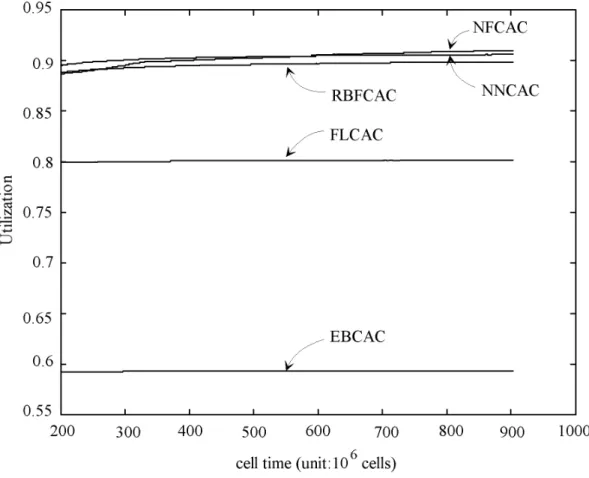
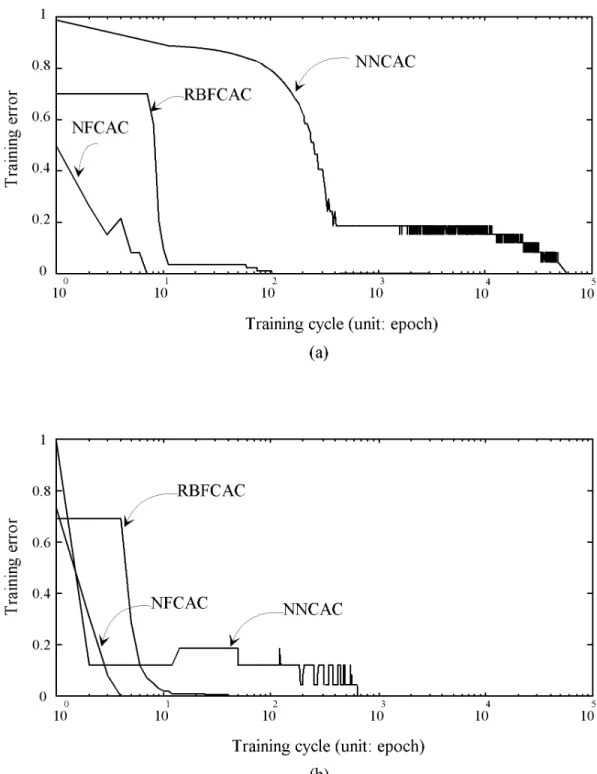
Firstly, a neural fuzzy connection admission control (NFCAC) scheme which based on the time-domain traffic parameters and provides QoS guarantees for ATM networks is proposed. The NFCAC scheme is an integrated method that combines the linguistic control capabilities of a fuzzy logic controller and the learning abilities of a neural network. With properly choosing input variables which involve the measured statistics of network performances, and well designing the rule structure for the NFCAC scheme, it can not only provide a robust framework to mimic experts’ knowledge embodied in existing connection admission
control techniques but can also construct precise and efficient computational algorithms for connection admission control. Simulation results show that, compared with conventional CAC schemes, the proposed NFCAC can achieve superior system utilization, high learning speed, and simple design procedure, while keeping the QoS contract.
And then, as contrast to the CAC scheme based on the time-domain traffic parameters discussed above, a power-spectrum-based neural-net connection admission control (PNCAC) scheme is proposed for also the multimedia high-speed ATM networks. It employs a neural network controller to handle the CAC function according to the frequency-domain power spectral density (PSD) parameters of the traffic sources. Since the PSD function of an input traffic contains the correlation and burstiness properties of the traffic, and it has been proven capable to characterize the queueing performances of the input traffic, the PSD parameters describing the PSD function can well correspond to the queueing performances also. With a composition algorithm to easily obtain the three PSD parameters of an aggregate traffic, it is suitable to adopting PSD parameters for CAC accordingly. Simulation results show that, after well training the neural network, an optimal CAC decision hyperplane based on the input variables is constructed to provide an efficient and robust admission control under dynamic network environments, while the QoS requirements are strictly assured.
After that, in addition to the studies about CAC, a traffic policing mechanism is neces-sary to ensure that all established connections conform to their respective traffic contracts, so that the CAC can perform correctly. Therefore, two intelligent usage parameter controllers are first proposed to implement the traffic policing function, usage parameter control (UPC), for multimedia transmissions in ATM networks. One is the fuzzy usage parameter controller realized by the fuzzy leaky bucket algorithm, in which a fuzzy increment controller (FIC) is incorporated with the conventional leaky bucket algorithm; the other is the neural fuzzy usage parameter controller base on the neural fuzzy leaky bucket algorithm, where a neural
fuzzy increment controller (NFIC) is added to the conventional leaky bucket algorithm. Both of FIC and NFIC properly choose the measured long-term and short-term mean cell rates, as input variables to adaptively determine the optimal increment value with respect to the traffic dynamics. Simulation results show that both intelligent leaky bucket algorithms have significantly outperformed the conventional leaky bucket algorithm, by higher selectivity and shorter responding time when taking control actions against a non-conforming connec-tion, while reducing the queueing delay experienced by a conforming connection. Also, the neural fuzzy leaky bucket algorithm outperforms the fuzzy one in all aspects especially the responsiveness.
Finally, since the UPC is the traffic policing function defined in ATM networks, the traffic conditioner defined in the differentiated services (DiffServ) model is employed to handle the traffic policing function, namely the traffic conditioning, for the IP networks. An enhanced traffic marker (ETM) based on the Two-Rate-Three-Color-Marker (TRTCM) scheme is then proposed for the traffic conditioner to perform traffic policing by properly determining the conforming level of the incoming packet and making a corresponding color notation on the packet. The proposed ETM scheme introduces the features of aggressive promotion and fair share marking, and incorporates them into the existing traffic policing function. Simulation results show that the ETM scheme can fairly allocates the color notations among connections within an aggregate one. It also enhances the throughput of each conforming level for the aggregate connection to achieve as high rate as possible by not only restore the conforming levels of the previously demoted packets, but also aggressively promote the packets to higher conforming levels, so that the end-to-end QoS of the applications would be substantially improved while the traffic contract is still be respected. It can be concluded that the ETM scheme outperform the conventional TRTCM scheme in both aspects of marking fairness and traffic throughput of each conforming level under congested and under-loaded networks.
感言 與 誌謝
Acknowledgement
在這個實驗室經歷了十個寒暑,有歡笑也有淚水,不過好在的是歡樂的時光 還是多於難過的時刻。在這十個年頭,感受了實驗室氣氛的轉變,從比較呆板的、 純粹屬於(交大)男孩子的生活,到比較活潑而多采多姿的樣貌,外校系以及女 生成員的加入,的確是這一股轉變的動力來源,為實驗室帶來很不一樣的朝氣和 活力,而我也似乎隨著一屆屆碩士班學弟妹們的來來去去,而得以始終保持在大 學剛畢業時的年輕 :) 十年了,不算短的一段時間,我彷彿伴隨著這個實驗室一起成長,又或者是 說,實驗室帶著我、照顧著我茁壯。實驗室如同我的第二個家。從面向交大棒球 場的這扇窗,我看到了春夏秋冬、晨昏午夜所有時刻的交大風景,也見證了一棟 棟拔地而起的館舍蠶食鯨吞地佔領珍貴的校園綠地,而這原是莘莘學子和外來訪 客最佳的休憩場所,內心覺得不捨卻又無可奈何,只希望能將這些景象永遠地烙 印在腦海裡,永遠保持鮮綠明亮!而正如每個孩子在長大後都必須離開家庭獨立 生活一般,此刻,也是我展開人生另一段旅程的時候了。感謝老師和整個實驗室 這些年來的照顧和磨練,豐富了我的羽翼,也蓄積了我向前飛行的力量! 要感謝的人真的很多,特別是十年的光陰串起來的人事物,全部寫來,即便 只有名字,也需要不少的篇幅。但在此,我還是想要把這些在每個階段同我一起 經歷、分享實驗室一切的夥伴們的名字再寫一遍,並同時在腦海中再度細數與回 憶我們曾一起經歷的時光。 首先最要衷心感謝的,自然是帶領我進入實驗室這個大家庭的恩師-張仲儒 教授,除了在論文研究上的指導之外,其在生活和待人處事上的嚴謹態度與自我 要求,也讓我在整個研究生涯中獲益良多,特別是幫助我看清自己的能力和障 礙。或許我最終無法完全克服自己的障礙,但是可以更加認識自己,掌握自我特 質的優缺點,也必將對於我的未來有很深遠的助益和影響,而我也真的很衷心感 激老師對於我有時莫名而執拗的任性所給予的莫大包容。 再來要感謝瑞光、古博、界和、芳慶、義昇、勇志、又壬等幾位學長,每每 不厭其煩地對於我的疑惑給予適切的引導和解答,在茅塞頓開的豁然開朗之外, 除了提供我的論文許多寶貴的建議,並讓我學習到不少做研究的經驗和技巧,也 開拓了我的生活視野和思想,明白一件事物是可以有很多面向與截然不同的風 貌。此外,也感謝有宗勳、家慶、俊雄、騰元以及青毓幾位好同學的陪伴,互相 鼓勵、加油打氣,才能夠讓我在論文研究的低潮期重新振作起精神和動力繼續走 下去。另外還要感謝的是所有可愛的學弟妹們,文成、智勝、伯偉、俊賓、樹佑、 宗益、尚逸、詠翰、嘉瑯、良正、鏗銘、崇光、慶喜、信宗、永宏、柏翰、照旗、 易霖、玉葵、寧佑、至永、凱盟、駿元、崇禎、皓棠、俊憲、志明、朕逢、宗軒、 立忠、凱元、同昊、家源、俊帆、文祥、煖玉、琴雅、建興、建安、佳璇、佳泓、 世宏、正昕、尚樺,和你們一起從事的所有活動以及你們所帶來的歡樂,豐富了 我的生活經驗,也讓我保持永遠年輕的心境和生活上的朝氣與活力。當然,也不能忘記對總是默默在背後給予實驗室許多幫助的秀鷹、玉琇、雅雯和惟媜說聲謝 謝,沒有妳們的貼心和幫忙,我可能沒辦法擺脫許多瑣事和煩人的行政工作的羈 絆,實驗室(計畫)的運作也會因而多受阻礙而踟躕難前吧。最後,再次感謝所 有實驗室的夥伴們,因為有你們大家的陪伴和幫助,充實了我人生中最精華的十 年時光,我會帶著這些回憶和感動,化成源源不絕的動力,繼續往前走去! 謝謝〜〜也說聲〜〜再會了,我親愛的701 實驗室〜〜〜 最後,在實驗室之外要感謝的,自然是我最親愛的家人-特別是爸爸和媽媽, 沒有他們的開明和耐心、安慰和鼓勵、體諒和包容,以及在信心和經濟上的支持, 我是決不能走到現在這一步的。感謝一起成長的弟弟和妹妹,在我長年負笈在外 的求學生涯裡幫我分擔許多為人子該有的責任。此外,也要謝謝女友芝宇一路體 貼的陪伴和支持,讓我可以偶爾有機會跳脫研究上的煩悶枯燥或是牛角尖,再以 一個全新的心情和精神來重新面對問題。而來自高中死黨裕忠和孟芳持續不斷的 關心和鼓勵,也讓我倍感溫馨並永遠感謝在心。來自家人與好友的支持、鼓勵和 祝福,永遠是最讓人感到窩心與幸福的一件事,也是我漫長的研究生涯中最強而 有力的後盾,真的,很謝謝你們! 林立峰 謹誌 民國 九十五 年 九 月 (于交通大學電信系ED701 寬頻網路實驗室)
Contents
Mandarin Abstract i
English Abstract iii
Acknowledgements vi
Contents viii
List of Figures xi
List of Tables xiv
1 Introduction 1
1.1 Motivation . . . 1
1.2 Paper Survey . . . 5
1.2.1 CAC using Time-domain Traffic Parameters . . . 5
1.2.2 CAC using Frequency-domain Traffic Parameters . . . 10
1.2.3 Traffic Policing in ATM Networks . . . 12
1.2.4 Traffic Policing in DiffServ IP Networks . . . 14
1.3 Dissertation Organization . . . 18
2 An Overview of Intelligent Techniques 22 2.1 Introduction . . . 23
2.2 Fuzzy Logic Controller . . . 24
2.3 Neural Network Controller . . . 28
2.4 Neural Fuzzy Controller . . . 36
2.5 Applications of Intelligent Techniques In This Dissertation . . . 41
2.6 Concluding Remarks . . . 43
3 Intelligent Connection Admission Control Scheme for Multimedia High-speed Networks Using Time-domain Traffic Parameters 44 3.1 Introduction . . . 45
3.2 Neural Fuzzy Call Admission Control . . . 48
3.3 Simulation Results and Discussions . . . 56
3.4 Concluding Remarks . . . 66
4 Intelligent Connection Admission Control Scheme for Multimedia High-speed Networks Using Frequency-domain Traffic Parameters 70 4.1 Introduction . . . 71
4.2 Power Spectrum of Input Process . . . 75
4.3 PSD-based Neural-net Connection Admission Controller . . . 79
4.4 Simulation Results and Discussions . . . 81
4.5 Concluding Remarks . . . 85
4.6 Appendix: Composition Algorithm for Power Spectrums . . . 86
5 An Intelligent Usage Parameter Controller for Multimedia High-speed ATM Networks 91 5.1 Introduction . . . 92
5.2 Leaky Bucket Algorithm . . . 98
5.4 Neural Fuzzy Leaky Bucket Algorithm . . . 103
5.5 Simulation Results and Discussions . . . 108
5.6 Concluding Remarks . . . 112
6 An Enhanced Traffic Conditioner for Multimedia High-speed DiffServ IP Networks 117 6.1 Introduction . . . 118
6.2 Enhanced Traffic Marker . . . 123
6.3 Simulation Results and Discussions . . . 128
6.3.1 Accuracy of the Marking . . . 128
6.3.2 Fairness of the Marking . . . 130
6.4 Concluding Remarks . . . 132
7 Conclusions and Future Works 135
Bibliography 140
Vita 145
List of Figures
1.1 The generic architecture of a network access node . . . 3
2.1 The basic structure of fuzzy inference system . . . 26
2.2 An example of Mamdani fuzzy model . . . 26
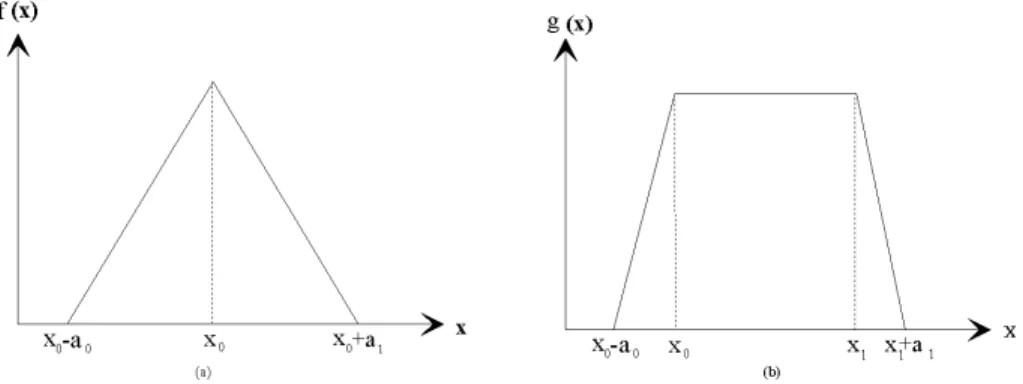
2.3 Definitions for functions f (·) and g(·) . . . 28
2.4 The basic structure of neural network . . . 29
2.5 The structure of multilayer feedforward neural network . . . 31
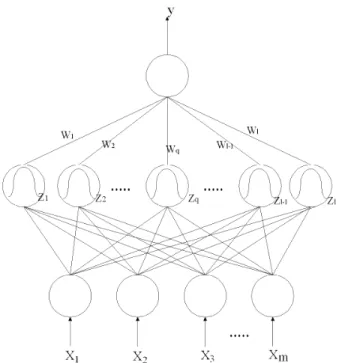
2.6 The structure of RBFN controller . . . 35
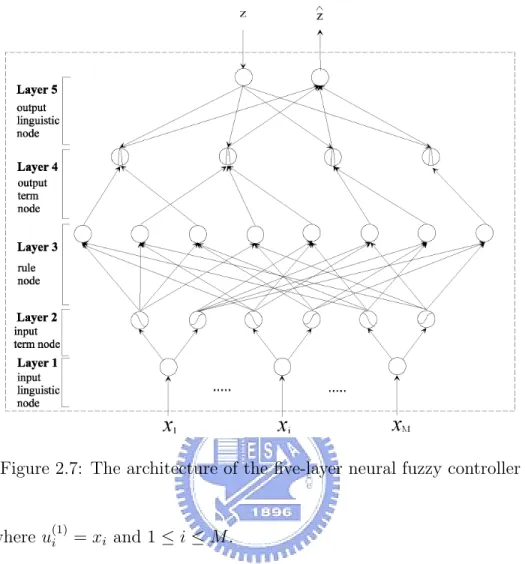
2.7 The architecture of the five-layer neural fuzzy controller . . . 39
3.1 An NFCAC controller with its peripheral processors . . . 48
3.2 The architecture of the NFCAC controller . . . 51
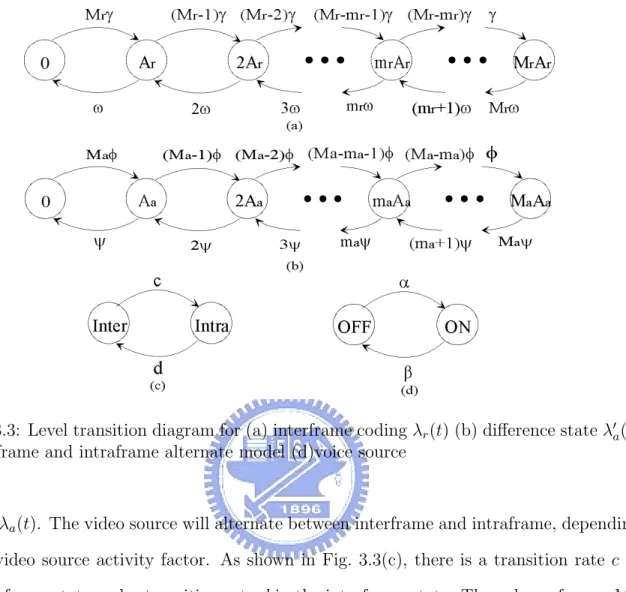
3.3 Level transition diagram for (a) interframe coding λr(t) (b) difference state λ0a(t) (c)interframe and intraframe alternate model (d)voice source . . . 58
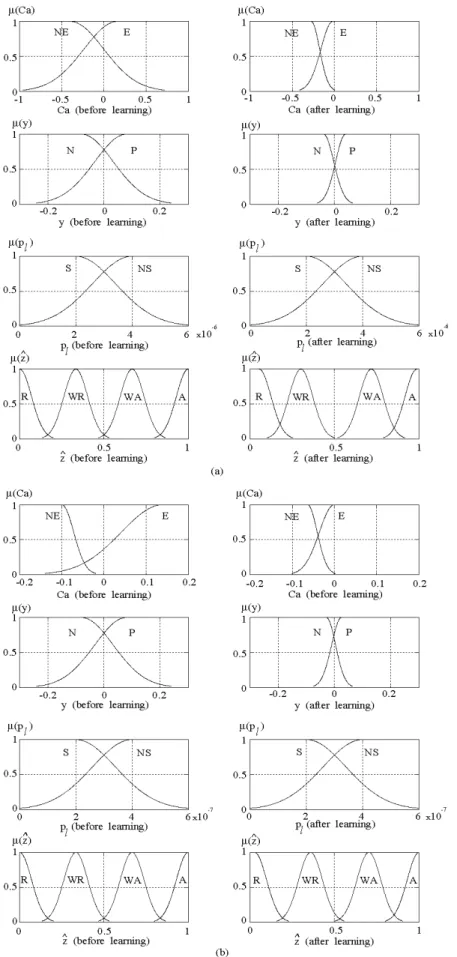
3.4 Membership functions of Ca, y, pl and ˆz for (a) type-1 traffic, (b) type-2 traffic 61 3.5 Cell loss ratio for (a) type-1 traffic, (b) type-2 traffic . . . 67
3.6 System utilization . . . 68
3.7 Training cycles needed for (a) type-1 traffic, (b) type-2 traffic . . . 69
4.1 The (M+1)-state birth-death MMPP model . . . 78
4.3 The functional block diagram of the PSD-based neural-net connection
admis-sion controller . . . 80
4.4 The basic structure of the PNCAC controller . . . 81
4.5 (a) The type-1 cell loss ratio (CLR), (b) the type-2 cell loss ratio (CLR), and (c) the system utilization of the ECCAC, Hiramatsu’s NNCAC, and PNCAC 87 4.6 (a) The type-1 cell loss ratio (CLR), (b) the type-2 cell loss ratio (CLR), and (c) the system utilization of the ECCAC, Hiramatsu’s NNCAC, and PNCAC with heavier traffic sources . . . 88
4.7 (a) The type-1 cell loss ratio (CLR), (b) the type-2 cell loss ratio (CLR), and (c) the system utilization of the ECCAC, Hiramatsu’s NNCAC, and PNCAC with lighter traffic sources . . . 89
4.8 The approximated bell-shaped function of the composed bell-shaped PSD . . 90
5.1 The connection model . . . 94
5.2 The flow chart of the conventional leaky bucket algorithm . . . 98
5.3 The intelligent leaky bucket algorithm . . . 100
5.4 (a) The membership functions for the input variables ΛL and ΛS (b) The membership functions for the output variable T . . . 101
5.5 The control surface of FIC . . . 104
5.6 The structure of the neural fuzzy increment controller (NFIC) . . . 105
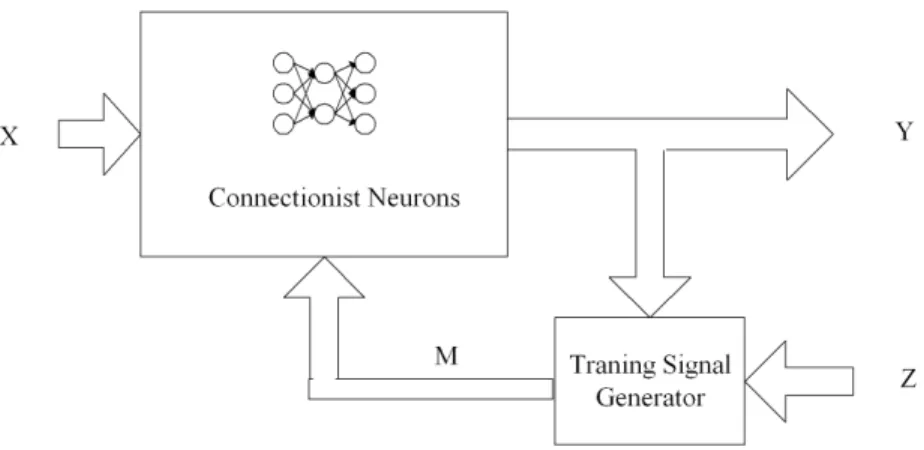
5.7 The configuration of the reinforcement learning for NFIC . . . 106
5.8 The correspondence between TS σ, UPC σ, and Source σ . . . 110 5.9 The selectivity of the conventional leaky bucket algorithm, the fuzzy leaky
bucket algorithm, and the neural fuzzy leaky bucket algorithm under (a) MMDP traffic source (b) MMBP traffic source (c) MPEG video traffic source 114
5.10 The responsiveness of the conventional leaky bucket algorithm, the fuzzy leaky bucket algorithm, and the neural fuzzy leaky bucket algorithm under (a) MMDP traffic source (b) MMBP traffic source (c) MPEG video traffic source, for Source σ=1.5 . . . 115 5.11 The mean queueing delay of the conventional leaky bucket algorithm, the
fuzzy leaky bucket algorithm, and the neural fuzzy leaky bucket algorithm under (a) MMDP traffic source (b) MMBP traffic source (c) MPEG video traffic source . . . 116
6.1 ETM scheme . . . 124 6.2 Simulation topology . . . 129 6.3 Throughput distribution of different traffic marker schemes in simulation
List of Tables
3.1 The rule structure for the NFCAC . . . 62
4.1 Traffic source parameters . . . 82
4.2 Heavier traffic source parameters . . . 83
4.3 Lighter traffic source parameters . . . 84
5.1 The rule base for FIC . . . 102
6.1 System parameters of scenario 1 . . . 129
Chapter 1
Introduction
1.1
Motivation
Over the past decades, the development of communication networks has been astonishing. So is the evolution of the service provisioning in the field of high-speed network. With the breakthrough of advanced semi-conductor and computer technologies, numerous transmis-sion and networking techniques associated with broadband capability have gotten dramatic developments. Also, the costs for network usage are continually getting cheaper and thus more people enroll in the network due to the low cost and convenience. All kinds of applica-tions or services have been developed over the high-speed communication networks. Most of them, especially the emerging ones, are the kind of multimedia services, which have various quality-of-service (QoS) and bandwidth requirements associated with the volume, high-burstiness and variable-rate traffics. Henceforth, high-bursty and high-volume services over high-speed networks are no longer scientifically fictional, but real. With the proliferation of various applications and the emergence of multimedia and real-time services, the high-speed network supporting multimedia services has to be capable of handling high-volume bursty traffic and providing guarantees to various QoS and bandwidth requirements. This is abso-lutely not an easy job because the abundant and diverse multimedia traffics have drastically
complicated the network environments. Henceforth, sophisticated and efficient (real-time) traffic control mechanisms are necessary to support diverse multimedia services/applications with different QoS and bandwidth requirements for high-speed networks while achieving high system utilization. Besides, the traffic control mechanisms are also required to be adaptive enough to handle the traffic and network dynamics.
Nowadays, both ATM (asynchronous transfer mode) and IP (Internet Protocol) tech-nologies can be employed to implement multimedia high-speed networks to accommodate versatile services and the subsequent diverse traffic types and characteristics. In order to support a set of QoS classes sufficient for all feasible multimedia services, several traffic con-trol mechanisms are proposed in both ATM and IP networks, such as connection admission control (CAC), traffic policing and shaping, congestion control, buffer management, (feed-back) flow control, priority control, traffic identification/classification, and traffic scheduling. [31], [32], [50], [51]. Among these traffic control mechanisms, the dissertation concentrates on the studies of connection admission control (CAC) and traffic policing functions for ATM and IP network systems. As shown in Fig. 1.1, where a generic architecture of a network access node is illustrated and the conceptual operation locations of several traffic control mechanisms are also depicted, the CAC and traffic policing functions can be regarded as two critical mechanisms performing access control upon the network-incoming traffics.
Connection admission control (CAC) is performed in a network access node at the call setup phase and is defined as “a set of actions taken by the network in order to determine whether a connection can be accepted or not” [31]. Specifically, the set of actions taken by the network (in the access node) is to estimate the network resources against the requirements of the incoming connections. A new connection is accepted and allowed to begin its traffic transmission only if sufficient network resources are available and its required QoS can be afforded while the QoSs of existing connections can still be maintained. In addition, the
Figure 1.1: The generic architecture of a network access node
network utilization would also be expected to increase through CAC as high as possible. The challenge of CAC is the complexity because the characteristics of heterogeneous source are hard to precisely estimate. For CAC to perform correctly, all the established connections can not violate their respective traffic contracts.
To make sure that the established connections conform to their traffic contracts, a traffic policing mechanism should be employed. Traffic policing is performed at the user-network interface (UNI) during the data transfer phase, and is defined as the set of actions taken by the network to police the offered traffic of a connection so that the associated traffic contract is respected. That is, some portion of the traffic of a connection would be dropped or shaped (by introducing queueing effect) to enforce the resultant traffic compliant with the traffic profile negotiated in the traffic contract during the call setup phase. Sometimes, the non-conforming portion of a connection would be tagged rather than directly dropped, so that the residual traffic satisfy the contract and some future processing would be performed
upon the tagged non-conforming traffic to attain some operation objectives. The main purpose of the traffic policing function is to protect network resources from malicious as well as unintentional misbehavior which can affect the QoS of other already established connections. The wide variety of multimedia services with different traffic characteristics and QoS requirements makes traffic policing a difficult job. The difficulty lies in finding a simple, universal, and effective scheme which is able to police any type of traffic to meet its (usually long-term and call-level statistic-oriented) traffic contract by making (short-term and packet-level) processing decision upon each incoming packet.
Several approaches have been designed and proposed to deal with the traffic control prob-lems. Most of the conventional approaches, which usually based on the analytic parametric models, suffer from serious shortcomings: some are simple but have many approximations and assumptions that are hard to justify, which makes those approaches impractical and leads to poor network resource utilizations because of the over- or under-estimations; others contain complicated mathematical solutions that may not be feasible to operate in real-time for high-speed multimedia networks. Besides, these conventional approaches provide optimal solutions only under a steady state with the assumption of a stationary system, and some parameters of the approaches are designed to be a pre-defined static value. This makes it difficult for the conventional approaches to handle the traffic control over non-stationarily dynamic network systems, because of not being able to react or respond to the highly varying network conditions.
Alternatively, some researchers turn to incorporate the measured system statistics and apply intelligent techniques to deal with the traffic control problems. Intelligent techniques, such as fuzzy logic inference systems, neural networks and neural fuzzy systems have been widely applied to deal with problems in numerous fields. They have replaced conventional technologies in many scientific applications and engineering systems including the network
control systems. Both fuzzy systems and neural networks are numerical model-free estima-tors and dynamical systems [1], which have the capability of modeling complex non-linear processes to arbitrary degrees of accuracy and efficiently adapting to the system dynamics. Recent research results have proven that these intelligent computations are capable of pro-ducing better results than parametric models or other conventional algorithmic approaches when applied to dynamic, non-linear complex systems. Researches have also shown that the non-stationarity of work-loads, together with heterogeneous traffic characteristics and QoS constraints of multimedia services, constitute the necessity for applying intelligent techniques in multimedia high-speed networks. Henceforth, in this dissertation, it is motivated to ex-ploit the merits of intelligent techniques applying to traffic control schemes for multimedia high-speed networks.
1.2
Paper Survey
1.2.1
CAC using Time-domain Traffic Parameters
Two kinds of CAC schemes are discussed in this dissertation for ATM networks. They make the CAC control decision according to the traffic parameters of different aspects which are the time-domain [8]–[23] and frequency-domain [33]–[39] parameters, respectively. For the CAC schemes based on time-domain parameters, the conventional ones usually apply a parametric model of the traffic being offered, either by requiring each connection to provide an accurate description of its traffic behavior (via traffic parameters such as the peak rate, mean rate, and the peak rate duration), or by measuring the observed traffic and fitting it to a model, and then infers the cell loss ratio (CLR) (and other network performance measures) from this model. For this scheme, when a new connection is requested, the network examines either the required bandwidth [8], [9], [10], [11], [12] or the QoS requirements [13], [14] to decide whether to accept the new connection or not. In most of the approaches disclosed in
the literature, complicated mathematical equations were derived and approximations were required to meet the real-time operation requirement for CAC. Some conventional CAC schemes based on the time-domain parameters are briefly described below.
Gu`erin, Ahmadi, and Naghshineh [8] proposed an “equivalent capacity” method for in-dividual and multiplexed connections, based on their statistical characteristics defined by traffic parameters and the desired QoS. A unified metric is then obtained to represent the effective bandwidth used by connections and the corresponding effective load on network links. Although the paper can provide an exact approach to the computation of the equiva-lent capacity, the associated complexity makes it infeasible for real-time calculation. Hence, an approximation is introduced and it results in the degradation in utilization. Chang and Thomas [9], [10] used the large deviation theory and the Laplace method of integration to provide a simple intuitive overview of the recently developed theory of effective bandwidth for ATM networks. A simple priority scheme and a cut-off threshold scheme for imple-menting multiple QoS were discussed. Four parameters of the average rate, the asymptotic variance, the peak rate, and the average burst duration were employed as traffic descriptors for approximating the effective bandwidth functions. They introduced the use of envelope processes and conjugate processes that could be used for fast simulation and bounds. An-other effective bandwidth approach is proposed by Elwalid, Mitra, et al. in [11], [12] for generic Markovian traffic sources rather than typical two-state on-off sources models. It also based on the large deviation theory and derive the effective bandwidth with an approxi-mation techniques according to Chernoff’s theorem. Fast and effective techniques for the computation of the approximation are given. The additive form in the effective bandwidth has simplifying consequences for connection admission problem with multiple heterogeneous classes of sources.
probability from the traffic parameters specified by users (i.e. the maximum number of cells arriving during a fixed interval, and the average and variance of the number of cells arriving during a fixed interval). The QoS requirement is guaranteed to be satisfied under this control without assumptions of a cell arrival process. In [14], Murata et al modeled an ATM switch as a discrete-time single server queueing system, and an exact analysis is developed to obtain the waiting time distribution and cell loss probability for a new call and all existing calls. According to the results, how the network performances depend on the statistics of a new call (burstiness, sojourn time of a call in active or inactive state, etc.) is investigated, and the effectiveness of admission control and traffic smoothing is also demonstrated.
As noted in section 1.1, the conventional CAC approaches, based on the analytical para-metric models, maybe simple but not feasible in practice. Many approximations and as-sumptions in these approaches simplify the models and this represents that networks are forced to make control decisions based on incomplete or imprecise information. Besides, the conventional CAC approaches provide optimal solutions only under a steady state with the assumptions of a stationary system. And some parameters of them are designed to be static values associated to the a-priori statistical knowledge. Henceforth, it is difficult to deal with the traffic control problems over modern and future communication networks, which are expected to be highly complicated and non-stationarily dynamic.
Some literatures [15]–[23] had proposed schemes to adopt a number of measured statis-tics of the network system to help provide a better or optimal traffic control decision. The statistics can be obtained by collecting network performance information such as the net-work load, the occupancy of the buffers, the data rate and the data loss ratio. All of them were proven to effectively and greatly improve the network performances. The reason lies on that the measured statistics of network performance indeed provide a more insight informa-tion of the system: the measured values represent the real condiinforma-tions which can substitute
the parameters that base on a-priori knowledge in the model-based conventional schemes; the continual measurements of the network statistics would further provide the controller adaptive capabilities responding to network dynamics. Besides, the measurement forms a close-loop control system capable of adjusting itself to correspond to the network conditions, which would consequently provide stable and robust operations.
Additionally, more network statistics can be collected than what are needed in the model-based schemes to provide more comprehensive information about the system. These addi-tional measurements may provide intuitive information about the traffic control. To full utilize those measurements, numerous model-free approaches based on the intelligent tech-niques are proposed. This is because the intelligent techtech-niques could accommodate all in-formation without any assumption about the systems. With the learning capability or the human experiences about the system, the intelligent techniques can extract the knowledge about the CAC and construct a robust admission controller. These approaches are briefly depicted as follows.
Fuzzy logic systems have been widely employed to deal with CAC-related problems in ATM networks [17], [18]. Bonde and Ghosh [17] used fuzzy mathematics to provide a flexible, high-performance solution to queue management in ATM networks. In [18], a fuzzy traffic controller which simultaneously incorporates CAC and congestion control was proposed. It is a fuzzy implementation of the two-threshold congestion control method and the equivalent capacity admission control method extensively studied in the literature. Comparative studies have shown that the proposed fuzzy approaches significantly improve system performance compared with conventional approaches.
Aamadi, Tarraf, Habib, and Saadawi [19] introduced intelligent traffic control for ATM networks. They surveyed some of the recent applications of NNs in high-speed networks. NNs could be used to measure and predict the traffic characteristics, to determine the acceptance
of connections as a CAC controller, to detect violation of negotiated parameters as a UPC controller, and to control the traffic flow via feedback control signal to prevent network from congestion. Performance results show that the NN approaches achieve better results, much simpler and faster than conventional approaches. Hiramatsu [20] proposed a neural-net based connection admission controller. The proposed ATM neural-network controller used multilayer feedforward neural networks for learning the relations between the offered traffic and the service quality. In the proposed method, the declared traffic parameters were used only to divide calls into several bit-rate classes. The neural network in the controller actually learns the relationship between the numbers of existing connections in each bit-rate class and their corresponding QoSs according to the statistical characteristics of each bit-rate class. Morris and Samadi [21] described the application of neural networks to the CAC and the switch control problems. Key network performance parameters are observed while carrying various combinations of calls, and their relationship is learned by a neural network structure. The neural network model chosen has the ability to interpolate or extrapolate from the past-experienced results, and it also has the ability to adapt itself to the new and changing conditions. In [22], Youssef, Habib, and Saadawi proposed a call admission controller for ATM networks. A neural network is trained to compute the effective bandwidth required to support MPEG-1 VBR video calls with different QoS requirements. They showed that the adaptability of the neural network controller to new traffic situations had been achieved by adopting a hierarchical approach to the design. We have also proposed a neural network connection admission control (NNCAC) scheme [23] for ATM networks. Simulation results reveal that call admission control with neural networks can improve significantly system utilization, under QoS constraint.
1.2.2
CAC using Frequency-domain Traffic Parameters
All the studies about CAC schemes mentioned above were conducted mainly on the basis of traffic parameters in time domain. On the other hand, Li and Hwang [33] and Sheng and Li [34] have studied the queueing performance of a high-speed network from the point of view in the frequency-domain traffic parameters. The process of input traffic inherently contains a power spectral density (PSD) function, which is the Fourier transform of the input traffic process’s autocorrelation function. From their studies, two characteristics of PSD are concluded: (i) The PSD can be well characterized by three main parameters such as the DC component, the average power, and the half-power bandwidth. (ii) The low-frequency band of the input PSD has a dominant impact on queueing performance, while the high-frequency band can be neglected to a large extent. This is because the low frequency component of PSD contains the correlation and burstiness of the input process. The more the low-frequency components are, the burstier the input traffic will be [35]. Therefore, according to the above two PSD characteristics from Li’s studies, it can be conducted that these three PSD parameters can well characterize the input traffic and correspond to its queueing performances, and thus this reveals a chance to employ the PSD parameters for CAC.
A composition algorithm is proposed in [36] to obtain the three PSD parameters of an aggregate traffic source from the given PSD parameters of these individual traffic sources which build the aggregate one. The computation process of the composition algorithm is just through some simple arithmetic operations. It can then be concluded that PSD param-eters possess additive property; this makes the PSD paramparam-eters more suitable for admission control, no matter how many types of traffic sources there are, because the PSD parameters of the virtually aggregated total traffic enrolling the new call could be easily estimated as the new call request arrives and maintain the same (three) reference variables, which can correspond to the queueing performances, for the admission control decision making. The
design of the CAC algorithm based on PSD parameters can be made accordingly and this indeed greatly reduce the complexity for admission control.
An intuitive and simple CAC method using PSD parameters, the power-spectrum-based table-lookup CAC method, was studied for multimedia communications in ATM networks, where the table content was the cell loss probability indexed by the PSD parameters of voice/video calls and arrival rates of data calls [36]. The table can be constructed through several explorative simulations. This method, according to the simulation results, is efficient enough, however, since the table is constructed based on the original three PSD parame-ters: DC component, half-power bandwidth, and average power [36], there is a drawback of large-dimensional CAC table. An “equivalent source” concept is consequently introduced to transform the PSD parameters of an offered traffic source into the so called “equivalent” PSD parameters which are corresponding to another (equivalent) traffic source [37]. The word “equivalent” exactly stands for almost the same queueing performances in some evaluation aspects. That is, the corresponding traffic source with the “equivalent” PSD parameters generated by the transformation is expected to have equivalent queueing performances with the offered traffic source characterized by original PSD parameters, so that the equivalent PSD parameters could substitute the original ones. A modified power-spectrum-based table-lookup CAC method was then proposed in [37] where the CAC table-lookup table is significantly reduced by one dimension than that proposed in [36], since the PSD parameters of each table entry in [36] can be transformed to the equivalent ones with the pre-defined half-power bandwidth value which is identical among all transformed entries, and thus only the DC component and the transformed equivalent average power have to be specified to character-ize and distinguish each (voice/video) traffic source. The offered three PSD parameters of a new call request would also be transformed to the equivalent ones at first to adapt to the operations based on the dimension-reduced CAC table. Although the transformation may
introduce some degradations on performances, simulation results show that the modified power-spectrum-based table-lookup CAC scheme is still efficient enough and more feasible for practical implementations.
In order to get rid of the trade-off between efficiency and table size due to the quantization resolution of the PSD parameters indexing the CAC table, an enhanced power-spectrum-based CAC method power-spectrum-based on the PSD parameters is designed by adopting the intelligent techniques to replace the lookup table and accommodate the index variables (including PSD parameters of voice/video calls and arrival rates of data calls) as the inputs for the intelligent controller. A continuous CAC decision hyperplane according to the input variables is then built to provide more precise admission control under the constraint of QoS requirements. Also, the learning capability of some intelligent techniques can bring adaptability to respond to the network dynamics. Two intelligent power-spectrum-based CAC schemes employing the neural network and the neural fuzzy controllers has been proposed in [38] and [39], respectively. Both of them further raise the performance improvements on network utilization of the power-spectrum-based CAC schemes as compared with the conventional equivalent capacity method [8].
1.2.3
Traffic Policing in ATM Networks
For CAC to perform correctly, a traffic policing mechanism is necessary to ensure that all established connections conform to their respective traffic contracts. Two traffic policing functions, the usage parameter control (UPC) [40]–[48] and traffic conditioning [49]–[56], are exploited in this dissertation for ATM and IP networks, respectively. The UPC is the traffic policing function defined in ATM networks [31], while the traffic policing in IP networks is performed through the traffic conditioning functions. For ATM networks, several UPC schemes such as the jumping window, triggered jumping window, moving window, exponen-tially weighted moving average, and leaky bucket algorithm were studied and compared [40],
[41], [42], [43]. The most popular and well-known policing scheme is the leaky bucket algo-rithm because of its simplicity and effectiveness. Three performance objectives have to be fulfilled by UPC and they can also be adopted as the criteria to evaluate the efficiency of the UPC in ATM networks: (i) High selectivity (detection accuracy): UPC should detect and tag (drop) the non-conforming cells of a violating connection as many as possible, while being transparent when the connection conforms to its traffic contract. (ii) High responsiveness: the time for UPC to detect a violating connection should be rather short. (iii) Low queueing delay: cells of a non-violating connection should not experience too much queueing delay at the output shaper of customer premise equipment (CPE).
Some literature had also studied to utilize the intelligent techniques for the UPC [44], [45], [46], [47]. In [44], a fuzzy logic implementation of the leaky bucket algorithm that used a channel utilization feedback to manage voice cells in ATM networks was proposed. Simulation results showed that the fuzzy leaky bucket had performance improvement over the conventional leaky bucket algorithm. In [45], a neural network traffic enforcement mechanism using window-based scheme for ATM networks was presented. It is based upon an accurate estimation of the probability density function (pdf) of the traffic via a counting process, and the system performance is evaluated in terms of the pdf violation. It has scalability and convergence problems if the number of previous windows is required to be a large value. In [46], the paper designed a fuzzy policer based on window control scheme, which has the characteristic of simplicity and the capability to combine a fast responsiveness with a high-degree selectivity close to that of an ideal traffic policer. In [47], the proposed policing strategy integrated with a linear prediction filter is used to forecast the cell rate of the policed traffic source.
1.2.4
Traffic Policing in DiffServ IP Networks
The traffic policing function in IP networks is handled by a controller named as traffic conditioner defined in the Differentiated Services (DiffServ) model [50], [51]. The DiffServ model is a QoS-provisioning service architecture for traffic processing and delivery proposed by the Internet Engineering Task Force (IETF) [50] for the IP network, since the IP network is basically originated on the “best-effort” service model and can hardly provides QoS guar-antees for any connection because the bandwidth resources are allocated in a competition sense among all connections. As contrary to the Integrated Services (IntServ) model [49] which is alternatively the other QoS-provisioning service model defined by IETF but has scalability problem because of the per-connection-based processing [51], DiffServ focuses on the QoS of the aggregate connections and supports only a set of finite number of predefined QoS classes in order to reduce the complexity and provide a promising solution to scalability. The connections that require a similar QoS level would be assigned to the same class, and thus (virtually) form an aggregate connection with a unique QoS processing including traffic conditioning.
The traffic conditioner, consisting of a meter, a marker and a shaper (or a dropper), would continually determine the conforming level of the incoming traffic of an aggregate connection according to the measured traffic flow and its traffic contract [50], [51]. After that, a notation would be made on the traffic packets by the marker to indicate the conforming level, and a corresponding processing action such as dropping, shaping and bypassing is then taken upon the packets. The packet notation assigned by the traffic marker in DiffServ networks is defined as three colors, denoted as green, yellow, and red, which are corresponding to three different pre-defined conforming levels for the packet with respect to the traffic contract. The packets assigned a green notation can be called as green packets for simplicity, and so do the packets marked a yellow or a red notation. The green packets stand for that these
packets belong to the best conforming level and have the lowest dropping precedence (or the shortest shaping delay); the red packets, on the contrary, represents that these packets are judged to be with the worst conforming level (e.g. the violation level) and have the highest dropping precedence (or the longest shaping delay).
In DiffServ IP networks, several traffic conditioning schemes such as Single-Rate-Three-Color-Marker (SRTCM) [52], Two-Rate-Three-Single-Rate-Three-Color-Marker (TRTCM) [53] and Time-Sliding-Window-Three-Color-Marker (TSWTCM) [54] were proposed in RFC to implement the traf-fic conditioner. The TRTCM, which is popular because of its simplicity and effectiveness, adopts a couple of token buckets to police two rate properties of a traffic source simultane-ously. The output traffic rate of green packets as well as the aggregate output rate of green and yellow packets are both ensured individually to conform to the traffic profile, where the green traffic rate is usually corresponding to the policed mean (or sustainable) rate of the incoming traffic and the aggregated green and yellow traffic rate represents the policed peak rate of the incoming traffic.
In addition to the color-blind operation mode, where the color marking decisions are based on only the metering results against the traffic contract, the alternative color-aware operation mode of the TRTCM performs the color marking according to not only the me-tering results against the traffic contract, but also the existing color notation of the packets, simultaneously. The purpose and operation principle of the color-aware mode is to maintain the existing color notation of the policed packets as best as it can while still conforming to the traffic contract. This is because, as noted above, the color notation of the packets can represent the conforming level and correspond to the pre-defined QoS-provisioning packet processing behaviors. A packet may originally have its first color notation assigned by the output shaping function at the source node according to not only the metered results but also the importance of the packet’s content. By properly allocating color notations
represent-ing higher conformrepresent-ing level and better QoS-provisionrepresent-ing packet processrepresent-ing behaviors to the packets with application critical contents, the QoS of each application is then expected to be quite improved while the traffic contract remains assured, since the packets with important application data are supported and served with better QoS. For example, the I-frame in the MPEG video is more vital than the other two coding frames, the B-frame and P-frame, because it serves as the base frame to reconstruct a series of video frames. The packets con-taining I-frame data can be assigned with the color notation representing higher conforming level and better QoS-provisioning packet processing behaviors so that the quality of the re-played video at the destination can be improved. Accordingly, the TRTCM operating in the color-aware mode can support better QoS for the applications than the TRTCM running in the color-blind mode.
As the TRTCM is a scheme to implement the traffic policing function in DiffServ IP networks, the packet demotion capability that re-marks a packet with a color notation corre-sponding to a lower conforming level than its existing one is inevitable and natural. However, a packet that is demoted due to occasionally short-term congestions or a locally stricter traf-fic profile may not have the chance to restore its existing or even the original conforming level. It has also been observed that the output rate of green packets might be impaired by the excessive incoming yellow packets: many packets with existing green notation are thus demoted to be with red color directly because the token resources are excessively consumed by the incoming yellow packets with the rate exceeding the traffic profile. These facts would result in the end-to-end QoS degradations for the applications since more packets carrying critical application data and originally denoted with a high conforming level maybe treated by worse packet processing behaviors due to the demotions. Also, the marking fairness among all connections within a (virtual) aggregate traffic is uncertain.
introduced in the UPC of ATM networks can also be employed to verify the efficiency of the traffic conditioner. In addition, because the processing of the traffic conditioner is based on the aggregate connection, the marking fairness for resource share among all connections within the (virtual) aggregate one could be taken into consideration as another performance objective. On the other hand, the IP network would be a world-wide network constituted by several interworking network systems which are hosted by different network service providers (NSPs). The network management policies of different NSPs may be varied and thus the definitions of a specific DiffServ QoS class can be distinct. Therefore, the traffic profile and the associated QoS-provisioning processing of an aggregate connection corresponding to the same QoS class may change from network domains to domains. As noted above in the TRTCM scheme, the packets might be demoted due to a locally stricter traffic profile and thus the end-to-end QoS of the applications would be degraded since the only demotion processing would make the traffic rate corresponding to the high conforming level decline along the communication route when the traffic traverse across several network hops or domains [55]. Consequently, a traffic promotion function is also considered as an objective for the traffic conditioner to not only restore the conforming levels of the previously demoted packets, but also aggressively promote the packets to higher conforming levels, if possible, for better application QoSs, while the traffic contract is still be respected. The aggressive promotion processing can then be equivalently regarded as fully utilizing the network resources to drive the traffic of each conforming level to achieve as high rate as possible by packet promotions while conforming to the traffic contract.
A random early demotion and promotion (REDP) technique [55] was proposed to over-come the unfair-marking problem. It implements a packet promotion function in addition to the demotion nature of the RED-In/Out (RIO) [56] marking mechanism, and achieves marking fairness by appropriately allocating the demotion/promotion probabilities among
packets during the packet demotion and promotion procedures. In order to fully utilize the network resources for better application QoSs and provide marking fairness among all con-nections within the (virtual) aggregate one for TRTCM, a TC PFG marking scheme [57] was proposed. However, in TC PFG, only the packets belonging to the yellow conforming level is allowed to be promoted and this limits its application. Moreover, TC PFG has the problem of unjust-promotion that the previously demoted packets can not be guaranteed to be promoted first when the network resource condition is available to perform the packet promotion function.
1.3
Dissertation Organization
In this dissertation, the traffic control functions involving the connection admission control (CAC) and the traffic policing for multimedia high-speed networks by neural/fuzzy intelligent techniques are studied. Several types of service with different QoS requirements and various bandwidth demands have to be supported by the multimedia high-speed networks. Both ATM and IP networks which can be utilized to construct the multimedia high-speed networks are considered in this dissertation. The CAC schemes which make the admission control decisions according to the time-domain and frequency-domain traffic parameters are both discussed where the intelligent techniques are chosen to implement the CAC controllers. Also, the enhanced algorithms which implement the traffic policing function by incorporating the intelligent techniques and a elaborate computation procedure into existing algorithms for ATM and IP networks respectively are both well explored.
In Chapter 2, the basic concepts of fuzzy systems, neural networks, and integrated neural fuzzy systems are briefly reviewed. The architecture of a fuzzy inference system (FIS) and the most basic and popular fuzzy inference model to implement a fuzzy logic controller are stated. The neural networks and learning mechanism are presented along with two popular
architectures for implementing a neural network controller. The benefits of integrated neural fuzzy systems is described. Also a typical five-layer connectionist architecture to build a neural fuzzy controller are stated there. Additionally, the applications of these intelligent techniques to the traffic control functions over multimedia high-speed networks are given.
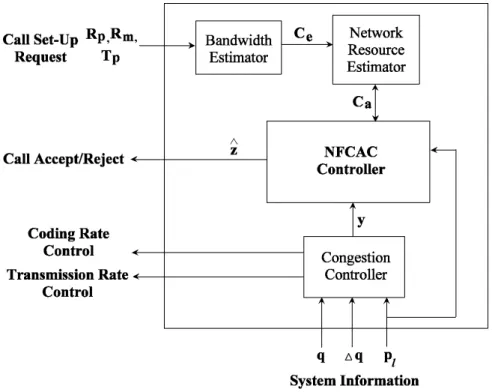
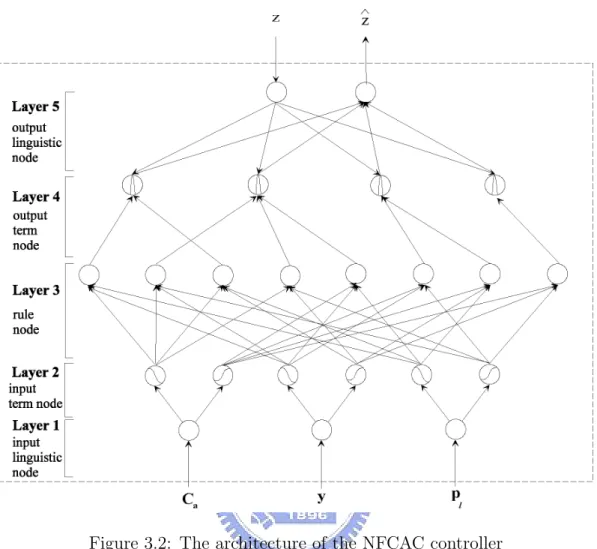
In Chapter 3, a neural fuzzy connection admission control (NFCAC) scheme which based on the time-domain traffic parameters and provides QoS guarantees for multimedia high-speed ATM networks is proposed. The NFCAC scheme adopts a neural fuzzy controller for admission control, which integrates the linguistic control capabilities of a fuzzy logic con-troller with the learning abilities of a neural network. We properly choose input variables which involves the measured statistics of network performances and the available network resources converted from the time-domain traffic parameters, and then well design the rule structure for the neural fuzzy controller. Accordingly, the NFCAC scheme can provide a robust framework to mimic experts’ knowledge embodied in existing connection admission control techniques and can construct precise and efficient computational algorithms for con-nection admission control to achieve high system utilization while supporting QoS-guarantee. In Chapter 4, a power-spectrum-based neural-net connection admission control (PNCAC) scheme for multimedia high-speed ATM networks is proposed. It employs a neural network controller to handle the connection admission control function according to the frequency-domain power spectral density (PSD) parameters of the traffic sources. With a composition algorithm to easily obtain the approximated three PSD parameters of the virtually aggre-gated total traffic enrolling the new call request, the neural network controller accommodate all the three PSD parameters as the inputs and generate the admission control decision. After well training the neural network, an optimal CAC decision hyperplane based on the input variables is constructed to provide an efficient and robust admission control even under dynamic network environments, while the QoS requirements are still satisfied and strictly
as-sured. Also, the learning capability of the neural network techniques can bring adaptability to respond to the network dynamics.
In Chapter 5, two intelligent usage parameter controllers are proposed to implement the traffic policing function for the sustainable-cell-rate (SCR) of multimedia transmissions in ATM networks. One is the fuzzy usage parameter controller realized by the fuzzy leaky bucket algorithm, in which a fuzzy increment controller (FIC) is incorporated with the conventional leaky bucket algorithm; the other is the neural fuzzy usage parameter controller base on the neural fuzzy leaky bucket algorithm, where a neural fuzzy increment controller (NFIC) is added to the conventional leaky bucket algorithm. The FIC and NFIC are exactly the fuzzy logic controller and the neural fuzzy controller, respectively, and both of them properly choose two measured statistics of the network performances, the long-term mean cell rate and the short-term mean cell rate, as the input variables to adaptively determine the optimal increment value with respect to the traffic dynamics. Accordingly, both of the proposed fuzzy and neural fuzzy usage parameter controllers can achieve better performances than the conventional leaky-bucket-based usage parameter controller because of the dynamic increment value by adaptive decisions.
In Chapter 6, an enhanced traffic marker (ETM) based on the Two-Rate-Three-Color-Marker (TRTCM) scheme is proposed for the traffic conditioner to perform traffic policing by properly determining the conforming level of the incoming packet and making a corre-sponding color notation on the packet. The proposed ETM scheme introduces the features of aggressive promotion and fair share marking, and incorporates them into the existing traffic policing function. One of the primary performance objectives is that it can fairly allocate the color notations among connections within an aggregate one. It is also anticipated to enhances the throughput of each conforming level for the aggregate connection to achieve as high rate as possible by not only restore the conforming levels of the previously demoted
packets, but also aggressively promote the packets to higher conforming levels if the net-work resource condition is available, so that the end-to-end QoS of the applications would be substantially improved while the traffic contract is still be respected. The performances of the proposed ETM scheme were verified via simulations and the simulation results were compared with the conventional TRTCM scheme.
Chapter 2
An Overview of Intelligent Techniques
In this chapter, the basic concepts of fuzzy logic systems, neural networks, and integrated neural fuzzy systems are briefly reviewed. Fuzzy logic systems and neural networks are both numerical model-free estimators and dynamical systems [1], which have the capability of modeling complex nonlinear processes to arbitrary degrees of accuracy and efficiently adapting to the system dynam-ics. Also, the integrated neural fuzzy systems are integrating fuzzy systems and neural networks into a functional system to overcome their individual weaknesses by mutual compensation; that is, neural networks provide fuzzy systems with learning abilities and fuzzy systems provide neural networks with structural reasoning.
2.1
Introduction
In light of the recent developments of multimedia high-speed networks, future telecommu-nication networks will consists of heterogeneous access networks and comprise of content-rich services with diverse service characteristics and QoS requirements. Thus, the future mul-timedia high-speed networks will be highly dynamic communication environments, which require comprehensive and real-time traffic control mechanism. Traditional modelling and computation techniques are not well-suited to fulfill the requirements of future multimedia high-speed networks. On the other hand, intelligent techniques, such as fuzzy logic sys-tems and neural networks, have attracted the numerous interests in various scientific and engineering areas. These intelligent techniques have the capabilities of soft-computing and adaptation, which are more flexible for network designers to cope with the network control problems. In this chapter, the concept of fuzzy logic system, neural network and neural fuzzy techniques will be briefly introduced.
Both fuzzy and neural network are mimicked the behaviors of human brain: fuzzy logic operates on the way the brain deals with vague information and neural networks are modelled according to the physical architecture of the brain [1]. There are a number of parallels that point out their similarities. Fuzzy systems and neural networks are both numerical model-free estimators and dynamical systems. Also, they have been shown to have the capability of modelling complex nonlinear processes to arbitrary degrees of accuracy. Although the two intelligent techniques are somewhat similar, some significant differences do exist. Fuzzy systems employ linguistic if-then fuzzy rules as a kind of expert knowledge to formalize in-sights about the structure of categories founding the real world. Fuzzy systems combine the mathematical theory of fuzzy sets with fuzzy rules to produce overall complex nonlinear be-havior. On the other hand, neural networks are dynamical systems and are adaptively fitting the behavior of the real-world through their various connectionist structures and learning
techniques. Neural networks have a large number of highly interconnected processing ele-ments (nodes or neurons) which demonstrate the ability to learn, recall and generalize from training patterns or data; these simple processing elements also collectively produce complex nonlinear behavior.
Alternatively, an innovative concept of interests of intelligent techniques is to merge or combine fuzzy systems and neural networks into a functional system to overcome their individual weaknesses. This innovative concept of integration reaps the benefits of both fuzzy systems and neural networks. That is, neural networks provide fuzzy systems with learning abilities, and fuzzy systems provide neural networks with a structural framework with high-level fuzzy if-then rule thinking and reasoning. Consequently, the two technologies can complement each other.
The rest of this chapter is organized as follows. The concept of fuzzy inference system (FIS) and the most basic and popular architectures of a fuzzy logic controller are stated in section 2.2. The neural networks and learning mechanism are presented in section 2.3, along with two popular architectures for implementing a neural network controller. In section 2.4, the concept of the integrated neural fuzzy system is described. Also a typical five-layer con-nectionist architecture to build a neural fuzzy controller are stated there. The applications of these intelligent techniques (such as fuzzy logic system, neural networks and integrated neural fuzzy system) in the following chapters of this dissertation are briefly previewed in section 2.5. Finally, the concluding remarks are given in section 2.6.
2.2
Fuzzy Logic Controller
2.2.1
Fuzzy Inference System (FIS)
Fuzzy logic is based on the concepts of linguistic variables and fuzzy sets theory. A fuzzy set in a universe of discourse U is characterized by a membership function µ(·) which