Ž .
Chemical Geology 182 2002 377–394
www.elsevier.comrlocaterchemgeo
Influence of the Yangtze River and grain size on the spatial
variations of heavy metals and organic carbon in the East China
Sea continental shelf sediments
Saulwood Lin
a,), I-Jy Hsieh
a, Kuo-Ming Huang
a, Chung-Ho Wang
b aInstitute of Oceanography, National Taiwan UniÕersity, Taipei, Taiwan
b
Institute of Earth Sciences, Academia Sinica, Taipei, Taiwan
Received 30 August 2000; accepted 9 May 2001
Abstract
Ž . 13
Bulk heavy metal Fe, Mn, Zn, Cu, Pb, Cd , Al, organic carbon and carbonate concentrations, grain sizes, and d C of the organic carbon distributions were studied in sediments collected throughout the East China Sea continental shelf and the Yangtze River Delta. The results demonstrated that terrigenous sediments from the Yangtze River is a dominating factor controlling the spatial variations of heavy metals and organic carbon concentrations on the East China Sea continental shelf. In addition, grain size and recent anthropogenic influences are also major factors modifying the spatial and vertical variations of heavy metals.
Large spatial variations with a band type distribution of heavy metals, grain size, organic carbon and carbonate were observed. Higher concentrations of heavy metal and light d C13of the organic carbon were found primarily in the Deltaic and inner shelf sediments. The band type distribution generally followed the coastline with little variations in the
Ž .
north–south direction. Away from the Delta and inner shelf west–east direction , most heavy metal concentrations decreased rapidly with the exception of Cd where high concentrations of Cd were also found in the carbonate-rich shelf break sediments. Coarse-grained relict sediments and biogenic carbonate are two primary diluting agents for the fine-grained aluminosilicate sediments from the Yangtze River with high concentrations of heavy metals.
Unusually high concentrations of Cu, Pb, and Cd showed both spatially and vertically that more pollution prevention measures are needed in the Yangtze River drainage basin in order to prevent further heavy metal pollution of the East China Sea inner continental shelf. q 2002 Elsevier Science B.V. All rights reserved.
Keywords: Yangtze River; East China Sea; Continental Shelf; Sediments; Heavy metal
1. Introduction
Yangtze River is the largest river in China and one of the largest in the world. After nearly three decades of economic reform and booming industrial
)
Corresponding author. Tel.rfax: q886-2-23636424.
Ž .
E-mail address: [email protected] S. Lin .
development, a tremendous amount of both natural and anthropogenic heavy metals was carried by the River into the East China Sea continental shelf. The annual discharge of suspended particle is
approxi-6 Ž
mately 480 = 10 tonsryear Milliman and Meade, .
1983 . Together with these tremendous amounts of suspended sediments, a great deal of terrigenous organic matter and heavy metals associated with
0009-2541r02r$ - see front matter q 2002 Elsevier Science B.V. All rights reserved.
Ž .
aluminosilicate were also transported out into the shelf. Understanding their deposition on the conti-nental shelf is essential in determining the fate of terrigenous materials from the river. Large rivers such as the Yangtze River are particularly important as a major source of terrigenous material exporting
Ž
to the ocean Milliman and Meade, 1983; Milliman
. Ž .
and Syvitski, 1992 . DeMaster et al. 1985 esti-mated that approximately 50% of the suspended particle were transported and dispersed south of the Yangtze River Delta. However, Niino and Emery Ž1961 showed that a great majority of East China. Sea continental shelf sediments were relict sediments from the last glacial. Despite the considerable efforts
Ž devoted to the study of the Yangtze River see Luo
.
and Ostenso, 1983; Yu et al., 1990 , data regarding the exact extent and deposition of recent sediments from the River on the East China Sea continental shelf remained inconclusive since most investiga-tions had focused on deposition processes near the Yangtze River Delta.
In addition to the tremendous amount of natural terrigenous material carried by the Yangtze River, recent rapid industrial development in China at the expense of environment may also play a very impor-tant role on the distribution of heavy metals and a potential ecological consequence on the East China Sea continental shelf. More than one-third of the heavily populated metropolitan areas were located inside the Yangtze River drainage basin. The sheer size of the population compounded with a very fast economic development will likely change the natural distribution processes on the East China Sea conti-nental shelf. In fact, anthropogenic influences on the heavy metal deposition near the Yangtze River Delta
Ž
were observed in recent studies Huh and Chen, .
1999; Zhang, 1999 .
Despite the growing interest in the study of the Yangtze River, our understanding of the influence of Yangtze River on the East China Sea continental shelf is still limited to the region near the river mouth, and little is known concerning the extent and scale of this rapid growing anthropogenic influence on the heavy metals distribution of the East China Sea continental shelf. In order to study the influence of Yangtze River on the East China Sea, a set of sediment samples cover most of the East China Sea continental shelf were collected and analyzed. This
study examined the spatial distributions of heavy metals, organic carbon and the stable carbon isotope in the East China Sea continental shelf sediments, and analyzed the major factors controlling the spatial and vertical variations of sedimentary heavy metals. The primary goal of this study was to investigate the influence and the extent of heavy metals from the Yangtze River on the East China Sea continental shelf. In addition, this study also attempted to evalu-ate the effect and scale of potential heavy metal pollution from the River on the East China Sea continental shelf.
2. Study area and methods
2.1. Study area
East China Sea is one of the world’s largest continental shelf systems. Major sources of
terrige-Ž 6
nous sediments include the Yangtze 480 = 10
. Ž 6 .
tonsryear and the Huanghe 1100 = 10 tonsryear
Ž .
rivers Milliman and Meade, 1983 . Fine-grained sediments originating from the Huanghe river de-posited not only on the Yellow Sea but also on the
Ž
northern part of the East China Sea Kim et al., .
1998; Lee and Chough, 1989 . For the Yangtze River, approximately 40% of the total suspended loads were deposited in the Yangtze River estuary ŽMilliman et al., 1985 . According to Milliman et al.. Ž1985 , shoreline progradation within the Yangtze. estuary during the past 2000 to 3000 years has accounted for less than 5% of the river’s load. Most sediment is temporarily deposited offshore and later resuspended and transported southward by
subse-Ž
quent winter storms Milliman et al., 1985; McKee .
et al., 1983; DeMaster et al., 1985 . Little informa-tion is available concerning the extent and the final deposition of the Yangtze River sediments and asso-ciated heavy metals south of the Delta.
2.2. Sampling and analytical methods
Ž .
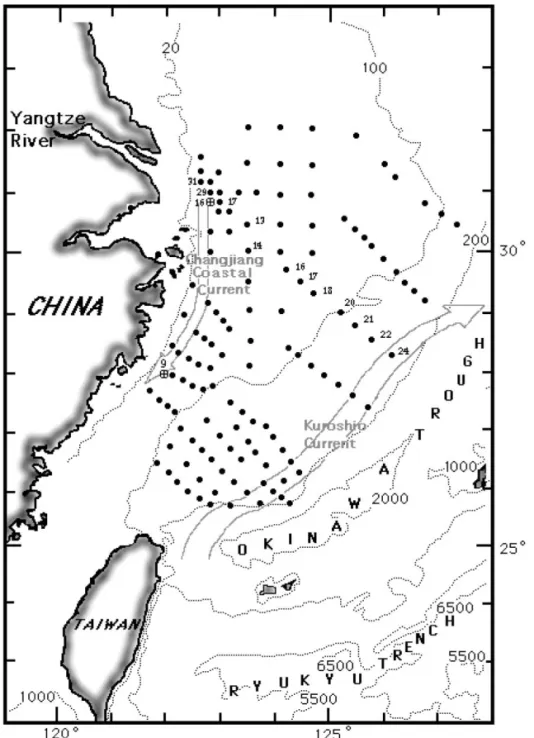
Sediments samples Fig. 1 at 130 stations were collected on board RrV VinogradoÕ using a Van-Veen type Grab, and RrV Ocean Researcher I, cruise 293, 322, 456, 499 and 551 with a Sautar type
( )
S. Lin et al.r Chemical Geology 182 2002 377–394 379
Ž .
Fig. 1. Study area and sampling stations v . [: Core locations. Dashed line contours are in meters.
box core andror Bentho’s gravity core. Upon re-trieving the core on deck, sediments were subsam-pled and subcored, sectioned into 1- to 2-cm sections with a plastic spatula and stored frozen in the
poly-Ž .
ethylene PE bottles.
Sediments were freeze-dried using a Labconco
Ž .
freeze-dryer Lyph-Lock, 6 l for 1 week, and then
ground to fine powder using an Agate mortar and stored in PE vials. Well-mixed subsamples were analyzed for total metals, inorganic carbon, organic carbon, and d C13 of the organic carbon. Untreated sediments were wet sieved through a set of Standard
Ž .
Sieve Endecotts, England larger than 63 mm to separate the sand size grain. Grain sizes of the
fraction smaller than the 63 mm were determined by
Ž .
the standard pipette technique Folk, 1974 . The
Ž Ž . .
precision for the clay diameter d - 4 mm , silt
Ž4 - d - 63 mm and sand d ) 63 mm are 0.37%,. Ž . 0.96%, and 1.56%, respectively.
Total carbon and organic carbon were analyzed
Ž .
using a LECO CrS Analyzer SC-444 equipped with a high temperature resistance furnace and an IR detector. Approximately 0.3 g of dry sediments was combusted at 1400 8C with high purity oxygen to determine the total carbon content. Organic carbon
Ž .
was determined with pre-acidified ; 2 ml 6N HCl
Ž .
and later hot-plate dried ; 50 8C sediments. Cal-cium carbonate content was calculated from the dif-ference between the total carbon and organic carbon content assuming calcite was the only carbonate phase. The precision for the total carbon and organic carbon are 1.2% and 3%, respectively.
Ž .
Dry sediments ; 0.25 g were digested in a Teflon lined digestion vessel using a CEM
mi-Ž . Ž .
crowave MDS-2000 based on Kokot et al. 1992 .
Ž .
A mixed reagent conc. HNO rHF: 5r2 of 2.5 ml3 was added to each vessel and heated with 100% power for 10 min. Next, the microwave was set up at 75% power for 20 min and 25% power for 5 min. After the pressure dropped to 1 atm, the digestion vessels were opened and 10 ml of 4% H BO were3 3
added and the above heating procedures were re-peated. Upon completion of the digestion process, the digested solution was stored in PE vials for analyses. A NIST-1646a Standard Sediment was used
Ž in each batch digestion for recovery test. Metals Al,
. Fe, Mn, Zn: flame; Cu, Pb, Cd: graphite were
Ž .
determined using Hitachi 8100Z graphite and
Ž .
Perkin-Elmer 3300 flame atomic absorption spec-trometer. For metals high in concentrations, i.e. alu-minum, iron, manganese and zinc, the digestion
solu-Ž .
tion was diluted 5–50 times with deionized water ŽMilli-Q, ; 18 V and the concentrations were de-. termined by calibration curves prepared from Merck Standard Metal Solution. For copper, lead and cad-mium, the standard addition technique was employed in order to minimize the matrix effect. The accuracy of the metal analysis was determined by total disso-lution of the NIST-1646 standard sediment. The analytical precision, as compared to the Standard Sediments, were better than 6% for most metals
Ž .
except copper and zinc 12% . Recoveries of 20
replicates analyses of the Standard Sediments were better than 94% as compared to the reported values. For organic carbon d C13analyses, sediments were
acidified with 1N HCl to remove inorganic carbon. Sealed tube combustion method was used to convert the sediment organic carbon for isotopic analysis ŽBoutton, 1991 . Samples were mixed with 1 g each. of CuO and Cu pellets and sealed in evacuated, precombusted 9 mm quartz tubes. Sample tubes were then combusted in muffle furnace at 900 8C for 3 h and 600 8C for 3 h. After combustion, CO samples2 were cleaned and transferred to 6 mm glass tubes for C13 analysis. Carbon isotope was analyzed using a
SIRA-10 triple-collector mass spectrometer. Calibra-tion was made through analyses of NBS-22. The precision of d C13 results was better than 0.06‰.
3. Results
3.1. Grain sizes
Grain sizes display large variations in the East China Sea continental shelf surface sediments. The
Ž
distribution of sandy sediments diameter greater .
than 63 mm is presented in Fig. 2A. Sand-sized sediments showed a ABand-typeB distribution, in-creasing from the inner shelf minimum to the outer shelf maximum. The sand% content in sediment varied only slightly in the north–south direction, whereas vast variations were mostly observed in the west–east direction. Near the Delta, grain size showed rapid coarsening effect away from the Delta except in the southward direction where most fine-grained sediments were found. As low as 1% of sand were found in the inner shelf extending from the Yangtze River Delta to the southern end of the study area. This inner shelf consisting primarily of fine-grained sediments was very similar to the Amud
Ž .
beltB described by Niino and Emery 1961 . In
addi-tion, the distribution of fine-grained sediments south of the Delta indicated that most fine-grained sedi-ments from the Yangtze River were transported and later re-deposited southward along the inner shelf.
Sediment grain sizes, in general, showed a rapid coarsening effect from inner shelf to outer shelf. Up to 100% of sandy sediment were observed in the
() S. Lin et al. r Chemical Geology 182 2002 377 – 394 381 Ž . Ž . Ž . Ž . Ž . Ž . Ž .
Fig. 2. Distributions of %Sand, %Carbonate, %Organic carbon, aluminum % , iron % , manganese ppm , zinc ppm , copper ppm , lead ppm , and cadmium ppb in the East China Sea continental shelf surface sediments.
outer shelf break region as compared to the lowest 1% in the inner shelf sediments. Sediment grain sizes in the northeastern region of the study area, however, were mostly fine-grained silty clay. Sand-sized quartz was the predominant grain type in most middle and outer continental shelf sediment, whereas carbonate sand was predominant in the southeast part of the outer shelf.
Sediment size distributions of the East China Sea continental shelf also showed vast differences from
Ž .
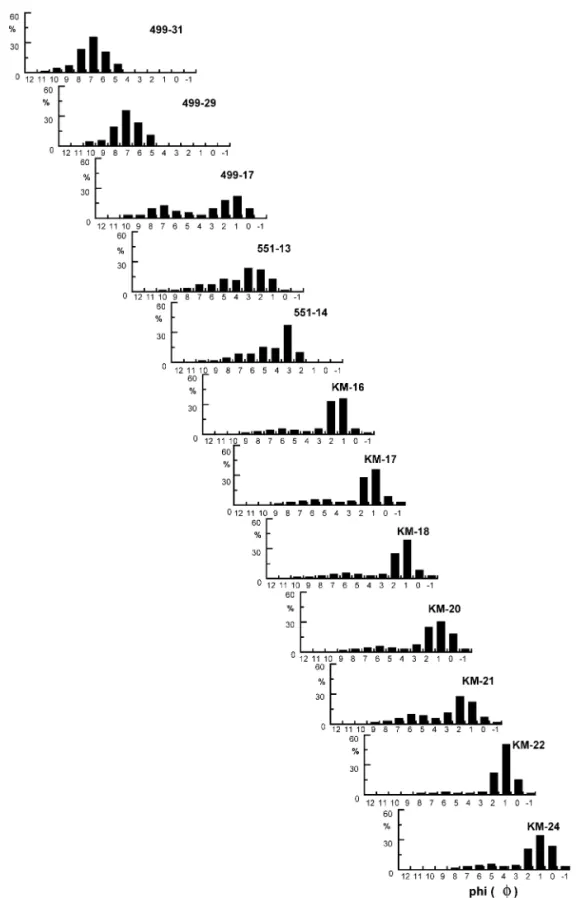
inner shelf to the outer shelf Fig. 3 . Grain size changes are especially rapid near the Delta. The
Ž
predominant sediment size of the Delta e.g. Station .
499-31, 499-29 is in the very fine clay to medium
Ž Ž .
silt size range 11 - f - 5, 0.48 mm - diameter d .
- 32 mm , with greater than 80% in the clay to fine
Ž .
silt range 9 - f - 6 . The predominant sediment
Ž .
size of the outer shelf e.g. Station KM-22, KM-24 , in contrast, is in the medium sand to granule size
Ž .
range 3 - f - y1, 0.125 mm - d - 2.4 mm , with greater than 80% in the medium to coarse sand range Ž2 - f - 0 . The size distributions of the outer shelf. sediment show a tailing effect, skewing toward the fine-grained sizes. Most inner and outer shelf sedi-ments display a normal grain size distribution. Away from the Yangtze River Delta, the middle shelf
Ž sediments display a bimodal size distribution e.g.
.
Station 499-17, Fig. 3 and rapidly prograding to a normal distribution toward the outer shelf. The bi-modal appearances of sediment grain sizes indicated that sediments in the middle shelf were composed of a mixture between the fine-grained Yangtze River sediment and the coarse-grained relict sediments.
3.2. Carbonate content
Carbonate was most abundant on the outer
conti-Ž .
nental shelf Fig. 2B . The highest concentration, up to 90%, was found in the southeastern part of the study area where the Kuroshio Current intruded onto the East China Sea continental shelf. Carbonate con-tents between 10% and 30% were common on the shelf; and values greater than 25% were observed mostly in areas directly under the path of the Kuroshio Current. Most sediments were biogenic carbonate along the southeastern part of the outer shelf. The Kuroshio Current flowing along the outer shelf break area appears to act as a barrier for the
deposition of fine-grained terrigenous sediments on the outer shelf. Carbonate concentration and distribu-tion pattern are similar to those observed by Niino
Ž .
and Emery 1961 .
3.3. Organic carbon
The distribution of organic carbon in the East China Sea continental shelf sediments also showed a
Ž .
Aband-typeB distribution pattern Fig. 2C . In gen-eral, the organic carbon concentrations decreased seawards, reflecting a corresponding increase of the
Ž .
sediment grain size Fig. 2A and proportion of marine organic material. High concentrations of or-ganic carbon were found in the Delta and inner shelf areas, with more than 0.9% of organic carbon found in areas where fine-grained sediments exceeded 70%. Except the Delta and inner shelf region, the organic carbon concentrations were between 0.0% and 0.4% for the majority of the East China Sea continental shelf sediments. The organic carbon concentration in the East China Sea continental shelf sediments is lower than those observed in other shelf and delta
Ž sediments, e.g. the Amazon shelf and delta 0.6 "
.
0.1%, Aller et al., 1986 , the Mississippi shelf and
Ž .
delta 0.71 " 0.27%, Lin and Morse, 1991 , and the
Ž .
world shelf average 0.75%, Berner, 1982 . In addi-tion, less than 0.2% of organic carbon were found in the outer shelf areas where approximately 90% of the sediments were composed of coarse-grained quartz andror carbonate sand. Lower concentrations of organic carbon observed in the middle and outer continental shelf sediments is probably a combined result of limited fine-grained sediment deposition and rapid organic carbon oxidation in sediments through sulfate reduction as demonstrated by Lin et
Ž .
al. 2000 .
Organic carbon in the Delta and inner shelf sedi-ments were composed primarily of terrigenous mate-rial where d C13 were as low as y25‰. d C13 of the organic carbon increased linearly with decreasing
Ž .
organic carbon concentration Fig. 4D . Away from the Delta and inner shelf, the organic carbon con-centration decreased rapidly since fewer terrigenous organic matters were capable of transporting and depositing on the middle and outer shelf area. Subse-quently, d C13 of the organic carbon rapidly changed
( )
S. Lin et al.r Chemical Geology 182 2002 377–394 383
Ž . Ž .
Fig. 4. Relationships between the concentrations of %Aluminum, and %Fine-grained sediment, %carbonate, %organic carbon, d C13, Fe,
Ž .
Mn, Zn, Cu, Pb, Cd of the East China Sea continental shelf sediment ` . Wide lines are the linear regression of the ECS data. Thin line is
Ž .
the Yangtze River Delta sediment data from Liao et al 1990 . Dotted line is the Southeast U.S. coastal sediment data from Windom et al.
( )
S. Lin et al.r Chemical Geology 182 2002 377–394 385
Ž .
to predominant marine ; 20‰ in origin. This
vari-Ž .
ation resembled those described by Tan et al. 1991 where d C13 of the Yangtze River Deltaic sediments were as low as y26.4‰. Similar rapid change of organic carbon d C13 from terrestrial to marine was
Ž
also observed in the Amazon River Delta Showers .
and Angle, 1986 and the Mississippi River Delta ŽSackett and Thompson, 1963 ..
3.4. Al, Fe, Mn, Zn, Cu, Pb
Similar to the sand%, organic carbon concentra-tions and d C13 content, surface sediment aluminum,
iron, manganese, zinc, copper and lead concentra-tions also displayed a Aband-typeB distribution
pat-Ž .
tern with concentration decreasing seaward Fig. 2 . Heavy metal concentrations decreased more rapidly
Ž .
in the seaward west–east direction than those in the southward direction, especially those near the Delta.
Ž .
Aluminum concentrations Fig. 2D in the East China Sea continental shelf sediments were in the range of 0.7–11 wt.%. High concentrations of alu-minum were found in the inner shelf region extend-ing from the Yangtze River Delta to the southern end of the study area. Aluminum concentrations
de-Ž .
creased seaward from the highest 11% in sediments
Ž .
near the Delta to the lowest 0.7% in the southeast-ern region with high carbonate contents. An excep-tion to this seaward decreasing trend was the area located in the northeast of the study region where a slightly higher aluminum concentration was found.
Iron concentrations also displayed aABand-typeB
Ž .
distribution Fig. 2E , with concentrations in
be-Ž .
tween 0.83% and 5.6%. The lowest iron 0.3% was observed in an area where high concentration of
Ž .
carbonate was also observed Figs. 2B,E and 4 . Iron
Ž .
concentrations 5.0–5.6% in sediments near the Delta and the inner shelf were higher than all other areas in the East China Sea continental shelf.
Ž .
Manganese concentration Fig. 2F displayed slight variations from other metals. Even though high
Ž .
manganese concentrations ; 1000 ppm were still observed in the inner shelf sediments and lower
Ž .
concentrations ; 260 ppm were observed in the outer shelf sediments, an unusually high
concentra-Ž .
tion of manganese up to 2670 ppm was found in the middle shelf region near the Delta.
Ž . Ž .
Zinc Fig. 2G and lead Fig. 2I displayed a similar band-type distribution pattern in the study
area. Up to 137 ppm of Zn and 50 ppm of lead were found in the inner shelf sediments, especially those near the Delta region. Both metals generally de-creased seaward. As low as 16 ppm of zinc and 6 ppm of lead were found in the outer shelf sediments. Lead, however, showed an unusually high
concentra-Ž .
tion ; 50 ppm in the middle shelf region near the Delta.
Ž .
Similarly, copper Fig. 2H also displayed a Ž band-type distribution with a high concentration 46
.
ppm in the Delta region and a low concentration Ž2.6 ppm in the outer shelf region..
3.5. Cd
Cadmium concentration appeared to decrease from the Delta and inner shelf to the outer shelf. Superim-posed on the band-type distribution that was often observed in the heavy metals of the East China Sea continental shelf sediments, cadmium distribution showed two distinct high concentration regions that differed from others. High concentrations of cad-mium were observed in the southeastern end of the study shelf break region and the inner shelf region
Ž .
south of the Delta Fig. 2J . Compared to a low cadmium concentration of approximately 30 to 60 ppb that was commonly observed in the middle shelf and outer shelf sediments, more than 500 ppb of cadmium were found in these two regions.
4. Discussion
The distributions of heavy metals, grain size, organic carbon and d C13 of the organic carbon
provide a solid data base to examine the extent of the influence of the Yangtze River on the East China Sea continental shelf sediment. The distributions of Al, Fe, Mn, Cu, Zn, Pb, Cd, %sand, %organic carbon and %carbonate contents all displayed a large spatial variation in the East China Sea continental shelf sediments, especially in a seaward direction away from the Delta. In particular, a band-type distribution along the coast south of the Yangtze River Delta with high concentrations in the inner shelf and low concentrations in the outer shelf sedi-ments were observed. The most important factors controlling the spatial variations of metals in the East China Sea continental shelf include: sediment sources, grain size, and anthropogenic pollution.
4.1. Sediment sources
Terrigenous sediment from the Yangtze River is a major factor controlling the observed spatial varia-tions. East China Sea continental shelf can be di-vided into five major regions of sediments: the Delta, inner shelf, middle shelf, outer shelf and northeast outer shelf based on spatial distributions, metalsr aluminum ratios, grain size, carbonate, organic carbon contents and d C13 of the organic carbon
ŽTable 1 . Each area is characterized by metalsr. aluminum ratio, grain size, carbonate and organic carbon content. The major types of sediments in-clude the terrigenous sediments from the Yangtze River, relict sediment of the middle shelf, biogenic carbonate of the outer shelf and sediments from the Yellow Sea.
High concentrations of heavy metals observed near the Yangtze River and their band-type distribu-tions along the inner shelf south of the Delta demon-strated that the primary source of heavy metals enter-ing the East China Sea continental shelf is from the Yangtze River. With its high suspended sediment
Ž .
concentration of ; 540 mgrl Shen et al., 1983 and an extremely high water discharge of ; 30,000 m3rs
ŽCai, 1982 , the Yangtze River is undoubtedly a. dominating source of sediment on the shelf. Most sediments were temporarily deposited near the river mouth and later redistributed southward along the
Ž inner shelf by the Changjiang Coastal Current
De-.
Master et al., 1985 . As a result, band-type distribu-tions were observed along the coast south of the Delta. Sediments of the Yangtze River Delta and inner shelf were composed of fine-grained terrige-nous clay with high concentrations of heavy metals. Since fine-grained sediments were primarily de-posited in the Delta and inner shelf, heavy metal concentrations decreased more rapidly in the sea-ward direction than those southsea-ward along the coast. Similarly, heavy metal concentrations also displayed a band-type distribution in the inner shelf sediments. Delta and inner shelf sediments were characterized by high ZnrAl, CurAl, PbrAl, CdrAl ratios and high concentrations of organic carbon with low d C13,
indicating a predominant terrigenous sediment with the Yangtze River as the primary source. The varia-tions between Delta and inner shelf were mostly a result of grain-size differences, especially in the
vicinity of the Delta where large grain-size variations were observed.
Relict sediment is the predominant type of sedi-ments on the middle and outer shelf region. Niino
Ž .
and Emery 1961 first defined these sediments as relict in origin based on their grain size distribution, shape, and degree of weathering. Fine-grained mod-ern Yangtze River sediments were mostly limited to the inner shelf area, whereas the medium to coarse-grained quartz sand was the main type of sediment in the middle and outer shelf. The area is characterized by the relict coarse-grained quartz sand with low
Ž
concentrations of metals, organic carbon Figs. 2A
. Ž
and 3 as well as low metalsraluminum ratios Table .
2 . The mixture between the modern inner shelf fine-grained sediments and outer shelf relict coarse-grained quartz sand made the metal distribution pro-gressively decrease seaward. The area is also a tran-sition zone from a detrital sediments dominated inner shelf to a biogenic sediment dominated outer shelf.
Ž .
Biogenic carbonate Fig. 2B is the major type of sediment in the outer shelf, especially in the region where the Kuroshio Current intrudes onto the East China Sea continental shelf. Contrary to other sedi-ments of the East China Sea, up to 87% and no less than 15% of carbonate are found directly underneath the path of Kuroshio Current. Almost no fine-grained sediments from the Yangtze River are deposited on the outer shelf and the biogenic carbonate is the predominant type of sediments under the path of the Kuroshio. The fine-grained terrigenous sediments were either limited to depositing on this region of the shelf by the Kuroshio Current or were horizontally
Ž .
transported to the slope region Narita et al., 1990 . These biogenic carbonate sediments are character-ized by high MnrAl, FerAl, CdrAl and low CurAl
Ž .
ratios Table 2 .
The northeast region of the study area is probably an extension of the Yellow Sea. In comparison with the coarse-grained relict sediment commonly found in the outer shelf region, sediments in the northeast region were composed mostly of fine-grained with
Ž relatively high concentrations of heavy metals Table
.
2 . The metalraluminum ratios in this region also differed significantly from other East China Sea shelf sediments. Relatively high concentrations of heavy metals, especially zinc, copper and manganese resembled sediment in the Yellow Sea north of the
() S. Lin et al. r Chemical Geology 182 2002 377 – 394 387 Table 1
Major deposition areas, sediment FerAl, MnrAl, ZnrAl, CurAl, PbrAl, CdrAl ratios, %Sand content and their characteristic features of the East China Sea continental shelf
Deposition Sediment %Sand FerAl MnrAl ZnrAl CurAl PbrAl CdrAl Characteristic features
area source
Ž . Ž . Ž . Ž . Ž . Ž .
Deltaic Yangtze -10 0.544 0.026 93.2 9.29 11.7 0.81 3.85 0.675 3.34 0.197 0.024 0.018 Fine-grained terrigenous sediments,
13
River low d C , high organic carbon,
CurAl, PbrAl and CdrAl ratio.
Ž . Ž . Ž . Ž . Ž . Ž .
Inner shelf 10 -%- 30 0.529 0.030 94.2 9.91 11.8 0.85 3.34 0.702 3.26 0.197 0.018 0.014
Ž . Ž . Ž . Ž . Ž . Ž .
Middle Shelf Relict 30 -%-90 0.545 0.082 95.0 29.5 11.1 1.45 1.48 0.522 3.09 0.430 0.011 0.004 Medium- to coarse-grained
quartz sand, low CurAl, PbrAl and CdrAl ratio.
Ž . Ž . Ž . Ž . Ž . Ž .
Outer Shelf Biogenic ) 90 0.663 0.166 124 94.4 11.3 2.97 1.13 0.590 3.59 1.94 0.047 0.141 Coarse-grained biogenic carbonate
sediments, high FerAl, MnrAl,
13
CdrAl ratio, high d C , low organic carbon.
Ž . Ž . Ž . Ž . Ž . Ž .
Northeast Yellow Sea - 30 0.547 0.008 98.1 9.72 13.2 0.618 2.63 0.128 3.09 0.258 0.011 0.001 Silty sediments, high ZnrAl and
Outer Shelf low PbrAl, CdrAl ratio.
() S. Lin et al. r Chemical Geology 182 2002 377 – 394 Table 2 Ž 2. 13
Correlation coefficient r matrix of Al, Fe, Mn, Zn, Cu, Pb, Cd, %Fine-grained sediments, %Organic carbon and d C of the organic carbon for the East China Sea continental shelf sediments
13 Al Fe Mn Zn Cu Pb Cd %Organic d C %Carb. carbon Al 1 Ž . Fe 0.831 0.456 1 Ž . Ž . Mn 0.635 80.1 0.790 184 1 Ž . Ž . Ž . Zn 0.857 12.2 0.826 24.2 0.634 0.102 1 Ž . Ž . Ž . Cu Al%) 5%: all: 0.802 10.8 0.750 0.052 0.753 0.395 1 Ž . 0.903 7.22 Al%- 5%: Ž . 0.365 0.928 Ž . Ž . Ž . Ž . Ž . Pb 0.841 3.10 0.772 6.03 0.667 0.027 0.746 0.224 0.759 0.497 1 Ž . Ž . Ž . Ž . Ž . Ž . Cd 0.035 0.0087 0.062 0.023 0.119 0.00014 0.057 0.00084 0.199 0.0034 0.102 0.0043 1 Ž . Ž . Ž . Ž . Ž . Ž . Ž . %Org. C 0.737 0.113 0.643 0.211 0.652 0.0011 0.674 0.0081 0.852 0.00201 0.673 0.0031 0.110 0.95 1 13 Ž . Ž . Ž . Ž . Ž . Ž . Ž .
d C 0.652 y0.500 0.702 y0.859 0.651 y0.0045 0.649 y0.0031 0.795 y0.071 0.578 y0.122 0.639 y17.5 0.665 1
Žy3.85.
Ž . Ž . Ž . Ž .
%Carb. Carb%) 20: all: 0.220 0.143 y5.85 0.220 y0.827 0.132 y0.295 0.245 y0.229 Carb%) 20: 0.179 0.029 1
Ž . Ž . Ž . Ž . Ž . 0.741 y0.059 y0.0032 0.672 0.0036 y0.0075 0.057 Carb%- 20: Carb%- 20: Ž . Ž . 0.006 y0.51 0.000 0.0009 Ž . Ž . Ž . Ž . Ž .
%Fine- %Fine) 25: all: 0.577 0.590 4.20 0.602 0.545 0.774 0.282 0.575 0.137 0.083 0.0005 0.913 0.454 0.216
Ž . Ž . Ž . . Ž .
grained 0.710 0.0412 0.020 0.0068 y0.026 y0.192
sediments %Fine- 25:
Ž .
0.724 0.310
( )
S. Lin et al.r Chemical Geology 182 2002 377–394 389
study region where copper, manganese and zinc were
Ž .
high Kim et al., 1998 .
4.2. Grain size
Grain size is also a major factor controlling the spatial variations of the heavy metals and organic carbon in the East China Sea continental shelf
sedi-Ž .
ments Fig. 4 . Similar spatial distribution patterns were observed for metals and organic carbon with respect to the percentage of fine-grained sediments in the East China Sea continental shelf sediments Žsee Fig. 2 . The inner shelf was dominated by. fine-grained terrigenous sediments, whereas the mid-dle and outer shelf were mostly composed of coarse-grained relict quartz andror biogenic carbon-ate sand. Quartz as well as carboncarbon-ate sand were the two most important dilution components for the ob-served grain-size effect on the sedimentary metal
Ž .
concentration variations Fig. 4 . Quartz and carbon-ate sand consisted of silica and carboncarbon-ate with rela-tively little heavy metals and contained almost no organic carbon, both served as diluting materials for
Ž heavy metals from aluminosilicate minerals i.e.
.
clays and organic matter of biogenic origin. With increasing percentage of fine-grained sediments Žgrain size - 63 mm and decreasing proportion of. carbonate content, aluminum concentrations
in-Ž .
creased accordingly Fig. 4A,B . The percentage of fine-grained sediments and carbonate content showed a good correlation with respect to the aluminum
Ž .
content Fig. 4A,B and Table 2 . The slope of the correlation, however, changed from 0.0412 to 0.310 for sediments with less than 25% of fine-grained sediments, and from y0.0585 to y0.508 for sedi-ments with less than 20% of carbonate content. The changing slope represented a shift in dilution effect from quartz to carbonate on the aluminum concentra-tion of the aluminosilicate minerals.
Corresponding to the grain-size effect on the
alu-Ž .
minum concentration, the organic carbon Fig. 4C ,
Ž . Ž . Ž .
iron Fig. 4E , manganese Fig. 4F , zinc Fig. 4G ,
Ž . Ž .
copper Fig. 4H , and lead Fig. 4I also showed a strong grain-size control effect. Table 2 presents the linear regression of the data. The positive linear correlation between metals and aluminum indicated that terrigenous aluminosilicate minerals are the pri-mary metal bearing minerals with the exception of
cadmium. In addition, the occurrences of a high organic carbon concentration in the Deltaic and inner
13 Ž .
shelf sediments and the low d C y25‰ further demonstrated that the inner shelf and Deltaic sedi-ments were composed of materials primarily
terrige-Ž .
nous in origin Fig. 4D . With the increasing aluminum concentration, i.e. more fine-grained sedi-ments, sediment metal concentrations also increased correspondingly with the exception of cadmium for the studied metals. The metal-rich aluminosilicate are associated with the fine-grained fraction of sedi-ments. Variation of grain-size distribution is one of the most important factors influencing the spatial variations of natural metal concentrations on the East China Sea continental shelf.
Previous studies have demonstrated that grain-size was a major factor controlling sedimentary heavy
Ž
metal concentrations Zhao and Yan, 1993; Windom et al., 1989; Cauwet, 1987; Horowitz and Elrick, 1987; Zhao, 1985; deGroot et al., 1982; Mayer and
. Fink, 1980; Forstner and Salomons, 1980 . As a comparison, data from the Southeast U.S. coastal
Ž .
sediments Windom et al., 1989 and the Yangtze
Ž .
River Delta Liao et al., 1990 were also plotted in Fig. 4E–I. Not surprisingly, most heavy metals showed a good linear relationship with respect to the aluminum concentration. With a few exceptions, the heavy metalraluminum relationships of this study resemble the data obtained from the Yangtze River
Ž .
delta sediments by Liao et al. 1990 , but a sharp contrast to the Southeast U.S. coastal sediments which displayed a rather large deviation. Differences in metalraluminum correlation between the East China Sea continental shelf and the Southeast U.S. coastal sediments were probably resulted from dif-ferences in source rocks, weathering history and clay
Ž .
mineral assemblages. Since Liao et al. 1990 showed that heavy metals in sediments were originated from the upstream Yangtze River, the similarities clearly suggested that the Yangtze River is the primary source of aluminosilicate minerals and that the distri-bution of the fine-grained aluminosilicate minerals on the shelf determined the spatial variations of heavy metal concentrations.
A number of manganese, lead, cadmium and es-pecially copper concentrations, however, showed significant variations from the linear metalr
Ž .
waste drainage from the Huangpujiang, a tributary of the Yangtze River near Shanghai city, might have increased the suspended sediment metal
concentra-Ž .
tions by 50–100%. Huh and Chen 1999 demon-strated that anthropogenic pollution was the cause of rapid lead concentration increase in the East China Sea inner shelf sediments. Consequently, the occur-rences of high concentrations of lead, cadmium, manganese observed in some parts of the inner shelf area seemed to indicate that a second source of metals, most likely anthropogenic in origin, may have entered the inner shelf region and drastically increased their concentrations. The areas where higher Pb, Mn and Cd concentrations were observed were mostly located in or near the inner shelf. Depo-sition of these anthropogenic metals may differ from those natural metal bearing fine-grained aluminosili-cate minerals and subsequently deviate from the observed grain-size controlled metalraluminum rela-tionships.
Unusual copper concentrations observed in the inner shelf and Delta sediments also indicated a possibility of pollution. Unlike other heavy metals, copper concentrations increased exponentially with
Ž 2 .
increasing aluminum concentrations r s 0.842 .
Copperraluminum relationship of the inner shelf sediments was clearly different from that of the middle and outer shelf sediments. For the inner shelf and Delta sediments, however, copper concentrations increased linearly with aluminum concentration with
Ž 2 .
an intercept at y32 r s 0.903, Table 2 with a
slope that differed from the middle and outer shelf sediment. For the middle and outer shelf sediments, copper and aluminum concentrations showed a rather
Ž limited association with a coefficient of 0.365 Table
.
2 . Delta and inner shelf sediments were recently deposited, whereas the middle and outer shelf
sedi-Ž ments were mostly relict from the last glacial Huh
.
and Su, 1999; DeMaster et al., 1985 . As a result, the unusual increase of copper concentrations of the Delta and inner shelf sediments may either be a result of the recent industrialization in the Yangtze
Ž .
River drainage basin as suggested by Zhang 1999 or a change of copper carrying phase in the Delta region. In addition to the aluminosilicate, other phases such as organic carbon or iron oxide could be another important contributor to the unusual copper concentrations increase in the Delta and inner shelf
sediments. However, the fact that both iron and organic carbon correlated well with the aluminum and that copper concentration increased rapidly in
Ž .
cores see discussion below indicated that anthro-Ž .
pogenic source s from recent industrial development in the Delta region may be responsible for the un-usual increase of copper.
Cadmium is another exception to the observed metalraluminum relationship. Its distribution on the East China Sea continental shelf seems to deviate from most other metals since high Cd concentrations were located in the outer shelf area as well as in the inner shelf region. Thus, a lack of linear correlation with respect to aluminum indicated that aluminosili-cate minerals are not the major types of natural metal bearing phases in the East China Sea sediments. Even though the inner shelf high Cd concentrations may be related to an anthropogenic origin, the occur-rences of high Cd concentration on the outer shelf were by no means anthropogenic as well. High concentrations of cadmium observed in the outer shelf region were found in sediments with high carbonate contents. Cadmium concentration in-creased linearly with carbonate content for sediments
Ž 2
with greater than 25% of carbonate r s 0.672,
.
Table 2 . The correlation between Cd and carbonate content indicated that Cd is probably associated with biogenic carbonate production in the outer shelf. Cadmium is a nutrient type metal being removed
Ž
from surface water by plankton growth Bruland,
. Ž .
1983 . In addition, Hester and Boyle 1982 demon-strated that cadmium in the foraminifera test repre-sented the chemical composition of the water they grow in. The shoaling of Kuroshio Current in the outer shelf region of the East China Sea probably provided cadmium and subsequently sequestered away by the biogenic carbonate and resulted in a cadmium-enriched carbonaceous sediment near the outer shelf.
4.3. Historical changes and implication
Unusual spatial distribution of copper as well as lead and cadmium in sediments near the Delta and Ž . inner shelf indicated that anthropogenic source s may become an important factor controlling heavy metal concentrations in the East China Sea inner shelf sediments. Vertical heavy metal concentration
( )
S. Lin et al.r Chemical Geology 182 2002 377–394 391
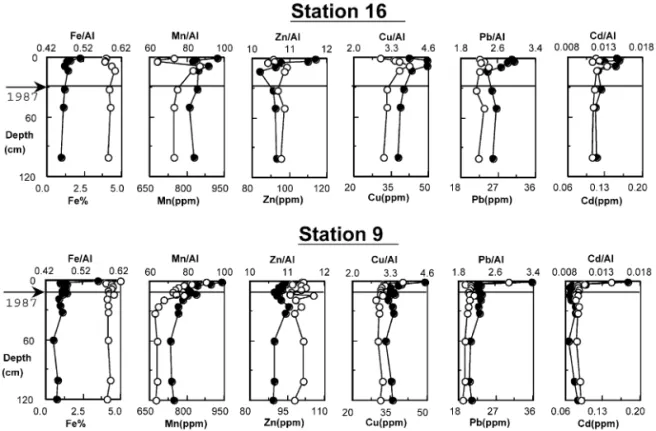
variations in deep sediment cores were examined in order to evaluate the level of pollution andror diage-netic remobilization and to establish background concentrations and historical changes of heavy met-als in sediments. Vertical profiles of heavy metal concentration and metalraluminum ratio at Station
Ž . Ž
16 Delta and Station 9 inner shelf away from the .
Delta are presented in Fig. 5. Also plotted are the 1987 time markers for both cores calculated with
Ž .
sedimentation rates from Huh and Su 1999 . Deposition of heavy metals in sediments showed clear historical changes, especially during the past two decades. Large vertical heavy metal concentra-tion variaconcentra-tions for both cores were observed, espe-cially the heavy metal enrichment at the surface ŽStation 9 or near surface Station 16 . From the. Ž . concentration maximum, heavy metal concentrations decreased rapidly with increasing depth, while below a depth of approximately 30 cm, metal concentra-tions as well as metalraluminum ratios showed very little variations. Low metal concentrations in the top 6 cm of Station 16 were a result of grain size change.
At depth, sediments were mostly fine-grained, whereas sand size grain was predominant in the top few centimeters. After normalization by the alu-minum content, the metalralualu-minum ratios de-creased rapidly from the surface with increasing depth.
Vertical variations were also influenced by the distance from the Yangtze River. Higher concentra-tions of heavy metal concentraconcentra-tions were observed deeper in sediments near the Delta than those away from the Delta. In Station 16 near the Delta, higher heavy metals concentrations and ratios could extend
Ž .
deeper into cores approximately 30 cm and gradu-ally leveling off at depth. In Station 9 further away
Ž .
from the Delta, only surface enrichments ; 4 cm were observed. In addition, except manganese and zinc, heavy metal concentrations and ratios at depth in Station 16 were higher than those at depth in the Station 9. Surface sediment metal enrichments were
Ž . Ž . Ž . Ž .
about 30% Cu , 26% Pb , 25% Cd , 10% Zn higher than those at depth calculated using metal aluminum ratios for Station 16. Further south in
Fig. 5. Vertical variations of Fe, Mn, Zn, Cu, Pb, Cd and FerAl, MnrAl, ZnrAl, CurAl, PbrAl, CdrAl in Stations 16 and 9. Open circles
Station 9, some of the surface sediment metal
enrich-Ž .
ments e.g. 60% for Pb and Cd were higher than those in Station 16. However, these higher enrich-ments were only observed in the top 4 cm and less than 10% of the enrichments were found in the entire core below the top 4 cm.
Manganese vertical variations, however, were not directly related to an accessory anthropogenic supply in these cores. Both manganese concentrations and MnrAl ratio showed a much deeper enrichment than other metals. Similar to that observed in the Long
Ž .
Island Sound sediment Aller, 1980 , surface man-ganese enrichment is a result of diagenetic remobi-lization. Under a reducing condition, pore water manganese increased during sediment manganese
ox-Ž
ide reduction Aller, 1980; Stumm and Morgan, .
1981 . Surface maximum is often observed as pore water manganese diffusion and reprecipitation at the sedimentrwater interface.
The profound increase of heavy metals in sedi-ment vertical profiles and their spatial distributions demonstrated that, to a large extent, the rapid indus-trialization since the opening of China in 1972 is most likely the culprit in alternating the AnaturalB heavy metal deposition in the East China Sea conti-nental shelf sediment. The increase of metal concen-trations in the Yangtze River Delta sediment showed the most drastic vertical changes. In addition, nearly the entire inner shelf sediments are showing signs of rapid change. Copper, lead, and cadmium all showed unusual rapid increase especially during the past decade. The extent of this increasing trend is quite alarming since the entire inner shelf is most likely at risk from a river drainage basin heavily populated and rapidly industrialized with little practice of pol-lution regulatory. Proper polpol-lution prevention mea-sures are needed to prevent further degradation of the East China Sea inner shelf.
5. Conclusions
Yangtze River is the major terrigenous sediments source that determined the concentrations of heavy metals and organic carbon variations on the East China Sea continental shelf. Large variations of heavy metals, grain size, carbonate, organic carbon concen-trations and d C13 of the organic carbon reflect the
spatial variations in the proportions of terrigenous
and biogenic components deposited on the East China Sea continental shelf and their mixtures with the relict sediment. In addition, unusual high concentra-tions of copper, lead, and cadmium found in the sediments of the Yangtze River Delta and inner shelf indicated possible anthropogenic influences from the recent rapid economic growth in China.
Source, grain size and anthropogenic influence are the major factors that controlled metals and organic carbon spatial and vertical concentration variations in the East China Sea continental shelf sediments. Major types of sediments include the terrigenous Yangtze River sediments of the Delta and inner shelf, the relict sediments of the middle and outer shelf, biogenic carbonate of the outer shelf and sediments from the Yellow Sea. The distribu-tions of metals, grain size as well as the organic carbon all showed a similar band-type pattern of spatial variations with higher concentrations in the inner shelf and Delta sediments and lower concentra-tions in the outer shelf sediments. Stable carbon isotope d C13 in sediments near the Delta indicated a predominately terrigenous source, whereas sediments away from delta were characterized by organic car-bon with marine signature.
Metals and organic carbon concentrations in sedi-ments were also controlled by the grain sizes in addition to reflect relative proportions of different type of sediments. Heavy metals and organic carbon linearly increased with increasing proportions of fine-grained sediments. Fine-grained sediments from the Yangtze River were deposited mostly in the inner shelf and Delta and decreased rapidly away from land. As a result, metals and organic carbon concen-trations also decreased in a seaward direction.
Near surface rapid increases of metal concentra-tions were observed in vertical profiles. The depth where rapid increase of metal concentrations were observed was deeper in site near the Delta, whereas high concentrations of metals were only observed in surface sediments approximately 200 miles away from the Delta.
Unusually high concentrations of Cu, Pb, and Cd, both spatially and vertically, showed that more pollu-tion prevenpollu-tion measures are needed in the Yangtze River drainage basin in order to prevent further heavy metal pollution of the East China Sea inner continental shelf.
( )
S. Lin et al.r Chemical Geology 182 2002 377–394 393
Acknowledgements
The authors thank the anonymous reviewers and the Editor for their constructive suggestions. We thank captains and crews of RrVAVinogradovB and AOcean Researcher-IB for their efforts during the sample collections. We also like to thank Dr. Ming-Pen Chen for his efforts in organizing the KEEP-MASS cruise and Mr. Chin-Ming Chen and In-Tian Lin for their elegant analytical works in the lab.
References
Aller, R.C., 1980. Diagenetic processes near the sediment–water interface of Long Island Sound: II. Fe and Mn. Adv. Geophys. 22, 351–415.
Aller, R.C., Mackin, J.E., Cox Jr., R.T., 1986. Diagenesis of Fe and S in Amazon inner shelf muds: apparent dominance of Fe reduction and implications for the genesis of ironstones. Cont. Shelf Res. 6, 263–289.
Berner, R.A., 1982. Burial of organic carbon and pyrite sulfur in the modern ocean: its geochemical and environmental signifi-cance. Am. J. Sci. 282, 451–473.
Boutton, T.W., 1991. Stable carbon isotope ratios of natural materials: sample preparation and mass spectrometric analysis.
Ž .
In: Coleman, D.C., Fry, B. Eds. , Carbon Isotope Techniques. Academic Press, San Diego, pp. 155–171.
Bruland, K.W., 1983. Trace elements in sea-water. In: Riley, J.P.,
Ž .
Skirrow, G. Eds. , Chemical Oceanography, vol. 8. Academic Press, London, pp. 157–220.
Cai, A.Z., 1982. Diffusion of sediments of Changjiang River discharging into the sea. Acta Oceanol. Sin. 4, 78–87. Cauwet, G., 1987. Influence of sedimentological features on the
distribution of trace metals in marine sediments. Mar. Chem. 22, 221–234.
deGroot, A., Shuppe, K., Salomons, W., 1982. Standardization of methods of analysis for heavy metals in sediments. Hydrobiol-ogy 92, 689–695.
DeMaster, D.J., McKee, B.A., Nittrouer, C.A., Qian, J.C., Chen, G.D., 1985. Rates of sediment accumulation and particle reworking based on radiochemical measurements from conti-nental shelf deposits in the East China Sea. Cont. Shelf Res. 4, 143–158.
Folk, R.L., 1974. Petrology of Sedimentary Rocks. Hemphill Pub., Texas, 129 pp.
Forstner, U., Salomons, W., 1980. Trace metal analysis on pol-luted sediments: I. Assessment of sources and intensities. Environ. Technol. Lett. 1, 494–505.
Hester, K., Boyle, E., 1982. Water chemistry control of cadmium content in recent benthic foraminifera. Nature 298, 260–262. Horowitz, A., Elrick, K., 1987. The relation of stream sediment surface area, grain size, and composition to trace element chemistry. Appl. Geochem. 2, 437–451.
Huh, C.-A., Chen, H.-Y., 1999. History of lead pollution recorded in East China Sea sediments. Mar. Pollut. Bull. 38, 545–549. Huh, C.-A., Su, C.-C., 1999. Sedimentation dynamics in the East China Sea elucidated from 210Pb, 137Cs and 239, 240Pu. Mar. Geol. 160, 183–196.
Kim, G., Yang, H.S., Kodama, Y., 1998. Distributions of transi-tion elements in the surface sediments of the Yellow Sea. Cont. Shelf Res. 18, 1531–1542.
Kokot, S., King, G., Keller, H.R., Massart, D.L., 1992. Applica-tion of chemometrics for the selecApplica-tion of microwave digesApplica-tion procedures. Anal. Chim. Acta 268, 89–94.
Lee, H.J., Chough, S.K., 1989. Sediment distribution, dispersal and budget in the Yellow Sea. Mar. Geol. 87, 195–205. Liao, X., Chen, Z., Ying, S., Fan, A., Zhang, X., Wei, L., Ren, D.,
Gao, S., 1990. The sources and the geochemical characteristics of the heavy metals in the sediment of the Changjiang River and its adjacent coastal waters of the East China Sea. In: Yu,
Ž .
G., Martin, J.M., Zhou, J., Windom, H., Dawson, R. Eds. , Biogeochemical Study of the Changjiang Estuary, Proceedings of the International Symposium on Biogeochemical Study of the Changjiang Estuary and its Adjacent Coastal Waters of the East China Sea. China Ocean Press, Beijing, pp. 413–436. Lin, S., Morse, J.W., 1991. Sulfate reduction and iron sulfide
mineral formation in Gulf of Mexico anoxic sediments. Am. J. Sci. 291, 55–89.
Lin, S., Huang, K.M., Chen, S.K., 2000. Organic carbon deposi-tion and its control on iron sulfide formadeposi-tion of the Southern East China Sea continental shelf sediments. Cont. Shelf Res. 20, 619–635.
Luo, Y., Ostenso, N.A., 1983. Sedimentation on the Continental Shelf, with Special Reference to the East China Sea. China Ocean Press, Beijing, 952 pp.
Mayer, L.M., Fink, K.J.R., 1980. Granulometric dependence of chromium accumulation in estuarine sediments in Maine. Es-tuarine Coastal Mar. Sci. 11, 491–503.
McKee, B.A., Nittrouer, C.A., DeMaster, D.J., 1983. Concepts of sediment deposition and accumulation applied to the continen-tal shelf near the mouth of the Yangtze River. Geology 11, 631–633.
Milliman, J.D., Meade, R.H., 1983. World-wide delivery of river sediment to the oceans. J. Geol. 91, 1–21.
Milliman, J.D., Syvitski, J.P.M., 1992. Geomorphicrtectonic con-trol of sediment discharge to the ocean: the importance of small mountainous rivers. J. Geol. 100, 525–544.
Milliman, J.D., Qhen, H.-T., Yang, Z.-S., Meade, R.H., 1985. Transport and deposition of river sediment in the Changjiang estuary and adjacent continental shelf. Cont. Shelf Res. 4, 37–45.
Narita, H., Harada, K., Tsunogai, S., 1990. Lateral transport of sediment particles in the Okinawa Trough determined by natural radionuclides. Geochem. J. 24, 207–216.
Niino, H., Emery, J.O., 1961. Sediments of shallow portions of East China Sea and South China Sea. Geol. Soc. Am. Bull. 72, 731–762.
Sackett, W.M., Thompson, R.R., 1963. Isotopic organic carbon composition of recent continental derived clastic sediments of eastern gulf coast, Gulf of Mexico. Bull. Am. Assoc. Pet. Geol. 47, 525–538.
Shen, H., Li, J., Zhu, H., Han, M., Zhou, F., 1983. Transport of suspended sediments in the Changjiang estuary. In: Luo, Y.,
Ž .
Ostenso, N.A. Eds. , Sedimentation on the Continental Shelf, with Special Reference to the East China Sea. China Ocean Press, Beijing, pp. 389–399.
Showers, W.J., Angle, D.G., 1986. Stable isotopic characterization of organic carbon accumulation on the Amazon continental shelf. Cont. Shelf Res. 6, 227–244.
Stumm, W., Morgan, J.J., 1981. Aquatic Chemistry. Wiley, New York.
Tan, F.C., Cai, D.L., Edmond, J.M., 1991. Carbon isotope geo-chemistry of the Changjiang estuary. Estuarine, Coastal Shelf Sci. 32, 395–403.
Windom, H.L., Schropp, S.J., Calder, F.D., Ryan, J.D., Smith Jr., R.G., Burney, L.C., Lewis, F.G., Rawlinson, C.H., 1989. Natural trace metal concentrations in estuarine and coastal
marine sediments of the southeastern United States. Environ. Sci. Technol. 23, 314–320.
Yu, G., Martin, J.M., Zhou, J., Windom, H., Dawson, R., 1990. Biogeochemical Study of the Changjiang Estuary. Proceedings of the International Symposium on Biogeochemical Study of the Changjiang Estuary and its Adjacent Coastal Waters of the East China Sea. China Ocean Press, Beijing, p. 898. Zhang, J., 1999. Heavy metal compositions of suspended
sedi-Ž .
ments in the Changjiang Yangtze River estuary: significance of riverine transport to the ocean. Cont. Shelf Res. 19, 1521– 1543.
Zhao, Y.-Y., 1985. Some geochemical patterns of shelf sediments of the China Sea. Chin. J. Oceanol. Limnol. 3, 200–211. Zhao, Y.-Y., Yan, M.-C., 1993. Geochemical record of the
cli-mate effect in sediments of the China shelf sea. Chem. Geol. 107, 267–269.