Economic Interdependence and International
Interactions: The Impact of Third-Party Trade
on Political Conflict and Cooperation
Yuan-ching Chang
(Assistant Professor of Economics Department, Chinese Culture University)Abstract
This article presents an empirical analysis of the relationship between economic interdependence and international third-party interactions. If countries seek to protect their trade gains, the trade-conflict model predicts that trade reduces trade-conflict between pairs of countries, designated “actors” and “targets”. This paper extends the trade-conflict model to garner implications concerning trade and conflict interactions where third parties are involved. The theoretical propositions supported by proofs are as follows: (1) Increasing trade by an “actor” with a third party will decrease conflict with a “target”, if the third party and target are “friends”,
who already have a negative level of mutual conflict. (2) Increasing
trade with a third party will increase conflict with a target, if the third party and target are “rivals”, having a positive level of mutual
conflict. A similar relationship is also discussed and tested if
conflict increases or decreases between the actor and third party. The empirical results of tests using a 30-country sample from the
Conflict and Peace Data Bank (COPDAB) generally support the hypotheses. Trade increases communication between states and promotes peace. Therefore, according to the implications of structural balance theory, the imbalance in a triadic relationship can be resolved by international trade. Thus, increasing world trade will give positive effect to the maxim: “a friend of a friend is a friend”. Keywords: Conflict, Cooperation, Trade, Third Party, International
Interaction
1. Introduction
Although at first sight the world may seem as primitive as ever, much has changed. Technological progress and the continuing process of economic internationalization have enlarged the human horizon considerably. A catch-word for the effects on the human environment is “interdependence” which includes the effects on social, economic, cultural, and military relati ons. Growing interdependence in an international context can be regarded as a process of enlarging the system in which human beings organize themselves. The traditional inter-state system has turned more and more into a complex social system with a much greater variety of actors.1 This brings us to a question: Is the rapid quantitative (more
For example, see Robert Keohane and Joseph Nye, Power and Interdependence: World Politics in Transition (New York: Harper Collins, 1989); Jaap de Wilde, Saved from Oblivion: Interdependence Theory in the First Half of the 20th Century: A Study of the Causality Between
actors) and qualitative (complex interdependence between actors) expansion of the international system, sufficiently reflected in the international legal standards which would guide and correct the behavior of the individual actors in the international system? A legal system can be regarded as successful if it can play its part in securing the stability and survival of the social system to which it belongs. But, what can we do if the international legal system cannot work well? If dyadic disputes can not be resolved through bilateral negotiations, it raises a further question: Does growing international interdependence create opportunities for the strengthening of mechanisms for peaceful settlement of international disputes through obligatory third party intervention? The central question in the investigation would be whether and how a correlation exists between emerging high levels of interdependence between states and their acceptance of compulsory third party dispute settlement procedures. The main purpose of this research will focus on the importance of economic interdependence among countries in relation to international interactions.
In an interdependent system, violent conflict anywhere threatens the very stability of the system, and thus effective diplomatic processes are required to prevent the outbreak of widespread violence and chaos within the global system. Once a conflict arises, international negotiation is the primary method by which social actors settle their disputes.2 There has been a surge of interest in
There are three modes for conflict resolution: (I) unilateral, (II) bilateral, (III) third-party assistance and three categories of mediators (i) individuals, (ii) states, (iii) governmental or nongovernmental institutions and organizations (e.g., the UN, GATT/WTO, IMF). For details, see Jacob
analyzing the role of the third party in international interactions. Countries can employ the assistance of some third party to help them resolve their conflicts. Third parties can play a variety of roles in an ongoing dispute (Young, 1967; Mitchell, 1988). The third party actively participates in the settlement process, but only offers suggestions for a possible solution. Mediation basically is a variant of negotiation (Touval, 1982). As pointed out by Hopmann [1996, pp.232]: “The role of the mediator, then, is to facilitate mutual and simultaneous flexibility. The mediator may begin by attempting to clarify the fundamental interests of the two parties as well as their limits to acceptable agreement.”3However, sometimes
third parties have variable motives for mediating a dispute. They probably become principals in a triangular bargaining process where they work toward an outcome favorable to their own national objectives, regardless of the grievances voiced by actors.4 Werner
Bercovitch and Allison Houston, “Influence of Mediator Characteristics and Behaviour on the Success of Mediation in International Relations,” International Journal of Conflict Management, Vol.4, No.4(1993), pp. 297-321; Jacob Bercovitch and Gerald Schneider, “Who Mediates? The Political Economy of International Conflict Management,” Journal of Peace Research, Vol.37, No.2(2000), pp.145-165.
Similarly, Thomas Princen has noted: “… much of what mediators do can be viewed as helping the parties overcome the difficulties of negotiating a voluntary agreement” see Thomas Princen, Intermediaries in International Conflict (Princeton, NJ: Princeton University Press, 1992), p.221.
For variable topics, see K. D. G. Pruitt Kressel and Associates,Mediation Research: The Process and Effectiveness of Third-Party Intervention (San Francisco: Jossey-Bass, 1989); John G. Merrills,International Dispute
(2000) also developed a modified model and suggested that the attacker’s ability to choose the stakes of war can weaken the third-party defender’s ability to deter an attack. Hopmann (1996, ch.12) further presented some criteria regarding who should be selected as a third party and five major kinds of roles that mediators can play in international negotiations. The focus on an obligatory role for a third party in dispute settlement facilitates an assessment on the basis of empirical observation of the degree to which states are willing to accept the international legal system or rule as the basis for their behavior (e.g., Huth and Russett 1988; Bercovitch and Langley 1993; Raymond, 1994; Smith, 1996; Dixon, 1996; Bercovitch and Schneider, 2000; Jackson, 2000). For example, Dixon (1996) proposed seven forms of third-party techniques of conflict management in relation to the de-escalation of disputes and their peaceful settlement. Jackson (2000) provided empirical evidence to examine some important factors that affect negotiation
Settlement (Cambridge: Grotius, 1991); Sanda Kaufman and George T. Duncan, “A Formal Framework for Mediator Mechanisms and Motivations,” Journal of Conflict Resolution, Vol.36, No.4(1992), pp.688-708; James Wall and Ann Lynn, “Mediation, A Current Review,”Journal of Conflict Resolution, Vol.37, No.1(1993), pp.160-194; Deiniol Lloyd Jones, “Mediation, Conflict Resolution and Critical Theory,” Review of International Studies, No.26(2000), pp.647-662; Suzanne Werner, “Negotiating the Terms of Settlement, War Aims and Bargaining Leverage,” Journal of Conflict Resolution, Vol.42, No.3(1998), pp.617-635; Suzanne Werner, “Deterring Intervention: The Stakes of War and Third-Party Involvement,”American Journal of Political Science, Vol.44, No.4(2000), pp.720-732.
outcomes.5The acceptance of third-party dispute settlement procedures,
and their application in practice, can serve as a more or less unbiased proxy for the extent to which states are prepared to subject themselves to the rule of international law.
Some substantial literatures that examine the likelihood of third parties joining in wars (e.g., Altfield and Bueno de Mesquita, 1979; Holsti et al., 1973; Kim, 1995; Sabrosky, 1980; Singer and Small, 1966a, b; Siverson and King, 1979, 1980; Smith, 1996). Altfield and Bueno de Mesquita (1979) use an expected utility model to predict that intervention depends on the utility gained from one or the other party winning. If a third party gains considerable utility from country i winning instead of country j, then intervention is more likely. Studies incorporating third parties model alliance formation as a function of potential wealth increases through gains from trade (e.g. Altfield, 1984; Morrow, 1991; Simon and Gartzke, 1996). Many alliances contain both large and small countries. Small countries have an incentive to join such an alliance due to the security a large country can offer. Large countries may not gain substantial security from allying with a small country, but may gain a market for the export of goods. These export markets provide large countries with gains from trade and increased wealth.
For the other studies, see Jacob Bercovitch, “International Mediation and Dispute Settlement: Evaluating the Conditions for Successful Mediation,” Negotiation Journal, Vol.7, No.1(1991), pp.17-30; Jacob Bercovitch and Allison Houston, op. cit.; Jacob Bercovitch and Jeffrey Langley, “The Nature of the Dispute and the Effectiveness of International Mediation,”Journal of Conflict Resolution, Vol.37, No.4(1993), pp.670-691.
Smith (1996) further referred the idea of alliance reliability and concluded that nations with unreliable allies are more likely to surrender if attacked than are nations with reliable allies.
In spite of numerous attempts by third parties to analyze international political interactions, these studies obviously neglect the role of economic interdependence in third-party relations. The neoliberalists claim that trade reduces conflict between countries (e.g. Polachek, 1978, 1980, 1997; Blainey; 1988; Neff, 1990; Domke, 1988; Mansfield, 1994; Oneal et al., 1996; Reuveny and Kang, 1996; Russet et al., 1998; Dorussen, 1999; Oneal and Russett, 1999; Polachek et al., 1999; Hegre, 2000; Russett and Oneal, 2001; Chang, forthcoming).6 This argument can be traced to Emeric Cruce,
Francois Qesnay, Adam Smith, David Hume, Cobden, John Bright, John Stuart Mill, and Baron de Montesquieu who discuss similar themes.7 Subsequently, the trade-conflict literature has been extended
to examine other questions. For example, as is well known, democracies fight each other less than non-democracies.8 This topic
Detailed reviews are provided in Katherine Barbieri, “Economic Interdependence: A Path to Peace or a Source of Interstate Conflict?” Journal of Peace Research, Vol.33, No.1(1996), pp.29-49; Katherine Barbieri and Gerald Schneider, “Globalization and Peace: Assessing New Directions in the Study of Trade and Conflict,” Journal of Peace Research, Vol.36, No.4(1999), pp.387-404; Rafael Reuveny and Heejoon Kang, “Bilateral Trade and Political Conflict / Cooperation: Do Goods Matter?” Journal of Peace Research, Vol.35, No.5(1998), pp.581-602.
For reference, see Henry W. Spiegel, The Growth of Economic Thought, 3rd ed. (Durham, NC & London: Duke University Press, 1991); Jaap de
can also be extended to discuss the third-party relationship. For example, Dixon (1993) indicated that democratically governed countries are more likely than others to resolve their disputes with the assistance of third parties. Raymond (1994)provided evidence that the presence of joint democracy in war-prone dyads has a strong positive effect on the probability of referring interstate disputes to binding third-party settlement, even when controlling for alliance bonds and geographic proximity. However, few studies that examine the trade-conflict relationships also address international
For example Steven Chan, “Mirror, Mirror on the Wall… Are the Freer Countries More Pacific,” Journal of Conflict Resolution, No.28(1984), pp.617-648; Zeev Maoz and Nasrin Abdolali, “Regime Types and International Conflict, 1816-1976,” Journal of Conflict Resolution, No. 33(1989), pp.3-36; Stuart Bremer, “Democracy and Militarized Interstate Conflict, 1816-1965,”International Interactions, No.18(1993), pp.231-249; Zeev Maoz and Bruce Russett, “Normative and Structural Causes of Democratic Peace, 1946-1986,” American Political Science Review, No. 87(1993), pp.624-38; John R. Oneal, Frances H. Oneal, Zeev Maoz and Bruce Russett, “The Liberal Peace: Interdependence, Democracy, and International Conflict, 1950-86,” Journal of Peace Research, Vol.33, No.1(1996), pp.11-28; Solomon W. Polachek, “Why Democracies Cooperate More and Fight Less: The Relationship Between International Trade and Cooperation,”Review of International Economics, No.5(1997), pp.295-309 are a few of the many studies. Recently, Russett and Oneal found evidence that three legs-democracy, extensive economic interdependence, and shared membership in supranational institutions- all reduce the probability of antagonism, see Bruce Russett and John R. Oneal, Triangulating Peace: Democracy, Interdependence and International Or-ganizations (New York: Norton, 2001).
third-party interactions. Polachek, Robst and Chang (1999) extended the trade-conflict model by incorporating foreign aid, tariffs, contiguity, and country size, while treating the terms of trade as given variables. Their brief results generally support the developed hypotheses, but many empirical questions were left unanswered. This research will extend the trade-conflict model that treats trade as an independent variable, in order to focus on the third-party conflict associated with trade. In addition to deriving the theoretical hypotheses, the empirical results will be examined.
The paper is structured as follows. This section serves as a simple introduction and a brief literature review. Section 2 presents the basic trade-conflict model of Polachek (1978) that is extended to derive third-party interactions. Section 3 discusses the sources of data. Section 4 provides the methodology and empirical results, and Section 5 concludes.
2. The Model
A world system encompasses numerous countries, many trading with each other because the virtues of trade make each country better off economically. What results is a system of inter-country interdependencies, which if based on free market principles including free trade and the full mobility of resources, would result in maximal global output. Any country breaking off such a trade relationship would decrease its own long-run economic well-being, as well as perhaps the well-being of its trading partners and of other countries (Anderton and Carter, 2001). As such, reneging on a trade relationship is costly from a private as well as a global perspective.
2.1 The Trade-Conflict Analytics
To see how these potential welfare losses lead to greater cooperation and less conflict, more structure needs to be introduced. First, an actor country’s social welfare function is defined as W (C, Z). The variable C is total domestic consumption which is defined as:
where Q is domestic production of a representative commodity, xi
are exports of a representative commodity to country i, and mi are
imports of a representative commodity from country i.9 By including
C, as defined, our approach is consistent with economic theory paradigms that describe how countries maximize their collective well-beings. The variable Z=(z1, z2,.., zn) represents a militarized
and political interstate conflict vector where each zi stands for
conflict towards a particular country i. If zi is greater than zero,
this implies that there is more conflict than cooperation, while a zi that is less than zero implies there is more cooperation than
conflict. Realist theories that emphasize the importance of national security motive include the political relations variable Z (Keohane and Nye, 1989). Typically:
We can have m commodities as in Solomon W. Polachek, “Conflict and Trade,” Journal of Conflict Resolution, No.24(1980), pp.55-78, However, introducing such complications does not alter the analysis, merely the number of subscripts.
denotes increased welfare achieved through increased domestic consumption. Similarly:
defines welfare associated with conflict. Wz can be positive if an
actor gains satisfaction when behaving conflictually towards another country.
In the beginning, countries face a trade pattern based on expected or existing international relations (i.e., relations based on conflict or cooperation). There are a variety of methods through which conflict may influence trade, including tariffs, quotas, embargoes, or other trade prohibitions. For simplicity, we view conflict as making trade more costly by affecting import and export prices. That is conflict is assumed to affect the terms of trade. If a target country responds to an actor’s conflict by decreasing the price it will pay for the actor’s exports, then conflict (on the part of an actor) raises the costs of trade. This implies decreased trade and a loss of the usual “gains from trade”. Similarly gains from trade are lost if a conflictual actor has to pay higher prices for imports from a target recipient of its conflict. This means that export price pxi and import price pmi are a function of conflict such
that p'xi zi <0, p " xi zi <0 and p ' mi zi <0, p " mi zi <0.
10 Thus, the implicit
price of being hostile is the diminution of welfare associated with potential trade losses.
Under this trade-conflict relationship, the actor country will choose an optimal level of conflict towards the ith target country (zi) so as to maximize the social welfare function with positive
but diminishing marginal utility of consumption and marginal utility of conflict; such that Wc> 0, Wcc< 0, Wz> 0, Wzz< 0, and Wzizj= Wzjzi.
For simplicity, we assume that the social welfare function is separable in C and Z (i.e., Wzc= 0), implying that the consumption
of conflict and the consumption of other commodities are independent. Materialistic goals clearly imply that greater consumption yields higher welfare levels. The first derivative Wzi is the innate marginal
benefit of additional conflict towards another country, namely, the benefit (if it exists) of hatred.11 The second partial derivative Wz
izj
depicts how this hatred is affected by increased conflict towards
For the original trade-conflict model, see Solomon W. Polachek, “Dyadic Dispute,” Papers of the Peace Science Society, No.28(1978), pp.67-80; Solomon W. Polachek, “Conflict and Trade,” Journal of Conflict Resolution, No.24(1980), pp.55-78.
In international relations, it might be argued that if nations feel forced to choose conflict as the “least undesirable” course of action available to them, there should always be some positive marginal benefit attached to this choice. One could further simplify by assuming that there is no direct welfare gain from conflict, i.e., Wz=0. However, because we will
define allies in terms of cross-effects (Wzz), we allow for W to be a function of Z Solomom W. Polachek, John Robst and Yuan-Ching Chang, “Liberalism and Interdependence: Extending the Trade-Conflict Model,” Journal of Peace Research, Vol.36, No.4(1999), pp.405-422, For the possibility that Wz<0, see Solomon W. Polachek, “Dyadic Dispute”, op.
cit.; Solomon W. Polachek, “Conflict and Trade,” Journalof Conflict Resolution, No.24(1980), pp.55-78.
a third party. For example, Wzizj>0 implies that actor conflict vented
towards country j reinforces the benefits of an actor’s conflict towards country i. Thus if rival target countries i and j are friends with each other but rivals of the actor, conflict with one reinforces conflict with another. This relationship is consistent with the maxim “a friend of a rival is a rival”. Alternatively, cooperation with one reinforces cooperation with another or “a friend of a friend is a friend”. On the other hand, Wzizj<0 implies the opposite, namely
that increased conflict with one country decreases the satisfaction of conflict with the other. This negative partial derivative is consistent with “a rival of a rival is a friend”. Alternatively, one can interpret this negative sign to imply that cooperation with another country (e.g. country #1) decreases the satisfaction of cooperation with a second country (country #2) or “a rival of a friend is a rival”.12
Given this structure, the actor’s domestic welfare is as high as possible when it chooses conflict Z to maximize W(C, Z) subject
These ideas are related to structural balance theory in social psychology that is originally based on individual cognitive consistency in his relations with other persons or desired goals. For reference, see Fritz Heider, “Attitudes and Cognitive Organization,” Journal of Psychology, No.21(1946), pp.107-112; D. Cartwright and Frank Harary, “Structural Balance: a Generalization of Heider’s Theory,” Psychological Review, No.63(1956), pp.277-293; MacDonald H. Brooke and Richard Rosecrance “Alliance and Structural Balance in the International System,” Journal of Conflict Resolution, Vol.29, No.1(1985), pp.57-82; Chih-Cheng Lo, “Multilateral Strategy of Taiwan Safety,” Issues and Studies (Chinese Edition) Vol.35, No.9(1996), pp.1-16.
to the balance of payments constraint, . That is, if the actor only considers the purely direct effect of trade gains on conflict, it faces the following maximization problem:13
First order conditions imply, for i=1 to n,
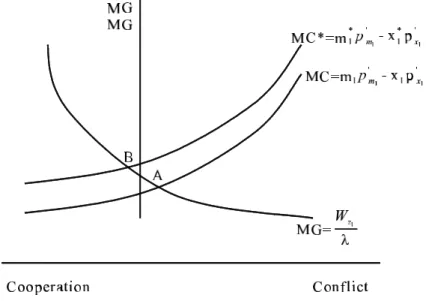
The FOCs simply state that, at the margin, an actor country chooses an amount of conflict with country #i so as to equate the conflict’ s marginal costs (mip'mi xip
' xi)
The indirect effect of trade gains may be due to transportation costs, foreign aid, tariffs, …etc., and see Solomom W. Polachek, John Robst and Yuan-Ching Chang, “Liberalism and Interdependence: Extending the Trade-Conflict Model,” Journal of Peace Research, Vol.36, No.4(1999), pp.405-422.
Figure 1 How Increased Trade Decreases Conflict
and marginal benefits (Wzi/ ).
14 For simplicity, we can assume that
an actor interacts with only two possible targets. In this simple two-country case, the comparative statics shows (see Appendix):
Thus the actor’s conflict towards the target falls as exports from the actor to the target and/or imports from the target to the actor
We assume the marginal welfare gain from trade is positive and constant across countries.While questionable, this assumption is necessary to reach the conclusions from the model (Solomom W. Polachek, John Robst and Yuan-Ching Chang, op. cit.
increase. This is the neoliberalists’s o-called result that trade reduces conflict.
The above optimality conditions can be illustrated graphically for the first target in Figure 1. A similar depiction is given in Polachek (1978, 1980). The MC curve depicts the marginal cost of conflict. It is upward sloping since the second derivative of the balance of payments constraint is positive, which indicates that higher levels of conflict result in higher costs. The MG curve depicts the marginal welfare gains from conflict. The optimal amount of conflict towards the ith target country is where the MG and MC curves intersect at point A. This outcome comes from the first order condition (FOC) of the model.
One can apply Figure 1 to illustrate how trade affects conflict. Greater levels of trade imply either greater exports x1, greater
imports m1, or both. Import and export values are contained in the
marginal cost function. Since p'm1 is positive, greater import levels
imply a larger m1 and a higher MC curve. In turn, this higher
marginal cost curve implies less conflict and more cooperation since the MC* curve now intersects the MG curve further to the left at point B. Similarly, since p'x1 is negative, greater x1 values
also imply a higher MC curve and hence lower levels of conflict. Next we consider how trade with one country may influence conflict with another country.
2.2 Trade and Third Party Conflict
By expressing conflict vented towards the various countries separately (i.e., by consideringW(., Z(z1,z2,..,zn)), one can examine
As was stated earlier,Wz1z2>0 andWz1z2<0 have political interpretations.
From an actor country’s vantage, Wz1z2>0 implies that an actor’s
conflict vented towards country #1 reinforces the marginal benefits of an actor’s conflict towards country #2. Thus if target countries #1 and #2 are friends, a conflict with one reinforces the conflict with the other. We claim that definingWz1z2>0 to occur when countries
#1 and #2 are friends implies that increasing trade with country #1 decreases the conflict with country #2, i.e., trade decreases the conflict with friends of a trading partner. This relationship is consistent with the maxims “a friend of a rival is a rival” or “a friend of a friend is a friend”. In other words, if the actor and target #1 become friendlier (increase trade), and countries #1 and #2 are friends, we predict that the actor and target #2 will become friendlier (conflict decreases). Furthermore, Wz1z2<0 implies that
conflict towards country #1 decreases the conflict’s marginal benefit towards country #2 which suggests that countries #1 and #2 are rivals. We claim that an increase in trade between an actor and target #1 reduces conflict with target #1, thereby increasing the marginal benefits of conflict with country #2. This is consistent with “a rival of a friend is a rival” or “a rival of a rival is a friend”, and one can show that increased trade with country #1 actually increases conflict with country #2.
The stated above can be explained by the following comparative statics (see Appendix):
Thus increasing exports to country #1 will decrease conflict with country #2 ( < 0), if countries #1 and #2 are friends (Wz1z2>0).
Increasing exports to country #1 will increase conflict with country #2 ( > 0), if countries #1 and #2 are rivals (Wz1z2<0). Similar
relationships hold for imports. The above clearly states that (1) increasing trade with a third party will decrease conflict with a target, if the third party and the target are friends, and (2) increasing trade with a third party will increase conflict with a target, if the third party and the target are rivals.
3. The Data
Prior research typically uses war data such as the Correlate of War (COW) or the Militarized Interstate Dispute (MID) data set. The COW defines a war as a conflict with 1,000 or more battle deaths, limiting analysis to a small portion of international interactions. MID defines a militarized dispute as an international interaction involving threats, displays, or actual uses of military force; it must be explicit, overt, government sanctioned, and not accidental. Our primary source of data on conflict and cooperation is the Conflict and Peace Data Bank (COPDAB). COPDAB is an extensive, longitudinal collection of more than 350,000 daily and yearly events reported by dyad.15 Events are obtained as reported from 72
For a clear understanding of COPDAB, see Edward Azar, “The Conflict and Peace Data Bank(COPDAB) Project,”Journal of Conflict Resolution, 24(1980), pp.143-152 and Solomon W. Polachek, “Conflict and Trade,” op. cit., pp.55-78.
newspaper and journal resources. These events are coded on the 15-point scale representing different kinds of cooperation and conflict. We concentrate on annual measures of conflict and cooperation for each dyad in a 30-country sample, with data pooled for the years 1958-1967.16 COPDAB is distinct from the COW and
MID data sets in at least two ways. First, it contains information on both cooperative and conflictual events. Second, it contains data on both severe and mild forms of conflict and cooperation. In addition, the sample period is set in a time of antagonistic power blocs aligned with the United States and the Soviet Union. As such, it will provide an enhanced portrayal of friendly and rival relationships among countries and thus strengthen the reliability of the empirical tests.
One problem with this type of data is that certain countries are more newsworthy than other countries. If newspapers concentrate on certain countries, these countries will have more conflict and cooperation in our data. These types of selectivity issues are reduced by looking at relative conflict, i.e., the frequency of conflict minus the frequency of cooperation for a dyad. In this way, under or over reporting is reduced by concentrating not on the absolute frequency of reported events, but instead on the relative amount of conflict. We define net conflict (NETF) as the frequency of conflictual events (those in categories 9 to 15) minus the frequency
For the 30-country sample, see Solomon W. Polachek, “Why Democracies Cooperate More and Fight Less: The Relationship Between International Trade and Cooperation,”Review of International Economics, No.5(1997), p.303, Table 4.
of cooperative events (those in categories 1 to 7). A positive value implies a net conflict, while a negative value implies a net cooperation. Consistent with Azar (1978), on average, countries cooperate more than they conflict, with the average dyad having 1.62 conflictual events and 2.71 cooperative events each year. This measure is criticized since a dyad with a high degree of interaction (both high conflict and cooperation) might have the same net conflict as a dyad with no interaction.17 In both cases, net conflict
is zero despite differences in dyadic interaction. As such, some argue that war data are more appropriate for examining international interactions. However, war data have a similar problem as dyads with a high degree of interaction, and appear the same as dyads that only conflict and do not cooperate.
Import and export data on a country directional basis in U.S. dollars are compiled by Gillespie and Zinnes (n.d.). Sources for these data are found in the International Monetary Fund series of annual volumes under the heading “Direction of Trade”. Standardized variables are included to hold other factors that may affect both trade and conflict constant. Banks’ (1973) Cross-National Times-Series Data Archive is used to select 13 country attributes over each of the years. These attributes are selected primarily because
A dyad with a high frequency of both conflict and cooperation, still shows a moderate relationship, but only in a case of high frequency of interactions. For further discussions, see Edward D. Mansfield and Brian M. Pollins, “The Study of Interdependence and Conflict,” Journal of Conflict Resolution, No.45(2001), pp.834-859 and Solomon W. Polachek, (forthcoming) “Trade-based Interactions: An Interdisciplinary Perspective,” Conflict Management and Peace Science.
they have the least missing information. In addition, the data on defense expenditures (compiled mostly from the UN Statistical Yearbook by Gillespie and Zinnes) that are used to standardize for general levels of country militancy are included.
4. Empirical Results
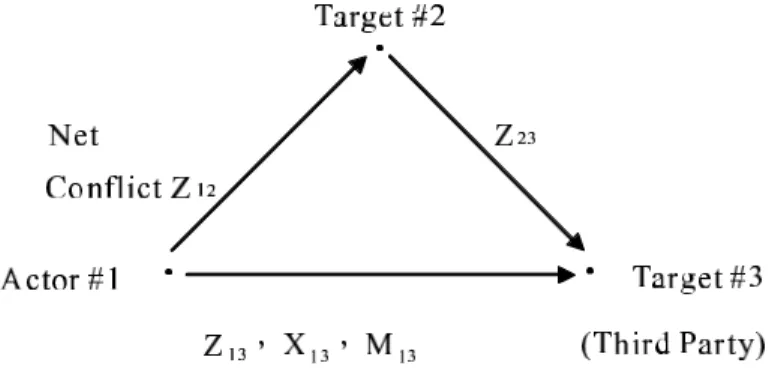
In order to keep the exposition as clear as possible, the theory section has used a single subscript to denote targets. The remainder of the paper uses two subscripts to denote the actor, the target and the third party. As illustrated in Figure 2, and discussed in the theoretical model section, an increase in trade between an actor and target #3 (assuming target #3 is the third party) will influence the conflict between the actor and target #2. Conflict will decrease if target #2 and target #3 are friends, while conflict will increase if target #2 and Target #3 are rivals. A similar relationship is likely to hold if conflict changes between the actor and target #3. A change in conflict between the actor and target #3 will influence the conflict between the actor and target #2 according to whether targets #2 and #3 are friends or rivals. In other words, the empirical work will test a broader interpretation of the hypothesis
Figure 2 Third Party Interactions
that considers conflict and trade as measures of whether the actor and target #3 are becoming more or less friendly.
We develop a measure of trade (conflict) between the actor and target #3 (X13, M13, Z13) and a measure of whether target #2
and target #3 are friends or rivals (Z23).If the target’s net conflict
towards the third party is greater than zero (Z23>0), it is assumed
the target and third party are rivals. If the net conflict is less than zero (Z23<0), then the target and third party are friends.18 The test
will treat each country as a third party. Thus for each dyad there are 28 observations. I would apply ordinary least squares (OLS) multivariate regressions to test the hypotheses. First I examine the actor-third party relationship based on conflict and equation (8) is performed.19
We use the target’s conflict towards the third party to measure whether they are friends or rivals. One could also use the third party’s conflict towards the target.
where Z12= the frequency of net conflict from actor country towards
the target country;
Trade12= exports from the actor country to the target country (X12),
or imports of the actor country from the target country (M12);
A1= a vector of actor country attributes;
A2= a vector of target country attributes;
Z13= frequency of net conflict initiated by the actor country towards
the third party;
Z23= frequency of net conflict initiated by the target country towards
the third party;
= a random error term normally distributed with mean zero.
The strategic (commodity) trade will cause different levels of conflict, for example one can see Solomon W. Polachek and Judith McDonald, “Strategic Trade and Incentives for Cooperation,” in Disarmament, Economic Conversion and the Management of Peace, ed. M. Chatterji and L. Forcey (New York: Praeger, 1992) and Mansfield, Edward D. and Jon C. Pevehouse, “Trade Blocs, Trade Flows and International Conflict,” International Organization, No.54(2000), pp.775-808. For causality problem between conflict and trade, please see Solomon W. Polachek, “Conflict and Trade,”op. cit.; Mark Gasiorowski and Solomon Polachek, “Conflict and Interdependence,”Journal of Conflict Resolution, No.26(December, 1982), pp.709-29; Katherine Barbieri, “Economic In-terdependence: A Path to Peace or a Source of Interstate Conflict?” op. cit. and Rafael Reuveny and Heejoon Kang, “International Trade, Political Conflict/Cooperation, and Granger Causality,” American Journal of Political Science, No.40(1996), pp.943-970.
Country attributes are considered to be exogenous and are used to identify the equations. The coefficients of country attributes can be thought of as other aspects of a price vector for conflict. The intercept terms reflect levels of conflict that would result independently of attributes and trade. In this study, we neglect the impact of country attributes and concentrate solely on the signs and magnitudes of the coefficients of third-party trade and net conflict.20
First, the coefficients of X12 and M12 in Table 1 are negative
and match the neoliberalists’ view which claims that trade promotes peace between countries.21 The results in column (1) of Table 1
show that, when controlling for exports, an increase in conflict from the actor towards other countries (Z13) reduces actor to target
conflict. Increases in conflict from the target towards other countries (Z23) increase actor to target conflict. In column (2) we control for
imports and find that actor-third party and target-third party conflict increase actor-target conflict. The above results provide some evidence that actor to target conflict depends on the actor’s conflict towards other countries and the target’s conflict towards other countries. We include an interaction between Z13 and Z23 to explicitly
test the proposition. The interaction will show whether the change
For more references, see Solomon W. Polachek, “Conflict and Trade,” op. cit.; Solomon W. Polachek, “Why Democracies Cooperate More and Fight Less: The Relationship Between International Trade and Cooperation,” Review of International Economics, No.5(1997), pp.295-309, Many thanks to a referee’s notification.
For a detailed test, see Solomon W. Polachek, “Why Democracies Cooperate More and Fight Less: The Relationship Between International Trade and Cooperation,” op. cit., p.303.
in actor to target conflict due to a change in the actor’s conflict towards other countries depends on the relationship between the target and other countries. The results in column (3) are statistically significant and somewhat consistent with the proposition.22
From column (3):
Thus an increase in conflict with target #3 has an impact on conflict with #2, and the strength of this relationship depends on the relationship between the target and the third party when controlling for exports.
In the theoretical section, we consider four different maxims based on whether countries #2 and #3 are friends or rivals. It is worthwhile discussing how consistent the results are with the theory. First, consider the case where we have an increase in Z13, implying
that countries #1 and #3 are becoming less friendly or more conflictual. This will influence the conflict between countries #1 and #2 depending on the relationship between countries #2 and #3. If Z23 is positive, this implies that countries #2 and #3 are
rivals and an increase in conflict between countries #1 and #3 will lead to a decrease in conflict between countries #1 and #2. This is consistent with the maxim “a rival of a rival is a friend”. If Z23 is negative, this implies that countries #2 and #3 are friends,
The results in column (4) controlling for imports will not discuss as the coefficient of Z13 is insignificant.
but Z23 must be less than– 3.91 to result in an increase in conflict
between countries #1 and #2. This is somewhat consistent with the maxim “a friend of a rival is a rival”.
Let us consider the case where Z13 is decreasing, implying
that countries #1 and #3 are becoming friendlier. Again if Z23 is
positive, this implies they are rivals and a decrease in conflict between countries #1 and #3 leads to an increase in conflict between countries #1 and #2. This is consistent with the maxim “a rival of a friend is a rival”. Lastly, Z23 being negative (again Z23 must
be less than– 3.91) leads to a decrease in conflict between countries #1 and #2. This is somewhat consistent with the maxim “a friend of a friend is a friend”.
Separate regressions controlling for Z13 are estimated for
observations where the target and third party are friends or rivals. As stated earlier, when the target and third party are friends (Z23<0),
we expect the coefficient of Z13 to be positive, and when the target
and third party are rivals (Z23>0), we expect it to be negative. The
empirical results are provided in Table 2. In column (1) the target and third party are friends and when controlling for exports, we find a positive, but insignificant relationship between actor to third party conflict (Z13) and actor to target conflict(Z12). A positive and
significant relationship is found in column (2) when controlling for the imports and matches our prediction, because the actor will increase conflict towards the target as actor-third party conflict increases when the target and third party are friends. Columns (3) and (4) look at cases where the target and third parties are rivals. Column (3) controls for actor’s exports and shows that an increase in actor-third party conflict significantly reduces actor-target conflict.
Column (4) finds similar results when controlling for actor’s imports. These results in both columns are consistent with the proposition.23
The hypotheses are actually based on the relationship between the actor and target #3 being measured by trade, not conflict. Thus we again perform the above analysis using trade to measure the actor-third party relationship (i.e., X13 and M13)and equation (9) is
estimated.
whereTrade13= exports from the actor country to the third party (X13),
or imports of the actor country from the third party (M13).
Table 3 includes interactions between actor-third party exports/ imports and target-third party conflict. The positive and significant coefficients of X13 may indicate that the existence of alternative
markets for the actor reduces the costs of a conflict with a given target. Column (2) includes an interaction between X13 and Z23,
however the coefficient is insignificant. The coefficient of M13 in
column (3) is marginally significant, thus imports from third parties are not as important as exports in determining actor to target conflict. As similar as column (3), the results in column (4) are marginally significant. From column (4):
It may be noted that the sample size is much smaller in Table 2 than in Table 1 as there are a large number of observations where target-third party net conflict equals zero.
For the entire sample, approximately 6,000 observations in relation to Z23 are less than– 28.26. If Z23 is positive, this implies that
countries #2 and #3 are rivals, and an increase in imports from the third party leads to an increase in the actor’s conflict towards target #2. If Z23 is negative and must be less than– 28.26 in this
case, this implies that countries #2 and #3 are friends, and an increase in imports from the third party leads to a decrease in the actor’s conflict towards target #2. Countries #2 and #3 must be highly cooperative with each other, otherwise when increasing trade, actor country #1 will still on average increase conflict towards country #2. Thus for the vast majority of observations for which it is implied that the target and third party are typically friends, an increase in imports from the third party leads to an increase in actor-target conflict.
As before, we run separate regressions for observations where the target and third party are friends or rivals. As the hypotheses stated, if the target and third party are friends (Z23<0), we would
expect that the coefficients of X13 and M13 on actor-to-target conflict
(Z12) will be negative, and if the target and third party are rivals
(Z23>0), we would expect that they will be positive. Column (1)
looks at actor-third party exports, but does not find a significant relationship. Column (2) looks at actor-third party imports and finds that actor-third party trade reduces actor-target conflict when the target and other countries are friendly. The results in columns
(3) and (4) consider the cases where the target and third party are rivals. In these cases, the positive coefficients of X13 and M13 show
that an increase in trade between the actor and other countries will increase actor-target conflict and support the propositions.24
The most explicit test parts of the hypotheses are summarized in the Table 5. Except the coefficients that are not significant, all other coefficients in the empirical tests match the expectation.
Since in our sample the mean of net conflict equals– 1.09, the dyads tend to be more cooperative on average. As such, if the target and third party are rivals, it shows stronger and more consistent results which strengthen the propositions.
5. Summary
This article presents an initial step in the analytical study of the impact of multilateral trade on international interactions. In the process, it develops a theoretical framework for subsequent empirical investigation. In 1978, Solomon Polachek developed the trade-conflict model which claimed that increased trade between countries reduces conflict. The purpose of this paper is to illustrate the static nature of the underlying links between trade and conflict where third party relationships are considered. In so doing, we extend the basic trade-conflict model to analyze international interactions involving third parties. An actor country maximizes its plausible social welfare function subject to a balance of payments
It is worth noting that the empirical tests apply to average results. This research does not discuss the potential heterogeneity between nations that will cause different international interactions.
constraint. We derive a theorem whereby, under reasonable assumptions, trade between the actor and a third party will affect conflicts between the actor and the target. A similar relationship is discussed for conflicts which may change between the actor and the third party.
According to the theory of structural balance in international polities, changes in international relationships between two states affect a third nation. Heider (1946) and Cartwright and Harary (1956) formulated the postulates of this theory which focused on the tendency toward balance in a triadic relationship. Imbalance is an important factor in attitude change. The imbalance can be resolved either by all nations becoming friends or by two deciding to like each other and to dislike the third member of the trio, who responds negatively to both. This research essentially highlights the importance of accounting for how the changes in trade or conflict between countries affect the international multilateral relationships. The policy implication here is straightforward. Encouraging free trade tends to decrease conflict and increase cooperation. The classical liberal thesis that trade promotes peace between states is based on two ideas: trade between two states increases the economic costs of waging war, and an inherent facet of increased trade is increased communication between states. The increased communication between states reduces the possibility of misunderstanding and fosters peaceful resolution of conflict (Hegre, 2000, p.5). Baron de Montesquieu (1990, p.316) stated that “Peace is the natural effect of trade. Two nations who traffic with each other become reciprocally dependent: for if one has the interest in buying, the other has the interest in selling; and thus their union
is founded on the mutual necessities.” With democracy being a worldwide trend, most contemporary leaders cling to this longstanding belief that expanding economic ties will increase the bonds of friendship and eliminate the thought of a resort to arms (Mansfield and Pollins, 2001, p.855). If the trade gains increase countries’ welfare and serious conflict among countries disrupts trade, trade will promote peace and increased world trade will make the maxim “a friend of a friend is a friend” a reality. As such, the international system will be very structurally balanced.
This is a preliminary study that leaves some questions unanswered, especially in empirical work. That trade changes caused by tariffs, foreign aid, transportation costs,…etc., indirectly influence third party interactions needs to be investigated. Further research is suggested to develop along two key lines. First, more sophisticated measurements of the appropriate variables need to be developed. Second, a more thorough understanding of the interaction of these variables and their relative importance is necessary. How far it will take us in understanding the relationship between third party trade and international interactions remains to be determined by future researches.
Table 1
The Conflict Relationship the Among Actor, Target and Third Parties Dependent Variable: Net Conflict (Z12)
Intercept - 1.71** - 1.08** - 1.72** - 1.08** (- 33.7) (- 31.8) (- 33.8) (- 32.0) X12 - 0.0088** - 0.0087** (- 55.4) (- 55.0) X2 12 1.4× 10⁻⁶** 1.4× 10⁻⁶** (42.0) (41.7) Z13 *Z23 - 0.00476** - 0.00397** (-18.1) (-22.5) M12 - 0.0069** - 0.0068** (- 70.8) (- 70.4) M2 12 9.9× 10⁻⁷** 9.8× 10⁻⁷** (54.1) (53.8) Z13 -0.00772** 0.0123** - 0.0186** - 0.00354 (-2.50) (5.55) (-5.92) (1.57) Z23 0.013** 0.00624** 0.00216 - 0.00275 (4.08) (3.04) (0.67) (-1.32) Pop-actor 2.0× 10⁻⁵** 3.4× 10⁻⁶** 1.9× 10⁻⁵** 3.3× 10⁻⁶** (54.1) (12.9) (53.8) (12.5) Pop-target - 5.4× 10⁻⁶** - 1.7× 10⁻⁶** - 5.5× 10⁻⁶** - 1.8× 10⁻⁶** (- 14.2) (- 6.95) (-14.5) (-7.40) GNP-actor - 1.2× 10⁻⁸** - 7.8× 10⁻⁹** - 1.2× 10⁻⁸** -7.8× 10⁻⁹** (- 46.8) (- 43.8) (- 47.0) (- 44.1) GNP-target 8.6× 10⁻⁹** 1.6× 10⁻⁹** 8.6× 10⁻⁹** 1.6× 10⁻⁹** (33.3) (9.33) (7.19) (9.18) Distance 1.0× 10⁻⁴** 1.2× 10⁻⁴** 1.0× 10⁻⁴** 1.2× 10⁻⁴** (6.55) (11.0) (6.57) (11.1) R-squared 0.094 0.104 0.097 0.109 N 93376 93805 93376 93805
T-statistics are in parentheses, * indicates significant at the 10 percent level, ** significant at the 5 percent level.
Table 2
The Conflict Relationship Among the Actor, Target and Third Parties Dependent Variable: Net Conflict (Z12)
Intercept - 2.21** - 1.29** - 2.66** - 1.62** (- 27.3) (- 25.3) (- 13.7) (- 12.6) X12 - 0.0097** - 0.0097** (- 11.4) (- 17.5) X2 12 15× 10-6** 1.5× 10⁻⁶** (29.3) (12.2) Z13 0.00493 0.0358** - 0.124** - 0.074** (1.08) (11.7) (-15.0) (-12.7) M12 - 0.0076** - 0.0080** (- 56.6) (- 23.8) M2 12 1.1× 10⁻⁶** 1.1× 10⁻⁶** (42.1) (17.8) Pop-actor 2.8× 10⁻⁵** 5.0× 10⁻⁶** 3.7× 10⁻⁵** 7.1× 10⁻⁶** (49.4) (13.1) (24.6) (6.43) Pop-target - 5.4× 10⁻⁶** - 1.6× 10⁻⁶** - 2.2× 10⁻⁶** - 7.3× 10⁻⁸ (- 9.39) (- 4.57) (- 2.79) (-0.15) GNP-actor - 1.4× 10⁻⁸** - 7.1× 10⁻⁹** - 1.9× 10⁻⁸** -9.3× 10⁻⁹** (- 32.8) (- 27.2) (- 18.1) (- 13.3) GNP-target 8.8× 10⁻⁹** 2.0× 10⁻⁹** 7.4× 10⁻⁹** 1.8× 10⁻⁹** (25.5) (8.86) (10.1) (3.65) Distance 9.8× 10⁻⁵** 1.2× 10⁻⁴** 1.0× 10-4* 1.7× 10-4** (4.12) (8.10) (1.61) (4.04) R-squared 0.108 0.109 0.127 0.113 N 49689 50168 9110 9325 Z23<0 Z23>0
T-statistics are in parentheses, * indicates significant at the 10 percent level, ** significant at the 5 percent level.
Table 3
The Conflict Relationship Among the Actor, Target and Third Parties Dependent Variable: Net Conflict (Z12)
Intercept - 1.73** - 1.74** - 1.12** - 1.12** (- 32.2) (- 32.3) (- 31.3) (- 31.3) X12 - 0.0090** - 0.0090** (- 55.8) (- 55.8) X2 12 1.5× 10⁻⁶** 1.5× 10⁻⁶** (42.4) (42.4) X13 0.000236** 0.000231** (2.98) (2.90) Z13 *Z23 0.00000417 (1.39) M12 - 0.0069** - 0.0069** (- 70.3) (- 70.3) M2 12 1.0× 10⁻⁶** 1.0× 10⁻⁶** (53.8) (53.8) M13 - 0.00009** 0.0000842* (-5.92) (1.74) M13 *Z23 0.00000298* (1.81) Z23 0.00954** 0.00782** 0.00348 0.00203 (2.93) (2.24) (1.67) (0.91) Pop-actor 1.9× 10⁻⁵** 1.9× 10⁻⁵** 4.2× 10⁻⁶** 4.2× 10⁻⁶** (52.1) (52.1) (14.2) (14.2) Pop-target - 5.0× 10⁻⁶** - 5.0× 10⁻⁵** - 1.2× 10⁻⁶** - 1.× 10-6** (- 12.5) (- 12.6) (- 4.89) (-4.91) GNP-actor - 1.2× 10⁻⁸** - 1.2× 10⁻⁸** - 8.2× 10⁻⁹** - 8.2× 10⁻⁹** (- 45.8) (- 45.7) (- 44.4) (-44.3) GNP-target 9.0× 10⁻⁹** 9.0× 10⁻⁹** 1.7× 10⁻⁹** 1.7× 10⁻⁹** (32.8) (32.7) (9.25) (3.18) Distance 1.0× 10⁻⁴** 1.0× 10⁻⁴** 1.1× 10⁻⁴** 1.1× 10⁻⁴** (6.36) (6.36) (9.91) (9.90) R-squared 0.0985 0.0985 0.111 0.111 N 85318 85318 84283 84283
T-statistics are in parentheses, * indicates significant at the 10 percent level, ** significant at the 5 percent level.
Table 4
The Conflict Relationship Among the Actor, Target and Third Parties Dependent Variable: Net Conflict (Z12)
Intercept X12 X2 12 X13 M12 M2 12 M13 Pop-actor Pop-target GNP-actor GNP-target Distance Z23<0 Z23>0 - 2.24** - 1.35** - 2.33** - 1.47** (- 29.9) (- 28.2) (- 12.1) (- 11.1) - 0.0098** - 0.0098** (- 47.2) (- 18.0) 1.6× 10⁻⁶** 1.5× 10⁻⁶** (34.2) (12.5) 0.0000484 0.000699** (0.38) (3.17) - 0.0076** - 0.0078** (- 63.4) (- 23.1) 1.1× 10⁻⁶** 1.1× 10⁻⁶** (47.5) (17.5) - 0.000166** 0.000454** (11.7) (3.44) 2.7× 10⁻⁵** 6.7× 10⁻⁶** 2.2× 10⁻⁵** -7.8× 10⁻⁷ (54.0) (17.2) (15.4) (-0.63) - 4.9× 10⁻⁶** - 1.1× 10⁻⁶** - 1.7× 10⁻⁶** - 3.0× 10⁻⁷ (- 9.46) (- 3.59) (- 2.18) (-0.58) - 1.4× 10⁻⁸** - 7.8× 10⁻⁹** - 1.5× 10⁻⁸** -7.4× 10⁻⁹** (- 37.1) (- 32.8) (- 14.8) (- 10.4) 9.2× 10⁻⁹** 2.2× 10⁻⁹** 6.6× 10⁻⁹** 1.5× 10⁻⁹** (28.3) (10.5) (8.87) (2.93) 1.1× 10⁻⁴** 1.2× 10⁻⁴** 2.0× 10-4* 1.5× 10-4** (5.11) (8.25) (3.31) (4.60) R-squared 0.114 0.117 0.099 0.106 N 56811 56256 8258 8509
T-statistics are in parentheses, * indicates significant at the 10 percent level, ** significant at the 5 percent level.
Table 5
The Summary of the Tests of Hypotheses
Friends or Rivals Controlling Coefficient Expected Effect Predicted Effect
Variable on Net Conflict on Net Conflict
Z23<0: X12 Z13 + N.S. M12 Z13 + + X12 X13 - N.S. M12 M13 - - Z23>0: X12 Z13 - - M12 Z13 - - X12 X13 + + M12 M13 + +
N.S. indicates Not Significant; “+”: The Actor Increases Net Conflict Towards the Target; “-”: The Actor Decreases Net Conflict Towards the Target;
Z23>0: The Target and Third Party Are Friends;
Z23>0: The Target and Third Party Are Rivals.
(收件:2003 年 3 月 17 日,修正:2003 年 7 月 11 日,採用:2003 年 7月 15 日)
Appendix: Procedures for Comparative Statics
In order to satisfy the second order conditions for maximization, the Hessian matrix must be negative definite. In other words, the principal minors , , , ……, must alternate in sign:
For a simple two-country case, the solving procedures are:
References
Anderton, Charles and John Carter (2001). “The Impact of War on Trade: An Interrupted Times-Series Study.” Journal of Peace
Research 38(4): 445-457.
Azar, Edward (1978). “An Early Warning Model of International Hostilities.” In N. Choucri and T. Robinson (eds.), Forecasting International Relations:Theory, Methods, Problems and Prospects. San Francisco: Freeman.
Azar, Edward (1980). “The Conflict and Peace Data Bank (COPDAB) Project.” Journal of Conflict Resolution 24: 143-152.
Altfield, Michael (1984). “The Decision to Ally: A Theory and Test.” Western Political Quarterly, 37: 523-544.
Altfield, Michael and Bruce Bueno de Mesquita, (1979). “Choosing Sides in Wars.” International Studies Quarterly, 23: 87-112. Banks, Arthur (1973).SUNY-Binghamton Cross-National Time-Series
Data. Center for Comparative Political Research, State University
of New York at Binghamton.
Barbieri, Katherine (1996). “Economic Interdependence: A Path to Peace or a Source of Interstate Conflict?” Journal of Peace
Research 33(1): 29-49.
Barbieri, Katherine and Gerald Schneider (1999). “Globalization and Peace: Assessing New Directions in the Study of Trade and Conflict.” Journal of Peace Research 36(4): 387-404. Bercovitch, Jacob (1991). “International Mediation and Dispute
Settlement: Evaluating the Conditions for Successful Mediation.”
Negotiation Journal 7(1): 17-30.
Mediator Characteristics and Behaviour on the Success of Mediation in International Relations.” International Journal of
Conflict Management 4(4): 297-321.
Bercovitch, Jacob and Jeffrey Langley (1993). “The Nature of the Dispute and the Effectiveness of International Mediation.”
Journal of Conflict Resolution 37(4): 670-691.
Bercovitch, Jacob and Gerald Schneider (2000). “Who Mediates? The Political Economy of International Conflict Management.”
Journal of Peace Research 37(2): 145-165.
Blainey, Geoffrey (1988). The Causes of War.
Basingstoke: Macmillan Press.Bremer, Stuart (1993). “Democracy and Militarized Interstate Conflict, 1816-1965.” International
Interactions 18: 231-249.
Cartwright, D. and Frank Harary (1956). “Structural Balance: a Generalization of Heider’s Theory.” Psychological Review 63: 277-293.
Chan, Steve (1984). Mirror, “Mirror on the Wall…Are the Freer Countries More Pacific.”Journal of Conflict Resolution 28: 617-648. Chang, Yuan-Ching (forthcoming). “Conflict and Trade: The Relationship Between Geographic Distance and International Interactions,” Journal of Socio-Economics.
de Montesquieu, Baron (1900). The Spirit of Laws, translated by
Thomas Nugent. New York: Collier Press.
de Wilde, Jaap (1991).Saved from Oblivion: Interdependence Theory
in the First Half of the 20th Century. A Study of the Causality
Between War and Complex Interdependence. Aldershot: Dartmouth.
Dixon, William J. (1993). “Democracy and the Management of International Conflict.”Journal of Conflict Resolution 37: 42-68.
Dixon, William J. (1996). “Third-Party Techniques for Preventing Conflict Escalation and Promoting Peaceful Settlement.”
International Organization 50: 653-681.
Domke, William K. (1988). War and The Changing Global System. New Haven: Yale University Press.
Dorussen, Han (1999). “Balance of Power Revisited: A Multi-Country Model of Trade and Conflict.” Journal of Peace
Research 36(4): 443-462.
Gasiorowski, Mark and Solomon Polachek (1982). “Conflict and Interdependence.”Journal of Conflict Resolution, 26 (December): 709-29.
Gillespie, J. and D. Zinnes. n.d. World Trade Data: 1958-1968. Inter-University Consortium for Political Research, University of Michigan.
Hegre, Havard (2000). “Development and the Liberal Peace: What Does it Take to be a Trading State?” Journal of Peace Research 37(1): 5-30.
Heider, Fritz (1946). “Attitudes and Cognitive Organization.”Journal
of Psychology 21: 107-112.
Holsti, Ole; Terrence Hopmann and John Sullivan (1973). Unity
and Disintegration in International Alliances: Comparative Studies. NY: Wiley.
Hopmann, Terrence (1996). The Negotiation Process and The
Resolution of International Conflicts. Columbia, SC: University
of South Carolina Press.
Huth, Paul and Bruce Russett (1988). “Deterrence Failure and Crisis Escalation.” International Studies Quarterly 32: 29-45.
Violent Conflict?” Journal of Peace Research 37(3): 323-343. Jones, Deiniol Lloyd (2000). “Mediation, Conflict Resolution and Critical Theory.” Review of International Studies 26: 647-662. Kaufman, Sanda and George T. Duncan (1992). “A Formal Framework for Mediator Mechanisms and Motivations.” Journal of Conflict
Resolution 36(4): 688-708.
Keohane, Robert and Joseph Nye (1989).Power and Interdependence:
World Politics in Transition. New York: Harper Collins.
Kressel, K., D. G. Pruitt and Associates (1989).Mediation Research:
The Process and Effectiveness of Third-Party Intervention. San
Francisco: Jossey-Bass.
Kim, Soo Yeon (1995). “Bilateral Conflict and Trade, 1948-86: The Role of Economic Interdependence in Conflict Processes.” Paper Presented at the American Political Science Association Conference, Chicago.
Lo, Chih-Cheng (1996). “Multilateral Strategy of Taiwan Safety.”
Issues and Studies (Chinese Edition) 35(9): 1-16.
MacDonald, H. Brooke and Richard Rosecrance (1985). “Alliance and Structural Balance in the International System.” Journal
of Conflict Resolution 29(1): 57-82.
Mansfield, Edward D. (1994). Power, Trade and War. Princeton: Princeton University Press.
Mansfield, Edward D. and Jon C. Pevehouse (2000). “Trade Blocs, Trade Flows and International Conflict.”International Organization 54: 775-808.
Mansfield, Edward D. and Brian M. Pollins (2001). “The Study of Interdependence and Conflict.” Journal of Conflict Resolution 45: 834-859.
Maoz, Zeev and Nasrin Abdolali (1989). “Regime Types and International Conflict 1816-1976.”Journal of Conflict Resolution 33: 3-36.
Maoz, Zeev and Bruce Russett (1993). “Normative and Structural Causes of Democratic Peace, 1946-1986.” American Political
Science Review 87: 624-38.
Merrills, John G. (1991).International Dispute Settlement. Cambridge: Grotius.
Mitchell, C.R. (1988). “The Motives of Mediation.” in C.R. Mitchell and K. Webb, eds., New Approaches to International Mediation. NY: Greenwood (29-51).
Morrow, James D. (1991). “Alliances and Asymmetry: An Alternative to the Capability Aggregation Model of Alliances.” American
Journal of Political Science 35: 904-933.
Neff, Stephen C. (1990).Friends But No Allies: Economic Liberalism
and the Law of Nations. New York: Columbia University Press.
Oneal, John R., Frances H. Oneal, Zeev Maoz and Bruce Russett (1996). “The Liberal Peace: Interdependence, Democracy, and International Conflict, 1950-86.” Journal of Peace Research 33(1): 11-28.
Oneal, John R. and Bruce Russett (1999). “Assessing the Liberal Peace with Alternative Specifications: Trade Still Reduces Conflict.” Journal of Peace Research 36(4): 423-442.
Polachek, Solomon W. (1978). “Dyadic Dispute.” Papers of the
Peace Science Society 28: 67-80.
Polachek, Solomon W. (1980). “Conflict and Trade.” Journal of
Conflict Resolution 24: 55-78.
and Fight Less: The Relationship Between International Trade and Cooperation.”Review of International Economics 5: 295-309. Polachek, Solomon W. (forthcoming). “Trade-based Interactions: An Interdisciplinary Perspective.” Conflict Management and
Peace Science.
Polachek, Solomon W. and Judith McDonald (1992). “Strategic Trade and Incentives for Cooperation.” inDisarmament, Economic
Conversion and the Management of Peace, ed. M. Chatterji
and L. Forcey. New York: Praeger.
Polachek, Solomom W., John Robst and Yuan-Ching Chang (1999). “Liberalism and Interdependence: Extending the Trade-Conflict Model.” Journal of Peace Research 36(4): 405-422.
Princen, Thomas (1992). Intermediaries in International Conflict. Princeton, NJ: Princeton University Press.
Raymond, Gregory (1994). “Democracies, Disputes, and Third-Party Intermediaries.” Journal of Conflict Resolution 38(1): 24-42. Reuveny, Rafael and Heejoon Kang (1996). “International Trade,
Political Conflict/Cooperation, and Granger Causality.”American
Journal of Political Science 40: 943-970.
Reuveny, Rafael and Heejoon Kang (1998). “Bilateral Trade and Political Conflict/Cooperation: Do Goods Matter?” Journal of
Peace Research 35(5): 581-602.
Russett, Bruce, John R. Oneal and David R. Davis (1998). “The Third Leg of the Kantian Tripod for Peace: International Organizations and Militarized Disputes, 1950-1985.”International
Organization 52(3): 441-467.
Russett, Bruce and John R. Oneal (2001). Triangulating Peace:
New York: Norton.
Sabrosky, Alan N. (1980). “Interstate Alliances: Their Reliability and the Expansion of War.” In J. David Singer, ed., The
Correlates of War: II. NY: Free Press.
Simon, Michael and Erik Gartzke, (1996). “Political System Similarity and the Choice of Allies. Do Democracies Flock Together, or Do Opposites Attract?”Journal of Conflict Resolution 40(4): 617-635. Singer, J. David and Melvin Small (1966a). “Formal Alliance, 1815-1939: A Qualitative Description.” Journal of Peace
Research 3(1): 1-32.
Singer, J. David and Melvin Small (1966a). “National Alliance Commitments and War Involvement, 1815-1945.”Peace Research
Society (International) Papers 5: 109-140.
Siverson, Randolf and Joel King (1979). “Alliances and the Expansion of War.” In J. David Singer and Michael D. Wallace, eds., To
Augur Well: Early Warning Indicators in World Politics. CA:
SAGE (37-50).
Siverson, Randolf and Joel King (1980). “Attributes of National Alliance Membership and War Participation, 1815-1965.”
American Journal of Political Science 24: 1-15.
Smith, Alastair (1996). “To Intervene or Not to Intervene.” Journal
of Conflict Resolution 40(1): 16-40.
Spiegel, Henry W. (1991). The Growth of Economic Thought, 3rd
ed. Durham, NC& London: Duke University Press.
Touval, Saadia. (1982). The Peace Brokers: Mediators in the
Arab-Israeli Conflict, 1948-1979. Princeton, NJ: Princeton University
Press.
Journal of Conflict Resolution 37(1): 160-194.
Werner, Suzanne (1998). “Negotiating the Terms of Settlement, War Aims and Bargaining Leverage.” Journal of Conflict Resolution 42(3): 617-635.
Werner, Suzanne (2000). “Deterring Intervention: The Stakes of War and Third-Party Involvement.”American Journal of Political
Science 44(4): 720-732.
Young, Oran. (1967). The Intermediaries. Princeton, NJ: Princeton University Press.