國立交通大學
企業管理碩士學程
碩士論文
企管碩士畢業生有自信成為全球經理人嗎:比較台灣的全
球化企管碩士班、企管碩士班與其他商業研究所碩士班學
生之差異
Are MBA Graduates Ready to be Global Managers: A
Comparison Among Global MBA, MBA and Business-majored
Students in Taiwan
研究生:葉璇
指導教授:陳姵樺 博士
I
Are MBA Graduates Ready to be Global Managers: A Comparison Among
Global MBA, MBA and Business-majored Students in Taiwan
–––––––––––––––––––––––––––––––––––––––––
Student: Hsuan Yeh
Advisors: Prof. Pei-Hwa Chen
Global Master of Business Administration
National Chiao Tung University
ABSTRACT
Many people perceive that having a MBA degree is as a passport to senior managerial roles. Having a MBA degree is recognized as a „ticket‟ not only to increase salary, enhanced career process, advanced knowledge and skills, but sometimes as a prerequisite for joining upper managerial ranks. On the other hand, Global and multinational enterprises are developing knowledge networks comprised of workers from around the world who collaborate on product or service innovations, growth and structural cost reduction. At the core of the
knowledge-based multinational enterprise is the global manager who has the ability to scan the environment, sense change, understand the firm's capabilities and put measurable and profitable plans in place. Therefore, some researchers studied on whether having a MBA will provide the competencies needed for managers in organizational settings or having a MBA will enhance performances as a manager. This study focused on whether the MBA graduates in Taiwan could possess the competencies which meeting the demand of global managers by self evaluation of graduates. Furthermore, Global MBA is a MBA program with whole English and cross-cultural environment in Taiwan. This study also probed whether the GMBA graduates could have more cross-cultural flexibility. The research method was used Factor Analysis both in Exploratory and Confirmatory, MONOVA and ANOVA analysis to prove the hypotheses that MBA graduates could possess more competencies of global
managers than other business majors. Based on the survey from 222 available respondents of GMBA, MBA and other business-majored graduates, the output of the study indicated the competencies they possessed by self-evaluation, and MBA graduates have more
characteristics of global managers comparing with business-majored graduates. Besides, GMBA graduates have more cross-cultural flexibility than non-MBA graduates. The reference of the training of MBA education with the globalized trend was provided.
II
Acknowledgement
I really appreciate my advisor who gave me a lot of help for completing this thesis. As a
non-business-majored student, my advisor spent a lot of time explaining statistics to me and
giving me many advices from very beginning of the thesis. She also inspired me many ideas
and concluded into the words. She not only discussed the thesis with me for many times with
patience but also notice the detail with carefulness. The positive study attitude is the other
important thing she taught me.
I also wish to express my thanks to the oral defense committee, Dr. Hung, Dr. Liu, and Dr.
Huang. They gave me many valuable advices which could make up the insufficient parts of
my thesis.
GMBA classmates, thank you for a lot of encouragement. As a non-business-majored
student, MBA program really gave me the chance to not only study but also perceive the new
field of the knowledge. GMBA classmates always gave me a lot of courage and support while
I was confused or tired. I really appreciate that I had the chance to know you guys and had
such a wonderful memory in Hsinchu.
Thanks for my parents who always give me the support. No matter what I want to do or
what I have done, you always give me the biggest support and comfort. I love you, Mom and
Dad.
Finally, I want to dedicate this study for my husband Allen Hsu and my son Hao Lan Hsu,
who has accompanied with me from the beginning of the draft while I was pregnant on 28
weeks to the complete of the thesis while he is around 9 months old. This would be one of the
special memories for three of us, our family.
NCTU, Hsinchu, September 2010 Hsuan Yeh
III
Content
Chapter 1 Introduction ... 1
1.1 Research Background and Motivation ... 1
1.1.1 The Background ... 1
1.1.2 Statement of The Problem and The Research Motivation ... 3
1.2 Research Purpose ... 5
1.3 Research Process ... 6
Chapter 2 Literature Review ... 7
2.1 MBA and GMBA/IMBA Education ... 7
2.1.1 Instruction of MBA Education ... 7
2.1.2 The Association to Advance Collegiate Schools of Business ... 9
2.1.3 MBA Education in Taiwan ... 10
2.1.4 GMBA/IMBA Program in Taiwan... 12
2.2 The Demand of Global Managers ... 15
2.2.1 The Definition of Global Managers ... 15
2.2.2 The Definition of Competency ... 16
2.2.3 The Competencies of Global Managers ... 16
2.3 MBA Education for Global Managers ... 22
Chapter 3 Research Methodology ... 25
3.1 Introduction ... 25
3.2 Research Design ... 26
3.2.1 Sampling Design ... 26
3.2.2 Questionnaire Design ... 27
3.3 Data Collection... 35
3.3.1 Pilot Study ... 35
3.3.2 Formal Study ... 35
3.4 Data Analysis Procedure ... 37
3.4.1 Reliability & Validity ... 38
Chapter 4 Results ... 39
4.1 Descriptive Statistics Result of the Sample ... 39
4.2 Reliability Analysis ... 41
4.3 Exploratory Factor Analysis ... 41
4.4 Confirmatory Factor Analysis... 44
4.4 MANOVA Analysis and ANOVA Analysis ... 50
IV
5.1 Research Findings and Conclusions ... 59
5.2 Research Limitation ... 63
5.3 Implications ... 64
5.4 Future Research ... 65
Reference ... 66
Appendix 1 Departments of Business and Management as the Sampling ... 69
V
Tables
Table 1 MBA and specialized master‟s degree enrollment and percentages (2008-2009) ... 8
Table 2 The acceptance rate of each graduate school in the departments/institutes of Business Administration and Management in 2008... 11
Table 3 The comparison of MBA program and GMBA program in NCTU ... 14
Table 4 Combination of the competencies from different research ... 21
Table 5 Related studies and corresponded variables in questionnaire ... 28
Table 6 Chronbach's alpha value of Global manager's characteristics ... 46
Table 7 Means, Standard Deviation, and Correlation among study variables... 47
Table 8 Confirmatory Factor Analysis Comparisons ... 48
Table 9 Means and Standard Deviations (SD) of three majors ... 50
Table 10 Test of between-subject effects ... 51
Table 11 Post-hoc test by Tukey's HSD test ... 53
Table 12 Mean, Standard Deviation (SD) for three majors ... 54
Table 13 Tests of Between-Subjects Effects ... 55
Table 14 Post-hoc test by Tukey's HSD test... 56
Table 15 Mean and Standard Deviation of three majors/programs ... 57
Table 16 Robust Tests of Equality of Means ... 57
VI
Figure
Figure 1 Research process ... 6
Figure 2 The procedure of developing the survey ... 27
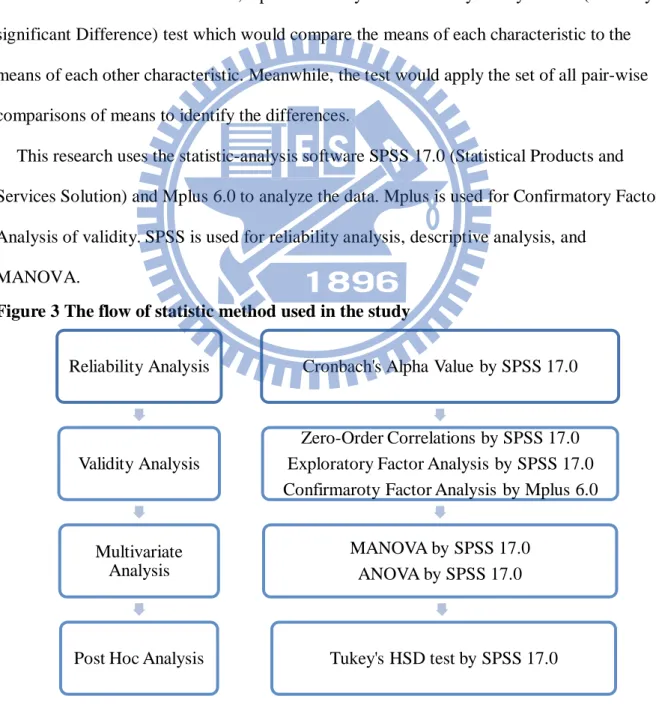
Figure 3 The flow of statistic method used in the study ... 37
Figure 4 Scree Plot ... 43
1
Chapter 1 Introduction
1.1 Research Background and Motivation
1.1.1 The Background
MBA education has been developed for decades from former business theory-tended to
later industry practice-tended. With the trend of globalization in business, MBA education has
been improved to meet the demands of the business world. As one of the top schools of
management in the world, Kellogg of Northwestern University (2001) stated that a broad and
nuanced understanding of the world to succeed is needed in today‟s economy which is driven by increasingly complex and interdependent markets. According to the other top institute of
management in the world, MBA program in Harvard Business School (2010), the inherently
international experience is emphasized, and an intense period of personal and professional
transformation prepares students for challenges in any functional area at anywhere in the
world.
Over the last few decades, according to the World Bank, the pace of the global integration
has become much faster and dramatic because of unprecedented advancements and
revolutions in technology, communication, transportation and industry. Today's international
organizations require global managers who understand and can respond to customers,
governments and competitors alike. Large multinational enterprises are developing
knowledge networks comprised of workers from around the world who collaborate on product
or service innovations, growth and structural cost reduction. At the core of the
knowledge-based multinational enterprise is the global manager who has the ability to scan
the environment, sense change, understand the firm's capabilities and put measurable and
profitable plans in place. All of the above requires a different form of human resource
management and candidate selection. The market is now the world and managers within firms
2
out global initiatives (Stanek, 2000).
Given the relationship between management education and the business world, market
forces such as globalization, technological change, and new workplace requirements may
affect business education more than any other branch of academia (Friga, Bettis et al., 2003).
Therefore, MBA education also needs to meet the change of globalization especially for those
who prepare to be the management roles in the future. The Master of Business Administration,
MBA, is a master's degree in business administration, which attracts people from a wide range
of academic disciplines. Originated in the United States, MBA emerged from the late 19th
century as the country industrialized and companies sought out scientific approaches to
management (Baruch and Leeming, 2001). The core courses in the MBA program are
designed to introduce students to various disciplines of business and management such as
accounting, marketing, human resources, operations management, etc. The goals of MBA
programs are to prepare their graduates for managerial roles; to help them gain a better
understanding of the industrial and business world and its needs, to enrich their skills and to
provide them with competencies and capabilities relevant to their careers (Baruch and
Leeming, 2001). Therefore, holding a MBA degree is usually perceived as a passport into
managerial roles.
In Taiwan, MBA attracts people from different undergraduate majors and the acceptance
rate is low. The acceptance rate of MBA programs in 2007 were under 10% based on the
report of Common Wealth Magazine (Wang, 2007). Moreover, the acceptance rate of
departments/institutes of Business Administration and Business and Management in 2008
were under 4% in average.
Starting from 2005, Ministry of Education (MOE) encourages national universities to
establish and assess professional business and management schools. The aims are to meet the
demand of the development of professional business and management education domestically
3
and the ability of self-control of students with practical training; to combine the internship and
practical teaching; and to improve the identification of professional knowledge and study
experience internationally for the connection with the world. These programs, called Global
MBA (GMBA) or international MBA (IMBA), offer the degree of Master of Business
Administration. These programs focus on developing the global points of view for students
and enforcing not only professional knowledge with intern systems and empirical study but
also the international-qualified abilities to increasing the competitiveness in the global
business. Through these programs, MOE not only expects to attract international students
studying in Taiwan but also expects to develop students‟ ability to foreign language and global viewpoints. Compared with traditional MBA program, GMBA/IMBA could offer
students a cross-cultural environment with international students worldwide and offers a fully
accredited Masters of Business Administration degree teaching completely in English.
Comparing with traditional MBA program in Taiwan, half of the GMBA/IMBA students and
faculty are local Taiwan citizens and the other half are from diverse nationalities, representing
a diverse mixture of people. Besides, unlike traditional MBA program in Taiwan, the
admission requirement includes at least two or three years of working experiences, which
makes GMBA/IMBA program much more practical because students can share their working
experiences in class and combine what they learn with what they did. To sum up,
GMBA/IMBA adds different values against Taiwan‟s traditional MBA programs.
1.1.2 Statement of The Problem and The Research Motivation
Because of the globalization of businesses, the demand of global managers is increasing. And
MBA education should meet the demand of this trend as well. As Friga, Bettis et al. (2003)
mentioned, business education must be affected by the trend of globalization. Ball and
McCulloh (1993) did the survey from the CEOs of the largest American multinational firms
studying the importance of international business education for their employees and the
4
Long‟s (2009) study, the gap between MBA education and business demands was explored. However, the demands of global managers were not included in her study. In Mellahi‟s (2000)
study, the teaching of leadership was focused on UK MBA programs even though it was from
an international perspective. Cabrera and Bowen (2005) discussed the professional
management education which MBA education provided for the global management should be
revised to have a true professional discipline considered by practitioners, educators, regulators
and society. Khurana et al. (2005) discussed the profession of business management in
America and the professional obligations of individuals.
In Taiwan, MOE has established a new MBA program with international students and
whole English courses for meeting the internationalization of MBA education. This program,
called GMBA/IMBA, has differences from traditional MBA education in Taiwan especially
with cross-cultural environment; would GMBA/IMBA students have additional competence
against the students of traditional MBA? Cant (2004) gave the advice for internationalizing
the business curriculum, but it was focused on undergraduate students. Eileen (2005) did the
research about cross-cultural competencies for U.S. business leaders, but it was only focused
on business not education.
The motivation of this research is to probe whether GMBA/IMBA programs in Taiwan
can make students more competitive on diverse cultural adjustment and whether MBA
students, comparing to other business majors, in Taiwan can meet the demands of global
5
1.2 Research Purpose
Based on the research background and motivation, this research will discuss whether
students of MBA programs in Taiwan can match the requirement of global managers who are
quite demanded in global businesses and whether students in the GMBA/IMBA programs in
Taiwan can have better cross-cultural adjustment.
The research purpose in this study is as the following:
1. to discover whether the training of MBA programs meets the competencies of global
managers, comparing with other business majors.
2. to discover whether the training of GMBA program makes students much more easily
6
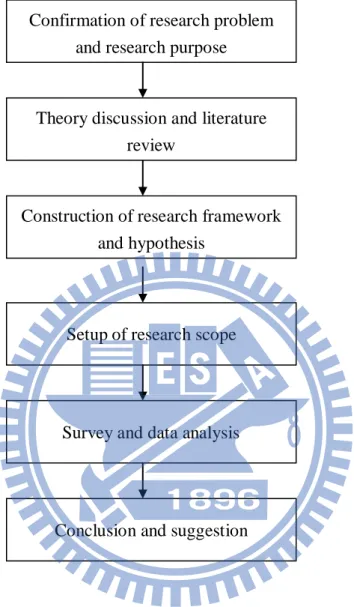
1.3 Research Process
Figure 1 Research process
Confirmation of research problem and research purpose
Setup of research scope Theory discussion and literature
review
Survey and data analysis
Conclusion and suggestion Construction of research framework
7
Chapter 2 Literature Review
2.1 MBA and GMBA/IMBA Education
2.1.1 Instruction of MBA Education
While Joseph Wharton, a prominent Philadelphia merchant, industrialist and philanthropist,
established the first business school, the University of Pennsylvania‟s Wharton School of Commerce in 1881, it was started the professional business education in the United States
(Brooks, 2006). The contemporary debate over what constitutes the appropriate balance in
professional business education between theory and scholarship and practical application can
be traced back to the two competing approaches of the Wharton School, focused on business
theory and scholarship, and Harvard University, following an experiential model (Mintzberg,
2004). In 1900, Master‟s Degree in Business was first offered by the higher education
institution, Dartmouth University (Friga, Bettis et al., 2003). Afterward, Harvard University
established the first Master‟s of Business Administration, abbreviated as MBA, degree program in 1908 (Cudd and King, 1995). The growing association between academia and
industry during the 1920s and 1930s caused the trend of a vocational business education
model in many MBA programs (Bennis and O'Toole, 2005). However, the employers in the
1940s began to complain that the MBA curriculum was unable to catch up with rapid changes
of business needs (Mintzberg, 2004). Because of the criticism from industry, the Mellon
Foundation gave the Carnegie Institute of Technology, which would become Carnegie Mellon
University, a huge endowment for a new business school to engage leading business minds in
research to improve U.S. management capabilities (Mintzberg, 2004). After many years
improvement, business schools modified their curricula by adding courses in organizational
behavior, team building, and an entrepreneurial focus, although the overall curriculum‟s structure did not change substantially (Friga, Bettis et al., 2003). In 1988, the report of Porter
and Mckibbin (1988), as the watershed, was intended to provide information to business
8
1988). The study made several advices on professional business education such as a more
integrated curriculum, improved relevance in faculty research agenda, an increased focus on
soft skills like communication, interpersonal skills and ethics. This study participants, which
involved over 60 academic institutions and 50 companies, made specific recommendations, a
greater emphasis on international business issues and information technology as well as
increased coverage of behaviorally oriented subject matter, for the core MBA curriculum
(Porter and McKibbin, 1988). Besides, a greater collaboration between industry and academia
on learning alliances and other partnerships was suggested as well (Muller and Porter, 1997).
As Brooks (2006) stated: “The Porter and McKibbin‟s (1988) study was the most recent comprehensive report on professional business education in the United States, and has
continued to influence contemporary research on the MBA curriculum.” (p.22)
MBA degree nowadays is popular around the world. According to the statistics of the
AACSB‟s report in 2010, enrollment of MBA degree is higher than other business majors (see Table 1) (AACSB, 2010).
Table 1 MBA and specialized master’s degree enrollment and percentages (2008-2009)
MBA Degree Enrollment and Percentages (2008–2009)
Program Level U.S. Percent International Percent
Total Enrollment 151,215 62.9 89,200 37.1
Number of schools reporting 434 - 138 -
Specialized Master’s Degree Enrollment and Percentages (2008–2009)
Program Level U.S. Percent Internati
onal
Percent
Total Enrollment 39,250 39.7 59,670 60.3
Number of schools reporting 281 - 105 -
9
2.1.2 The Association to Advance Collegiate Schools of Business
The Association to Advance Collegiate Schools of Business, which is known as AACSB,
was founded in 1916. The standards for business administration were first set in 1919. It is the
oldest accrediting agency of business degree programs. The accreditation process is a
voluntary review of educational institutions and their programs. The association regularly
reviews accreditation standards for opportunities to improve their relevance and currency. It is
a non-for-profit corporation of educational institutions, corporations and other organizations
devoted to the promotion and improvement of higher education in business administration and
accounting (AACSB, 2006). The AACSB, with membership represented in more than 70 countries (AACSB, 2010), plays a significant thought leadership role in the field of business and management education. The AACSB sponsored many programs and conferences with
business schools, corporations and other stakeholders to explore the issues facing industry and
society (AACSB, 2006); and the findings from those forums identified many issues such as the transition to a service and information economy, the impact of technology, international
issues, entrepreneurial issues, diversity, societal values, and the accelerating pace of world
change (Porter and McKibbin, 1988). The AACSB plays an important role in the strategic planning in business schools, as the issues of curriculum content and business school alliances
within the context of accreditation must concerned the educational institutions (Bailey and
Dangerfield, 2000; AACSB, 2002). The AACSB recently put more focus on skill development in its accreditation standards as a complement to its traditional emphasis on knowledge, and
this change represented the growing importance to employers and employees of the capacity
to measure skill capability for career success (Ryan, 1999). Besides, the AACSB reinforced its standards on teaching diversity, awareness of ethical and global issues, and team development
10
member business schools organize new alliances with industry partners and other educational
institutions to have the competitiveness with global business schools and non-traditional
sources such as online programs, corporate universities and in-house training (AACSB, 2002). Business schools, suggested by the AACSB, should create more innovative and flexible
programs by breaking the boundaries between educational disciplines and seeking action
learning and new technology-based pedagogies in management education (AACSB, 2002). In Taiwan, there are 27 schools as the member of AACSB, and these are included five
schools, Fu Jen Catholic University, National Chengchi University, National Chiao Tung
University, National Sun Yat-sen University and National Taiwan University, having the
accreditation of AACSB (AACSB, 2010).
2.1.3 MBA Education in Taiwan
Management education was established in Taiwan first by National Chengchi University
(NCCU) in 1927. NCCU cooperated with University of Michigan in 1963 building the
undergraduate schools and establishing graduate schools after two years. The main curriculum
was based on the experience in America and modified by the domestic environment (Long, 2009).National Chiao Tung University originally established in Shanghai in 1896, and the
University was moved to Taiwan by former Chiao Tung University faculty and alumni in
1958, established Institute of Management Science in 1970, with the objective of training
management experts to meet both academic and practical needs. After the development for
decades, the MBA degree in Taiwan is popular and has low acceptance. Taking the
acceptance rate in 2008 for example, most of graduate schools have the rate below 5% in
average as Table 2.
In Taiwan, the curriculums of MBA education in each school are alike. Some will require
the prerequisite courses such as the following courses in National Chiao Tung University:
11
Computer / Information Science (Institute of Business and Management, 2007) or the
following courses in National Taiwan University: Economics or related courses, Accounting
Table 2 The acceptance rate of each graduate school in the departments/institutes of Business Administration and Management in 2008
University Name Department &
Institute/Group 2008 Number of Candidates Number of Admission Acceptance Rate National Central University Department of Business Administration 1550 53 3.42
Yuan Ze University Department of Business
Administration 898 14 1.56 National Sun Yat-sen
University Department of Business Management, Group 1 882 15 1.70 National Taiwan University Department of Business Administration, Group 1 864 19 2.20
Tamkang University Department of Business
Administration 854 14 1.64 National Cheng-Kung University Department of Business Administration, Group 2 807 13 1.61 National Taipei University Department of Business Administration, Group 1 794 40 5.04 National Chung Hsing University Department of Business Administration 765 24 3.14 Fu Jen Catholic University Department of Business Administration, Group 1 756 13 1.72 National Chung Cheng University Department of Business Administration, Group 1 682 9 1.32
Tunghai University Department of Business
Administration 549 30 5.46 National Chengchi
University
Department of Business
Administration, Group 3 525 20 3.81
Soochow University Department of Business
12
Table 2 The acceptance rate of each graduate school in the departments/institutes of Business Administration and Management in 2008 (Continue)
University Name Department &
Institute/Group 2008 Number of Candidates Number of Admission Acceptance Rate National Taipei University of Technology Institute of Commerce Automation and Management, Group 1 431 16 3.71
National Cheng Kung University
Department of Business
Administration, Group 3 431 12 2.78 National Chiao-Tung
University
Institute of Business and
Management 788 32 4.06
Source: Website of Taso Knowledge Bank (TKB, 2008).
2.1.4 GMBA/IMBA Program in Taiwan
Ministry of Education (MOE) has established a new MBA program for meeting the
internationalization of MBA education. This kind of program, called Global MBA (GMBA)
or International MBA (IMBA), has cross-cultural environment because of the compound of
not only Taiwanese students but also international ones, from five continents, and has whole
courses in English. This is, in common, a two-year and full-time program, including a
requirement of a summer internship, is exclusively designed for students who are interested in
a career change or enhancing their professionals. The GMBA/IMBA program is to provide a
solid practical foundation on three dimensions: Entrepreneurship, Innovation, and Real-World
Practices. The core courses are included as master thesis, managerial economics, managerial
accounting, information management, marketing management, organizational behavior,
financial management, business statistics, globalization seminar, global supply chain
management, entrepreneurship and venture capital, etc. The elective courses are similar with
13
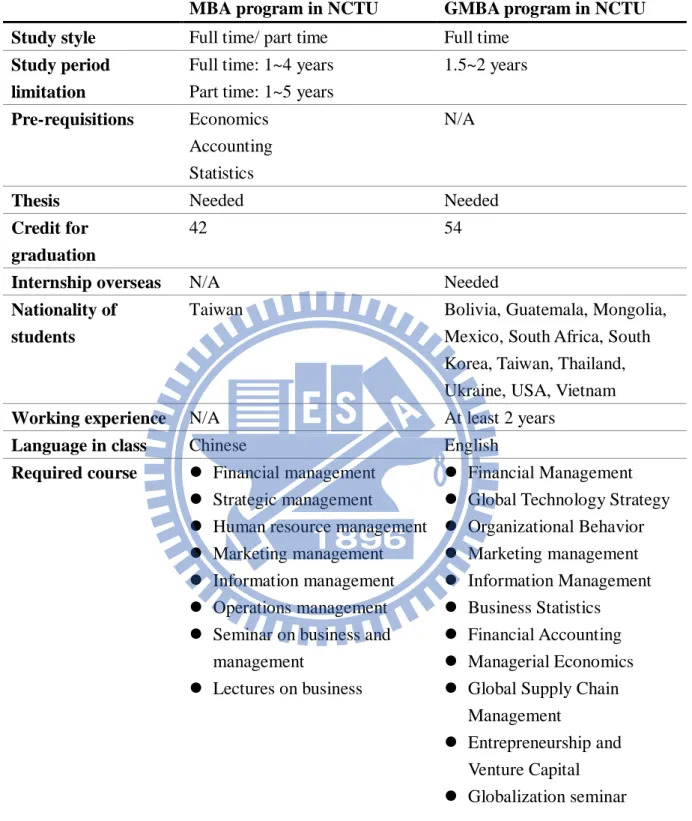
required (GMBA, 2005; GMBA, 2009). For comparing the difference between GMBA/IMBA and MBA programs in Taiwan, two kinds of programs in National Chiao Tung University is
taken for example as Table 3. The main differences between these two programs are the
pre-requisitions of economics, accounting and statistics or related courses in MBA, the higher
credit requirement in GMBA, internship requirement in GMBA, diverse nationalities of
students in GMBA, 2-year working experience needed in GMBA, and the whole courses in
14
Table 3 The comparison of MBA program and GMBA program in NCTU
MBA program in NCTU GMBA program in NCTU
Study style Full time/ part time Full time
Study period limitation
Full time: 1~4 years Part time: 1~5 years
1.5~2 years
Pre-requisitions Economics
Accounting Statistics
N/A
Thesis Needed Needed
Credit for graduation
42 54
Internship overseas N/A Needed
Nationality of students
Taiwan Bolivia, Guatemala, Mongolia, Mexico, South Africa, South Korea, Taiwan, Thailand, Ukraine, USA, Vietnam
Working experience N/A At least 2 years
Language in class Chinese English
Required course Financial management
Strategic management
Human resource management Marketing management Information management Operations management Seminar on business and
management
Lectures on business
Financial Management Global Technology Strategy Organizational Behavior Marketing management Information Management Business Statistics Financial Accounting Managerial Economics Global Supply Chain
Management
Entrepreneurship and Venture Capital Globalization seminar
Source: website of Institute of Business and Management of National Chiao Tung University and website of Global MBA of National Chiao Tung University (Institute of Business
15
2.2 The Demand of Global Managers
Today, organizations are on the increase challenged to coordinate business on a worldwide
scale, integrating activities that take place in different countries (Galbraith, 2000). As one of
American multinational CEOs, Edwin Artzt, Procter & Gamble's president, stated, every
business essentially in the U.S. was touched in some way by global competition (Gamble, 1990). “Globalization-whether at the level of the industry, business, or individual leader-is all
about overcoming national differences and embracing the best practices from around the
world” (Morrison, 2000).
To this purpose, organizations need global managers who have the ability to organize
functional domains on a global scale (Galbraith, 2000). Global managers need to understand the worldwide business environment from a global perspective, finding a balance between the
demands of both global integration and national responsiveness (Bartlett and Ghoshal, 1992; Pucik and Saba, 1998). In the study of Gregersen et al. (1998), it stated that most companies lack an adequate number of globally competent executives. Based on the result of their
three-year study with 130 executives in fifty firms across Europe, North America and Asia,
they found that almost all companies assert that they need more global leaders with higher
level and quality.
2.2.1 The Definition of Global Managers
Leaders today are no longer live in their own countries or work for their own countries.
With the development of global market to the transnational businesses, leaders in these
multinational businesses need to have connection with the world. By Cohen‟s (2008)
definition, global managers refer to leaders who work either outside their country of origin or
with others from outside their country of origin needs to demonstrate an effective blend of
16
from all over the globe.
Percy Barnevik, former CEO of Asea Brown Boveri, who defined global managers as
managers that have exceptionally open minds (Taylor, 1991). They respect how things are
different and can imagine why these things are different. Global managers are "incisive" as
well as generous and patient (Bartlett and Ghoshal, 1995).
Other research studies have defined global managers as "global brains". Actually, global
managers have the capacity to realize world trends as they affect business, governments, and
standards of competition. They understand their own roots; they are sensitive to global issues
and cultures, and they are adaptable to new things (Brake et al., 1995).
2.2.2 The Definition of Competency
The explanation from American Heritage (2000) identified the term competency as a
specific range of skill, knowledge or ability. In Pritchard‟s (1999) study, competencies were described as the knowledge, skills, abilities, personal characteristics and other person-based
factors that help distinguish outstanding performance from average performance. In
Stephenson„s (2007) study, competency was the capacity to function in a particular manner by
being adequately or well qualified with a specific range of skills or knowledge.
2.2.3 The Competencies of Global Managers
There is increasing evidence that large scale globalization is rendering traditional ways of
doing business largely irrelevant. It is a growing need for managers to become global
managers with a global perspective. For a company to become more global, its leaders must
develop competencies that go beyond what is familiar in the home country (Yamaguchi, 1998). In Staneck‟s (2000) study, it stated: “the market is now the world and managers within firms must have the competency to grapple with complex issues and possess the confidence to carry
17
consists of a global mindset supported by appropriate skills and knowledge.
Mainly, there are two different approaches of the competencies of leaders who effectively
direct operations that span a world of diverse cultures, capabilities, and customers (Morrison, 2000). The first approach is company-specific competency models. Morrison (2000) stated
that the multinational companies as diverse as IBM, AIG, Citibank, Black & Decker and
Deloitte & Touche have identified company-specific leadership attributes that apply around
the world by their long-term human resource management teams. However, there are two
problems: (1) the number of competencies indentified. For example, Chase Manhattan Bank
tracked almost 250 competencies while IBM‟s leadership model contains eleven; (2) the identification of characteristic that are not mutually exclusive and competencies that can be
assigned to multiple characteristics. The employees had poor acceptance of some leadership
models because of the complex combination and internal inconsistency. Besides, Morrison
(2000) also mentioned that some senior managers, with political pressure, would influence the
content of company-specific models and have an interest in defending and perpetuating their
own leadership approaches. Therefore, the second approach, academic global leadership
competency models, will be mainly discussed as the following.
Moran and Riesenberger (1994) surveyed 49 senior U.S. managers who were business
school‟s international advisory committee. They identified 12 different competencies, associated with implementing global strategies, which were organized around four
characteristics: attitudes, leadership, interaction, and cultural understanding. The three global
leadership competencies included the ability to (1) facilitate organizational change, (2) create
learning systems, and (3) motivate employees to excellence (Morrison, 2000). Rhinesmith (1996) structured the competencies of global leaders into three main
responsibilities: (1) strategy and structure, (2) corporate culture, and (3) people. There were
18
competition, two actions, drive and balance, and two mindsets, embrace both a global picture
and a balanced picture, within the responsibilities of strategy and structure.
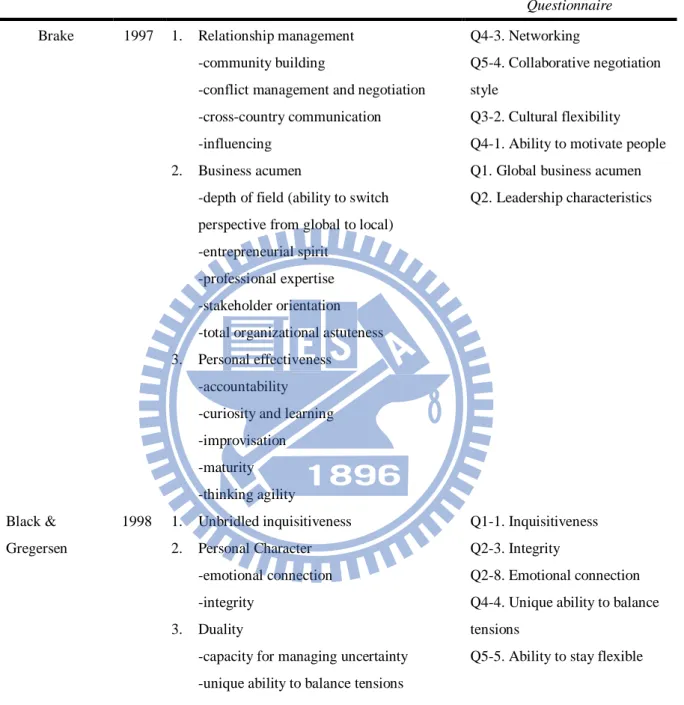
Brake (1997) developed the “global leadership triad,” a model of global leadership. The primary characteristics are: (1) relationship management, which has five components of
change agency, community building, conflict management and negotiation, cross-country
communication and influencing; (2) business acumen, which includes competencies of depth
of field (an ability to switch perspective from global to local), entrepreneurial spirit,
professional expertise, stakeholder orientation and total organizational astuteness; (3) personal
effectiveness, which includes accountability, curiosity and learning, improvisation, maturity
and thinking agility.
In Black and Gregersen‟s (1998) research, global managers must have: (1) unbridled inquisitiveness; (2) personal character, emotional connection and integrity; (3) duality,
capacity for managing uncertainty and unique ability to balance tensions. The attribute
pertaining to inquisitiveness is one of the striking differences between managers with national
characteristic and global managers. In their study, leaders have intelligence but are not all
necessarily inquisitive. Inquisitiveness supports behavior or values that include adventure,
curiosity, and open-mindedness. The emotional connection is a function with three steps.
Having a sincere interest in and concern for others is the first process. Second, do an effort to
really listen to people. Having an understanding of different viewpoints is the final one.
Integrity is described in terms of ethical behavior and loyalty to the company‟s values and
policy. In their study, global managers were most effective when they consistently maintained
the highest ethical standards in personal and company matters. A successfully global manager
has a capacity for managing in changing conditions. Besides, global managers must balance
various tensions while they encounter the pressures for both globalization and localization.
Finally, global managers need to be more savvy in both business and organizationally. Global
19
organizational savvy makes managers have intimate knowledge of their firms‟ capabilities
and their ability to assemble resources to apprehend market opportunities.
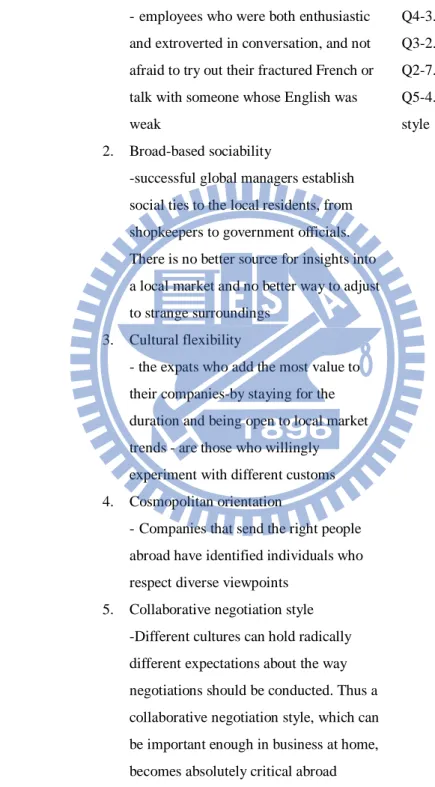
In Black and Gregersen‟s (1999) research, global managers must have the following
competencies: (1) drive to communicate (extroverted): A good global managers do not give
up having conversation with people while the situation is embarrassed; (2) broad-based
sociability: A successful global managers establish social network with local residents no
matter shopkeepers or government officials; (3) cultural flexibility: A good global manager is
willing to experiment with different customs and being open to local market trends; (4)
cosmopolitan orientation: A good manager respects diverse viewpoints and understand that
different cultural norms have value and meaning to those who practice them; and (5)
collaborative negotiation style: a good global managers can understand that different cultures
can hold basically different expectations of the conduct of negotiation and try to find best
solution for both side.
According to Adler and Bartholomew (1992), global managers need to know the
worldwide business environment from a global perspective, finding a balance between the
simultaneous demands of global integration and national responsiveness (Bartlett and Ghoshal,
1992; Pucik and Saba, 1998). Adler and Bartholomew (1992) suggest that global managers
must learn about many foreign cultures‟ perspectives, tastes, trends, technologies, and approaches to conducting business. Global managers need to be skillful at working with
people from many cultures simultaneously. In terms of cross-cultural skills, global managers
are expected to tread smoothly and expertly within and between cultures and countries on a
daily basis, whereas expatriate mangers focus on becoming an expert on one specific culture.
Global managers are expected to overcome an ethnocentric mindset and develop an openness
to and understanding of other perspectives, selectively incorporating foreign values and
practices into the global operations (Adler and Bartholomew, 1992).
20
for global managers. The International Labor Organization in U.S. (2004) found that 70% of
global business ventures worldwide failed due to intercultural differences. Therefore,
Sheridan developed the 7 “C‟s” of the cross-cultural adjustment (intercultural leadership competence): (1) capability: intercultural savvy team members; (2) care: concern beyond
bottom line;(3) connection: engaged connection with diverse cultures; (4) conscientiousness:
self-awareness of own culture background and bias; (5) context: situational perspective with
no judgment;(6) contrasts: cultural differences in leading and motivating followers; (7)
cultural immersion: lived experience in other cultures.
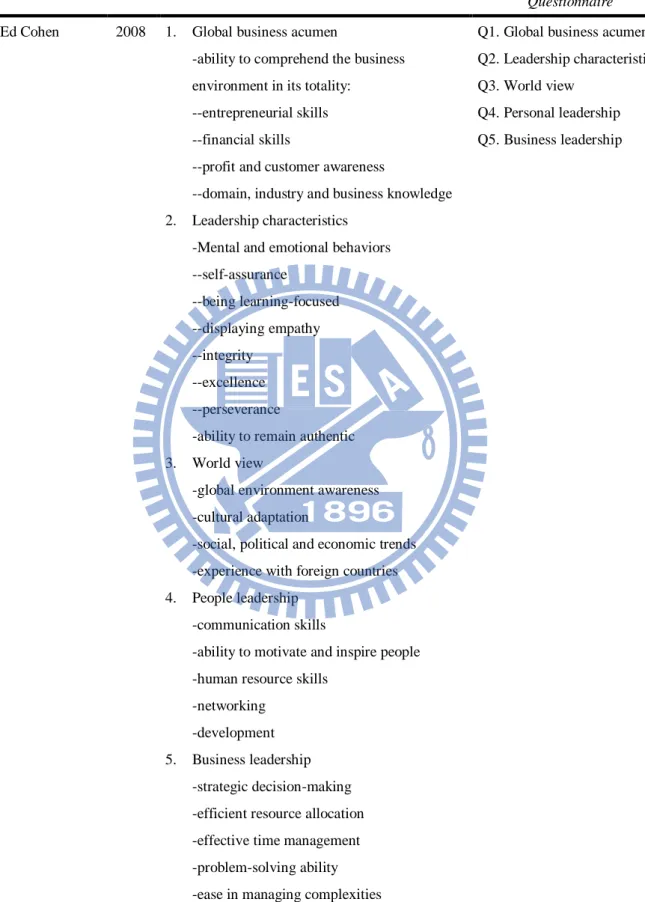
In the study of Cohen (2008), five characteristics of global managers were concerned: (1)
global business acumen, which includes the ability to comprehend the business environment
in its totality, entrepreneurial skills, financial skills, profit and customer awareness and
domain, industry and business knowledge; (2) leadership characteristics, which includes
mental and emotional behaviors, self-assurance, energy, enthusiasm, being learning-focused,
displaying empathy, common set of core values, integrity, excellence, respect, perseverance
and ability to remain authentic; (3) world view, which includes global environment awareness,
cultural adaptation, social, political and economic trends, other factors influenced world view
responses such as experience with foreign countries, organization size, etc.; (4) people
leadership, which includes communication skills, ability to motivate and inspire people,
human resource skills, networking and development; (5) business leadership, which includes
strategic decision-making, efficient resource allocation, effective time management,
problem-solving ability, ease in managing complexities and ability to stay flexible.
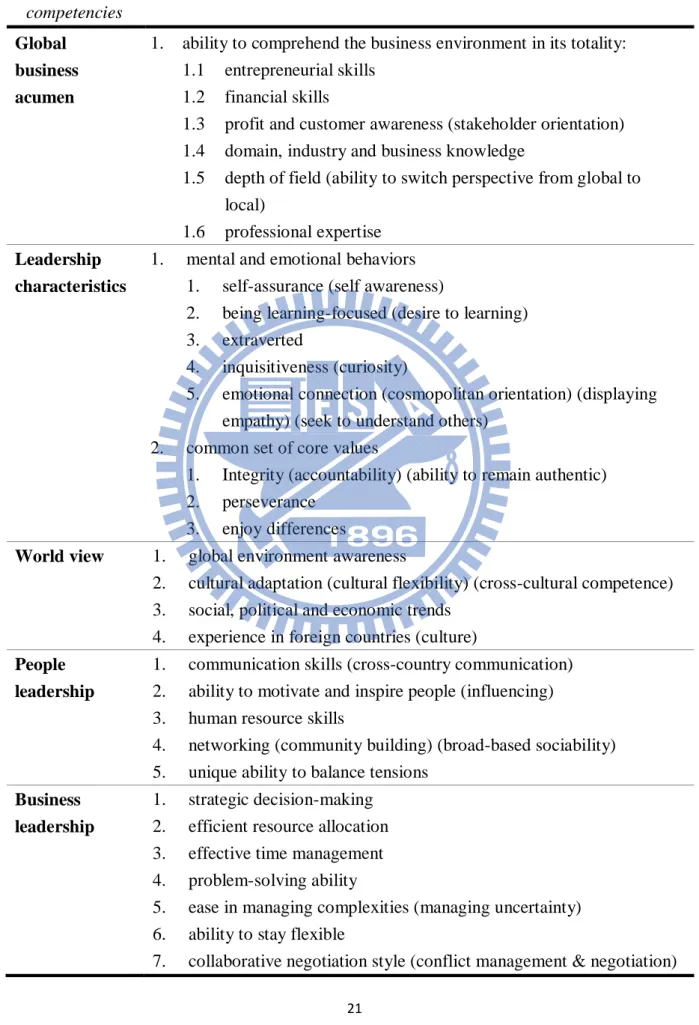
From the early academic researches until now, there are some similar competencies of
global managers in each study. To sum up, according to Cohen‟s (2008) study, the
21
Table 4 Combination of the competencies from different research
The main competencies Detail Global business acumen
1. ability to comprehend the business environment in its totality: 1.1 entrepreneurial skills
1.2 financial skills
1.3 profit and customer awareness (stakeholder orientation) 1.4 domain, industry and business knowledge
1.5 depth of field (ability to switch perspective from global to local)
1.6 professional expertise
Leadership characteristics
1. mental and emotional behaviors 1. self-assurance (self awareness)
2. being learning-focused (desire to learning) 3. extraverted
4. inquisitiveness (curiosity)
5. emotional connection (cosmopolitan orientation) (displaying empathy) (seek to understand others)
2. common set of core values
1. Integrity (accountability) (ability to remain authentic) 2. perseverance
3. enjoy differences
World view 1. global environment awareness
2. cultural adaptation (cultural flexibility) (cross-cultural competence) 3. social, political and economic trends
4. experience in foreign countries (culture)
People leadership
1. communication skills (cross-country communication) 2. ability to motivate and inspire people (influencing) 3. human resource skills
4. networking (community building) (broad-based sociability) 5. unique ability to balance tensions
Business leadership
1. strategic decision-making 2. efficient resource allocation 3. effective time management 4. problem-solving ability
5. ease in managing complexities (managing uncertainty) 6. ability to stay flexible
22
2.3 MBA Education for Global Managers
Many people perceive that having a MBA degree is as a passport to senior managerial roles
(Lucker, Bowers et al., 1989; Carnall, 1992; Baruch and Peiperl, 2000). Prospective students are typically considered acquiring managerial competencies quickly and efficiently and
improving career prospects (Baruch and Peiperl, 2000). Carnall (1992) indicated that having a MBA degree is recognized as a „ticket‟ not only to increase salary, enhanced career process,
advanced knowledge and skills, but sometimes as a prerequisite for joining upper managerial
ranks. Therefore, some researchers studied on whether having a MBA will provide the
competencies needed for managers in organizational settings or having a MBA will enhance
performances as a manager (Baruch and Peiperl, 2000; Baruch and Leeming, 2001). In the previous part, the competencies of global managers are concluded and summarized
into five characteristics. The first one is the competency of global business acumen, which is
the ability to comprehend the business environment in its totality. Rhinesmith (1996)
suggested that global managers need to have both knowledgeable and analytical
characteristics, and the mindsets to embrace both a global picture and a balanced picture as
what Brake (1997) stated in the part of business acumen, which mentioned about the ability to
switch perspective from global to local as the depth of field. Brake (1997) also suggested
global managers should have entrepreneurial spirit, professional expertise, stakeholder
orientation as well as Cohen (2008) referred to profit and customer awareness, and total
organizational astuteness. Cohen (2008) considered global managers should have domain,
industry and business knowledge, and financial skills are requested. To sum up, a MBA
graduate is assumed to have the competencies of global business acumen. Therefore, the
hypothesis is proposed as the following:
23
The second is the competency of leadership characteristics, which includes the mental and
emotional behaviors and the common set of core values. Moran and Riesenberger (1994)
stated that global managers should have the attitudes of facilitating organizational change, and
creating learning systems. In Brake‟s (1997) study, personal effectiveness is important for
global managers, such as accountability, curiosity and learning, and improvisation. Black and
Gregersen (1998) suggested that the unbridled inquisitiveness was important as well as
personal characters as integrity and emotional connection, which was the same as the
characters of cosmopolitan orientation in their later study. Black and Gregersen (1999)
pointed out the drive to communicate, the same as extroverted attitude, was important for
global managers. Cohen (2008) emphasized on mental and emotional behaviors,
self-assurance, and so on. To sum up, a MBA graduate is assumed to have the competencies
of leadership characteristics after the training of MBA programs. Therefore, the hypothesis is
proposed as the following:
H2: MBA students have more leadership characteristics than non-MBA students.
The third is the competency of world view, which is the global perspective. According to
Moran and Riesenberger (1994), cultural understanding was one of the important
characteristics of global managers. Brake (1997) also mentioned about cross-country
communication in the part of relationship management. Black and Gregersen (1999)
suggested that cultural flexibility was one of keys to become a global manager. Cohen (2008),
furthermore, composed the characteristic of world view with not only cultural adaptation but
also experiences with foreign countries, global environment awareness and world trends. To
sum up, a MBA is assumed to have the competencies of world view after the training of MBA
programs. Therefore, the hypothesis is proposed as the following:
24
Furthermore, GMBA/IMBA students differ from MBA students with cross-cultural
environment, internship training, whole English courses and diverse nationalities of students.
Therefore, the hypothesis is proposed as the following:
H3-2: GMBA/IMBA students have more cross-cultural adjustment than non-GMBA students.
The fourth is the competency of people leadership skills, which is the competency to work
with people. In Rhinesmith‟s (1996) study, the action of drive and balance was mentioned.
Brake (1997) suggested the relationship management included community building,
cross-country communication, and influencing, which was the same as the ability to motivate
and inspire people in Cohen‟s (2008) study. Black and Gregersen (1998) mentioned the
unique ability to balance tensions in the part of Duality. To sum up, a MBA is assumed to
have the competencies of people leadership after the training of MBA programs. Therefore,
the hypothesis is proposed as the following:
H4: MBA students have more people leadership skills than non-MBA students.
The final one is the competency of business leadership skills, which is the competency to
work within the organization. Rhinesmith (1996) mentioned about the corporate culture.
Brake (1997) suggested the conflict management and negotiation, which was similar with the
collaborative negotiation style in Black and Gregersen‟s (1999) study. Black and Gregersen (1998) mentioned the capacity for managing uncertainty as well as the ease in managing
complexities in Cohen‟s (2008) study. Besides, Cohen (2008) also suggested several
characteristics such as strategic decision-making, efficient resource allocation, and so on. To
sum up, a MBA graduate is assumed to have the competencies of business leadership after the
training of MBA programs. Therefore, the hypothesis is proposed as the following:
25
Chapter 3 Research Methodology
3.1 Introduction
The purpose of this quantitative study is to identify that a sample of MBA students, a
sample of GMBA/IMBA students, and a sample of other business-majored students
considered as: (1) they have the competency of global business acumen as a global manager;
(2) they have the competency of leadership characteristics as a global manager; (3) they have
the competency of world view as a global manager; (4) they have the competency of personal
leadership as a global manager; (5) they have the competency of business leadership as a
global manager; (6) they have the competency of cross-cultural adjustment as a global
manager.
This chapter describes the research design of the study, the study participants, the data
26
3.2 Research Design
This quantitative research is to collect quantitative data, which makes the researcher
determine the relationship between different majors and the competencies of global managers
and the statistical difference among three majors, which are MBA students, GMBA/IMBA
students, and other business majors as the independent variables. According to the framework
of research, there are five characteristics of the competencies of global managers: global
business acumen, leadership characteristics, world view, personal leadership, and business
leadership. Among each characteristic, there are correlated competencies such as the
entrepreneurial skills and the financial skills for the global business acumen, and the resource
allocation and problem-solving ability for the business leadership, etc. as the dependent
variables in a population. This research employs the questionnaire which developed by the
researcher and it is a quantitative method of research. Quantitative research methods are
considered acceptable when the researcher is attempting to identify relationships or specific
factors that affects situational outcomes (Creswell, 2003). The results are analyzed using accepted statistical procedure to compare the results.
3.2.1 Sampling Design
The main subjects of this research are MBA students and GMBA/IMBA students in
Taiwan, and other business-majored students as the comparison. In Taiwan, however, there
are 105 universities in Taiwan so far (Ministry of Education, 2010). Therefore, business departments of seven universities (see Appendix 1) were chosen to send the e-mail with the
link of the online survey based on their membership or the accreditation of AACSB, and also
based on their academic reputation in Taiwan. Besides, all of these schools have established
Global MBA or International MBA in their business departments. There are totally
27
3.2.2 Questionnaire Design
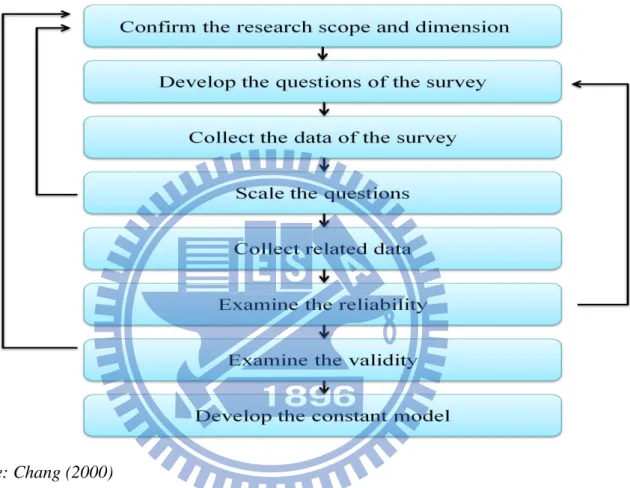
The questionnaire is used for research analysis in this study. The developing procedure of
the questionnaire is referred to the research method which Chang (2002) suggested as the
following (see figure 2):
Figure 2 The procedure of developing the survey
Source: Chang (2000)
According to Chang (1997), the research scope and dimension could be confirmed by the
literature review. In this research, therefore, it is concluded the related studies and used
Cohen‟s (2008) study as the base to construct the proper variables and research dimensions. The survey questions could be developed by the literature review, empirical study, and
group-focused interview (Chang, 1997). Thus, the related studies were referred and developed the questionnaire according to the literature review. Besides, Chang (1997) mentioned that the
reliability could be examined by Cronbach‟s α value; or the confirmation of dimensions and deletion of questions could be examined by the factor analysis. After collecting the data,
28
therefore, the quality of the survey is improved by deleting or modifying the questions
through the analysis of reliability and validity. In this study, after examining the reliability
and validity, the quality of the survey is proved without deleting or modifying any question.
Because the participants are from Taiwan and international countries, the survey question
is created both in English and Chinese and list side by side. There are two parts of the survey.
The first part is the questions designed by the different variables. Each question is developed
by clear and easily-understood words for respondents. There are totally thirty questions in the
first parts, which including five characteristics of competencies: global business acumen,
leadership characteristics, world view, personal leadership, and business leadership, according
to Cohen‟s (2008) construct of the competencies of global managers. (See detail in Table 5).
Table 5 Related studies and corresponded variables in questionnaire
Author Year Statement of competencies of global managers Variables/factors in Questionnaire
Moran and Riesenberger
1994 1. Attitudes
-facilitate organizational change -create learning systems
-motivate employees to excellence 2. Leadership
3. Interaction
4. Cultural understanding
Q2-2. Being learning-focused Q4-1. Ability to motivate people Q5-5. Ability to stay flexible Q4-2. Communication skills Q3-2. Cultural adaptation (cultural flexibility)
Q2. Leadership characteristics Rhinesmith 1996 1. Strategy and structure
-characteristics: knowledgeable and analytical
-skills: manage both in complexity and competition
-actions: drive and balance
-mindsets: embrace both a global picture and a balanced picture
2. Corporate culture 3. People
Q1-5. Professional expertise Q5-1. Ease in managing complexities
Q4-4. Unique ability to balance tensions
Q2-1. Inquisitiveness Q1-6. Depth of field Q4. Personal leadership Q5. Business leadership
29
Table 5 Related studies and corresponded variables in questionnaire (Continue)
Author Year Statement of competencies of global managers Variables/factors in Questionnaire
Brake 1997 1. Relationship management -community building
-conflict management and negotiation -cross-country communication -influencing
2. Business acumen
-depth of field (ability to switch perspective from global to local) -entrepreneurial spirit
-professional expertise -stakeholder orientation -total organizational astuteness 3. Personal effectiveness
-accountability -curiosity and learning -improvisation -maturity -thinking agility Q4-3. Networking Q5-4. Collaborative negotiation style Q3-2. Cultural flexibility Q4-1. Ability to motivate people Q1. Global business acumen Q2. Leadership characteristics Black & Gregersen 1998 1. Unbridled inquisitiveness 2. Personal Character -emotional connection -integrity 3. Duality
-capacity for managing uncertainty -unique ability to balance tensions
Q1-1. Inquisitiveness Q2-3. Integrity
Q2-8. Emotional connection Q4-4. Unique ability to balance tensions
30
Table 5 Related studies and corresponded variables in questionnaire (Continue)
Author Year Statement of competencies of global managers Variables/factors in Questionnaire
Black & Gregersen
1999 1. Drive to communicate (extroverted) -employees who were both enthusiastic and extroverted in conversation, and not afraid to try out their fractured French or talk with someone whose English was weak
2. Broad-based sociability
-successful global managers establish social ties to the local residents, from shopkeepers to government officials. There is no better source for insights into a local market and no better way to adjust to strange surroundings
3. Cultural flexibility
- the expats who add the most value to their companies-by staying for the duration and being open to local market trends - are those who willingly experiment with different customs 4. Cosmopolitan orientation
-Companies that send the right people abroad have identified individuals who respect diverse viewpoints
5. Collaborative negotiation style -Different cultures can hold radically different expectations about the way negotiations should be conducted. Thus a collaborative negotiation style, which can be important enough in business at home, becomes absolutely critical abroad
Q2-5. extroverted Q4-3. Broad-based sociability Q3-2. Cultural flexibility Q2-7. Emotional connection Q5-4. Collaborative negotiation style
31
Table 5 Related studies and corresponded variables in questionnaire (Continue)
Author Year Statement of competencies of global managers Variables/factors in Questionnaire
Ed Cohen 2008 1. Global business acumen
-ability to comprehend the business environment in its totality:
--entrepreneurial skills --financial skills
--profit and customer awareness
--domain, industry and business knowledge 2. Leadership characteristics
-Mental and emotional behaviors --self-assurance --being learning-focused --displaying empathy --integrity --excellence --perseverance
-ability to remain authentic 3. World view
-global environment awareness -cultural adaptation
-social, political and economic trends -experience with foreign countries 4. People leadership
-communication skills
-ability to motivate and inspire people -human resource skills
-networking -development 5. Business leadership
-strategic decision-making -efficient resource allocation -effective time management -problem-solving ability -ease in managing complexities -ability to stay flexible
Q1. Global business acumen Q2. Leadership characteristics Q3. World view
Q4. Personal leadership Q5. Business leadership
32
The 5-point Likert item, strongly disagree, disagree, neutral, agree, and strongly agree, is
taken, and the score is from 1 to 5. The questions and corresponded variables are as the
following:
Q1. Global Business Acumen (according to related studies from Rhinesmith (1996), Brake
(1997), Cohan (2008)):
1. I have developed the skills of entrepreneurship. (entrepreneurship skills)
2. I can read the financial statements (such as income statement, cash flow and balance
sheet) of a company. (financial skills)
3. I have developed the basic knowledge of different industries. (domain, industry and business knowledge)
4. I know the importance of the company profit and customer. (profit and customer awareness)
5. I have developed professional knowledge/expertise. (professional expertise) 6. I have confident to hold both global and local perspective. (depth of field)
Q2. Leadership Characteristics (according to related studies from Riesenberger (1994),
Brake (1997), Gregersen (1998), Black and Gregersen (1999), and Cohan (2008)):
1. I become more curious in life. (inquisitiveness)
2. The training of my program inspires me to keep learning. (being learning-focused)
3. I know the importance of honesty and reliability. (integrity)
4. The training of my program let me know the importance of keeping moving toward my
goals without quitting. (perseverance)
5. I become a more outgoing person. (extraverted)
6. I feel comfortable facing changes in life. (enjoy difference)
7. I try to understand other people‟s viewpoints. (emotional connection)
33
Q3. World View (according to related studies from Riesenberger (1994), Brake (1997), Black
and Gregersen (1999), and Cohen (2008)):
1. I know the global environment, especially in business world. (global environment
awareness)
2. I become easier to adapt diverse cultures. (cultural flexibility)
3. My program encourages me to experiment with different customs. (experience in foreign
countries/culture)
4. I always notice the news of world trends. (social, political and economic trends)
Q4. Personal Leadership (according to Rhinesmith‟s (1996), Brake (1997), Black and
Gregersen (1998), and Cohen (2008)):
1. I am more willing to inspire people. (ability to motivate and inspire people)
2. I have improved my communication skills. (communication skills)
3. I know how to make friends and build relationships with others efficiently. (networking)
4. I become more capable of coping with stress. (unique ability to balance tensions)
5. I try to listen to people sincerely. (human resource skills)
Q5. Business Leadership (according to Rhinesmith (1996), Brake (1997), Black and
Gregersen (1998), Black and Gregersen‟s (1999), and Cohen (2008)):
1. I am able to manage multiple tasks at the same time. (ease in managing complexities)
2. I know how to manage my time more effectively. (effective time management)
3. I know how to allocate resources more efficiently. (efficient resource allocation)
4. I try to find a win-win solution while negotiation. (collaborative negotiation style)
5. I can handle the change in my work or study with flexibility. (ability to stay flexible)
6. I know how to make decisions strategically. (strategic decision-making)
34
The second is questions about participants‟ background and in-class situations. The
questions are as the following:
1. Gender.
2. Age.
3. Your major/program.
4. How many courses do you usually have to do a project with students/people from different
countries in your program/department per sesmester? (cross-cultural adjustment)
5. How many times do you usually join activities with international classmates/students per
month? (cross-cultural adjustment)
6. How many years of working experiences do you have before enrolling into this school?
7. How many languages do you speak except your mother tongue?
8. Are you a Taiwanese?
9. If you are not a Taiwanese, where do you come from?
35
3.3 Data Collection
3.3.1 Pilot Study
Because the survey is made by the researcher, the primary examination is taken for
verifying the accuracy of question design.
Ten people (6 male and 4 female) who were Global MBA students in National Chiao Tung
University participated the pilot study. Six of them were from Taiwan, one from South Africa,
one from Ukraine, one from United States, and one from Guatemala. They got the e-mail with
the website-link of the survey and were asked to provide the feedback on June 22th in 2010.
All the feedback was collected before June 23th in 2010. According to the feedbacks, there
were some ambiguous choices or conflict of the design of survey. Therefore, the questionnaire
was modified for clearly understanding and answering. For example, in the demography part,
the last two questions asked about the nationality. The first one asked if the respondents were
a Taiwanese or not. If the respondents chose “No,” then they should move to the final question: “where do you come from?” In original design, however, two questions were the
required questions. No matter the respondents answer “Yes” or “No” in the first question, they have to answer the second one. The result would be ambiguous. Therefore, the final
question was changed into optional question. Besides, one response was as the following:
…… I noticed that even though you asked if I was Taiwanese or not, the questions seemed to be targeted toward Taiwanese students; for example, “how many projects do you work with foreigners per semester?” and “how many times / month do you socialize with foreigners per month?” I am a foreigner so this is a strange question to ask……
Therefore, the word “foreigners” was replaced with “international students” in those two questions.
3.3.2 Formal Study
This survey was delivered online with the website called mySurvey. Forty-seven graduate
36
survey. All of these graduate schools belong to business departments. The Appendix 1 lists
these graduate schools in detail. The business departments of seven universities are informed
by sending the e-mail on June 23th in 2010. The phone contact was made after sending the
e-mail of the link of the survey online. After one week on July 1st in 2010, the reminder of
e-mail was sent for raising the response rate of the survey. The online survey ran for a period
of 30 days until July 24th in 2010. There were totally 311 respondents who completed the
online survey. However, there were only 222 responses available in this study because the
study sampling was focused on only three majors/programs: GMBA/IMBA (74 respondents),
37
3.4 Data Analysis Procedure
First, the quality of the measurement scales should be examined. Therefore, the internal
consistency reliability assessment would be conducted by the reliability analysis. The
construct validity of the measurement scales for the elements of five characteristics of global
managers should also be examined. Thus, Confirmatory Factor Analysis would be used.
Multivariate analysis of variance (MANOVA) would be used to compare the five
characteristics across the three different majors of graduates. When significant differences
revealed in the MANOVA results, a post hoc analysis was used by Tukey‟s HSD (Honestly
significant Difference) test which would compare the means of each characteristic to the
means of each other characteristic. Meanwhile, the test would apply the set of all pair-wise
comparisons of means to identify the differences.
This research uses the statistic-analysis software SPSS 17.0 (Statistical Products and
Services Solution) and Mplus 6.0 to analyze the data. Mplus is used for Confirmatory Factor
Analysis of validity.SPSS is used for reliability analysis, descriptive analysis, and
MANOVA.
Figure 3 The flow of statistic method used in the study
Reliability Analysis
Validity Analysis
Multivariate Analysis
Post Hoc Analysis
Cronbach's Alpha Value by SPSS 17.0
Zero-Order Correlations by SPSS 17.0 Exploratory Factor Analysis by SPSS 17.0 Confirmaroty Factor Analysis by Mplus 6.0
MANOVA by SPSS 17.0 ANOVA by SPSS 17.0