行政院國家科學委員會專題研究計畫 成果報告
台灣智慧資本整合型研究--國家智慧資本初探與智慧資本
之動態分析(2/2)
研究成果報告(完整版)
計 畫 類 別 : 整合型 計 畫 編 號 : NSC 95-2416-H-004-013-SSS 執 行 期 間 : 95 年 08 月 01 日至 97 年 04 月 30 日 執 行 單 位 : 國立政治大學企業管理學系 計 畫 主 持 人 : 林月雲 共 同 主 持 人 : 莊奕琦 計畫參與人員: 碩士級-專任助理:林德怡 報 告 附 件 : 出席國際會議研究心得報告及發表論文 處 理 方 式 : 本計畫可公開查詢中 華 民 國 96 年 11 月 15 日
行政院國家科學委員會補助專題研究計畫
■ 成 果 報 告
□期中進度報告
台灣智慧資本整合型研究
“I
nt
e
l
l
e
c
t
ua
l
Ca
pi
t
a
l
”integrated project summary
計畫類別:□ 個別型計畫
■ 整合型計畫
執行期間:
94
年
8
月
1
日至
96
年
7
月
31
日
子計畫:
計 畫 項 目
主持人
計畫名稱
總計畫&子計畫一 林月雲
國家智慧資本初探與智慧資本之動態分析
子計畫二
陳世哲
人力資源策略、人力資本、員工行為與績效之研
究
子計畫三
許壹傑
組織知識管理模型之建構
–人力資本之觀點
子計畫四
方世榮
行銷資本模式之建構
子計畫五
羅家德
關係資本的衡量以及其對發明資本的影響
子計畫六
張元杰 智慧資本的衡量與報告: 跨國比較研究
子計畫七
彭朱如
醫療產業智慧資本之鑲鉗、管理及績效
子計畫八
陳端容 醫療產業智慧資本、組織學習與臨床治理之研究
子計畫九
楊朝旭
高階管理團隊社會資本與研發生產力
子計畫十
蘇桓彥
/方世杰
策略性觀點之智慧資本發展與企業競爭優勢關聯
性的研究
子計畫十一
郭文忠
無形資本、資產定價及公司融資決策
中
華
民
國
96
年
11
月
7
日
Two-year (August 2005 –
Jul
y
2007)
“I
nt
e
l
l
e
c
t
ual
Capi
t
al
”
integrated project summary
Prepared by Yeh-Yun Lin, National Chengchi University November 2007
It has been my honor to serve as the project leaderofthis“IntellectualCapital”integrated project with a total of 10 members (one member transferred to China and discontinued the project) covering the period from August 1, 2005 to July 31, 2007. The ten professors in various disciplines are from ten different universities in different cities. However, the geographical distance from Taipei to Kaohsiung did not hamper the gatherings of this research community. During the past two years, we had two total-group meetings chaired by the project leader each semester and some sub-group (strategy and HR groups) meetings chaired by the sub-group leader generally before the total-group meeting.
This integrated project was organized under a strong mission to explore this new field of research from various disciplines in different universities in order to reap inter-disciplinary insights, inter-university collaboration, and increase Taiwanese scholars’ exposure in the international academicarena.With themembers’consensus,when we submitted theproposalsat2004 year end, wehaveattached an “exitmechanism”to thisprojectin orderto prompta higherself-expectation for academic publication. Now, we are proud to say that we have achieved and exceeded our original publication goals within two short years. We believe that more publications will follow in the coming years based on this two-year project.
In addition, this research community has been expanded to a larger group along the way with interested professors joining the conversation that we have to officially split them into strategy and HR two groups for more effective communication in the just started second stage three-year integrated “Intellectual Capital”project. Our past effort is only the advent of this field of study in Taiwan, therefore we are glad to see more scholars joining in. My overall summary of this integrated project contains the following sections:
I. Academic research performance of each project member II. Scope and research focus of each individual project III. Contribution of this integrated project
IV. Brief summary of each individual project
V. Publication list of each project member pertaining to this 2-year project
I. Academic research performance of each project member (as of Oct. 31, 2007)
Project #
Journal paper published
Journal paper under review or revision
Conference
paper Working paper
-#2 1 - 1 -#3 - - 2 3 #4 - - 2 -#6 2 2 4 2 #7 1 2 3 -#8 2 - 1 -#9 2 - 4 -#10 1 1 1 -#11 - - 1 3 Total
12
(two joint papers)
6
25
(for reference only)
The above table tallies the publications of this integrated project as of October 31, 2007. On an average, each member has 1.2 published or accepted journal papers and 2.5 conference papers. Generally speaking, our members have pretty good international exposures with papers mainly published in international journals and presented in international conferences. However, I have to make a special remark here that at the present time most of our journal papers are not published in the highly ranked journals for the reason that this is a new field still not fully recognized by the mainstream management scholars. Yet, some of them have been accepted by the field specific journal “Journal of Intellectual Capital” with the indication that research results of Taiwanese intellectual capital scholars have gained acknowledgement of pertinent international experts. In addition, with the ambition and commitment of our members, better quality journal papers and more joint papers can be anticipated.
II. Scope and research focus of each individual project
Project
# Micro Macro
#1
Dynamics among human capital, organizational capital,
and social capital
(area of focus: general management, conceptual)
National Intellectual Capital Index (NICI)
ranking of 40 countries spanning from 1994 –2005 (area of focus: national level, database)
#2
The relationship between human capital (through HR practices) and job performance is contingent on employee commitment and employee-employer perception
consistency
(area of focus: OB/HR, empirical)
mediate the relationship between intellectual capital and firm dynamic capabilities
(area of focus: general management, empirical)
#4
Developed a framework and measurement of internal
market capital, external market capital, and interactive market capital
(area of focus: marketing, conceptual)
#6
-Measure and report
intellectual capital of
Panama and Danish top 20 listed companies
(area of focus: general management, national level, case study)
#7
Developed intellectual capital (58 questions) and performance (23 questions) measurement for a survey in the healthcare industry; examine intellectual capital
transfer between and among partner hospitals
(area of focus: general management, empirical)
#8
Human capital (education and accreditation) was found to
be associated with the acceptance of new hospital management practices.
(area of focus: general management, empirical)
#9
Developed quantifiable and linked-to-performance indicators of R&D management capability in discovery, implementation, and commercialization stages; investigate whether financial analysts play a significant role in
augmenting market efficiency by explaining intellectual
capital information (R&D management capability)
correctly.
(area of focus: accounting, database empirical)
#10
Intellectual capital reporting enhanced the partnership
among 4 key customers, case company, and 5 key suppliers.
(area of focus: general management, case study)
#11
Established a framework of asset prices including
intangible capital and then empirically examine how
intangible capital affects asset prices and financial performance; investigate how technology innovation and
and then explore the association between intellectual capitaland analysts’recommendation
(area of focus: finance, database empirical)
This integrated project covers both micro and macro perspective studies. In the micro level, there are six general management studies, two accounting/finance studies, one human resource management study, and one marketing study. Research approach contains four empirical studies, three database empirical studies, two conceptual studies, and two case studies.
III. Contribution of this integrated project
Since Edvinsson and Malone’s book was published in 1997, the concept of intellectual capital has been swiftly adopted by both academia and practitioners. Although the importance of “intangible assets”has long been recognized, it has never been articulated well enough to be included in the formal financial report. Professor Edvinsson is the first person to operationalize intellectual capital by using his own working experience and observation in Skandia Insurance Company in Sweden. That is, the concept was formalized from real-life business experience rather than from theory development. As a result, at its inception, there was no distinctive theory adhered to it. Up to the present, relevant researchers need to borrow theories from other disciplines, such as economics and sociology, which also explains why this field of study has not yet been fully recognized.
During the past ten years, relevant research has been centered on intellectual capital measurement development and reporting mainly initiated by accounting and finance professors. Recently, management professors join in the conversation by integrating human resources management perspective to cover human capital, strategic management perspective to cover organizational capital, and social network and marketing perspectives to cover social capital. Our project member selection was based on this domain integration. With two years dedication, most of our members have developed their own intellectual capital framework and some even progressed to measurement development. The synergy achieved includes peer review and idea contribution to improve the quality of each research, broader perspective with inputs from the viewpoint of different disciplines, and joint research.
Basically, the first contribution of this integrated project is establishing a comfortable community climate and laying a nurturing research ground for members to freely interact for more future intellectual dialogues. Second, research results of Taiwanese intellectual capital scholars have been recognized through our international journal papers and international conference presentations. Third, the unexpected contribution to the academic reputation of Taiwan is our strong alliance with some heavy-weight field experts. Professor Tzu-Ju Peng (Project #7) has joint papers with Professor Roos in the United Kingdom, Professor Yuan-Chieh Chang (Project #5) has
joint papers with Professor Mouritsen in Denmark, and Professor Yeh-Yun Lin (Project #1) has joint papers with Professor Edvinsson in Sweden. Partnership with these intellectual capital gurus has raised the profile of our research community in the international arena. Fourth, the added value of this integrated project is the international collaboration opportunities through sending members to overseas partners and the international conference encounters as evidenced in our publication list.
Our project members have just started to patch an intellectual capital puzzle from various perspectives and have not yet achieved theory integration during the two short years, yet we are confident that the research foundation that has been laid will lead to more cross-fertilization in this increasingly accepted research field.
IV. Brief summary of each individual project
Project#1 “An Exploratory Study of National Intellectual Capital Index and the
DynamicsofOrganizationalIntellectualCapital”
Yeh-Yun Lin
1. First Year –National level Intellectual Capital Index (NICI) research result summary:
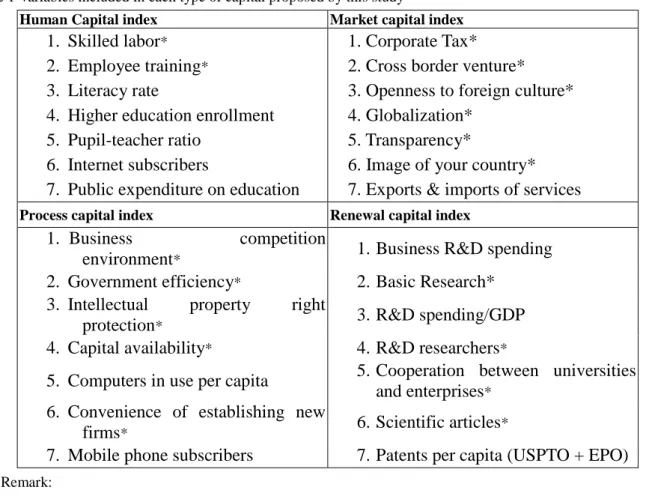
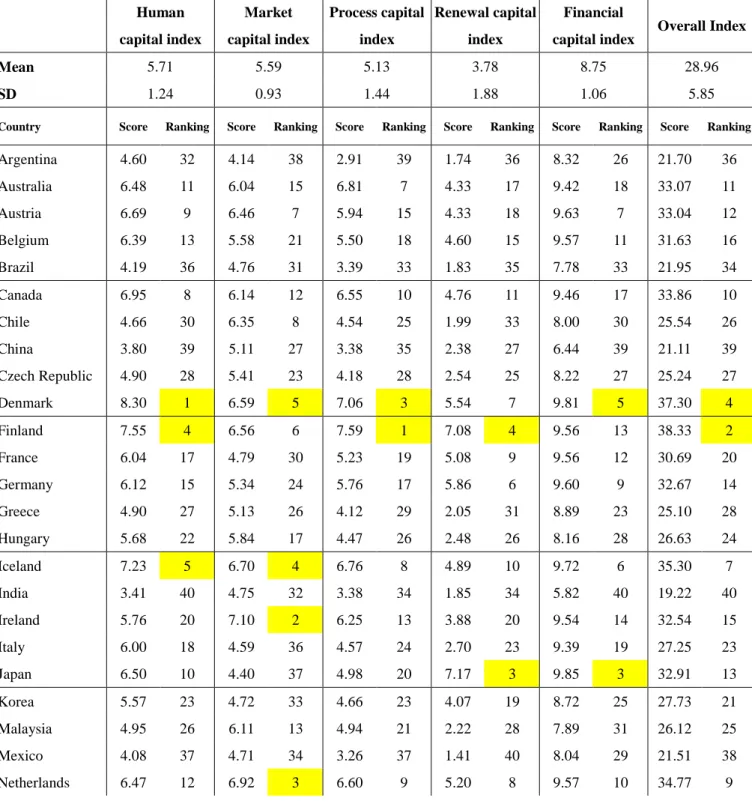
Based on extensive literature reviews of past relevant studies, a national level intellectual capital index framework was developed covering five capital dimensions, namely human capital, market capital, process capital, renewal capital, and financial capital. Based on literature and the results of several rounds of focus group discussion, a total of 29 variables were selected to represent the NICI; that is, seven each for human capital, market capital, process capital, renewal capital, and a single variable (GDP per capita adjusted by ppp) for financial capital. With a set of 12-year panel data covering 1994 –2005 from OECD and IMD databank, an overall NICI for a total of 40 countries was ranked. Among which, Taiwan ranked number 17 in the list, with a descending order of renewal capital (#12), human capital (#14), process capital (#16), market capital (#18), and financial capital (#22). In other words, Taiwan has a pretty good performance with respect to renewal and innovation. The developed framework is valid as the ranking has a good correlation (.83) with that of IMD country competitiveness ranking. For this project performance, several papers based on this NICI framework have been accepted for publication in international journals as well as conferences.
2. Second Year –Organizational level intellectual capital dynamics research result summary: The second year project focused on the dynamics of the components of intellectual capital at the organizational level, namely human capital, organizational capital, and social capital. In
addition to the literal description about the interdependence and the dynamics among the three capitals, the following portfolio with six systems of dynamic configurations for a company to effectively utilize its intellectual capital for better organizational performance was developed.
System congruence with dynamic configurations of human capital, organizational capital, and social capital
Six systems
Configuration (for easier ratio presentation, total 12 points
are utilized ) HC : OC : SC Positive/ Negative effect Growth Paths I. Structural leverage system 2-3 : 4-6 : 4-6 + I.->II.->(IV,V,VI)->IIx2
II. Rational balance
system 4 : 4 : 4 +
II.->(IV,V,VI)->IIx2
III. Human facilitating
system 3-5 : 2-3 : 5-6 +
III->
II.->(IV,V,VI)->IIx2 IV. Bureaucratic system 1-4 : 5-7 : 3-6
-V. Human control system 5-7 : 1-4 : 3-6 -VI. Incompetent organizational system 1-4 : 1-4 : 7-8
-Remark: HC=human capital, OC=organizational capital, SC=social capital
Project #2 ”人力資源策略、人力資本、員工行為與績效之研究”
Shyh-jer Chen
This two-year study of intellectual capital has two purposes. First, I explore the black box concept by testing the mediating effects of employee commitment on their perception of HR practices and their job performance. This exploration is an attempt to advance strategic HRM knowledge and to develop a multilevel HR-performance framework bridging organizational (HR practices) and individual (organizational commitment and job performance) perspectives. Second, I attempt to measure consistency in perception of HR practices by using to questionnaires to find outhow closely theemployees’and employers’perceptionsofHR practicesagreewith each other. This study hopes to contribute further understandings of the relationship between HRM (especially human capital) and firm performance.
human resource practices on firm performance (Arthur, 1992; 1994; Delery & Dotty, 1996 Huselid, 1995; Huselid, Jackson & Schuler, 1997; MacDuffie, 1995; Wright & McMahan, 1992). The theoretical background connecting HR practices and firm performance is mainly resource-based and rooted in the belief that a firms gain competitive advantage by developing a set of rare, valuable, inimitable, and non-substitutable human resources (Barney, 1991; Wright & McMahan, 1992). In strategic HRM, most studies have found that high-involvement work system, including extensive use of selection mechanism, in-house training, job enrichment, pay for performance and employee empowerment, have a positive impact on firm performance, measured by various indicators such as turnover (Shaw, Delery & Gupta, 1998; Batt, 2002; Huselid, 1995), financial performance (Huselid, 1995), and employee productivity (Huselid, 1995, Huselid, Jackson & Schuler, 1997).
Most studies of the HR-firm performance relationship have focused on analysis at the organization level. Although the relationship between high-involvement work system and firm performance has been reported to be positive, some critics had suggested that there may not be a direct effect between the two, but rather a “causal gap”, as Wright & Boswell (2002) have described,alessexplored “black box”or“specificmechanism”within theorganization,itself, where the two can interact. Guest (1998) proposed a psychological contract model and posited that HR practices create an atmosphere of fairness and trust in employment relationship. The fairness and trust further foster employee organizational commitment, job satisfaction, organizational citizenship behavior, and reduce employee intention to quit. Becker & Huselid (1998) specified a causal model which included employee behavior and strategic implementation as mediating variables between high-involvement work system and employee job performance. The perspective of“black box”or“specificmechanism”in HR-firm performance relationship implies a multilevel framework (Kozloswski & Klein, 2000) in which organizational (e.g., HR practices) and individual (e.g., employee organizational commitment) factors function together to affect firm performance.
HR strategy can be viewed as a social exchange and communications between employers and employees (Rousseau, 1995). The communications create a workplace atmosphere that affects employee organizational commitment and job performance. Basing their ideas on the situationism defined by Lewin, Pippit & White, Bowen and Ostroff (2004) introduced the concept of “strength ofHR system.” In thatstudy,they stated thatemployeeperceptionsofHR practices would influence their commitment and accumulation of human capital, and in turn affect employee job performance.Oneimportantaspectrelated to strength ofHR system is“consistency,”here referring to the extent to which HR message can be encoded and interpreted uniformly among employees and employers. Ostroff and Bowen (2000) indicated that HR consistency may moderate the relationship between employee perceptions of HR practices and employee commitment.
This study has two purposes. First, it explores the black box concept by testing the mediating effects of employee commitment on their perception of HR practices and their job performance. This exploration is an attempt to advance strategic HRM knowledge and to develop a multilevel HR-performance framework bridging organizational (HR practices) and individual (organizational
commitment and job performance) perspectives. Second, we attempt to measure consistency in perception ofHR practicesby using to questionnairesto find outhow closely theemployees’and employers’perceptionsofHR practicesagreewith each other.
Two studies were conducted in hair salons in Taiwan. The first study, a preliminary study, was performed to develop and validate the construct of HR practices. The second study was to test our hypotheses, which are described in the next section. Data were collected by questionnaire from both hair salon owners and hairdressers of somewhat small independent salons. We excluded chain stores from our analysis because differentiating HR practices among stores belonging to the same chain is difficult. While most studies focused on HR systems in manufacturing (e.g. Arthur, 1992; 1994; Delaney & Huselid, 1995; Delery & Doty, 1996 Huselid, 1995), few have focused on the service sector. In fact, because service is more related to work attitude, HR quality should affect competitive advantage more in the service industry than in the manufacturing industry. We found the more consistent the perception of HR practices between hairdressers and owners, the greater the employee affective commitment to organization, emphasizing the value of HR practices in communicating clear and direct signals to employees regarding norms and expectations.
Project #3 “Toward a Model of Organizational Knowledge Management – A Human CapitalPerspective”
I-Chieh Hsu
This research seeks to investigate how intellectual capital and organizational knowledge management processes contribute to dynamic capabilities of the firm. To facilitate this investigation, a survey methodology was adopted. The sample for this study was 1466 public-listed companies obtained from the Market Observation Post System in 2006 maintained by the Taiwan Stock Exchange Inc., Taiwan. A total of 533 effective questionnaires were collected from 533 companies, representing a response rate of 36.4%. The investigation has produced findings that have theoretical and practical implications. The following two papers have been drafted with Prof. Rajiv Sabherwal (University of Missouri Curators Professor, College of Business School, University of Missouri at St. Louis) with each having its theoretical and practical contributions. The abstracts of the two papers capture the contributions of this research.
1. Capabilities for Knowledge Enhancement and Knowledge Utilization: Relationships with Dynamic Capabilities and Human, Social, and Organizational Capital
Abstract. Despite considerable theoretical development and empirical research, two important issues remained unanswered: the causal mechanism by which organizational knowledge contributes to firm competitiveness and the antecedent for the accumulation and development of organizational knowledge. Thus, a comprehensive understanding of the source of firm competitiveness still remains elusive. This study proposes and tests a model of organizational
knowledge enhancement and utilization that takes into account intellectual capital as an umbrella term for differing types of organizational knowledge, dynamic capabilities as a construct for firm competitiveness in uncertain environments, and knowledge culture as the antecedent that facilitates the accumulation and development of organizational knowledge. In this model, knowledge enhancement capabilities and utilization capabilities mediate the relationship between intellectual capital and dynamic capabilities of the firm. To test the model, questionnaires obtained from 533 public-listed companies in Taiwan and secondary data for these companies were collected. The theoretical model is generally supported. Dynamic capabilities are also demonstrated to lead to high firm performance. However, the test of the theoretical model has led to an emergent model that presents better statistical results. This study sheds light on the roles of knowledge culture in accumulating and developing intellectual capital, and underlines the importance of human capital, social capital, knowledge enhancement capabilities, and knowledge utilization capabilities in improving dynamic capabilities of the firm.
2. Intellectual Capital and Knowledge Management: An Empirical Study of their Bi-directional Relationship and Effects on Dynamic Capabilities
Abstract. Despite considerable theoretical development and empirical research, three
important issues remained unanswered: the relative importance of knowledge management and intellectual capital in determining dynamic capabilities, the relationship between knowledge management processes and intellectual capital, and the role of organizational culture in facilitating the development of intellectual capital. This study has proposed and tested a comprehensive model of dynamic capabilities to address these three issues. To test the model, questionnaires obtained from 533 public-listed companies in Taiwan and secondary data for these companies were collected. Major findings include the following: Intellectual capital has been found to affect both knowledge management processes and dynamic capabilities, which have been found to affect firm performance through innovation outcomes. Organizational culture (knowledge culture) has been found to facilitate the development of intellectual capital. However, the test of the theoretical model has led to an emergent model that presents better statistical results. This study sheds lights on inconsistent theoretical perspectives and inconsistent findings from parallel lines of enquiries. Our findings have both theoretical and practical implications.
Project#4 “行銷資本模式之建構”
方世榮
The value on the business market mainly comes from financial capital and intellectual capital; however, firms focus on the intangible asset rather than on the tangible asset in the knowledge-based market. Therefore, the exploration of the intellectual capital has been the important issues either in the academic or practical field. According to the resource-based view, intangible assets and organizational competence are the most unique and causal ambiguity
resources and the source of the competitive advantages (Mahoney, 1995). It is important for firms to search the intangible asset and organizational competence which could facilitate creation of the value. This value coming from the intangible assets is the concept of the intellectual capital.
In the filed of marketing, the marketing concepts can be applied to the service industry that is intangible in nature, and its subject even include internal customers (i.e., employees). Grönroos (1996) had provided the concept of the service marketing triangle which is composed of firms, employees and customers. It emphasized that marketing activities not only focused on the external customers (i.e., external marketing) but inside customers (i.e., internal marketing). Besides, employees and customers can interact well (i.e., interactive marketing). In addition, Grönroos (1996) suggested that the resources, used to resolve customers’problem, must create perfect service quality and value. Therefore, the marketing capital can be viewed as non-imitative and intangible assets, and can be a sustainable competitive advantage of the firms.
This study explores the concept of marketing capital and the relationship of the marketing capital and marketing performance. In the concept of the marketing capital, we used the internal marketing capital, interactive marketing and external marketing capital as the components of the marketing capital. The empirical results are consistent with our hypothesis; hence, the purposes of this research have been achieved. In addition, since little attention has connected the concept of intellectual capital and marketing, we provide a full model after exploring the intellectual capital, knowledge-based concept, resource-based views and relationship marketing. We use multidimensional constructs to measure marketing capital and explore the key components of marketing capital, which facilitate the research of marketing capital in the future. For example, future studies can examine, first, the relationships between internal marketing, interactive marketing and external marketing. Second, these interactive relationships impact on the marketing capital. Third, marketing capital and other capital, such as structural capital, simultaneously influence on the organizational capability.
In the practical contribution, we develop the scale of marketing capital. It is helpful for marketing managers that the scale can be used to measure the marketing capital of firms. Besides, marketing manager can confirm the advantages and disadvantages in marketing and understand which resources should be emphasized. Marketing managers can also establish a proper marketing strategy and accumulate marketing capital. In the end, they can achieve the marketing goals and improve the marketing performance.
Project #6 “Intellectual Capital Measuring and Reporting: A Comparative Study”
Yuan-Chieh Chang
The study was devoted in “Intellectual Capital (IC) Measuring and Reporting: A Comparative Study”during the period from August 1st, 2005 and July 31st2007. The frameworks, methods of IC reporting in Denmark, Sweden, Finland and Netherlands were comparative. In the rise of
knowledge-based economy, the intellectual capital has become one of sources of competitive advantages for nations. The study mainly focused to measure and report intellectual capital in macro-environments such as regions, cities, communities and nations in the first year. We also investigated the possibilities of measuring the intellectual capital of nations in the developing countries, especially in Panama. We mainly investigated the intellectual reporting in the companies in the second year. One of research interests is to investigate what and how intellectual capital reporting in Danish top 20 companies, Taiwanese corporate R&D centers and Taiwanese IPO prospectuses. So the study advanced the understanding of IC reporting both in nations and in firms across Denmark and Taiwan.
Project #7 “Intellectual Capital Embeddedness, Management, and Performance: Hospital-level and Alliance-level Analysis in Healthcare Industry”
Tzu-Ju Peng
Although the Intellectual Capital Perspective has been widely applied to research in knowledge-intensive industry, less attention has been paid to the healthcare sector. Prior research pertaining to intellectual capital focus more on individual level or firm level analysis, this 2-year study is conducted by firm level as well as by alliance level, exploring the intellectual capital management and performance at both levels. The 1st-year study was based on intellectual capital perspective and performance measurement, examining the IC elements, IC importance, and performance measurement in Taiwan healthcare industry. The 2nd-year study was based on intellectual capital perspective with strategic alliance perspective, examining IC transformation between and among alliance partners within a healthcare alliance. In the 1st-year study, we conducted a survey from 104 hospitals. Statistical analysis has revealed the detailed elements of healthcare intellectual capital and the performance indicators. In the 2nd-year study, by using ICN (Intellectual Capital Navigator) as an analytical approach, we examined the IC transformation within a healthcare alliance, which is composed of 18 public hospitals. This study is expected to be a starting point of exploring healthcare intellectual capital in the Taiwanese healthcare industry. The report of this 2-year study includes the execution and results in the first and second years, and publications of this study.
1. The 1st-year study
This study used a development process that employs a set of procedures. In the first stage, we developed a preliminary check-list with detailed elements of healthcare intellectual capital and performance measurement. These items were derived from both the literature and healthcare practices in Taiwan. In the second stage, the preliminary check-list was refined by expert opinions. Five experts were consulted. From the expert-refined check-list a preliminary questionnaire was developed with each item. In the third stage, we conducted a pilot study with 30 senior managers.
We analyzed the data from pilot study and deleted some items. The final questionnaire contains 58 elements of intellectual capital comprised of 7 elements of human capital, 31 elements of organizational capital, and 20 elements of relational capital; and 23 performance indicators comprised of 5 indicators of income and growth, 4 indicators of cost control, 5 indicators of operation efficiency, 4 indicators of productivity, and 5 indicators of clinical and medical quality. In the fourth stage, we conducted a survey from the population of the 590 hospitals; of these 113 hospitals responded with 104 valid samples, including 10 medical centers, 37 regional hospitals, and 57 district hospitals, representing a valid response rate of 17.63%. In the fifth stage, we performed a reliability test and analyzed relative importance of those elements. According to the reliability test and factor analysis, the intellectual capital resources were categorized into human capital, organizational capital, and relational capital. Organizational capital was further divided into four groups: healthcare service and quality capital, strategic management capital, marketing capital, and information technology capital. Performance indicators were divided into five groups: income and growth, cost control, operation efficiency, productivity, and clinical and medical quality.
In this study, we have identified critical intellectual capital elements and performance measurement that are regarded as important for IC management practices in the Taiwanese healthcare industry. The results of intellectual capital and performance measurement in three different hospital accreditation level and all samples were revealed. This study also reveals the resource transformation data. The major contribution of this study is to figure out how healthcare executives can prioritize an array of critical intellectual capital and performance measurements. This study also demonstrated how the resources transformation between and among themselves. We adopt intellectual capital perspective as our theoretical base which is international. This study contributes to more valuable practical references of performance management in Taiwan healthcare organizations.
2. The 2nd-year study
The source of healthcare competitive advantages lies not only on monetary capital and physical assets but also on human capital, organizational capital, and interorganizational cooperative relationships. Current research pertaining to intellectual capital mainly focuses on individual-level and firm-level analysis, however, less attention has been paid to alliance-level analysis. Linking an intellectual capital perspective with a strategic alliance concept, this research explores how hospitals in a healthcare alliance transfer intellectual capital between and among partner hospitals.
This study selected and healthcare alliance, which is composed of 18 government-owned hospitals, as a research setting. In particular, this study examined the intellectual capital transformation in joint-logistic activities of the alliance. Conducting by an in-depth case study, we interviewed 14 informants from member hospitals in the alliance who are directors of logistic management and are responsible for join-logistic management activities in the alliance.
The joint-logistic intellectual capital is categorized in five groups: human capital, organizational capital, relational capital, monetary capital, and physical capital. Each group is composed of detailed intellectual capital elements. Based on an analytical approach, the ICN (Intellectual Capital Navigator) developed by Roos, Pike and Fernström (2005), this study has identified the importance of each detailed element of joint-logistic intellectual capital. More importantly, this study has demonstrated the ICN and Effector Plot to address the inward and outward transformations among partner hospitals. According to the results, this study provides practical implications as well as suggestions for future research, which contributes to healthcare managers for managing intellectual capital hospital at the alliance-level.
Project #8 “醫療產業智慧資本、組織學習與臨床治理之研究” 陳端容
My main purpose in the 2-year IC project is to understand whether highly dominant professionals as physicians can change their professional practices. If we were able to understand how their medical practice changes are possible, then we may be a step further to understand better how professionals can adopt management innovation. The purpose of this two-year project is to understand the factors associated with how medical professionals dealt with new hospital management practices, and how they adapt to it. We took this as an example to look into the mechanism associated with how professionals changed their professional practices. Using the data collected from 1,137 physicians, this study will be able to explore the characteristics associated with the acceptance of new hospital management practices, and whether their attitude toward new hospital management practices were associated with their perceived professional autonomy, learning behaviors and mode of decision making. In this study, we found that new hospital management practices to control medical practices such as use of information feedback mechanisms, restriction of medical resources utilization and setting medical use quota were only adopted by some hospitals. Half of the hospitals did not use strong medical intervention to control medical practices with respects to their utilization of medical resources. Human capital is found to be associated with the acceptance of new hospital management practices. Physicians with a learning behavior toward peer-oriented decision making, tended to decline the new hospital management practices. Physicians with a self-oriented learning for evidence-based literature also tended to decline the new hospital management practices. Learning behaviors are important for us to understand the mechanisms underlying the changing process of physicians’adaptation of new hospital management practices. It suggests that to better understand how innovation will be adopted in hospital, attention should be directed to the process of how different medical professionals (i.e., physicians) learn to recognize the innovations.
With the preliminary results from this 2-year project, we may be able to understand how professionals change their professional practices. As professions claims their practices are their
jurisdiction, how their medical practices and perceived autonomy being changed can lead us to understand how intellectual capital will be maintained and modified in the organizational context.
Using the coming 3 year project, the project is aimed to get to the core of the creation process of medical knowledge creation. We tend to understand how medical knowledge creation is processed in the interplay with professionals, health care organizations, and academia.
Project #9 “IntellectualCapital Information and Analysts’Forecasts: The Value Chain Perspective”
Chaur-Shiuh Young
1. First year
Intangible assets are substantially more difficult to manage and operate than tangible assets. Now the key point is not the quantities of intangibles an organization owns but the effectiveness of intangibles an organization uses. In fact, the major limitation on the use and growth of intangibles is managerial diseconomies. Investors and often managers too, are deprived of intangibles-related information on essential business capabilities and performance characteristics. Bukh (2003) argued that, for intellectual capital disclosure to be perceived as relevant from a capital market perspective, the information should be disclosed as an integral part of a framework illuminating the value creation processes of the firm. Bukh (2003)’s argument is very similar to Lev (2001)’s value chain framework for information system. In this project, I develop quantifiable and linked-to-performance indicators of R&D knowledge management capability based on Lev’s(2001) R&D value chain framework, which covers three major stages: discovery, implementation, and commercialization. Three indicators are used to measure the R&D knowledge-nourishing,
transforming and appropriating capabilities in various value chain stages. Further, I empirically validate these measures proposed in this study by examining their effects on the future R&D productivity. It is documented that the proposed measures of R&D management capability have significantly positiveeffectson firms’futurerealized salesand grossmarginsfrom investing in R&D. Hence, this study suggests that the measures of R&D management capability contain useful information aboutfirms’valuecreation potential from the R&D investments in various value chain stages.
This is the first study, from an innovation value chain perspective, to develop quantitative and easy-to-useindicesindicating afirm’sknowledge managementcapabilitiesin R&D.Further,this capability indicator is decomposed as three measures, which enable the investors and managers to visualize the intellectual ability of managing R&D in a stage-oriented view. Thus, this study provides important academic and practical value. The value chain indicatorsofmanagers’R&D
knowledge management capabilities, developed in this current study, can arguably provide a platform for managers to examineafirm’sR&D strengthsand weaknessesin differentinnovation value chain stages and to identify the areas requiring more attention as they strive for R&D excellence. Also, improved disclosure of the R&D knowledge management capabilities based on the value chain perspective may provide lucid value creation storylines for communicating with market actors, which improvesinvestors’assessmentoftheR&D performanceand firm value. 2. Second year
Analysts’forecast information may fulfill a role in compensating for the intangibles-related deficiencies of corporate financial statements (via correctly explanations for IC information). This rolestemsfrom analysts’ability to usetheirindividual(private)knowledgeto produceforecasts that contain new analyst-specific information or interpretations about IC information. However, currently, there is only limited research-based insight into how this reading and interpretation are conducted. Seeing that we know little about the use of forward-looking IC information by investors and analysts, I investigate how analysts interpret these “intellectual capital information” in the second year of this project. Specifically, I examine whether market participants, i.e., investors and analysts, incorporate the implications of managers’R&D knowledge management capability indicators for future earnings in an efficient manner when determining stock prices and earnings forecasts. In addition, I investigate whether analysts play a significant role in augmenting market efficiency by explaining intellectual capital information correctly.
The results indicate that R&D is assessed at a significantly higher value by both investors and analysts when a firm had a better R&D knowledge management capability. As to the issue of market inefficiency, though important for understanding users’ processing of nonfinancial information, has not been extensively examined by prior studies. My results indicate that, despite the ready availability and high reliability of R&D management capability measures, investors and analysts seem to under-react to the implication of some indicatorforfirms’futureprofitability, suggesting that the knowledge management nature of R&D management information may hinder users’processing ofthisinformation.The result of investors underestimating the true contribution of R&D knowledge management capability to future profits provides evidence for supporting disclosures of the R&D knowledge management capability indicators, meaningfully classified by the stage of value chain. Additionally, the documented market under-reaction to R&D management capability measures is an interesting contrast to the result of Rajgopal, Shevlin, and Venkatachalam (2003) that the stock market overweights the contribution of order backlog in predicting future earnings. Investigation of why investors exhibit different biases in processing dollar-denominated versus nondollar-denominated information is beyond the scope of this study and can be an interesting topic for future research.
Project #10 “Intellectualcapitalforthedevelopmentofcorporate competitive advantage in Taiwan: A strategic view”
Hwan-Yann Su and Shih-Chieh Fang
This study is concerned with the implementation of partnership enhancement within a business-to-business context. Forming partnerships with suppliers and customers to leverage their own resources and attain competitive advantage has become more and more important for the growth of businesses. Although in the business-to-business environment, the benefits for businesses to improve partnerships have been highly emphasized, little guidance has been provided regarding how to enhance their partnerships in practice. Based on the literature of business-to-business partnerships, this study adopts intellectual capital reporting as a way to enable the reporting of knowledge resources of a business of concern in order to honestly and confidently communicate with its partners and enhance partnerships.
The case study approach, using the guidelines of Yin (1993), was adopted as the research method in this study because of the dynamics inherent in implementation, our objective to provide a comprehensive picture of the process, and because single-case study can be used for exploration as well as explanation and illustration (Hakim, 1992; Yin, 1993). Therefore, a case study demonstrating and explaining how to report intellectual capital is detailed.
The case company is a multinational business which has established global operations in Taiwan, USA, Turkey, Thailand and China. The case company is in the fastener industry in which its hundreds of thousands of products are used in many industries for many purposes. Limited by facilities, size and manufacturing capability, a single manufacturer needs partnerships with other manufacturers to satisfy the full lines of products required by customers. From the perspective of customers, they have to manage a group of suppliers to fully satisfy their needs and this cost is high. Consequently, to manage suppliers and to offer one-stop shopping services for its customers, the case company aims to be the customer channel to OEM components and to play the major role of integrator and logistics service provider between customers and suppliers in the Asia-Pacific region. Therefore, due to its target role between its customers and suppliers, the case company was very suitable for addressing the issue of implementing business-to-business partnership enhancement. Four key customers and five key suppliers of the case company were selected by its CEO for partnership enhancement and for seeing things from their perspective due to their important high volume transactions. The four customers selected were all multinational companies. Among them, three were general distributors of fasteners and one was a fastener distributor specializing in the automobile industry. All four customers had an office in Taiwan. The five suppliers were all located in Taiwan. One was a manufacturer of nuts; one a manufacturer of screws and bolts; and three of them were specialized processing services providers of surface processing, anti-loosing and leaking processing, and stamping and welding processing.
The results of this study are the proposition of an approach of intellectual capital reporting for businesses to implement partnership enhancement in the business-to-business context and the provision a case study which demonstrates and explains how it operates. When reporting intellectual capital, the focal business should identify knowledge resources needed to achieve its vision and create its value, report current status of the needed knowledge resources under its particular context and compare numerical data from different fiscal years. To use intellectual capital reporting in the context of enhancing business-to-business partnership, the proposed approach particularly emphasizes the importance of honestly and confidently enabling partners of the focal business to better understand its professionalism concerning many aspects of its business in four steps. The first step is concerned with identifying partners' received value and their information needs. The second step is to incorporate partners'received valuewith thebusiness’ proposed value. In step three, the focal business prepares and reviews the information concerning knowledge resources to be reported. The final step is to communicate with partners through the report. The case company demonstrates that partnerships can be enhanced and partners are more satisfied with their partnerships, and are more willing to continue this relationship and feel further that it is more honest, trustworthy, and professional through intellectual capital reporting. It also demonstrates intellectual capital reporting can show its willingness to honestly face its own situation, keep important indicators on track and to provide additional and sometimes confidential information to support a strategy of signifying its honesty, sincerity and confidence in its professionalism.
Project#11 “無形資本、資產定價及公司融資決策”
郭文忠
The object of this research is to examine the association between intellectual capital and capital markets. In a knowledge-based economy, traditional measures of financial performance often fail to capture the wealth-creation effects of intangibles and to fully understand the competitive advantage of fast growth firms such as software developments companies, pharmaceutical companies and others. While an increasing literature recently describes the role intangible capital in managing the companies and other organizations in the modern economy, there is still a lack of a generally accepted approach for valuing intangible capital, especially for those intangible capitals not associated with intellectual property right.
This research aims to discuss the influence of intangible capital in the capital markets. It includes three parts. In the first part I attempt to establish a framework of asset prices including intangible capital and further examine empirically how intangible capitals may affect asset prices and financial performance. It finds that firms with more balance sheet intangibles, bonus and salary would have better accounting performance, with the exception when we consider the change in sales.
In the second part it also further how technology innovation, human capital and human capital affect market and accounting performance of 279 listed biotech firms. Our main results are summarized as follows. (1) The influence of intangible capital on asset prices depends on the effect of intangible capital on the production, sales, profits, market opinion and risk. (2) Empirically the result does not find consistent effect of intangible asset on the financial and market performance, but it suggests positive effect of human capital on financial and market performance. (3) For the biotech companies, it finds that human capital also affects the amount of patents, but research inputs may either affect negatively or not affect financial performance.
In the third part it examines the association between intellectual capital and analysts’ recommendation and observes that the announcement effects are most observed before and at the eventdate.Fortheshortterm,oursampledemonstratesthatanalysts’recommendationsappearto have an impact on stock prices, with -1.5% abnormal return on the event date. I also demonstrates that“marketleadership” hasthelargestimpactson accumulativereturns-7.6%. Furthermore, the influences of expected revenue (profit) change and leadership and personnel matters also found in our sample.
V. Publication list of each project member pertaining to this 2-year project
國科會 2005-2007「台灣智慧資本整合型研究」研究員論文發表狀況 As of Oct. 31, 2007 計 畫 項 目 主 持 人 服務 機構 計畫名稱 本整合型計畫論文發表狀況 總計 畫& 子計 畫一 林 月 雲 政大 企管 國家智慧資 本初探與智 慧資本之動 態分析 I. Journal paper:1. Lin, Y.Y. & Edvinsson, L. (2008) National intellectual capital: Comparison of the Nordic Countries, Journal of
Intellectual Capital, 9(4),
2. Chen, D.R. & Lin, Y.Y. (accepted) Physician’s Career Success: Educational Stratification or Inequality in Social Capital (管理學報)
3. Lin, Y.Y. and Lin, T.Y. (2007) National intellectual capital: Exploring Taiwan’s standing, International Journal of
Learning and Intellectual Capital Special Issue, 4(2)
II. Journal paper under revison:
1. 李怡禛、林月雲,從 Hofstede 國家文化觀點看國家智慧資 本之創造(journal paper, under first revision)
III. Conference paper:
1. Lin, Y.Y. & Edvinsson, L. National intellectual capital: Comparison of the BRIC Countries, to be presented in
McMaster World Congress, Hamilton, Ontario, Canada,
January 16-18, 2008
2. Lin, Y.Y. (2007) Intellectual capital: A comparison of seven European countries, presented at Intellectual Capital Congress 2007, May 3-4, in Haarlem, Netherlands.
3. 林月雲(2006) 從智慧資本的觀點探討中華文化之加值者
-「得意典藏」,第十二屆服務管理研討會,國立政治大學
企業管理學系,(Dec. 15/16, 2006)
4. Lin, Y.Y. and Lin, T.Y. (2006) National intellectual capital: A comparison of the Nordic countries, presented on Dec. 9 at 2006 科管年會
5. Lin, Y.Y. and Wei, Y.C. (2006) Environmental pressure and organizational decline: The moderating effects of human capital and social capital, presented on Dec. 19-21, 2006 at Asian Academy of Management, Waseda University, Japan.
6. Lin, Y.Y. and Lee, I.C. (2006). National intellectual capital: A comparison of Japan, Korea and Taiwan, presented on Dec. 19-21, 2006 at Asian Academy of Management, Waseda University, Japan. 子計 畫二 陳 世 哲 中山 人管 人力資源策 略、人力資 本、員工行 為與績效之 研究 I. Journal paper:
1. Chen, Shyh-jer, Lin, Pei-fen, Lu, Chia-mei, & Tsao, Chiung-wen. 2007. The Moderation Effect of HR Consistency on the Relationship between Perceived HR Practices and Employee Job Performance. Social Behavior
and Personality. 35(8): 1121-1138. (SSCI)
II. Conference paper:
1. Chen, Shyh-jer, Lin, Pei-fen, and Lu, Chia-mei. 2006. A Multilevel Analysis of HR Practices and Employee Job Performance: Hairdressing Salon in Taiwan. Paper presented at the European Academy of Management Meeting, May 17-20, Oslo, Norway. 子計 畫三 許 壹 傑 彰師 大企 管 組織知識管 理模型之建 構 –人力 資本之觀點 I. Conference paper: 1. 許壹傑、鍾慧婷. 2005. 組織知識管理對組織績效之影 響 –以人力資本為中介變數. 台灣商管與資訊研討會, 2005 年 9 月 29、30 日, 靜宜大學, 台灣。
2. Hsu, I.-C. 2005. Developing a model of knowledge
management from a human capital perspective –Preliminary thoughts. Paper Presented at the 2005 Annual Meeting of the
Academy of Management, Aug. 5-10. Honolulu, Hawaii, U.S.
II. Working paper:
1. Hsu, I.-C., & Sabherwal, R. 200X. Intellectual capital and knowledge management: An empirical study of their bi-directional relationship and effects on dynamic capabilities.
2. Hsu, I.-C., & Sabherwal, R. 200X. Capabilities for knowledge enhancement and knowledge utilization: Relationships with dynamic capabilities and human, social, and organizational capital.
3. Hsu, I.-C. 200X. Developing a model of knowledge management from a human capital perspective –Preliminary thoughts. 子計 畫四 方 世 中興 企管 行銷資本模 式之建構 I. Conference paper:
榮 1. 方世榮、黃瓊瑤、石渼華(2006),智慧資本觀點之行銷
資本建立,第四屆跨領域管理學術與實務研討會,東海大 學。
2. Fang, Shgh-Rong, Building the Model of Marketing Capital: Based on Intelliectual Capital Perspective, The R&D Management conference 2006 Taiwan.
子計 畫五 羅 家 德 元智 企管 關係資本的 衡量以及其 對發明資本 的影響
(transferred to China and discontinued the project)
子計 畫六 張 元 杰 清大 科管 智 慧 資 本 的 衡 量 與 報告: 跨國 比較研究 I. Journal paper:
1. Chen, M.-H., Wang, M. & Chang, Y.-C. (2007). Entrepreneurial Networks in Technology-Based Entrepreneurial Teams: A Social Capital Perspective, 科技管 理學刊, Vol. 12 (3), pp. 107-130
2. Chen, M.-H., Chang, Y.-C. & Hung, S. (2007). Social Capital and Creativity in R&D project teams, R&D Management, (accepted in 15 Oct. 2007) [SSCI].
II. Journal paper under review:
1. Chang, Y.-C. and Kan, C., Measuring and reporting national intellectual capital: a study of Panama, Journal of Intellectual Capital (under review).
2. 張元杰& 鄭翔壬, Intellectual Capital disclosure: the study of IPO prospectuses in Taiwan, 組織與管理 (under review).
III. Conference paper:
1. 張元杰& 鄭翔壬 (2007), Intellectual Capital disclosure: the study of IPO prospectuses in Taiwan, TAoM 2007:全球化之 管理挑戰,九月八日,台北:政治大學.
2. 張元杰&余佩儒 (2007), Measuring R&D capabilities: the intellectual capital perspective, TAoM 2007:全球化之管理 挑戰,九月八日,台北:政治大學.
3. Chang, Y-C. and Kan, C. (2007) Measuring and reporting national intellectual capital: a study of Panama, IC Congress 2007, 3~4th May 2007, Inholland University, Haarlem, the Netherlands.
4. Chang, Y-C., Mouritsen, J. and Malmjer, P. (2007), Mandatory intellectual capital reporting: a study of top Danish public-listed firms, IC Congress 2007, 3~4th May
2007, Inholland University, Haarlem, the Netherlands.
IV. Working paper:
1. Chang, Y-C., Mouritsen, J. and Malmjer, P. (2007), Intellectual capital reporting: Towards a knowledge narrative framework, Economy & Society [SSCI] (under submission). 2. Chang, Y.-C., Yu, P., Measuring R&D capabilities: the
intellectual capital perspective, IEEE Transactions on Engineering Management (under submission) [SSCI]
子計 畫七 彭 朱 如 靜宜 企管 醫療產業智 慧資本之鑲 鉗、管理及 績效 I. Journal paper:
1. Peng, Tzu-Ju Ann, Stephen Pike and Göran Roos (2007), “Intellectual capital and performance indicators: Taiwanese healthcaresector,”Journal of Intellectual Capital, 8(3), pp.
538-556.
II. Journal paper under review:
1. Pike, Stephen, Tzu-Ju Ann Peng, and Göran Roos, “Managing intellectual capital and performance: The Taiwanesehealthcareindustry”,under1streview,submitted abstract on 14th May 2007, submitted full paper on 30th Sep. 2007.
2. Peng, Tzu-Ju Ann, Johnson Chung-Hsin Yang, Stephen Pike, and Göran Roos,“IntellectualCapitals,Businessmodelsand PerformanceMeasurementsin Forming Strategic Network”, under 1st review, submitted to International Journal of Learning and Intellectual Capital on 15th Sep. 2007.
III. Conference paper:
1. Peng, Tzu-Ju Ann, Stephen Pike, and Göran Roos (2006) “Healthcare Intellectual capital and performance in Taiwan,” The 3rd International Conference on Intellectual Capital, Knowledge Management and Organisational Learning (ICICKM 2006). Santiago, Chile, 19-20 OCT. 2006.
2. Peng, Tzu-Ju Ann, Göran Roos, and Stephen Pike (2006) “Intellectual Capital and Performance Measurement: An Exploratory Study in Taiwan Healthcare Sector,” Performance Measurement Association 2006 Conference. London, UK, 25-28 JULY 2006.
3. Peng, Tzu-Ju Ann and E. Y. Lee (2005),“Intellectual Capital Embeddedness, Management, and Performance: A Framework of Analysis at the Hospital level and the Alliance level,” Proceedings ofThe 6th European Conference on Knowledge Management, Limerick, Ireland, 8-9 SEP. 2005.
子計 畫八 陳 端 容 台大 醫管 醫療產業智 慧資本、組 織學習與臨 床治理之研 究 I. Journal paper:
1. Duan-Rung Chen, T-H.Kuo,“DeterminantsofProfessional Incompetence: An Analysis of Medical Errors from Intellectual Capital Perspective”, International Journal of
Learning and Intellectual Capital, accepted.
2. Duan-Rung Chen, Y-Y Lin, “Career Success of Hospital-based Physicians: School Stratification or Inequality in Social Capital?”, Journal of Management (管理學報) (TSSCI),accepted.
II. Conference papers:
1. Duan-Rung Chen, 2006, “Intellectual Capital, professional Competency and MedicalErrors.”Paperpresented at2006 International Intellectual Capital Conference, Taipei, 2006 April 24. 子計 畫九 楊 朝 旭 成大 會計 高階管理團 隊社會資本 與研發生產 力 I. Journal paper:
1. Young, C. S. and L. C. Tsai. 2007. “The Sensitivity of Compensation to Social Capital: Family CEO vs. Nonfamily CEOs in the Family Business Groups”, Journal of Business
Research, accepted (SSCI).
2. Young, C. S., H. Y. Su, S. C. Fang, and S. R. Fang. 2007. “Cross-Country Comparison of Intellectual Capital Performance of Commercial Banks in Asian Economies”,
The Service Industries Journal, accepted for publication in
Vo. 29 No. 9. (SSCI).
II. Conference paper:
1. Young, C. S., and L. C. Tsai, Top Executives’ Directorate Networks and Business Value Creation: Vertical vs. Horizontal Ties, the AAA 2007 Management Accounting
Section (MAS) Midyear Meeting, Fort Worth, Texas, January
5–6, 2007.
Capabilities in R&D: Moderating Effects on R&D Productivity, The R&D Management Conference Taiwan, 2006, November 8- 9, 2006.
3. Young, C. S., Hung, Y. C., Hsu, H. W., Yen, D. C. (2006), Prospective Strategy, Adopting Intellectual Capital Accounting and Information and Communication Technology in Supply Chain, Proceedings of the 16th International Conference on Pacific Rim Management, Honolulu, Hawaii, July 27-29, 2006.
4. Young,C.S.,L.C.Tsai,and H.W.Lee.,“TheRelationship between Intellectual Capital-oriented Performance Management Systems, Intellectual Capital and Corporate Performance:An Exploratory Study”,American Accounting Association 2005 Annual Meeting, San Francisco, California, August 7–10, 2005. 子計 畫十 蘇 桓 彥 /方 世 杰 高雄 亞太 管理 /成 大企 管 策略性觀點 之智慧資本 發展與企業 競爭優勢關 聯性的研究 I. Journal paper:
1. Young, C., Su, H., Fang, S. & Fang, S. (2007). Cross-country comparison of intellectual capital performance of commercial banks in Asian economies, The Service Industries Journal. (accepted) (SSCI)
II. Journal paper under revision:
1. Su, H., Fang, S. & Young, C. (2006). Implementing partnership enhancement: An intellectual capital reporting perspective. (submitted to an international journal - Industrial Marketing Management (SSCI) - and under revision)
III. Conference paper:
1. Su, H., Fang, S. & Hu, C. (2006). Honesty and confidence in professionalism: Intellectual Capital reporting as a strategy for improving inter-organizational collaboration. Proceedings of The 16th International Conference on Pacific Rim Management, Honolulu, USA.
子計 畫十 一 郭 文 忠 台北 經濟 無形資本、 資產定價及 公司融資決 策 I. Conference paper
1. Guo, W.C., Shin-Rong, S.H., Chien, W.J. (2006), “Human Capital, Compensation Scheme and Performance of Biotech Firms,”The R&D Management Conference 2006 Taiwan.
II. Working paper
paper) “Does Intellectual Capital Matter for Firms’ Performance.”
2. Guo, W.C., Lai, S.H. (2006, working paper), “Intangible Capitals and Financial Analyst Recommendations.”
27
行政院國家科學委員會補助專題研究計畫
■成 果 報 告
期中進度報告□
國家智慧資本初探與組織智慧資本之動態分析
計畫類別:□ 個別型計畫
■ 整合型計畫
計畫編號:NSC 94-2416-H-004-023-SSS
執行期間:
94 年 08 月 01 日至
96 年 07 月 31 日
計畫主持人:林月雲教授
共同主持人:莊奕琦教授
計畫參與人員:林德怡
成果報告類型(依經費核定清單規定繳交):□精簡報告 ■完整報告
本成果報告包括以下應繳交之附件:
□赴國外出差或研習心得報告一份
□赴大陸地區出差或研習心得報告一份
■出席國際學術會議心得報告及發表之論文各一份
□國際合作研究計畫國外研究報告書一份
處理方式:除產學合作研究計畫、提升產業技術及人才培育研究計畫、列
管計畫及下列情形者外,得立即公開查詢
□涉及專利或其他智慧財產權,□一年□二年後可公開查詢
執行單位:國立政治大學企業管理學系
中
華
民
國
年
月
日
28 一、計畫成果中英文摘要 (一)計畫成果中文摘要
國家智慧資本初探與組織智慧資本之動探分析
本計畫為「總計劃」與「子計畫一」之合併,因此擔負著兩項任務。一為宏觀之國家智 慧資本初探,二為微觀之組織智慧資本動態研究。納入宏觀研究的主要目的在於與既有的文 獻進行國家間的比較研究,增加台灣在此新興學術領域的曝光度。 國家智慧資本之研究架構經由文獻探討、專家團體討論、與 LISREL 驗證發展出五構面 含國家人力資本、市場資本、流程資本、更新資本與財務資本。根據此五構面,運用 OECD 與 IMD 十二年的資料從 1994-2005,計算四十個國家之總智慧資本並加以排序。至今整理出 且於期刊或研討會發表的論文,含台灣之國家智慧資本,台灣、日本、與韓國之國家智慧資 本比較研究,歐洲七國之國家智慧資本比較研究,北歐五國之國家智慧資本比較研究,與金 磚四國之國家智慧資本比較研究。其中台灣之國家智慧資本於四十個國家中排名第十七。 組織智慧資本動態研究乃延續計畫主持人四年前之相關研究,發現組織之人力資本、結 構資本,與關係資本係動態性的演進,失衡的發展將導致組織智慧資本之溶蝕。本計畫第二 年之微觀組織智慧資本動態研究更進一步的發展出六種動態組合,即 Structural leverage system、Rational balance system、Human facilitating system、Bureaucratic system、 Human control system、Incompetent organizational system,其中前三種為成功的動態組合而後三種為失敗的 動態組合。關鍵詞:國家智慧資本、智慧資本、動態研究
(二)計畫成果英文摘要
An Exploratory Study of National Intellectual Capital Index and the
Dynamics of Organizational Intellectual Capital
Thisprojectisacombination ofthe“Main Project”and “Sub-ProjectNumber#1”which carries two missions: explore national intellectual capital index (NICI) at the macro-level and investigate the dynamics of organizational intellectual capital at the micro-level. The motivation to include a macro perspective study is to have country comparisons, which may facilitate the exposure of Taiwanese studies in the global intellectual capital research communities.
Based on extensive literature reviews, focus group discussion, and LISREL confirmation, a national level intellectual capital index framework was developed covering five capital dimensions, namely human capital, market capital, process capital, renewal capital, and financial capital. A total of 29 variables were selected to represent the NICI; that is, seven each for human capital, market capital, process capital, renewal capital, and a single variable (GDP per capita adjusted by ppp) for financial capital. Based on the 12-year panel data covering 1994 –2005 from OECD and
29 IMD databank, an overall NICI ranking for a total of 40 countries was achieved. Among which, Taiwan ranked number 17 in the list, with the descending order of renewal capital (#12), human capital (#14), process capital (#16), market capital (#18), and financial capital (#22). The developed framework has been regarded valid as the ranking has a good correlation (.83) with that of IMD country competitiveness ranking. In addition, several papers based on this framework have been accepted for publication in international journals as well as conferences.
The second year project has been focused on the dynamics of the components of intellectual capital at the organizational levels, mainly human capital, organizational capital, and social capital. In addition to the verbal description about the mutual support and the dynamics among the three capitals, this study has developed the following six types of dynamic configurations, namely Structural leverage system, Rational balanced system, Human facilitating system, Bureaucratic system, Human control system, and Incompetent organizational system. The former three configurations should lead to successful organizational performance, whereas the latter three should result in performance failure.
Keywords: National intellectual capital index, NICI, Intellectual capital, Dynamic
二、報告內容
Research Background
Although the intellectual capital concept has been extended from a micro (organizational) level to the macro (national and regional) levels, the creation of national intellectual capital models suffers from the lack of widely accepted methodologies, mainly due to the embryonic nature of this field (Pomeda, et al., 2002). In other words, more studies need to be done to refine the existing national intellectual capital models. Up to now, there has been little research focusing on the East Asian region. A study of a nation like Taiwan that relies heavily on the output of its knowledge workers should enrich this field of study and provide a different perspective.
By utilizing theOECD database,theIMD’sWorld CompetitivenessYearbookand matching Taiwanese data, this study proposes a set of national intellectual capital indices that can be used to rank thecountriesin the chosen dataset,thereby clarifying Taiwan’sintellectualcapitalstanding from an East Asian perspective. Key features of this study that adds value to the existing literature include the fact that it is a longitudinal study spanning the period from 1994 to 2005 and covering a total of 40 countries. Furthermore, the study focuses on an emerging economy –Taiwan and provides a set of indices for future researchers to refine.