High performance hybrid white OLEDs based on new platinum
complexes and new blue fluorescence host
Anurach Poloek,
a,b,cChieh Wang,
b,dChiao-Wen Lin,
bChin-Ti Chen,*
band Chao-Tsen Chen,*
aa
Department of Chemistry, National Taiwan University, Taipei, Taiwan 10617, R. O. C.
b
Institute of Chemistry, Academia Sinica, Taipei, Taiwan 11529, R. O. C.
c
Nano Science and Technology Program, TIGP, Academia Sinica, Taipei, Taiwan 11529, R. O. C.
dDepartment of Chemistry, National Chiao Tung University, Hsinchu, Taiwan 300, R.O.C.
ABSTRACT
A new series of platinum complexes containing 4-hydroxy-1,5-naphtyridine derivative with different substitutens such as methyl, dimethyl, phenyl, phenoxy, dimethyl amine, piperidine, morpholine, phenoxazine or carbazole unit as the primary ligand and 2-(2,4-difluorophenyl)pyridine as the secondary ligand were synthesized and characterized. Single crystal X-ray diffraction studies of FPtOPhND, FPtCzND and FPtdmaND showed trans-coordinated in distorted square-planar geometry. Their photophysical properties and electrochemical properties were examined. All platinum complexes in these series exhibited dual emissions not only in solution but also in solid state thin film. Employing CBP or 4P-NPD as host material, high efficiency monochromatic and high quality hybrid white organic light emitting diodes (WOLEDs) were achieved with the single platinum complex dopant device, a relatively simple device configuration. Keywords: hybrid white OLEDs, platinum complex, high CRI, phosphorescence.
1. INTRODUCTION
In the past few decades, white organic light-emitting diodes (WOLEDs) have drawn increasing attention because of their potential applications in full color flat-panel displays and solid-state lighting.1,2 In order to achieve white light emission, two or three emitters are generally required in device configuration. Particularly, three phosphorescent dopants (red, green, blue) have been employed to realize high efficiency and high quality WOLEDs.3,4 Nonetheless, such a strategy leads to the complicated structure and difficulty getting of color balance. In addition, blue phosphorescent emitters still suffer from the lack of stability. To simplify WOLED fabrication, utilizing only two complementary phosphorescent emitters, either blue and yellow or blue and orange,5-8 is a reasonable alternative to achieve white EL. In order to achieve stable WOLEDs and yet having easy fabrication, fluorescence (F)-phosphorescence (P) hybrid WOLEDs have been demonstrated before.9 Recently, the hybrid of blue fluorescence and yellow10,11 or orange12,13 phosphorescence has attracted much attention in generating white EL with long stability and simplified device structure. However, most of such hybrid WOLEDs have been based on iridium complex phosphorescent dopant. Although F-P hybrid WOLEDs with iridium complexes exhibit relatively high EL efficiency, insufficient CRI less than 80 is always the results. To improve the quality (i.e., CRI) of F-P hybrid WOLED with a simple device configuration, platinum complex is a better choice than iridium complex because square planar molecule geometry of platinum complex can facilitate molecular aggregate and excimer formation that exhibits red-shifted emission different from the complex itself. Such emission feature of platinum complex easily broadens the EL spectra and high quality virtual sunlight often can be achieved.
Herein, we report the synthesis, and characterization, as well as photophysical and electrochemical properties of a new series of heteroleptic platinum complexes bearing 4-hydroxy-1,5-napthyridine derivatives14 and 2-(2,4-difluorophenyl)pyridine (F)15 as the mixed ligand (Figure 1). With conventional 4,4'-N,N′-dicarbazolebiphenyl (CBP) or the new 4P-NPD as the host material, application of FPtXND for OLEDs showing monochromatic color or hybrid white EL has been extensively explored.
*Correspondence: Email: [email protected]; Tel: +886-2-2789-8542; Fax: +88-2-2783-1237 Invited Paper
N N O Pt N F F FPtmND N N O Pt N F F FPtmmND N N O Pt N F F N N O O Pt N F F N N N O Pt N F F FPtdmaND N N N O Pt N F F FPtppND N N N O Pt N F F FPtmoND N N N O Pt N F F FPtCzND FPtPhND FPtOPhND O N N N O Pt N F F FPtpxzND O
Figure 1. Chemical structures of FPtXND.
2. RESULTS AND DISCUSSION
2.1 Synthesis
The new heteroleptic platinum complexes were prepared in two steps as shown in Figure 2. It involved the cyclometallation of K2PtCl4 with 2-(2,4-difluorophynyl)pyridine (F) to form the Pt μ-dichloro-bridged dimer (FPtCl)2. The subsequent reaction of (FPtCl)2 with XND ligand yielded heteroleptic platinum complexes.
N Pt Cl Cl Pt N F F F F N N OH R1 N N R1 O Pt N F F Na2CO3 2-ethoxyethanol 80oC R2 R2 N F F 2-ethoxyethanol 80oC K2PtCl4 F (FPtCl)2 XND FPtXND Figure 2. Synthesis method of FPtXND.
2.2 Single crystal structure x-ray analysis
Figure 3. ORTEP diagram of FPtOPhND (left), FPtCzND (center) and FPtdmaND (right) with thermal ellipsoids shown at the 50% probability level.
Single crystals of FPtOPhND, FPtCzND and FPtdmaND were grown from dichloromethane/methanol solution and determined by single-crystal X-ray diffraction. Figure 3 shows the ORTEP diagram of FPtOPhND, FPtCzND and FPtdmaND. Each platinum atom in all three platinum complexes exhibits a distorted square planar geometry with the coordinating nitrogen atom of F and XND ligands in trans conformation. In the crystal packing, each platinum complex form pair wise stacking with Pt-Pt distance of 3.540, 3.169 and 5.869 Å for FPtOPhND, FPtCzND and FPtdmaND, respectively. FPtOPhND and FPtCzND show a short Pt-Pt distance, a clear indication of EL originated from the
dimer/aggregate of the platinum complexes. FPtdmaND displays a longer Pt-Pt distance, suggestive of moderate contact interaction between two platinum complexes.
2.3 Photophysical properties
The absorption spectra of FPtXND are displayed in Fig 4. FPtXND showed two major absorption bands. The strong absorption band at ≤ 300 nm are derived from π-π* local electronic transition of the ligands. The weak absorption bands around 300-450 nm have relatively small extinction coefficients and are assigned to electronic transitions of mixed singlet metal-to-ligand charge transfer (1MLCT) and triplet metal-to-ligand charge transfer (3MLCT). FPtdmaND, FPtppND, and FPtmoND show stronger absorbance in the long wavelength region (≥ 375 nm), which are attributed to the contribution of intraligand charge transfer (ILCT) due to the strong electron-donating aliphatic amine substituent.
250 300 350 400 450 500 550 0.0 2.0x10⁴ 4.0x10⁴ 6.0x10⁴ 8.0x10⁴ 1.0x10⁵ In CH 2Cl2 at 1 x10⁻⁵ M FPtmND FPtmmND FPtPhND FPtOPhND FPtdmaND FPtppND FPtmoND FPtCzND FPtpxzND ε / d m 3 mo l -1 cm -1 Wavelength (nm)
Figure 4. UV-Vis absorption spectra of FPtXND in CH2Cl2 at a concentration of 1x10⁻⁵ M.
The emission behaviors of these platinum complexes were recorded both in solution and solid state (Figure 5). In CH2Cl2 solution (2x10⁻⁵ M), FPtmND, FPtmmND, FPtPhND, FPtOPhND, FPtdmaND, FPtppND, FPtmoND, FPtCzND and FPtpxzND displayed photoluminescence at 550, 550, 597, 555, 537, 545, 542, 573 and 537 nm, respectively. In solid thin film, all platinum complexes exhibited more red-shifted emission. These two different emission bands can be attributed to the isolated platinum complex at shorter wavelength and its aggregated forms at longer wavelength, respectively. The PL quantum yields (ΦPL) of FPtxND were measured in degassed dilute solution of
CH2Cl2 by the optical dilute method with [Ru(bpy)3](PF6)2] in acetonitrile (ΦPL = 0.062) as the reference. The platinum
complexes show ΦPL of 0.13, 0.09, 0.22, 0.21, 0.17, 0.08, 0.23, 0.15 and 0.04 for FPtmND, FPtmmND, FPtPhND, FPtOPhND, FPtdmaND, FPtppND, FPtmoND, FPtCzND and FPtpxzND, respectively.
450 500 550 600 650 700 750 800 0.0 0.2 0.4 0.6 0.8 1.0 Nor m a liz ed PL In te ns it y (a .u .) Wavelength (nm) In CH2Cl2 at 2 x10⁻⁵ M FPtmND FPtmmND FPtPhND FPtOPhND FPtdmaND FPtppND FPtmoND FPtCzND FPtpxzND 500 550 600 650 700 750 800 0 10000 20000
30000 In solid thin film
FPtmND FPtmmND FPtPhND FPtOPhND FPtdmaND FPtppND FPtmoND FPtCzND FPtpxzND PL In tensi ty (a .u .) Wavelength (nm)
Monochromatic OLED Hybrid White OLED AI (150 nm) LiF(1 nm ) TPBI 140 nm z%PtCBP(2Onm) NPa40 nm) ITO Glass Device A Device B Al (150 nm) LiF(1 nm) TPBI f40 m x%Pt:4P-NPD(20nm) s%Pt:CBP(20 nm) NPB (404{n) ITO Glass Device W Double El\ ILs
2.4 Thermal and electrochemical properties
The thermal stabilities of these platinum complexes were examined by thermogravimetric analysis (TGA) under nitrogen atmosphere (Table 1). Platinum complexes in these series have high thermal stabilities (ΔT5%) in a range of
304-392 oC, sufficiently high for OLED fabrication by vacuum-thermal-decomposition process.
Table 1. The thermal properties and energy level of FPtXND.
Complex EHOMO
(eV)a E(eV) LUMO λonset (nm) Eg (eV) ΔT5%b(oC)
FPtmND -5.18 -2.40 448 2.78 332 FPtmmND -5.20 -2.41 445 2.79 304 FPtPhND -5.32 -2.68 470 2.64 313 FPtOPhND -5.16 -2.33 438 2.83 319 FPtdmaND -5.11 -2.24 432 2.87 318 FPtppND -5.11 -2.26 435 2.85 351 FPtmoND -5.18 -2.34 437 2.84 357 FPtCzND -5.25 -2.63 473 2.62 392 FPtpxzND -5.22 -2.65 483 2.57 356
aThe energy level of HOMO was determined from the onset oxidation based on the reference level of ferrocence (4.8 V
below the vacumn level). bΔT
5% is the temperature of 5% weight-reduction.
2.5 Electroluminescence Monochromatic OLEDs
Fig. 6 shows the device configures and the molecular structures of relevant compounds used in OLEDs of this work. Five platinum complexes, FPtmND, FPtmmND, FPtOPhND, FPtppdND and FPtCzND, were selected to fabricate OLEDs with multilayer structures. Device A was first fabricated with configuration of ITO/NPB (40 nm)/5 wt% Pt:CBP(20 nm)/ TPBI(40 nm)/LiF(1 nm)/Al(150 nm) where NPB (4,4'-bis[N-(1-naphthyl)-N-phenylamino]-biphenyl) was used as hole-transporting layer (HTL), whilst CBP was used as host material and TPBI was used as electron-transporting layer (ETL). The dopant concentration was carried out at 5 wt% in CBP host.
N N CBP N N 4P-NPD N N NPB N N N N N N TPBI
Figure 6 Device configurations and the molecular structures of the relevant compounds used in these devices.
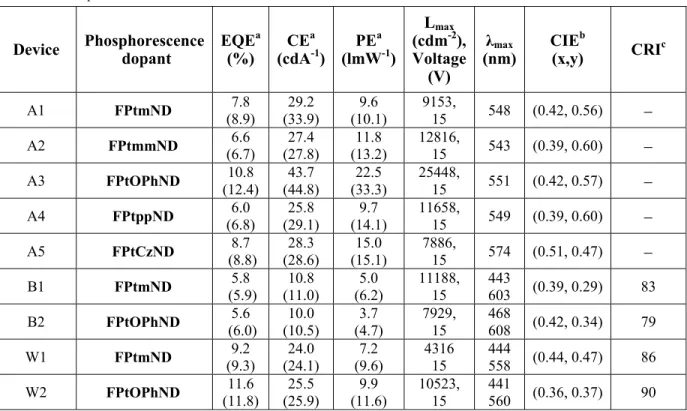
Figure 7 display EL spectra and performance data for Device A. Device A with dopant FPtmND, FPtmmND, FPtOPhND, FPtppND at 5 wt% dopant concentration exhibited greenish yellow EL emission (λmaxEL around 543~551 nm), which are similar to their PL of the isolated platinum complex in solution, whereas FPtCzND displayed an orange EL with λmaxPL at 574 nm. The EL efficiencies are given in the Table 2.
400 500 600 700 800 0.0 0.2 0.4 0.6 0.8 1.0 Device A1, 5 wt% Device A2, 5 wt% Device A3, 5 wt% Device A4, 5 wt% Device A5, 5 wt% Device A N o rmalized EL Intensi ty (a.u. ) Wavelength (nm) 10 100 1000 0.01 0.1 1 10 Device A1, 5 wt% Device A2, 5 wt% Device A3, 5 wt% Device A4, 5 wt% Device A5, 5 wt% EQE (%) P o w er Ef fi ci en cy ( lm/ W ) Electroluminance (cd/m2) 0.1 1 10 100
Figure 7 Normalized EL spectra of Device A with different platinum complexes at 5 wt% (left) and their external quantum efficiency (EQE) and power efficiency as a function of electroluminance (right).
Hybrid white OLEDs
Hybrid white OLEDs were fabricated with relatively simple configurations, in which platinum complexes were directly doped into 4P-NPD host. FPtmND and FPtOPhND were selected for evaluation of WOLED performance. Device B with configuration of ITO/NPB/4P-NPD: 8% FPtXND (20 nm)/TPBI (40 nm)/LiF(1 nm)/Al (150 nm). With 4P-NPD as host material, Device B exhibited different EL profiles from the Device A hosted by CBP. Two strong emissions were observed, containing (i) The blue emission (λmaxEL around 441~468 nm) (ii) The orange red board emission spectrum (λmaxEL around 603~608 nm). These two different emission bands can be attributed to the deep blue fluorescence 4P-NPD emission and excimer/aggregate emission from platinum complex, which was achieved from the diffusive triplet transfer to platinum complex. Device B with 8 wt% FPtmND displayed white EL (CIEx,y (0.39, 0.29)),
showing maximum external quantum efficiency of 5.9%, current efficiency of 11.0 cd A-1, power efficiency of 6.2 lm W -1 and a maximum CRI of 83. Device B with 8 wt% FPtOPhND also displayed white EL (CIE
x,y (0.42, 0.34)) with the
peak EL efficiency of 6.0%, 10.5 cd A-1 and 4.7 lm W-1and a CRI of 79.
To improve the EL performance and CRI, devices with double EMLs were further fabricated, in which the platinum complex was doped into both CBP and 4P-NPD host materials. Device W with configuration of ITO/NPB (40 nm)/CBP: 5% FPtXND (20 nm)/4P-NPD: 8% FPtXND (20 nm)/TPBI (40 nm)/LiF(1 nm)/Al (150 nm) was constructed. The EL spectra of Device W and efficiencies are shown in Figure 8 and Table 2. Device W1 with FPtmND exhibited warm white EL, CIEx,y (0.44 ,0.47) , displaying the peak efficiencies of 9.3%, 24.1 cd A-1 and 9.6 lm W-1and a CRI of 86. For
Device W2 with FPtOPhND, CRI increased to 90 as compared to its white EL with the single EML-type device and maximum EL efficiency elevated to 11.9%, 29.0 cd/A, 12.1 lm/W, respectively. Interestingly, the EL spectra of Device
W2 displayed nearly pure white light CIEx,y (0.36 ,0.37) due to much stronger blue fluorescence EL and broader EL
from both FPtOPhND and its excimer/aggregate.
400 500 600 700 800 0.0 0.2 0.4 0.6 0.8 1.0 Device B1 Single EML
a
)
8 wt% FPtmND N o rm a liz ed EL In te ns it y (a .u. ) Wavelength (nm) 400 500 600 700 800 0.0 0.2 0.4 0.6 0.8 1.0 Device B2 Single EMLb)
8 wt% FPtOPhND Wavelength (nm) No rm al ized EL In tensi ty (a.u .) 400 500 600 700 800 0.0 0.2 0.4 0.6 0.8 1.0 Device W1 Double EMLc)
FPtmND Norm alized EL Intensity (a .u.) Wavelength (nm) 400 500 600 700 800 0.0 0.2 0.4 0.6 0.8 1.0 Device W2 Double EMLd)
FPtOPhND Normal iz ed EL Inte nsit y (a .u. ) Wavelength (nm)Figure 8 Normalized hybrid white EL spectra of single EML WOLED of FPtmND (a), FPtOPhND (b) and Normalized hybrid white EL spectra of double EML WOLED of FPtmND (c), FPtOPhND (d).
10 100 1000 0.1 1 10 EQE (% ) Electroluminance (cd/m2) Power Efficie n cy (lm /W) Device B1 Device B2 Device W1 Device W2 1 10 100 0 2 4 6 8 10 12 14 16 100 1000 10000 Device B1 Device B2 Device W1 Device W2 E le ctroluminance ( c d /m 2) Current Density (mA /cm 2) Voltage (V) 0 50 100 150 200 250 300 350 400
Figure 9 External quantum efficiency (EQE) and power efficiency as a function of electroluminance of Device B and W (left). Luminance-voltage and Current density-voltage characteristics of Device B and W.
Device Phosphorescence dopant EQE(%) a (cdACEa-1) PE a (lmW-1) Lmax (cdm-2), Voltage (V) λmax (nm) CIE b (x,y) CRIc A1 FPtmND (8.9) 7.8 (33.9) 29.2 (10.1) 9.6 9153, 15 548 (0.42, 0.56) − A2 FPtmmND (6.7) 6.6 (27.8) 27.4 (13.2) 11.8 12816, 15 543 (0.39, 0.60) − A3 FPtOPhND (12.4) 10.8 (44.8) 43.7 (33.3) 22.5 25448, 15 551 (0.42, 0.57) − A4 FPtppND (6.8) 6.0 (29.1) 25.8 (14.1) 9.7 11658, 15 549 (0.39, 0.60) − A5 FPtCzND (8.8) 8.7 (28.6) 28.3 (15.1) 15.0 7886, 15 574 (0.51, 0.47) − B1 FPtmND (5.9) 5.8 (11.0) 10.8 (6.2) 5.0 11188, 15 443 603 (0.39, 0.29) 83 B2 FPtOPhND (6.0) 5.6 (10.5) 10.0 (4.7) 3.7 7929, 15 468 608 (0.42, 0.34) 79 W1 FPtmND (9.3) 9.2 (24.1) 24.0 (9.6) 7.2 4316 15 444 558 (0.44, 0.47) 86 W2 FPtOPhND (11.8) 11.6 (25.9) 25.5 (11.6) 9.9 10523, 15 441 560 (0.36, 0.37) 90 a The data for external quantum efficiency (EQE), current efficiency (CE), and power efficiency (PE) obtained at 500
cd/m2. The data in the parentheses are the maximum values; b Commission Internationale d' Eclairage chromaticity
coordinates at 7-10 V; c Color rendering index.
ACKNOWLEDGMENT
This research was support in part by the National Science Council of Taiwan (NSC 101-2113-M-001-004-MY2). REFERENCES
[1] Kim, S., Kwon, H.-J., Lee, S., Shim, H., Chun, Y., Choi, W., Kwack, J., Han, D., Song, M., Kim, S., Mohammadi, S., Kee, I., Lee, S. Y., "Low-Power Flexible Organic Light-Emitting Diode Display Device." Adv. Mater. 23, 3511-35162 (2011).
[2] D'Andrade, B. W., Forrest, S. R., "White Organic Light-Emitting Devices for Solid-State Lighting." Adv. Mater. 16, 1585-1595 (2004).
[3] Reineke, S., Lindner, F., Schwartz., G., Seidler, N., Walzer, K., Lüssem, B., Leo, K., "White organic light-emitting diodes with fluorescent tube efficiency." Nature. 459, 234-238 (2009).
[4] Sasabe, H., Takamatsu, J.-I., Motoyama, T., Watanabe, S., Wagenblast, G., Langer, N., Molt, O., Fuchs, E., Lennartz, C., Kido, J., "High-Efficiency Blue and White Organic Light-Emitting Devices Incorporating a Blue Iridium Carbene Complex." Adv. Mater. 22, 5003-5007 (2010).
[5] Yu, X.-M., Zhou, G.-J., Lam, C.-S., Wong, W.-Y., Zhu, X.-L., Sun, J.-X., Wong, M., Kwok, H.-S., "A yellow-emitting iridium complex for use in phosporescent multiple-emissive-layer white organic light-yellow-emitting diodes with high color quality and efficiency." J. Organomet. Chem. 693, 1518-1527 (2008).
[6] Lai, S.-L., Tong, W.-Y., Kui, S. C. F., Chan, M.-Y., Kwok, C.-C., Che, C.-M., "High Efficiency White Organic Light-Emitting Devices Incorporating Yelow Phosphorescent Platinum(II) Complex and Composite Blue Host." Adv. Funct. Mater. 23, 5168-5176 (2013).
[7] Wang, R., Liu, D., Zhang, R., Deng, L., Li, J. "Solution-processable iridium complexes for efficient organe-red and white organic light-emitting diodes." J. Mater. Chem. 22, 1411-1417 (2012).
[8] Chang, C.-H., Ho, C.-L., Chang, Y.-S., Lien, I.-C., Lin, C.-H., Yang, Y.-W., Liao, J.-L., Chi, Y., "Blue-emitting Ir(III) phosphors with 2-pyridyl triazolate chromophores and fabrication of sky blue- and white-emitting OLEDs." J. Mater. Chem. C. 1, 2639-2647 (2013).
[9] Sun, Y., Giebink, N. C., Kannol, H., Ma, B., Thompson, M. E., Forrest, S. R., "Management of singlet and triplet excitons for efficient white organic light-emitting devices." Nature. 440, 908-912 (2006).
[10] Hung, W.-Y., Chi, L.-C., Chen, W.-J., Chen, Y.-M., Chou, S.-H., Wong, K.-T., "A new benzimidazole/carbazole hybrid bipolar material for highly efficient deep-blue electrofluorescence, yellow-green electrophosphorescence, and two-color-based white OLEDs." J. Mater. Chem. 20, 10113-10119 (2010).
[11] Hofmann, S., Furno, M., Lussem, B., Leo, K., Gather, M. C., "Investigation of triplet harvesting and outcoupling efficiency in highly efficient two-color hybrid white organic light-emitting diodes." Phys. Status Solidi A. 210, 1467-1475 (2013).
[12] Wan, J., Zheng, C.-J., Fung, M.-K., Liu, X.-K., Lee, C.-S., Zhang, X.-H., "Multifunctional electron-transporting indolizine derivatives for highly efficient blue fluorescence, orange phosphorescence host and two-color based white OLEDs." J. Mater. Chem. 22, 4502-4510 (2012).
[13] Ye. J., Zheng, C.-J., Ou, X.-M., Zhang, X.-H., Fung, M.-K., Lee, C.-S., "Management of Singlet and Triplet Excitons in a Single Emission Layer: A Simple Approach for a High-Efficiency Fluorescence/Phosphorescence Hybrid White Organic Light-Emitting Device." Adv. Mater. 24, 3410-3414 (2012).
[14] Liao, S.-H., Shiu, J.-R., Liu, S.-W., Yeh, S.-J., Chen, Y.-H., Chen, C.-T., Chow, T. J., Wu, C.-I., "Hyrodxynaphthyridine-Derived Group III Metal Chelates: Wide Band Gap and Deep Blue Analogues of Green Alq3 (Tris(8-hydroxyquinolate)aluminum) and Their Versatile Applications for Organic Light-Emitting Diodes." J. Am. Chem. Soc. 131, 763-777 (2009).
[15] You, Y., Park, S. Y., "Inter-Ligand Energy Transfer and Related Emission Change in the Cyclometalated Heteroleptic Iridium Complex: Facile and Efficient Color Tuning over the Whole Visible Range by the Ancillary Ligand Structure." J. Am. Chem. Soc. 127, 12438-12439 (2005).
[16] Poloek, A., Chen, C.-T., Chen, C.-T., "High performance hybrid white and multi-colour electroluminescence from a new host material for a heteroleptic naphthyridinolate platinum complex dopant." J. Mater. Chem. C. 2, 1376-1380 (2014).