行政院國家科學委員會專題研究計畫成果報告
超媒體資訊系統之應用模式與系統發展方法研究
Application Modeling and System Development Methods for
Hyper media Infor mation Systems
計畫編號:NSC 87-2416-H004-018
執行期限:86 年 8 月 1 日至 87 年 7 月 31 日
主持人:余千智 國立政治大學資訊管理系
一、中文摘要
由於全球資訊網(World-Wide-Web)超
文件資訊資源及網底資訊系統(Web-Based
Information Systems, WIS)等的技術與商業
化應用進展快速,促使超媒體資訊系統發
展方法的研究需求顯著增加,技術課題包
括系統功能架構、應用模式、發展流程、
建置環境、工具及語言標準等。研究文獻
中雖有不少超媒體應用的模式表現及設計
方法,但極少從管理資訊系統的角度,整
合性地探討超媒體資訊系統發展方法中有
關架構、模式、流程、資料庫查詢、使用
者個人化管理功能等層面的結構與運作關
係。本研究的目的即在提出一個超媒體資
訊系統的概念架構與系統發展流程,整合
超媒體應用之節點-鏈結模式方法與物件
導向多媒體資料庫模式方法等,以使超媒
體資訊系統之文件內容、畫面展現、使用
者介面及多媒體資料庫等具有一致性的表
現方法及系統發展上的階段相容性,能充
分支援各種不同的超媒體文件檢索與多媒
體資料庫查詢方法,且能提供使用者導向
之個人化資訊服務。同時,也方便於導入
決策支援系統及知識庫系統功能。
關鍵詞:超媒體資訊系統,應用模式方法,
系統發展方法,多媒體資料庫
Abstr act
Due to the rapid growing of technologies and
commercial applications of
World-Wide-Web hyperdocument resources as well as
Web-based information systems(WIS), the
needs
for
demanding
researches
on
hypermedia information system development
methods increase significantly. Technical
issues for system development include
functional structure, application model,
development
process,
implementation
environment, tools and language standards.
Although there are a number of researches in
the literature discussing modeling and design
methods for hypermedia applications, little
has adopted a management information
system paradigm to accommodate structural
and operational issues for hypermedia
information
system
development
methodologies including system architecture,
modeling, process, database query, and
personalized management. The goal of this
research is to propose a conceptual
architecture and a development process for
hypermedia information systems. Within this
framework,
the
node-link
model
for
hypermedia applications and the
object-oriented model for multimedia databases are
integrated to consistently represent document
contents, user view presentations, user
interfaces, and multimedia databases of the
hypermedia information system as well as to
support comparable transitions between
phases of the system development process.
The established hypermedia information
system architecture and process should be
able to sufficiently support various search
and retrieval methods for hypermedia
documents and multimedia databases, to
provide
user-oriented
personalized
information services, and to facilitate
integration of decision support system and
knowledge-based system functions.
Keywords: Hypermedia Information System,
Application Modeling, System
Development
Method,
Multimedia Database.
二、緣由與目的
近年來由於網際網路(Internet)全球資
訊 網 (World-Wide-Web, WWW) 超 文 件
(Hyperdocument)資訊搜尋技術及電子商務
(Electronic Commerce, EC)應用的快速發
展 , 傳 統 以 瀏 覽 (Browsing) 及 領 航
(Navigation) 功 能 為 主 的 超 媒 體 應 用
(Hypermedia applications)之模式及網頁開
發方法,已無法因應強調多媒體資料庫查
詢(Multimedia database query)、網路資源聯
合(Repository federation)與資料採掘(Data
mining) 等 資 訊 密 集 (Information-intensive)
應用為特色的超媒體資訊系統(Hypermedia
Information System)的需要[3, 16, 20, 29, 33,
41, 43, 45, 48, 54, 64, 66, 70, 76, 81, 85]。因
此,如何將現有超媒體應用的概念及技術
提昇至超媒體資訊系統的層次,改良並強
化現有超媒體應用的系統架構、資料模式
及發展方法等,使能有效表現超媒體資訊
系統的資訊及功能結構關係,並清楚界定
系統發展的階段性工作內容、步驟、結果
及轉換關係等,以提昇系統分析、設計與
建置流程的效率與效益,已成為一個重要
且迫切的研究課題。
文獻中與全球資訊網、超媒體應用、
多媒體資料庫、超媒體系統發展方法等有
關的研究主題,大致含以下幾類:
超媒體系統及應用之參考資料模式與交換
格 式 標 準 [15,35,36,37,41,42,47,50,51,52,
53,62,81,82,91,92,93,95,100,101],超媒體應
用 之 需 求 設 定 及 系 統 設 計 方 法
[4,12,25,31,40,48,49,71,79,80,88],超媒體系
統 建 置 之 軟 體 輔 助 工 具 及 環 境
[2,16,26,29,34,38,43,46,57,68,73,87,98],特
定應用領域之系統發展模式及管理應用
[59,61,69,74,84,89,90,99],超媒體文件管理
系統及相關多媒體資料庫模式與查詢方法
[7,8,13,18,19,21,30,33,39,44,45,54,55,58,60,
65,67,76,77,78,83,85,86,96,97],超媒體文件
之標記及劇本語言[10,11],全球資訊網應
用系統之製作環境[17,28,72,75],超媒體、
文件管理、物件導向模式、群體工作、資
訊檢索、資料庫系統、決策支援系統、知
識表現及知識庫系統等技術與全球資訊網
的 整 合 及 應 用 方 法 [1,3,5,6,9,21,24,
37,56,63,66,70,102],使用者介面及視覺化
模式方法[20,22,64,94],智慧型代理人系統
之架構及應用[14,20,66]等。
上述研究主題中與超媒體資訊系統發
展最具相關性的超媒體應用資料模式方法
與超媒體系統設計及開發方法,亦均有為
數不少的研究,分別舉主要的文獻說明如
下[4,12,16,25,31,35,36,40,48,49,50,79,80,88,
98]:
(一)、超媒體應用模式
超文件
超媒體應用強調非線性linear) 的 資 訊 組 織 及 非 循 序 性
(non-sequential)的資訊處理方法,具有超空間交
互參考(Cross-reference)的特性,含互動式
(Interactive) 及 視 覺 化 (Visualized) 操 作 介
面,並以節點-鏈結模式(Node-Link model)
來表現系統的資訊結構關係。幾個主要的
超媒體應用模式方法大都採用層次化的系
統結構觀點,但以應用系統內容呈現及資
訊瀏覽之領航介面設計與資訊鏈結機制為
主。
1、HAM(Hypertext Abstraction Machine)[16]
HAM提出超文件應用之三層次系統架
構來表現一般超文件應用的系統展現、結
構 與 儲 存 關 係 , 三 層 分 別 為 (1) 呈 現 層
(Presentation level) (2)超文件抽象機制層
(Hypertext Abstract Machine level) 及(3)資
料庫層(Database level)。呈現層是指將資訊
依使用者需求格式呈現,而資料庫層即是
用來儲存文件資料,超文件抽象機制層為
HAM結構中最重要的層次,定義超文件應
用內容之節點與鏈結關係。
2、The Dexter Reference Model[31,35]
Dexter模式起源於1988年在美國新罕
普什州(New Hampshire)Dexter Inn所舉行
之超文件工作研討會,其目的在萃取超文
件應用系統的主要結構性因子,並將其抽
象化及一般化,使能提供超文件應用之間
的參考比較,以建立超文件應用系統的交
互運作及資訊交換標準。Dexter模式將超文
件系統架構分成三個層次。各層次為:(1)
執行層(Run-time Layer),為超文件之展現
及操作介面,提供基本的展示與瀏覽功
能。(2)儲存層(Storage Layer),表現超文件
應用之節點與鏈結結構關係。(3)內涵單元
層(Within-Component Layer),則表現超文
件內涵單元之內部結構,即節點之內容項
目及結構關係。Dexter架構的三個層次之間
有兩個界面:(1)呈現確認機制(Presentation
Specification Mechanism),用來確定並處理
文件內容展現相關的格式資訊,介於執行
層與儲存層之間。(2)下錨機制(Anchoring
Mechanism),為儲存層與內涵單元層之介
面,提供內涵單元內容項目的定址功能,
以便建立節點內容與節點內容間之鏈結關
係。Dexter模式之重點在表現儲存層,並未
深入討論內涵單元層的規範,而其資訊處
理方式及介面設計則以瀏覽為主,對超文
件資料庫之定義與資訊檢索功能並無探
討。
3 、 AHM(The Amsterdam Hypermedia
Model)[36]
Amsterdam 模 式 結 合 Dexter 模 式 及
CMIF(CWI Multimedia Interchange Format)
多媒體交換格式,擴充Dexter模式之儲存層
以包含動態的多媒體資料型態,如聲音、
視訊等。同時,將組合式多媒體資料內容
項目間複雜的時間性及展示關係(Timing
and presentation relationships)如順序、同步
(synchronization)等,涵蓋在模式結構的定
義之中。另外,也加入了鏈結相關的領航
項目與展示屬性等的設定。
(二)、超媒體應用系統發展方法
超媒體系統設計及開發方法,主要在
規範系統發展之需求分析、概念及建置設
計、工具運用及實體系統開發等,現有之
系統發展方法以網頁導向之建置及瀏覽設
計為主,或著重開發工具及環境的支援。
1、HB1(The Hyperbase Management System,
HBMS)[50,79,98]
HB1與後續發展之HBx系列為一個原
型超文件管理系統,使用物件化的語意資
料模式(Semantic Data Model)。資料模式中
含 應 用 (application) 、 內 容 單 元
(component)、選擇器(persistent selections)、
下 錨 (anchors) 、 鏈 結 (links) 、 及 組 合
(associations)等六個物件項目。應用項目中
包含內容單元項目,選擇器項目則為內容
單元項目內的連結及取得其他應用項目的
裝置,而透過下錨項目及鏈結項目可完成
連結及瀏覽等工作。組合項目則為結合內
容單元項目的代號集合,可表現結構化的
實體關係。
HB1超文件管理系統的組成架構含:(1)
鏈 結服 務 管 理 器 (Link Services Manager,
LSM),處理下錨及鏈結功能。(2) 物件管
理器(Object Manager, OM),提供應用之儲
存 及 使 用 者 介 面 。 (3) 組 合 集 合 管 理 器
(Association Set Manager, ASM),提供組合
關係之儲存及執行展現功能。(4) 儲存管理
器(Storage Manager, SM),為一原型語意網
路資料庫管理系統(IBM發展之Saberel)。
HB1模式及管理系統中之物件為簡單的主
題(subject)物件,只有名稱與資料,而無類
別結構、方法與繼承關係等之定義。主題
物件之間為二元化的語意關係。
以HBx為基礎的分散式超媒體系統發
展環境Hyperform,可供多位使用者一起開
發超媒體系統。Hyperform環境中的HBMS
系統發展包含五個步驟,即:(1)分析問題
領域(Analyzing the Problem Domain),(2)
設計超媒體服務(Designing the Hypermedia
Services) , (3) 撰 寫 類 別 描 述 (Writing the
Class Descriptions) , (4) 安 裝 類 別 描 述
(Installing the Class Descriptions),及(5)測試
類別描述 (Testing the Class Descriptions)
等 。 Hyperform 之 系 統 建 置 模 式 係 以 The
Dexter Reference Model為本。
2、HDM(The Hypermedia Design Method)
[25,80]
HDM及HDM2方法的重點在描述與定
義超文件
超媒體應用的資訊項目、領航
瀏覽行為、及介面轉換關係等。在HDM模
式中與節點相關之元件有節點node及內含
之單元component,node的呈現單元為視框
frame,frame內含槽格slot。component組合
成之實體entity可定義為物件object,object
之集合即collection。鏈結之類別則有結構
化 鏈 結 (Structural link)、 索引 鏈結 (Index
link)、導遊鏈結(Guided tour link)、綱目鏈
結(Schema link)、及一般鏈結(Generic link)
等。
由 HDM 所 延 伸 之 物 件 導 向 方 法
OOHDM中,超媒體應用發展的流程共有四
個 階 段 , 即 : (1) 領 域 分 析 (Domain
analysis),主要工作為設定應用領域之物件
類別關係並建立物件類別結構。(2)領航設
計(Navigational design),主要工作為轉換物
件類別結構至表現節點與鏈結關係之領航
瀏覽存取結構。(3)抽象介面設計(Abstract
interface design),主要工作為轉換節點鍵結
物件至使用者介面物件,含對外部事件的
回應。(4)建置(Implementation),主要工作
即為在目標作業環境中執行系統應用並檢
查其績效與完整性。
HDM及其延伸方法仍以瀏覽介面導
向之超媒體應用為對象,以傳統物件導向
方法在第一階段建立的物件導向資料模式
只做為後續節點鏈結關係及瀏覽介面設計
之根據,並未調整並融合物件導向分析及
設計方法於超媒體應用與資訊系統的發
展,且亦無法支援超媒體資訊系統之多媒
體文件與資料庫管理及內容基底查詢等功
能。
3 、 EORM(Enhanced Object-Relationship
Model) [48,49]
加強式物件關係模式EORM之主要目
標為將語意關係加入物件導向模式之設計
與建構中。使用類似OMT(Object-Oriented
Modeling Technique)之符號,定義超媒體應
用之鏈結語意(Link semantics)與物件互動
(Object interactions)關係,其物件之間所定
義的關係(relation)本身即為具有屬性及行
為的鏈結物件。
EORM物件導向設計方法之四個步驟
為:(1)建立類別架構,確認及修訂領域物
件類別。(2)建立組合架構,含鏈結關係類
別。(3)建立圖形介面架構,如視窗內容、
展示格式、及鏈結作業等設定。(4)評估及
修訂,透過原型系統方法逐步測試及修訂
完成。
EORM方法基本上類似HDM,但在節
點鏈結物件與使用者瀏覽操作介面間之轉
換對應方法較不明確,而在超媒體資訊系
統層次之資料庫管理方面則同樣缺乏探討
及考量。
4 、 RMM(The Relationship Management
Methodology)[24,40]
關係管理方法RMM之目的同樣在設
計及建構超媒體應用,其概念內涵係視超
媒體為管理資訊物件間關係的機能,而方
法上則特別強調設計流程及關係管理。
RMM中所使用的資料模式為關係管理資
料 模 式 RMDM(Relationship Management
Data Model),模式內容在表現實體與實體
之間的關係及存取介面,且提供了資訊物
件及領航瀏覽機制的描述語言。RMDM之
主 要 元 件 有 三 類 : (1) 實 體 關 係
(Entity-Relationship, ER) 領 域 元 件 (ER domain
primitives),用來建立應用領域之資訊結
構,包含實體(entities)、屬性(attributes)及
一 對 一 與 一 對 多 關 係 (relationships) 等 元
件 。 (2)RMD 領 域 元 件 (RMD domain
primitives),用來描述資訊的展現,元件為
切 片 (slices) 。 (3) 存 取 元 件 (Access
primitives),用來描述領航瀏覽方法,含單
向 鍵 結 (Unidirectional link) 、 雙 向 鍵 結
(Bidirectional link)、組合(Grouping)、條件
索 引 (Conditional index) 、 條 件 導 遊
(Conditional guided tour)、條件索引導遊
(Conditional indexed guided tour)等元件。
RMM 之 系 統 設 計 流 程 含 下 列 各 階
段:(1)可行性研究(Feasibility study),即系
統發展先期之可行性分析。(2) 資訊及領航
瀏 覽 需 求 分 析 (Information/navigation
requirements analysis),分析系統之資訊需
求 及 領 航 瀏 覽 需 求 。 (3)ER 設 計 (ER
design),旨在確認實體及實體間之關係。(4)
實體設計(Entity design),含確認跨實體間
之切片元件(Cross-entity slice)及最少切片
集(Minimum slice)。(5)領航設計(Navigation
design) , 產 生 RMD 圖 以 呈 現 存 取 結 構
(Access structure) 。 (6) 轉 換 協 定 設 計
(Conversion protocol design),決定建置工具
及伺服器之使用,如HTML、WWW伺服
器、資料庫伺服器等。(7)使用者介面螢幕
設計(User-interface screen design),主要為
內容展現及操作流程之使用者介面設計,
含視窗、螢幕、選項、路徑等之設計。(8)
執行行為設計(Run-time behavior design),
產生系統作業所需之功能程式並建立鏈結
標記。(9)建構(Construction),使用系統建
置工具及伺服器建立原型系統。(10)測試與
評估(Testing and evaluation),測試及評估原
型系統之績效並進行修改。
RMM與HDM發展方法相似之處在先
建立概念模式後再據以加入瀏覽介面設
計,不同的是HDM使用OO模式而RMM使
用ER模式,且RMM方法有較細部的階段規
劃。然而,兩者均以超媒體應用為探討重
點,不及於資訊系統層次中內容資料庫方
面的檢索與管理設計。
上述研究文獻中所提出之方法與成
果,皆以超媒體應用為系統發展探討對
象,以節點鏈結模式為資料表現方法,以
瀏覽及文字基底檢索為主要應用功能,缺
乏整合性超媒體資訊系統架構與發展流
程、多媒體資料庫模式表現與多媒體文件
內容基底查詢(Content based query)等方法
及管理功能層面的整體考量。應用上述超
媒體應用發展方法及一般物件導向分析及
設計方法於超媒體資料庫及資訊系統之開
發,在畫面介面格式及流程關係、文件超
鏈結結構關係、文件內容物件互動關係、
多媒體物件展現同步關係、多媒體文件資
料庫結構關係等方面之表現方法與整合發
展步驟並不明確。本研究的目的即在提出
一個超媒體資訊系統的概念架構與系統發
展流程,整合超媒體應用之節點鏈結模式
方法與物件導向多媒體資料庫模式方法,
以使超媒體資訊系統中多媒體文件之文件
內容、展現、使用者介面及資料庫等具有
一致性的表現方法及系統發展上的階段轉
換相容性。此一系統架構及發展流程能充
分支援含多媒體文件內容基底查詢之各種
不同資訊檢索方法及使用者導向之個人化
資訊管理功能,並能順利擴展至全球資訊
網決策支援系統及知識管理的應用層面。
三、結果與討論
(一) 研究方法與步驟
為有效建立超媒體資訊系統之應用模
式及資料庫模式,並提出結構化的系統發
展方法與流程,本計畫所採用之研究方法
與步驟列述如下:
1、採用整合性系統發展層次結構(Layered
Structure)方法,規範超媒體資訊系統之
系 統 發 展 程 序 並 設 定 系 統 規 格 與 標
準 。 將 系 統 結 構 分 為 應 用 層
(Application Layer)、概念層(Conceptual
Layer)及實體層(Physical Layer)三層,以
作為技術類別區分及系統發展階段工
作分解的依據。應用層著重於使用者介
面、資訊畫面、管理功能及個人化文件
管理輔助等需求之界定。概念層著重於
整合性系統概念模式之建立,以表現資
料、文件、介面、畫面、功能、知識及
資料庫等之間的邏輯關係。實體層重視
軟硬體與通訊整合環境的建立及實體
系統建置等,三個層次分別引導系統分
析、設計及建置的階段性工作內容並承
接階段間成果的對映及轉換關係。
2、採用超媒體導向的介面及畫面設計方法
與節點鏈結應用模式方法,以建立具多
工、多視窗、多媒體驅動、非線性資訊
鏈結等特色之視覺化、交談式作業環境
及資訊展現之流程結構。
3、採用物件導向資料模式方法,界定超媒
體資訊系統及文件組織結構之類別關
係、畫面及介面之內容與互動關係等,
賦予資料、知識、文件、介面、畫面、
功能、程序等一個一致性的資料庫模式
表現方法。
4、採用智慧型經紀人及知識庫方法,建立
多媒體資訊及文件之分類、索引、查
詢、個人化管理等之智慧型輔助功能。
5、採用多媒體資料庫方法,建立系統之多
媒體文件資料庫結構,並提供內容基底
查詢及其他管理功能。
6、採用主從(Client-Server)網路架構,規範
整體超媒體資訊系統及文件管理之分
散式作業環境,以界定應用及文件伺服
器、全球資訊網伺服器、多媒體資料庫
伺服器及使用者工作站等之間的功能
劃分、交互運作流程與共通作業協定。
7、採用軟體整合方法,建立實體系統發展
之工具及作業環境,並據以建置原型系
統。
(二) 超媒體資訊系統發展方法與流程
本研究採用層次化的系統發展架構,
整合物件導向方法及超媒體應用發展方
法,所提出的超媒體資訊系統發展方法,
其系統分析、設計及建置之步驟如下 :
1、確認應用系統 之作業功能及資訊 流
程,
2、收集和定義多媒體使用者觀點及介面
需求,
3、以節點-鏈結模式表現畫面及介面之
資訊內容、功能 及流程等 之結構 關
係,
4、確定資料、文件、功能、畫面、介面
等物件(Objects),
5 、 定 義 物 件 的 屬 性 (Attributes) 及 操 作
(Operations),
6、建立物件目錄(Object Directory),
7、定義物件間之繼承、組合及參考關係
(Relationships),
8、建立整合性之資訊物件類別結構(Class
Structure),含多媒體文件、文件內容
及超鏈結等之多媒體資料庫結構,
9、確定多媒體資料庫與文件、畫面、介
面 之 邏 輯 存 取 對 映 (Logical Access
Mapping )關係,
10 、 確 定 系 統 之 功 能 結 構 (Functional
Structure) 及 操 作 流 程 (Operational
Process),
11、建立整合性系統發展及操作之實體環
境,含軟硬體及通訊工具之選擇及整
合,包括超媒體系統製作工具、資料
庫伺服器及其他功能性軟體等,
12、確認系統之多媒體資料庫結構、功能
結構等與系統發展工具間的實體對映
關係,含功能與軟體程式之實體對映
轉換程序,例如將物件導向資料庫模
式對映至擴充式關聯資料庫管理系統
之定義及查詢語言等,
13、建立系統建置之功能及程式模組,並
確認實體程式及檔案結構等,
14、建立實體多媒體資料庫,並製作多媒
體展現 (Presentaion)之格式及操作介
面,
15、建置原型系統,含程式撰寫、測試、
整合、修訂及擴充等,
16、系統評估確認及完成,含系統文件之
建立及傳送。
上述系統發展流程中,步驟1-6、步驟
7-10、步驟11-15等分別屬系統分析、設計
及建置階段的工作內涵。步驟9及步驟12的
邏輯存取對映程序與實體對映程序則分別
處理分析-設計階段及設計-建置階段間的
成果轉換,以使系統發展流程具有階段相
容性(Compatibility)及連續性(Continuity),
也可達成系統發展的邏輯獨立性(Logical
Independence)與實體獨立性(Physical
Independence)的需求。此外,在上述各階
段的步驟中加入決策流程及決策模式的確
認、定義及軟體整合轉換等,便可自然地
延伸超媒體資訊系統的發展與應用至決策
支援系統的層面。
以數位圖書館服務系統及遠距教學系
統之發展為例,並將多媒體文件型態限定
為電子書及電子教材,則依上述超媒體資
訊系統發展流程的步驟執行,主要的階段
性成果如下:
1、數位圖書館服務系統及遠距教學系統
之功能主要包括資訊及文件之瀏覽與
檢索、網路資源搜尋及鏈結、線上通訊
等,其功能架構及作業流程如圖1及圖2
所示。瀏覽功能含循序式、索引式、導
遊式、混合式等,檢索功能含基本資料
檢索、關鍵字檢索、全文檢索、內容基
底查詢等。
2、以使用者觀點及介面中之電子書基本
資料畫面及相關資料畫面為例,其畫面
內容及介面類型的關係結構以節點-鏈
結模式表現,可得圖3及圖4,分別顯示
內容資 料層 次及畫 面-介面層次的關
係。
3、將電子書文件及畫面、介面等物件經確
認及概念化後,可建立物件導向類別結
構。圖5、圖6及圖7分別顯示多媒體文
件結構之完整物件導向模式,電子書文
件含屬性、內容及展示等部份結構之物
件導向模式,以及系統含介面、畫面、
資料庫等層次結構之物件導向模式。
4、以選擇擴充式關聯資料庫管理系統做
為多媒體資料庫建置工具為例,則圖8
顯示經對映轉換後之電子書文件關聯
資料模式。
5、圖9及圖10分別顯示實體原型系統建置
之軟體整合環境及分散式系統作業環
境等。
6、圖11顯示數位圖書館原型系統之電子
書基本資料畫面,與前述節點-鏈結模
式及物件導向模式對映。圖12則顯示遠
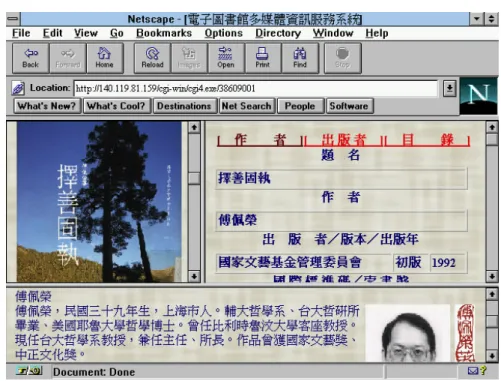
距教學原型系統之電子教材章節內容
瀏覽畫面。
上述超媒體資訊系統的發展方法亦可
適用於決策支援系統的發展,如開發類似
圖13中之消費者導向決策支援系統。發展
階段各步驟中加入決策流程及決策模式的
確認及建立後,可發展出如圖14含旅遊行
程搜尋及評估畫面之全球資訊網旅遊規劃
決策支援系統。
四、計畫成果自評
本研究屬整合性的技術與應用研究,
提出超媒體資訊系統之概念架構、應用模
式、資料庫模式及系統發展方法,並透過
實體環境上的原型系統開發,顯示其實務
上應用的可行性與引導系統發展的績效。
本研究計畫所完成之工作項目及具體成果
如下:
1、確定超媒體資訊系統概念架構與系統發
展之層次及階段關係,並建立系統化建
構流程。
2、擴充超媒體應用之節點鏈結模式內涵元
件,增訂節點及鏈結型態,以充分表現
資訊系統應用層次之資料、文件、畫面
及使用者介面的結構與語意關係。
3、建立物件導向多媒體文件結構模式及多
媒體資料庫模式、並界定模式間之對映
關係。
4、建立超媒體資訊系統作業模式及環境,
整合軟硬體及通訊網路,以利系統開發
及應用。
5、使用所提出之超媒體資訊系統發展方法
發展資訊密集導向的原型超媒體資訊
系統,如數位圖書館系統及遠距教學系
統等。同時,延伸此一方法發展原型決
策支援系統,如消費者導向之全球資訊
網旅遊規劃決策支援系統等。驗證了整
體系統發展架構、模式、流程、及環境
的可行性,並顯示其實用價值。
本研究計畫之成果整合並推展了以往
研究的結果與視野,為超媒體資訊系統的
發展及應用提供了結構化的具體方法與流
程,已達成原期望目標並有所延伸,可整
理成學術論文發表並推廣應用。
參考文獻
[1] Akscyn, R., McCracken, D. L., and Yoder, E. A., "KMS: A Distributed Hypermedia System for Managing Knowledge in Organizations," Communications of the ACM, 31(7), July 1988, pp. 820-835
[2] Anupam, V., and Bajaj, C. L., "Shastra: Multimedia Collaborative Design Environment," IEEE Multimedia, Summer 1994, pp. 39-49.
[3] Ba, S., Kalakota, R., and Whinston, A. B., “Using Client-Broker-Server Architecture for Intranet Decision Support,” Decision Support Systems, 19, 1997, pp.171-192.
[4] Balasubramanian, V., Ma, B. M., and Yoo, J., “A Systematic Approach to Designing a WWW Application,” Communications of the ACM, 38(8), August 1995, pp. 47-48.
[5] Balasubramanian, V. and Bashian, A., “Document Management and Web Technologies: Alice Marries the Mad Hatter,” Communications of the ACM, 41(7), July 1998, pp. 107-115.
[6] Berners-Lee, T., Cailliau, R., Luotonen, A., Nielsen, H. F., and Secret, A., "The World-Wide Web," Communications of the ACM, 37(8), Aug. 1994, pp.76-82
[7] Berra, P. B. et. al., "Architecture for Distributed Multimedia Database Systems," Computer Communications, 13(4), May 1990, pp. 217-231.
[8] Bertino, E., Rabitti, F., and Gibbs, S., "Query Processing in a Multimedia Document System," ACM Transactions on Office Information Systems, 6(1), Jan. 1988, pp. 1-41.
[9] Bieber, M. and Vitali, F., “Toward Support for Hypermedia on the World Wide Web,” IEEE Computer, 30(1), 1997, pp. 62-70.
[10] Bodriguez, A. A., Fisher, M., and Markey, B., "Scripting Languages Emerge in Standards Bodies," IEEE Multimedia, Winter 1995, pp. 88-92.
[11] Bormann, U. and Bormann, C., "Standards for Open Document Processing: Current State and Future Developments," Computer Networks and ISDN Systems, 21, 1991, pp. 149-163. [12] Ceri, S., Fraternali, P. and Paraboschi, S.,
“Design Principles for Data-Intensive Web Sites,” ACM SIGMOD Record, 28(1), 1999, pp. 84-89.
[13] Christodoulakis, S., Theodoridou, M., Ho, F., Papa, M., and Pathria, A., "Multimedia Document Presentation, Information Extraction, and Document Formation in MINOS," ACM Transactions on Office Information Systems, 4(4), Oct. 1986, pp. 345-383.
[14] Ciancarini, P., et al., “Coordinating Multiagent Applications on the Web: A Reference Architecture,” IEEE Trans. on Software Engineering, 24(5), May 1998, pp. 362-375. [15] Colaitis, F., "Opening Up Multimedia Object
Exchange with MHEG," IEEE Multimedia, Summer 1994, pp. 80-84.
[16] Compbell, B. and Goodman, J., "HAM: A General Purpose Hypertext Abstraction Machine," Communications of the ACM, 31(7), July 1988, pp. 856-861.
[17] Crespo, A. and Bier, E. A., “WebWriter: A Browser-Based Editor for Constructing Web Applications,” Proceedings of the Fifth International World Wide Web Conference,
Paris, France, 1996,
http://www5conf.inria.fr/fich_html/papers/P35/ Overview.html.
[18] Davcev, D., Cakmakov, D., and Cabukovski, V., "Distributed Multimedia Information Retrieval System," Computer Communications, 15(3), April 1992, pp. 177-184.
[19] Dunlop, M. D. and van Rusbergen, C. J., "Hypermedia and Free Text Retrieval," Information Processing and Management, 29(3), 1993, pp. 287-298.
[20] Falchuk, B. and Karmouch, A., “Visual Modeling for Agent-Based Applications,” IEEE Computer, 31(12), Dec. 1998, pp. 31-38. [21] Foo, S. and Lim, E. P., “A Hypermedia
Database to Manage World-Wide-Web Documents,” Information & Management, 31, 1997, pp. 235-249.
[22] Fox, E. A., "Advances in Interactive Digital Multimedia Systems," IEEE Computer, Oct. 1991, pp. 9-21.
[23] Furht, B., "Multimedia Systems: An Overview," IEEE Multimedia, Spring 1994, pp. 47-59. [24] Gaines, B. R. and Shaw, M. L. G., “Embedding
Formal Knowledge Models in Active Documents,” Communications of the ACM, 42(1), Jan. 1999, pp. 57-63.
[25] Garzotto, F., Paolini, P., and Schwabe, D., "HDM--A Model-Based Approach to Hypertext Application Design," ACM Transaction on Information Systems, 11(1), Jan. 1993, pp. 1-26.
[26] Gaviotis, I. and Christodoulakis, D., "Architectural Requirements for Open Distributed Hypermedia," Information and Software Technology, 37(4), 1995, pp. 245-251.
[27] Gellersen, H.-W. and Gaedke, M., “Object-Oriented Web Application Development,” IEEE Internet Computing, 3(1), Jan.-Feb. 1999, pp. 60-68.
[28] Gellersen, H.-W., Wicke, R., and Gaedke, M., “WebComposition: An Object-Oriented Support System for the Web Engineering Lifecycle,” Computer Networks and ISDN Systems, 29, 1997, pp. 1429-1437.
[29] Ginige, A., Lowe, D. B., and Robertson, J., "Hypermedia Authoring," IEEE Multimedia, Winter 1995, pp. 24-35.
[30] Ginsberg, A., "A Unified Approach to Automatic Indexing and Information Retrieval," IEEE Expert, 8(5), 1993, pp. 46-56.
[31] Gronbaek, K., Trigg, .R. H., "System Design Applying the Dexter Model," Communications of the ACM, 37(2), February 1994, pp. 26-39. [32] Grosky, W. I., "Multimedia Information
Systems," IEEE Multimedia, Spring 1994, pp. 12-24.
[33] Guglielmo, C., "Documenting Success," Open Computing, Feb. 1995, pp. 57-62.
[34] Haan, B. J., Kahn, P., Riley, V. A., Coombs, J. H., and Meyrowitz, N. K., "IRIS Hypermedia Services," Communications of the ACM, 35(1), Jan. 1992, pp. 36-51.
[35] Halasz, F. and Schwartz, M., "The Dexter Hypertext Reference Model," Communications of the ACM, 37(2), Feb. 1994, pp. 30-39. [36] Hardman, L., Bultermen, D. C. A., and van
Rossum, G., "The Amsterdam Hypermedia Model: Adding Time and Context to the Dexter Model," Communications of the ACM, 37(2), Feb. 1994, pp. 50-62.
[37] Horn, F. and Stefani, J. B., "On Programming and Supporting Multimedia Object Synchronization," The Computer Journal, 36(1), 1993, pp. 4-18.
[38] Huang, C.-M. et al., “MING-I: A Distributed Interactive Multimedia Document Development Mechanism,” Multimedia Systems, 6, 1998, pp. 316-333.
[39] Hwang, K., and Fu, K. S. "Integrated Computer Architecture for Image Processing and Database Management," IEEE Computer., Jan. 1983, pp. 51-60.
[40] Isakowitz, T., Stohr, E. A., and Balasubramanian, F., “RMM: A Methodology for Structured Hypermedia Design," Communications of the ACM, 38(8), Aug. 1995, pp. 34-44
[41] Karmouch, A. and Emery, J., "A Playback Schedule Model for Multimedia Documents," IEEE Multimedia, Spring 1996, pp. 50-61. [42] Khalfallah, H. and Karmouch, A., "An
Architecture and a Data Model for Integrated Multimedia Documents and Presentational Applications," Multimedia Systems, 3, 1995, pp. 238-250.
[43] Kilov, H. and Cuthbert, L., "A Model for Document Management," Computer Communications, 16(6), June 1995, pp. 408-417.
[44] Kirstein, P. and Montasser-Kohsari, G., "The C-ODA Project: Accesss to Electronic Journals," Communications of the ACM, 39(6), June 1996, pp. 87-99.
[45] Klas, W., Neuhold, E. J. and Schrefl, M., "Using an Object-Oriented Approach to Model Multimedia Data," Computer Communications, 13(4), May 1990, pp. 204-216.
[46] Koegel, J. F., Rutledge, L. W., Rutledge, J. L., and Keskin, C., "HyOctane: A HyTime Engine for an MMIS," Proceedings of Multimedia'93, Anatheim, CA, Aug. 1-6, 1993.
[47] Kretz, F. and Colaitis, F., "Standardizing Hypermedia Information Objects," IEEE Communications Magazine, May 1992, pp. 60-70.
[48] Lange, D., “An Object-Oriented Design Method for Hypermedia Information Systems," Proceedings of the 27th Annual Hawaii International Conference on System Sciences, 1994, pp. 366-375.
[49] Lange, D., “Object-Oriented Hypermodeling of Hypertext-Supported Information Systems," Journal of Organizational Computing and Electronic Commerce, Fall 1996, pp. 269-293. [50] Leggett, J. J. and Schnase, J. I., "Viewing
Dexter with Open Eyes," Communications of the ACM, 37(2), Feb. 1994, pp. 76-86.
[51] Linthicum, D. S., "Creating Compound Document Standards," Open Computing, Jan. 1995, pp. 55-60.
[52] Little, T. D. C. and Ghafoor, A., "Multimedia Object Models for Synchronization and
Databases," Proceedings of the Sixth International Conference on Data Engineering, February 1990, pp. 20-27.
[53] Little, T. D. C. and Ghafoor, A., "Spatio-Temporal Composition of Distributed Multimedia Objects for Value-Added Networks," IEEE Computer, Oct. 1991, pp. 42-50.
[54] Loeb, S., "Delivering Interactive Multimedia Documents Over Networks," IEEE Communications Magazine, May 1992, pp. 52-59.
[55] Mackenzie, J., "Document Repositories," Byte, April 1995, pp. 131-138.
[56] Manola, F., “Technologies for a Web Object Model,” IEEE Internet Computing, 3(1), 1999, pp. 38-47.
[57] Masunaga, Y., "Design Issues of OMEGA: An Object-Oriented Multimedia Database Management System," Journal of Information Processing, 14(1), 1991, pp. 60-74.
[58] McKie, S., "A New Era of Document Management," DBMS, June 1995, pp. 62-70. [59] Merrill, D., Parker, N., Gey, F., and Stuber, C.,
"The University of California CD-ROM Information System," Communications of the ACM, 38(4), April 1995, pp.51-52.
[60] Michalski, G. P., "The World of Documents," Byte, April 1991, pp. 159-170.
[61] Naffah, N., "Multimedia Applications," Computer Communications, 13(4), May 1990, pp. 243-249.
[62] Newcomb, S. R., Kipp, N. A., and Newcomb, V. T., "The HyTime: Hypermedia/Time-Based Document Structuring Language," Communications of The ACM, 34(11), Nov. 1991, pp. 67-83.
[63] Nicol, J. R., et al., “How the Internet Helps Build Collaborative Multimedia Applications,” Communications of the ACM, 42(1), Jan. 1999, pp. 79-85.
[64] Nielsen, J., “User Interface Directions for the Web,” Communications of the ACM, 42(1), 1999, pp. 65-72.
[65] O'Docherty, M. H. and Daskalakis, C. N., "Multimedia Information Systems-The Management and Semantic Retrieval of all Electronic Data Types," The Computer Journal, 34(3), 1991, pp. 225-238.
[66] O’Keefe, R. M. and Mceachern, T., “Web-Based Customer Decision Support Systems,” Communications of the ACM, 41(3), March 1998, pp. 71-78.
[67] Orenstein, J.A. and Manola, F.A. "PROBE Spatial Data Modeling and Query Processing in an Image Database Application," IEEE Transactions on Software Engineering, 14(5), May 1988, pp. 611-629.
[68] Ores, P., "Hypertext Publishing Edit Trail," PC Magazine, Feb. 7, 1995, pp. 132-143.
[69] Palmer, J. W. and Griffith, D. A., “An Emerging Model of Web Site Design for Marketing,” Communications of the ACM, 41(3), March 1998, pp. 45-51.
[70] Paoli, J., "Cooperative Work on the Network: Edit the WWW," Computer Networks and ISDN Systems, 27(6), 1995, pp. 841-847. [71] Paulo, F. B., Masiero, P. C., and de Oliveira, M.
C. F., “Hypercharts: Extended Statecharts to Support Hypermedia Specification,” IEEE Trans. on Software Engineering, 25(1), Jan./Feb. 1999, pp. 33-49.
[72] Peters, R. and Neuss, C., "CrystalWeb--A Distributed Authoring Environment for the World-Wide-Web," Computer Networks and ISDN Systems, 27(6), 1995, pp. 861-870. [73] Phillips, R. L., "MediaView: A General
Multimedia Digital Publication System," Communications of the ACM, 34(7), July 1991, pp. 75-83.
[74] Powell, J., "Adventures with the World Wide Web: Creating a Hypertext Library Information System," Database, Feb. 1994, pp. 59-66. [75] Quint, V., Roisin, C., and Vatton, I., "A
Structured Authoring Environment for the World-Wide-Web," Computer Networks and ISDN Systems, 27(6), 1995, pp. 831-840. [76] Rosenberg, J., Cruz, G., and Judd, T.,
"Presenting Multimedia Documents Over a Digital Network," Computer Communications, 15(6), 1992, pp. 377-380.
[77] Roussopoulos, N., Faloutsos, C., and Sellis, T. "An Efficient Pictorial Database System for PSQL," IEEE Transactions on Software Engineering, 14(5), May 1988, pp. 639-650. [78] Rowe, N. C. and Guglielmo, E. J., "Exploiting
Captions in Retrieval of Multimedia Data," Information Processing and Management, 29(4), 1993, pp. 453-461.
[79] Schnase, J. L., Leggett, J. J., Hicks, D. L., and Szabo, R. L., "Semantic Data Modeling of Hypermedia Associations," ACM Transactions on Information Systems, 11(1), Jan. 1993, pp. 27-50.
[80] Schwabe, D. and Rossi, G., "The Object-Oriented Hypermedia Design Model," Communications of the ACM, 38(8), Aug. 1995, pp. 45-46.
[81] Shepherd, D., Hutchinson, D., Garcia, F., and Coulson, G., "Protocol Support for Distributed Multimedia Applications," Computer Communications, 15(6), 1992, pp. 359-366. [82] Shetler, T., "Birth of the BLOB," Byte, Feb.
[83] Silvano Pozzi, C. and Celentano, A., "Knowledge-Based Document Filing," IEEE Expert, 8(5), Oct. 1993, pp. 34-45.
[84] Smith, T. R. and Frew, J., "Alexandria Digital Library," Communications of the ACM, 38(4), April 1994, pp. 61-62.
[85] Smoliar, S. W. and Zhang, H. J., "Content-Based Video Indexing and Retrieval," IEEE Multimedia, Summer 1994, pp. 62-72.
[86] Sprague, R. H., "Electronic Document Management: Challenges and Opportunities for Information Systems Managers," MIS Quarterly, March 1995, pp. 29-49.
[87] Stotts, P. D. and Furuta, R., "Programmable Browsing Semantics in Trellis," Proceedings of the HyoerText‘89, ACM Press, New York, 1989, pp. 27-42.
[88] Streitz, M. A., "Designing Hypermedia: A Collaborative Activity," Communications of the ACM, 38(8), Aug. 1995, pp. 70-71.
[89] Sullow, K., Gabel-Becker, I., Ockenfeld, M., Putz, W., and Roth, G., "MultiMedia Forum: An Interactive Online Journal," Electronic Publishing, 6(4), Dec. 1993, pp. 413-422. [90] The Stanford Digital Libraries Group, "The
Stanford Digital Library Project," Communications of the ACM, 38(4), April 1994, pp. 59-60.
[91] Thuraisingham, B., "On Developing Multimedia Database Management Systems Using the Object-Oriented Approach," Multimedia Review, 3(2), Summer 1992, pp. 11-19
[92] Tompa, F., "A Data Model for Flexible Hypertext Database Systems," ACM Transactions on Information Systems, 7(1), January 1989, pp.85-100.
[93] Vazirgiannis, M. and Mourlas, C., "An Object-Oriented Model for Interactive Multimedia Presentation," The Computer Journal, 36(1), 1993, pp. 78-86.
[94] Wales, M. G., “WIDL: Interface Definition for the Web,” IEEE Internet Computing, 3(1), Jan.-Feb. 1999, pp. 55-59.
[95] Wang, W. and Rada, R., “Structured Hypertext with Domain Semantics,” ACM Trans. on Information Systems, 16(4), 1998, pp. 372-412. [96] Whang, K.Y. et al. "Office-By-Example: An Integrated Office System and Database Manager," ACM Trans. on Office Infomation Systems, 5(4), Oct. 1987, pp. 393-427.
[97] Wiil, U. K., "Experiences with HyperBase: A Hypertext Database Supporting Collaborative Work," Sigmod Record, 22(4), Dec. 1993, pp. 19-25.
[98] Wiil, U. K. and Leggett, J. J., “Hyperform: A Hypermedia System Development
Environment,” ACM Trans. on Information Systems, 15(1), 1997, pp. 1-31.
[99] Wilensky, R., "UC Berkerley's Digital Library Project," Communications of the ACM, 38(4), April 1995, pp. 60.
[100] Wilson, D., "Wrestling with Multimedia Standards," Computer Design, Jan. 1992, pp. 70-88.
[101] Woelk, D., Kim, W., and Luther, W. "An Object-Oriented Approach to Multimedia Databases," Proceedings of the ACM-SIGMOD'86 Conference, Washington D. C., May 28-30, 1986, pp. 311-325.
[102] Wood, L., “Programming the Web: The W3C DOM Specification,” IEEE Internet Computing, 3(1), Jan.-Feb. 1999, pp. 48-54.
[103] Yu, C. C., "A Software Integration Approach for Linking Database and Desktop Publishing Systems," Proceedings of the International IMC Data and Document Systems Conference, June 28-30, 1989, Taipei, Taiwan, R.O.C. pp. 87-98. [104] Yu, C. C., "An Object-Oriented Development
Process for Multimedia Videotex Applications," Proceedings of the 1993 Pan Pacific Conference on Information Systems, May 31-June 1, 1993, Kaohsiung, Taiwan, R.O.C., pp. 25-33.
[105] Yu, C. C., "Designing a Multimedia Database for Electronic Publication Systems," Journal of National ChengChi University, 67, Dec. 1993, pp. 743-764.
[106] Yu, C. C., "HESS: A Hypermedia Expert Support System for Intelligent Decision Making," Proceedings of the First Asia Pacific Decision Sciences Institute Conference, June 21-22, 1996, Hong Kong, Vol. 3, pp. 1201-1210.
[107] Yu, C. C., "Designing an Intelligent Multimedia Document Database for Digital Library Services," Proceedings of the Fourth International Symposium on Real-Time and Media Systems, September 11-12, 1998, Taipei, Taiwan, pp.1-17. [108] 余千智, 鄧一政, "超媒體財務會計資訊系統 之建構方法," 國立政治大學學報, 66, 1993 年3月, pp. 269-290. [109] 余千智, 蘇佩芬, "電子圖書館多媒體資訊服 務系統之建構方法," 第六屆國際資訊管理 學術研討會論文集, 1995年5月27,28日, PP. 257-264. [110] 余千智, "多媒體文件管理群組支援系統之整 合性架構與環境," 國立政治大學學報, 75, 1997年10月, PP. 75-112. [111] 余千智, "數位圖書館之多媒體文件資料庫設 計與知識輔助內容基底查詢方法," 國科會 研究彙刊:人文及社會科學類, 1999年1月, PP. 42-66.
[112] 余千智, "電子商務中的消費者導向決策支 援," 論文發表於第二屆資訊管理發展研討
13
系統、文件及資料庫等之
概念資料模式
使用者觀點、介面及流程
多媒體軟硬體及網路組合模式
視窗作業環境
超媒體應用系統及瀏覽軟體
多媒體資料庫管理系統
網路管理及資源搜尋擷取系統
1
2
3 •••
應用層
概念層
實體層
邏輯對映
實體對映
多媒體資料處理、設備介面
及驅動軟體等
分散式多媒
體資料庫及
知識庫等
圖 1 超媒體資訊系統發展之層次架構
14 服務導覽 線上通訊 •圖書館沿革 •特色導覽 •服務項目 使用說明 •最新訊息 館藏 資料導覽 •館藏多媒體 文件及資料 等之分類導 覽 •文件基本資 訊及相關資 訊導覽 •多媒體文件 內容瀏覽、 標示書籤、 加註、專題 編輯等. 館藏資料 查詢檢索 •館藏基本 資料檢索 •關鍵字檢 索 •全文檢索 .摘要全文 檢索 •多媒體文 件之內容 基底查詢 及知識推 論 館藏 資料維護 •館藏採訪 •館藏編目及 屬性建檔 •館藏資料維護 •作者資料維護 •出版者資 料維護 •使用者資 料維護 •網路資源 索引資料 維護 網路 資源服務 •網路資源 搜尋引擎 •網路資源 之瀏覽鍵 結服務 •對網路文件 加上標示、 註記
數位圖書館多媒體資訊服務系統功能
使用者介面
使用者
網路通訊介面
Internet/TANet
網路資源/WWW Servers
多媒體文件資
料庫、知識庫
系統應用功能
分
散
式
環
境
•使用者登 錄、授權 •文件使用 軌跡記錄 電子文件 出納流通 CGI,Java文件庫
HTTP
•問題解答 •意見留言 •線上交談圖2 數位圖書館服務系統之功能架構
15
圖 3 數位圖書館主從式系統之作業流程關係
介面/畫面層(瀏覽、查詢、輸出入) 介面物件: 視窗、視框、表格、選 單、按鈕、對話框、功 能圖像 畫面物件: 選單畫面、文件畫 面、媒體驅動畫 面、背景畫面 文件層 文字文件、多媒體文件、超媒體文件 資 料 庫 、 知 識 庫 、 資 料 目 錄 搜尋處理器 索引處理器 文件庫/資料庫/知識庫層 超媒體文件、文字物件、內容物 件、屬性物件、特徵物件、超鍵 索引物件、資料目錄、查詢規則 等 數位圖書館用戶端 (Client Sites)數位圖書館伺服器端 (Ser ver Site)
加入個人 化特徵物 件 查詢或 中介資 料物件 文件清單或 中介程式 (java applet) 取出及 傳送文 件 瀏覽、查詢、 輸入 結果顯示 (文件清單或 文件內容) 文件庫 文件庫 文件庫 Internet WWW sites 文件採 訪、分 析、特徵 取出 數位圖書館 使用者 取出及 傳送文 件
16
館藏文件
資料層次
評論
摘要
A
A
A
A
館藏代碼
題名
封面
版本
國際標準碼
型態
長度
類別
關鍵字
A A
A
A
A
A
R
O
年份
A
基本資訊
A
出版社代碼
出版者
資訊
其他出版品
電話
地址
名稱
A
A
R
A
A
R
A
A
O
作者資訊
其他著作
A
作者代碼
姓名
照片
簽名
生平
A
A
A
A
R
作者訪問
O
R
A
A
O
O
本文目錄
序言
•
•
•
A
A
A
章節 1
章節 N
R
標題
內文
A
R
A
註解
書籤
R
R
R
相關資訊
A
R
A
R
圖4 電子書文件資料層次之節點—鏈結模式
A(Aggregation): 組合關係 R(Reference): 參考關係 O(Option): 選擇性關係17 ) 文件資訊 View 清單選擇 View 數位圖書館 多媒體資訊 服務系統 View M(l) M(l) 館藏資料 維護 View 館藏資料 檢索 View 館藏資料 導覽 View B(i) B(i) D M(l) A A A A S A A R A A A R R R A R R B(t) B(t) B(t) 出版者 View 出版社代碼 名稱 地址 電話 A R R 檢索條件 View A B(i) B(t) R A 目錄 View R 類別分佈 View RM(l) A 出納流通 View 網路資源 服務 View 圖書館服務 導覽 View B(i) B(i) B(i) A A A R R R 館藏代碼 題名 封面 型態 長度 類別 國際標準碼 文件基本資訊 •••• 作者資料 View R A 作者代碼 姓名 照片 簽名 生平 作者訪問 B(t) 文件相關資訊 序言 章節 1 章節•• •••• M(l) 本文 View A 書籤 View 註解 View B(t) B(t) A A R R R • • • • • • • • • ••• A A A R B(t) A B 文件本文資訊 D C R
圖5 數位圖書館系統使用者觀點與介面整合層次之節點—鏈結模式
節點型態(Node types): 資料節點、畫面節點、選單節點(可為長條選單(M(b))、下拉式選單(M(l))或畫面選單)、 按鈕節點(可為文字按鈕(B(t))或圖像按鈕(B(i)))、對話節點(D)、條件節點(C)等。 鏈結型態(Link types): 繼承鏈結(G)、組合鏈結(A)、特例鏈結(V)、參考鏈結(R)、選擇性鏈結(O)、瀏覽鏈結(B)、 搜尋鏈結(S)等。
18
多媒體文件架結構
文件主體結構
應用功能結構
文件屬性結構
內容結構
展現結構
運算結構
文字資料結構
非文字資料結構
展現運算結構 模式/知識運算結構
特徵結構
時間/空間資料結構
參考
組合
繼承
圖 6(a) 多媒體文件概念結構之物件導向模式關係
索引結構
註記結構
多媒體文件
使用者資料
文件內容
內容註記
圖 6(b) 多媒體文件與使用者個人化管理之結構關係
文件授權
個人化註記
內容特徵
個人化特徵
查詢規則
個人化規則
19
文 件
摘
要
目
錄
本
文
封
面
頁
出 版 者 作 者組 合
參 考
繼 承
章
本 章 名 稱節
本 節 名 稱段
媒 體 展 示
區 塊
文 字區 塊 位 元區 塊按 鈕
字 體
格 式
列 印 格 式 頁 格 式 頁電 子視 框
影 片
聲 音
圖 形
... • •題
名
關 鍵 字特 徵
註 記
參 考 文 獻 基 本 資 料 相 關 資 料 視 窗圖7 電子書多媒體文件結構之物件導向資料模式
20
文件
資料庫
參考
參考
參考
選項
選單
長條
選單
下拉
選單
文件
資訊畫面
館藏維護
資訊畫面
圖書館查
詢檢索畫面
組合
繼
承
繼承
繼承
資訊畫面
繼承
組合
參考
畫面
選單
參考
參考
參考
參考
參考
參考
參考
背景圖
參考
參考
組合
參考
組合
聲音
資料庫
資料庫
影片
資料庫
圖形
資料檔
組合
關連式
資料庫
參考
按鈕
組合
組合
...
文件檔
聲音檔
影片檔
圖形檔
組合
組合
組合
繼承
組合
參考
參
考
視窗
參
考
組合
規則檔
組合
知識庫
庫
參考
圖8 超媒體資訊系統(數位圖書館)之整合性物件導向概念模式
功
能
介
面
資訊畫面
資
料
庫
及
知
識
庫
21 館 藏 基 本 資 料 館 藏 代 碼 題 名 • • • 館 藏 — 作 者 檔 館 藏 代 碼 作 者 代 碼 作 者 基 本 資 料 作 者 代 碼 姓 名 • • • 出 版 者 基 本 資 料 出 版 者 代 碼 館 藏 — 出 版 者 檔 館 藏 代 碼 出 版 者 代 碼 名 稱 • • • 國 際 標 準 碼 分 類 出 版 年 館 藏 代 碼 本 文 資 料 檔 本 文 代 碼 章 數 • • • 網 路 資 源 代 碼 出 現 位 置 關 鍵 字 代 碼 • • 網 路 資 源 關 鍵 字 資 料 檔 館 藏 代 碼 媒 體 展 示 描 述 檔 展 示 描 述 代 碼 型 態 說 明 本 文 代 碼 章 資 料 檔 章 代 碼 本 章 名 稱 頁 數 節 數 章 代 碼 節 資 料 檔 節 代 碼 本 節 名 稱 段 數 節 代 碼 段 資 料 檔 段 代 碼 行 數 內 文 圖 形 代 碼 大 小 顏 色 格 式 路 徑 及 檔 名 聲 音 代 碼 長 度 音 量 音 調 格 式 路 徑 及 檔 名 影 片 代 碼 格 數 速 度 格 式 路 徑 及 檔 名 分 類 代 碼 分 類 別 資 料 檔 分 類 名 稱 分 類 代 碼 分 類 -物 件 檔 物 件 代 碼 物 件 代 碼 特 徵 物 件 資 料 檔 物 件 名 稱 關 鍵 字 代 碼 關 鍵 字 資 料 檔 • • • 本 文 代 碼 本 文 註 記 檔 節 代 碼 章 代 碼 段 代 碼 註 記 代 碼 圖 形 展 示 檔 聲 音 展 示 檔 影 片 展 示 檔 本 文 代 碼 本 文 關 鍵 字 資 料 檔 關 鍵 字 代 碼 章 節 段 代 碼 關 鍵 字 物 件 代 碼 物 件 屬 性 資 料 檔 屬 性 名 稱 物 件 代 碼 媒 體 展 示 物 件 特 徵 描 述 檔 特 例 代 碼 屬 性 名 稱 屬 性 值 文 件 型 態 代 碼 展 示 描 述 代 碼 展 示 描 述 代 碼 屬 性 代 號 展 示 數 註 記 內 容
圖9 數位圖書館服務系統電子書文件之關聯資料模式
22
Server
Windows 95/NT
(HTTPD or Website/
Visual Basic/M. Toolbook
)
(KonwledgePro)
(
DBF 及 MM data files / SQL server)CGI(VB
Scripts)
HTML
Files
及
Client(LAN)
Windows 31/95
數位圖書館執行程式(
VB/MTBK Runtime)
Client(Internet)
Windows 31/95
(Netscape
Navigator )
數位圖書館資訊服務系統 文件資料庫 知識庫 WWW 瀏覽器 外部資 料檔圖 10 數位圖書館資訊服務系統之軟體整合環境及流程關係
區 域 網 路 FDDI DL使用者 WWW Server KB DL DB 電子圖書館 多媒體資訊 服務系統 系統管理者 或DL使用者 TANET DL 使用者 數 據 專 線 INTERNET DL 使用者 DL使用者 其 他 遠 端 WWW Server 知 識 庫 館藏多媒體 文件資料庫 WWW DB DL 使用者 廣域網路 WAN DL使用者圖 11 數位圖書館資訊服務系統整體網路環境關係圖
23
圖12 數位圖書館電子書文件之基本資訊及作者資訊畫面
24 CDSS MBMS 規劃模式, 評估模式, 模擬模式,..等 DBMS 產品資料庫, 鏈結資料庫, 資訊代理人,..等 DGMS 對話管理器, 程序處理器, 通訊機制等 WWW 資訊資源 中介服務者 搜尋引擎, 分類目錄, 拍賣, 競標, 協商, 及推薦經紀人等 相關資料及模式等 消費者 瀏覽器 網路社群 新聞群體, 評估報告, 意見論壇,..等 其他 消費者 其他 CDSSs
圖 14 消費者導向決策支援系統的架構與環境
中介服務者, CDSSs25