
美洲開發銀行在海地與其基礎教育協同合作之研究 - 政大學術集成
96
0
0
全文
(2) 美洲開發銀行在海地與其基礎教育協同合作之研究 IDB Involvement in Basic Education in Haiti: A Case Study on Its Effectiveness and Propositions to Achieve Quality Education. 研究生:潘景明. Student: Jems Stevenson Pompee. 指導教授:吳文傑. 立. 治 Jack Wu 政 Advisor: 大. ‧ 國. 學 國立政治大學. ‧. 商學院國際經營管理英語碩士學位學程. n. al. A Thesis. y er. io. sit. Nat. 碩士論文. v. i Submitted to C International MBAnProgram. hengchi U. National Chengchi University in partial fulfillment of the Requirements for the degree of Master in Business Administration. 中華民國一〇三年六月 June 2014.
(3) Acknowledgements I want to give praise to my God for the protection, the mercy and intelligence that were given to me. His precious love toward me is the engine that powers all my achievements.. My gratitude goes to the ICDF for awarding me the scholarship to study here in Taiwan; to the National Chengchi University (NCCU) that has built such a unique study environment. 政 治 大. that has contributed to the enrichment of my personality in many ways.. 立. Special thanks to Mr. Frank Chang who took care and kindly assisted me in every situation. ‧ 國. 學. during my stay in Taiwan; to Mrs. Lichi Ho for her precious advices and tireless accompaniment; to my advisor Professor Jack Wu for his understanding and support during. ‧. the process that led to the completion of my dissertation; to my dear friends and colleagues. Nat. sit er. io. program.. y. from the IMBA for the amazing and unforgettable experiences that we shared through this. al. n. v i n Though I prefer not to mention C names, I cannot forget the priceless support that I received hengchi U. from all my colleagues at the Inter-American Development Bank (IDB) in Washington D.C. and those at the Ministry of National Education in Port-au-Prince, Haiti.. Last but not least, my thanks go to my family, back in Haiti and the United States, who always support my actions and willing to sacrifice themselves to push my achievement in any sense.. i.
(4) Abstract IDB Involvement in Basic Education in Haiti: A Case Study on Its Effectiveness and Propositions to Achieve Quality Education By Jems Stevenson Pompee. 治 政 This paper presents the findings of my researches 大 on the matter of building “Quality 立. education” in Haiti. The study aims to identify whether or not the efforts made to build quality. ‧ 國. 學. education in the country after the January 2010 earthquake has achieved the results expected. ‧. and consequently to propose alternative ways to achieve the goals targeted.. Nat. sit. y. In this sense, the paper hypothesizes that “Even with the support of the Inter-American. n. al. er. io. Development Bank (IDB) which was selected as main partner to help in rebuilding the sector. i n U. v. after January 2010, the actions implemented in the sector by the Government of Haiti (GOH). Ch. engchi. lack of effectiveness in building quality education.. To evaluate the quality of the results achieved in the sector, the study uses a gap analysis by comparing the state of the sector before and after the earthquake. This analysis is based on a mixt of empirical data and qualitative data that were collected both through online sources and through interviews with stakeholders deeply involved in education in Haiti.. The analysis has proven that performances are poor and that they have suffered from the same problems that have hindered the effectiveness of the interventions implemented in the sector even before the earthquake. In this sense, to rebuild the education sector as one major. ii.
(5) pillar to launch the country’s development process, the paper proposes building on a public-private partnership in education that should help to achieve quality education through the revamp of the following tree pillars: “quality teacher”, “quality tools” and “quality environment”.. Keywords: Quality education, basic education, effectiveness, sustainability.. 立. 政 治 大. ‧. ‧ 國. 學. n. er. io. sit. y. Nat. al. Ch. engchi. iii. i n U. v.
(6) TABLE OF CONTENTS Chapter 1 Introduction and Conceptual Framework ........................................................... 1. 1.1.. Why This New Study in Important for the Sector? .................................................... 2. 1.2.. What New Contribution This Study Will Bring to the Existing Literature on the. 政 治 大. Matter? .................................................................................................................................... 2. 立. What Is Quality Education? ........................................................................................ 3. 1.4.. Criteria to Assess Quality Education .......................................................................... 3. 1.5.. Limitations of the Study ............................................................................................. 3. 1.6.. Scope of the Study ...................................................................................................... 4. 1.7.. General Overview on the Education Sector ............................................................... 4. ‧. ‧ 國. 學. 1.3.. n. er. io. sit. y. Nat. al. Ch. engchi. i n U. v. 1.7.1. Structure of the Education System in Haiti ............................................................ 5 1.7.2. Partnership in the Sector ......................................................................................... 6 1.7.3. Partners Overall Contribution in the Sector ........................................................... 6 1.7.4. Overall Performance in the Sector.......................................................................... 7 1.7.5. Observation and Main Hypothesis of the Paper ..................................................... 8 1.7.6. Research Methodology ........................................................................................... 8. iv.
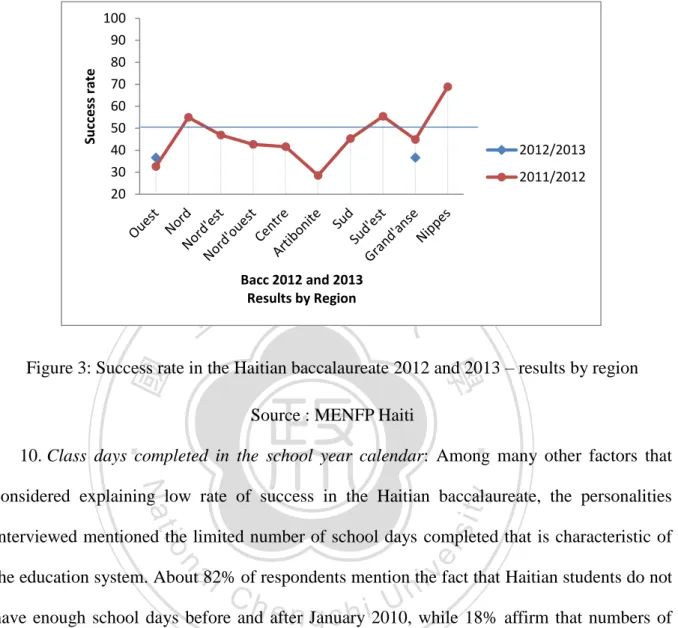
(7) 1.7.7. Conceptual Framework......................................................................................... 10 1.7.8. Organization of the Paper ..................................................................................... 11. Chapter 2 Review of the Literature about Education in Haiti ........................................... 12. 2.1.. Library of the U.S. Congress: Country Profile, May 2006 ...................................... 12. 2.2.. Study by Henriette Lunde ......................................................................................... 13. 2.3.. Attempts at Reforming Haiti’s Education System: The Challenges of Mending the. 立. 政 治 大. ‧ 國. 學. Tapestry, 1979-2004 ............................................................................................................. 14. ‧. Education in Wake of Natural Disaster_Vallas Report II Haiti ................................ 15. 2.5.. The Haitian Diaspora & Education reform in Haiti: Challenges & Recommendations. sit. n. al. er. io 17. y. Nat. 2.4.. Ch. engchi. i n U. v. Chapter 3 Challenges for the GOH and the IDB in the Sector .......................................... 20. 3.1.. Challenges in Building Partnership with Haiti in General ....................................... 20. 3.2.. Challenges for the IDB ............................................................................................. 22. 3.3.. Challenges for the Education Sector ........................................................................ 22. Chapter 4 Education in Haiti A Priority for the GOH and IDB ........................................ 25. v.
(8) 4.1.. General Overview of the Partnership between the IDB and the LAC Countries ..... 25. 4.2.1. IDB’s Overall Involvement in Haiti ..................................................................... 25 4.2.2. IDB’s Commitment in the Education Sector in Haiti ........................................... 28. 4.2.. Education a Sector of Priority for the GOH ............................................................. 30. 4.2.1. Education at the Early Age of the State of Haiti................................................... 31. 政 治 大. 4.2.2. Current Focus on Education in Haiti .................................................................... 31. 立. ‧ 國. 學. Chapter 5 Situation of Education in Haiti before January 2010 Earthquake .................. 34. Situation of the Sector before January 12 Earthquake ............................................. 34. 5.2.. Assessment of the reforms in the sector of education before January 2010............. 36. ‧. 5.1.. io. sit. y. Nat. er. 5.2.1. The Bernard Reform ............................................................................................. 36. al. n. v i n The National Plan onCEducation h e n gandc hTraining i U (NPET) of 1997 .......................... 38. 5.2.2.. 5.2.3. The Presidential Commission for Education in Haiti of 2008 ............................. 38. Chapter 6 Situation of Education in Haiti: Context Post-Earthquake.............................. 39. 6.1.. Haiti: Overall Dynamism in the Context Post-Earthquake ...................................... 39. 6.1.1. Dynamic IDB and the GOH in Education ............................................................ 39 6.1.2. Redefinition of the Partnership with the IDB ....................................................... 40. vi.
(9) 6.1.3. The Operational Plan of 2010-2015 ..................................................................... 40 6.1.4. Project HA-L1049: Support for Haiti's Reconfiguration of the Education Sector 41. 6.2.. Assessment of the Results under the New Dynamism in the Sector ........................ 42. 6.2.1. Assessment of “Quality Teacher” ......................................................................... 43. 政 治 大. 6.2.2. Assessment of “Quality Tools” ............................................................................. 45. 立. 6.2.3. Assessment of “Quality Environment” ................................................................ 46. ‧ 國. 學. Chapter 7 Conclusion and Propositions to Achieve Quality Education in Haiti .............. 53. ‧. Quality Teachers ....................................................................................................... 54. 7.2.. Quality Tools ............................................................................................................ 59. n. al. er. io. sit. y. Nat. 7.1.. 7.3.. Ch. engchi. i n U. v. Quality Environment ................................................................................................ 60. Reference ................................................................................................................................. 65. Appendix ................................................................................................................................. 69. vii.
(10) List of Figures and Tables Figure 1: IDB’s Investment in Haiti over the last 5 years (source: IDB Website) ................... 27 Figure 2: IDB’s Commitment for Education in Haiti ............................................................... 29 Figure 3: Success rate in the Haitian baccalaureate 2012 and 2013 – results by region .......... 50. Table 1: 2010-2011 Disbursements to Haiti ............................................................................. 26. 政 治 大. Table 2: Overview of the areas of IDB support for the operation plan 2010-2015 .................. 41. 立. Table 3: Success rate in the Haitian baccalaureate 2012 and 2013 .......................................... 49. ‧. ‧ 國. 學. n. er. io. sit. y. Nat. al. Ch. engchi. viii. i n U. v.
(11) List of Acronyms and Abbreviations CAP Teaching Support Center CFEF Training Center for Fundamental School CIDA Canadian International Development Agency CLIO Commission Education du Cadre de Liaison Inter-ONG CONATEL National Council for Telecommunications. 政 治 大. CSNA National Committee for Food Security. 立. CSU Country Strategy Updated. ‧ 國. 學. DGS Direction du Genie Scolaire EFA Education for All. ‧. EFACAP Fundamental Application Schools and Pedagogical. Nat. sit. y. ENI National School for Teacher. n. al. i n U. FAO United Nations Food and Agriculture Organization. Ch. engchi. FEMA Federal Emergency Management Agency FNE National Fund for Education FONHEP Foundation for Private Education GOH Government of Haiti. GTEF Presidential Commission on Education and Training IDB Inter-American Development Bank IHRC Interim Haiti Recovery Commission INFP National Institute of Vocational Training MENFP Ministry of National Education and Professional. ix. er. io. FAES Economic and Social Assistance Fund. v.
(12) MINUSTAH United Nations Stabilization Mission in Haiti NPET National Plan on Education and Training ONAPE National Office for Partnership in Education PAR QUE Support Program to Strengthen Quality Education PHARE Programme Haïtien d'Appui à la Réforme de l'Education PSUGO Program for Universal Free and Obligatory Education SSRC Social Science Research Council. 政 治 大. UNESCO United Nations Educational Scientific and Cultural Organization. 立. USAID United States Agency for International Development. ‧. io. sit. y. Nat. n. al. er. WB World Bank. 學. ‧ 國. UNICEF United Nations Children's Fund. Ch. engchi. x. i n U. v.
(13) Chapter 1 Introduction and Conceptual Framework In the words of the Delors Commission (UNESCO, 1996) “Education is at the heart of both personal and community development; its mission is to enable each of us, without exception, to develop all our talents to the full and to realize our creative potential, including responsibility for our own lives and achievement of our personal aims.”. 治 政 大 (World Bank, 2011). Indeed, promote socioeconomic development and to fight poverty 立 looking at the recent history of the world economy, the countries that have successfully Education is known as one of the important pillars that a country should focus on in order to. ‧ 國. 學. achieved economic development over the last 50 years have based their development on. ‧. education. The examples of Japan and other Asian countries like Taiwan are undeniable evidences of the impact that education can have on bringing development and raising up a. y. Nat. er. io. sit. nation economy. At the light of these examples we say that through education, Haiti, the poorest country of the western hemisphere has a chance to break the cycle of poverty that has. n. al. Ch. i n U. v. maintained its people into an unacceptable life condition for more than two centuries of independence.. engchi. Such observation constitutes the main reason why the Government of Haiti (GOH), supported by donors of the international community, has emphasized on rebuilding the education sector in Haiti particularly after the January 2010 earthquake. This disaster marked a turn on the will manifested by the GOH’s partners to finance a massive action plan for the sector. However, many are concerned that despite huge efforts made since the earthquake, the sector still lack of performance and the actions taken to build quality education continue to suffer from the. 1.
(14) same problems that have hindered the effectiveness of previous interventions implemented before January 2010. This concern about the education sector is considered in this paper.. 1.1.. Why This New Study in Important for the Sector?. Since the January 2010 earthquake in Haiti, the Government of Haiti (GOH) has recognized the need to focus on education as one major pillar to carry socioeconomic development and to reduce inequality in the country. Supported by donors’ partners in the international. 政 治 大 achieve quality education. However, despite the new dynamism and the importance of the 立 communities, the GOH has established a national development plan for education that aims to. ‧ 國. 學. investment to be directed in the sector mainly after the January 2010 earthquake, many doubt of the likeliness of achieving the goals targeted. So, given the importance of education for the. y. sit. What New Contribution This Study Will Bring to the Existing Literature on theaMatter?. er. io. 1.2.. Nat. the plan in order to propose areas for improvement.. ‧. country’s development process, it is necessary to continuously evaluate the progress made in. n. iv l C n The existing literature on educationhine Haiti trends ito evaluate n g c h U the quality of the results made in regards to the reforms undertaken in the sector. Although many observations of failure and low performance in the sector, the propositions to rebuild education continue to consider implementing plans that are based on same old principles: a strong dependency upon external funding; a lack of participation of local communities in the decision processes.. This study rather considers a modification of the plans for education by orienting the strategies toward a public-private and local partnerships. Then the adapted plan should. 2.
(15) address the issue of funding for education plan in Haiti, and also the country’s ownership of the process, although collaboration with international donors is needed at the initial phase.. 1.3.. What Is Quality Education?. Quality education is knowledge and guidance that gives people the opportunity to adequately develop their skills and abilities in a way that translates to becoming a productive member of society. A quality education allows people to realize their potential in a way they would not. 政 治 大 benefiting society in some way (Unite For Quality Education, 2014).’’ 立. be otherwise able to. It should allow people to realize their personal goals while also. ‧ 國. Criteria to Assess Quality Education. 學. 1.4.. The criteria for quality education take into consideration the relevant aims of education which. ‧. focus on developing the right environment to achieve learning effectiveness. Hence, the three. y. Nat. sit. pillars used to assess quality education in this paper are defined according to the organization. er. io. Unite for Quality Education. They are:. al. n. v i n C himportant educational Quality teachers: the most e n g c h i U resource and a critical determinant. 1-. of quality 2- Quality tools: Appropriate curricula and inclusive teaching and learning materials and resources, including ICT (Information and Communication Technologies) 3- Quality environment: Supportive, safe, and secure facilities enabling teachers to teach effectively. 1.5.. Limitations of the Study. This study is limited by the difficulty to access sufficient data relative to the education sector in Haiti. The matter of data availability is one of the concerns that researchers in the sector 3.
(16) always identified and it is due to the fact that the country has never been able to implement its plan to create an information system to manage statistics of education. In such case, the study relies on statistics collected through different online sources and other third parties in the sector such as the UNICEF, the World Bank, the IDB, but also interviews with key stakeholders of the education sector in Haiti.. 1.6.. Scope of the Study. 政 治 大 implemented to achieve quality of education. It will also explore different perspectives to 立. The paper will look at the evolution of the Haitian education sector through actions. ‧ 國. 學. achieve such goal by looking at what is doing elsewhere and trying to duplicate to certain extend strategies that works for other countries. This paper addresses the issue of building. Nat. y. General Overview on the Education Sector. sit. 1.7.. ‧. quality education in Haiti mainly with a management perspective.. n. al. er. io. Education in Haiti is evaluated with poor performance in terms of its openness to the largest. i n U. v. and poorest portion of the population; but also in its role to provide the population with the. Ch. engchi. proper formation that fits the development needs of the country.. The Haitian constitution of 1987 recognizes education as a human right. In theory, the GOH is required by law 1 to provide every child born in Haiti with nine years of free basic education, without costs for books or other materials. However, over the last 20 to 30 years, education has remained a privilege that only a small portion of the population could afford. In Haiti, the cost of education at all level is on the families who spent up to half their income to send their children to school (McNulty, 2011). 1. Haiti Constitution of 1987 in Article 32. 4.
(17) According to a study conducted by Bruemmer2 an inordinate number of children do not have the opportunity to enjoy the same privilege (Bruemmer, 2011). At the time of the study, of the approximately three to 3.5 million school-age children in Haiti, 800,000 do not have access to education. This situation is mainly due to the fact that Haitian public schools have the capacity to serve only one quarter of the school-age population (The World Bank, 2006). Even before the January 12 earthquake, 25 percent of Haiti‘s school districts, mostly in rural areas, did not have a school. Due to these challenges, the average Haitian child receives only. 政 治 大. five years of education (Bruemmer, 2011).. 立. 1.7.1. Structure of the Education System in Haiti. ‧ 國. 學. Education in Haiti begins informally at pre-school and is formally followed by nine years of. ‧. compulsory education, divided into three cycles (6 years of primary school and 3 years of. sit. y. Nat. fundamental school). The next step is the secondary education comprising four years during. io. er. which students have the option of a vocational educational programs or a traditional academic. al. college preparation. After the secondary education, students are illegible for accessing the. n. v i n C over higher education level which range years based on the course of study. h e various ngchi U. The system is regulated by the Ministry of National Education and Professional Training (MENFP) which has a representative office in most regions of the country and this entity rules both the public and private schools in the country.. Indeed, the system comprises three categories of schools categorized by the orientation of the owners. They are: public schools, non-profit schools and for-profit schools. 2. Bruemmer, 2011. 5.
(18) 1.7.2. Partnership in the Sector The institutional weaknesses and the lack of resources available for the GOH to carry out the changes needed in the education sector were partially compensated for many decades by the contribution of partners in the international community. This partnership in the sector has evolved in a dynamic area of collaboration between the government of Haiti (GOH) and its partners (local and international).. 政 治 大 counts among its partners several bilateral and multilateral actors like the United States of 立. For the most important in terms of contribution3 and presence in the sector, the GOH. ‧ 國. 學. America through the USAID program, the United Nations through the UNICEF, the World Bank and the Inter-American Development Bank (IDB).. ‧. 1.7.3. Partners Overall Contribution in the Sector. y. Nat. sit. Through the partnership built with the GOH, these partners have contributed to some extend. n. al. er. io. in providing better education in Haiti. The main objective is to create a free and quality education accessible for all Haitians.. Ch. engchi. i n U. v. The United Nations Children's Fund (UNICEF), acting on behalf of the United Nations Organization, has long history of partnership with Haiti and the organization continuously contributes in improving school infrastructures in the country but also training for teachers and other workers in the sectors. As a former employee of the Ministry of National Education, I personally had the opportunity to benefit from training provided by the UNICEF through its online platform.. 3. Haiti PDNA 2010. 6.
(19) The USAID is another contributor to the sector. This organization supports the GOH in strengthening its capacity control over the sector. This support is made effective through programs and projects like the PHARE4 which is the Haitian Program for the Reinforcement of the Education Sector.. The World Bank is another major actor in the sector. This organization has initiated since 2006 in collaboration with the government of Haiti (GOH) and other partners of the. 政 治 大 accessibility for all Haitian to education. 立. international community the program “Education for All (EFA)” which intended to open. ‧ 國. 學. The Inter-American Development Bank is nowadays an important piece in the project for rebuilding the education sector in Haiti. After the dramatic earthquake that stroke down the. ‧. country in January 2010, the IDB has committed to provide a substantial US250 million. y. Nat. 1.7.4. Overall Performance in the Sector. al. er. io. sit. dollars to support the sector over 5 years with an annual disbursement of 50 million.. n. v i n Cmeets Building an education system that standards in terms of quality is of a h e ntheginternational chi U concern for the GOH and also for its partners involved in the sector. So far when compare to these standards, overall performance in the sector is poor and has always been. With a literacy rate5 averaging 53 percent, Haiti has the lowest rate in the whole Latin America where literacy rate turns around 90 percent. Almost unanimously, all the reports and studies conducted in the sector to assess the quality of education in Haiti make the same observation that education standard in in the country is very low (Library of the US Congress, 4. Programme Haïtien d'Appui à la Réforme de l'Education. 5. Appendix 2: Illiteracy by age group, gender, and geographical situation. 7.
(20) 2006). Most issues identified in the sector are related to the lack of infrastructures suitable to deliver proper education to the public; also the qualification of the human resources like teachers is pointed out as areas to improve in the system. Other major issues are related to the severe shortage in educational supplies of teachers even under-qualified in many areas of the country particularly in the rural areas where the lack of state’s representation in terms of schools facilities is still a fact. That situation leaves the population in these regions with no way to access education. Although many efforts was made to increase access to education,. 政 治 大. particularly with the support of partners of the international community, the situation has not. 立. changed consequently. ‧ 國. 學. 1.7.5. Observation and Main Hypothesis of the Paper. ‧. Even with the support of the IDB after January 2010, the actions implemented in the sector by. y. sit. io. n. al. er. education.. Nat. the GOH lack of effectiveness in building a quality education with free access to basic. i n U. v. International assistance to the education sector in Haiti has been a story of mixed results. Ch. engchi. during the past 20 to 30 years. As one of the major players and partners of the GOH in the sector, the IDB’s performance has suffered from the same problems that have hindered the effectiveness of the interventions implemented in the sector.. The need for a different approach that calls for both GOH and IDB to readapt actions plan to availability of resources and country’s context is an essential step toward an optimal use of the resources to be directed at the sector during the next 10 years and to effectively create quality education.. 1.7.6. Research Methodology 8.
(21) The method used for this paper is a mixt of qualitative analysis and empirical statistics. In the case of Haiti where availability of data for education is deficient, this combination is necessary when it comes to evaluate the action plans and the results achieved in the sector. Also a gap analysis is used as complement of analysis to assess and compare how effectively the goals for the sector are achieved in different contexts. Based on the observations made, the paper draws propositions about actions to take in building quality education in Haiti. These propositions derive from interviews realized with stakeholders of education in Haiti but also. 政 治 大. from observations of achievements in other countries like Taiwan.. 立. ‧ 國. 學. The study borrows the concept of “adaptation” that derives from the framework developed by Michael T. Hannan and John Freeman to explore the ways that actions conducted in the sector. ‧. can achieve results more effectively.. y. Nat. sit. To assess the need for a reorientation of actions plan in the sector, but also to legitimate the. n. al. er. io. propositions made in the sense, this paper first focuses on assessing the environment of the. i n U. v. education sector in Haiti as an important element to understand, evaluated and propose areas. Ch. engchi. for improvement in the system. The environment of the sector is described with data collected from different online sources.. To assess the effectiveness of the actions taken to achieve quality education in the country, the paper produces a gap analysis*6 by comparing the situation of the sector before and after the January 2010 earthquake in the country. The criteria to evaluate quality of education are those used by the organization Unite for Quality Education which considers three pillars for. 6. * The gap analysis is based on data collected through interviews with some key resources of the Haitian. Ministry of National Education.. 9.
(22) this matter:. quality teachers, quality tools and quality environment. Then, the paper refers to. effectiveness not only as the results achieved while pursuing the goals targeted but also by addressing the issue of the sustainability of the process.. 1.7.7. Conceptual Framework Researchers Hannan and Freeman (Bert Markgraf, 2014) refer to the fact a natural measure of the effectiveness for an organization is how well it achieves its goals which is indicated by the. 政 治 大 the concept of organizational ecology (Bert Markgraf, 2014). Hannan and Freeman argue that 立 measure of its performance, they develop the Theories of Organizational Effectiveness using. ‧ 國. 學. the environment in which an organization operates is the key elements that influence its organizational effectiveness.. ‧. According to the theory, to understand the environment it is important to assess the internal. y. Nat. sit. and external constraints the organization faces. The effective organization is the one to deliver. er. io. adequate performance given these challenges in the environment (E.g. location, actors, etc.).. al. n. v i n Ch In order to achieve an adequate performance facing such environmental challenges, the e n gwhile chi U organization must learn how to adapt its ecology to the given environment when using the available resources. For instance when the organization is lacked of financial resources to implement the optimal solution, it must develop other alternatives by implementing less expensive solutions. When the problem is the deficiency of the human capital used in the organization, training the people is an alternative way to carry effective solution; etc.. In the light of this theory, the present paper will identify alternative actions that can be implemented to achieve quality education in Haiti given all the constraints this sector faces. These issues will be further addressed in chapter 3. 10.
(23) 1.7.8. Organization of the Paper This new research paper on the education sector in Haiti is built in 7 chapters, which are divided basically into two portions. The first portion pictures the environment of education in Haiti, it comprises in chapter 1 to 5 that are built with data collected from different sources. The second portion regroups chapter 6 and 7 that reveal the main contribution of this paper to the existing literature on the topic. This contribution is brought through the gap analysis on which relay the propositions made to rebuild Haiti’s education sector.. 政 治 大 Chapter one presents an introduction to the paper and it highlights the conceptual framework 立. ‧ 國. 學. of the document. It responds to questions such as: Why this new study in important for the sector? What contribution this study will bring to the existing literature on the matter? What is. ‧. quality education and what are the criteria that are used to assess the concept? What are the. sit. y. Nat. limitations of the study? What is the scope of the study? It gives a general overview of the. io. er. education sector in Haiti that considers: the structure of the sector; the partnership in the. al. sector; Partners overall contribution in the sector; overall performance in the sector;. n. v i n C ofh the paper; the U observation and main hypothesis e n g c h i research methodology and conceptual framework of the paper; and the organization of the paper.. Chapter two presents a review of the literature on education in Haiti. Chapter three highlights the challenges for GOH and the IDB in the sector. Chapter four reviews the education sector as a priority for the GOH and the IDB. Chapter five assesses the situation of the sector before January 12, 2010. Chapter six presents the situation of education in Haiti in the context post-earthquake. Chapter seven draws the conclusion and propositions to achieve quality education in Haiti. 11.
(24) Chapter 2 Review of the Literature about Education in Haiti Although the education has been recognized as a priority by the successive governments in Haiti, the actions plan taken in order to open access to quality education to the populace have not helped achieving successfully these goals. From this observation, we have built the main hypothesis that supports this paper: “The need for a different approach that calls for both GOH and IDB to readapt actions plan. 治 政 大 step toward an optimal use of to availability of resources and country’s context is an essential 立 the resources to be directed at the sector during the next 10 years and to effectively create ‧ 國. 學. quality education.”. ‧. The five studies reviewed in this section confirm the observation made and they also attempt. Nat. io. sit. y. to support the main hypothesis:. er. 2.1. Library of the U.S. Congress: Country Profile, May 2006. al. n. v i n The “Haiti Country Profile” ofC the U Congress is a research paper that h Library e n g cof hthei US assesses the state of the socio-economic evolution of the country. Among other sectors analyzed, the document portrayed the state of the education sector in Haiti. The document assesses the quality of the education in Haiti in comparison to international standards. The research concludes that education standards in Haiti are extremely low as the country has the lowest literacy rate in the Caribbean and Latin American regions.. 12.
(25) It emphasis the fact that although many progresses were made to improve the situation of the sector, the country still faces severe shortages in educational supplies and qualified teachers, and the rural population remains vastly underrepresented in the country’s classrooms.. It also points out the lack of presence of the GOH as provider for this service. Indeed, most Haitian schools are private rather than state-funded. International private schools (run by Canada, France, or the United States) and church-run schools educate 90 percent of students.. 政 治 大. Many of the factors revealed within the framework of this study were further investigated. 立. with the study by Henriette Lunde who focused more specifically on the “Incentives,. ‧ 國. 學. vulnerability and constraints” that tend to explain how and why the system has failed in several respects.. ‧ sit. y. Nat. 2.2. Study by Henriette Lunde7. er. io. “Youth and Education in Haiti” is a research paper by Henriette Lunde that has identified the. al. v i n C h year; the study cause them to drop out during the school e n g c h i U has also identified the factors which n. main factors which prevent children from being enrolled in school, the circumstances which. makes children more prone to fail their exams and hence to have to repeat or drop out.. The document has also explored the incentives and disincentives to education by looking at the state of the Haitian education sector; the weak public education sector; the lack of physical access to education. It has also analyzed the vulnerabilities and constraints in the sector particularly in regards to school expenditures; prioritizing within the household;. 7. ISSN 0804-5135. 13.
(26) non-enrolment and dropouts in rural areas; dropouts in urban areas and the importance of personal connections. Through the analysis, the author has clearly confirmed the fact that the situation of the sector is a reason for grave concern, both for the GOH and its partners of the international community (Lunde, 2008). Such a concern has led to several attempts at reforming the sector.. 2.3. Attempts at Reforming Haiti’s Education System: The Challenges of Mending the Tapestry, 1979-20048. 立. 政 治 大. This is a paper on education in Haiti written by Marc Prou of the University of the. ‧ 國. 學. Massachusetts, USA.. ‧. The paper has highlighted the nature and degree of the social and economic disparities characteristic of the Haitian society that led to the first official attempt to reform the education. y. Nat. er. io. sit. sector in the country: The Reform Bernard. It has also elaborated on the continuing struggle that the Haitian state faces in establishing the compulsory and free system of education as it is. n. al. Ch. mandated by the country’s constitution.. engchi. i n U. v. In this document, the author has associated the massive opening of private schools, both lay and religiously-oriented, as a response to the failure of the GOH to deliver on its constitutional guarantees to respond to the educational needs of the populace.. The paper has also analyzed the everlasting contrast between urban and rural public education in terms of curricula, educational outcomes, and student populations; the gap in terms of quality of education delivered by public schools versus private schools; the decadence of the. 8. Marc Prou, January 2009. 14.
(27) schooling system with few exceptions by certain religious schools affiliated to the Catholic or Protestant churches.. In fact, the research has pointed out such factors as visible signs to prove that the system needed more than superficial repair of its tapestry. The need for change has been even more evident after the occurrence the January 2010 earthquake in Haiti, as it was observed by Paul Vallas in the report “Education in Wake of Natural Disaster”.. 政 治 大. 2.4. Education in Wake of Natural Disaster_Vallas Report II Haiti9. 立. Education in Wake of Natural Disaster is a report on the situation of the education sector in. ‧ 國. 學. Haiti written by Paul Vallas with Theresa Pankovits and with an Introduction by Elizabeth. ‧. White. This document is available from the “Program on America and the Global Economy” platform managed by the Woodrow Wilson International Center for Scholars.. sit. y. Nat. er. io. The paper has explored the challenges for educational reforms in Haiti, before and after the. al. v i n Ch situation and lessons learned in rebuilding e n g education c h i Usystem in other n. earthquake that has devastated the nation in 2010. It has formulated advices based on the parts of the world. particularly after natural disaster. For instance it has considered the case of post-earthquake Chile and post-Hurricane Katrina New Orleans as two examples of success in systems impacted by natural disasters. In this paper Vallas has mentioned that the problems with Haiti’s education system begin with its foundational structure. The Ministry of National Education and Training (“MENFP”), responsible for regulating the education system, is overextended and under-resourced. The. 9. ISBN: 978-1-938027-29-1. 15.
(28) MENFP does not provide funding for the majority of the schools, and therefore has little control over them. With regard to private schools, few teachers receive training in education and many of these schools operate without a license from the MENFP. These schools are out of control of the reach to the vast majority of Haitians who live below the poverty line.. The paper has also pointed out the fact that there were prolific discussions and disagreements on both the causes of the failure of the massive amounts of development aid to make. 政 治 大 the problem related to education in the country. As regards to perspectives for future reforms, 立 significant progress in Haiti. The study has concluded by acknowledging the complexity of. ‧ 國. 學. it has argued that if substantive, measurable progress is going to occur in the education sector, which is critical for securing international and Diasporas support, certain steps must happen. ‧. prior to that. It must begin with strengthening the Director General’s office, developing the. io. n. al. er. authority, and creating the international fundraising entity10.. sit. y. Nat. national curriculum, coordinating and aligning teacher training, establishing a facilities. i n U. v. The issue of securing international supports to the sector, particular support from the Haitian. Ch. engchi. Diasporas, has motivated the study on “The Haitian Diaspora & Education reform in Haiti: Challenge and Recommendations” co-authored by Wendy L. Carlson, Alison Desir, Stephanie Goetz, Seunghee Hong, Sheena Johns and Juontel White.. 10. Education in the Wake of Natural Disaster, Paul Vallas, p.55. 16.
(29) 2.5. The Haitian Diaspora & Education reform in Haiti: Challenges & Recommendations11 This research was commissioned by the Bureau of Haiti's Special Envoy to the United Nations and the Social Science Research Council (SSRC). It aims to identify the ways that Haitian living abroad (the so called Diaspora) can impact positively the development in the country through education.. 治 政 大 in Haiti‘s education system and to capacity of the US-based Haitian Diaspora to affect change 立 determine best practices for uniting their technical knowledge as well as intellectual and. The authors have considered the challenges of the education sector in Haiti, and analyzed the. ‧ 國. 學. financial resources. To achieve this goal, they have directed recommendations toward. ‧. Diaspora organizations, the GOH, and the international community. The main recommendations were as follows:. sit. y. Nat. er. io. Recommendations for the Haitian Diaspora. al. n. v i n 1. Work towards creating aC strong Diaspora advocacy group that may influence public hengchi U. opinion on education and education policy in Haiti.. 2. Work towards creating a central database of Diaspora individuals and organizations working in Haiti in the private and public education sector.. Recommendations for the Haitian Government 3. Explore ways of incentivizing Diaspora involvement in Haiti‘s education sector. 11. Wendy L. Carlson & Stephanie Goetz, School of International and Public Affairs, ColumbiaUniversity, May. 2011. 17.
(30) 4. Bolster the financial and programmatic capacities of the Ministry of Haitians Abroad.. 5. Streamline the NGO registration process.. 6. Establish an electronic tracking system to monitor all NGO activity in Haiti.. 7. Establish and enforce education standards.. 8. Increase planning for education activities.. 政 治 大 Recommendations for the International Community 立. ‧ 國. 學. 9. Ensure efficiency of education projects and assess their impact.. ‧. 10. Provide financial and human resources that support the education efforts of the. io. sit. y. Nat. Haitian government.. n. al. er. 11. Augment funding for education efforts, particularly in tertiary education and training.. Ch. engchi. i n U. v. The documents presented in this section mainly describe the situation of the education sector in Haiti particularly in terms of the lack of quality of the service offered and the challenges to rebuild the sector. In regards to the actions needed to improve the sector, the proposition made mainly turn around a similar logic of identifying external sources of funding for the sector; although many doubt of the ability of the GOH and the will of its international partners to rise the $US4.2 billion estimated needs for the rebuilding, given the international context of economic crisis that limits the capacity of the main fund providers.. 18.
(31) The present study explores the subject through a different perspective. It tries to identify alternatives strategies to rebuild the sector; it mainly focuses on identifying internal sources of funding while considering the best ways to integrate into a locally owned strategy the support from the international community via the partnership Haiti-IDB in the education sector.. Since education has been recognized has one of the main priorities for the GOH and the IDB after the January 2010 earthquake, it is importance to understand whether or not the resources. 政 治 大 In order to assess the effectiveness of actions taken in pursuing quality education, the study 立 directed toward the sector after the January 2010 has contributed to achieve quality education.. ‧ 國. 學. compares the state of the sector before and after January 2010.. Similarly to the studies reviewed in this section, the present points out the challenges in the. ‧. sector that limit the impact of the actions plan elaborated and implemented by the GOH with. y. Nat. sit. the support of the IDB. However, the study differs from the others as it identifies distinct. n. al. er. io. ways to improve the effectiveness of actions taken to enhance quality education; it also. i n U. v. focuses on specific areas of intervention among all other priorities for the sector.. Ch. engchi. The main contribution of this new study comes with the propositions made to redesign the school map and the national program for education.. 19.
(32) Chapter 3 Challenges for the GOH and the IDB in the Sector Haiti faces challenges of all kinds that always impacted its development process. These challenges not only affect the plans made by the GOH but also its partnership with other stakeholders in the sector.. 3.1. Challenges in Building Partnership with Haiti in General. 政 治 大 the country development plan the concern for the protection of the environment. Nowadays, 立 Environmental: Over the last fifty years, the Haitian authorities have neglected to integrate in. ‧ 國. 學. the country’s environment is one of the most affected in the Caribbean with the lowest forest coverage in the region. With more than 60% of forest coverage in 1923, the country had. ‧. maintained less than 2% of its vegetation in 2006 (Wikipedia, 2014). Facing such. sit. y. Nat. environmental issues, the country remains highly vulnerable and it continuously experiences. io. er. the destruction of its agricultural plantations, houses and other infrastructure in rain season. This situation contributes in weakening the country’s economy and it nourishes the cycle of. n. al. poverty of its people.. Ch. engchi. i n U. v. Political: Haiti experiences a recurrent political instability that has contributed in large part to weaken the country system. As a consequence of this situation, the GOH is seen by many local or international stakeholders, as a partner with none or limited credibility.. This. perspective explains why external aids to the country tend to bypass the government and the country system but rather channeled through international organizations or NGOs.. 20.
(33) Institutional: The government of Haiti (GOH) has failed to build a public administration system that has the ability to offer decent services of any kind to the citizens. The institutional problem of the country is reflected even in the capacity of the GOH to collect its taxes. Socio-economic: Haiti is one of the poorest countries in the western hemisphere. In Haiti, 78% of the population lives in poverty with less than $2 a day and over half lives in extreme poverty with less than $1 a day (IHSI, 2011). This cycle of poverty in the country not only has. 政 治 大 sufficient resources from collection of taxes to finance GOH’s projects directed toward the 立 an impact on the household, but also directly affects the capacity of the government to raise. ‧ 國. 學. country’s development process.. Relations with donors: Haiti has developed a relation of strong financial dependency vis-à-vis. ‧. its partners of the international community. Through this cooperation, both the GOH and the. y. Nat. sit. international community are facing the challenge of implementing short-term projects that. n. al. er. io. respond to the population’s immediate needs, and boost public and investor confidence while. i n U. v. ensuring that these projects fully fit into the long term development plan for the country. In. Ch. engchi. one hand, the GOH continuously criticizes the donor community for not dispensing funds quickly enough and it also frustrated that foreign aid is provided primarily through nongovernmental organizations (NGOs) rather than directly to the government. In the other hand, the partners in the donor community are affected by different economic crisis and they tend to reduce their commitment vis-à-vis the country; the partners also point out the political instability in the country that is traduced by the incapacity to organize the elections that aim to renew and to legitimate the country’s political authorities; they also worried about the lack of. 21.
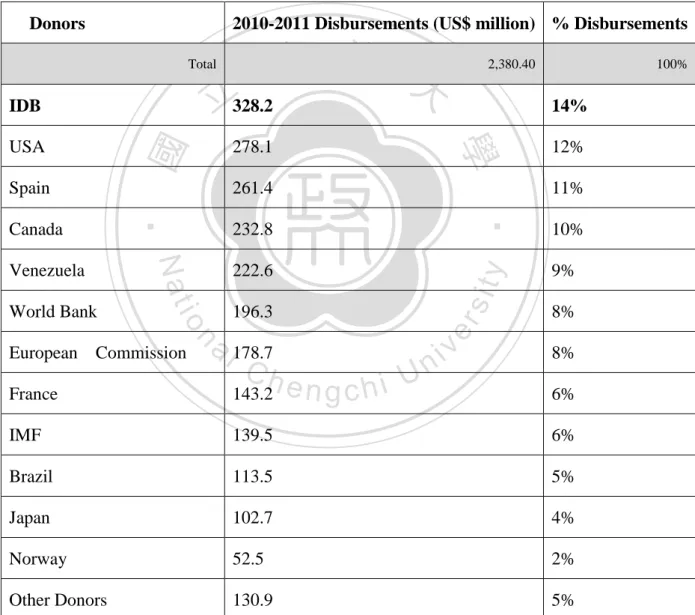
(34) Haitian capacity to design and implement programs, as well as corruption that is a major concern for this partnership (Taft-Morales, 2013)12.. 3.2. Challenges for the IDB Achieving successfully the plan to rebuild the education sector in Haiti is crucial for the credibility of the bank and its capacity to raise fund on behalf of the country. Indeed, IDB’s grant to Haiti is part of the non-for profit activity of the bank, and it is rather based on the. 政 治 大 these partners have relied onto multiple entities particularly NGOs involved in the country to 立. co-financing of the country's partners of the international community and the IDB. Originally,. ‧ 國. 學. channel their aids to the sector (Taft-Morales, 2013). But facing the issues related to the ineffectiveness in terms of results achieved, the donors have manifested their will to finance. ‧. the country by rechanneling the aids in a more effective way, and the IDB has been selected. sit. y. Nat. by the GOH as a reliable interface to lead the process. For this reason, the IDB is continuously. io. al. n. quality education.. er. under pressure and it has the obligation to show results in supporting the GOH to achieve. Ch. e nSector gchi 3.3. Challenges for the Education. i n U. v. This section reports on statistics collected by different entities interested in education in Haiti. These statistics help to understand the difficult condition in which the GOH and the IDB have to implement their conjoint plan for rebuilding the education sector.. Although education has been identified as one major pillar for the country development plan, the GOH’s investment in the sector has always been very low when compare to other partners. 12. Haiti Under President Martelly: Current Conditions and Congressional Concerns. 22.
(35) in the regions. The Haitian government spends approximately 2.5 percent of its gross domestic product in education compared to 5 percent in other Latin American countries (World Bank, 2007). Therefore, only 20 percent of all primary level students attend free, government financed public schools while 80 percent attend non-public schools financed by parents, religious associates, NGOs and other. Families living in poverty cannot afford to send their children to school. Overall, for those. 政 治 大 uniforms, textbooks and other supplies) averages 25 percent of per capita income (Ministry of 立 who can afford the price, the direct cost of schooling (registration, tuition, exam fees,. ‧ 國. aged students are not enrolled in school (UNICEF, 2010).. 學. Education and Professional Training 2010). As a consequence, only 50 percent of primary. ‧. It is widely acknowledged that the quality of education is below international standards and. y. Nat. sit. that the majority of students are enrolled in facilities which do not provide a suitable learning. er. io. environment (World Bank, 2007).. al. n. v i n Haitian adults have the highestC illiteracy of the Caribbean at 57 percent and Haitian h e n rate gchi U children tested well below their peers in other countries in achieving basic competencies in numeracy and literacy (IDB, 2010).. Curricula are outdated and in many cases inappropriate for over-age students who make up the bulk of the primary education population. 72 percent of children enrolled are at least two years older than they should be for their grade (IDB, 2010).. 23.
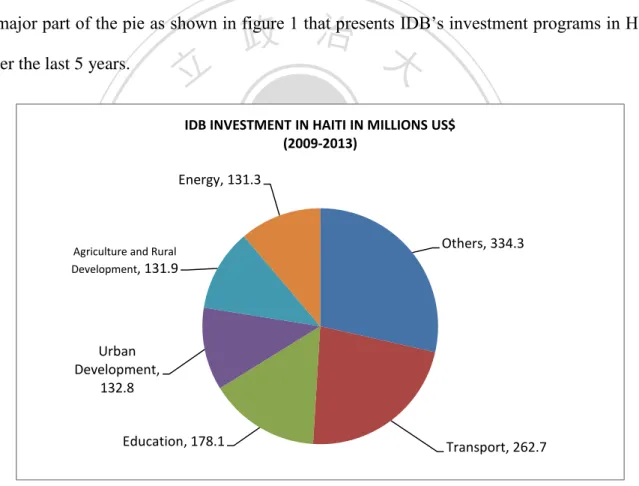
(36) According to UNICEF, approximately 30 percent of Haitian children attending primary school will not make it to third grade and of those who attend school, 60% of them will abandon school by sixth grade (UNICEF, 2008).. Quality of instruction is deficient in most private and public schools because of unqualified and unmotivated teachers. Approximately 75 percent of all teachers lack adequate certification or licensing; many have just a 9th grade or 12th grade education, with no teacher training at all (World Bank, 2007).. 立. 政 治 大. The system has not enough trained teachers to meet the demand. An estimated 10,000 new. ‧ 國. 學. teachers are needed nationwide when just 450 new teachers are certified each year. Teacher training programs have not benefited from any investments in at least a decade. Thus,. ‧. facilities are in bad shape, outdated teaching methods are emphasized and trainees lack the. y. Nat. er. io. (World Bank, 2007).. sit. materials they need to develop both theoretical and practical pedagogical competencies. al. n. v i n Just as if it were not enough, theCJanuary earthquake has contributed to worsening the h e n2010 gchi U situation. Approximately 50% of schools were destroyed and the educational sector as a whole sustained damages and destruction estimated at $478.9 million (GOH, PDNA, 2010). The earthquake destroyed or damaged an estimated 4,268 schools, training centers, institutions of higher education, and the building for the Ministry of Education (IDB, 2010).. For the overall, this is the situation in which the GOH and its main partner in education, the IDB are both committed into the difficult task of rebuilding a sector under-resourced and badly affected by the natural disasters of January 2010.. 24.
(37) Chapter 4 Education in Haiti A Priority for the GOH and IDB Education plays an important role among the various areas of intervention where the IDB focuses its efforts to promote socio-economic development in the Caribbean and Latin American Countries.. 4.1. General Overview of the Partnership between the IDB and the LAC Countries. 政 治 大. The Inter-American Development Bank (IDB) is a partner for development that continuously. 立. accompanies the Caribbean and Latin American countries (LAC) in their development. ‧ 國. 學. process. The bank operates since 1959 and since then it has become the leading source of. ‧. development financing in the region. More than a regular bank providing loans to its partners, the IDB also provides grants, technical assistance and do research and it has gained an. y. Nat. er. io. region.. sit. important reputation of being reliable and knowledgeable of the needs for development in the. al. n. v i n C hlong lasting partnership So far the bank has built a strong and e n g c h i U with the 26 Caribbean and Latin American countries and it is one the most important funds provider in the region particularly in Haiti where its operations continue to extend after the earthquake of January 2010.. 4.2.1.. IDB’s Overall Involvement in Haiti. Pursuing a partnership built over more than 50 years, the IDB is continuously supporting the Government of Haiti (GOH) in pursuing the country’s development goals. This collaboration has been strengthened after the earthquake of January 12, 2010 that has weakened the country economically occasioning a wave of interests from international partners to support the. 25.
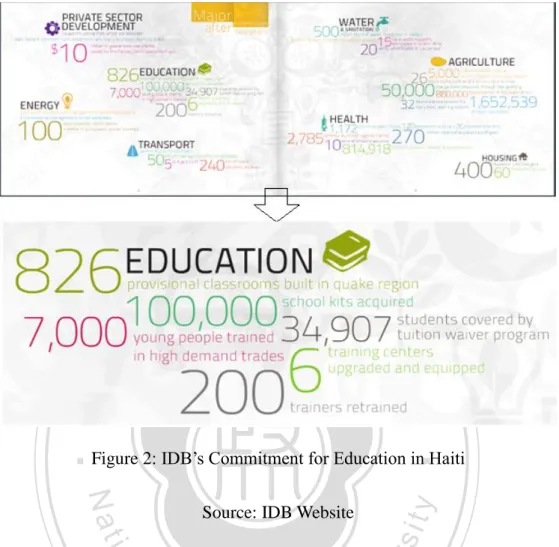
(38) country reconstruction. This dynamism has brought the IDB at a leading position as funds provider to the country right after the disaster with about 14% of the total funds disbursed in support to the country recovery efforts between 2010 and 2011. Table 1 presents the major donors to the country for the period 2010-2011.. Table 1: 2010-2011 Disbursements to Haiti Donors. 2010-2011 Disbursements (US$ million) % Disbursements. 政 治 大. Total. 2,380.40. 立328.2. France. 10%. 222.6. 9%. 196.3. 8%. a l 178.7 v i n Ch U 143.2 e n g c h i. n. European Commission. 232.8. y. io. World Bank. Nat. Venezuela. 11%. ‧. Canada. 261.4. 12%. sit. Spain. 278.1. er. USA. 14%. 學. ‧ 國. IDB. 100%. 8% 6%. IMF. 139.5. 6%. Brazil. 113.5. 5%. Japan. 102.7. 4%. Norway. 52.5. 2%. Other Donors. 130.9. 5%. Source: UN Office of the Special Envoy for Haiti (New York Conference Recovery Pledge Status) Data Updated as November 2011. 26.
(39) After the January 12, 2010 earthquake, the IDB pledged to provide Haiti more than $2.2 billion in grants over the next decade to fund its recovery efforts and long-term development plans. The Bank also cancelled all of Haiti’s outstanding debt and converted undisbursed loan balances into grants. Since the earthquake the IDB has approved $735.5 million in new grants and disbursed $501.9 million for Haiti (IDB, 2014)13. Among other sectors that benefit from IDB’s investments in the country, education represents. 政 治 大. a major part of the pie as shown in figure 1 that presents IDB’s investment programs in Haiti. 立. over the last 5 years.. ‧ 國. 學. IDB INVESTMENT IN HAITI IN MILLIONS US$ (2009-2013). ‧. Energy, 131.3. Nat. y. Others, 334.3. n. al. er. io. sit. Agriculture and Rural Development, 131.9. Urban Development, 132.8. Ch. engchi. Education, 178.1. i n U. v. Transport, 262.7. Figure 1: IDB’s Investment in Haiti over the last 5 years (source: IDB Website). 13. IDB Website: http://www.iadb.org/en/countries/haiti/hope-for-haiti,1001.html. 27.
(40) Over the period 2009-2013, the IDB has invested more than US$1,117 million in Haiti where education counted for US$178.1 million which represents about 15% of the total amount invested over this period.. 4.2.2.. IDB’s Commitment in the Education Sector in Haiti. The Inter-American Development Bank (IDB) has a long history of collaboration with Haiti in the education sector. This commitment to the sector has evolved in a different manner. 政 治 大. before and after the January 12 earthquake in the country.. 立. 4.1.2.1. Situation of the Collaboration before January 12 Earthquake. ‧ 國. 學. Before January 12 earthquake, the IDB was already involved in promoting the development. ‧. of a better education system in Haiti. However, the contribution made in the sector was. sit. y. Nat. mostly through sporadic projects conducted as answers to particular requests from the GOH.. n. al. er. io. In the case of Haiti, the first country strategy (CS) approved by the IDB in November 2007. i n U. v. has considered education among other sectors where IDB had to invest over the 5 years period. Ch. engchi. 2007-2011 (IDB, 2007). However, the bank focus on the sector has strengthened after January 2010 and the IDB has developed an action plan for the sector over longer period. 4.1.2.2. Situation of The Collaboration Post-Earthquake. 28.
(41) 立. 政 治 大. ‧. ‧ 國. 學. Nat. y. Figure 2: IDB’s Commitment for Education in Haiti. io. sit. Source: IDB Website. n. al. er. To cite Marcelo Cabrol, IDB’s Education Chief Division reacting on IDB’s involvement in. Ch. i n U. v. education in Haiti: “Broken school. Untrained teachers. Excluded kids. Education is Haiti’s. engchi. greatest development challenge. That’s why it’s a priority for the IDB”.. Indeed, the bank has recognized the will of the country to make of education one of the most important pillars in its post-earthquake development program. The bank’s commitment to accompany the GOH is traduced in the Country Strategy Updated (CSU) for Haiti which was elaborated right after January 2010. As it is specified into this CSU, the bank works closely with the GOH to shape the reform agenda for the sector where the goal is to gradually expand access to a quality and free education to all Haitians.. 29.
(42) Approved in December 2011, the bank’s new country strategy (CS) for Haiti was elaborated for the period of 5 years from 2011 to 2015. This collaborative document defines the actions to undertake by the IDB in its accompaniment to Haiti and it is based on the priorities set by the GOH and its partners into the Haiti’s Action Plan for Reconstruction and Recovery document (GOH, 2010). Therefore, the Country Strategy focus on six priority sectors: (i) education, (ii) private sector development, (iii) energy, (iv) water and sanitation, (v) agriculture, and (vi) transport (IDB, 2011).. 政 治 大 Based on this renewed country strategy, the IDB and the GOH raise high expectations on the 立. ‧ 國. 學. results to achieve in the sectors. According this CS, the main priority is to support the GOH’s strategy to rebuild an education system access for all Haitians with main focus on improving. ‧. quality education in the country; implementing significant reform in higher education and. sit. y. Nat. technical and vocational training.. n. al. er. io. Through its actions plan in Haiti, the IDB set up its priorities in the education sector and these. i n U. v. priorities intend to support the vision of the GOH in the sector.. Ch. engchi. 4.2. Education a Sector of Priority for the GOH Although limited by lack of resources to open access to quality education for all Haitians, Haiti through its successive governments has always set a high value upon education as one important pillar for its development process.. This focus on education was manifested since the foundation of the first black independent nation and continues to be one priority particularly after the devastating earthquake of January 2010.. 30.
(43) 4.2.1.. Education at the Early Age of the State of Haiti. The first Haitian constitution of 1801 has considered education as a need and that it would be ultimately the responsibility of the private sector to educate its youth. The constitution stated that, ―every person has the right to form private establishments for the education and instruction of youth (Haiti Constitution, 1801). However, with the revision of constitution in 1807, the practice of providing public education for all was established. Article 34 of the 1807 constitution establishes that, ―A central school shall be established in each Division and. 政 治 大. proper schools shall be established in each District (Haiti Constitution, 1807).. 立. ‧ 國. 學. In 1987, the GOH redrafted its constitution to include Article 22, which reads, ―The State recognizes the right of every citizen to decent housing, education, food and social security. ‧. (Haiti Constitution, 1987).. y. Nat. sit. However, many Haitians consider access to education a privilege they cannot afford despite. n. al. er. io. the 1987 constitution’ proclamation of education as a human right. The solution to this. i n U. v. situation is of a concern for the successive Haitian governments that reached the power over the last two decades.. 4.2.2.. Ch. engchi. Current Focus on Education in Haiti. After the departure of the president Jean Claude Duvalier in 1986, the new constitution of 1987 has been set to assess the new vision for the country and education is one of the focuses of this constitution. Despite the legal obligation made to the GOH to facilitate access to education to all Haitians, real progress in opening the sector to the most vulnerable and poorest fringe of the population, meaning more than ¾ of the citizen, will be made in the most recent years.. 31.
(44) Accessing the political power at the favor of the elections in 1990, the government of President Jean Bertrand Aristide will contribute in improving accessibility to education by opening new public schools in different regions of the countries. In 1997 the administration of René Préval passed a 10-year education plan, with the goal of universal access to quality schools; the share of education in the national budget increased from 9 percent in 1997 to 22 percent in 2000, which paid for programs to provide school lunches, uniforms, and bus transportation, etc. (Library of the US Congress, 2006). Under the leadership of René Préval,. 政 治 大. the GOH launches in partnership with the international community the program Education. 立. For All (EFA) in 2007.. ‧ 國. 學. The January 2010 earthquake that destroyed an important portion of the school infrastructures. ‧. in the department of Ouest and Sud’Est of the country has been considered by many and. sit. y. Nat. particularly the Haitian authorities as an opportunity to rebuild from scratch the education. io. er. sector in Haiti. The GOH and its partners in the sector wanted to play on the fact that the. al. earthquake has put Haiti under the spotlights of the world to collect sufficient funds to rebuild. n. v i n the C Haiti Committee h eReconstruction ngchi U. the sector. In this sense,. (IHCR) has considered. education as one pillar that should be integrated in the reconstruction plan for Haiti. An estimate of US4.2 billion dollars is the amount that was needed to be collected for the renewal of the sector.. Taking over the power in the course of the ongoing actions in the education sector, the administration of the actual president Joseph Michel Martelly understood the importance that education has to play in the reconstruction process. For this reason, his government has defined the priorities for his 5 years terms and with no surprise education is made one of the top priorities of his action plan.. In an April 20, 2011 press conference with US Secretary of 32.
(45) State Hillary Rodham Clinton, President-elect Martelly remarked on the priorities he had emphasized during his presidential campaign. He spoke briefly about his top three priorities, one of which is education (US Department of State, 2011).. 立. 政 治 大. ‧. ‧ 國. 學. n. er. io. sit. y. Nat. al. Ch. engchi. 33. i n U. v.
(46) Chapter 5 Situation of Education in Haiti before January 2010 Earthquake The assessment of the results achieved in the education sector in Haiti aims to evaluate whether or not the actions undertaken in the sector before the earthquake of January 2010 have helped to build an education system complying with the international standards of quality. The results of this analyst will be necessary to assess the effectiveness of the actions. 政 治 大. undertaken in the sector by the GOH and its partners particularly the IDB.. 立. ‧ 國. 學. 5.1. Situation of the Sector before January 12 Earthquake The constitution of the Republic of Haiti made obligation to the GOH to facilitate free access. ‧. to quality education to all Haitians14. However, during the years preceding the devastating. Nat. sit. y. earthquake of January 2010, the statistics recorded for the sector were similar to those of a. er. io. country facing war for a long period.. al. n. v i n Before the occurrence of the January C h12 earthquake, theUGOH has a very low control over the engchi education sector. This situation was due mainly to the fact that the GOH lacks of resources to either finance schooling activities in the country or enrolling sufficient and well qualified staff to look over the activities by other actors involved in the sector. This cycle leaded to a situation of a sector where state regulation is almost non-existent. As a consequence the lack of resources combined to a deficient regulatory system opened the way for an education sector where about 85% of school facilities were operated by. other. private. sector. counterparties. Moreover, the relative absence of the state in the education affairs in addition. 14. Haiti constitution of 1807, and revised constitution of 1987. 34.
(47) to low income level and a continuous impoverishment of the population made of education an expensive service only affordable for a small portion of the population. Indeed, studies conducted by the Haitian statistic authority IHSI15, showed that over that period households with school-aged members spent 14% of their income in education (IHSI, 2011). This cycle of poverty has contributed to worsening the statistics of the sector.. Starting the 2000 decade, the literacy rate among the youngest fringe of the population was. 政 治 大 around 91%, in Haiti only 55% of the population older than 15 years was literate. 立. very low. While other Caribbean and Latin American countries had a literacy rate turning. ‧ 國. 學. Similarly, statistics relative to school attendance for the young children were also low. Only 6 out 10 children aged between 6 and 11 years old attended school. The situation in the rural. ‧. er. io. sit. Nat. had 74% of children between 6 to 11 years to attend school.. y. areas was even worse with about 54% of the group attending school while in the urban areas. al. In terms of teachers, over the same period it was estimated that among the 45 thousand. n. v i n C h5 out 10 have received teachers serving in the system only e n g c h i U a secondary education and adding to that overall low salary in the system that made of this profession less attractive for many and particularly well-qualified human resources. Low salaries16, at approximately 60 USD per month, in both the public and private sector, result in high teacher turnover, in addition to many staff members not reporting to school on time and/or consistently (Lunde, 2008).. Before the 2010 earthquake, school infrastructures were also an issue for the performance of the sector. Other than being built in bad condition and without any respect of safety rules, the 15. IHSI: Haitian Institute for Statistics and Informatics. 16. Appendix 6: wage grid for education workers. 35.
(48) schools sites were lacked of basic needs to perform, for instance only half of the schools have had access to water, etc.. The situation described above traduced the low level of human and physical capital that characterized the education sector before January 2010. A situation that all the forces and actors in the sectors intended to change as many understood the role that education has to play in fighting against poverty and creating a society more balanced and fair where everyone. 政 治 大. would have the opportunity to hope for better life and to stand in dignity.. 立. ‧ 國. 學. 5.2. Assessment of the reforms in the sector of education before January 2010 Successive governments that have ruled the country of Haiti over the last 30 years have. ‧. recognized the need to focus on education as the main force to drive the socio-economic. Nat. sit. y. development and to help the country achieve sufficient level of national development in the. 5.2.1.. al. n. sector.. er. io. global scheme. This focus has been the reason why many attempts were made to reform the. Ch. The Bernard Reform. engchi. i n U. v. Starting the early 80’s the country has embarked into its very first major educational reform known as the “Bernard Reform” (in French “La Réforme Bernard”) which was an attempt to modernize the Haitian education system by aligning the education structure with the needs of the labor market. Indeed, beginning 1982 the GOH has launched the “Bernard Reform” with main objective being to rebuild an educational sector so far obsolete and unable to meet the international standards of quality in education. This reform envisioned that more students would complete school with academic skills that could contribute to Haiti’s economic growth.. 36.
(49) Hence, it would address the following five major goals as specified by the Minister of education Joseph C. Bernard on May 20, 1979:. 1) establishment of basic education for all school-age children by the year 2000; 2) introduction of “Kreyol (local language spoken by all Haitians) as an official language of instruction; 3) restructuring of primary and secondary grades;. 政 治 大 adaptation of curricula to students’ reality as a catalyst for social and economic 立. 4) revamping of pedagogy; 5). ‧ 國. 學. development.. Marc E. Prou17, researcher at the University of Massachusetts describes the state of the sector. ‧. at the dawn of this reform as follow: “the country’s schooling system has sunk into a. sit. y. Nat. persistent state of crisis, afflicted with such problem as a lack of adequate schools, poor. io. er. quality of teaching personnel, a high rate of failure to the Baccalauréat (baccalaureate) examination, wide disparities between urban and rural schooling, constant teachers ‘strikes for. al. n. v i n living wage, and chronic studentC protest improved schools, etc. (Prou, 2009)” h efor ngchi U. Although at date there has been no comprehensive assessment of the nationwide impact of this reform, the fact is that the reform has not been successfully implemented given that the same issues that it was aimed to address are still of a concern for the GOH and its partners. In the other hands, experts of the education sector in Haiti agree to say that despite the limited results, this reform serves as a catalyst to start re-orienting the Haitian educational system (Prou, 2009). Marc Prou further concludes that the Bernard Reform was doomed to failure. 17. Attempts at reforming Haiti’s education system: The challenges of mending the tapestry, 1979-2004. 37.
(50) due to the lack of commitment, ownership, and political will on the part of the foreign actors involved in the system as well as local agents.. 5.2.2.. The National Plan on Education and Training (NPET) of 1997. The NPET of 1997 was a plan that introduced a shift away from the French education model (Luzincourt & Gulbrandson, 2010). The main objective of the plan was to ensure the free access to primary education to all Haitian children. However, this goal as of the occurrence of. 政 治 大. the earthquake of January 2010 was not achieved.. 立. The Presidential Commission for Education in Haiti of 2008. 學. ‧ 國. 5.2.3.. Headed by the rector of the Université Quisqueya of Port-au-Prince 18 , the Presidential Commission for Education in Haiti was charged to elaborate a national plan for education and. ‧. to provide recommendations for the new national curriculum for education. The primary goals. y. Nat. sit. of the commission were to provide 100% enrollment of all school-age children, a free. n. al. er. io. education to all, including textbooks and materials, and a hot meal daily for each child. i n U. v. (Carlson, 2011). Although many efforts was made in the sense of the recommendations made. Ch. engchi. by this commission, the results are not as expected particularly in regards of the application of a new curriculum for education which is not yet a fact in the sector.. These results so far represent a typical example of a system that has failed to develop and implement successfully a plan to build and open access to quality education for the Haitian citizens.. 18. Port-au-Prince is the capital city of Haiti and main economic center of the country. 38.
數據
+3

Outline
相關文件
• helps teachers collect learning evidence to provide timely feedback & refine teaching strategies.. AaL • engages students in reflecting on & monitoring their progress
The Government also established the Task Force on Promotion of Vocational and Professional Education and Training in April 2018 to evaluate the implementation
Robinson Crusoe is an Englishman from the 1) t_______ of York in the seventeenth century, the youngest son of a merchant of German origin. This trip is financially successful,
fostering independent application of reading strategies Strategy 7: Provide opportunities for students to track, reflect on, and share their learning progress (destination). •
Strategy 3: Offer descriptive feedback during the learning process (enabling strategy). Where the
How does drama help to develop English language skills.. In Forms 2-6, students develop their self-expression by participating in a wide range of activities
Now, nearly all of the current flows through wire S since it has a much lower resistance than the light bulb. The light bulb does not glow because the current flowing through it
refined generic skills, values education, information literacy, Language across the Curriculum (
