1032 OPTICS LETTERS / Vol. 24, No. 15 / August 1, 1999
High-power diode-pumped Q-switched intracavity
frequency-doubled Nd:YVO
4
laser with a sandwich-type resonator
Yung-Fu Chen
Department of Electrophysics, National Chiao Tung University, Hsinchu, Taiwan
Received April 5, 1999
A compact and eff icient diode-pumped acousto-optically Q-switched intracavity frequency-doubled Nd:Y VO4兾KTP green laser is demonstrated. With 0.5-at. % Nd:YVO4, greater than 4.6 W of 532-nm average
power at a repetition rate of 50 kHz was generated with 17-W pump power, corresponding to a conversion eff iciency of 27%. At 10 – 30 kHz the pulse width is shorter than 10 ns, and the peak power is higher than 13 kW. 1999 Optical Society of America
OCIS codes: 140.3480, 140.3540, 320.7090, 190.7220, 140.3580.
Many applications such as optical communications from deep-space and undersea imaging require eff icient, compact, high-peak-power and high-repetition-rate 共.20-kHz兲 visible-wavelength lasers. Diode-pumped solid-state lasers have been shown to be eff icient, compact, and reliable all-solid-state optical sources. Recently developed diode-pumped pulsed visible lasers include actively and passivelyQ-switched
intracavity frequency-doubled lasers.1 – 3
Active
Q-switching lasers have the advantage over passive
techniques of greater pulse management, although this is usually at the expense of more complexity.
The sandwich-type f lat – f lat cavity that consists of a coated gain medium and a coated frequency doubler has been used to produce green lasers in cw mode and the passiveQ-switch mode up to several hundred
milliwatts per second.4,5
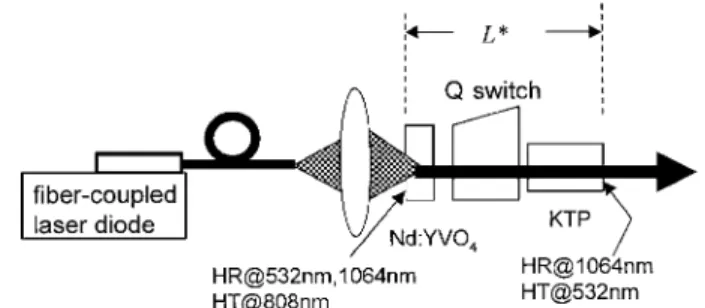
In this Letter a high-power, high-repetition-rate Q-switched and intracavity frequency-doubled Nd:YVO4 green laser with a
sandwich-type resonator, as shown in Fig. 1, is de-scribed. More than 4.6 W of 532-nm average power at a repetition rate of 50 kHz was generated with 17-W pump power, corresponding to a conversion efficiency of 27%.
Nd:YVO4 has often been used in diode-pumped
in-tracavity frequency-doubled lasers because of its high absorption over a wide pumping wavelength bandwidth and its large stimulated-emission cross section at las-ing wavelength. Unfortunately, however, power scal-ing with Nd:YVO4 has been hindered by thermally
induced fracture.6
In a recent study,7
I found that the fracture-limited pump power for an end-pumped laser is inversely proportional to the absorption coeffi-cient; i.e., Plim苷 1 a 4pRT j , (1)
where j is the fractional thermal loading, a is the ab-sorption coeff icient at the pump wavelength, and RT
is a thermal shock parameter that depends on the me-chanical and thermal properties of the host material. The absorption coeff icient of the laser crystal increases linearly with increasing dopant concentration. There-fore, lower concentrations of Nd31 can be benef icial in
extending the fractulimited pump power. Here I re-port using Nd:YVO4crystals with different Nd31
con-centrations (05. – 2.0 at. %) to investigate their output performance.
The experimental setup included a 0.8-mm-core f iber with a numerical aperture of 0.16 and a maxi-mum output power of 20-W. The lengths of Nd:YVO4
crystals were 6, 3, and 3 mm for 0.5, 1.0, and 2.0 at. % Nd31 concentrations, respectively. All crystals were
a cut to yield a high-gain p transition. The Nd:YVO4
crystal was wrapped with indium foil and mounted in a water-cooled copper block. The water temperature was maintained at 17±C. One side of the Nd:YVO4
crystal was coated to be nominally highly ref lecting (HR) at both the fundamental wavelength共R . 99.9%兲 and the second-harmonic wavelength 共R . 98%兲 and highly transmitting (HT) at the pump wavelength 共T . 95%兲. The remaining side was antireflecting at the fundamental wavelength 共R , 0.2%兲. The 20-mm-long Q switcher (Gooch and Housego) had
antiref lectance coatings at 1064 nm on both faces and was driven at a 41-MHz center frequency with 3.0 W of rf power. The KTP crystal was 20 mm long and coated to be nominally highly ref lecting at the fundamental wavelength 共R . 99.9%兲 and highly transmitting at the second-harmonic wavelength 共T . 95%兲. The remaining side was antiref lecting at the fundamental wavelength共R , 0.2%兲.
The thermally induced lens in the laser crystal brings the f lat – f lat cavity into geometrical stability. This concept was found at nearly the same time by Zay-howski and Mooradian8
and by Dixon et al.9
However,
Fig. 1. Experimental setup for the Q-switched intra-cavity-frequency-doubled green laser.
August 1, 1999 / Vol. 24, No. 15 / OPTICS LETTERS 1033 an end-pump-induced thermal lens is not a perfect lens
but is rather an aberrated lens. It has been found that the thermally induced diffraction loss at a given pump power is a rapidly increasing function of the mode-to-pump ratio. Practically, the optimum mode-to-mode-to-pump ratio is in the range of approximately 0.8 – 1.0 when the incident pump power is greater than 5 W. The laser mode size in the present cavity is determined by the thermal lens and the effective length L of the cavity.
For a fiber-coupled laser diode, the thermal lens can be given by10 1 fth 苷 Z l 0 jPabs 4pKc a exp共2az兲 1 2 exp共2al兲 共dn兾dT 1 naT兲 vp2共z兲 dz , (2) where Kc is the thermal conductivity, Pabs is the
absorbed pump power, n are the refractive indices
along the c axis of the Nd:YVO4 crystal, dn兾dT are
the thermal-optic coeff icients of n, aT is the thermal
expansion coeff icient along thea axis, l is the crystal
length, and vp共z兲 is the pump size in the active
medium. With the usual M2 propagation law, the
pump beam is given by vp2共z兲 苷 vp02 Ω 1 1 ∑l pMp2 npvp02共z 2 z0兲 ∏2æ , (3) where vp0 is the radius at the waist, lp is the pump
wavelength,Mp2is the pump beam quality factor, and
z0 is the focal plane of the pump beam in the active
medium. The f irst and second terms in parentheses in Eq. (2) arise from thermal dispersion and axial strain, respectively. With the following parameters of the Nd:YVO4crystal: dn兾dT 苷 3.0 3 1026兾K, n 苷 2.165,
and aT 苷 4.43 3 1026兾K, the relative contributions of
thermal dispersion and axial strain can be found to be approximately 1:3.
With the thermal lens, the beam waist at the input face of the laser crystal is given by
vl苷 s l p 共Lfth兲1/4 共1 2 L兾fth兲1/4 , (4) L苷 Lⴱ 1 l共1兾n 2 1兲 1 lKTP共1兾nKTP 2 1兲 1 lQ共1兾nQ2 1兲 , (5)
where Lⴱ is the cavity length, lKTP is the length of
the KTP crystal, nKTP is the KTP crystal’s refractive
index for the output laser beam,lQis the length of the
Q-switched crystal, and nQ is the refractive index of
theQ-switched crystal for the output laser beam.
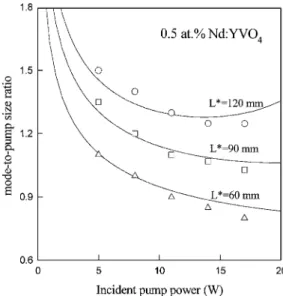
Figure 2 shows the dependence of the mode size on the pump power in 0.5-at. % Nd:YVO4 crystal for
several cavity lengths. The experimental data were measured by the knife-edge method. The theoreti-cal results were theoreti-calculated for the following parame-ters: j苷 0.24, Kc苷 0.0523 W兾K cm, vp0苷 0.2 mm,
Mp2 艐 310, n 苷 2.165, nKTP 苷 1.75, nQ 苷 2.33, l 苷
6 mm, lKTP 苷 20 mm, lQ 苷 20 mm, dn兾dT 苷 3.0 3
1026兾K, and a
T 苷 4.43 3 1026兾K. The good
agree-ment between theoretical results and experiagree-mental data indicates that the thermal lens effect provides a stability mechanism in the present cavity. It is clear from Fig. 2 that the mode-to-pump size ratio is approxi-mately 0.8 – 1.0 atLⴱ 苷 60 mm for pump powers in the
range of 5 – 20 W, leading to optimal mode matching. It should be noted that nearly 30 – 40% of the backward green light incident upon the Nd:YVO4 is absorbed.
Nevertheless, numerical calculations show that the for-ward green light almost dominates the output power. I also measured the fractional thermal loading by using the previous method11
and conf irmed that the absorbed green power does not result in a substantial contribu-tion to the thermal loading beyond the quantum defect. Figure 3 illustrates the average green output power at a repetition rate of 50 kHz atLⴱ苷 60 mm as a
func-tion of the incident pump power for several Nd:YVO4
Fig. 2. Dependence of the mode-to-pump size ratio on the incident pump power for several cavity lengths: symbols, experimental data; curves, theoretical calculations.
Fig. 3. Average green output power at a 50-kHz pulse-repetition rate as a function of the incident pump power for several Nd:YVO4 crystals with different dopant
1034 OPTICS LETTERS / Vol. 24, No. 15 / August 1, 1999
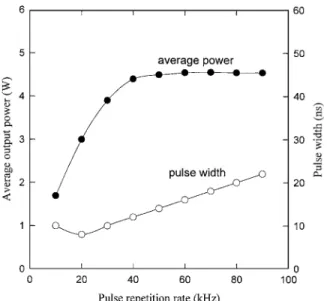
Fig. 4. Average green output power and pulse width as a function of theQ-switched pulse-repetition frequency.
crystals with different dopant concentrations. Experi-mental results show that, once the pump power reached the thermal fracture limit, the output power immedi-ately dropped, and output characteristics were not re-producible when the pump power was decreased. As expected, the lower the dopant concentration (absorp-tion coefficient), the higher the fracture-limited pump power. A maximum green output power of 4.6 W was obtained in a 0.5-at. % Nd:YVO4crystal at 17 W of
ab-sorbed pump power. To my knowledge, these are the highest eff iciency and the highest power ever reported for a singly end-pumped Q-switched Nd:YVO4兾KTP
green laser.
Figure 4 shows the average green output power and laser pulse width at 17 W of pump power as a func-tion of the pulse-repetifunc-tion rate. To avoid damage to the intracavity optical components, I operated the
Q switcher above 10 kHz. It can be seen that at
low pulse-repetition rates the pulse width is short and the energy per pulse is high, whereas at higher pulse-repetition rates the energy per pulse is low and the pulse width is long but the average power is high. At full pump power, the pulse width in-creases from 8 ns at 20 kHz to 22 ns at repetition rates greater than 90 kHz. Previously, Hemmati and Lesh3
reported a 3.5-W Q-switched intracavity
frequency-doubled Nd:YAG兾KTP green laser at a 50-kHz pulse-repetition rate. The pulse width in their research increased from 20 ns at 16 kHz to 52 ns at 60 kHz. The pulse width in the present green laser is ⬃2.5 times shorter than the output results demonstrated by Hemmati and Lesh, mainly because of the compact-ness of the present cavity. Although the pulse energy in the Nd:YVO4兾KTP laser is less than that in the
Nd:YAG兾KTP laser at frequency-repetition rates below 20 kHz, the shorter pulse width of the present design leads to a peak power that is nearly the same as that in the Nd:YAG兾KTP laser. For frequency-repetition rates greater than 20 kHz, the output performance of the present system is generally better than that of the Nd:YAG兾KTP system because of higher conversion.
After the optical elements were thermally stabilized, the f luctuations of the average power over hours of operation were measured to be 64%. No damage or darkening of the KTP crystal was observed in these ex-periments, and the laser performance was reproducible on a day-to-day basis. I measured the 1064-nm power leakage of the laser to estimate the intracavity peak power of the fundamental light. The 1064-nm output power was approximately 20 – 40-mW at 10 – 50-kHz repetition rates with 17-W pump power. For theoreti-cal estimation, the intracavity peak power of the funda-mental light was near50 150 MW兾cm2. These power
levels are essentially below the optical damage thresh-old of the KTP crystal, which is usually .450 MW兾cm2
for 10-ns pulses at 1064-nm. The beam quality factor at the maximum output power was⬃2.0. The degra-dation of the beam quality arises mainly from the thermally induced aberration. I believe that a com-posite crystal structure,6
which is fabricated by diffu-sion bonding of a doped crystal to an undoped piece of the same cross section, can be used to reduce the ther-mally induced distortion. Use of the composite crystal with the present cavity is currently under way.
I have demonstrated the use of a thermal lens to obtain high efficiencies of Q-switched green output
power with a f iber-coupled laser diode. The cavity is formed by a coated Nd:YVO4 crystal, an
acousto-optical Q switcher, and a coated KTP crystal. With
the thermally induced lens, the cavity length was adjusted to yield the optimal mode-to-pump size ratio for the maximum output power. The strategy for avoiding the thermally induced fracture was to use a YVO4 crystal of lower Nd concentration. 4.6 W of
532-nm average power at a repetition rate of 50 kHz was generated with a 17-W pump power, corresponding to a conversion eff iciency of 27%. The present result indicates that there is substantial scope for further power scaling of end-pumped Nd:YVO4lasers with low
Nd concentrations.
The author’s e-mail address is [email protected]. edu.tw.
References
1. V. G. Ostroumov, F. Heine, S. K ¨uck, G. Huber, V. A. Mikhailov, and I. A. Shcherbakov, Appl. Phys. B 64, 301 (1997).
2. T. Taira and T. Kobayashi, IEEE J. Quantum Electron. 30, 800 (1994).
3. H. Hemmati and J. R. Lesh, Opt. Lett. 17, 1322 (1994). 4. N. Mackinnon and B. D. Sinclair, Opt. Commun. 105,
183 (1994).
5. Y. F. Chen, IEEE Photon. Technol. Lett. 9, 669 (1998). 6. M. Tsunekane, N. Taguchi, T. Kasamatsu, and
H. Inaba, IEEE J. Sel. Top. Quantum Electron. 3, 9 (1997).
7. Y. F. Chen, IEEE J. Quantum Electron. 35, 234 (1999). 8. J. J. Zayhowski and A. Mooradian, Opt. Lett. 14, 1989
(1989).
9. G. J. Dixon, L. S. Lingvay, and R. H. Jarman, Proc. SPIE 1104, 107 (1989).
10. C. Pfistner, R. Weber, and H. P. Weber, IEEE J. Quantum Electron. 30, 1605 (1994).