Effects of Functional Communication Training
on Hand-Mouthing in a Student with Severely
Mental Retardation
Jung-Chang Tang
*, Chiu-Hua Chiang
**Abstract
The purpose of this current study was to assess the functions of hand-mouthing and develop appropriate intervention to decrease such aberrant behavior in a student with mental retardation. This study employed single subject methodologies and included three experiments that functionally analyzed one student’s hand-mouthing behavior. An analogue functional analysis was used in Experiment 1 to detect the possible function of the student’s hand-mouthing. Results indicated that sensory consequence was a main determinant of hand-mouthing in this student. Preferred objects were employed in Experiment 2 to compete with sensory consequences maintaining the student's hand-mouthing. Results showed that both preferred items could decrease the student’s mouthing behavior. Finally, functional communication training (FCT) developed from prior functional analyses and preference assessment was employed in Experiment 3 to treat the student's mouthing behavior. Results of the present study demonstrated FCT could be successfully taught to increase the student’s communication ability and to decrease his hand-mouthing behavior.
Key words: functional communication training, hand-mouthing, mental
retardation
* Associate Professor, Department of Special Education, National Chiayi University ** Associate Professor, Department of Special Education, National Chiayi University
Effects of Functional Communication Training
on Hand-Mouthing in a Student with Severely
Mental Retardation
Jung-Chang Tang, Chiu-Hua Chiang
I. Introduction
Hand mouthing is a behavior problem observed in about 17% of persons with mental retardation (Rast & Jack, 1992). Hand mouthing, or hand-in-mouth behavior is a repetitive and rhythmic behavior that has been defined as the placing of one or more digits of the hand past the plane of lips, insertion of the hand into the mouth, or any contact between the hand and the mouth (Lerman & Iwata, 1996). Chronic hand mouthing can cause tissue damage which results in skin infection (Ball, Campbell, & Barkemeyer, 1980). Such behaviors might affect learning activities if it exhibited at high levels (Koegel & Covert, 1972). Therefore, detecting the functions of hand mouthing and reducing this aberrant behavior becomes an important issue.
Despite a variety of behavioral techniques, such as aversive stimulation (e.g., Friman & Hove, 1987), a respond cost (e.g., Lloyd, Kauffman, & Weygant, 1982), overcorrection (e.g., Doke & Epstein, 1975), timeout (e.g., Bishop & Stumphauzer, 1973), and differential reinforcement of incompatible behavior (e.g., Miner, 1991) being used to reduce hand-mouthing in studies, little attention was paid to the functions of such behavior. Therefore, the effects of treatments have been inconsistent (Lovaas, Newsom, & Hickman, 1987). Further exploration to examine the functions that might exert their control over hand-in-mouth behavior is needed.
Recently studies used analogue functional analyses to detect the functions of hand-in-mouth behaviors. If high levels of hand-mouthing occurred in alone settings would suggest that such aberrant behavior was maintained through automatic reinforcement (e.g., sensory stimulation) (e.g., Lerman & Iwata, 1996; Mazaleski,
Iwata, Rodgers, Vollmer, & Zarcone, 1994; Piazza, Adelinis, Hanley, Goh, & Delia, 2000; Stricker, Miltenberger, Garlinghouse, & Tulloch, 2003; Tang, 2004; Tang, 2005). Consistent with this view, Mason and Iwata (1990) found that one girl with profound mental retardation exhibited higher rates of hand mouthing in the alone condition than in any other conditions. The same results were reported by Irvin, Thompson, Turner, and Williams (1998), showing that the highest levels of hand mouthing occurred when two people with profound mental retardation were left alone in a separate room. These studies suggest a lack of stimulating environments can control high levels of hand-mouthing behaviors.
If hand mouthing was maintained by sensory stimulation, one treatment approach is based on attempts to eliminate or attenuate the sensory consequences directly produced by hand mouthing. For example, Mazaleski et al. (1994) attenuated the participants’ sensory stimulation by placing oven mitts on their hands and then reduced the levels of their hand mouthing effectively. In consistent with Mazaleski et al.’s study, Irvin et al. (1998) decreased the sensory consequences by placing flexible sleeves containing stays to increase rigidity on the arms of 2 participants who engage in hand mouthing. The results of their study revealed that attenuation in sensory consequences could decrease the rates of hand mouthing. The second treatment approach involves providing access to alternatives of stimulation to compete with that produced by hand mouthing. For example, Goh et al. (1995) used functional analyses to study twelve people with developmental disabilities with mouthing behaviors and found nine out of them exhibited high levels of such behavior only in alone settings. Further providing alternative preferred toys for these nine persons effectively reduced the levels of hand-mouthing behavior which presumably might be maintained by sensory consequences. In consistent with the findings of Goh et al.’s (1995) study, Shore, Iwata, DeLeon, Kahng, and Smith (1997) also found sensory reinforcement may contribute to occurrence of hand-mouthing in two students with developmental disabilities. After preferred item assessments, the most favorite objects were employed to compete with hand-mouthing and effectively decreased the levels of such aberrant behaviors in these two students. Similarly, Tang (2004) used functional analysis to assess the causes of hand-mouthing in one adolescent with profoundly mental retardation and found that
such mouthing behavior was maintained by sensory consequences. Preferred items were then successfully employed to substitute and to reduce the aberrant mouthing responses in this adolescent. Favell, McGimsey, and Schell (1982) also supported this viewpoint and found that the hand mouthing of four persons were maintained by oral sensory stimulation, such mouthing behavior were reduced by providing participants with items that provide oral sensory stimulation. (e.g., mouthing toys and popcorn). The third approach to treat stereotypical hand-mouthing behavior may use functional communication training to teach students to request functional equivalence to compete with the outcome of aberrant behavior (Carr & Durand, 1985; Durand & Carr, 1991). For example, Tang, Patterson, and Kennedy (2003) conducted functional analyses of stereotypic behaviors for six students with developmental disabilities and found that sensory consequence was the main reason to maintain such aberrant behavior in one student. After demonstration of one sensory manipulative toy could be effectively used to compete with stereotypic behavior, functional communication training was further employed to teach this student to request such preferred toy. Because sensory consequences derived from manipulating preferred toys could be substitutable for those produced by aberrant behavior, the presence of these toys reduced the levels of such behavior in this student.
On the other hand, after analogue functional analyses, if high levels of hand-mouthing occurred in attention or demand settings would suggest that such aberrant behavior was maintained by social reinforcement (Baumeister & Forehand, 1973). Some researchers also found that social situations may serve as a negative reinforcer to control stereotypy. For example, using analogue functional analyses to assess the functions of hand mouthing in two students with mental retardation, Lalli, Casey, and Kates (1995) have shown that such aberrant behaviors served to escape from task demands in the environment. The students’ hand mouthing served as an escape from instructors’ demands. This study suggests that such behavior might function as negative social reinforcement to escape or avoid difficult tasks in the environment. If hand mouthing is maintained by social consequences, the extinction for social reinforcement may be needed. One option for treatment might be to provide a break or attention contingent or non-contingent on the absence of hand mouthing
(e.g., Goh et al., 1995).
A. Purpose of the Study
The first purpose of this study was to examine possible functions of one student’s hand mouthing maintained mainly by positive and/or negative social reinforcement, and/or sensory reinforcement. Analogue functional analyses were used in Experiment 1 to detect hand mouthing which served as escape from task demand, obtaining attention from the investigator, and producing self-stimulation.
Second, if sensory reinforcement could be demonstrated its effect on this student’s hand mouthing behavior, this study would seek to assess possible preference objects that might compete with sensory consequences maintaining such aberrant behavior. Preference assessments in Experiment 2 were employed to evaluate the effectiveness of alternative sensory reinforcers.
Third, if the functions for this student’s hand-mouthing were maintained either by social, sensory, or multiple reinforcements, this study would test functional analysis findings via a concurrent operant procedure. Experiment 3 sought to examine the effect of functional communication training developed from prior functional analyses to test specific hypotheses regarding the operant functions of mouthing behavior.
According to these purposes, there were several hypotheses in this study:
B. Hypotheses of the Study
1. The functions of this student’s hand mouthing may be maintained either by sensory reinforcement, positive social reinforcement, or negative social reinforcement.
2. If the student’s hand mouthing was maintained by sensory reinforcement, alternative sensory preferences may be used to compete with this student’s hand-mouthing behavior.
3. Functional communication training developed from findings of functional analyses and preference assessments may be successfully taught to decrease this student’s mouthing behavior.
II. General Method
The current study used single subject methodologies to investigate one student who exhibited lots of hand-in-mouth behavior. Functional analyses were used to examine possible contingencies which might maintain this student’s hand mouthing.
A. Student and Settings
Andrew was enrolled in a special school which included one teacher and one teacher assistant in each class. He was selected because of his high levels of hand-in-mouth behavior that were exhibited throughout the day. He was an 11-year-old boy classified as having severely mental retardation. He could walk and go to restroom independently. Andrew rarely depended on others for his care. He often ate soft diet with a spoon. He can hardly speak single words and follow simple one-step direction. Additionally, he often displayed high levels of hand mouthing in his classroom.
B. Measures
The dependent variables were hand-mouthing behaviors. His mouthing behavior was defined as “Put either his thumb or finger(s) into his mouth” The investigator videotaped each condition using a videocassette recorder and a stopwatch. Two observers recorded the frequency of hand mouthing responses by employing a 15-s partial interval sampling method. All data were converted to percentage of 15-s intervals during which this aberrant behavior occurred.
C. Interobserver Agreement
Before conducting the functional analysis, two graduate students in special education were trained for 3 hr to use the observational system and reached a 90% agreement criterion, and then served as observers for all sessions. These two observers recorded data independently and compared with data sheet simultaneously. Across experiments an average of 27% sessions (range, 20% to 32%) was scored for interobserver agreement. An agreement was computed using an interval-by-interval agreement method to assess percentage agreement for the frequency of hand-mouthing
behaviors (Kazdin, 1982). Interobserver agreement was computed by dividing the number of agreements by the number of agreements plus the number of disagreements and multiplying by 100%. The interobserver agreement for Andrew’s hand-mouthing behavior is 91% (85% to 100%) in Experiment 1, 96% (90% to 100%) in Experiment 2, and 93% (90% to 100%) in Experiment 3.
III. Experiment 1: Analogue Functional Analysis
A. Method
1. Procedure
Before functional analysis was conducted, Andrew was observed in classrooms to analyze possible antecedent and consequence events. He was observed 4 hr across activities for 1 day.
A multielement design (Sidman, 1960) was used to assess the occurrence of hand mouthing across four conditions: (a) attention, (b) demand, (c) alone, and (d) play (Iwata, Dorsey, Slifer, Bauman, & Richman, 1982/1994). Each condition was presented once per day for 5 min with a random sequence occurring each day. Sessions were conducted at the same time each day. All sessions were videotaped by a graduate student and recorded by two graduate students using data sheets. The graduate student positioned video camera facing the student from approximately 2 m, repositioning it if the participant moved. These conditions were used to identify possible operant functions that the hand mouthing might serve. During the Attention condition, Andrew was seated beside the investigator. When seated the investigator read a book, while Andrew was provided with toys. If hand mouthing occurred, the investigator provided 5 s of social comments to him, telling him not to engage in such disruptive responses, and provided physical contact. After the 5 s of social comments elapse, the next occurrence of hand mouthing occasions a similar consequence. All other responses exhibited by Andrew were ignored. During the Demand condition, the investigator sat beside Andrew and delivered a verbal demand every 10 s (e.g., "Put the blocks in the
box"). Correct responses were immediately praised and incorrect or no responses resulted in a partially physical prompt after 10 s elapsed. Any occurrence of hand mouthing responses resulted in 30 s cessation of task demands. During the Alone condition, Andrew was seated on a chair in the room. No social interaction or activities occurred during this condition. During the Play condition, Andrew was seated beside the investigator. Andrew was provided with various toys identified by the teachers as being preferred and was praised every 30 s in the absence of hand mouthing (occurrences of stereotypical hand mouthing was ignored).
B. Results
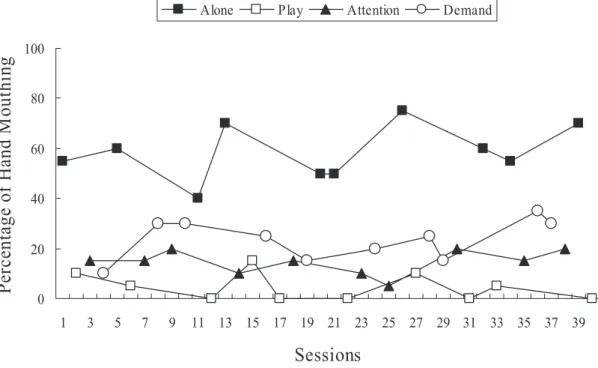
Figure 1 displays the results of the functional analysis for Andrew’s hand mouthing responses. Throughout 40 sessions Andrew exhibited a high frequency of hand mouthing only in Alone condition. For all of the sessions a mean of 59% (range, 40% to 75%) of intervals contained hand mouthing in the Alone condition, a mean of 5% (range, 0% to 15%) of intervals contained hand mouthing in the Play condition, a mean of 22 (range, 10% to 35%) of intervals contained hand mouthing in the Demand condition, and a mean of 15% (range, 5% to 20%) of intervals contained hand mouthing in the Attention condition. The results showed that the function of hand mouthing might be maintained by sensory reinforcement. It seems to be reasonable to find out some appropriate alternative stimulation to compete with sensory consequences derived from such repetitive hand-mouthing responses. Therefore, Experimental 2 was further conducted to assess Andrew’s possible preferred stimulation in order to decrease his mouthing behavior.
0 20 40 60 80 100 1 3 5 7 9 11 13 15 17 19 21 23 25 27 29 31 33 35 37 39
Sessions
P
er
ce
n
ta
g
e
o
f
H
an
d
M
o
u
th
in
g
Alone Play Attention Demand
Figure 1. Andrew's percentage of intervals engaged in hand mouthing in analogue functional analysis
IV. Experiment 2: Analysis of Preference Items
A. Method
The second study further analyzed Andrew’s possible preferred stimulation in order to compete with his high rates of mouthing behaviors occurring in the Alone condition identified in Experiment 1. The same definitions of hand-mouthing responses, measures, settings, and interobserver agreement in Experiment 1 were conducted through this study.
1. Procedure
a. Assessing Preference
Object preference ratings were determined by presenting five different kinds of objects in a horizon row. No instructions were given; the experimenter waited for the
student to choose an object. The preference sessions began by seating the student with objects in front of him. Five preassessment sessions were conducted. The student had free access to the stimuli for 30 min each session. Stimuli for Andrew were chosen according to the reports of his classroom teachers. All stimuli in Andrew’s preference assessment consisted of sensory manipulative toys or items. Preference was assessed using a multiple-stimulus without replacement (MSWO) procedure (DeLeon & Iwata, 1996). The experimenter presented 5 items to Andrew in a linear array. Andrew was permitted to choose one stimulus item from the array. After a particular stimulus was chosen, he had 10s access to the item, after which time the trials resumed. This procedure continued until all items were chosen, or until no choice was made. This procedure was repeated 3 times. Preference was determined as the percentage of times an item was selected. The most two preferred stimuli were used during the specific item analysis phase.
b. Specific Item Analysis
A multielement design was used to evaluate the effects of prefer objects on Andrew’s stereotypic hand mouthing across three conditions: (a) Duck, (b) Bear, and (c) Alone. During the Duck condition, Andrew was seated on a chair in the room. He was provided with a plastic duck during all 5 min sessions. Besides, no other social interaction or activities occurred during this condition. During the Bear condition, the manipulation procedures were almost the same as those in the Duck condition except for providing Andrew a toy bear substitutable for a duck. During the Alone condition, Andrew was seated on a chair in the room. No social interaction or activities occurred during this condition. Each condition was presented once per day for 5 min with a random sequence occurring each day. Sessions were conducted at the same time each day. The procedures for videotaping and recording were the same as those in Experiment 1.
B. Results
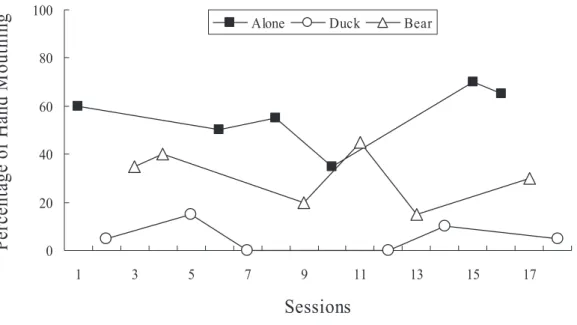
Figure 2 displays the results for Andrew's analysis of specific preference items. Throughout 18 sessions Andrew exhibited a high level of hand mouthing in the Alone
condition and a low level of such aberrant behavior in the Duck condition. For all of the sessions a mean of 56% (range, 35% to 70%) of intervals contained hand mouthing in the Alone condition, a mean of 6% (range, 0% to 15%) of intervals contained hand mouthing in the Duck condition, and a mean of 31% (range, 15% to 45%) of intervals contained hand mouthing in the Bear condition. The results showed that providing a plastic duck could consistently and significantly decrease the levels of hand mouthing for Andrew. Therefore, Experimental 3 was further conducted in order to teach Andrew to request such preferred object to compete with his hand-mouthing behavior.
0 20 40 60 80 100 1 3 5 7 9 11 13 15 17
Sessions
P
er
ce
n
ta
g
e
o
f
H
an
d
M
o
u
th
in
g
Alone Duck BearFigure 2. Andrew’s percentage of hand mouthing during object preference assessments
V. Experiment 3: Treatment of Hand Mouthing
A. Method
Experiment 3 analyzed effects of functional communication training on the frequency of Andrew’s hand-mouthing behavior.
1. Research Design
An ABAB reversal design was used to evaluate the effects of functional communication training on Andrew’s hand mouthing. The percentage of the time intervals with hand-mouthing and communicative responses was the dependent variable. Functional communication training developed from Experiment 1 and 2 was the independent variable. All sessions were taken across Alone conditions. Thus, through observation and data records, the effects of treatment on hand-mouthing behaviors were assessed.
2. Procedure
a. Baseline
One possible operant function (sensory consequence) identified in Experiment 1 was incorporated into baseline. The Alone condition simulated a lack of sensory stimulations was used to assess the frequency of mouthing behavior and communicative responses. The procedure conducted in this phase was the same as Experiment 1. However, the observers recorded mouthing responses as well as communicative responses during all sessions. The baseline phase was conducted in the no-interaction context. The investigator didn’t reinforce any Andrew’s communicative responses (i.e., presenting preferred objects or giving praise) nor did he pay attention to his mouthing behavior. Andrew was exposed to baseline conditions until his data were stable. The same hand-mouthing response definition and measures as Experiment 1 were conducted.
b. Functional communicational training
During this phase, a treatment procedure, functional communication training, developed from the result of functional analysis was applied to Andrew’s mouthing responses. An alternative behavior was selected to occasion a similar consequence for each aberrant response-reinforcer relation (Carr & Durand, 1985; Durand & Carr, 1991). For Andrew, an alternative response was to request a preferred object to play by giving a gesture sign which already existed in his repertoire. Andrew was taught to emit such alternative learned responses that would replace his hand-mouthing responses for sensory stimulation. After the initial baseline was established,
intervention began. During this intervention condition, Andrew was seated in his chair, while investigator sat next to him providing no interaction with him. Following Andrew’s hand mouthing, the investigator would use functional communication training to physically and verbally prompt him to request to play the most preference object (a white plastic duck) by making the gesture sign for a duck (e.g., “Andrew. If you want to play the duck, what do you do?). After Andrew signed for a duck using gesture in his repertoire, the investigator would show him the white duck for 20 seconds. Consequences for his hand-mouthing behaviors were the same as those in the baseline conditions. The physical prompts were faded until Andrew’s percentage of intervals with sign communication was 15% higher than the average of those in baseline phase lasting three sessions.
B. Results
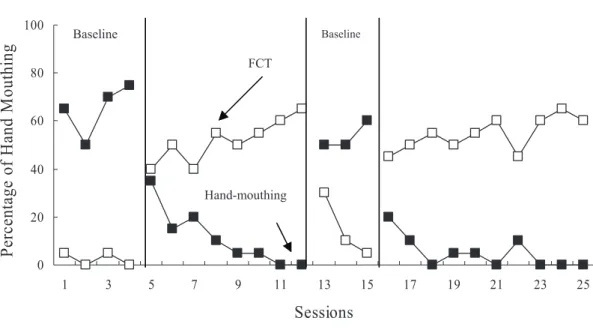
Figure 3 displays the results for Andrew's functional communication training in the Alone conditions. In this condition, Andrew’s mean percentage of hand-mouthing responses occurring during the first baseline was 65% (range, 50% to 75%). After 8 sessions of teaching Andrew using sign to request a dock, his aberrant behavior was decreased to a mean percentage of 11% (range, 0% to 35%). The trend was stable and decreasing. Therefore, it was reversed to baseline in the Alone condition again. Andrew’s mean percentage of hand mouthing responses occurring during the second baseline was 53% (range, 50% to 60%). After another 10 sessions of teaching Andrew use sign to request the duck, his hand-mouthing behavior was dramatically decreased to a mean percentage of 5% (range, 0% to 20%).
0 20 40 60 80 100 1 3 5 7 9 11 13 15 17 19 21 23 25 Sessions P er ce n ta g e o f H an d M o u th in g
Figure 3. Andrew’s percentage of hand mouthing during functional communication training
On the other hand, Andrew’s communication responses showed an inverse pattern to that for his mouthing behavior in this Alone condition. In this condition, Andrew’s mean percentage of communication responses occurring during the first baseline was 3% (range, 0% to 5%). After 8 sessions of teaching Andrew using sign to request a dock, his communication behavior was increased to a mean percentage of 52% (range, 40% to 65%). The trend was stable and increasing. Therefore, it was reversed to baseline in the Alone condition again. Andrew’s mean percentage of communication responses occurring during the second baseline was 15% (range, 5% to 30%). After another 10 sessions of teaching Andrew use sign to request the duck, his communication behavior was dramatically increased to a mean percentage of 55% (range, 45% to 65%). The results from Experiment 3 suggest that Andrew can successfully learn how to request a preferred object through functional communication training. Additionally, the appearance of the preferred item can reduce his hand-mouthing responses as well.
Baseline Baseline
FCT
VI. Discussion
Results of the present study demonstrated that sensory reinforcement could be a main determinant of hand-mouthing in Andrew, suggesting that such behavior occurred frequently in a lack of environmental stimulation without antecedent and consequent events. The findings of this study were also supported by several researches (e.g., Goh et al., 1995; Lerman & Iwata, 1996; Mazaleski et al.,1994; Piazza et al., 2000; Stricker et al., 2003; Tang, 2004; Tang, 2005) which have shown that hand mouthing behavior functions to obtain sensory reinforcers. For example, Goh et al. (1995) conducted study to analyze the functions of hand-mouthing in twelve people with mental retardation and found that nine people’s repetitive mouthing behavior served to obtain sensory consequences.
On the other hand, specific sensory consequences were never detected in our study at this time, because Andrew refused to put on a pair of any gloves or mittens. It is uncertain whether Andrew’s hand-mouthing was maintained by oral or hand sensory sources. Prior studies (e.g., Goh et al., 1995) have shown that hand stimulation contributed to occurrence of repetitive hand-mouthing behavior because most of preferred toys picked up by subjects in their study were used for hand manipulation and stimulation. In contrast, the preferred object (a plastic dock) provided in our study could be used for hand stimulation or oral stimulation for Andrew at times. Therefore, it is difficult to determine exact sources of stimulation for Andrew’s hand-mouthing. Unless specific sensory sources could be successfully masked, it is hard to demonstrate specific sensory reinforcement contribute to such behavior.
During the initial assessment sessions of the participant’s preferred objects, both of the most preferred items for Andrew were a dock and a bear, respectively. However, in a subsequent preference analysis conducted through a multielement design seemed to show huge differences to decrease the levels of hand-mouthing between these two preferred items. It is highly possible that initial assessment was not precisely correct to reflect the degree of preference. Perhaps the limited exposure to the stimuli may have skewed the preference assessment. On the other hand, it could be a real case that both stimuli were not equally reinforcing, but a more viable alternative may be that
preference was not adequately assessed for the bear. In addition, it could be that preference changed with time, or that we were unable to accurately measure preference from the beginning. Further make a careful examination to procedures of MSWO is needed.
Another issue raised is whether appearance of the preference item acted as an alternative sensory stimulation or an incompatible response for Andrew’s hand-mouthing behavior. The data from the analogue functional analysis in Experiment 1 indicated that the function of Andrew’s hand-mouthing might be maintained by sensory reinforcement. Additionally, different preferred objects were used to decrease hand-mouthing in Experiment 2. Providing preference objects may be incompatible to occurrence of hand-mouthing only when the subject was trained to select and manipulate objects and obtained reinforcement later. However, in this case, Andrew had free choice to decide to play with the preferred item or continuously engaged in his hand-mouthing responses. It is unlikely for him to play with a preferred object in order to compete with engaging mouthing behavior by himself. On the contrary, he could get the sensory consequences from manipulation of objects to substitute those derive from engaging in hand-mouthing responses. This is further supported by functional communication training implemented in Experiment 3. In the intervention sessions, functional communication replaced Andrew’s mouthing behaviors with more appropriate communicative behaviors when provided a reinforcer (preferred object). The reinforcer (preferred object) used in the functional communication training acted as an equivalent to that maintained by hand-mouthing behavior and reduced such aberrant behavior.
The results of this study suggest several areas for further research. First, more studies extending functional analyses to detect specific sensory consequences maintained hand mouthing are needed. If masking sensory sources is impossible in some cases, analyses of alternative sensory properties of preference items are needed. Previous studies (e.g., Lerman & Iwata, 1996; Stricker et al., 2003; Tang, 2004) indicated that mouthing behavior occurred in the Alone condition might be relevant to sensory reinforcement. However, little is known about the actual mechanisms underlying the behavior. The hypotheses regarding what kind of sensory stimulation
contributes to hand-mouthing never be tested thoroughly, so it lacks the evidence that sensory consequence is the cause of hand-mouthing. At best, these analyses only show some relation between hand-mouthing and poor environmental stimulation. So far, few studies (e.g., Goh et al., 1995) have conducted further analyses to examine what specific sensory consequences might cause mouthing behaviors. Therefore, there is a need to further extend alone condition analyses which assume a lack of stimulation in the environment to examine specific sensory stimulation that may control hand mouthing before more effective environmental stimulation could be adopted. Furthermore, researchers should pay more attention to analyzing perceptual hand-mouthing rather than object mouthing. The possibility is high that removal of certain objects might directly eliminate object mouthing responses even though you do not realize the functions of such behavior. Thus, further studies need to focus on analyzing perceptive functions of hand-mouthing instead of object mouthing behavior.
References
Ball, T. S., Campbell, R., & Barkemeyer, R. (1980). Air splints applied to control self-injurious finger sucking in profoundly retarded individuals. Journal of Behavior Therapy and Experimental Psychiatry, 11(4), 267-271.
Baumeister, A. A., & Forehand, R. (1973). Stereotyped acts. In N. R. Ellis (Ed.), International review of research in mental retardation (pp. 55-96). New York: Academic Press.
Bishop, B. R., & Stumphauzer, J. S. (1973). Behavior therapy of thumbsucking in children: A punishment (time-out) and generalization effect: What's a mother to do? Psychological Reports, 33(3), 939-944.
Carr, E. G., & Durand, V. M. (1985). Reducing behavior problems through functional communication training. Journal of Applied Behavior Analysis, 18, 111-126.
DeLeon, I. G., & Iwata, B. A. (1996). Evaluation of a multiple-stimulus presentation format forassessing reinforcer preferences. Journal of Applied Behavior Analysis, 29, 519–533. Doke, L. A., & Epstein, L. H. (1975). Oral overcorrection: Side effects and extended
applications. Journal of Experimental Child Psychology, 34, 535-538.
behavior: Maintenance and application in new settings. Journal of Applied Behavior Analysis, 24, 251-264.
Favell, J. E., McGimsey, J. F., & Schell R. M. (1982). Treatment of self-injury by providing alternate sensory activities. Analysis and Intervention in Developmental Disabilities, 2, 83-104.
Friman, P. C., & Hove, G. (1987). Apparent covariation between child habit disorders: Effects of successful treatment for thumb sucking on untargeted chronic hair pulling. Journal of Applied Behavior Analysis, 20, 421-425.
Goh H. L., Iwata, B. A., Shore, B. A., DeLeon, I. G., Lerman, D. C., Ulrich, S. M., et al. (1995). An analysis of the reinforcing properties of hand mouthing. Journal of Applied Behavior Analysis, 28, 269-283.
Irvin, D. S., Thompson, T. J., Turner, W. D., & Williams, D. E. (1998). Utilizing increased response effort to reduce chronic hand mouthing. Journal of Applied Behavior Analysis, 31, 375-385.
Iwata, B. A., Dorsey, M. F., Slifer, K. J., Bauman, K. E., & Richman, G. S. (1994). Toward a functional analysis of self-injury. Journal of Applied Behavior Analysis, 27, 197-209. (Reprinted from Analysis and Intervention in Developmental Disabilities, 2, 3-20, 1982) Kazdin, A. E. (1982). Single-case research designs. New York: Oxford University Press.
Koegel, R. L., & Covert, A. (1972). The relationship of self-stimulation to learning in autistic children. Journal of Applied Behavior Analysis, 5, 381-387.
Lalli, J. S., Casey, S., & Kates, K. (1995) Reducing escape behavior and increasing task completion with functional communication training, extinction, and responses chaining. Journal of Applied Behavior Analysis, 28, 261-268.
Lerman, D. C., & Iwata, B. A. (1996). A methodology for distinguishing between extinction and punishment effects associated with response blocking. Journal of Applied Behavior Analysis, 29, 231-233.
Lloyd, J. W., Kauffman, J. M., & Weygant, A. D. (1982). Effects of response cost contingencies on thumbsucking and related behaviors in the classroom. Educational Psychology, 2, 167-173.
Lovaas, I., Newsom, C., & Hickman, C. (1987). Self-stimulatory behavior and perceptual reinforcement. Journal of Applied Behavior Analysis, 20, 45-68.
Mason, S. A., & Iwata, B. A. (1990). Artifactual effects of sensory-integrative
therapy on self-injurious behavior. Journal of Applied Behavior Analysis, 23, 361-370.
Mazaleski, J. L., Iwata, B. A., Rodgers, T. A., Vollmer, T. R., & Zarcone J. R. (1994) Protective equipment as treatment for stereotypic hand mouthing: Sensory extinction or punishment effects? Journal of Applied Behavior Analysis, 27, 345-355.
Miner, D. (1991). Using nonaversive techniques to reduce self-stimulatory hand-mouthing in a visually impaired and severely retarded student. Review, 22(4), 185-194.
Piazza, C. C., Adelinis, J. D., Hanley, G. P., Goh, H-L. & Delia, M. D. (2000). An evaluation of the effects of matched stimuli on behaviors maintained by automatic reinforcement. Journal of Applied Behavior Analysis, 33, 13-27.
Rast, J., & Jack, S. (1992). Mouthing. In E. A. Konarski, J. Favell, & J. Favell (Eds.), Manual for the assessment and treatment of disorders of people with mental retardation (pp. 1-11). Morganton, NC: Western Carolina Center Foundation.
Shore, B. A., Iwata, B. A., DeLeon, I. G., Kahng, S., & Smith, R. G. (1997). An analysis of reinforcers substitutability using object manipulation and self-injury as competing responses. Journal of Applied Behavior Analysis, 30, 21-41.
Sidman, M. (1960). Tactics of scientific research. New York: Basic Books.
Stricker, J. M., Miltenberger, R. G., Garlinghouse, M. A., & Tulloch, H. E. (2003). Augmenting stimulus intensity with an awareness enhancement device in the treatment of finger sucking. Education and Treatment of Children, 26, 22-29.
Tang, J-C. (2004). Reduction of hand-mouthing in an adolescent with profoundly mental retardation. Bulletin of Tainan Teacher College,38(2), 69-80.
Tang, J-C. (2005a). Functional analysis of oral-digital stereotypy in a student with profound mental retardation.
Malaysian Journal of Learning and Instruction, 2, 1-16.
Tang, J-C., Patterson, T. G., & Kennedy, C. H. (2003). Identifying specific sensory modalitiesmaintaining the stereotypy of students with multiple profound disabilities. Research in Developmental Disabilities, 24, 433-451.