IEEE TRANSACTIONS ON CIRCUITS AND SYSTEMS FOR VIDEO TECHNOLOGY, VOL. 6, NO. 3, JUNE 1996 287
Finite State Vector Quantization with Multipath
Tree Search Strategy
for
ImageNideo Coding
Chen-Yi Lee, Member, IEEE, Shih-Chou Juan, and Yen-Juan Chao
Abstract-This paper presents a new vector quantization (VQ) algorithm exploiting the features of tree-search as well as finite state VQ’s for imagdvideo coding. In the tree-search VQ, mul- tiple candidates are identified for ongoing search to optimally determine an index of the minimum distortion. In addition, the desired codebook has been reorganized hierarchically to meet the concept of multipath search of neighboring trees so that picture quality can be improved by 4 dB on the average. In the finite state VQ, adaptation to the stqte codebooks is added to enhance the hit ratio of the index produced by the tree-search VQ. Thus, compressed bits can be further reduced. An identifier code is then included to indicate to which output indexes belong. Therefore, this modified algorithm not only reaches a higher compression ratio, but also achieves better quality compared to conventional finite-state and tree-search VQ’s. Finally, suitable VLSI architectures for real-time performance are proposed here
1) to remove the bottleneck of iteration bound in finite-state VQ and 2) to provide parallel computing structure for tree-search VQ to meet computational requirements.
I. INTRODUCTION
ECTOR quantization or VQ is a technique for data
V
compression. The key concept inherent in this technique is to replace an input vector by an index whose codevector has the minimum distortion compared to other codevectors of a designed codebook. To find such an index, several search schemes have been proposed in the literature [l], such as full search, tree-search, etc. In general, these schemes are evaluated in terms of computation complexity, compression ratio, and picture quality. Some minor modifications for storage space reduction on these schemes can also be found in the litera- ture. For example, in [2], [3], the authors exploit transforms and then select key components for comparison. Thus both computational complexity and storage space can be reduced. However, the picture quality becomes degraded due to the selection of fixed transform components. To provide a high- quality picture service, a large codebook is often demanded. However, the drawback lies in the low compression ratio which can be defined by (W x N ) / l o g z M , where M , N , and W stand for codebook size, input vector size, and input word length, respectively. It can be found that the compression ratio is very related to the codebook size M .Manuscript received September 1, 1993; revised June 15, 1995. This paper was recommended by Associate Editor P. Pirsch. This work was supported by
the Natlonal Science Council of Taiwan, R.O.C. under Grant NSC82-0404- E009-113. Also, the MPC support from Chip Implementation Center (CIC) of NSC for the prototype VQ chips is acknowledged.
The authors are with the Department of Electronics Engineering & Institute of Electronics, National Chiao Tung University, Hsinchu, Taiwan, R.O.C.
Publisher Item Identifier S 1051-8215(96)04110-9.
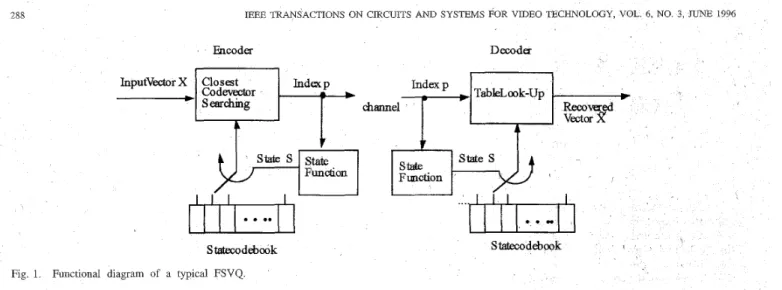
One way to improve the compression ratio while maintain- ing high picture quality is to exploit finite state machines for state tracing. These finite state vector quantization or FSVQ methods have been found to be an efficient technique for image compression [4]-[6]. Fig. 1 shows the block diagram of typical FSVQ’s. Both encoder and decoder of an FSVQ have a finite state machine, which uses previously encoded vectors to decide current state and then selects one corresponding state codebook, which is a subset of master codebook, to quantize input vector. Since the state codebook is smaller than the master codebook, FSVQ can achieve both higher compression ratio and lower computational complexity than the full search VQ. And if the finite state machine can be designed well, the quality of this coding method will be better than that obtained by the full search VQ. For example, if the state codebooks contain 16 codevectors and the master codebook has 5 12 codevectors, then the computational complexity and the bit rate of FSVQ are 1/32 and 419, respectively, of those obtained by the full search VQ.
However, the state machine of FSVQ often does not produce the correct current state. In other words, the selected state codebook often does not contain the closest codevector and the encoder can only find suboptimal codevectors to encode the input vector. This causes larger distortion during the encoding process and since the next state is selected according to the previously decoded vector, the wrong selection of current state will influence the selection of the following state. Therefore, error becomes propagated and hence conventional FSVQ’ s only get 1-2 dB better coding quality than that obtained by the full search VQ at the same bit rate. In addition, since the current state codebook highly relies on previously decoded vectors, we cannot start to quantize the current input vector and select the state codebook from the state machines until the previous input vectors have been vector quantized. This feedback structure or iterative bound of FSVQ makes it difficult to develop real-time cost-effective hardwares for practical applications.
To solve the aforementioned problems, we propose a mul- tipath tree search FSVQ algorithm and its VLSI architecture. In this novel approach, instead of waiting for the quantization of previous vectors and then selecting current state codebook to quantize input vector, we first use the tree search vector quantization or TSVQ method to find the indexes, ITSVQ, of the two closest codevectors from the codebook, and then check whether the state codebook contains any of these two codevec- tors. If yes, the index, Istate, corresponding to one of the two closest codevectors in the state codebook will be transmitted,
288 IEEE TRANSACTIONS ON CIRCUITS AND SYSTEMS FOR VIDEO TECHNOLOGY, VOL 6, NO 3, JUNE 1996 Encoder Decoder Inputvector X Closest ~ Codevector TsbkL~k-Up . w searching Recowred vector
z
4 StatecodebookFig 1 Functional diagram of a typical FSVQ
otherwise an identifier ID together with the index ITSVQ of the closest codevector in the master codebook will be sent out. This method overcomes the problem that the state codebook, in some cases, does not contain the proper codevector to represent the input vector. In Section I1 we will describe this algorithm in detail. Also, some simulation results are given to highlight distinguished features of this algorithm. We then present a VLSI architecture for the proposed algorithm in Section 111, where module design and removing iteration bound will be emphasized. Section IV outlines design issues of our approach and gives some comparisons with current VQ approaches for image and video coding.
11. THE MULTIPATH TREE SEARCH FSVQ ALGORITHM
The functional diagram of the proposed algorithm is shown in Ftg. 2. It contains two VQ phases: one is the TSVQ, and the other is the FSVQ. In the first phase of encoder design, we first exploit a multipath tree search VQ to find the nearly closest codevector. Since the computational complexity of TSVQ is almost as low as that of FSVQ, the advantage of lower computational complexity inherent in FSVQ is still reserved in this proposed algorithm. In the second phase, we then exploit a finite state machine to predict the possible index produced by the TSVQ. That is, the state machine selects a state codebook which may or may not contain the index ITSVQ produced by the TSVQ. If the prediction is correct and the selected codebook really contains the ITSVQ, the information needed to be transmitted to the decoder is the position Istate which specifies the position of I ; ~ S V Q in the selected state codebook; otherwise an identifier code ID together with the
ITSVQ are transmitted to the decoder. This solves the problem that sometimes the state codebook does not contain the proper codevector to represent the input.
In the following, we will show how the TSVQ is designed to achieve better quality of decoded images and how the finite state machine is designed to reach lower bit rate.
A. Design of Multzpath TSVQ
The first part of the proposed VQ algorithm is a TSVQ, which is exploited to find the nearly closest codevector to rep- resent the input vector. The tree search VQ (TSVQ) or known as tree-structure VQ [7] is an alternative to full search VQ. In
Statecodebook
principle, the TSVQ performs a sequence
words, In addition, the of TSVQ nearly double
makes the TSVQ more attractive.
briefly present two kinds of TSVQ’s: balanced and unbalanced TSVQ’s. Then we explain why one
for our TSVQ design.
I ) Balanced TSVQ: Traditionally, TSV
the tree is designed and then fixed. Each is then designed by splitting each codev
method results in an unbalanced tree bec be at ahy depth. For a binary tree, the
is that there will be more codevectors av distortion events which imply those trees of the time. Another approach to design an described in [9]. A balanced fixed rate TS then optimally pruned back using the ge
289 LEE et al.: FINITE STATE VECTOR QUANTIZATION WITH MULTIPATH TREE SEARCH STRATEGY FOR IMAGENIDEO CODING
I I I
State codebook
Input
vector ~
d t i path tree search
Fig. 2. Functional
Channel Table from master Look-y
codebook
a *
1
-
(b)
diagram of the proposed FSVQ system: (a) encoder and (b) decoder.
called a pruned TSVQ (PTSVQ). The PTSVQ has the ability to out-perform the balanced TSVQ by being able to devote more bits to high distortion events.
Although the performance of unbalanced TSVQ is, in general, better than the balanced TSVQ, the uncertain search- ing depth makes it difficult for hardware implementation, which also degrades the advantage of lower computational complexity inherent in TSVQ. In addition, our experiment results show that sometimes the performance of the unbalanced TSVQ is not good enough, especially for images outside the training sequences. The reason for this phenomenon is that unbalanced TSVQ uses more codevectors to encode commonly used clusters while training the codebook, and for the less used clusters, fewer codevectors are used to represent them. Therefore, for the outside training images, if most input vectors belong to the less used clusters, the performance of this encoder becomes very bad. Due to this consideration, the balanced TSVQ is exploited here in the first phase to reach a reasonable computational complexity and make the algorithm more suitable for general images. Moreover, some strate- gies are added to improve the performance of the balanced TSVQ.
3 ) Strategy to Improve TSVQ: The TSVQ is a sequence of binary search operations which can be described as follows.
1) First, identify a searching node as the root.
2) Calculate the distortion between input vector and two children of the searching node. The new searching node is the children which is closer to the input vector.
Recovepl
Vector X
3) If the new searching node is the leaf, the searching process is over and this leaf is identified as the code- vector to represent the input vector: otherwise, go to step 2) for ongoing search.
Sometimes, the TSVQ cannot find the closest codevector because the “father” of the closest codevector is not always closer than the other nodes in the “ancestor” level. This phenomenon becomes more serious when the tree size is larger and the codevectors become closer to each other. Then the “ancestors” of the closest codevector are not selected as the new search node, because sometimes the brothers of these “ancestors” are closer to the input vector. If one of the “ancestors” is not selected, the obtained codevector will never be the closest one and then cause large distortion. This is why the performance of TSVQ is always lower than full search VQ. To reduce the effect of this problem, we use the following strategies.
Multi-Path TSVQ: Chang et al. [ 111 have proposed a mul- tipath TSVQ to improve the performance of TSVQ. Instead of finding one nearest node from two searching nodes, the multipath TSVQ finds two nearest nodes from the four search- ing nodes. The next four search nodes are the children of the two found nearest nodes. The computation of the multipath TSVQ is the double of that of conventional TSVQ’s. The reason that multipath TSVQ searches more nodes than the TSVQ is because sometimes the “ancestor” of the closest codevector is not closer than other search nodes, then the tree search will cause some errors. Therefore, the multipath TSVQ
schemes
I
TSVQ1
25.837I
26.732I
24.732I
25.428I
test images (SNR)
lena pepper girl jet
1
multi-path TSVQl
29.09l
29.619l
31.97l
29.505l
full-search VQ 29.718 30.296 32.79 30.616TABLE I1
THE EXPERIMENT RESULTS OF SEARCHING THE NEIGHBORS OF THE CLOSEST CODEVECTOR
N1-search VQ 29.718 30.296 30.616
multi-path TSVQ with 4 neigh.
I
29.232I
29.706I
31.611I
29.776I
schemesmulti-path TSVQ with 8 neigh.
~ test images (SNB)
lena pepper girl jet 29.311 29.844 31.82 29.929
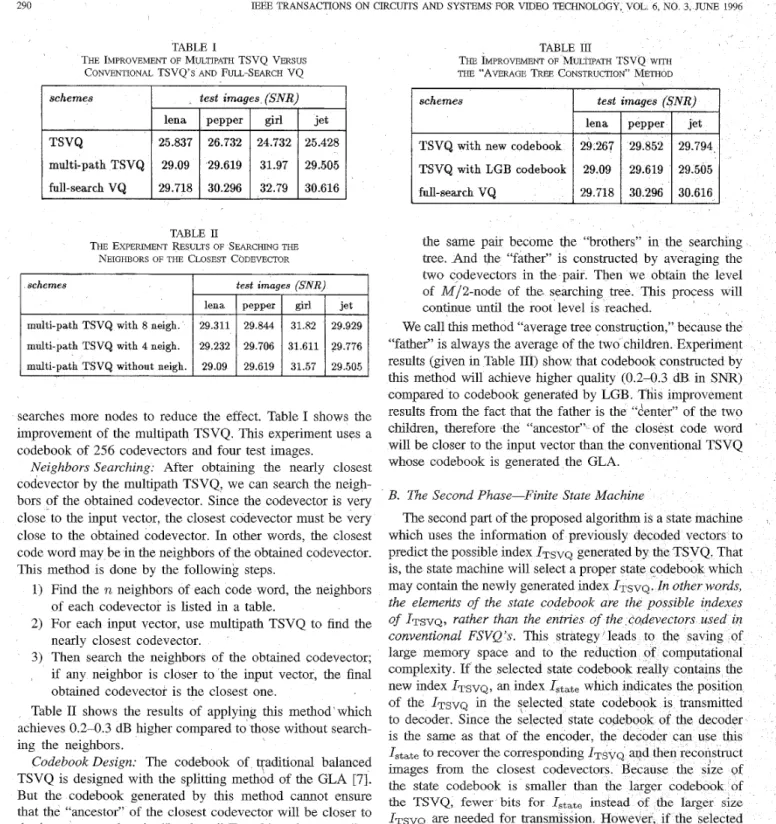
searches more nodes to reduce the effect. Table I shows the improvement of the multipath TSVQ. This experiment uses a codebook of 256 codevectors and four test images.
Neighbors Searching: After obtsuning the nearly closest codevector by the multipath TSVQ, we can search the neigh- bors of the obtained codevector. Since the codevector is very close to the input vector, the closest codevector must be very close to the obtained codevector. In other words, the closest code word may be in the neighbors of the obtained codevector. This method is done by the following steps.
1) Find the n neighbors of each code word, the neighbors of each codevector is listed in a table.
2) For each input vector, use multipath TSVQ to find the nearly closest codevector.
3) Then search the neighbors of the obtained codevector; if any neighbor is closer to the input vector, the final obtained codevector is the closest one.
Table I1 shows the results of applying this method’ which achieves 0.2-0.3 dB higher compared to those without search- ing the neighbors.
Codebook Design: The codebook of traditional balanced TSVQ is designed with the splitting method of the GLA [7]. But the codebook generated by this method cannot ensure that the “ancestor” of the closest codevector will be closer to the input vector than its “brothers.” To achieve better coding quality, the codebook used in the TSVQ has to be modified. In this paper, we propose the following scheme to construct the tree structure codebook.
1) Use the LBG algorithm [12] to produce the codebook until the codebook size reaches the desired figure M . These M codevectors are the leaves of the tree. 2) For the obtained N-size codebook, we first identify
the pairs whose leaves are closest to each other. This location process begins at looking for the furthest pair (i.e., pair distance is the longest). The codevectors in
multi-path TSVQ without neigh.
TABLE III
29.09 29.619 31.57 29.505
THE IMPROVEMENT OF MULTIPATH TSVQ WITH THE “AVERAGE TREE CONSTRUCTION” METHOD
schemes test images (SNR)
TSVQ with LGB codebook
I
29.09I
29.619I
29.5051
290 IEEE TRANSACTIONS ON CIRCUITS AND SYSTEMS FOR VIDEO TECHNOLOGY, VOL 6, NO 3, JUNE 1996,
compared to codebook generated by LGB. Tliis improvement results from the fact that the father is the “denter” of the two children, therefore the “ancestor” of the closest code word will be closer to the input vector than the conventional TSVQ whose codebook is generated the GLA.
B. The Second Phase-Finite State Machine
The second part of the proposed algorithm is a state machine
may contain the newly generated
complexity. If the selected state c
is the same as that of the encoder, Istate to recover the corresponding ITSV images from the closest codevectors. the state codebook is smaller than th ITWQ are needed for
state codebook does not c ITSVQ, an identifier code be transmitted to the decoder.
recently used index on the top of state CO
in an adaptive version of multipath tree algorithm whose output is a variable rate.
LEE et al. : FINITE STATE VECTOR QUANTIZATION WITH MULTIPATH TREE SEARCH STRATEGY FOR IMAGENIDEO CODING 29 1
is designed well, and selected state codebooks usually hit the
I T s ~ ~ ,
then the average bit rate becomes lower than thatobtained from FSVQ without adaptation. C. Experiment Results
We have used this scheme to implement the side match VQ (SMVQ) [ 5 ] , which is one of the FSVQ’s, to observe the cod- ing quality. Simulation results are obtained from two different approaches: one is the multipath tree search FSVQ or called the modified SMVQ, and the other is the adaptive version which is called the adaptive modified SMVQ. The adaptive modified SMVQ adaptively updates the state codebook by exploiting the least recently used (LRU) strategy. This LRU is implemented by placing the most recently used element on the top of selected state codebooks. Here, the codebook of the TSVQ is generated by the “average tree construction” technique mentioned earlier, where a four-path TSVQ is used. We have changed both sizes of the codebook of the TSVQ and the state codebook of the state machine. The larger the codebook size of TSVQ is, the higher will be the signal-to- noise ratio (SNR) coding results obtained. For a given TSVQ codebook size, there is an optimal state codebook size to reach a minimum bit rate. The more complex the encoded image is, the larger the optimal state codebook size is. Fig. 3 shows the comparison of the SNF versus bit-rate of this proposed algorithm with that obtained from the original SMVQ. Note that each point is derived at an optimal state codebook size for different TSVQ codebook sizes. Simulation results show that the modified SMVQ implemented by our proposed approach does achieve higher SNR than that obtained from the original
SMVQ. The reason why this modified SMVQ improves the coding quality is because our proposed algorithm eliminates the disadvantage that the nearest codevector is not in the state codebook as found in conventional FSVQ’s. And the reason the adaptive modified SMVQ out-perfoms the others is because the state codebook of the adaptive modified SMVQ can trace the local statistics of input imagehide0 sequences so that the prediction of the I T ~ V Q is more accurate and the average output bit rate becomes lower.
Fig. 4 shows the results of our algorithm for two test images. Output bit-rates for “Lena” and “Pepper” are 0.321 and 0.305 b/pixel, respectively. Picture quality obtained from this method is very close to that from full-search VQ, as shown in Table 111. However, the output bit-rate becomes less than 65% of that from full-search VQ.
111. VLSI DESIGN FOR REAL-TIME PERFORMANCE
It can be seen from the algorithm description that the recursive part is only in the finite state machine. Therefore, to speed up coding performance, we have to break this bottleneck in order to meet real-time requirements. In this section, we first deal with a pipeline structure for implementing the TSVQ. We then show a parallel structure for removing the iteration bound of the FSVQ. Thus, the complete architecture, which is also named “multipath tree-search based architecture” here [ 131, can be pipelined to implement the proposed algorithm.
average PSNR 0 0.00.10.1 0.20.2 0.30.3 0.40.4 5 5 5 5 5 BIT RATE
+
Adaptive M o d i SMVQ+
M o d i S M V Q A OriginalSMVQFig. 3. SNR versus different bit rates. Simulation results on Claire sequence are obtained, respectively from original SMVQ and our modified SMVQ implemented by the proposed architecture. The adaptive one modifies state codebook by using LRU strategy. The master codebook is generated by using LBG algorithm from the luminance of four JPEG test images: “balloons,” “Barbara,” “boats,” and “chairlady.”
@)
Fig. 4. Simulation results for two test images-Lena and Pepper-(a) shows the original images and @) shows the decoded images with output bit-rates at 0.321 and 0.305 b/pixel, respectively.
A. Architecture for the TSVQ
The required operations in different levels of the tree structure are very related because only when the upper level is determined can the next level be performed. However, there is no feedback loop between two adjacent levels. Therefore, each level can be performed independently if its upper is already determined. Thus, the structure of tree search VQ is inherently pipelined. An overall hardware organization of the encoder is
shown in Fig. 5. The TSVQ contains several stages, each of which has different sizes of codebook depending on its depth in the complete tree structure. The indexes of the two nearest codevectors are transmitted to the address generator which
292
State Codeboo Address Generator and Master Codebook
Fig 5 Block diagram of the encoder
Fig. 7.
can be reahzed on PLA and RAM, respectively.
Overall hardware organization of the FSVQ’ t SFU and LRU
Fig. 6 . Block diagram of the first three stages for address generator and master codebook
function, For other FSVQ’S, we Only state function of state machine and the produces the address ‘for the codevectors needed at the next
level. Fig. 6 shows the architecture of the first three stages of the address generator. Each stage of the address generator uses the indexes produced by the previous stage of TSVQ to determine the searching node of current stage. The two indexes produced by the last stage of the TSVQ are the indexes of the two identified nearly closest codevector I T ~ V Q ’ S which will be passed to the FSVQ.
From this architecture description, it can be found that only (0-2) levels are needed for tree searching, where D is tree depth. This is because four nodes are required simultaneously at each level, implying the first two stages, i.e., Do and D1,
are never used. The TSVQ architecture mainly consists of two parts, one is the storage and address generation for codevectors and the other is the distortion estimation and index selection. It is clear that for tree depth of D , [ z ( ~ + ‘ ) - 41 codevectors are
needed to be stored. Also the addresses for four different code- vectors have to be provided by the address generators whose part of the MSB’s are determined by its previous stage. As for the distortion estimation and index selection, it can be easily realized on a few adders, registers, and multiplexers [13]. B. Architecture f o r the FSVQ
From the algorithm description, we know that the only calculation in the finite state machine is to check whether
function, and an
Isu
for selection of indindex &ate accompanied by an ID 1s sent
C. WS’I Imphaentation
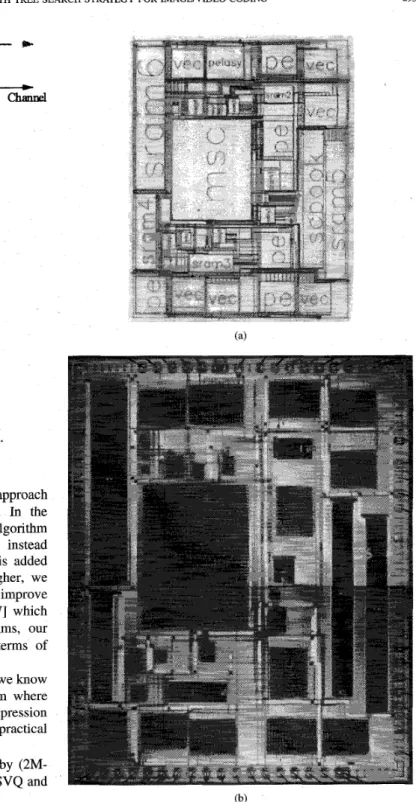
A prototype VLSI chip (as show algorithm has been fabricated and
1024 pixels be handled by to allow the use of different code
Algorithm: multipath tree-search (seve Throughput: 1 pixel per cycle; gorithm;
LEE et al.: FINITE STATE VECTOR QUANTIZATION WITH MULTIPATH TREE SEARCH STRATEGY FOR IMAGENIDEO CODING
-
293
address to state codebook
Fig. 8. Block diagram of index matching and selection units.
Maximum clock rate: 35 MHz; Transistor-count: 420K;
Internal memory size: 40 Kb (22.8 mm2); Die size: 95 mm2;
Power consumption: 0.95 W at (33 MHz, 5 V); Process: TSMC 0.8 pm CMOS SPDM process; Package: 84-pin CLCC;
Design style: full-custom
+
cell-based approach. I v . EVALUATION AND DISCUSSIONSCompared to other FSVQ algorithms [ 5 ] , [6], our approach
offers higher picture quality at the same bit-rate. In the meantime, the iteration bound is now removed in our algorithm because only one input data has to be compared instead of an input vector. Although the multipath TSVQ is added and, hence, computational requirements become higher, we can exploit the pipelining inherent in the TSVQ to improve speed. Unlike other available VQ solutions [ 1414 171 which are dedicated to tree-search or full-search algorithms, our approach does reach a more optimal solution in terms of picture quality, bit-rate, and hardware complexity.
From both algorithm and architecture descriptions, we know that pipelining can be applied to this new algorithm where computational complexity can be reduced and compression ratio can be enhanced. Below, we highlight some practical design issues for real-life applications.
1) The required memory space can be estimated by (2M- 4)NW
+
1024 W, where the first term is for TSVQ and the second term is for FSVQ.2) Input sample rates for TSVQ and FSVQ are different. Since the TSVQ deals with block image data while the FSVQ deals with index data, data rate of the latter is only 1/N of the former. Thus, the TSVQ is more computation intensive.
3) Parallel computation or shared hardware data-path can be considered by trading off area and performance at the multipath TSVQ. For example, if only one 8-b data bus is available, at least 4 N cycles are needed for each stage. On the other hand, if the bus number increases, parallel datapaths are needed and, hence, cycle-count can be reduced.
(b)
Fig. 9.
microphoto of the chip.
(a) Shows floor plan of the VQ encoder chip, and (b) shows
V. CONCLUSION
In this paper, we have proposed a new VQ algorithm and a- chitecture which combines the advantages of both tree-search and finite-state VQ’s. This so-called multipath tree-search FSVQ architecture does solve the problem that sometimes the selected state codevector does not contain the better codevector to represent the input vector. Simulation results have shown that good picture quality can be achieved at lower output
294 IEEE TRANSACTIONS ON CIRCUITS AND SYSTEMS FOR VIDEO TECHNOLOGY, VOL 6, NO 3, JUNE 1996
bit-rate. Moreover, we have also presented a VLSI solution for the proposed algorithm, where tested results show that 30 imagehideo frames per second (1024 x 1024 pixels) can be handled‘ at 33 MHz.
In summary, this fully pipelinable multipath wee-search based architecture not only suits the implemention of various FSVQ’s for real-time imagehide0 coding, but also achieves higher SNR than conventional FSVQ’s in terms of bit-rate and picture quality.
ACKNOWLEDGMENT
The authors would like to thank their colleagues within the SI2 group of NCTU for many discussions-and fruitful suggestions.
REFERENCES
[I] R M Gray and A Gersho, Vector Quantization and Signal Processing. Norwell, MA Kluwer, 1991
[2] C Y Lee and S C Juan, “An ASIC architectwe for real-time im- ageivideo coding based on fixed-basis &stomon vector quantization,” in Proc ISCAS’92, San Diego, CA, May 10-13, 1992.
[3] -, “VLSI implementation of a modified-VQ encoder suitable for imageivideo applications,” in Proc EURSIPC0’92, Brussels, Belgium,
[4] J Foster, R M. Gray, and M. 0. Dunham, “Finite state vector quanid- zation for waveform coding,” IEEE Trans. Info. Theory, vol IT-31, pp. 348-355, May 1985
[5] T G m , “Side match and overlap match vector quantizers for image,”
IEEE Trans Image Processing, vol 1, no 2, Apr 1992
[6] W T Chen, R F Chang, and J. S Wang, “Image sequence coding using adaptive finite-state vector quantizahon,” IEEE Trans Czrcuzts
Syst Video Technol, vol 2, no 1, Mar 1992
[7] A. Buzo, A H Gray, J r , R M Gray, and J Markel, “Speed coding based upon vector quantization,” IEEE Tran Acoust , Speech, Signal
ASSP-28, pp 562-574, Oct. 1980.
Roucos, and H. Gish, ‘‘Vector quantization in speech
Trans Commun, vol COM-36, no. 8, pp. 957-971, Aug 1988.
[9] P A Chou, T Lookabaugh, and R M Gray, “Ophmal pmmng with applications to tree-structured source coding and modehng,” IEEE
Trans Inform Theory, vol 35, no 2, pp 299-315, Mar 1989
[lo] L Breiman, .IH Friedman, R. A Olshen, and C. J Stone, Classlficatzon
and Regression Trees Belmont, CA. Wadsworth, 1984.
[ I l l F Chang, W T Chen, and J S Wang, “Image sequence coding using adaptive tree-stmcture vector quantlzation with multipath searching,” in IEEE Int Conf Acoust , Speech, and Signal Processzng, 1991, pp. 2281-2284
[12] Y Y Linde, A Buzo, and R M. Gray, “An algonthm for vector quantizer design,” IEEE Trans Commun, vol COM-28, no 1, pp. 84-95, 1980
[13] Y J Chao and C Y Lee, “A new multipath tree-search FSVQ architecture for imageivideo sequence coding,” in Proc ISCAS’95, Seattle, WA, Apr 29-May 3, 1995, pp 1628-1631
[14] G A Davidson, P R. Cappello, and A Gersho, “Systolic archtectures for vector quantization,” IEEE Trans Acoust., Speech, Signal Process-
m g , vol 36, pp 1651-1664, Oct 1988
Aug 26-28, 1992
\
I
[15] P. A. Ramamoo~thy, B Potu, and T Tran, mentation of vector quantlzer for real-time i
Czrcuits Systems, vol. 36, pp. ’1281-1290, 0 [16] H. Park and V. K. Prasanna, “Modular VLSI full-search-based vector quantization,” IEEE
TechnoL, vol. 3, pp. 309-317, Aug. 1993
[17] W. C. Fang, C Y Chang, B J Sheu, 0 Curlander, “VLSI systolic binary tree-searc image compression,” IEEE Trans VLSI Syst ,
Mar. 1994.
Chen-Yi Lee (S’89-M’90) received the B.S. from
National Chao Tung University, Taiwan, in 1982, the M S and Ph D degrees from the Katholieke Umversity Leuven (KUL), Belgium, ’in 1986 and 1990, respectively, all in electrical engineering
From 1986 to 1990, h worhng in the area of DSP Since February 1 sociate Professor in the Engineenng at the Nation Hsinchu. Tawan His r
clude videohmage coding, high-speed networhng system-level synthesis.
Shin-Chou Juan received the B S and M S de grees from the Department of Electronics Engi- neering from the National
(NCTU), Hsinchu, Taw
HIS research interests i
cuits.
March 18, 1971, and mo
high speed architecture