行政院國家科學委員會補助專題研究計畫期中進度報告
多方策略聯盟與廠商績效之研究(1/2)
計畫類別:
;
個別型計畫 □ 整合型計畫
計畫編號:NSC 98-2410-H-004-068 –MY2
執行期間:98 年 8 月 1 日 至 99 年 7 月 31 日
計畫主持人: 黃國峯 助理教授 國立政治大學企業管理學系
成果報告類型(依經費核定清單規定繳交):
;
精簡報告 □完整報告
本成果報告包括以下應繳交之附件:
□赴國外出差或研習心得報告一份
□赴大陸地區出差或研習心得報告一份
□出席國際學術會議心得報告及發表之論文各一份
□國際合作研究計畫國外研究報告書一份
執行單位:國立政治大學企業管理學系
中 華 民 國 99 年 7 月 1 日
行政院國家科學委員會補助專題研究計畫期中進度報告
多方策略聯盟與廠商績效之研究(1/2)
Multiple Strategic Alliances and Firm Performance
計畫編號:NSC 98-2410-H-004-068-MY2
執行期間:98 年 8 月 1 日至 99 年 7 月 31 日
計畫主持人:黃國峯助理教授 國立政治大學企業管理學系
多方策略聯盟與廠商績效之研究(1/2)
黃國峯
國立政治大學 企業管理學系
Email: [email protected] Tel: (02)29393091 #81238 Fax : (02) 29398005 Address : 116 台北市文山區指南路二段 64 號 *For correspondence 本篇文章為本年度國科會專題研究計劃中正在投稿期刊文章之摘錄,全文請洽詢作者。INTRODUCTION
Prior alliance research mainly focus on the effect of alliance partner number on performance. According to organizational learning theory, Chen (2003) asserts that the alliance performance will start to decrease if the number of alliance partners is over certain level. Gulati (1995) regards that the two-party alliances can have better direct and frequent coordination whereas the multi-party alliances make the coordination channels more complicate and inefficient, which in turn leads to more conflicts among partners. Das and Teng (2002) also conclude that multi-party alliances are more complex in terms of organization and structure than dyadic-relation alliances. Based on the order of member participation, Ridder and Rusinowska (2008) further distinguish multi-partner alliances into two types: simultaneous-joint alliances and sequential-joint alliances. Though these prior studies conclude that multi-party alliances affect firm performance, none of these studies investigate whether multiple simultaneous alliances or sequential alliances taken by a firm have different impacts on firm performance. Thus, our research attempts to fill this research gap.
Building on the current conceptual work that suggests alliance experience accumulation can be obtained both from allying across a diverse set of partners and from repeatedly allying with the same partner over time (Hoang & Rothaermel, 2005), we extend this stream of research by outlining a concept of simultaneous alliances and sequential alliances based on the resource-based view and organizational learning theory. Simultaneous alliances refer that firms conduct multiple alliances at the same period of time while sequential alliances refer that firms conduct an individual alliance once for each time. Simultaneous alliances require a better alliance management capability (Dyer & Singh, 1998; Ireland, Hitt, & Vaidyanath, 2002) to manage multiple alliances simultaneously, whereas sequential alliances allow firms to facilitate the alliance management capability one by one. As a result, we expect that firms conducting sequential alliances may have better performance than those firms conducting simultaneous alliances. By examining 1,029 alliances in pharmaceutical companies globally in the biotechnology industry since 1980, this paper provides a different perspective of the effect of simultaneous alliances and sequential alliances on firm performance.
THEORETICAL BACKGROUND
Simultaneous Alliances and Sequential Alliances
Alliance is a highly interdependent relationship among individual firms who share with the same goal and interests (Mohr and Spekman, 1994). According to the resource dependency theory, firms seek for connections with external institutions possessing resources which are needed by these firms (Pfeffer & Salanick, 1978). Firms seek for complementary resources or assets (Harrison, Hitt, Hoskisson, & Ireland, 2001) or seek for knowledge acquisition or technology development in an alliance (Gilsing, Lemmens, and Duysters, 2007). If an alliance can contribute to a firm, will the firm benefit more when conducting multiple alliances? Prior studies show that firm performance is positively related the number of alliances due to alliance experience but there is a diminishing marginal return with the increase of alliance number (Chen, 2003). From the perspective of the organizational learning school, firms do learn management capability from their previous alliance experience. However, this alliance experience is implicitly assumed in the circumstance of subsequent alliances (see an example in Hoang and Rothaermel’s study in 2005). In business practice, most firms conduct multiple alliances at the same time instead of one by one. Thus, a question whether this alliance management capability can manage multiple alliances
simultaneously becomes increasing important.
With limited resources and capabilities of each firm, firms are constrained to acquire knowledge, process information, and communicate with other units, particularly as conducting multiple external collaborative projects at the same time. From the perspective of transaction costs, Jones and Hill (1988) assert that transaction costs increase with the number of participated alliances, and the marginal costs are greater than marginal rewards for each added alliance. As a result, the more alliances involved by a firm at the same time, the worse performance the firm have due to diversified resources into different alliances. In contrast, firms can more easily concentrate their resources or capabilities on an alliance if the alliance only one in the period of time. Therefore, in this research, we propose:
Hypothesis 1: Firms conducting simultaneous alliances are inclined to have worse performance than firms conducting sequential alliances.
Simultaneous Alliances and Inter/Intra-Industry Alliances
As mentioned earlier, if simultaneous alliances are inevitable, what types of alliances are more appropriate for simultaneous alliances? If a firm conducts multiple intra-industry alliances simultaneously, the risk of spillover and competition orientation across multiple intra-industry alliances will prevent the contribution of alliances, which in turn leads to a worse performance. In contrast, if a firm conducts multiple inter-industry alliances simultaneously, less risk of spillover or less competition will encourage inter-industry alliance partners to contribute the alliances, which in turn leads to a better performance. Therefore, in this study, we propose the following hypothesis:
Hypothesis 2: The interaction effect of simultaneous alliances by inter-industry alliances is positively related with firm performance.
Simultaneous Alliances and Exploration/Exploitation Alliances
Levinthal and March (1993) define exploration as ‘the pursuit of knowledge, of things that might come to be known,’ and exploitation as ‘the use and development of things already known.’ Based on Levinthal and March’s (1993) study, Rothaermel and Deeds (2004) show the two stages of the innovation process: exploration for technology innovation and exploitation for new product development. Firms initiate exploration alliances to seek for new technology or knowledge from external sources in the early stage of R&D process while other firms initiate exploitation alliances to share the risk of new production development (Rosenkopf & Nerkar, 2001). Thus, the outcome of exploration alliances is inclined to be highly uncertain and most of time is negative. Thus, if a firm can conduct multiple exploration alliances simultaneously, it can increase its opportunity to acquire breakthrough technologies, and the reward is extreme high once it succeeds. On the contrary, although the outcome of exploitation alliances is more predictable and positive, the reward is relatively low. This is because in exploitation alliances, some technologies are patented by other firms and the cost of using these technologies is high. As a result, we expect that firms can benefit more as conducting simultaneous exploration alliances.
Hypothesis 3: The interaction effect of simultaneous alliances by exploration alliances is positively related with firm performance.
Simultaneous Alliances and Business Functional Alliances
Different types of alliances in terms of business function, including R&D, licensing, manufacturing, and marketing, may also affect a firm’s performance. Since R&D alliances involve more tacit knowledge sharing and transfer (Sampson, 2007), firms need to commit more resources to manage alliances. If a firm conducts multiple R&D alliances simultaneously, the limited resources of the firm will constrain its capability of managing the multiple alliances, which in turn leads to a worse performance. Thus, this study expects the following hypothesis:
Hypothesis 4a: The interaction effect of simultaneous alliances by R&D alliances is negatively related with firm performance.
McCutchen and Swamidass (2004) assert that in the licensing alliances, licensors can join alliances to acquire new market opportunities whereas licensees join alliances to reduce R&D time and to improve competitive position in the industry. Compared to R&D alliance, licensing alliances require less resource to commit in the alliances, making firms easily to conduct multiple alliances simultaneously at the lower costs. More importantly, undertaking more licensing alliances simultaneously means a higher possibility of firms to commercialize products, which in turn have a better performance. Therefore, we expect:
Hypothesis 4b: The interaction effect of simultaneous alliances by licensing alliances is positively related with firm performance.
Marketing alliances refer that partner firms share distributions, promotions, and branding in such collaborations. Firms with multiple marketing alliances simultaneously attempt to seek for new market opportunities or new product segments. Thus, the more marketing alliances imply the more complementary markets or products possessed by the alliance firms, which in turn lead to better performance.
Hypothesis 4c: The interaction effect of simultaneous alliances by marketing alliances is positively related with firm performance.
Varadarajan and Cunningham (1995) assert that manufacturing alliances can reduce costs for alliance partners by sharing production facilities or creating economies of scale. Moreover, firms can use partners’ production capacity as a buffer when they involve various types of drug productions. As a result, the more manufacturing alliances are undertaken, the more drugs are demanded of the firm and the lower manufacturing costs, which in turn lead to better firm performance. Thus, we can derive the following hypothesis:
Hypothesis 4d: The interaction effect of simultaneous alliances by manufacturing alliances is positively related with firm performance.
Simultaneous Alliances and Firm Size
McCutchen and Swamidass (2004) point that compared to small pharmaceutical firms, large pharmaceutical firms have the resource advantage of dealing with regulations, developing clinical test, conducting mass production, and establishing distributions. Prior studies suggest that firm size and alliance number have a positive relationship (Rothaermel, 2001; Rothaermel and Deeds, 2004). Thus, with the increase of firm size, firms are capable of conducting multiple alliances simultaneously due to possession of more resources and capabilities, which allow firms to communicate multiple internal units and external partners more efficiently and effectively at the same period.
Hypothesis 5: The interaction effect of simultaneous alliances by large firms is positively associated with firm performance.
RESEARCH METHOD
Sample and Data
In a first step toward creating a dyadic database, we identified all pharmaceutical companies active globally in biotechnology as of 1980 through studying SIC listings and a variety of industry publication. Our research used the US alliance database, Securities Data Company’s (SDC) section of Worldwide Mergers, Acquisitions, and Alliances to select our sample. The research scope of our sample firms is limited in the drugs industry, including medicinal chemicals and botanical products, pharmaceutical preparations, in vitro and in vivo diagnostic substances, and biological products except diagnostic substances. The SIC Codes of the above sectors were 2833, 2834, 2835, and 2836. We collected all collaborative biotechnology projects that these sample firms had initiated between 1994 and 2008 since a complete process of new drug development need 12-15 years.
Variables and Measures
(1) Dependent variable: financial performance
George, Zahra, and Wood (2002) employ sale to asset ratio to measure a firm’s financial performance since this proxy can explain a firm’s ability of revenue generation based on its total assets. Revenue generation is particularly important to a pharmaceutical firm because it provided needed cash inflow for the high R&D intensity firm. Thus, we used sale to asset ratio as our measure for firm performance in this research. Sale to asset ratio was calculated net sales divided by total assets in the database of COMPUSTAT. Considering the possible lag between alliance activities and firm performance, we used a three-year average sale to asset ratio after the end of each alliance project as our proxy.
(2) Independent variable: sequential alliance/ simultaneous alliance
Based on our definition, simultaneous alliance means that a firm conducts multiple alliances at a period of time while sequential alliance means that a firm conducts an alliance once at a time. Thus, our independent variable was binary, with 0 indicating sequential alliance and 1 indicating simultaneous alliance. We collected all alliances that these pharmaceutical firms had initiated between 1994 and 2008. These data were obtained from the part of ‘Participants in Venture/Alliance’ in the SDC database. We then identified simultaneous alliance and sequential alliance by our definition. However, the SDC database has one limitation that it only shows ‘alliance date announced’ but no ‘alliance date expired’, which makes us difficult to identify whether there was an overlap between two alliances at a period of time. To overcome this limitation, we estimated the length of an alliance by calculating the mean of 106 cases with ‘alliance expected length’ in the SDC database. The averaged expected length alliance was 4.69 years and therefore we used this 5-year period as our estimation of an alliance’s length. In the SDC database, there were 1,030 cases in 315 firms with the SIC codes of 2833, 2834, 2835, and 2836 initiating alliances during the 15-year period between 1994 and 2008. We then distinguished simultaneous alliance from sequential alliance by checking whether there were two or more alliances conducted by a firm which overlapped in the same period of time.
Intra-industry vs. inter-industry alliance. This variable was binary, with 0 indicating
intra-industry alliance if all partner firms in the alliance were with the SIC code of 2833, 2834, 2835, and 2836, and 1 indicating inter-industry alliance if one of partner firms in the alliance was not included within the SIC code of 2833, 2834, 2835, and 2836.
Exploration vs. exploitation alliance. Based on the ‘Deal Text’ and ‘Activity Description’ of
alliances in the SDC database, we used the content analysis method to identify an alliance with the keywords such as research and development, discovery, target research, design, preclinical, efficacy, derivatives, formulation, and compound for exploration alliance, and clinical, Phase I, II, III, approval, NDA, registration, dosage, market and development, retail and wholesale, and commercialize for exploitation alliance. The variable was binary, with 0 indicating exploration alliance, and 1 indicating exploitation alliance.
Functional types of alliance. In the part of ‘Activity Description’ in an alliance from the SDC
database, there are four types of functions, including R&D, licensing, marketing and manufacturing. We constructed the functional type variable by creating binary dummies for the four aforementioned functions (i.e. R&D, licensing, marketing, and manufacturing). These four dummies were not exclusive, which means that firms might conduct alliances with two or more functions.
(4) Control variables
We also control firm age, R&D intensity and firm size in this research.
ANALYSIS AND RESULTS
In the results, simultaneous alliance accounts for 82.6% while sequential alliance17.4% of cases. The result also shows that control variables such as firm age, alliance experience, R&D intensity, and firm size, had moderate a correlation with our dependent variable. Thus, we further used the variance inflation factor (VIF) values to assess multi-collinearity problem. In our model, the VIF scores for all independent variables were less than 10, suggesting that our models have limited multicollinearity among independent variables, which should not significantly influence the stability of the parameter estimates. We used hierarchical regression models to test our developed hypotheses.
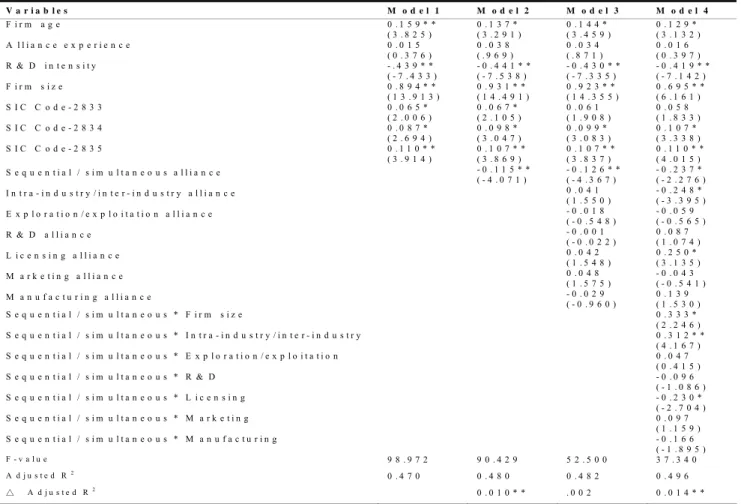
Table 1 shows the regression results of four models in this study. Model 1 explains 47.0% of the variance (adjusted R Square = 0.470) in the dependent variable. As predicted, firm age (b = 0.159, p < 0.01) and firm size (b = 0.894, p < 0.01) is positively associated with firm performance, suggesting that older and larger firms have better firm performance. However, R&D intensity is negatively correlated to firm performance (b = -0.439, p < 0.01), suggesting that higher R&D intensity may reduce a firm’s performance in terms of sale to asset ratio. Model 2, which includes sequential/simultaneous alliance as an independent variable, explains 48.0% of variance in firm performance and the adjusted R square is significant improved compared with Model 1 (Δ Adjusted R2= 0.010, p < 0.01). The simultaneous alliance is found negatively related to firm performance (b = -0.115, p<0.01), suggesting that comparing with sequential alliances, firms conducting simultaneous alliances are inclined to have worse performance, which supports our Hypothesis 1.
Table 1 Regression results V a r i a b l e s M o d e l 1 M o d e l 2 M o d e l 3 M o d e l 4 F i r m a g e 0 . 1 5 9 * * ( 3 . 8 2 5 ) 0 . 1 3 7 * ( 3 . 2 9 1 ) 0 . 1 4 4 * ( 3 . 4 5 9 ) 0 . 1 2 9 * ( 3 . 1 3 2 ) A l l i a n c e e x p e r i e n c e 0 . 0 1 5 ( 0 . 3 7 6 ) 0 . 0 3 8 ( . 9 6 9 ) 0 . 0 3 4 ( . 8 7 1 ) 0 . 0 1 6 ( 0 . 3 9 7 ) R & D i n t e n s i t y - . 4 3 9 * * ( - 7 . 4 3 3 ) - 0 . 4 4 1 * * ( - 7 . 5 3 8 ) - 0 . 4 3 0 * * ( - 7 . 3 3 5 ) - 0 . 4 1 9 * * ( - 7 . 1 4 2 ) F i r m s i z e 0 . 8 9 4 * * ( 1 3 . 9 1 3 ) 0 . 9 3 1 * * ( 1 4 . 4 9 1 ) 0 . 9 2 3 * * ( 1 4 . 3 5 5 ) 0 . 6 9 5 * * ( 6 . 1 6 1 ) S I C C o d e - 2 8 3 3 0 . 0 6 5 * ( 2 . 0 0 6 ) 0 . 0 6 7 * ( 2 . 1 0 5 ) 0 . 0 6 1 ( 1 . 9 0 8 ) 0 . 0 5 8 ( 1 . 8 3 3 ) S I C C o d e - 2 8 3 4 0 . 0 8 7 * ( 2 . 6 9 4 ) 0 . 0 9 8 * ( 3 . 0 4 7 ) 0 . 0 9 9 * ( 3 . 0 8 3 ) 0 . 1 0 7 * ( 3 . 3 3 8 ) S I C C o d e - 2 8 3 5 0 . 1 1 0 * * ( 3 . 9 1 4 ) 0 . 1 0 7 * * ( 3 . 8 6 9 ) 0 . 1 0 7 * * ( 3 . 8 3 7 ) 0 . 1 1 0 * * ( 4 . 0 1 5 ) S e q u e n t i a l / s i m u l t a n e o u s a l l i a n c e - 0 . 1 1 5 * * ( - 4 . 0 7 1 ) - 0 . 1 2 6 * * ( - 4 . 3 6 7 ) - 0 . 2 3 7 * ( - 2 . 2 7 6 ) I n t r a - i n d u s t r y / i n t e r - i n d u s t r y a l l i a n c e 0 . 0 4 1 ( 1 . 5 5 0 ) - 0 . 2 4 8 * ( - 3 . 3 9 5 ) E x p l o r a t i o n / e x p l o i t a t i o n a l l i a n c e - 0 . 0 1 8 ( - 0 . 5 4 8 ) - 0 . 0 5 9 ( - 0 . 5 6 5 ) R & D a l l i a n c e - 0 . 0 0 1 ( - 0 . 0 2 2 ) 0 . 0 8 7 ( 1 . 0 7 4 ) L i c e n s i n g a l l i a n c e 0 . 0 4 2 ( 1 . 5 4 8 ) 0 . 2 5 0 * ( 3 . 1 3 5 ) M a r k e t i n g a l l i a n c e 0 . 0 4 8 ( 1 . 5 7 5 ) - 0 . 0 4 3 ( - 0 . 5 4 1 ) M a n u f a c t u r i n g a l l i a n c e - 0 . 0 2 9 ( - 0 . 9 6 0 ) 0 . 1 3 9 ( 1 . 5 3 0 ) S e q u e n t i a l / s i m u l t a n e o u s * F i r m s i z e 0 . 3 3 3 * ( 2 . 2 4 6 ) S e q u e n t i a l / s i m u l t a n e o u s * I n t r a - i n d u s t r y / i n t e r - i n d u s t r y 0 . 3 1 2 * * ( 4 . 1 6 7 ) S e q u e n t i a l / s i m u l t a n e o u s * E x p l o r a t i o n / e x p l o i t a t i o n 0 . 0 4 7 ( 0 . 4 1 5 ) S e q u e n t i a l / s i m u l t a n e o u s * R & D - 0 . 0 9 6 ( - 1 . 0 8 6 ) S e q u e n t i a l / s i m u l t a n e o u s * L i c e n s i n g - 0 . 2 3 0 * ( - 2 . 7 0 4 ) S e q u e n t i a l / s i m u l t a n e o u s * M a r k e t i n g 0 . 0 9 7 ( 1 . 1 5 9 ) S e q u e n t i a l / s i m u l t a n e o u s * M a n u f a c t u r i n g - 0 . 1 6 6 ( - 1 . 8 9 5 ) F - v a l u e 9 8 . 9 7 2 9 0 . 4 2 9 5 2 . 5 0 0 3 7 . 3 4 0 A d j u s t e d R2 0 . 4 7 0 0 . 4 8 0 0 . 4 8 2 0 . 4 9 6 △ A d j u s t e d R2 0 . 0 1 0 * * . 0 0 2 0 . 0 1 4 * *
In order to further examine the moderating effects, this study uses regression model with interaction term. We multiplied sequential/simultaneous alliance by firm size, intra-industry/inter-industry alliance, exploration/exploitation alliance, and four functional alliances, and entered the multiplicative interaction items into the regression (shown as Model 4 in Table 3). Model 3 and Model 4 explains 48.2% and 49.6% of the variance (adjusted R Square = 0.482 & 0.496) in firm performance. The adjusted R square is not significantly improved in Model 3 (Δ adjusted R2= 0.002, p > 0.05) but significant improved in Model 4 (Δ adjusted R2= 0.014, p < 0.01), suggesting that our regression model with interaction term has higher explanation power for the dependent variable. Model 3 shows that all added moderator variables do not significantly have direct correlation with firm performance. Model 4 shows that simultaneous alliance interacted by firm size and inter-industry alliance is positively correlated to firm performance (b = 0.333, p<0.01, and b = 0.312, p<0.01). However, simultaneous alliance interacted by licensing alliance is negatively correlated to firm performance (b = -0.230, p<0.05). The results suggest that simultaneous alliances can lead to better firm performance if firms are larger or conduct inter-industry alliances but lead to worse performance as firms conduct licensing alliances.
DISCUSSION AND CONCLUSION
While prior alliance experience studies assert that there is a positive association between alliance experience and firm performance (Hoang and Rothaermel, 2005), the methods using to measure
and to examine in these studies implicitly assume that alliances are undertaken sequentially. In business practice, most firms conduct multiple alliances at the same time instead of one by one. According to our research, only 17.4% out of 1,029 alliances are sequential alliances.
The result shows that firms conducting simultaneous alliances are inclined to have worse firm performance than firms conducting sequential alliances. This suggests that as conducting multiple alliances simultaneously, firms may diverse their resources into several alliances and then lose their focus on core businesses, or may increase their transaction costs due to the increase of number of alliances (Jones and Hill, 1988). As a result, the simultaneous alliances lessen the effect of alliance on firm performance. Lichtenthaler and Lichtenthaler (2004) also assert that managing multiple alliances is different from managing a single alliance. For instance, the support of top managers on alliances is regarded as an important determinant of a successful single alliance. However, in the case of multiple alliances, firms need to consider more factors which affect the success for the multiple alliances, such as the priority of the alliances. The added benefits of each single alliance do not equal to the total benefits of multiple alliances since the effect of one alliance may be at the cost of another alliance, particularly when they are taken simultaneously. The findings in this research support this proposition that firms can not further improve performance as they conduct multiple alliances simultaneously. Firms can achieve better performance if they conduct alliance sequentially. This result suggests that although firms may be able to manage an alliance successfully, managing multiple alliances simultaneously is different from managing a single alliance. Firms should avoid conducting multiple alliances simultaneously if they do not have capabilities of managing a number of alliances at the same period of time.
While some prior studies (Berg and Friedman, 1977; Berger and Ofek, 1995; Comment and Jarrel, 1995; Wang and Wu, 2004) find intra-industry alliances can enhance a firm’s value, Chan et al. (1997) asserts both intra-industry and inter-industry alliances can increase shareholders’ value of partner firms. Our study extends the research by examining the effect of intra-industry or inter-industry alliances on firm performance in the situation of multiple simultaneous alliances. The findings show that firms can better benefit from conducting multiple inter-industry alliances simultaneously. One possible reason can be explained for this result. As conducting simultaneous alliances, partners in inter-industry alliances can better commit themselves into alliances because they seek for complementary resources. In contrast, partners in intra-industry alliances are more competitive-oriented and then lack of trust among alliance members, particularly as conducting multiple alliances simultaneously. As a result, firms conducting inter-industry alliances simultaneously have better performance.
As for four types of business function alliances, only conducting multiple licensing alliances simultaneously is significantly negative correlated to firm performance, which is not consistent with our hypothesis. The result suggests that joining too many licensing alliances at the same period of time will lead to the worse firm performance. From the perspective of licensees, joining too many licensing alliances simultaneously will signal to their partners that they are potential competitors in the future. As a result, it may lessen the trust among alliance partners, which lead to the worse performance of alliances. Moreover, from the perspective of licensors, though too many licensing alliances simultaneously can bring in licensing incomes, it accelerates the time span of the licensed technology development, which shortens the gap between the licensors and licensees. Thus, conducting many licensing alliances simultaneously will shorten the capitalization of technologies, which in turn leads to the worse firm performance.
Finally, while prior research suggests that larger firms have better alliance performance (Simonin, 1997), our research further finds that larger firms can better benefit from multiple simultaneous
alliances. This is because larger firms have more resources or more matured coordination capabilities to respond multi-units and multiple alliances. Therefore, larger firms can perform well as conducting multiple alliances simultaneously.
While prior alliances research mainly focus on the effect of multiple partners on performance in an alliance project level, the major contribution of this research attempts to investigate the effect of multiple alliances on performance in a firm level. Though prior studies conclude that multi-party alliances affect firm performance, none of these studies investigate whether multiple simultaneous alliances have impacts on firm performance. Thus, our research fills this research gap and finds that firms conducting simultaneous alliances have worse performance than firms conducting sequential alliances. However, if firms are larger or conducting inter-industry alliances, then they can benefit more from such simultaneous alliances. In contrast, conducting simultaneous licensing alliances will lead to a worse performance. Our study provides empirical evidences for linking strategic alliance, resource dependency, and organizational learning, and thus enriches the empirical and theoretical development of this stream of research.
From a practical perspective, our study indicates that firms are encouraged to conduct strategic alliance one by one. When top managers face several alliance opportunities, they should consider whether their firms large enough or have the capability of managing multiple alliances simultaneously. More importantly, if firms need to conduct a number of alliances simultaneously, it is better for these firms to conduct inter-industry alliances, which can complement the needed resources.
A number of limitations may constrain our study. First, since the database does not disclose the ending date of alliances, we can only estimate the duration of each the alliance by using the mean of all alliances, which makes our results vulnerable. Second, the measurement for firm performance in this study was used by financial performance instead of the number of new drugs. The reason why this study did not use the number of new drugs as the dependent variable is that this research investigates the effect of multiple alliances on firm performance in a firm level. While a firm conducts a number of alliances simultaneously, not all alliances are related to new drug development. Different alliances have different goals or motivations set by the firms. Thus, as we investigate the effect of multiple simultaneous alliances, a firm level measurement will be more applicable for this research. Finally, this study did not distinguish licensing alliances into licensor and licensee alliances since information is unavailable in the database. Future studies are suggested to distinguish the types of licensing alliance, which allows us to more exactly explain the findings.
REFERENCES
Berg, S.V. and Friedman, P. 1977. Joint Ventures, Competition, and Technological Complementarities: Evidence from Chemicals. Southern Economic Journal 43(3):1330-1338.
Berger, P.G. and Ofek, E. 1995. Diversification’s Effect on Firm Value. Journal of Financial
Economics 37(1):39-65.
Chan, S.H., Kensinger, J.W., Keown, A.J., & Martin, J.D. 1997. Do Strategic Alliances Create Value? Journal of Financial Economics 46(2):199-221.
Chen, C. J. (2003). The Effect of Environment and Partner Characteristics on the Choice of Alliance Forms. International Journal of Project Management 21(2): 115-125.
Comment, R. and Jarrella, G.A. 1995. Corporate Focus And Stock Returns. Journal of Financial
Economics 37(1):67-87.
Das, T.K. and Teng, B. 2002. Alliance Constellations: A Social Exchange Perspective. Academy
of Management Review 27(3): 445-456.
Dyer, J. H. and Singh, H. 1998. The relational view: Cooperative strategy and sources of interorganizational competitive advantage. Academy of Management Review 23: 660-679. George, G., Zahra, S.A. and Wood, D.R. 2002. The Effects of Business-University Alliances on
Innovative Output and Financial Performance: A Study of Publicly Traded Biotechnology Companies. Journal of business Venturing 17(6): 557-570.
Gilsing, V.A. , Lemmens, C. E. A. V. and Duysters, G. (2007). Strategic Alliance Networks and Innovation: A Deterministic and Voluntaristic View Combined. Technology Analysis &
Strategic Management 19(2): 227-249.
Gulati, R. 1995. Does Familiarity Breed Trust? The Implications of Repeated Ties for Contractual Choice in Alliances. Academy of Management Journal 38(1):85-112.
Harrison, J.S., Hitt, M.A., Hoskisson, R.E., and Ireland, D.R. 2001. Resource Complementary in Business Combinations: Extending the Logic to Organizational Alliances. Journal of
Management 27(6): 679-690.
Hoang, H. and Rothaermel, F.T. 2005. The Effect of General and Partner-Specific Alliance Experience on Joint R&D Project Performance. Academy of Management Journal 48(2), 332-345.
Ireland, R. D., Hitt, M. A., & Vaidyanath, D. 2002. Alliance management as a source of competitive advantage. Journal of Management, 28: 413-446.
Jones, G.R. and Hill, C.W.L. 1988. Transaction Cost Analysis of Strategy-Structure Choice.
Strategic Management Journal 9: 159-172
Levinthal, D.A. and March, J.G. (1993). ‘The Myopia of Learning’, Strategic Management Journal,14: 95-112.
Lichtenthaler, U. and Lichtenthaler,E. 2004. Alliance Functions: Implications of the International Multi-R&D-Alliance Perspective. Technovation 24(7): 541-552.
Explanations for R&D Alliances in the Biopharmaceutical Industry. Management
International Review 44(1): 53-67
Mohr, J. and Spekman, R. 1994. Characteristics of Partnership Success: Partnership Attributes, Communication Behavior, and Conflict Resolution Techniques. Strategic Management
Journal 15(2):135-152
Pfeffer, J. and Salancik, G. R. 1978. The External Control of 0rganization. Harper and Row: New York.
de Ridder, A. and Rusinowska, A. 2008. On Some Procedures of Forming a Multipartner Alliance.
Journal of Economics & Management Strategy 17(2), 443-487.
Rothaermel, F.T. 2001. Complementary assets, strategic alliances, and the incumbent’s advantage: an empirical study of industry and firm effects in the biopharmaceutical industry. Research
Policy 30(8):1235-1251.
Rothaermel, F.T. and Deeds, D.L. 2004. Exploration And Exploitation Alliances in Biotechnology: System of New Product Development. Strategic Management Journal 25(3): 201-221
Simonin, B.L. 1997.The Importance of Collaborative Know-How: An Empirical Test of the Learning Organization. Academy of Management Journal 40(5): 1150-1174.
Varadarajan, P.R. and Cunnigham, M.H. 1995. Strategic Alliance: A Synthesis of Conceptual Foundations. Journal of the Academy of Marketing Science 23(4):282-296.
Wang, Y.H. and Wu, C.T. (2004). The Share Price Responses and Determinants of Strategic Alliances in Taiwan’s High-Tech Industry: A Quantile Regression Approach. Review of