
針對印度學校及學院提出之平價的Wi-Fi解決方案 - 政大學術集成
90
0
0
全文
(2) 便宜的Wi-Fi解決方案為印度學校及學院 Inexpensive Wi-Fi solution for Indian schools & colleges. 研究生:賴艾比. Student: Abhishek Subrata Lahiri. 指導教授:吳文傑. Advisor: Prof Wen-Chieh Jack Wu. 國立政治大學. 學. ‧ 國. 立. 政 治 大. ‧. 商學院國際經營管理英語碩士學位學程 碩士論文. er. io. sit. y. Nat. A Thesis. n. a to International MBA Program Submitted iv l C n U NationalhChengchi University engchi. in partial fulfillment of the Requirements for the degree of Master in Business Administration. 中華民國(103)年(6)月 June 2014.
(3) Acknowledgements My experience at NCCU has been nothing short of amazing. Although I’ve stayed in Taiwan for more than six years, this program gave me new perspective on the Chinese culture. This thesis represents not only my work at the keyboard, it is a milestone in more than two years of study at NCCU IMBA program. Of course, this would have not been possible without the. 政 治 大. unwavering support from many. First and foremost, I wish to thank my advisor, Professor. 立. Jack Wu. His guidance, ideas and suggestions have helped me finish the last step on the. ‧ 國. 學. IMBA program. I also wish to thank my son, Arav, who was born on the day of my final. ‧. presentation of “Strategy and Business Modeling”. His expected arrival to this world. y. Nat. er. io. sit. encouraged and motivated me to complete my studies at the earliest. My wife, Suchandra, who has always been there by my side, in spite of herself being a PhD student, a mother and. n. al. Ch. engchi. i n U. v. an excellent home maker. I also wish to express my sincere gratitude towards my parents, who were always there by my side, despite having to travel out of Taiwan every two months. I wish to extend my gratitude towards my managers in Nokia Networks, Dennis and Lee, for their support and understanding during my studies in the IMBA program. Last, but not the least, my sincere thanks and gratitude to Li-Chi Ho. Her help and outstanding support was instrumental in completing my studies in NCCU. I also wish to thank all my friends and colleagues who’s help and experience sharing has helped me come this far. i.
(4) Abstract Inexpensive Wi-Fi solution for Indian schools & colleges By Abhishek Subrata Lahiri India has one of the fastest growing internet users in the world. This has been partly attributed to the advent of wireless mobile telecommunication systems. Moreover, due to the advent of. 政 治 大. smart phones and smart devices, and aggressive price war from telecom operators, wireless. 立. telephony has become cheaper than landlines. However, data services over wireless still. ‧ 國. 學. remain to be expensive. VayuConnect intends to make internet services affordable, both in terms of hardware costs and overall service (cost per MB).. ‧. The Ministry of Human Resource and Development (MHRD) of India has an initiative to link. y. Nat. io. sit. 25,000 colleges and 400 universities in an e-learning program. To that effect, MHRD has. n. al. er. launched low cost tablet computer running Android OS, to be distributed to students of Indian. Ch. i n U. v. schools and colleges, at very affordable prices. VayuConnect would go into a strategic. engchi. partnership with the government, to subsidize the cost of hardware for such schools and colleges, and facilitate internet connectivity across such wireless devices. This thesis attempts to show the merit of the value proposition offered by VayuConnect.. Keywords: internet, Wi-Fi, business plan, India, wireless. ii.
(5) TABLE OF CONTENTS. Table of Contents INTRODUCTION ............................................................................................................ 1 . 政 治 大. 1.1. . Overview .................................................................................................................... 1 . 1.2. . Financing .................................................................................................................... 2 . 1.3. . Mission Statement ...................................................................................................... 3 . 1.4. . Management Team...................................................................................................... 3 . 1.5. . Sales Forecast ............................................................................................................. 4 . 立. 學 ‧. ‧ 國. io. sit. y. Nat. er. 1. . al. n. v i n Ch Expansion Plan ........................................................................................................... 5 engchi U. 1.6. . 2. . COMPANY AND FINANCING SUMMARY ................................................................ 7 2.1. . Registered Name and Corporate Structure ................................................................. 7 . 2.2. . Required Funds ........................................................................................................... 7 . 2.3. . Investor Equity ........................................................................................................... 8 . 2.4. . Ownership................................................................................................................... 8 iii.
(6) 2.5. . PRODUCTS AND SERVICES ........................................................................................ 9 3.1. . Wi-Fi infrastructure .................................................................................................... 9 . 3.1.1. . Wi-Fi router with indoor antenna ..................................................................... 10 . 3.1.2. . 3G/LTE modem with outdoor antenna. ............................................................ 10 . 學. Internet connectivity services ................................................................................... 11 . 3.3. . Annual maintenance contract (AMC)....................................................................... 11 . ‧. 3.2. . y. Nat. STRATEGIC AND MARKET ANALYSIS .................................................................. 13 . io. al. n. 4.1. . sit. 4. . ‧ 國. 3.1.3. . 政 治 大 Aggregating routers .......................................................................................... 11 立. er. 3. . Exit Strategy ............................................................................................................... 8 . i n U. v. Economic Outlook .................................................................................................... 13 . Ch. engchi. 4.2. . Industry Analysis ...................................................................................................... 14 . 4.3. . Competitors .............................................................................................................. 16 . 4.3.1. . Wireless telephony (3G/LTE) providers ........................................................... 16 . 4.3.2. . DSL and broadband providers .......................................................................... 16 . 4.3.3. . Commercial Wi-Fi service providers................................................................ 17 . 4.4. . Customer Profile ....................................................................................................... 18 iv.
(7) 4.4.1. . Background....................................................................................................... 18 . 4.4.2. . Schools and Colleges ........................................................................................ 19 . 4.4.3. . Students ............................................................................................................ 21 . 4.5. . Government support ................................................................................................. 21 . 4.6. . OEM/ODM vendor for Wi-Fi infrastructure ............................................................ 22 . 4.6.1. . 政 治 大. Why D-Link? .................................................................................................... 22 . 立. 3G/LTE modems ....................................................................................................... 23 . 4.8. . 3G/LTE network operator ......................................................................................... 24 . 4.9. . Outsourcing hardware installation and commissioning ........................................... 24 . ‧. ‧ 國. 學. 4.7. . er. io. sit. y. Nat. 4.10. SWOT analysis ......................................................................................................... 24 . n. al. Ch. engchi. i n U. v. 4.11. Porter’s five forces analysis ...................................................................................... 25 4.11.1. . Threat of New Entrants .................................................................................... 25 . 4.11.2. . Threat of Substitute Product or Service: .......................................................... 26 . 4.11.3. . Bargaining Power of Customers ....................................................................... 26 . 4.11.4. . Bargaining Power of Suppliers ......................................................................... 27 . 4.11.5. . Competitive Rivalry ......................................................................................... 27 . v.
(8) Marketing Objectives ............................................................................................... 29 . 5.2. . Marketing Strategies ................................................................................................. 29 . 5.3. . Keys to success ......................................................................................................... 30 . 政 治 大. Pricing .............................................................................................................................. 32 . 立. Wi-Fi hardware infrastructure .................................................................................. 32 . 6.2. . Internet connectivity services ................................................................................... 32 . 6.3. . Annual maintenance contract (AMC)....................................................................... 35 . 學. 6.1. . ‧. sit. y. Nat. Organization structure ................................................................................................... 37 . io. 7. . 5.1. . er. 6. . Marketing plan ............................................................................................................... 29 . ‧ 國. 5. . al. 7.2. . Organizational budget............................................................................................... 38 . n. 7.1. . v i n Corporate organizationC with of employees ................................................. 37 h enumber ngchi U. 8. . 7.2.1. . Normal economic conditions ............................................................................ 38 . 7.2.2. . Severe economic downturn .............................................................................. 38 . Financial plan.................................................................................................................. 39 8.1. . Sensitivity analysis ................................................................................................... 39 . vi.
(9) 8.2. . Underlying assumptions ........................................................................................... 39 . 8.2.1. . Normal economic condition ............................................................................. 40 . 8.2.2. . Severe economic downturn .............................................................................. 40 . 8.3. . Source of funds ......................................................................................................... 40 . 8.4. . Revenue and cost of goods sold ............................................................................... 41 . 學. 8.6. . ‧ 國. 8.5. . 政 治 大 Operating expenses ................................................................................................... 49 立 Proforma profit and loss statements (income statements) ........................................ 54 Normal economic condition ............................................................................. 54 . 8.6.2. . Severe economic downturn .............................................................................. 58 . 8.6.3. . Notes to proforma profit and loss statement..................................................... 60 . ‧. 8.6.1. . er. io. sit. y. Nat. al. n. v i n C h ..................................................................................... Proforma cash flow analysis 61 engchi U. 8.7. . 8.7.1. . Normal economic condition ............................................................................. 61 . 8.7.2. . Severe economic downturn .............................................................................. 62 . 8.7.3. . Notes to proforma cash flow ............................................................................ 62 . 8.8. . Proforma balance Sheet ............................................................................................ 64 . 8.8.1. . Normal economic condition ............................................................................. 64 . 8.8.2. . Severe economic downturn .............................................................................. 65 vii.
(10) 8.8.3. 8.9. . 8.9.1. . Normal economic conditions ............................................................................ 66 . 8.9.2. . Severe economic downturn .............................................................................. 66 . 8.9.3. . Notes to net present value................................................................................. 66 . 政 治 大 References........................................................................................................................ 68 立. 學. Appendix ..................................................................................................................... 70 . ‧. io. sit. y. Nat. n. al. er. 10. . Net present value analysis ........................................................................................ 66 . ‧ 國. 9. . Notes to proforma balance sheet. ..................................................................... 66 . Ch. engchi. viii. i n U. v.
(11) List of Figures and Tables Table 1 Proforma Revenue, COGS & Profit (normal economic condition) ............................... 4 Table 2 Proforma Revenue, COGS & Profit (severe economic downturn)................................ 5 Table 3 Required funds ............................................................................................................... 7 . 政 治 大. Table 4 Number of colleges interested in VayuConnect’s value proposition (normal economic. 立. condition) .......................................................................................................................... 20 . ‧ 國. 學. Table 5 Number of colleges interested in VayuConnect’s value proposition (severe economic. ‧. downturn) ......................................................................................................................... 20 . y. Nat. al. er. io. sit. Table 6 SWOT analysis ............................................................................................................ 24 . v. n. Table 7 Value proposition for stakeholders .............................................................................. 31 . Ch. engchi. i n U. Table 8 VayuConnect's data usage plan .................................................................................... 35 Table 9 Annual maintenence contract (% of total hardware sales)........................................... 36 Table 10 Number of field engineers ......................................................................................... 38 Table 11 Organizational budget (normal economic conditions) ............................................... 38 Table 12 Organizational budget (severe economic downturn) ................................................. 38 Table 13 Underlying Assumptions ........................................................................................... 39 . ix.
(12) Table 14 Colleges interested (normal economic conditions).................................................... 40 Table 15 Colleges interested (severe economic downturn) ...................................................... 40 Table 16 Cost per piece of hardware ........................................................................................ 41 Table 17 Number of hardware elements needed (normal economic condition) ....................... 42 Table 18 Number of hardware elements needed (severe economic downturn) ........................ 42 . 政 治 大. Table 19 Total costs for cabling and labor ................................................................................ 42 . 立. Table 20 VayuConnect's internet service offering price ........................................................... 43 . ‧ 國. 學. Table 21 User distribution for internet services package ......................................................... 43 . ‧. Table 22 Total number of students under target colleges (normal economic condition) .......... 44 . y. Nat. er. io. sit. Table 23 Total revenue from internet services (normal economic condition) .......................... 44 Table 24 Total cost of internet services (normal economic condition) ..................................... 44 . n. al. Ch. engchi. i n U. v. Table 25 Total number of students under target colleges (severe economic downturn)........... 45 Table 26 Total revenue from internet services (severe economic downturn) ........................... 45 Table 27 Total cost of internet services (severe economic downturn)...................................... 45 Table 28 Revenue and COGS from hardware sales (normal economic condition) .................. 46 Table 29 Revenue and COGS from hardware sales (severe economic downturn) ................... 47 Table 30 Revenue and COGS for AMC (normal economic condition) .................................... 48 Table 31 Revenue and COGS for AMC (severe economic downturn)..................................... 48 x.
(13) Table 32 Total Payroll expenses (normal economic condition)................................................ 49 Table 33 Laptop expenses (normal economic condition) ......................................................... 49 Table 34 Laptop depreciation (normal economic condition).................................................... 50 Table 35 Fixtures and lights, with respective depreciation (normal economic condition) ....... 50 Table 36 Scooter expenses and depreciation (normal economic condition)............................. 50 . 政 治 大. Table 37 Other expenses (normal economic condition) ........................................................... 51 . 立. Table 38 Marketing expenses (normal economic condition).................................................... 52 . ‧ 國. 學. Table 39 R&D expenses (normal economic condition)............................................................ 52 . ‧. Table 40 Payroll expenses (severe economic downturn).......................................................... 53 . y. Nat. er. io. sit. Table 41 Laptop expenses (severe economic downturn) .......................................................... 53 Table 42 Laptop depreciation (severe economic downturn) .................................................... 53 . n. al. Ch. engchi. i n U. v. Table 43 Fixtures and lights, with respective depreciation (severe economic downturn) ........ 53 Table 44 Scooter expenses and depreciation (severe economic downturn) ............................. 54 Table 45 Other expenses (severe economic downturn) ............................................................ 54 Table 46 Marketing and promotion expenses (severe economic downturn) ............................ 54 Table 47 R&D expenses (severe economic downturn) ............................................................ 54 Table 48 Income statement (normal economic condition) ....................................................... 55 Table 49 Income statement (severe economic downturn) ........................................................ 58 xi.
(14) Table 50 Interest expense ......................................................................................................... 60 Table 51 Cash Flow (normal economic condition) .................................................................. 61 Table 52 Cash Flow (severe economic downturn) ................................................................... 62 Table 53 Interest expense ......................................................................................................... 63 Table 54 Balance Sheet (normal economic condition) ............................................................. 64 . 政 治 大. Table 55 Balance Sheet (severe economic downturn) .............................................................. 65 . 立. Table 56 Net present value (normal economic condition) ........................................................ 66 . ‧ 國. 學. Table 57 Net present value (severe economic downturn)......................................................... 66 . ‧ sit. y. Nat. Figure 1 Proforma Revenue, COGS & Profit (normal economic condition) ............................. 4 . er. io. Figure 2 Proforma Revenue, COGS & Profit (severe economic downturn) .............................. 5 . al. n. v i n Ch Figure 3 Use of funds ................................................................................................................. 8 engchi U Figure 4 Simplified network design architecture ..................................................................... 10 Figure 5 Overall design architecture ........................................................................................ 11 Figure 6 Internet users in India ................................................................................................. 14 Figure 7 Demographic composition of internet users .............................................................. 15 Figure 8 WLAN unit shipment in 2012 .................................................................................... 23 Figure 9 Data usage among mobile operating systems ............................................................ 33 . xii.
(15) Figure 10 Airtel data plan (3G) ................................................................................................ 34 Figure 11 Vodafone data plan (3G)........................................................................................... 34 Figure 12 Organizational structure and number of employees................................................. 37 Figure 13 Revenue, COGS & Profit forecast (normal economic condition)............................ 56 Figure 14 Source of revenue (normal economic condition) ..................................................... 56 . 政 治 大. Figure 15 Sources of revenue - excluding internet usage (normal economic condition) ......... 57 . 立. Figure 16 Revenue, COGS & Profit forecast (severe economic downturn) ............................ 59 . ‧ 國. 學. Figure 17 Sources of revenue (severe economic downturn) .................................................... 59 . ‧. Figure 18 Sources of revenue - excluding internet usage (severe economic downturn) .......... 60 . y. Nat. er. io. sit. Figure 19 Cash Flow (normal economic condition) ................................................................. 61 Figure 20 Cash Flow (severe economic downturn) .................................................................. 62 . n. al. Ch. engchi. i n U. v. Figure 21 Assets, liability and net worth (normal economic condition) .................................. 64 Figure 22 Assets, liability and net worth (severe economic downturn) ................................... 65 . xiii.
(16) 1. INTRODUCTION The purpose of the business plan is to raise ₹ 6,000,000 (US$ 100,570) for the development of a Wi-Fi infrastructure and service provider company, while showcasing the expected financials and operations over the next five years. VayuConnect, a Mumbai-based sole proprietorship based company, will provide low cost Wi-Fi infrastructure to customers in its targeted market. The company would also provide low cost internet services to its customers. The Company was founded by Abhishek S Lahiri, who stands poised to earn an MBA with Distinction from the. 治 政 National Cheng Chi University International MBA program. 大 VayuConnect will have a distinct 立 first-comers advantage in this industry in India. ‧. ‧ 國. 學. 1.1. Overview. The Ministry of Human Resource and Development (MHRD) of India has an initiative to link. sit. y. Nat. 25,000 colleges and 400 universities in an e-learning program. In light of the initiative, the. n. al. er. io. government promoted AAKASH a.k.a Ubislate 7+, an Android-based tablet computer.. v. Originally projected as a "$35 tablet PC", the device will manufactured by an UK based. Ch. engchi. i n U. OED/ODM (DataWind corporation) and would be sold to the Government of India and distributed to university students – initially at US$50 until further orders are received and projected eventually to achieve the target $35 price. The government has plans to market this tablet to the schools and colleges in India. In order to keep the prices significantly low for the students, the government plans to foot a significant amount of the cost, with a smaller fraction of the cost to be borne by the college or school. With low cost of the tablet in mind, the AAKASH range of tablets were designed with basic configuration, which sports only Wi-Fi connectivity. The latest version of the tablet has EGDE connectivity in addition to Wi-Fi connectivity. EDGE (Enhanced Data Rated for GSM Evolution) however has a typical data 1.
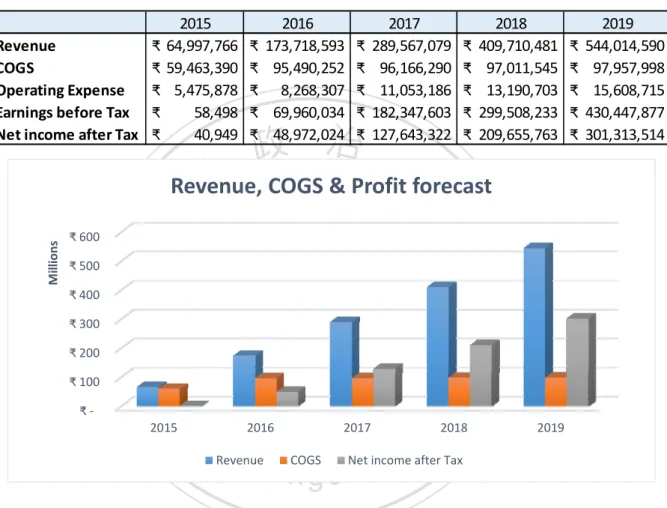
(17) rate of 400kbps, which is much lower than those offered by modern internet. None of the schools and colleges in Mumbai and elsewhere have wireless internet access, with only a handful having wireline internet connectivity, predominantly for the school/college staff and faculty only. VayuConnect intends to bridge the wireless connectivity gap and provide inexpensive Wi-Fi infrastructure for schools and colleges in India (the target segment) and low cost internet services to the students of the target segment. VayuConnect plans to start its operation and. 政 治 大. project implementation in its home base, Mumbai, after which it may consider expanding to. 立. other markets. The company intends to develop ongoing relationships with the government (in. ‧ 國. 學. particular, the Ministry of Human Resources and Development, India) and OEM/ODM providers for Wi-Fi infrastructure. In collaboration with the government, the cost of hardware. ‧. can be subsidized, the benefits of which can be passed on to the target segment. VayuConnect. Nat. sit. y. intends to also develop long lasting relationships with wireless mobile telephony operators to. n. al. er. io. get dedicated wireless bandwidth from their 3G/LTE sites, to be used as the source for Wi-Fi.. i n U. v. Not only would this help the colleges easily adopt the e-learning program, but also help the. Ch. engchi. government increase the sales of their tablet PCs.. 1.2. Financing Mr. Abhishek is seeking to raise ₹ 6,000,000 from a bank loan. The interest rate and loan agreement are to be further discussed during negotiation. This business plan assumes that the business will receive a 5 year loan with a 10% fixed interest rate. The financing will be used for the following: •. Office furnishings. •. Employee laptop computers. •. Office rentals, utilities and warehousing 2.
(18) •. Company registration and permit fees. •. R&D. •. Software licenses. 1.3. Mission Statement VayuConnect’s mission is to become the recognized leader in its targeted market for IT installation and maintenance services. We view ourselves as partners with our customers, our. 政 治 大. employees, our community and our environment. We aim to become a regionally recognized. 立. brand name, capitalizing on the sustained interest in internet connectivity. Our goal is. ‧ 國. 學. moderate growth, annual profitability and maintaining our sense of humor.. ‧. 1.4. Management Team. sit. y. Nat. The management team behind VayuConnect is comprised executives with a commitment to. er. io. quality, integrity and social responsibility. In particular, the CEO and founder of VayuConnect,. al. n. v i n Mr Abhishek Lahiri, has over 12Cyears of direct experience h e n g c h i U in operations, customer handling and has vast technical expertise. He also stands poised to earn an MBA with Distinction from the National Cheng Chi University International MBA program. The Marketing Manager of VayuConnect, Mr Sameer Yadav, who has a successful import/export business between India and Taiwan, has vast experience handling government officials in India. His experience would be paramount in subsidizing infrastructure products, thereby achieving our mission. Mr. Sameer would be a part of VayuConnect’s management. 3.
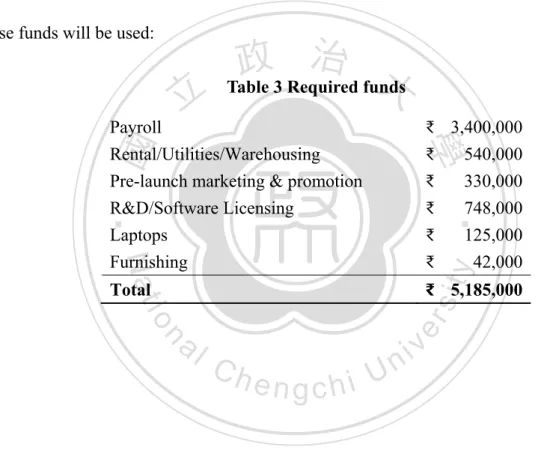
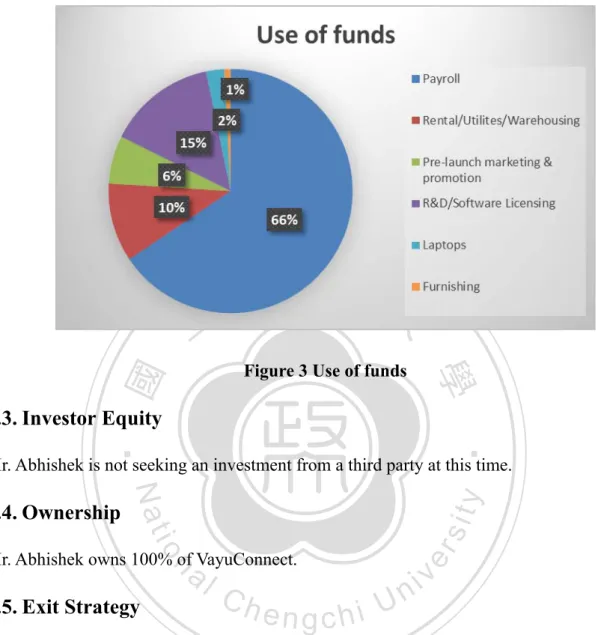
(19) team from its inception. VayuConnect would employ one more marketing manager during the second year of its operation, should the business generate revenue as per expectation.. 1.5. Sales Forecast Mr. Abhishek expects a strong rate of growth at the start of operations. Below are the expected financials over the next five years. These financial projections are based on economic conditions as of today.. 立. 政 治 大. Table 1 Proforma Revenue, COGS & Profit (normal economic condition). ‧ 國. 2017 ₹ 380,225,368 ₹ 143,863,034 ₹ 12,053,769 ₹ 224,308,565 ₹ 157,015,995. 2018 ₹ 560,204,702 ₹ 145,046,012 ₹ 15,263,445 ₹ 399,895,245 ₹ 279,926,671. 2019 ₹ 761,465,702 ₹ 146,397,812 ₹ 18,404,957 ₹ 596,662,933 ₹ 417,664,053. sit. y. ‧. 2016 ₹ 202,983,935 ₹ 119,282,057 ₹ 8,580,961 ₹ 75,120,918 ₹ 52,584,642. 學. 2015 ₹ 64,997,766 ₹ 59,463,390 ₹ 5,475,878 ₹ 58,498 ₹ 40,949. Nat. Revenue COGS Operating Expense Earnings before Tax Net income after Tax. Millions. n. al. er. io. Revenue, COGS & Profit forecast. ₹ 800 ₹ 700 ₹ 600 . Ch. engchi. i n U. v. ₹ 500 ₹ 400 ₹ 300 ₹ 200 ₹ 100 ₹ ‐ 2015. 2016 Revenue. 2017 COGS. 2018. 2019. Net income after Tax. Figure 1 Proforma Revenue, COGS & Profit (normal economic condition) This business plan takes into account contingencies such as severe economic downturn (due. 4.
(20) to political instability, economic recession or otherwise). In such a situation, proforma profit and loss (yearly) would be as follows. Table 2 Proforma Revenue, COGS & Profit (severe economic downturn) 2015 Revenue ₹ 64,997,766 COGS ₹ 59,463,390 Operating Expense ₹ 5,475,878 Earnings before Tax ₹ 58,498 Net income after Tax ₹ 40,949. 2016 ₹ 173,718,593 ₹ 95,490,252 ₹ 8,268,307 ₹ 69,960,034 ₹ 48,972,024. 2017 ₹ 289,567,079 ₹ 96,166,290 ₹ 11,053,186 ₹ 182,347,603 ₹ 127,643,322. 2018 ₹ 409,710,481 ₹ 97,011,545 ₹ 13,190,703 ₹ 299,508,233 ₹ 209,655,763. 政 治 大. 2019 ₹ 544,014,590 ₹ 97,957,998 ₹ 15,608,715 ₹ 430,447,877 ₹ 301,313,514. ₹ 100 . io. ₹ ‐. y. Nat. ₹ 200 . sit. ₹ 300 . ‧. ₹ 400 . al. n. 2015. 2016. Ch. Revenue. 2017. er. ₹ 500 . ‧ 國. ₹ 600 . 學. Millions. Revenue, COGS & Profit forecast 立. v2018 i n. 2019. i U e nCOGSg c hNet income after Tax. Figure 2 Proforma Revenue, COGS & Profit (severe economic downturn). 1.6. Expansion Plan The Founder expects that the business will aggressively expand during the first three years of operation. Mr. Abhishek intends to implement marketing campaigns that will effectively target more schools, colleges and establishments in and around Mumbai. VayuConnect plans to expand its services beyond Mumbai after completing five years of its operation.. 5.
(21) VayuConnect expects to see steady growth in business when its operations are established in cities like New Delhi, Bangalore and Chennai.. 立. 政 治 大. ‧. ‧ 國. 學. n. er. io. sit. y. Nat. al. Ch. engchi. 6. i n U. v.
(22) 2. COMPANY AND FINANCING SUMMARY 2.1. Registered Name and Corporate Structure VayuConnect is registered in the city of Mumbai. 2.2. Required Funds At this time, VayuConnect requires ₹ 6,000,000 of debt funds. Below is a breakdown of how these funds will be used:. 立. 政 治 大 Table 3 Required funds ₹ 3,400,000 ₹ 540,000 ₹ 330,000 ₹ 748,000 ₹ 125,000 ₹ 42,000. ‧. ‧ 國. 學. Payroll Rental/Utilities/Warehousing Pre-launch marketing & promotion R&D/Software Licensing Laptops Furnishing. sit. y. Nat. ₹ 5,185,000. io. n. al. er. Total. Ch. engchi. 7. i n U. v.
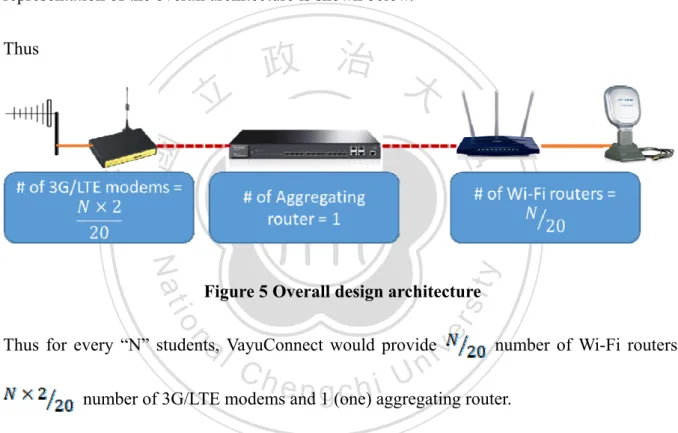
(23) 立. 政 治 大. ‧ 國. 學. Figure 3 Use of funds. 2.3. Investor Equity. ‧. Mr. Abhishek is not seeking an investment from a third party at this time.. er. io. sit. y. Nat. 2.4. Ownership. Mr. Abhishek owns 100% of VayuConnect.. n. al. 2.5. Exit Strategy. Ch. engchi. i n U. v. If the business is very successful, Mr. Abhishek may seek to sell the business to a third party for a significant earnings multiple. Most likely, the Company will hire a qualified business broker to sell the business on behalf of VayuConnect. Based on historical numbers, the business could fetch a sales premium of up to 3 times earnings.. 8.
(24) 3. PRODUCTS AND SERVICES 3.1. Wi-Fi infrastructure Most commercial Wi-Fi infrastructures rely on an existing backbone of fiber-optics or on ADSL. Not only is it expensive to maintain fiber-optics, but fairly expensive to install as well, since they have to subterranean. ADSL connectivity is available only for subscribers staying. 政 治 大. within a certain kilometer radius from the ADSL hub, the quality of which is extremely. 立. unreliable owing to the poor maintenance of the land-line telephone network. VayuConnect. ‧ 國. 學. plans to provide internet connectivity services which are not only reliable, but also has very. ‧. good quality of service (QoS). VayuConnect’s target audience would initially be colleges. al. er. io. most of their funds from private trust based organizations.. sit. y. Nat. under University of Mumbai. Most of these colleges are not government funded. They receive. n. v i n C happroach which dramatically VayuConnect incorporates a novel reduces the cost of Wi-Fi engchi U infrastructure. Instead of relying on the expensive fiber-optics or ADSL connectivity, VayuConnect utilizes the existing 3G/LTE network and converts them to Wi-Fi. Each client of VayuConnect will receive only the highest level of professional services. A simplified architecture of the implementation is shown below.. 9.
(25) Figure 4 Simplified network design architecture. 政 治 大 The Wi-Fi infrastructure has the following: 立. ‧ 國. 學. 3.1.1. Wi-Fi router with indoor antenna. One Wi-Fi router can cater upto 20 users. Indoor antennae are used to boost the signal. ‧. coverage and reception.. y. Nat. er. io. sit. 3.1.2. 3G/LTE modem with outdoor antenna.. 3G/LTE technologies allow the total throughput of the cell to be shared across multiple. n. al. Ch. engchi. i n U. v. subscribers (i.e. individual users with unique SIM cards belonging to the same network operator, and served by the same cell). As an example, if the cell offers a total of 42Mbps, and there are 10 unique users under the cell, then each user would get 4.2Mbps. In our approach, each modem (with its own SIM card) represents a unique user (from the network operator’s point of view). In order to provide good quality of service (QoS) to 20 Wi-Fi users, two 3G/LTE modems are used.. 10.
(26) 3.1.3. Aggregating routers Data from the modems are aggregated (summed up) by this router before passing on to the Wi-Fi router, and vice-versa. For any given college, there can be “N” number of students. A further simplified representation of the overall architecture is shown below. Thus. 立. 政 治 大. y. ‧. ‧ 國. 學 sit. io. al. er. Nat. Figure 5 Overall design architecture. n. Thus for every “N” students, VayuConnect would provide. Ch. engchi. i n U. v. number of Wi-Fi routers,. number of 3G/LTE modems and 1 (one) aggregating router.. 3.2. Internet connectivity services VayuConnect would provide pre-paid internet connectivity services to its infrastructure end-users at prices far lower than those of the wireless telecom service provides. Low internet connectivity prices can be achieved through economies of scale.. 3.3. Annual maintenance contract (AMC) VayuConnect would provide only the highest level of professional maintenance services to all. 11.
(27) its client. The first year of purchase would be covered under the manufacturer’s warranty. VayuConnect would extent the annual maintenance of the infrastructure after the competition of the first year for the next 4 years, which would cost only a fraction of the sales.. 立. 政 治 大. ‧. ‧ 國. 學. n. er. io. sit. y. Nat. al. Ch. engchi. 12. i n U. v.
(28) 4. STRATEGIC AND MARKET ANALYSIS 4.1. Economic Outlook This section of the analysis will detail the economic climate, the internet industry, the customer profile, and the competition that the business will face as it progresses through its business operations. The current economic market condition in India is moderate. India’s. 政 治 大. economic growth slowed last quarter, holding below 5 percent. Gross domestic product rose. 立. 4.7 percent in the three months ended Dec. 31 from a year earlier, compared with 4.8 in the. ‧ 國. 學. previous quarter. However, IT network installers operate with great economic stability as. sit. y. Nat. economy.. ‧. businesses will continue to require IT services despite deleterious changes in the general. er. io. India recently went through a legislative assembly elections to elect their new Prime Minister.. al. n. v i n C h have been positive, The general outlook after the elections with Indian Rupee appreciating in engchi U value with respect to the US dollar. With appreciating currency, we should see exports to become more expensive and imports to become cheaper. This should further help VayuConnect, as the company plans to import most of the hardware products. However, this business plan considers an alternative scenario in case of an unfortunate case of economic downturn. The section on “Financial Plan” details financial reports considering both normal economic condition and severe economic downturn.. 13.
(29) 4.2. Industry Analysis As of Oct 2013, India has more than 205 million internet users, with 137 million (67%) of them in urban towns. 110 million users (54% of total internet users) use mobile internet, with 77% of them from urban towns. Indian online landscape is very different. With more than 205 million users, it makes India the third largest internet market.. 立. 政 治 大. ‧. ‧ 國. 學. n. er. io. sit. y. Nat. al. Ch. engchi. i n U. v. Figure 6 Internet users in India Independent survey by comScore that 37% of the total online audience in India are between the ages 15~24 years. This growth has caused a number of businesses in this industry to. 14.
(30) develop and expand, including commercial Wi-Fi service providers.. 立. 政 治 大. ‧. ‧ 國. 學. n. er. io. sit. y. Nat. al. Ch. engchi U. Figure 7 Demographic composition of internet users. v ni. . As time progresses, Mr. Abhishek expects that the number of businesses operating within this market will continue to grow. One of the primary attractive elements to this market is that the demand for internet connectivity services is insulated from changes in the general economy. The rapid growth in social media has further ensured that regardless of the prosperity or recession of the economic market, this industry would always have good demand.. 15.
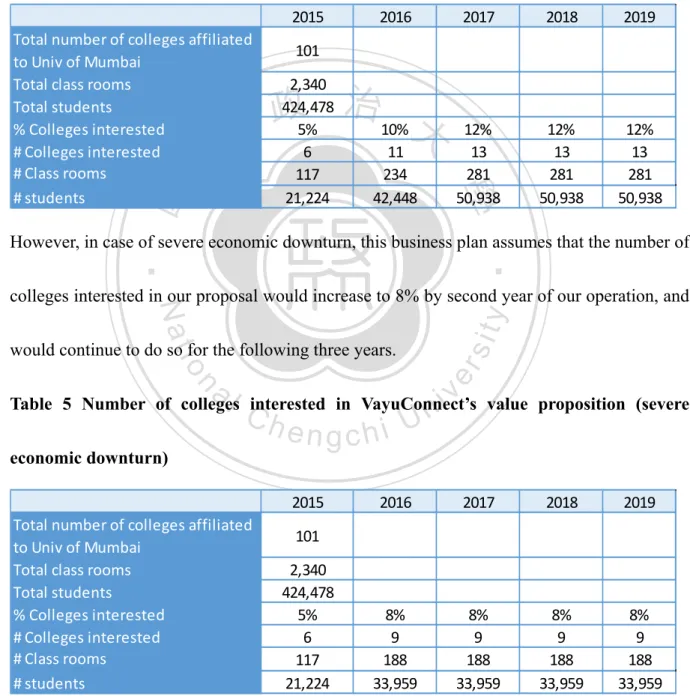
(31) 4.3. Competitors India has one of the faster growing internet users in the world. Although competition in the wireline internet segment is becoming fierce, static wireless internet (static referring to limited mobility, such as Wi-Fi) is relatively growing on a slower pace. VayuConnect’s possible competitors (direct or indirect) are:. 4.3.1. Wireless telephony (3G/LTE) providers. 政 治 大 Although the Wireless telephony (3G/LTE) providers have a significantly large presence pan 立. ‧ 國. 學. India, they are indirect competitors to our company. Our target segment for internet connectivity services are students who would be using the “AAKASH” tablets. These tablets. ‧. sit. y. Nat. do not have 3G/LTE connectivity. The students, however, can have other smart phones (other. n. al. er. io. than the “AAKASH” tablet) which may have 3G/LTE connectivity. They may use services. i n U. v. from the wireless telephony (3G/LTE) operators for internet connectivity in their smartphones.. Ch. engchi. However, the students can take the advantage of the low cost wireless internet services offered by VayuConnect even in their smart phones.. 4.3.2. DSL and broadband providers VayuConnect could face direct competition from DSL and broadband service providers. Few schools and colleges already have access to wireline internet, using one of the DSL and broadband providers. The schools and colleges may buy and install Wi-Fi routers by. 16.
(32) themselves, thereby eating into VayuConnect’s market share. However, there are severe technical limitations to this approach. . It may not be always possible to increase the bandwidth of the DSL connection. Also, there can be limitations on the number of DSL connections on the same copper cable. In case of VayuConnect, the connection bandwidth is scalable, which means, should the demand for data increase, we can increase the number of 3G/LTE modems.. . 政 治 大 end user (i.e. the students) would have freedom to visit any website of their choice, and 立. A simple Wi-Fi router attached to a DSL alone does not provide user access control. The. ‧ 國. 學. consume unlimited amount of data until the DSL subscription runs out. The school/college would have to bear the cost of Wi-Fi connectivity. On the other hand, VayuConnect. ‧. provides end-to-end solution for the schools/colleges and the students. The school/college. sit. y. Nat. also earns a portion of the revenue as the students use the Wi-Fi internet connectivity. io. er. provided by VayuConnect (based on the profit-sharing program). VayuConnect’s. al. infrastructure provides total access control to the schools/colleges and they can implement. n. v i n C hthey deem inappropriate. websites engchi U. access restrictions to. VayuConnect also provides. billable data usage to the students to limit and restrict the amount of data they can consume.. 4.3.3. Commercial Wi-Fi service providers Although there are very limited number of commercial Wi-Fi operators in Mumbai, they pose a direct threat to VayuConnect. Currently, the commercial Wi-Fi services are monopolized by a few companies, such as “O-zone”. New players, such as MTNL (a telecom provider) are rumored to provide a similar service in the future. VayuConnect intends to keep a strong foot-hold in this segment by aggressive marketing and 17.
(33) competitive pricing. VayuConnect also plans to improve on its value proposition by investing in R&D.. 4.4. Customer Profile VayuConnect’s average cliental would be schools and colleges in Mumbai. Hardware service for the Wi-Fi infrastructure would be offered to such schools and colleges. Internet connectivity services would be offered to the students, staff and faculty of these schools and. 政 治 大. colleges. The next section will elaborate in detail more on the concept of colleges in Mumbai.. 立. 4.4.1. Background. ‧ 國. 學. University of Mumbai is one of the first three oldest public state universities in India, located in. ‧. the city of Mumbai in the state of Maharashtra. It is abbreviated as either UoM, standing for. y. Nat. er. io. sit. University of Mumbai or MU for Mumbai University. In its early days, University of Mumbai offered Bachelors, Masters and Doctoral degrees apart from diplomas and certificates in many. n. al. Ch. engchi. i n U. v. disciplines. However, as the number of aspiring students increased, pressure from the government increased on the university to increase the number of student intake capacity. However, since the infrastructure and the available real-estate was limited, the government allowed several private intuitions (viz. colleges) to be affiliated to the University of Mumbai. These colleges would offer courses under the guidance from University of Mumbai. The students from these colleges would be awarded degree from the University of Mumbai. Gradually, over the years, most of the popular disciplines awarding a bachelor’s degree (such as 18.
(34) engineering, commerce, medicine etc) were migrated to these colleges. University of Mumbai offers advanced disciplines, such as masters and PhDs, and also highly specialized courses. As of today, most of the big universities across India have many affiliated colleges, thereby helping thousands of students to fulfill their dreams. Although a few colleges in Mumbai are government funded (also called as government. 政 治 大. colleges), most of these colleges are funded by a private trust based organization. The student. 立. fees for such “private” colleges are higher than the government colleges.. ‧ 國. 學. 4.4.2. Schools and Colleges. ‧. VayuConnect’s average client would be schools and colleges in India. Initially, VayuConnect. sit. y. Nat. would be targeting government run colleges and colleges receiving funds from financially. er. io. sound trustees. This business model assumes that in the first year of operation, there would be. al. n. v i n five government run colleges andCone privately run college, h e n g c h i U all of which would be affiliated to University of Mumbai. The business plan also assumes that under normal economic conditions, the number of colleges interested in our proposal would increase to 10% by second year of our operation, followed by an increase to 12% for the following three years. All the colleges mentioned here are affiliated to University of Mumbai. As of 2014, University of Mumbai has 101 affiliated colleges.. 19.
(35) Table 4 Number of colleges interested in VayuConnect’s value proposition (normal economic condition) 2015. ‧ 國. 立. 2017. 2018. 2019. 12% 13 281 50,938. 12% 13 281 50,938. 12% 13 281 50,938. 101 2,340 424,478 5% 6 117 21,224. 政 治 10% 大 11 234 42,448. 學. Total number of colleges affiliated to Univ of Mumbai Total class rooms Total students % Colleges interested # Colleges interested # Class rooms # students. 2016. However, in case of severe economic downturn, this business plan assumes that the number of. ‧. sit. y. Nat. colleges interested in our proposal would increase to 8% by second year of our operation, and. n. al. er. io. would continue to do so for the following three years.. i n U. v. Table 5 Number of colleges interested in VayuConnect’s value proposition (severe. Ch. economic downturn). engchi 2015. Total number of colleges affiliated to Univ of Mumbai Total class rooms Total students % Colleges interested # Colleges interested # Class rooms # students. 2016. 2017. 2018. 2019. 8% 9 188 33,959. 8% 9 188 33,959. 8% 9 188 33,959. 8% 9 188 33,959. 101 2,340 424,478 5% 6 117 21,224. Based on actual financial performance, VayuConnect may extend its value proposition to. 20.
(36) colleges affiliated to other universities, such as University of Delhi. University of Delhi has 77 affiliated colleges.. 4.4.3. Students Most of the students in these colleges come from average income households. It is quite common in urban cities like Mumbai to see parents pay for their children college fees, which. 政 治 大. might be well above their daily means. This may be particularly applicable for students who. 立. are enrolling to professional technical streams, such as engineering or medicine. Parents for. ‧ 國. 學. such students are likely to avail education bank loans in order to pay for their children’s. ‧. education. It is traditional among Indian families pack lunch boxes for their children, and also. sit. y. Nat. provide them with some small amount of “pocket money” for their spending needs. The. n. a. er. io. students usually hold on to the pocket money until a significant sum is accumulated.. 4.5. Government supportl. Ch. engchi. i n U. v. VayuConnect would create strategic collaboration with the government, in particular with Ministry of Human Resources and development (MHRD) in India. It would be in the best interest of the government to finds ways to encourage schools and colleges to adopt the e-learning program. The adoption of the program entails the schools and colleges to pay a small fraction of the cost of AAKASH tablets. These tablets are manufactured by DataWind, an OEM/ODM company, but sold through the government. The highly subsidized tablets. 21.
(37) would then be given to the students. Due to the low cost structure of the tablet PC, the specification for the AAKASH tablet includes only Wi-Fi connectivity. VayuConnect proposes that, with its value proposition, the company would be able to provide inexpensive Wi-Fi solution to the schools and colleges. In order to further reduce the price of the Wi-Fi infrastructure, VayuConnect plans to enter into a strategic collaboration with the Government.. 政 治 大. VayuConnect would do several workshops to educate the government to the merits of this this. 立. collaboration. The Marketing Manager of VayuConnect, Mr Sameer Yadav, who has a. ‧ 國. 學. successful import/export business between India and Taiwan, has many successful. ‧. interactions with members of the government. VayuConnect, through its various marketing. y. Nat. er. io. sit. and promotion campaigns for its value proposition, would also help to promote the tablet PCs offered by the government. The collaboration would help subsidize much of the hardware. n. al. Ch. engchi. infrastructure needed for the Wi-Fi network.. i n U. v. 4.6. OEM/ODM vendor for Wi-Fi infrastructure VayuConnect plans to enter into a strategic partnership with D-link, Taiwan’s leading network infrastructure company, for its Wi-Fi infrastructure needs. D-Link would be the sole supplier for VayuConnect, supplying aggregating routers and Wi-Fi routers.. 4.6.1. Why D-Link? D-Link is the global leader wireless networking equipment. In 2012, D-Link’s unit shipment. 22.
(38) had 33% global market share.. 立. 政 治 大 . ‧ 國. 學. Figure 8 WLAN unit shipment in 2012. D-Link has manufacturing plants in Goa, with software and R&D centers in Goa and. ‧. sit. y. Nat. Bangalore. D-Link also has a dedicated customer service technical call center in Mumbai,. n. al. er. io. which caters to India as well as the rest of the English speaking world. D-Link is a very well. i n U. v. respected and trusted brand in India, with its presence in most businesses and households in. Ch. engchi. Mumbai. D-Link is also listed in National Stock Exchange (NSE) and Bombay Stock Exchange (BSE) in India.. 4.7. 3G/LTE modems VayuConnect would source the 3G/LTE modems from Xiamen Four-Faith Communication Technology Co., Ltd. This company is one of the professional wireless data communication terminal manufacturers in China. Xiamen Four-Faith Communication Technology Co., Ltd.. 23.
(39) specializes in R&D, production, marketing and service, and follows the "Honesty, Trust, Confidence, Belief" tenet. They have become the leader in industrial wireless data communication terminal field.. 4.8. 3G/LTE network operator VayuConnect plans to enter into a strategic partnership with Bharti Airtel. Mr Abhishek, the. 政 治 大. owner and CEO of VayuConnect, has previously worked with Bharti Airtel and has good. 立. connections with high ranking officials in that company. Bharti Airtel is one of the largest. ‧ 國. 學. telecom service provider in India, and one of the first to introduce LTE services to Mumbai.. ‧. Bharti Airtel would be the sole supplier of 3G/LTE service, which VayuConnect would. sit. y. Nat. convert to be used as Wi-Fi service.. n. al. er. io. 4.9. Outsourcing hardware installation and commissioning. i n U. v. VayuConnect would outsource the infrastructure installation and commissioning. The demand. Ch. engchi. for labor intensive work would differ with time, and VayuConnect would greatly benefit by outsourcing this responsibility to a third party company.. 4.10. SWOT analysis Table 6 SWOT analysis Strengths (Internal). Weaknesses (Internal). . Well established technical team.. . . Affordable. infrastructure,. with. Relatively. difficult. to. persuade. economically weak colleges the merits. low 24.
(40) . . maintenance costs.. of VayuConnect’s proposal.. Low internet chargers compared to . VayuConnect cannot influence much on. mobile operators.. the Quality of service (QoS) of the. Strong R&D support team.. internet connectivity, as it would solely depend on the network quality of the 3G/LTE network. . 政 治challenging 大 to keep up with customer’s. 立. demands.. ‧ 國. 學. Opportunities (External). Indirect competition coming from other. India is increasing at a rapid pace, and. internet service providers.. ‧. Smartphone and tablet penetration in . Nat. Due to low overhead costs, this business. growth.. plan is relatively easy to copy.. n. al. Possible to outsource R&D, so that VayuConnect. could. sit. y. showing great potential for business . io. . Threats (External). er. . Technology itself evolves fast, making it. Ch. focus. esolely ngchi. i n U. v. improving its QoS towards its esteemed clients.. 4.11. Porter’s five forces analysis This section describes Porter five forces analysis as a framework for industry analysis and business strategy development. 4.11.1.Threat of New Entrants Threat of new entrants in this kind of business is high for VayuConnect. Internet penetrating is 25.
(41) rapidly increasing, and new companies could provide similar services to quench the thirst for internet connectivity. VayuConnect’s market share and profit margin would decline with other new entrants offering a similar value proposition. VayuConnect plans to stay ahead of the game with unique value propositions and with new offerings, all through aggressive investments in R&D and marketing.. 政 治 大. 4.11.2.Threat of Substitute Product or Service:. 立. The threat of substitute product or services is moderate to low for VayuConnect. Internet. ‧ 國. 學. connectivity services can be offered over fixed line (DSL/ADSL/Cable internet) or through. ‧. mobile telephony services (direct 3G/LTE service). These services already exist and have a. sit. y. Nat. unique target segment. VayuConnect’s value proposition is to offer low cost Wi-Fi services to a. n. al. er. io. specific group of target audience who do not have access to fixed line internet not to direct 3G/LTE services.. Ch. engchi. i n U. v. 4.11.3.Bargaining Power of Customers The bargaining power for VayuConnect’s customers are moderate. VayuConnect’s target segment for the hardware infrastructure would initially be the schools and colleges under University of Mumbai. Most of these schools and colleges are run by private trustees, with not a very flexible budget. VayuConnect would price its products such as to encourage those schools and colleges to avail our services. The target segment for internet connectivity services. 26.
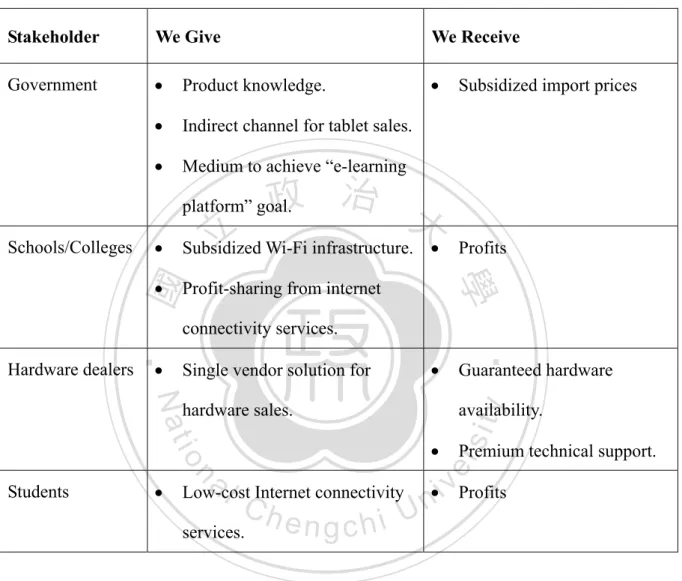
(42) would be the students of these schools and colleges. Most of the students would be from average income households, who receive pocket money for their daily expenses. VayuConnect would encourage them to buy their services by offering prices lower than those offered by completion. The profit margin for VayuConnect would be low in its initial year, however, as time progresses, VayuConnect shall be highly profitable with a significant customer base.. 政 治 大. 4.11.4.Bargaining Power of Suppliers. 立. The bargaining power of suppliers is high. In its initial stages, VayuConnect has a limited. ‧ 國. 學. number of suppliers, one for the hardware, one for the 3G/LTE connectivity, and one for labor. ‧. outsourcing. Any changes in pricing from any if its suppliers would greatly affect. sit. y. Nat. VayuConnect’s profit margin. However, VayuConnect does not foresee significant increase in. er. io. prices from its suppliers, other than in case of a catastrophic economic failure. Prices for. al. n. v i n C h supplier would internet connectivity from VayuConnect’s only down as demand increases. engchi U Likewise, VayuConnect does not foresee any significant increase in the prices for infrastructure hardware. Should the need arise, VayuConnect might consider entering into long term commitments with hardware supplier to ensure consistent prices over the years.. 4.11.5.Competitive Rivalry The competitive rivalry for VayuConnect is high. VayuConnect could face indirect competition from 3G/LTE operators and fixed line DSL/ADSL and broadband/cable TV internet providers.. 27.
(43) VayuConnect would could also face direct competition from other commercial Wi-Fi operators, such as O-Zone. VayuConnect needs to be aware of this and build very strong business relationships with both the government and its customers to ensure sustainability in such competitive environment.. 立. 政 治 大. ‧. ‧ 國. 學. n. er. io. sit. y. Nat. al. Ch. engchi. 28. i n U. v.
(44) 5. Marketing plan VayuConnect intends to maintain an extensive marketing campaign that will ensure maximum visibility for the business in its targeted market. Below is an overview of the marketing strategies and objectives of VayuConnect.. 5.1. Marketing Objectives. . Develop an online presence by developing a website and placing the Company’s name and. 治 政 contact information with online directories that specifically 大 focus on the IT industry. 立 Establish relationships with government, in particularly with Ministry of Human 學. ‧ 國. . Resources and Development (MHRD) of India, and with colleges. Establish relationships with schools and colleges, and with the students of these schools and colleges.. ‧. . y. Nat. er. io. sit. 5.2. Marketing Strategies. Mr. Abhishek intends on using a number of marketing strategies that will allow VayuConnect. n. al. Ch. engchi. i n U. v. to easily target schools and colleges within the target market. These strategies include workshops for government, in particular Ministry of Human Resources and Development (MHRD) and for schools and colleges, traditional print advertisements and ads placed local newspapers and on search engines on the Internet. Below is a description of how the business intends to market its services. One of VayuConnect’s key partner is the government. VayuConnect intends to educate the benefits of VayuConnect’s value proposition to the government through several workshops. 29.
(45) The workshops are intended to show how VayuConnect’s value proposition would help to increase the sales of AAKASH tablets to schools and colleges, ultimately helping the government to realize their dream of gradually migrating the education system to an e-learning platform. VayuConnect would also perform pre-sales workshops for schools and colleges, educating. 政 治 大. them on the value proposition and the benefits of migrating to an e-learning platform.. 立. VayuConnect’s value proposition also involves revenue sharing with the schools and colleges.. ‧ 國. 學. VayuConnect will also maintain a sizable amount of print advertising methods within local. ‧. markets to promote the Company’s offering and value proposition. These traditional print. y. Nat. er. io. sit. campaigns will include advertisements in local educational journals, local newspapers, and other publications that are frequently distributed to Mumbai and its metropolitan area. n. al. residents.. Ch. engchi. i n U. v. 5.3. Keys to success VayuConnect offers a value added proposition to all associated parties, thus ensuring a maximum chance of success and prosperity. VayuConnect would be the first company in India to offer a competitive product which is aggressively priced, superior services and strong management principles. VayuConnect’s marketing strategy and value proposition ensures a win-win situation for all parties involved. The table below highlights some of the key wining. 30.
(46) factors on the value proposition. Table 7 Value proposition for stakeholders Stakeholder. We Give. We Receive. Government. . Product knowledge.. . . Indirect channel for tablet sales.. . Medium to achieve “e-learning. Subsidized import prices. 政 治 大. platform” goal.. 立. Subsidized Wi-Fi infrastructure.. . Profit-sharing from internet connectivity services. . Single vendor solution for. Nat. . al. n. . availability. Premium technical support.. er. io. Students. Guaranteed hardware. y. hardware sales.. ‧. Hardware dealers. Profits. 學. . . sit. . ‧ 國. Schools/Colleges. i n U. Low-cost Internet connectivity. Ch. services.. engchi. 31. vProfits.
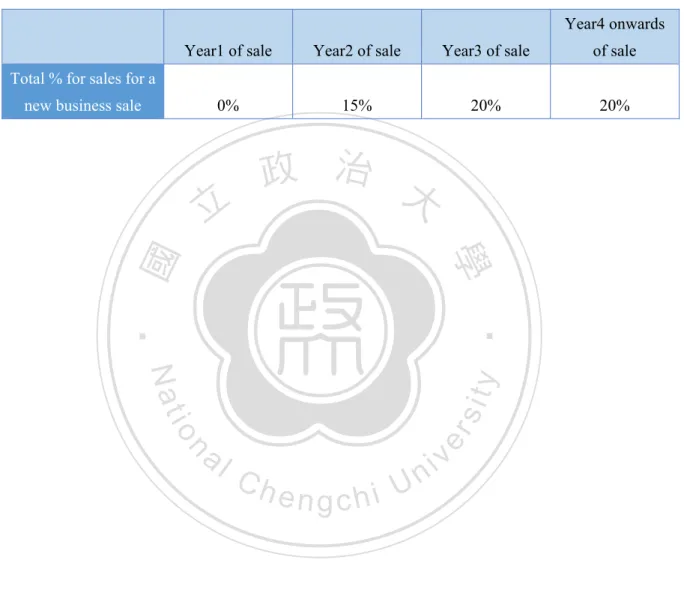
(47) 6. Pricing VayuConnect has three kinds of offering; Wi-Fi hardware infrastructure, internet connectivity services and annual maintenance contract. This business plan assumes the government would exclude 7.5% of import duty (all inclusive), which is normally levied on all imported electronic items in India. This rebate is passed on to the schools and colleges.. 政 治 大 infrastructure is directed towards the 立. 6.1. Wi-Fi hardware infrastructure The Wi-Fi hardware. ‧ 國. 學. infrastructure would consist of:. . Aggregating router, costing ₹ 11,840 each.. . Wi-Fi router with internal antenna, cost ₹ 2,960 each.. . Cabling and labor, priced at ₹ 500 for every 20 students.. er. io. sit. y. ‧. 3G/LTE modem with external antenna, costing ₹ 2,200 each.. Nat. . 6.2. Internet connectivity a services. iv l C n U h e n gis cvery pricing strategy h i important. n. Designing a balanced. schools and colleges. The. for VayuConnect. Internet. connectivity services are directed towards the students in the schools and colleges. VayuConnect would refer to general statistics on internet usage by android users and device a base pricing model. At the same time, VayuConnect would refer to existing prices offered by competitors (direct or indirect) and price lower that their offering.. 32.
(48) 立. 政 治 大. ‧. ‧ 國. 學 sit. y. Nat. n. er. io. Figure 9 Data usage among mobile operating systems. al. . i n U. v. Independent survey shows that android users use on an average 2.2GB per month. Most of the. Ch. engchi. data usage is due to the “smart” nature of the phones/tablets and due to the background activity and processing.. 33.
(49) Figure 10 Airtel data plan (3G). 立. 政 治 大. ‧. ‧ 國. 學 er. io. sit. y. Nat. . n. 11 Vodafone data plan (3G) aFigure iv l C n hengchi U. The above two pictures show the current prices offered by the leading 3G operators in Mumbai. Most of the students may not use data over 2.2GB per month, since VayuConnect’s internet access is limited to the school or college premises. The prices for internet connectivity offered by VayuConnect are highly competitive, and would encourage the students to make use of VayuConnect’s services. VayuConnect would enter into a revenue sharing scheme with the colleges and schools. 34.
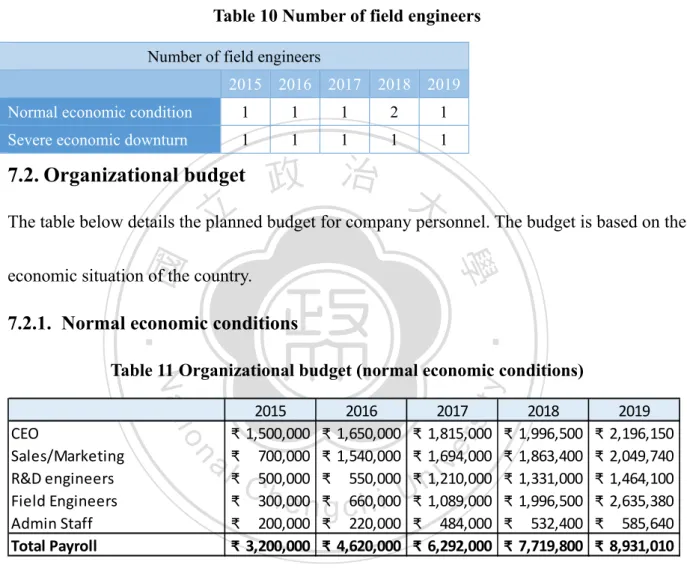
(50) Based on this research, VayuConnect would price its offering on a pre-paid basis as follows: Table 8 VayuConnect's data usage plan. Price (₹) . Revenue. Revenue. Data usage. % revenue for. earned by. earned by. package . school/college. school/college. VayuConnect. (₹) . (₹) . Validity . 120 . 500 MB . 8% . 9.6 . 110.4 . 1 month . 230 . 1.0 GB . 8% . 18.4 . 211.6 . 1 month . 330 . 1.5 GB . 303.6 . 1 month . 420 . 2.0 GB . 386.4 . 1 month. 立. 8% 治 26.4 政 8% 33.6 大. Data services would be disabled after the balance in the data usage package is depleted. The. ‧ 國. 學. data usage is the collective sum of both uploading and downloading traffic.. ‧. 6.3. Annual maintenance contract (AMC). Nat. io. sit. y. Annual maintenance contract (AMC) is between the schools/colleges and VayuConnect, and. er. would be priced at 15% of hardware sales for the previous year. The price for AMC would. al. n. v i n C should increase to 20% of hardware sales schools/colleges propose to continue the AMC h e nthe gchi U. for a second year. The price for AMC would continue to remain at 20% of hardware sales until the end of five years from the sale of hardware. The following table summarizes the price for AMC for any new sale.. 35.
(51) Table 9 Annual maintenence contract (% of total hardware sales) Year4 onwards . Year1 of sale . Year2 of sale . Year3 of sale . of sale. 0% . 15% . 20% . 20%. Total % for sales for a new business sale . 立. 政 治 大. ‧. ‧ 國. 學. n. er. io. sit. y. Nat. al. Ch. engchi. 36. i n U. v.
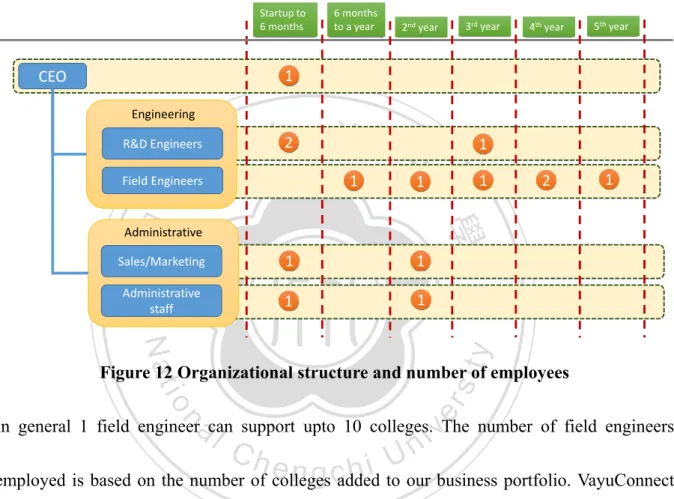
(52) 7. Organization structure 7.1. Corporate organization with number of employees Detailed below is a simplified illustration of the company organization structure. Startup to 6 months. 6 months to a year. 3rd year. 2nd year. 4th year. 5th year. 2. 1. 1. CEO Engineering R&D Engineers. 立. Administrative. 1. 1. Administrative staff. 1. 1. 1. Nat. y. ‧. Sales/Marketing. 1. 學. ‧ 國. Field Engineers. 政2 治 大 1 1. al. er. io. sit. Figure 12 Organizational structure and number of employees. v. n. In general 1 field engineer can support upto 10 colleges. The number of field engineers. Ch. engchi. i n U. employed is based on the number of colleges added to our business portfolio. VayuConnect would need 5 employees at business startup, including Mr Abhishek, the CEO and Mr Sameer Yadav, the marketing manager. VayuConnect would have two R&D engineers at the company inception, who would be responsible for developing a billing platform and user access control. VayuConnect would use SaaS/PaaS as the base platform for its software needs. In case of a severe economic downturn, less number of field engineers would be needed to. 37.
(53) support the colleges. The following table details the number of field engineers needed in case of normal economic conditions and severe economic downturn. Table 10 Number of field engineers Number of field engineers 2015. 2016. 2017. 2018. 2019. Normal economic condition . 1 . 1 . 1 . 2 . 1 . Severe economic downturn . 1 . 1 . 1 . 1 . 1. . 7.2. Organizational budget. 立. 政 治 大. The table below details the planned budget for company personnel. The budget is based on the. ‧ 國. 學. economic situation of the country.. ‧. 7.2.1. Normal economic conditions. n. al. Ch. 2016 ₹ 1,650,000 ₹ 1,540,000 ₹ 550,000 ₹ 660,000 ₹ 220,000 ₹ 4,620,000. engchi. sit. 2015 ₹ 1,500,000 ₹ 700,000 ₹ 500,000 ₹ 300,000 ₹ 200,000 ₹ 3,200,000. 2017 ₹ 1,815,000 ₹ 1,694,000 ₹ 1,210,000 ₹ 1,089,000 ₹ 484,000 ₹ 6,292,000. er. io. CEO Sales/Marketing R&D engineers Field Engineers Admin Staff Total Payroll. y. Nat. Table 11 Organizational budget (normal economic conditions). i n U. v. 2018 ₹ 1,996,500 ₹ 1,863,400 ₹ 1,331,000 ₹ 1,996,500 ₹ 532,400 ₹ 7,719,800. 2019 ₹ 2,196,150 ₹ 2,049,740 ₹ 1,464,100 ₹ 2,635,380 ₹ 585,640 ₹ 8,931,010. 7.2.2. Severe economic downturn Table 12 Organizational budget (severe economic downturn). CEO Sales/Marketing R&D engineers Field Engineers Admin Staff Total Payroll. 2015 ₹ 1,500,000 ₹ 700,000 ₹ 500,000 ₹ 300,000 ₹ 200,000 ₹ 3,200,000. 2016 ₹ 1,650,000 ₹ 1,540,000 ₹ 550,000 ₹ 660,000 ₹ 220,000 ₹ 4,620,000. 38. 2017 ₹ 1,815,000 ₹ 1,694,000 ₹ 1,210,000 ₹ 1,089,000 ₹ 484,000 ₹ 6,292,000. 2018 ₹ 1,996,500 ₹ 1,863,400 ₹ 1,331,000 ₹ 1,597,200 ₹ 532,400 ₹ 7,320,500. 2019 ₹ 2,196,150 ₹ 2,049,740 ₹ 1,464,100 ₹ 2,196,150 ₹ 585,640 ₹ 8,491,780.
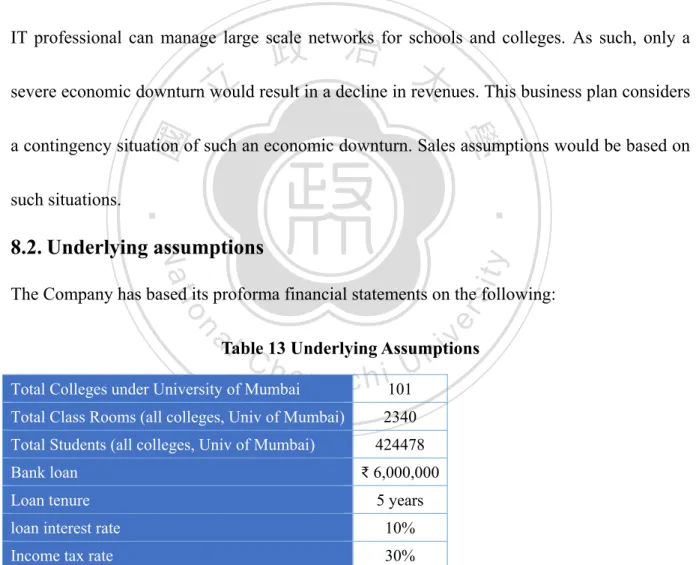
(54) 8. Financial plan 8.1. Sensitivity analysis In the event of an economic downturn, the business may have a decline in its revenues. However, internet connectivity is demanded regardless of the general economy, and only a trained. 政 治 大. IT professional can manage large scale networks for schools and colleges. As such, only a. 立. severe economic downturn would result in a decline in revenues. This business plan considers. ‧ 國. 學. a contingency situation of such an economic downturn. Sales assumptions would be based on. ‧. such situations.. sit. y. Nat. 8.2. Underlying assumptions. er. io. The Company has based its proforma financial statements on the following:. n. aTable iv l C 13 Underlying Assumptions n hengchi U Total Colleges under University of Mumbai 101 Total Class Rooms (all colleges, Univ of Mumbai) Total Students (all colleges, Univ of Mumbai) . 2340 424478 . Bank loan . ₹ 6,000,000. Loan tenure . 5 years . loan interest rate . 10% . Income tax rate . 30%. The business plan also assumes that the outsourced labor charge would be ₹ 500 for every 20 students. The underlying assumptions would further get classified based on the economic situation of. 39.
(55) the country.. 8.2.1. Normal economic condition The percentage of colleges interested in our value proposition increase to 10% during the second year of operation. The percentage increases further by 2% the following year. The company consistently is able to generate additional business by adding 12% of colleges to its business portfolio. Table 14 Colleges interested (normal economic conditions). 政 2016治 2017大. 2015. # Class rooms # students. 10%. 12%. 12%. 12%. 6. 11. 13. 13. 13. 117. 234. 281. 281. 281. 21224. 42448. 50938. 50938. ‧. ‧ 國. # Colleges interested. 2019. 學. 立 5%. % Colleges interested. 2018. Nat. y. 50938. sit. 8.2.2. Severe economic downturn. n. al. er. io. Due to possible severe economic downturn, the percentage of colleges interested in our value. i n U. v. proposition would remain at 8% every year, after increasing from 5% in year one.. Ch. engchi. Table 15 Colleges interested (severe economic downturn) 2015. 2016. 2017. 2018. 2019. % Colleges interested. 5%. 8%. 8%. 8%. 8%. # Colleges interested. 6. 9. 9. 9. 9. 117. 188. 188. 188. 188. 21224. 33959. 33959. 33959. 33959. # Class rooms # students. 8.3. Source of funds VayuConnect is seeking to raise ₹ 6,000,000 from a bank loan. Mr. Abhishek has no plans for. 40.
數據
+7
相關文件
學校選用「對學校的態度」量表,以了解學生對 學校的觀感及學生朋輩之間的關係,探討學生的 發展及成長需要。學校再於 下學年
Wi-Fi Supported Network Environment and Cloud-based Technology to Enhance Collaborative Learning... • Curriculum is basically a lesson plan that functions as a map
Wi-Fi Supported Network Environment and Cloud-based Technology to Enhance Collaborative Learning.. Centre for Learning Sciences and Technologies (CLST) The Chinese University of
* School Survey 2017.. 1) Separate examination papers for the compulsory part of the two strands, with common questions set in Papers 1A & 1B for the common topics in
Provide all public sector schools with Wi-Fi coverage to enhance learning through the use of mobile computing devices, in preparation for the launch of the fourth IT in
Provide all public sector schools with Wi-Fi coverage to enhance learning through the use of mobile computing devices, in preparation for the launch of the fourth IT in
Microphone and 600 ohm line conduits shall be mechanically and electrically connected to receptacle boxes and electrically grounded to the audio system ground point.. Lines in
In order to detect each individual target in the crowded scenes and analyze the crowd moving trajectories, we propose two methods to detect and track the individual target in
