Specific heat of Mn-doped Na
x
CoO
2
Æ yH
2
O
J.-Y. Lin
a,*, Y.-J. Chen
a, C.-J. Liu
b, J.-S. Wang
b, C.P. Sun
c, H.D. Yang
caInstitute of Physics, National Chiao Tung University, Hsinchu 300, Taiwan bDepartment of Physics, National Changhua University of Education, Changhua 50007, Taiwan
cDepartment of Physics, National Sun Yat Sen University, Kaohsiung 804, Taiwan
Available online 30 March 2007
Abstract
C(T) of NaxCo0.99Mn0.01O2Æ yH2O is studied to reveal more details on the nature of the doped Mn ions and the Tcsuppression. The extra specific heat contribution in NaxCo0.99Mn0.01O2Æ yH2O manifests the induced local magnetic moment due to Mn doping. The absence of the superconducting transition peak in C(T) of NaxCo0.99Mn0.01O2Æ yH2O suggests a reduced superconducting volume fraction.
Ó 2007 Elsevier B.V. All rights reserved.
Keywords: Cobaltate; Specific heat; Magnetic moment; Impurity effect; Superconducting order parameter
The superconducting order parameter of Nax
-CoO2Æ yH2O has remained elusive. On the one hand,
almost all the relevant experiments agree on the existence of the nodal lines in the order parameter [1] favoring p-or f-wave pairing, if the crystal and time reversal symme-tries are further considered. On the other hand, the decrease in the Knight shift below Tc[2–4]is a strong
advo-cate of s- or d-wave pairing. To gain more insights into the nature of the superconductivity in NaxCoO2Æ yH2O, the
impurity effects on Tcof NaxCoO2Æ yH2O has been studied [5,6]. Based on the experimental results of Mn-doped Nax
-CoO2Æ yH2O, Ref.[6]suggests an intriguing model of
coex-istence of s-wave and unconventional pairing in NaxCoO2Æ yH2O. Indeed, two distinct phase transition in
NaxCo1 zMnzO2Æ yH2O for z = 0.005 has been directly
observed by the specific heat C(T) experiments. In this paper, C(T) of the z = 0.01 is studied to reveal more details on the nature of the doped Mn ions and the Tcsuppression.
Polycrystalline parent compounds of sodium cobalt oxi-des c-Na0.7Co1 zMnzO2(z = 0–0.03) were prepared using a
rapid heat-up procedure [4]. The resulting powders were
immersed in the 3M Br2/CH3CN solution for 5 days,
fol-lowed by filtering and thorough washing with CH3CN
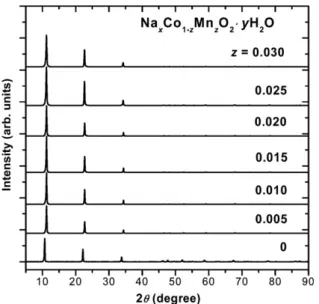
and DI water. X-ray diffraction patterns indicated that all the parent (not shown) and hydrated samples were of single phase as in Fig. 1. M(T) was measured in MPMS of Quantum Design. C(T) was measured by the heat pulse relaxation method.
Fig. 2 shows M(T) below 6 K for NaxCo1 z
-MnzO2Æ yH2O. The inset demonstrates the Meissner effect
of the undoped NaxCoO2Æ yH2O, as pronounced as those
of the best polycrystalline samples in the literature. Tc is
defined as the onset of the Meissner effect. Tcsuppression
rate is determined to be dTc/dz = 0.64 K/1%[6]. This
sup-pression rate is one order of magnitude slower than that of the cuprate superconductors with the line nodal order parameter.
C(T) of NaxCoO2Æ yH2O and NaxCo0.99Mn0.01O2Æ
yH2O is shown inFig. 3. At temperatures above 8 K, both
sample have almost identical C(T). This indicates that Mn doping changes neither of the lattice contribution and the normal electronic linear term in C(T). However, C(T) of NaxCo0.995Mn0.01O2Æ yH2O is significantly larger than that
of NaxCoO2Æ yH2O below 8 K, especially at very low
tem-peratures. This extra contribution to C(T) is magnetic, and comes from the local magnetic moment of the doped Mn
0921-4534/$ - see front matter Ó 2007 Elsevier B.V. All rights reserved. doi:10.1016/j.physc.2007.03.285
*
Corresponding author. Tel.: +886 3 573 1653; fax: +886 3 572 0728. E-mail address:[email protected](J.-Y. Lin).
www.elsevier.com/locate/physc Physica C 460–462 (2007) 475–476
ions. This assignment is in qualitative agreement with M(T) of NaxCo0.99Mn0.01O2Æ yH2O which shows a paramagnetic
contribution from Mn4+ ions [6]. Mn K-edge XAS also indicates that Mn ions in the doped samples have a valance close to +4[6]. A quantitative analysis of the magnetic con-tribution to C(T) of NaxCo0.99Mn0.01O2Æ yH2O is difficult
due to, for example, the unknown crystal field of Mn4+ ions in the triangular CoO2 planes. A Schottky anomaly
was tried to fit the magnetic contribution to C(T) at low T, but the fitting results were far from satisfactory.
Partly due to the large magnetic background, the super-conducting phase transition peak was not observed in C(T) of NaxCo0.99Mn0.01O2Æ yH2O as in that of NaxCoO2Æ
yH2O (Fig. 3). Another reason could be the reduced
super-conducting volume in the Mn-doped sample.
As seen inFig. 2, though with Tc= 3.97 K, the Meissner
diamagnetic signal is much smaller than that of Nax
-CoO2Æ yH2O. Therefore, the results of C(T) and M(T)
are consistent with each other. The reduced superconduc-ting signal could be partly due to the suppression of super-conductivity in part of the volume with the nodal order parameter. Moreover, impurities may perturb and remove the energy degeneracy of the two order parameters, and the system with increasing z becomes favoring the one with nodal lines[6].
In conclusion, the extra specific heat contribution in NaxCo0.99Mn0.01O2Æ yH2O manifests the induced local
magnetic moment due to Mn doping. The absence of the superconducting transition peak in C(T) of NaxCo0.99
-Mn0.01O2Æ yH2O is probably due to the large magnetic
background, and could also suggest a reduced supercon-ducting volume fraction.
Acknowledgement
This work was support by the National Science Council of Taiwan, under Grants: NSC 2112-M-009-006, 94-2112-M-018-001, and 94-2112-M-110-010.
References
[1] For example, see H.D. Yang, J.-Y. Lin, C.P. Sun, Y.C. Kang, K. Takada, T. Sasaki, H. Sakurai, E. Takayama-Muromachi, Phys. Rev. B 71 (2005) 020504(R).
[2] M. Yokoi, H. Watanabe, Y. Mori, et al., J. Phys. Soc. Jpn. 73 (2004) 1297.
[3] G.Q. Zheng, K. Matano, D.P. Chen, C.T. Lin, Phys. Rev. B 73 (2006) 180503(R).
[4] K. Kuroki, S. Onari, Y. Tanaka et al., cond-mat/0508482.
[5] M. Yokoi, H. Watanabe, Y. Mori, et al., J. Phys. Soc. Jpn 73 (2004) 1297.
[6] Y.-J. Chen, C.-J. Liu, J.-S. Wang J.-Y. Lin, C.P. Sun, S.W. Huang, J.M. Lee, J.M. Chen, J.F. Lee, D.G. Liu, H.D. Yang, cond-mat/ 0511385. 2 3 4 5 6 -0.010 -0.005 0.000 0.005 0.010 Na CoO . yH O z=0.02 z=0.015 z=0.01 z=0.005 z=0 M (emu/g) ZFC H=20 Oe NaxCo1-zMnzO2. yH2O M ( e mu /g ) T (K) T (K)
Fig. 2. M vs. T of NaxCo1 zMnzO2Æ yH2O samples. Inset shows ZFC and
FC data of undoped NaxCoO2Æ yH2O.
0 2 4 6 8 10 0 10 20 30 40 NaxCo0.99Mn0.01O2·y H2O NaxCoO2·yH2O C /T (mJ/mol K 2 ) T (K) H =0
Fig. 3. C(T)/T of (s) NaxCoO2Æ yH2O and (d) NaxCo0.99Mn0.01O2Æ
yH2O.
Fig. 1. X-ray diffraction patterns of NaxCo1 zMnzO2Æ yH2O using Fe Ka
radiation.