行政院國家科學委員會專題研究計畫 成果報告
網路時代技職院校數位出版專業實務課程發展與驗證之研
究
研究成果報告(精簡版)
計 畫 類 別 : 個別型 計 畫 編 號 : NSC 99-2511-S-003-012- 執 行 期 間 : 99 年 08 月 01 日至 100 年 07 月 31 日 執 行 單 位 : 國立臺灣師範大學圖文傳播系(所) 計 畫 主 持 人 : 廖信 共 同 主 持 人 : 梁桂嘉、戴孟宗、楊翠竹 報 告 附 件 : 出席國際會議研究心得報告及發表論文 處 理 方 式 : 本計畫可公開查詢中 華 民 國 100 年 10 月 23 日
摘 要
面對資訊社會的變遷、出版業界工作流程的數位化、以及出版從業人員能力 內涵的改變,數位出版課程的發展將是重要的議題,出版人才的培育也必須配合 產業轉型,以加速傳統出版產業之數位化。 科技校院學生將是未來數位出版產業的中堅份子,科技校院也開始新設許多 數位出版相關課程,在各界對數位出版人才之培育日益重視之際,本計畫透過了 解數位出版業者對人力之需求,期望能發展出符合數位出版產業需求之專業實務 課程,以縮短學校與業界二者供需之間的差異。 因此本研究利用研究者於九十八年所發展出之「數位出版專業能力指標」 (NSC98-2511-S-003-035)為基礎,進行第二階段之後續研究,利用文獻探討及 專家訪談,探討目前所開設之數位出版課程現況及其學生專業能力表現情形,做 為發展數位出版專業實務課程之參考;並採用 DACUM 專家會議做為課程發展之方 式。最後共規劃出數位出版專業實務課程目標三大構面與 20 門數位專業實務課 程,作為未來數位出版產業人才實務能力培養之參考。 關鍵字:數位出版、專業實務能力、課程發展、能力指標ABSTRACT
The personnel training in digital publishing industry needs to be developed strategically and systematically. The college level students are the future main force in publishing industry. In the meanwhile, when the importance of the training of the digital content design professions are gaining awareness in many aspects, this research will investigate the need of digital competencies and develop professional digital design curriculum to satisfy digital publishing industry and close the gap between schools and industries.
Thus, this research will begin its second stage of continuous research based on the researcher's "The Indicators for Professional Competence of Digital Publication" (NSC98-2511-S-003-035) completed in 2009. The interview and focus group sessions were conducted to investigate the learning status quo of the digital publishing program currently. A DACUM expert meeting was consulted to develop professional digital practicum curricula for digital publishing industry.
Finally, the research constructed 3course objectives and 20 professional digital practicum curricula. The result of this research will be shared with the digital publishing industry.
Keywords:Digital Publishing, Industry Oriented Professional Competency, Curriculum Development, Competence Indicator.
壹、緒論
在國家政策的支持與科技高速革新的影響下,不論是國內各大軟體或硬體廠 商,紛紛推出以「環保無紙化」與「縮短數位落差」為訴求的電子書閱讀器,這 代表國內數位出版產業已融入國人生活中,因此輕巧實用、具有紙本舒適閱讀體 驗與簡潔友善的介面設計,是數位出版目前的主要訴求。 本研究自 98 年開始投入研究產業對數位出版人才的能力需求調查,99 年配 合產業需求能力指標,規劃符合產業需求之數位出版實務課程,以否滿足產業對 人力之需求。 傳統圖文印刷產業的創新,是隨著科技創新而改變,原有的產業透過媒體如 網路、電子、數位等論訊息之傳遞方式改變,在速度和層面均產生巨大變革。因 此,向公眾傳播之出版載體,已由傳統紙本形式衍變成現今之多元媒體形式,如 Wikipedia 百科之免費使用、Google Book 的免費閱讀、數位印刷的快速成長、 電子期刊的大量應用、Web 2.0 互動型態的確立、長尾理論(The Long Tail)的 發展等,都成為影響消費者與業者的巨大因素。同時許多諸如產品的授權收入、 周邊產品之販售、虛擬商品的營收等比例也越來越高,皆為過去傳統經營方式帶 來極大變化,數位科技迅速的發展,網路結合文字、數位圖像、電腦動畫以及虛 擬實境等不同資訊科技應用,形成一個資訊豐富並且提供資訊分享的網路環境 (王鼎銘,2003)。 數位出版時代已經融入生活之中,原先圖文印刷的形態已由紙張轉換為電子 紙,電子紙的呈現亦隨不同的媒介載體之形式而有不同,這是有別於傳統的實體 出版,經由報刊、圖書等印刷出版品形式呈現。徐明珠(2006)提出數位出版的範 疇與傳統之比較,認為以數位形式載體所呈現之數位出版物,由於係經由資訊或 網路媒介複製傳送,因此速度、容量和暴露的重複性均較傳統實體出版品具有更 多之優勢。今日,數位出版的出現可以讓傳統的文化產業獲得新的生命力,其大 量易於流通的特性使得資訊的取得更為便利,數位加值出版不但流通快速而且有 量身定做的優點,並使書版的發行不會有絕版、缺版之憾。對於消費者而言,數 位出版的便利性可以及時滿足使用者的需求,加上成本的優越性與溝通性皆優於 傳統出版, 使得數位出版可針對不同的消費者量身定做,進行客製化 (Customization)的製作。 人才為興業之本,隨著數位出版產業的蓬勃發展,從事相關工作之人員也將 與日俱增,然而目前國內外直接探討數位出版工作所需之專業能力資料甚少,面 對數位潮流席捲全球之際,出版人才的培育也必須配合產業轉型,以加速出版產 業之數位化(王揚智、徐明珠,2007)。那福忠(2007)根據 Joe Webb 之預測指 出,從 2005 年到 2017 年,全世界期刊與書的出版,將走向小型化,且自由個人 工作者人數將大幅增加,因此對數位出版從業人員而言,獨立工作已是不可避免 的趨勢,文字、圖像、影像、及語音整合之數位實務能力,將是數位出版從業人誠如本應用科學教育學門計畫徵求書中所描述,有鑑於國內產業結構的調整 與重組,以及面對新知識經濟時代中技職人才培育的需求,教育部對我國的高等 技術教育(含技術相關的專科學校、技術學院與科技大學之教育)相當重視。從高 等技術教育的學生來源與特質而言,絕大多數學生均來自高職,此類學生學習的 成就感也透過技能學習來獲得。 然而高等技術教育在轉型的過程中,在課程規劃上卻未針對學生特質、能力 與產業技術需求來規劃,往往延用一般大學的課程內涵,以致所謂「實務應用」 之教學目標無法達成。因此高等技術教育應以其強項的核心技能學習模式引發學 生的成就感、愉悅感等,來帶動他項能力之學習。同時就實務應用面而言,產業 界也亟需具有產業實務工作經驗與能力之技術人才,以避免技職教育內涵與產業 實務需求的落差。 技職院校專業教育的主要目的在於培養國家經濟建設所需的高級專業人 才,因此其課程不但要理論與實務配合,而且還要能滿足高科技時代的要求,著 重於以創造思考及問題解決之能力、兼重個人與他人溝通能力、及團隊合作精神 等核心能力。因此故專業學程課程應包含基礎核心課程、專業核心課程、與專精 核心課程等三大區塊。 「挑戰 2008:國家發展重點計畫」執行成果報告(經濟部,2008)中指出, 在 2002 年時,國內尚無數位內容核心人才的養成培育,產業極缺人才,人才來 源多為業界彼此挖角居多,多數參與本地市場開發或國際代工專案。時至今日, 人才培訓工作日益重要,必須加強發掘、匯聚創意人才及施予創作商品化輔導等 各項措施,並加強原創人才培育。 Schmidt(2008)指出,藉由瞭解新的科技技術及新工作流程,可評估未來 產業界對職場人力及所應具備能力之需求。因此,本研究將從產業所需之能力為 基礎,規劃符合產業需求之數位出版專業實務課程,相關研究目的如下: 1.探討科技校院數位出版相關課程開設現況。 2.探討數位出版相關科系之學生專業能力表現情形。 3.規劃符合數位出版產業需求之專業實務課程。
貳、 文獻回顧
一、數位出版產業發展現況與趨勢
(一)我國數位出版產業發展現況 全球數位出版產業正值蓬勃發展之際,目前流通在臺灣市場上的數位出 版商品形式大致為光碟、電子資料庫、電子書與電子雜誌、電子報、行動內 容等,雖然總體產值上有成長,但由於大眾對數位出版品的接受度還是不夠 全面,因此能真正從這些數位出版商品中獲利的業者並不多,如何拓展數位 出版品在臺灣的市場仍是業者需要努力的關鍵(王祿旺,2008)。 以2010年經濟部統計資料顯示,數位出版的直接與間接產值,在2009 年己超過新台幣四百億元,達到4603億元,代表政府亦大力的推廣數位出版 產業。 數位出版為數位知識經濟的核心產業,當它結合網路媒體科技之時, 形成台灣數位知識體系,將創造無比龐大的商機。產業未來對人才的需求, 是快速的增加,學校作為產業人才的供應者,應當加強注重此數位出版專 業能力的培訓,以符合未來業界的需求。 (二)數位出版產業發展趨勢 薛良凱(2008)在2008出版年鑑中指出,數位出版的幾項趨勢為: 1.出版本質上的變化 面對環境的高速變革,以及受到讀者偏愛網路與成本考量影響,出 版業多開始思考進一步成立專門數位出版或網站內容編輯,將網站視 為是單獨一個主體,不再只是書籍的附屬品。 出版產業在市場,資金、環境、管理也需要有長遠眼光,否則將逐漸 失去市場地位。未來媒體將投入更多資源在網路上,包括培養人才與 相關技術,甚至需要培訓或招攬網路行銷高手。 2.設備隨身化 手機目前當作替代紙張的閱讀裝置可行性比較小,但是扮演有聲 書、資訊平台、短信息提供、電影播放機、遊戲機卻綽綽有餘。未來, 不管手機就是電子書閱讀器,或是會有另外的電子書閱讀器出現,手 機都是數位出版值得長期觀察的目標。 3.多重觸控螢幕開始流行 受到iPhone概念的影響,觸控螢幕可省下原先鍵盤所占面積,提 供寬廣的螢幕,而且用手指觸控操作更直覺。為了達到靈活操控,觸 控螢幕改變單一指標的方式,多重觸控螢幕(MultiTouch)將會是下 一個改變人類的技術。目前已經有博物館、展覽廳使用具備多重觸控 螢幕的導覽裝置,未來將會有更多這方面的數位出版應用服務出現。4. 數位閱讀終將會取代紙張的功能 閱讀紙本雜誌、書籍、報紙的人口正不斷下滑,藉傳統郵政系統寫 信的人也逐漸減少,唯有透過電子郵件、網站取得訊息的讀者正不斷增 加中。雖然,現在傳統出版暫時沒有電子紙的嚴重威脅,但這並不表示 就不須注意相關資訊;相反的,當沒有好的電子紙解決方案況且造成衰 退影響,就更難估計若真的電子紙時代來臨,世界將發生什麼樣的劇變。 因此,正當現今全球出版產業正在面臨變化與轉型之際,出版從業人員應當 正視這個問題,並積極在新的產業結構中,摸索與找尋新的角色定位,以面對這 一波數位出版之潮流。
二、數位出版相關課程開設現況
本研究近年來持續關注數位出版課程之發展情形,經調查後發現,相較於公 立院校,私立院校課程開設數量較多;四年制大學及二技皆有開設數位出版課 程,但以四年制大學所開設之數量較多。 開設數位出版課程之學校院校數量,從 95 學年度 10 間學校,增加為 99 學 年度 21 間學校;開設數位出版課程之科系數量,亦從 95 年 16 個科系,增加為 99 學年度 24 個科系,數位出版相關課程之開設數量已成倍數的在逐年增加中, 顯示國內各類型之大專院校皆開始重視數位出版產業之人才培育,數位出版課程 開設數量統計如下表一所示。 表一 數位出版課程開設數量統計表 學年度 95 學年 96 學年 97 學年 98 學年 99 學年 學校數量 10 11 13 11 21 科系數量 16 12 15 13 24 資料來源:本研究整理。 經分析開設之系所類型,可發現開設數位出版之系所主要偏向設計、傳播、 多媒體相關數位設計領域,其中必修與選修之比重相當,顯示在數位設計領域 裡,數位出版能力之培養已是不可避免之趨勢,相關課程開設情形如下表二所示。 表二、97-99 學年度大專院校數位出版相關課程開設情形 學校名稱 科系 課程名稱 必/選修 97 學年度 中國文化大學 資訊傳播學系 超媒體與數位出版 選修 圖文傳播暨數位出版系 數位出版 必修學校名稱 科系 課程名稱 必/選修 圖文傳播暨數位出版系 數位出版 必修 圖文傳播暨數位出版系 數位出版科技 必修 北 台 灣 科 學 技 術學院 資訊傳播系 數位出版 選修 資訊傳播系 數位出版 選修 台 南 應 用 科 技 大學 視覺傳達設計系 數位出版作業(二) 選修 弘光科技大學 文化事業發展系 數位出版科技 選修 亞 太 創 意 技 術 學院 視覺傳達設計系 數位出版實務 選修 視覺傳達設計系 數位出版實務 選修 東方設計學院 美術工藝系 數位出版 必修 美術工藝系 數位出版 必修 美術工藝系 數位出版 必修 南開科技大學 電子工程系 數位內容產業與電子 出版管理 選修 國 立 台 中 技 術 學院 多媒體設計系 印前企畫與數位出版 選修 國立交通大學 學程 數位出版與機構典藏 選修 國 立 雲 林 科 技 大學 數位媒體設計系 數位出版 選修 國立臺東大學 學程 數位內容與電子出版 必修 國 立 臺 灣 師 範 大學 圖文傳播學系 數位出版 選修 圖書資訊學系 數位出版研究 必修 國 立 臺 灣 藝 術 大學 圖文傳播藝術學系 數位出版 必修 圖文傳播藝術學系 數位出版 必修 98 學年度 中國文化大學 資訊傳播學系 超媒體與數位出版 選修 資訊傳播學系 超媒體與數位出版 選修 資訊傳播學系 數位出版專題製作 必修 資訊傳播學系 數位出版專題製作 必修 世新大學 圖文傳播暨數位出版系 數位出版科技 必修 圖文傳播暨數位出版學研 究所 數位出版 必修 圖文傳播暨數位出版系 數位出版科技 必修 北 台 灣 科 學 技 術學院 資訊傳播系 數位出版 選修 弘光科技大學 文化事業發展系 數位出版科技 選修
學校名稱 科系 課程名稱 必/選修 亞洲大學 數位媒體設計學系 印前企劃與數位出版 必修 東方設計學院 美術工藝系 數位出版 必修 美術工藝系 數位出版 必修 國 立 台 中 技 術 學院 多媒體設計系 印前企畫與數位出版 選修 國 立 臺 灣 師 範 大學 圖書資訊學研究所 數位出版研究 必修 圖文傳播學系 數位出版 選修 國 立 臺 灣 藝 術 大學 圖文傳播藝術學系 數位出版管理 必修 圖文傳播藝術學系 數位出版 必修 圖文傳播藝術學系 數位出版 必修 圖文傳播藝術學系 數位媒體出版管理 必修 圖文傳播藝術學系 數位出版研究 必修 慈 惠 醫 護 管 理 專科學校 數位媒體創意設計科 數位典藏出版設計 選修 數位媒體創意設計科 數位典藏出版實務 選修 99 學年度 大同技術學院 資訊管理學系 數位出版 必修 大葉大學 視覺傳達設計學系 數位出版與印刷 必修 中國文化大學 資訊傳播學系 數位出版專題製作 必修 資訊傳播學系碩士班 超媒體與數位出版 選修 世新大學 圖文傳播暨數位出版學系 數位出版 必修 圖文傳播暨數位出版學系 數位出版 必修 北 台 灣 科 學 技 術學院 資訊傳播系 數位出版 選修 弘光科技大學 文化事業發展系 數位出版科技 選修 亞 太 創 意 技 術 學院 視覺傳達設計系 數位出版實務 選修 東方設計學院 美術工藝系 數位出版 必修 美術工藝系 數位出版 必修 美術工藝系 數位出版 必修 美術工藝系 數位出版 必修 國 立 台 中 技 術 學院 多媒體設計系 印前企畫與數位出版 選修 國 立 虎 尾 科 技 大學 四媒體四甲 印前企劃與數位出版 必修 國立政治大學 數位碩 數位出版 必修
學校名稱 科系 課程名稱 必/選修 國 立 勤 益 科 技 大學 文化創意事業系 數位出版應用 選修 國 立 臺 中 教 育 大學 數位內容科技學系 數位出版 選修 國立臺南大學 美術學系 數位出版設計創作 選修 數位學習科技學系 數位出版與典藏 選修 美術學系 數位出版設計創作 必修 國 立 臺 灣 師 範 大學 圖文傳播學系 數位出版 選修 國 立 臺 灣 藝 術 大學 圖文傳播藝術學系 數位出版 必修 圖文傳播藝術學系 數位媒體出版管理 必修 圖文傳播藝術學系 數位出版管理 必修 淡江大學 資訊與圖書館學系 數位出版與學術傳播 必修 興國管理學院 文化創意與觀光學系 數位出版編輯 必修 醒吾技術學院 資訊傳播系 數位出版與編輯 選修 資訊傳播系 數位出版與編輯 選修 資訊傳播系 數位出版與編輯 必修 資訊傳播系 數位出版與編輯 必修 嶺東科技大學 視覺傳達設計系 數位內容製作與出版 研究 選修 視覺傳達設計系 數位內容製作與出版 研究 選修 資料來源:整理自技職校院課程資源網,http://course.tvc.ntnu.edu.tw/,上網 日期:2011 年 5 月 30 日。
參、研究設計
一、研究架構
本研究透過調查數位出版課程發展現況,進而發展符合產業需求之實務課 程,進而培養國內數位出版產業人才實務能力,形成學校與產業的良性互動。研 究架構圖二所示: 圖一 研究架構圖二、研究方法
本研究旨在接續先前之計畫成果,發展符合產業需求之數位出版專業實務課 程,茲將研究方法分述如下: 1.專家訪談 本次專家訪談之對象共四位,為減少方便抽樣法之缺點憾,本研究在進行專 家訪談前,即先進行相關專業背景之篩選,以具有數位出版專長實務背景之公司 主管階級以上人員、及曾經參與數位出版相關學術研究或計劃之研究人員為研究 對象。 數位出版專業實務課程 1.學理課程 2.技術導向課程 3.實務整合課程 數位出版課程現況分析 1.探討數位出版產課程 開設現況 2.探討學生專業能力表 現情形 課程發展會議 1.業界需求分析 2.課程規劃 3.職務類別分析專家訪談之過程皆採錄音記錄,撰打訪談稿,以利於進一步分析專家學者之 看法,瞭解其對於現今數位出版相當科系學生之專業能力表現情形、以及數位出 版產業對工作職務之需求。 2. DACUM 專家會議 DACUM 專家會議的參加成員共計 10 位,包含數位出版產業領域專家、 以及數位出版相關課程領域資深教師集體各五位,透過專家們的深度討論, 進行腦力激盪與協力合作,達成對數位出版專業實務能力上所有項目的共 識,並分析符合產業需求之數位出版專業實務能力,最後發展出專業實務課 程。本次 DACUM 專家會議之參與對象為: (1)曾獲得「數位出版金鼎獎」之得獎公司負責人或主管共 5 位; (2)於科技院校開設數位出版課程之系所教授共 5 位。
三、資料處理
本研究以三角驗證法來建構所蒐集資料之內容效度,在研究過程中,利用 各種不同方法蒐集不同來源和型態的資料,經過交叉比對,其中包括不同的方 法、資料、觀察者與文獻理論,以減低研究者的偏見(黃瑞琴,1999)。其三 角對象與內容如下: (一)資料檢證 利用文獻書籍資料、數位出版相關課程內容大綱、訪談記錄、以及 研究者、業界專家、對於數位出版專業實務課程之共識、進行交叉檢 視,做為資料檢證之依據。 (二)研究者檢證 研究者部份,必須要與相同領域之專家學者多做溝通,吸取前人 經驗加強研究設計,透過不斷的反思及覺察釐清研究脈絡。並透過訪 談具數位出版產業實務經驗之專家、從業人員,實際觀察數位出版相 關科系學生畢業後之專業能力表現情形,以及產業之工作流程與所需 之人力,作為研究之參考,以降低研究者之主觀因素。 (三)方法檢證 本部份將所發展出之課程,透過訪談、內容分析、回顧、省思等 方式,作為所發展課程之修正建議。肆、資料分析與討論
一、數位出版相關科系學生專業能力表現情形 本研究透過專家訪談所得之結果發現,對於現今數位出版相關科系學生專業 能力表現情形,多認為學校所教授之內容尚無法符合業界之需求,也因此學生專 業能力表現情形亦有待加強。訪談之意見彙整如下: (一) 專業能力訓練部份: 1. 數位出版產業變化快速,學校要跟上業界的速度較為困難,因此畢業生剛 在進入產業時,相關專業實務知識普遍不足,但若學生在學校求學時,有 扎實的學習好基本理論及技術基礎,公司還是可以很快的透過教育訓練培 養他盡快上手。 2. 學生基礎訓練不足,容易習慣於單一軟體操作,無法多工完成所交付之工 作。例如有學生 Illustrator 很厲害,但就只會使用 Illustrator 進行排 版跟全部的設計,變成只有技術很好,但卻不具備出版業所應有的基本能 力,一但工具變了他就沒辦法跟上業界步調。 3. 若能有資訊相關能力當然是加分,但要同時具備資訊能力跟數位出版能力 的人才實在太少,因此我們希望學生不一定要很懂資訊,但要知道如何跟 資訊人員溝通。 4. 通常畢業後一開始工作時銜接不太順利,需半年左右之訓練,才能比較上 軌道。 (二) 其他意見: 1. 學生畢業後容易眼高手低,不願從基層開始學起,且抗壓性太低,工作態 度影響到同事對他工作能力的評價。 2. 學校所教的課程內容與業界落差很大,且現在學生較不能適應數位內容產 業長時間工作型態,換工作頻繁,易造成公司困擾。 綜上所述,隨著科技進步影響了整個出版產業的作業流程,也改變了出版品 的內容形式,多數數位出版業者認為相關科系學生畢業後之專業能力並不能符合 目前業界需求。業者們希望學校能多提供學生基礎的學理課程,並鼓勵學生多參 與各式競賽、展覽,讓學生做好隨時可進入職場的準備。二、數位出版產業相關職務類別分析 利用職業分類典、各大人力銀行網站資料、及相關文獻收集等方式,配合專 家訪談所得之資料彙整分析後發現,依據工作內容之屬性不同,國內數位出版公 司之主要之職務可分為「產品行銷」、「內容製作」、「程式設計」、「版權交易」四 類,其職務類別之內容分述如下: (一) 產品行銷: 主要之職務類別有數位產品編輯、網路行銷企劃人員,除行銷企劃工 作外,多需負責數位出版品之編輯、整合等工作。 (二) 內容製作: 主要之職務類別有數位媒體編輯人員、網路美術編輯人員、數位內容排 版人員,相關工作內容為美術設計、版面規劃、FLASH 設計等 (三) 程式設計: 主要之職務類別有研發工程師、網頁程式設計師、系統分析師、通訊應 用軟體開發工程師等,職務則以網站程式之開發、或該公司所研發之電 子書閱讀平台之系統開發為主,近年來配合行動閱讀之風氣盛行,各數 位出版公司亦開始增聘熟悉手機通訊應用軟體開發技術之工程師。 (四) 版權交易:主要之職務類別為版權專員、法律顧問等,以出版品之版權 徵集、版權交易,以及協助相關智慧財產權所衍生之問題為主要之職務 內容。 本研究將上述分析所得之數位出版產業從業人員職務內容,與先前計畫所發 展出之數位出版專業能力指標進行對應,如下表三所示。 表三 數位出版從業人員職務與能力指標之對應情形 數位出版工作職務 所需專業能力指標(依權重排序) 數位產品編輯、 網路行銷企劃人員 1. 瞭解發行通路 2. 瞭解數位出版電子商務系統 3. 數位出版品檔案管理 4. 字型規劃 5. 瞭解各式電子出版品規格 6. 製作物外包規劃 7. 出版載具規劃 8. 版面規劃 9. 產品創新能力 版權專員 1. 瞭解數位版權管理方式 2. 瞭解智慧財產權規範
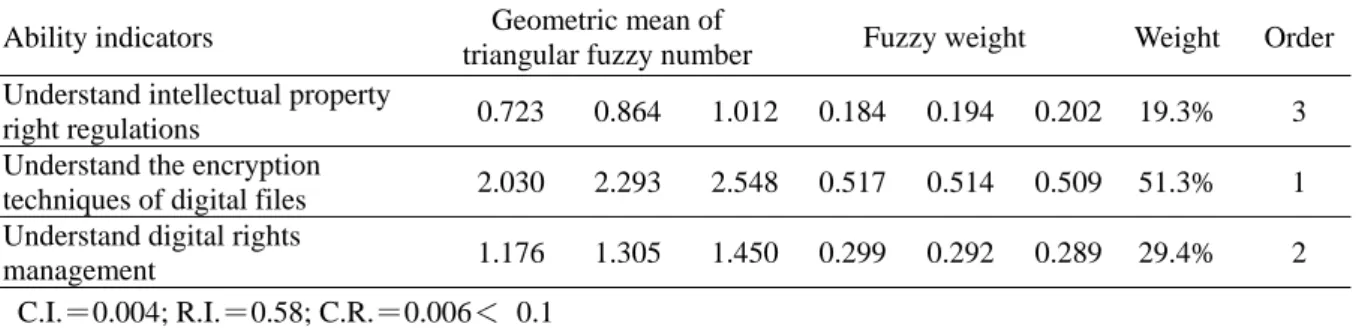
數位媒體編輯人員 1. 瞭解數位攝影方式 6. 分鏡繪製 3. 瞭解「使用者介面」設計原理 4. 瞭解平面媒體製作方式 5. 瞭解影音剪輯方式 6. 瞭解影音錄製方式 7. 設計內容整合 網路美術編輯人員 1. 網頁設計軟體操作 2. 畫面樣式(ex:工具列、按鈕)設計 3. 動畫製作軟體操作 4. 電腦繪圖軟體操作 數位內容排版人員 1. 瞭解影像掃瞄方式 2. 色彩管理 3. 瞭解印前作業規格 4. 瞭解不同閱讀器介面 5. 瞭解數位檔案格式轉換方式 研發工程師、 網頁程式設計師、 系統分析師、 通訊應用軟體開發工 程師 1. 瞭解數位檔案加密方式 2. 瞭解開發平台軟體 3. 瞭解多媒體程式語言 4. 資料庫系統管理 5. Metadata 設計
三、數位出版專業實務課程發展 (一) 課程架構初稿發展 本研究參考近三年國內各大專院校已開設之數位出版相關課程內容及 授課大綱,首先發展出數位出版課程架構初稿,將數位出版專業課程分為學 理課程、技術導向課程、實務導向課程三大課程構面,並發展出 19 門數位 出版專業課程。如下圖二所示: 圖二、 數位出版專業實務課程內涵架構圖初稿 (二) 課程架構內容修正 課程架構初稿完成後,本研究即邀請 10 位數位出版產業領域專家、以 及數位出版相關課程領域資深教師,召開 DACUM 會議,藉由會議中反覆討 論,先針對數位出版專業課程之教學目標進行意見發表,歸納出認知、技能 與情意三大構面之教學目標如下圖三所示: 數位出版 專業實務課程 學理課程 技術導向課程 實務導向課程 1. 色彩學 2. 電子商務 3. 數位攝影 4. 影像美學 5. 新媒體藝術 6. 數位內容概論 7. 數位創意行銷 8. 影視導論與實踐 9. 數位媒體出版管理 10. 數位內容智財權管理 與保護 11. 數位內容產業分析與 加值應用 1. 商業短片製作 2. 數位影音剪輯 3. 數位內容製作技術 4. 資訊素養轉業能力 認證 5. 互動多媒體之整合 與應用 1. 專題創作 2. 數位內容產業 實習 3. 數位內容專題 講座
圖三、數位出版專業實務課程教學目標關係圖 在發展課程內涵方面,則需同時考量到課程內容的完整性、適切性、前瞻性 等問題,由專家學者們進行逐項審核,並參考先前計畫所發展出之「數位出版專 業能力指標」,最後在 DACUM 會議中求得共識,相關課程內涵調整情形如表四 所示。 表四、 DACUM 專家會議後課程內涵調整情形彙整表 類別 項目 DACUM 會議審核後調整情形 學理 課程 1. 數位攝影 二者合併為「數位攝影與影像處理」 課程 2. 影像美學 3. 新媒體藝術 非目前數位出版產業所需之核心技術 能力,故予以刪除 4. 數位內容概論 調整為「數位出版概論」 5. 數位創意行銷 調整為「數位出版行銷與通路」 6. 影視導論與實踐 調整為「影視導論」 7. 數位媒體出版管理 調整為「數位出版匯流管理」 認知: 瞭解數位出版專業 基礎知識 技能: 熟悉數位出版 製作流程 情意: 培養學生良好的 數位出版工作態度
類別 項目 DACUM 會議審核後調整情形 技術 導向 課程 1. 商業短片製作 非目前數位出版產業所需之核心技術 能力,故予以刪除 2. 數位內容製作技術 課名範疇過於龐大,調整後分為「字 型與版面設計」、「網頁設計」兩門課 程 3. 資訊素養轉業能力認證 非目前數位出版產業所需之核心技術 能力,故予以刪除 4. 互動多媒體之整合與應用 調整為「跨媒體出版與整合」 5. 新增 新增「人機介面設計」課程 6. 新增 新增「數位出版系統設計」課程 7. 新增 新增「數位版平台建置與管理」課程 透過上述資料匯整之結果,本研究將課程架構重新進行修正,由原先之 19 門課程增加為 20 門,並將學理課程及技術導向課程分為基礎課程與進階課程兩 部份,如圖四所示: 圖四、 數位出版專業實務課程內涵架構圖 數位出版 專業實務課程 學理課程 技術導向課程 實務整合課程(必修) 基礎課程(必修) 1. 數位出版概論 2. 色彩學 3. 電子商務概論 4. 影視導論 基礎課程(必修) 1. 數位攝影與影像處理 2. 數位影音剪輯 3. 字型與版面設計 4. 網頁設計 5. 電子書製作 1. 數位出版專題講座 2. 專題製作 3. 跨媒體出版與整合 4. 數位內容產業實習 5. 數位內容產業分析與 加值應用 進階課程(選修) 1. 數位出版行銷與通路 2. 數位出版匯流管理 3. 數位內容智財權管理與 保護 進階課程(選修) 1. 人機介面設計 2. 數位出版系統設計 3. 數位出版平台建置與 管理
根據上述所發展出之 20 門數位出版專業實務課程內涵,本研究將其與先前 計畫所調查出之「數位出版專業能力指標」進行相互對應,彙整如下表五所示: 表五、 數位出版專業實務課程名稱與能力指標對應關係表 課程名稱 對應數位出版從業人員專業能力指標 學 理 課 程 1. 數位出版概論 專業實務基礎 2. 色彩學 色彩管理 3. 電子商務概論 瞭解數位出版電子商務系統 4. 影視導論 分鏡繪製 5. 數位出版行銷與通路 瞭解發行通路 6. 數位出版匯流管理 數位出版品檔案管理、製作物外包規 劃、設計內容整合、瞭解印前作業規格 7. 數位內容智財權管理與保護 瞭解智慧財產權規範、瞭解數位版權管 理方式、瞭解數位檔案加密方式 技 術 導 向 課 程 1. 數位攝影與影像處理 瞭解數位攝影方式、瞭解平面媒體製作 方式、電腦繪圖軟體操作、瞭解影像掃 瞄方式 2. 數位影音剪輯 瞭解影音剪輯方式、瞭解影音錄製方式 3. 字型與版面設計 字型規劃、版面規劃 4. 網頁設計 網頁設計軟體操作、畫面樣式(ex:工具 列、按鈕)設計、動畫製作軟體操作 5. 電子書製作 版面規劃、設計內容整合、瞭解數位檔 案格式轉換方式、產品創新能力 6. 人機介面設計 出版載具規劃、瞭解「使用者介面」設 計原理、瞭解不同閱讀器介面 7. 數位出版系統設計 瞭解各式電子出版品規格、瞭解數位檔 案加密方式、瞭解多媒體程式語言、資 料庫系統管理、Metadata 設計 8. 數位出版平台建置與管理 瞭解數位檔案加密方式、瞭解開發平台 軟體、資料庫系統管理、Metadata 設計 實 務 整 合 課 1. 數位出版專題講座 數位出版專業實務能力整合 2. 專題製作 數位出版專業實務能力整合與應用 3. 跨媒體出版與整合 數位出版專業實務能力整合與應用 4. 數位內容產業實習 數位出版專業實務能力整合與應用 5. 數位內容產業分析與加值應用
(三) 其他課程內容意見 除上述課程內涵之具體修正意見外,本研究亦將 DACUM 專家會議中所得 之其他關於數位出版課程規劃之建議、以及對人才培育之建議整理如下: 1. 對課程規劃之建議 (1) 出版本質的學理還是為數位出版系所的核心價值,數位出版的技術 為輔。因此不可重數位製作技能而忽略原有學理的課程。 (2) 出版本質的學理還是為數位出版系所的核心價值,數位出版的技術 為輔。因此不可重數位製作技能而忽略原有學理的課程。 (3) 可加強學生實作能力的展現,因此可把一些創作、實習與講座課程 規劃為整合專業實務導向課程。 (4) 相關人機介面互動的課程為人才需求重要課程之一,數位出版相關 課程可考慮在內。 (5) 數位出版管理課程範疇過大,可將學習專業更精進至數位出版匯流 管理課程。 (6) 數位出版職業能力的培養,可透過業界專家之經驗分享,來建立學 生對未來進入職場工作之認知與規劃能力。然而業界專家受限於工 作因素,無法長期進行整學期的授課,因此若能以短時間二至三週 的方式進行,可望有更多的業界專家願意投入協同教學工作。 2. 對人才培育之建議 (1) 數位出版產業所使用之軟體工具設備更新的速度日新月異,待學生 畢業時,當初於學校所學的技術已與產業有所落差,因此相較於其 他能力,業界更注重學生是否具備正確的概念,與面對困難時問題 解決的能力。 (2) 數位出版產業的核心價值在於所創造出之圖文內容,是否可符合顧 客之需求,系所應配合產業趨勢之變化與未來發展,有彈性的調整 系所的定位,來充實數位出版課程之內涵。
伍、結論
一、科技校院數位出版相關課程開設現況 課程是培養數位出版專業知識與技能教育的主體,關係著人才培養與供應業 界需求的重要任務。本研究針對近三年來,國內科技校院數位出版相關課程開設 情形進行調查,可發現隨著國家政策對數位內容產業之大力推動,與數位出版領 域相關之課程開設數量也逐年增加。 經調查後發現,95-96 學年度期間,開設數位出版之科系多以設計、資訊傳 播相關科系為主,強調數位內容的製作。而隨著數位出版產業之興起,各式行動 閱讀的工具越來越普及,資訊管理、資訊工程等科系亦開始注意到數位出版背後 所包含的龐大資訊技術,因此 97 學年度起,已開始有科系開設程式技術、XML 等課程,以彌補產業人才之不足。 二、數位出版相關科系之學生專業能力表現情形 近年來由於科技突飛猛進,尤其數位科技的發展更是一日千里,行動通訊相 關之軟硬體研發設計已成為政府重點發展的產業,而電腦軟硬體的開發與應用, 直接造就了傳統出版產業的質變。技術領域的改變與提升,使得大專院校內各類 設計、傳播、甚至是資管、資工科系,皆開始增設數位出版相關課程。 然而經本研究實地訪談後發現,僅管多數學生在校期間曾修習過數位出版相 關課程,畢業後,其專業能力多無法滿足數位出版產業僱主之需求,因此各階段 之數位出版課程乃有修正或調整的必要,其中又以「系統程式設計」、「數位版權 管理機制(DRM)」及「人機介面設計」方面之專業能力與產業界落差較大,亦表 示產業對此方面人才之需求較為急迫。 三、數位出版產業需求之專業實務課程發展 藉由文獻資料、專家訪談內容及數次 DACUM 會議之共識,本研究與業界 專家、學者共同發展出數位出版專業實務課程,其課程目標可分為認知、技能與 情意三大構面。課程內涵部份可分為學理課程、技術導向課程及實務整合課程三 大構面,其中學理課程及技術導向課程依專業程度之不同,規劃有必修的基礎課 程、及選修的進階課程,共計 20 門課程。 此次研究所發展出之數位出版業實務課程,與先前計畫所發展之專業能力指 標、數位出版職務類別進行彙整後,將三者間之關係整理如下圖四所示,可做為 日後人才培育之參考。圖四、 數位出版業實務課程與專業能力指標、數位出版職務類別關係圖 數位出版專業實務課程 編輯企劃 內容製作 系統開發 整合發行 數位出版專業實務能力構面 基礎學理 課程(4 門) 基礎技術 課程(5 門) 進階學理 課程(3 門) 進階技術 課程(3 門) 實務 整合 課程 (5 門) 數位產品編輯 網路行銷企劃 人員 版權專員 數位媒體編輯 網路美術編輯 數位內容排版 人員 數位出版專業人才培育 網頁程式設計師 研發工程師 系統分析師 通訊應用軟體開 發工程師
參考文獻
王揚智與徐明珠(2007)。台灣數位出版產業及大學數位出版課程之研究。教育 學術彙刊,1,113-132 王祿旺(2008)。數位出版大眾化的關鍵因素。2008出版年鑑。台北:新聞局。 王鼎銘(2003)。藝術教育與網路學習新思維。美育,134,27-32。 那福忠(2007)。2017 年。嶄新科技網際論壇。線上檢索日期:2008 年 12 月 28 日。網址:http://www.brainnew.com.tw/Article/na2007/n_091807.htm 徐明珠(2006)。文化創意產業與圖文傳播人才培育。線上檢索日期:2009 年 3 月 12 日。網址 http://www.npf.org.tw/PUBLICATION/EC/095/EC-R-095-008.htm 陳信元(2008)。行政院新聞局2008出版年鑑。台北:行政院新聞局。 教育部技職校院課程資源網(2011),課程搜尋系統。線上檢索日期:2011 年 5 月 30 日。網站:http://course.tvc.ntnu.edu.tw/ 郭家銘。(1999)。圖書出版的數位化現象暨其科技歷程探索。未出版碩士論文。 南華大學,嘉義。 黃瑞琴(1999)。質的教育研究方法(四版)。台北:心理出版社。 經濟部(2008)。挑戰2008:國家發展重點計畫(重要成果摘要報告編號: 1009700885)。台北:經濟部。 薛良凱(2008)。行政院新聞局2008出版年鑑。台北:行政院新聞局。International Digital Publishing Forum (2010). Industry Statistics. Retrieved 2010/12/16 form http://idpf.org/about-us/industry-statistics
Romano,F(2006). The Future of Global Markets for Digital Printing to 2015. Maine: PIRA International.
Schmidt, J(2008). Advisory Services & International Co-operation Federal Institute for Vocational Education and Training (BIBB) Germany, International
Technological and Vocational Education Conference, Taiwan. Tribute,A.(2006). Digital Goes International. Retrieved 2008/10/13 from
http://www.attributes.co.uk/index.php
已投稿之期刊與研討會
廖信(2011)。網路時代技職院校數位出版專業實務課程發展之研究。。教育資 料與圖書館學。ISSN 1013-090X。(TSSCI)。(審查中)
Shin Liao, Chui-Chu Yang (2011). The Study of the Hierarchical Competencies
Required for the Digital Publishing Professionals. 2011 Conference Proceedings on Hawaii International Conference on Social Sciences, 247-265. ISSN: 1539-7300.
2011 國科會補助出席國際學術會議報告
100 年 08 月 31 日 報告人姓名 廖信 服務單位 及職稱 國立台灣師範大學圖文傳播學系 教授 會議時間 2011/6/1-6/4 會議地點 Hawaii, USA 會議名稱 2011 Hawaii International Conference on Social Sciences
發表論 文題目
The Study of the Hierarchical Competencies Required for the Digital Publishing Professionals
報告內容:
一、參加會議經過 2011 年夏威夷社會科學國際研討會是以社會科學為研究主題的學術研討 會,可以見到各式各樣與社會、人相關的研究議題。參與此次研討會的學 者大約有 150 多人。 本人的發表被安排在 6/3 下午 1:00 - 2:30,在發表期間有多位與會學者對本 人的發表主題及內容感到興趣,並加以詢問和討論,也交換了些彼此的研 究心得。圖一、圖二為參加此次研討會之留影。二、參加會議心得 此次研討會除了發表自己的研究成果之外,也藉此機會觀摩其他國家 的學者專家所發表的研究主題與方法,而從觀摩他人的發表中也發現有趣 的議題。對於個人日後的研究方向多所啟發,參與此次研討會個人收穫頗 豐。 同時,感謝國科會及本校對於本人參加此次研討會在經費上的補助, 讓本人有此次的學習之旅。 三、建議事項 無。 四、攜回資料 研討會論文集光碟一片。 五、論文內容
The Study of the Hierarchical Competencies Required for the Digital Publishing Professionals
Shin Liao, Professor, Department of Graphic Arts Communication, National Taiwan Normal University, Taipei, Taiwan
Chui-Chu Yang, Assistant Professor, Department of Human Development and Family Study, National Taiwan Normal University, Taipei, Taiwan
Abstract
The purposes of this research is to explore what competency required for Digital Publishing professionals and to rank identified competencies into hierarchy. Through literature review, the study identified 4 types of competencies that guided the
development of the questionnaire. Companies listed on the “2007 Publication Annual” were selected as the survey samples. Total 46 questionnaires were delivered and 34 out of them (74%) were returned and valid. The collected data were analyzed by SPSS statistic software. The results indicated that required competency for Digital Publishing professionals could be categorized into 4 constructs, 7 dimensions and 32 indicators. “Able to do computer programming” was rated as the most important among the 4 constructs and “the ability of processing data security” was ranked as the most important among the 32 indicators
Introduction
A survey by the U.S. publishing and printing adviser Andrew Tribute (2006) revealed that global sales of e-books have reached 400,000 copies per month, soaring at a rate of 5 to 7 percent a month. It is anticipated the output of digital data will catch up with that of printed data in 2010, and the market share of digital data will reach 65% in 2020. A report by Frank Romano (2006) predicted that digital printing would make up approximately 30% of the global printing volume from 2005 to 2015. By 2015, China will become the most important printing market in the world, and its market value will rise to EUR2.7 billion, and also by that time, 48% of the books will be printed on demand digitally. Furthermore, the ratio of income from product authorization, sales of peripheral products, revenue from virtual products, etc. will rise, leading to immense changes to the traditional way of operation.
In the “Challenge 2008: National Development Plan” (Ministry of Economic Affairs, 2008) report, it was stated there was no cultivation of core talents for digital content in Taiwan in 2002, and there was a manpower shortage for the industry. Most of the talents were raided from competitors in the industry, and most were engaged in the development of local market or international subcontracting projects. To date, training of talents has become pressing issue of the industry; more effort should be put on identifying and pooling together creative talents, advisory service of commoditization of creativity, as well as cultivation of talents of originality.
In view of the aforesaid background, it follows that digital publishing work has to be done by teams of professionally trained talents with professional knowledge (Kenney, 2000). However, people currently engaging in the digital publishing work have been trained by the traditional communication faculty of various universities and colleges. Thus, the relevance of their abilities to the needs of the digital publishing industry is an issue yet to be discussed.
Schmidt (2008) expressed that the industry’s requirement of the workplace manpower and the abilities they should possess may be assessed by probing into the new technology and new workflow. Therefore, the study started off by an industry survey. An exploration of the current digital publishing industry’s needs of
professional abilities may shed light on the direction to which traditional publishing workers may go for transformation, and provide a reference for the cultivation of publishing talents and the design of training programs. The purposes of the study are as follows:
(1) Discuss the work content of digital publishing industry.
(2) Discuss the digital publishing industry’s requirements on professional abilities. (3) Develop professional ability indicators that meet the digital publishing
Literature Review
Digital Publishing
The prominent difference between digital publishing and traditional publishing is not about the physical nature of the content, but the way in which information is transmitted to the users. The greatest difference lies in the different possibilities that digital publications may offer in terms of the demand-oriented output format, the provision of custom-made or personalized service based on consumers’ preference (Yang, 2007), and the facilitation of readers’ interaction with the images and text content of the book. With the features of being large in volume and easy to circulate, digital publications are more easily accessible than traditional publications, and such regrets as books being out of print or out of stock will not occur.
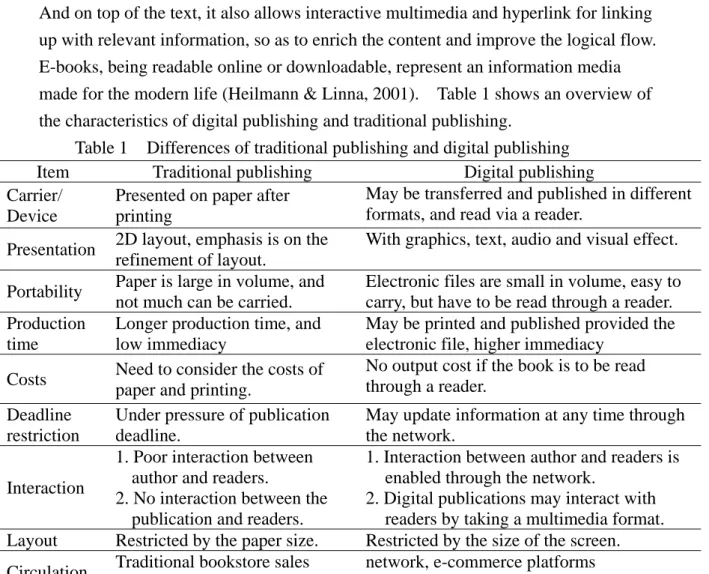
All forms of digital publications outperform the same-size paper-back books in terms of both data capacity and transmission speed. The digitizing process makes the content small in volume; for example, an 80G hard disk may save nearly 100,000 copies of e-books. It is also easier to carry and transmit than traditional books. And on top of the text, it also allows interactive multimedia and hyperlink for linking up with relevant information, so as to enrich the content and improve the logical flow. E-books, being readable online or downloadable, represent an information media made for the modern life (Heilmann & Linna, 2001). Table 1 shows an overview of the characteristics of digital publishing and traditional publishing.
Table 1 Differences of traditional publishing and digital publishing
Item Traditional publishing Digital publishing
Carrier/ Device
Presented on paper after printing
May be transferred and published in different formats, and read via a reader.
Presentation 2D layout, emphasis is on the refinement of layout.
With graphics, text, audio and visual effect.
Portability Paper is large in volume, and not much can be carried.
Electronic files are small in volume, easy to carry, but have to be read through a reader. Production
time
Longer production time, and low immediacy
May be printed and published provided the electronic file, higher immediacy
Costs Need to consider the costs of paper and printing.
No output cost if the book is to be read through a reader.
Deadline restriction
Under pressure of publication deadline.
May update information at any time through the network.
Interaction
1. Poor interaction between author and readers.
2. No interaction between the publication and readers.
1. Interaction between author and readers is enabled through the network.
2. Digital publications may interact with readers by taking a multimedia format. Layout Restricted by the paper size. Restricted by the size of the screen.
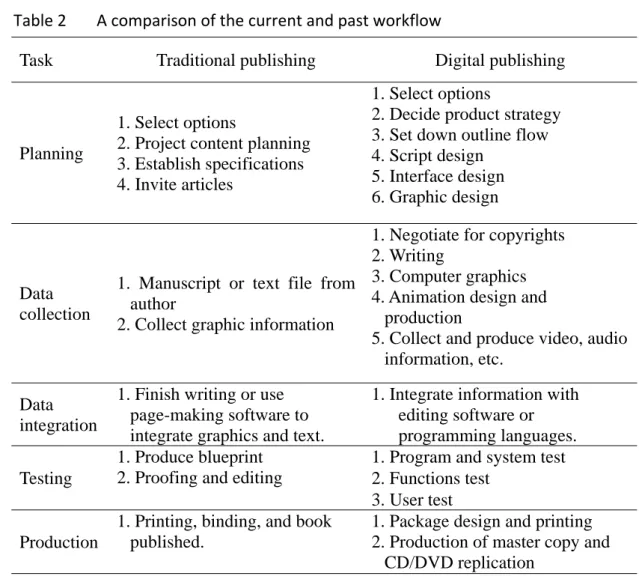
As technology advances, the digital publishing workflow has undergone great changes. In order to make digital publications more interactive and diversified, the script and image elements of the e-books should be considered during the planning stage, and there are additional procedures for the production of audio/visual
information and system programming, etc. As a contrast to traditional publishing, it saves the proofing and editing procedures before printing. Overall speaking, digital publishing work requires the combination of much more diversified professional abilities than traditional publishing. Table 2 shows the similarities and differences of traditional publishing and digital publishing workflow.
Table 2 A comparison of the current and past workflow
Task Traditional publishing Digital publishing
Planning
1. Select options
2. Project content planning 3. Establish specifications 4. Invite articles
1. Select options
2. Decide product strategy 3. Set down outline flow 4. Script design
5. Interface design 6. Graphic design
Data collection
1. Manuscript or text file from author
2. Collect graphic information
1. Negotiate for copyrights 2. Writing
3. Computer graphics 4. Animation design and
production
5. Collect and produce video, audio information, etc.
Data integration
1. Finish writing or use page-making software to integrate graphics and text.
1. Integrate information with editing software or programming languages. Testing
1. Produce blueprint 2. Proofing and editing
1. Program and system test 2. Functions test
3. User test Production
1. Printing, binding, and book published.
1. Package design and printing 2. Production of master copy and
CD/DVD replication Source: Similarities and Differences of Traditional Publishing and Digital Publishing
Workflow, Market Intelligence & Consulting Institute (2004a), Industrial Development Bureau, Ministry of Economic Affairs, Taipei.
publishing talents?” co-organized by the Book Publishing Association of Taiwan and the online UDN digital reading network, speakers believed that digital publishing talents should not only possess professional skills, have passion and be well-versed in the new network media and new technology, but also have to possess the ability to create reading (on different forms of carriers), imagination and the ability to communicate across different areas of specialties.
In the forum, Du (2008a) from Yuan-Liou Publishing Co., Ltd. pointed out from her observation that digital publishing talents had to possess such abilities as
intellectual property rights negotiation, products planning and production, and information security management skills for product circulation, etc. In the talk on “Demand on Digital Publishing Talents", Du (2008b) listed six basic abilities of digital publishing talents based on the development of Yuan-Liou Publishing Co., Ltd., which were: digital application ability, text/image/video/audio appreciation ability, logical organization ability, problem solving ability, self-learning ability, and communication ability. Among these, the “digital application ability" is of primary importance in the required abilities of digital publishing workers.
The Technical Consultation Group from Printing Technology Research Institute (2005) stated that the printing industry needed to train technicians in printing,
information, network technology, etc., in order to ensure sustainable development, as well as to accumulate domain knowledge, know-hows, information integration and network technology in the printing industry.
A study by Chen (2004) revealed that professional techniques and skills required for network editing were familiarity with e-commerce technology, cash flow and logistics ability and web-page editing ability. Web-page editing ability includes the use of web-page editing software, possession of the concept of web-page visual arrangement, and knowledge about the habits of network users, etc.
When conducting a survey on the current status of digital publishing industry and the clustering needs, the Magazine Business Association of Taipei (2006) found that planners were the most highly demanded digital publishing talents by the industry, seconded by information research and development, and art editing and design talents. Hong (2006) found in her study on professional abilities of art editing for Taiwan’s book publishing industry that “editing and design execution” was the most important ability, followed by the “arrangement and design creativity” and “application of computer graphics and page making software”.
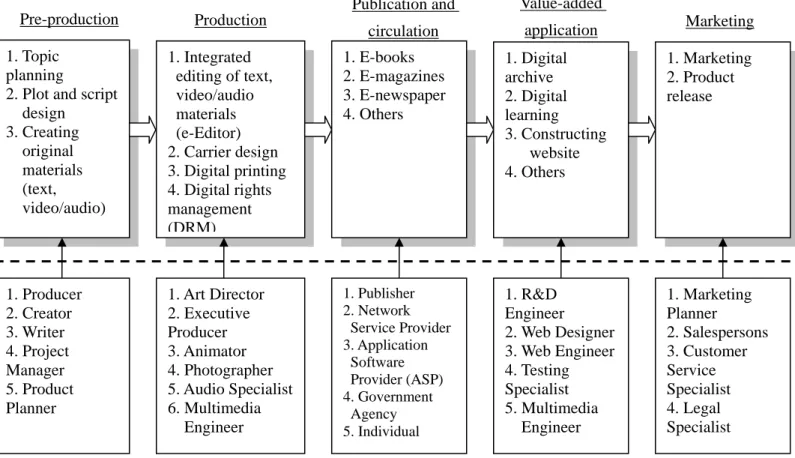
Market Intelligence & Consulting Institute (MIC, 2004) listed out five stages of the digital publishing workflow in the report of “Survey on Digital Content Institute’s Curriculum and Training Needs”, which were pre-production stage, production stage,
By summarizing the above information, the five stages of digital publishing workflow and the respective work content, as well as the manpower needed are sorted out in Figure 1:
Figure 1 Digital publishing workflow and corresponding talents
Source: Adapted from the Survey Report on Curriculum and Training Needs, Market Intelligence & Consulting Institute (2004), Industrial Development Bureau, Ministry of Economic Affairs, Taipei
After reviewing different countries’ requirements on publishing workers and the work content of digital publishing workers, the abilities of digital publishing workers are categorized into 7 dimensions in this study, namely the text editing ability, art and design ability, digital design ability, audio/video production ability, digital circulation ability, digital rights management ability, and programming ability.
Professional competency
The scholar Chia (1979) made a definition of profession which should covers abundant knowledge, excellent capability, service and devotion. Lee (1999) also explained that the competency is the performance of personal knowledge, operation skill and good attitude to execute the job effectively. Wu (2006) quoting from Darlling-Hammond, stated that the profession is composed of expertise, technique, Pre-production
1. Topic planning
2. Plot and script design 3. Creating original materials (text, video/audio) Production 1. Integrated editing of text, video/audio materials (e-Editor) 2. Carrier design 3. Digital printing 4. Digital rights management (DRM) Publication and circulation 1. E-books 2. E-magazines 3. E-newspaper 4. Others Marketing Value-added application 1. Digital archive 2. Digital learning 3. Constructing website 4. Others 1. Marketing 2. Product release 1. Producer 2. Creator 3. Writer 4. Project Manager 5. Product Planner 1. Art Director 2. Executive Producer 3. Animator 4. Photographer 5. Audio Specialist 6. Multimedia Engineer 1. Publisher 2. Network Service Provider 3. Application Software Provider (ASP) 4. Government Agency 5. Individual 1. R&D Engineer 2. Web Designer 3. Web Engineer 4. Testing Specialist 5. Multimedia Engineer 1. Marketing Planner 2. Salespersons 3. Customer Service Specialist 4. Legal Specialist
mission and responsibility. Professionalism is the process of enhancing those elements to be qualified with service, independence, and uniqueness. Chen(2001) defined that the competency is the behavior or real performance of implementing a job through the personal knowledge, skill, and goodwill. Hong(1997) divided the competency into the dominant and recessive ability. Generally speaking, profession, management, and personal relationship are relevant to dominant abilities. Intellectual wisdom and personal value belong to recessive abilities.
According to above statements, this research generalized that the competency for the professional is the condition and quality of utilizing knowledge, technique, and goodwill for someone who is devoted to a special-trained job. As a result, professionals with the competency will be highly respected in society through their join into the group, service and independence.
Research Design
Framework of the study
To achieve the objectives of the study, literature review, and Fuzzy Analysis Hierarchical Process (FAHP) were adopted as the basis for the design of the study framework, as shown in Figure 2. First of all, the current status of digital publishing industry was explored through literature review, and with the understanding of the industry’s current status, the work content and ability dimensions of digital publishing industry was identified. Then, the industry’s needs of digital publishing workers’ abilities and the relative weights of various indicators were found by the FAHP. Finally, the relative importance of digital publishing workers’ abilities was established.
Dimensions of professional abilities
Current status of digital
pu
blishing
industry
Professional ability indicators
Items of professional abilities
Publishing planning ability Text/image creation ability Interface design ability Multimedia production ability
Programming ability Digital circulation ability DRM ability
Editing and planning Content production System development Integrated circulation
Research method
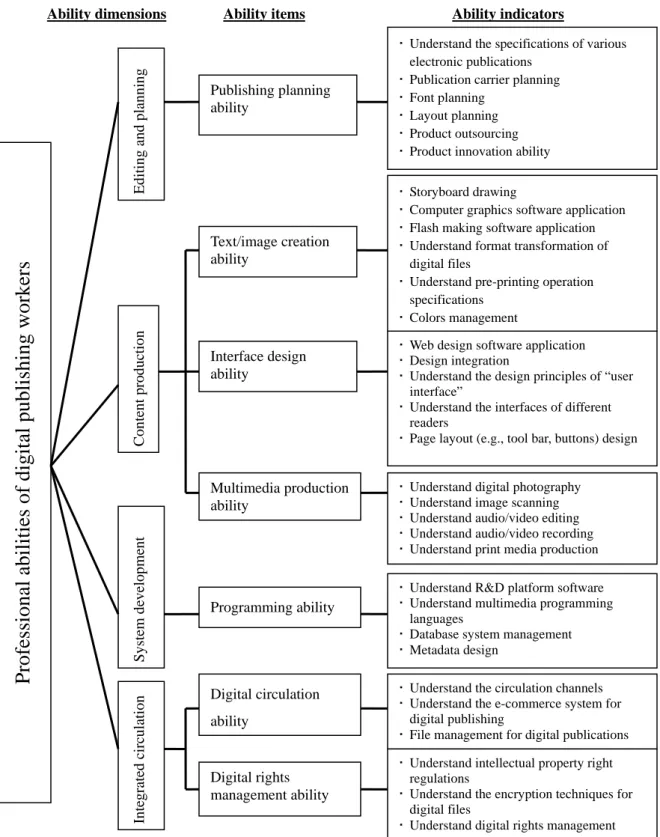
Questionnaire survey is the major research method of the study. Based on literature review and expert review of a questionnaire, the indicator dimensions and items were obtained and adjusted for developing the structural hierarchical questionnaire on the “Professional abilities of digital publishing workers”, and the hierarchy of their professional abilities was shown in Figure 3.
The questionnaire used a 9-point scale for comparison (9:1 to 1:9), in which paired comparisons of two same-level indicators were made in sequence. A pairwise comparison matrix was then established with the acquired data. The concept of fuzzy number, etc. was also introduced for processing the data, and finally the relative weights of various factors were obtained, thus establishing the hierarchical analysis of the professional abilities of digital publishing workers.
Figure 3 Overall hierarchical structure of professional abilities of digital publishing Workers
Subjects
The chief executives of the companies “actually engaged in the production of
Professional abilities of digital publishing workers
Understand digital photography Understand image scanning Understand audio/video editing Understand audio/video recording Understand print media production
Co n ten t pr oductio n Inte grated circ ulation Ability items Text/image creation ability
Web design software application Design integration
Understand the design principles of “user interface”
Understand the interfaces of different readers
Page layout (e.g., tool bar, buttons) design
Digital circulation ability
Multimedia production ability
Understand intellectual property right regulations
Understand the encryption techniques for digital files
Understand digital rights management
Digital rights management ability Publishing planning ability
Understand R&D platform software Understand multimedia programming
languages
Database system management Metadata design Programming ability Ability indicators Interface design ability Ed itin g and p lan n in g Syst em de vel o pme n t
Understand the specifications of various electronic publications
Publication carrier planning Font planning
Layout planning Product outsourcing Product innovation ability Storyboard drawing
Computer graphics software application Flash making software application Understand format transformation of
digital files
Understand pre-printing operation specifications
Colors management
Understand the circulation channels Understand the e-commerce system for
digital publishing
File management for digital publications
companies listed under the “digital publishing” category in the “2007 Publication Annual” were chosen. A total of 46 questionnaires were sent, and 34 were returned, representing a response rate of 74%. Deducting 4 invalid responses, 30 valid responses were received. In order to ensure a higher response rate and make it more convenient for the subjects, the questionnaires were sent out both as printed copy by post and via the Internet at the same time. The questionnaire survey was carried out from March 22, 2009 to April 10, 2009.
Results
Description data
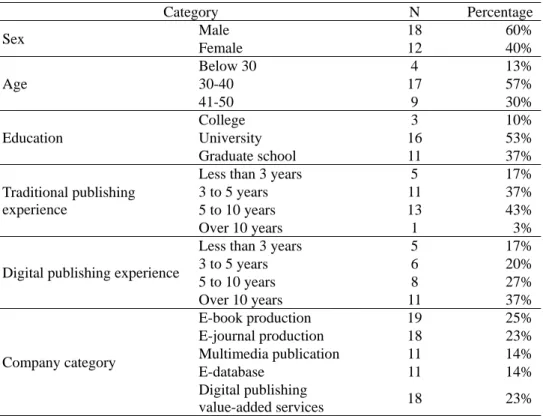
According to the returned questionnaires, most of the respondents are male (60%), and aged between 30 and 40 (57%); most are university graduates or above (90%), and most of them have about 5 years’ experience in the publishing industry. As for the company category, since it is a question that allows more than one choice, the percentage may be overlapped. The majority are in the category of e-book production (25%), e-journal production (23%), and digital publishing value-added services (23%). The basic information is summarized in Table 3:
Table 3 Analysis of basic information of questionnaire respondents
Category N Percentage Sex Male 18 60% Female 12 40% Age Below 30 4 13% 30-40 17 57% 41-50 9 30% Education College 3 10% University 16 53% Graduate school 11 37% Traditional publishing experience
Less than 3 years 5 17%
3 to 5 years 11 37%
5 to 10 years 13 43%
Over 10 years 1 3%
Digital publishing experience
Less than 3 years 5 17%
3 to 5 years 6 20% 5 to 10 years 8 27% Over 10 years 11 37% Company category E-book production 19 25% E-journal production 18 23% Multimedia publication 11 14% E-database 11 14% Digital publishing value-added services 18 23% FAHP analysis
professional abilities were revised based on the opinions obtained from expert review of questionnaires, and paired comparisons of various indicators were made with the Linguistic Scale, to find out the weights of various hierarchical indicators. Hence, the consistency test and weights of various dimensions and indicators are illustrated below:
(1) Ability Dimensions
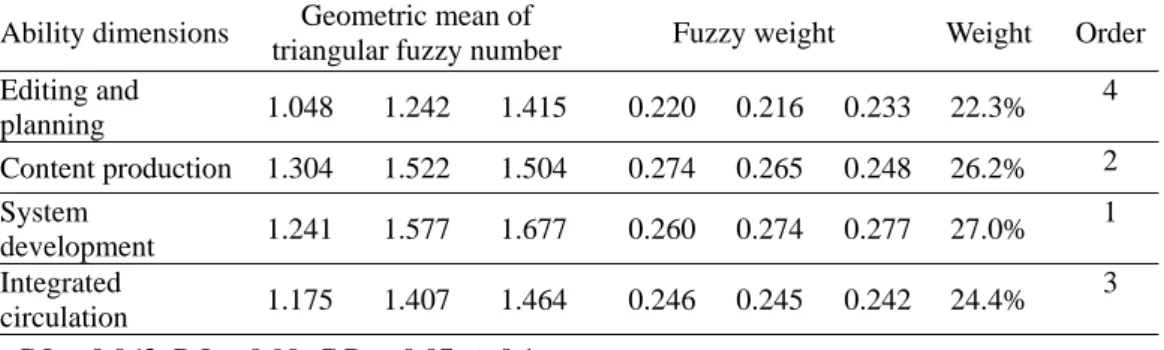
The weights and ranking of the four dimensions of professional abilities after statistical analysis are shown in Table 4. The “system development” ability is rated highest (weight 0.270), and the others in descending order are “content production” ability (weight 0.262), “integrated circulation” ability (weight 0.244) and “editing and planning” ability (weight 0.223).
Table 4 Fuzzy weights of digital publishing workers’ professional “ability dimensions”
Ability dimensions Geometric mean of
triangular fuzzy number Fuzzy weight Weight Order Editing and planning 1.048 1.242 1.415 0.220 0.216 0.233 22.3% 4 Content production 1.304 1.522 1.504 0.274 0.265 0.248 26.2% 2 System development 1.241 1.577 1.677 0.260 0.274 0.277 27.0% 1 Integrated circulation 1.175 1.407 1.464 0.246 0.245 0.242 24.4% 3 C.I.=0.063; R.I.=0.90; C.R.=0.07< 0.1
Remark: C.I. is consistency index; R.I. is random index; C.R. is consistency ratio.
(2) Ability Items
Since the “content production” dimension and “integrated circulation” dimension include more ability content, the “content production” dimension is further divided into 3 items, and the “integrated circulation” dimension is divided into 2 items. Their weights are illustrated as follows:
A. Content production dimension
The weights of the three items under “content production” dimension, after statistical analysis, are listed in Table 5. The most important item is “multimedia production ability” (weight 0.524).
Table 5 Fuzzy weights of “content production” abilities of digital publishing workers
ability Interface design ability 0.879 1.008 1.146 0.241 0.241 0.244 24.2% 2 Multimedia production ability 1.888 2.204 2.484 0.517 0.528 0.528 52.4% 1 C.I.=0.050; R.I.=0.58; C.R.=0.09< 0.1
B. Integrated circulation dimension
The weights of the two items under “integrated circulation” dimension, after statistical analysis, are shown in Table 6. The most important item is “digital rights management ability” (weight 0.598).
Table 6 Fuzzy weights of “integrated circulation” abilities of digital publishing Ability items Geometric mean of
triangular fuzzy number Fuzzy weight Weight Order Digital circulation ability 1.070 1.138 1.206 0.407 0.401 0.397 40.2% 2 Digital rights management
ability 1.559 1.700 1.833 0.593 0.599 0.603 59.8% 1
C.I.=0; R.I.=0.00; C.R.=0< 0.1
(3) Ability Indicators
A. Publishing planning ability
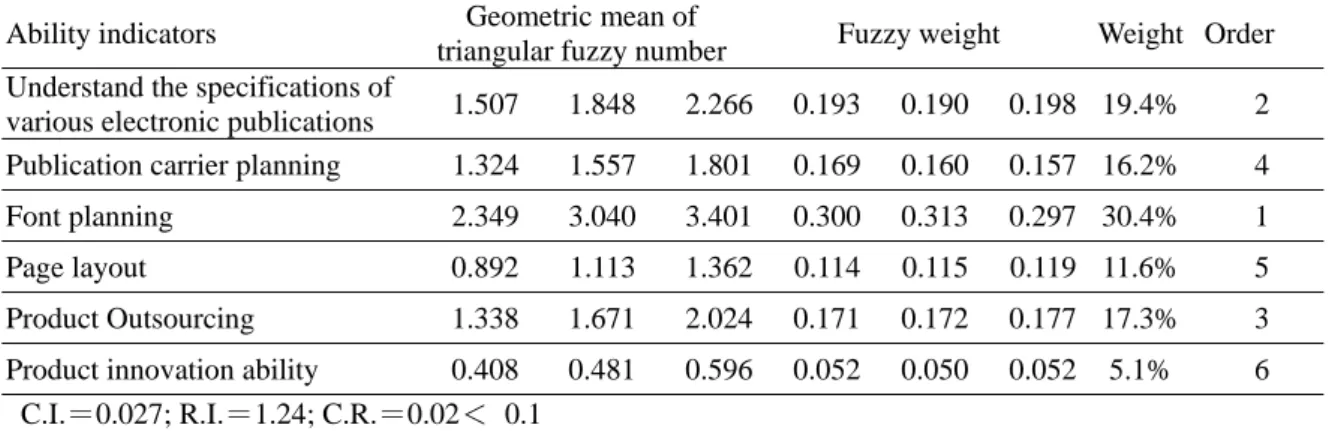
There are 6 indicators under the “publishing planning ability” item, and their weights and order as shown after statistical analysis are listed in Table 7. The most important indicator is “font planning” (weight 0.304).
Table 7 Fuzzy weights of “publishing planning ability" indicators of digital publishing workers
Ability indicators Geometric mean of
triangular fuzzy number Fuzzy weight Weight Order Understand the specifications of
various electronic publications 1.507 1.848 2.266 0.193 0.190 0.198 19.4% 2 Publication carrier planning 1.324 1.557 1.801 0.169 0.160 0.157 16.2% 4 Font planning 2.349 3.040 3.401 0.300 0.313 0.297 30.4% 1 Page layout 0.892 1.113 1.362 0.114 0.115 0.119 11.6% 5 Product Outsourcing 1.338 1.671 2.024 0.171 0.172 0.177 17.3% 3 Product innovation ability 0.408 0.481 0.596 0.052 0.050 0.052 5.1% 6
C.I.=0.027; R.I.=1.24; C.R.=0.02< 0.1
B. Text/image creation ability
There are 6 indicators under the “text/image creation ability” item, and their weights and order as shown after statistical analysis are listed in Table 8. The most important indicator is “animation making software application” (weight 0.201).
Table 8 Fuzzy weights of “text/image creation ability” indicators of digital publishing workers
Ability indicators Geometric mean of
triangular fuzzy number Fuzzy weight Weight Order Storyboard drawing 1.399 1.756 2.115 0.195 0.195 0.193 19.4% 2 Computer graphics software
application 1.260 1.626 1.975 0.176 0.180 0.180 17.9% 3 Animation making software
application 1.432 1.810 2.230 0.199 0.201 0.203 20.1% 1 Understand format transformation
of digital files 0.637 0.766 0.972 0.089 0.085 0.089 8.7% 6 Understand pre-printing operation
specifications 1.153 1.446 1.728 0.161 0.160 0.158 15.9% 5 Colors management 1.297 1.615 1.953 0.181 0.179 0.178 17.9% 3 C.I.=0.005; R.I.=1.24; C.R.=0.004< 0.1
C. Interface design ability
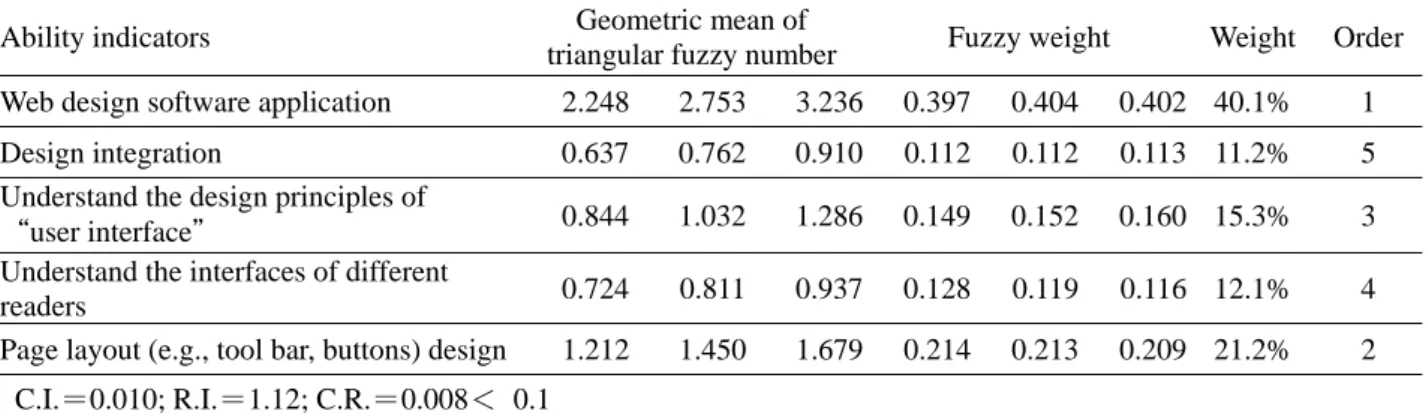
There are 5 indicators under the “interface design ability”, and their weights and order as shown after statistical analysis are listed in Table 9. The most important indicator is “web design software application” (weight 0.401).
Table 9 Fuzzy weight of “interface design ability” indicators of digital publishing workers
Ability indicators Geometric mean of
triangular fuzzy number Fuzzy weight Weight Order Web design software application 2.248 2.753 3.236 0.397 0.404 0.402 40.1% 1 Design integration 0.637 0.762 0.910 0.112 0.112 0.113 11.2% 5 Understand the design principles of
“user interface" 0.844 1.032 1.286 0.149 0.152 0.160 15.3% 3 Understand the interfaces of different
readers 0.724 0.811 0.937 0.128 0.119 0.116 12.1% 4
Page layout (e.g., tool bar, buttons) design 1.212 1.450 1.679 0.214 0.213 0.209 21.2% 2 C.I.=0.010; R.I.=1.12; C.R.=0.008< 0.1
D. Multimedia production ability
There are 5 indicators under the “multimedia production ability” item, and their weights and order as shown after statistical analysis are listed in Table 10. The most important indicator is “understand image scanning” (weight 0.293).
Ability indicators Geometric mean of
triangular fuzzy number Fuzzy weight Weight Order Understand digital photography 1.475 1.827 2.211 0.276 0.285 0.288 28.3% 2 Understand image scanning 1.499 1.900 2.308 0.281 0.296 0.301 29.3% 1 Understand audio/video editing 0.787 0.863 0.995 0.147 0.134 0.130 13.7% 4 Understand audio/video
recording 0.782 0.831 0.924 0.146 0.130 0.120 13.2% 5 Understand print media
production 0.799 0.995 1.231 0.150 0.155 0.160 15.5% 3 C.I.=0.015; R.I.=1.12; C.R.=0.013< 0.1
E. Programming ability
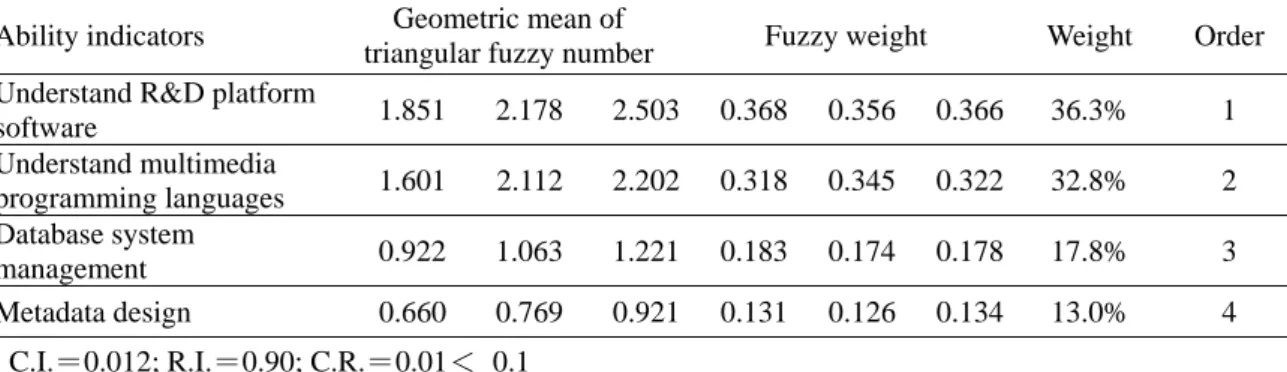
There are 4 indicators under the “programming ability” item, and their weights and order as shown after statistical analysis are listed in Table 11. The most important indicator is “understand R&D platform software” (weight 0.363).
Table 11 Fuzzy weights of “programming ability” indicators of digital publishing workers
Ability indicators Geometric mean of
triangular fuzzy number Fuzzy weight Weight Order Understand R&D platform
software 1.851 2.178 2.503 0.368 0.356 0.366 36.3% 1 Understand multimedia programming languages 1.601 2.112 2.202 0.318 0.345 0.322 32.8% 2 Database system management 0.922 1.063 1.221 0.183 0.174 0.178 17.8% 3 Metadata design 0.660 0.769 0.921 0.131 0.126 0.134 13.0% 4 C.I.=0.012; R.I.=0.90; C.R.=0.01< 0.1
F. Digital circulation ability
There are 3 indicators under the “digital circulation ability” item, and their weights and order as shown after statistical analysis are listed in Table 12. The most important indicator is “understand circulation channels” (weight 0.346).
Table 12 Fuzzy weights of “digital circulation ability” indicators of digital publishing workers
Ability indicators Geometric mean of
triangular fuzzy number Fuzzy weight Weight Order Understand circulation channels 1.028 1.188 1.349 0.338 0.347 0.353 34.6% 1 Understand the e-commerce system
for digital publishing 1.049 1.144 1.249 0.344 0.334 0.327 33.5% 2 File management for digital