Ontology-Based Adaptive presentation for Course Management System
Lawrence Y. Deng
1, Yung-Hui Chen
2and Yi-Jen Liu
31
Department Computer Science and Information Engineering, St. John’s University
[email protected]
2
Department of Computer Information and Network Engineering,
Lunghwa Univerisity of Science and Technology
[email protected]
3Department of Computer Science and Information Engineering, Tamkang University
499, Sec. 4, Tam King Road Tamsui, Taipei, Taiwan, R.O.C
Abstract-
Course management systems (CMS) require flexible supports for the modeling of multimedia content models. Many CMS provide the synchronized, sequential or concurrent, and possible interactive, transfer of streams multimedia data such as audio, video, text and annotations using with network facilities. However, we investigated the exist standards and applications for multimedia documents models such as HTML, MHEG, SMIL, HyTime, RealPlay and MS Windows Media. These content model standards and media applications didn’t provide adequate supports for adaptation presentation facility and fundamental semantic.Consequently, we proposed an ontology-based approach for the modeling of reusable and adaptable multimedia content. We developed a comprehensive system for advanced multimedia content production: support for recording the presentation, retrieving the content, summarizing the presentation, weaving the presentation and customizing the representation. This approach significantly impacts and supports the multimedia presentation authoring processes in terms of methodology and commercial aspects.
Key Word: Course Management, Multimedia
Content Model, Multi-level Content Tree, Ontology-based, Adaptive Presentation
1.
I
NTRODUCTIONMore and more learning course management systems (LCMS) provide the multimedia presentation tools for authoring course contents. The multimedia presentation tools contain some popular facilities, such as video/audio recording tool, text editor, and slides presentations. Mass course content has been produce and then grown mass storage. Therefore, how to develop the multimedia presentation tools that contains the reusability and the adaptive/weaving
course content become more and more important. In past a few years, we have been working on multimedia presentation tools for course management system in related popular commercial or nonprofit projects [8, 13, 14, 4, 1]. An effective presentation design procedure should not only involve sequential flow of actions, but also parallel/concurrent and user interactive actions. Additionally, the design includes a number of high-level concerns, such as goals and focus of the presentation, the user’s context and current task, and the media selection to represent the information in a way that corresponds to these concerns. text text Content Structure Manipulation Model Presentation Model Representation Model
Figure 1: Multimedia Document architecture and its components [12].
The first step of the research is to design a multimedia content model, which is built upon with the existing models. A multimedia content model is a model comprised of information coded in at least one time-dependent medium (e.g. video, audio…) and in one time-independent medium (e.g. text, image…). The corresponding multimedia document architecture and their relations are shows in figure 1 [12]. Multimedia document architecture demonstrates the relationships among the individual components represented as models. It includes the presentation model, manipulation model and representation model.
The presentation model illustrates the media elements how they to be processed during running time. The manipulation model describes all the possible operations allowed for creation, change and deletion of multimedia information. The representation model not only defines the protocols for exchanging this information among different computers but also the formats for storing the data. It contains the relations between the individual media elements which need to be considered during presentation. Structure implicates the basic requirements and advanced requirements while these models operate their functions.
The second step is to develop an ontology-based course management system. [3] examined ontology ways to automate course and exercise sequencing. [7] proposes the M-OBLIGE model for building multitutor ontology-based learning environments. M-OBLIGE model can be used as a framework for integrating multiple tutors on the web. [5] developed the OURAL to support ontology-based engineering in distance learning by producing both ontologies and design reports and to provide a case study on common ontology design. The OURAL stands for “Ontologies for the Use of digital learning Resources and semantic Annotations on Line”. In [6], they investigated to the design of service-oriented architecture that adheres to the e-Learning and Semantic Web standards in an attempt to cater for the repository of multimedia learning objects, and to keep a storage of the contexts among them and allowing their retrieval and manipulation.
This paper is focus on two parts: one is the development of the ontology-based multimedia course object; another is to construct a multimedia presentation model for all possible operations for course content. This remain paragraph is organized as follows. Section 2 addressed the ontology development for learning course object. Section 3 gives the formal framework and the related adaptation operation for a detailed understanding of the multimedia content model. Section 4 summarizes our work and gives an outlook to ongoing and future work.
2. Multimedia Course Object Ontology
Development
Ontology is a method of conceptualization on a specific domain [10]. Protégé-3.1.1 [9] was developed by SMI( Stanford Medical informatics ) for construction ontology. This software has some advantages for developers:
1. Open-source software.
2. Multiple knowledge ontology support. 3. Multiple storage formats support.
4. Multiple data types support. 5. Integrated Application GUI. 6. Plug-in service support.
Base on above features, we knew that the Protégé-3.1.1 not only have the friendly GUI for developer but also supporting multiple storage formats for database. We could use the database to construct the entities or the XML description to represent the semantic facilities. In this paper, we used Protégé-3.1.1 to develop our multimedia course object ontology. There are two main methods to construct the ontology in Protégé: Open Knowledge Base Connectivity protocol (OKBC) and Web Ontology Language (OWL).
Open Knowledge Base Connectivity protocol (OKBC) defines the knowledge ontology: class describes the domain concept; slot describes the abstraction of properties and relationships; facet is the restriction of the properties. Inheritance relationship existed between two classes. Subclass inherited superclass’s slot and their relationship.
Web Ontology Language(OWL) [2] is designed for application to process the messages that the documentation contained. This feature is very form only presenting the content for people. OWL can represent the terminologies of the specified vocabulary and the relationship between two terminologies with more clearly and definitely. In domain semantic representation, OWL provide more categorical than XML, RDF or RDF-S. OWL
OWL adds many lexicons to describe the properties and classes: among others, relations between classes, cardinality, equality, richer typing of properties, characteristics of properties, and enumerated classes. On the other hand, OWL designed three extensible sub-languages for special purposes communities of implementer and users [11]:
1. OWL Lite: It is the syntactically simplest sub-language and supports those developers needing classification hierarchy and simple constrain.
2. OWL DL: It is based on Description Logics and are therefore amenable to automated reasoning. It is therefore possible to automatically compute the classification hierarchy and check for inconsistencies in an ontology that conforms to OWL-DL.
maximum expressiveness and the syntactic freedom of RDF with no computational guarantees. OWL Full allows an ontology to augment the meaning of the pre-defined (RDF or OWL) vocabulary. It is unlikely that any reasoning software will be able to support complete reasoning for every feature of OWL Full.
The choice between OWL Lite and OWL DL depends on the extent to which users require the more-expressive constructs provided by OWL DL. The choice between OWL DL and OWL Full mainly depends on the extent to which users require the meta-modeling facilities of RDF Schema. We took the OWL DL as our meta sub-language.
Figure 2: protégé-3.1.1- classes user interface
Figure 3: protégé-3.1.1-Property user interface
Figure 2 shows the protégé-3.1.1development user interface for classes design. There are three main regions in class tab: Classes, Annotation, Properties and Restrictions. Figure 3 illustrates the properties
setting tab. There are four parts for configuration: Property, Triples, Domain, and Range.
In [15], authors had outlined a principle construction procedure; following the procedure we have developed an ontology for the multimedia course object (MObject) domain. Fig. 4 shows part of the media course object ontology taxonomy. A MObject has seven object properties: Title, Length, Significance, reference, Keyword, in_back_of, and is_Part_of. There are four subclasses in a MObject: Outline, EndPage, Normal, and FirstPage.
Figure 4: Multimedia Course Object ontology
In multimedia course, the most operation is to retrieve/search the user what they needs. Therefore, the Keyword property is most important. Figure 5 shows the Keyword property.
Figure 5: The Keyword Attribute of a Multimedia Course Object
3. Adaptation Operation: Retrieval,
Abstraction, Additional Adaptation,
Weave, and Customization
For the most part, a multimedia presentation must be produced a great quantity of data capacity. In most existing presentation system, user didn’t to be endowed with retrieving, abstracting, additional adapting (e.g. select channels, time specified), weaving or customizing facilities during the presentation. These above-mentioned presentation system facilities are user-concerned in the available system resources. In the section, we assume that multimedia content model must offer the possibility to represent alternatives and categorically to conform to the dynamic user-context.
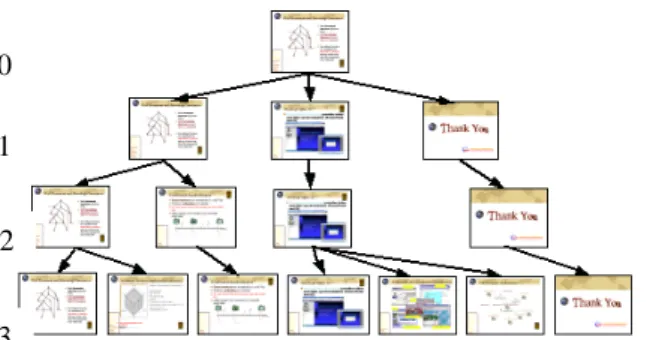
Given a web-based multimedia presentation, the corresponding multiple level content trees can be constructed. A teaching material can be taken as a multimedia presentation (e.g. collection of text, video, audio, image…etc.) with some kinds of sequence fashion. The multiple level content tree approach may be used to arrive at an efficient summarizing method.
A content tree is a finite set of one or more nodes such that there is a particularly designated node called the root. The level of a node is defined by initially letting the root be at level 0. If a node is at level q, then its children are at level q+1. Since a node is composed of a presentation segment, the siblings with the order from left to right represent a presentation with some sequence fashion. The higher level gives the longer presentation. Consequently, this approach gives flexible teaching material; accordingly, it is very fit for the web-based multimedia presentation.
Figure 6: An example of a presentation to represent to be a content-tree, where Pi is denoted
as a presentation segment.
Due to the unpredictable changes in the dynamic user context, the multimedia content model must be able to model alternatives not only on the level of atomic media elements but also on the level of user specific segment. Given a multimedia document
with foregoing definitions, the corresponding multi-level content tree can be constructed, as shown in Figure 6. A multimedia presentation (e.g. collection of text, video, audio, image…etc.) can be taken as some kinds of sequence fashion. The multiple level content tree approach may be used to arrive at an efficient summarizing method.
3.1 Retrieval within Content-Tree
By retrieval we mean the multimedia course management system can satisfy the storage and retrieval requirements of a very large number of atomic media object (possibly hundreds of millions) where a presentation can have a storage requirement of several hundred megabytes. Therefore, this is closely impossible to query in multimedia course management system by using content-based image/video retrieval techniques. In our approach, we defined the attributes “Keyword” to achieve user demand. Keyword attributed can be extracted form the title or presenter’s specified of the presentation slides/transparencies. Queries are expressed in terms of high-level declarative constructs that allow users to qualify what they want to retrieve from the persistent multimedia course management system. The retrieval definition is defined as follow.
Definition 3.1: The retrieving operation,
ρk(PN’{P’1, P’2, …, P’m}, PN{P1, P2, …, Pn }) extracts from PN{P1, P2, …, Pn } all the keyword k of the presentation media place P’i that are similar to PN’{P1, P2, …, Pm} with respect to the similarities threshold keywords.
Let the set of keyword k’ 1 ∈ P’ 1, k’ 2 ∈ P’ 2,….. ,k’m ∈ P’m, where P i ∈PN’, and k 1 ∈ P 1, k 2 ∈ P 2,….. ,kn ∈ Pn, where P’ i ∈PN. ρk(PN’{k’1, k’2, …, k’m}, PN{k1, k2, …, kn }) = PN{k’1, k’2, …, P’m} → ρk(PN’{P’1, P’2, …, P’m}, PN{P1, P2, …, Pn }) = PN{P’1, P’2, …, P’m}
3.2 Abstraction within Content-Tree
In abstraction operation, we defined the attributes “degree” to achieve user demand. Degree attributed can be represented by the subtitle or presenter’s specified of the presentation slides/transparencies. Abstractions are expressed in terms of high-level declarative constructs that allow users to qualify what they want to abstract from the persistent multimedia course management system. The abstraction definition is defined as follow.
3 0
1
Definition 3.2: The abstracting operation, αd
(PN{P1, P2, …, Pn }) extracts all the presentation media place Pi with degree d.
Let the set of degree d 1 ∈ P 1, k 2 ∈ P 2,….. ,kn ∈ Pn, where P i ∈PN.
αd (PN{d1, d2, …, n }) = PN{d’1, ’2, …, P’m} → αd ( PN{P1, P2, …, Pn }) = PN{P’1, P’2, …, P’m}
where the degree of P’i in PN{P’1, P’2, …, P’m} is equal to d.
3.3 Additional Adaptation within Content-Tree
In additional adaptation operation, there are two additional adaptation operations in our presentation model: channel selection and time specification adaptation. Firstly, we defined the attributes “channel” to achieve user demand. The purpose of a channel is to be a media grouping abstraction for a set of media items that display some common media attributes. The channel provides a logical thread upon which media objects can be placed. This thread can be switch on or off during the presentation based on the needs of user or user adaptation agent. The channel abstraction can be to satisfy user-concerned adaptation, but it can also to be used by the presentation on-line system to select fractional Qos adaptation of multimedia content alternatives. The channel abstraction definition is defined as follow.
Definition 3.3.a: The channel abstracting
operation, γc (PN{P1, P2, …, Pn }) extracts all the presentation media place Pi with degree c.
Let the set of degree c 1 ∈ P 1, k 2 ∈ P 2,….. ,kn ∈ Pn, where P i ∈PN.
γc (PN{d1, d2, …, n }) = PN{d’1, ’2, …, P’m} → γc ( PN{P1, P2, …, Pn }) = PN{P’1, P’2, …, P’m}
,where the channel of P’i in PN{P’1, P’2, …, P’m} is equal to c.
Secondary, we use the media element attributes “duration” to achieve user demand (i.e. time specification) while she or he can designate the presentation period. As we known, the presentation can be represented to be a content-tree in our foregoing definition. In a content-tree, the multimedia presentation is a multi-level of sequence fashions. The higher level gives the longer presentation. After the user specified the “time” of what they desire, our presentation generator will compare it with the presentation period in the different level sequence
fashions. Then, the appropriate level of sequence fashions will be selected. The remained processes are same as the abstraction operation.
Definition 3.3.b: The time abstraction operation.
Let the time of user specified is defined as τ; the period of sequence fashion is defined as φ; the set of degree d 1 ∈ P 1, k 2 ∈ P 2,….. ,kn ∈ Pn, where P i ∈PN.
Process:
FOR i=1 to i<=d DO
IF (φi<τ AND τ<φi+1) THEN d=i Return d END IF End FOR End Process And, αd (PN{d1, d2, …, n }) = PN{d’1, ’2, …, P’m} → αd ( PN{P1, P2, …, Pn }) = PN{P’1, P’2, …, P’m}
where the degree of P’i in PN{P’1, P’2, …, P’m} is equal to d.
3.4 Weave within Content-Tree
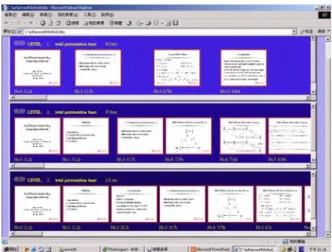
In weave operation, user is endowed the flexibility editing presentation program. This adaptation operation provides the user with dynamically not only to select the presentation atomic media or presentation segment but also can rearrange the presentation sequence. Figure 7 showed a weave operation example. In this case, we assumed the PN as the pre-orchestra presentation, the PN’ and PN’’ were manufactured by user profiles or user adaptive agent at the client side. The presentation generator will weave the new presentation performance to response client agent request. The weave operation definition is defined as definition 3.4.
Definition 3.4: The weave operation, ωselect
(PN{P1, P2, …, Pn }) weaves all the presentation media place Pi into a new PN’ {P’1, P’2, …, P’m}. The designated select is evaluated from the user adaptive profiles.
Let the set of dynamic attribute select s1 ∈ P1, s2 ∈ P2,….. ,sn ∈ Pn, where Pi ∈PN, si ∈ user adaptive profiles.
FOR i=1 TO i<=n DO IF (si= = TRUE) THEN
ωselect ( PN{P1, P2, …, Pn }) = PN’{P’1, P’2, …, P’m}, END IF End FOR End Process where the P’1, P’2, …, P’m ∈ PN.
3.5 Customization within Content-Tree
As above mentioned, the weave, additional adaptation, abstract, and retrieval operation can provide an alternative adaptation for the use-concerned specification. After user decided to perform these user-specified operations, the customization operation provides user advanced to store the new presentation vision to be a persistent presentation media. The server presentation generator will modify the multimedia content document with certain constrains (satisfied the user’ adaptive profile and the multimedia content model). The customization operation definition is defined as follow.
Definition 3.5: The customization operation,
θselect (PN{P1, P2, …, Pn }) weaves all the presentation media place Pi into a new PN’ {P’1, P’2, …, P’m}. The designated select is evaluated from the user adaptive profiles.
Let the set of dynamic attribute select s 1 ∈ P 1, s 2 ∈ P 2,….. ,sn ∈ Pn, where P i ∈PN; si ∈ user adaptive profiles; PN1, PN2 ….PN k ⊆ multimedia course management system database.
FOR i=1 to i<=n DO IF (si= = TRUE) THEN
θselect ( PN1{P1, P2, …, Pa }, PN2{P1, P2, …, Pb },….. PNk{P1, P2, …, Pn })
= PN’{P’1, P’2, …, P’m},
where the P’1, P’2, …, P’m ∈ PN
Figure 7: An Multi-level content tree of the ontology-based multimedia course
4. Conclusion and Future Work
In this article, we not only proposed a well-defined multimedia content model but also offered a framework of ontology-based multimedia course management system. In order to model the fundamental presentation requirements clearly, we begin to use formalized definitions of user-concerned adaptive adaptation operation. Thus, the configuration and the operation steps of the multimedia course management system are clear and definite. We also considered the generated course with different operations for user context. The main goal of our approach is to provide a feasible multimedia content model and the unequivocal framework to developer as guiding principle or policy. We hope that this approach can be used to the general purposed multimedia course management system such as distance learning, enterprise training, commercial advertisement, and others.
References
[1] Chang S. K.; Hassanein E.; Hsieh C. Y., “A Multimedia Micro-University”, IEEE Multimedia Magazine, Vol. 5, No. 3, July-September 1998, pp.60-68.
[2] Deborah L. McGuinness,"OWL Web Ontology
Language Overview" , W3C
Recommendation ,10 February 2004.
[3] Fischer, S. (2001). Course and exercise sequencing using metadata in adaptive hypermedia learning systems. Journal on Educational Resources in Computing.
[4] Flor Chia-I Chang, Te-Hua Wang, Yu-Wei Chan, Lawrence Y. Deng, I. Lee and Y. Wang, ”Internet-based Distance Education: an Agent-based Distance Learning Project in Tamkang University as an Example,” in Proceeding of the 7th International Conference on Distributed Multimedia Systems (MMS’ 2001), Taipei, Taiwan, September 2001.
[5] Grandbastien, M.; Azouaou, F.; Desmoulins, C.; Faerber, R.; Leclet, D.; Quenu-Joiron, C.; “Sharing an ontology in Education: Lessons learnt from the OURAL project”, Advanced Learning Technologies, 2007. ICALT 2007. Seventh IEEE International Conference on 18-20 July 2007 Page(s):694 – 698.
[6] Lai, Chang-Yen; Liou, Wen-Ching; “A Service-Oriented Architecture for Constructing Ontology-Based Learning Objects Repository”, Multimedia Workshops, 2007. ISMW '07. Ninth IEEE International Symposium on 10-12 Dec. 2007 Page(s):349 – 355
[7] Mitrovic, A.; Devedzic, V.; “A model of multitutor ontology-based learning environments”, Computers in Education, 2002. Proceedings. International Conference on 3-6 Dec. 2002 Page(s):1557 - 1558 vol.2.
[8] Multimedia Micro-University Virtual Society, http://www.mine.tku.edu.tw/mmvs
[9] N.F. Noy and D.L. McGuinness, "Ontology Development 101: A Guide to Creating Your First Ontology, " Available at http://www.ksl.stanford.edu/people/dlm/papers/o ntology-tutorial-noy-mcguinness.pdf, 2000. [10] Noy, N.F. and Hafner, C.D. (1997). The State of
the Art in Ontology Design. AI Magazine, [11] OWL web Ontology Language Overview,
http://www.w3.org/TR/2004/REC-owl-features-20040210/
[12] Ralf Steinmetz and Klara Nahrstedt, ”Multimedia: Computing, Communications and Applications”, Prentice Hall Inc., pp. 481-542, 1995.
[13] Timothy K. Shih, Lawrence Y. Deng, J. H. Wang, and Andy Ay-Hwa Liou, “Maintaining Persistent Look-and-feel for Roaming Student with Mobile Agent in Distance Learning,” in Proceeding of the 7th International Conference on Distributed Multimedia Systems (MMS’ 2001), Taipei, Taiwan, September 2001.
[14] Timothy K. Shih, and Lawrence Y. Deng, “Distributed Multimedia Presentation with Floor Control Mechanisms in a Distance Learning System,” in Proceeding of the 2000 International
Conference on Information Society in the 21 Century: Emerging Technologies and New Challenges, Japan, November 2000.
[15] Yang, S.Y. and Ho, C.S. (1999). Ontology-Supported User Models for Interface Agents. Proc. of the 4th Conference on Artificial Intelligence and Applications (pp. 248-253). Chang-Hua, Taiwan.
![Figure 1: Multimedia Document architecture and its components [12].](https://thumb-ap.123doks.com/thumbv2/9libinfo/8916473.261566/1.892.510.723.636.839/figure-multimedia-document-architecture-and-its-components.webp)